



Abstract
Materials are an essential part of social practices, their performance and sustainability. However, there are different views on the role of materials in practices and the agency they induce in relation to humans. The purpose of this research is to examine the agency of material in the household energy consumption practices. To this end, we analyse consumer narratives (n = 25) and interviews (n = 30) on daily home practices. Based on practice-theoretical analysis, we demonstrate that materials can change the performance of a practice in three main ways: by delaying the performance of the practice, shaping its performance, or creating a new practice. Furthermore, by comparing the material agency from human-centric and posthumanist practice theoretical approaches, we pinpoint the variability on the views on material contribution to practices and their sustainability. We show how sustainability is determined by the materiality of the practice, its connection to other practices, and people’s reactions to the disruption caused by the material.
Introduction
Practices and their materiality play a crucial role in determining how (un)sustainably we live. As Spurling et al. (2013) argue, targeting social practices is more effective for sustainability policy than focusing solely on ‘behaviour’, ‘choice’, or technical innovation. Many everyday practices are resource-intensive and often performed unconsciously (Gram-Hanssen, 2014). Typically, we do not notice the materials involved in these practices. For example, we do not consciously consume energy; rather, we perform practices that consume energy, making it difficult to reduce environmental impact (Jack, 2022). Shove (2003b: 198) contends that much consumption impacting the environment, such as heating, is often beyond individual choice. Goods and technology influence how energy is consumed at home (Sahakian and Wilhite, 2014).
Consequently, homes play a pivotal role in transitioning to more sustainable lifestyles, as housing is a major contributor to greenhouse gas emissions (Salo et al., 2021; Tukker and Jansen, 2006). The demand for energy in domestic practices has risen over the past century significantly due to larger living spaces, higher indoor temperatures (Kuijer and Watson, 2017), and an increase in electrical devices (Jacobsen, 2019; Sahakian, 2022). Investigating practices related to energy consumption is crucial for making housing more sustainable.
The significance of materials is deeply intertwined with the performance of practices (e.g., Rinkinen et al., 2015; Sahakian et al., 2020; Shove et al., 2014). Practice theory, often seen as a response to individualistic perspectives on everyday life, focuses on the conditions surrounding the practical performance of social life (Halkier and Jensen, 2011). Material entities are considered part of practices and to surround, enable, shape and even reproduce them. Technological innovations can reveal the significance of unnoticed material objects in everyday practices (Shove et al., 2007). Practices inherently possess the potential for both stability and change (Pink, 2012), with changes occurring through the reordering of their elements (Evans et al., 2012).
As commonly noted, no single, unified practice theory exists (e.g., Halkier and Jensen, 2011; Reckwitz, 2002; Warde, 2005); instead, practices are studied through various approaches that differ in their views on the role of material in practice performance. Where some approaches assign a pivotal but still rather passive role to materialities, such as Reckwitz (2002: 250), who states that ‘objects are handled’ in practices, others view the material world as more agentic in the creation of practices (e.g., Gherardi, 2016). Strengers et al. (2016) define agentic capacity as the ability for entities to act in the world, an ability emerging in relation to other entities. In human-centric approaches, objects do not possess agency but act as enablers of human practices (Reckwitz, 2002; Schatzki 2001). Schatzki (2002: 192) writes that there are two types of doings and agencies. Humans and non-humans can do things causally but only humans can perform an action, carry out a practice or embody practices. Many human doings instantiate this sort of agency. In contrast, in posthuman practice theory, agency is an outcome of the relationship between artefacts and humans (e.g., Pickering, 1995). For instance, Jones and Boivin (2010: 346) define agency as the ‘material qualities of things and their involvement in social practices’, advocating for greater symmetry between humans and non-humans.
This study focuses on household energy consumption practices. Our aim is to explore the implications of materials in the change of home practices to better understand the agency of houses, systems, technologies, and other material entities (Rinkinen and Jalas, 2017). We ask how materials change the performance of household energy consumption practices and how they contribute to sustainability. We approach the role of materials in practices from different practice-theoretical perspectives, thus gaining a multifaceted understanding of the role of materials in the sustainability of practices. Subsequently, we shed light on how materiality is understood in various practice-theoretical approaches within the consumption literature, complementing this body of research by analysing our empirical material from human-centric and posthuman perspectives to highlight their variations. Previously, Rinkinen et al. (2015) have investigated object relations, and Madsen (2018) has studied heating and cooling technologies change heating and cooling practices. In our research, we focus on the influence of materials on the human world, thereby adding to Madsen’s (2018) work. In this way, our study contributes to a more nuanced understanding of the roles assigned to materials in various practice-theoretical approaches. Further, our findings promote understanding of the role of materials in the sustainability of home practices, emphasising the importance of recognising how consumption occurs to support sustainable lifestyles.
Materiality in social practices
According to many practice researchers, materiality is integral to the social world, shaping and reproducing practices. Material things’ social significance lies in how they are handled (Reckwitz, 2002), mobilized in practice, and combined in practice-arrangement nexuses (Schatzki, 2010). The lives of things and practices are mutually co-constituted and densely interwoven (Reckwitz, 2002; Shove, 2016). Nevertheless, there is no consensus on whether materials merely mediate activity, serve as intermediaries among humans, or act as carriers of practice.
Approaches to materiality in practice theories.
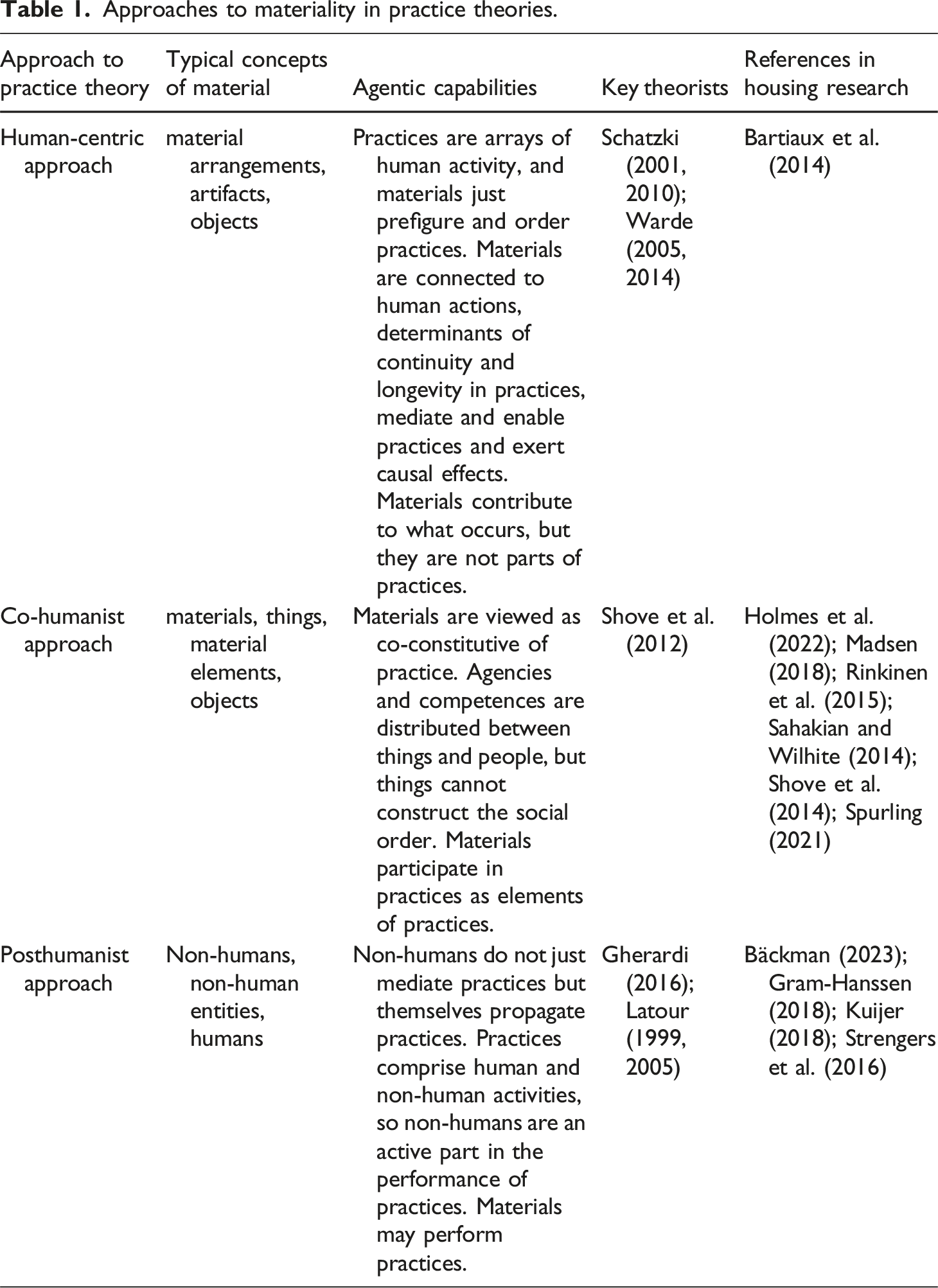
The human-centric practice theory considers materials as enablers of human practices. This approach relies heavily on Schatzki, who posits that ‘human coexistence transpires as arrangements of people, artifacts, organisms, and things’ (2002: 149). As this approach regards practices as human practices, and agency assigned to humans, with non-human materials playing a significant role in enabling humans to perform these practices, we term this a human-centric approach to practice theory. According to Schatzki (2010), materiality is a part of society, but material things are not part of practices; instead, materials form arrangements co-produced with practices (ibid.: 135). Materiality is defined by Schatzki (2019: 53) as a physical-chemical composition of entities. Material entities are connected to human actions; they are determinants of continuity and longevity in practices, mediating and enabling practices and exerting causal effects (Schatzki, 2010). This means that material arrangements prefigure human practices.
This perspective is visible in Bartiaux et al.’s (2014) study on energy retrofits, where technologies and products are components of practices performed by people. Although material arrangements may hold meaning for non-humans, material arrangements remain practices in which humans engage (Schatzki, 2010). This perspective implies that only humans are carriers of practices, and non-humans, whether living or not, are mere objects supporting, anchoring, inducing and prefiguring human practices. However, human bodies are also matter. Social practices are internalized in humans’ bodies and minds, so the practices are embodied and thus visible in people’s actions (Bourdieu, 1977). The practices are therefore strongly linked to the physical essence and materiality.
The co-humanist approach views material things as elements within practices, distributing agencies and competences between things and people (Shove et al., 2012: 113). Although this approach draws on ideas from science and technology studies, this perspective stops short of accepting Latour’s claim that ‘artefacts can have a capacity to construct social order’ (2000: 113). Instead, Shove (2003b: 12–13) highlights the embedding of ways of life within tools, devices, and material objects. She emphasises the mutual shaping of technologies and their users, as well as the potentially formative role of things and sociotechnical systems. In consumption research related to housing, a co-humanist perspective is evident in studies such as those by Holmes et al. (2022), Rinkinen et al. (2015), Sahakian and Wilhite (2014), Shove et al. (2014), and Spurling (2021). To illustrate, Holmes et al.’s (2022) study demonstrates how, during the lockdown, when all activities took place at home, the form and function of materials became changeable. For example, furniture or home spaces acquired new uses.
More specifically, Shove (2016) categorises material things into three different roles that show how co-humanist approach assigns only limited agency to materials in the practices with materials having varying impacts on practices. She claims that ‘materials are defined, constituted and positioned with respect to each other through their role within specific practices’ (p. 157). Things can possess an infrastructural relation to practice, which means that these things are necessary, but they are not interacted with directly. Rather, they form the background to the practice. In the context of housing, this background can be, for example, the home or kitchen, or, more broadly, the infrastructure that also enables living. Second, things can be mobilised or manipulated, or in other words they play a device-oriented role in relation to the performance of a practice. Third, things can be used up or radically transformed. Clear examples are resources or products that eventually become waste: they are used, and their form is altered. Notably, the same object can play different roles at different times.
The posthumanist approach posits that material things play a more agentic role in the social world, forming practices through the actions of both material entities and humans (Pickering, 1995). Posthumanism decentralizes the human as the master, acknowledging the agency of multiple others and highlighting the entanglement of all earthly creatures (Valtonen et al., 2020). Matter is recognized as “an active participant in the world’s becoming” (Barad, 2003: 803). Matter actively participates in social processes and extends human activity in space and time (Monteiro and Nicolini, 2015). For example, Bäckman’s (2023) study shows how materials in the home, like a showerhead, can encourage greater consumption than might have been intended. Kuijer (2018) argues that with washing machines performing tasks that humans previously did, agency has become shared. Similarly, Strengers et al. (2016) indicate that animals also consume energy.
The concept of sociomateriality is integral to posthumanist practice theory, asserting that the social and the material are co-constituted, and nature and culture are entangled (Gherardi, 2016). Fuentes (2014: 108) defines the sociomaterial in posthumanism as treating materiality – including meanings, images, things, humans, and non-humans – as simultaneously and intrinsically interlinked.
In sum, while human-centric practice theory focuses on humans with their embodied understandings and practices, posthumanist theory questions how all elements within a practice hold together and achieve agency through entanglement (Gherardi, 2016). Posthumanists consider that humans and non-humans share agentic capacities. In our empirical analysis, we explore household energy consumption practices from the human-centric and posthumanist perspectives to highlight the variability in understanding material agency.
Materials and methods
In this study, we analyse qualitative data consisting of written narrative diaries and interviews to understand the influence of materials on the performance of practices. Previous research has employed interviews (e.g., Gram-Hanssen, 2010; Rinkinen and Jalas, 2017) and consumer diaries (e.g., Rinkinen et al., 2015) to study domestic consumption using a practice-theoretical approach. Diaries are useful for understanding practices as they reflect the variety of symbolic resources and societal discourses their writers engage with (Atkinson and Coffey, 2003; Halkier and Jensen, 2011: 109). Since diaries can capture small details (De Certeau, 1984) and interviews allow for open-ended questions, we use both methods to enhance our understanding of consumers’ daily lives (Halkier and Jensen, 2011).
Participants were recruited via a pre-questionnaire shared on social media, with 79 Finnish consumers expressing interest. Of these, 25 completed narrative diaries and 30 were interviewed. Both diaries and interviews were collected during COVID-19, likely increasing the time spent at home and attention paid to domestic environments.
Diaries were collected in Spring 2021, with participants aged 31 to 65 (average age 46); 23 identified as female and two as male. Participants described everyday moments of home usage, guided by questions on the elements of practices and involved entities. Similar to Bartiaux et al. (2014), we chose to focus on the practice-theoretical elements of procedures, understandings, and engagements (Warde, 2005) as well as social interaction, materials, and non-human entities, to enable the emergence of both elements of practices and the non-humans participating in the actualisation of those practices. The data included activities like heating, water consumption, ventilation, recycling, and home maintenance. The data comprises 46 pages of diverse diary entries.
Interviews were conducted in Autumn 2021, with participants aged 30 to 73 (average age 49); 26 females and four males. Fourteen interviewees also completed diaries. Interviews covered housing aspects like housing solutions, practices, sustainability, dreams, and future visions. The diary data was thematically pre-analysed before finalising the interview guide to deepen the discussion related to the most pivotal energy consumption-related topics. Thus, the interview theme on practices, was created according to the most common topics in diaries: temperature regulation, home maintenance, and water consumption. The texts of those interview participants who had written a diary were used in the interviews during the theme on practices to refresh their memory. This approach allowed the participants to elaborate on specific situations from their diaries in their own words. For those who had not written a diary, a parallel method was employed. They were encouraged to reflect on events or routines related to temperature regulation, home maintenance, and water consumption, enabling them to share their experiences in a similar manner.
Interviews lasted 22 to 111 minutes (average 46), producing 256 pages of transcribed text, along with home photographs and observation notes. Sixteen interviews were conducted in participants’ homes and 14 remotely via Zoom or Teams. When the interview was conducted in the participant’s home, the participant gave a tour of their dwelling while discussing with the researchers on household appliances, systems, and other materials, and researchers taking pictures of the participants’ homes. In the remote interviews, the participants were requested either to walk around their homes while taking video footage or to verbally describe their home.
Analysis
The narratives and interviews were analysed simultaneously through a multiphase process. Initially, a data-driven approach was employed by reading diaries, transcribing interviews, and reviewing recordings. The first analysis round focused on identifying various materials involved in home practices. According to Haraway (2003), entities and categories are fluid; they can embody multiple roles simultaneously as materiality, meanings, and boundaries evolve continuously. We sought to understand different materials and their roles in practices, inspired by object interviews (Holmes, 2020), examining the significance of various materials and their structuring of practices. Non-human materials’ impact became particularly clear when practices deviated from expected outcomes, highlighting materiality’s influence.
In the second analysis round, data sections identifying materials’ influence on practices were systematically reviewed, revealing three ways materials change practice performance. In the final analysis round, we employed a theory-driven interpretation, analysing these influences through different practice-theoretical approaches to materiality (Table 1). We selected data excerpts to demonstrate the variations between human-centric and posthumanist perspectives on materiality. We focused on the extremes of these perspectives to highlight their differences clearly.
Findings
Our analysis focuses on what materials are like, what they do when the practice is performed, and how the role of a material emerges in relation to other materials. Based on our analysis, a variety of materials can change the performance of the practice in various ways, thus highlighting the agency of materials in the performance of practices: the material can delay the timing of practice performance, it can shape how practice is performed, and material can also create a new practice. Next, we analyse these different changes using human-centric and posthumanist practice-theoretical approaches to materials.
Delay the performance of the practice
We first address how the material can delay the performance of the practice. In these instances, the material influences the temporal realization of the performance of the practice, having thus mildest implications on the performance of the practice. The first analysis example is based on showering, which has quite largely been studied from a practice-theoretical perspective (e.g., Bäckman, 2023; Gram-Hanssen, Christensen, Madsen, and do Carmo, 2020; Hand et al., 2005; Shove, 2003a), because washing consumes abundant resources: energy and water. Material aspects related to cleanliness practices have evolved over time and can be disrupted by temporary events or specific socio-material settings, impacting water and energy consumption (Gram-Hanssen et al., 2020). Torriti (2017) argues that washing is a practice that is time-dependent, meaning it is carried out at specific times of the day or week.
In the diary excerpt, a female participant who lives in a detached house in a suburb describes a problem her husband encountered with warm water from the shower. This showering practice involves several materials, including water, the shower and the heat pump: Soon after [my husband] turned on the shower, he rushed out of the shower, irritated that
From a human-centric perspective, family members engaged in the practice of showering. They took turns in the shower, and when the last person entered, only cold water was available. After a brief investigation of the cause of the lack of warm water, they realised that the heat pump was not heating the water efficiently enough as the family members took hotter showers than normally, showing how human bodies and their sensations determine the way practice was carried out. Consequently, the heat pump’s performance proved insufficient for their needs to embodying the practice. As an enabler of human practices, the heat pump, thus, not function to support human activities.
From a posthumanist perspective, the practice of showering is performed in collaboration with various entities, both human and non-human. To take a shower, the essential materials are a functional shower and a water supply. In this house, warm water is generated through the house’s heat pump, while cold water is readily available. The heat pump exhibits its agentic capabilities by influencing the temporal performance of the showering practice. The temporalities of practices are shaped by the material world (Spurling, 2021). The heat pump is the entity that affects whether it is comfortable to wash in the shower and also the length of time one is likely to spend there. The resident lacks control over the heat pump’s operation and must adapt to its performance. As highlighted by Cowan (1983), machines often handle a significant portion of tasks that humans themselves performed before. Gram-Hanssen (2018) suggests that automated energy systems should be viewed as an infrastructural component of material arrangements and as a performer of energy-consuming practices (see also Kuijer, 2018). In this situation, the heat pump prevented the participant’s husband from taking a shower when he wanted, but, in the future, it can change how long the household members spend in the shower and thus affect the amount of water consumed and energy used to heat it.
Shape the performance of the practice
The second category highlights how a material can shape how the practice is carried out. In such a situation, the material exerts greater agency than just simply changing the timing of practice performance. This is shown in another type of warm water consumption-related practice, described in the extract below, that relates to the way dishwashers can lead to more consumption of energy and water than is necessary, thereby indicating how technology shapes energy consumption practices (see also, Gram-Hanssen, 2010). A female participant living in a detached house in a suburb describes her dishwasher use in the interview excerpt:
In this case, the performance of the dishwashing routine is influenced by the dishwasher and the layout of the house. The sound of the dishwasher is particularly disturbing because the dwelling contains an open kitchen connected to the living room, so the noise generated in the kitchen cannot be silenced by closing the door. From a human-centric perspective, the practice is again related to bodily sensations (hearing the noise), and it is the human participant who has solved the problem by using a shorter washing program so that she is not forced to listen to the sound of the machine for so long. Shorter programs generally consume more water and energy because the machine must obtain a satisfactory result in a shorter time. The participant lives in a house that she, together with her spouse, had built a few years ago. Therefore, they had the opportunity to participate in planning the house, and chose an open-plan living in which kitchen is part of the living room. This is achieved to create more space for the kitchen and provide an opportunity for socialising and maintaining relationships while cooking. Different practices are thus connected to each other (Halkier et al., 2011). In this case, the interconnection of some practices undermines the sustainability of another practice: dishwashing.
From a posthumanist perspective, the dishwasher participates in carrying the dishwashing practice, as it is the entity that cleans the dishes. Kuijer (2018) writes that dishwashers even select the appropriate amount of water for washing. However, the machine produces disturbing noise while running. The only action that the resident can take to mitigate this unwanted effect is to shorten the time the machine operates. The machine thus exercises agency in how it controls the living room-kitchen space with its sound and shaping the practice.
The next diary excerpt highlights how the changing seasons and the weather’s agency in relation to heating and airing (Madsen, 2018; Rantala et al. 2011). In the excerpt season and weather exert an influence on routines related to ventilation and indoor air comfort, as the female participant living in a detached house in a suburb responds to the changing weather: The morning
The material entities influencing the performance of this air conditioning practice include the weather, the house, the ventilation system, the fireplace, fire, the residents and the dogs. The respondent describes how the rising temperatures in spring and summer impact the indoor air quality of their home. The dwelling becomes increasingly warm, at times uncomfortably hot for human and dog bodies. Ventilation proves insufficient for the residents’ preferences, necessitating that doors are kept open to facilitate air exchange (Bauer et al., 2021). Residents have different preferences and needs regarding indoor temperature, and, for example, new energy-efficient houses are not designed for rapid temperature changes. As a result, people open doors and windows even in the winter (ibid.) According to Berneiser et al. (2024), windows and doors are opened when the indoor air no longer meets expectations. This may be due to a lack of knowledge of the dwelling’s air conditioning systems (ibid.). Notably, in the extract presented above, humans are not the sole inhabitants of the dwelling; dogs also reside there, each with its own preferences for the most comfortable temperature. Consequently, the door is left open for the dogs as well. However, as evening sets in, it becomes too cool inside, prompting the residents to resume heating the house. Excerpt show how airing and heating practices are interconnected (Madsen, 2018).
A human-centric approach would posit that the human residents engage in air conditioning and temperature regulation practices facilitated by the material arrangements. Schatzki (2016) asserts that social change results from causal chains and actions. Most actions involve interventions in the world or reactions to previous actions (ibid.). The house traps heat and air, causing the dwelling to become hot inside during warm weather and the air to stagnate. The practices are facilitated by materials, including the house and its components, such as the fireplace. The residents engage in these practices to enhance their own comfort and that of their dogs. The residents understand that keeping the door open during the day and then heating the apartment in the evening does not make sense, but for them it brings ease and comfort to everyday life (Madsen, 2018), while it also affects the sustainability of the practice.
The second way to analyse this indoor air practice is through a posthumanist perspective. The weather is not merely in the background; it is an integral actor participating in the existence of this indoor air regulation practice. As Schlosberg (2019) notes, practices unfold within a non-human material world. The weather impacts not only humans but all living things and their chances of survival. Since humans coexist with non-humans, the well-being of all living being, such as the pets are integrated. Given that dogs regulate temperature differently from humans and may not tolerate heat in the same way, leaving the door open throughout the day allows them to move freely without the need to constantly open and close it. In this situation, the dogs independently perform their own practices by changing their position indoors and outdoors based on what feels most comfortable to them. Household members can have different preferences for temperatures within specific spaces (Sahakian et al., 2020). Consequently, the weather influences indoor air quality, which is further manipulated by opening the door and heating fireplaces for the comfort of both humans and non-humans. Energy is consumed in homes by both human and animal residents (Strengers et al., 2016).
Another material entity contributing to the practice of indoor air is the house itself. It is constructed to protect and retain warmth. The house is equipped with ventilation systems, and there are methods to heat and potentially cool the dwelling. Nonetheless, the residents may not necessarily possess the knowledge or means to influence these structures or settings. Similarly, Sahakian et al. (2020: 431–432) found that it is often challenging for humans to maintain agency over their indoor climate because a constellation of entities exerts a more direct influence on setting temperatures in homes than do individual household members. The house itself establishes the conditions for living and the practices that can be performed within it. When the air in the house becomes stagnant, the residents open the door because the house and its systems do not automatically function properly in that weather. As a result, energy is consumed in the effort to create a more comfortable indoor environment for both humans and dogs. From a posthumanist perspective, the example highlights how various heterogeneous human and non-human, material and living entities induce different agencies in relation to each other and thereby interact and collaborate in changing the shape of the practice.
Create a new practice
The third way that materials can change the performance of a practice is by contributing to the creation of a new practice. In this case, the material demonstrates the most dominant form of agency when compared to the other two ways of changing practices. When the material creates a new practice, it is the most intertwined with human practices of all three possibilities of material influence.
Here, we draw on an example relating to air conditioning. Cooper (1998) explains that the use of air conditioning has become part of the normalised routines of homes as a result of changes in construction and renovation practices. At the same time, passive ways of ventilating indoor air have been abandoned (Shove, 2022: 76). Many participants wrote in their diaries about the ventilation of their homes, indicating that ventilation was visible, audible or otherwise perceptible to human bodies. Ventilation practices are frequently mentioned as they are interconnected with various other activities, such as adjusting thermal comfort, cooking, or washing. The complex interplay of these practices makes it challenging to find precise substitutes for a specific practice in order to promote sustainability (Foulds et al., 2013). These activities are intertwined and mutually influence one another, shaping individuals’ daily routines (ibid.). In the following diary excerpt, a male participant living in an apartment building in a suburb describes how ventilation has caused various troubles and is connected to other practices:
Besides humans, this ventilation practice involves various materials, such as the ventilation device itself and also dust and cleaning tools as well as the weather. This participant describes an air conditioner that interferes with everyday life in several ways. The first is that the device hums and emits a loud noise. Silence is an important criterion for air conditioning (Berneiser et al., 2024). Another problem is that the device blows dust into the apartment.
First, the ventilation situation is analysed from a human-centric perspective, the materials influence the performance of human practices and even their existence. Ventilation practices vary among residents and are influenced by situational, habitual, and goal-directed factors (Berneiser et al., 2024). An apartment can be ventilated without an air conditioning device, but as can be seen from the excerpt, the air conditioning unit can significantly impact the bodily experience of ventilation. This example highlights that from a sustainability perspective, it is important to consider the requirements and preferences of occupants when planning and implementing mechanical ventilation systems to enhance their optimal energy efficiency (ibid.). The operation of the air conditioning unit currently disturbs the residents: it creates noise and generates dust. Then it is ‘a constant battle against dust and dirt’ (Berner, 1998). When the system fails to work as expected, they tackle it by starting a new practice of cleaning: the first one who wakes up in the morning, wipes the dust off the surfaces.
From a posthumanist perspective, the air conditioning device manages the ventilation of the apartment on behalf of the residents; it performs the practice of ventilation. One could claim that ventilation occurs despite the human resident, thanks to this material entity. The air conditioning unit thus displays agentic capabilities concerning home ventilation. In addition to actual ventilation, however, it produces sound and blows dust. Dust occurs regardless of human influence, as the device causes dust to spread throughout the apartment. As a result, the residents have begun the new practice of cleaning the dust in the mornings. Gherardi (2019: 179) uses the term ‘the texture of practice’, which means that ‘practices rest on other practices’, and that is why researchers must recognise these interactions to show how elements or practices ‘acquire agency in their being connected’. In this excerpt, the air conditioning unit acquires agency in connection with other materials and the practice.
Discussion
This study addressed implications of materials in the change of the performance of household energy consumption practices. Materials are an essential part of social practices and their performance (e.g., Madsen 2018; Reckwitz, 2002; Rinkinen et al., 2015; Sahakian et al., 2020; Shove et al., 2012), and they may even influence the very existence of these practices. Recognising the constant relations among people, beings, and things facilitates a better understanding of energy consumption (Butler et al., 2016) and energy demand (e.g., Rinkinen et al., 2020). Consequently, research on domestic practices has increasingly emphasised the role of materials (e.g., Hand et al., 2005; Rinkinen et al., 2015; Sahakian et al., 2020; Shove et al., 2014; Spurling 2021). Our study contributes to this discussion by (1) demonstrating how materials provoke changes in practices and by (2) highlighting different interpretations of material agency from various practice-theoretical perspectives.
Based on our qualitative analysis, materials such as home appliances, systems, weather, and the house itself affect home practices in various ways: they can delay, shape, or create new practices. We examined the relations between materials and people from two perspectives: human-centric and posthumanist. This analysis aimed to highlight how a change in the perspective can reveal insights into the involvement of non-humans in carrying out practices. In posthumanism, non-human entities gain agency in the performance of practices, whereas in the human-centric view, materials merely intervene in human action. Thus, the current study contributes to existing theory on the role of materials in energy consumption practices (e.g., Sahakian et al., 2020; Shove et al., 2014). Although the human-centric approach to practice theory emphasises humans as carriers of practices, through this lens material may still be influential in changing practices as materials participate in enabling the practical performance of everyday lives (Schatzki, 2002, 2010). To illustrate, the functioning of a heat pump may change when and how the practice of showering occurs. The posthumanist approach to practice theory focuses on the agentic capacities of material entities in relation to other entities; thus, from this perspective, they are not simply enablers of human practices but may even perform practices themselves (Gherardi, 2016). For instance, a ventilation system may be regarded as carrying out the ventilation practice.
To reduce energy consumption and emissions, understanding how home practices are changed by materials is essential. Regardless of the approach to practice theory, humans’ agency in performing social practices is always somewhat tied to non-humans. For instance, water and indoor air consumption involves technology and automation that use energy and water. Our analysis revealed how poorly functioning ventilation or water-related devices can increase overall consumption, highlighting the interlocking of materials and practices and their impact on sustainability (Foulds et al., 2013).
When new technology is introduced, it disrupts practices, providing an opportunity to change routines. Recognizing these disruptions is crucial for sustainability. The sustainability of a practice may be influenced by the materiality of the practice, i.e., non-human materials. Humans also play a role in how sustainability is realised, as their reactions are also a determining factor. Humans can react to influence in multiple ways, and this reaction can affect the sustainability of the practice in question. In particular, the desired level of bodily comfort may influence this reaction, for example as the adaptation to heatwaves is becoming increasingly topical. Comfort may play an essential part in the home and cleanliness practices (Shove, 2003b) and explains why current practices are unsustainable.
The value of our study and our use of two practice-theoretical perspectives in the analysis of mundane household energy consumption situations is that it allows the identification of focal points where material relations might require special attention in order to improve the sustainability of housing. Our study suggests that attention could be directed at (1) human engagement, such as action motivated by irritation at material arrangements that fail to facilitate practices in an optimal way. In addition, it is important to (2) consider the connections between practices and (3) whether material entities collaborate smoothly with other entities. In all, consideration could be given to whether materials function as intended as part of practices.
Conclusions
As the significance of materials is intrinsically entwined with the performance of practices (e.g., Rinkinen et al., 2015; Sahakian et al., 2020; Shove et al., 2014), the materiality intertwined with practices is crucial in determining how (un)sustainably we live. In this study, we have explored the implications of materials in the change of home practices to better understand the agency of houses, systems, technologies, and other material entities. The findings of this study show that materials may change performance of practices in three ways: by delaying when the practice is performed, by shaping how the practice is performed, and by creating a new practice.
To further analyse the different interpretations of the agency of materials in the changing practices, we examined from two different practice-theoretical approaches to the role of materials in the performance of practices to highlight their implications for the sustainability of these practices. According to our analysis, sustainability is determined by the materiality of the practice, its connection to other practices, and people’s reactions to the disruption caused by the material.
Our practice-theoretical reading emphasises how the same situations can be interpreted from several different perspectives, highlighting both differences and similarities among these viewpoints. In our study of materiality, we have focused on a small unit within the economy, namely the household. However, materiality could also be connected to the broader economy (Evans, 2020), where the effects of material within the household could be seen as part of larger political, economic, and material influences on households.
Footnotes
Declaration of conflicting interests
The author(s) declared no potential conflicts of interest with respect to the research, authorship, and/or publication of this article.
Funding
The author(s) disclosed receipt of the following financial support for the research, authorship, and/or publication of this article: This work was supported by the 10.13039/501100009047; Strategic Research Council; 358275, 10.13039/501100009047; Strategic Research Council; 358343.
