



Abstract
The purpose of this article is to explore consumption practices that involve the deliberate destruction of meaningful possessions; in particular, what motivates consumers to do so, why they choose it over other divestment options and what value creation do they expect from this. This is a consumer choice acknowledged but lacking in extant research, theoretical or empirical. From the existing literature a qualitative study was developed, consisting of a series of exploratory interviews with consumers who considered that they had engaged in possession destruction. From analysis of the identified themes, we developed a temporal process, where possession destruction creates self-wellbeing for the consumer, through the elimination of negative symbolic value associated with the possession. The existence of ritualistic and taboo behaviour suggests that this type of consumption can also be conceptualised as a social, violent, and sacrificial process.
Introduction
Contemporary consumer literature has extensively studied the symbolic roles that material objects can play for individuals (McCracken, 1986). Research has demonstrated that individual self-concept and identity are often interlinked with the myriad material objects that make up their possessions, with these functioning as repositories for personal meanings, memories, and experiences. Notably, this was conceptualised by Belk (1988) as the “extended self”.
A fundamental implication from the linkage of possessions and identity is that change and transition in the lives of individuals are accompanied by modifications to the constellation of possessions that they hold (e.g., Schouten, 1991). And of relevance for our research, material objects are not only acquired for symbolic reasons, but they are also divested. Whilst literature has considered various methods of possession divestment (e.g., Lastovicka and Fernandez, 2005), scholars have paid scant attention to consumption practices that involve the deliberate destruction of meaningful possessions. Destruction is more than the elimination of a possession from an individual consumer collection. It is a particular divestment practice that requires the investment of time and resource by an individual. One reason for exploring this is that it fills a literature gap but, more importantly, it appears removed from accepted contemporary consumption practice.
What motivates consumers to engage in such a practice? Why do they choose it over other divestment options? What value do they expect to be created from it? Outwith consumption practices, the notion of creative destruction has been discussed in various disciplines, most notably within the domains of anthropology, economics and creative arts. The assertion of creative destruction is that, through the very act of destruction, something new and of value is created. For example, a contemporary illustration of this is the deliberate shredding of the Banksy artwork “Girl with Balloon” (Jones, 2018). Accordingly, the overall aim of this study is to explore consumer practices that involve the deliberate destruction of meaningful possessions.
Our research focuses on an empirical study of individual consumers who considered that, at some point in their lives, they had purposely destroyed a possession. As such, this is of necessity a self-selected bounded study group. There is no suggestion that this is a regular behaviour routinely performed by all consumers. Nevertheless, those individuals who responded to the call for research volunteers were able to shed much light on this consumer practice, as they regarded this act of possession destruction as being of importance within their life narrative.
The structure of this paper is to commence with consideration of existing relevant literature. There is discussion of theory concerned with the role of material objects within consumer self-identity and the disposal of possessions. Focus then turns to literature from several disciplines concerned with the concept of creative destruction. From this, we derived a working definition of the act of creative destruction for our research study. The qualitative work that was conducted is then detailed. Finally, we discuss our findings in relation to social practices.
Important contributions result from our work. It improves our understanding of a particular form of possession disposal. It highlights the complexity of contemporary consumption and how the functionality of a material object can be an incidental feature. Further, it suggests a social, violent, and sacrificial consumption practice.
Literature review
The symbolic role of material objects
Contemporary consumer research is increasingly predicated on the assertion that a material object may carry symbolic meaning (Appadurai, 1986; Csikszentmihalyi and Rochberg-Halton, 1981; Schau, 1998). Accordingly, it may perform a symbolic role, rather than simply a functional role (Ferraro et al., 2011), for an individual consumer (Belk, 1991). Much of this symbolic meaning and value of a material object may be created by and be idiosyncratically personal to a consumer (Vargo and Lusch, 2004; Iglesisas et al., 2017). Belk (1988) developed the notion of the extended self, with the fundamental premise being that material objects, and particularly our possessions, can be considered as psychological extensions of ourselves (Burris and Rempel, 2004). Possession can be contrasted with ownership, as the former is associated with greater control over and stronger relationship with the material object (Benjamin, 1968; McCracken, 1988). This has become an accepted conceptualisation within the consumer research domain (Ahuvia, 2014).
A key symbolic use of possessions is that of the overall maintenance and development of the self (e.g., Ahuvia, 2005; Elliott, 2014; Gentry et al., 1995; Lastovicka and Sirianni, 2011). Identity conflicts can be addressed through consumption solutions assisting in the provision of a cohesive self (Ahuvia, 2005). An important dimension within this symbolic role is that of memory-marker (Belk, 1990), with the possession acting as a concrete and enduring (McCracken, 1988) stimulus for memories of significant people, places, events, and personal narratives within the life of the consumer (Kleine et al., 1995). As such, the possession acts to mould present-day identity, through the protection of self-relevant activity from the past (Zauberman et al., 2009).
There is also general agreement that recent socio-cultural changes (Gergen, 1991) have tended to make the self more fluid, with self-identity less likely to be grounded upon a stable pre-ordained role (Bauman, 2000). It is argued that these have led to the demand and requirement for additional resources for individual self maintenance and development (Kamptner, 1989) and thereby increased the use of the symbolic role of material objects to achieve our desired self. The assertion is that contemporary consumption is primarily a symbolic project (Elliott, 2014) that “begins and ends with the self” (Ruvio, 2014). Many purchases of material objects are not just for immediate functional use but are of possessions with symbolic meaning that the individual keeps, uses and surrounds themselves with for a long time, as part of their extended self (Kamptner, 1991).
Self-identity: Constellations of possessions and their disposal
The extended self does not consist of a single possession but rather a coherent constellation (Belk, 1982). When the actual or desired self-identity of an individual changes then it would be expected that this would be accompanied by a change in their constellation of possessions. This occurs through the purchase of identity affirming or enhancing items but also from the disposal of material objects that are no longer in keeping with the current and desired self-identity (e.g., Cherrier, 2009; Young and Wallendorf, 1989; Gregson et al., 2007). In other words, these have been reclassified as discordant to our schema (Douglas, 1966). Accordingly, the disposal of certain possessions generates positive value to an individual consumer (Türe, 2014), through improvement to their constellation of possessions held.
The voluntary disposal of such possessions is considered not to occur on a whim but often as a “carefully calculated manoeuvre” (Young, 1991), requiring effort and only occurring at the point at which the individual is ready (Korosec-Serfaty, 1984). Consequently, disposal can often be a temporal process (Roster, 2001). For example, where there is a gradual transitional acceptance of personal identity change, certain possessions may move from the centre of an individual’s life to a secondary liminal position (e.g., the back of the garage rather than in the front room of a house) before complete disposal occurs (Hirschman et al., 2012; Winterich et al., 2017).
A variety of types of voluntary disposal have been identified and studied. Possessions may be passed down the generations of family, given to friends, to those in need, sold or abandoned (Belk et al., 1988). They may be trashed or recycled (Sun and Trudel, 2017), through mundane socio-culturally determined ways, such as routine household refuse collection or recycling centres (Gregson et al., 2007). Young and Wallendorf (1989) produced a taxonomy of possession divestment, and this included intentional physical damage. However, this specific type of disposal has not been researched, which highlights the research gap that our study fills.
Creative destruction
If the concept of wasteful consumption (Bataille, 1988) is considered, the notion of creation from destruction initially appears contradictory. This is because this concept is predicated on the idea that consumption within society beyond that necessary to maintain life is wasteful and lacks value. As such, acts of possession destruction cannot be creative, as they either reduce functional resource or else this destruction is of something useless to society. However, this ignores the possibility that at the individual level psychological value is gained due to the “conventions of consumption” (Watkins, 2019) within society. And this possibility forms the basis for much theorising about the symbolic role of material objects. Indeed, the idea of creation from destruction can also be found within the above literature with the activity of potlatch, where the destruction of possessions creates social power for an individual.
Potlatch is a particularly pertinent example from anthropology and research here has identified destructive acts as a key aspect of ritualistic practice. This is particularly prevalent within rites of passage and transition. Examples include the cutting or breaking of something connected with childhood as part of the marriage ritual and the burning of a house with its contents as part of a funeral rite (Van Gennep, 1960). The purpose of such destructive rituals is the creation of something better for those individuals involved, through self-transformation (Turner, 2008).
In economics the term creative destruction has been used within an overall critique of capitalism (Schumpeter, 1942; Zukin, 1991). The assertion made is that the creation of additional economic value is predicated on the destruction of the existing economic and social order. Whilst this conceptualisation of creative destruction is not primarily that of a material nature, this destruction of the economic and social order is invariably accompanied by actual physical destruction (e.g., derelict factories and retail centres) (Hughes and Jackson, 2015).
Cultural arts is another domain where the idea of creative destruction is located. In addition to the Banksy case mentioned above, other well-known examples are that of the K Foundation “Burn a Million Quid” in 1994, which led to the creation of a book, a film and ongoing cultural discussion (Drummond, 1997). A further example is the work of Gustav Metzger, whose art was created through the destruction of material objects by the use of acid and fire (Jeffries, 2012).
Consideration of the creative destruction construct within various diverse fields suggests several aspects relevant for a consumer-focused study on a particular form of possession disposal distinguished from others. The first is that creative destruction is a deliberate, conscious, considered, voluntary activity involving violence and/or ritual. The second is that the result of such activity is that the original material object no longer exists or is irreparable. The final key aspect is that the destruction is expected to lead to the creation of something of value. We incorporated these aspects into the method used to meet our overall research aim, which is discussed next.
Method
As the phenomenon of consumer creative destruction has not been previously investigated, a qualitative approach was considered most appropriate (Doz, 2011). This called for a study focused on relevant individuals (Bjørner, 2015), where data of richness and depth about a specific phenomenon could be collected (Dessart et al., 2015). Based on the review of the existing literature the act of creative destruction was operationalised as “the use of some form of conscious violence and/or ritualised performance with a given possession where the purpose and end result is that it can no longer exist or be repaired”. Accordingly, the population of interest for the study consisted of individual consumers who considered that, at some point in their lives, they had performed such an act.
The method adopted was a series of in-depth, semi-structured face-to-face interviews at two universities within the United Kingdom, which took place before and after the pandemic. Due to the potentially sensitive nature of the subject matter, we considered that participants would not be willing to discuss this openly within a focus group setting (Krueger and Casey, 2009). For similar reasons, pseudonyms were employed for the participants. A couple of researchers undertook the interviewing, with the use of an agreed and detailed interview guide, together with post-interview comparison of collected data ensuring appropriate standardisation of interpretation.
Characteristics of participants, possessions, and destructive act.
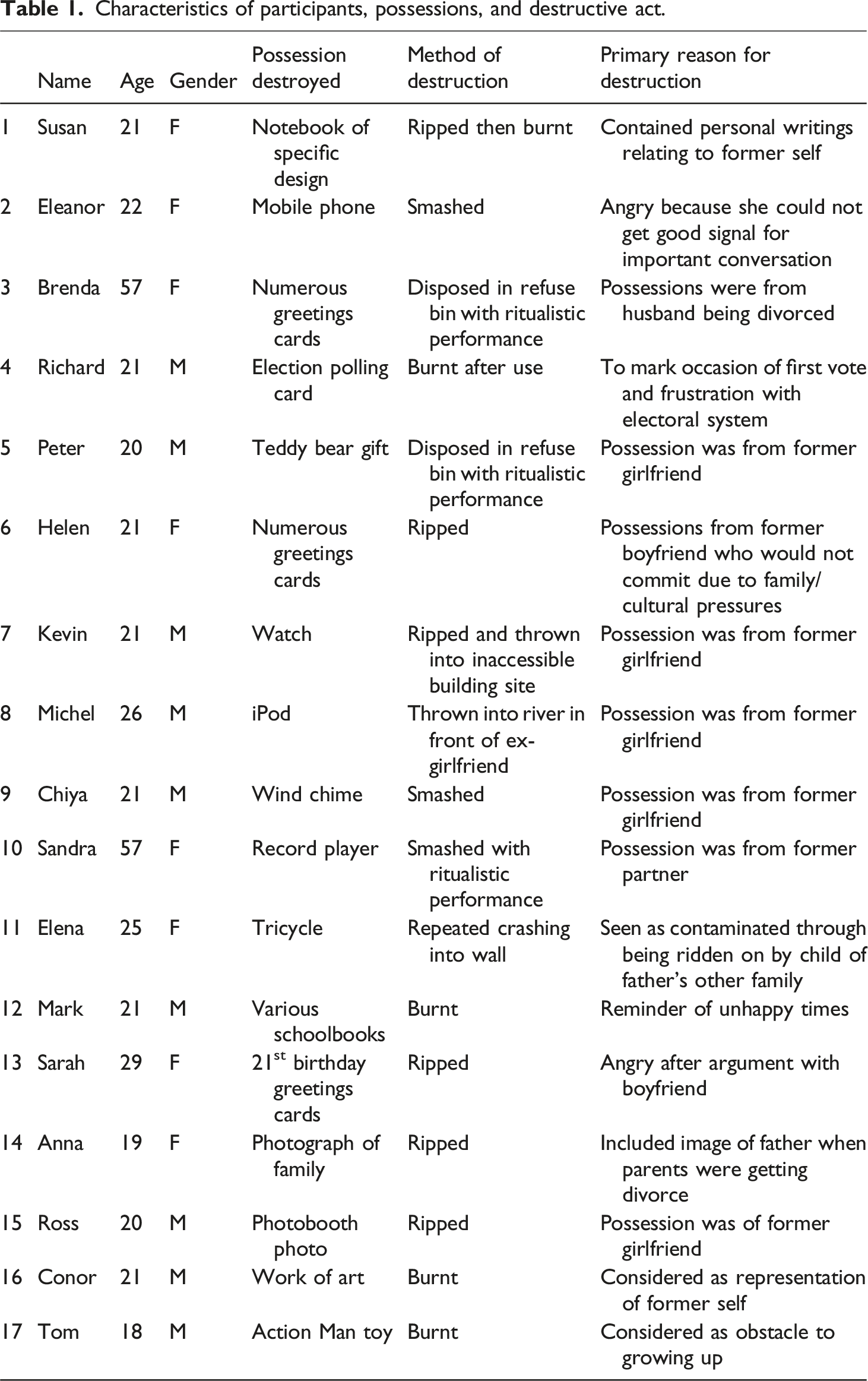
We created and used an interview guide, focused on creative destruction. This was based on the extant literature and explored dimensions of this phenomenon. These were discussion of the possession, causes of the destructive activity, the destructive incident itself and the post-incident effect on the individual. However, given the exploratory nature of the research, discussion was not constrained to these specific areas. Interviews commenced with a recap of the aim of the research study and then turned to discussion of the relevant possession. The structure of the remainder of the interview was flexible, provided that all relevant dimensions were covered. Interviews were audio recorded, transcribed and were typically 20 to 30 minutes in length. NVivo software was used to analyse the data, using template analysis (Brooks et al., 2015) to code the data and help generate relevant themes from the data. Template analysis is an established technique. It adopts a similar approach to grounded theory but without the insistence that all potential themes emerge from the data, allowing them to be drawn from existing literature as well. Findings from the research were structured around these themes. Validity and reliability were considered using the qualitative criteria of LeCompte and Goetz (1982). Using interview guides, template analysis and NVivo software reduced the degree of subjectivity and aided the possible replication of the study. In addition, an audit trail was created through the maintenance of comprehensive records (Guba and Lincoln, 1994).
Findings
From the analysed data, we identified the key elements of the prototypical possession destruction temporal process, and this is shown in Figure 1 above. The destroyed possession held importance, carried symbolic meanings, and functioned as a memory marker to the individual. The initial motivation for destructive activity resulted from an adverse event that had had an adverse impact on them. The individual had symbolically linked this event to the possession so that the possession provides them with ongoing negative symbolic value. They anticipated that the destruction of this possession would create value for them.
A trigger point often set in motion the pre-destruction stage of the process. This involved the planning of the destruction and was often accompanied by strong emotions. Alternative divestment approaches to possession destruction were contemplated but were regarded as being less value generating.
Although various destruction methods were employed, assurance of complete destruction was a key requirement. The actual act of destruction itself was often a powerful emotional and solitary experience. Post-destruction, the individual considered that they had received long term improved self-wellbeing, through the removal of the negative symbolic value from the possession. We now explore the elements of the process in more detail, using pertinent verbatim (Corden and Sainsbury, 2006) participant quotations to assist in elucidation. The possession destruction temporal process.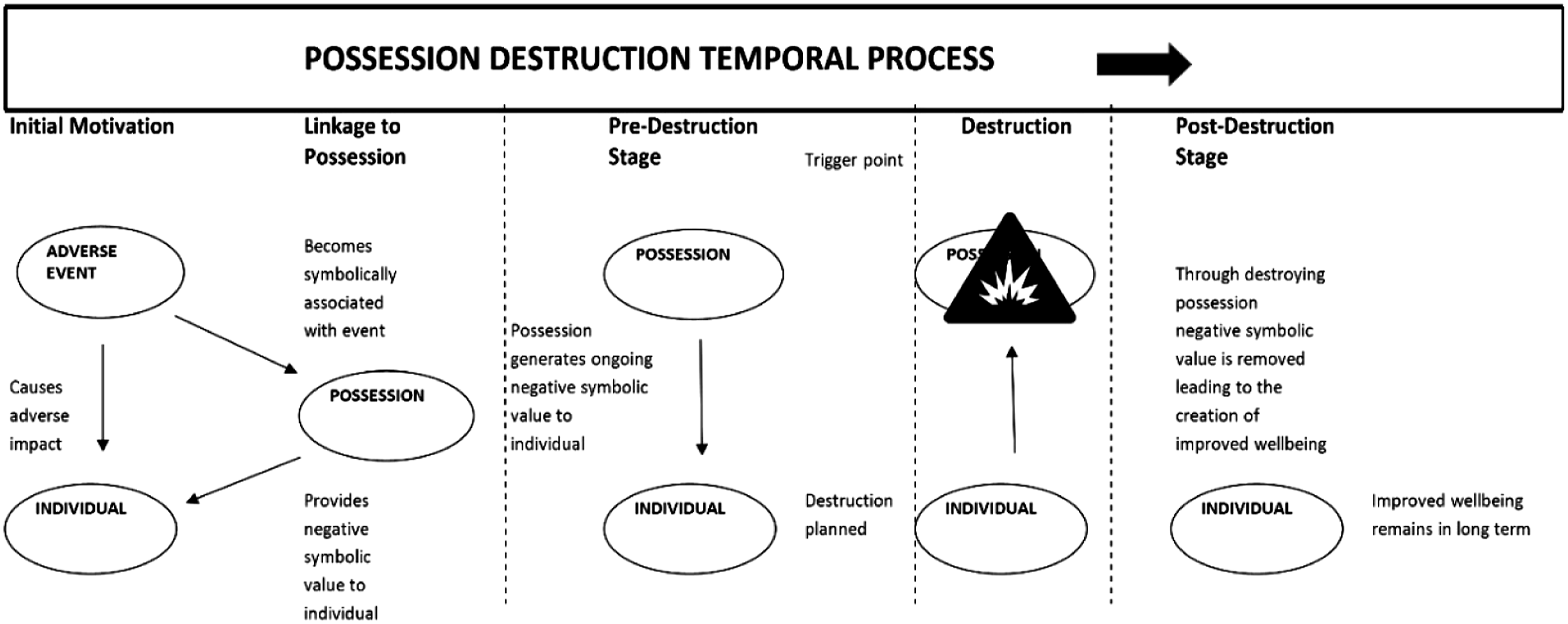
Characteristics of destroyed possessions
Participants highlighted different possessions relating to destructive activity, but some frequent characteristics could be observed. Often these possessions had not been bought by the participant but had been given to them by other people, usually their then partner or close family member. Many of the destroyed possessions had been of particular importance to the individual participants within their lives and had been subject to significant investment of time and resource. For example, Susan had not simply chosen any notebook, “This is the nicest one possible…It took me like a good 15 minutes in the store to choose…I wrote an introduction to this book, just a personal introduction”, whilst Kevin was hardly ever parted from his watch, “To me it was the most expensive – most important thing that she’d bought me because everything up until that point was kind of like little bits…and when she got me that, I appreciated it so much more than anything else that she’d bought…As soon as I got it, I didn’t take it off unless I was showering or in bed”.
Destroyed possessions tended to carry strong symbolic meanings, in addition to fulfilling functional roles. Sometimes these symbolic meanings related specifically to the individual participant, such as with Susan and her notebook, “It was almost a representation of myself…When you choose something you choose something to express yourself…It was like that is who I am in notebook form…It is very personal. I’ve only ever spoken (about its existence) once”. Generally, the possession symbolised a current relationship with a significant other, such as in the case of Chiya and his wind chime, “The wind chime reminds me that we are still in the relationship and we’re going to be even more happy, you know, throughout our relationship. The wind chime is like her”. Alternatively the possession symbolised the other person after a relationship had ended, such as Sandra, talking about a record player, “It’s very much, that’s the thing that represents him, his lifestyle…his personality, his interests, his control”. Possessions also often fulfilled the role of memory marker, whether these memories were perceived as good or bad, such as in the case of Peter, talking about his teddy bear, “I was in my room once just looking for something and I stumbled across it...and you start remembering”.
Motivation for destructive activity
The destruction of a possession did not simply happen. It was rarely a spontaneous act. Participants were able to identify and discuss their initial motivation, how they related this to a particular possession and why they considered that destruction would be the best divestment method. It was often stressed by participants that this was not their normal disposal behaviour. Initial motivation varied but almost always related to an event that had an ongoing adverse impact on the individual. Generally, this involved a significant other, although sometimes self-focused. For example, several participants had found themselves unexpectedly dealing with difficult mental health issues, such as in the case of Susan, “I think it was around college time when I went through sort of a darker period of my life…I didn’t expect my life to take that sort of turn”.
However, for most of the participants the initial motivation revolved around a failed relationship (i.e., relationship breakup, divorce of partner or parents). This had had a significant adverse impact upon them and was often compounded through experiencing this as a traumatic event, as in these following cases. “It ended like a tornado hit a volcano” [Kevin]. “When my Mum told me we are going to leave my house for no apparent reason (parental divorce) I got really upset” [Anna].
The destruction of a particular possession was predicated by the symbolic meaning and memory markers contained within it, where the possession was seen as representing the adverse event and its impact on the individual. The perception of such symbolic linkage appeared self-evident to participants. For example, in Eleanor’s case, stress from not being able to get emotional support from her mother was transferred to her mobile phone, which had been stopping her through not working. Susan’s notebook was seen as denoting past mental health issues. Where the adverse event resulted from a relationship, the possession represented the relationship or the other person within it.
The destructive act was generally a considered decision by the individual with the expectation that possession destruction would provide benefit to their life, through the removal of a possession holding negative value. Participants had found it difficult to keep the possession. “I couldn’t move on. I couldn’t move forward with myself if I had these cards just staring right at me” [Helen].“This wind chime is giving me hell; a lot of problem emotionally…I feel depressed when I see the wind chime” [Chiya]. Divesting the possession was seen to be in their best interest.“I was doing it (divesting) to protect myself ” [Susan].
There was often a feeling of compulsion, that it had to be done. Crucially, divestment alone was not seen as sufficient. They saw physical destruction being also required to remove the negative value that the possession gave to the individual “If it’s destroyed it’s destroyed. How I thought of it was, it wasn’t destroying part of me. It was allowing part of me to just stay where it was and the rest of me to progress further” [Kevin]. “I end up thinking of what I can do just to be less angry, less depressed, less thinking about that person so the only option is just destroying things really” [Michel]. “…Destroying it. It has no power over me anymore…I am now free” [Sandra]. “I think breaking things helps me move on” [Anna].
The pre-destruction stage
There was often a trigger point that set in motion the final stage before the actual possession destruction. In Chiya’s case it was hearing a particular song, “…until Christmas when I hear the song ‘‘Last Christmas, you gave me my heart’’…So this song…it, it snap me, it snap honestly. It snap me…I decided, okay, I – if I do not remove this wind chime, I’ll never get on with my life”. In some cases, the time before destruction included the individual planning the actual destructive activity, such as the case of Mark with the destruction of his schoolbooks “For like 2 years I must’ve been thinking about it…The more time went on, the more I wanted to do it…It was the last day of exams…We got the train home…I had the idea myself before, but we were talking about it together on the train back”. However, detailed planning was not always observed. Eleanor with her mobile phone and Sarah with her 21st birthday cards were both examples where the interval between the trigger point and the destructive act was short. Planning possession destruction tended to be an individual activity and there was only one case where there was shared pre-destruction activity.
A mixture of negative emotions was apparent prior to the destructive act. Principally these were anger, sadness, and embarrassment. Sometimes the time between the trigger point and the destructive act was described as a period of building tension, as in these cases, “…Sort of like, I’ll do that (the possession destruction) …today and never do it today…and then came the point where “No, I
There were concerns within the pre-destruction stage. Participants acknowledged that the loss of the possession would also mean the loss of any remaining positive symbolic values, together with its functional benefits, such as for Peter, “It’s sort of a dead memory…but I didn’t want to like destroy the memory”. Some participants talked about having to find the right moment for the destructive act. This could be conceptualised as the point where the expectation of value creation from destroying the possession exceeded the value lost from no longer holding the possession, such as for Ross, “I feel like waiting a couple of months to do it (the destructive act)…It was a perfect moment to do it because the items didn’t hold nowhere (sic) near as much meaning as they did, like the day after the relationship, where it’s still fresh”.
Individuals acknowledged that destroying a possession might be regarded as an extreme form of divestment. However, fundamentally they considered that the impact from possession destruction was different from other divestment methods because it created much more value. Kevin considered that everyday divestment was not appropriate because “the memories I have of the actual relationship ending is (sic) just horrible then why should I go about it in a nice quiet way?”. Conor highlighted the importance of a physical act within his divestment because “it just got to the point where I was ready to kind of like move forward and get past that part of my life…I felt like I needed some kind of physical personification of my taking the next step.”
Destruction
Various methods were employed to achieve the destruction. Smashing was a popular quick option. Ripping was also commonplace where smashing was not available (e.g., for paper and photographs). Burning was a slower and more involved process. This required greater effort but allowed for more reflection during the destructive act, as highlighted by Richard, “Fire is a very physical thing…It’s a very primal thing…and I think doing that…maybe made me connect more to something…to myself ”. There was only one instance of sinking in water being employed (Michel/iPod). This was regarded as having the disadvantage of the possibility of retrievability for certain types of possession. There were several examples of possessions being disposed through usual mundane socio-cultural determined channels (e.g., disposal bins). However, these were distinguished from standard divestment behaviour through being accompanied by ritualistic consumer performance. In the case of Brenda, this involved continually checking that the greetings cards were still at the top of the disposal bin, so that they were in the plain sight of her partner, were he to use it. In the case of Peter, he deliberately travelled to make use of a disposal bin far from his home.
A key theme was assurance that irretrievable possession destruction had occurred. Certain methods were highly appropriate to achieve this (e.g., smashing, ripping, and burning). One concern of individuals was that they might be tempted to recover the possession after the act of destruction, as highlighted by Tom.“I think the fire did make a difference…Obviously, if I threw it in the bin, I could always just take it back out, but once you put it in a fire it’s just irreversible”. Another concern was that other people could retrieve their possession. Kevin had been against the idea of disposing his watch through the normal household waste for this reason, “I didn’t want anyone else to pick it up and wear it because it wasn’t for them”.
Participants often recalled the actual destructive act as a powerful emotional experience. Susan stated, “It took a while to burn all the stuff. I think I went through all the emotions during the process…” and Mark, “Like an animal on its prey, that’s what it feels like. Sort of amazing. Yeah, just like taking pleasure in destroying it as bad as you can really”.
Thoughts often turned to the initial motivation behind the destructive act. “I knew the guy who came into our relationship before…So yeah, when I smash that thing, it was like also smashing his face” [Chiya]. When the destruction took time, such as with burning, relief and peace of mind sometimes developed, “…Just watching it burn, it was like, this is a good step…It was a good thing for me personally to experience” [Conor].
Participants did not always consider the actual act of destruction to be an act of violence, although they acknowledged that this might be seen differently by others. For example, Sarah asserted, “I very much think that there are (sic) a certain selection of society that would call it a violent act and would judge me poorly based upon it…I would question whether or not these people actually have really felt strong emotions.” Destruction was almost always a solitary act, although there were a couple of cases of the actual destruction being performed in front of a significant other. Attempts were frequently made to ensure that other people were not aware of the destructive act.
The post-destruction stage
There was a consensus that the destructive act had been a success in that individuals felt better for having done it. It was a “positive thing” (Peter), that made them “feel so good” (Michel/Elena). Participants talked about feelings of immediate release, liberation, and freedom. For example, Helen said, “I felt such a relief…Goodbye, I need to work on myself, work on me”. Anna was clear that the destructive act was a success. “It did help me at the moment because I was really really upset. A lot of things were going on in my life, so it really did help…I just broke the picture, and it helped me through it ”. Generally, the destructive act was never discussed with others after the event.
The value created from destruction, “by destruction breeds creation” [Sarah], primarily resulted from allowing the individual to move on from their adverse event. It was “a healing act” (Richard). Sometimes the benefit of possession destruction to the individual was not immediate but developed over time. Immediate benefits from possession destruction often remained, although these were short lived in a small number of cases with little positive long-term impact. On the other hand, in several cases the destructive act was perceived as having been so beneficial as to be life changing, as demonstrated by Kevin, “It’s taken away the negativity that I had towards anything. Like when I got rid of it I decided that from that point on that if someone suggested something I’d say yes because up to that point...I’d say no…So I missed out on quite a lot…so as soon as that went, now I’ve got literally no time on my hands”. There were only a few concerns over the possession destruction, with some participants expressing guilt and regret from no longer being able to obtain its functional value from the destroyed possession.
Discussion
The nature of possession destruction
From the findings we obtained greater understanding about why possession destruction occurs. Fundamentally individuals consider that, in their circumstances, they obtain benefit from engaging in this consumption activity. They assess other divestment alternatives and decide that these would be less effective than possession destruction in achieving their objective. This study offers a key motivation for why consumers engage in such a practice and why they choose it over other divestment options. This is essentially predicated on the assertion that our possessions offer symbolic value as well as functional value. Possession destruction cannot be understood purely through a rational functional lens. “It’s never a logical reason to destroy something really, is it?” [Sarah]. Possessing an object with symbolic meaning can be a serious matter (Benjamin, 1968) and destroying it much more so.
Generally, participants did not articulate the act of destruction as one of violence. However, we can evaluate this in the context of the symbolic meaning contained within the possession, and particularly its frequent connection to a specific person. Physical violence towards an individual is typically unacceptable in contemporary society. Accordingly, destructive activity towards a possession could be interpreted as a symbolic proxy for such. In other words, the act of physical destruction of a possession represents the physical destruction of an individual. Any admission of violence, even of the symbolic kind, is still problematic and it was notable that acts of possession destruction tended to be never discussed with other people.
Creation through destruction
Figure 1 asserts that destruction eliminates the negative symbolic value offered by the possession. Although elimination is not creation per se, destruction of the possession created an improvement in the emotional wellbeing of the consumer. Whilst the value of this improvement might not be straightforward to quantify or even conceptualise, almost all participants within our research study asserted its existence and relevance. Whilst our study focused on individuals at a psychological level, consideration of existing literature also suggested a social dimension to their creative destruction activity, and this is considered below.
The relevance of ritual within possession destruction
Study participants did not mention ritual. However, it is useful to consider whether possession destruction is fundamentally ritualistic in nature. Ritual is an important dimension of social life, where the performance of specific actions makes meaning and changes social reality (Douglas, 1966). Ritual features in consumer literature, most notably within McCracken’s (1986) foundational cultural movement of meaning model, where individuals use social rituals to transfer the cultural meaning of goods to and from themselves, such as exchange, possession, grooming and divestment rituals (Lastovicka and Fernandez, 2005).
To demonstrate the relevance of ritual within possession destruction, consideration of specifics from three of the research study cases is insightful. Brenda put her greetings cards in the normal external household disposable receptacle but deliberately arranged them at the top of its contents. Over the course of several days, she continually returned to the receptacle to rearrange them, until they were taken away. Peter took his teddy bear, drove some distance, placed it in a public waste disposal receptacle and then drove back home. Kevin first tore the strap from his watch, dropped this in a sewer grid, tore the back off and then did the same with this, walked on for a while and then threw the remaining face of the watch across the road into a construction site. These cases are useful because they highlight that the individual chose to transform their possession destruction activity from one that was short-term and transactional into one that was over a longer time span, with sequenced stages and much more akin to the enactment of a performance.
As such, these bear some of the characteristics associated with ritual, specifically those of performance, use of material artifacts and disruption to usual routine (Belk, 2012; Rook, 1984). However, they also differ from much ritualistic behaviour in that they were private and not public in nature (Douglas, 1966; McCracken, 1986). As such individuals appear to be applying the idea of ritual as a social activity but adapting it for their private use (Douglas, 2013). This may be because the symbolic meaning of their destroyed possessions has been determined individually rather than being cultural in nature.
Anthropological literature on ritual has often focused on that associated with rites of passage and in particular rites of transition (Van Gennep, 1960) and it is noteworthy that the cases of possession destruction within our study were also often associated with transitional events. Certainly, the success of possession destruction appears to have been accentuated, through its transformation by the consumer into an activity with transitional ritualistic undertones. This is despite individuals not being consciously aware that this is what they are doing.
Taboo behaviour and sacrifice
Rituals associated with rites of transition, such as when an individual is transformed from a child to an adult, are often linked to taboo behaviour. Behaviour regarded as forbidden and unacceptable within the community occurs, such as that of body mutilation and head shaving. In other words, during these rites a temporary suspension of the usual societal rules of behaviour is in place (Türe, 2014; Turner, 2008).
Even without consideration of symbolic proxy violence, contemporary society does not regard the deliberate destruction of possessions as conventional acceptable behaviour. This is particularly so with the growth in the importance of the sustainability agenda (e.g., Geissdoerfer et al., 2017). Ritualistic actions that represent violence against individuals would also fall outside of acceptable behaviour within society. Accordingly, deliberate possession destruction does have hallmarks of a socially determined taboo. Our study supports this, through the finding that participants avoided informing other people about engaging in destructive activity, thereby avoiding negative reaction.
Transitional rites of passage are also often associated with the idea of sacrifice. Sacrifice tends to be conceptualised in two ways (Miller, 2009). The first is that of actual sacrifice, where something of material form is physically destroyed, often by fire, to create something of value (Hubert and Mauss, 1964). Alternatively, sacrifice is conceptualised metaphorically. With this alternate definition, somethingof value is given up (i.e., sacrificed) to get something else of value in return. With both conceptualisations, sacrifice leads to positive transcendental self-transformation (Türe, 2014).
Most interestingly, within our research both conceptualisations of sacrifice were often apparent. The act of destruction often resembled that of a sacrificial ceremony. Burning sometimes took place. In one case there was a specific reference to the death of a possession. “It had died…like a religious ceremony” [Richard]. At the same time, participants also often made metaphorical sacrifice through possession destruction, most notably through the loss of its functional value. Further, a positive change to self occurred. Consequently, we offer an addendum to Figure 1 in Figure 2 below suggesting that an individual possession destruction temporal process may belie practices of a social nature. Possession destruction conceptualised as sacrificial process.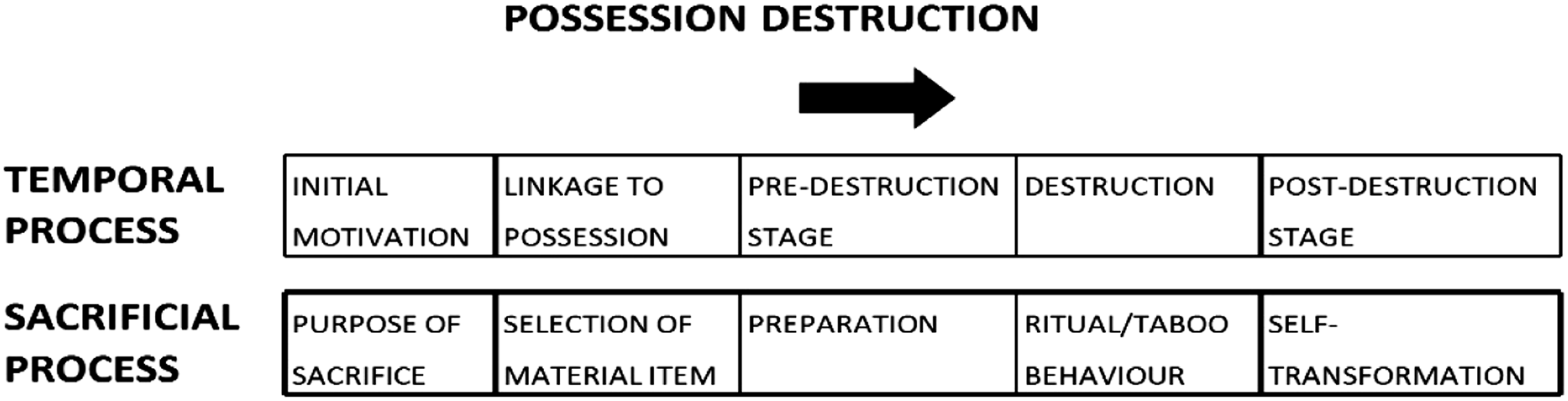
We suggest that possession destruction can be conceptualised as a sacrificial act within contemporary society. The initial motivation for possession destruction can be seen as equivalent to having a purpose for a sacrificial act. The linkage to possession for destruction is analogous to the selection of a material item for sacrifice, representing the initial motivation and often a specific individual. Following a period of preparation, the consumer engages in ritualistic and taboo behaviour, which leads to the destruction of their possession and often representing the destruction of a specific individual. The sacrificial process ends with the individual having experienced positive change.
Conclusion
This study has explored consumer practices that involve the deliberate destruction of possessions and provides important insights. It draws out the relevance of the symbolic, non-functional aspects of material possessions and details a quite different type of consumer divestment process to those already discussed within the literature. This furthers our understanding of the consumer, their use of possessions, motives for destruction, and the resulting value created.
Destruction does indeed appear to create something of value for an individual at the psychological level. However, we suggest that this consumption activity can be also conceptualised as a social activity, involving violence, ritual, taboo behaviour, and sacrifice. Accordingly, this paper offers a further key insight, through demonstrating the interplay between the individual and the social within consumer culture.
Footnotes
Declaration of conflicting interests
The author(s) declared no potential conflicts of interest with respect to the research, authorship, and/or publication of this article.
Funding
The author(s) received no financial support for the research, authorship, and/or publication of this article.
