



Abstract
Social research on organic consumption has increased in recent decades, partly due to its growing demand in central economies. Different studies have agreed to point out that health is one of the most relevant factors that help explain organic consumption. However, a substantial part of these studies are quantitative and fail to clearly establish the role played by health as a motivational element for organic consumption. This paper proposes an analysis of how the symbolic image of organic consumption is configured in light of the significant and emotional relationships that it establishes with health in order to advance knowledge about the motivational process in this type of consumption. We propose an articulation between a sociological and psychoanalytic approach that allows us to interpret how certain non-conscious fantasies and certain emotional states mediate the relationships with which consumers orient their experiences in their daily socio-cultural reality. The empirical analyses of the work have consisted of conducting focus groups and interviews with organic consumers who meet the majority profile in the Catalan market. The results reveal a Manichaean discourse on health and food reality where the organic acquires a defensive and reactive sense linked to the protection and stimulation of personal health. However, it is a discourse that does not manage to get out of the paradox of food modernity: the greater the insistence on risk, the more the fantasy of total protection is fed.
Introduction and aims
The use of organic products has become an increasingly common subject of research by academics studying consumption. Many have shown that the phenomenon is complex, multi-dimensional, and even ambivalent in its motivation (Moisander, 2007). In some cases, organic has been associated with ‘green’ or ‘ethical’ consumption, and has been widely studied in the context of the preservation of the environment and its social contradictions (Connolly and Prothero, 2008; Grosglik, 2017; Rana and Paul, 2020). On the other hand, research has been carried out focussing on types of organic product consumption that are not necessarily linked to sustainability and lifestyles based on environmental concerns. In this case, consumption has had to develop motivational conceptions, values and aspects where what is important is the impact of organic or non-organic consumption, particularly of food products, on the individual (Eyinade et al., 2021; Grauel, 2016; Gundala and Singh, 2021) In such cases, what is organic undergoes a kind of resignification process, often the result of marketing strategies. An example of this is how the background value of official organic certificates, such as the preservation of environmental sustainability (Grosglik, 2017; Prothero, 2017), is redrawn in a much more restricted and individualized way (Baumann et al., 2017; Goodman et al., 2013; Schrank and Running, 2018). The concern for personal health thus occupies a central position for many, mainly middle, and upper-middle class, consumers of organic products, where they express their status and class symbolism (Johnston and Szabo 2011; Rizzo et al., 2020). For such consumers, this exclusive concern regarding health, along with the importance of official certificates, justifies the reference to the ‘organic’ category.
The relevance of health, as well as the awareness of its promotion through the consumption of organic products, is in tune with a rising uncertainty in contemporary societies as a new relationship emerges between individuals and risk. With technological and scientific progress bringing apparent new dangers, individuals are managing the aforementioned relationship and the insecurity linked to modern food themselves. This is paradoxical, given the fact that the market in general, and the food sector in particular, has never before been subject to as many controls and safety systems. Despite this, the sense of risk is only increasing however (Beck, 2008; Castel, 2006).
Taking such research as a starting point, this article aims to explore the social discourse of organic product consumers and discover the role played by health in the motivational process of such consumption. Specifically, we analyse the significant and emotional relationship that consumers develop between health and organic food consumption within Alfonso Ortí’s (1979) socio-psycho hermeneutical theoretical concept. This is an interpretation of discourse that articulates sociological and psycho-analytical aspects in the analysis of consumption processes.
Most work that has dealt with ideas similar to ours is quantitative, limiting our knowledge regarding the density of the symbolic image of what constitutes the organic, and its links with health. However, as we shall see, some notable qualitative research has been undertaken in this regard, although for the most part it has not focused on the motivational genesis of the consumption process. Through the analysis and conceptual proposition in this article, our goal is to contribute to clarifying the motivational logics that underlie the demand for health in organic food consumption and, furthermore, advance our understanding of the aforementioned paradox of (in)security through empirical evidence regarding what mobilizes consumers.
Organic product consumption: Social and emotional aspects
Research dedicated to organic products that focuses on reasons related to self-preservation and personal health indicates that consumers perceive them as products that do not contain the following: synthetic fertilizers; pesticides; hormones or antibiotics. As well as those that avoid transgenic processes (Thogersen, 2017). As recent reviews have pointed out, health protection would be the main reason for consumption and the most relevant value of this type of product (Apaolaza et al., 2018; Gracia and de Magistris, 2008; Rana and Paul, 2020).
Those few qualitative investigations that have analysed these topics show that the socio-cultural construction of what we call organic is carried out based on nutritional values that only this type of product would have, the pleasure linked to the positive experiences of food flavours, and a romantic discourse linking it to a state of ‘pure’ and harmless nature, authenticity and security (Grosglik, 2017; Hansmann et al., 2020; Mazzacano and Falzon, 2014; Schösler et al., 2013). The work by Ditlevsen et al. (2019), for example, focuses on the relevance of the discourse in relation to the ‘purity’ of the organic product for consumers as a means of justifying its healthiness by constituting products that are free from any contaminating substance. With regard to this, other works have revealed the relevance of the bodily emotional (and not only abstract and reflective) experience that organic products are though to provide as a way of avoiding risky practices associated with conventional products (Orlando, 2018).
These results are consistent with those linking the consumption of organic products with high levels of ‘health consciousness’. This notion refers to those people who are highly motivated to preserve personal health as a marker of their quality of life. They are consumers who undertake consumption activities, including training activities, that promote disease-preventive behaviour, physical and mental well-being (Michaelidou and Hassan, 2008; Von Essen and Englander, 2013). In line with the above, some studies have found particular preferences for organic products in families with young children in which parents tend to want to project the ‘purity’ with which organic products are perceived onto their children. This occurs when the ideal of a ‘good mother’ involves protecting their children through a good diet (Cairns et al., 2013), which is no in all mothers (MacKendrick and Pistavec, 2019).
Most works indicate that the most prominent relationship between health and organic products is mediated by fear. Following Lupton (2013), fear would act on organic product consumers as a link between emotion and risk. That is, as a socio-cultural and emotional construct at the same time. Risks refer to potential, virtual issues, to threats linked to the future consequences of an event. However, when something is perceived as the presence of risk, it is most likely a felt emotion, as it emanates from a prior social meaning. Conventional products are often evaluated as risky products, precisely because of the negative consequences they can have for health: fear arises when there is uncertainty or threats to health (Grosglik, 2017). Thus, while health would be the main purpose of consumption, fear of conventional products would function as a central motivational aspect in the process (Jose and Kuriakose, 2021; Rizzo et al., 2020). And this fear, some authors point out, tends to generate an anxiety that blocks certain ‘contaminated’ forms of consumption (Nixon and Gabriel, 2015).
The socio-motivational process of consumption: The socio-psycho hermeneutical approach
The motivational approach in sociology arises from the general study of behaviour. When applied to the field of consumption, beyond Dichter’s work (Schwarzkopf, 2015), serves to comprehend and interpret the motives, values and socio-cultural norms that guide consumption. However, ‘motivational’ is taken to mean a process here, and not a ‘fact’ – a motive – that functions as one or many external causes. Conversely, it deals with discovering the affective orientation that underlies the attitudes and representations of consumption in specific social situations (Callejo, 1994).
The psycho-analytical and motivational orientations of consumption presuppose the construction of desires, tastes and preferences through the dynamic interiorization of affective and relational patterns (Desmond, 2013). A more sociological perspective places this process of affective structuration in a frame in which social practices are generators of experiences, the accumulation and repetition of which also contribute to constructing patterns of evaluation and cognition (Lahire, 2019). We can thus state that the motivational processes of consumption do not respond to autonomous, strictly individual elective processes, but rather constitute a process at the psycho-social level. Understood as such, socio-motivational analysis deals with determining the symbolic and ideological formations generated within a specific social and cultural context, established by its dominant values and norms, and recognizing the conditioning that these exercise over the affective dynamic experienced by the consumer (Ortí, 1979).
Given the above, the aim of using the socio-psycho hermeneutical approach is to uncover the meaning of consumption processes, paying attention to how the socio-cultural and ideological level influences the level of affections. That is, analyse how present socio-cultural contexts are capable of evoking certain emotional experiences, some of which are from the past and not conscious. In this way, the symbolic and ideological representations that arise in certain social contexts, which we will analyse here with regard to the issue of organic consumption and health, would be able to evoke particular desires, feelings and affective projections that consumers maintain with respect to reality and others (Barbeta-Viñas, 2020). That being said, the study of discourse does not purport to cover personal problems, but rather the social form – whether cultural or of class – of the structure of the consumers’ personality, and the ideological or symbolic constraints of their typical motivational process (Ortí, 2002: 178).
The above calls for an analytical model that seeks out inter-relationships between the varying contexts of the social and cultural structure and the affective structure mobilized in a specific situation, along the lines of Freud’s (1933) and Klein’s (1946) psycho-analytical theory of affective phases and positions. Nonetheless, we understand this theory in accordance with current views that define phases and positions not as endogenous evolutionary aspects, but rather as relational aspects that form groups of affection and experiential representations.
Design and methodology
The methodological design of the research has been qualitative, in line with the aims of the study. Two focus groups (FGs) were formed, each comprised of 8–10 people, and nine open interviews (Ints) were conducted with organic product consumers (Krueger and Casey, 2015). The sample, which is structural (Ibáñez, 1979), was formed from quantitative data regarding the profile of the consumer of organic products in Catalonia (Spain). Focus was then placed on the majority profiles. The most important differences noted were in the participants’ socio-economic and cultural levels. Consumption of organic products on the Catalan market is particularly concentrated among people of a middle- and upper-middle social status, where the sample was built. We also included consumers with middle- and upper-middle educational levels; young people and adults; and men and women from the Barcelona urban area and smaller population centres. The interviews that were conducted took into account the point of purchase, thus ensuring a range of discursive orientations (motivational) between those who shop in ‘green’ cooperatives, small organic produce shops and organic supermarkets (usually the property of large distributors) (see Figure 1). Social background of organic consumers in the Focus Groups and Interviews.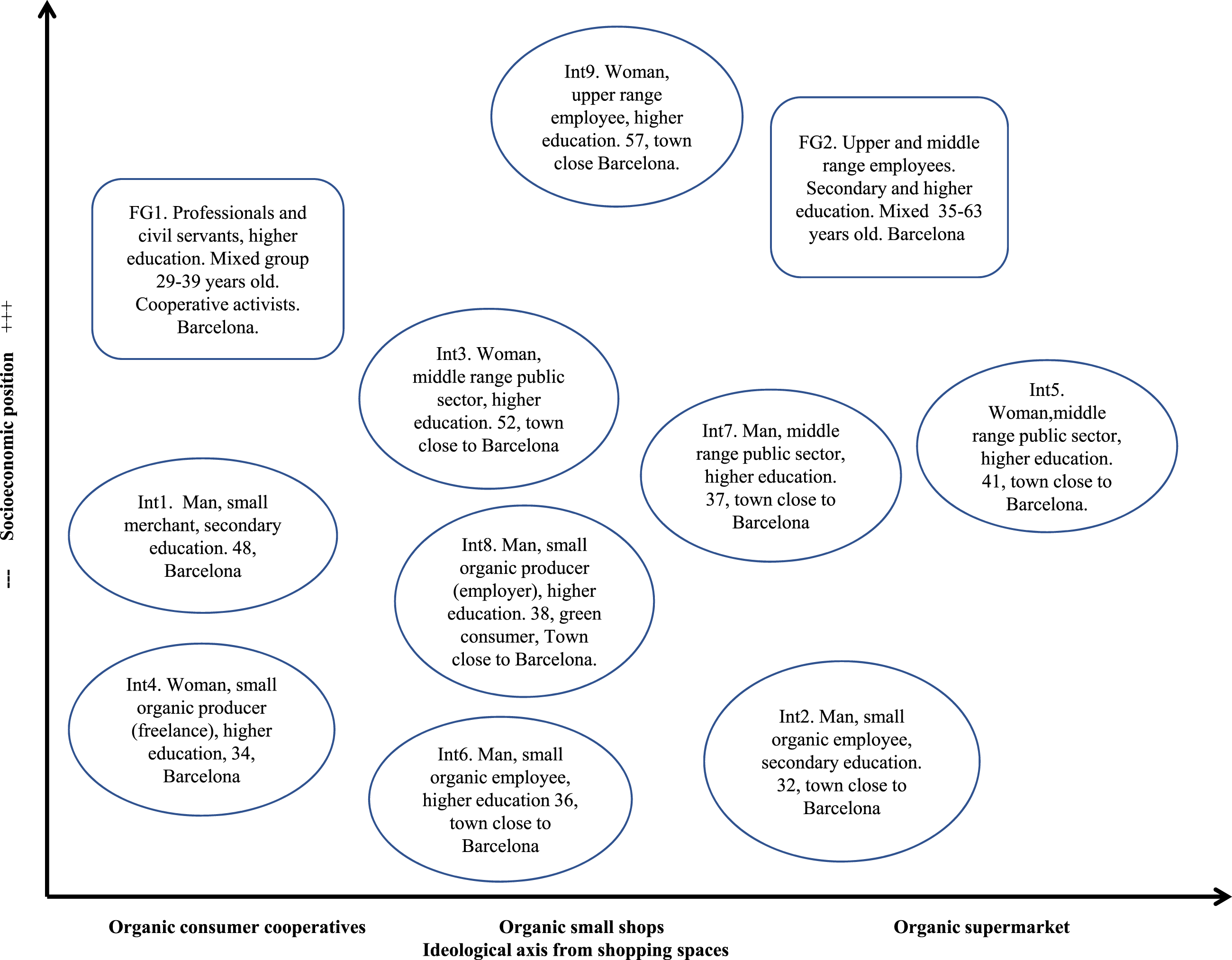
The FGs and Ints were carried out respecting a balance between homogeneity and internal social heterogeneity within and between the groups. The aim was to cover the aforementioned majority social profiles of consumers in Catalonia, as well as their social discourses. This allowed us to analyse the social ideological representations and affective expressions arising from these micro-groups and interviews, which at the discursive level were representative of the social macro-groups incorporated in the sample according to the majority profiles (Ibáñez, 1979). Both the FGs and interviews were recorded with verbatim transcriptions for subsequent analysis. Interviewee recruitment involved administering questionnaires to determine consumers’ socio-demographic characteristics and their relationship with ‘organic’ or ‘green’ consumption, combining (a) contact made by specialized companies using anonymous pre-made lists of citizens; and (b) the snowball method via the researcher’s own networks.
The fieldwork was part of a research project that ended in 2013. Recovering this recent data is important, since it provides us with a context with which to study the consumption of organic products in what could be deemed its ‘purest’ state. The European organic produce logo was still relatively new, and the regional certificate had just been reframed in Catalonia (CCPAE); such legal guarantees enabled consumers to better identify organic products. Furthermore, Spain was deep in the grip of a serious economic crisis, and this led to great consumer discipline, especially among the middle class; it also meant that organic produce was not among the most popular consumer choices (Alonso et al., 2014, 2015). This would suggest that, despite the financial difficulty, consumers were prepared to spend more on organic produce regardless of its elevated price. From this, we can deduce that these consumers had a high degree of conviction towards organic products. In turn, this also allowed us to study the ‘typical or extreme case’ of consumers of organic produce whose attitudes and discourse closely match the ideal model of attitudes and discourse regarding organic produce. These would have been less crystallized had the social groups or contexts been different.
In order to ensure a productive dynamic with the FGs, we followed a number of methodological rules which constitute more or less typical protocols of social science FGs.
Firstly, it is important that members of each focus group do not know each other. This enables them to share what unites or divides them, because they form part of the same social group; it also guarantees discourse that is more spontaneous, and not subject to prior routines (Alonso, 1998).
Secondly, open dynamics were promoted, the interviewees being asked to freely associate, taking the discourse and discussion in the direction they wanted. This relatively ‘free’ and spontaneous method was key when carrying out analysis interpretation. A first approach followed the distinction suggested by Bion (1961) between work group and base group. These terms refer to the emotional and unconscious components that predominate at one time or another in small-group dynamics. In our analysis, we attended to the basic assumption that tended to prevail in our FGs in order to observe the desires or anxieties at the origin of the interviewees’ reactions, group work and discursive production (Ibáñez, 1979).
This conception and handling of the research methods is linked to the socio-psycho hermeneutical approach, which draws on the sociological analysis of discourse (Alonso, 1998; Ortí, 2002). It focuses on the analysis of a symbolic and discursive universe linked to the social contexts comprising the sample, in order to explore images of organic product consumption and its social and emotional conditioners. This methodological approach combines an analysis of emerging semantics, which is used to analyse discursive forms with pragmatic (contextual) and expressive sociological interpretations. This allows socio-cultural contexts to be linked with the semantic production of the discourse, as well as with pre- and unconscious emotional attitudes arising in the subjects’ discourse (Barbeta-Viñas, 2020; Stamenova and Hinshelwood, 2018).
The empirical analysis procedure was applied to the texts resulting from the FGs and Ints with the aim of formulating conjectures that account for the entire corpus, in a process of coming and going – typical of the hermeneutic circle – from the data to the theory and from theory to data. The analytical work followed the postulates of abductivism and the index paradigm (Ginzburg, 2013). Broadly speaking, the analysis consisted in identifying and encoding the signs, including symptoms that appeared in the texts, allowing us to reconstruct the social and emotional meaning of organic consumption and its relationship with health. At a first level of analysis, the points of view, rationalizations and different semantic values associated with that which constitutes organic and its relationships with health were encoded. In addition, those text segments indicating emotional expressions or conflicts were also encoded. For this first encoding, ad hoc codes were used, linked to the objectives and framework of the research but with no theoretical basis. At a second level, we proceeded to reconstruct the semantic fields linked to the image of health and what constitutes organic, and to divide coherent values and points of view into theoretical categories; this process pivoted around a contextual and emotional interpretation of the speakers. The identification and grouping of the empirical elements scattered throughout the corpus (verbal expressions, summaries, associations, conflicts, etc.) made it possible to generate emerging categories that in theory responded to the underlying socio-emotional dynamics in the discourses.
The interpretive analysis was conducted by applying an inferential logic validated by means of the following: the intelligibility and explanatory capacity of the resulting conjectures; consistency with theoretical reference models; compatibility with the existing state of knowledge; and the greater probability of the validity of the established conjectures in comparison with alternative hypotheses (Ricoeur, 1976).
Finally, it is worth two methodological limitations. One, the sample it was focused on middle- and upper-middle class consumers of organic products (the majority profile), leaving the more popular sectors out of the analysis. The second, the factual behaviours could not be studied in this qualitative framework, and neither the statistical significance of the discourses.
Findings
The discourse we are going to examine in depth is that which deals with the topic of health. In line with our predictions, this prevailed over others as the most relevant symbolic value in the image of organic produce. It developed paradigmatically in the case of FG2, comprising middle- and upper-middle class adult men and women with secondary or higher education in interviews 2, 5, 7 and 9 (see Figure 1). Although elements of this discourse were found in the other FGs and interviews, they were linked to collective issues, such as environmental reflexivity, sustainability and have been addressed in another work (Barbeta-Viñas, 2023).
To a more or less latent degree, health was defined in ‘individualized’ terms, rather than collectively, and ‘embodied’ in the person, emphasizing the influence that organic produce may have on one’s own health and body (Connolly and Prothero, 2008: 135). It is a construct formed ‘in the negative’, by which we mean that health is the absence of illness or physical or mental discomfort. Such an aspiration is practically omnipotent, given that ‘healthy’ or ‘health’ entail a kind of invulnerability, or lengthening of life and, as other authors have noted, of the denial of death (Desmond, 2013; Falk, 1996). That being said, one aspect that over-determines this image of organic produce is a conception of health as being something that happens ‘inside’, something that one has, but can be lost, and that can be controlled or stimulated to a certain extent. It is not, therefore, only the ‘healthy’ nature of organic products that guides this discourse, but also the chance to use them as a protection against the ‘external’, or that which can harm health. Semantic variety of symbolic expressions associated with conflict in the incorporation process.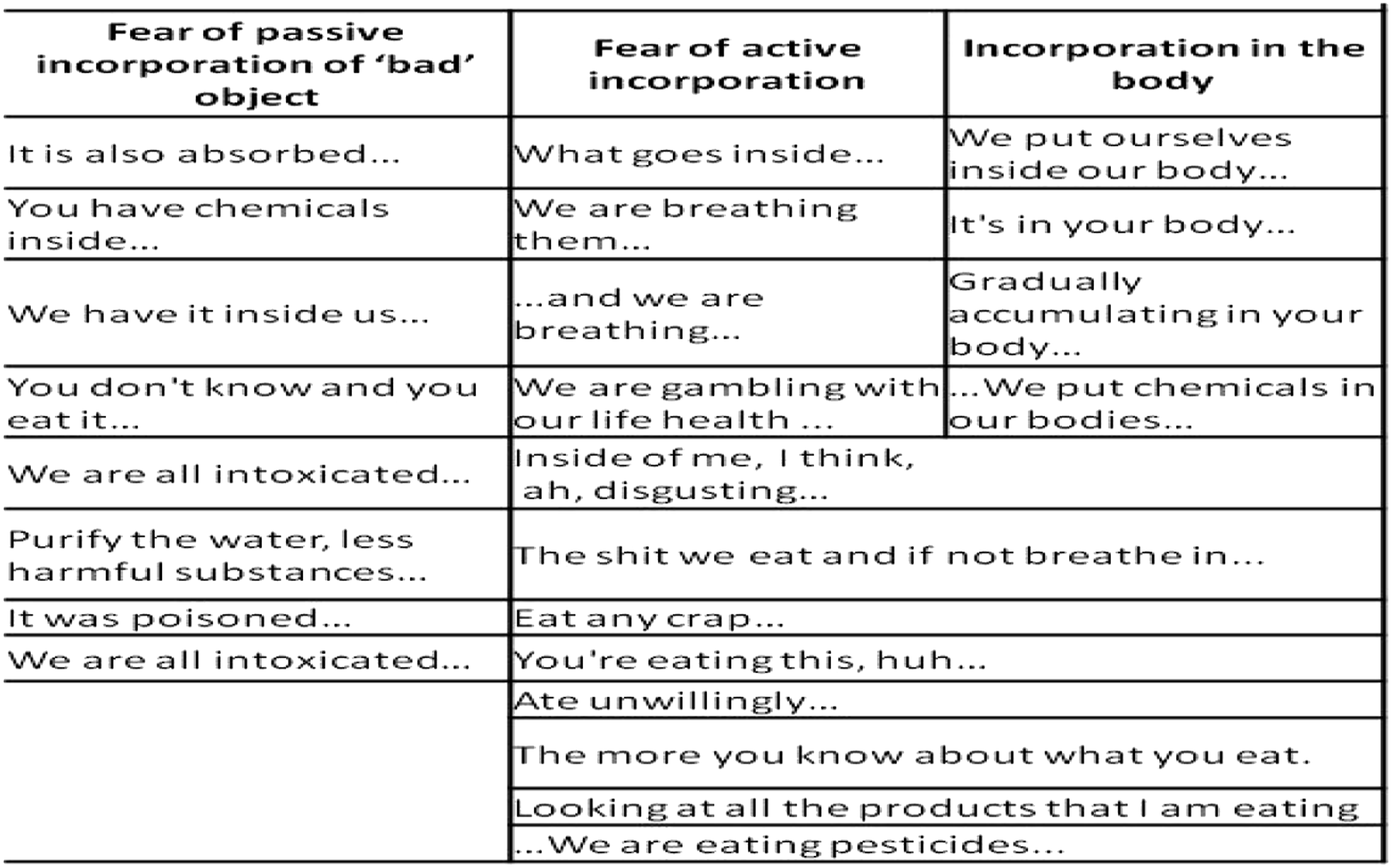
These conceptions of the links between organic produce and health arose in FG2, in an emotional climate specific to the basic fight or flight supposition (Bion, 1961). They were based on an imaginary conviction that it is necessary to defend oneself from ‘attacks’ emanating from outside the group. These ‘attacks’ are linked to the representations and assessments that these consumers have regarding modern foodstuffs in general, and the conventional, non-organic, product market in particular. The systematic move through this affective structure during the conducting of FG2 (and also in the interviews), conditioned the direction of the discourse regarding organic consumption. The members of the group thus tended to offset and reduce their fears and anxieties through the construction of a positive and idealized vision of what constitutes organic. Thus, one of the key elements in the discourse structure was the split and Manichean development of the image of organic produce consumption. Along the lines of the Kleinian idea that allows us to see consumer objects as vehicles for idealization and denigration, both a denigrating image of the conventional product market and an idealized image of the consumption of organic produce were observed (Minsky, 1998: 243).
The denigrated image of conventional products: Fear and insecurity in the face of damage to health
The consumers in this study adopted a consensual discourse of denigrating the conventional product market and placing the consumption of organic produce in a private and personal symbolic space that has to be preserved. From this perspective, organic products acquire their basic general meaning as a defence against the tensions produced by feelings of insecurity towards conventional products. By this we mean an individualized approach to facing the risks posed by daily alimentary habits (Grosglik, 2017). The progressive process of abstraction in the production-consumption cycle has been shown to be one of the contexts that lead to this discourse of denigration (Fischler, 1995; Poulain, 2017). For such consumers, there is a loss of contact with food production: they no longer have any clear guidelines. Modernity has given rise to numerous, very important changes when it comes to issues such as the use of technological advances in the food sector. The production process itself is one of the major problems with conventional products; in the discourse, this was aggressively and specifically linked to alimentary modernity, which is seen as the process of food industrialization (‘the industrial, for example, the destructive’ FG2). This results in the view that the conventional product market is ever further distanced from the traditional forms of the production-consumption cycle. In turn, it is seen to be nearer to the sources of risk and danger, where there is greater uncertainty in the mind of the consumer (Beck, 2008). Paradoxically, despite the increased safety measures that consumer goods are subject to nowadays, alimentary modernity stands out as a context that is less well-known and less controlled (Castel, 2006). In line with Lupton’s conceptualization (2013), this is, then, a vision of risk typical of modernity itself, in which health can be harmed in the long-term: transgenic products, fear about past consumption effects, alimentary crises, etc., appear in discourse.
These consumers experiencing external reality, and in particular food, as a threat and the need to address this align with what Klein (1946) called the paranoid-schizoid position, which can be seen as the origin of the affective reactions displayed in their discourse. A lack of knowledge regarding production processes is one of the elements that has given rise to the mistrust of what they view as conventional, along with expressions of anxiety that show a certain degree of paranoia. This has led to a suspicion, shared by all those interviewed, of conventional products. They have little doubt that such products are increasingly treated with chemicals such as pesticides, both in agriculture and in food preservation (additives, preservatives, etc.), and that many of these are transgenic and treated with hormones. In line with contributions from other works (Ditlevsen et al., 2019; Mazzacano and Falzon, 2014; Nixon and Gabriel, 2015), the anxiety-inducing cliché is thus formed that conventional produce is ‘contaminated’, ‘toxic’ and ‘harmful’; as already mentioned, such anxiety is largely due to a lack of knowledge regarding the products themselves, their production processes and industrial processing, which leads to an increase in the perceived risks entailed in their consumption. This fear of the ‘bad and external’ precedes the attitudes and opinions of these consumers with regard to any kind of foodstuff they consider ‘contaminated’. W: It’s fear, I guess, fear of all the rubbish they add. And above all, it’s a lack of knowledge, because I don’t understand any of it, what pesticides they use and where. Quality for me is that there aren’t any pesticides, that there’s nothing harmful. Because it seems that they add a stack of harmful stuff that we don’t know about, and, not knowing, for me, well…I like to know about everything… I’d like to know what’s in everything, and the fact that I can’t know… (Int5).
However, the interviewees’ comments show that access to greater information, such as reading labels or information manuals, very often serves to increase fears rather than allay them. In addition, the discourses have revealed pre-conscious fantasies, such as those related to ‘deceit’ and ‘manipulation’. Such fantasies highlight the lack of control exercised over the ‘bad object’, projected onto conventional products, and lead to defensive attitudes such as extreme precaution in the choice of food. We have noted how these consumers feel the need to know what products contain, right down to the last detail; the aim here is to reassemble (at least in their imagination) a relationship with the product that is safe and provides them with the health they desire. They even feel they are victims of a ‘bombardment’ of information that does not increase their knowledge about what they consume, to such an extent that they even begin to question the socio-cultural rules that have traditionally informed their diet. This, in turn, produces new doubts, new mistrust of what dietary norms they should follow: the paranoid emotional experience is linked to a rationalized discourse here, one that is more cognitive, where cultural norms are viewed with suspicion, hostility and a watchful attitude.
W: Sometimes you don’t really know what’s healthier (…) Maybe I’m being conned at the end of the day (Int5).
M: You don’t know if that box was organic or not (…) if you know more about what you eat, they’re going to trick you less, there’s less crap behind it… (Int7)
However, at other times, these rationalizing elements became weaker, and the discourse was characterized by a predominant generalized projection of these states of anxiety, leading to a less organized discourse, with less consistent rational and legitimizing arguments. In its place, there emerged omnipresent dangers and ‘harmful’ products ‘all over the place’ (FG2), in an atmosphere that was close to delirium. The fears had wormed their way into a whole array of products that were not only food, but also technological. Their image had been constructed on the value of ‘harmfulness’ and ‘poison’, with FG2 making a clear link to the poisoned apple in Snow White, and the possibility of falling ill.
As would seem logical, however, the single most anxiety-inducing and problematic of all the processes was that of ‘incorporation’, defined by Fischler (1995: 65) as intake, or the movement of food from outside to inside the body. It is this moment that generates the consumers’ biggest fears. We should bear in mind that, for these middle- and upper-middle class consumers, health is something that is ‘within’ the body, and the threat of its absence tends to come from without. This belief reveals that the consumers are on a permanent state of alert, and this, in turn, is the cause of the common problem faced by individuals of what they should eat (Fischler, 1995). Such problems are difficult to avoid. These consumers perceive the food sector as one that is ‘organized, manipulated, contaminated’, where eating habits are subject to a kind of conspiracy with potential consequences for their health (‘everything is totally organized, manipulated… our habits also’, FG2). The problems in developing a more rationalized discourse that would allow the consumers to ‘process’ their fears and anxieties has resulted in a repository of symbolic expressions that, in form of condensation, tie in with emotional burdens linked the incorporation process into de body (Orlando, 2018; see Figure 2).
These fears regarding the incorporation of ‘bad’, ‘harmful’ elements suggest this discourse contains the fantasy of ‘introjection’ of the ‘bad object’, described by Melanie Klein (1946) as a process typical of the paranoid-schizoid position. The discourse expresses a permanent fear of the ingestion or introduction through other means (waves, body lotions) of conventional products that are highly prejudicial to health. As the Kleinian perspective shows, and as seen in these discourses, the predominant anxiety in the paranoid-schizoid position is based on the idea that persecutory objects are introduced into the self in order to destroy it. Thus, the affective conflict develops into the discourse’s associative chains through the fear of ‘contamination’, ‘illness’ and, finally, ‘death’.
W: It’s a bit frightening, really... because you start with “and what about the Wi-Fi? And what about (...) what it’s made of, everything around me, and what about the microwave, and whether they use… uff!
M: Right...
W: ...and on and on, and there are times when you say, ‘it’s better not to think about it’, because it makes you ill...eh...
W: Yes, yes, yes…in the end, it’s all a bit paranoiac...
M: Yes, it’s that people generally do this, that’s why there’s not much…maybe they don’t know…
W: I’m in the street, looking at the antennas...
W: It’s just that we live in such a poisoned world that really... I’ve often thought it doesn’t matter, I’m going to die just the same... so... (FG2).
M: And I always carry with me... Oh, I haven’t got it with me today! No, a frequency detector.
I: Oh, why?
M: Everything, fluorescent lights, the, well, the... I haven’t got it today, but I’ve got a card in my wallet that also acts as a protector... (Int7).
The idealized image of organic produce consumption: Safety, and trust in a healthy diet
The basic and over-riding problem in this discourse boiled down to the possibility of maintaining a healthy diet in a hostile dietary context. The more or less conscious anxieties linked to the cultural representations of contemporary alimentary processes tended to be resolved through a process of idealization – in the Kleinian sense of the word (Minsky, 1998) – of organic product consumption. Such consumption arose in the discourse as a compensating element – representative of the ‘good object’ – for the fears and anxieties with which consumers face the ‘assault’ of conventional products. Organic products undoubtedly formed part of the semantic (and symbolic) field of ‘what is healthy’. This allowed participants to project the basic desire for a healthy diet, which is all but institutionalized and stimulated by contemporary culture (Crowford, 2000).
The image of organic consumption is motivationally constructed upon the basic fantasy of trust that authors such as Erikson (1963) locate in the oral stage of personality development (Desmond, 2013: 36). The discourse revealed that organic products are able to evoke the idea and experience of how consumers are going to be cared for, aided and given security; this goes hand in hand with being able to avoid any kind of illness – at least in the imagination. The conflicts of satisfaction and frustration linked to ingestion form the most notable meaningful and motivational context of this discourse. Even the organoleptic attributes and aesthetic assessments tend to be subsumed by this supreme value of health. The best tastes are thus linked to the absence of contaminants in products (FG2). Among the main connotations, we find the value of ‘safety’, ‘tranquillity’ and ‘the feeling of trust’. The different lines of meaningful association pivot around these values, so that what is organic becomes the receptacle of the oral desires and fantasies of incorporating ‘good objects’. As noted by Minsky (1998: 233), in states of anxiety or fear we may search for the well-being associated with the breast, as is the case of these consumers, with the aim of obtaining something in our inner world that acts as a substitute for the meaning of the good breast.
The discourse labelled organic products as ‘true’, ‘pure’ and ‘safe’, in line with other research on this issue (Connolly and Porthero, 2008; Hansmann et al., 2020; Schösler et al., 2013). These values have led to the reestablishing of a relationship of trust in the alimentary process. It comprises a feeling of trust in what one consumes, effortlessly accompanied in the discourse by satisfying and comforting affective states, which tend to free ingestion from conflict, and served to omnipotently distance these consumers from any type of unease, as preponderantly oral relationships will do. Such discourse associates the label ‘organic’ with the ability to separate itself from all the ‘bad objects’ that come with conventional products (transgenic, additives, colourants, chemical fertilizers, etc.) and to generate a ‘decontaminated’ and thus ‘safe’ symbolic space. The ‘pure’ character of organic products is linked to their completely ‘natural’ state, seen as the absence of any additives that might make the products artificial. It is precisely this that connects organic product consumption with the value ‘healthy’: the ‘purity’ that guarantees what we suggest calling the ethic of non-intervention. The lesser the degree of human intervention, such as the use of technology in food production, the greater the ‘purity’ and the more ‘real’ and inoffensive the product, in consistency with Ditlsevsen et al. (2019) and Schösler et al. (2013).
W: I think they’re products that haven’t been treated with chemicals or fertilizers, or chemical products, so no sulphates or any of that stuff that makes apples or tomatoes…
M: That they’re not manipulated... that’s the main thing for me ….
W: It’s about quality for me, that there aren’t any pesticides, or any harmful substances more than anything (…)
W: What they put in it, it’s your life health… (FG2).
W: I don’t trust chemical things so much, they’re things that have been made (…). The only thing that makes me feel safe is when I know it’s organic, I’m like relaxed eating it, right? (...) I mean what I focus on above all is if they tell me it’s organic, it puts me at ease (…). Complete and total tranquillity. And sincerely, I mean, when you’re eating an apple, and, oh, it’s doing me so much good you know... a healthy feeling, that it’s something healthy that you’re eating, something real, you know (Int5).
The associative chain of the discourses developed through other values that maintained a certain semantic continuity, and defined the meaning of the ‘purity of the organic’: ‘trustworthiness’ and ‘honesty’. Both of these qualities are linked to the belief that the use of organic products cannot result in a harmful experience. This context also revealed a symbolic ‘nostalgic’ strand, in which organic products evoke a certain idealized yearning for the ‘old’, ‘before now’ and the ‘rural world’, where there seemed to be no danger or conflict in food processes (Mazzacano et al., 2014). This is more an imaginary present than a return to the past, however.
A ‘medicalized’ image of organic produce was also discernible from the discourse of these consumers of a middle or high social status. They expressed attitudes and preferences related to medical discourses and nutritional criteria (Coveney, 2006). This could be seen in specific accounts of the benefits of the nutritional capacity and functional character of organic products, ‘food’ and ‘medicine’ being joined together here. However, this narrative tends to be overdetermined by fantasies of oral appropriation, as what is valued and sought is not merely the legitimization of their choices based on expert criteria, but the assimilation in oneself of these capacities, always in the name of improving one’s personal health. These fantasies affirm the ‘preventative’ character of organic food, avoiding or delaying the appearance of potential illnesses. They even highlighted the ability of organic produce to increase the body’s own defences, providing, they believed, a greater quantity of ‘vitamins, nutrients and minerals’. This defensive aspect also gives rise to the fantasy of the ‘curative’ capacities of organic produce.
W: [Organic] oranges have 30% more vitamin C than those mass-produced ones (FG2).
M: …it gives you the feeling that you’re looking after yourself better, that the food you eat, the nutrients, it’s definitely got more nutrients, it’s better quality, and so what you eat will be better for you. It’s like I’m looking after myself (...) They’ll be less carcinogenic, above all less toxic, with more minerals, and if they’ve got minerals, then they have nutrients, vitamins and so on... And more anti-oxidants, which basically directly affects your (Int7).
Finally, the symbolic development revealed by the motivational context is the ‘nutritive’ and ‘maternal’ image that appears in FG2 and in some of the interviews (Int5 and 2) through the evocation of maternal breastfeeding. The chain of associations in the spontaneous discourse depicted organic food as a symbolic and material substitute for the maternal breast in the process of feeding young children. What they understand as organic is thus seen as the symbolic continuity that reproduces the same oral values of ‘safety’ and ‘tranquillity’ as breastfeeding, bringing with it the basic feeling of trust found among these consumers (Erikson, 1963). Furthermore, this ‘safe’ image of that labelled as ‘organic’ forms the basis of legitimizing the ‘good mother’, who provides her children with ‘good’ food (Cairns et al., 2013). Other studies, however, have found this process to be rejected by other mothers with a less threatening vision of conventional products (MacKendrick and Pistavec, 2019). W: The breast, of course, full-on maternal breastfeeding, and the more natural the better, and more so for a new-born. I mean, of course, things evolve (…). I never gave the older one those pots of baby food, but rather almost always normal food. But with this one, since the pots were organic, I didn’t have any kind of…. They’ve eaten no end of that kind of pot, because they were organic, you know, the difference (Int5).
Discussion and conclusions
This study has made advances in our knowledge regarding links in meaning between health and the consumption of organic food, and understanding the motivational logics behind such consumption. The socio-psycho hermeneutical model used has proved to be fruitful in analysing the discourses of study participants, as it has provided us with conceptual tools with which to articulately interpret the socio-cultural and emotional meanings – some of which are not conscious – implied in the motivational process of consuming organic produce (Figure 3). Central aspects of the motivational dynamic related to consuming organic products.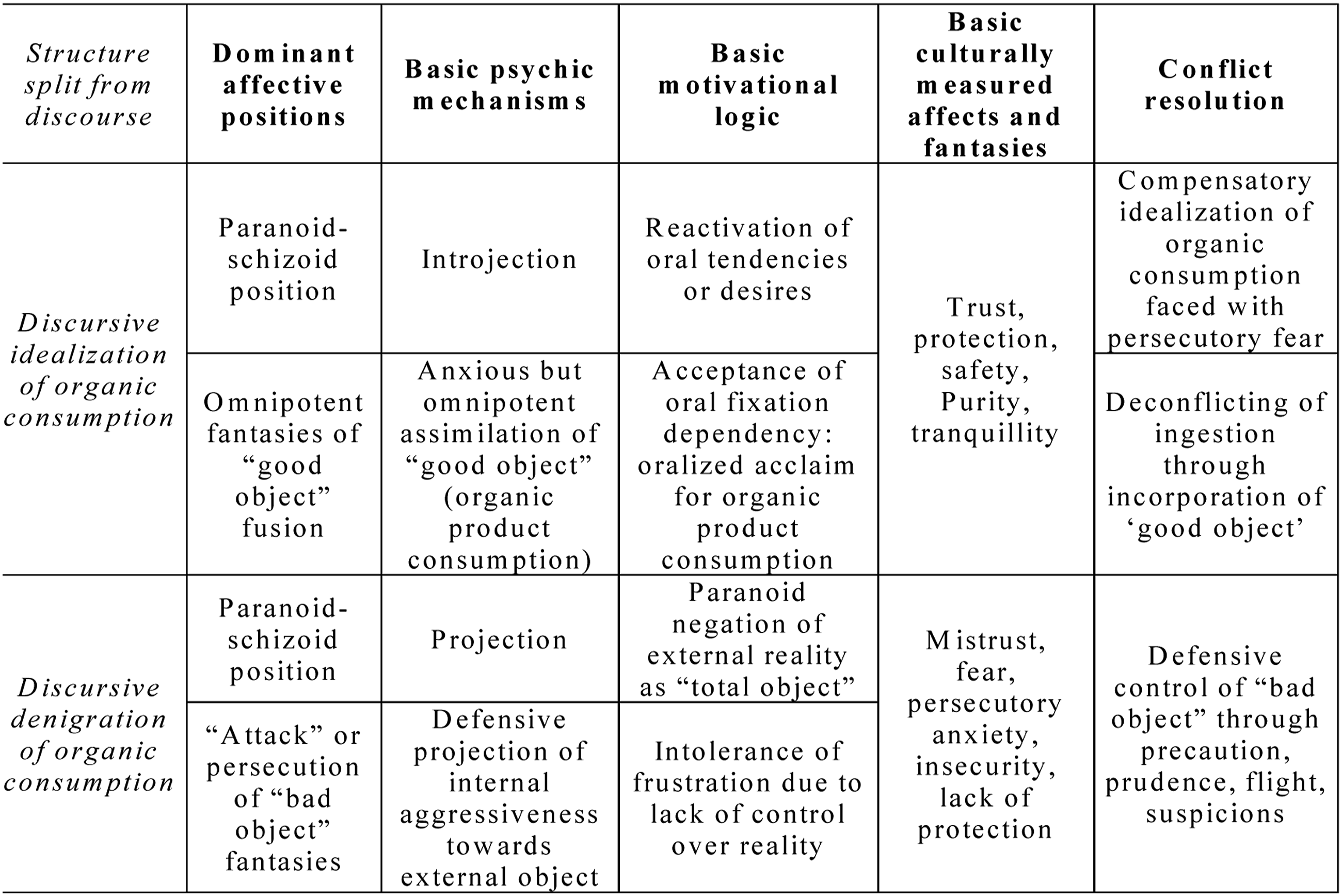
From this perspective, the results shed light on the central role played by health for the consumers of organic products analysed here. Our evidence indicates that this type of products it has to do with a fundamentally defensive and reactive model of consumption; it is closer to compensatory motivational principles and logic regarding the deep-seated worries and concerns associated with conventional products. Thus, work enphazise the emotionally conflictive and avoidant nature underlying the consumption of organic products (Nixon and Gabriel, 2015). We have seen that the representations of the conventional food industry and market form a symbolic space housing multiple sources of risk or insecurity towards personal health, when understood as being the absence of illness (Grosglik, 2017). As Lupton (2013) and Beck (2008) have posited previously, this reveals an individualized conception of health and one’s own safety that depend on privately managing risk, in as much as consumers themselves feel responsible for guaranteeing their good health through the market. These are not consumers who live in fear of going hungry or suffering malnutrition, as can occur in other social groups. Rather, under a Manichean construction, where food safety is viewed reductively, denying consumers some objective improvements, especially in the West, the discourses locate the principal problems associated with food within a dichotomy between ‘good and bad’ products, that which ‘provides health’ and that which ‘poisons’. This split conception of the reality of consumption, marked as we have seen by paranoid-schizoid reactions, which partially coincides with the findings presented by Chatzidakis et al. (2021), ends up connecting with a neoliberal vision more concerned with what one has to eat in order not to get sick than with the end of food inequalities and the socialization of ‘eating well’ (Guthman, 2007).
From this standpoint, the consumption of organic products would imply a further symptom of the paradox of modern food: the greater the safety and protection systems, the greater awareness of what makes us vulnerable (Castel, 2006). This vulnerability, which is subjectively experienced as insecurity and fear, implies an incessant demand for safety and protection. Consumers aim to find a less anxiety-inducing way to relate to their consumption, one that can be experienced without fear, as well as a less conflictive relationship with diet. Nonetheless, as Castel (2006) implied, inflation and the insistence on risk tend to nourish the fantasy of absolute security and protection since, as demonstrated by our consumers, the root of this unease is the feeling of being unprotected. As stated, the pursuit of health is always imperfect, and subject to conflicts and ambivalence. This becomes ever more evident – and almost obsessively so – when personal health is mythically understood to be the ability to control whatever can cause harm and, ultimately, end life.
As with previous literature, in this study, we have seen that the objective need among these consumers to acquire a degree of trust in products, in particular foodstuffs, is fundamentally projected onto that represented by the term organic, where the risk is idealized as being non-existent. However, the present work goes further to reveal that in these groups, organic products assume a symbolic form, with oral echoes of consumption and the incorporation of ‘good health’ and the linked feelings of security and protection. In effect, it is the imaginary formula that they use to resolve the emotional conflict of ‘incorporation’ that, while perhaps less pronounced, is found to a greater or lesser degree among the contemporary diner (Fischler, 1995; Poulain, 2017). In essence, what is deemed to be organic lends a fantasy of omnipotent protection, purity and trust, that tends to counter the supposedly insufficient coverage and control of risks in the institutional sphere (Beck, 2008).
The implications of these results are therefore relevant to producers and marketing campaigns that wish to strengthen this aspect of the culture of consumption through the dichotomous parameters cited. However, we feel that the implications of the results are more relevant to policies of consumption and food that aim to re-establish a higher degree of security among the general population. To this end, it seems necessary to move towards a reinstitutionalization of food security systems in the production stage, in parallel with the incorporation of sustainable production models. The first step is to discourage the development of opposing niches – conventional and organic – in favour of promoting the resulting dichotomous images. By this we mean generating an environment where consumers see most products – in Kleinian terms – as ‘total objects’; that is, products that allow for a relationship capable of taking into account both the more positive and more negative aspects, and thus enabling critical judgement among consumers. Clearly, this will necessarily involve the development of public regulations and governance systems capable of creating a food environment that generates trust and well-being for society as a whole. The second step is to prevent risk management from remaining in the hands of the private and commercial strategies of the more privileged sectors. The absolute goodness of organic products is questionable (Smith-Spangler et al., 2012), but as long as it is an option, it seems hard to sustain the justice of the market controlling the unequal distribution of healthy goods to the more privileged economic and cultural sectors.
Footnotes
Declaration of conflicting interests
The author(s) declared no potential conflicts of interest with respect to the research, authorship, and/or publication of this article.
Funding
The author(s) received no financial support for the research, authorship, and/or publication of this article.
