



Abstract
The nature of prosumption is one of the most important areas of debate within the study of contemporary consumer culture. David L. Andrews and George Ritzer highlighted how the majority of literature in the 21st century has focused on the sociology of sport as a form of consumer culture, and that there is a distinct lack of research into the exploration of fan atmospheres in regard to physical prosumption at live sports events as opposed to virtual spaces. We seek to address this through utilising findings from a 3-year ethnographic study at a range of live Professional Darts Corporation (PDC) events across the globe. Our findings extend existing knowledge on prosumer fandom, providing valuable insights for researchers on how sports organisations, when promoting their sporting event, utilise the fans as both producers and consumers to help create fervent atmospheres and market their sport to associated media outlets.
Introduction
Although recognised as a phenomenon involving both production and consumption (see Ritzer and Jurgenson, 2010), the majority of the studies within the field of consumer culture consider prosumption to be merely a type of consumption – namely, the most extreme or active version of consumption (see Cova and Dalli, 2018). Other scholars have presented the concept of prosumption or ‘prosumer activities’ as a form of co-creation (see Miles, 2018). Following Toffler's (1980) seminal work regarding the concept of the prosumer, the concept has advanced to a modern approach (see Ziemba and Eisenbardt, 2015). Prosumer culture reached its ‘enrichment stage’ between 2000 and 2010 and since then researchers have conceptualised prosumption in a variety of contexts, many of which were summarised by Perera et al. (2020). Whilst there has been recognition of physical prosumption within other spheres (Izvercian and Seran, 2013; Lang et al., 2021; Seran and Izvercian, 2014: Woermann, 2012), prosumer culture in sport studies has been mostly presented from a virtual, online or digital perspective (see Andrews and Ritzer, 2018; Bond et al., 2021a, 2021b; Woratschek et al., 2014). Andrews and Ritzer (2018) urged for more research into live prosumer cultures in addition to digital (or virtual) prosumer cultures. Our research partially addresses the lack of studies into physical prosumer fandom in the field of live sport, providing an empirical exploration of prosumer fandom at a variety of live PDC darts events.
Fandom at live sports events is predominantly focused on the aspect of performative consumption and how this is portrayed (Abercrombie and Longhurst, 1998; Crawford, 2004; Hills, 2002). A more contemporary example is demonstrated in consumer culture research by Hill et al. (2022), who asserted that atmospheres are experiences of place involving transformations of consumers’ behaviors and emotions. They argued that it remains unclear how shared experiences of atmosphere emerge and intensify among groups of people during collective live events. Using Liverpool FC’s Anfield Stadium as a site of a live sporting event, Hill et al. offered a demonstration of social atmospheres as mobile and co-created between firms and consumers. In agreement with previous work by Fuschillo (2020), Hill et al.’s (2022) research predominantly focuses on the role of fans in creating a consumption-related fandom, where cultural meanings and economic values are socially negotiated, produced, and exchanged (Guschwan, 2012; Muniz and Schau, 2005; Thorne and Bruner, 2006).
There is a scarcity of research on performative prosumer fandom at live sports events. Within this article, we provide an insight into physical prosumer fandom at live Professional Darts Corporation (PDC) events. We begin by highlighting the need for more research into live physical prosumer fandom as the basis to validate our study. We then discuss the rise and success of the PDC in the 21st century and our methodological process, before using our ethnographic data to demonstrate how the atmosphere created by prosumer fans at live PDC events is crucial to understanding the continued global success of PDC darts.
Sport and prosumption
Andrews and Ritzer (2018: 358) defined sport prosumption as the co-creation of activities between fans and players at sporting events arguing that sport spectators are at least ‘partially responsible for generating the atmospheric backdrop against which the sporting drama (or otherwise) unfolds’ and that due to this, sport spectators ‘add to the surplus value of a sporting event by positively contributing to the enactment of the live sporting contest’ (Davis, 2018). Andrews and Ritzer (2018) highlighted how the majority of sociological literature on sport in the 21st century has focused on sport as a form of consumer culture (see Crawford, 2004; Horne, 2006; Giardina and Newman, 2011) with many scholars connecting sport to consumer fandom (Brown, 2008; Dixon, 2013; Giulianotti, 2002; Healy and McDonagh, 2013; Hewer et al., 2017; Porat, 2010; Sandvoss, 2003).
Fuschillo (2020) provided a detailed set of critical perspectives on fandoms, arguing that they are the expression of a larger historical-cultural phenomenon manifesting as consumption-related and brand-related fanaticism in today’s consumer societies. Fuschillo covered many elements of Jenkins (1992, 2006) participatory culture, and the phases identified within Jenkins (2014) analysis of the evolution of fandom. As briefly alluded to in the Introductory section, Hill et al.’s (2022) study at Anfield (Liverpool FC) explained the processes by which social atmospheres are created during interaction ritual chains intended to create the kinds of lively social atmospheres that typify many collective live events. Hill et al. claim that their study is applicable to events at which the collective effervescence emerges as moments of positive affect. They also claim that their study is applicable to social atmospheres in both small contexts such as pubs/bars and larger, more organised live events such as sports and music events, religious ceremonies, festivals, and carnivals. Their theory is especially relevant to recurring events, as the cyclical nature of interaction ritual chains means that the recovery stage feeds into the preparation stage.
One issue with Hills et al.’s (2022) study is that it is only based on one football stadium. In PDC darts, these atmospheres are being created at all of the live venues across the globe – and not sports specific stadia, but in a variety of multi-purpose arenas or halls for a limited number of days in each location. Moreover, Hill et al. (2022) do not recognise prosumers as a facet of consumer culture that is significantly different to the consumers. They understand that there are individual consumers who get placed into small groups that begin to create a social atmosphere, but when going through the four-stage ritual process, they do not establish the producer and consumer (prosumer) nexus that certain fans perform to create atmospheres at Anfield. They outline how consumers co-create, but not how they produce the atmosphere whilst consuming it at the same time, which is a key element of Toffler’s (1980) and, in recent times, Ritzer and Jurgenson’s (2010) conceptualisations of prosumption. Not all fans perform the interaction ritual chain at Anfield Stadium – some engage with the atmosphere, but they do not create, or combine tools to create, which links to Izvercian and Seran’s (2013) conceptualisation of prosumer culture. One of the main reasons the Spion Kop has become such a renowned area of Anfield amongst many other specific areas of sporting stadia (see Davis, 2022b), is because in certain sections of stadiums there are stands where prosumers are vital to the club and the broadcasters in the way the produce and consume the atmosphere, dragging the team onto victory by ‘sucking the ball’ into the net through their noise (see Prentice, 2008).
The success of the professional darts corporation (PDC) in the 21st century
Professional darts has rapidly changed from a pub game into a sporting spectacle. This occurred through two processes: a primary transformation under the auspices of the British Darts Organisation (BDO) from the 1970s until the 1990s (see Davis, 2018), and a secondary metamorphosis under the auspices of the PDC from the late 1990s until the present day. Following the official accreditation of professional darts as a sport in 2005 (Kelso, 2005), the PDC version of darts has developed into a multi-million-pound annual circuit, holding events in a variety of multi-use arenas across the globe (see Allen, 2017; Dirs, 2009). The guidance of former PDC Chairman (now PDC President) and renowned sports agent Barry Hearn, CEO Matt Porter, and associated PDC administrators, have combined to capitalise upon prosumer fandom to co-create an environment that has enabled the rapid global transformation of the sport.
Between 2010 and 2020, PDC darts became the second most watched sport on Sky Sports myriad of channels and has its own dedicated channel throughout the premier tournaments during the year (see Curtis, 2019; Sky Sports, 2015). With broadcast viewing figures of over 4 million for the 2018 PDC World Darts Championship Final worldwide (Ronay, 2018), a variety of live PDC darts events have become permanent fixtures in the sporting calendar. The sport also gained significant global exposure following Fallon Sherrock’s success (becoming the first female to win a match and reach the third round) at the 2020 PDC World Darts Championship (Bloom, 2020). By the start of the 2022 PDC darts season, the total annual prize money had increased to over £15m, and the PDC had created a 20-event PDC Women’s Series with prize funds totalling £240,000 annually (Sky Sports, 2021; Allen, 2022).
The sport of professional darts has been rarely recognised within academia aside from research by the likes of Davis (2018, 2022a, 2022b), Cartlidge (2022), DeVillez et al. (2022), Howe Bukowski (2022), and Liebscher and Kirchstein (2017). However, the rapid rise of PDC darts since the mid-2000s (see Davis, 2023), aligned with the demise and ultimate dissolution of the BDO in 2020 (see Gill, 2020), has not gone unnoticed within news media. Many journalists have outlined the transformation of the live PDC darts events in the 21st century, highlighting the raucous atmosphere that the vibrant darts fans create (see ADZ, 2017; Glendenning, 2020; Keogh, 2019; Liew, 2020; Michaels, 2017; Ronay, 2018; Weeks and Bull, 2017). Although fans have always been a part of the live darts tournaments in England (see Chaplin, 2009), in PDC darts, they are the central part of the spectacle.
Methodology
The lead author was granted ‘access all areas’ to live PDC tournaments around the world, collecting a variety of qualitative research from a range of fans (n = 80) and players and administrators (n = 30) during the 2016, 2017 and 2018 PDC darts seasons (see Davis, 2022b). The specific methods used were non-participant observation of the live PDC events; semi-structured interviews with PDC staff/administrators and players; and informal conversations with fans (see Davis, 2022b).
The study was positioned from an ethnographic rather than a phenomenological standpoint given that many of the tools commonly employed to conduct ethnographies were employed as the research sought similar outcomes. A complete ethnography was not conducted, as the lead author did not fully immerse himself within a selected group of darts fans to collect data over a long period of time. As a methodological consideration, there was a nuanced difference between how the lead author conversed with the fans and interviewed the administrators. Because of the need for anonymity for fans in comparison to the signed approval and use of names of the players and administrators from the PDC and Professional Darts Players Association (PDPA), in the discussion of findings we identify the players and administrators but anonymise the fans responses. The fans were provided with pseudonyms of M (men) 1–50 and W (women) 1–30 to ensure anonymisation.
The qualitative data collected was coded using the method of thematic analysis (Braun and Clarke, 2006, 2019). The thematic analysis was completed in a manual format (see Boyatzis, 1998; Manoli, 2020) by linking the overall research aims and then pinpointing emerging themes within the data via colour-coding, underlining and analysing the text (Belotto, 2018). An open coding form was developed, resulting in 16 codes which were developed into a coding map. These codes were then grouped together into overarching themes, which, for the purpose of this article included 1) the centrality of the atmosphere to the global marketing of darts to television viewers; 2) the ways in which prosumer fans create the atmosphere at live PDC darts events. A rigorous checking process to ensure there was sufficient data within each of the codes to support each theme (see Braun and Clarke, 2019). By the conclusion of the 2018 PDC darts season, the lead author had collected the data necessary where the overall study had reached the point of saturation (see Hennink et al., 2017) and no new findings were being revealed at any of the live PDC events attended (see Davis, 2022b). The data analysis involved a process of continual reflection and interpretation using said tools because data was collected not only from the field but also from the interviews as an ongoing process to form an interpretative contextual narrative (see Blackshaw, 2016).
The centrality of the atmosphere to the global marketing of darts to television viewers
Interviews with the PDC staff and players revealed how the organisation rely on the performances of the prosumer fans to market their version of professional darts. With a fast-growing fan economy, savvy entrepreneurs have seen tremendous profit opportunities that enthusiastic fans can bring to firms (see Wang, 2017). PDC President Barry Hearn, (assisted by CEO Matthew Porter and the PDC staff), saw the opportunities that prosumer fans could bring, which heralded the metamorphosis of PDC darts between 2000 and 2010 (see Davis, 2023) and saw their version of darts dominate the sport from 2010. During an interview, Barry Hearn explained their ethos and the rise of PDC darts: I think the PDC darts is equivalent to the rise of the UFC [Ultimate Fighting Championship]. UFC and MMA [Mixed Martial Arts] in general had been going for years and years, but suddenly it explodes. They came from the same ethos as us: pile it high, sell it cheap, create characters, let fans engage with the atmosphere – in turn, they will create atmospheres (and so will the players when they are on stage). We don’t get stuck in the traditional ‘this is the way we do it’ method, where you are adverse to change. You need to embrace change and new technology: the result of all this is a multi-million-pound business built out of a game that came out of a pub.
The crucial point here is when Hearn says ‘to let the fans engage with the atmosphere – in turn, they will create atmospheres’. Izvercian and Seran’s (2013) asserted that prosumption only occurs through engagement and creativity – highlighting a key differential between consumers and prosumers, in that consumers engage with the environment, but they do not always create the atmosphere. In agreement with Izvercian and Seran, it was clear from our research that whilst the consumer fans engaged with the PDC live event atmosphere, the prosumer fans were deliberately targeted by the PDC to actually create the atmosphere within the live event arenas.
The PDC, similar to other organisations (Borghini et al., 2020; Sherry et al., 2001), provide spectacular stimuli to facilitate the fans to create the atmosphere at live events (see Davis, 2022b). Bradford and Sherry (2018) and Hill et al. (2022) elucidated how spectacular environments can reduce consumer participation, but this is not the case in PDC darts. The PDC use the fan performances and work closely with the broadcasters to portray this experience as a form of entertainment, as PDC CEO Matthew Porter explained: Look, we know the value of these newer fans. We made a decision to utilise those fans to help sell the product across the globe. Everyone wants to enjoy themselves and have a good time: that’s what a live spectacle is about. All sports want to portray their audience enjoying themselves; ours are more genuine in how they are having a good time because of the consistently enjoyable experience the fans have from the moment they enter the facility.
During the interviews with the PDC administrators, it became evident that the PDC consciously made a decision to use the performances from the prosumer fans to sell their product. For Edensor (2015), atmospheres do not simply take over a subject, enveloping the individual without resistance or participation; rather, they are co-produced between the practices and dispositions of individuals or groups. This resonates with Alhashem’s (2017) definition of prosumption as production of use of value by individuals alone or through co-production of activities (i.e. peer-to-peer or collective groups of consumers), and how prosumption has also been used to describe the relationship between production and consumption involving the co-creative and participatory process (Comor, 2010; Zhang and Ha, 2018). The prosumer darts fan co-produces the spectacle by creating an atmosphere in the darts arena that appears, via broadcast media, to be as vital as the sporting action itself.
The governors within the PDC understand that the atmosphere created at a live darts event is central to the popularisation of their product, so understand that they had to create an environment in which the fans can produce a spectacle that the broadcasters will project to the watching television audiences. The PDC were ‘savvy’ to realise that the culture of the game of darts originated from the public house (see Chaplin, 2009) and hence this was the type of environment they needed to re-produce in arenas to help encourage prosumer fans to create an atmosphere that would be highly seductive to television viewers, which would in turn encourage new fans to attend the live events and perform in the same manner. As M10 outlined: You get a chance to dress up and celebrate and get on the TV. It’s a great way for us as fans to get involved. We watch the other tournaments on TV so if we can get tickets for this event, we want to come and perform in the same way. I always enjoy how the PDC involve us in the stuff you see on television.
The key element within the extract above is that the prosumer darts fans appreciate that they are co-creators of the spectacle within the live PDC darts event. Woratschek et al. (2014) stressed that sports management should consider sports events as sites of co-creation – this is already occurring at the live PDC darts events. The performances from the prosumer fans are arguably the main reason for the rapid global transformation of darts, and the PDC administrators and players are very aware of this, as the former PDC World Matchplay winner, James Wade, explained: Without the fans, there’s no darts. They are the most important piece of the whole jigsaw. I’m not saying that because you’re doing an interview: without the fans, the PDC is nothing, the darts players (us), we are nothing, no one in the game is anything.
The PDC darts arena is one of the only sports events in which various fans are displayed on the broadcast continually during the live match action. The players are aware of this, and many vibrantly respond to the crowd after throwing their three darts onto the dartboard during a match. The three-time PDC World Darts Champion, Michael Van Gerwen, who is very expressive during matches when throwing darts, admitted that the fans were as important as the players to the successes of the circuit, and that the professional players were very aware of their impact: The fans are incredible. They have been key to the growth of the sport. People like to enjoy themselves in the crowd and have a nice evening out, and the cameras like to show that. We understand that they are a part of the atmosphere, they create it with us, and I enjoy responding to the fans when they respond to my play, especially nine darters or high checkouts.
Similar to other individual sports such as tennis, golf, boxing, mixed martial arts and the big American sports of American football, ice hockey, basketball and baseball, there are numerous breaks of play in professional darts matches. In PDC darts particularly in between players throws, (which occur every 60 s), the television cameras typically cutaway to the fans. As per Van Gerwen’s comments above, the continual interaction between the broadcasters and the fans makes the prosumer fans feel like co-creators of value (Vargo and Lusch, 2004, 2015), because their performance, intertwined with the players throwing darts, combine to create the key elements of the atmosphere at live PDC darts events. Therefore, the prosumer fans are always waiting to perform or in a position to react to the sporting action and perform on cue, as former Sky Sports commentator Dave Clark explained: We (Sky Sports) need to show the fans having a good time. They make the atmosphere. As a spectacle, we cannot just show four hours of continuous darts being thrown by the players. The cutaways to the fans help as they are always ready to perform. The musical cues and breaks in play help this too: the fans are ready on cue to create a raucous atmosphere. This has only really been a thing since the newer or more extroverted fans started to attend at the start of the 2010s, but it has been such a vital element to the spectacle.
Zwick et al. (2008) relate prosumption to Foucauldian and neo-Marxian theory, concluding that prosumption means companies are granting new freedom to consumers. They argue that ‘the ideological recruitment of consumers into productive co-creation relationships hinges on accommodating consumers’ needs for recognition, freedom, and agency’ (Brown, 2008: 165). The PDC are granting new freedoms to both consumers and prosumer fans at their live events. Most importantly, by allowing prosumer fans to co-create the spectacle, they make the PDC darts arena one of the most performative sites of fandom in sport. This is due to the freedom the prosumer darts fans possess when creating the spectacle. It is clear that the prosumer fans are made to feel as though they control how they perform their fandom, as W27 explained: I really feel a part of this event. You feel like you’re creating the atmosphere when you get up and sing. It doesn’t happen like that in other sports events or arenas. I can’t really explain why. Maybe you just don’t get that opportunity at the others. I come every year if I can.
The extract above demonstrates one of the key themes that emerged from researcher observations and fan interactions: the ability to participate in the creation of the atmosphere was what the prosumer fans felt so in tune with when attending a live darts event – and that the PDC darts arena was the only place they could find the opportunity to be fully immersed in the creation of the atmosphere.
Akin to research by the likes of Cova et al. (2007) and Muniz and O’Guinn (2001), it is evident that the fans at live PDC darts events produce a range of practices, rituals, myths, and traditions which create cultural and social value for commercial cultures (the broadcast media and sports organisation). However, it is the way in which the prosumer fans can overtly demonstrate this within an open multi-purpose arena, with lesser regard to the sporting activity, that makes prosumer fandom distinct from consumer fandom. By transforming sport spectators into performers, the sporting event becomes (for the fan) a framed arena for his/her physical, social, and emotional involvement (Lancaster, 1997). The sport event offers a beckoning stage to those fans daring enough to seize its opportunities, no more so than at the live PDC darts event, as the former two-time World Matchplay champion and former PDC director, Rod Harrington explained: The fans don’t really get to be creators of the atmosphere in other sports like they do within darts. It’s mostly reactionary in other sports to what’s happening on the field of play. We provide them with the chance to be a creator in a very liberating and open way throughout the whole session. They actively participate in the ‘whole’ spectacle: they are as important as the players, if not more important when you consider the televisual spectacle to be honest.
The apparent freedom the prosumer fans possess at live PDC darts events infers a sense of the prosumers having total control of their performances within the arenas. Cova et al. (2007) focused on the idea of prosumers as supposed agents controlling their consumer destinies, but agents who are actually moulded by their very involvement in a commercial system of co-production (see Alhashem, 2017; Alhashem et al., 2021). The prosumer fans at PDC darts events are the ‘agents’ who are moulded by their involvement in the PDC system of co-production. Cova et al. (2007) analysis implies the prosumer is a willing participant with a business where the emphasis is on the satisfaction gained from creative consumption rather than production, reflecting Humphreys and Grayson’s (2008) company-consumer production. This is true of the prosumer darts fans – the satisfaction they gain from creating a spectacle at the live PDC darts event makes prosumers willing participants at every live event. Due to the ‘freedom’ the prosumer darts fans believe they possess, the fact that they are moulded by the PDC in their involvement becomes irrelevant at the live event.
The ways in which prosumer fans create the atmosphere at live PDC darts events
Davis (2022b) identified alcohol, songs/chants, signs and fancy dress as the key tools that fans use at the live PDC darts events. Using observations and informal conversations with the fans, in this section we analyse the ways in which prosumer fans use the combination of the tools to create the atmospheres at live PDC darts events and how these prosumer performances have become central to the PDC darts spectacle, which the PDC have utilised to market their sport. What makes the prosumers so critical to the PDC is that they use a combination of the key tools in the multi-purpose venues to demonstrate their fandom. Whilst the use of a combination of tools is not a new revelation in sports fandom, the key is the centrality of these fan performances to the sporting spectacle at live PDC darts events. The PDC market their version of live professional darts events in a way that encourages arena-wide overt displays of the processes of interaction ritual chains, rather than this being confined to certain stadia within a sport, or within a ‘fabled’ area of a stadium. This is not to say that the PDC do not cater for the consumer fans – these fans would be found at all venues, regardless of the size of venue – but they tended to explicitly avoid using a combination of the tools explored in Davis (2022b) to portray their fandom.
Crawford (2004) argues that the performance and spectacle engaged in by many supporters at the sport venue are part of a carnivalesque atmosphere (Bakhtin, 1984) that sees the breaking down of societal norms of public behaviour. The idea of the carnival is highly relevant to the spectacle of darts. The carnivalesque, according to Stallybrass and White (1986), are enduring forms of social ritual that provide sites of ‘ordered disorder’, where according to Eros, (cited in Blackshaw, 2010: 33), ‘we can explore our otherness through our instinct for life’. The antics at the live PDC darts event, such as ‘excessive drinking, loss of inhibition, discordant noise and the donning of animal costume’ (Borsay, 2006: 226) is represented by the prosumer fans through using a combination of the tools.
The combination of the tools the PDC fans use to perform have been eradicated from many of the sites of performance in professional British football, or are trying to be re-manufactured in certain areas of football stadia, with mixed results (Dixon, 2011; Edensor, 2015; Giulianotti, 2002; Turner, 2007, 2017). However, it must be noted that in line with Guschwan (2016), this only occurs in British football – other sites of fandom still encourage performances within all-seater stadia. Guschwan (2016) highlighted the depth to the meaning of the performances from the S.S. Lazio ultras and how this reaches wider society than just sport, when explaining how the ‘ultra’ fans construct their fandom in this way because they know the media attention that is generated from their performances. This is similar in the Kop at Anfield (see Hill et al., 2022), but as with many stadia in professional sport, this is a concentrated area in a certain part of the stadium.
The prosumer fans are the PDC darts version of the football ultras, in that they utilise a combination of tools in expressive and overt ways to gain attention from the broadcast media (even though the objectives of the S.S. Lazio and darts fans were markedly different, the former being more politicised). For Guschwan (2016: 314), the real power of the stadium ‘is when the individual joins with others to create magnificent displays, powerful songs, overwhelming sound or, at times, equally as powerful silence’. The PDC understand that this is what makes their sporting event a spectacle, so provide the tools and opportunity for the PDC darts fans to perform (see Figure 1). The PDC would not overtly encourage performance from fans – this was all done in a covert but visible way: they provide the tools in the arenas to enable the fans to perform their fandom if they wish. Fans celebrating Michael Van Gerwen (Netherlands) scoring a 180 at the 2019 PDC World Darts Championship, Alexandra Palace, London (Photo: Jonny Weeks/The Guardian, Bull, 2018).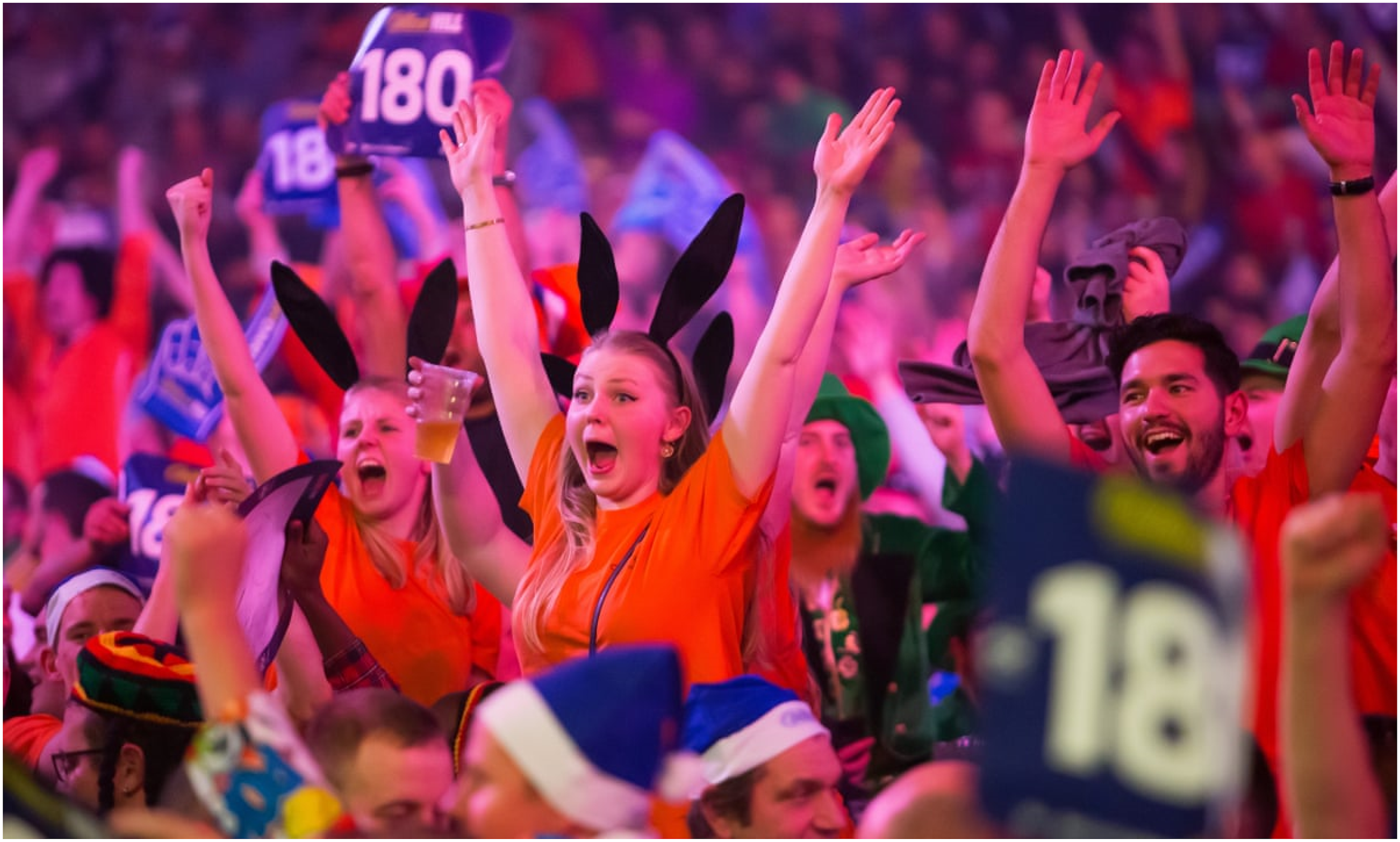
The PDC embraced the new fans that began to attend their events following the popularisation of the PDC darts circuit after the classic 2007 PDC World Darts Championship Final (see Davis, 2023) and decided, critically, to utilise the overt performances from these fans to help promote their events globally. In order to unleash prosumer fandom, advancing Mermiri’s (2009: 61) argument, there is a general recognition within the sporting industry that spectators need to be educated in precisely how to act as ‘participative consumers’ who positively ‘co-produce or shape’ the sporting event. In PDC darts, this starts with a person watching televised darts events to view/identify the variety of tools that the prosumer darts fans use to perform. By understanding what these tools are, the television viewer then understands what they need to use to co-create the spectacle. When the person then subsequently attends a live PDC darts event, they can then utilise a combination of the tools they have seen on the television events to demonstrate their prosumer fandom to the watching television audience. As W14, one of a group of seven fans dressed as Minions, explained during a conversation: Well, each year during the different events we see what the fans are doing on the TV – dressing up, waving the signs, singing, having a drink, the foam hand, all the lot. We knew when we came here that we would need to do the same thing. That’s why we’ve all come like this. There’s no point doing it half arsed is there!
The PDC, working with the broadcasters, have ensured that this practice became normalised during the 2010s – as the sizes of the venues have increased, the number of prosumer fans have increased. Jenkins (2006: 331) defined participatory culture as a culture ‘in which fans and other consumers are invited to actively participate in the creation and circulation of new content’. Whereas Jenkins’ (2006) explores participatory culture in regard to new media content, linked to Fuchs (2017), prosumer darts fandom is about physical participatory culture within an arena. The PDC, using the tools they provide within the darts arena, invite the prosumer fans to actively participate in the creation of the atmosphere at live darts events.
Each of Jenkins’ (2006: 7) five-pointed definition of participatory culture are evident within prosumer darts fandom – the PDC provide low barriers to artistic expression and civic engagement (1), providing the 180 signs, foam hands and musical cues, whilst encouraging the prosumer fans to create fancy dress to wear in the arena, and allow copious amounts of alcohol to be consumed. The prosumer fans, when using the combination of tools, show strong support between their peers and others in the arena – from the creation and use of fancy dress; to the singing songs/shouting chants together; to the creation of the 180 signs (2). There is mentorship for the first-time prosumer fans visiting a live PDC darts event (those who have only watched the PDC darts events on television) – the experienced prosumer fans will guide the new prosumers by instructing them in regard to what to wear, what they can write on their 180 sign, and when they should sing, chant, or rise to their feet in the arena (3). Most importantly, the prosumer fans believe that their contributions (use of the combination of the key tools) are a significant contribution to the PDC darts spectacle (4). The first author’s observations and conversations with the fans found that they feel a connection to others in the arena that use the combination of tools, particularly those who wear fancy dress (5). The prosumer fans also search for the Radio Frequency (RF) cameraman (to gain a chance to be displayed on the television) and some take pictures on smartphones in their fancy dress, which is evidence that they care what other people (television viewers, persons on social media) think about what they have created (5).
The prosumer fans also appear to care about gaining PDC and broadcasters’ acceptance, which is validated by actually being allowed to wear the fancy dress or wave their 180 signs, or by getting a cutaway of their outfits and signs displayed on the television broadcast. As M34 explained, they feel that their participation is valued and encouraged: The PDC let us take part, and they appreciate our efforts. That’s the difference. We can’t participate like this at football matches can we? Yeah you sing a bit and cheer at football grounds, but it’s not like this mate. Where else are you gonna get a constant stream of 2-pinters? The PDC know we like this, and they know if they let us do all this, us, the fans…we will properly get into it. Sky Sports look for it too. You see that cameraman over there [points finger] he is clearly instructed by the production team to find fans having a good time. The action is great, but they need the fans performances too, that’s what makes the event.
The prosumer fans are enjoying themselves combining the use of the tools in the freedom of an environment they believe they cannot find elsewhere in sport. As outlined within examples from other sports in this article, it is clearly evident that the key tools located at the live PDC darts events are found within other sporting venues. However, what is noticeable is that these are found only in specific tournaments or events within the other professional sports: in cricket, this is typically found at Twenty20 matches and specific international fixtures (see Morshead, 2019). In golf, this would be exemplified at just one hole across all of the standard annual tournaments – the ‘stadium hole’ (see Figure 2), the Par-3 16th hole at the Phoenix Open (see Bukowski, 2016), which is synonymous with tiered stands along the fairway and green, raucous cheering, and alcohol being consumed in large quantities and thrown onto the course at regular intervals if a hole-in-one occurs. Blimp picture of the Par-3 16th hole at the Waste Management Phoenix Open, Arizona, USA (Bukowski, 2016).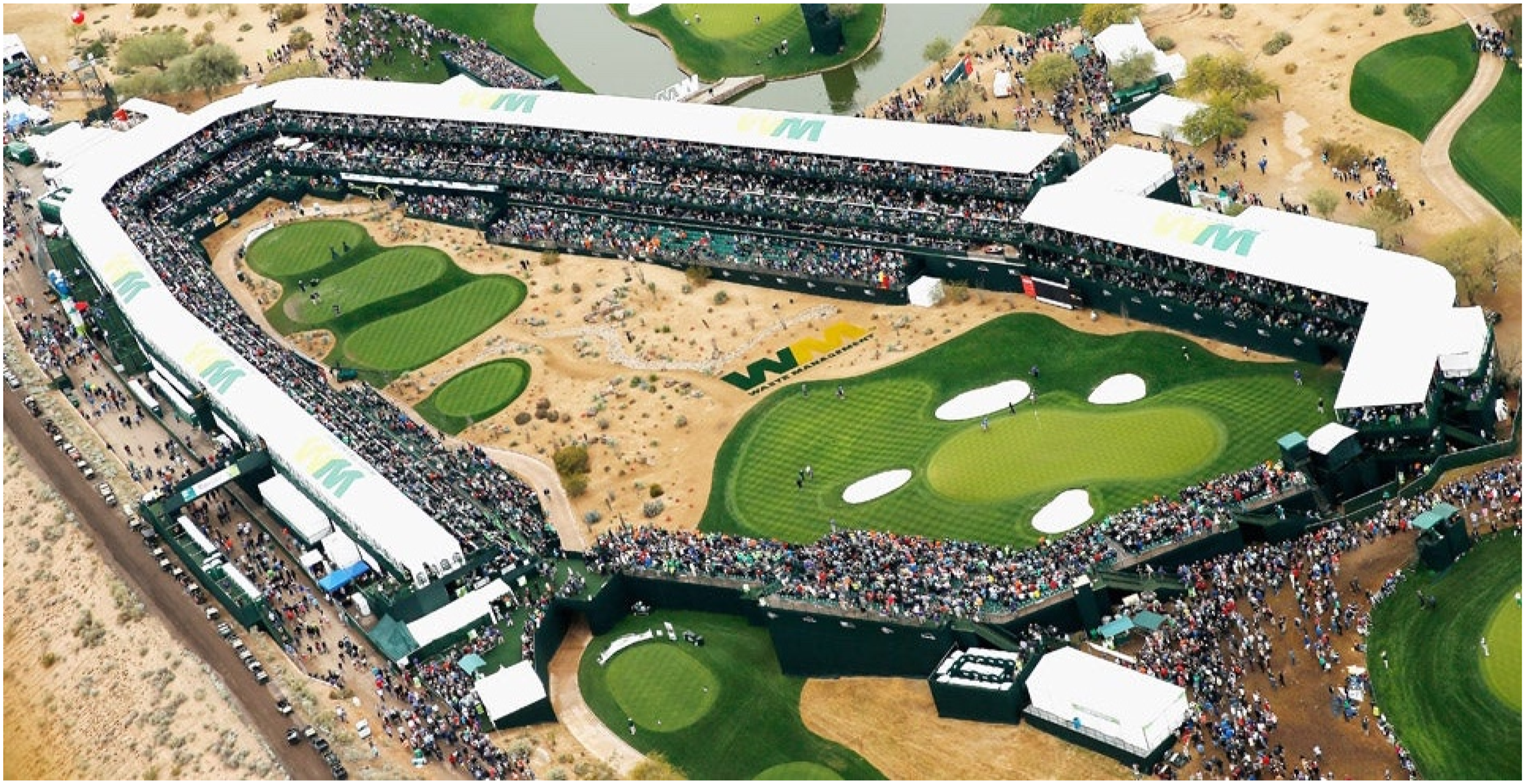
In rugby (both codes), again this is at certain derby matches or international fixtures, and within professional tennis, it can be stated that the overt use of PA music is only found at one of the four grand slams, the US Open, in New York, USA (see Chairusmi, 2014) and the season ending ATP World Tour Finals, but is prohibited at the likes of grand slams such as Wimbledon, held annually in London, which also bans selfie sticks, flags, rattles and klaxons (see BBC News, 2015; Wimbledon, 2019). What makes the live PDC darts events unique is that the key tools are not reserved for one specific tournament, and they are not only allowed to be used within a specific area of the venue. The key tools are found within all of the premier darts tournaments and can be used throughout the event, making the reliance on the prosumer fans performances even more critical for the PDC and broadcast media.
Concluding comments
Within this article, we have provided an empirical exploration of physical prosumer fandom at a live sports event. Whilst there has been recognition of physical prosumption within other spheres (Izvercian and Seran, 2013; Lang et al., 2021; Woermann, 2012), our study sought to begin to address the lack of studies into physical prosumer fandom in sport. Andrews and Ritzer (2018) encouraged scholars to research sport and prosumption, and this is the first study to fully embrace the concept of prosumption theoretically. Advancing Woermann’s (2012) empirical study, this is also the first study to explore prosumer sport in a professional sport setting.
Our ethnographic research revealed that the prosumer fans use a variety of the tools (see Davis, 2022b) in a very overt, expressive and excessive manner when demonstrating their fandom at live PDC events. Their performances when creating atmospheres involve a repeated cycle of atmosphere activation and atmospheric climaxes (see Hill et al., 2022). This is what the PDC and associated broadcasters have capitalised on to promote their version of live professional darts to prospective new fans to entice them to multi-purpose venues to co-create the spectacle. The televisual spectacle of the performances from the prosumer darts fans led to an increased interest in attendance at a live PDC darts event to sample the experience of the atmosphere, and with higher demand, this led to the sizes of the venues increasing across the PDC circuit over the last 20 years. The PDC are reliant on the performances from the prosumer fans, who embody the spectacle of a pub-based culture within a multi-use arena, to make the sport attractive to television viewers.
Footnotes
Declaration of Conflicting Interests
The author(s) declared no potential conflicts of interest with respect to the research, authorship, and/or publication of this article.
Funding
The author(s) received no financial support for the research, authorship, and/or publication of this article.
