



Abstract
This study aims to understand how Chinese audiences have consumed and engaged in BBC’s Sherlock as a transcultural fan with the help of digital media. Drawing on the transcultural and gendered fan studies and 36 qualitative interviews, this article interrogates Chinese Sherlock fandom within the hybridised transcultural flow of texts and identity. The key argument is that Chinese Sherlock fans have created a female-dominated fandom that updates the gendered fandom by enriching paratexts of Boys’ Love (BL) whilst China’s censorship has largely constrained fans’ homosexual productivity. On the one hand, the wide application of digital media technologies largely helps Chinese fans to access Sherlock transnationally and contribute to the global Sherlock fandom; on the other, the censoring mediascape in China has restricted fan prosumption, as erotic/homosexual fan work is not regarded as a canonical culture. This study thereby concludes, although Chinese Sherlock fans have been cultivated to circumvent the media censoring mechanism and produce fantexts outside China that features resistance power and fan intelligence, the compromised fan culture is understood as incomplete rebellion because Chinese fans have made concessions and the alternative choices are tacit by the national power itself.
Introduction
British TV has become a worldwide phenomenon that has attracted a great number of Chinese audiences, especially over the past decade (2010–20) when BBC’s Sherlock was introduced to China (Durrani, 2014). The first episode of the third season of Sherlock was viewed five million times within two hours after its debut, ‘making it the (Chinese) video-hosting platform Youku.com’s most popular TV programme ever’ (Evening Standard, 2014; Wales Online, 2014). From 2010 onwards, China witnessed a huge welcome of Sherlock among Chinese audiences and a growing number of significant British TV shows in China (e.g. Sherlock, Downton Abbey), however, the studies of British TV and its fan consumption in China are limited. Research has been undertaken to understand American TV audiences in China (Jiang and Leung, 2012; Liu, 2010, 2015), while Chinese fans’ engagement with British TV dramas is an academic gap without enough attention. I notice this academic gap and take advantage as a transcultural scholar to discover the Chinese Sherlock fans in this article because of its wide acceptance and awareness in China.
China ‘has experienced the extremely rapid proliferation of information and communications technology (ICT) that has given rise to new social networks with unprecedented power’ (Esarey and Xiao, 2011: 298). Due to the fast-growing Chinese online video industry, Chinese fans are able to access and view Sherlock and contribute to the global Sherlock fandom in the digital sphere. Digital media technologies speed up the progress of fan practices beyond national and cultural boundaries. Thus, my research relies on digital media to approach Chinese fans and focuses on their involvement with Sherlock on Chinese digital media platforms. To fully examine Chinese Sherlock fans, this study poses the following research questions: a). What kinds of demographics have been featured by Chinese Sherlock fans? b). How do Chinese fans transculturally consume and engage with Sherlock with the help of Chinese digital media? c). How have Chinese fans used Sherlock to circumvent particular censorship? To address the above research questions, I have collected 36 Chinese fans derived from my netnographic observation of six major Chinese fansites (Douban, Zhihu, Post Bar, Bilibili, Weibo and Lofter) for 18 months from March 2018 to September 2019 and snowballing strategy (Bertrand and Hughes, 2017) to conduct interviews via face-to-face, video and voice calls with the help of digital apps (mainly WeChat) from November 2019 to January 2021.
Taking the gendered fandom in the transcultural context as a starting point, I contend that Chinese Sherlock fans have created a female-dominated fandom that updates the gendered fandom by enriching Boys’ Love (BL)-themed paratexts 1 whilst China’s censorship largely constrained fans’ homosexual productivity. This study aims to contribute to the existing studies on fandom studies in three ways. First of all, theoretically, this study engages with Chinese fans from a female perspective by highlighting female fans’ erotic production. A close investigation of fan profession and motivation enables me to explore how the female-dominated Sherlock fandom has been formed and progressed. Second, empirically, it provides a case study to investigate the impact of local/Chinese media policies on fans’ practices. Many scholars have stressed the significance of fan productivity by examining media texts and fans’ interpretations of these texts (e.g. Chin, 2010; Jung, 2010; Chin and Morimoto, 2013). Little research has paid attention to the media landscape in which fans have been greatly cultivated and influenced. However, it is academically necessary to explore how the media landscape in China shapes fan behaviour and involvement, especially with a non-local media text. Third, many canonical studies focus on Anglo- or American-popular culture fans (e.g. Fiske, 1992; Jenson, 1992; Bury, 2005; Glasspool, 2012) while recent years have witnessed an increase in fan studies beyond the Western arena. Scholars such as Rahma Sugihartati (2020), Zhen Chen (2021) and Otávio Daros (2022) have explored the fan activities in Indonesia, China and Brazil to demonstrate the importance of non-Western fandom as one of the key debates in consumer culture. Thus, it is academically necessary to place this research within the existing non-Western production and further uncover the transculturalisation and diversity of fandom in an authoritative ecosystem.
Fandom in the transcultural context
The past three decades have experienced the expansion of fan studies as a vibrant interdisciplinary field (Ford, 2014; McLaren and Dal Yong, 2020). Early studies of fans attempted to situate fan audiences as legitimate objects of inquiry (Bacon-Smith, 1992; Fiske, 1992; Jenkins, 1992b; Jenson 1992; Cavicchi, 1996). Most academic scholars first arrived at fandom studies from a single cultural perspective such as Anglo- or American-popular cultures. For instance, Michel De Certeau (1984) and John Fiske (1992) studied how teenage fans of Madonna “used their own reading ‘tactics' to oppose and work against the culture industry’s strategies” (Busse and Gray, 2014: 427). The fan studies were triggered to discover fans’ practices within one particular cultural domain in one particular nation (Busse and Gray, 2014). With the development of globalisation and new digital technologies after the 2000s, fan consumption practices are embedded in globalised media systems – the recent criticisms of fan studies have pointed to the privileging of Western media and Western audiences (McLaren and Dal Yong, 2020), relegating studies of non-Western fans to the periphery of the discipline (De Kloet and Van Zoonen, 2007; Chin and Morimoto, 2013; McLaren and Dal Yong, 2020). As Chin and Morimoto (2013) argued, not only does the ‘national identity and transnational historical and socio-political context’ influence fannish transcultural engagement, ‘the gender, sexual, popular, and fan cultural contexts within which fans consume and create’ (p. 93) determine their participation. Over the past decade, more researchers turned to notice the transcultural affinities of fans’ participation behind the contexts due to the worldwide circulation of transnational media texts. Although there are different languages, geographical and cultural barriers, fans are willing to be active participants around the object of different cultural backgrounds because of their obsession and affect. Chin and Morimoto (2013: 95) confessed that fans, as well as scholars, were ‘hardly immune to the pleasures of being a fan’ and the affect as a pivotal role cultivated the pursuit of fannish activities across borders. This laid the solid foundation to underpin fans’ transcultural practices in the light of affective affinities/attachment.
The notion of affective affinities has been examined in different cultural contexts. Promkhuntong (2015) studies the discourses of pleasure and practices by fans of film director Wong Kar-Wai whilst Devereux and Hidalgo (2015) have explored Latino/a and Chicano/a fans’ obsession with Morrissey in Los Angeles, where a distinct hybridised fan sub-culture has emerged due to fan’s construction of a glocalised imagined community based on their identification and affinities with Morrissey (and his music) ‘in the contradictory, complex conditions of the US/Mexico borderland region’ (p. 211–12). ‘With the consumption of globalised and hybrid popular cultures among cross-border fandoms, interrogating not only the transnational but also the transcultural provides space for more nuanced forms of inquiry and deeper understandings of how fans consume, appropriate, and use fannish objects based not on a local/national identity but on identities mediated by various other cultural contexts as well as personal and community constructions of affective investment’ (McLaren and Dal Yong, 2020: 105). Thus, it is a signal and parameter for transcultural fandom studies to cover other underexplored cultural territories, such as Chinese fans of Sherlock, the target of my research.
Female audiences in fan culture studies
Fan studies are not only beyond culture but also imply gender. Fan scholars have noticed the gendered boundaries in fandom (Fiske, 1992; Jenkins, 1992a, 1992b) and ‘the distinction between the strategies of the powerful and the tactics of the disempowered’ (Gray et al., 2017: 9). Jenkins (2012) informed that most (media) fans were females with college degrees and were employed but underpaid in roles where they could not fully utilise their creative skills. Female audiences, therefore, were viewed as a disempowered group fighting for their interest in different forms of fan practices (Jenkins, 1992b). Janice Radway (1984), a leading scholar in media and cultural studies, groundbreakingly investigated 42 female readers of romance novels in Smithton (a commuter suburb of a Midwestern city) by using reader-response criticism. Challenging the literary critics of the 1970s and 1980s who had focused on the text instead of the reader, Radway (1984) explained that the Smithton women skilfully adopt reading strategies through which they make sense of romance novels in their own terms. They always linked signifiers with signified to meanings that resonate personally with themselves. More than that, reading helps women to escape the burdens and loneliness of housework and childcare and carve out their own space and time in a culture that demands them to nurture others and deny themselves. Radway (1984) thereby concluded that the reader has the ability to appropriate, poach and interpret on her own. Followed by Radway’s canonical interpretation, more cultural studies scholars turned to be reflective and analytical about female audience behaviour. Bacon-Smith (1992) explicitly focused on female fans of science fiction to present the process of fan initiation and training in reading within the female fan communities. It depicted several models around female fan communities and self-affirmation to adapt TV to their own purposes. From a female perspective, Bacon-Smith (1992) initially discussed slash fanfics as an active and resistant way to consume most TV shows that provided passive female images and consumer values at that time. Female fans are interested in slash writing for gender/social resistance, which has largely evolved as a way of affective expression as well as a longing for freedom and equality for women. As Yost (1994) argued, female fans who worked as slash writers love men and the homoerotic relationship between men for updated social status- they developed strong affection and mood for the cultural contexts about men. It has become a widespread genre of fan imagination and creativity to supplement the primary plots, other than a kind of statement on a purely personal experience of tragedies or unhappiness.
Female audiences/consumers gradually evolved as the main research object for fan studies. Joli Jenson (1992) argued that female fans made up for the lack of fulfilment in their lives with attention to fictional realities. They applied fan practices (e.g. slash fanfics) to replace an incomplete (interpersonal) relationship with an imaginative relationship and facilitated to compensate the relationship that may not be openly accepted in real life. Rhiannon Bury (2005) analysed two elite female online fandom forums of an American TV series The X-Files and the Militant RayK Separatists (MRKS), a space organised around an actor from the Canadian Due South series. She theorised collectivity in these forums as a gendered style of communication because female fans asked questions, listened attentively and politely offered supportive responses. Female participants who were the politest may perceive themselves as the ones with the least situational power. Such cases were rendered by fan scholars (e.g. Bacon-Smith, 1992; Jenson, 1992; Bury, 2005) to indicate that female audiences not only act as a constructive source for fan communities but a gendered indicator, which was similar to China’s (media) fandom. In China, female fans outnumber males in the fan communities from the most recent studies (Yang and Xu, 2017; Zhang, 2021) and turned out to be active prosumers. A significant number of female fans devotedly updated (sub)themes of fanfic writing with a focus on Boys’ Love (BL) in China, which pandered to fangirls’ interests in romantic or erotic relationships between male characters. Although female-dominated fandom distinguished itself by BL-themed paratexts, the ways and forms fans engaged in the official text and narratives varied- the slash fanfics used to be the mainstream of fan productivity, whereas the presence of BL-related narratives and discourses has largely shrunk in China under severe media governance, which will be contextualised and analysed in this research.
Methodology
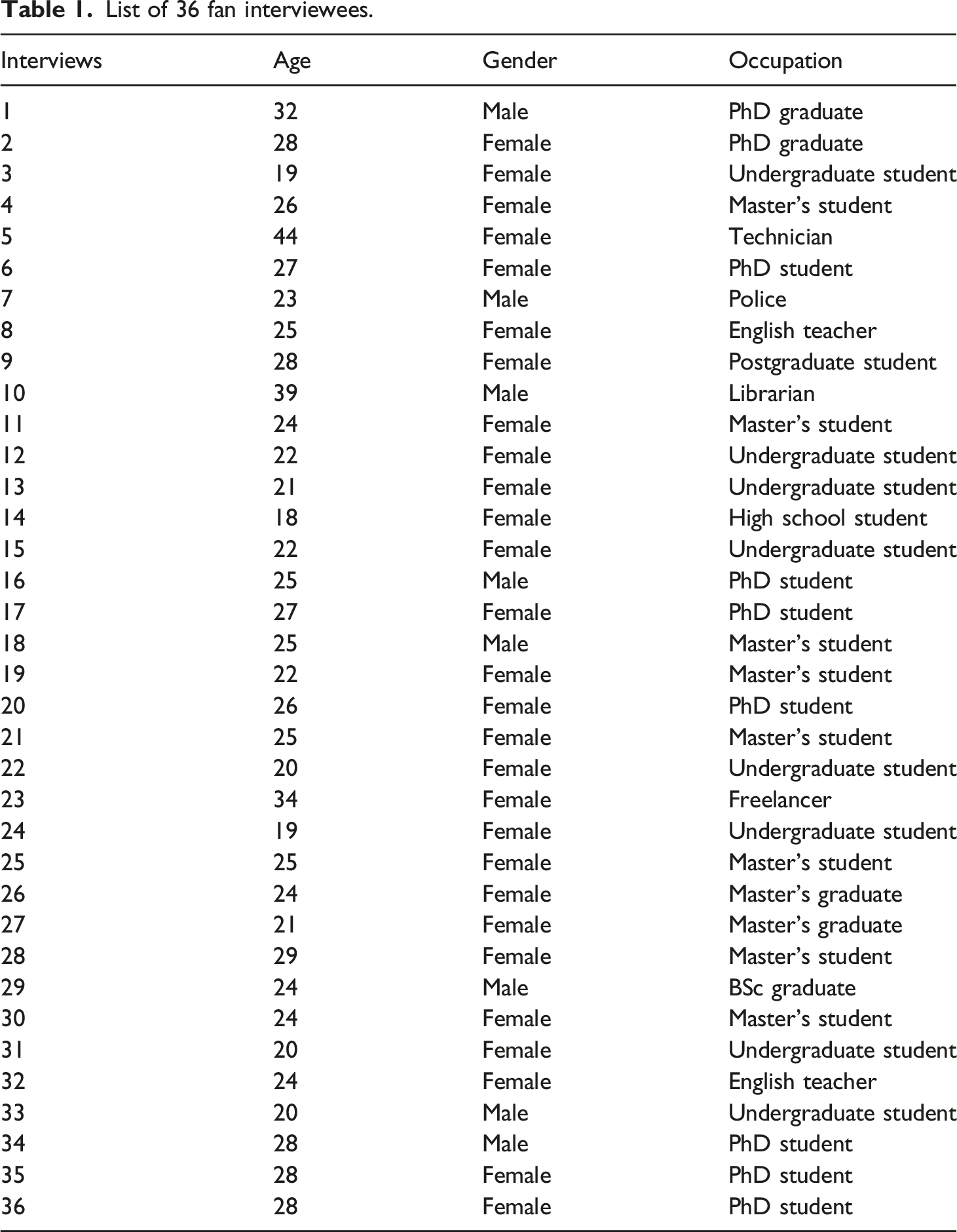
The methodology for studying and researching fans has been a focal point among fan academics. Scholars (e.g. Jenkins, 1992b; Bacon-Smith, 1992; Jenson, 1992) before the 21st century tended to research fans as a collective group/community whilst fans after the 2000s applied an approach ‘that connected the multiple ways in which an individual engages fannishly with different objects, intensities, and levels of community involvement’ (Busse and Gray, 2014: 429). In order to fully investigate individual identification and transcultural interpretation of BBC’s Sherlock by Chinese fans, qualitative interviews laid the foundation of analyses in this research, as they informed the relationship between the fans and the fan object by self-disclosure (Caldwell, 2009). I conducted interviews in depth that were obtained in three ways. The explosion of social media sites brought with it ‘exciting opportunities’ for studying fan communities (see e.g. Pullen, 2004; Hine, 2011) as well as the interactive process by which new media technologies are becoming an integral part of communication and ‘meaning-making’ (Kim, 2016). Those who uploaded frequent and/or welcomed posts with the most reviews, clicks and comments were firstly paid attention to as they were the active prosumer as well as fans of Sherlock, according to the fan definitions from Hills (2002) and Jenkins (2006a, 2006b). Based upon my netnographic observation from March 2018 to September 2019, I sent interview requests to the authors/uploaders of these posts to which a few of them responded. This method has its limitation to collect as many interviewees as possible because most authors were not digitally active anymore when Sherlock became a past TV show during the research. It finally helped to secure 15 interviewees. Due to the limited sample of the first method, I looked for other fans by sharing fan recruitment posts on major social media sites such as Douban, Zhihu, Weibo, Post Bar, QQ, WeChat, and even in my friend circle. The second way is not helpful to directly recognise fan identity for interviewees, so the only prerequisite for taking part in my interviews was to self-profess as a Sherlock fan. By this means, I collected another 16 interviewees. Although these two manners facilitated sourcing 31 interviewees, the Chinese Sherlock fandom was not only limited to the internet sphere and I hoped to expand the interview sample by a further degree. As Bertrand and Hughes (2017: 68) highlight, snowballing sampling is a process that ‘you find one person, who directs you to another, who in turn directs you to still others. This allows you to tap into kinship and friendship networks, which may be part of what you are studying’. Fan scholars such as ‘Zhang and Mao (2013), Sandvoss and Kearns (2016) have made full use of snowballing sampling to reach more fan interviewees’ (Zheng, 2019: 200). I thereby asked 31 interviewees to recommend Sherlock fans from their personal networks. By this approach, five more interviewees were managed (see Table 1).
However, snowballing has a similar concern to confirm fan identity as the second manner, I elaborately included the preset question in the interview as a benchmark to identify interviewees’ fan identity. All interviewees must have a ‘yes’ answer along with an explanation to preset questions ‘Do you think you are a fan of Sherlock? Why?’ to proceed with the interviews. Interviews are designed into a semi-structure of 34 questions with closed and open discussion from Part One- ‘general questions about watching TV habits’, to Part Two- ‘specific questions for watching British TV’, to Part Three- ‘specific questions for watching BBC’s Sherlock’, to Part Four- ‘specific questions for Sherlock fan practices’ to Part Five- ‘specific questions for being part of fan communities/groups’. The questions were organised from general enquiries about watching TV/BBC’s Sherlock to the specific commitment of being a Sherlock fan to uncover comprehensive aspects of fans’ watching habits and engagement practices. The interview questions were carefully considered and I approached and interviewed all fan interviewees in a natural manner, so the findings from each source are not divergent in terms of results. Nevertheless, I have to acknowledge that the ways to collect interviewees are not exhaustive and my identity as a female scholar tended to engage with more female fans (than males) who are highly educated and internet-fandom-community engaged. According to the data collection, 28 of 36 interviewees were women so the sample of male fans is not large enough to make claims about male viewers. My gender as a female researcher may make the male interviewees uncomfortable when mentioning any of the male-male erotism. Thus, the following analysis mainly focuses on female interviewees’ responses, to avoid possible biased interpretation from the small sample of male interviewees.
The interviews were conducted from November 2019 to January 2021, with an average duration of 62 minutes. All respondents had consented to take part in the project anonymously and agreed to the publication of the interview content after being informed of the objectives of this research. The interviews were audio-recorded, transcribed, coded and thematically analysed (Bryman, 2012). Based on my repetitive and careful reading of the transcriptions, the research identified recurring patterns and themes by the frequently discussed keywords and topics – (a). How female fans dominated Chinese Sherlock fandom and were involved with Boys’ Love-themed paratexts; (b). How media policies (e.g. censorship) in China influenced fans’ transcultural engagement and productivity with regard to homosexuality.
Female dominance- boys’ love (BL)/gay fans
Among all the collected interviews, only eight males partook in my interviews, accounting for less than 25% of the total interviewees (36). Twenty-eight out of 36 fans who responded to my interview call were female. The fan recruitment call was posted on different social media platforms with no preference for gender while the final data revealed the female-dominated Chinese Sherlock fandom based on the sample, which was differentiated from a ‘masculine-centred’ society (Bacon-Smith, 1992; William, 2001; Chin, 2010). Women overwhelmingly made up the Chinese Sherlock fan interviewees and impacted the fan relationship (Chin, 2010). From my interview data, all the loyal fans (6/36) were female who devoted themselves to active fan production, for example, slash fanfic writing. Their commitment to Chinese Sherlock fandom has been witnessed, which was highly appreciated by fan fellows. Those active fan producers not only nurtured the ‘intimacy and collaborative effort of the female fan community’ (Chin, 2010: 10) but also helped Chinese fans as non-native English speakers to overcome the cultural and language difficulties of developing and localising the original texts in an understandable way by creating Chinese fanfics about Sherlock. Gender played a huge role in Chinese Sherlock fandom so this section explores the reasons why more female (28) fans have engaged in the Sherlock fandom than males (8) in my research and how female fans have nurtured the Sherlock fandom because of the adoration of Boys’ Love (BL) that was about the male-male erotic and romantic relationship (Levi et al., 2014), along with the banning of homosexual elements on Chinese TV.
‘Boys’ Love is used to refer to male/male homoerotic texts, particularly manga, created by and for women’. (Pagliassotti, 2008: 222). It ‘is one of the largest by-and-for women sexual subcultures and a truly global phenomenon (Levi et al., 2014). While the content always on men in romantic and/or sexual relationships’ (Madill and Zhao, 2021: 563). ‘There is an ardent and vocal contingent of fans engaged in the culture of slash-the practice of producing and engaging with homoerotic storytelling’ (Hampton, 2015: 3). In China, slash culture was influenced by and imported from Japan in the late 1990s and expanded in the 2000s due to the increasing access to internet technologies. The fangirls of male/male fiction referred to themselves as ‘rotten girls’ (Galbraith, 2011) or ‘Fu Nv’ in mandarin (Wang, 2020). When it came to Chinese Sherlock fandom, the discourse determining its legitimacy and significance differed based on the gender of fans. Duffett (2013: 332) explained that ‘the same subtext of homoeroticism that might previously have been of interest to gay fans is useful to female fanfic writers who wish to put those characters in slash situations’. Chinese female Sherlock fans were the main force of fanfic production and interpretation of the original TV show produced by two “self-proclaimed Sherlock Holmes ‘fanboys' Steven Moffat and Mark Gatiss” (Hampton, 2015: 3). Although my sample presented the unequal demographics on gender, the percentage (92.8% females and 25% males) generally indicated the overwhelming advantage of female fans who enjoyed two male characters and male-male relationships. Female fans were inclined to understand the relationship between Sherlock Holmes and John Watson as homoeroticism. As some female fans informed, I am so fascinated by Sherlock Holmes and John Watson as they are very cool/handsome. Besides, you can see hints of their same-sex relationship from many details in the episodes, which deeply appealed to me. The two actors surprised me- they were fabulous!
2
IE-19 [a female fan who was doing her Master’s studies in the UK] I started to watch Sherlock because I glanced at the pilot of Sherlock before the first series. The pilot was about the two male characters and their homoerotic relations that attracted me first. It is touching, and I got my heartbeat from their close relationship. After then, I got stuck by their excellent performance and interactions with each other. You know, every scene between these two men in the episode can be screenshot as a wallpaper. IE-3 [a female fan who was doing her UG studies in China]
The above narratives indicated how Chinese female fans intended to view the pilot in a male-male erotic way and developed the spin-off products of Sherlock such as using their screenshot of two male characters as wallpapers [IE-3]. Chinese female fans expressly explained why they utilised the two male protagonists as the main object of their spin-offs-1. The actors’ excellent performances from Benedict Cumberbatch and Martin Freeman including actors’ lines; 2. The good looks of the two actors. 3. The two male characters and the hints of their homoerotic relationship in the series, which were pointed out by 26 female interviewees. No matter if it is a deliberate or unconscious setting, these three points were discussed in great detail and viewed as the most significant reasons for their obsession with Sherlock by female fans widely. Twenty-two female interviewees supposed it was a designated setting by the TV producers who aimed to attract more female audiences. However, behind the evident reasons, the hidden cause of fan favour for the two male characters’ relationship is the ban on TV production for homosexuality in China, especially for gay depiction (Ellis-Petersen, 2016). Chinese censors have released regulations for content that ‘exaggerates the dark side of society’ and have deemed homosexuality, extramarital affairs, one-night stands and underage relationships as illegal on screen. It caused uproars among millions of Chinese viewers (Ellis-Petersen, 2016). The suppression of same-sex orientation, on the contrary, stimulated fan interest in media texts with hints of homosexuality. Although not all female fans positively engaged in the (re)production process of spin-off products about Sherlock, their interpretation of Johnlock 3 can be read as ‘a way of taking control of the text and its meanings’ (Chin, 2010: 11), even if the show itself did not explicitly feature or indicate this homoerotic relationship.
Female fans focused on the sexually inflected male relationship played up in the series. Stein and Busse’s (2014) research about transmedia Sherlock fans had similar findings, suggesting Chinese fans have shared similar attitudes and pleasures from the text. ‘The homoerotic subtext of the series is one of the most explored themes in Sherlock fan fiction’ (Stein and Busse, 2009: 53). ‘The way in which Sherlock and John are frequently mistaken for lovers […] clearly acknowledges the potential for slash in their relationship, addressing the program to fan communities who appreciate slash, and referencing the swathe of prior slash fiction which features Holmes and Watson’ (Steward, 2014: 141). Chinese female fans focused on male sexuality from Sherlock to develop fan paratexts and were never stingy with words of praise about this setting. The sexual tension between Sherlock Holmes and John Watson touches me. I highly appreciated the setting of two male characters and am eager for this kind of kinship in real life. They are too masculine! Homosexual love in Sherlock was one of the key reasons that inspires me to work on related paratexts such as drawings and videos and wait for the following seasons. IE-11 [a female fan who was an English teacher in Beijing]
Female interviewees underscored the relationship between Sherlock Holmes and John Watson and the setting of two male protagonists to feature their continuous obsession towards Johnlock. They particularly addressed the same-sex relationship of a romantic or erotic nature, such as sexuality or gay as a way to express their longing for the freedom and equality of sexual orientation. Female fans have been highly appreciative of the intentional design of intimate behaviour between two male characters that hinted the homosexual instead of homosocial relationship, distinguished from previous scholars such as Jenkins’ (1992b: xviii) argument that, the industry’s address to male fans reflects the male producer’s intuitive understanding of what fans want to see and thus diversifying who produces media can help diversify the kinds of media produced. Of course, it remains to be seen if these women will have the same freedom to proclaim the fan investments their male counterparts now take for granted or whether they are still under a lot of pressure to demonstrate their professionalism and are not ‘simply fan girls’.
This has been answered and further validated in fandom studies after 2000. As Chin (2010:10) argued, ‘LiveJournal, for instance, is often conceded as a fandom space for female fans’ cultural production (Busse, 2006; Driscoll, 2008; Senft, 2008)’. Female fans utilised the digital space to ‘perform identity’ (Busse, 2006: 209), which resonated by (Driscoll (2008: 199) that the people he ever worked with for LiveJournal communities were almost always women. The female-dominated responses towards my interview provided further evidence for this argument. There was indeed female space for Chinese fans to discuss and share fan production and creativity about their fanned objects, while Chinese fandom space was not as free as that outside China, for example, LiveJournal. Chinese female fans’ relationship with the text was a personal, emotional, individual reading of the text-they wanted to have a personal intimate relationship with Sherlock, the text, the characters and the relationship Holmes had with Watson because Chinese female fans were inclined to work through the gender issues around sexuality and identity and how they felt about themselves. ‘It is much safer to discuss homoerotic issues in my private circle as it is a sensitive topic in the Chinese digital sphere. But I really enjoy understanding the male sexuality as it is the most attractive point from Sherlock’ (IE-4, 7, 12). This is a classic feminist reading of a female fan’s relationship to a text they are obsessed with, which also raises a sense of communality for being a fan of Sherlock. Here the interpretation emphasises the autonomy and freedom for female fans to deconstruct a text and reinterpret the narration as they like, especially in face of the gay-sex connotation from Sherlock.
In China, there has been ‘blanket ban on sexually-explicit material and strong disincentive to acknowledge same-sex relationships in public media’ (Zhao 2016, cited by Madill and Zhao, 2021: 563). An increasing number of Chinese female fans turned to obsess about two male protagonists in a private circle because of the tightened censorship on homosexuality. Different from what Chin (2010: 12) argued that this genre of fan fiction has become synonymous with fan cultural production as most fan scholars from Bacon-Smith (1992) and Penley (1997) to Busse (2006) view slash fiction as-among other things-an act of (fan) rebellion against traditionally masculine and patriarchal (commercial) culture, exercised largely by heterosexual women.
It seemed not possible for Chinese fans to take action, especially in extensive and large-scale ways, for the rebelling against masculine and patriarchal culture; instead, they showed their resistance via breaching the firewalls 4 and reproducing paratexts on a small scale to fight against the ban of the homoerotic presence in China’s internet sphere.
Prohibition of homosexuality in China’s cyber culture
The majority of explicit same-sex narratives on Chinese websites (including fansites) have been disastrously impinged on by Chinese authorities in the past decade (Wang, 2020). Two female fans of my interviews produced slash fiction of over 100,000 words about the development of homosexual relationships between Sherlock Holmes and John Watson. Due to the prohibition of same-sex relations at home, they breached the firewalls and archived it on Archive of Our Own
5
(AO3), which was only shared privately with close friends and fan peers. According to my sample, Chinese female fans of Sherlock were eager to read/watch homosexual texts against China’s censorship that forbade homosexuality. Such content has been only implied in Sherlock because the mainstream culture and media texts in China were not allowed to have explicit materials about homosexuality. These readings/viewings were a form of subcultural resistance practices (Jenkins 1992b; Abercrombie and Longhurst 1998; Scodari, 2003; Burr, 2005) that positioned Chinese Sherlock fans on the periphery. They were not accepted by the mainstream culture and media system in China, which led to a compromised Sherlock fandom in China. According to the General Regulation of Television Production (GRTP, Sohu News, 2016), co-drafted and co-enacted by China Television Production Committee (CTPC) and China Television Drama Production Industry Association (CTDPIA) in 2016, The TV producers and companies cannot include and present any abnormal sexual relationships and sexual behaviour including incest, homosexuality, parasexuality, sexual assaults, sexual abuse, and sexual violence on TV. [translated by the author]
This regulation has aimed to restrain and standardise the content and process of TV production in China. It has been used as a criterion for all TV producers and companies to comply. Among all the terms and clauses, homosexuality was a controversial point thereinto. Chinese fan interviewees showed different attitudes towards homosexuals as a certain number of them viewed it as a normal and natural sexual orientation along with heterosexuality. It has also greatly impacted fans’ online production because Chinese netizens were not allowed to publicise any production related to homosexuality, according to the Content Censorship of Audio-visual Programs on the Internet (CCAVPI, Sohu News, 2017) enacted by China Netcasting Services Association (CNSA) in 2017. CCAVPI banned any internet presence of ‘abnormal’ sexual relationships and sexual behaviour, including incest, homosexuality, parasexuality, sexual assaults, sexual abuse and sexual violence from plots, actors’ lines, subtitles, characters, music, etc. Because of this, one of my interviewees who used to be an active fanfic writer complained, it was too tough to read and produce paratexts related to homosexuality in China. Rigorous censoring rules applied to cyberspace since 2016. Online writers are not allowed to describe any sexy elements in her/his writing. For instance, if you mentioned a body part below the neck, it must be deleted; otherwise, it would be shielded. I attempted different platforms at home such as Lofter but failed. IE-35 [A female fan who was doing her PhD in the UK]
The complaint evidenced the cultural governance from Chinese authorities because National Radio and Television Administration (NRTA) and the Cyberspace Administration of China (CAC) have forbidden the presence of homoerotic romance and homosexual relations in cyberspace. The ban on the presence of homoerotism was viewed as an emblematic of cultural governance and authority from Chinese authorities. This complaint also indicated the dilemma of fan production in China due to the institutionally sanctioned webmasters
6
who dominated the public domain to some extent. CTPC and CNSA are for coordinating and managing TV and internet-related stakeholders, companies and affiliations in China. It is a struggle for us fans who enjoy LGBTQ literature (gay culture in particular) to post something online in these areas as this kind of culture is not advocated by the authority. Meanwhile, it is tough for us to post any content about homosexuality, which is a heated topic among Sherlock fandom in China, especially for female fans. IE- 26 [a female fan who was doing her Master’s in Australia]
The above interview revealed the difficulties of fanfic production in Chinese Sherlock fandom. My interviews showed that all the fanfic writers (6/36)
7
in my research were women with straight sexual orientations. They all enjoyed making stories about male/male relationships after watching Sherlock, seeing slash as compensation for those who could not be satisfied with the original text itself (Green et al., 1998). Fanslash is an implicit method for female fans to express dissatisfaction with patriarchal social institutions. However, as a female fan in China, they were not able to challenge the patriarchal and male-dominated society in the name of strict censorship and powerful authorities as a minority group. The only thing they could do was to attempt different methods to elude the policies and find ways to protect the freedom and creativity of their fanfic production. We do not dare to challenge the webmasters and authorities, so we have to employ a diversity of memes, gifs, pinyin and English to avoid the direct expression of homosexuality in case of censorship. This is also a way to reduce the possible deletion of our fanfic writing. IE-15 [a female fan who was doing her undergraduate studies in Xi’an]
Fanfic writers in my interviews tried different digital spaces such as Weibo and Lofter
8
for free slash discussion, circumvented sensitive words about gay and homosexuality in Chinese, and replaced them with other methods of expression (memes, gifs, English, pinyin, etc.) (IE-14, 15, 22, 23). However, due to the increasingly tightened censoring mechanism, all the fanfic writers had to reduce the updates of slash fiction and four of the fanfic writers even suspended the fanfic production about Sherlock. The female-dominated Chinese Sherlock fandom experienced the move from a relatively free environment of slash fiction production to the strengthened censorship of fan writing about same-sex relationships at home. Nevertheless, these fans did not intend to be submissive; instead, they developed a compromised Sherlock fandom in China, especially towards the Sherlock fanfic/slash culture under censorship. There is an evolving process in my slash fiction production. I’d love to share the Boys’ Love/Couple-oriented writing after watching Sherlock. At the very beginning (before 2014), we were allowed to post our writing about porn and gay texts on the two major fan writing spaces in China, Jinjiang
9
, and Qidian
10
. Later on, the censorship becomes severe, so I have to turn to other websites outside China for publication such as Archive of Our Own (hereafter “AO3”). However, AO3 has been banned in China now. We, fan producers, feel exhausted and struggling to continue producing paratext for our peers. While the slash fiction writer in China is still a small group, especially for Sherlock fandom, we find other ways to connect and “talk” with counterparts outside China. IE-25 [a female fan who was doing her Master’s studies in the UK]
List of 36 fan interviewees.
Conclusion
This article has analysed 36 Chinese fan interviewees’ responses about their engagement with Sherlock. In critically examining the formation of Chinese Sherlock fandom and fans’ self-confession of fan practices, this research has contoured a female-dominated Chinese Sherlock fandom in the transcultural context by enriching BL-themed paratexts of two male characters. However, China’s media landscape largely limited fans’ homosexual production, particularly as expressed in an authoritative ecosystem. To reduce the possibility of being censored, Chinese fans attempted different methods such as memes, gifs, pinyin and English to elude the policies and find ways to protect the freedom and creativity of their fan productivity. The findings of this study provide theoretical implications to underscore the fan power and intelligence to circumvent cultural governance and develop resistance subculture through paratext production with a British media text. This article has identified three patterns from fans’ self-confession of their practices with Sherlock- (a). Female fans have dominated the Chinese Sherlock fandom and engaged with the transcultural fandom in their peculiar ways of erotic/homosexual production; (b). Chinese Sherlock fans have been largely constrained in their fan productivity at home due to media censoring mechanism whilst extending their practices beyond the firewall; (c). Chinese Sherlock fandom evolved into a compromised fan culture – active outside (China) production, passive inside (China) consumption.
Although Chinese Sherlock fandom features resistance power and fan intelligence to circumvent the constraints at home, the compromised Sherlock fan culture is understood as incomplete rebellion as Chinese fans have not fought for fan identity and/or rights as a collective community from my sample. They neither showed initiative nor motivation to cultivate fan-fan relationships with existing or new fans for fan loyalty, power independence and collective reflection. What they have done is part of the submission to the predicament constructed by the media industry and national authoritarianism – fans living in an authoritative state consider that they have spared no efforts to find alternative ways for extending their fan communities beyond national boundaries; however, they have made concessions since their choices are tacit by the national power itself.
Previous studies about transcultural fandom have largely focussed on the interpretation of fan practices and their affective affinities with the media texts (Jung, 2010; Chin and Morimoto, 2013; Han, 2017; McLaren and Dal Yong, 2020). My research contributes to the existing literature in the field of fan culture studies by evaluating the intersection of fan behaviour with an overseas IP and the cultivation of the local media landscape. Given the case-study nature of my research, the findings do not intend to provide a grand narrative of transcultural fandom in contemporary China. Yet, these findings have shed light on the intertwined impacts on transcultural fandom by unravelling the fan interpretation and media policies in a non-Western context, which helps us to recognise the dynamic relationship between fans and censorship. The outcomes of my research enable us to critique the influence of authoritative governance on fan behaviour and fan response to network supervision, especially in the digital media era.
Footnotes
Acknowledgements
I show my sincere thanks to Joanne Garde-Hansen and Pietari Kaapa for their comments on the previous drafts and their advice on this project.
Declaration of conflicting interests
The author(s) declared no potential conflicts of interest with respect to the research, authorship, and/or publication of this article.
Funding
The author(s) received no financial support for the research, authorship, and/or publication of this article.
