



Abstract
Previous research on fashion, clothing and accessorising practices typically stressed either the symbolic and identity-creating or practical and habitual functions of fashion, often neglecting its affective, emotive and mnemonic aspects. Drawing on affective theory and the agency of things, we theorise how the affects, feelings and emotions attached to active and inactive fashion objects evoke and are evoked by the consumer’s ongoing reminiscence, reconciliation, and renewal of memories. Remapping the intricate relationship among consumers, memory, affect, and fashion objects, this article employs wardrobe study interviews to reconceptualise the clothing consumption, storage and disposal practices of male fashion consumers in Hong Kong and their trans-temporal self-memory-object relationships. Interviewing 21 gay male participants while physically going through their wardrobes together reveals the mnemonic abilities of clothes and accessories to bring up the past, their functioning as emotive devices, and the process of how affective, unpatterned feelings and sensations are reminisced, reconciled and renewed through fashion. These unique theoretical and methodological approaches make it possible to delve deeper into consumers’ intimate material and sensual relationships with clothing and accessory items, which are often used to make sense of incongruent memories and future fantasies, also enabling their ongoing mediation of unresolved affective experiences and curation of a linear cultural script of personal development.
Keywords
Introduction
Henry, living in a Hong Kong public housing estate for his whole life, is a 40-year-old model, videographer and violin teacher. He shares a 30 square-meter flat with his younger sister and a cat. To make best use of the little space, Henry’s clothes and accessories are stored away systematically in different places. His underwear, loungewear and sports clothes are tucked in the drawers under the bunk bed in one corner of the bedroom-slash-living room. Blazers, winter coats and other rarely used items are stored in a wooden wardrobe inside his late mother’s tiny bedroom. Working three part-time jobs, the ‘slasher’ still has little spare money for fashion, so for special events, he sometimes borrows formal wear from his friends. Once a year, Henry and his sister sort out and donate old, idle clothes to the Salvation Army. Yet, Henry still keeps his high school uniform and its necktie, both untouched since graduation over two decades ago. Wrapping the sleek fabric emblazoned with his school’s crest around his fingers, unexpectedly, the touch of the necktie evokes vividly the faces of his dear high school friends, the extensity of the long hallways, his popularity among his peers and his still open career path back then, Henry utters (Figure 1). The sapphire stud earrings.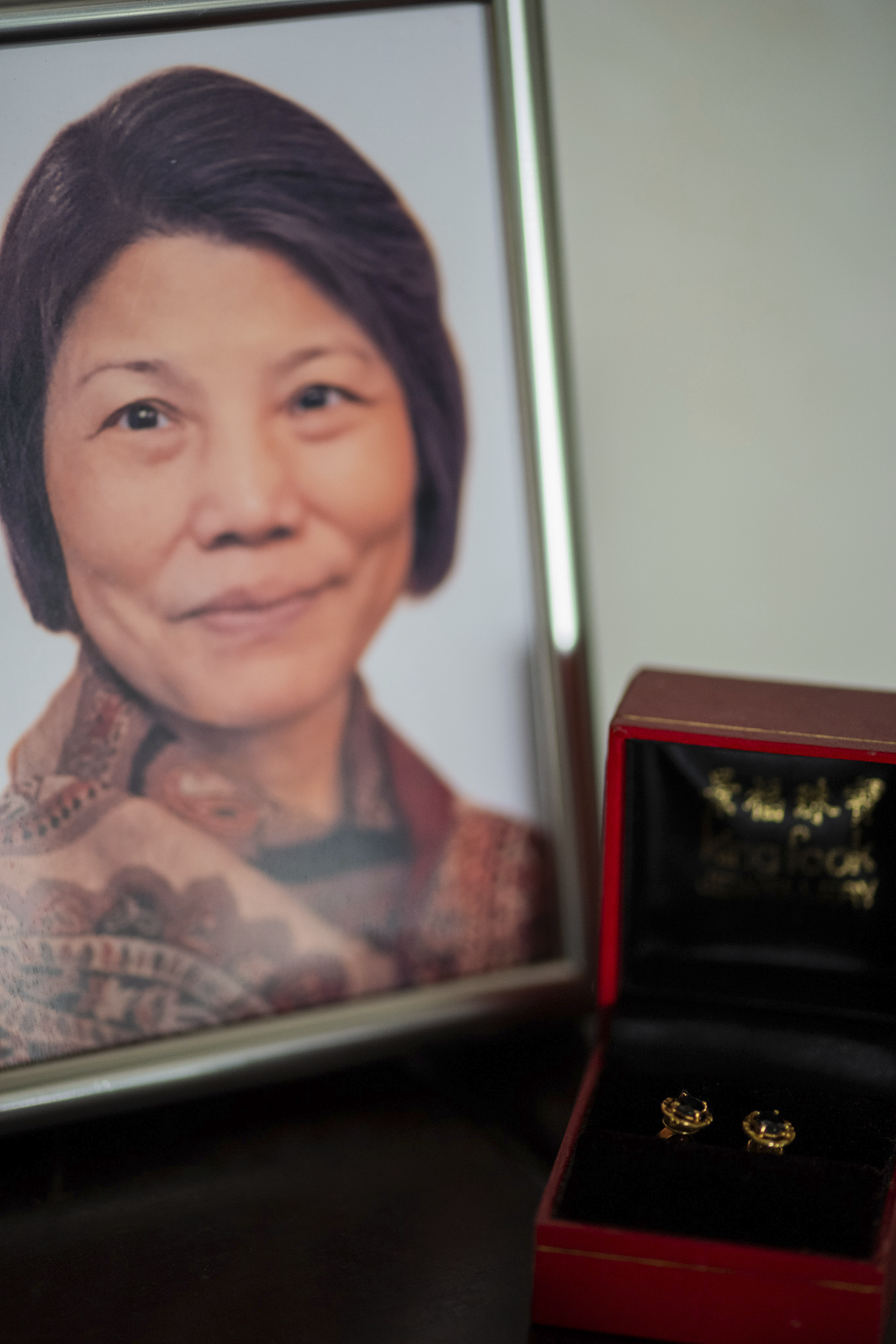
From a drawer Henry then carefully takes out a set of sapphire stud earrings mounted on black velvet in a little gold-accented red box, which he revisits often. ‘She [mum] only had a few pieces of accessories, but this pair of earrings she frequently wore. After she passed away [two years ago], I sometimes wear them when I need a source of power to support me, like when I have an important casting or a grand event to attend’. Henry’s bubbly demeanour changes and his voice becomes tender: ‘I feel like my mum is here to watch over me, or sometimes, I would want to bring her [earrings] along to witness some moments together’. Like his necktie, the earrings hold a special place in his wardrobe: ‘Most of her clothes are either donated or discarded, but we did keep a few special items, the ones we will continue to hold on to’.
Henry – like many of us do – keeps and uses specific clothing and accessory items for emotional reasons. Through them, we reminisce good memories, reconcile difficult emotions from the past, and renew the relationships and experiences they stand for from time to time. The actual pre-cognitive, pre-biographical and pre-social affective experiences that are shaping one’s personal feelings and social emotions when being dressed/accessorised, however, cannot be adequately explained by the two major current strands of scholarship on consumer culture, namely the culturalist and the practice-theoretical approach (Tse and Gheorghiu, 2022). As Smelik and van Tienhoven (2021: 164) point out, ‘the emotional connection we establish with [clothing and accessory items] is often mediated by the embodied affective experience that precedes it [emphasis added]’. The problem of the culturalist approach lies in its overemphasis on fashion consumption as a potential platform for symbolic articulation of agent-consumers’ preferred identities towards others, leaving its non-rational, sensory aspects ‘implicit, glossed over, unexplored’ (Ruggerone, 2017: 574). For the practice-theoretical approach, it narrowly focuses on the material, routine, practical and ordinary features of consumption, leading to its disentanglement from broader sociological concerns and critical orientations (Evans, 2019) and its ‘theoretical imprecision, methodological eclecticism, potential political conservatism and the difficulties with application to policy’ (Warde, 2014: 289).
This study aims to provide a more comprehensive yet contextualised theorisation of fashion and clothing consumption beyond macro-structural forces (i.e. understanding clothes as ‘signifiers of structural variables such as class, gender, race and status’ (Ruggerone, 2017: 574)), meso-social practices, and micro-individual capacity. Amid the ‘affective turn’ of cultural and fashion studies (e.g. Petersson Mclntyre, 2021; Ruggerone, 2017; Smelik and Van Tienhoven, 2021),
Scholarship in fashion consumption – bridging the symbolic, pragmatic and affective
Existing scholarship predominantly adopts culturalist or individualist approaches in studying fashion consumption and clothing practices as autonomous identity construction and symbolic communication (e.g. Barnard, 2002; Zukin and Smith Maguire, 2004). In response, Van der Laan and Velthuis (2016) criticise the overemphasis on late-modern consumers’ individual agency in playing with identity through clothing practices like ‘style surfers’ (2016: 23). This approach neglects the endurance of other values such as daily routines, material needs and practical considerations of getting dressed (e.g. Pellandini-Simányi, 2016; Woodward, 2007), as well as macro-structural constraints and traditional identity sources, such as class (Rafferty, 2011), gender and religion (Entwistle, 2000; Karademir-Hazir, 2020), body type (Sassatelli, 2011), or sexuality and occupation (De Casanova et al., 2016).
Rafferty (2011) examines connections between self-fashioning practices and emotions, wearers’ habitus, as well as behaviours and choices reflecting class positions. Karademir-Hazir (2020) discusses clothing as an embodied practice and analyses the link between Turkish women’s appearance-driven experiences and wider class-cultural processes. Sassatelli (2011) explores how everyday clothing can be utilised and appropriated to negotiate different perceptions of the sexualised body and normative standards of beauty. De Casanova et al. (2016) detail white-collar men’s self-understandings of ‘metrosexuality’, and how fashion styles not only act as forms of conspicuous consumption, but also play pivotal roles in forging workplace relationships between males of different sexual orientations. These more recent approaches offer a more holistic analytical lens in studying how the symbolic, material and affective facets of clothing consumption interact.
Fashion, affect and memory
While studying consumers’ emotional attachments to fashion and clothing items are nothing new in consumption studies, the focus has been primarily on how media advertising triggers immediate and identified psychological sensations such as happiness, love, contentment, excitement, self-esteem, pride, empathy and nostalgia, and encourages consumers to register to these emotional appeals and narrative persuasion to eventually engage in consumption (e.g. Kim and Sullivan, 2019; Phillips and McQuarrie, 2010). This behaviouralist or psychological approach assumes a docile role of consumers under the control of external stimuli in their emotional attachment to the material objects. In sociology and cultural studies, it was only recently that concerns about inner feelings and emotions in the consumption and use of fashion emerged (Ruggerone, 2017). Even the seminal work of Entwistle (2000), which goes beyond a macro-structural perspective and addresses the complexities and heterogeneity of everyday dress practices as an embodied experience, ‘still fails to address an important element of the body-dress compound: the affective practical experience of the clothed body in space’ (Ruggerone, 2017: 577) and does not adequately consider ‘the bodily, non-rational and non-individual processes that shape life’ (Leys, 2011). Smelik and van Tienhoven further advocate for an ‘affective methodology’ (2021: 168) focussing on the materiality of fashion objects, ‘the embodied experiences, feelings and emotions that play a key role in our relationship with fashion’ and in particular, how such emotional connections are ‘mediated by the embodied affective experience that precedes it [emphasis added]’, which are often ‘located outside the realm of representation and language’ (2021: 163–164). While we find the affective approach productive in theorising fashion consumption and destabilising a hierarchical subject-object relationship, we argue that memory – situated somewhere between the subject’s conscious self and the material fashion objects – also plays a vital role in mediating the relationship between the two. In other words, how the affects, feelings and emotions attached to fashion and clothing objects – both active and inactive – evoke and are evoked by
We argue that the ongoing affective and emotional exchanges between consumers and the material fashion objects they consume often go beyond the moment of acquisition, constituting trans-temporal human-object relationships. Arguably, these ‘objects’ play an important role in (re)shaping how significant life events are/were experienced, remembered and felt. Brown’s (2004) concept of ‘thingness of objects’ can be used here to describe how fashion and clothing objects become ‘mnemonic things’ and are gradually imbued with memory. These ‘things’ have rubbed up against the human in a memorable way over time, and the process creates traces of past experiences with and held within them, eventually becoming part of a meaningful ‘mnemonic assemblage’ (Freeman et al., 2016: 5). Rather than being stored in the consumer’s mind, these memories have been relocalised into the clothing and accessory items, which function as an ‘external memory cluing’ system (Zijlema et al., 2019: 378). Woodward and Greasley (2017) have shown that looking at wardrobes and music collections as personal assemblages – that include both ‘things at rest’ (Banim and Guy, 2003) and items for daily use – gives a more complete understanding of contemporary consumption. These assemblages are ‘temporally dynamic’, creating a ‘personal form of personal biography’, which are regularly revisited and rearranged, taking elements of the past to shape the present (Woodward, 2007; Woodward and Greasley, 2017: 671–672). Hoskins (1998) further explains that ‘the object is not only a metaphor for the self but a pivot for reflexivity and introspection, a tool for autobiographic elaboration, a way of knowing oneself through things’. Building along these lines, we emphasise the importance of sidestepping the subject-object dualism by looking into the agency of (active and inactive) things and how they are invoking and reassembling memories.
Things remember us: The agency of ‘things at rest’
Fashion ‘things at rest’ (Banim and Guy, 2003) stowed away in one’s wardrobes and clothing racks are not necessarily separated from daily social practices but kept for a range of different reasons: some are primarily valued for their utilitarian qualities; some for the symbolic or personal values they represent; some merely ‘superficially [touch] the memory and [evoke] mainly semantic knowledge regarding the associated events’, and some are filled with vital memories that ‘reflect the personal self and personal relationships’ (Zijlema et al., 2019: 379). Significantly, the difference between a memory inducer and a general object is often blurred, as the role of an item can switch between a utilitarian role and a memory inducer (Zijlema et al., 2019). These vital memories embedded in things
The linkages between memory, the material world and spatial configurations should not be perceived as immediate, direct, static, permanent, neatly defined, or easily retrieved by the subject. In memory, ‘the past, present, and future take turns in the lead’ and resist strict choreography (Freeman et al., 2016: 4). As ‘our main depository for the past while our internal experience of memory declines’ (Freeman et al., 2016: 5), the
Methodology
Wardrobe studies are a research method that helps to uncover the real, dynamic, and unpredictable lives of consumers and their relationship to their clothing beyond the point of purchase, thereby contributing to a more diverse and holistic understanding of the fashion system (Fletcher and Klepp, 2017). The goal of these object-based interviews and observations is to delve deeper into consumers’ sensual and habitual relationships with clothing and accessory items, also to concretely verbalise and visualise the underlying reasons for acquiring, appropriating, keeping and abandoning items by making use of the sensual quality of clothes, as ‘clothing matters not only through its visual appearance but also through its smell, touch and sound’ (Woodward and Greasley, 2017: 666). These aspects can evoke memories and emotions in a way that is hard to achieve in a typical language-based interview setting (Woodward, 2007). Recently, wardrobe studies have, for example, been used to explore the real-life complexities of sustainable fashion consumption (Heinze, 2021) and the daily dressing practices of young Dutch heterosexual men (Van der Laan and Velthuis, 2016). They have also been fruitfully employed to approach peoples’ affective relationships to their clothes (Almila and Zeilig, 2021; Petersson McIntyre, 2021). None of these studies, however, uses wardrobe interviews to systematically examine the way how fashion objects, memory, and affect interact with each other to affect consumers and continuously transform their understanding of selfhood. For this project, the researchers spent time with the participants in their bedrooms, dressing rooms or living rooms, documenting and classifying the active and inactive items in their wardrobes, and questioning them about their choices and the stories behind specific items. While active clothing consists of ‘work clothing and clothing worn often or habitually’, inactive items include ‘unworn and formerly worn clothing’ (Woodward, 2007: 45).
Compared with previous studies of fashion consumption which primarily focus on female, heterosexual and Western consumers, the uniqueness of our sample lies on its focus on male, gay and Hong Kong Chinese consumers, groups that are comparatively neglected and scantly studied. As an important and growing market, fashion consumption in Greater China has been discussed from a variety of perspectives. The Chinese special administrative zone of Hong Kong, however, has been rarely examined in relation to fashion. As a former British colony and global financial centre, the city’s ambiguous cultural and political identity (Choy, 2006) also extends to dress and consumption (e.g. Chan, 2000; Joy et al., 2020). Apart from the context of this socio-political peculiarity, Hong Kong fashion consumption, and especially fashion consumption among Hong Kong gay men (Kong, 2011) is still underexplored. Likewise, Barry’s (2018) wardrobe interviews with Canadian men from diverse ages, races, ethnicities, and sexualities through which he explored how they present different masculinities through dress and a study of gay male fashion consumers from the UK by Dodd et al. (2005) are two of the rare examples of research of gay male fashion consumers in general.
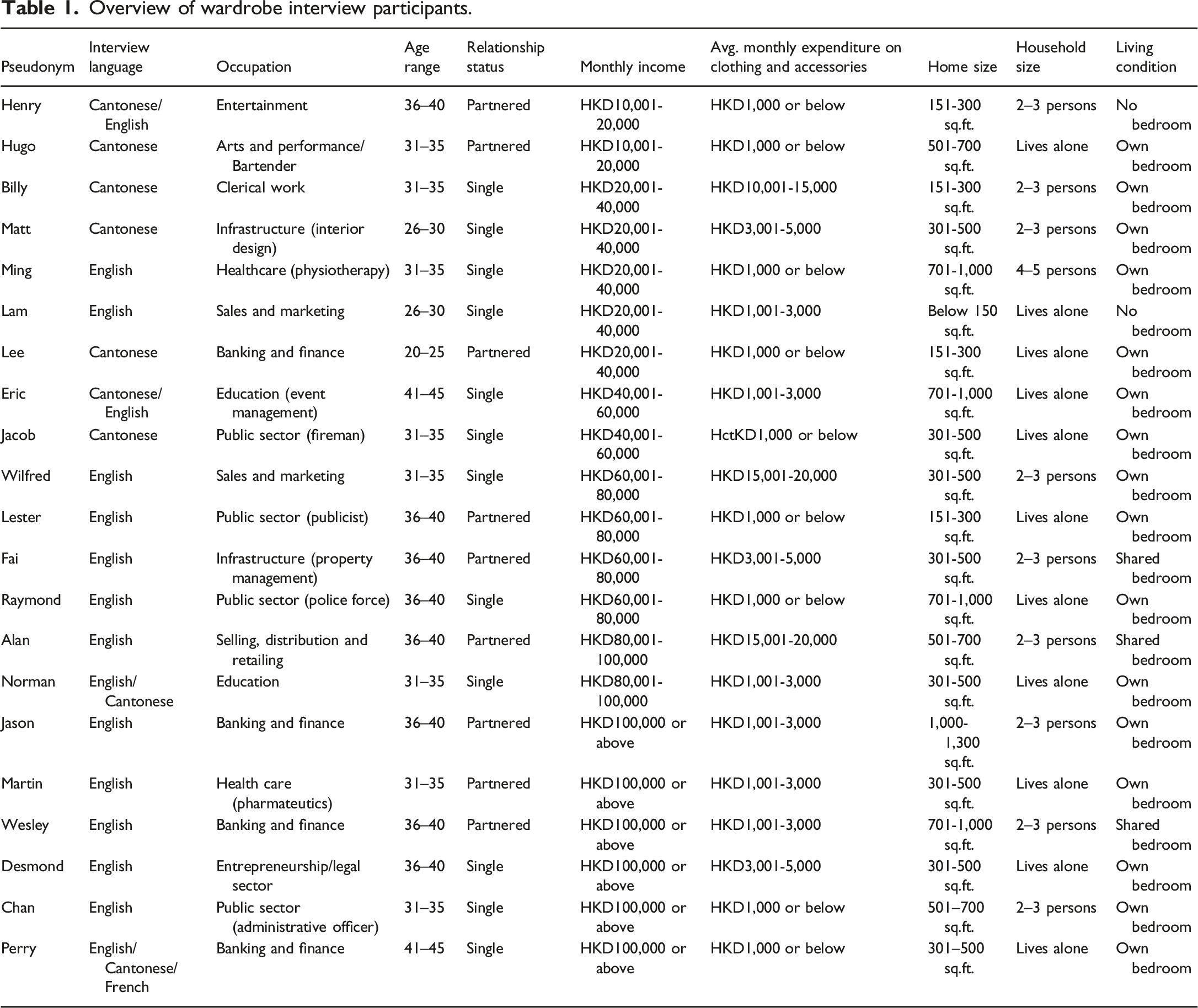
The wardrobe archival study was conducted between October 2020 and January 2021. Through a prolonged process of strategic snowball sampling, we secured consent of 21 male fashion consumers in Hong Kong representing a wide range of occupations, income levels and living conditions to participate in our study. 2 Selection criteria include gender (male), sexuality (gay), age (between 20 and 45 years), ethnicity (Chinese) and geographical location (Hong Kong permanent residents). There was no pre-selection according to dressing or consumption habits, assuming that everyone can be regarded a fashion consumer to some extent.
An interview guide was developed to inter alia document their clothing and accessory acquisition, consumption, maintenance, storage and disposal practices, question them about their choices and the stories behind specific items, and classify the active and inactive items in their wardrobes. Memories of the past and possibilities for the future were also explored using the items as triggers. All wardrobe interviews took place in the informants’ homes, each lasting between one and four and a half hours. Fifteen of the interviews were conducted in English and six in Cantonese. All interviews were recorded, fully transcribed and translated into English. To ensure anonymity, all interviewees have been given pseudonyms.
Data analysis
Overview of wardrobe interview participants.
Positive memories reminisced – An evolved self
Desmond, a single closeted gay man in his late thirties, a lawyer-slash-entrepreneur, typically spends his week between two homes – one with his big family of four generations and the other on his own. Adjacent to the seashore in Hong Kong, Desmond’s ‘weekend sanctuary’ is rather minimally decorated. Consistent with his consciously self-imposed identity as an educated, professional, and self-possessed man, Desmond’s rigorously weeded out wardrobe personifies a spirit of practicality and inconspicuousness, in which we only see a handful of white shirts, suit trousers, blue jeans and plain sport-tees, plus a couple of autographed hoodies and tees he keeps as memorabilia of his university days. ‘I would want my own flat to be very minimalistic… I would only keep maybe 3 to 5 items that I want and like, and I can dress up every day. And then I keep it neat and tidy, so I don’t get very stressed… very simple, no pressure, and this represents me and… the lifestyle and the mentality, you know, you don’t have to waste money on fashion and stuff.’
At first glance, this perfectly confirms a (stereo) typical dichotomy of male-versus-female fashion consumption practices, that fashioning oneself is regarded as wasteful, shallow, meaningless for a rational man. But it also breaks the conventional view that gay men, unlike heterosexual men (e.g. Van der Laan and Velthuis, 2016), always take clothing as identity play and conspicuous display. But even participants who have an otherwise very minimalist wardrobe and pragmatic dressing style still keep inactive items for emotional reasons, which is often neglected in existing research focusing on active items (Woodward, 2007; Woodward and Greasley, 2017). Within Desmond’s minimalist wardrobe, we discern inconsistent (also evolving) meanings and functions between the active and inactive items. For example, at the bottom of his wardrobe we spot floral agnès b. and Paul Smith shirts purchased on memorable trips to London and Tokyo; a navy-blue jacket with a rainbow-colour zebra charm likened by his beloved adolescent nieces; and the colourful university tees, among others, unworn for years, are still kept dearly. Only when the respondent is asked to put on the clothes in front of a mirror, he starts reminiscing all the good old memories – the countless wild drunk nights he spent with his hallmates in the university dormitory, the club night with a hundred guests for his 23rd birthday, the months he spent to save up pocket money for buying an expensive flashy shirt, or the pride he had when winning an inter-hall sports competition in this purple tee, revealing a hint of unexpected positive sensation in his calm temperament. ‘You know, now I also think of a lot of my achievements and friends are more or less connected to this volleyball sportsmanship history because you go through a lot of ups and downs with your sports teams and they became your friends and all along your life… lifelong companions and partners in crime.’
Through interacting with these inactive clothing items imbued with meanings connected to his university time, cherished friendships and proud sportsmanship, long-forgotten emotional experiences within his teenage social circles and a mixture of unidentified feelings are enacted. These memories are neither separate nor still but giving new meanings to Desmond’s existing pragmatic clothing choices and part of his personal history fitting into his morphed self-perception. His past conspicuous consumption and current pragmatic clothing practices are linked and contrasted to form his evolved present self.
Alan, a corporate sales manager for a global personal care company in his early 40s, visibly enjoys showing us around the fashion treasure trove that is the flat he shares with his partner. Resembling a typical conspicuous consumer completely controlled by fashion advertising, the self-confessed ‘suit lover’ owns dozens of pricy, extravagant tailormade suits, more than a hundred pairs of dress shoes and more bags than he can remember. He cares deeply about the designers of different brands, especially Gucci, Fendi, Hermès, Alexander McQueen and Yohji Yamamoto, and is so passionate about fashion that he has been dieting, tanning, and even changing his hair colour before to match his look with certain fashion aesthetics. Alan’s passion is also reflected in the interior design and spatial setting of his crammed flat – where a large Louis Vuitton trunk serves as a coffee table, an Hermès silk scarf framed like a painting is hanging above his TV, and in his living room one has to navigate around translucent acrylic cases full of branded belt buckles or accessories, tall stacks of bright orange Hermès boxes in all sizes, and other luxurious packaging material scattered on the floor. Shoes and clothes he is wearing regularly are in a large wardrobe in the living room, while items he wears less often are all stored in a windowless closet room, in addition to a storage space Alan rents in a warehouse nearby. There, he keeps clothes from brands that fell out of his favour over time, such as Dior and Dolce & Gabbana, and other items that do not fit his sturdy build anymore. Every time he runs out of space in his apartment, Alan sorts out his clothes, giving most of the ones he cannot wear anymore to his father, and putting others into storage.
From his excessive clothing consumption and storage practice, Alan reveals a rarely disclosed emotional facet. One particular item Alan still keeps ‘based on emotions’, he says, is a white pinstripe suit from the Spanish fast fashion retailer Zara. This suit, which Alan bought 15 years ago and last wore for his 25th birthday, is still wrapped in the plastic cover from the dry cleaner and now stained and yellowed from the humid Hong Kong climate. Quite obviously it stands at odds with Alan’s other luxurious possessions. Alan allegedly preserves it for its then good price, high quality, and fashionable style. He also says, ‘sometimes I just want to display it here, or hang it here, and just watch it’. While handling the suit, it reminds him of the times when he was able to perfectly fit into off-the-rack fashion without any alterations, ‘Because it [the suit] is my memory [of being in a fit body shape]. I don’t want my memory to fade away’. The incongruence between Alan’s pride in his bold dressing style regardless of his current build and a strong nostalgia for his younger self and athletic body is revealed. The process of ageing and the gaining of weight renders the very same dress unfit to the consumer’s current flow of existence, generating a set of unpleasant affects (Ruggerone, 2017). Regardless of its price, symbolic value, brand positioning and wearability, the Zara suit – along with other prominent display items on a special clothes rail in front of his large living room window – now serves as a constant materialisation of the past and fading good memories which Alan emotionally holds on to, and becomes a significant facet of his selfhood across the past, present and future (Banim and Guy, 2003; Odabasi, 2022). As material embodiments of ‘formers selves’ (Woodward, 2007), the recurring affective force of these inactive items also shows the complex dynamics of remembering, trans-temporal extension of the self, and the agency of things (Freeman et al., 2016).
Mixed memories reconciled and renewed – A renascent self
For our participants, active and inactive clothing and accessory items can be keepsakes of memories of people or events, such as trips abroad, making friends, having a successful body transformation, changing one’s style, getting engaged, having a career breakthrough, a breakup, or the death of a loved person, evoking negative, positive, or mixed emotions, also revealing the archival character of the wardrobe (Woodward and Greasley, 2017). While clothing items connected to negative memories are often still kept in the wardrobe or nearby, they are usually out of direct sight. Coming across them in daily life by accident is often described as a painful experience, as they trigger ‘memory evoked think or feel’ responses (Zijlema et al., 2019). While confronting certain inactive items, the affects, feelings, thoughts, judgements or reflections based on the memories connected to them are often stronger than the participants expected, provoking unidentified and unresolved sentiments. Participants usually portray a feeling of helplessness regarding what to do with inactive items imbued with these mixed, incongruent past memories. Apparently, the participants seem to keep them for a lack of a better alternative. The conundrum is: why don’t they dispose them? What purposes do these unwanted items still serve?
One example of this is Jason, a successful banker in his mid-30s. The oldest item he keeps in the huge smart closets he commissioned appropriating the design of Cathay Pacific’s airport lounges – the flag carrier of Hong Kong – is a plain grey polo shirt beneath dozens of formal, neatly ironed suits and shirts for daily work, a gift Jason’s first boyfriend gave him about 15 years ago when he was still in college abroad. He wore it rarely since, yet always took it with him whenever he moved. In an old friends gathering last year, Jason overheard by chance that this ex-boyfriend had passed away several years ago, unbeknownst to him. Even though he had long lost contact with this person, this news came to him as a shock: ‘I was just kind of trying to… I guess at that time, I was trying to find some closure, and then I remembered I had this shirt, and then I found it in my closet… that’s one thing that I don’t wear and I haven’t worn in [many] years. And it’s always staying in my wardrobe’.
While the incidents or people involved in those painful experiences may be long gone, by revisiting these associated ‘mnemonic things’ imbued with the extended memories from time to time, the subject goes through an ongoing, often unconscious therapeutic process for reconciling traumatic experience and mediating hurtful feelings, ultimately re-establishing a renascent self. Actively looking for the grey polo shirt to get closure, Jason continually translates his unsettled affective sensations into representational feelings and emotions, and ensures that the vital memory of his cherished personal relationship will be saved from his gradual memory decline so it can be continuously retrieved (Freeman et al., 2016).
To Wilfred, another participant, however, the clothes connected to traumatic memories ‘come’ by accident to reconfigure the contours of his negative memories. Throughout the wardrobe interview, Wilfred cheerfully shows us a wide range of clothing and accessory items he possesses, tidily organised in different cabinets, drawers and wardrobes located in the sitting room and inside his bedroom, some even spilling over to his mother’s. The 34-years-old brand manager of a global pharmaceutical company energetically speaks of his preference for trying on online purchased items one by one and see if they fit at home relaxedly, rather than being judged and pestered by the salespersons in the retail stores; and him being able to slip into new white skinny jeans and looking charming like a ‘white knight’, which gives him an exceptional sense of pride after a drastic body transformation, losing 40 pounds through a 3-month intensive workout regimen. Contrary to Alan’s case, Wilfred’s weight loss and embodied clothing experience allow him to ‘become somebody right for the kind of “existential setup”’ and ‘form a new positive [affective] relation’ with his new look (Ruggerone, 2017: 583).
When we move on to discuss two specific suits hidden in a corner of the storage under Wilfred’s bed, an unexpected affective exchange between the respondent and the clothing objects occurs. ‘I didn’t remember I had these until one day… my [domestic] helper helped get them out and put them back into the closet’. After a long pause while looking at and touching the two suits with matching beige and teal blue colours, the ‘thingness’ of these items act to cue his episodic memories of a photoshoot session, having predominantly strong visual qualities (Zijlema et al., 2019). Wilfred recalls his bittersweet romantic memories, with mixed feelings and emotions, following a non-chronological order from past to present and into the future: ‘But it has a very sad story… I was engaged to a guy, so we went to Sydney and we bought a photoshoot session… the relationship ended a year or so ago… we had some sort of pre-wedding thing booked… we didn’t need something very fancy… just some suits for the photos… [when I] moved back to this house like a year ago… I saw these. I didn’t feel like I wanna throw it right away… just put it in a corner, you know that corner is very unreachable, so very likely I couldn’t see it until ten years later, but then my helper is too helpful (laughter).’
Wilfred says he was mentally prepared to show us the two pre-wedding outfits, however, his mood suddenly changes when actually seeing them. ‘But then, you know, clothes, you remember how it looked on the person. So I feel… mmm… what is more than sad?’ When being asked further why he does not dispose these items, Wilfred ponders: ‘Well, I thought about that… definitely not because I would wear them again. I will not… [but] I feel like there is still some part of me that I would like to hold on to. The story was tragic, but then the moment was very nice, that someone proposed to me… if he wasn’t that bad after all, he was a piece of memory that I want to hold on to… I want to forget all the bad memory… but it was a really nice moment… I’ll put them back in [to the corner of the storage], do you need a picture tho?’
In the end, Wilfred shows us three pouches from Celine, Thom Browne, and Giuseppe Zanotti stained by hair conditioner intentionally by his ex after a fight, which he regards as ‘useless’, ‘ruined’, ‘taking up space’ and the ‘wounds of [his] bad breakup’. While hurtful memories and feelings have been transplanted into the material objects, Wilfred still keeps these pouches ‘because it’s [just] the bag… every time when I see the stains, that’s a reminder… I don’t even wanna see what’s there!’ These ‘unusable’ clothing and accessory objects repeatedly confront Wilfred and engage him into an oblivious and ongoing therapeutic process for mediating hurtful feelings. Odabasi contends that clothing and textile objects are active agents that can ‘heal and reveal trauma’ and ‘surface emotions such as anger, sadness, and joy’. (2022: 2). With their ‘thing-power’ (Bennett, 2010) to ‘make a difference, produce effects [and] alter the course of events’ (Latour, 2004), they help renew and reconcile Wilfred’s negative memories through his repeated mental rehearsal of, making peace with or laughing off the traumatic experiences, allowing a renascent self to emerge out of this haunting memory from time to time. ‘It’s quite sad, but not to a point when I would cry. I feel frustrated, and… yea basically like that, yeah’.
Future fantasies reaffirmed – A becoming self
Meanwhile, inactive clothing items are also kept in the wardrobe as manifestations of past or present aspirations and fantasies for future achievement, be it an imagined perfect wedding, a drastic bodily transformation, or a career/life attainment. Personifying a becoming self, these items act as a constant reminder and reaffirmation of one’s goals, even sometimes they are unlikely to be accomplished in a short while. The recurring mental rehearsal of such fantasies and the process of reaching them (through consumption) fill the gap of such improbable wishes.
Billy is 34 years old and lives with his mother. Tall and well-toned, he likes to show off his tattoos in one of his many tank tops when going out and meeting his friends. During the interview, the clerical officer does not hide his melodramatic character and confidence, boasting ‘I look good in anything’, playfully calling himself a ‘bombshell’, and describing his yearning for a walk-in-closet like Carrie Bradshaw’s in Sex and the City. Billy’s current bedroom is a small, simple and orderly one, with all his clothes and accessories stored away behind the wooden doors of built-in drawers and cupboards. Although deeply enthralled by luxury brands such as Christian Dior, Givenchy and Moncler, Billy claims to not care about trends, ‘because I am already a trend. The trend is set by me’.
In most people’s eyes, Billy is perhaps a typical ‘shopaholic’ who spends over half of his monthly salaries on expensive fashion, despite his average income. Among the many branded clothing and accessory items he shows us, there exist some well-kept, unworn items in Billy’s wardrobe that point to his romanticised future relationships. ‘This is a bowtie for my wedding’, Billy opens his nightstand drawer and takes out a black silk bowtie from DSquared2 in its original packaging. Having discovered it first while shopping online, he became intrigued with the delicate silver lock attached to the bowtie and bought it spontaneously, ‘… when I am getting married, he will have to lock me up… and I will give myself to him unreservedly’. Single at the time of the interview, Billy has developed very clear ideas about his prophesised wedding ceremony: ritually getting locked up on his neck by his future husband in front of their families, relatives and friends. Though determined to save up money for stocking these items one by one, as a gay man born and raised in a city where same-sex marriage is culturally unacceptable and not legally recognised, Billy repeatedly emphasises its improbability, ‘I don’t know if I can get married though’.
Billy does not seem to care about how people see or judge him and his dressing style; he regards his subjective selfhood as the utmost important thing for his sartorial choice. These ideas go beyond aesthetic choices and pragmatic concerns, also pointing to Billy’s conceptions of ideal selfhood and romantic relationship. For instance, his recently acquired wedding shoes, ‘noble’ and ‘preppy’ black Thom Browne brogues which he has been fond of for years, make him feel like ‘someone of blue blood’. While Billy will strictly save the bowtie for his imagined wedding, he is eager to parade the shoes at a social event as soon as possible. Due to their strong connotation of intimacy, romance, and commitment, it is also unimaginable to him to lend them out to anyone. Billy meticulously describes why he is so intrigued by the sound their wooden soles make in his future wedding: ‘I want them to make the ‘clang-clang’ noise when I walk in my wedding (laughter)... I’m not a woman and I can’t wear heels… so I want some ‘clang-clang’ sound. I really waited so long for these shoes. I finally bought it after such a long wait.’
Billy keeps the bowtie and the shoes as material harbingers of a potential future relationship with strong ‘imagination value’ (Freeman et al., 2016: 7). Helping him to imagine and revel in the details of a happy romantic ending he wishes to realise, they are the ongoing motivation cues to his establishing a linear cultural script of development and his congruent present image of a becoming self (Conway and Jobson, 2012). Even just looking at and touching these inactive items evokes certain visual and audio sensations in Billy. This is followed by an emotive excitement when he mentally rehearses his fantasised Western wedding ceremony where cultural differences, socioeconomic constraints and heterosexism all vanish amid the affective siren and summon of fashion, ‘opening up to a process of becoming, a line of flight, the final result of which we cannot foresee’. (Ruggerone, 2017: 582).
Discussion and conclusion
The multifaceted self-memory-object relationships.
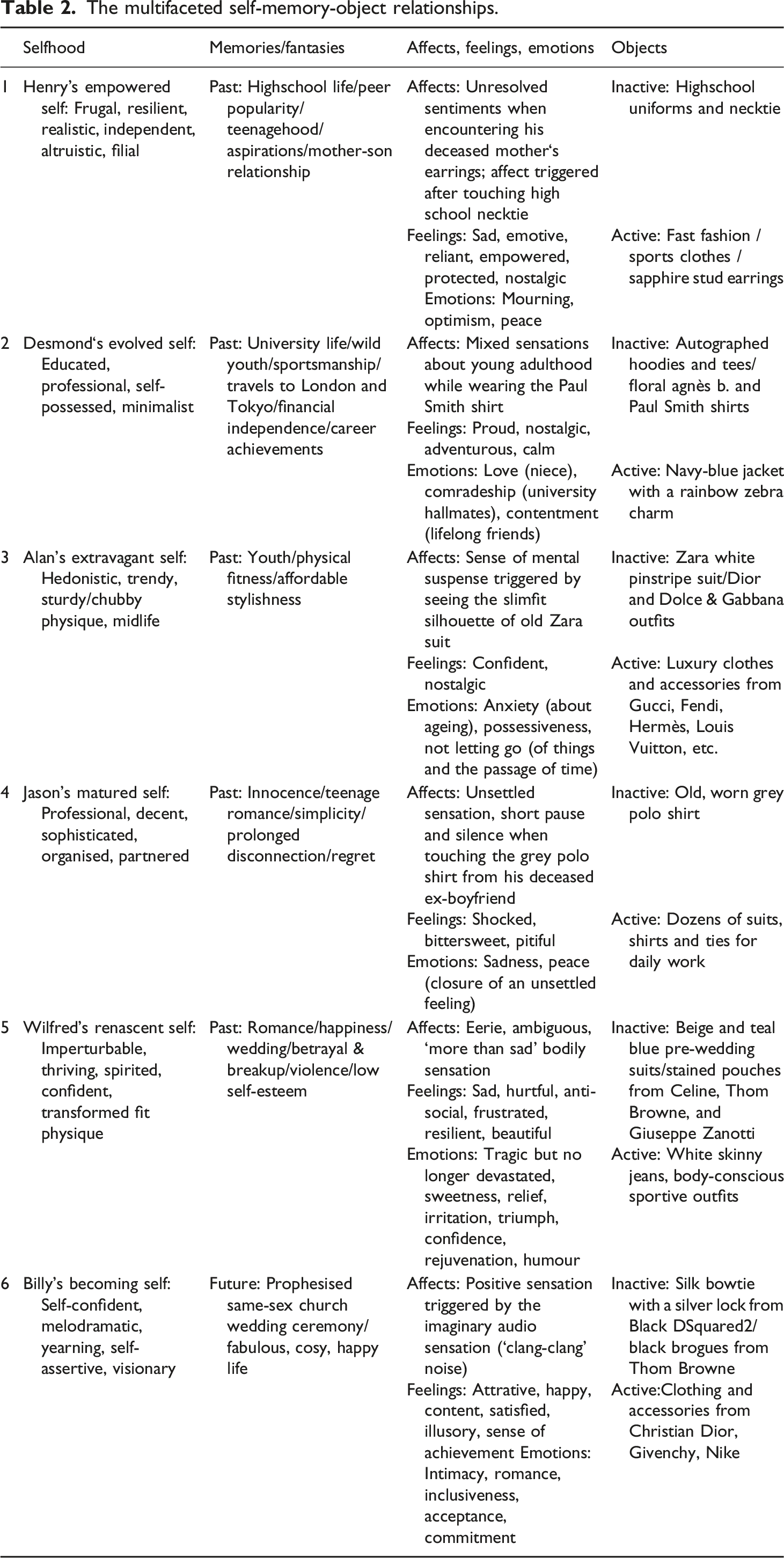
This article provides an important analytical perspective to complement both the structuralist determination of fashion wearers’ passive role, culturalist overemphasis on fashion as an active identity play, and practice theory’s narrow conception of the ‘social’ as a flat level of reality. To reinstate a more holistic analytical lens in studying interactions among the material, symbolic and affective facets of clothing consumption (Tse and Gheorghiu, 2022), this reinvented wardrobe study reveals the oft-hidden affective exchanges between the consumers, their memories and fantasies, and their repertoire of active and inactive clothing and accessory items. Additionally, we illuminated the process of how affective, unpatterned feelings and sensations can be triggered by a range of items often simplistically viewed as conspicuous, wasteful or impractical at first sight – be it an unmatched, anachronistic earring for a male model, a flashy but idle shirt for a pragmatic lawyer, an unfitting, yellowed blazer for a fashion victim, a blemished clutch for a breakup survivor, or a lavish yet unworn bowtie for a marriage idealist. Our findings demonstrate fashion consumers’ pursuit of not only traditional, structurally constrained identities framed by class (Rafferty, 2011), gender and religion (Entwistle, 2000; Karademir-Hazir, 2017, 2020), body type (Sassatelli, 2011), or sexuality and occupation (De Casanova et al., 2016) (macro), socially-sanctioned selfhood or voluntarist, immediate symbolic identity play (micro), and pure functionality (meso), but also an affective reminiscence, renewal or reconciliation of oft-hidden past memories and a reaffirmation of future fantasies. Going back to the aspects of gender and sexuality, this pioneering study of Hong Kong gay men and their wardrobes shows that men are no less affected by clothes than women (Ruggerone, 2017), and that gay men do not always use fashion as conspicuous display and identity play. It therefore debunks any crude male/female or gay/straight dichotomies in fashion consumption and its scholarship. Fashion consumers’ emotional, sensual and habitual relationships with particular events, people and objects beyond their present temporal-spatial position (Zijlema et al., 2019) manifest multifaceted self-memory-object relationships, defying the neat oppositions between mind and materiality in conceptualising memory and the mechanism of remembering (Freeman et al., 2016), also revealing how fashion things ‘act as quasi agents or forces with trajectories, propensities, or tendencies of their own’ (Bennett, 2010: viii; cited in Freeman et al., 2016).
This article also calls for a more nuanced understanding of the identity construction process in fashion and clothing consumption, storage and disposal practices, for considering its more unconscious, affective, emotional processes. Unlike the culturalist perspective, identity construction is not just about consumer choice/agency, but also about the power of incongruent, involuntary and unanticipated memories (Zijlema et al., 2019) and the agency of ‘things at rest’ (Banim and Guy, 2003). Along the same vein, identity is constructed not only for others but also for oneself, for suiting one’s own, congruent understanding of selfhood. Granting agency to memories and ‘fashion things’ enables us to recognise the constant evolution of self-identity over time, and how emotionally invested things evolve into our externalised selves amid the turbulence of life and everydayness. At times, consumers may have forgotten things, but things always ‘remember’ them: they act to reshape, rebuild and reaffirm our congruent self-perceptions as an ongoing project of becoming.
Footnotes
Acknowledgements
The authors are grateful to Ling-Tung Tsang, Fan Xiao, Ho Ming Bryan Choi, Lok See Rosalyn Yu, Wai Kwan Winnie Suen, Raffaele Di Tria and Ching Yin Lee for their research assistance. They also thank Paul Cox and Marcus Lam for their professional photography during the wardrobe archival study interviews.
Declaration of conflicting interests
The author(s) declared no potential conflicts of interest with respect to the research, authorship, and/or publication of this article.
Funding
The author(s) disclosed receipt of the following financial support for the research, authorship, and/or publication of this article: This work was supported by the University of Hong Kong under the HKU Seed Funding Programme for Basic Research ‘De-Westernising Fashion: An Ex-centric Perspective on Creativity, Authenticity, Cultural Mediation, and Consumer Agency along Chinese-African Fashion Value Chains’ (Project number: 201910159043).
Notes
Author Biographies
 ). His work has appeared in Consumption Markets & Culture; Journal of Consumer Culture; Journal of Cultural Economy; International Journal of Fashion Studies and New Media & Society among others. Previously, Tse taught at the University of Hong Kong’s Department of Sociology and Hong Kong Baptist University’s School of Communication.