




Abstract
This paper analyzes social conflicts among amateur computer gamers who are playing online multiplayer games. Whereas prior research tends to focus on the passion and fun of consumption community, or negative individual consequences of gaming, our research contributes with theorization of the role of social conflicts within and across gaming communities. The empirical data consists of two data collecting phases. We develop our understanding of gaming communities and culture through virtual ethnography and netnography. Then we conduct interviews with young adult gamers who belong to six communities. Our findings show four types of social conflicts; those between casual versus competitive logics, depending on skills and power, immoral behavior, and troubles of team alignment, which are related to routinized, prerogative or transgressive conflict cultures. We discuss how the study contributes with new knowledge on consumption-mediated social conflicts and suggest a model of the relationship between conflict cultures, conflict types and implications.
Introduction
The gaming culture has changed the way we become entertained today (Shaw, 2010), and multiplayer computer gaming is established as a cultural zeitgeist among young consumers. Consequently, people meet on digital platforms for experiencing fantasies and having fun in “virtual heaven.” The most popular game genres include massive multiplayer online role-playing game (World of Warcraft), first person shooter (Counter Strike), multiplayer online battle arena (Defense of the Ancient 2, League of Legends) and real-time strategy (StarCraft 2). Today, online gaming is well established in the junction between play and school/work and is characterized by consumers’ emotional goals and experiences. Consumers meet in communities where the consumption activity is essential for communion and socializing activities (Chen et al., 2008) to share the fantasy and its commitment (Kozinets et al., 2004). Consumers join communities that are culturally diverse and rich with distinct rituals, traditions, sense of belonging and moral responsibility (Muniz and O'guinn, 2001).
Much game research has been preoccupied with the hedonic nature of experiences. Hedonic experiences have been well documented in consumer culture research (e.g., Belk and Costa, 1998; Celsi et al., 1993; Kozinets, 2002; Lindberg and Østergaard, 2015; Tumbat and Belk, 2010) and in-game studies (Cole and Gillies, 2021; De Schutter and Brown, 2016), and it is commonly understood as a voluntary and captivating activity outside of or in contrast to ordinary life (Seregina and Weijo, 2017).
Recent research has discovered various types of tensions, such as gender imbalance and its impact on youth (Shaw, 2010), psychological consequences such as aggressive behavior (Greitemeyer, 2014), violence in videogames (Hemovich, 2021), and how game consumption control consumers’ lives (Brock, 2017). Whereas much attention is on individual tensions, less focus is on tensions in closely knit communities and the broader game culture. Consequently, there has been a call for cross-disciplinary research, primarily between consumer research and game studies (Brock and Johnson, 2021; Seo et al., 2015, 2019), for identifying and understanding tensions and conflicts outside of the micro-social analytical level.
Consumer culture theory (Arnould and Thompson, 2005) enables a focus on consumption within gaming communities and how consumers actively and enthusiastically are involved in consumption while (re)producing identities, practices, rituals, and meanings (Cova et al., 2007). Original contributions on consumption communities, such as subcultures of consumption and consumer tribes (Cova, 1997; Schouten and McAlexander, 1995), provide an understanding of communities as those where consumers seek social bonds that represent a connecting way of life through commitment to product class, brand, activity, or even consumption ideology (Thomas et al., 2013). The social bonds reflect consciousness of kind, shared rituals and traditions, and moral responsibility towards the community members (Muniz and O'guinn, 2001), which seems a relevant understanding for the ludic activities that take place in “virtual heaven.”
However, just like game studies, much community-based research has been preoccupied with the “authority of the hegemonic perspective” with focus on bonding and shared passion (Schouten et al., 2007: 74). Recent consumer research focuses on community fragility and contestation, interpersonal conflicts, competition and positional struggles (Canniford and Shankar, 2013; Lindberg and Mossberg, 2019). Despite this, there is a lack of research on gaming contexts that covers consumption-mediated social conflicts, defined as “an interaction relationship between two or more parties that pursue mutually exclusive or incompatible goals” (Husemann and Luedicke, 2013: 355), and the implications of such heterogeneity (Thomas et al., 2013). Whereas neither consumer culture research nor gaming research have been much preoccupied with conflict implications (Husemann et al., 2015), sociological conflict research argues for both constructive and destructive consequences (Dubiel, 1998; Hirschman, 1994). Consequently, the purpose of this study is to contribute with new knowledge about social conflicts and their implications for gaming cultures through the lens of consumption communities. We ask the following question: What role do social conflicts have among consumers in online consumption communities?
This article reports from a study of gaming communities within which young adults meet for sharing fantasies and having fun playing various online multiplayer games, such as role-playing, first person shooter and real-time strategy games. The findings show that four social conflict types distinguish the communities. We show how some conflict types are routinized conflicts that are controllable, manageable and divisible, for which tensions result in bargaining processes and compromises. Prerogative conflicts happen when highly skilled gamers gain and put into practice power in their community, and transgressive conflicts violate or push boundaries of established cultural gaming norms and/or community’s social contract. We discuss how the study contributes with new knowledge within consumer research and game studies and suggest a theory on social conflicts in online gaming communities.
Social conflicts in consumption community
Research shows that communities can be unstable and shifting with hybrid characteristics, intergroup dynamics and tension as the norm (Cova et al., 2007), which has been documented in contexts such as the running community (Thomas et al., 2013), surfing (Canniford and Shankar, 2013), climbing (Lindberg and Mossberg, 2019), gay community (Kates, 2002), but to a lesser extent in tightly knit online consumption communities, such as food enthusiasts (De Valck, 2007), free/open-source software development (Hemetsberger, 2006) and premium cola community (Husemann et al., 2015). These studies show community tension due to ideology, morality issues, assemblage mismatch and competing value regimes. Consequently, one might expect a variety of reasons for conflicts in an online gaming community when consumers gather to share emotional experiences and ludic play, but where sociality is present both in real life and in virtual worlds.
Previous consumer research argues for three patterns of consumption-mediated social conflicts: Emancipatory, ideology-advocating and authenticity-protecting conflicts (Husemann and Luedicke, 2013). First, emancipatory conflict calls attention to parties of conflicts who attempt to break free from or to regain power from each other. This is a conflict situation where actors and/or institutions dispute because, for example, consumers feel exploited by businesses or due to their unethical behavior. An emancipatory situation is reported by Giesler (2008) on the disputes between consumers and the music industry. Second, ideology-advocating conflicts cover ideological and moral conflicts during consumption. This is demonstrated in research on brand mediated social conflicts between Hummer-owners (Schulz, 2006) and others who criticize consumption of such highly pollutive cars (Luedicke et al., 2010). Schulz (2006) argues that Hummer is a “vehicle of the self” that creates contempt and disrespect because it reflects a selfish way of consumption. This stream of research shows how consumption can create conflicts when consumers engage in more fundamental ideological battles and moral disputes that are triggered by certain consumption objects and logics.
Third, authenticity-protecting conflicts revolve around consumption practices that are particularly evident within consumer communities and subcultures (Husemann and Luedicke, 2013: 357). Consumers that consider themselves core-members of a community with a high level of identity investment related to objects or experiences tend to protect their identity from undesirable associations or unauthentic people and practices (Arsel and Thompson, 2011). For example, O’Leary and Carroll (2013) show how consumers within an online poker community are sanctioned if they don’t adhere to a certain community ethos, and Schouten and McAlexander (1995) show how hardcore Harley Davidson bikers dominate novice bikers who must earn trust and respect for becoming a community member.
Fourth, research on intergroup dynamics show how disputes of group belonging may be a source of tension (White et al., 2012). For example, consumption choices can be relevant for individuals who want to display a desired social identity. However, consumers may avoid consumption that is associated with dissimilar or dissociative others because core users become misrecognized (Berger and Heath, 2007). In consumption community it is reasonable to expect intergroup dynamics among actors, institutions and resources, but that it is possible to preserve continuity even when heterogeneity operates as a destabilizing force (Thomas et al., 2013).
A relevant topic for conflict sociologists is the question of what makes a conflict productive versus destructive (Husemann et al., 2015). The perpetual enactment and salutary experience of living through and cultivating conflicts might be important for community building and is regarded a pillar of society (Dubiel, 1998; Hirschman, 1994). Conflict would often “bolster and extend society’s normative common ground” (Dubiel, 1998: 219) and can be viewed as non-divisible conflict, for example, tensions of ethnicity, religion and gender, or divisible conflicts that are regarded common and susceptible to compromises in market societies (Hirschman, 1994). Inspired by such theorizations, Husemann et al. (2015) suggest the distinction between “routinized conflicts,” as those that a “community performs in controlled, habitual way,” and “transgressive conflicts” as those that “tend to break with cultural norms, stepping over boundaries set by the community’s legitimized conflict culture” (Husemann et al., 2015: 275–277). Inspired by economic sociology (Boltanski and Thévenot, 2006), Lindberg and Mossberg (2019) indicate that transgressive conflicts might be resolved in community through “composite compromise” that are argued unstable because it depends on the goodwill of the involved parties who can question the appropriateness of a given composite arrangement.
In sum, members of a hedonic gaming community socialize by interacting and sharing passion for the consumption fantasy, and they would appreciate the activity and its commitment due to its ludic and emotional experiences. Whereas much research point at the magic that take place in such communities, recent research call attention to social conflicts and intergroup dynamics in the process of achieving emotional meanings. Four main research streams dominate the literature. Although they have been theorized as distinct versions, emancipatory conflict and ideology-based tension are possibly relevant as transgressive conflict versions, while authenticity-based conflicts and intergroup dynamics are possibly relevant as routinized conflict versions for our context.
Method
List of participants.
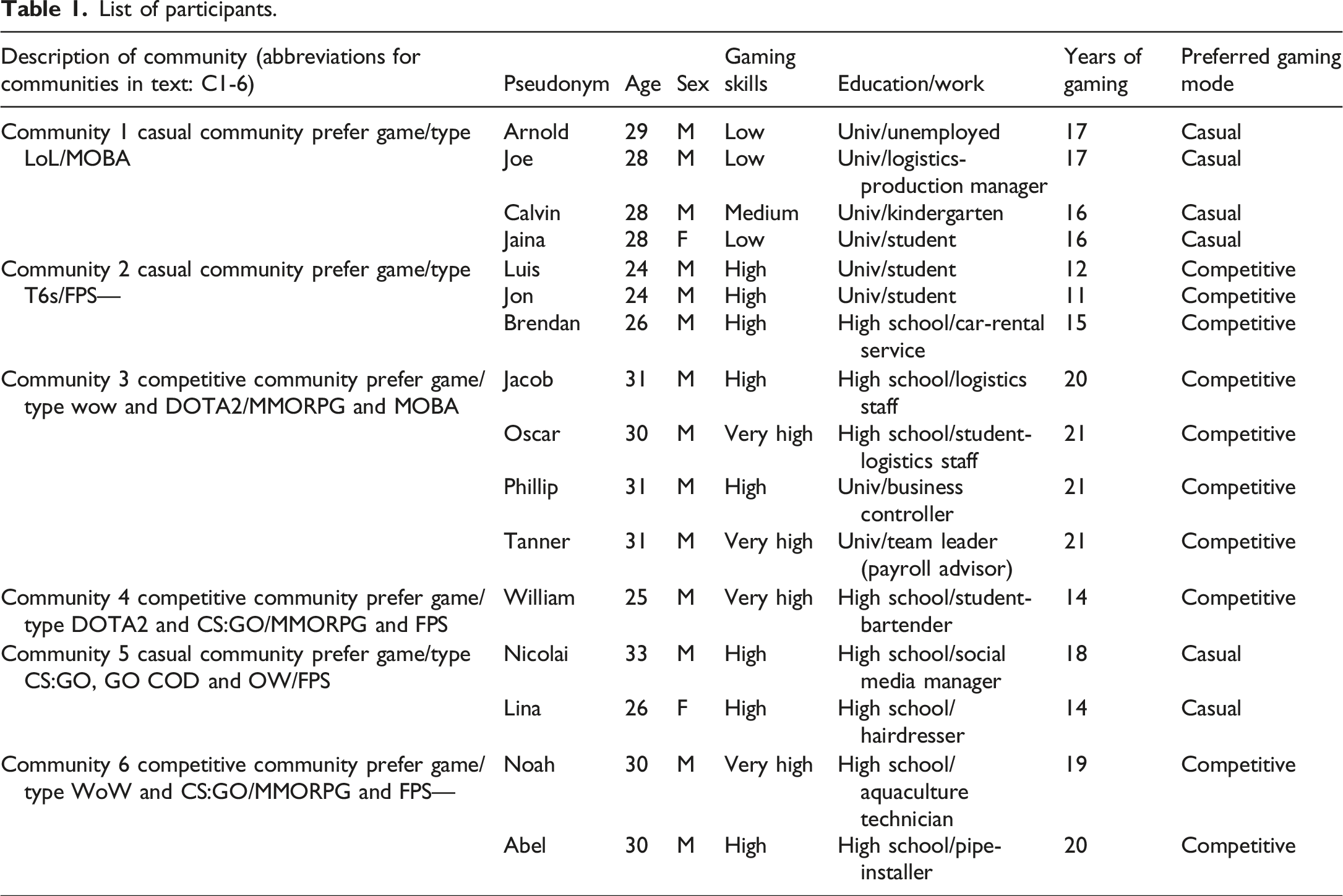
In the second phase, we conducted sixteen in-depth interviews with gamers of the six communities. We used purposeful sampling (Creswell and Creswell, 2017) for choosing informants. Three specific sampling criteria were used; they needed to be (1) experienced desktop (computer) multiplayer gamers, due to the likeliness of social conflict involvement, (2) presently affiliated with the chosen gaming communities, and (3) active players within the community. A snow-balling technique was applied during the empirical phase for getting in touch with relevant gamers of the various communities. With exception of one community (C4), we were able to interview two or more gamers of each community (see Table 1).
Of our six communities, four communities favored first person shooter (FPS), three multiplayer online battle arena (MOBA) games, and two communities favored a broader variety of genres. The informants’ average age was 28 years, 14 males and 2 females, and all were highly experienced. Most of the informants had been gaming with their communities since before adulthood.
The informants’ level of skill (compared to all other players) illustrates the competitive rank of the gamers. 12 of them had a competitive rank above the 55-percentile mark signifying that their gaming skills are better than half of other players (high; 55–80, very high; 80–99). Four of the informants had a competitive rank below or close to the 50-percentile mark (low; 0–45, medium; 45–55 percentile).
The in-depth interviews were done over a period of 2 months in 2020, and the average length was 50 min. Due to the COVID-19 pandemic, half of the interviews were conducted through digital media. The interviews began by focusing on general themes such as their gaming community and what games/genera they play. We asked how long they have been playing video games and how long they have been playing together in the current community, what their in-game rank are, game style/role preferences, etc. Then they were asked to share stories of situations were disagreements occurred, both in corporeal and in virtual worlds. With participant observations from the communities the researchers were able to understand language and logics during the interviews, and follow-up questions were applied to gain a comprehensive understanding of how tensions happened and the outcome of the conflicts.
Our analysis of community tensions are inspired by hermeneutic interpretation where “interpretation of textual data proceeds through a series of part to-whole iterations” (Thompson, 1997: 441). First, intra-textual analyses of the interview transcripts are conducted to achieve interpretations of each informant. Second, inter-textual analyses as related to each community are conducted for interpreting patterns across interviews. Third, inter-textual analyses across communities are conducted for being able to theorize variants of social conflicts in the gaming culture. The first phase consisted of participatory observations with field notes and netnographic observations, which strengthen the breadth and depth of the second phase interpretation. Consequently the data was analyzed by moving back and forth between the data sources, data types and analytical levels, searching for conflicting practices, and developing categories with the aim of meaning condensation (Brinkmann and Kvale, 2015).
Findings
We answer our research question by organizing the findings into three parts. First, we identify characteristics and tensions of the gaming culture. Second, we identify four social conflicts on two levels: between individuals within a community, and between different communities. Third, we highlight what cause the social conflicts and the consequences for consumption practices among the gamers.
The gaming culture
The gaming culture belongs to a large gaming industry which generates higher revenues than the movie and music industry (Seo et al., 2019). While games are played on PC, consoles and smartphones, PC gaming is regarded as the platform with highest skill ceiling and are played by both amateurs and professionals. Amateur gamers spend money on hardware, software and symbolic virtual artifacts, for example, related to avatars. The latter has increased the revenue for the gaming companies. However, our informants view the industry as immoral and greedy when targeting young gamers, pointing at how advertising directed towards young gamers is problematic because youths do not have the same reflective “immunity” toward virtual markets (micro-transactions) as older gamers. “Younger gamers get more affected by artifacts, because having a certain artifact is a way of symbolizing that you have money and that you play this character often.” (Jaina, C1)
Another conflict is political. For example, in 2019 the Hong Kong player Ng Wai Chung criticized the Chinese government’s treatment of Hong Kong. Due to pressure from the Chinese authorities, the gaming company Blizzard banned Chung from playing professional hearthstone for 1 year and withheld all his price money. This sparked a public outcry (Trithara, 2021). Among our participants, community 5 decided to boycott Blizzard and their games which however resulted in a dispute because not everyone in the community wanted such a boycott. The love for the game was more important.
The gaming culture is accentuated through the use of videos/streaming platforms (Twitch.tv; Youtube.com), various forums and imageboards (Reddit.com; 4chan.org; Discord), and “memes.” A meme consists of images, videos, pieces of text, etc., typically humorous of nature, which is spread rapidly among gamers (Lexico.com). On the popular web forum “/r/pcmasterrace” (reddit.com), which has 3.6 million members, users praise the superiority of playing games on a PC while mocking gamers that are playing on consoles or smartphones. For example, tensions are created through the meme “filthy casual” which symbolizes easy gaming as simple gameplay (knowyourmeme.com).
A significant part of the gaming culture is the subculture of online multiplayer gaming. Gamers are free to play with and against other gamers independent of geographical location. However, they need to attend to the conventions and norms of a fantasy world which govern practices and what is regarded valuable for teams and players. There are ongoing discussions in virtual communities related to the rules of online multiplayer gaming.
Our informants account for debates about how to deal with the ranking system of various games. Ranked gaming has a competitive overtone because players receive a certain rank depending on if they are winning or losing (see “gaming skills” in Table 1). High rank symbolizes hard work, dedication, and perhaps also talent, and high ranked gamers would receive high status in the gaming community. However, a mix of gamers’ ambitions on the same team might create tension. The alternative, casual gaming, means that gamers favor the ludic play of unranked games and thus reject the convention of status over time. Nevertheless, both versions of amateur gaming resemble a hedonic leisure activity and a way to disconnect from everyday life (Cole and Gillies, 2021). We might expect that communities of competitive and/or casual gamers are somewhat different with regards to rules and values, and how a game is performed.
Skills and the hierarchy of power
In multiplayer gaming communities there is a need to orchestrate different types of skills to be successful as a playing team. Our findings call attention to particularly two forms: practical and strategic skills. Practical skills involve pushing the right combination of mouse and keystrokes that are developed into a kind of automated tacit practice. Strategic skills concern the ability of understanding and interpreting the game logic which is developed by attending to the game plot and playing different avatar roles central to the game. It is necessary to develop both practical and strategic skills for playing a game efficiently. “In our community, I and a few others were very skilled, but others were low skilled. This resulted in a split among the real-life friends into to two virtual communities […] We that were highly skilled could not bear playing with our friends that where less skilled. This caused conflicts that affected both our virtual communities and real-life friendships” (William, C4).
William calls attention to how skills in a virtual gaming world cause conflicts in the corporeal world because gaming is an important part of their identity. Noah (C6) argues that high skills lead to respect from other gamers, but also creates a hierarchy of power within a community. Consequently, gamers with low skills often face criticism, social sanctions and even exclusion (Abel, C6).
A “loot council” often decides social sanction and consists of high-status members of the community. The loot council’s mandate is to distribute artifacts (“loots”) to the players who are regarded as the most efficient wielders of set artifacts against virtual monsters. The virtual artifacts have symbolic and functional value and make the avatar more powerful, which in turn increases the overall functional power of the team. However, teams with high skilled and low skilled players might develop a conflict of hierarchy because the lower skilled gamers would disagree about the rule which governs success. “Gamers have different views about what the correct course of action is during in-game situations. Some might think we can take this 5 versus 5 fights, but others think we need more time to build the strength of the team, especially in DOTA2. There is a constant exchange of information, which creates thousands of possible outcomes.” (William, C4).
Disputes about strategy which William accounts for are very common and evident in field notes. Gamers with equal practical skills have different opinions about the proper course of action which results in discussions about in-game actions. Such disputes become very hypothetical and almost impossible to validate since only one strategy is possible to play. However, those with extensive experiences and high strategy skills would often receive power and decide the outcome of such disputes.
Immoral behavior in virtual worlds
Real-world moral principles do not necessarily mean much for actions in a virtual world of gaming. However, some gamers are more morally devoted than others and apply real-world values on virtual contexts. Tanner (C3), for example, states that he sees his “virtual character as an extension of his real-life persona.” Others test real-life boundaries of moral principles and transgress them while playing. Tensions are created between gamers with high and low virtual moral standards, and intra and inter team controversies might appear when members do not comply to any moral standards at all. “After Eric went too far and stole an [artifact] [...] I got annoyed, because I don’t think it’s ok to steal from others. My moral principles are the same, even though we are in a virtual world. It was especially bad because he stole from friends.” (Tanner, C3).
When a team member performs immoral actions, the team would often face sanctions. Depending on the severity and who it affects, the immoral player might be excluded from the team, or the community might split up. As for community 3, the theft of Eric resulted in a dispute which eventually ostracized Eric from the community.
Severe conflicts also appear when gamers demonstrate discriminating attitudes, witnessed by first author on voice communication, at a different occasion but involving the same actors as in Oscar’s recollection below: “Their humor went a bit too far, jokes with a racist and sexist undertone […] it felt more real when they said it […] if you tell a very racist joke, but afterwards come with a racist statement, then you’re not just using dark humor anymore. There is an ideological backdrop to the joke, which is uncomfortable” (Oscar, C3).
Faced with attitudes of racism and sexism, Oscar could not accept the gamer’s behavior and decided to abandon the community even though he knew that the attitudes were not shared by other members.
Problems aligning team engagement
Our findings show that gamers often disagree on how to practice game playing. For a community, such disagreements are recurring because it involves team engagement, or what we might refer to as problems aligning team engagement. An example is when gamers dispute over playing against the computer (PvE) vs. playing against other players (PvP). “[My friend] doesn’t see the value in going around killing other players in WoW. Every time I talk about PvP and how fun it is, he says that I’m just wasting my time and the time of others that I ‘kill’. He thinks I’m a douchebag for doing it.” (Tanner, C3).
Tanner enjoys playing against other players, whereas his friend think the PvP style is more demanding and that the gamer would use too much time on the sideline as “dead.” It is not an ethical issue then, but a disagreement of functionality or which game style that provides most efficient gaming.
Another team alignment problem is when gamers do not agree about actions and engagements during the gameplay. Our observations of community 5 show that some might for example value defensive, risky or aggressive strategies which influence how a game is played. For example, some teams that are playing Rainbow Six Siege (R6S) perform with an aggressive style while others with a defensive style. Being unpredictable as a team signifies members who can change style during the game, which is seen as an advantage. However, the debate about style emerges when members are not able to adapt to a versatile playing mode. “A situation where one of us wants to rush in aggressively and we tell him we aren’t ready […] and this person still runs in, he gets mad when he dies because we didn’t follow him. His aggressive playstyle often causes a negative atmosphere.” (Lina, C5). “Individualists would be much better players if they just played as a team and followed decided tactics instead of turning individual for achieving praise and recognition.” (Abel, C6).
Situations where gamers disagree about game performance are often a source of conflict. Multiplayer games are a team effort, and everyone must act as a team member and play together for achieving success and having fun.
The last source of conflict pertaining to team alignment involves choices of strategy that have implications for various virtual gaming roles among the team members. For example, some games demand a healer role (keeping teammates alive), tank role (making monsters attack you rather than your teammates) or damage-dealer role (deals more damage to monsters than other roles). In DOTA2, the team members are given a role position (from 1 to 5). Each role has specific duties and tasks that they are responsible for throughout the game. To be successful as a team, each role must be attended to according to the game plan. Consequently, gamers spend time training for becoming experts in playing a specific avatar role. The downside of the specialization is that team members might receive a role that they do not prefer playing. Jacob (C3) argues that “disagreements often emerge in the picking [strategy] phase, where choices about what avatar to play, and what roles people should have, are decided.”
Status seems important for alignment processes, that is, preparing a team and allocating avatars and roles. In DOTA2, the positions 1–3 are regarded fun to play while the positions 4 and 5 are less desirable because they are designed to support other players. Jaina (C1), who often plays a supportive role, explains her frustration when team members do not take their role seriously. She argues that “when you have a supportive role, you need to support the team. Often this includes sacrificing yourself for the more important goal of team survival and success.” The stories of Jaina and Jacob are also evident in the field notes and illustrate how status might explain tensions on two levels. First, team members face controversy during the “picking phase” where they try to receive favorable game roles. Second, team members who favor avatars with supportive roles do not receive credit when they ignore the status convention.
Disputes between casual and competitive logics
Our findings show that the ranked and unranked division of the culture turns gaming into two quite different practices that potentially create tensions both within and between the communities. “The few times we decide to play ranked together the group’s focus changes because winning becomes the only goal. This is causing a negative atmosphere where disagreements happen. The team members don’t like this winning mentality and therefore avoids ranked games.” (Joe, C1).
Community 1 changed towards unranked gaming that they regarded free of stress and tensions. Jaina (C1) explains how they used to play ranked games, but “focus on winning ruined the enjoyment of the game and created bad atmosphere within the group.” Thus, the origin of the controversy was between a competitive and casual logic. “I was more competitive before. I mainly played ranked games, but eventually got tired of the rude behavior of other players, so I actually quit gaming for several years.” (Calvin, C1)
When Calvin got tired of the competitive ranked logic, he rejoins a team which conforms to a casual logic of having fun. Whereas several gamers avoid the stress and discomfort associated with ranked gaming, others prefer a competitive mindset and the values and meanings of reaching status and high personal rank. “To me, everything is competitive. That applies to games, work, climbing, training and everything I do basically. If I don’t have anyone to compare myself to, I compare myself to my own previous performance. It is depressing if there is no progress” (Tanner, C3).
To have “progress” in a virtual competitive milieu, gamers must win more then they lose. Every game adds or subtracts points from your rank. However, when stakes are high and not everyone has the same desire to win, conflicts might emerge within a community. Oscar (C3) illustrates this when he “dislike others who don’t invest as much time and effort” as he does. To increase the chances of winning, all community members must practice a lot and retain the same competitive mindset. Time becomes a challenge because all players of a community need to adapt to the competitive norm of commitment. Not unlike sport athletes, the dedication to the success of the team is more important than the feelings of each member (Tanner, C3). Consequently, there is no room for disagreement of the gaming logic and the goals of the activity, which however creates conflicts because time is a scarce resource. That is why some players try their best to become highly ranked but fail because they are limited by real-life responsibilities such as work and family (Jacob, C2; Lina, C4).
Social conflicts in gaming community
Conflict types in online consumption communities.
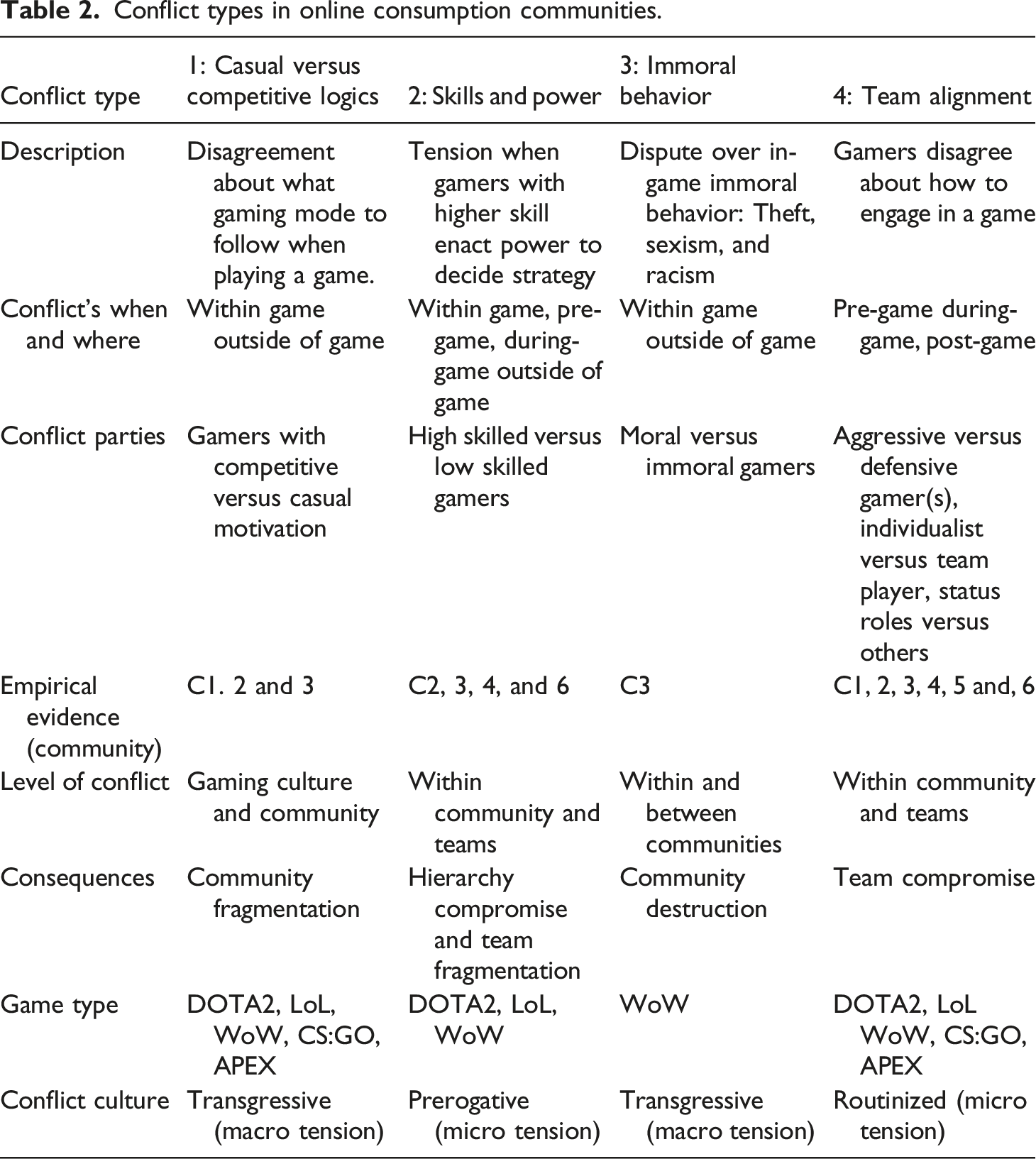
Table 2 shows four main social conflict types. “Casual versus competitive logics” (type 1) and “immoral behavior” (type 3) are interpreted as transgressive conflict culture that often have major consequences (i.e., community fragmentation or destruction) for the continuation of the community, because gamers violate central ethos and norms of the gaming culture. The findings show that “casual vs. competitive logics” points to conflicts that originate from disputes about centrally held gaming values, while “immoral behavior” originates from violation of ethical rules of society and moral code of conduct.
“Team alignment” (type 4) points to disagreements of how to engage in a game, for example, disputes of which game role to play. Our findings show that all the communities struggle with aligning team engagement on a regular basis. While they are creating tension and negative atmosphere, we interpret them as routinized conflict culture that mostly end in compromises.
The findings show that “skills and power” (type 2) distinguish communities with a competitive gaming mode. In competitive communities, it seems pervasive for gamers to make their skill position socially relevant so that they can decide or influence game strategy and perform with interesting avatars and roles. Whereas disagreements about “skills and power” originate from power bias of a community due to the cultural significance of skills, the consequences might be a compromise about a certain hierarchical order (i.e., hierarchy compromise). However, if players do not accept the relationship between (high) skills and power, the consequences can be new team configurations (i.e., team fragmentation).
We interpret “skills and power” (type 2) as a prerogative conflict culture where highly skilled gamers receive privileges. Prerogative conflicts are different from transgressive conflicts (“casual vs. competitive logics” and “immoral behavior”) in that it does not violate central ethos and norms of the gaming culture, because gaming skills are important for reaching team goals. The findings show that implications are contextual, that is, if a certain team or community accept the dominance of highly skilled gamers, or not.
The routinized conflicts (“team alignment”) are different from transgressive conflicts due to the conflict regularity and compromising outcomes. Whereas prerogative conflicts might end in team fragmentation, and as such are different from routinized conflicts, they can be similar to routinized conflicts when gamers reach compromise about the privileged role of skilled gamers due to some sort of common goal, for example, winning a game. The findings show how social conflicts range from negative team atmosphere that a community performs in a controlled and habitual way, and which might be argued constructive for the future development of the community, to community fragmentation and destruction which “tend to break with cultural norms, stepping over boundaries set by the community’s legitimized conflict culture” (Husemann et al., 2015: 275–277).
Discussion
This article introduces social conflicts as an inseparable part of online amateur gaming experiences. Through the theoretical lens of consumer culture theory, gaming literature and to some extent sociological conflict research, we (1) discuss how different conflict culture contexts are constructive and destructive for community building, (2) suggest a novel theoretical model for understanding social conflicts in online gaming communities, and (3) extend knowledge of the connection between social conflicts and their implications. From the study of the Norwegian gaming communities, we discuss how these three contributions impact consumer research and how this knowledge alters the hegemonic authority of gaming as primary a hedonic experience in “virtual heaven.”
Previous research on tension in consumer culture portrays community conflicts as emancipatory or ideology-advocating disputes (Husemann and Luedicke, 2013; Giesler, 2008), and gaming research tends to emphasize a rather masculine and competitive culture where gamers hunt for points, levels and leaderboards as extrinsic motivation and game engagement (Mekler et al., 2013), or that tensions are caused by misfit between extrinsic and intrinsic incentives which reduces motivations and well-being (Deci et al., 1999). Our findings diverge from these notions because conflicts are not structured by a single or dominant ideology or caused by micro-social variations in how actors are motivated or engaging in games. We think this might be caused by the analytic approach of the present study, that allows us to focus on “within” tensions in tightly knit communities, which is largely omitted in previous research (Husemann et al., 2015; Thomas et al., 2013), but which enables identification of multiple conflicts, implications and sociocultural origin. Our community-based study allows us to identify gamers who draw on multiple and often divergent cultural-based logics, within which social conflicts appear in-between actors in the gaming communities.
First, the findings point to three dominant conflict culture contexts in the gaming communities, that is, (1) ethos and norms of the gaming culture (casual vs. competitive disputes) and societal conventions (immoral gaming), (2) in-game disagreements of how to play a game (team alignment tension), and (3) community social order disputes (high skills/power). Whereas previous research has documented influences of society values (Lindberg and Mossberg, 2019) moral (Schulz, 2006) and within-community (Thomas et al., 2013) conflicts, our results show the multi-faceted and contextual origin of conflicts, which enable distinguishing between conflicts that might be constructive for community building and those that are destructive (Hirschman, 1994; Dubiel, 1998). While previous research is rather normative about conflict cultures (Husemann et al., 2015), our findings show that constructive conflict cultures are related to the consumption activity itself (e.g., negotiating controversial in-game standpoints) while destructive conflicts depend on a larger context (game culture) and context-of-context (society values) (Askegaard and Linnet, 2011) to become intelligible.
Our empirical findings further nuance the otherwise dichotomic divisible—non-divisible nature of conflict. Previous studies criticize the distinction between “casual gamer” and “hardcore gamer” (Chess and Paul, 2019), but our research shows that both casual and competitive logics can be part of young adult communities. For example, the results show how competitive and casual logics distinguish player modes of games such as DOTA2, LoL, CS:GO, WoW and APEX. Tensions occur when members disagree on following the competitive, “hardcore,” logic with focus on winning and ranking, or a casual logic within which they develop their own community-based conception of how-to-play. We identify young adults’ situation (e.g., work, family) as relevant for understanding transgressive versions of social conflicts.
Such distinctions have consequences for consumption practices since centrally held values are different. The gaming culture’s development toward e-sport, with focus on mastery of skills, competition and self-improvement (Seo, 2016) influences amateur communities. Consequently, communities valuing competitive logics are simulating e-sport ethos and an utilitarian form of leisure (Huston et al., 2021), while communities valuing casual logics remain faithful to a recreational ethos outside of or in contrast to ordinary life (Seregina and Weijo, 2017) Thus, the destructive conflicts are not so much about “right” or “wrong” consumption practices within and in-between the communities, but rather a struggle about ethos, conventions and subsequent playing logics.
Second, the study shows that there is a distinction of conflict types in gaming communities (see Figure 1). Along Husemann et al.'s (2015) theorizing, we document routinized and transgressive conflict cultures where community fragility and contestation, interpersonal conflicts, competition and positional struggles are present in ludic play community (Canniford and Shankar, 2013; Cole and Gillies, 2021; De Schutter and Brown, 2016). The findings show and confirm that transgressive conflicts might leave members offended and frustrated, and that teams and communities might find themselves in a temporarily state of tension (Lindberg and Mossberg, 2019). Whereas previous research shows that these conflicts often impact on member enthusiasm, sanctioning (O’Leary and Carroll, 2013) and loss of members (Husemann et al., 2015), our result show rather harmful consequences such as fragmentation (the team is dissolved, community is divided, but still operational) and destruction (community shut down). Both result from rejection of moral standards and oppositional mainstream logics, and thus a desire for alternative ways of becoming a consumer (Ulusoy and Fırat, 2018). Social conflicts in online gaming communities.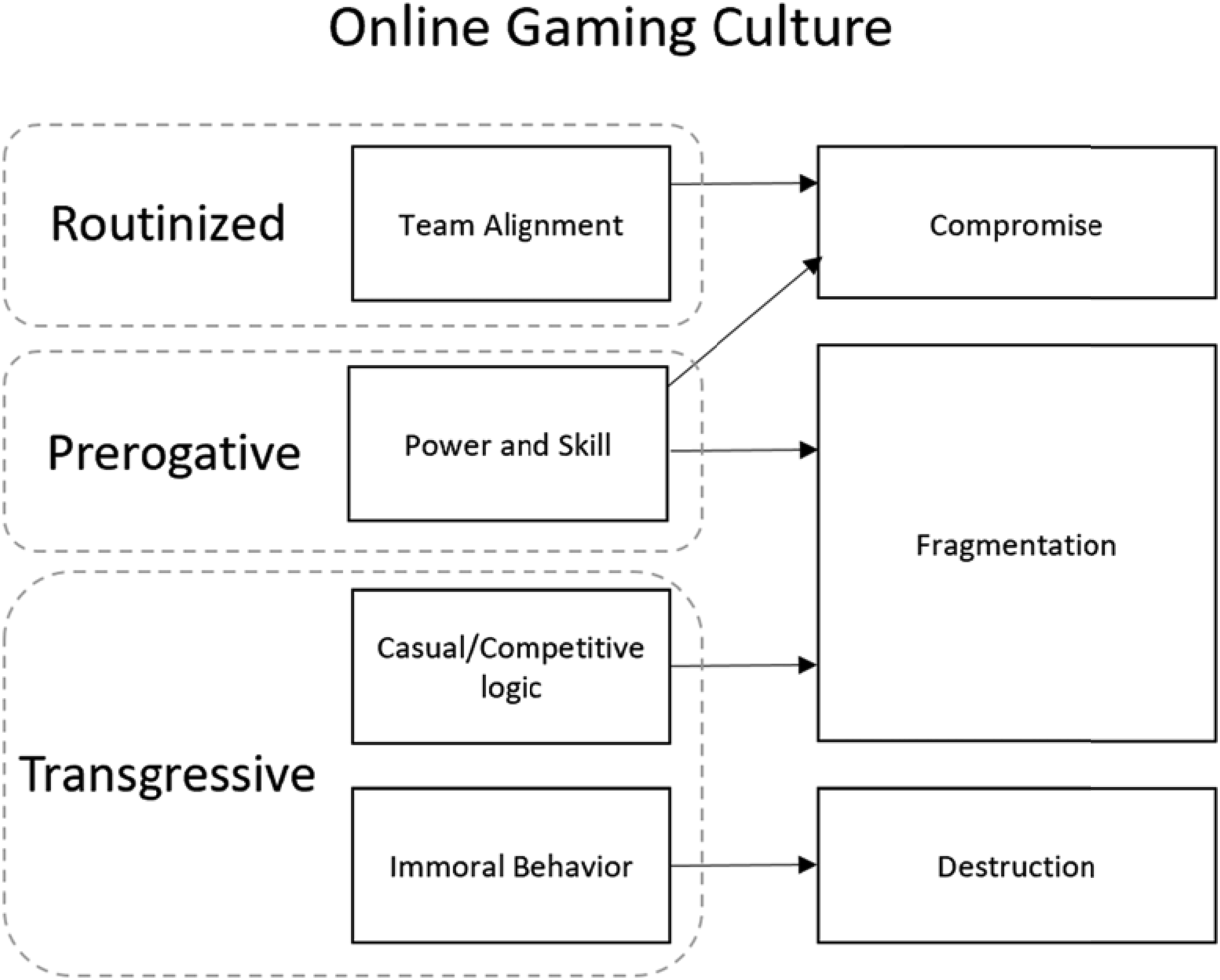
Routinized conflicts are well documented in previous research (e.g., Hemetsberger, 2006; Thomas et al., 2013), and call attention to dialectical categories of exclusion and integration within controlled and habitual conflict situations. In the present context, the routinized conflicts have a dynamic and almost democratic aspect where members openly discuss team alignments for reaching community goals during pre-game, in-game and post-game discourses.
Extending the work of Husemann et al.'s (2015), the findings call attention to prerogative conflict cultures in communities marked by hierarchical division due to high/low skills. Since gaming skills are important for reaching game missions (De Schutter and Brown, 2016), tensions would develop when team members question if highly skilled gamers should “receive” privileges of dominating decision making. In Figure 1, we theorize the implications of prerogative conflict cultures as either compromise (team members’ acceptance) or fragmentation (e.g., member loss). Some of the participants state that they have left communities because they do not accept the hierarchical status within the group. One might speculate if a Norwegian amateur gaming context, characterized by egalitarian values (Martin et al., 2019), is less amenable to hierarchical power configurations than gamers of (neoliberal) contexts that value individual freedoms and skills. However, more research is necessary on the role and impact of prerogative conflict cultures.
Third, unlike much of community research where consumers are only loosely connected in a community (Cova et al., 2015; Chandrasapth et al., 2021; Thomas et al., 2013), the present community-based study involves members who engage in intense, enduring personal relationships with goal of sharing hedonic experiences in tightly knit online consumption communities. While previous gaming research report negative emotions, for example, due to game failure (Breuer et al., 2015) or win-loss ratio (Hemovich, 2021), our results show that conflicts are not necessary a deviation that violates the ludic gaming experience. Although gamers engage with different commitments, for example, depending on time invested, the study shows that compromises nurture continued community existence. Inspired by previous research (Lindberg and Mossberg, 2019), we argue that compromise-as-avoidance is relevant when consumers temporarily set aside their preferred gaming logic and let high skill gamers dominate, which could be the outcome of prerogative conflict cultures. In routinized conflicts, “composite compromise” might be used when gamers choose to play a different game because of team alignment disputes. However, compromises can be argued unstable because they depend on the goodwill of the involved parties who can question the appropriateness of a given composite arrangement (e.g., new game) (Cova et al., 2015). Further research is needed as to the possible relationship between social conflict culture, conflict types—and compromises.
Conclusion
This article investigates the role of social conflicts among consumers in (amateur) online gaming communities. Whereas passion and fun are central for gamers, it is interesting to address how the sociality of communities plays out. However, the “virtual heaven” of gaming is not only “heavenly.” Previous research has documented challenges of gender imbalance and its impact (Shaw, 2010), psychological consequences of extensive gaming (Greitemeyer, 2014) and how gaming controls consumers’ lives (Brock, 2017). The present research contributes with knowledge on the role of social conflicts among players of (multiplayer) gaming communities. More broadly, we contribute to the sociocultural stream of consumer research (Arnould and Thompson, 2005), on consumption heterogeneity related to hedonic consumption communities (Lindberg and Mossberg, 2019; Thomas et al., 2013) and argue for the constructive role of conflict for the dynamic development of communities’ conflict culture, by establishing new community boundaries and norms for acceptable discourse (Dubiel, 1998; Husemann et al., 2015; Hirschman, 1994). We show how online gaming communities are imbued with routinized, prerogative and transgressive conflicts that manifest through community fragility and contestation, interpersonal conflicts, competition and positional struggles. Interestingly, our data shows time, intensity, and degree of involvement as criterion of routinized conflicts resulting in compromise, while prerogative and transgressive conflicts are indicatory of protracted dispute of communal and sociocultural origin, that provoke destructive and fragmenting outcomes. We suggest that future research should investigate the relationship between various in-game ethos and norms, such as between casual and competitive ethos, in both virtual and real contexts, and further, how these communal and cultural relationships both restrict or expand the consumption experience. Perhaps then, “virtual heaven” is “heavenly” after all, despite all the tension and dispute.
Footnotes
Declaration of conflicting interests
The author(s) declared no potential conflicts of interest with respect to the research, authorship, and/or publication of this article.
Funding
The author(s) received no financial support for the research, authorship, and/or publication of this article.
