




Abstract
This article explores the legalization and marketing of recreational cannabis in Canada, specifically the province of Nova Scotia, that has extended state monopoly over sales. Beginning with Howard Becker’s classic analysis of “becoming a marijuana user,” this ethnographic investigation of the first day of state cannabis sales utilizes and extends Bourdieusian analyses, particularly by showing how “symbolic violence” and “taste distinctions” work beyond overt class reproduction to establish state classifications and rituals. The practices we observe show state formation in action at the point of sale, including education, warning, prohibition, and promotion. As we demonstrate, the state marketing of cannabis works to invite emotional identification toward becoming the state consumer as an embodied habitus. The citizen is not just redeemed morally by the legal recategorization of cannabis but brought into a new subject position as good consumer citizen at the moment of ritual consumption, that is, brought into a “tasteful state.”
Keywords
Introduction
In 2018, Canada became the second country to legalize, regulate, and tax recreational cannabis. As the federal Cannabis Act transformed cannabis and its consumers from illicit to licit things, the state also redefined cannabis as a necessarily and legitimately state-mediated consumable. In the province of Nova Scotia, the government exerted monopoly over recreational cannabis sales and had then implicitly to defend this monopoly in its framing of the meaning of cannabis and its consumption. This article explores the political framing of cannabis by the Canadian federal government leading up to legal sales, as well as the first day of cannabis sales in Nova Scotia Liquor Corporation (NSLC) stores. This historic cannabis legalization and marketing offers an opportunity to observe how the state as an institution makes itself the “natural” and pleasurable site of the sale and promotion of cannabis.
Our research contributes to analyses of consumption politics and the consumer citizen by (1) investigating “soft state” practices by which the state transforms deviant/illegal substances into legal markets which the state itself participates in and (2) extending Bourdieusian analysis of taste distinctions and habitus beyond their social class applications to processes of state mediation, whereby symbolic violence works to constitute the citizen as consumer of the state’s products, and ultimately the state’s classifications/point of view. The consumer citizen is thus positioned and domesticated into a “tasteful state.” As we demonstrate, through the marketing of legal cannabis, the consumable state sells itself—its version of legitimate consumer pleasures—domesticating cannabis as a substance and generating the citizen as a consumer of the state. Our discussion contributes to analyses of state formation by examining the state’s interest in colonizing previously illegal substances and practices and examines how the state proceeds to move into consumer markets.
In his classic essay, “Becoming a Marihuana User,” American sociologist Howard Becker (1953) analyzed the processes by which an individual comes to enjoy marijuana. In Becker’s day, cannabis was illegal in the United States but was enjoyed in particular subcultures. Becker’s discussion is grounded in symbolic interactionist theories of deviance, whereby taking on the role of habitual deviant or criminal is learned in a social context. This is significant here since now legal state-owned or run cannabis sales must transform the deviant or criminal label, making the activity of consuming state cannabis socially acceptable. We offer an ethnography of the practices by which prospective cannabis consumers (as well as long time and casual users) come to be state cannabis consumers through their experiences of what we have called “State Cannabis Day” in Nova Scotia. These experiences include lining up for the opening of the NSLC store, media framing of the celebratory wait (with celebrity spottings), the interior design, signage, interaction with staff and taste talk, taking a taste quiz, and returning home to legally unpack one’s purchase filled with government warnings and safety packaging.
Becker’s analysis offers a three-stage learning process of becoming a regular cannabis user: first, learning to smoke the drug in a way that produces real effects; second, learning to recognize the effects, connecting them with the drug; and third, learning to enjoy the perceived sensations (Becker 1953). We provide examples of this third moment through the various ways state cannabis marketing teaches the consumer to “enjoy your experience,” the phrase used by NSLC staff to end transactions on the first day of sales. The learning processes Becker described often involved an experienced user teaching a novice. We suggest that the state now presents itself as a stand-in for the “experienced user” and as a consequence must sanitize/erase the earlier stigmatized connotations associated with the deviant role, such as the “dealer” and the “street.” But the state as dealer must also continue to demonize the remaining street vendor by cultivating the meaning of cannabis as simultaneously safe and dangerous, expanding and hardening the gap between state and street cannabis.
We extend Becker’s analysis by linking learning processes to Bourdieusian theories of taste distinction practices and state formation. By state formation, we mean the continuous doxic repositioning of the state and its organs to sustain its legitimacy as the exclusive site of nonnegotiable power over a territory and its citizens (Weber, 1946). Bourdieu’s early work on education demonstrated a critical approach to learning processes through the application of concepts such as “symbolic violence” (1977). The concept of the “tasteful state” we utilize here comes from our application of Bourdieu’s early theories of taste distinctions and symbolic violence and his later explicit discussions of state formation. We suggest that Bourdieu’s discussions of state formation understate the possible pleasures generated in the process. As our discussion proceeds, we will see that state formation does not occur solely through the heavy-handed practices of the hard state but through the subtler practice and symbolic violence of the soft, consumer state.
We argue that while consumers bring taste distinction practices to state cannabis experiences, the state orchestrates these practices to its own ends, ultimately allowing the state to manifest as the performative location of legitimate taste practices and their arbitration. Moreover, state mediation itself is offered as pleasurable and consumable as state practices of ritual and categorization parallel those of consumers toward a statist nationalism. Following Warde, we link the “practical” and “collective” aspects of consumption” (2014: 283) with individual taste practices. Hence, non-state cannabis remains as allegedly dangerous and distasteful as before legalization, perhaps more so as the state moves to become the only legitimate, “universal” (Bourdieu, 2014) vendor. In this positioning, cannabis remains neither wholly dangerous nor safe as a substance. The state resolves this tension of meaning, in part, in the consumer moment of choice, where the consumer, as informed by stark federal state packaging and signage, remains responsible for personal choices and their consequences (Rose, 1999). Moreover, state-hosted rituals of tasteful categorization and sorting are performative and reconstituting of the state as the doxic location of consumer pleasure, shored up by the authority of the state as a safe place to consume and get advice. Connoisseurship as differentiation renders the non-state location of cannabis consumption an unintelligible and distasteful “mass” of indiscriminate action (Lawler, 2005). Following Veblen (2007), we find that the state as host not only ensures pleasure but also asserts power over its “guests” by delineation and orchestration of taste distinctions toward the “civilized” (Elias, 2000) and assimilated consumer citizen. The real danger of non-state cannabis is that it violates the morality of tasteful state consumption.
Bourdieu formulated state symbolic violence in terms of both its universalizing and categorizing capacities. State symbolic violence (Bourdieu, 1979, 2014) works institutionally to shape how citizens think categorically, for example, what is and is not a legitimate or moral person, practice, habit, substance, or place, by orchestrating understandings of the most basic realities at the level of common sense, or doxa. The state functions at the level of cognition and unconsciously in the form of habitus, embodied “classificatory schemas,” “durable dispositions,” and “practical taxonomies” (Bourdieu, 1984), but habitus lives in the body and visceral subjective experiences like disgust. Hence, symbolic violence includes national sentiment, as the emotional “imagined community” (Anderson, 1983) adds depth to its effects. It is worthy of note in this context that Canada has been described as a state nation rather than a nation state (Gwyn, 1995; Vipond, 1992) in that historically the state preceded and brought into existence the feelings of nation necessary to its own existence and legitimation.
In order to examine the enactment of new state classification and understand the enthusiastic participation of new state cannabis consumers, we link Bourdieu’s early work on taste distinctions with his later work on the state. Consumer objects offer, at any given moment, “… the universe of cultural goods as a system of stylistic possibilities” (Bourdieu, 1984: 230). Moreover, this aestheticization can expand and colonize any aspect of everyday life (Bourdieu, 1984: 5). Discernment then aligns with connoisseurship and self-controlled consumption (Bourdieu, 1984: 56). Connoisseurs coolly reject what is “beneath” their taste, but the revulsion or “disgust” directed at others who do not share or understand their taste values is “terribly violent” (Bourdieu, 1984: 56).
But, if taste, for Bourdieu, is to make and remake class distinctions, power, and hierarchy, and if the state is a universalizing social location (i.e., in some way inclusive of all consumer citizens in the monopolized context), then how does taste work here? As Curley (2018) has argued, the state not only shapes taste distinctions by reinforcing ideas about legitimate cultural practices, but it also manifests itself as institutional organs of political administration by way of these taste distinctions. Clearly, the NSLC is not trying to attract one type of clientele over another type. Taste talk is not outwardly directed at distinguishing clients, rather it is inwardly directed at legitimating the state itself as vendor.
At the center of the consumer–citizen nexus is state formation, more or less evident. As Cohen (2003) argues in the American context, while in the late 19th and early 20th centuries, the consumer citizen petitioned the state to regulate prices and quality of goods and later provided a legitimate status for social protests (e.g., the civil rights movement), the consumer citizen has also shored up state interests (curbing consumption during war only to then patriotically power the economy and the US sphere of influence during the cold war). More recently, citizens have exerted their rights in the context of state services themselves (Trentmann, 2016). As the consumer has emerged as citizen, and citizen as consumer, so too has the state positioned and remade itself. Clearly, it is cannabis’ move from illicit to licit consumable that makes this case study of interest in terms of state renewal and legitimacy, but non-criminalized substances also shape consumer citizenship. As Trentmann (2016) documents, middle-class British male consumer citizenship took shape in the late nineteenth century around asserted rights to affordable and dependable water. Wilk (2006) notes bottled water takes on meanings to the degree that consumers generally trust public commons and state management. That tap water could be bottled and branded as safer and more palatable than its unbranded counterpart speaks to the power to frame substances, symbolically transubstantiated from profanity to purity (Douglas, 1966; Durkheim, 1995). Significantly, Wilk indicates Canadians find the taste of bottled water its main attraction over its safety, pointing to a faith in state regulation not found in the American case, but also a connoisseurship of taste distinctions. Are Canadians, then, as consumer citizens well positioned to find pleasure in state consumption as taste practices beyond their simple redemption as drug users?
Canada, vice, and State formation
Academic study of drugs and “vices” in Canada has focused primarily on state formation by way of regulation, surveillance, and punishment, with a more or less explicit Foucault (1977) emphasis on groups targeted as potential victims or purveyors (Campbell, 2008; Chanteloup, 2002; Dyck, 2011; Little, 1998; Marquis, 2004; Morton, 2003; Heron, 2003; Carstairs, 1998, 1999, 2006; Thompson and Genosko, 2009; Kinsman, 1996; Kinsman and Gentile 2010). During the Progressive Era, and influenced by cultural and political trends in the United States, Canadian federal and provincial governments variously prohibited or regulated tobacco (Alston et al., 2002), alcohol (Heron, 2003), cannabis and various other drugs (Grayson, 2008), and gambling (Morton 2003). Later the Canadian state used its position as moral arbiter to impose “sin” taxes, based on the argument that particular substances and practices are unnecessary and indulgent. In 1929, the Nova Scotia Temperance Act was repealed and government monopolized liquor sales, justified along prohibitive grounds of liquor “control” and reflected in austere packaging, interior design, and sales practices. Over the last 30 years, all Canadian provinces have rebranded state-sold alcohol as increasingly “tasteful,” marketed around sociability and the consumption of food.
The history of the increasing “consumability” of state-mediated pleasures shows that as the state benefits financially from the legitimization of practices that it previously deemed deviant and illegal, its interests in revenues and the related marketing of such substances or activities are combined with efforts at risk management of concomitant unwanted social consequences, such as addiction and illness. The expansion of legalized gambling in Canada, for example, has been accompanied by a mode of neoliberal risk management aimed at shaping the comportment of individuals in relation to the problems of excess that can accompany gambling, typically couched in the medicalized constructs of “problem” and “pathological” gambling. This shaping aims at producing a “responsible gambler” and indicates the off-loading of risks from the state to the individual as markets are expanded and normalized (Cosgrave, 2009).
With legalization of cannabis in 2018, the federal government followed the model it had used earlier with alcohol and gambling legalization, ceding the administration and profits to provincial governments, who then were to frame consumption and control within the confines of the federal Cannabis Act. Some provinces allowed a mixed model, with government and private sale existing side-by-side. Others, like Nova Scotia, opted for a single, state model of sales. And while this apparent liberalization of cannabis seems to signal a withdrawal of state from the regulation of adult pleasures, as with gambling legalization, overt oppressive state formation expanded with the legalization of cannabis. For example, in Nova Scotia, private vendors, their landlords, and even residential tenants were arrested or evicted by police (CBC, 2018b; Star, 2019), non-high drivers with Tetrahydrocannabinol (THC) in their bodies were charged (CTV, 2019), and selling to minors became heavily criminalized under the Cannabis Act.
Health and addiction researchers in Canada had for decades condemned the government’s war on drugs (Alexander, 1990; Erickson and Oscapella, 1999; Giffen et al., 1991; Hyshka et al., 2012) as aimed more at criminalization than public interests, including health. As early as 1972, when the United States was talking about drug “epidemics,” Canada’s Le Dain Commission recommended that the Narcotics Control Act be amended to a “reasonable” fine for cannabis possession (Zeese, 1999: 344). Cannabis takes on collective meaning in this nationalistic dynamic, especially as the United States pushed back with threatened trade sanctions in the early 21 century and the Canadian government publicly back-peddled on legalization (Wesley, 2019a). Once finally underway, cannabis legalization moved at a remarkable speed, noted as “… one of the most complex and time-compressed exercises in national policymaking since the construction of the modern welfare state” (Wesley, 2019b).
In the few years leading up to cannabis legalization, Canada’s two major political parties squared off on the issue, each making use of moral and risk discourses. In October 2015, the Liberal Party of Canada defeated the incumbent Conservatives and came to power under the leadership of the young and charismatic Justin Trudeau. The Liberals had run on a broadly statist platform, including deficit spending, expanding social programs, raising taxes, resettlement of Syrian refugees, and the legalization of cannabis. They had promised to decriminalize cannabis consumers, keep profits from organized criminals, cut off access to harder drugs, and impose harsher penalties for providing cannabis to minors, driving under its influence, and selling illegally (Liberal Party of Canada, 2015). Here, “moral panic” (Cohen, 2002) tropes were called up, including vulnerable children, gangsters, gateway drugs, vehicular mayhem, and drug pushers, with state power legitimated. In an interview with Vice (2017), Trudeau emphasized the government’s interest in “health and safety,” drawing a contrast with those individual American states that have legalized cannabis, as the latter allegedly focus primarily on “commercial” interests. Trudeau routinely stressed that organized crime was at the root of illegal cannabis distribution in Canada, asserting that “rational” consumers would not want to buy cannabis of “dubious provenance” from a “shady character in a stairwell” (Vice, 2017). Significantly, during his Vice interview, the interviewer countered that underage cannabis consumers purchased it from their friends, challenging Trudeau’s fear-mongering framing of the street dealer. During the election campaign, the incumbent Conservative Party also invoked moral panic, but toward increased criminalization, continuing to promote its “National Anti-Drug Strategy” (Conservative Party of Canada, 2015). Each party used similar arguments but toward different manifestations and expansions of state. Once in power, the Liberals created the new cabinet portfolio of “Minister of Border Security and Organized Crime Reduction” for former Chief of Toronto Police, Bill Blair. This portfolio includes all federal cannabis legislation.
“Enjoy your experience”—State Cannabis Day
The just under one million people who live in Nova Scotia are the largest per capita consumers of cannabis in Canada (Statistics Canada, 2019). On 17 October 2018, the first day of cannabis sales, the NSLC reported 12,180 cannabis transactions, totaling just over $660,000 in sales, including $47,000 of sales online (Global News, 2018b). By February, NSLC reported third-quarter year revenue at $17 million with 456,822 transactions since the first day of sales (CBC, 2019). While sales were apparently strong, the NSLC had yet to turn a profit due to the costs of store renovation, staffing, training, and purchasing of product (CBC, 2019). Nova Scotia Liquor Corporation also reported continued difficulty maintaining quantities and varieties of cannabis (CBC, 2018a). The price of NSLC cannabis is significantly higher than illegal, street cannabis, so both cost and availability of choice may constitute ongoing challenges for the NSLC. How then does the NSLC appeal to and cultivate its cannabis clientele?
As participant observer on State Cannabis Day, one author stood in line with other eager and curious Nova Scotians, was greeted and informed about the product by NSLC staff, saw the interior design of the newly unveiled cannabis section of the store, read the promotional posters and warnings, participated in the taste quiz, and was handed an access code for online shopping. As Bourdieu suggests, the state’s manifestation through symbolic violence works in stark and dramatic ways. At 11:59, 16 October 2018, cannabis was officially illegal in Canada. One minute later, it was transubstantiated by law and ratified by state and consumer ritual. Practically, cannabis would become available only at 10:00 a.m. when NSLC stores opened. Nova Scotians camped overnight outside the NSLC, sang songs, and generally celebrated. The historic wait for cannabis legalization was marked by this final expectant wait. News media also emphasized that the purchase would itself be celebratory Upwards of 100 people were in a lineup at the NSLC outlet in Sydney River by store opening at 10 a.m. to mark the legalization of recreational cannabis in the country with their own purchase, a line that steadily remained over the 100 mark and by 11 a.m. reached more than 150 (Montgomery-Dupe, 2018).
Many consumers took selfies while in line and after their purchase, holding up their sealed brown paper bag. The media also conceded that these purchases were a “first” only in the technical sense as many of those interviewed explained that they had been cannabis consumers for decades. It was clear by the animated conversations that most customers were not new to cannabis but connoisseurs with street strain names and taste distinctions showing their “cultural capital” (Bourdieu, 1986). Apparently, the giddy celebration involved not only the legalization of cannabis but also the very move of cannabis sales from the street to the state. In Bourdieusian terms, these customers were the first to consume official cannabis, but also were to ritually consume the first official state staging of cannabis as well as recasting of their own status from officially illegitimate to legitimate consumer. Famous Nova Scotian musician Ashley MacIsaac waited all night to be the first in the door at one location—“I don’t need to be a criminal anymore, and that’s a great feeling…And my new dealer is the Prime Minister” (Global News, 2018a). In spite of his famed bad-boy image, MacIsaac, as citizen, here turns to the state to celebrate its apparent reclassification of cannabis, and the ritual stepping from the street to the government store marks MacIsaac’s civic rebirth.
Once inside the NSLC store, interior design, signage, an interactive quiz, and attentive staff oriented consumers toward the reinterpretation of themselves, cannabis, and the state vendor. Other than one stand-alone cannabis store in the provincial capital of Halifax, all other 11 cannabis stores are located within NSLC liquor stores. Customers buying liquor in the months leading up to cannabis sales got hints of the experience to come as they could hear construction behind temporary walls inside liquor stores. NSLC signs oriented customers to the new, still illegal, product soon to be available—“Coming Soon: A New Category: Thank you for your patience as we renovate to integrate cannabis into the NSLC shopping experience.” This use of “category” rather than “product” points to the NSLC challenge of redefining cannabis and its own relationship to cannabis sales. The sign hints at how this will unfold—“integrate” points to the work that will have to be done to define cannabis as a legitimate consumable. In a promotional media interview to introduce the new stores, the NSLC president and CEO repeated that cannabis in general was a “new category” for some consumers, which is then subdivided by the NSLC into the four taste categories “to help consumers choose” (CTV, 2018). The word “experience” would also be repeated and thematically woven into the first day of sales.
In all but the one stand-alone store, the cannabis section is located at the back of the NSLC liquor store. Massive white letters spelling out “CANNABIS” stand against a wood-faced upper wall. Customers enter by navigating around an opaque glass wall and then a white-tiled wall that visually separates the cannabis sales from the rest of the store. Bright interior lighting and white walls make the space glow as seen from the outside. One participant likened this entrance to a sterile and cold public bathroom. Others compared it to a clinical medical cannabis dispensary or operating room, suggesting that the theme of this “servicescape” (Booms and Bitner, 1981) is blank neutrality and universalization. Still others interpreted this space as a modern aesthetic comparable to that found in highbrow, yet mass culture, coffee shops like Starbucks (Bookman, 2013).
As one customer put it The table in the back of the store was a nice natural wood table with modern metal stools, reminiscent of an urban coffee shop or an Apple Store. The aesthetic of the place seems to be clean, contemporary, stylish, minimalist, white, art gallery-esque, and friendly. Arriving at the counter felt like I was about to order a coffee. I told the woman working that it was my first time in the store, and she said in a light-hearted way “What took you so long man?”
Another observed When approaching the counter, I felt the experience was similar to walking up to a bar or a coffee shop whereby you are greeted by a friendly staff member. But, this staff member was wearing an apron with the experience ‘catch phrase’ printed directly on the front of the apron bib. The staff place a few informational pages […] in front of you and you may ‘browse’ through to determine what you may like to purchase. The staff member that was serving me was playful and friendly–and indicated to me that if I wanted to be on the couch for the night –an “Indica” was the one to purchase.
As Holt (1998) found in an application of Bourdieu to American culture, modernist design signifies connoisseurship because a less cluttered space indicates discrimination. Hence, neutrality and taste are linked in this aesthetic. And while this physical space is new, it must be understood in terms of what it distinguishes itself against. Since 2000, medical cannabis has been increasingly available in dispensaries (that tend toward clinical interior design), but the long-standing commercial manifestation of cannabis-related sales was the counterculture “head shop” that sold cannabis paraphernalia and was typically colorful and crowded with psychedelic artwork and interior designs (Joyner, 2018). Nevertheless, as the above quotes show, NSLC staff employed language and lifestyle discussion apparently modeled on impressions of pothead counterculture. Here, the rational, predictable, and controlled aspects of consumption, packaged as tasteful modernism, are married with residues of thrill and risk (Halnon, 2002).
Inside the cannabis section of the NSLC, customers waited in roped lineups and were served by staff at counters behind which the cannabis is stored. Unlike the liquor section, where customers directly pick bottles off shelves, cannabis customers must interact, at least nominally, with staff to place an order. Staff circulated among customers with lists of cannabis strains, formats, and prices, encouraging customers to discuss their desired type of high or “experience.” At the end of each transaction, the friendly staff used the stock phrase, “enjoy your experience.” As Sacks (1989) argues, such formal “ceremonials” are powerful interactional strategies used to close and define situations. Cannabis, but not alcohol, is an “experience” according to the NSLC. The consumer’s experience of the cannabis as a high is framed by way of taste talk. In contrast with the liquor section, there is no commercial branding of cannabis for the customer to see, in part because the NSLC has a handful of suppliers. While there are no brand names, the NSLC does offer taste distinction language in the cannabis section, but one that comes from established street names for strains, most obviously comparable to roasts and types of coffee beans available in high-end coffee shops, and their concomitant proliferation of connoisseur language and subjectivity (Bookman, 2013; Cormack, 2008; Cormack and Cosgrave, 2013).
On the backdrop of the white interiors, signage makes repeated use of a four-colored cannabis leaf motif to crudely sort and characterize the experience of strains of cannabis by THC and Cannabidiol (CBD) levels—lime green—“relax” (low THC); orange—“unwind”; pink—“center”; and purple—“enhance”(highest THC). The terms that accompany the colored leaves are meant to capture the experience associated with each strain, with “relax” signifying a bodily experience, and “enhance” signifying a mental experience at the other end of this spectrum. The lime green, orange, pink, and purple leaf motif was repeated throughout the store and on aprons worn by staff (Figure 1). The purple leaf motif, that some customers interpret as a stylized maple leaf found on the Canadian flag, is also used with the NSLC “Need to Know” campaign, showing an integration of official education and warning about the alleged dangers of cannabis with the promotion of consumption through taste talk. In Canada, the pro-cannabis movement has long used a cannabis leaf imposed in place of the maple leaf as its symbol. Nova Scotia liquor corporation cannabis store interior.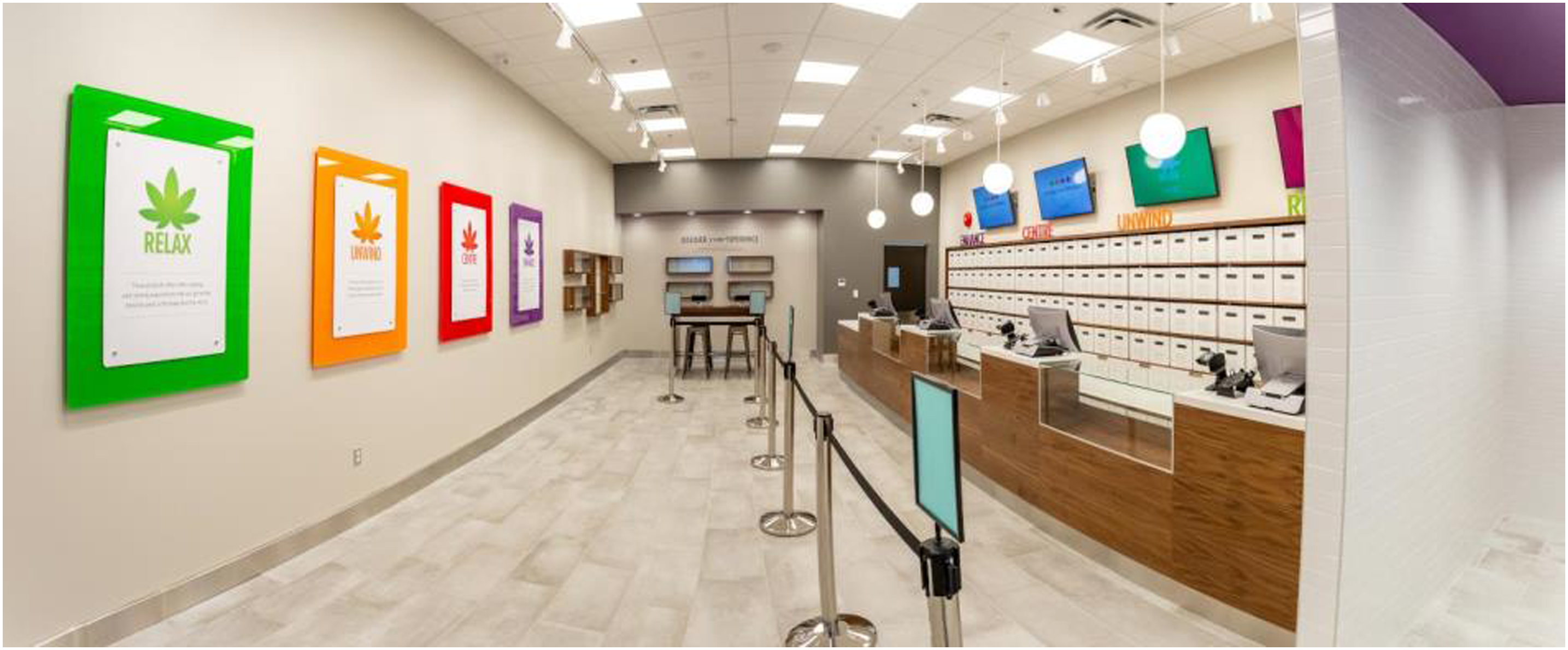
Using this color coding, customers were invited to do taste talk with the staff. But, it was not simply evident, for example, how “relax” is different from “unwind.” One could argue that it is difficult to capture the cannabis “experience,” which may be better characterized as more than one potential experience. As the NSLC “Start Low and Go Slow” campaign states, “cannabis affects everyone differently.” This categorization is apparently a way to educate the consumer about how to find a good fit with their own desired experience and their own physiological particularities. Again, as the cannabis high is apparently extremely individualized, discussions of effects tie directly to both safety and taste talk.
A closer look at this sorting of cannabis strains reveals contradictions within the apparent logic of this classificatory schema. As well as consulting with staff, customers were encouraged to take the online quiz (available in-store on screens) that begins with the four-color cannabis logo and the title, “Discover your Experience.” The first screen explains that there are as many differences in cannabis as there are consumers, suggesting a plethora of taste choices, matches, and experiences. As the quiz unfolds, it becomes clear that “experience” does the work of legitimating state mediation through both taste distinctions and the responsibilization of the consumer. Screen 1: “Cannabis affects everyone differently. Each person is as unique as the product. Let this quiz help you discover the experience that is right for you.” Screen 2: “Are you new to cannabis?”, with four choices that range from “all brand new to me” to “I consume cannabis on a regular basis.” Screen 3: “The aroma and flavour of cannabis results from naturally occurring oils in the plant called terpenes. What aroma and flavour do you prefer – earthy; floral; citrus?” Screen 4: This screen informs consumers about the forms of cannabis and asks about dried flower, oil/capsules, or growing at home from seeds. Screen 5: “What kind of experience are you looking for – relaxing and calming; grounded and balanced; uplifting and invigorating; soothing and comforting?” Screen 6: Explaining that THC affects the mind, and CBD the body, it asks “What are you planning on doing – putting my feet up and relaxing; spending time with a good friend and watching tv; having a few friends over to visit; a social night out?”
Oddly, when completing the quiz and answering that one is “brand new” to cannabis and plans a “social night out” the recommendation is to choose from the “enhance” category (highest THC), contrary to “street” knowledge that strong strains should be consumed in safe and familiar places (Becker, 1953). Hence, the ritual of taking the quiz itself should not be overlooked to understand this consumer experience. While questions appear to be of equal weight in the calculation of recommended purchases, such quantitative evaluations could not be mathematically calculated by the consumer and are not presented as such, except at the experiential level of working through each screen/question toward a recommendation with the question about social plans anchoring the quiz. The “Discover Your Experience” cannabis quiz has subsequently been replaced by the “Cannabis Strain Guide” with only four questions that retain the queries about previous experience and taste talk but replace the vague experience terms with “mind”/”body” questions about intended effects. The question about social plans has been removed and results have replaced the categories like “Centre” with more technical language and less direct recommendations, for example, “Sativa leaning.”
When the first customers left the NSLC with their “Need to Know” paper bag sealed with a sticker warning “keep sealed while in-store,” they were legally able to open their purchase at home (not in the car). At this point, the experience of cannabis met one more state framing, and in this case, obstacle, packaging as physical barrier and site of warnings. All cannabis products come in black heavy plastic containers (with childproof lid) or cardboard boxes covered with information, including the name of company, name of stain, percentage of THC and CBD per unit, one of various yellow-blocked warnings from Health Canada, for example, adolescent use (psychosis and schizophrenia), use during pregnancy and breastfeeding, a keep-out-of-reach-of-children warning, storage instructions, package date and Lot #, weight, and description of content (e.g., “3 pre-rolled joints”). Inside the “Need to Know” bag, customers also find a federal government warning sheet (in English and French) as well as the “Need to Know” NSLC insert reminding them of the age prohibition, recommending the “low and slow” approach to consumption because “everyone’s experience is unique,” warning of mixing alcohol and cannabis, instructing to lock up and keep out of sight and reach of minors, and to refrain from driving while high. The federal government “Know the Facts” sheet repeats similar warnings, with more detail about forms of cannabis and the length of effects, as well as warnings about addiction and the suggestion to “avoid smoking cannabis” even though dried leaf cannabis is by far the most commonly available form.
Layers of packaging as well as government information sheets made these cannabis purchases necessarily wasteful, as customers and media pointed out. This moment of unpacking one’s cannabis purchase is a stark juxtaposition with the playful interaction with staff. That the paternalistic and highly generalized warnings rooted in the apparent scientific expertise of state bureaucracy happen mostly after purchase means they are experientially separated from the promotional moment of shopping.
Clearly, the framing of cannabis and alcohol consumption cannot be handled in the same way by the NSLC. While alcohol has over time been fully integrated into taste talk around celebrations and food preparation, the NSLC has had to face the consumer’s desire for a cannabis high head on and the attendant deviant connotations. It has responded by treating the high itself as a tasteful practice by integrating the discussion of effects with that of flavor, preference, and rituals of selection. The attempt to integrate social activities has been removed from quizzes but does linger in the staff interactions, and even on the warning-filled packaging (cigarettes are “joints”). Moreover, the NSLC liquor section does not need at this point in Canadian history to discredit its potential competitor, the moonshiner, while the cannabis section does have to compete with the local street dealer. Its taste talk builds on the political framings of street cannabis as dangerous by adding the consumer risks of the product being apparently undifferentiated, unreliable, and untraceable, and the street dealers unresponsive to consumer complaints. The transubstantiation of cannabis into legal consumable thus depends on the symbolically violent overdetermination of the dangers and risks of illegal cannabis, thus disavowing but also assimilating cannabis (sub)cultures and the replacement of the dealer by the tasteful state vendor.
Conclusion
Consumers who buy cannabis legally in Nova Scotia no longer have to face the supposed menace of Trudeau’s “shady character in a stairwell,” but they do necessarily have to deal with the state. Such customers are thus generated as consumer citizens, and it is at this nexus that practices of state formation around legalized cannabis become observable. The NSLC must position itself as the only reasonable and desirable site for the purchase of cannabis, both for its legitimacy and its survival as a vendor. Our investigation broadens understandings of the consumer citizen, seen here as arising through the state’s hosting and cultivation of consumer choice. The citizen is constituted and solicited as consumer through the state’s creation of and involvement in a newly created legal market.
As we have demonstrated, the scope and shape of state power is made observable when the state “changes its mind” about particular consumer practices. Significantly, symbolic violence is at work, not only when an activity or substance is defined as illegal and forced to exist in the shadowy stairwells, thereby requiring the physical violence of enforcement, but when it is redefined as legal and made available for licit consumption. This production of the consumer citizen through symbolic violence has depended on the neutralization of cannabis’s historical countercultural significance, and any radical or otherwise deviant connotations associated with the drug on the basis of class-based habituses. At work in both cases is the naturalization of the state’s point of view. Normalization strategies arise with legal cannabis consumption aimed at shaping the individual’s experience: one may “enjoy their experience” and desire for the product but is enjoined to do so through the state’s classifications of the product and the desired way to purchase and consume it.
The celebratory and ritualistic pleasures we analyzed were associated with the national countdown to the first day of sales. Hence, state symbolic violence and pleasurable rituals, like personalized taste talk, should be understood as complementary moments of state formation. The performative moment of state formation is both a universalizing move in the form of state ritual and a particularizing move in terms of pleasurable connoisseur taste practices. State Cannabis Day customers anticipated and celebrated this liberalizing moment of Canadian history—one in which the state apparently retreats in terms of the repression of consumptive pleasures. But the state as host sets the tone of consumption and also the retroactive reinterpretation of Canada as having been moved inexorably toward increased liberalization as the state becomes “reasonable.” The prime minister’s political comments regarding cannabis of “dubious provenance” proactively framed the consumer citizen to evolve through the legalization and marketing of cannabis.
While hard state practices were not the central interest of this article, they cannot be separated from the apparent softening of the state as the purveyor of consumptive pleasure, including the pleasure of state mediation itself. The plethora of warnings and responsibilization of consumers we discussed is not in contradiction with consumer pleasures. Responsibilization here is not just the off-loading of risks onto the neoliberal subject but rather the integration and assimilation of the citizen into the apparently caring and knowledgeable state, the stand-in for Becker’s “experienced user.” The hard state is supported and hidden behind its own appearance in the market as purveyor of consumer choice, and its authority to make categorical and moral distinctions unaffected as it changes its official position on cannabis. As discussed, non-state cannabis remains criminalized and demonized by state positioning.
Over the last two years, the NSLC has worked to make cannabis as well as its role as vendor attractive to consumers. Nevertheless, illegal sales remain strong, pointing to both the higher price of legal cannabis and the continuing problem of adequate supply and variety in NSLC stores. In the future, the excitement of State Cannabis Day may be replaced by the realities of the pocketbook and frustrations with the state vendor. In the fall 2019, the NSLC introduced edible cannabis in the form of candies, part of its continuing effort to expand the cannabis offerings and experiences. These candies are packaged in stark black boxes, and like all cannabis packages, covered with government warnings.
We expect that state formation around cannabis in Canada will continue to involve both its hard and soft expressions, but ultimately oppressive state formation will become less necessary if the consumer citizen discovers cannabis as a naturally state-mediated pleasure. On the other hand, Canadians could fall back into non-state “bad habits” of buying cannabis from known, local dealers, at which point the issue of the hard state will arise, threatening the work done at the level of the state vendor, or at least requiring a balancing act between the two faces of the state.
This discussion of cannabis legalization through “soft state” practices contributes to understanding how the state transforms deviant/illegal substances and practices into legal markets where the state plays a central role. The extension of Bourdieusian analyses of taste distinctions and habitus to processes of state mediation and formation demonstrates how symbolic violence works to constitute the citizen as consumer of the state’s products, and ultimately the state’s point of view. As such, the citizen is not just redeemed morally by the recategorization of cannabis, but repositioned as consumer citizen at the moment of ritual consumption, that is, brought into a “tasteful state.”
Footnotes
Acknowledgements
The authors would like to acknowledge the generaous support and critical insight of Evan Curley, Emma MacDonald, and Peter Mallory.
Declaration of Conflicting Interests
The author(s) declared no potential conflicts of interest with respect to the research, authorship, and/or publication of this article.
Funding
The author(s) disclosed receipt of the following financial support for the research, authorship, and/or publication of this article: This article was financially supported by St. Francis Xavier University, University Council on Research (UCR-B24009).
