



Abstract
This study explores how ethical food consumption is framed in the accounts of ordinary people living in affluent societies, with a particular focus on income differences. Research on ethical consumption often associates ‘ethical’ with the consumption of certain predefined products. This study leaves the question of the content of ethical consumption open for empirical investigation. Further, instead of focusing only on the moment of purchasing, this study considers how people with different income levels relate to both food consumption and waste. The analysis draws from qualitative interviews with 60 people living in Canada and Finland. The analysis identified the techniques, subjects and norms through which the question ethical food consumption is posed by the informants and how they framed these issues with regard to income. The findings underline that ethical consumption is a socially constructed, contested and even internally contradictory discourse. Differences in income do not only mean differences in the role that money plays in food choices but also in what kind of consumption people consider worth pursuing. Further, differences in income dictate differences in how people are morally positioned vis-à-vis abundance. For people with a higher level of income, moral blame is asserted on wasteful consumption habits. For the people with a low income, in turn, it is ethically condemnable to refuse to rejoice at the abundance around us. The findings indicate that even in a society where the rhetoric of choice is prominent both as a right and as an obligation by which people ought to display ethical agency, the ethics of choice is tied to the resources available for consumption. People with a severely low income occasionally enjoy the trickling down of abundant treats and surprises. However, for them, occasional indulgence causes not only pleasure but also trouble.
Introduction
Today’s Western countries can be regarded as affluent societies that provide people with opportunities beyond the basic necessities. These opportunities are largely facilitated by consumption (Lorenz, 2015: 2–4). Research has shown that in contemporary consumer society, food consumption is not only a matter of satisfying basic needs, nor is it merely about calculating costs and benefits or following individual tastes and desires. People infuse manifold moral and political insights into consumer behaviour and communicate care, identity and values through foodways (e.g. Grauel, 2016; Varul, 2016; Baumann et al., 2017; Kennedy et al., 2019; Oke et al., 2020). Ordinary people and their individual views and practices have been given pivotal positions both as sources of social and ecological problems and as drivers of societal and environmental change (Barnett et al., 2011: 1). People are invited – and even expected – to display moral agency via responsible consumption practices.
Research has rightly pointed out the vast cultural meanings of consumption that reach beyond economic rationalities into ethics, politics and care. However, material resources still matter in food consumption (Warde, 1997: 97, 100). Consumers are not all equally capable when it comes to their abilities to influence society with their choices: factors such as gender, race, age and socio-economic position play a role in people’s capacity to engage in consuming certain foods and to make influential choices (e.g. Cairns and Johnston, 2015; Johnston and Baumann, 2015; Schoolman, 2016).
This study explores how ethical food consumption is framed in the accounts of ordinary people living in affluent societies, with a particular focus on income differences. The findings complicate what we mean by ethical consumption by showing that income does not only affect people’s ability to engage in predefined forms of ethical eating. It also affects what kind of food products and consumer behaviour people count as worth pursuing, what kind of expectations they encounter in terms of their consumer roles and how they frame ideal food consumption.
Towards a more nuanced understanding of ethical consumption and income
Previous research highlights the need for a more nuanced analysis of ethical food consumption and income. First, the content of the concept of ethical consumption is far from unequivocal. It is often used to refer to consumption practices that aim at addressing social and ecological problems, such as fair-trade and organic products, and with consumers who display their ethical commitments by choosing these products (e.g. Johnston et al., 2011; Varul, 2016; Oke et al., 2020). This narrow view of ethical food consumption tends to privilege upper (or) middle-class ideals of what constitutes good consumption (Johnston et al., 2012: 1092, 1104), foster divisions between activists and ordinary consumers (Grauel, 2016; Kennedy et al., 2018), and create confrontations between individualised consumption and respectable civic engagement (Soper, 2007). Not all consumers necessarily agree on the contents of ethical eating. In fact, outside activist groups and ethically highly committed individuals, adhering to strict moral principles in consumption might be considered rigid and ideological, and as such, ethically suspicious (Grauel, 2016; Cairns and Johnston, 2015: 31–32). Further, people face puzzles as they try to accommodate competing ethical ideals in their daily lives, ranging from sustainability and social justice to concerns over health, family and propriety (Cairns and Johnston, 2015; Evans, 2014; Pecoraro and Uusitalo, 2014; Wheeler, 2018). This complexity highlights the intermingling of the narrow understanding of ethical consumption with wider notions of morality (Askegaard et al., 2014; Caruana, 2007).
To acknowledge this complexity, the present study leaves the question of the content of ethical consumption open to empirical investigation. I approach ethics as a modality of social action that is embedded in moral reasoning, but which is also attuned by the varying contexts and competing interests that people often face in ordinary life (Lambek, 2010; Sayer, 2011). From this perspective, ‘ethical’ is not an on-off category, something which one can either choose or decline. Ordinary food-related talk is filled with expressions that articulate what people consider as praiseworthy or reprehensible consumption, even when they are not explicitly framed in terms of ethics.
Second, the span of ethical consumption is often treated narrowly to include merely food purchasing (Warde, 1997: 126). However, neither consumption nor ethics end upon leaving the grocery store. People not only acquire but also process, eat and dispose of food, and they give ethically relevant meanings to these practices. In today’s world, one of the most pressing questions concerning food and ethics is household food waste; food that is bought but never eaten. Saving food from being wasted is considered an emotionally satisfying and morally respectable act (e.g. Koskinen et al., 2018: 24; Lehtonen and Pyyhtinen 2020: 198), whereas waste-producing food practices cause shame (Lang and Heesman, 2015: 224). Nonetheless, there are many structural and temporal factors that contest individual efforts to avoid food waste (Evans, 2011, 2014; Lehtokunnas et al., 2020; Mattila et al., 2019).
The amount of food waste is unprecedented today (Lang and Heesman, 2015). This does not mean that everybody is living in abundance in affluent societies. Food insecurity is still a pressing problem in many rich countries. Nevertheless, it has been calculated that in affluent societies, even the poor consume unsustainable amounts of the planet’s resources (e.g. Hirvilammi et al., 2014). The question of waste is cumbersome for people of all income levels, but perhaps in different ways. Thus, this study considers ethics and income also in relation to wasting food.
Finally, studies of poor consumers tend to concentrate on their excluded social position and on their constrained abilities to engage in ethical consumption. It has been shown that poverty has a negative effect on the ability to engage in many such consumer practices considered central in a given culture (Halleröd et al., 2006; Headey, 2008). However, on the other hand, people living in poor economic situations are found to be able to carve out a space for agency, for example, by adapting dominant ethical eating repertoires (Johnston et al., 2011) or engaging in different types of secondary (Lorenz, 2015; Salonen, 2016) or anti-consumption (Leipämaa-Leskinen et al., 2016). This study aims to move further from the analysis of mere constraints by analysing both everyday food choices and people’s perceptions of ideal consumption were they not restricted by their income. Ethical consumption is intimately linked to pursuits to change the world and social structures. Social change, in turn, requires the ability to imagine a better world (Eskelinen et al., 2020; Kennedy et al., 2018; Perrin, 2009). Engaging with people’s views of ideal food consumption in addition to descriptions of their daily food choices can reveal prospects for change.
Data and method
This study draws from qualitative interview data that were gathered in two affluent societies: Canada and Finland. The first data set consists of individual interviews with people living in Ottawa, Canada. I conducted the interviews in the spring of 2019. The questions in the interviews covered a wide array of themes concerning ordinary food consumption, including the participants’ daily food routines and practices, food choice priorities, and food waste. The second data set was collected to reflect the same themes with interviewees in a different country and in a group discussion context. Group interviews capture justifications that are utilised in broader social contexts (Thorslund and Lassen, 2017: 841) and can thus challenge or support notions from individual interviews. The data consist of group interviews with 18 people living in Helsinki, Finland, which I conducted in late 2019 and early 2020. The third data set consists of individual interviews with 18 food aid recipients living in Espoo, Finland. The interviews were collected by Kristiina Alppivuori in 2020. These interviews focus on the life histories and social and economic situations of the participants and their experiences of food aid and municipal social services. In addition, the interviewees were asked about their ideal diet if money were no constraint on their food choices.
The number of interviewees in the different data sets by income level.
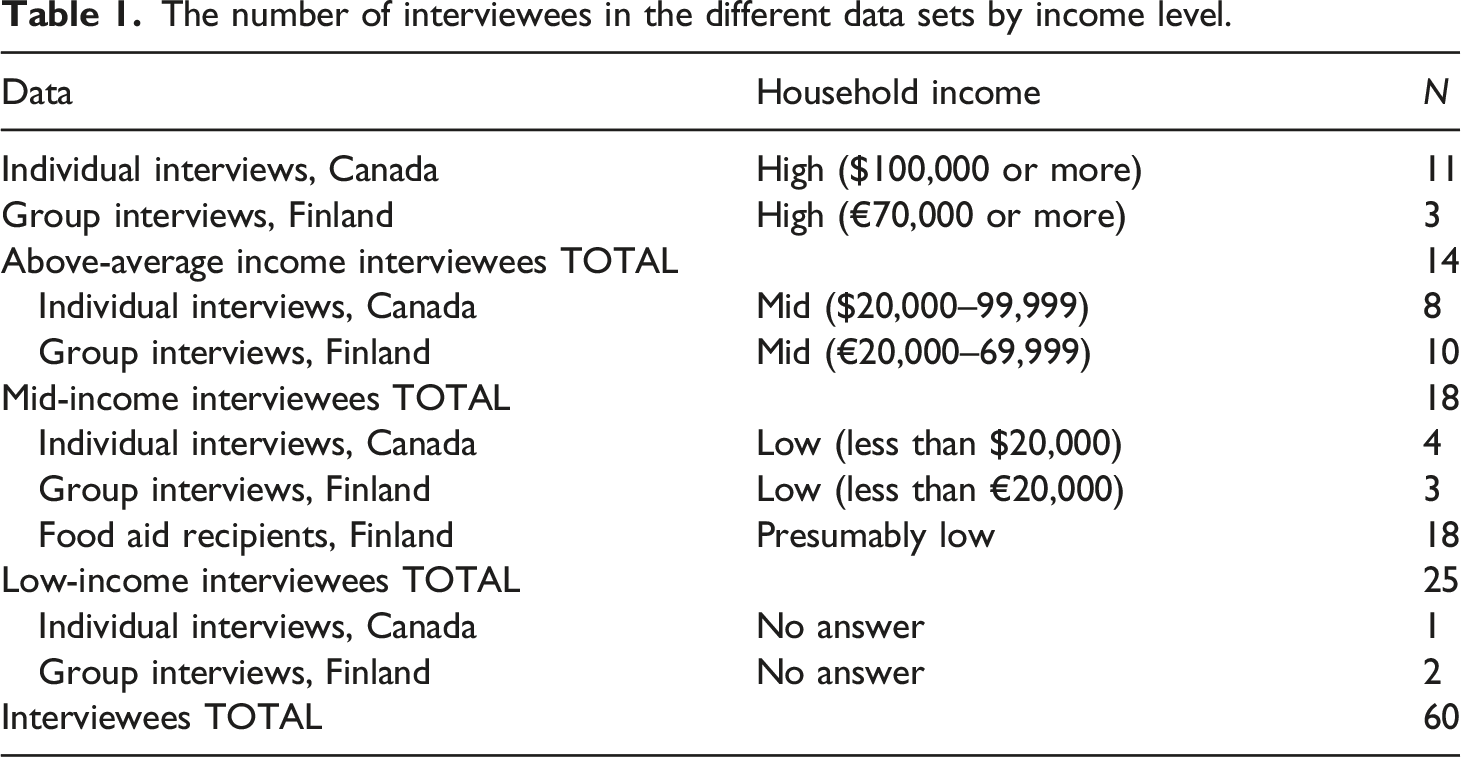
The analysis is based on inductive content analysis. I first analysed each interview separately. Then, I compared and contrasted the findings from different interviewees and different data sets to find recurring themes. The analysis focused on eliciting meaningful qualitative themes and differences, not on the quantitative occurrence of different views and topics. The initial analysis did not justify the use of the interviewees’ country as an analytical point of departure. Rather, it encouraged eliciting similarities between the countries. The findings highlight similarities between consumer experiences in two affluent societies of the global North.
For the analysis, I used the above income groups as background information to map rough differences and commonalities between people. In addition, I paid attention to how the interviewees talked about their financial situation and how they phrased the relationship between money, food cost and ethical concerns over food. The most decisive points of departure appeared between the low-income versus the mid- and high-income interviewees. The next sections present the findings of the analysis.
Choosing ethics
When asked what they consider to be the most important factors when making food choices, most interviewees with a high income emphasised health, taste, local production, environmental issues and convenience above the food’s cost. Many used terms such as privilege, luck and fortune to describe their financial situation. One high-income woman said, ‘luckily, I’m in a situation where I don’t have to think about the [food] cost. I have also been in a situation where I have had to think about it’. Another high-income woman said she prefers to shop at ‘the cheap store’, but only because she has chosen to do so: ‘We have that luxury that we don’t have to eat cheap’. The woman explained that they go to this relatively cheaper store partly because the food is affordable, but also ‘because the food is still good there for the most part and we can still get some organic stuff there’. The interviewee justified her affordable choices with food quality and the ability to choose organic options.
The interviewees with a high income readily portrayed ethical consumption as a matter of choosing what to buy: a good consumer is someone who follows their ethics by buying certain food items, such as organic, healthy and locally produced food. Money has a role in this: the high-income interviewees underlined that having money allows people to make food-related decisions based on their ethical ideals without having to choose based on necessity. A mid-income woman, for example, said that her income allows her to buy her food from a farmers’ market, where she believes the food is healthier, more environmentally friendly and more sustainable for the food producers. She acknowledged her privileged position, as she added ‘for people who don’t have oodles of money, they can’t afford to eat environmentally friendly and healthy or as healthy. I know I spend a lot of money on food’.
However, the interviewees with a higher income also pointed out that money alone does not dictate ethical consumption. While they acknowledged that their privileged position allows them to make ethical food choices, many of them also noted that ethical consumption is not only about money. A high-income man said: Well, I guess the first thing I could say is that we are lucky enough to be in a financial situation where we can maybe have more power in deciding what we actually want to eat. So if you want to always eat healthy, always local, always environmentally friendly, it can be very hard for it to be cheap. So that’s one aspect, and at the same time I’m sure even if I were not making as much money as I were in this situation here, I’d probably be living in a cheaper household or living a different life that would still potentially allow me to follow my convictions.
The man first acknowledges but then relativises the relation between income and his opportunities to make ethical and health conscious food choices. For him, making these choices is ultimately a matter of following one’s convictions. Thus, making the right food choices is tied not just to income but also to the ethical character of the consumer.
Some interviewees in the low-income group shared the higher-income interviewees’ ideal of the ethical consumer as someone who makes conscious, environmentally friendly and healthy food choices. However, for them, their financial situation created an actual barrier for good consumption. For instance, throughout the interview, one low-income woman reflected on the puzzles that she faces when it comes to eating well on a restricted budget. She would like to buy her groceries in a store that has more healthy, organic, local and fresh food options, but she must first ‘look at my bank account and then decide’ which store to visit. She described her ambivalent situation: ‘I support people who have locally produced food and whatnot. Yes you should. If it’s expensive, I’m sorry I won’t buy it, but I like where you’re going with that’. She lamented how ‘it’s hard to eat healthy and support even locally produced food, at least for me and the people that I know. So for us, it’s hard’. In her view, ‘it is important to think about where your food is coming from, what you’re putting in your body, and I wish I was in a better position to do that’.
Nevertheless, the low-income interviewees did not only lament their inability to make ‘good’ choices. They also relativised the focality of such choices. A low-income woman said that she often goes to a store that has the best sales, but which she considers somewhat unethical: she believes that the owner of this corporation ‘has a castle and he’s taking all our money’. The woman admitted laughingly that ‘I don’t think I’m doing a good thing supporting such a big company who’s taking over the world, but it works for me’. When I asked if she spends time thinking about the ambivalence of supporting this big company that she is apparently suspicious of, she answered that she does ‘a little bit’. However, she continued, ‘but still, I mean I’m not going to be on the world for ever and ever and ever, so I might as well have fun while I’m here’. For her, this means that she priorities affordable food prices above voting with her dollar.
Further, some of the low-income interviewees doubt whether certain products or practices are as good or ethical as they are often stated to be. A low-income man makes his point aptly: Organic food costs more and it’s a shame that healthy food always costs more, but I mean I draw the line at organic. An organic banana versus a non-organic banana, there’s only one type of banana out there.
A low-income woman, in turn, has doubts about environmental friendliness. She says that she in principle prefers local and environmentally friendly food. However, she adds that ‘perhaps there is a little bit too much fuss about it these days. I mean, the things that we can do’. Thus, the interviews with low income people highlight that necessity overrides the ideals of healthy or ethical consumption, but they also challenge the importance and goodness of choosing certain stores or obtaining certain products.
The ethics of not choosing
The low-income interviewees do not only challenge the idea of ethical consumption as buying certain products. Their accounts paint an alternative picture of a good consumer: one that is thrifty. A low-income woman describes herself as ‘very resourceful’. She regularly obtains food from a food bank and other places such as a women’s drop-in centre, and she then supplements what she cannot get from those places by buying food on sale. She orders a low-price food box from a community centre and buys her bread from a bakery early in the morning when ‘they sell you day-old for half price’. For this woman, managing with a low income is a matter of prioritising a low food price over convenience: ‘I don’t mind going five miles to save a dollar. I don’t mind. I have a bus pass and I just travel all the time’.
Another important strategy for low-income people is to limit consumption to a minimum. A low-income woman says that she does not save money, but tries to use it wisely: How to save money? It doesn’t go in my pocket. It goes on actual products, but I try to get the most for my money. I try. I’m not going to go to a [store] every day to check all the sales and buy and buy and buy and put it in the fridge and [let it] stay there.
This woman is cautious of low-price tags that ‘attract the eye’. For her, living with her budget is not about what she buys, but what she does not. From a low-income perspective, good consumers avoid temptations and get value out of the little money that they have. A key difference between people with a high and low income is that people with more money display their ethics by choosing certain products, while the ones with less money do so by navigating the world of abundance by not choosing.
Another difference is the awareness of food spending. Many of the interviewees with a low income are highly aware of how much they spend on food. For example, a low-income man aptly answers that his grocery budget is $39 or $40 a week. One woman, in turn, estimates that her monthly food costs are ‘maybe over $100, $125’. For some other people with a low income, it is not as easy to estimate their food costs. However, this difficulty is not due to a lack of attention to food budgets and prices but because these interviewees only buy what they can afford to on any given occasion, and because it is difficult to put a price tag on food that is acquired for free from family, friends and food charity organisations.
Living with a highly constrained budget requires resourcefulness and careful calculation. Failing in this task is emotionally burdening. A low-income man recounts a story of failing to keep to a budget. The man has difficulties in handling money, and his mother helps him out in many ways. She also tries to teach him about the consequences of spending money without consideration. At one point in his life, the man was regularly buying food from a local fast-food chain. He visited there so often that he eventually ran out of money: ‘Then all of a sudden my bank card said, “Nope, you don’t have any more money on it” so I couldn’t go’. At that point, his mother took away his bank card. ‘You don’t want to be homeless, do you?’ the man recounts his mother asking him and explaining that ‘if you have no money on your bank card, you have to go stand in those line ups like everybody else does’. For low-income people, indifference towards food costs or the inability prioritise resourcefulness and rational calculation over wants can have tragic consequences.
The ethic of thrift was no stranger to the higher-income interviewees, either. For them, it was present as an uneasy awareness of not paying enough attention to their spending. When asked whether she pays attention to food prices, one high-income woman answered, ‘probably not as much as we should’. A high-income man, in turn, noted that ‘we’re not really good at keeping track of our spending, sadly’. Not knowing how much they spend money on food makes them troubled.
Some of the high-income interviewees started to make calculations of their food costs during the interview for the first time in a while. They felt surprised as they suddenly became more aware of how much money they spend on food. A high-income woman tried to think about the issue: ‘Oh god, this is probably going to sound ridiculous, probably $125-$150 a week maybe. Sometimes maybe even more’. Another interviewee asked her partner to join her in counting their food costs. After a while of adding up, they concluded that their family’s weekly food costs are about $250. ‘Wow, that’s expensive’, she said when she finished counting, ‘When I was starting to think about it, I was like, “Jesus!”’ Some interviewees deliberately avoided knowing their food costs. When asked how much money she spends on food, a mid-income woman said that ‘It’s something I have not intentionally calculated’. She explains why this is so: ‘I’m afraid that when I do calculate it, that I’ll stop. I’ll just go, “That’s ridiculous!” I’d rather just not know’. The woman is concerned that being better informed of her spending would force her to change her eating habits.
Money matters in food choices, and rational calculation is considered as ethically relevant – even though it is a troubling issue – for interviewees in all income brackets. Whereas not keeping track of their spending resulted in emotional discomfort for the higher-income interviewees, for people living on a low income, failing to keep to their budget is an enormous risk. The fear of ending up in ‘those line ups’ is a real threat, if not already a reality.
Some might argue that the ethics of thrift holds the promise for more sustainable consumption. The rejection of pro-consumerist ideals can of course be considered sustainable in that by consuming less, people consume fewer of the Earth’s resources. However, as Evans (2011:551) points out, taming consumption out of economic necessity unlikely unsettles ‘the dominant expectations and practices of consumer cultures in favour of more frugal and environmentally friendly forms of consumption’. The ethics of thrift follow the ethos of resourcefulness rather than that of ecological sustainability.
(De)valuing abundance
For the mid- and high-income people, the lack of attention to food costs was accompanied by a lack of attention to the amount of food purchased. A high-income man described how food waste is in many ways connected to his ability to choose what to eat. On the day of the interview, for example, he decided to go out to eat breakfast, even though the fridge was full of food. The man explained that ‘We’re not exceptional in that we stockpile a huge amount of food for the winter, and another thing, I don’t think we’re exceptional either that we don’t necessarily eat all of that food’. In his view, ‘this habit of stockpiling and dumping’ is ‘a huge structural feature’ embedded in the framework of consumer society.
Some interviewees explicitly paralleled food waste and money. A mid-income man explained that ‘whenever I have food waste, I do feel bad because I look at it and I’m like, “Well that’s my money going down the drain”’. The man stated that the pivotal reason for food waste is that ‘food is too affordable’. He noted that ‘there’s so many cheap grocery stores out there’, and ‘I do know that food can be purchase[d] in large quantities for a very low price’. Wastage is a sign of devaluing food (Lehtonen and Pyyhtinen, 2020), and this devaluation is a sign of affluence. A mid-income woman confirmed this by saying, ‘There’s a lot of people I know who don’t eat food twice. So I think it’s a sign of excess wealth that we can just do this’.
However, wasting food is not only a matter of ignorance. A mid-income woman reflected how her food and waste practices have changed in her life. When she was married and had more money at her disposal, she also used to waste more food: ‘I still minded the budget, but it would be like, “Oh salmon’s on sale. I’ll buy three packages instead of one.” I bought too much. I buy a lot less now’. The woman continued: ‘I just know that if I had more money I would have the best of intentions, but you’re hurried and then something goes on sale and you buy too much of it’. Wasting food is not merely a matter of carelessness (Evans, 2014; Koskinen et al., 2018). As this woman points out, food waste happens regardless of ‘the best of intentions’, if and when she can afford to waste food.
One of the reasons why the question of waste is morally so puzzling is that ‘there’s so many people in the world that go to bed hungry at night, have nothing to eat’, as one mid-income man put it. Wasting food in a world where poverty and hunger prevail is intolerable for many people. A high-income woman acknowledges her privilege as she said how she feels when she wastes food: I’m annoyed with myself too that I haven’t managed things properly. I don’t want to be wasting because I’m very conscious, especially in our neighbourhood. I’m conscious that I’m throwing food away that my neighbour probably didn’t have enough of.
There are others, both near and far, who one should consider in relation to food waste.
In the above examples, wasting food is condemned on the basis that some people waste while there are others who do not have enough to eat. However, food waste can be also used as proof that hunger is not a real problem in an affluent world. Many low-income people in this study condemn wasting food, but many of them also note that there is in fact a lot of food available also for people living with highly restricted budgets. A food aid recipient states that in Finland, no one dies of starvation because nongovernmental organisations take care of people. This line of argument places low-income people under a moral gaze.
A low-income man stated that ‘I can’t believe anyone in our society has that feeling of hunger the way I’ve seen it described’. He connects the question of hunger to abundance and food waste. He asked if I really think that people would be stopped from taking food from the grocery store without paying for it ‘if they were starving’. He explains: ‘We’re in a society where we look at the food being wasted. I mean food that’s thrown out at the back of the [grocery store] is huge and it’s already in packages’. The man named several nearby places that give out this excess food to low-income people and then continued: Nobody in Ottawa goes hungry and if they’re going hungry, there’s something else going on so there might be a mental issue or some other issue they’re having that’s interfering with their ability to go find that food.
The man laments that there are food safety-related legal barriers to donating food to charity: the stores that donate food and the charity organisations that deliver it to the poor can be held responsible if the food causes its recipients health issues. However, the man has a simple solution to this problem: people who are in a position to receive food as charity do not have the right to complain. They ought to be grateful. He says, ‘I have this simple rule. If you go somewhere and you eat, don’t complain about the food they’re serving you. They cooked it, they’re serving it, shut up, eat it, and move on’.
Similarly, a low-income woman who herself obtains food from charity organisations notes that even though she should not be saying it out loud, in her view, ‘so many people are hungry for their own stupidity’ because they do not utilise opportunities to get free food. ‘I don’t even have to cook ever again for the rest of my life because I can go for breakfast, I can go for lunch, and I can go for supper and on the weekends I can go to the church and have meals’, she explains. According to this view, hunger is a result of failing to appreciate the abundance around us.
Some contrasting opinions also surfaced. A high-income woman says that in her neighbourhood, they often encounter people who ask for money or food. She gives an example of a woman who asked her if she could buy her gummy worms: ‘She asked us for things that weren’t necessarily going to fill her up physically but would fill her up emotionally’. This woman emphasises that even extremely poor people have the right to choose what they eat and what they do not. However, mostly the interviewees did not address the right of low-income people to choose. Instead, people with a low income were expected to accept charity with gratitude and without complaint (Tarasuk and Eakin, 2003; Van der Horst et al., 2014: 1513).
Abundant, mundane and troubled dreams
‘We’re more or less eating what we want to eat anyway’, a mid-income woman answered when I asked how she would change her eating habits if she had significantly more money. Most people in the mid- and high-income groups suggested only small changes to their diets. Some would ‘eat out more’, eat ‘almost entirely locally, farm-raised meat’, and buy ‘some nice and more expensive wines’. A high-income woman said that with more money, she would perhaps have ‘a few more specialty items every now and then for a treat, but no I don’t think I would really change my spending habits’. The woman already now sometimes rewards herself ‘with a glass of red wine and a little bit of cheese like an aged Gouda’, and with ‘these chips from Spain that are made with truffle oil and rock salt and I only can buy them at this one little cheese store’. That most mid- and high-income people would not significantly change their eating habits with more money suggests that these people already live a life where the freedom of choice in consumption is realised.
Only a few thought of bigger changes. With more money, a mid-income man would get someone to cook for him, ‘because the older I get, the lazier I get. I’d probably eat a hell of a lot healthier than I am’. A high-income woman would ‘probably have a cook prepare our meals’ so that she would not have to worry about everyday domestic responsibilities. These views reflect the ideal of independence and detachment from daily concerns. Paradoxically, as we saw above, some of the interviewees with the lowest income already live this dream; they ‘don’t even have to cook ever again’, if they are willing to compromise on their right to choose their food.
Two of the high-income interviewees would ideally concentrate on growing their own food. When I asked a high-income woman whether she would change her eating habits if she had significantly more money, she answered: If I had enough money that I didn’t need to work, I would probably have a farm. So I would grow animals that I know exactly how they’ve been treated. I’d like to do the whole thing where you have a cow, you get her pregnant in the spring, you raise the calf until the fall, you kill the calf, you eat the calf over the winter, and you give her another baby in the spring. So that way you get your milk from the cow and you get your meat for the entire winter.
These high-income interviewees dream about self-sufficiency and a simple life. Freedom from work would give them time to focus on the essential aspects of life, and knowing ‘exactly’ how their food is produced would ease the pain of making ethical choices.
Unlike the ethic of thrift articulated by low-income people, the interviewees above seek a simple life not out of necessity, but as a utopia. Their perspective is closer to frugality than thrift, as it is ‘at odds with normative expectations of consumer cultures’ (Evans, 2011: 552). According to Evans (2011: 554), frugality springs from a moral and aesthetic critique of excessive consumption, not from scarcity. However, for these interviewees, such a life requires nearly unlimited abundance; for them, it is an ideal that could be realised only with financial independence and freedom from responsibilities such as paid work. Such an ideal world represents a utopia of escape (Eskelinen et al., 2020: 13), turning away from society instead of seeking societal transformation.
When the low-income interviewees in turn were asked what their ideal diet would be if they could choose their food freely without financial constraints, they said that they would eat more often, and they would consume more healthy and varied food. One interviewee, for example, explained that he would eat breakfast, lunch, supper and an evening snack as opposed to his present situation, where ‘Currently I eat once a day’. Some other interviewees talked about changing their food quality towards healthier options. Instead of only eating whatever happens to be available at the food bank or on sale in the grocery store, they would eat ‘by the book’ and choose healthy products such as vegetables, salads, fruits and fish. Some low-income interviewees aspired to eat more culturally valuable dishes, such as salmon and steak. One entertained the idea of eating a steak everyday with potatoes, gravy and salad. Another noted that it does not have to be a steak; ground beef would be enough. A third specified that he would not have to eat meat every day, but it would be nice to eat meat every now and then.
Descriptions of ideal diets do not only communicate hopes and desires but also refer to the world in which such ideals are narrated (Eskelinen et al., 2020: 9). The above examples illustrate that people living on a highly restricted budget must compromise their daily eating both in terms of quantity and quality. Their food choices are determined by what happens to be available (Salonen, 2016). A woman on a low income said that with more money, she would eat an avocado every day: ‘I mean, if I could afford an avocado every day, because avocados don’t come from the food bank. We don’t get avocados at the food bank. Never, never, never’.
The people using charity food aid hardly ever entertained the idea of extremely abundant consumption. A daily steak or avocado was the furthest extent of their thinking. These examples show that for people with highly constrained consumption options, it is difficult to dream big. This does not mean a lack of imagination; it might well be that the imaginative capacities must be reserved for other issues. A food bank-user noted that utilising items that they receive from the food bank requires creativity: This entails using imagination in many ways, because we receive different ingredients, and we develop new dishes and it is not always the same food. It is in a certain way quite a challenge for the mind to cook these foods, and they have been really good.
This surprise factor that comes with charity food connects food aid recipients with other groups that utilise surplus food. Lehtonen and Pyyhtinen (2020) note a bare contrast between dumpster divers and average consumers that revolves around choice: regularly, people expect to get precisely those food products that they are looking for, while dumpster divers engage in a creative valuation of those food items that they happen to acquire and which are left over from primary food markets. Similarly, the inability to choose food freely has led the interviewee cited above to experiment with new dishes and varied foods. Alongside the pain of lacking choice, there is sometimes also a joy of discovery.
Even people with severely low incomes occasionally treat themselves. A low-income woman told about her innovative way of satisfying her cheese cravings once a month: And if I could afford cheese, I would buy cheese. I love cheese. Oh, I have cheese once a month. I will go to an art opening. Yes. I will pretend I like the art and I will eat cheese. […] I get my little cheese fix once a month for free.
In her analysis of the morality of food and waste, Spelman (2014: 1827) notes that, actually, ‘having enough to waste is part of the point of the feast’. Celebration requires a certain amount of excess. The above example shows that there is a bright side to excess that allows people with low incomes to occasionally entertain themselves.
On the other side, some low-income people also talked about what foods they would ideally want to avoid if they were in a better position to choose their food. Some mentioned, for example, that there are sometimes ‘temptations’ available at the food bank, such as buns, cakes and other sweets. One refers to a caramel cake that is on display in a food bank where the interview takes place. ‘I can’t ignore it’, she said, laughing. Whether because of a sweet tooth or the internalised norm that requires one to eat whatever is available, even the poorest cannot always escape temptations.
Some low-income interviewees found it difficult to even start thinking what they would eat if they could choose freely. One refused to answer the question at all: ‘Because that could entail so much, so I will skip this one’. The emotional pain caused by the inability to choose one’s food can be hard to bear in a society where people are invited to constantly exhibit their identity and values through food choices (Johnston and Baumann, 2015). It narrows the ability to imagine alternatives and thus cuts down the possibilities for change (Kennedy et al., 2018; Perrin 2009).
For some, the unease caused by the prompt to think how they would change food consumption did not spring from their own hardship, but from that of even less privileged others. An illustrative example is given by a man whose whole life has been characterised by poverty. He said, for example, that he has never been out to eat or stayed in a hotel for a night if one excludes the free charity meals and guest houses for the homeless with which he is familiar. The man is by many standards living in a weak social and economic situation. Nevertheless, he compares himself to even less fortunate others.
The man said that if he had more money, he would perhaps eat more, but that eating more would probably be accompanied by guilt. He gives an example of an incident where he recently felt this guilt. A few weeks ago, he had enough money, so he bought a pack of processed cheese. ‘I thought that I would cut just a small slice and nibble it. Press it against my palate. Like, “aww, how delicious,”’ he explained. However, instead of merely nibbling tiny bits of cheese, he ended up eating the whole pack. ‘So it went all at once. I mean, the whole cheese in one day’, he confesses. After finishing the cheese, a ‘sinful feeling’ arose. He explained that he felt ‘the pain of conscience’ that concerned partly his own body and his fear of gaining too much weight due to this indulgence, but also other people: ‘Immediately I came to think of other people’s poverty, and all’. Picturing himself ‘just sitting and eating’ while ‘I watch TV and there is a famine’ was unbearable for the man. His example illustrates that even the poorest in an affluent society cannot necessarily escape the call to tame and govern their desire (Sassatelli, 2001).
Discussion and conclusions
Ethical consumption is not given, but a socially constructed, contested and even internally contradictory discourse (Johnston et al., 2012: 1092). This study adds an important contribution to the existing body of ethical food consumption research by showing that what is counted as ethical is structured by economic privilege, and that this applies to both purchasing and wasting food.
First, differences in income mean differences in the role that money plays in food choices: the more money one has, the less it matters. People on higher income levels emphasise taste, health and sustainability in their food choices. Low-income people, in turn, need to first look in their wallets before deciding whether to vote with their money or to get the most bang for their buck. This finding is in line with other studies that have noted that privileged groups are better equipped to access ethical consumption (Kennedy et al., 2019; Johnston et al., 2012). Moreover, the findings of this study highlight that it is not only capacities to consume but also contents of ethics that need critical exploration. Differences in income also mean differences in what kind of consumption people consider worth pursuing.
Further, differences in income dictate differences in how people are morally positioned vis-à-vis the question of abundance and waste. Contemporary society represents a historically exceptional situation where a considerable number of people are living in abundance. However, affluence has not straightforwardly led to material wealth for all. It has not eliminated ethical problems, but has altered the context in which they emerge and brought about new challenges (Lorenz, 2015: 2–4). When it comes to people with a higher level of income, moral blame is asserted on wasteful consumption habits. In the contemporary world of abundance, affluent people are invited to consider and condemn food waste against the background of the starving others (Miller, 1997: 100). An ethical consumer cares about food, understands its value and considers the distant others by refraining from wasting it.
Previous research on the ethics of household food waste has concentrated on people with high food purchasing power. The novel contribution of this study is to show that the ethics of food waste also affect people with a low income, but in a different way. For people with a low income, it is ethically condemnable to refuse to rejoice at the abundance around us. Charitable food assistance is an institutional manifestation of such a moral connection between abundance and poverty. Food aid programmes that rely on surplus food donations turn food waste into a utility of last-resort material assistance. Via this transformative process, they make food excess less disturbing (Salonen, 2018), but this system requires that there are people who are willing to accept all the food that happens to be available.
For people on a low income, this means an obligation to be grateful. Expressing gratitude for food can be considered ‘a profoundly political act’ (Wirzba, 2019: vxiii), particularly in a world where waste constantly undermines food’s value. However, it can also be a profoundly repressive norm that undermines the leverage of choice people have regarding what they eat. Studies on economic differences in consumption have found that people living in weak social and economic situations face exclusion from mainstream consumption (e.g. Lorenz, 2015; Salonen, 2016). In contemporary consumer society, the line of social exclusion is drawn between those who can and those who cannot choose their food (Lorenz, 2015). The findings of this study indicate that even in a society where the rhetoric of choice is prominent both as a right and as an obligation by which people ought to display ethical agency (Sassatelli, 2001), the ethics of choice is tied to the resources available for consumption.
Against this background, it is noteworthy that if they would not be constrained by money, people with high and low incomes alike envisioned rather similar food consumption. Across income levels, ideal consumption would entail adequate and sufficient food, a nutritious diet and occasional treats. Envisioning an ideal life is not only an exercise in wishful thinking. Such visions tell a story of the social world in which they are narrated (Eskelinen et al., 2020: 9). Differences between higher- and lower-income people can be summarised in that people with a high income in many ways already live that dream by eating what they want. Their utopian world would simplify life, free them from tiring responsibilities and reconnect them to the land that provides their food. People with a severely low income, in turn, occasionally enjoy the trickling down of abundant treats and surprises. However, for them, a daily avocado or steak is a distant dream, and an occasional indulgence causes not only pleasure but also unease and trouble.
Footnotes
Acnowledgements
The author wants to thank Kristiina Alppivuori for collecting and sharing the third data set and providing helpful comments for its analysis.
Declaration of conflicting interests
The author(s) declared no potential conflicts of interest with respect to the research, authorship, and/or publication of this article.
Funding
This work was supported by the Academy of Finland under the project '(Im)moderation in everyday food consumption' (decision number 316141) at the Tampere University.
