



Abstract
At the beginning of the millennium, consumer culture researchers predicted that people would increasingly demand that marketplace actors subscribe to contemporary ethics of liberal democracy. Although their prediction indeed came true, they did not foresee that an algorithm-powered media ecosystem in combination with growing authoritarian movements would soon come to fuel an increasingly polarized political landscape and challenge the very fundament of liberal democracy per se. In this macroscopic, conceptual article, I discuss three assumption-challenging logics—counter-democratic consumer culture, de-dialectical algorithmic manipulation, and growing illiberal consumer resistance—according to which the market increasingly monetizes the conflicts accompanying this polarization and, thereby, reinforces it. I call this new logic a conflict market and illustrate it through three, historically situated and currently conflicting, consumer ideoscapes—the neoblue, the neogreen, and the neobrown—between which consumers engage in marketized conflicts, not in a de-politicizing way, but in an increasingly un-politicizing, de-dialectical, and polarizing way. At the technologically manipulated conflict market, the role of marketers is to monetize politically sensitive topics by creating conflict, knowingly renouncing large groups of consumers, and giving fodder to the political extremes.
Keywords
Introduction
I mightn’t have done much good in my life, but at least I contributed to the destruction of the planet — and I systematically sabotaged the selective recycling system put in place by the residents’ association by chucking empty wine bottles in the bin meant for paper.
Quote from Houllebecq’s (2019) book Serotonin
This quote, from French author Houllebecq’s anti-hero Florent-Claude, is an illustration of one side of the everyday consumer embodiment we popularly speak of as political polarization. Although a living truism, most agree that there indeed is an ongoing transnational polarization dividing the public into ideologically oppositional and uncompromising groups (Bartels, 2016; Klein, 2020; Krastev and Holmes, 2019; McCarty, 2019; Pew Research Center, 2020; Prior, 2013). But how are the market and consumer culture involved in ongoing political polarization? This conceptual article takes its departure in consumer culture theory (CCT) (Arnould and Thompson, 2005), in the intersection of research on algorithmically powered surveillance capitalism (e.g., Darmody and Zwick, 2020) and research on the market’s (de-)politicizing co-optation of political movements (e.g., Veresiu and Giesler, 2018). From this starting point, I discuss an alternative future for consumer culture, where market actors increasingly monetize political conflict exacerbated by an algorithmical capitalist logic, resulting in what I call a conflict market. I argue that in a conflict market, market-consumer interaction is un-politicizing (Rosanvallon, 2008) (rather than de-politicizing) in ways that contrast with previous consumer research on the marketization of ethical issues (e.g., Carrington et al., 2016; Holt, 2002) and political ideologies (e.g., Brunk et al., 2017).
CCT literature is generally embedded in an underlying worldview that takes for granted liberal democracy (Firat and Dholakia, 2017), in the broad meaning of Enlightenment ideas about civil society, tolerance, liberty and equal rights (Slater, 1997). But, lately, global challenges to liberal democracy have arisen, resulting in increasing political extremism opposed to liberal democracy per se (Berman, 2019), which also manifests in consumer culture (Miller-Idriss, 2017). Accordingly, researchers have begun to explore how brands increasingly engage in politically sensitive conflict issues, such as nationalism (Pineda et al., 2020) or immigration (Ulver and Laurell, 2020). Yet, little attention has been paid to how market provocations may co-produce wider political polarization when technological and ideological shifts radically affect the market logic. Therefore, the overarching aim guiding this article is to explore how the reproduction of consumer culture transforms in the new context of monetized conflict.
I begin by discussing three underlying assumptions in consumer research that, due to the new sociopolitical times, need to be revised: (1) democratic consumer culture, (2) brands as de-politicizing conflict solvers, and (3) liberal (albeit progressive) consumer movements. I do this by proposing French sociologist and political historian Rosanvallon’s (2008) theory on counter-democracy, together with two other influential narratives in current political history writings (Berman, 2019; Krastev and Holmes, 2018, 2019), as a combined alternative historical understanding of the prelude to nascent Western consumer culture. Second, by using academic insights on current algorithmic consumer manipulation (e.g., Darmody and Zwick, 2020) and political narratives in branding (e.g., Kravets, 2012), I develop what I call the conflict market. I argue that the prevailing idea of brands, as cultural operators solving conflicts (e.g., Holt, 2004), is problematic in the new societal context where the overall business model at the marketplace rather is about creating conflict. Third, in light of counter-democracy, I discuss the general research focus on progressive consumer resistance, and argue that previous consumer research has (with few exceptions) not yet accommodated the wider influences of burgeoning illiberal movements, which may fundamentally disrupt the marketplace. After having revised the underlying assumptions, I present a brief history leading up to the proposed counter-democratic culture, and delineate three consumer cultural ideoscapes that embody and perform political polarization in this counter-democratic culture. I conclude by discussing the conflict market’s un-politicizing and polarizing implications on consumer culture and society at large.
To provide theoretical and historical context, in Figure 1, I position some of the key historical concepts accounted for in this article, along a historical timeline. Key theoretical constructs on a timeline.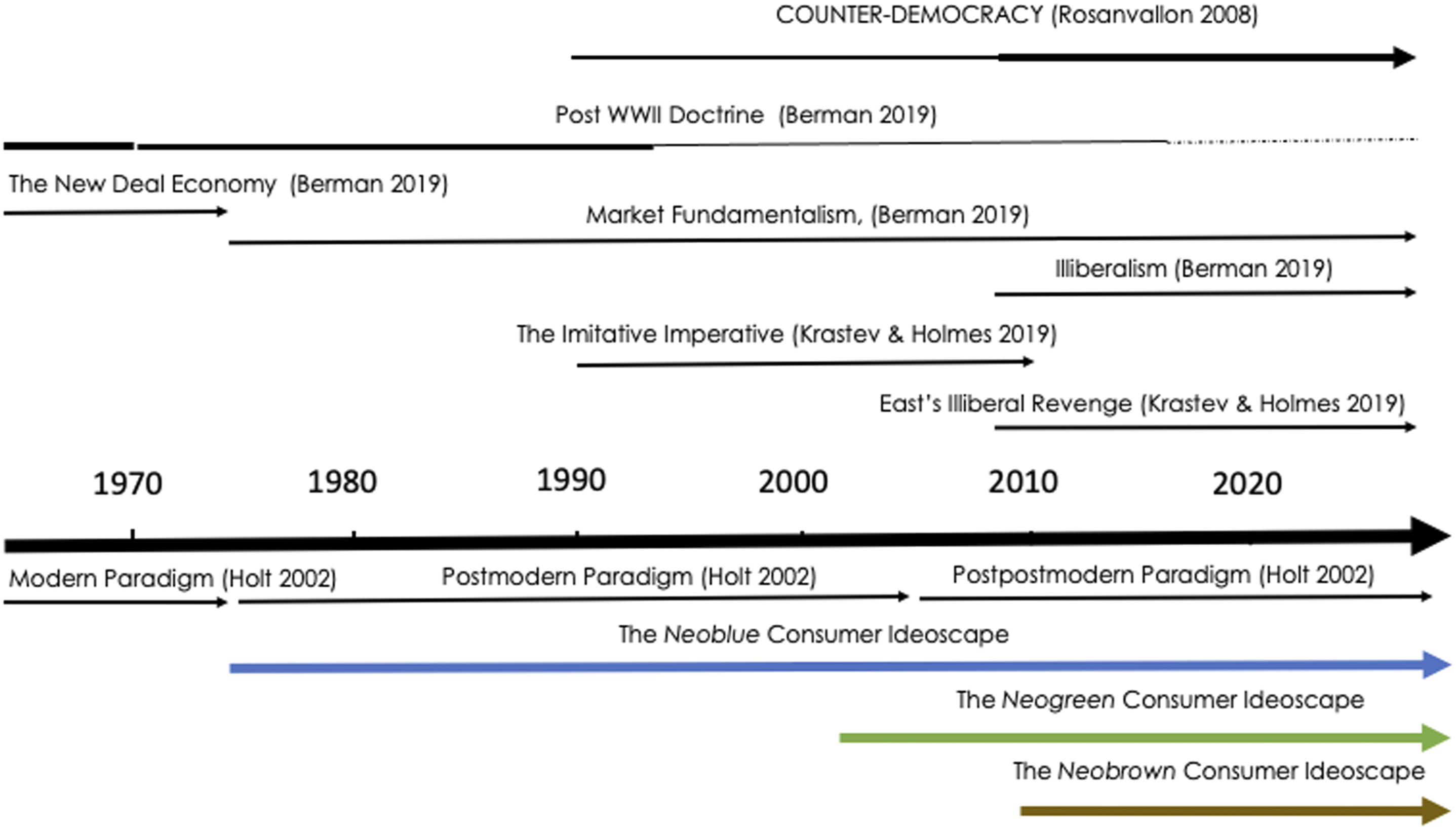
Counter-democratic culture
One of the most influential predictions about consumer culture is Holt’s (2002) macroscopic account about the dialectic and historic relationship between branding and consumer culture paradigms in late capitalism. There, in brief, consumer capitalism grows because of tensions between the market and consumer culture, and brands become successful when they solve these contradictions. Accordingly, in the modern paradigm, brands were caught manipulating the rising middle-class and, in the postmodern paradigm, brands were debunked for claiming a sort of non-profit authenticity while simultaneously acting as global exploiters of workers, environment, and consumers. Holt’s prediction for the postpostmodern paradigm was that brands could, indeed, be openly profit-seeking but, to satisfy consumers, they must pursue contemporary democratic ethics, such as human rights, animal welfare, and the environmental good.
But, from Rosanvallon’s (2008) perspective, Western democracies have, over the last two decades, begun to face unprecedented challenges and evolved from societies of trust to those organized around distrust; counter-democracies. Here, the powers of surveillance take over as stabilizing control mechanisms. On its own, counter-democracy does not imply that citizens are against democracy as such. They still use their democratic rights to protest against their representatives but, without offering a proposition. Rosanvallon calls this kind of engagement the un-political, suggesting “a failure to develop a comprehensive understanding of problems associated with the organization of a shared world” (Rosanvallon, 2008: 22). This should not be conflated with the terms a-political, as in politically disengaged, or de-political, as in the consequences of the neoliberal imagination that political issues will be solved by the market. Instead, un-political protests foster a culture of discontent, resentment, and accusation, which fuels polarization and anti-democratic movements. Ultimately, the democratic conversation diminishes because polarization is utterly self-confirmatory at its extremes.
There are at least four reasons why Rosanvallon’s counter-democracy could also foster a culture of polarization at and by the marketplace. Firstly, according to Rosanvallon, people are increasingly encouraged to practice market-mediated citizenship, that is, political consumerism (e.g., Stolle and Micheletti, 2013). Secondly, Rosanvallon doubts that the perpetual speed of social interaction that accompanies digital technology will provide the civic engagement optimistically imagined in, for instance, Dahlgren’s (2013) “alternative democracy.” Instead, the more we are exclusively directed towards self-affirmation in algorithmic “echo-chambers” (Sunstein, 2001) through the biopolitics of algorithmic identities (Cheney-Lippold, 2011), the more democratic conversation evaporates. Alternative perspectives become invisible to us and what is left is resentment of what already is. Thirdly, Rosanvallon claims that a “negative” democracy—that is, a system of complaint rather than proposition—is easier to organize than a content majority because the intensity of citizens’ negative reactions together with the negative advertising of political opponents (or brands) “crystallizes opinion and alleviates doubt” (p. 178). Finally, with time, “poison politics” wins ground and polarized conflict is further exacerbated. Surveillance is not predominantly undertaken by the government but, in a disorganized and increasingly polarized way, by vigilant, denunciating and evaluating “neutral watchdogs.” Market actors and individuals act as such watchdogs, and are even obliged, according to the “ethos of democratic oversight” (Rosanvallon, 2008: 74), to compete in denunciating each other.
Echoing Rosanvallon’s counter-democracy, political scientist Berman (2019) identifies three tenets that built the Post WWII liberal democracy doctrine in the West. Firstly, the international monetary system of Bretton Woods that tied nations together through currency. Secondly, the Marshall plan that aimed to prevent the vengeful sentiments and actions of the inter-war era. Thirdly, the democratic welfare state with independent media and freedom of assembly in Roosevelt’s New Deal, which intended to prevent all kinds of fundamentalism. These principles have, in Berman’s account, been successively abandoned over the last 75 years, leading to cultural conflict and illiberal democracy. In particular, the third tenet began to be cast aside in the 1980’s in favor of alternative-lacking (compare Rosanvallon’s “without proposition”) neoliberalism, which she also refers to as “market fundamentalism” because of its fixation with free, de-regulated markets. According to Berman, it is under these conditions that polarized conflict and populism have grown in tandem with protests from other fundamentalist directions. Paradoxically, and in line with counter-democracy, these fundamentalist oppositions rest upon the neoliberal infrastructure in that ideological persuasion and “voting” are mediated, foremost, by the market.
Furthermore, the Bulgarian and American political scientists Krastev and Holmes (2019) explain the power of market forces in today’s polarization and populism by suggesting that the Post–Cold War world went from Fukuyama’s (1992) “end-of-history” illusion, to an actual “age of imitation” which is now backfiring. Today’s growing conflicts and illiberalism have an emotional and pre-ideological origin in the states of East and Central Europe’s subordination to the liberal West and are grounded in a “deep-seated disgust at the post-1989 ‘imitation imperative’ with all its demeaning and humiliating implications” of “living up to Western standards” (Krastev and Holmes, 2018: 118). According to Krastev and Holmes, Russia’s imitation of Western democracy and the free market in the 1990’s was “faked.” When momentum appeared, Vladimir Putin turned against the West’s inherent double standards of “tolerance” and “political correctness” and presented authoritarian nationalism as more morally correct. Also, China’s imitation is described as temporary, in that it was a pure appropriation of technological and scientific knowledge but, in the end, just an instrument to present their real alternative to liberal democracy; state capitalist dictatorship. In turn, America’s Donald Trump managed to use the imitation imperative in an inverted manner by claiming that the imitators accounted for above (plus all immigrants) systematically imitated America at the expense of Americans, by dispossessing them of their jobs, their technology, and their culture. All in all, Krastev and Holmes argue, these illiberal powers want a cropped kind of globalization that harbors nationalism, markets and technology, but not the liberal enlightenment ideas of democracy, truth-seeking, human rights, and equal value. Their conclusion is that ideology is only the means for global political actors to compete at a market and offers branding opportunities at a regional place branding level, which spills over into consumer markets.
Below, I will argue that when large, international market actors increasingly latch on to the counter-democratic sentiment, they also perform political polarization and thereby contribute to creating a counter-democratic consumer culture that nurtures a market revolving around and monetizing conflict rather than “solving” it, a conflict market.
The conflict market and consumers
Market actors' co-optation of ideologies or political movements has long (e.g., Ewen, 1988) attracted scholarly attention for its de-politicizing damages. Examples are the exoticization and fetishization of ethnic subjects (Borgerson and Schroeder, 2018; Crockett, 2008; Veresiu and Giesler, 2018) or the neoliberal allocation of environmental responsibility on the market and individual consumers (Carrington et al., 2016: Cronin and Fitchett, 2021; Giesler and Veresiu, 2014), but the most central critique is that co-optation distracts from real political and structural change. Yet, this work has not yet addressed the burgeoning marketplace context where very specific political and ideological conflicts are brought up in marketing communication—for example, Patagonia’s suing the Trump administration in the United States (Stanley, 2020). Due to its, here argued, relationship with a counter-democratization of society, it is important to better understand what consequences this conflict-oriented market context may have in terms of (de-)politicization of consumers.
In line with Rosanvallon’s powers of surveillance and in combination with provoking significant consumer engagement in social media forums, this type of political marketing could be understood through concepts like (Zuboff, 2015) “surveillance capitalism.” When market actors increasingly engage in surveillance technology, consumers are deemed subjects by the market’s “algorithmic control” (Karakayali et al., 2018) and “dopamine economy” (Williams, 2018). Generally, these concepts refer to the strategic neuronal manipulation built into devices, apps, and streaming services, as well as the persuasive powers of the algorithmic distortion (Airoldi et al., 2016) and the governing of behavior through “dataveillance” (Espoti, 2014). Here, what consumers experience as their own empowering decisions, are actually designed by computational marketing analytic systems (Darmody and Zwick, 2020), where market actors legitimize algorithmic manipulation and surveillance of consumers as an act of offering relevance and empowerment through engagement. In order to raise this engagement, they manipulate neural responses (Nemorin and Gandy, 2017) and, rather than solving conflicts, they create conflict online—something consumer researchers Scholz and Weijo (2016: 613) term “distributed infuriation”—and thereby reproduce polarization.
Illiberal consumer movements
In accounts of consumer activism (e.g., Gopaldas, 2014; Holt, 2002; Kozinets and Handelman, 2004; Sandlin and Callahan, 2009), resistance is momentous for the market as it provides fuel for co-optation strategies. In relation to this, I bring up a third underlying assumption that historically has been dominant in consumer research; that a lion’s share of counter-cultural consumer movements are distinctively embedded in social liberal and progressive values (Cambefort and Pecot, 2020), where the “social” in front of “liberal” puts particular focus on human equality, rather than on the free market as in “neoliberal” or “market liberal.” However, during the last decade, consumer movements that are polarized according to a clear ideological fault line of liberalism versus illiberalism (especially in terms of the social, as some far-right fractions are, indeed, in favor of a free market), are gaining increased interest in consumer research. This manifests, for example, through elaborations on consumer nationalism (Castello and Mihelj, 2018; Luedicke et al., 2010; Pineda et al., 2020; Varman and Belk, 2009), Islamist resistance against market globalism (Izberk-Bilgin, 2012), and radical and far-right consumer resistance in Europe (Cambefort and Pecot, 2020; Lekakis, 2017; Pecot et al., 2021; Ulver and Laurell, 2020). Unlike the progressive movements, most of these illiberal consumer movements—including the self-labeled “alt-right” movement in the United States (Daniels, 2018)—are particularly motivated by an opposition to the ideas of social liberal democracy.
Polarizing counter-democratic ideoscapes
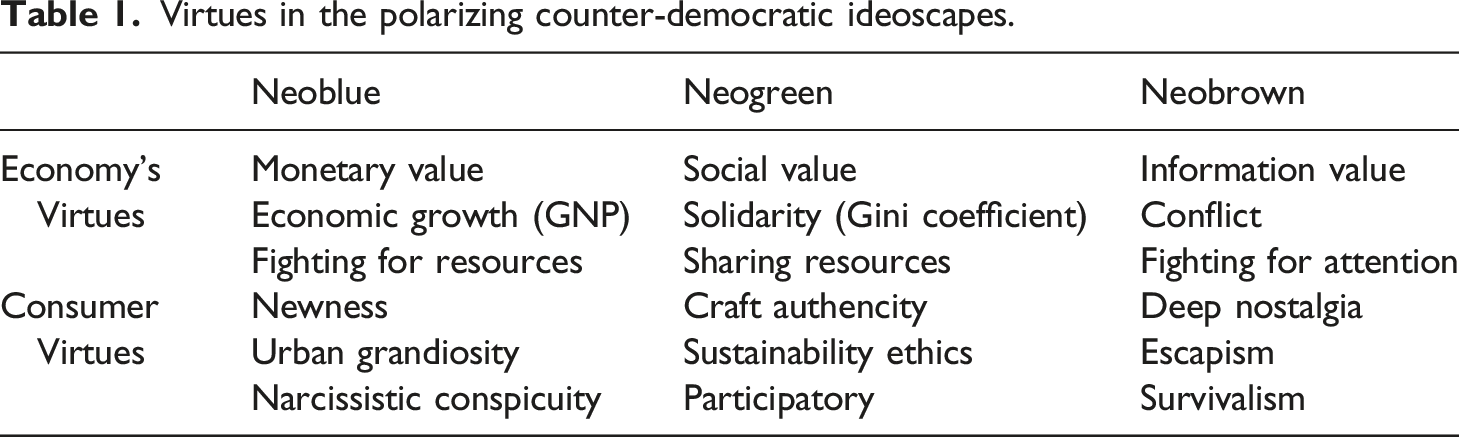
Virtues in the polarizing counter-democratic ideoscapes.
The neoblue ideoscape
In the neoblue consumer ideoscape, virtues of fast cash, growth, and competition are promoted by the neoliberal ideology of state de-regulation, free markets, and individualized responsibility (Harvey, 2005). The culture among the Western middle-classes is infused with narratives of ever-expansive resources and wealth and, in the 1990’s, was impregnated by an “end-of-history” hubris. Although the Western middle-classes live in cultural-historically different contexts, the general consumer cultural manifestations in pop culture are the celebration of newness (e.g., the global re-conceptualization, mass production, licensing, and proliferation of classic Danish design furniture through Fritz Hansen), grandiose urbanism (e.g., the HBO series Sex and the City’s branded representations of successful lifestyles as urban and grand (Evans and Riley, 2013)) and aspirational conspicuity (e.g., the influx of luxury brands within product categories like champagne, exclusive handbags, Michelin restaurants, and private jets), as seen in popular culture, marketing, and other media representations (Walters and Carr, 2019; Wissinger, 2009; Zhang, 2017).
The archetypical politician in the neoblue ideoscape would be Ronald Reagan, and the consumer cultural archetype is the Wall Street Yuppie of the 1980’s and the internet boom brat enclave (Ostberg, 2007) at the turn of the millenium. Many critical commentators, like Klein (2000), picture this era as marked by opposition from anti-capitalist consumers where brands respond with false identity-political promises. Brands marketed themselves as fighters for minorities and inclusive values, but the composition of their employees and their treatment of workers in the less affluent world (via outsourced production) did not match this at all (Otis, 2011; Pun, 2005). The cognitive dissonance between the dreamy, glamorous brand in the “north west” and its product genesis in the “south east” made activists and angry consumers boycott brands and protest against globalization and consumer society (Kozinets and Handelman, 2004). But, in line with Krastev and Holmes’s (2019) “imitation imperative,” at the same time as the protests in the West took place, there was a radical increase of Asian middle-class wealth and the global luxury brand industry swelled (Wang, 2008; Wu et al., 2013). While simultaneously losing its luster in the “north west,” in-your-face conspicuous consumption by way of luxurious brands flourished in Asia (Eckhardt et al., 2015). These industries grew, not least through aggressive merger and acquisition strategies, such as those executed by Pierre Arnault and his ever-growing luxury brand empire, LVHM. The 2008 financial crisis paused the growth of conspicuous luxury consumption and luxury brand retailers temporarily but it picked up and continued the following year (Bains and Company, 2019). While the Post WWII suburban middle-class, who embraced Holt’s (2002) modern branding paradigm, aspired to be just that; middle-class, the neoblue consumer ideoscape encourages everyone to aim for the upper class and beyond. Hence, postmodern consumer resistance managed to change large companies’ public policies and codes of conduct, as well as marketing messages, but it failed to stop the hyper consumption of the global middle-classes. The lion’s share of global marketing continues to cater to this cult of aspiration, which is particularly well articulated in Greenfield’s (2017) renowned art project Generation Wealth, in the more mass-cultural chic-lit Crazy Rich Asians by Kwan (2013), or in the brand publics co-produced by social media influencers, followers, brands, visual technologies, and hashtags in social media platforms (Arvidsson and Caliandro, 2016). Hence, although it is resisted by many (which, in turn, contributed to the ideoscape to be presented next) the neoblue ideoscape is alive and kicking.
The neogreen ideoscape
Early in this millennium, at the time of Holt’s (2002) growing consumer resistance against the postmodern branding paradigm, alarming reports about global warming were popularized by the former vice president of the United States, Al Gore, in his 2006 academy-award winning movie, An Inconvenient Truth (Ziser and Sze, 2007). This is when, what I term, the neogreen ideoscape picked up global speed. Whereas the neoblue ideoscape of global expansion now appeared destructive, the neogreen consumer ideoscape of environmental care was reparative.
The neogreen ideoscape differs from the “old” green ideas of the 1960’s and 1970’s, which grew out of a socialist ontology, in that it gains traction across a politically wide spectrum of consumers. Indeed, as in Holt’s (2002) dialectic model, the neogreen ideoscape appeared as the anti-thesis of the neoblue because its economic virtues were social rather than monetary, its measures of national success related to equality rather than GNP, and in line with liquid consumption (Bardhi and Eckhardt, 2017), it focused on sharing instead of fighting for resources. Also, the neogreen consumer virtues were the opposite of the neoblue ideoscape’s: craft authenticity (e.g., “from-scratch” cooking as in Campbell’s (2001) notion of craft consumer, or vintage platforms like Vestiaire) rather than newness, sustainability (e.g., “honest fruit” juice Innocent, built on small-scale communal values or foraging as promoted by influential restaurant rankings like San Pellegrino’s) rather than urban grandiosity, and participatory culture, rather than narcissistic conspicuity (Eckhardt et al., 2015). The archetypical politician would, here, be Barack Obama and the model consumer the hipster or the “Swedish dad” (Molander et al., 2019). In its environmental departure, the neogreen manifests in nature-related consumption categories like food (Ulver, 2019), health (Ertimur and Coscuner-Balli, 2015), transport (Bardhi and Eckhardt, 2012), and consumer restraint in general (Khamis, 2019). Brands promoting urban farming (Freight Farms), biking (Hövding), vegetarianism and veganism (Oatly), sharing apps (WeeShare), agritourism (Roter Hahn), savvy food festivals (Heartland), and natural wines (Pur Jus) all found momentum in this ideoscape. The branding strategies largely followed Holt’s (2002) postpostmodern branding paradigm in that they offered ethically legitimate products that, in their very purpose, were partly social, and could therefore communicate this as their contribution to contemporary society. Embracing an aggressively anti-regulatory “Californian ideology” (Barbrook and Cameron, 1996), the Silicon Valley tech start-up scene quickly absorbed and commodified the resource-sharing virtue of the neogreen ideoscape into platform apps like Airbnb and Uber, and electric cars like Tesla. All branded as part of the larger technological solution to the climate threat, hence, a market-mediated cultural resource through which consumers could actively save the world.
However, here we can discern a split between the Californian ideology’s market and technology optimists on the one side, and social regulationists on the other, with a more mainstream un-political mass of consumers, who are largely unconscious of this divide, in between. Ideologically, the anti-regulatory stream of ideas in the neogreen ideoscape opposes the content but complements, and thereby overlaps with, the overarching market liberal ideas of the neoblue and can, in other words, be seen as a synthesis. The other stream, on the other hand, contradicts both the content and systemic implications of the neoblue and thereby creates a new contradiction. As a symbol of the climate movement, the archetypical consumer and politician of the more radical fraction of the neogreen ideoscape would, for example, be the young climate activist, Greta Thunberg (Hintz and Pluciennik, 2020). Here, the conviction is that structural changes and a radical decrease of consumption, rather than technological innovations and consumer responsibilization, will solve the climate problems. Its activists fight for change in the economic system, including climate-saving regulations, measurements, and business models, while its consumers reward brands that join this fight despite sacrifices in monetary growth and freedom from regulations. However, probably due to its oxymoronic deadlock, very few, or no, global brands can adhere to this system-critical fraction of the ideoscape, even if some say they do (e.g., Patagonia and Oatly).
All in all, the regulationist stream of the neogreen is, unlike the anti-regulatory stream, the anti-thesis to the neoblue ideoscape, but, from a mainstream consumer perspective, the two streams conflate in that they preach the same end, a “green” future.
The neobrown ideoscape
If the neoblue consumer ideoscape is very little about consumer resistance and more about a-political indulging, the neogreen emerged as an opposition to unreflexive, wasteful, and egotistic hedonism. Still, both are offsprings from typical Enlightenment ideas of democracy and freedom. In contrast, in counter-democracy, a culture of resentment thrives through algorithmically market-controlled surveillance capitalism (Darmody and Zwick, 2020), paradoxically boosted by the Californian ideology’s technological opportunities. Here, global movements of illiberalism prosper through “disinformation machines” (Becker, 2019) and a neobrown ideoscape that does not lean upon Enlightenment ideas gains ground. Hence, the very institutional fundament for brands as a global ideoscape of Enlightenment elements (Askegaard, 2006), is challenged.
Where monetary value (as in economic growth measurements and competition for resources) is autotelic for the neoblue ideoscape, as social value (by way of equality measurements and sharing resources) is for the neogreen, in the neobrown, it is information value through conflict between groups and the fight for attention, that lure. Information, in the form of Big consumer data, provides biopolitical power and capital through appropriation of the digital commons (Charitsis et al., 2018; Zwick and Bradshaw, 2016) and is best obtained if consumers are sufficiently emotional to engage online (Booth, 2014; Bucher, 2017). Pursuant to Gopaldas’ (2014) exploration of activists’ sentiments, emotions connected to ostracism and injustice are easily triggered in online forums, where fake news is allocated by algorithms (Sumpter, 2018) and where swarms and shitstorms quickly form due to the immediacy of the digital universe (Han, 2017). Furthermore, in accordance with resentment culture in counter-democracy, neobrown sentiments work up such emotions more aggressively than the two elaborately liberal (market and/or social liberal) ideoscapes. In the same vein as Krastev and Holmes’s (2019) alleged globalization of nationalism, the virtue of deep (nationalist) nostalgia is typically embodied by brands that are iconic for their national history and have signaled political affiliations, such as the Russian Putinka vodka (Kravets, 2012), Budweiser’s America rebranding trial, or those at the far right with iconography from Norse mythology (such as Thor Steinar, Ansgar Aryan, or Erik & Sons). The virtue of escapism is aptly materialized by online strategy games that take place in historical times (such as Crusader Kings) and the virtue of survivalist defense by brands catering to zombie and prepper culture (such as General Prepper and the Doomsday Prep platform, or surveillance brands like DJI Spark). Here, the archetypical politicians would be Donald Trump and Vladimir Putin, and the consumers the affluent oilman, the disillusioned social media troll, and the prepper.
Mobilizing conflict with the neogreen ideoscape, the expressive anti-hipster brand positionings like Budweiser’s “Brew it the Hard Way” 2015 campaign, Piel de Toro’s campaign against the Catalonian separatist movement in Spain (Pineda et al., 2020), and Protein World’s proud objectifications of the female body (Scholz and Weijo, 2016), can be seen as ways to ride on neobrown sentiments. Also, entire industries are growing fast around this ideoscape, like the home security industry (Bloomberg, 2018) or global underground shelter networks. For instance, Vivos (2019) urges consumers to buy private bunkers in South Dakota (US) and central Germany, with copy like “We are living in very dangerous times, making the need to have a life-assurance shelter solution a must-have, for those who want to survive these extinction level events and to have the opportunity to emerge safely on the other side.” The potential air of absurdity evaporates when considering how renowned multi-billionaires like Amazons’ Jeff Besos and Tesla’s Elon Musk aim for space because “the alternative to extinction [is] to become ‘multi-planetary’” (Tynan, 2016). Also, in 2019, Volvo Cars (Volvo Cars, 2019) (historically targeting liberal and academic middle-class families) began promoting their first armored car, with ballistic and explosive certification, to “make the renowned Volvo comfort and the distinct yet discreet Scandinavian style available for people in need of heightened protection.” Their expressed imperative was “Enter the Safe-Guard Zone.”
In “high” popular culture, the neobrown ideoscape has been portrayed in, for instance, Packer’s (2013) award winning The Unwinding-An Inner History of the New America and immortalized by the controversial French author Houellebecq's (2001, 2016, 2019) in his acclaimed, best-selling books. There, the continuous references to brands, which is so characteristic for zeitgeist novels, is vastly different in content from, for example, Bret Easton Ellis’ (1991) American Psycho, which illustrated the neoblue consumer ideoscape on Manhattan at the beginning of the 1990’s. In Submission, Houellebecq’s anti-hero, the Sorbonne professor, has submitted to the radical Islamization of Europe and now has to follow his university’s commitment to the laws of sharia. In his private resistance and chronic boredom, he resorts to the obsessive consumption of YouPorn and microwave-oven fast food. Falling even deeper into depression and disillusion (as quoted in the very beginning of this article), Serotinine’s anti-hero, Florent-Claude, previously employed at Monsanto but now working for the EU, crunches the fictive anti-depressant Captorix and smokes countless Marlboro cigarettes. The triology deals with the theme of the meaningless man, a theme which has been heavily capitalized on by best-selling gurus like psychology professor Peterson (2018, 2021) where men in the West are encouraged to sport an anti-green diet and stand up against destructive postmodernization, feminism, and cultural relativism that are destroying their lives.
Needless to say, climate is one of the main conflicts (and immigration another) upon which polarization between the neobrown and neogreen rests. There are, of course, exceptions where extremes meet, in for example eco-fascism (Staudenmeier, 2013). Yet, the polarizing ideoscape model I present here should be understood as an ideal-typical one, which is reproduced in everyday marketing practices and through consumer culture at a general level.
The polarizing conflict market
Previous consumer and critical marketing research has treated the new, polarizing, digital market landscape either with concepts referring to the burgeoning algorithmic culture, like “surveillance capitalism” and “algorithmic control” (Darmody and Zwick, 2020), or to the heated consumer–marketer or consumer–consumer conflicts in social media, like “distributed infuriation” (Scholz and Weijo, 2016) or “brand-mediated moral conflict” (Luedicke et al., 2010). While these concepts do, indeed, capture important elements of the contemporary marketplace and consumer culture, research has been short of a construct that critically integrates these elements with marketing’s role and conceptualizes it as an overall capitalist logic at a macrolevel (and business model at a microlevel). This logic is what I, here, have introduced as the conflict market. Below, I discuss its potential implications and contributions.
De-dialectical polarization
One possible theoretical contribution of this work is how it contrasts with the theoretical fundament of dialectical evolution at the market. In fact, a general thesis in consumer culture theory research is that market evolution materializes not primarily from market actors' initiatives but as more or less co-produced syntheses and compromises between them and consumers (Giesler, 2008; Holt, 2002). Although critiqued (e.g., by Hietanen et al., 2018 and Zwick et al., 2008) for not problematizing the politico-economical aspects of capitalism, dialectic co-creation is a viable theoretical model, as long as one’s interface to the world is analogue or, if digital, relatively free from structural manipulation. But, due to the radical, structural transformations brought by “algorithmic culture” (Striphas, 2015), central aspects of this synthesis-of-ideas process is disrupted. In fact, and as accounted for earlier, due to algorithmic recommendation and categorization of cultural content, for example, on YouTube (Airoldi et al., 2016), the market-driven development of ideological echo-chambers assists in polarizing ideoscapes. In Rosanvallon’s (2008) un-political evanescence of democratic conversation, each ideoscape is necessarily introverted and knows only what it does not want. Because of strong monetizing market forces, brands contribute to polarization, rather than synthesization, of opposing ideas and ideoscapes. The business model (see Figure 2)—composed by multiple types of back-stage B2B market actors in a complex web of relations—steers consumers into engagement in conflicts, while brands create and leverage these conflicts in terms of raised brand engagement, or through directed advertising within ideoscape-corresponding echo-chambers. Thus, Darmody and Zwick’s (2020) argument that the shared ethos of “relevance” enables digital marketers to claim that consumers become more, not less, empowered, could be interpreted as an ideological deadlock and an unsolvable kernel (Žižek, 2004), but not as synthesis. In such deadlock, there is no room for dialectical evolution through compromise. The conflict market capitalist logic and business model.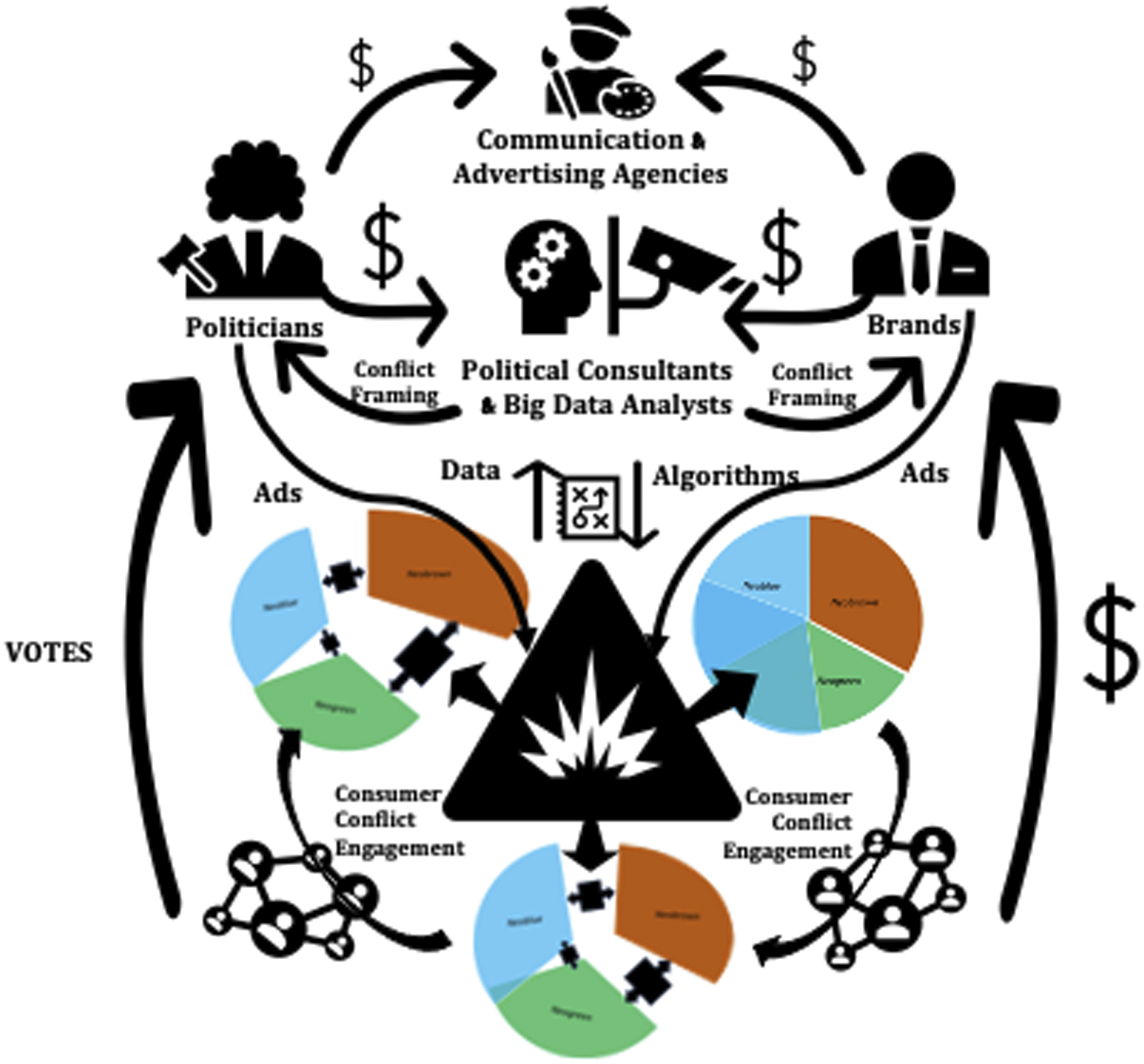
Figure 2 aims to illustrate the conflict market’s general capitalist logic and business model, which revolves around the creation and reproduction of polarizing conflict (O’Neil, 2017; Shaffer, 2019; Sumpter, 2018). There are political consulting firms (e.g., the now defunct Cambridge Analytica (Kaiser, 2019)), doing ideology-related analyses and strategic communication through data mining for politicians and public as well as commercial companies. They do this with the help of news media analysis in combination with AI text analysis services (e.g., Google Cloud) and bought information from social media and other digital platforms (e.g., Facebook). This, in turn, is generated from general online consumer behavior, and affective consumer online engagement in a politically charged issue, identified, defined, and re-framed by the strategic communication actors. In turn, brand owners, advertising agencies, and politicians buy these “conflict services” in order to position themselves in one of the conflict’s trenches. Ultimately, the social media platforms get more engagement and can therefore sell more data (to brands and the political consulting firms) and ad space (to brands and politicians). The brands and politicians get the desired attention, and political consultants are legitimized to charge more. In short, everyone—except, perhaps, democracy—capitalizes.
Consequently, the theoretical implication is that contradictions between the neobrown and neogreen ideoscapes will not merge into a completely different, or compromised, synthesis. Rather, they will become more neobrown and more neogreen, at least as long as the algorithmic forces nurture the un-political condition of counter-democracy. The practical implication of this is that market-driven political polarization will continue as long as companies, politicians, and consumers engage in it. And as long as they do, brands need to continue polarizing in order to be noticed at all. In this way, the conflict market may become hegemonic.
Un-politicizing market
As explicated earlier, in Rosanvallon’s terms, un-political does not mean de-politicization in the sense of “diminished interest in public affairs and declining citizen activity” (p. 22), as warned about in research on neoliberalism’s green consumer responsibilization (Cronin and Fitchett, 2021), on neoliberal multiculturation (Veresiu and Giesler, 2018), or on brand resistance (Holt, 2002). Rather, Rosanvallon uses the concept of un-political to point to the lack of shared problematizations of world issues, leading to ongoing fragmentation and polarization. From this perspective, political marketing and monetization of conflict does not make consumers less inclined to be voting citizens, as the historical critique has it. Rather, it makes people necessarily more political, both as civilians and in their brand choices, although in a negative—Rosanvallon’s un-political—way. Rosanvallon’s nascent un-politicization seems to perform a paradoxal re-politicization at the conflict market—but not in the “ethical” re-enchanting and enabling way previously put forward by Thompson and Coskuner-Balli (2007) and Thompson and Kumar (2018)—as the (post)postmodern idea that contemporary brands must be “ethical” is highly dependent on the (social) liberal context. In the counter-democratic conflict market, large groups that adhere to the neobrown ideoscape will, instead, demand the opposite, that brands oppose the “great awokening” (Mounk, 2018) and preach illiberal, even far-right values (Cambefort and Pecot, 2020; Castelló and Mihelj, 2018; Pineda et al., 2020; Ulver and Laurell, 2020). Thus, political polarization and counter-democratic culture of resentment will very likely force more brands to be openly ideological, but not necessarily distract consumers from voting. Quite the opposite. Consumers’ politically polarized activism, voting, and civilian engagement may give fodder to the extremes, which spills over into the mainstream.
Market renouncement
The third implication for brands and consumers that I bring up here is what I call market renouncement. That is, market actors will find it necessary to renounce consumers that, in previous branding paradigm(s), they would have targeted. They will have to sacrifice them because the forced re-politicization of brands will necessarily invert the logic of the textbook “market shielding” strategy, into something that looks more like Scholz and Weijo’s (2016) distributed infuriation strategy. Classic market shielding aims to indirectly attract aspirants by targeting those they aspire to, and making it harder for aspirants to get hold of the brand. Brands in counter-democracy will have to decide which political consumer groups they must infuriate and lose, in order to win others. Although Scholz and Weijo (2016) suggest this infuriation could be managed by the market actors through the enabling of discussions, the literature on algorithmic power (e.g., Beer, 2009) would hold this unlikely. Instead, the brands will be necessarily stigmatized by large groups at the market, but onanistically chosen by others, and polar sides have to be performed.
Historically, conventional marketing has monetized the difference between segments, but not conflict. In counter-democracy’s negative politics, it is the conflict coming from the negation of ideologies that sells, not each ideology per se. In mainstream marketing strategy, conflict is to be avoided because no one is prepared to actively offend any consumers, while cultural branding has it that brands should try to solve societal conflicts (e.g., Holt, 2004). At the counter-democratic conflict market, this assertion is inverted and conflict should be fueled, not solved. From this perspective, cultural capital’s structuring of consumption (e.g., Allen, 2002; Holt, 1998) and identity in general, would be more and more subsumed by political identity (Mason, 2018) or, actually, by the conflict between these.
In a concrete socio-political context, processes similar to the ones at the conflict market can be found in Sociologist (Eribon, 2013) Returning to Reims, a memoir, sociological inquiry and critical theory that offers a vivid explanation of why large population groups in France have now turned towards nationalist, authoritarian parties. In Eribon’s interpretation, his old working-class friends and family, who used to be devoted to social democracy, turned against the (liberal) Left and against him, because their identities were no longer tied up with who they were, but with whom they hated. This, in other words, is Rosanvallon's counter-democracy.
Limitations and future research
This conceptual article has sketched an alternative consumer cultural scenario based on a new world-political and technological context. Although this macroscopic envisioning does not rest upon a specific set of empirical data, it is still based on systematic reading, documented reflections, and general insights from several years of empirical and conceptual research inside and about what I, here, call the neogreen and neobrown ideoscapes. In order to fully understand the bits and parts of this narrative, I encourage future empirical research to look critically into how nascent illiberal and radicalizing consumer ideoscapes take form, how they grow, and, not least, how market actors are involved in these processes. Furthermore, consumer researchers should start paying more critical attention to the processes of algorithmically organized consumption and how it reciprocally connects to and reinforces ideoscapes. Considering the structuring power of these technological inventions in combination with counter-democracy’s conflict market business model, these processes could very well become the artificial masterminds of future politics, consumer culture, and marketing. From that perspective, at the conflict market, consumer “resistance” is a form of market-sanctioned political manipulation through which the market assists in polarizing, not only itself, but society at large.
Footnotes
Acknowledgements
I would like to extend my gratitude to the positive response from reviewers and the constructive process with the editor. I would also like to thank all the participants at the JCR conference at Colombia University, NY, in December 2019, for valuable comments on the early ideas for this article. An extra 'thank you' to Eric Arnould and Ela Verasiu who both provided me with more comments afterwards.
Declaration of Conflicting Interests
The author(s) declared no potential conflicts of interest with respect to the research, authorship, and/or publication of this article.
Funding
The author(s) disclosed receipt of the following financial support for the research, authorship, and/or publication of this article: Familjen Kamprads Stiftelse.
