



Abstract
Diversity in the fashion industry, it seems, is on the rise, with recent efforts poised to address the exclusion of people with disabilities. Based on a content analysis of editorials, advertising campaigns, and 213 online consumer comments between 2014 and 2019, we examine how diversity is showcased: specifically, whether images of disability serve to challenge or reinforce negative stereotypes. We find that market logics constrain the use of models with disabilities and shape their posturing in advertisements and fashion images. While consumers respond favorably to these images, demanding disability be more regularly and prominently featured, they are often responding to images that are sanitized and naïvely conceived. Nonetheless, we show how consumer feedback interacts with the production process, which in turn can challenge market logics, providing opportunities for increased representation. We shed light on how cultural representations reflect, shape, and challenge broader sociocultural norms and values.
Introduction
At first blush, 2018 was a year of change in the fashion industry. A greater number of racial minority women, trans-women, and plus-sized models were postured in print media and walked in ready-to-wear runway shows. Vogue Paris became the second Vogue edition to place a trans model on its front page. By the fall of 2018, “a full 50%” of the top 10 fashion magazines featured women of color on their cover (Schneier, 2018), and more than a quarter of all models that walked the runways in Milan, London, and Paris were women of color. 1 It is in this shifting context of diversity that Teen Vogue’s September 2018 cover featured three models with disabilities. They were not alone. Last year, retailers such as Nike, Tommy Hilfiger, and Aerie included models with disabilities as part of their advertisements and promotional campaigns. Aerie’s campaign went viral online, where consumers responded with praise and admiration in real-time: “A model who looks like me,” wrote one Twitter user. Tommy Hilfiger’s recent line of adaptive garments tailored for people with disabilities was also met with media praise and consumer support. When asked about his latest collection for men and women with disabilities, Hilfiger replied that “inclusivity and the democratization of fashion have always been at the core of [his] brand’s DNA” (Feldman, 2017).
But, until relatively recently, the $3 trillion-dollar fashion industry paid little direct attention to issues of gender, sexual identity, or race, let alone disability. 2 Thought to be inconsistent with prevailing aesthetic preferences (Thomas, 2001), the neglect of disability by the fashion industry both reflects and reinforces widely shared cultural ideals about what kinds of bodies should be valued, adorned, and emulated. Both academic and popular accounts suggest that these omissions are not accidental (Barry, 2015; Chase-Marshall 2018; Friedman, 2018; Godart and Mears, 2009; Mears 2010). In an industry where “looks are unstable” and uncertainty is high, the exclusion of diverse bodies is purposefully designed to maximize profit and minimize risk (Entwistle, 2002; Mears, 2010: 24; Mears, 2011).
Risk-averse industry leaders may treat disability images as “unusual stimuli” which is problematic in advertisements where such images are thought to turn off consumers (Workman and Freeburg, 1996). As fashion editor Robin Givhan explained in a recent interview, “We are drawn to people who look like us…unless they’re [industry producers] making a conscious decision to deviate from the standard, then the standard is what they go for. And [their] standard is blonde and blue eyed.” 3 This narrow scope may account for why few disabled people have been featured in product advertisements and why they are practically nonexistent in television ads (Ganahl and Kallem, 1998). In an industry defined by an “image is everything” modus operandi, to borrow from (Ganahl and Arbuckle, 2001: 6), images must exude “power, credibility and appeal”—qualities dissociated from disability. Givhan’s statement also suggests that what drives innovation is a conscious effort among leaders—some form of cultural entrepreneurship that calls into question the risk-reward ratio typically excluding disability from fashion images.
In fact, recent efforts at inclusion indicate that disability is not incompatible with the market’s desire to awe and inspire consumers. Consumers who interpret and respond to cultural products play their part in shaping reception processes along with agents and critics (Becker, 1982; Ferguson, 1998; Godart and Mears, 2009; Leschziner, 2015; Peterson and Anand, 2004). 4 Consumer support is an important part of creative decision-making among cultural producers because support lowers perceived risk while increasing potential reward (Heldman, 2018). This is especially the case among producers who may already be looking for a more diverse customer base aligning with socially conscious ad campaigns and editorials or else co-opting existing “brand-communities” such as those interested in reclaimed or locally-made fashion garments (Thompson and Coskuner-Balli, 2007: 148; Thompson, 2011; Currid-Halkett 2017). As casting director James Sully explained, brands can no longer afford to ignore consumers and their vociferous criticisms, compelling producers to broaden their reach and appeal, to take new risks, and to challenge existing conventions. 5
Just what are these socially conscious ads consumers are responding to and do they authentically capture and communicate diversity? Portrayals of disability in editorials and advertisements can amount to naïve images and narratives that superficially satisfy aims of diversity by providing sanitized, unidimensional depictions of disability, uncomplicated by other intersecting statuses. They can also reinforce extant beliefs about people with disabilities. For example, the relationship between disability and charity or between disability and illness is routinely drawn out in the mainstream media (Houston, 2019) and in advertisements that inspire pity among would-be donors (Pettinicchio, 2019; Shapiro, 1994). These are depictions thought to be most familiar to consumers. As Garland-Thomson (2002: 25) concluded, when people with disabilities are featured in media, it is “simply one of the many variations that compose the market to which they appeal.” As such, diversity campaigns may end up playing to existing negative disability stereotypes among consumers, not challenging them.
Informed by the dynamic reciprocating producer–consumer relationship posited to influence change within cultural fields (Childress, 2017; Childress and Friedkin, 2012), we examine how consumers receive aesthetic preferences communicated by producers in fashion through print and online media images and text. To do so, we analyzed 29 editorial articles published between 2014 and 2019 and three widely publicized advertising and promotional campaigns. As cultural products, these reflect widely shared beliefs, communicate ideas, draw boundaries, and reinforce symbolic notions of sameness and difference. We then analyzed 213 online comments revealing how everyday consumers evaluate and understand representations of disability in fashion. This empirical contribution sheds light on the role consumers play in directing future efforts at diversity and inclusion that either challenge or reinforce extant values and norms.
Communicating and responding to aesthetic preferences
Aesthetic preferences are generated through creative decisions about the look of models and the posturing of sartorial goods within brands and fashion houses—part of a broader “aesthetic economy” governed by a field of creative and entrepreneurial fashion industry leaders and fashion news outlets (Asper, 2010; Entwistle, 2002; Godart and Mears, 2009). Industry leaders and creatives act as gatekeepers deciding what is and what is not of value (Haenfler et al., 2012; Mears, 2010). At times, they act entrepreneurially, pushing conventional boundaries of beauty. By and large, however, they are constrained by industry and market norms that homogenize “the look” on fashion runways, in ads and editorials (see Crane 1997; Entwistle, 2002; Godart and Mears, 2009; Aspers, 2010), and by their shared positions (and dispositions) within the broader field of fashion (Bourdieu, 1984). As Entwistle (2002: 332) explains, “insiders in the industry exist in a network of institutional and social relations within the world of fashion and, as such, acquire the same cultural capital, habitus and taste as each other.”
Working within these normative constraints, industry leaders transmit values and preferences to fashion consumers through commercial ads and fashion editorials (Hirsch, 1972; Mears, 2010: 24). Any consumer with sartorial savvy knows that these aesthetic preferences are the preferences to look to. Each type of media content, however, comes with its own set of standards about how fashion and beauty should be portrayed. In the commercial market, for instance, bookers and clients select models that maximize appeal, reflecting the field’s orientation toward large-scale production and profit-driven sales (Bourdieu, 1983). These models are considered “conventionally attractive” and are slightly larger and older than their editorial counterparts (Entwistle, 2002; Mears, 2010: 28). In the editorial market, on the other hand, models are selected to inspire fashion consumers; they are “edgy” and “avant-garde” often possessing an “extraordinary body” (Mears, 2010: 29–42). They are, on average, quite young, embodying whatever look is currently in demand and requiring a certain “aesthetic sensibility to be intelligible” (Entwistle, 2002:327). This is because editorial models have niche appeal and are not employed to sell fashion goods en masse. As the British modeling agency RMG (2017) revealed, editorial models are “big names” in fashion. They are “tall, slim, unique faces” that work closely with high-status brands and are widely recognizable.
Differences between ads and editorials—and the field dynamics they reflect—have important implications for the ways in which disability is represented and consumed. Whereas producers in the commercial market might select models with disabilities because they broadly appeal to consumers sympathetic to, and even demanding diversity, producers in the editorial market are interested in models that can be interpreted as extraordinary. Editorial producers have less interest in selling a large volume of material goods or profiting from their work and, as such, may be more willing to call on models with disabilities, especially if they meet their criteria for inspiration, inclusive, or exclusive of their specific disability.
While inclusion is therefore differently motivated depending on the nature of the medium and market, representations of beauty and fashion found in both types of media content reflect and reinforce extant ideals and values (Baumann, 2008; Johnston and Taylor, 2008; Hall, 1997; Peterson, 1979), like, for example, the virtue of slenderness and the shame of fatness (Saguy and Gruys, 2010). They communicate shared meanings, power relations, and cultural practices (Hall, 1997). Ads and editorials “conventionalize our conventions, stylize what is already a stylization, [and] make frivolous use of what is already something considerably cut off from contextual controls” (Goffman, 1979: 84). As Schudson (1984: 215) reminds us, these cultural products capture “reality as it should be.” Contorted by editors and stylists, often to the extreme, they illustrate that to which we ought to aspire (Baumann, 2008).
One way this manifests itself is through naïve integration—sanitizing models with a disability, doctoring their features to conventionalize their appearance, bringing them closer to prevailing industry standards and with what consumers are thought to be most comfortable. This is not unique to disability. Crockett’s (2008) analysis of mainstream product advertisements showed that race is routinely idealized to sell products and maximize appeal. All the while, questions surrounding racial inequality or the media’s role in reinforcing it fade from view (Crockett, 2008). Even when brands or marketers make deliberate efforts to broaden the scope of representation in the mainstream media, they tend to err on the side of convention. Consider the well-known Dove campaign for “Real Beauty.” Crafted to celebrate every day and unconventional images of beauty, it still failed to include bodies that significantly deviated from what is culturally considered beautiful (Heiss, 2011). This meant including no images of disability of any kind. The ads compartmentalized aging, body size, ethnic and racial diversity, ignoring the intersections of these statuses and in effect, taking little risk by not challenging the values and norms associated with beauty. Efforts to sanitize disability and other characteristics for consumers are not only potentially “more sinister” than total exclusion (Kreps, 2000: 184), they take place with little concrete evidence that consumers are, in fact, unreceptive to more multidimensional representations of disability (Barry, 2015).
Consumers engage with the meanings and messages attached to fashion media content and often make their opinions directly known. This is especially true online where consumers can interact with content in real time (Toffoletti and Thorpe, 2018). They may respond favorably to this content including text and images, or they can reject their message in whole or in part (Radway, 1991; Shively, 1992). As when, for example, young consumers critically engage with media programs and mainstream images of beauty such as the popular television show America’s Next Top Model, commenting that these portrayals are unrealistic (Press, 2011; see also Milkie, 1999). Or, when consumers see through marketing efforts and endearing product campaigns like those produced by Dove that, however well-meaning, leverage broad appeals toward “real beauty” in an effort to sell products (Millard, 2009). Of course, not all consumers are so inclined. As culture scholars point out, consumer evaluations of cultural content can vary considerably (Childress and Friedkin, 2012; Radway, 1991; Scarborough and McCoy, 2014; Shively, 1992). Some consumers are, for example, more critical than others, inveighing their thoughts and feelings against brands and businesses, while others are somewhat more passive or less driven to take action on or against content they admire or dislike (see for example, Foster, 2021).
Analyzing depictions of disability and consumer responses
Content analyzing ads and editorials provides access to widely shared beliefs and aesthetic preferences surrounding disability as they are communicated to consumers. It provides direct empirical knowledge about the range of ways people with disabilities are featured and for what purpose (e.g. to adorn an image, to sell a product, and as a lead feature with an accompanying article).
We draw on three data sources. First, we content analyzed the images and texts of three widely read fashion magazines—Vogue, Harper’s Bazaar, and InStyle—over a 5-year period. Considering the person depicted as well as the implications of their posturing and dress, we also used any accompanying text to understand how these images were contextualized for readers by Vogue, Haper’s Bazaar, and InStyle, respectively. Given that not all disabilities are visible, we also relied on accompanying text in order to identify the nature of the disability. For instance, in Vogue’s February 2018 editorial, “Stronger Together,” we learned of Tommy’s autism from his sister who spoke about her brother’s disability.
Second, we surveyed more than 2500 advertisements featured in InStyle magazine and found little in terms of disability, evidence that disability in fashion advertisements is very rare. Therefore, we adopted a case-based approach, drawing on the recent promotional campaigns of retailers, Nike, Aerie, and Tommy Hilfiger. These well-known campaigns provide a unique opportunity to assess how industry figures posture disability in advertisements and whether these advertisements challenge or reproduce existing beliefs about people with disabilities.
Editorial themes in print magazines
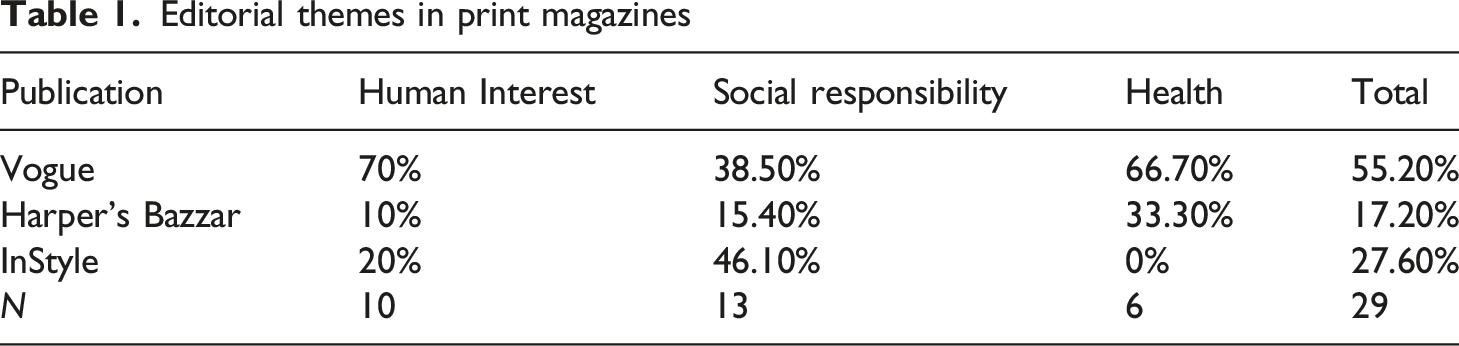
Human interest stories mainly covered athletes, public figures, and mainstream celebrities. These stories connect readers to the intimate lives of others through the use of biographical details and personal testimonials. Editorials surrounding social responsibility and charitable work were often couched within larger conversations on politics or care work and followed the various contributions of individuals and charitable groups in the United States and abroad. Finally, editorials focused on health, typically addressed diagnoses, treatment plans, or medical risks related to disability. To ensure intercoder reliability, editorials were coded independently and then compared.
We compared disability across commercial and editorial images telling us whether and to what extent models with disabilities are compatible with the industry’s desire to sell a large quantity of goods and/or to inspire consumers with extraordinary images. In an effort to contextualize fashion images (Laan and Kuipers, 2016), we also accounted for image placement (e.g. on the cover and within a feature story), revealing the relative import the magazine places on the image itself. Our sample of 180 issues over three publications and across 5 years produced not one case where a model with a disability was featured on the cover. Against this backdrop, Teen Vogue’s September 2018 cover featuring three models with a disability represents a significant departure from conventional practice.
We were also conscientious about situating these multiple data sources within a broader context of diversity. Disability intersects with other status characteristics such as race and gender, and these intersections are socially, politically, and economically consequential (Maroto et al., 2019). In fashion, for example, intersecting status characteristics such as race and disability might be perceived as too risky among industry producers or bookers constraining modeling opportunities for individuals sharing multiple identities. To avoid the mis-identification of racial bodies, we distinguished between white and nonwhite models. We also attend to whether or not the editorial explicitly highlights the sexual identity of the featured model(s). Our analysis revealed no distinct pattern in the overlap of these status characteristics in mainstream editorials. However, we discuss how the intersection of race, gender, and disability may matter more in advertisements and online representations, where markers of difference are often (and naïvely) “idealized and essentialized” (Crockett, 2008: 255).
Finally, consumers can directly challenge industry producers for being racially or culturally insensitive 6 or find alternative meaning behind depictions meant to communicate inclusion and diversity (see Hebdige, 1979; Banks, 2010; Childress and Friedkin, 2012, on alternative and repossessed meanings co-constructed by consumers). In order to better understand how consumers evaluate, interpret, and challenge industry producers, we analyzed 213 online comments across three widely shared images drawn from Teen Vogue’s Instagram page. These images and comments are publicly available for view. Comments lent themselves to one of four categories: (i) expressions of praise and admiration, (ii) rejection of diversity in fashion, (iii) neutral/indifferent, and (iv) and criticisms of the fashion industry itself. This latter type also points to the way consumers can be cautiously optimistic, remarking that gestures toward diversity and inclusion do not go far enough. Importantly, the consumer comments we share likely reflect the thoughts and feelings of relatively fashion forward and politically conscious young people between the ages of 18-24—Teen Vogue’s target audience online (Warrington, 2017). Taken together, comments such as these embody the ways in which consumers make sense of, and interact with, media content messaging (Rose, 2007; Williamson, 1978). These interactions can either reinforce or challenge extant cultural meanings and symbols (Peterson and Anand, 2004; Zukin and Maguire, 2004).
Representing disability in fashion: adorning the able-bodied
In mainstream fashion editorials, disability is often used to decorate or adorn the lives of otherwise ordinary and nondisabled individuals, emphasizing their charitable goodwill, while inspiring compassion or pity among readers. In an editorial spread in Vogue, focused on beauty and fitness, the article claimed that the life of young basketball star—Elena Donne—had “been shaped by extreme physical disability.” The physical disabilities in question—blindness, cerebral palsy, and deafness—however, were not her own, but her sister, Lizzie’s. The editorial spends some time discussing Lizzie’s communicative challenges as well as her relationship with her sister.
With little else to say, the editorial ultimately shifts the reader’s attention to Elena’s appearance and athleticism: “Elena, who has come from a hot-yoga class and lifting weights at the gym, arrives with her mother for lunch at a bustling restaurant nearby. Slightly tan, with her long blonde hair pulled back into a high ponytail, she looks as if she might have come from a run on Venice beach.” Described in this way, consumers are presented with a stark contrast between Elena and her sister. Elena, a young, nondisabled, athletic, and physically attractive female is the center of the editorial’s focus. Her sister, Lizzie, appears as if to enhance Elena’s remarkable character, namely, her strength and ability to persevere in the face of adversity. Lizzie pales in comparison to her sister, reflecting and reinforcing notions of disability as a marker of difference, while eclipsing any opportunity for Lizzie to be understood outside of her disability.
The contrast between “ability” and disability is somewhat less stark in Harper’s Bazaar’s editorial coverage of former first-lady, Michelle Obama. Within a larger conversation on aspiration, the former First Lady reflects briefly on her father’s experience with multiple sclerosis. A shift worker, Michelle’s father “invested everything” in his children and worked hard despite persistent issues with his mobility. He is featured as a small part of her success, noteworthy insofar as he overcame the limits of his disability to provide for his family. Read in this way, the editorial reinforces broadly shared beliefs suggesting that when it comes to disability, it is ability, rather, that is of the utmost importance.
Similarly, Vogue’s February 2019 editorial spread on American actress and entrepreneur, Reese Witherspoon, exemplifies how people with disabilities are included to support the narrative of people without disabilities. Within this editorial, Witherspoon is lauded for her ambition, business savvy, and for her advocacy on behalf of people with disabilities, among others. Still, no images were included to reflect people with disabilities with whom she works, nor has any commentary been solicited from members of the disability community. To compare, a labor activist as well as a member of the Time’s Up movement and Witherspoon's production staff were all featured in the editorial’s images.
In that vein, InStyle produced an editorial on a supermodel and philanthropist, Natalia Vodianova who sat on the board of the Special Olympics. She credits her “upbringing” for having instilled in her an interest in this and other noteworthy philanthropy: specifically, her mother and sister, the latter diagnosed with autism and cerebral palsy as a child. With no state-support—reads the editorial—it is a wonder that Vodianova’s mother did not bring her younger daughter to an orphanage for children with special needs. She “refused,” it continues, “and the family paid the price both financially and socially.”
Taken together, these cases reflect a narrow vision of disability. People with disabilities are postured to emphasize the remarkable or charitable qualities of others. While the professional accomplishments and advocacy work of nondisabled people are brought to the fore, people with disabilities fade from view. Bringing the activist slogan “not about us without us” to bare on the fashion industry—that real inclusion requires input from the disability community (Pettinicchio 2012, 2019)—makes all the more evident that the stars of editorials are not people with disabilities.
Rendering aesthetic citizens
Cast in roles supporting the narrative of nondisabled celebrities and almost completely absent from photographs, editorials tell us a great deal about the aesthetic preferences that dominate the fashion industry. Although editorials often included multiple photographs of the featured star and in some cases, friends and relatives, they did not include any images of people with disabilities. Even in editorials that emphasize the inspiring role that people with disabilities have played in the lives of their nondisabled counterparts, visual representations of disability were excluded.
Although Vogue’s March 2015 issue offered an uncommonly reflective portrayal of disability, it too included no images of disability. Here, the author confesses that after years of difficulty in school and in navigating her day-to-day life, she was told that “there was a lemon-size hole in her brain.” Searching for a “label to describe herself,” this nonvisible condition sparked “neither grief nor joy,” she wrote. Disability, she insisted was not quite right. Or, as she put it: “Words about disability are used to compartmentalize more than unify. I’m looking for a word that doesn’t exist yet…A word that recognizes that my strengths and weaknesses are not parallel traits but instead shaped more like a double helix. Ability and inability are two hands belonging to one person, each shaking the other.” By including the voice of a member of the disability community, Vogue challenges readers to reconsider prevailing beliefs about people with disabilities and broadens readers’ understanding of the range of visible and nonvisible disabilities. Whether at Vogue’s request or by the author’s own choosing however, no name was attached to the editorial, leaving readers unable to place a face alongside this important story.
If and when people with disabilities are included in mainstream editorials, they are not the subject of sartorial study. They are rarely dressed in designer labels, treated as stylish, or thought of as fashion trendsetters. Consider Vogue’s February 2018 editorial Stronger Together. Here, the model Jacquelyn Jablonski is featured alongside her brother, Tommy, and two sisters. Tommy’s early autism diagnosis motivated Jacquelyn and her sisters to establish a charitable organization dedicated to raising awareness for people with Autism. The family appears picture perfect, dressed in designer labels including Chloé and Chanel. Vogue makes explicit mention of who is wearing what, with one notable exception: Tommy. This in itself is symbolically significant. Fashion goods, like other material elements of culture, are routinely used to communicate meaning, express belonging, blur boundaries, and to confer distinction (Harkness, 2012; Lamont and Molnár, 2002; Pugh, 2011; Warde, 1994). In Vogue, men are routinely dressed in designer apparel and that apparel is signaled to the reader. That Tommy is dressed in clothing too unremarkable to note mistakenly suggests that Tommy too is unremarkable.
In contrast, InStyle offered a somewhat more fashionable rendering of Aaron Philip, a black, transgender model with a disability. Aaron was signed to Elite Model Management in September of 2018 amidst a sea of other changes reported here. More recently, she appeared on the cover of Paper Magazine. In their editorial reporting, InStyle declared that Aaron as well as 49 other women alongside whom she shared the photo shoot, were “unstoppable in their pursuit of a better world.” Reporting of this kind reflects a shift in the portrayal of people with disabilities not as helpless but as active, productive, and in this case, as aesthetic citizens. Aaron “credits much of her success to her presence on social media, where she has a combined following of 120,000 on Twitter and Instagram.” 7 Indeed, consumers’ positive reception of models with disabilities highlights the important role that social media plays in connecting consumers to a larger network of industry producers.
Advertisements featuring “Crazy dreams” and Beautiful Bodies
Ads of all kinds have historically popularized unidimensional, dehumanized, medicalized, and piteous images of disability (Barnes, 1992; Panol and McBride, 2001; Pettinicchio, 2019; Shapiro, 1994). Yet, the recent fashion advertisements we analyzed couched disability within broader stories around beauty and athleticism, posturing people with disabilities quite differently than mainstream fashion editorials.
American retailer Aerie, for example, paired images of models with a range of disabilities alongside nondisabled and un-retouched models, in an effort to celebrate women’s real beauty. Dressed in the company’s lingerie, Aerie’s models are featured smiling and laughing aside visual indicators of their disability including a wheelchair and walking supports. The images have since been shared across social media platforms and picked up by news outlets, where they have received significant praise. More recently, the athletic apparel designer, Nike, seemingly challenged prevailing beliefs about “ability” and athleticism. Featuring Tatyana McFadden, a Paralympic athlete, and a cast of accomplished sports stars, Nike’s 90-second television spot and corresponding print and in-store advertisements exclaimed, “if they think your dreams are crazy show them what crazy dreams can do” (emphasis added).
Tommy Hilfiger took a step further, producing a set of print advertisements and online videos alongside a line of adaptive clothing for men and women with a disability. Of the three apparel designers discussed here, Hilfiger is the only one to have designed adaptive clothing tailored specifically to people with disabilities. In this way, Hilfiger makes salient an important distinction between advertisements that target consumers with disabilities and advertisements that posture disability as secondary to the products and people featured. Whereas the first takes this buying demographic quite seriously, the other bypasses people with disabilities in order to reach a broader consumer base. Hilfiger’s video advertisements and promotional images feature men, women, and children with different disabilities including both physical and intellectual disabilities. In one such advertisement, the camera shifts between close-up shots of clothing and accessories designed with adaptive features to make getting dressed easier. “Your disability is an honor not a burden,” says the advertisement’s narrator.
Taken together, advertisements differ from mainstream fashion editorials in three respects. First, they situate people with disabilities at center stage, recognizing the qualities and characteristics of people with disabilities absent any comparison to nondisabled people. Second, and consistent with existing work surrounding representation in fashion (Mears, 2010, 2011), they feature considerably more diversity in disability type and cut across a wider set of status characteristics including race and age, often presenting a less-idealized and more conventional picture of beauty. Third, and relatedly, ads are explicitly designed to sell goods and to endear all consumers to the brands that created them.
“The new faces of fashion”
Consumers responses to Teen Vogue’s September issue
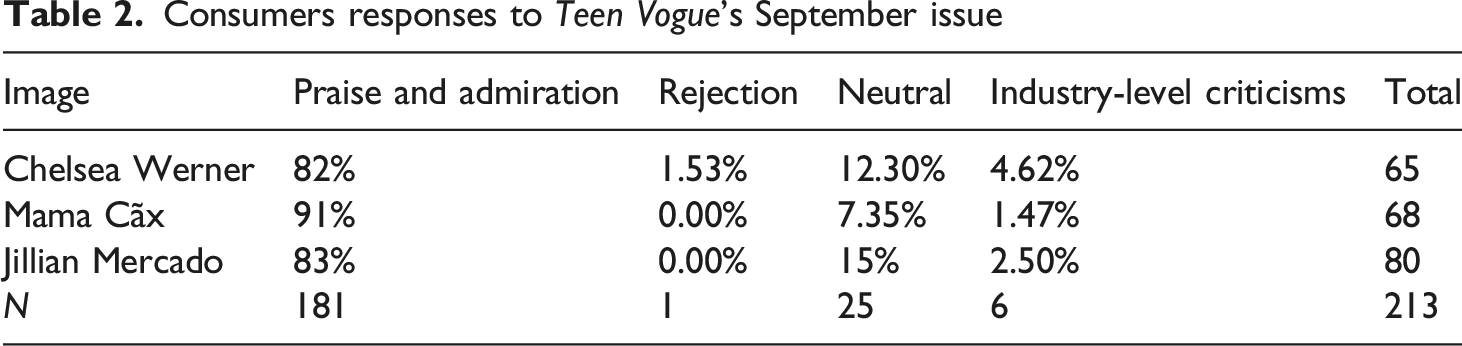
Described as “The New Faces of Fashion,” Chelsea Werner, Mama Cax, and Jillian Mercado are the first women with visible disabilities to appear on the cover of Teen Vogue. Chelsea Werner, a Special Olympics athlete was also featured by Aerie for their apparel ad campaign earlier this year. Speaking about her place in fashion, Jillian Mercado remarked that “When I was younger, I would only show my face [on social media sites], that’s it. There was a time when I was just very ashamed of who I was because not only was I not seeing myself represented anywhere, but I was put into the category that I wasn’t enough, that I couldn’t feel good about myself” (Wanshel, 2018). A glance at Mercado’s social media presence would suggest that she is not alone.
With over 190,000 followers on her Instagram platform, Mercado represents a significant figure in the fashion landscape. Her re-post of Teen Vogue’s cover photograph received more than 12, 000 likes and 600 (and counting) comments. “I absolutely love seeing you on the cover of this magazine,” wrote one viewer. “Reminds me so much of my sister. She passed away 8 years ago 3 days before her 18th birthday from congestive heart failure. She had muscular dystrophy and I know if she was alive today she’d be over the moon excited to see herself represented by you,” they continued. Hundreds of comments followed, both on Mercado’s post and on Teen Vogue’s Instagram platform, echoing praise and admiration for Mercado. For instance, one commentator wrote: “this is so important. This is so long overdue.” Another, “@teenvogue oh my god yes!! Keep doing what you guys are doing!!”
Mainstream images of disability cast light on “disability as a human experience” and have the potential to empower disabled consumers (Garland-Thomson, 2002: 25). What is more, these images can play an important role in changing perspectives on disability more generally through their global proliferation. Inspired, one viewer thanked Vogue for “making great changes.” Another, eager for inclusion wrote: “let’s see this on a regular basis, please.” Comments such as these suggest that where the fashion industry may have been reluctant to diversify its models, 8 shifts in consumer preferences towards more inclusivity reinforce recent efforts on the part of some industry initiatives to do just that. Enchanting a larger demographic of potential purchasers—–whether consumers with disabilities or consumers who are motivated to purchase from brands they see as championing diversity—–makes good economic sense.
For example, the photograph of Chelsea Werner, Special Olympics athlete and recent star of apparel retailer Aerie’s advertising campaign, received 12,667 (and counting) likes on Teen Vogue’s Instagram platform. The campaign resulted in tremendous growth in sales for Aerie (38% in 2018) and landed Chelsea a contract with We Speak agency and a spot in a recent H&M campaign (Brown, 2018). This was not a surprise to Chelsea’s mother who told Vogue that “if other companies see the positive feedback they’re going to realize it’s a really good thing for them to do, business-wise. It’s a huge segment of the population that has disabilities” (Brown, 2018).
Indeed, consumers of Vogue’s content were not the only actors to engage with these representations. Comments were also left by brands like Dove Beauty and Allure magazine as well as by numerous verified accounts and Instagram influencers. This is significant because cultural producers often look to one another, aligning themselves with other market actors in order to minimize the level of risk inherent in creative decision-making (Crane, 1997; Hirsch, 1972; Godart and Mears, 2009; Mears, 2010). As such, Teen Vogue’s cover may signal opportunities to other brands and outlets to follow suit. This is a particularly important gesture within the editorial market, where industry logics constrain the selection of models to a handful of widely recognizable men and women. The monetary success of Aerie’s campaign and the praise Teen Vogue received is evidence that the rewards of inclusion outweigh any possible risks.
But, among praise, comments also reveal the longstanding view that disability is something to be overcome, not celebrated. As one commentator reflected, Teen Vogue’s September cover “shows that all thing[s] can be conquered.” Others wrote “truly inspiring” and “so proud of all you’ve accomplished.” To compare, Teen Vogue’s celebrity- and style-focused content is rarely praised for its inspiring qualities or accomplishments of the figures and faces featured. Comments like these then, continue to problematize disability by shining the spotlight only on those who are thought to have sufficiently overcome their disability(ies). They also suggest that consumer praise is not always reflexive or deeply critical (Shively, 1992). Rather, these comments echo widely shared values and preferences surrounding disability, “articulated and submerged” (Baumann, 2008: 4–5) in our broader cultural discourse through fashion media.
Furthermore, consumers supporting inclusion and diversity efforts were not always optimistic that the industry would in fact change. In a comment on Chelsea Werner’s photograph one viewer wrote: “except the fashion peeps [people] running things remain status quo.” Another, in reply, wrote “it’s true change is slow and some peeps are more resistant but there are changes happening.” And a third, in direct response to Allure’s praise, rightfully pointed out that: “@allure you can join the Inclusion Revolution too.” This latter comment suggests that consumers can both support and be critical of mainstream fashion media (Milkie, 1999; Press, 2011), willing to point out when producers are not engaging fully with initiatives they purport to stand by. The support of consumers, including those concerned that current efforts at diversity are ephemeral, may play a significant role in ensuring that they are in fact enduring. Their support signals that disability is compatible with industry aims at maximizing revenue and brand appeal.
Discussion and conclusion
The aesthetic economy encompasses a broad field of brand leaders, agents, models, creatives, and consumers governed by norms and values that historically rendered entire populations invisible. It is a field organized to disregard “would be consumers whose bodies society typically deems unattractive” (Scaraboto and Fischer, 2012: 1238). Consequently, people with disabilities have been denied aesthetic citizenship. Nonetheless, we occasionally see bursts of industry innovation as a result of cultural entrepreneurship that can work to change organizational norms as producers attend to and align themselves with their competitors’ cultural offerings. Our analysis of social media revealed a network of well-connected industry figures who look to one another to minimize risk in creative decision-making. Producers, however, are not only looking to each other, but to the ways in which consumers acknowledge, favor, or criticize their ideas. This means that long-lasting change requires consumer engagement.
Our findings point to two key aspects related to consumers’ role in cultural production. First, industry logics including those distinguishing commercial and editorial markets do indeed shape representations of diversity. Specifically, the commercial market affords greater opportunity for representations of disability that cut across status characteristics and that appear conventional in their posturing and appearance. Editorial images, although less likely to include a model with a disability, do evince some diversity. Indeed, Teen Vogue’s cover story constitutes a case of editorial representation. Second, consumers’ comments can directly and indirectly challenge depictions of disability, pushing the industry past the aesthetic logic that defines the production of fashion images. Where the industry may see disability as exotic and unusual, consumers may not because they directly and indirectly experience disability in their day-to-day lives. As Workman and Freeburg (1996: 250) put it, “models in wheelchairs are more effective than models in lawn chairs in stimulating increasing levels of consumer commitment to fashion products.” Of course, not all consumers evaluate or respond to media content in the same way, but it is unlikely that they are as unreceptive to depictions of disability as industry insiders suppose. In other words, the fashion industry is wrong to assume that “diversity doesn’t sell” (Barry, 2015).
Diversity in fashion may be on the rise but cultural change, as Lieberson (2000) reminds us, is often slow. The advertisements produced by Aerie, Nike, and Tommy Hilfiger represent an important step forward in the posturing and portrayal of disability in the mainstream media. But as our analyses indicate, diversity is packaged and framed in particular, often narrow, ways. When people with disabilities are represented, they are often treated as supporting material to bolster the image of someone without a disability, medicalized or made to inspire pity (Barnes, 1992; Panol and McBride, 2001).
With this in mind, our analyses raised a number of empirical questions we were unable to directly address. First, with so few examples featuring models with disabilities who were also women of color, it was difficult to disentangle which status characteristic or identity is being privileged. On the one hand, representations of these young women allow viewers to think about and comment on intersectionality, moving beyond the sort of naïve integration plaguing cultural industries (Heiss, 2011). On the other hand, each status risks being “muted to the level of gesture” (Garland-Thomson, 2002:25) preventing any real discussion of the ways in which difference shapes the experience of models within the fashion industry or structures collective understandings of race, gender, and disability. Future work should systematically address intersectionality in fashion as others have with disability in a variety of domains (see Pettinicchio and Maroto, 2017; Maroto et al., 2019). This work would further benefit from considering more systematically how different consumer segments evaluate and respond to intersectional representations of diversity in fashion.
Second, although we consider the nature of disability in ads and editorials, with so few cases, it is difficult to ascertain how some disabilities may be more privileged in media content. For many, someone using a wheelchair is synonymous not only with disability but with the whole disability rights struggle—an image the general public is familiar with (Panol and McBride, 2001). The inclusion of mainstream disabilities like autism, for example, may actually point to the durability of existing industry conventions as well as familiar tropes related to exoticism and difference. This is an area future work should expand on.
Third, the creation of fashion media content including advertisements and editorials is an inherently social process. Creative agents are influenced by the broader social valence in which they are embedded (see Becker, 1982; Bourdieu, 1984; Leschziner, 2015). As such, industry leaders often (re)produce existing sociocultural ideals from which they receive cues and signals (Mears, 2010). Future work should further investigate how broader social conventions and industry norms interact to either enable or constrain creativity and innovation in cultural industries. Godart and Mears (2009) have done important work in this area, helping to shed light on processes that lead to convergence or divergence in representations. Engaging directly with industry producers is necessary for learning more about decision-making surrounding the inclusion of disability.
In this article, we examined the apparent rise of inclusivity and diversity against a backdrop of historical neglect. That people with disabilities have been symbolically, if not literally, erased from mainstream advertisements and editorial images carries with it very real implications. As cultural products, these images and advertisements play an important role in shaping public preferences. We provide some insight on how cultural production might be shaped by reception processes. Like Childress (2017:11), we recognize that the relationship between cultural production and reception is “dynamic and interlocking” with feedback processes connecting the two. That is, positive or critical consumer evaluations can also motivate producers to make changes to their product offerings or to invest in offerings that are altogether new. New York Times journalist Safronova (2017) recently commented that “Diversity, of all kinds, is on the rise [in fashion].” This however does not mean that all groups are equally represented, that they are represented in meaningful ways, or that these representations are not just reinforcing widespread stereotypes that consumers find reaffirming. Yet, if Allure’s recent 2020 editorial spread featuring Ellie Goldstein, a model with Down’s syndrome, is any indication of sustained change, it signals that early entrepreneurial efforts towards inclusivity in fashion over the last couple of years may have paved a path for industry figures to follow moving forward.
Footnotes
Acknowledgments
We are very grateful to the many individuals who provided feedback on various drafts of this paper. We would like to thank those attending our talks at the 2019 Canadian Sociological Association (CSA) and American Sociological Association (ASA) meetings, especially members of the Disability and Society and Culture sections of the ASA, for their helpful suggestions in the early stages of this project. We would also like to give a special thanks to Shyon Baumann and Ashley Mears for their constructive and thoughtful comments on this paper.
Declaration of Conflicting Interests
The author(s) declared no potential conflicts of interest with respect to the research, authorship, and/or publication of this article.
Funding
The author(s) received no financial support for the research, authorship, and/or publication of this article.
