




Abstract
If resource intensive practices are regularly represented as conventional, these potentially become naturalised and inconspicuous consumption will increase. Understanding how representations, conventions and everyday practices interact is thus fundamental in tackling unsustainable consumption. To gain new insights into how representations, conventions and practices interact, this paper explores how people respond to cleanliness representations in Swedish media. Cleanliness is chosen as a case for its role in accelerating water and energy consumption (Shove, 2003), and Sweden where cleanliness activities are in line with upward trends (Jack, 2017). Focus-group participants read magazines, discuss content and how it relates to their lives. Cleanliness is perceived as being intertwined with a host of co-conventions such as freshness, health, femininity, masculinity, sustainability, et cetera. Participants have strategies to receive and resist representations, and are especially averse to representations that they suspect are meant to increase consumerism. Dilemmas for participants do not arise from deciding when or how to receive or resist representations. The real dilemmas arise when integrating meanings into everyday life practices given the multiplicity of meanings. Participants see conventions as influencing wider society, but see themselves as individuals critically interacting with representations, a sovereign dupe 1 juxtaposition.
Keywords
Inconspicuous consumption – A sustainability problem
We consume critical resources during the course of everyday life, without necessarily being aware of our increasing environmental impact. Most consumption occurs not for its own sake, but within and because of practices like eating, cleaning or transport et cetera (Warde, 2005: 145; Mylan and Southerton, 2018). Environmental impacts arise because we want a clean load of laundry (Yates and Evans, 2016), to have cool air on hot days (Strengers, 2012) or a tropical holiday (Hares et al., 2010); not because we set out to release CO2 but rather due to the social and material lock-ins surrounding practices (Sahakian, 2018). Because consumption of energy and water is often hidden in other practices and therefore invisible, decreasing the environmental impact of everyday life is not as straight-forward as providing information about more sustainable ways of doing. Not even those who identify as environmentalists consistently consider sustainability in everything they do (Halkier, 2001: 34). Neither do households who identify as climate change aware necessarily act in environmentally friendlier ways (Bartiaux, 2008: 1176). Rather, meaning and social normality 2 are key: most everyday practices occur because they are conventional.
If the bulk of consumption is ‘routine, ordinary, collective and conventional’ (Warde, 2017: 97), then knowing how conventions form is promising in tackling unsustainable consumption. While consumption practices are routine, they can be reflexive at the same time (Halkier, 2001), constantly performed but can be drawn into the conscious realm and reflexively reproduced in environmentally friendly ways (Jack, 2018). Interventions should consider both the social context and the individual (Warde, 2014) be participatory and immersive (Hoolohan and Browne, 2018) and address a variety of sub-conscious levels (for a good discussion see Keller et al., 2016: 84-86; Boström and Klintman, 2019). Common intervention strategies often focus on the conscious level, including individual behaviour change, behavioural economics (‘nudge’) and technological approaches, however these approaches all have limitations (Keller et al., 2016). Individualistic interventions often fall short of instigating long-lasting change: even when provided with ‘precise, professional and customised information’, household consumption routines are unlikely to change (Bartiaux, 2008: 1177). Considering consumption as a product of individual choice and decision making has so far not been successful in changing unsustainable consumption (Warde, 2017: 185). Changing what is conventional may provide a key in sustainability transitions.
In this paper I investigate representations’ role in constructing conventions, using the case of inconspicuous consumption stemming from cleanliness practices. Representations have the potential to normalise (un)sustainable practices as they, over time, sediment into common-sense ideas that organise social reality (Wibeck, 2014: 3). To explore social processes 3 around decoding representations, people discuss magazine images in groups. Discussions show cleanliness as intersecting with parallel meanings such as freshness and gender. Participants read representations in magazines as aiming to increase consumerism, something that they actively resist. They also reflect around representations’ relation to their own lives, and how cleanliness conventions arise. This empirical data may provide new insights into social processes around representations leading to conventions, relevant for understanding inconspicuous consumption.
Research design
Focus-groups as method
To research representations, conventions and everyday practices, I use focus-group discussions centred around cleanliness representations in popular Swedish magazines. These representations provide a useful vignette of conventions (Jack, 2018). Focus-groups are useful in studying social processes of ‘attitude formation and the mechanisms involved in interrogating and modifying views’ (Barbour, 2007: 31), particularly useful in investigating cleanliness, a sensitive and also resource intensive practice. Group settings inspire discussions around sensitive, intimate matters as participants share, relate to, and encourage each other, resulting in more honest discussions compared to one-on-one interviews (Browne, 2016). People constantly (re)produce themselves in all contexts of interaction by ‘telling, negotiating, re-telling and performing their self-narratives, each self-narrative equally ‘authentic’’’ (Halkier, 2010: 76). Even as these individual performances are staged with deliberate effort, they are not necessarily deceitful but rather an insight into accepted social narratives (Millard, 2009: 161). As participants discuss, argue, and make sense of the subject of conversation, these interactions provide the key to understanding meaning-making (Barbour, 2007: 113; Wibeck et al., 2007), helping to illuminate the relationship between personal and social normality (Warr, 2005). Limitations to the focus-group format can arise from potential participants not being able to find a mutually convenient time, a vocal minority dominating conversations and hindrances to open sharing if rapport is not established early on. Keeping these limitations in mind, for this study, focus-groups helped to access social processes around decoding cleanliness representations. This study allowed participants to discuss surrounding issues like hygiene, gender, sustainability, class, respectability, health, risk and ethnicities’ role in shaping cleanliness meanings as well as how they negotiate conventions more generally in everyday life.
Recruitment
I recruited participants for the focus-groups through snowballing via personal, professional, and social media networks. I sent out a call for participation in English and Swedish (Appendix 1) via email, handed it to friends and colleagues and pinned it up on notice boards in and around Lund, Sweden. I also used facebook as a tool to invite an extended network posting an event in various community groups relating to Lund (e.g. ‘Buy and sell stuff in Lund’, et cetera.). The announcement linked to a doodle 4 where participants selected a time that suited them. Once groups reached six members, no further participants could sign up, to keep the groups small and give participants a better chance to be involved (McLafferty, 2004). My aim was to include a wide range of sociodemographic backgrounds, to provide a diverse range of discussions allowing a broad picture of how different people negotiate representations in everyday practices.
Participants
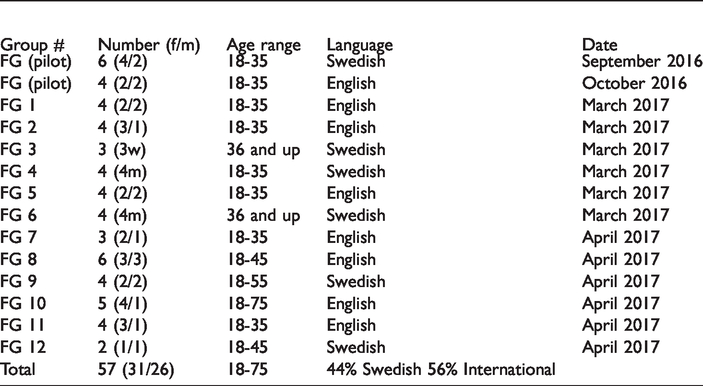
The participant pool was varied. Of fifty-seven people over fourteen focus-groups thirty-one were female and twenty-six were male (Table 1). Age ranged from twenty-one to seventy-five years old with average age of thirty-four. Participants were well educated (many had a master degree or higher), and/or working in white collar jobs such as lawyers, journalist or teachers. 44% of participants identified as Swedish while the others came from many different countries including China, Colombia, Germany, Greece, Japan, North America, Turkey and more. The international discussions were a way to see how globalised conventions are, and indeed many meanings were shared by participants across borders. Social normality is embedded in gender, class, and ethnic relations and as everyday life is different for people with different backgrounds, these categories are attached to participants quotes.
Participants.
Language
Participants choose the discussion language, as using the mother tongue encourages ‘spontaneous and open discussion’ (Barbour, 2007: 99). Groups often had a mix of English and Swedish speakers and it was up to the participants to choose a language that was most comfortable, and some of the groups shifted between the two languages with participants translating for each other. Just under 50% of the participants spoke in their native language. Transcriptions were done in the language of the focus-group and quotes translated to English for this paper.
Environment
Focus-groups were held in a variety of venues including my home, participants’ homes, university group rooms and the state library, the wide range of locations reflecting the varied and contextualised nature of everyday life. I created a private and welcoming setting at each of these venues to help participants feel relaxed. Focus-group discussions lasted from 40 minutes to over 2 hours, the recordings were on average 1 hour and 32 minutes, in addition to a pre-discussion fika 5 and post focus-group debrief, which were not recorded.
Prompts and discussions
To start the focus-groups, I spoke for about three minutes to welcome participants, encourage them to discuss with each other, and to state that I would try to disrupt as little as possible (Appendix 2, focus-group guide), so that they could talk about what they deemed important.
Participants were to discuss five pages from three magazines (Figures 1 to 5). The pages, including both advertisements and articles (i.e. commercial and journalistic content), were chosen to represent common themes in Swedish media – aspiration, shame, medicalization (Jack, 2018, p7-8) – to explore how the different representations elicit different responses. During the discussions, magazines with the images were placed on a table around which participants sat. Participants discussed specific images, talked generally about representations and then about conventions, and back again to one or more images, not always clearly being specific or general. Images that are specifically referred to have been identified along with their quotes, more general quotes do not have image references.
The images were not explicit representations of conventions, but rather provided vignettes from which to launch broader conversations on cleanliness representations, and participants sometimes had different readings of the images (Hall, 1980). The images were used as prompts to elicit socially recognisable (Halkier, 2017) discourses, to which participants could relate and contrast their own practices. The discussions have a distinct media flavour deriving from this method, participants did not always distinguish between representations and everyday life. The resulting discussion where participants debated meanings of the magazine representations in front of them, related to their own lives and contrasted to wider conventions forms the basis for this paper.
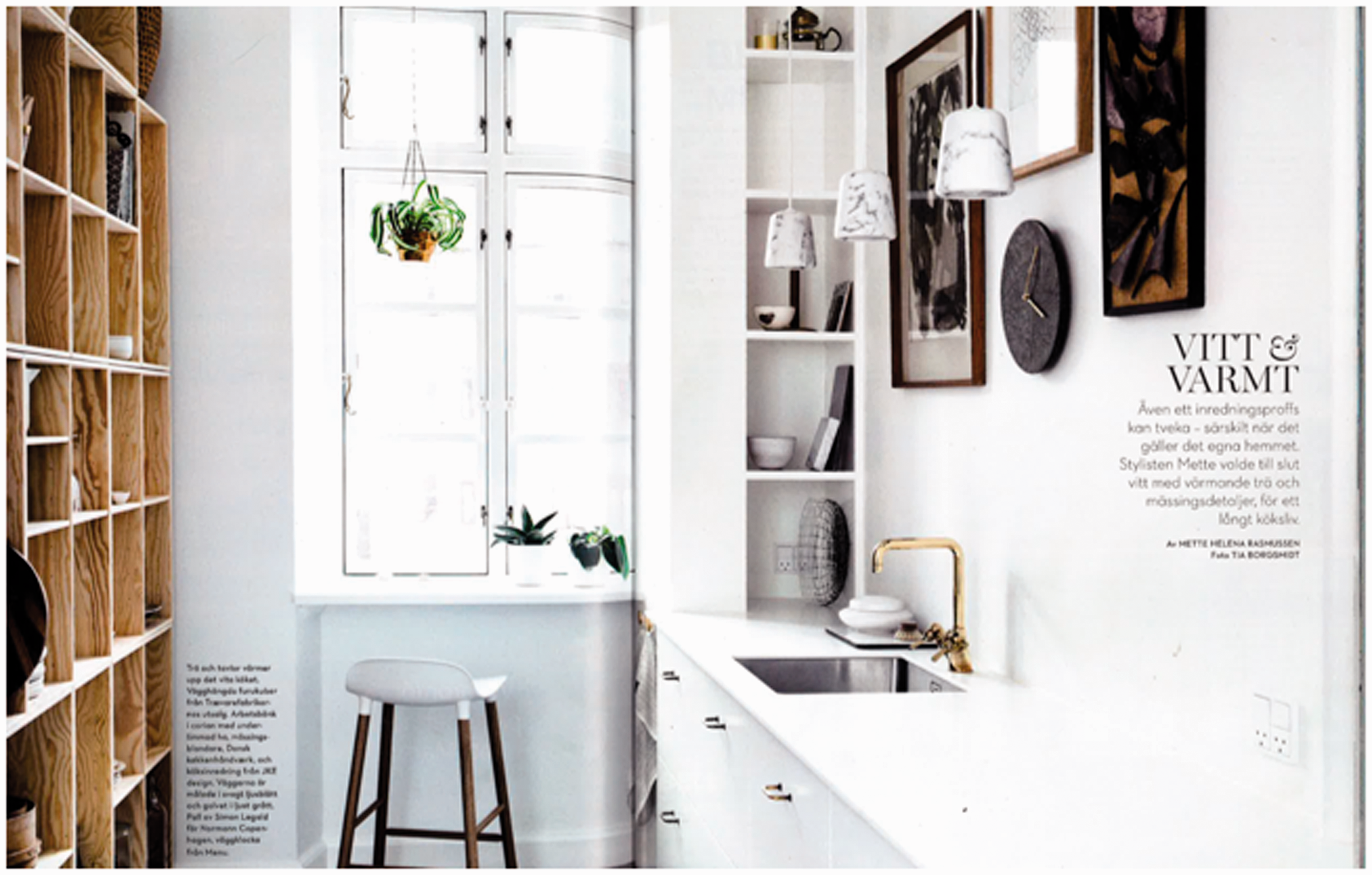
Vitt & Värmt, sköna hem, issue 3 2017, p149.
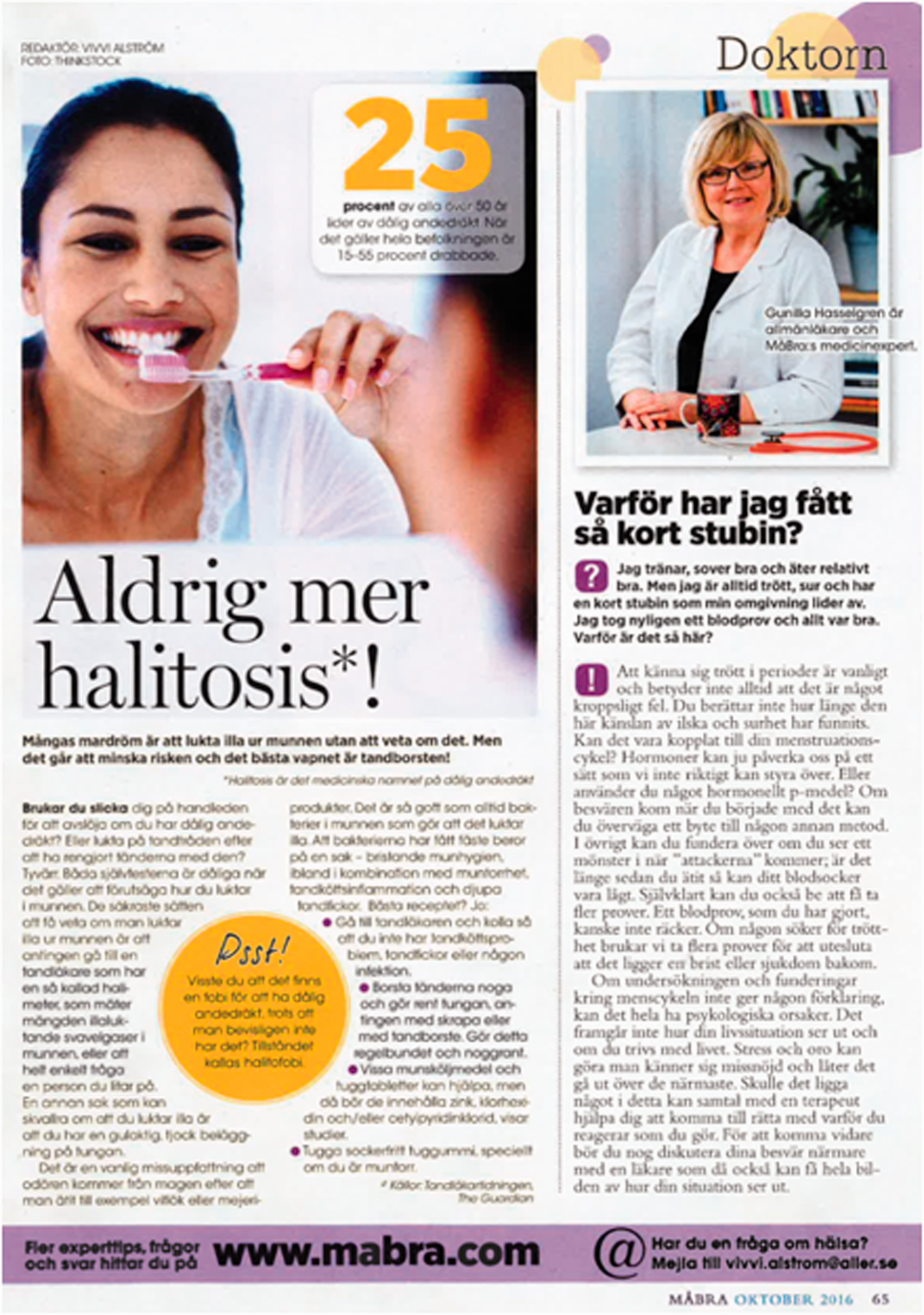
halitos, må bra, issue 10 2016, p65.

zlatan suprëme, femina, issue 3 2017, p8.
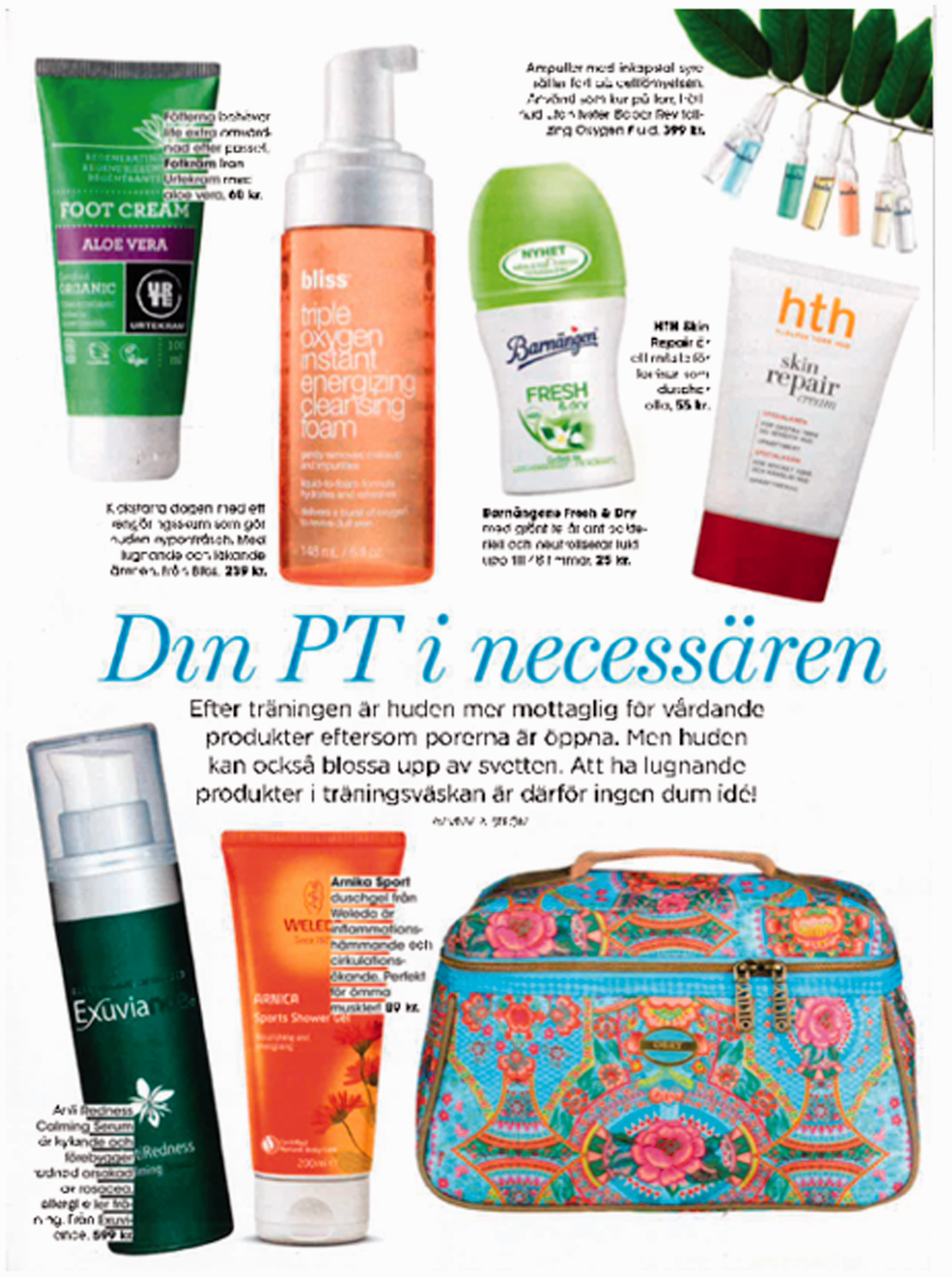
necessären må bra, Issue 10 2015, p99.
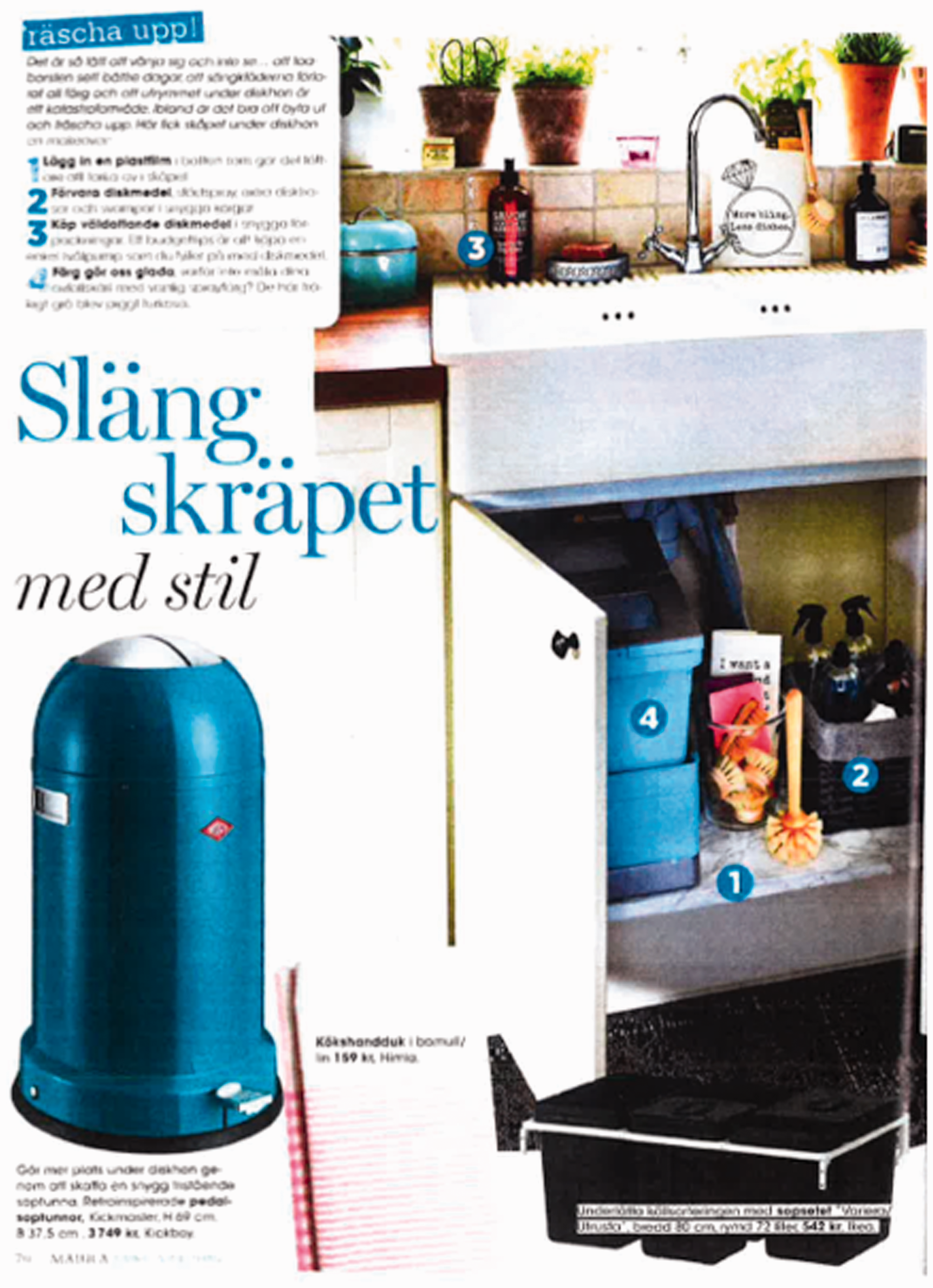
skräpet med stil, Må Bra, issue 1 2015, p70.
Ethics
The recruitment process included a description of the project (Appendix 1) so that participants could judge if this was a comfortable topic for them before signing up. As a further precaution, participants received a plain language statement (Appendix 3) detailing their rights regarding withdrawing, and deleting previous input, and that pseudonyms would be used. With the participants’ written consent (Appendix 4), discussions were recorded using a mobile phone. Participants received a sek50 voucher at ICA, a national supermarket, to acknowledge the time and contribution they make to the study (Grady, 2001: 40). Payment was at the beginning of the focus-group to communicate that it is for participation rather than for a specific ‘right’ kind of discussion (Head, 2009: 341). The material was stored on a password protected computer, and consent forms in a locked cabinet.
Analysis
The focus-group discussions resulted in more than twenty hours of reflexive discussion on the prompt-images, cleanliness representations in media more broadly, persuasion, resistance, meaning and everyday life. Even though some discussions went for over two hours, there was always space for further debate, sometimes we sat and talked for an extra half hour after concluding the formal session. The longer they talked, the more nuanced participants became, and the more examples they could think of from their own lives, but they also changed viewpoints about how much representations influence them, or gave juxtaposing arguments to previous positions. This fluidity of position points to a multiplicity of meaning. While participants could give contradictory accounts, they are not necessarily dishonest but rather performing that they understand socially accepted narratives (Millard, 2009: 161). This testing out of different positions is also how meaning is built up in the real world and so these focus-groups reflect the messiness of representations interacting with conventions and individual performances.
To store and analyse the material, interviews were transcribed into NVivo 6 and coded for various responses to media representations, along the continuum from influential to indifferent, via aspiring, being sceptical, resisting and forming consensus. A key interest was how participants respond to representations, what meanings they appeal to and how they agree, disagree, and come to consensus. Examples they shared from their own lives of being influenced by or resisting representations, were also highlighted. In the following results section the conversations are central and, rather than inserting entire chunks of verbatim transcription, quotations are used from individuals to sum up the group discussion as an efficient and effective way to illustrate discussion topics (Morgan, 2010). The following section presents findings: unrealistic expectations, societal influence and personal engagement and/or resistance, all stemming from participants’ own definitions of the meaning of cleanliness, and their experiences of negotiating conventions.
Results: Cleanliness conventions and everyday life
The representations (Figures 1 to 5) provided a vignette for the participants to contrast their assumptions and everyday lives, and reflect over whether their own practices accord with or differ from the cleanliness conventions represented in the magazines. Participants have preconceived ideas about media, people joked about influence ‘they are trying to trick us (laughing)’ (m, 44, British, Scientist), or were wryly self-depreciating ‘I hope I’m not influenced, but I’m sure I am’ (m, 38, Swedish, PhD candidate), which flavour the study. Through considering representations’ influence on cleanliness practices, people became aware of their ability to be both sovereign and dupe, especially in the group discussion context.
To create a shared departure point, I asked participants to define what cleanliness meant for them. Definitions were neither singular nor exhaustive, participants found cleanliness tricky to pin down: ‘But what is cleanliness? That is also something super weird. (It’s the absence of…) Yeah but what? If my jeans are dirty, I… it looks bad and they might smell bad but… usually the bacteria we have around us are not harmful’ (f, 35, Swedish, biologist). Cleanliness is not a pathological necessity, but rather an abstract construct: ‘It’s cleanliness that is disassociated with the body, it’s cleanliness as standard, rather than as a human decision or human activity’ (f, 75, North American, retired). Cleanliness was seen as culturally relative: ‘Definitely different cultures have different ideas about what cleanliness should be’ (f, 26, Swedish, lawyer). In some cases, representations and examples from participants lives were described as too clean: ‘Like fifty years ago we didn’t have this obsession with whiteness or cleanliness. Maybe it was okay to smell of sweat… Maybe we are a little bit fixated with this cleanliness lifestyle nowadays’ (f, 28, Swedish, checkout operator). Participants built on each other’s’ definitions and there were no major disagreements around cleanliness, they all saw cleanliness as a relative, broad convention around washing and removing dirt.
Participants could agree about the broader meaning of cleanliness, but also bought up many other meanings during the discussions. These suggest that cleanliness meanings are intermingled with freshness, health, femininity, masculinity, the good life, class, sustainability, risk and so on. These multiplicities of cleanliness are explored, and talked about in different scales and contexts, from bodies, to lifestyles to homes and locker-rooms.
Freshness was the most commonly appealed to meaning around cleanliness, the words ‘fresh’ or ‘fräsch’ came up more than fifty times during the discussions (29 times in Swedish and 24 times in English). In many of the mentions it was appealed to in terms of clean and fresh, to emphasise the cleanliness, e.g. to ‘be shaven, to be fresh to be just out of the shower’ (f, 27, German, student) or ‘Clinical, clean, fresh… light and fresh’ (m, 30, Swedish, PhD student). The colour white is also associated with cleanliness and freshness. ‘I like white very much. It’s very fresh… you always see it in Swedish media, or media in general. White and fresh’ (f, 28, Swedish, checkout operator). Freshness also came up in discussion of clean food, that one should prepare fresh food as part of living a clean and healthy life.
Health was a common co-meaning, coming up nearly thirty times during the discussions. ‘Cleanliness also means healthiness’ (f, 27, Japanese, student). Healthiness is part of a clean-living trend ‘There’s been a new idea of the word clean and clean living in the last five years or so, with environmental studies and new lifestyles, and vegans and gluten free and all these clean diets … people tend to use the word clean rather than healthy now’ (f, 28, French, waitress). Cleanliness is also part of creating a healthy life ‘Cleanliness … a way of living your life … eating raw food in the morning, and going to work-out … cleanliness is done as a very structured way to be extremely healthy’ (m, 38, Swedish, consultant). Cleanliness, as part of health conventions, also shapes what people eat, and how they take care of their bodies.
Gender also intersects with cleanliness. Reflections focus around the extra pressure exerted on women, but also on increasing pressure for men to be extra clean and well-groomed: I think society imposes different rules. I think there are much tougher rules on women in general. Most of the women I know are feminists and they’re super into their rights and they try and be as equal as possible. And the men in my life. But I do think society imposes different rules (m, 24, British, student) Men aren’t supposed to care so much about grooming. Like traditionally. That’s been a feminine domain. Now it’s a market opening up (mmm) for men as well and producers think ´oh we can also make men groom in their very most intimate detail, and powder and shower and huff and puff’ (f, 36, Swedish, social worker)
Resisting the pressure to be hysterically clean for either gender is further linked to performance of class. ‘Certain people buy many of these hygiene products, use half of their salaries for it. It can be very lower-class to buy … I mean there is a lot of status in saying no to these products’ (m, 48, Swedish, artist, Figure 4). Lower classes had more pressure to be clean according to many discussions, but higher classes could afford to be ‘charmingly messy’ (m, 29, Swedish, student). Ethnicity was in some ways bound to class, those born to overseas parents, or growing-up in working class suburbs use more perfume, hair gel and other products: ‘When I grew up I used a lot of perfume. I grew up in a suburb in Stockholm where there a lot of people that were from like, the working class’ (m, 35, Swedish, freelancer). According to the discussions, those with a precarious class position adhere more strictly to cleanliness conventions.
Acting sustainably, or at least telling each other that they did, was seen as positive by participants, being clean was linked with using less harmful chemicals, recycling and cleaning up the environment. The environment or sustainability (also including the Swedish miljö and hållbar) were mentioned more than sixty times during the groups. Participants often talked about actions they were taking for the environment, for example (m, 32, Swedish, personal assistant) emphasizes that he uses environmentally certified laundry powder, (f, 28, French, waitress) tries to save water by taking shorter showers and (f, 28, Swedish, checkout operator) buys as many organic products as she can, as well as many more examples where participants, especially the younger ones, ‘drop-into’ the conversations ways that they are being environmentally friendly. Being sustainable and taking care of the natural environmental is part of cleanliness conventions.
That cleanliness intersects with a myriad of other discourses suggests that participants wrestle with a multitude of meanings and connections in their own understandings and doings of cleanliness. These discussions suggest that cleanliness does not only mean clean in body and home, but also has wider implications for freshness, self-presentation, being healthy, doing gender, class, sustainability and being a good citizen. An unanswered question is if the differing, intersecting meanings of cleanliness can be understood as a series of social constructions around an essentially similar convention or perhaps rather could be understood as multiple ontologies (Jackson et al., 2019) of cleanliness performed differently and producing different realities.
Unrealistic expectations and anxiety
A common discussion in the focus-groups was the tension between perfection shown in magazines and the muddle of everyday life. When comparing one’s own life to representations, it was often seen as lacking, creating insecurity. This is present in representations of bodies and health: ‘Like a little guilt … or bad conscience because I haven’t flossed properly’ (f, 28, Swedish, architect, Figure 2). Insecurity is also present in relation to homes, the following quote shows the negativity with feeling that one is not clean enough: ‘ … you have to have a really clean home, and if you don’t have a really clean home, there’s something wrong’ (f, 28, Danish, student) or ‘it’s an image of a good life to aspire to, it’s pretty hard to measure up to’ (f, 28, North American, student, Figure 1). Creating unrealistic expectations and insecurity is part of a wider understanding of marketing, which participants feel aims to create dissatisfaction and insecurity in order to sell more products: ‘it must be some kind of advertising. I suspect that this magazine is commercially financed’ (m, 33, Swedish, lawyer, Figure 2), having commercial interests was considered negative. When considering representations of bodies and homes, they were widely agreed on as unrealistic and damaging to self-worth. The discussions about creating insecurity felt almost expected of and by participants; there is an existing narrative around media creating unrealistic expectations that they tapped into.
Unrealistic representations of hyper-perfectionism were talked about as persuasive in everyday life. Participants spoke about feeling insecurity or even paranoia when comparing themselves to representations. One participant responding to the article about halitosis: ‘I read that once and got some kind of panic, like how … how should I know? What if I had this disgusting breath’ (f, 32, Swedish, social worker, Figure 2). Although in a different focus-group: ‘Thinking about possible bad breath … I don’t think there’re so many people who can be bothered with that’ (m, 41, Swedish, unemployed, Figure 2). Interestingly, the discussions about influence were quite general; participants elaborated a consensus that representations influence conventions, without admitting that they themselves were influenced. ‘Advertisements and TV also make an impact on what you think is clean. If you watch a series, or sitcom maybe you start to think like the people in the sitcom. Like ‘oh that person cleans a lot’ and you start to, not copy the person on TV, but unknowingly start to act like that’ (m, 28, Swedish, producer). ‘If you just show something again and again and again then it’s just normal. That’s what it’s supposed to be’ (m, 33, Turkish, researcher, Figure 5). Discussions suggest that cleanliness representations are influential at a social level, images that circulate through media act as simulacra for socially accepted conventions and can create wider feelings of anxiety.
Negotiating conventions: Resistance, indifference, adherence
Once focus-groups came to consensus that representations are influential, they continued on to times when they had been influenced, or more often, strategies for resistance. The few specific examples of influence were often from early teenage years, and used an ‘other’ more naïve self as the protagonist. ‘When I was 12 or 13 I read Vecko Journalen
7
with all their tips of everything and I was … I went on diets and I cleaned my face morning and evening. I thought that was really normal’ (f, 26, Swedish, PhD candidate). Some of the accounts of the gullible teenage years were more general: ‘I remember when I was a teenager, I became aware, or extra aware, of all sorts of implications … . I think it just stuck in my head. I think there is still requirements to be hygienic, you should not smell of BO [body odour] and that is just basic knowledge’ (f, 32, Swedish, art administrator).
Discussing influence on the duped majority was in comparison to the sovereign self, participants emphasise scepticism as part of maintaining immunity to magazines’ hyper-perfect representations. ‘I think magazines can definitely be aspirational, I would look through for ideas and things. But I would always be a bit suspicious … ’ (f, 30, British, researcher). Here the participant is open to media suggesting idealised worlds, but tries to keep a distance to her own life. Some assertions were more dismissive: ‘it doesn’t affect me at all I don’t believe in that … It’s not reality’ (f, 28, Swedish, checkout operator) or ‘to be honest I don’t think I would spend another second on that picture – I would just flip the page, it’s so unrealistic anyways’ (f, 29, Greek, lecturer, Figure 1) or ‘I know all the processes behind magazines. It doesn’t affect me anymore’ (f, 35, Swedish, designer). These claims were in response to wider discussions on the coercive persuasion of media, respondents did not like the idea of being controlled and tended to insist they were indifferent, even if this seemed somewhat feigned. Being gullible was not a desirable position. Flat-out refusals to accept influence on their own lives were often followed-up with more nuanced descriptions of negotiating conventions. Participants didn’t claim that they were automatically immune to persuasive representations, but that resistance is a continuous part of engaging with the world around us. ‘We read this … like either now or next week we’ll be thinking about this halitosis, it’ll be subconsciously in my mind. Maybe like one level up I know it’s totally bullshit, but I have to keep telling myself how much bullshit this is’ (m, 25, North American, student, Figure 2). ‘Everyone gets influenced all the time … there’s no person on this earth who isn’t constantly falling into these traps. I also feel comfortable, I’ve spent enough time thinking about it that I’ve built up an efficient filter, so my alarm bells go off all the fucking time’ (m, 35, Austrian, researcher). These two participants acknowledge that representations are influential and respond by asserting that they resist by constantly reminding themselves not to be sucked in like the duped mainstream.
Resistance strategies are manifold and include: avoidance, only superficial engagement and being critical. ‘I don’t read these magazines I try to avoid them. Other media gets more easily to me. I have to watch at least a few seconds on YouTube before I can skip’ (f, 33, Austrian, PhD candidate). This participant does not like what she takes to be unrealistic representations of women and tries to avoid these by not reading magazines and avoiding arenas where she thinks these may circulate. Some participants could enjoy flipping through media at a superficial level, but would avoid engaging too deeply by not reading the text: ‘I like looking at those interior magazines … but I never read the text because I think they are quite bullshit’ (f, 27, German, student). For this participant, idealised representations can provide a pleasant escape from reality, but she tries to separate fantasy from her own life. If participants were struck by a message, they could contest it, common for dissonant messages or if they suspected manipulative intent. Participants assert that nothing one encounters in a potentially commercial space should be trusted: ‘these magazines, or TV series … [make us] criticize ourselves and how we live our lives. Media gives us this idea of how it should be and then we become more critical of how we live. That’s not a good thing’ (m, 38, Swedish, consultant) and ‘I’m very biased against these magazines. Whenever I see them I feel like I’m always going to look at it very critically like “Oh here’s another horrible ad. Here’s another horrible thing they want me to think and do”‘(m, 25, North American, student). These participants actively resisted as they feel that representations of cleanliness in these magazines tell them that they aren’t good enough. Resistance was often talked about with some irritation or even anger, participants used swear-words and raised their voices. Resisting seems to be a chore, taking up cognitive energy, but also giving participants some satisfaction in establishing themselves as uncoerced. That people use these strategies suggests that representations are influential, otherwise resistance would be unnecessary. The continuum of strategies from avoidance, via detachment to resistance helps participants to maintain a self-image of sovereignty from intended influence when making sense of and comparing representations with everyday life.
People also have strategies of engaging with representations, to the current, sovereign (as opposed to other naïve) self. Even if being duped – especially by marketing aiming to sell products – is seen as negative, participants also expressed pleasure in harmonising with conventions: After I clean my room, I look at my room and feel really calm and happy like ‘yes!’ It looks like something I’ve seen. I look at my apple computer and I’m like, ‘I have this.’ Or I hold a Starbucks, no I don’t drink Starbucks, but if I have a Starbucks it’s a status symbol. It makes you feel good because you’ve been exposed to certain symbols that mean something, so you’ve somehow arrived (f, 28, Danish, student).
In some discussions, participants took this further, recognising themselves and various elements of their lives in the representations. ‘Even if she has super white teeth, she looks kind of normal. She looks like a normal person’ (f, 35, Swedish, circus performer, Figure 2). Recognition also occurred for homes: ‘But this is actually not an unreasonable home. I know people whose homes are like this’ (m, 28, Swedish, senior advisor, Figure 1) or ‘this is exactly like under the sink of every single house I’ve ever lived in’ (f, 29, British, researcher, Figure 5). Recognising one’s life in the representations may arise from participants growing-up with these representations, and maintaining their bodies and homes accordingly. This sense of recognition may equally well point to recalibration; people recognise that magazines show people and places at their best and subconsciously recalibrate. ‘When I see the picture, I feel that this represents what the kitchen looks like maybe 5% of the time. Like if you have just done a spring clean. Just scrubbed the floor. Everything tidied away … Sometimes it looks like this … sometimes, but very rarely’ (m, 29, Swedish, student, Figure 5). Participants also agreed that they had become accustomed to the hyper-cleanliness: ‘We don’t really notice because it’s so normal to show something very clean. You don’t really notice how clean the picture actually is’ (f, 26, Swedish, PhD candidate, Figure 1). That participants see themselves and their lives in the representations, points to conventions circulating through reality as well as media, and that sovereign dupes can appreciate and relate it to their lives, without necessarily being conscious of conventions.
Interestingly, media qua interventions into cleanliness conventions, while trying to increase cleanliness has rather ‘cried wolf’. Consequently, audiences now expect hyper-idealisation in such representations, and may recalibrate before comparing with their own lives. If this is the case, people are likely to be desensitised to the ‘anxiety-creating unrealistic expectations’ discussed above. Whether or not people are sensitive to (hyper)representations, there is a strong case for media acting as a circulator of normality, a place for people to gauge (unrealistic) expectations, become reflexive over ideas and perhaps re-align practices with reference to available resources. This train of reasoning calls for the heightened visibility of locally relevant environmental challenges. If transparent knowledge about limits to natural resources becomes part of wider conventions, there is a good chance that people will re-align practices within the confines of their context. This could lead to the normalisation of environmentally friendly practices, and indeed pro-environmental ways of being are becoming more conventional, especially corresponding with increasing education (Meyer, 2015).
Media is only a part of encountering cleanliness representations: cleanliness is also encountered at friends’ houses, in locker-rooms and workplaces. ‘I think it [cleanliness] is very difficult because it is something that is very rarely talked about … it is clean at all of my friends’ when I visit them. So it should be clean in people’s homes’ (m, 30, Swedish PhD student). This discussion was around where cleanliness conventions stem from, and parental as well as friends’ homes where an example of ‘unwritten rules’ around cleanliness (m, 33, Swedish lawyer). Unwritten rules were also tangible in locker-rooms: ‘there could be three pairs of eyes staring at me like I’m a freak for not showering after training’ (m, 33, Swedish, lawyer). Locker-rooms after training were discussed in a few of the groups as somewhere people feel pressure to conform, with looks and comments given as prompts to shower. The workplace is another source of pressure to clean: ‘if I want to apply for a job it’s important to be clean because it’s a way of expressing that you are able to take care of yourself and subsequently take care of the job’ (m. 26, Swedish, student). People encounter cleanliness representations in many different contexts, and these representations play into cleanliness conventions. Any representations will always be contextualised against, and provide the context for, more banal everyday representations.
In summary, common understandings of media representations are that they create unrealistic expectations, influence the duped majority but can be filtered, resisted and potentially incorporated by the sovereign self. Cleanliness conventions intersect with a myriad of meanings: not acting in a vacuum but contributing to, and contributed to, by freshness, femininity, masculinity, health, sustainability et cetera. The negotiations playing out in the focus-group discussions suggest that conventions cut across different contexts that may call on cleanliness, or other meanings in different ways, and the people are likely to respond as the contexts suggest. Discussions indicate that cleanliness is socially desirable, but resisting persuasion is even more so, and participants want to show that they can do both. In the focus-groups participants agreed that conventions are influential but were at the same time positioning themselves as sovereign resisters. Showing that one was critical towards representations was socially condoned; there was less laughing and justifications after such statements. Decoding and considering representations and making sovereign choices was a desirable self-presentation in the focus-groups.
Representations > social processes > conventions > practices > inconspicuous consumption > environmental impact
In this paper I explore social processes around decoding representations to understand convention construction underlying practices. Focus-group participants read cleanliness associated content in popular magazines and discussed how this relates to their everyday lives. Women and those with a precarious class position were seen as adhering more strictly to cleanliness conventions. Participants in this study perceived representations as influential on a broad social scale especially for others, but as individuals positioned themselves as resisting. Strategies to resist include avoidance, superficially skimming and consciously resisting especially representations decoded as promoting manipulative consumerism. Participants used a younger or duped mainstream ‘other’ as a device to argue that uncritically aspiring to representations creates anxiety: problematic consumption is attributed to ‘other’ dupes. At the same time sovereignty was used to show that being critical helps to construct everyday life in the best interest of yourself, the people around you and the environment. Resisting was seen as mentally strenuous, and so being a dupe and buying into conventions can be a pleasant relief. However, the real tension for participants in this study came not from deciding whether to receive or resist, but rather how to incorporate conventions given the many – sometimes conflicting – representations around cleanliness, freshness, health, femininity, masculinity and not least sustainability.
During these sessions, participants could be reflexive and many positioned themselves as conscientious objectors, not following conventions that lead to a global environmental catastrophe. Rather, given space to consider their lives, participants could critique various representations and talk about actions they were taking to save the environment. Resisting, while cognitively strenuous, is a socially desirable self-narrative, however it was not media representations that participants resist, but rather the suspected underlying commercial interests that aim to accelerate consumption. Participants especially resisted commercial representations, along with inherent consumerism. In the context of these group discussions between well-educated individuals, participants collectively reflected over representations, weighed up potential implications and then processed this in discussion with each other to establish the social legitimation to redefine accepted modes of existence. This may be how conventions reproduce, also in broader social contexts. By looking at ways that people discuss representations in relation to their own lives, this study provides an empirical case of social processes around decoding representations and negotiating conventions. Potential interventions to encourage societal transitions away from unsustainable inconspicuous consumption could thus constructively inject locally relevant environmental information, and sovereign dupes would arguably construct their practices accordingly and reduce unsustainable consumption.
If I go back to the original ‘sovereign dupe’ my twitter self, how would this chain of representations > social processes > conventions > practices > inconspicuous consumption > environmental impacts play out? Well perhaps I would read a tweet about not showering being gross representation (Figure 6). I may then take my existing beliefs (not showering is ok) out of doxa to ask if it is infact gross, read what other people say and take into account how I relate to the people social processes. In this case I have ♡’d the discussions I agree with to also participate, it may not always be the case that one engages so consciously with a social process. These interactions may strengthen my assumption that not showering is ok, strengthening the convention. This would support my infrequent showering practice, leading to less inconspicuous consumption of water, energy and soap, with lower environmental impacts. At the same time I may, although not necessarily, feel some sense of sovereignty that I was leading an exemplary life, while infact rather duping myself with confirmation bias and going through my same old routines. I might also think that the author behind this piece was infact duped and wonder how she could not see that she was following a suboptimal convention. It is this tension between sovereign and dupe that is interesting for sustainable consumption debates. How much sovereignity do we actually take to our practices? Is it always we who see the sovereignity in our own actions and the dupedness in others’? These questions hark back to immemorial discussions of structure and agency, that are nevertheless continuingly pertinent to sustainable consumption research.
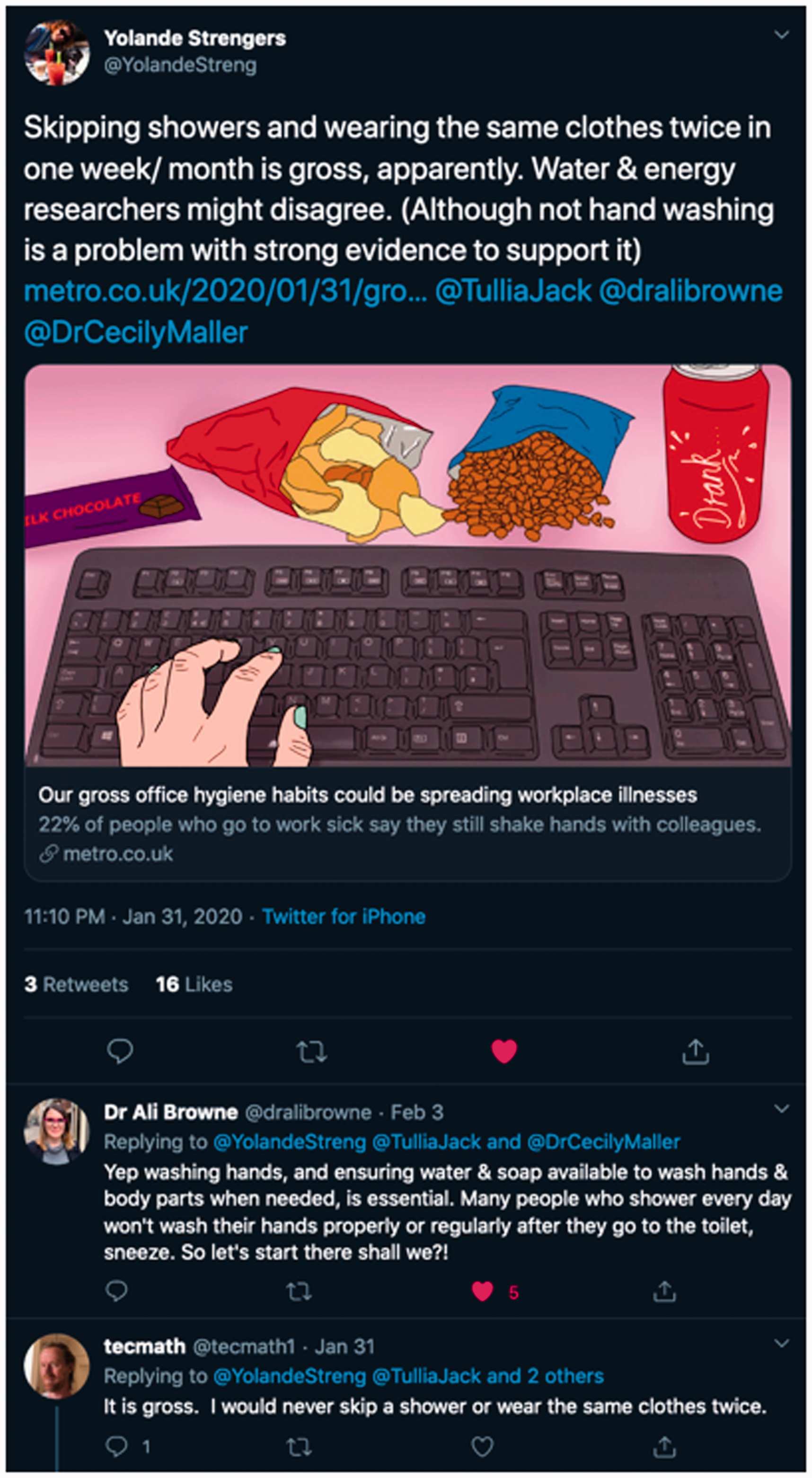
Office hygiene habits tweet by @YolandeStreng, 31/01/2020.
Generalisability
There are several factors to consider when generalising these findings. Firstly, participants were attracted through snowballing, and while the study aimed for a wide representation, many participants had post-graduate education and high-status jobs. This sample is problematic for understanding social stratification and power relations in decoding representations, and further research is needed to understand how different groups respond to representations. A further consideration arises from the conflated responses to the media representations of cleanliness. The results have a distinct media flavour stemming from the empirical material, and do not always articulate a clear difference between socially accepted ways of doing and mediatised representations of perfection.
Unsustainable consumption is something that other people do
A concern raised in the beginning of this paper was that if resource intensive practices are frequently represented, these become naturalised and increasing consumption will ensue with potentially negative environmental consequences. Going by the discussions people engage critically with cleanliness representations, maintain sovereignty over their everyday routines and justify their practices to each other, often with reference to environmental concerns. The main tension arising for participants was not whether to receive or resist, as they had established strategies to filter, critique and incorporate, but rather how to construct everyday life to meet myriad priorities, not least of all sustainability. Participants felt that there were too many competing and inconsistent messages, they didn’t trust sources and they were averse to representations that they perceive as consumerist. In the group discussion setting, people could be both dupe in accepting and more-or-less agreeing to wider conventions, while at the same time being sovereign and discussing developments in their own and wider society’s best interests. Participants saw ‘others’ as more easily duped than themselves suggesting that problematic consumption is positioned as something done by “others”. If resource intensive practices are frequently represented, these can become naturalised as something ‘others’ do wrongly, which could lead to exclusions.
Footnotes
Acknowledgements
My foremost thanks to the participants for such interesting discussions. The ideas wrangled out in this paper have been refined through the generous and inspiring discussions with Boel Berner, Lisa Eklund, Åsa Lundqvist, Christofer Edling, David Wasterförs, Devrim Umut Aslan, Lisa Flower, Staffan Edling, Alan Warde, Bente Halkier, Anders Rhiger Hansen and Ulrike Ehgartner. Final thanks to two meticulous reviewers who really helped to clarify my ideas.
Declaration of Conflicting Interests
The author(s) declared no potential conflicts of interest with respect to the research, authorship, and/or publication of this article.
Funding
The author(s) received no financial support for the research, authorship, and/or publication of this article.

Notes
Appendix 1. Call for Participants (in Swedish and English)
Appendix 2. Focus-Group Guide (in Swedish and English)
Appendix 3. Plain Language Statement (in Swedish and English)
Appendix 4. Consent Form (in Swedish and English)