




Abstract
In the past decades, numerous disciplines have investigated so-called ethical and alternative forms of consumption. This has led to confusion about what terms to use and how to interpret the multiple ways in which people act within and upon the market. This article presents the first comprehensive review of the main concepts used in these discussions. Then, drawing on critical theory, in particular on Marcuse and Horkheimer, the article argues that the current debate over consumption lacks critical self-reflection with regard to the uses of these concepts. The second part of the article shows how the analytic structure of the debate over consumption creates an artificial difference between forms of consumption deemed deviant and those judged normal. By disregarding this artificiality, the article argues, research normalizes individual consumption as the sphere of political action and ends up legitimating forms of consumption it critiques.
Keywords
Introduction
What is normal consumption, and what forms of consumption are instead deviant? This question is essential in understanding current debates on consumer resistance, anti-, alternative, ethical, political and green consumption. Within these fields, a variety of phenomena, such as boycotting, and shopping for products labelled ‘Fair Trade’ or ‘Organic’, have been seen to question the idea of consumers as merely hedonistic, self-serving individuals. The standard economistic model of consumers’ decision-making has been challenged in, for example, consumer research and marketing (e.g. Cherrier, 2009; Peñaloza and Price, 1993; Roux, 2007), political science (e.g. Copeland, 2014; Micheletti, 2003), sociology (e.g. Sassatelli, 2006; Willis and Schor, 2012), geography (e.g. Bryant and Goodman, 2004; Clarke et al., 2007; Jackson et al., 2007), environmental science (e.g. Vittersø and Tangeland, 2014), cultural studies (e.g. Binkley and Littler, 2011), and history (e.g. Trentmann, 2016). Consequently, no general agreement exists on what terms to use or how to interpret the ways in which people act within or upon the market.
The purpose of this article is twofold. The first section critically reviews the concepts and definitions used in academic discussions on so-called alternative or atypical forms of consumption. The review serves to clarify how different phenomena related to consumption have been recognized – and as I will later argue, constructed – as ‘deviant’ within different research traditions. I use the term ‘deviant’ to depict how the diverse concepts describe ‘deviations in conduct’ (Amine and Gicquel, 2011: 1809–1810). In this sense, the term contains no evaluation of the inherent or interpreted goodness or badness of the forms of consumption. The term allows a certain distance to the examined concepts while depicting how all the concepts examined mark an exception from the economistic consumer ‘norm’. As such, it is not meant to refer to previous research traditions examining deviant behaviours (for a concise description of deviance within consumption research see Amine and Gicquel, 2011).
Then, drawing on critical theory as a tool for dissolving ‘objective illusion’ (Geuss, 1981: 61, 70–73), and in particular on Marcuse’s (1964) and Horkheimer’s (1972) critique of the assumed self-evidence of concepts and ‘facts’ found, the second section shows how the different terms and their definitions produce rather than depict differences between deviant forms of consumption and forms that I call ‘consumption-as-usual’. Rather than describing an observable phenomenon, the term ‘consumption-as-usual’ represents an assumed field of activities against which or as an alternative to which researchers have proposed the emergence of deviant activities. The questions I pose are: How does research produce knowledge about deviance and normality within the sphere of consumption? What problems may these contemporary approaches generate? What insights might contemporary consumer research on deviant forms of consumption gain from the work of critical theorists?
The article’s main focus is on concepts and definitions as means of producing knowledge. This focus is essential, since any theory of society should examine ‘not just social institutions and practices, but also the beliefs agents have about their society – to investigate not just “social reality” in the narrowest sense, but also the “social knowledge” which is part of that reality’ (Geuss, 1981: 56). By fixing certain activities as ‘alternative’, ‘ethical’, or ‘deviant’, other activities are easily (if often implicitly) rendered ‘conventional’, ‘unethical’ or ‘ethically neutral’, or ‘normal’. This artificial line between so-called deviant and normal forms of consumption blurs certain important aspects of reality, enables the normalization of consumption and ends up preserving the status quo. What is therefore needed is a more self-reflective stance towards the concepts applied in research.
The field of deviant consumption
Ever since the environmentalist movements of the 1970s brought responsible and ecological consumption to academic discussions (Peattie, 2010), there has been an exponential growth and fragmentation in research on deviant forms of consumption. This section presents one interpretation of the main definitions and definitional debates within these fields. The review is based on an analysis of over 200 academic sources, including journal articles, chapters in edited collections, and full monographs. Sources were collected with continuous snowballing starting with Google Scholar (scholar.google.fi) and the Web of Science database (www.webofknowledge.com). The key words used included consumer resistance, anti-consumption, anti-consumerism, alternative consumption, ethical consumption, political consumption, and green, ecological and sustainable consumption. In the analysis, particular attention was paid to how and what concepts and methods were used, which research fields the authors and journals represented, as well as the explicit and implicit aims of the works.
The following review presents the examined fields as overlapping, flexible areas of contestation in which concepts and definitions are debated. Does resistance to consumption, for instance, require consciousness? Where should we draw the line between anti-consumption and consumption? What is alternative consumption an alternative to? The different approaches researchers propose do not only describe consumption as an object of study. Instead the concepts actively intervene in academic and public understandings and treatment of the problems and solutions related to consumption. As Marcuse (1964: 16) argues, terms are never neutral. Instead, they direct action towards specific ends. By using, for instance, the term ‘green consumption’ to denote purchases of products labelled ecological, research ties the action of purchasing an eco-label to the concept of greenness. The appearance of greenness is turned into a ‘fact’ (cf. Marcuse, 1964: 85). The aim of the review is, therefore, neither to contribute to the definitional debates themselves nor to offer an exhaustive historical account of the research carried out in these fields. Instead, the section illustrates how perceived deviances from a usually implicit idea of normality are translated into interpretations of actions as consumer resistance or anti-, alternative, ethical, political or green consumption.
Imagining deviance
Originally conceptualized as something taking place rather autonomously from consumer culture, yet prone to being commodified, the concept of resistance later came to encompass also actions taking place within the field of consumption (Moore, 2011: 1213). In marketing studies, the concept of consumer resistance first emerged in the start of the 1990s to cover a large field of actions, ranging from individual to collective, reformist to radical, and carried out with various methods (Peñaloza and Price, 1993). Rather than formally defining consumer resistance, many researchers have used the term as a ‘catch-all’ category depicting a vast number of different forms of consumption and non-consumption (e.g. Cherrier, 2009; Dobscha, 1998).
Perhaps one of the most concise definitions of consumer resistance is given by Roux (2007). She defines consumer resistance as, ‘a motivational state leading to variable manifestations of opposition and which is triggered by certain factors linked to corporate behaviors [sic] and marketplace practices’ (Roux, 2007: 69). The resistant consumer must perceive the force exerted on her or him and consciously try to cancel this effect (Roux, 2007: 61). Another definition specifies resistance as, ‘an act against a system of domination that responds to a unifying, totalizing and universal modern scheme’ (Cherrier et al., 2011: 1759). In this case, resistance is also conscious but the target is much broader than certain marketplace practices. For others, however, resistance can also be performed unintentionally or involuntarily (Sassatelli, 2007: 81).
Often contrasted to consumer resistance is the later developed concept of anti-consumption. 1 Whereas consumer resistance is seen to relate to power asymmetries and an opposition to ‘a well-defined dominant antagonist’, anti-consumption describes any consumer phenomena set against the processes of consumption (Lee et al., 2011). In a later article, Chatzidakis and Lee (2013) take the definition further by stressing that to qualify as anti-consumption, activities need to be based on reasons against consumption. The incapability to separate between behaviours and reasons for behaviours has, according to them, led to the failure to differentiate between, for instance, ethical and anti-consumption (Chatzidakis and Lee, 2013: 198).
Rather than depicting a lack of something, the affix ‘anti-’ is generally seen to refer to an opposition to (Galvagno, 2011), or a distaste of consumption (Zavetoski, 2002: 121). A difference is made between selective forms of anti-consumption, where, for instance, certain brands are avoided for ethical reasons, and generally practised anti-consumption that includes lifestyle-choices such as voluntary simplicity (Lee et al., 2009: 147). Some recognize anti-consumption as a subset of non-consumption (Black, 2010: 403), whereas others see it essentially as a form of consumption (Galvagno, 2011). It is usually argued that anti-consumption needs to be voluntary and intentional (Lee et al., 2011). The term non-voluntary anti-consumption has, however, been concocted to show that even when choices are dictated by circumstances such as poverty, people can and do resist market practices in innovative, if hidden, ways (Leipämaa-Leskinen et al., 2016).
Summary of concepts.
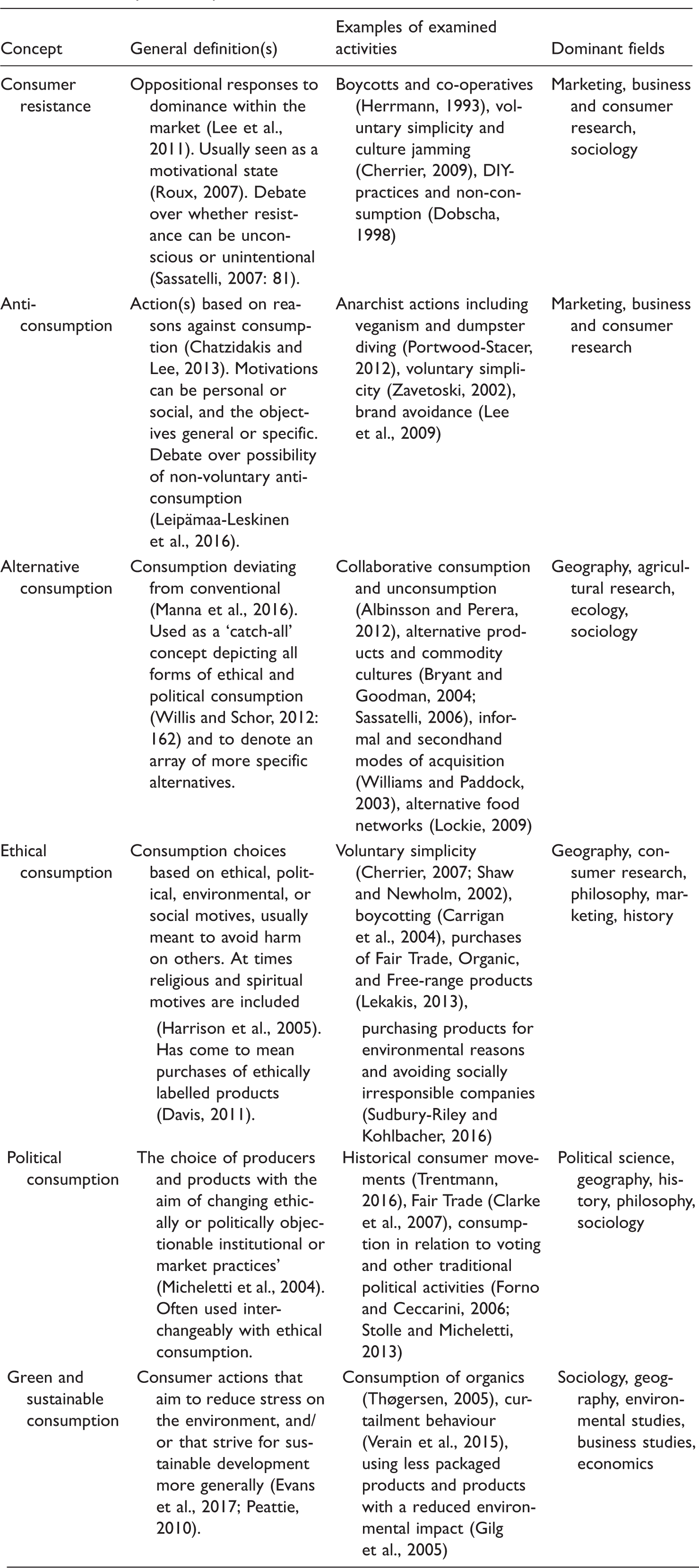
Research on alternative consumption often concentrates on the spaces, networks, and modes of consumption rather than on how people relate to certain goods or to consumption generally. The concept of embeddedness is used to denote the socially entrenched character of consumption (Sonnino and Marsden, 2006: 189) while localization is studied both as a development potentially countering negative trends of globalization and as an intrinsic part of those globalizing processes (Lockie, 2009: 194–195). Finally, although some researchers use the term ‘alternative’ as a synonym for ethical or political consumption, others prefer the former to maintain a certain relationality to mainstream practices without portraying deviance as essentially good or ethical or its alternative as necessarily bad or unethical (Coles and Crang, 2011).
This brings us to ethical consumption. Ethical consumption has been examined in a number of edited collections. Some define it rather broadly as, ‘collective commentary on the relationship between economy and society’ (Carrier, 2012: 12), whereas others frame ethical consumption more narrowly as purchasing choices (Harrison et al., 2005: 2–3). Lewis and Potter (2011: 4) refuse to define the concept at all, preferring to use it as a ‘convenient catch-all phrase’ for diverse activities within contemporary consumer culture. Differences aside, the guiding idea within most ethical consumption research is that while aiming at improvements in their own well-being, ethical consumers aspire to minimize or avoid harm to other humans, animals or the environment (Carrigan et al., 2004: 402). The concept is usually applied to describe ways in which consumption is deliberately used to express ethical beliefs or further ethical objectives. As Davis (2011), however, points out, being an ethical consumer has generally come to mean the purchase of products and services labelled as ethical (see Table 1). Rather than rejecting the consumer identity, everyday consumption is used as a ‘surface of mobilisation for wider, explicitly political aims and agendas’ (Clarke et al., 2007: 233).
The field of ethical consumption is thus deeply intertwined with that of political consumption. 2 In fact, defined most commonly as, ‘consumer choice of producers and products with the goal of changing objectionable institutional or market practices’ based on the, ‘ethical or political assessment of business and government practice’ (Micheletti et al., 2004: xiv), political consumption includes ethical evaluations as a key indicator of the political nature of consumption (see also Harrison et al., 2005). It is, therefore, practically impossible to separate the two fields. Two particularities, nevertheless, merit recognition. First, and quite intuitively, as the field of political consumption is heavily influenced by political scientists, consumption is often examined as an alternative or addition to traditional political participation, such as voting and protesting (e.g. Forno and Ceccarini, 2006; Stolle and Micheletti, 2013). Second, the introduction of a political science perspective has increased the number of quantitative studies. These analyses generally focus on the elements that affect people’s likelihood to ‘consume politically’ (e.g. Copeland, 2014; Newman and Bartels, 2011) or measure the kinds of political consumption people practice (Neilson, 2010).
All in all, stressing the overlaps between public and private behaviours has made the citizen-consumer a notable figure in both ethical and political consumption discourses. An important contribution to understanding the citizen-consumer has come from research on consumer history. For example, Frank Trentmann (2006, 2016) has problematized the apparent novelty of the citizen-consumer and shown how the water wars in late 19th-century United Kingdom, the co-operatives of the early 20th century, the ‘value-for-money’ organizations and various social and environmental justice campaigns have ascribed different normative and political responsibilities to consumers at various times (see also Halkier, 2001: 25).
The last group of concepts includes those focussed specifically on the environmental aspects of consumption. These include green, ecological, and sustainable consumption. The concept of sustainable consumption is, according to Evans et al. (2017), difficult yet necessary to separate from the concept of ethical consumption. The separation is necessary, since the primary objective of sustainability actions should be to ‘reduce the resource intensity of production-consumption systems’, that is, to push for consuming less rather than consuming differently (Evans et al., 2017: 1397). Indeed, in much research, green consumption has been understood specifically as the avoidance of certain kinds of products (Carrigan et al., 2004: 401). The separation is, however, also difficult since in many cases, greenness means consumption ‘oriented toward sustainable development’ including not only environmentalist, but also diverse solidarity goals (Peattie, 2010).
Previously dominated by sociologists and geographers (Gilg et al., 2005: 482), the field of green and sustainable consumption has since the early 2000s acquired many contributions from environmental studies, business studies and economics. Approaches range from understanding the motives of green consumers to examinations of institutional and personal factors enabling or inhibiting ecological practices (e.g. Gilg et al., 2005; Tanner and Kast, 2003; Thøgersen, 2005). Instead of being exclusively related to purchasing decisions, greenness is often understood in terms of acquisition, use, and disposal of products and services (e.g. Peattie, 2010). Green consumers have been categorized using diverse variables including geographic, cultural, personality and socio-demographic measures (Diamantopoulos et al., 2003) as well as motivations and types of involvement (Prothero et al., 2010). One contemporary research agenda has been to demonstrate the heterogeneity of green consumers (Verain et al., 2015).
Deviance through intentions and actions
Within the approaches described above, consumption is categorized as normal or deviant based on mainly two types of criteria. First, a number of authors stress that it is not the performed action but the motives behind or reasons given for the actions that make consumption deviant (e.g. Chatzidakis and Lee, 2013; Micheletti, 2003). For example, political consumers are defined as people who have boycotted or purchased products for political, ethical, or environmental reasons in the past 12 months (Stolle and Micheletti, 2013: 68). A person’s subjective view of doing something ethical is enough to measure whether a person is acting politically within the sphere of consumption. Similarly, in much consumer resistance research, resistance is understood as an internal willingness to do something rather than the manifestation of that desire (Roux, 2007). Reasons for action are also used to determine whether an action represents a form of anti-consumption (Chatzidakis and Lee, 2013). Finally, sometimes also more specific motives, such as a deliberative aim at making a difference, are used to define deviance (Andersen and Tobiasen, 2004: 205). In all these cases, researchers focus on the meanings people themselves ascribe to their consumption.
Studying subjective meanings is, however, often difficult and the results uncertain or intuitive. The second approach, therefore, uses certain marginal actions as examples of deviance and asks, for example, about the potential motives or impediments for those actions. Activities are labelled deviant if they fill certain criteria set by the researcher. When practices such as collaborative consumption (Albinsson and Perera, 2012) or informal and secondhand modes of acquisition (Williams and Paddock, 2003) are examined, deviance is located in the participation in certain activities rather than in the motives guiding that participation. Similarly, many activities examined as ethical or political consumption, such as purchases of Fair Trade or local goods (Lekakis, 2013) or ethical banking (Forno and Ceccarini, 2006), are treated as ethical or political because they differ from what is thought of as economically rational consumption.
Finally, a combination of these two approaches exists. First, the formal definition given for deviance may require certain reasons for action, but in the operationalization of that concept, activities are taken as deviant de facto. For example, Neilson (2010: 214) defines political consumption as, ‘publicly motivated consumption’. In her empirical analysis she, however, uses the question ‘Have you boycotted certain products?’ in order to determine whether a person has taken part in political consumption. Yet, the statement of having boycotted does not reveal the public motivations of the person answering. Both certain reasons and certain actions come to be taken as political. Second, in their measuring scale of ethical consumption, Sudbury-Riley and Kohlbacher (2016) include questions both about the performance of certain actions (irrespective of the motives) as well as about certain motives for action (irrespective of the actual actions). In this case, actions and motives combined determine the extent of ethical consumption.
None of these approaches is unproblematic. First, studies rarely ask about the meanings people assign to terms such as ‘ethical’, ‘political’ or ‘environmental’ action. A person’s conception of what it means to act ethically might differ greatly from that of their neighbour. Thus, for example, the argument that 30.6% of Italians practice political consumption hides within it a variety of different understandings of the meaning of ethical consumption, household economizing or ethical tourism (see Forno and Ceccarini, 2006: 204). Second, within research that focusses on motives or reasons, latent motives are generally ignored. Even if it is commonly acknowledged that people may use post-rationalization strategies, or not be fully aware of the factors affecting their decision-making, statements about reasons for action are shown to prove the extent of those reasons. Third, when choosing which criteria should be used to categorize deviance, researchers are often prone to opt for criteria offered by the given state of affairs. Measuring political consumption by calculating if and how people use the methods for political consumption offered by the market eventually results in a self-validating analysis (cf. Marcuse, 1964: 115–116). Finally, approaches that combine motives and actions are at times problematically circular. Including statements of behaviour, when those behaviours are used to determine the extent of ethical action, implies that ethical motives guide those actions. Similarly, statements of motives imply that those motives are in fact put into action. In the end, these circular deductions serve as the framework for the analysis as a whole. Thus, neither a focus on motives nor on activities (nor a combination of the two) can give us a fully unambiguous account of the extent or effects of deviant consumption. The next section examines these problems further and shows the artificiality of the differentiation between deviant forms of consumption and consumption-as-usual. The section suggests more internal criticism on the part of consumer research regarding the uses, definitions, and operationalizations of concepts related to consumption (see Geuss, 1981: 70).
Constructing deviance
Within the fields presented above, a great deal of enlightening research has been carried out. Research has, for instance, demonstrated the context-bound nature of consumption and how the economistic rational-consumer model cannot suffice in understanding people’s behaviour (e.g. Chatzidakis, 2012; Clarke et al., 2007; Micheletti, 2003). Also, deviant consumption activities have been both celebrated and criticised in previous research. This critcism has been predominantly of two types. The first is a form of criticism in which resistant, alternative or ethical forms of consumption are seen as essentially positive changes with limited potential. In these cases, researchers often search for ways of increasing the reach of the activities, or ameliorating their potential effects (e.g. Albinsson and Perera, 2012; Thøgersen, 2005). The second form of criticism instead challenges the whole notion of, for example, ethical or political consumption as a solution to any of society’s ills. Instead, individualized action is seen as a potential limitation for more comprehensive, structural solutions (e.g. Binkley and Littler, 2011; Lockie, 2009). That said, the field of consumer research as a whole still lacks a critical examination of the construction of deviance and normality within research itself. In fact, the issue largely absent (even if continuously implied) in the field of deviant consumption is the kind of consumption from which deviant forms are seen to differ. This is what I call consumption-as-usual.
Rather than merely depicting difference, the concepts used to examine deviance produce an artificial binary between forms of consumption thought of as deviant and consumption-as-usual. This binary takes the form of, for instance, political/apolitical consumption, consumer resistance/regular consumption, and consumption/anti-consumption. These concepts, like any others formulated in science, are not neutral, innocently depicting an observable reality. Instead, the concepts and their definitions are drawn up purposefully, and they do something in the world (cf. Horkheimer, 1972: 195; Marcuse, 1964: 16). What these binaries, for instance, end up doing, is that they consolidate the idea of consumers as free individuals acting critically or non-critically, being either resistant or submissive. These dichotomies hide the politics behind the terms used and the activities examined. They also preserve the idea of the consumer as a sovereign, rational decision-maker whose responsibility it is to make certain kinds of choices in the marketplace (see Carrington et al., 2016: 27).
The second section of the article argues on two interrelated problems based on Marcuse’s (1964) analysis of one-dimensional thought and Horkheimer’s (1972) critique of traditional theory. First, the article demonstrates how research on deviant consumption lacks a necessary critical stance to popular concepts. Accepting common-sense ideas as basis for research dissolves the tension between appearance and reality (cf. Marcuse, 1964: 85). Taking observations as ‘facts’ and insisting on the separation of these ‘facts’ from values obstructs a critical examination of how choices of terminology and operationalizations of concepts affect our understanding of the social world and what counts as desirable action (cf. Horkheimer, 1972: 199–201). Second, the analysis shows how the arbitrariness and open-endedness of the definitions allows for the academic discussion to continue to churn on while (no matter how unwittingly) legitimating current conceptualizations and structures of consumption. Accepting the current social system and its terms as the ultimate frame of reference, as Marcuse argues, eventually represses thought and confines it ‘within the circle of the conditions prescribed by the formula’ (Marcuse, 1964: 107–108, 88). For consumer research to thrive and be able to imagine things ‘otherwise’, what is needed is a problematization of the things considered simple facts within the field (cf. Horkheimer, 1972: 199). This critical perspective also enables a deeper reflection on the role of the researcher as part of the object of research (Jay, 1973: 81).
The problem of disappearing tension between appearance and reality
The first general problem within research on deviant consumption relates to adopting common sense terms and concepts without sufficient criticism. The presentation of deviant consumption as an opposite of consumption-as-usual and the display of the former as a solution to problems posed by the latter unifies these opposites, and thus seals the discourse ‘against any other discourse which is not on its own terms’ (Marcuse, 1964: 90). Also, how the concepts used to study consumption are operationalized and which observations are chosen as meaningful affect the judgements made about the potential of deviant consumption. This section thus argues that by taking certain problematic premises as essentially unproblematic, research comes to promote the acceptance of appearance as reality (Marcuse, 1964: 85; cf. Horkheimer, 1972: 202).
Although the idea that problems caused by consumption can be solved through consumption is widely questioned, research on deviant consumption often aims to increase so-called alternative behaviours (e.g. Albinsson and Perera, 2012; Black, 2010; Thøgersen, 2005). The assumption must be that even if these types of consumption cannot alone solve large-scale societal problems, they are important in answering certain socio-political issues and creating a more sustainable future. It is, however, reasonable to suspect that even if deviant forms of individual consumption became the norm in consumer behaviour in the Minority World 3 (the context in which they are currently mostly studied), problems such as climate change, social inequality and loss of biodiversity would not become any less urgent.
First, the effects of sustainable consumption largely depend on which practices are judged sustainable and why. When researchers treat, for example, the consumption of organic products as a taken-for-granted example of a sustainable action, the fact that labels such as ‘Organic’ are, in effect, results of political compromises is obscured (see Klintman, 2006). Asking how policies can encourage sustainability through reducing constraints on organic products (e.g. Thøgersen, 2005) implies that purchasing organics has a real effect on environmental sustainability. But a move to organics is wholly inadequate and can in some conditions and product categories even work against sustainability (e.g. Searchinger et al., 2018). This is not to say that preferring organics would never have beneficial effects. Instead, I argue that taking the purchases of products with certain labels as self-evident examples of sustainability obscures the difference between appearance and reality. Finally, and perhaps most discouragingly, even if so-called sustainable consumption activities were to grow exponentially and spread globally at an unprecedented speed, research has shown how the actual effects of changes in individuals’ behaviour may be much lower than expected (Csutora, 2012). The focus on encouraging behavioural change might eventually work against the environmental issues it seemingly addresses (Peattie, 2010: 215).
Second, for example, Prothero et al. (2010: 153) argue ‘…consuming less, consuming differently (…), and consuming responsibly (…) have all become global, mainstream consumer actions. A green commodity discourse, we therefore contend, has been successfully used to encourage consumers to consume less’. It is true that according to research, 31% of Americans and Europeans acted as political consumers, that is, boycotted or buycotted products for political, ethical, or environmental reasons between 2002 and 2003 (Stolle and Micheletti, 2013: 68). Also, the number of US consumers who bought green products ‘almost always’ or ‘regularly’ increased according to Mintel (2014) by 6% in 2012–2014. But to state that a green consumer discourse has succeeded globally in making people consume differently and less is a huge overstatement. It is, for instance, in stark contrast with the Organisation for Economic Co-operation and Development (OECD) statistics showing how material resource consumption has continued to grow in the 21st century, and with the prediction that the world’s consumption of raw materials will nearly double by 2060 due to growing populations with higher incomes (OECD, 2018). In addition, for instance, in Sweden, a country thought of as one of the leading in sustainability issues, the amount of clothing and electronic devices purchased has more than tripled from the 1990s (Trentmann, 2016: 683–685). I am also doubtful of the global reach of the kind of green consumer discourse Prothero et al. (2010) are referring to. For instance, a United Nations Economic Commission for Africa report on sustainable production and consumption in Africa states that in 2009, sustainable consumption was still a rather unrecognized concept on the continent (UNECA, 2009: 81). In many locations, Western standards of living are pursued, and the desire to consume less is hardly a priority.
Third, in analyses on deviant consumption, the role of public consumption is almost invariably ignored. Instead, consumption is understood in terms of individual or household decisions. However, for instance, in Finland approximately a quarter of the GDP consists of public consumption, and in Europe approximately 16% (Statistics Finland, 2015; Trentmann, 2016). Although much of this spending goes to schooling, health care and social services, even those require infrastructural investments that use resources. A portion of consumption thus remains outside of the influence of private consumption choices. This eventually limits the potential of politics through individual purchases or non-purchases.
In sum, when research accepts certain problematic premises as essentially unproblematic (such as Organics as markers of sustainability, actions in the Minority world as universal, or individual consumption as the sphere of consumption), the analysis lacks necessary criticism and becomes ‘an element of the ideology that sustains the facts’ (cf. Marcuse, 1964: 119). This locks the analysis and confines ‘the range of judgment (…) within a context of facts which excludes judging the context in which the facts are made, man-made, and in which their function, and development are determined’ (Marcuse, 1964: 115–116). In addition, since much of the research on deviant consumption focuses on individual decision-making and consumer identities, the real effects of consumption, whether deviant or not, are not always sufficiently integrated in the analyses. This is not to say that issues regarding decision-making or consumer identity would not be interesting or important topics of research. The aim, instead, is to demonstrate that since certain premises adopted by research are highly ambiguous, many works on deviant consumption do not, and cannot, sufficiently deal with whether and how changes in consumer behaviour make a difference in the social world. Also, by focussing primarily on if and how people (in the Minority World) are becoming more aware of the effects of their purchasing choices, individual consumption becomes too easily legitimized as the sphere of political action. The lack of questioning common-sense ideas of, for example, what counts as sustainable, who consumes and how, and how big of an effect individual consumption choices may eventually have, hides the production of the systemic conditions for people’s motives and actions. This focus overrides a critical examination of how, why and whether deviant consumption choices actually differ from choices made on any other basis. The artificiality of this difference between deviant behaviours and consumption-as-usual is the focus of the next section.
The illusion of the objectivity of deviance and normality
As stated above, many researchers examining deviant forms of consumption are also sceptical about the possibilities of market-based ethico-political action (e.g. Carrington et al., 2016; Jacobsen and Dulsrud, 2007; Peattie, 2010). Even in these cases, however, the inherent difference between deviant practices and consumption-as-usual is usually taken for granted. The second problem related to research on deviant forms of consumption thus concerns the arbitrariness and open-endedness of the concepts and definitions. One of the tasks of critical theory is to dissolve the illusion of objectivity and to show the inseparability of so-called facts from values (Geuss, 1981). Research makes what Raymond Geuss calls ‘an objectification mistake’ when it takes the results of its own activity as effects of an objectively existing, value-free reality (Geuss, 1981: 71). When, for example, the difference between deviance and normality is accepted as the ultimate frame of reference, research itself comes to fix the difference between the two. In the following, I provide three examples of how this occurs. The following examples do not, and obviously cannot, depict the whole variety of research or all the ways in which research negotiates the line between deviance and normality. Instead, they aim to demonstrate the artificiality and context-boundedness of this line and dissolve the illusion that forms of deviant consumption are somehow objectively different from consumption-as-usual.
First, where the line between deviance and normality is drawn depends on how researchers measure deviance. Contemporary interpretations of ethical and political consumption seem to assume, for instance, that economic considerations are not, by definition, ethical. Instead, researchers stress public motives, and a willingness to transform the market as examples of political or ethical motives (e.g. Andersen and Tobiasen, 2004; Neilson, 2010). However, for instance, Daniel Miller (1998), in his widely cited research on North-Londoners in the 1990s, stressed how most consumption choices include a number of moral considerations related to care that cannot be separated from economic deliberation (Miller, 1998: 26). His research also showed how saving money may be understood both as a form of resistance and as a regular part of consumption-as-usual (see Miller, 1998: 57). Hence, how the terms ‘ethical’, ‘political’ and ‘normal’ are understood depends on contextual factors, cultural norms and other elements of the knowing individual’s life-world (cf. Horkheimer, 1972: 200–201). Using, for instance, the motivation to ‘do good’ through consumption as proof of deviance proves rather the strength of the cultural norm of what it means to consume ‘normally’ than an actual difference between the two activities (cf. Bobel, 2010: 166).
Second, normality and deviance are fixed when researchers decide what kind of activities count as deviant. For example, two different fields of deviant consumption emerge depending on whether researchers use the term anti-consumption to denote activities that challenge ‘the ideological primacy of consumption’ (Kozinets et al., 2010) or, alternatively, to describe any activity that contains a reason against consumption (Chatzidakis and Lee, 2013). Although both present consumption-as-usual as inherently uncritical, they differ in what counts as deviant. Whereas the latter would see action against individual company policies deviant, the former would not. These definitions do not merely depict difference but instead fix certain forms of action as truly deviant and others as less so. Similarly, research produces normality by using certain goods or the participation in certain activities as ‘proof’ of deviance. Researchers in these cases often use activities generally regarded as ‘ethical’ such as purchases of Fair Trade or recycled products as examples of deviance while simultaneously fixing them as deviant (e.g. Lekakis, 2013; Sudbury-Riley and Kohlbacher, 2016). And because those assumedly legitimate forms of alternative consumption are marginal, research contributes to upholding consumption-as-usual as the norm against which other activities are judged. The goals of research are thus imperative in determining what is seen as ‘deviant’ (cf. Horkheimer, 1972).
Third, what is included in or excluded from deviant consumption is intricately linked to how narrowly or broadly consumption is defined. For example, in the research of Lee et al. (2011), consumption is understood as a broad activity including acquisition, use, and disposal. If consumption is, instead, understood mainly in terms of purchasing choices, the way one uses the purchased item no longer affects whether the activity should be considered deviant or normal. This is the case in, for example, the analysis of Williams and Paddock (2003: 312) who define alternative consumption as, ‘modes of goods acquisition that do not involve obtaining new goods from formal retail outlets (including mail order companies and the Internet)’. Similarly, for example, Bryant and Goodman (2004) examine alternativeness as a quality inherent in certain products. They use the term ‘alternative commodities’ to denote goods that ‘speak’ to consumers in ways that reveal the conditions under which they are produced. Forms of consumption are thus categorized as alternative through their de-fetishizing (and re-fetishizing) qualities (Bryant and Goodman, 2004: 348). Normal products are, instead, seen to hide or mask production conditions. Deviance is thus considered a quality of the product or the acquisition process unrelated to the ways in which the goods are used or disposed of.
It is thus imperative not to see the concepts examined in the first section of the article as depicting an observable reality in which people act as ‘anti-consumers’ or ‘ethical consumers’ or practice ‘consumer resistance’, but as ways in which research temporarily fixes the line between deviant and normal actions. And although in most cases, consumption-as-usual is understood as unsustainable, the analytic structure of the debate which takes for granted the difference between deviant consumption and consumption-as-usual constantly renews and justifies the existence of the latter (cf. Marcuse, 1964: 88–89). In their critical analysis of the ‘attitude-behaviour gap’ Carrington et al. (2016: 24) conclude that the gap, rather than an observable phenomenon, is produced by the ways in which consumer ethics is theorized. Similarly, the insistence on the objective existence of deviant forms of consumption not only reproduces normality and deviance, but also suppresses critique of structural forces and masks the role played by researchers and research disciplines in producing ‘facts’ and knowledge. What critical theory can bring to consumer research on deviant forms of consumption is a problematization of the premises usually considered unproblematic, and a thorough self-reflection of if, how, and why concepts applied to examined phenomena affect action in the social world (cf. Horkheimer, 1972).
Conclusion
We are seen to resist consumption by participating in boycotts. We are interpreted as anti-consumers when we use products sparingly and green or ethical consumers when we choose things labelled ‘Organic’ or ‘Fair Trade’. These ways of taking part in the consumer system do not, however, necessarily differ from any other consumer choices. Instead, they can just as well be understood as more convenient and depending on the activity, either more or less expensive ways of living within contemporary consumerism. Perhaps these choices allow one to feel a bit more empowered. But a problem arises when certain forms of consumption are treated as inherently ‘ethical’ or ‘resistant’ based on assumed and stated intentions or motives or the appearance of those actions. What is it really that differentiates deviant consumption from consumption-as-usual?
Based on the analysis of research on deviance depicted above, the closest definition of consumption-as-usual would resemble something like the following: A purchase made in a formal retail outlet to fulfil a purely self-interested need or desire. This choice should not include any political, ethical, or environmental considerations or be based on any value judgments, whether social or personal. The product should be used in the exact way expressed on the label, and not shared with others. The label should not include any mention of Organic or Fair Trade or the like, or be of local production. However, in case one or more of these labels does appear on the product, the person purchasing the good should not notice the labels (neither before nor after the purchase) nor consider it in current or future decision making. The product should be discarded immediately once it is judged not to fulfil the need it was acquired for. The disposal should take place in the most convenient possible way, excluding any kind of recycling.
This intriguing relationship between reality and its subjective interpretation is well depicted by artist David Hockney (Louisiana Channel, 2013). In an interview in the Louisiana Museum of Modern Art, the artist discusses his admiration for Picasso’s ceramic owl in the museum’s collection. According to him, the owl is marvellous, not because it is a perfect replica of an owl, but because ‘it’s an account of a human being looking at an owl’. Hockney’s words illuminate also my project; my intention has not been to critique research for not being ‘objective’ enough. Instead, what I find problematic is when research on deviance takes the established universe and its discourse as a starting point and fails to problematize its own premises. Trying to depict the details of the owl with the methods and theories most suited for that purpose, research eventually loses sight of something important. The existence and impact of the human looking at the owl can only be perceived when it is openly recognized that deviance and normality are continuously constructed by, through and within research itself. It is this understanding that research on deviant forms of consumption can gain from a turn to critical theory.
Footnotes
Declaration of Conflicting Interests
The author(s) declared no potential conflicts of interest with respect to the research, authorship, and/or publication of this article.
Funding
The author(s) received no financial support for the research, authorship, and/or publication of this article.
