




Abstract
This conceptual article explores the interplay between literacies, play, and intimacy in one family. It describes how two children and their father co-create intimate moments across various modalities, including multiplayer video games and oral storytelling. By examining family-specific literacies, the article contributes to understanding how such idiosyncratic literacies foster intimacy over time. These practices, which may seem nonsensical in conventional contexts, are vital for both children and adults, particularly in early childhood. The article centers on the development of “goosey stories,” improvised narratives inspired by their shared experience with the videogame Untitled Goose Game and contributes the concept of momentous desires and their relationship to family literacies, idiocultures, and joint videogameplay. It illustrates how these stories, characterized by playful antics of mischievous geese, cultivate intimacy within the family over time, emphasizing the emotional significance of everyday, shared moments of togetherness.
Daddy, will you tell me a goosey story? (Ayla, age 4, at bedtime) Daddy, will you tell me a goosey story? (Ayla, age 5, at bathtime) Daddy, will you tell us a goosey story? (Ayla, age 5, and Babar, age 2, at the dinner table) Daddy, will you tell me a goosey story (Babar, age 3, at bedtime, after a mosquito bite earlier in the day)
Introduction
Literacies are deeply embedded in the relational, cultural, and affective lives of families (Anderson et al., 2010; Compton-Lilly, 2011; Rajagopal and Anderson, 2025). Moreover, research has surfaced the many playful ways families engage in literacies with one another (Gee et al., 2017; Wohlwend and Chen, 2024), focusing especially on the postdigital nature of play and literacy as it stretches across screens, games, toys, settings, and more (Becker and Corbitt, 2025; Pettersen et al., 2025). This article contributes to research on playful family literacies in two ways: First, as a form of intimate inquiry that emerged over multiple years through the act of sharing family updates between friends, this article details the relationship between family play, intimacy, and literacy; Second, this article offers what we refer to as momentous desires—the small yet powerful longings that accrue throughout everyday family play, sustaining intimacy and connection across time and space—to understand the affective dimensions of playful family literacies.
To do so, this article describes how two siblings, Ayla and Babar (children’s names are pseudonyms), and their father, the first author, Ty, collectively-produced moments of intimacy across multiple modalities, from multiplayer video games to oral storytelling and more. As such, it contributes one account—that of a White, middle-class, family residing in the Eastern United States—of how families develop and use family-specific literacies to produce and re-produce moments of intimacy over time. From the outside, these literacies can appear nonsensical or even disruptive in normative contexts, like schools. But for both children and adults they are amongst the most extraordinary and important, especially in their early parent- and childhood lives.
To understand family-specific literacy practices, we draw on literature related to literacy and learning in family idiocultures (e.g., Keifert, 2021). Through family idiocultures, we refer to the multiple sets of idiosyncratic practices and traditions, sometimes ephemeral, that often develop within a family culture, like silly sayings (i.e., “Don’t forget the beans!”) or rituals (yelling “dinner time!” and running to the table when a meal is ready), or even habits (i.e., ventriloquized voices that belong to specific toys or stuffed animals). This article focalizes one such idiosyncratic literacy practice that developed in a family’s life over multiple years. The practice, telling goosey stories, arose initially from Ayla (then age 4) and her father playing the videogame Untitled Goose Game together. We further describe how–and when–Ayla’s younger brother, Babar, adopted these stories. Goosey stories, as we describe below, refer to improvisational stories told by Ty to and with Ayla and Babar about geese and other characters from the videogame. The stories often center the antics of a mischievous goose (or geese) who, oftentimes, steals objects from the characters, or collects food, or travels to fantastic worlds, and more.
Through our analysis, we show how this idiosyncratic family literacy practice produces and sustains intimacy over time. Moreover, we show how these practices and traditions arise through literacy events charged with, what we theorize as, momentous desires. In everyday moments of familial interaction, momentous desires refer to how caregivers and children feel like a moment needs something, something important and deeply significant to the moment itself even if it may seem mundane or ordinary when looking in as an outsider. We italicize ‘some’ and not ‘thing’ to highlight that what is needed is affective and not a specific, discrete, or definable object. For example, a father telling his child a story while she finishes her bath before bedtime. And the child improvising additions to the story to make the moment last longer, in part desiring toward prolonging a silly joyful, lovingly intimate moment. And, her father, even while feeling bedtime encroaching, extending bathtime beyond what he is ‘supposed to’, as he feels the moment’s ordinary importance and builds on her improvisations. Through analyses of events of momentous desires such as these, we show how uses of literacy in the maintenance of family idiocultures over time produce essential threads in a family’s fabric of love.
Related literature and theoretical orientation
Family literacies, idiocultures, and affect
A well-established body of research on family literacy has explored the diverse literacies that families use at home and in their communities (Ellison et al., 2024), including how those literacies may travel across technology-use (Becker, 2023; Lewis, 2013; Vieira, 2016, 2019), nature (Marin and Bang, 2018) and other contexts such as schools (e.g., Gonzalez et al., 1995; Li, 2003). In their meta-ethnography of family literacy research across a 35-year period, Compton-Lilly and colleagues (2020) analyzed how metaphors in highly influential family literacy scholarship inform how we understand what ‘literacy’ means in family life. They argue that “key metaphors influence how scholars, educators, and policymakers think about literacy in families and construct and convey normalized meanings” (p. 285). As examples, they show how ethnographies of family literacy describe “family narratives as embedded in everyday artifacts and experiences” (Pahl, 2004), and “literacy practices as connected to everyday social realities” (Li, 2003). Such metaphors reflect an understanding of literacy as a socially- and culturally-situated practice with language and texts that are shaped by family life over time.
We build from these perspectives to explore how families develop literacies that circulate and sustain feelings of intimacy–a metaphor of literacies that acknowledges their value in deepening everyday human connection. Vieira’s (2016, 2019) research on the writing remittances of families, particularly in terms of its relation to intimacy, serves as inspiration. While the global scale of their work is quite different than what we describe here, we are drawn to their focus on the relationship between literacy, intimacy, and circulation. In this work, literacy and intimacy become sedimented in things—hardware, software, letters—that travel between family members across transnational contexts. Vieira demonstrates how writing remittances function as “circuits,” or back-and-forth exchanges that supported “interchange, intercourse, and mutual shaping” (Zelizer, 2006: 32).
This “mutual shaping” is evident in research that has explored everyday familial routines and cultures that emerge around digital media (Pink and Leder Mackley, 2013). Taylor and colleagues (2018), for instance, describe how families–and the technologies they use–are increasingly on the move, impacting how they learn from and engage with one another across settings. They point toward the ways in which parents introduce children to apps, games, and other forms of media to strengthen familial, cultural, and relational connections (p. 82).
Video games are a significant site of joint media engagement, where families come together to play, build, and compete (Stevens et al., 2008). We are drawn, in particular, to the forms of intimacy that take shape through these shared gaming experiences—the affective and relational ties that unfold as family members engage within and around gameplay. As Martinez and colleagues (2022) illustrate in their study of Animal Crossing: New Horizons, for example, family members often co-construct and maintain shared virtual worlds, even when playing asynchronously. They describe how players’ ongoing contributions to the game world—what they term “indirect affective interactions”—serve as subtle gestures of connection that sustain relationships and shared meaning over time. Musick and colleagues (2021) offer a similar perspective, describing how video games serve as “emotional bridges” between parent and child, particularly through the physical setup of the gaming environment and the navigation of collaborative and competitive dynamics. Emotional bridges signify movement and circulation, concepts that overlap with Becker and Corbitt’s (2025) analysis of how children (re)construct narratives and relationships within and beyond video gameplay. In particular, they offer constructs such as narrative bleeding and bending to show how children’s experiences within and across game worlds are “future-making, speculative acts that allow them to reimagine relationships, power, and social organizations in everyday life” (p. 9).
Extending the emotional valences of this collective work, we therefore use intimacy as a metaphor to express the feelings produced through the uses of family literacies that we describe below and that are impossible to represent in language. We build further from these perspectives, developing affect theory to account for how family literacies are not only “embedded in everyday artifacts and experiences” or “connected to everyday social realities” (Compton-Lilly, Rogers & Lewis Ellison, 2020: 281) but also are affectively-resonant across intimate moments–including moments across bed, bath, books, and play–that produce and sustain familial love.
Literacies and momentous desires in family idiocultures
To understand how literacies resonate through intimate moments that produce and sustain familial love over time, we develop the concept of momentous desires. We draw on Deleuze’s affirmative conceptualization of desire (Deleuze and Guattari, 1987) which understands desire not as the want for something lacked (Ehret, 2018), but as a primary force of production in social life. For example, playing video games on the couch with your father and making up shared goosey stories produces desires toward resonant, but not yet determined, feelings in the future. This desiring produces what Deleuze (1994) calls an ‘image’ of goosey stories, whereby the stories become more than an actual, structured ‘object,’ for example, specific goosey story structures that father and child need to make use of again. They become a ‘virtual’ potential of feeling: the possibility for feeling something new, yet resonant, in a future moment that is produced through silly goosey stories, funny goosey stories, intimate goosey stories, goosey stories that produce affect no matter how they come to be structured. In other words, the story’s structure is less important than the future story’s potential resonance with the affects of momentous desires unfolding in that later present moment.
In that future present moment, family formations, such as this father and child, respond to the affective intensities produced through the process of making stories. These affective intensities belong neither to father nor to child (see Massumi, 2015). They are the movement made through each interplay of gesture, word, tone, stuffy, imagined character, goose honk, and…that makes the next part of the story possible. Boldt and Leander (2020) argued that any such ‘story’ element “has the potential to matter as much or more than the next. The connections that form create intensities and thereby movement into the next thing that happens and the next and the next” (p. 8). The story is not in combination of the things themselves, the ‘elements’, but in the potentials the ongoing combinations produce, the affective intensities that churn the story making process.
Our contribution to this line of affect studies and literacy research (e.g., Leander and Ehret, 2019; Burnett and Merchant, 2021; Hackett, 2021; Leander and Boldt, 2013) works to understand how desiring emerges through a collective sense of these affective intensities in and across singular and idiosyncratic moments of family life. Momentous desires arise out of complex assemblages. As Deleuze puts it: “desire is then inseparable from complex assemblages, and assemblages are passional compositions of desire” (Deleuze and Guattari 1987: 399). Moments where a child feels apprehensive about going to school are such assemblages: the structures of school, specific histories of school, an anticipatory time of day, a particularly gloomy morning, are all parts of an assemblage productive of desire. These moments need something. Perhaps a goosey story improvised with the child’s father that makes the moment feel different, intimate, safe, and that creates potential for talking more about what the child is feeling. Deleuze again describes this relationship between assemblages, between an apprehensive moment and desiring stories: Desire has nothing to do with a natural or spontaneous determination; there is no desire but assembling, assembled, desire. The rationality, the efficiency, of the assemblage does not exist without the passions the assemblage brings into play, without the desires that constitute it as much as it constitutes them. (Deleuze and Guattari 1987: 399)
This affirmative conceptualization of desire helps us to understand how one family’s set of idiocultural practices relate across affectively-resonant moments in everyday life that produce goosey stories. Moreover, this affirmative conceptualization of desire also helps us to understand literacy differently as family members use it through events of momentous desires. It helps us to understand how the improvisation of stories for, and throughout, moments creates a relational experience of attending closely to each other’s words, gestures, and movements and, in particular, the affects they carry, both to produce the next part of a story and to maintain a feeling. It helps us to understand how family literacies produce, and are produced by, mundane moments that feel essential.
Conceptualizing momentous desires through intimate inquiry
We describe our partnership in this research as a form of intimate inquiry (Laura, 2013; Ulmer, 2017). Intimacy, in this sense, moves two ways. The subject matter itself–the idiocultural practice of telling goosey stories between a father and child–is intimate. And, how we began our theorization of momentous desires is intimate as well. Our conceptualization, and the collaborative writing of this article, emerged from an ordinary process of storytelling between friends separated by geographical distance. Over the course of three years—although the practice has never truly ended—Ty shared moments and memories of his family’s goosey gameplay and storytelling with Christian during everyday phone calls and messages, while visiting each other’s homes, or through participation in academic conferences (Figure 1). Ty’s first coining of “goosie [sic] stories” in message to Christian, highlighting their importance in connection to the intimate act of bedtime storytelling.
Initially, these were everyday conversations between friends, wherein intimacy was the need to share these stories, deepening a friendship and, at the same time, deepening Ty’s understanding of his relationship, and relations to come, with his children. After a period of time, and as the family idioculture grew more complex, our conversations—with one another as well as with Ayla and, later, Babar—included an explicit search for understanding: Why, exactly, do these goosey stories feel so important? Why did Ayla and Babar return to them over multiple years? What do these feelings tell us about literacy, play, and family life? During subsequent conversations, versions of the concept of ‘momentous desires,’ before and after it had been named, helped us to explain and understand Ty’s, Ayla’s, and Babar’s experiences of goosey stories.
As frequent academic co-authors, we decided to write through our thinking together, sharing a working version of this manuscript at a large academic conference. The experience folded, unexpectedly, into our process of intimate inquiry, as we shared goosey stories using our working conceptualization of momentous desires during a roundtable session. The athletic-field sized convention hall was filled with the voices of participants at, what felt like, one hundred tables, making it difficult to hear. Participants at our table, about 25, leaned in closely as Ty softly sang a goosey song and told a goosey story, enacting the same voices and mannerisms as he would with his children. After the presentation, and after the session, multiple participants lit up, sharing their own family’s idiocultural literacies. Parents and caregivers in the session especially affirmed how idiocultural practices emerged from mundane moments that felt essential, important, and in need of stories to produce and maintain a shared feeling.
We share these experiences between friends and colleagues, including the conference experience, not to claim that our process was especially unique from others’. In fact, we wonder how common these experiences are, and how important they feel to other researchers’ work, knowing how important they were to ours. We therefore wish to make visible the processual intimacy that is too often occluded in research methods sections, and yet are part of the love that guides intimate inquiries. There was a feeling of need, of joy, of desiring in conference participants’ sharing their resonant stories of literacies and momentous desires. These were vulnerable moments between colleagues that produced their own sense of intimacy through sharing family stories.
We have described how, rather than thinking about data from outside our experience of it, we let experience lead us through our conceptualization of literacies and momentous desires, as well as how unexpected experiences, as at the academic conference, added to the validity of our conceptualization. This felt-sense of conceptual validity (see also Ehret, 2024), emerging from the intimate sharing of resonant stories of literacies and momentous desires between the various and distributed colleagues that attended our roundtable presentation, propelled us back to our shared moments with theory-driven questions focused on how momentous desires relate to family literacies, idiocultures, and joint videogameplay: • How does the idiocultural practice of telling a goosey story through moments of momentous desiring create feelings of intimacy attuned to what the moment needs? • How does a family’s idiocultural practice of telling a goosey story evolve in relation to momentous desires over time?
Analysis: Desiring goosey stories
To move with the emotional resonance of goosey stories and momentous desires over time, we revisited our goose-related memories, conversations, messages, images, and videos that Ty had shared with Christian over multiple years. We followed the flow of our intimate inquiry from when Ty realized, and shared in a text to Christian (see again Figure 1), the importance of goosey stories in his family. In continued conversations with each other, we traced, and jointly interpreted, how over time goosey stories became intimately connected to desire, to when the present moment called for them—when silliness, healing, or a break from boredom was needed.
In conversations focused on our research questions, we talked about how idiocultural practices developed over time in response to such needs. We used these conversations to identify moments that were especially meaningful to Ty as a father, helping him feel again the role they play in continuing, to this day, to cultivate and sustain intimacy with his children through play and storytelling. In the sections that follow, we use these moments to first show how (1) familial gameplay seeded future stories and desires; then (2) explore how these narratives were shaped by the immediacy of present emotional needs; and finally (3) examine how those desires evolved across time, particularly as Babar adopted the idiocultural practice of goosey stories himself. Ty writes in the first person to preserve that sense of intimacy.
Playing and storying “Goose Game” together
Ayla played her first video game when she was 4 years old. Her curiosity about video games had grown in the midst of the COVID-19 pandemic: I would use some of my daily “family rest time”—a COVID-driven idiocultural practice itself– to play a game and Ayla would occasionally observe, surreptitiously leaving her bedroom to see what her dad was doing in the basement. I had prepared for her eventual interest in playing herself in advance, curating games for her that she might play in the future that had simple mechanics, that were relatively open-ended and that could foster exploration. I settled on The Untitled Goose Game as a suitable introductory game. The game had brought me great joy in the early stages of the pandemic when I felt the need for a light-hearted, colorful, breezy game in which to find refuge from the unknowns of the world at the time. It was also a game that I was yet to complete so there were still many puzzles that Ayla and I could solve together. From the very beginning, then, our play was shaped by a desire both to escape a world of uncertainty as well as to be together, in this moment, through that escape.
In short, Goose Game, as Ayla and I began to call it, allows a player to control a mischievous goose who bothers (and sometimes helps!) the residents of a small town (Figure 2). Screenshot from The Untitled Goose Game. Goose stealing radio from The Gardener.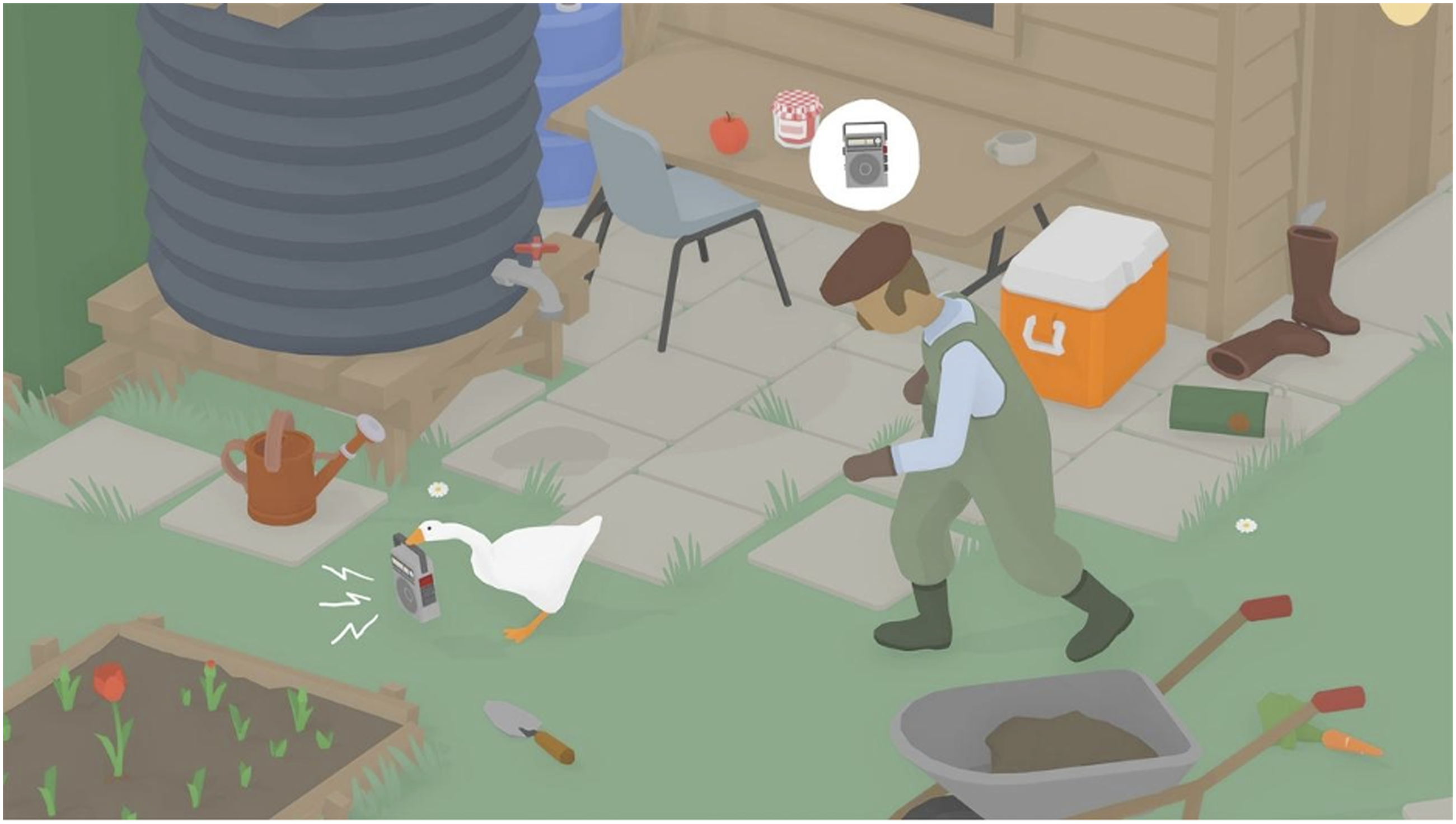
A stealth puzzle game at its core, the player-goose must sneakily disrupt the lives of the town’s residents, taking vegetables from their garden, for instance, or untying their shoes, stealing their hats, and more, all without being noticed or else the goose is shooed away, forced to start its meddling over. Each part of town has a series of predetermined tasks that the goose must complete before unlocking the next section of the game. For instance, the goose must “have a picnic” by bringing specific items to a nearby picnic blanket. The goose must then collect those items, without being noticed by the gardener, in order to accomplish the task.
Most often, Ayla didn’t really care about the task, choosing instead to create her own stories as she played. With Ayla controlling the goose, I sat alongside her side as she shared her exploits: turning a sprinkler on so it squirted water on a gardener, stealing a carrot, honking repeatedly to scare a kid so he would run and hide in a phone booth and more. Days after she first began playing, I purchased a second controller so that Ayla and I could wreak havoc on the town together: two geese now running wild throughout the town. Ayla was tickled that, upon activating co-op mode, the opening title now read The Untitled Geese Game, to reflect the cooperative, two-player gameplay. By age five, Ayla would document the Geese, which had, by then, been named “Goosey 1” and “Goosey 2,” through her art (Figure 3). Ayla’s drawing of Goosey 1 and Goosey 2.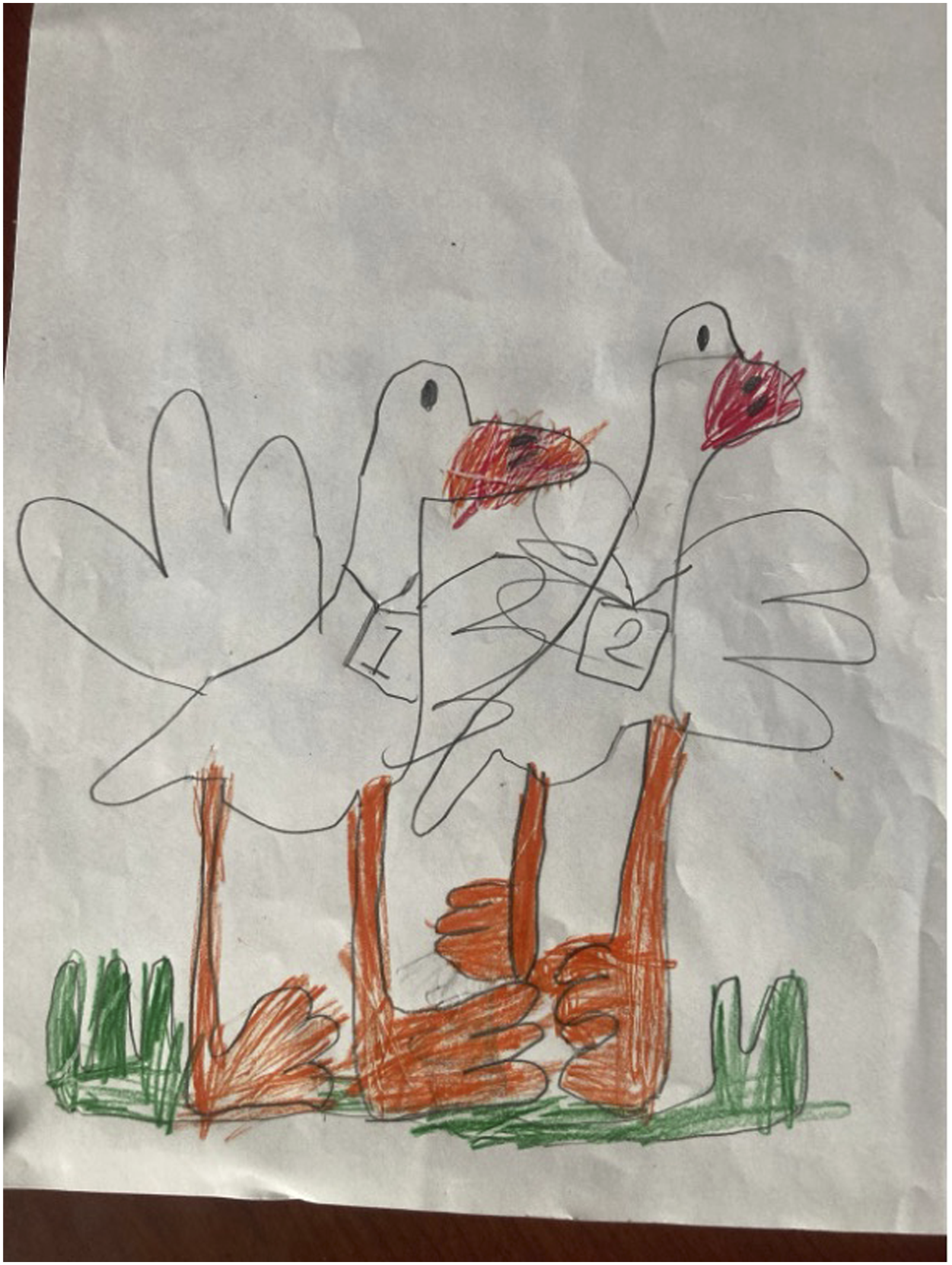
Idiocultural family gameplay
While Goose Game has a series of puzzles to solve in order to progress through the game, it is also open-ended enough to allow players to explore freely. Ayla loved the freedom she had to control her goose and explore the town, manipulate objects, and interact with characters. As part of our family’s wind-down routine, Ayla spent about 20 minutes each night playing Goose Game, at first by herself and, later, with me. The independent time enabled her to gain expertise and to begin to develop her own stories, deviations from the designed narrative of the story. For example, Ayla, who loved flowers, realized that she could find a variety of flowers scattered around the game world, and that she could collect them in a basket that the goose carried in its beak. When playing with me, she would narrate and direct how we–Goosey 1 and Goosey 2–were going to collect the flowers and return them to a central location, a water well, to prepare for the goose wedding. When not gathering flowers, we would find various items–a radio, a tin can, an umbrella, and bring them back to, what we referred to as, the “goose nest.” The “goose nest” was the initial area where the goose starts the game–and wasn’t actually a nest but rather a small pit filled with a number of golden bells. To Ayla, however, it was a safe space that the goose could return to with its collectibles, or to hide from characters, or to sleep, or to host a party, or other innumerable possibilities.
Much of our play, and our delight, revolved around a character that we began to call “The Big Man” (Figure 4). The Big Man served as a literal gatekeeper to one section of the game–a garden pub–his presence forcing the geese to gain entry by hiding inside of a cardboard box to be carried in by a delivery person. If he catches sight of the geese The Big Man gives chase, moving towards them in order to force the geese out of the pub. The geese can escape from The Big Man in numerous ways, from hiding under the pub’s porch, to distracting him with nearby tomatoes, to untying his shoelaces which, inevitably, causes him to trip and fall, giving plenty of time for the geese to escape. Screenshot of “The Big Man” as he awaits the geese, intending to keep them from entering the pub’s garden.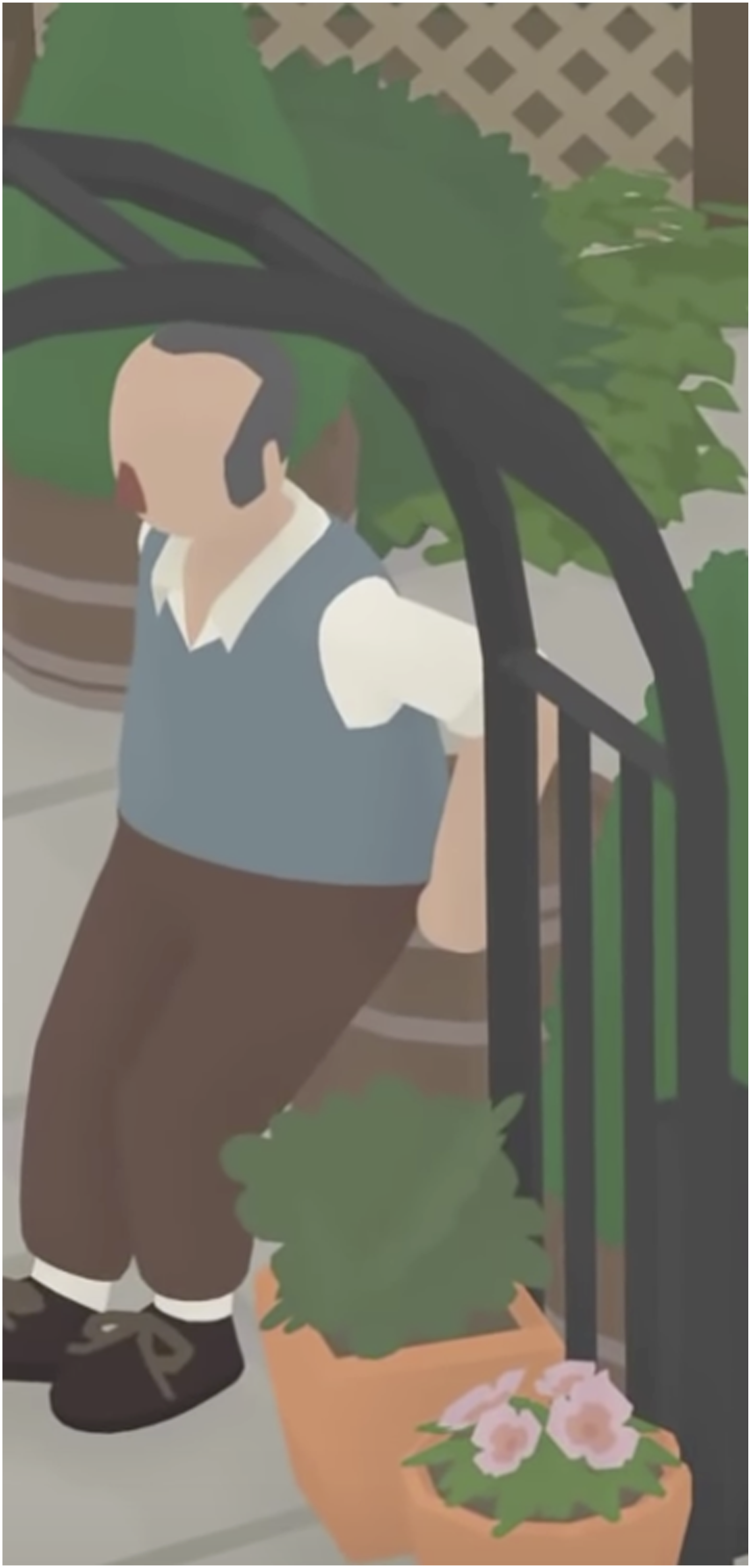
One of the game’s tasks required the geese to make a character “fall on his bum.” To Ayla, this was hysterical, the fact that she could make a character fall on his bum–so this was a task she wanted to complete. But how could we make The Big Man fall on his bum? Our continued efforts to distract The Big Man led us to learn that if we stole some tomatoes from a nearby tomato box (Figure 5(5.1)) The Big Man would chase us to get it back (5.2 and 5.3). If we dropped the tomato, he would eventually pick it up (5.4) and return it to a different tomato box located at the back of the pub (5.5). The box sat on the ground below the deck and, if the goose got near the bucket quickly enough, it could knock the bucket on to The Big Man’s head (5.6) as he leaned over to return to it. The bucket on his head, in turn, led him to trip and fall–on his bum!--and get “smushed” (our word) tomato on the back of his pants (5.8). Screenshots of The Big Man chasing the geese and falling on the tomatoes.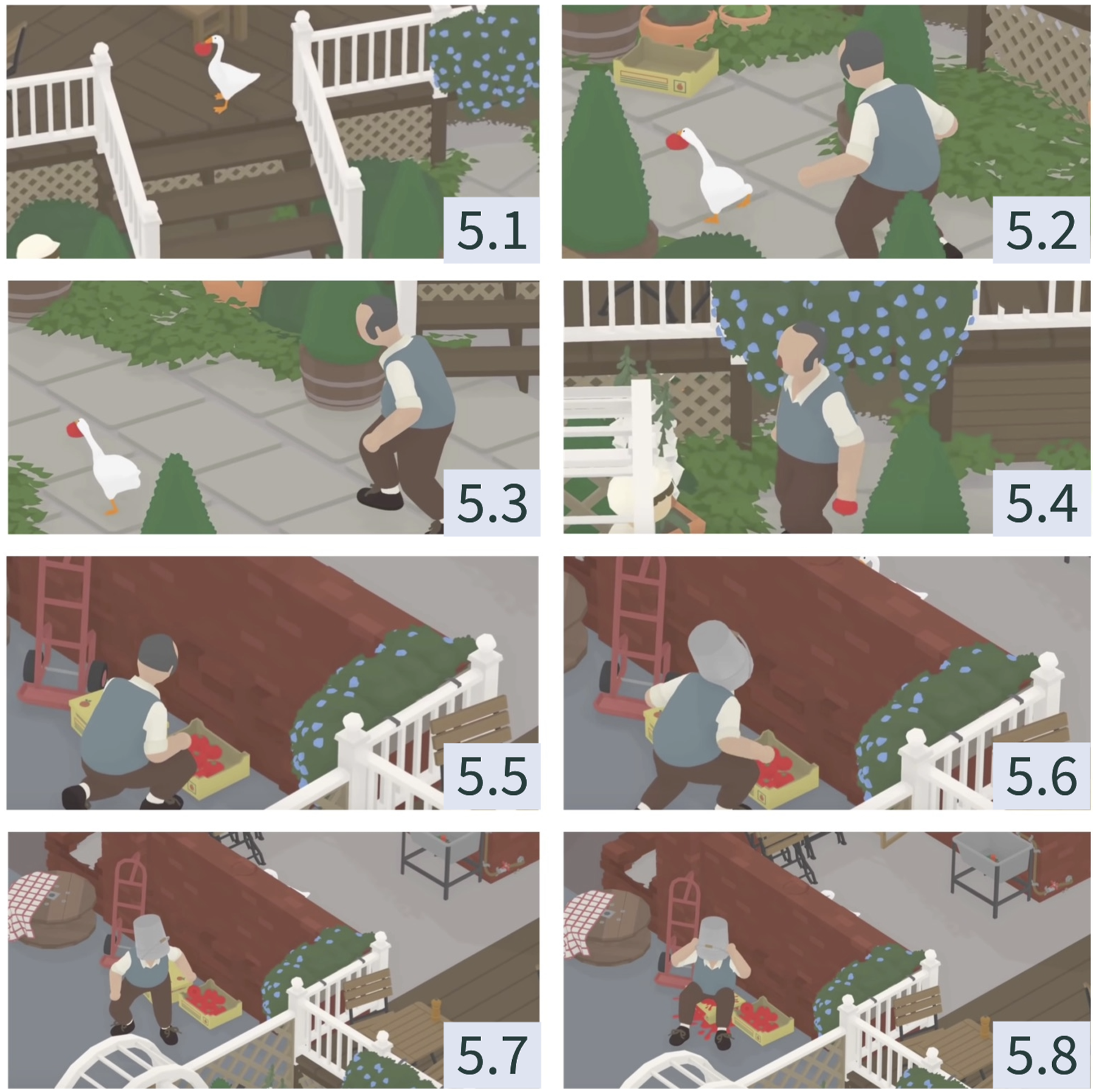
Ayla’s idiocultural gameplay was affectively-resonant. By affectively-resonant we mean that it was not directed by the gameplay itself but rather by the feeling produced when playing–of successfully gathering objects and making a nest, of smushing tomatoes, of running away in hopes of not getting caught, in squealing when we did–-together with her father. The goose nest was less about gathering items for Ayla than it was about making something new, something that had yet to exist in that game, together; the tomato smushing of The Big Man was not about making a character fall; rather, it was about a desire to be held in suspense together as we sought out The Big Man, ensured he would give chase, and delegated who would knock the bucket on his head at just the right time–and it was about producing and reproducing that feeling, together, over time, with Ayla exhorting me to move my goose more quickly as we sought to escape The Big Man. As we transition into our next section, we further elaborate on this re-production of feeling and desire through the idiocultural practice of telling goosey stories.
The idiocultural (re)production of intimacy through storytelling
Our together play of Goose Game eventually led to alternative ways of interacting with that source material. One evening, when winding down prior to bedtime, Ty told Ayla the first goosey story. Goosey stories emerged as a form of bedtime story that described the exploits of the two geese, Goosey 1 and Goosey 2, beyond the events in the video game. Goosey stories were direct descendants of other versions of bedtime stories we told that prominently featured various animals and the imagined adventures they went on. Previous iterations included “Kasey stories,” or the adventures of my childhood dog, Kasey, and “Autumn stories,” or the adventures of Ayla’s mother’s childhood dog, Autumn.
Each goosey story begins with a song, or jingle, to indicate the beginning of the story. It goes like this: “Goosey and goosey the very best of friends; they were the very best of friends.” Oftentimes, we would tell goosey stories at bedtime. Ayla and I lay in her twin bed, which rests in the corner of her room. Ayla pressed up against the wall, surrounded by stuffed animals–cheetahs, rabbits, penguins. I am to her left. She leans her head on my chest, her “fleecy” pajamas soft against my skin. And then we begin: Goosey and Goosey were soundly asleep in the goose nest when they suddenly heard what sounded like a stick breaking under someone’s foot. They woke up and saw the Big Man reaching his hand into a hole in the tree where they kept all their candy, especially their Reese’s peanut buttercups. They let out a loud honk to scare him away, but he still grabbed a handful of the buttercups and put them in his pocket before running away as fast as he could. The two geese quickly chased after the Big Man, when suddenly he tripped and fell. All the peanut butter candies flew out of his pockets. They checked on him to make sure he was okay and said, “You can’t take our candy!” He apologized, saying he really loved the buttercups. They replied, “Okay, you can have one, but please don’t take any more” before going back home to sleep in the goose nest.
Or Goosey and goosey, were looking for hamburgers. They could smell them. The Big Man must be cooking them at the pub, they thought. So the two geese set off for the pub, leaving their goose nest in search of the biggest hamburger to eat…
Other stories introduced new goose characters, those imagined only for the stories and who, in turn, became recurring characters for Goosey stories: Goosey and goosey were playing soccer with The Kid, when suddenly a villainous goose, named Shadow Goose, flew in and took the ball. “Give us back the ball Shadow Goose,” they cried. They flew after Shadow Goose but were too slow. “We need help!” they called out. Suddenly, the clouds opened up and a majestic Rainbow Goose flew out. The goose went “HOOOOOONK” and a beautiful rainbow shot out of its mouth. It hit Shadow Goose, changing the color of its feathers to rainbow, and knocking the ball out of its beak. The ball fell down and Goosey and Goosey gave it back to The Kid.
Some stories elicited giggles (falling on bums), others intrigue (who ate the candy?); some led to a gentle reminder that it was bedtime; others with the geese going to sleep in their goose nest, a symbol of Ayla’s impending rest.
Goosey stories were not reserved for bedtime, though. I told them in the bathroom, in the car, and, oftentimes, when Ayla was feeling scared, sad, or when she was hurt: “Daddy, will you tell me a goosey story,” she would request, at the dinner table, or in the tub, or through tears after a scary fall. Throughout the telling of goosey stories, Ayla would sometimes add her own components to the story, or re-direct emerging plot points, shifting a story about hamburgers for instance, to one about pancakes.
Goosey stories, as they evolved in our family idioculture, were—and still are—always more than stories. They were moments of connection, intimacy, playfulness, and creativity. These stories were always about a push and pull–they pushed forward with new narratives while reaching back in time to make contact with earlier gameplay (and previous stories). There was never a set duration. They were not meant to put Ayla to sleep. They were told for the sole purpose of being present over and across time–in game, in story, side-by-side–with one another. As such, they were folds in time themselves, re-assembling the feeling of playing-storying-being together in the given moment.
As the idiocultural practice became more entrenched, the stories became more intimately connected to momentous desires: moments that needed something. Ayla used that time to explore and discuss her feelings, allowing that resonant feeling to envelop her like a protective shroud. When transitioning from preschool to Kindergarten, for example, the stories we told together often revolved around the character of The Kid, a boy who–at least in the game–liked to fly a toy airplane and kick a soccer ball and who, sometimes, the geese would chase. In one instance, Ayla wanted the Goosey story to describe how The Kid was a bit nervous to go to a new school since he didn’t know any other kids. It was the first time that Ayla had–through any medium–expressed this kind of anxiety. This was not always the case, however, and we are not arguing for the therapeutic nature of storytelling. Instead, we return to our conception of momentous desires: Goosey stories intimately braid past stories and experiences with the present moment in order to produce potential resonance into the future.
Idiocultural variation among family members
Goosey stories continued to evolve within our family over time. Nearly 3 years after Ayla first played Goose Game, the stories became less frequent–yet still desired, particularly in times of uncertainty. As one example, Ayla finds comfort in goosey stories when she doesn’t feel well or when she needs time to herself. “Can you tell me a goosey story?” she asks while hiding under her bed. As such, the goosey stories became both a distraction from tummy troubles as well as a way to be present together, the palimpsest of play and stories over time coalescing in a singular moment. Over years, they have transformed from simple entertainment to familial comfort, a nostalgic return to moments of care and togetherness.
They have taken on this role for Ayla’s little brother, Babar, too, even though he has never played Goose Game. Babar, at age three, feels an itchy mosquito bite on his arm. “Can Daddy tell me a goosey story about a mosquito bite?” he asks, recognizing that moments of discomfort can, potentially, be alleviated by a story (Figure 6). As Figure 6 suggests, the frequency of goosey stories for Ayla “[have] stopped”—although not completely—but they begin to take on meaning and resonance for Babar. As such, goosey stories have resurged as bedtime stories—this time for Babar. After reading bedtime stories together–usually, at this point for Babar, non-fictional accounts of termites, or volcanos, or sperm whales–goosey stories are the final event once Babar is situated in his crib. They are both a means for me to segue from a rocking chair in Babar’s room to the crib and to signal that the time for reading books has come to a close. “We’ll do one more book and then two goosey stories in your crib,” I would say, preparing Babar for the transition. “Okaaaay,” Babar sleepily responds, recognizing that the time to go to bed has nearly arrived. Message sent from Ty to Christian when goosey stories spread to Ayla’s brother, Babar. Christian “loved” the message.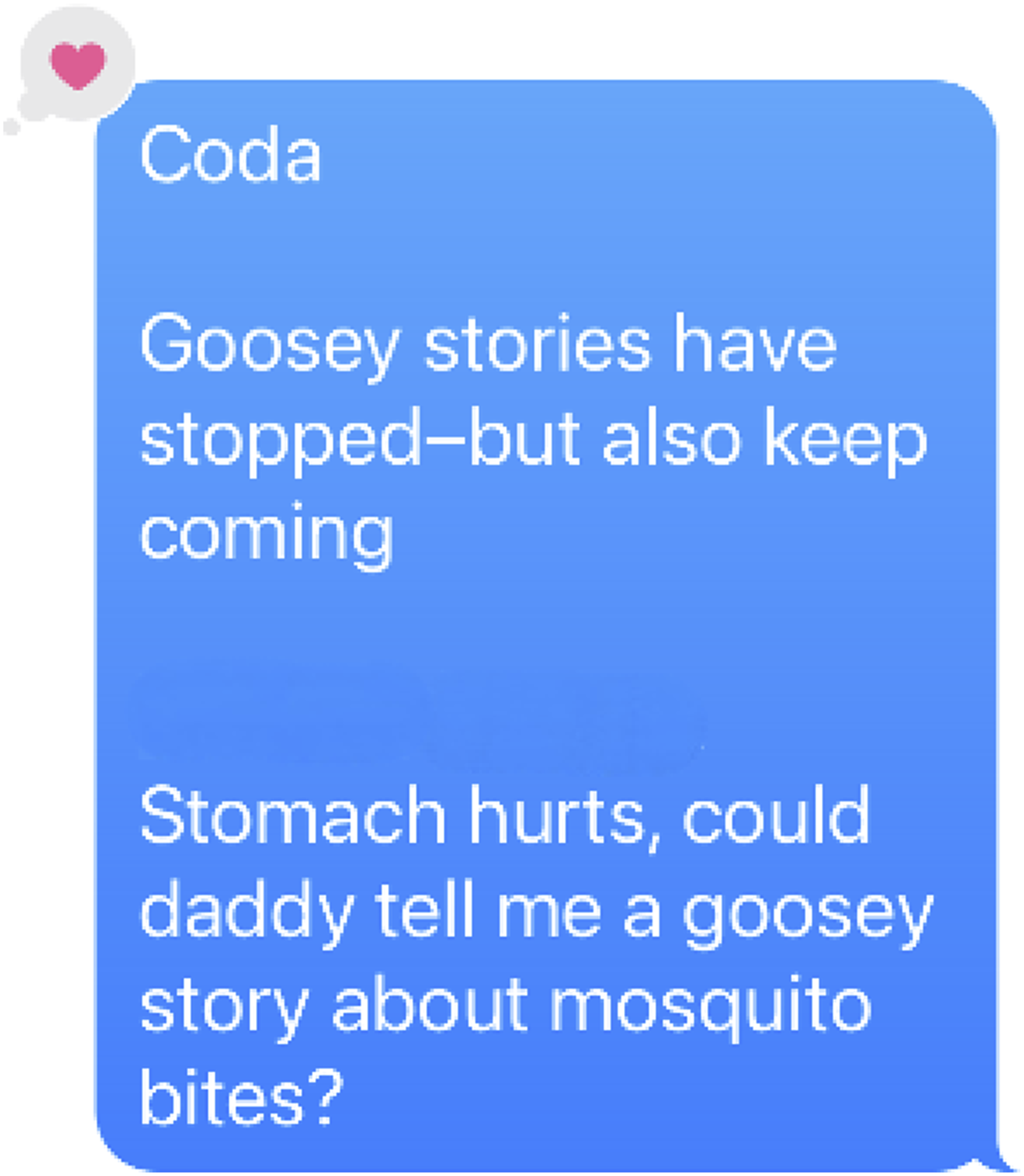
This iteration of goosey stories, though, is Babar-specific and connected to the stuffed animals that adorn his crib–numerous teddy bears, a squishy rabbit, a shark, and a small pig. The introductory jingle is still present—“Goosey and Goosey, the very best of friends…”—but the events and duration are quite different from tales told to Ayla. In fact, Goosey and Goosey are rarely present in these stories; rather, they are merely a means to jumpstart a story about the stuffies in the crib. These stories describe Goosey and Goosey visiting various “lands” of the stuffies–Teddy Land, or Shark Land, or Squishy Rabbit Land. Goosey and Goosey, first, encounter the inhabitant and then the inhabitant does something silly–like a teddy bear that does a flip from the bed rail or a shark that can’t figure out how to swim forwards but only backwards. Babar giggles with delight as the stuffies perform their various actions.
These stories are more than stories, though. They are momentous, something that needs to happen in the felt-moment resonating between Babar and me. The stories emerged as Babar increasingly began to protest being put into his crib, feeling scared of the dark and not wanting the lights turned off. The stories, then, became a means to deviate from a previously-established routine in which I would, first, turn off a night-light and, then, lift Babar up and put him in his crib. The stories provide a sense of comfort as Babar and I keep the light on while I carry Babar to his crib and then while I tell the goosey stories. They also shift the being-put-into-crib experience from one of trepidation to one of laughter and joy. Babar cackles as the bears jump onto his head; he grabs the shark’s tale, spins it around, and helps it swim forwards. Babar often continues the stories on his own in his crib, his voice heard faintly behind the now-closed door, his actions visible on the video screen of the baby monitor. I leave the room differently, too. Indeed, I needed the goosey stories as well. The final moments that Babar and I share together are now moments of laughter and play rather than fear. The darkness of the room has transformed from one of uncertainty for Babar to one of pleasure, at least in the moment.
Discussion: A sense of importance in family idiocultures
A well-established body of research has shown how literacy is productive of space, time and affect (Ehret, 2018; Ehret and Hollett, 2014; Leander and Boldt, 2013). With momentous desires, we have contributed to this literature, showing how literacies produce intimacy across years of family life. Our focus on the idiocultural performances of literacies, and their relation to desire, finds inspiration in Lemke’s (2000) opening invocation of his article on timescales and development wherein he asks: “How do moments add up to lives and how do our shared moments together add up to social life as such? (p. 273). The shared moments and feelings of intimacy portrayed here resonate across time and family members and are produced from ordinary moments that carry extraordinary senses of importance. The stories that emerge through these moments have familiar goosey elements, like The Big Man and practical jokes. And those elements carry new tones, inflections, paces, and resolutions as parent and child collaborate to tell stories attuned to what that particular moment needs. And those needs arise everyday: from the silliness of making a character squish a tomato, to the comfort of making a goose nest together, to anxieties about a first day at a new school. Each of these moments, together and apart, carry a sense of importance that drive storytelling in the moment, and that, over time, accrue into a feeling to hold onto: one of many ways family comes to feel like family. Analyzing the relationship between momentous desiring, storytelling and idiocultures, we have offered one portrait of how families use their literacies to feel like themselves.
The concept of momentous desires aids literacy researchers and educators in understanding, feeling, and valuing the sometimes seemingly idiosyncratic uses and performances of literacy that children carry with them across everyday life, including when they come to school. For Ayla, goosey stories emerged from a family’s joint-media engagement, here videogameplay, which itself is often devalued or incorporated into refrains of moral panic over new media. Yet, when analyzed over time through moments of momentous desiring, we come to know how family video gameplay coalesced into deeply loving, intimate moments that were woven into future moments of togetherness. Similarly, the seeming silliness of goosey stories when performed beyond the family context may belie their value as sophisticated improvisations capable of creating the comfort, care, love, or humor that a moment needs. When we think about the affective dimensions of social life through concepts like momentous desires, how might we come to know literacy differently? How might we know its value differently and understand what it can do to bring and hold us together? How might such concepts and perspectives aid researchers and educators in communicating the value of literacy beyond what is measurable, representable, commodifiable, or artificially inflated by the politics of the times?
Creating, developing and employing concepts that innervate analyses of these affective dimensions of literacy and social life will require the field to become more intimate in inquiry. More and more, literacy researchers are boldly exploring their own affective positionalities and vulnerabilities in relation to the phenomena they study, opening new questions that might not otherwise be considered (e.g., Lemieux, 2024, in press). Every stage of our inquiry was enabled by our vulnerabilities to each other as friends and scholars, and by a father’s vulnerability to the field, opening to the possibilities of increased intimacy with it. Through each stage we have considered how these intimacies enabled new understandings of family literacies. In doing so, we have offered one way toward responding to Berlant’s (1998) query regarding writing about intimacy: “What happens to the energy of attachment when it has no designated place? To the glances, gestures, encounters, collaborations, or fantasies that have no canon” (p. 285)? We believe there is a place for intimacy in literacy research.
Still, the goose-related intimacies—the stories, jokes, voices, and characters—presented here are a small slice of the idiosyncratic performances of literacy in Ty’s family. When speaking with Ayla about some of the ideas generated in this article, a common practice throughout its genesis, she asked Ty if he hoped more parents and caregivers would play video games with their kids, like Ty and Ayla did with Goose Game. After reflection, he responded that he hoped that parents and caregivers could develop a refined attunement to the kind of repetitive stories, or sayings, or gestures that make moments feel special within their family, especially those that develop a kind of weight, or resonance, over time. He said that while he wanted to share their experience with others, he also wanted to strike the right balance between their private moments as a family and those that could be shared more broadly. Literacy research is an act of world-building. Yet, without intimacy, without vulnerability, what worlds—especially those of early child- and parenthood— are (and are not) built? Berlant (1998), again, offers a way forward: “It is hard not to see lying about everywhere the detritus and the amputations that come from attempts to fit into the fold; meanwhile, a lot of world-building energy atrophies (p. 239). If we are vulnerable to each other, to our inquiry, what might we sense as important that otherwise would be left occluded by the artifice of emotional neutrality? How might we connect more humanely with each other as researchers, opening new discussions, opening new inquires, opening to re-valuing what we may have overlooked in tightly-focused research agendas that often force us to “fit into the fold”?
Conclusion
The shared social life of family literacies is often, and ordinarily, idiocultural and affectively-resonant. They are incredibly intimate, a moment-to-moment adjudication of past-feeling with present-feeling to produce new, desired feeling-futures. In the beginning of this article, we offered an epigraph in which Ayla, and then Babar, requested goosey stories over time. These were not simple requests; rather they were desires for a kind of affective multiplicity; they were bids for intimate connection–both personal connection, as well as a connection back to previous experiences of play or joy or togetherness. And those requests were—and still are, albeit at different moments, with different desires--deeply connected to the family’s idiocultural practices, including persona’s adopted, or voices ventriloquized, or imaginative places produced. In concluding, we wonder: When does literacy feel momentous for both children and caregivers? When is it simultaneously connected to past feelings and towards future desires? How can we follow the sense of importance that moves through these events toward new ways of being present in our research, of talking about the value of literacy, literacy research and literacy education? Through moments that feel important, whether in everyday family life or in larger historical eras, how can we use our literacies to be silly, to cry, to move, to love? What can we do with our literacies to meet the moment and hold together over time?
Footnotes

Funding
The authors received no financial support for the research, authorship, and/or publication of this article.
Declaration of conflicting interests
The authors declared no potential conflicts of interest with respect to the research, authorship, and/or publication of this article.
IRB statement
This study was approved by the Pennsylvania State University Institutional Review Board (approval no. 00009496) on 4/2/2018.