




Abstract
Shared reading with young children is promoted as good practice in national and international policy. Existing literature explores cognitive and developmental benefits of family shared reading for young, typically developing children, but much less is known about benefits for young people with learning disabilities. Additionally, the analysis of ‘benefit’ is often cast in economic terms to society rather than through the sociological lens of everyday ‘family practice’. This paper explores the significance of shared reading for two young people with Profound and Multiple Learning Disabilities (PMLD), a group traditionally characterised as having a developmental age of 24 months or less and who may therefore continue to enjoy shared reading far beyond early childhood. Drawing on iterative qualitative data analysis of semi-structured interviews with two mothers, findings suggest that shared reading is a valued everyday practice fulfilling a range of functions such as emotional regulation, marking time and routine, and inclusion with siblings. The paper considers ways to support shared reading within PMLD families in research, policy and practice.
Keywords
Introduction
‘Shared reading’ is argued to confer many instrumental benefits for a typically developing child who is expected to become an independent reader. For instance, it is reported to support language development, cognitive skills, and reading readiness (Massaro, 2017). However, much less is known about the affective, embodied and sociomaterial dimensions of everyday family shared reading (Hall et al., 2018), and about its effects on the quality of the parent-child relationship (Canfield et al., 2020). Less again is known about how shared reading is practised with children with the UK label of Profound and Multiple Learning Disabilities or PMLD (known elsewhere as Profound Intellectual Multiple Disabilities or PIMD), and the meaning their families attach to this everyday practice. This lack of literature may reflect a narrow conceptualisation of ‘literacy’ as the functional skills of independent reading and writing, questioning its place in the lives of children who do not follow this trajectory (Robinson et al., 2019). Additionally, many young people with learning disabilities continue to enjoy shared reading far beyond the early age range typically studied in research. This paper addresses these gaps in our knowledge by exploring the everyday shared reading experiences of two young people with PMLD as they share traditional print books, personalised iPad stories and remote online classroom shared reading experiences during COVID-19 lockdown.
Shared reading with preschool learners is actively promoted in international and national policy. For instance, the UNESCO Institute for Lifelong Learning (UIL) describes family learning as fundamental to the realisation of multiple Sustainable Development Goals including quality education (SDG4), good health and wellbeing (SDG3) and reduced inequalities (SDG10). It recommends that ‘family literacy programmes should develop a reading culture that permeates families’ daily lives … This can be done by helping parents and caregivers to improve their skills and confidence to engage and motivate their children to both develop their language and read for pleasure’ (UIL, 2017: 3). The Organisation for Economic Co-Operation and Development (OECD) cautions that ‘children who experience fewer interactions with their parents (e.g., reading with children …) perform lower on cognitive skills tests later in life’ (OECD, 2018: 8). In England, where this study takes place, the Department for Education (DfE) advises parents that ‘reading helps your child’s wellbeing, develops imagination and has educational benefits too’ (DfE, 2022). Similarly, a report commissioned by the National Literacy Trust (Cole et al., 2022) notes that if parents of children at risk of vulnerable language skills did one additional home learning activity daily (such as shared reading) this would result in £170 million in benefits for each cohort of 3 year olds (Kerr and Franklin, 2021). Delaune’s (2019) analysis of OECD influence on early childhood education identifies a ‘globalising, neoconservative and neoliberal’ discourse wherein ‘a story is told of how investment in effective ‘human technologies’ applied to young children will bring high economic and social returns’ (p. 60). These economic policy drivers are further intensified by concerns around an ‘impending literacy crisis and the possible economic impacts of learning loss’ as a result of extended global school closures during COVID-19 lockdowns (Zhang et al., 2023: 2). The direction of national and international policy is therefore consistent with a functionalist view of family shared reading as producing future economically active citizens, neglecting analysis of shared reading as a vehicle for building relationships, closeness and everyday quality interactions.
Background
Posited benefits of shared reading
The ‘home learning environment’ has been defined as ‘the physical home and the interactions in and around the home that implicitly and explicitly support a child’s learning’ (Government and National Literacy Trust, 2018: 9). Here, shared reading sits alongside other aspects of cultural praxis such as nursery rhymes, songs, games, painting, drawing and conversations (Niklas et al., 2020). Shared reading has been likened to Vygotsky’s (1978) Zone of Proximal Development, since children are scaffolded by a more competent reader to initially engage with books, become familiar with print conventions, and eventually to learn to read (Swain et al., 2017). Posited gains include improved metalinguistic knowledge, alphabetic knowledge and phonological awareness (Pillinger and Wood, 2014); development of theory of mind through empathy with fictional characters (Adrian et al., 2005); exposure to vocabulary and concepts not encountered in everyday conversation (Shahaeian et al., 2018); increased sustained attention, prosocial behaviour and school readiness (Jimenez et al., 2019) and even enhanced mathematical comprehension (Davidse et al., 2014).
Other literature focuses on optimising the parental ‘performance’ during shared reading. Curenton and Justice (2008) argue that high-quality shared reading interactions feature active engagement of the child, higher order extratextual conversations, inferential language, explanations and predictions. According to Hutton et al. (2022), the benefits of shared reading are moderated by the degree of verbal and social-emotional interactivity during reading. Pillinger and Wood (2014) distinguish between ‘shared reading’ (SR), which they characterise as having a high degree of adult control whilst the child sits passively and listens, and ‘dialogic reading’ (DR) where the child is encouraged to become the storyteller with adult scaffolding and expansion. The authors argue that SR may be a useful starting point which can raise parental engagement and confidence before introducing the more interactive style of DR.
Shared reading within family relationships
Less has been written about effects of shared reading on emotional wellbeing and quality of family relationships. Canfield et al. (2020) argue that shared book reading at 6 months is associated with increases in observed parental warmth and sensitivity and decreases in parenting stress at 18 months. Similarly, Jimenez et al. (2019) find that early shared reading predicts less harsh parenting when the child is older. Swain et al. (2017) found that emotional bonding with their child was cited as a key motivator for fathers to engage in shared reading.
Less again has been written about the ‘everydayness’ (Nutbrown et al., 2017) of shared reading and its embeddedness within relationships, routines and the enactment of family life. Morgan (1996) conceptualises ‘family practices’ as ‘little fragments of daily life which are part of the normal taken-for-granted existence of [families]’ (p. 190). Mobilising this concept, Hall et al. (2018) argue that it is important to ‘understand how families are using shared reading activity within the context of their everyday lives’ (p. 366). According to the authors, public policy interventions designed to encourage shared reading will be unsuccessful when they ‘fail to acknowledge the individual and unique ways in which families operate’ (p. 364). They go on to observe that for many families, shared reading is not primarily an ‘educational’ or ‘literacy’ endeavour but rather is ‘crucial to the execution of daily routine’ (p. 369), embedded within other family practices such as bath time or bedtime. It provides an opportunity for physical closeness and cuddles, and for a busy working parent to spend quality time with their child.
In a further sociological exploration of shared reading, Preece and Levy (2020) observe a wide range of approaches including talking about pictures, deviating from texts, reading every word on every page, reading only selected words, or retelling the story in their own words. They argue that ‘the perception of a singular, correct way of reading could act as a barrier’ (p. 634). The authors further note that a powerful motivator of shared reading is parental perception of positive embodied feedback from the child: for example labelling, pointing, repeating, asking questions, or displaying facial expressions suggesting interest. In contrast, negative feedback includes moving away, not sitting still, seeming distracted, or pushing books away. Some families expressed uncertainty about the value of reading to young babies due to the limited or ambiguous embodied feedback received. This is interesting to consider in the context of older children with learning disabilities who may also display ambiguous embodied feedback to shared reading, an underexplored phenomenon considered in this paper. Preece and Levy (2020) conclude that enjoyment and pleasure must be centred in discussions of family shared reading practice rather than conceptualising it as preparatory practice for independent reading.
Shared reading, technology and COVID-19
COVID-19 lockdowns in 2020–2021 resulted in worldwide school closures and the implementation of ‘emergency remote education’ or ERE (Sosa Díaz, 2021) which has had profound and continuing effects on education, family life and child development. These effects were not felt equally across diverse households. Shared reading became a lower priority for some families due to lack of contact with professionals, lack of resources and time, or general pandemic-related stress and anxiety (Cole et al., 2022). Conversely, for other families the extra time at home provided more opportunity to engage with a child’s early literacy development (Kartushina et al., 2022; Parentkind, 2020). This contrasting literature indicates the difficulty of generalising lockdown experiences across households with widely differing resources and circumstances as well as ‘socio-digital inequalities’ such as broadband and device availability (Sosa Díaz, 2021: 1).
Lockdowns also intensified the focus on technology which traversed the home-school divide in previously unthinkable ways, such as teachers virtually ‘entering’ student homes via online transmission of live lessons. Whilst pre-pandemic shared reading was already diffused across technologies such as television or iPad storywriting apps (Kucirkova et al., 2013), ERE significantly accelerated the development of new possibilities. Libraries started offering live online storytime sessions to young children unable to attend the library in-person (Carbery et al., 2020); video-call shared reading (VCSR) became a powerful tool for connection where families could not gather in person (Kucirkova and Hoel, 2020); and teachers created digital stories to recreate classroom routines and rituals for students learning at home (Buchholz and Rust, 2021). Relatively little has been written on how young people with PMLD coped with the pivot to ERE: Sutton (2021) reports difficulties with on-screen ‘Zoom’ lessons including visual and/or hearing impairment, confusion over why school-based activities were now taking place at home, and the loss of physical contact which was detrimental to well-being.
These developments call to mind the concept of a ‘literacy event,’ originally defined as ‘occasions in which written language is integral to the nature of participants’ interaction’ (Heath, 1982: 50) such as the nightly routine of a bedtime story. Burnett and Merchant (2020) call for a more contemporary redefinition: Transcontextuality has come to the fore at a time when many literacy events are mediated by mobile devices and involve multiple participants and purposes in on/off screen activity across sites … literacy events are porous and permeable and may lack the patterned predictability of Heath’s original conception. (Burnett and Merchant, 2020: 47).
The authors propose a shift to literacy-as-event, intended to evoke the fluid, transcontextual, elusive and unpredictable encounters which arise from the assemblage of human and non-human (technological) elements. Similarly, Flewitt and Clark (2020) call for recognition of the ‘porous boundaries’ (p. 447) of the contemporary home literacy environment, noting that ‘the presence of digital technologies in the contemporary home … transforms a previously bounded space into a networked space’ (p. 451).
Shared reading and profound and multiple learning disabilities (PMLD)
The UK label PMLD (Profound and Multiple Learning Disabilities; known elsewhere as PIMD/Profound Intellectual and Multiple Disabilities) describes a low-incidence group who have the greatest possible level of intellectual impairment arising from causes including genetic disorders or acquired brain injuries. Historically, people with PMLD have been described as having a developmental age of up to 24 months (Butler, 2018) although there is now a shift away from definitional comparisons with typically developing infants. This shift reflects growing awareness of the ableism and ‘infantilising dynamics’ (Safta-Zecheria, 2018: 104) inherent in the practice of ascribing an intellectual age below biological age. People with PMLD ‘have great difficulty communicating, often requiring those who know them well to interpret their responses and intent’ (Doukas et al., 2017: 12), and often have co-existing conditions including visual/hearing impairments and epilepsy. Nevertheless, Doukas et al. (2017) argue that: All, however, have the capacity to participate in everyday life in a way which is personalised to their needs and abilities, to benefit from good health care and education and are able in various ways to communicate their satisfaction or otherwise with their quality of life. (p. 13).
Shared reading has also been argued to facilitate shared attention, closeness and wellbeing for young people with PMLD (Robinson et al., 2019). However, this requires a ‘responsive significant other’ (p. 100) who can make the book come alive. The authors argue that parents make highly effective shared reading partners due to their knowledge of the young person and their skill in personalisation and repetition. They also note that families of children with PMLD typically do not orient towards shared reading as a precursor to autonomous reading, instead foregrounding the here-and-now benefits relating to family closeness, joy and wellbeing. As one mother remarked, ‘I read to him because it makes him happy’ (p. 100). For parents who do not initially perceive shared reading as relevant to a child with PMLD, it can be therapeutic to discover a new way of relating to the child through sharing a book (Mercieca and Mercieca, 2009).
PMLD literature contains reference to Multi-Sensory Storytelling (MSST), a particular storysharing practice which involves the planned use of actions, songs and physical artefacts so that ‘stories are not simply told but can be experienced with all our senses’ (Fornefeld, 2012: 78). For example, a fan can be used to experience ‘wind’ or a water spray ‘rain’ in a story about weather. Ten Brug et al. (2016) argue that MSST results in greater attentiveness to the story than regular reading for children with PMLD. In contrast to the literature on shared reading for typically developing children, which emphasises the developmental importance of elaboration and extra-textual talk, Grace (2014) argues that with MSST it is desirable to deliver the story as uniformly as possible each time. This is because for a learner with PMLD, variation will impede their ability to develop anticipation. This echoes the argument of Fleury and Hugh (2018) that posited best practice in shared reading for typically developing children may not generalise to disabled young people.
Methodology
Study overview
Five parents of disabled children were interviewed about their child’s engagement with ‘literacy', books and shared reading practices at home. Each was then given an iPad with a digital storymaking app called Pictello, and for 12 weeks they experimented with making stories for or about the child by assembling their own text, photos and video. During this period the families submitted stories, weekly diaries and video data showing the process of interacting with the iPad. A final interview discussed the family’s experience of working with the app, including its role in shared reading practices. This paper draws from the interviews conducted with Laura and Anna, mothers of Matthew (9) and Eve (10). Both young people have the label of PMLD and are both in the earliest stages of literacy development, enjoying shared reading of board books typically marketed at infants with textures, buttons, sounds and bright colours.
Theoretical framing
This research draws upon the theoretical insights of ethnography, multimodality and ‘inclusive literacy’ (Flewitt et al., 2009). It takes from ethnography a commitment to acknowledging the emic perspective of disabled young people and their families as ‘valuable experiential experts’ (McCord and Soto, 2004: 215) in their own lives. Multimodality sees meaning-making as diffused across multiple modes and resists the automatic privileging of speech and written text in analysis of interaction (Jewitt et al., 2016). The embodied idiosyncratic communication of disabled young people is taken as their contribution to the shared reading process. Following ‘inclusive literacy’ (Flewitt et al., 2009) I look broadly at the social, embodied, interpersonal and material dimensions of meaning-making rather than a functional focus on independent reading and writing.
The research is also informed by the sociological work of David Morgan on ‘family practices’ (1996) which understands ‘family’ not as a concrete noun, institution or entity but rather as a set of everyday, regular practices through which members affirm, reproduce and re-define their family bonds (Morgan, 2011). This approach emphasises fluidity and reflects family mobilities: family practices can occur in car journeys, on holiday, or remotely via online video platforms such as Zoom (Morgan, 2020). Family practices can also be boundary practices (McKie et al., 2005) which define who belongs as a family member: for instance, a photograph of a family gathering redistributed electronically reminds everyone of a practice of belonging which transcends individual households.
Setting and participants
A number of ‘special schools’ in the Midlands of England assisted in recruitment of five participating families. Beyond initial recruitment, schools had no further involvement in the research. Fieldwork took place May–July 2021 when COVID-19 restrictions were starting to ease in the UK, and contact with participants was remote (email and videocalling). It is therefore unsurprising that families frequently oriented to the profound influence of lockdown on family practices in their talk.
This paper focuses on the experiences of the two participants with a label of PMLD (Figure 1). Participant characteristics.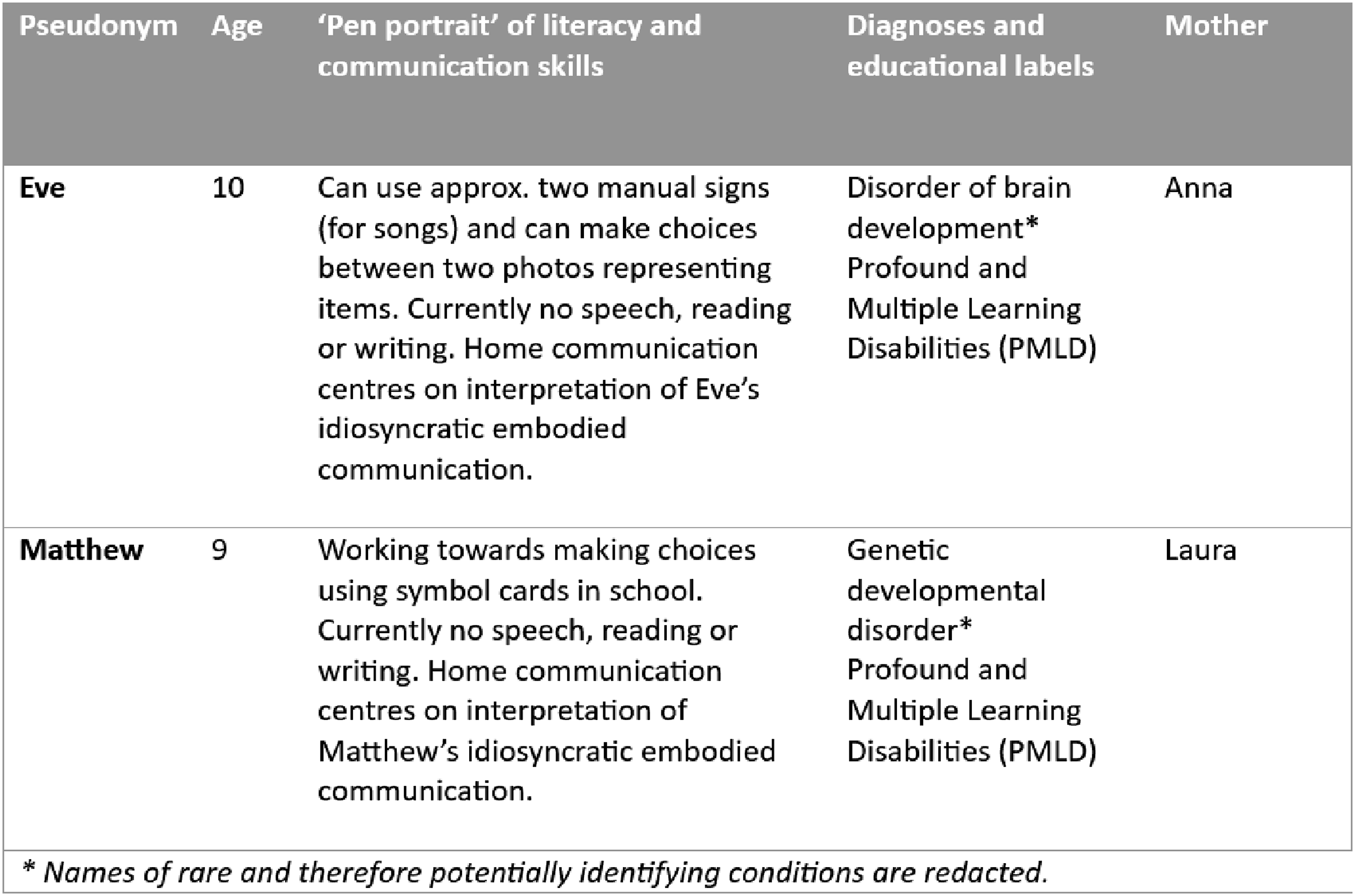
Materials
Each family was given an iPad with Pictello storywriting app which facilitates assemblage of photo, video, typed text and voice recording, a protective case, and a copy of the Pictello user manual (AssistiveWare, 2022). AssistiveWare was not involved in project conceptualisation, funding or design. Families were signposted to online Pictello support and associated social media groups and received remote technical support from the author throughout fieldwork. Families were instructed only to use the app in any way which seemed engaging for their young person.
Ethics
This study was carried out in accordance with the BERA Guidelines for Education Research (BERA, 2018) and was approved by the author’s University Research Ethics Committee. In each family, written consent was given by a parent. All participants chose pseudonyms, and potentially identifying details have been redacted. Families were permitted to retain their iPads at the end of the study by way of thanks, although this was not specified at the recruitment stage to avoid inducement to participate.
Data generation
This study generated a multidimensional view of shared reading through complementary forms of data. The digital stories produced were transferred to the researcher’s device, which permitted viewing of dynamic elements such as audio, video and page transition. Families submitted short home videos which showed the young person’s embodied interaction with the app, as well as a weekly email diary which gave an ‘overtime’ perspective on their journey with the iPad. Semi-structured interviews took place with each parent at the beginning and end of the 12-week fieldwork period. The first interview explored existing family shared reading practices with print books, whilst the second discussed the iPad app and its influence on shared reading practices. Interviews were conducted online and the second interview incorporated an element of video-stimulated recall, reflection and dialogue (Nind, 2016): each parent was invited to rewatch two of the home videos they had created and to discuss their child’s interactions with the iPad story.
Data analysis
Qualitative data analysis software (NVivo 12, QSR International Pty Ltd v.12) initially facilitated manual coding across diverse data formats. Data were first coded on a story-by-story basis. This enabled summarisation of story content, dynamic features, relevant home video and related participant quotations. I then manually re-interrogated the data on NVivo using the iterative qualitative data analysis framework of Srivastava and Hopwood (2009). This involved alternating between theory and data on the theme of ‘family shared reading’, repeatedly moving between the questions (1) What are the data telling me?, (2) What do I want to know? and (3) What is the dialectical relationship between (1) and (2)? The research questions which informed part (2) of this framework (What do I want to know?) were as follows: 1. How is family shared reading practised with young people who have PMLD? 2. How does this compare to shared reading with non-disabled siblings? 3. What role can new and emerging technologies (Zoom, iPad digital stories, etc.) play in enhancing family shared reading for children with PMLD? 4. What role does shared reading play in the enactment of everyday family life?
Qualitative rigour
Both interview transcripts and a draft version of this article were shared with families to invite correction or dialogue, as a form of member checking (Mullet, 2018). The study involved triangulation of methods (video data, diary entries, interview) which can provide ‘multiple avenues to arrive at multiple ‘truths’’ (Flewitt, 2006: 102); and my interpretation of video data was subjected to further member checking in the form of video-stimulated recall and dialogue during interview (Nind, 2016). Data analysis was further shared and discussed with other researchers in conferences and research seminars which helped to identify interpretive blind spots or unwarranted assumptions (Sandelowski, 1993). Finally, a reflexive research journal was useful throughout the project to explore my evolving understanding of the data (Ortlipp, 2008).
Findings & discussion
How is family shared reading practised with young people who have PMLD?
For both Matthew and Eve, shared reading has always played an important part in their lives. Anna described books typically associated with a preschool readership which Eve continues to enjoy: ‘we’re still reading the same books we did when she was one really’ because ‘repetition is the key for her, because she knows what’s coming I guess, and she enjoys that.’ This appears to support the argument that the consistency-anticipation link is key in PMLD shared reading (Grace, 2014) and also echoes the observation of Fleury and Hugh (2018) that posited best practice in shared reading such as extra-textual talk may not generalise to all disabled learners. In the case of Eve, it seems likely that introducing extra-textual talk would reduce the pleasure and confidence she derives from anticipating the next sentence.
Laura also identified books designed for typically developing infants as Matthew’s favourites, typically featuring characters from his favourite television programmes or alternatively nursery rhymes which can be sung. The physical characteristics of books are also important: robust board books are necessary for durability (‘he can chew through a book within minutes’), bright colours and big pictures are advantageous, and books providing buttons for sound effects are helpful to reinforce meaning.
In terms of delivery style, Eve enjoys shared reading of stories with rhyme or song, anticipation and build-up, repetition, and tactile elements such as textured pages or sound buttons. Eve associates certain books with her mum (whose delivery style tends to favour rhyming stories, building of excitement and anticipation) and others with her dad (who performs characters with different voices): She really associates [Peace at Last] with him and his voice. So we’ve got that on there as his [iPad] story. He recorded his voice for that one, which is just great … he does the voice of Mr Bear … When I read it to her, I don’t think it has the same impact.
This points to the sociomateriality of literacy events (Burnett and Merchant, 2020; Heath, 1982): for Eve, books are not decontextualised artefacts that could be read by anyone, but rather are entangled with embodied presence and performance by specific people. Eve’s parents – each in their own way – have found ways to become the ‘responsive significant other’ (Robinson et al., 2019) that Eve needs to make a story come alive.
Laura also carefully considers her narration style with Matthew: ‘we changed the voices, we changed the tempo, we changed the volume, just so that [he] can understand that there was a story there, it’s not just pictures.’ Laura described the experience as follows: We sit together, it’s good one to one time. So we normally, we sit on the floor or on the sofa, have a little snuggle up … give him a choice of books, so he can choose what he wants … It’s good, it's a nice time.
Finally, both families demonstrated a finely-honed ability to interpret embodied feedback to gauge the young person’s level of interest or the need to adjust delivery style. As noted by Preece and Levy (2020), embodied indications of engagement motivate parents to continue with shared reading. For Eve, signs of high engagement with a story include leaning in for a kiss, smiling, eye gaze directed at book (although conversely sometimes looking away when deeply listening), and pointing to a desired book. For iPad stories, high engagement was additionally indicated by slower swiping on screen, indicating the desire to listen to the recording on each ‘page’ before continuing. Indicators of disengagement might include physically moving away, turning her back, pushing the book or iPad away, and making loud vocalisations which drown out the recorded words. Very closely spaced screen taps indicated a desire to reach the end without engagement. For Matthew, engaged behaviours would include reaching out to ‘choose’ a book, eye gaze directed at book or iPad, attempting to make physical contact with book and bring it close, snuggling into the person reading, attempting to press buttons, making happy noises and being ‘jiggley.’ Conversely, signs of disengagement might be shuffling away, or turning his back.
How does this compare to shared reading with non-disabled siblings?
Both Eve and Matthew have non-disabled siblings, and this provided an interesting point of comparison. Both mothers noted that shared reading in the early years was comparable for their children in terms of book choices and practices such as anticipation-building and dramatic narration. This meant that it was possible for the disabled child to join their siblings for story time. Laura recalled: ‘It’s something that he and his siblings shared together when they were small … It was time that they spend with [dad] when he came home from work, it was lovely.’
As Hall et al. (2018) note, shared reading can be a powerful practice for a working parent, enabling them to connect and engage with a child they haven’t seen all day. Similarly, it echoes the findings of Swain et al. (2017) that the emotional bonding of shared reading can be a motivator for fathers. However, as Matthew’s developmental trajectory diverged from his siblings, it became necessary to read with him separately. This was partly due to practical issues (‘he can get quite rough and over excited’) and partly due to the growing divergence in reading materials. For the non-disabled siblings, reading increasingly became associated with stressful notions of linear, measurable progress. Anna reflected on her non-disabled daughter’s ‘failure to progress’ according to school: ‘she’s not feeding into that very narrow ideal of tick boxes, of what should be achieved at what time.’ Likewise, Laura recalled that ‘painful stage when they’re starting to learn to read’ and the child is required to read back to the adult rather than just enjoying a story. She described reading with Matthew’s sister as now being much more instrumental than pleasurable, echoing discourses of literacy as a functional driver of the economy (DfE, 2022; Kerr and Franklin, 2021): Reading books, understanding stories, reading more and more complicated words, sentences or... and it is things like how sentences are made and what they’re made of, punctuation, that sort of thing.
By way of contrast, shared reading with the child with PMLD felt uncoupled from functional expectations of a trajectory towards independent reading. This meant both Anna and Laura felt free to continue reading the same books over many years and to undertake shared reading which felt rewarding, rather than engaging in the goal-oriented approach associated with their other children.
What role can new and emerging technologies (zoom, iPad digital stories, etc.) play in enhancing family shared reading for children with PMLD?
Anna and Laura referred to a range of technologies to support reading including iPads, online video platforms such as Zoom, television and assistive technology. As described previously, part of the current study involved experimenting with a storymaking app called Pictello. This allowed families to easily combine family photos, videos, typed text and voice recording to create an engaging story. For Matthew, such stories could help him prepare for a potentially stressful event such as a hospital visit or a haircut by acting as a cue: ‘with a story … we can give him advanced warning of what’s going to happen.’ One of the iPad stories Laura created was about the process of getting your hair cut, complete with sound effects of scissors, hair trimmers and running water. The story will be shared with Matthew before haircuts to hopefully reduce his distress.
Personalised iPad stories can also celebrate joyful events. For example, Matthew enjoyed a story about a visit to a local castle (which focused on his sensory experiences of the trip, such as his wheelchair bumping over cobblestones) and a story about his dad’s birthday incorporating a videorecording of the family singing ‘Happy Birthday.’ An unexpected benefit of creating celebratory iPad stories was sibling involvement: Matthew’s sister was active in creating content and recording her voice for some stories, including the birthday story. This recalls the argument that ‘family practices’ can also be ‘boundary practices,’ reinforcing Matthew’s centrality, presence and role in a family celebration (McKie et al., 2005).
In contrast, Eve preferred iPad stories which were digital recreations of her favourite print books, constructed with photographs of each page accompanied by recorded narration from the parent associated with that story. The value of a digital ‘translation’ of her favourite books offered her a degree of autonomy in reading: I think there was a sense of pride of like, look what I’m doing … I can do it myself, being in control of it. It’s just really one of the big plusses of it, because it gives her that chance to control stories …
As Anna noted, it also allowed the family practice of shared reading to travel beyond the family home: If she’s ever with other people you know, staying elsewhere, in respite or whatever, if she’s got those stories, and it’s got our voices with the familiar stories … it’s perfect.
This instantiates the argument of Morgan (2020) that family practices are intertwined with family mobilities: if ‘family’ is to be conceptualised as a set of practices rather than a concrete entity, it follows that family practices can be practised beyond the family home and without the physical presence of family, especially with new technologies. It also recalls the argument by Burnett and Merchant (2020) that the ‘boundedness in time and space’ (p. 47) of a literacy event such as a bedtime story becomes ‘porous and permeable’ (p. 47) when mediated by technology, as well as Flewitt and Clark (2020) who note that the presence of digital technologies ‘transforms a previously bounded space into a networked space’ (p. 451).
The mobility of shared reading was additionally seen in Matthew’s experiences with remote learning during COVID lockdown. During this time, classroom staff narrated a book over Zoom and at home Laura simultaneously deployed the sensory artefacts to make the story come alive. Laura noted that tolerating the artefacts was a challenge for Matthew: ‘he will literally just kind of bat them out of the way, because … because he has a lot of issues with tactile defensiveness.’ Laura further commented ‘he would much prefer … sitting down and having the physical book, and going through it, and going through the noises.’ This observation supports the argument that on-screen ‘Zoom’ lessons can be difficult to access for some children with learning disabilities who rely on the physical presence of people and artefacts to make learning come alive (Sutton, 2021).
Anna has also explored assistive technology called ‘communication switches’ to enhance the shared reading experience with Eve. These are large buttons which are easy to press and which can play a pre-recorded message: Yeah, she’s got [a book] called Riding on an Elephant, and it’s incredibly repetitive … So we did it with the switch initially, where she would always press the switch for the ‘riding on an elephant, what do I see?’ And then I’d read the next bits out, so she could really join in.
Finally, Matthew engages with shared reading on television when he watches the UK-based children’s programme ‘CBeebies Bedtime Story’ every evening. In this programme, a celebrity is invited to narrate a children’s book whilst close-ups of each page are shown on screen. This practice formed a powerful marker of time in the family’s daily routine, as discussed further below.
What role does shared reading play in the enactment of everyday family life?
Both families identified a wide range of functions that shared reading could play in the rhythm of everyday family life. One important function was providing a sense of emotional regulation and calm through the repetition of a familiar text. Anna noted: [Don’t Wake the Bear, Hare has] … got us through some difficult times. It sounds over dramatic, but when you can’t settle her when we’re out somewhere, and she’s been getting upset, we all know it off by heart, and it’s one of those ones that just settles her down.
Similarly, Laura observed how sharing an iPad story with his dad helped Matthew recover from a period of distress: He did start off upset, so he was upset before he started watching that [iPad story] … he just needed a bit if a diversion, and it worked well.
For Anna, personalised iPad stories meant that Eve could enjoy a form of ‘shared reading’ through her headphones during an occasion such as a family meal which would help her remain calm. This helps her to remain included in the event: as Anna noted, ‘I don’t want to separate her or shut her off’ from the meal, but the fast-moving conversation around the table can leave her ‘zoned out.’ The recording of the book therefore provides a sense of comfort which enables Eve to remain present with the family.
Continuing the theme of inclusion, Laura described how important it was to include Matthew in the family tradition of book gifting, wherein the family practice became a ‘boundary practice’ (McKie et al., 2005) reinforcing his belonging and equal status as a consumer of books within the family: He has currently destroyed all of his Mr Tumble books … So normally at Christmas or Easter, or any you know, any celebration, with the presents that the children get, they will always get a new book, each of them. So I think we will be purchasing some more Mr Tumble books in the near future.
Stories when read at a regular time each day can also function as a marker of time. For instance, the CBeebies bedtime story on television each evening provides an important cue for Matthew: ‘he knows that when it comes to the bedtime story, that’s his bath time.’ Similarly, the Zoom stories provided by school during COVID lockdown ‘gave us structure to the day, because they were always at the same time.’ This demonstrates how stories can become ‘crucial to the execution of daily routine’ (Hall et al., 2018: 369), particularly during an unsettling time such as lockdown.
The above data suggest a diverse range of functions including marking time and giving structure to the day, emotional regulation, and inclusion with siblings in the practice of book gifting. Additionally, as noted in the previous section on technology, personalised digital stories on iPad offered the possibilities of providing a cue for potentially stressful events and celebrating family events which had gone well, and this provided a role for non-disabled siblings in authoring stories. Consistent with the findings of Robinson et al. (2019), this suggests that shared reading is a very meaningful practice for young people with PMLD and confers a range of benefits to everyday family functioning.
Conclusion
These findings lead to the wider question of how we can support positive shared reading experiences for children with PMLD and their families in policy and practice. National and international policy encourages families to engage in shared reading, yet the underlying rationale is typically functional in terms of projected benefits to a typically developing reader. This advice does not speak to families of young people like Matthew and Eve, who will find such a projected trajectory of little relevance. Instead, the neglected affective, embodied and sociomaterial dimensions (Hall et al., 2018) or the ‘everydayness’ (Nutbrown et al., 2017) of family shared reading rise to the fore in the experiences of these families, who read with their young people not as a means to an end but as an intrinsically rewarding activity. These two case studies could therefore be read as a powerful counterpoint to notions of shared reading as a goal-oriented activity leading to economically active citizens: as Hall et al. (2018) note, families of typically developing young children also orient to shared reading as ‘crucial to the execution of daily routine’ (p. 369) rather than a primarily educational endeavour. This embedded, embodied everydayness of shared reading is therefore not unique to the families of disabled children, although in their cases its uncoupling from performative goals is perhaps more self-evident.
To support shared reading in families of children like Matthew and Eve, more research is needed into everyday PMLD family experiences of shared reading. As noted previously, a small body of useful research exists specifically on the practice of Multi-Sensory Storytelling (MSST) with this group (Fornefeld, 2012; Grace, 2014). Findings in the current study suggest that a diverse range of shared reading practices is practised by families of children with PMLD. This includes various hybrid combinations of MSST, traditional book sharing, and technology-assisted reading including video platforms, digital stories and assistive technology. More research is needed on how these approaches combine, particularly as we seek to learn lessons from the COVID-19 pandemic and the role of remote learning for disabled learners. More case studies such as Matthew and Eve would be helpful in reassuring PMLD families who are hesitant about shared reading due to perceptions of a ‘singular, correct way of reading’ (Preece and Levy, 2020: 634). For instance, some families may require reassurance that the repetition of the same books over many years, which might be framed as a failure to progress, actually serves important purposes of building familiarity, anticipation, emotional regulation, and a deepening understanding over time. Similarly, families may have received messaging around the importance of extra-textual talk and ‘dialogic reading’ (Pillinger and Wood, 2014) and may require reassurance that guidelines for best practice with neurotypical children may not apply here (Fleury and Hugh, 2018). By undertaking further research elucidating the diversity of shared reading practices with disabled children and the range of functions it fulfils, it is hoped that families will be supported to experiment with different reading practices and to have faith in their own ability to ‘read’ the embodied feedback from their child to optimise the shared reading experience.
Footnotes
Declaration of conflicting interests
The author(s) declared no potential conflicts of interest with respect to the research, authorship, and/or publication of this article.
Funding
The author(s) disclosed receipt of the following financial support for the research, authorship, and/or publication of this article: UK Literacy Association.
