




Abstract
This article examines what happens when first grade students (age six) interact and talk with each other while writing individual texts. The data for the study comprises observations and video-recordings from 26 writing lessons in two different first grade classrooms in Norway. The study builds on sociocultural theories of writing that argue that writing is an activity that unfolds within writing communities in which each writer’s knowledge and skills have the potential to become a shared resource for the participants. The analysis found that students’ interactions can be grouped into five categories: copying, unsolicited advice, subteaching, mutual commenting and ignored initiatives. Within these different patterns of interaction, students seemed to explore and practice writing in varying ways; so it is therefore useful for teachers to be aware of what type of interaction is occurring. The findings indicate that students’ interaction elicits many benefits, as students are found to practice spelling, handwriting, and composing; use and develop their writing metalanguage; and experience being writers in a writing community. At the same time, interaction can make students socially vulnerable, and advice from peers can be too focused on correctness and can be unwelcome.
Keywords
Introduction
What happens when young students (aged six) are given opportunities to interact freely while writing? Such a question follows Rowe’s (2010) call for more attention towards young students’ participation in literacy events. It is further motivated by findings that young students in Norway have few opportunities to talk in small groups or pairs (Skaftun and Wagner, 2019; Skaftun et al., 2021; Hodgson et al., 2012). Dyson observed that writing is often framed as an individual endeavor in official curricula; “an individual task requiring diligence and independence” (Dyson, 2010: 8). However, much research on writing and early literacy takes a different stance, arguing that children learn to write as they explore writing as part of their ongoing interactions (e.g. Dyson, 2010; Kissel et al., 2011; Zurcher and Stefanski, 2022). Against this backdrop, the research questions for the present study were: What characterizes first grade students’ spontaneous writing interactions? and What affordances and limitations for students’ writing practice follow from students’ interaction while writing?
Talking and interaction while writing might be overlooked when discussing writing instruction – merely viewed as matters tied to classroom organization and discipline rather than to early literacy. We have aimed to contribute to the debate on writing instruction and classroom organization in the early literacy classroom by bringing more attention to this topic. In this article, writing is conceptualized as comprising transcription skills, composing and the use of various semiotic resources to create texts for different purposes.
The present study analyzed interactions documented by observations and/or video recordings from 26 writing lessons in two first grade classrooms in Norway. The teachers were teaching writing by engaging the students in meaningful writing activities, encouraging the students to use the semiotic resources they found fitting. We opted to use the term writing interaction instead of, e.g., collaboration, cooperation, or side-by-side composing (see, e.g., Jaeger, 2021; Schultz, 1997; or Van Steendam, 2016, for a discussion of these terms), as the students who participated in our study were never expected to co-compose a shared text or to agree upon the process or product. The interactions were not organized or structured by the teachers. Accordingly, some episodes were not characterized by shared interests or a desire to collaborate; therefore, we found interaction to be a neutral term that fits well with our data.
This article is structured as follows: In the introduction, we first present our theoretical understanding of writing, and then earlier research on interaction in early literacy classrooms. Next, the methods section discusses the data and analytic process that led us to identify different interaction patterns. We then present each of these patterns with overall descriptions and examples before we discuss how these interactional patterns elicit opportunities and limitations for students’ writing practice. Finally, we summarize the implications we believe this study has.
Theoretical framework: Writing and writing competence
Writing competence can be defined as being able to express oneself in writing in an understandable and appropriate way, adapted to different situations and purposes (Evensen, 2010). This understanding of writing underscores the many different dimensions of writing – e.g., forming letters and spelling, genre, pragmatics, and rhetoric – and it sheds light on the writer, the writing situation and the communicative purposes involved in the writing process. Writing therefore involves a multitude of considerations and choices for the writer. According to Puranik and Lonigan (2014), these considerations can be related to conceptual knowledge (the purpose and function of writing), procedural knowledge (form-related dimensions such as letter-writing and spelling), and generative knowledge (the students’ ability to compose phrases and sentences, and knowledge about how to convey meaning and express ideas through writing). Such a broad understanding of writing invites attention towards the writing process, not just the product, if one wants to understand writing competence, especially that of young students (Zurcher and Stefanski, 2022).
According to sociocultural theories, writing is a social activity, learned and developed in writing communities (Myhill and Chen, 2020; Rowe, 2010). Graham (2018: 271) claims that what each writer brings to the community is an integral part of and a resource for the writing environment, and participants in the writing community – their skills, motivation, and knowledge – can therefore be resources for the other members. This calls for attention towards how individuals develop as writers within their writing community and how the individual writers make use of the resources – such as each other – in the community and the writing situation.
Viewing each individual’s knowledge, traits, and skills as integral parts of the writing community (Graham, 2018) is related to sociocognitive theories on learning. Talking while working could generate dialogic learning (Alexander, 2020), in which students can reach a higher level of abstraction and performance through collaboration with a more capable peer (Vygotsky, 1978) as a type of interthinking (Littleton and Mercer, 2013). Such interaction depends on the ability to both think about what is being written (metacognition) and talk about the writing (metalanguage) (Myhill and Chen, 2020: 6).
Children’s talking and interaction while writing
Young children’s talking while writing is found to have various functions. When young children talk to themselves, the talk can be a way to externalize rehearsal for writing (Bomer and Laman, 2004: 423) as they hear the language and phonemes. Such talking helps them in the process of producing and analyzing language that writing requires (Dyson, 1983: 2), and they meta-communicate about the writing – for example by evaluating their own work (Dyson, 1983, p. 17).
When children talk to each other while writing, they often discuss correctness and help each other with spelling (Herder et al., 2018; Schultz, 1997), and they rehearse and articulate their writing plans (Bomer and Laman, 2004: 423). They also inspire each other when it comes to developing content and serve as audiences for each other (Dyson, 2010; Jaeger, 2021; Portier et al., 2019; Schultz, 1997; Zurcher and Stefanski, 2022).
Talk between young students who are writing can therefore provide them with many learning opportunities. Daiute and Dalton found that writing a story together made the students develop their discourse knowledge and use, as they not only discussed what to write, but also related that to story structure and character development (Daiute and Dalton, 1993: 325). A study of first grade students who wrote in pairs (Jones, 2003) found that “social forms of regulations such as guiding, checking and correcting elicit self-regulation strategies such as sounding out letters and re-reading the written text” (Jones, 2003: 176). Sutherland and Topping (1999) conducted an intervention where students (aged 8) worked in pairs, where one student was assigned the role of “helper” (pp. 160-164). Findings indicate that the writing done in these collaborate processes improved – in the short term for less skilled writers and in the long term for more skilled writers (Sutherland and Topping, 1999).
Playful interactions and group dynamics
However, it is often the playful atmosphere that is most striking when one observes young students’ writing interaction, as shown, e.g., by Zurcher and Stefanski (2022) in a collective case study of four-to five-year-old children in writing workshops. “The students did not seem to be only playing with their drawings and stories but playing in them as if entering into imagined worlds they created” (Zurcher and Stefanski, 2022: 13). Play and writing intersect as students use writing as resources in their play (Wessel-Powell et al., 2018; Yoon, 2014) and create imaginary worlds together (Dyson, 1986). Play is vital in making writing meaningful for children, as children through play: “introduce and work on material that they find compelling, creating their own curricula. Through play, children introduce familiar and salient topics and processes that provide a context for acquiring new knowledge and mastering new skills”. (Daiute and Dalton, 1993: 286)
Dyson (2003) also emphasized students’ creativity and playfulness, describing students’ use of their own and their peers’ linguistic and cultural repertoires as recontextualization through remixing and sampling: children not only build from what they know, but also “[…] build with what they know” (Dyson, 2003: 10).
Writing can be a source of friendship – for example as students invite each other to be characters in their stories (Schultz, 1997: 275; Yoon, 2014). However, such writing interaction can also be excluding, as shown by Yoon, who describes interaction where “[c]hildren used writing as a tool to pull some members in and simultaneously leave others out” (Yoon, 2014: 115). Not all students are comfortable showing and sharing their writing (Schultz, 1997). Bomer and Laman (2004) pointed out that, as children say out loud what they write, their written text becomes available to others, making the writer “socially visible and vulnerable” (2004: 423).
When children interact, they sometimes seek out more knowledgeable students to learn from them (Kissel et al., 2011). Dyson (2010) discussed how copying, although often framed as “illegal” (2010: 8) by the teacher, can be viewed as part of how children interact, build relationships, and inspire each other. Further, Tholander and Aronsson (2003) described a discursive practice that they called subteaching, where students position themselves, and are positioned by their peers, as subteachers. When a teacher initiates group work, they transfer responsibility from themselves to students, and this creates new communicative arenas, with some students in these groups often functioning like a teacher (Tholander and Aronson, 2003).
The present study contributes to and expands this line of research, as describing interactions in changing groups of students over the course of a year generates data for a critical discussion on the benefits, but also the challenges, of peer interaction as part of students’ early writing practice.
Data and method
The present study was part of the R&D project “Functional Writing in Primary School” (FUS) (Skar et al., 2020), which aimed to increase the quality of writing instruction during the first years of schooling in Norway by promoting meaningful and contextualized writing. The teachers in the project took part in network sessions (four during the year covered by this study) aimed at increasing teachers’ knowledge and reflections about early writing instruction. They were also given different writing activities to conduct, all of which were aimed at being meaningful for the students. Many of the assignments gave the students opportunities to write about themes that were close to the children’s culture and interests, such as inventing and describing a superhero, writing a wish-list for Christmas, or writing a letter to the principal about how they wanted to celebrate their first 100 days as students. The project did not control classroom organization – i.e., whether students were organized into small groups, pairs, or individually. Of the 58 participating schools, three were chosen randomly as sites for qualitative research. In these three schools, five researchers observed and video-recorded writing lessons, and the data used in the present study is part of this collection.
Research sites
This study’s data stemmed from the two schools at which the authors were conducting observations. In each school, we followed one class. School 1 was located in a typical suburban area, while School 2 was a city center school. In both schools, the students came from diverse socioeconomic backgrounds. Each school comprised approximately 80 students at each level divided into groups of approximately 20 students in each class. In both of the classes we observed, there were 3-4 students with a plurilingual background. All participating students’ parents and teachers agreed to participation in the study through written informed consent.
Altogether, we observed 26 writing sessions – 11 in School 1 and 15 in School 2 – over a period of one school year. Due to COVID-19 restrictions, we were not allowed into the classrooms for most of March–June 2020. The writing sessions varied in length. Usually, they started in the morning and lasted until lunch time, about 3 hours including a break. The sessions typically started with the teacher gathering all students for a daily start-up routine, including establishing what day it was, counting number of days in school, etc., before turning to activities to prepare the writing. In this prewriting phase, the teacher presented the assignment in varied ways – for instance, modeling how to write this type of text, or inviting students to join in to generate content for the text, before the students started to write individually. The teachers were then available for students who wanted support, but they did not have much time to aid each student.
In both schools, the students alternated between sitting as a group and at their individual desks. In School 1, the students’ desks were placed in pairs or small groups, which elicited much dialogue during their individual work time. In School 2, the students’ desks were first placed along the walls, with the students facing the wall when they were working individually, thereby making it difficult to observe the students’ writing. In November, the teacher started to seat the students around a large table during writing sessions. They then sat with whom they wanted, and interacted much more than at the start of the school year. Both teachers sometimes reminded the students that they could ask a peer for help, but we never heard teachers talk about what form such help or interaction could take, and the teachers did not instruct students to interact. We therefore describe these interactions as spontaneous.
Data
Data.
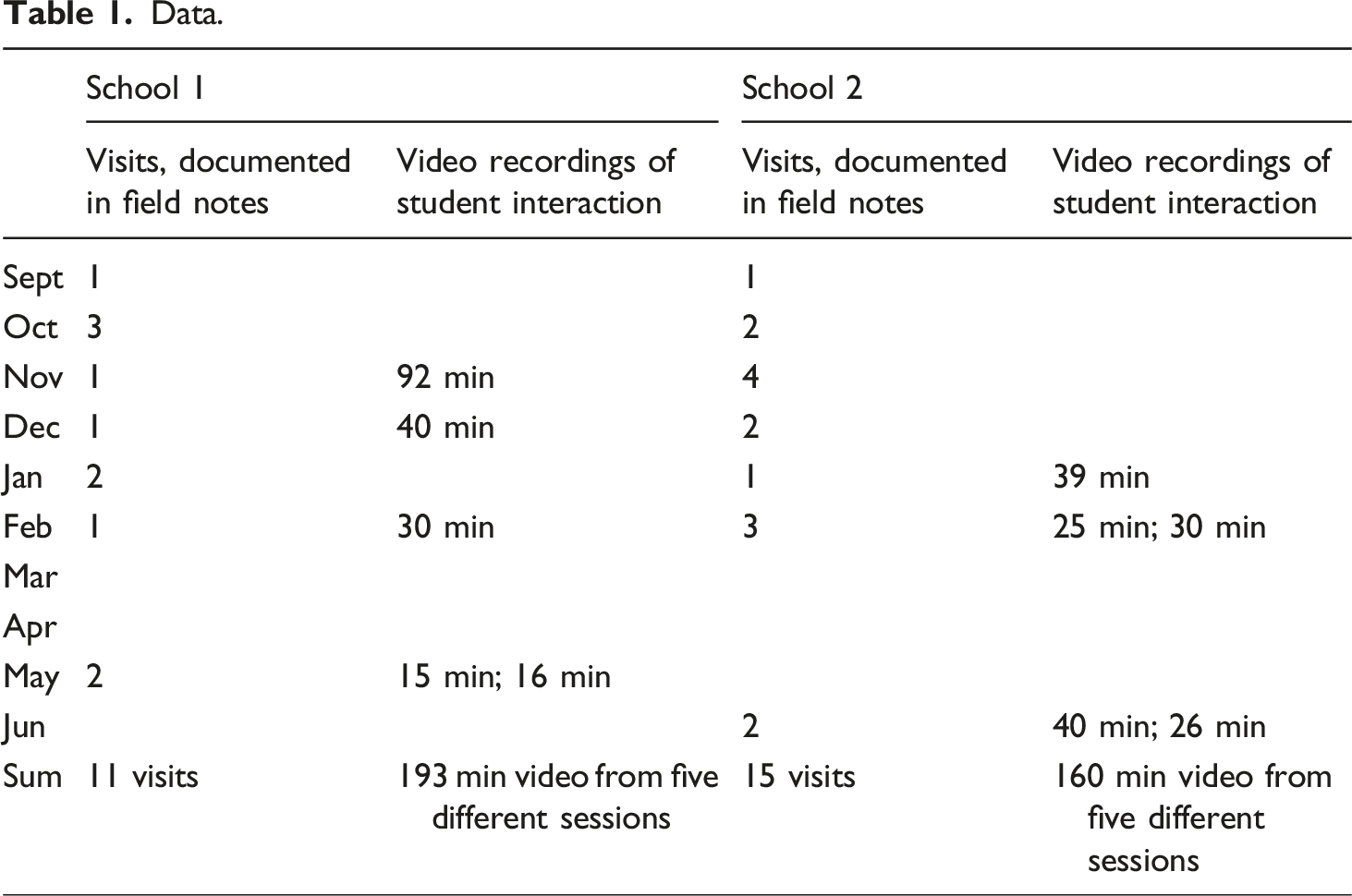
The field notes were written as running accounts (Heath and Street, 2008: 77) of what was occurring in the classroom. They were typed into MS Word documents after the visits, and the researcher’s reflections were separated from the running account using different colors or textboxes. The field notes were part of the data collection to answer the overall question in the project and were shared between the five members of the research group. Therefore, these field notes covered a broad spectrum of what occurred in the writing classroom.
As this study’s topic evolved, the two authors and one master’s student (Johansen, 2021) started to pay extra attention to interactions, both through live observations and video recording. We made nine video recordings (totaling 5 hours, 27 min, Table 1) of students who had the opportunity to interact with each other while writing, as they were placed in either groups or pairs. These video recordings were made by the researchers using either a handheld camera or a camera placed on a tripod next to the students. Which students we recorded was not systematically chosen; sometimes we would place a camera next to a table where alternating groups of students were writing, while at other times, we chose a pair or group that seemed to be engaged in writing and interaction.
A limitation of these data is that, as we only had one or two video cameras, we could not record all group or pair interactions. More data could have revealed other patterns, and following some students over time, instead of varying who we observed and recorded, could have made us more aware of students’ personal dispositions when it came to interaction. Furthermore, we might have had more diverse data had we examined more schools. It might also have been beneficial to not limit observations to sessions dedicated to learning to write, as the students might interact in other ways when using writing in other school subjects. However, we believe that the many observations over the course of a year and the finding of recurrent patterns between two schools and various students are strengths of this study.
Data analysis
During the first step in the analytical process, the two authors jointly looked through all the data that the research group gathered (field notes and video recordings from 26 visits) to identify episodes in which students were interacting while writing individual texts. The word ‘episode’ here refers to a stretch of time during which two (or more) students interacted, before they physically moved or simply stopped talking. Such episodes were only included in our collection of data if the students talked about something related to writing. Interactions where the teacher took an active part in the conversation were excluded. This resulted in a selection of 23 episodes – 14 from the video and nine from the field notes. 10 of these were from school one and 13 from school two. The episodes varied from short exchanges lasting for a couple of minutes to recordings of students who sat together and interacted for a whole writing session. We made rough transcriptions of the video recorded interactions, noting what the students said, wrote, and how they used each other’s texts and other material objects.
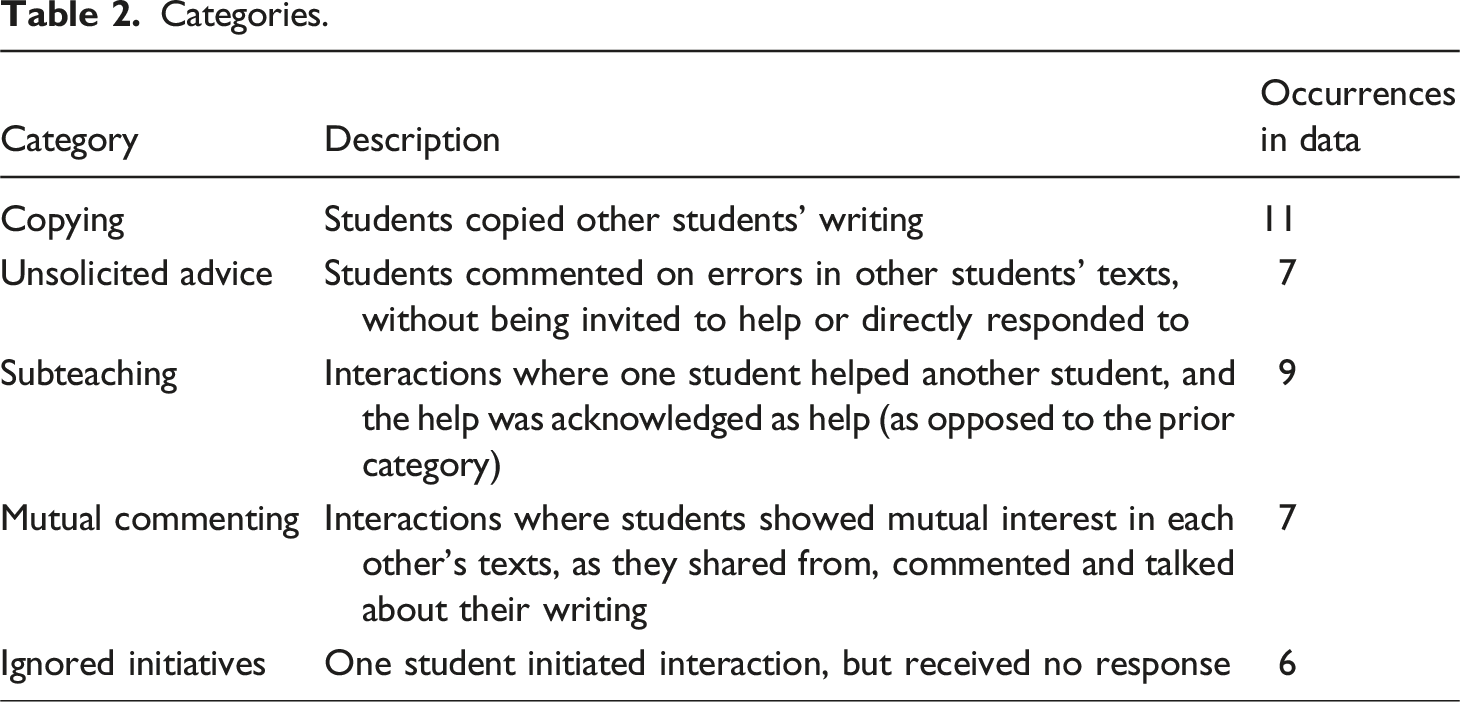
Categories.
Findings
We found five patterns that characterize how the students in our data interacted. In the following, these will be presented in the form of an overall description (Table 2) and through examples and short discussions on how each pattern is related to different dimensions of learning to write. To ensure anonymity, all student names are pseudonyms.
Copying
Copying is when students consciously wrote what they had seen other students write. The student being copied could choose to hinder the copying by moving their paper or shielding it, but this rarely happened in our data (but see the category ignored initiatives for an exception). Notably, most students denied copying if the teacher asked them, perhaps indicating that they viewed copying as an illegal activity, although the teachers did not stop them if they spotted copying.
In the following example,
1
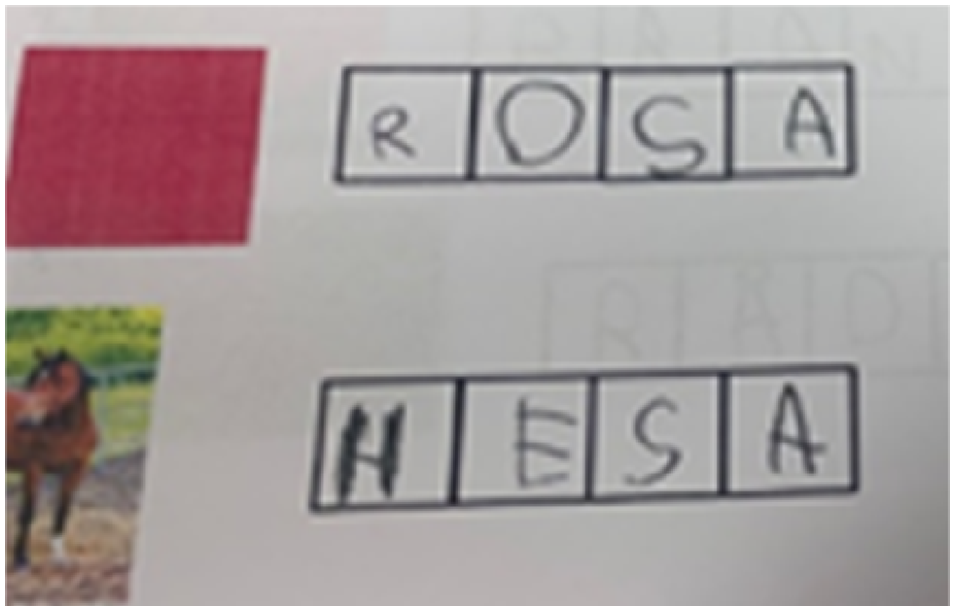
the students were writing down words based on pictures, and the letters were to be written in one square at a time. Nora sat next to Therese, and asked if she could look at what Therese was writing. Therese agreed, and Nora then started to copy. In Nora’s text, there were several examples of Nora copying letters into wrong slots, as shown in Figures 1 and 2. Here, Therese had correctly written HEST (horse), while Nora had written HESA. As Nora was copying letter by letter, she probably mixed the fourth letter with the fourth letter of the word above (ROSA). It seems here that Nora was not monitoring her own writing, as she didn’t detect this or other similar errors. Therese's text. Nora's text.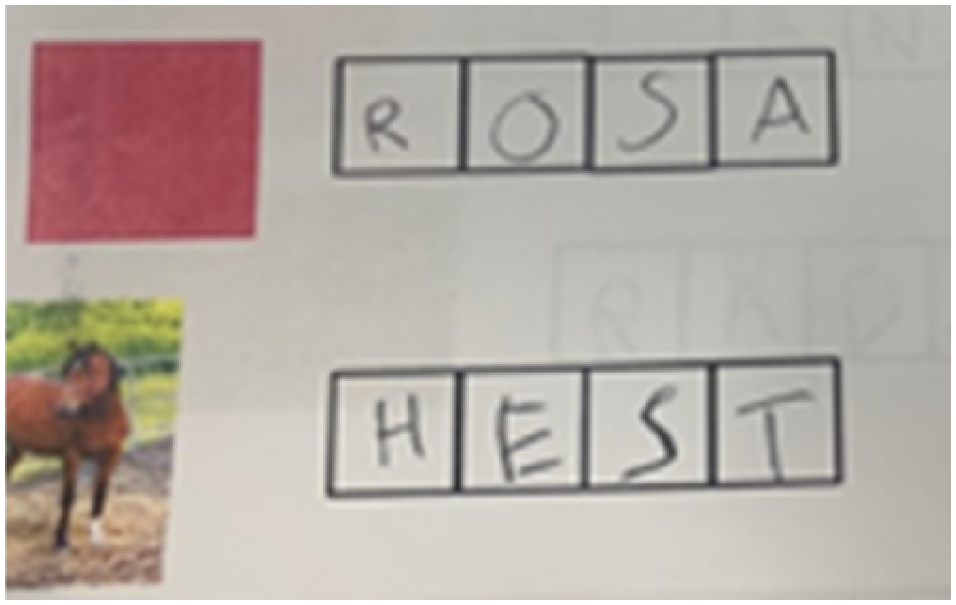
The next example involves copying words and sentences instead of letters. In this situation, all students brought a toy to class, and they were asked to write a description of their toy. The teacher told them that she would read the descriptions aloud, so that the class could try to guess which toy was being described. Naomi sat down next to Fie and placed her toy mouse in front of her, in the same manner as Fie had placed her bear. After writing the heading “MY TOY” she started to look at Fie’s text and soon started to copy it, sentence by sentence. This resulted in a text that was not suitable as a description of her toy. For instance, Naomi copied Fie’s description “it has small ears,” even though Naomi’s toy mouse had rather large ears. However, when, after some time, the observing researcher pointed this out for Naomi, she kept Fie’s sentence structure, but changed the adjectives into ones that fitted better. In this way, she ended up having a text when the time to share came.
Unsolicited advice
Unsolicited advice is a pattern whereby one student approached another with comments or advice about the latter’s writing, without being invited to do so. In our data, such advice was always oriented towards spelling or letter formation. In five of the seven examples, the advice was simply ignored or answered minimally, while in the last two, the advice was directly rejected.
In the following example, Tina ignored Siri’s advice and intervention, and did not seem to take interest in Siri’s advice at all. Siri: I think you have made a tiny error Tina: Where? (sounds a bit annoyed) Siri: Um … sorry for saying it, but you have missed something. You have forgotten (points in Tina’s text) period here. (Siri writes a period in Tina’s text. A student passes by, and Tina turns to him.) Siri: And then you should have one more (writes another period in Tina’s text. Tina is still turned away from her text, looking at the other student. Both girls then turn towards something taking place on the other side, before they turn to their texts, without mentioning what Siri had pointed out.)
Siri here provided advice without being invited to do so. Although she formulated it in a mitigated way (“a tiny error”, “sorry for saying it”), Tina seemed uninterested, and simply did not respond to it. This was the most common response to unsolicited advice in our data.
In other situations, however, the advice was clearly rejected by the receiving student. In the following example, Tim and Siv sat beside each other during a writing session, but up until this point, they had not been talking. Suddenly, Siv pointed to Tim’s text and stated that a “J” had been written the wrong way around and therefore looked like an “L.” Tim responded by pointing at different random places in his text, asking in an offended tone whether she meant “this J” or “this J.” When Siv repeated what she first said, Tim merely said “no” and demonstratively stopped answering. Siv summoned the teacher to support her, and Tim made an accusation about Siv’s writing – that her “S” had been written the wrong way around, which it had not.
Subteaching
Although the unsolicited advice might have been intended as being helpful, the receiving student did not seem to acknowledge the advice as support. However, in our data, there are many instances of students supporting each other, where the help was clearly welcomed. As mentioned in the introduction, the term subteaching refers to practices in which one student assumes a teacher-like role during the writing interaction (Tholander and Aronsson, 2003). In the interactions in this category, the two participants (the “subteacher” and the “student”) implicitly agreed on the new frames by interacting according to these positions.
In eight out of nine occurrences in our data, the subteacher followed initiatives from the student, as in this following interaction between Ali and Tim, who were writing wish-lists for Christmas. Neither of the boys were orthographic writers, but Tim knew most letters and how to segment phonemes, which was something that Ali struggled with. Tim and Ali sat close to each other and talked enthusiastically about the TV-game Mario Kart. When the teacher asked them to start writing, Tim immediately started and seemed concentrated on his writing. Ali, however, stopped after writing an “M”. He shouted out to the teacher “how do I write Mario Kart?”, but before she answered, Tim started to sound out each phoneme in the word for Ali. Ali turned rapidly to his paper and as Tim identified each phoneme, Ali wrote down the corresponding grapheme. Ali sometimes asked Tim if he had found the right grapheme, by pointing at letters in the alphabet-sound-helper (a laminated paper with the alphabet and corresponding pictures of words that start with each letter) or in Tim’s text. This sequence was wrapped up by Tim, who stated: “Now it says Mario Kart”, and Ali smilingly sang out “Mario Kart! Mario Kart!”.
The next example is different from the rest, as the subteacher here takes on a much more active role. The class was writing a letter to the principal, and the three girls Helen, Anna, and June were sitting next to each other. In the beginning, the girls wrote individually. As Anna and June talked about which letters to use, Helen, who was a much more skilled writer, often looked at them, gave answers for what they were discussing, and showed them her paper to instruct them on how to write letters and words. Anna then asked Helen to write a letter for her. Helen wrote the letter on a new piece of paper so that Anna could copy it – just as the teacher often had done. This then became a strategy they used going forward: all three girls agreed on something to write, Helen wrote down the words, and Anna and June copied them into their own texts. As the real teacher did, Helen sounded out the letters as she wrote them, and she guided the other girls if they were unsure of where to write. She also moved so that she was standing between Anna and June, in order for them both to see what she wrote, and Anna especially followed Helen’s writing closely (Figure 3). Helen (middle) guides Anna (left) and June (right).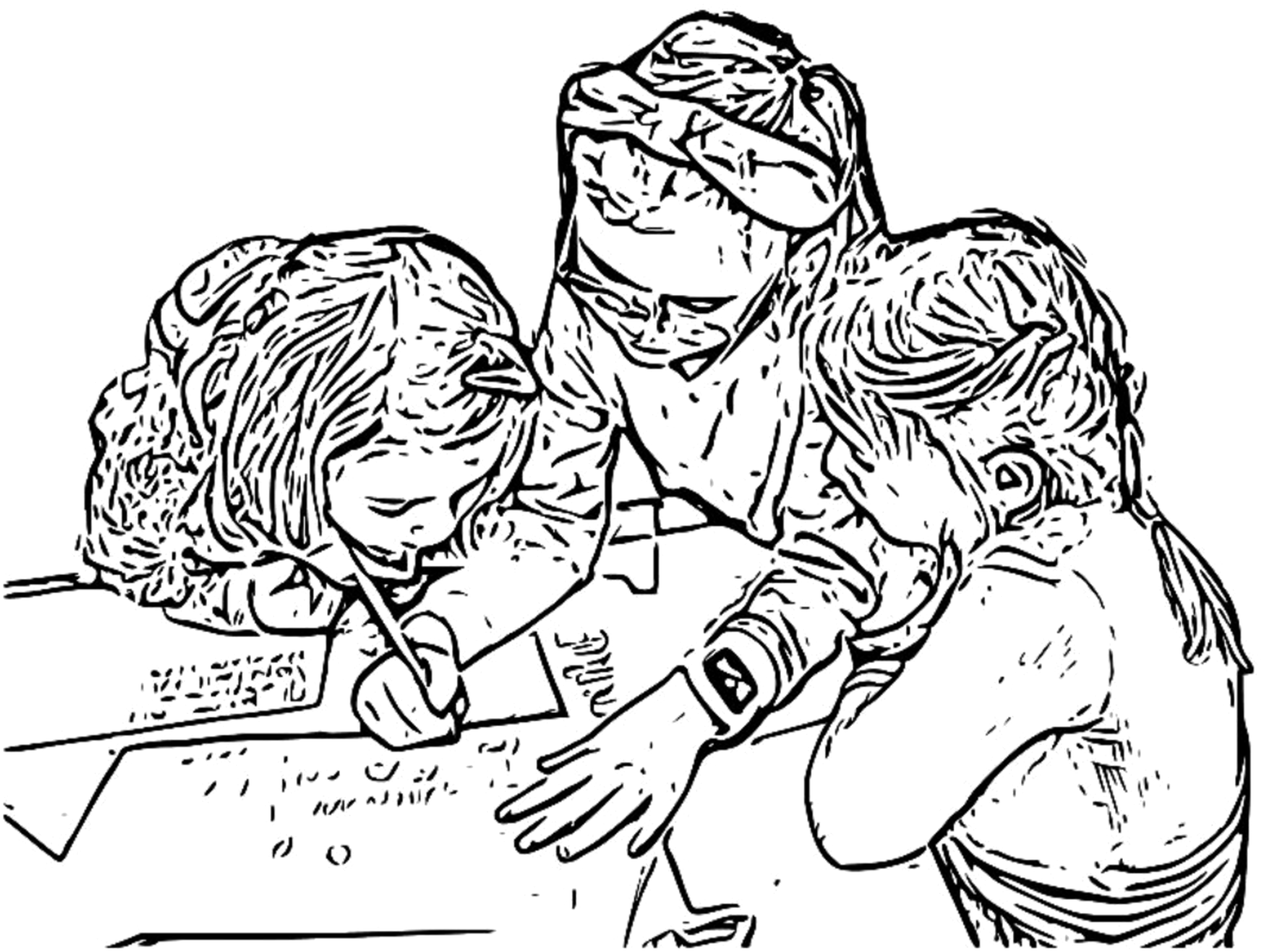
After a while, June seemed to lose interest in the writing activity, and started to play with her pencil sharpener. Helen tried several times to make June write down a sentence that Anna had copied into her text, but as June kept avoiding writing, Helen ended up writing the sentence in June’s text, and then declared that they now had similar texts.
In both these examples, we find that the subteacher’s discursive position was made possible by how the students asked for and followed the subteacher’s instructions. In the first example, Ali knew what he wanted to write but lacked knowledge of how to identify the letters. Tim helped him to do precisely that, as he followed Ali’s pace and allowed Ali to find the letters by himself. In the second example, we found that Helen moved from following the students’ requests and developing the text together, to more or less dictating what they should do, and ended up taking over June’s text.
Mutual commenting
In this category, students who sat next to each other engaged in each other’s writing. They showed and talked about what they were writing or drawing, inviting each other to serve as audiences and inspirators for their writing. Both students commented on each other’s texts, without one student seeming to lead or help the other. The interactions were often playful exchanges with a lot of laughter as the students played with the text’s words, sounds, and content, and they were often seeking the others’ confirmation and attention.
In this example, John and Eric explored letters and writing in a playful manner as they used their knowledge about the salience of direction when writing letters and how some letters (and numbers) look alike. While they were writing their individual texts, they both looked at the other’s text from time to time and talked about what they were writing. At one point, Eric sounded out the word “magic” (in Norwegian, “magisk”) while he was writing. As he uttered “/m//a//g/,” John started to search through the alphabet-sound-helper to find the “G.” John pointed at the “G” for Eric to see and said, “Here is the pig,” as a pig is used as an illustration for the letter G (pig in Norwegian is “gris”). They both laughed, and Eric said, “I’m not having a pig!”, before he wrote down a “g.” He then looked at the letter he had written, commented “No, no, that was a 9,” and looked for an eraser. John looked and said, “Really, it is the letter ‘E’,” and Eric followed by saying “because it is the wrong way around.” They both studied the alphabet-sound-helper more closely, and Eric commented that he would write “the small ‘g’.” Again, John searched through the alphabet-sound-helper to find the “G,” but now Eric simply said, “I’m going to take the pig” and wrote a new “G.”
In the next example, Tina and Siri created a new word that they both found funny. After having talked for a while about what to write, Tina said to Siri: “What were you going to write – were you going to write blueberry-fart?” Siri confirmed, and Tina said that she also wanted to write that. They both laughed and turned to their papers. Tina sounded out the word and wrote it down first. Siri then looked at Tina’s paper and copied the word into her text. They both laughed and repeated the word to each other and to the teacher who was passing by them.
Ignored initiatives
In the final category, we found six examples where students ignored a peer’s attempt to interact during writing. Three of the examples involved students who were sitting close together and obviously must have heard each other, but who did not respond to the other’s questions. In one example, a group of six students sat around a large table, and as many of them were spelling words out loud as they were writing, there was a sound of low voices. In this situation, Stig said, several times: “I don’t know what to write,” but without directing the utterance at any specific student. Neither of the students answered him. We interpret this not as a deliberate decision to ignore Stig, but rather as an example of how students were often occupied with their own writing and did not rush to interact with or help others.
In two other examples, students were more clearly ignored, as in the interaction between Kari and Stine. From the beginning, Kari openly looked at what Stine was writing, and copied from her. After 2 minutes with no interaction, Kari started to talk: Kari: What are you writing?
(Stine continues to write without showing any sign of having heard Kari’s question.)
Kari: “I wish”?
(Stine continues to write without giving an answer.)
(Kari turns to her own paper, but then starts to look at Stine’s paper again, and copies.)
Kari: What-what ‘are you writing? (more insistent tone) Stine: Are you looking? (sounds annoyed) Kari: No Stine: Yes Kari: But, what is this? (points in Stine’s text) Stine: “wish” (Kari turns to her own paper. Stine watches as Kari writes.) Stine: What does it say? (Kari does not answer.) Stine: It only says “wish”.
(Stine turns to her own paper, both continue silently.)
This interaction is also coded as an instance of copying, as Kari copies Stine’s writing, but at the same time, it included an initiative to interact that was ignored. Kari here showed an interest in Stine’s writing, in a way that could have led to an instance of mutual commenting or to subteaching. However, Stine did not follow up on Kari’s first initiatives, and when she finally answered, it was Kari who did not answer back. This writing situation continued in this manner for another 8 minutes before the students moved to another activity.
A different example is found in the same situation as the instance of subteaching involving Helen, Anna, and June. Here, a fourth girl, Rose, tried to copy Helen’s writing. Helen placed her hand over her text when she discovered that Rose was trying to copy her. Helen then turned towards Anna, indicating that she preferred to cooperate with her rather than with Rose.
Discussion
Socio-cultural theories of writing emphasize that writing is learnt “with and through others” (Myhill and Chen, 2020: 3) The intended meaningful writing activities in our data seemed to make students take an interest in each other’s writing, as they wondered what their peers were writing about. Through such interaction, the students got to know each other’s texts, which could be said to be vital in establishing the class as a writing community. We found this to lead to playful and joyful exchanges, as was especially seen in the mutual commenting and subteaching categories. When given the opportunity to interact, students often acted as inspirators, audience, and readers for each other as they talked about what to write, and played with words and expressions, as also shown in, e.g., Jaeger (2021) and Schultz (1997). Expressing and displaying friendship often seemed to be part of the writing interaction, and was sometimes shown by the students’ enjoyment of writing the exact same word or text.
As seen in our examples, seating arrangements and proximity were essential conditions for much of the interactions. As Rowe stated, “Spaces provide opportunities for some kinds of learning-to-write interactions and decrease the probability of others” (Rowe, 2010: 140), and we found that proximity supported involvement and interaction, as students pointed at letters, read, and used each other’s texts.
Many of the students in our data did not yet master what Puranik and Lonigan (2014) called the procedural elements of writing, and our findings indicate that interaction helped these students to still be participants in the writing activity. For instance, by copying, students produced a text that they would not have been able to write on their own, and could therefore participate in the subsequent sharing of texts. Also, students experienced being the composer of a text, as for instance Ali who received enough help to write Mario Kart in his wish-list. In such ways, the students got to be participants in activities that were central to the writing community.
The findings further support earlier research in that interaction and talk gave students experiences of analyzing and producing words and sentences as they talked about their writing (Bomer and Laman, 2004; Dyson, 1983; Herder et al., 2018; Jones, 2003; Schultz, 1997). This became particularly evident in the subteaching and mutual commenting categories. For instance, students developed a shared metalanguage, as seen in the example of Jan and Eric’s discussion about ‘the pig’; and they developed words and expressions that constituted new content for their texts, as in the example of the ‘blueberry-fart’. Such activity can be expected to increase the students’ metacognition and metalanguage on writing (Myhill and Chen, 2020: 6).
Graham (2018) claims that the skills, motivation, and knowledge of writers are shared resources in a writing community. Our data provides examples of how individual traits became collective through writing interaction, especially in the subteaching examples. An interesting finding was that students who had not mastered orthographic writing were still able to provide adequate help to other students who were struggling with phonological analysis or letter recognition. Students also indirectly modeled for each other how they used resources such as the alphabet-sound-helper or writing strategies such as how to segment a word into sounds. The findings therefore support earlier research in that young students can be resources for each other, and that the role of ‘expert’ can shift through the interaction, as argued by Daiute and Dalton (1993: 322) and Sutherland and Topping (1999). In addition, we found that students employed the same strategies as their teachers used, as shown especially in the subteacher-examples. This underlines that strategies and resources are re-established as shared resources for the writing community, through student interaction.
However, our data also showed limitations that followed when students interacted. Students are vulnerable writers as they are seated in crowded classrooms where it is easy to see each other’s papers (Bomer and Laman, 2004), as shown by the instances of unsolicited advice. Sometimes invitations to interact were disregarded, and sometimes students were conscious about whom they wanted to interact with and overtly chose one over another, as also shown by Yoon (2014). In some of our examples, students were allowed to choose who they wanted to sit next to. This provided the possibility to exclude students with whom they did not want to interact, as shown in the final example of ignored initiatives.
Rejections could also happen because unsolicited advice pointed at form-related aspects of writing that the writer was perhaps not concerned with or yet aware of, as in the example of mirroring letters. Young students are often oriented towards correctness (Herder et al., 2018; Schultz, 1997), and there is a risk that they mostly point out each other’s errors, thereby promoting a view of writing where form is foregrounded at the expense of content and purpose.
A different problem related to writing interaction was that subteaching and copying sometimes had the effect that students did not practice their procedural and generative writing knowledge (Puranik and Lonigan, 2014), and instead depended on peer help. Students who copied sometimes stopped monitoring their own text and reproduced a letter, word, or sentence without considering how it would fit in with their own text or situation. In such situations, the students neither explored nor practiced the phoneme-grapheme connection, and they did not use their own vocabulary or content knowledge to create texts.
There is also a risk that subteachers end up spending their time helping others instead of expanding their own writing competence, as when Helen, who mastered writing coherent texts, only wrote single sentences with Anna and June.
Theories that view writing as a social activity imply that building a writing community is an important part of working with the students’ writing development, and that encouraging students to interact is a vital part of building this community. The findings in our study confirm that young students can constitute such a writing community for each other. At the same time, however, the study also sheds light on the complexity and limitations. Writing development must be seen as being interwoven with individual development as a social being (Bomer and Laman, 2004; Yoon, 2014). When students exclude each other or point out each other’s errors or shortcomings, the teacher must address that as they would in other situations. Therefore, we claim that the social issues that appear when children interact while writing should not merely be interpreted as disruptions of their writing practice, but as part of what students experience and must learn to handle as they become writers.
Implications for practice
Based on this study and the findings from earlier research, we claim that students’ interactions are valuable when learning to write, and essential in inviting students into writing communities where they experience writing as creating meaning (Evensen, 2010). This should encourage teachers to welcome students’ interaction when they prepare writing assignments and make seating plans for the classroom.
However, Schultz (1997) warns against using collaboration as a technique and argues that the value of student collaboration is related to the overall classroom climate and interaction and writing practices. Arguing for the benefits of collaborative learning, Littleton and Mercer (2013) assert that students must be taught how to talk in ways that lead to shared thinking: “just giving them opportunities to collaborate is not enough” (Littleton and Mercer, 2013: 96). Therefore, although we agree with Kissel et al. in that effective writing classrooms “cannot be silent ones” (Kissel et al., 2011: 450), we also argue that one should not take a naïve perspective, believing all talk to be productive. It is important, for example, to be aware of how some students might depend on others’ help instead of trusting their own ability to explore and try out writing. In addition, teachers should keep a keen eye on whether students’ comments might be too oriented towards correctness.
Awareness of the patterns identified in the present study can help teachers to see beyond the ’noise’ of students interacting, and to pay attention to whether students are engaging in active learning and exploration. Also, the finding of how students reproduce the strategies used by the teacher underscores the teacher’s importance as a role model in creating a supportive writing environment.
This study also sheds light on the importance of observing students’ writing process, not just their written products, to understand the students’ writing practice and development (Rowe, 2010; Zurcher and Stefanski, 2022: 20). A writing community in which students’ interaction is encouraged and given attention can provide meaning, motivation, and mastery, thereby helping students to develop as writers. Students who talk and laugh may very well be writing, exploring, and learning.
Footnotes
Acknowledgment
The authors thank Kathrine Vik Tollaksen, Randi Solheim and Synnøve Matre for inspiring research cooperation!
Declaration of conflicting interests
The author(s) declared no potential conflicts of interest with respect to the research, authorship, and/or publication of this article.
Funding
The author(s) disclosed receipt of the following financial support for the research, authorship, and/or publication of this article: This work was supported by The Research Council of Norway (288795).
