




Abstract
For decades, language and literacy scholars working within a sociocultural framework have laboured to bring attention to the strengths of marginalized students in an effort to create more inclusive and equitable learning environments (e.g., Cummins, 2000; Dyson, 1997; González et al., 2005; Heath, 1983). While this work has moved the field forward in invaluable ways, it has not consistently engaged with processes of marginalization as a complex practice, which has produced gaps in our understanding of how we can best address it in research and practice to the benefit of all learners. Drawing on the notions of literacy socialization (Sterponi, 2012) and syncretic literacy (Duranti and Ochs, 1996; Gregory et al., 2013a), in this paper I conduct a close examination of the in- and out-of-school literacy socialization practices of Max Calfu, a seven-year-old Chilean-Canadian boy, over the course of a year-long ethnography that I conducted with his family at their home, at his Spanish-English bilingual public school, and in transit between home and school in a large Western Canadian city. At school, Max’s Indigenous identity was regularly rendered invisible by the cultural capital his Chilean-national heritage held within the Spanish bilingual program (Calderón and Urrieta, 2019). Using thematic analysis (Saldaña, 2013), I demonstrate how Max incorporated the wolf figure into his literacy practices over the course of the research year, considering multiple scales of space and time, and in relation to key mediators. My analysis calls attention to the ways in which he drew on his syncretic literacy experiences to author his Indigenous identity in official and unofficial learning spaces. I conclude the paper by arguing that examining syncretism in children’s literacy practices can lay the foundation for a more ethically, emotionally, and culturally engaged language education.
Keywords
For decades, language and literacy scholars working within a sociocultural framework have laboured to bring attention to the strengths of marginalized students in an effort to create more inclusive and equitable learning environments (see e.g., Cummins, 2000; Dyson, 1997; González et al., 2005; Heath, 1983; Zentella, 1997). Researchers have tended to focus on learners labelled as being “at risk” of failing or falling behind. While this work has moved the field forward in invaluable ways, this approach has not consistently engaged with processes of marginalization as a complex practice, which has produced gaps in our understanding of how marginalization works, and how we can best address it in research and practice to the benefit of all learners. This paper presents a close examination of the wolf figure in the in- and out-of-school literacy socialization practices of Max Calfu 1 , a seven-year-old, Chilean-Canadian boy of Mapuche Indigenous 2 ancestry, over the course of a year-long ethnography I conducted with his family at their home, in transit, and at his Spanish-English bilingual public elementary school (Escuela Magpie School) in a large Western Canadian city (Corvidell).
The notion of syncretism, or syncretic literacy (Duranti and Ochs, 1996; Gregory et al., 2013a) refers to the agentive, creative blending or merging of cultural knowledge systems that occurs during cross-cultural literacy events and practices. Max’s grandfather, Eduardo, was a significant mediator (Gregory et al., 2013a) of his syncretic literacy and Indigenous identity socialization. Following Eduardo’s exile from Chile in the 1970’s, Canada became a space in which he could reclaim a strong sense of pride in his Indigenous ancestry. In Chile, however, Mapuche people continue to endure (and resist) substantial physical and symbolic repression by the Chilean state 3 (Carter, 2010; Crow, 2013). In the research I report on in this paper, I demonstrate how syncretic literacies are not just a “creative blending or merging” but also a form of intergenerational resistance and agency within fraught situations, particularly at school.
Building on a rich tradition of ethnographic literacy research (e.g., Duranti and Ochs, 1986; Dyson, 1997; Gregory et al., 2004; Heath, 1982, 2012; Kendrick, 2016), in this paper I consider the ways in which Max’s Indigenous identity was rooted in his syncretic family literacy practices, which echoed broader Indigenous and Mapuche cultural revitalization efforts. I also examine the ways in which he attempted to reconcile these meaningful home literacy practices, identities, and knowledge(s) with academic literacy expectations at school. Although the school featured displays of local and Latin American Indigenous art, most of the faculty seemed largely unprepared to engage more substantively with Indigenous cultures or students. Drawing on interview excerpts, field notes, and examples of Max’s schoolwork, I demonstrate how the wolf figure was an essential part of his syncretic literacy socialization, which enabled him to (re)assert an Indigenous identity in his literacy practices at school. While most of his classmates and teachers understood the wolf to be Max’s favourite animal, the following analysis of his literacy practices through the lenses of literacy socialization (Sterponi, 2012) and syncretic literacy (Gregory et al., 2013a; 2013b) demonstrate its cultural, spiritual, and kinship value to him.
The colonial ideologies and practices that Indigenous people around the world have to contend with are often perpetuated in classrooms, where Indigenous identities and ways of knowing are routinely marginalized, exoticized, appropriated, and exploited (e.g., Battiste, 2017; Hare, 2005). In a Spanish-English bilingual program where Max’s Chilean heritage had symbolic capital, it was unsurprising (though unacceptable) that his Indigenous identity was not equally valued (Calderón and Urrieta, 2019). I conclude the paper by arguing that examining syncretism in children’s literacy practices can lay the foundation for a more ethically, emotionally, and culturally engaged language education.
Children’s literacy socialization
This study builds on a robust body of work in the literacy socialization tradition (see e.g., Sterponi, 2012) that has used ethnographic methods to provide highly contextualized accounts of children’s in-and-out-of-school literacy development in order to advocate for a greater awareness and consideration of institutionally marginalized ways of knowing, reading, and representing. This research has demonstrated, in a variety of national, cultural, and linguistic contexts, “how language and literacy learning is embedded in the broader process of becoming a competent member of a community” or communities (Sterponi, 2012: 232; e.g., Duranti and Ochs, 1996, 1988; Dyson, 1997; Fader, 2009; Gregory et al., 2013b; Heath, 1982, 1983; LC Moore, 2008; Pahl, 2007). Most studies have foregrounded contextual aspects of how literacy and social belonging or “becoming” are related, such as identity, culture, language, ideology, representation, history, and power. A major contribution of the literacy socialization literature has been to demonstrate how students labeled “at risk” (officially or unofficially) are further marginalized by institutional ideologies, beliefs, and practices (e.g., Dyson, 1997; Hawkins, 2005; Heath, 1982; Willett, 1995). This study examines marginalization from a different angle. Here, I consider how the Indigenous identity of a Mapuche-heritage student was marginalized in the classroom, which may have inadvertently contributed to the cognitive imperialism (Battiste, 2017) that continues to marginalize Spanish heritage language learners of Indigenous heritage in schools (Calderón and Urrieta, 2019). This institutional reality was somewhat (though not entirely) surprising in a school that indexed its awareness and inclusion of Indigenous people regularly and overtly (e.g., having an Indigenous consultant on staff, regularly inviting Indigenous Elders and writers to speak, and commissioning Indigenous artists to lead art projects and paint murals on their walls).
Children’s text-making
While children’s text-making and identity formation begins long before they enter school (Kress, 1996; Pahl, 2007), the first few years of schooling are a particularly crucial time for literacy and identity development in children (Compton-Lilly et al., 2017; Dyson, 1997; Kendrick and McKay, 2002, 2004; O’Neil, 2015; Rogers and Elias, 2012). For many children, the onset of formal education is their introduction to the institutionalized literacy socialization trajectory that will have major implications for their social and cultural mobility as they grow. It is a trajectory that most will follow over the next 12 years of their lives, and one that has its roots in a variety of literacy practices and events embedded in significant intergenerational (at times intercultural, multilingual) relationships (Heath, 1982, 2012). Neither context (in- or out-of-school) is free of ideology or power structures, of course, but the homogenizing goals (e.g., standardization) of schools and curricula can be particularly fraught (e.g., Freire, 1970/2000). For instance, Kendrick and McKay (2004), Wiltse (2014), and Campano (2007) all examined, in different racialized, migratory, and cultural contexts, the ways in which children’s funds of knowledge, which appear in a variety of modes in classrooms, are often disregarded, which has negative implications for their engagement with literacy in that space. In traditionally marginalized groups, such as racialized learners and English language learners, the consequences of disengagement in institutional learning can be severely limiting, and can result in high rates of program attrition (see Gunderson, 2007).
Research on students’ in- and out-of school identities in relation to their literacy practices has shown that young learners tend to have a strong sense of who they are and/or aspire to become, what interests them, and how they prefer to communicate their identities and interests (e.g., Dyson, 1997; Kendrick and McKay, 2004; Kress, 1996; Wiltse, 2014). As Compton-Lilly et al. (2017) have put it: “a child who repeatedly writes about a favorite sports team or a favorite Disney princess is making claims on being a particular type of child” (p. 119)—and the same can be said of other ways of representing their interests (e.g., drawing, acting, film-making) (Cummins and Early, 2011; Rowsell and Pahl, 2007). For instance, Pahl’s (2007) examination of one Turkish-British boy’s (Fatih’s) drawings of birds over multiple timescales revealed that the bird figure recurred in his text-making not simply because he “liked” birds, as one might assume, but rather because it was rooted in significant relationships and life events. As a result, the bird figure served as a consistent, as well as affectively and semiotically meaningful device that Fatih deployed to make sense of his life and experiences. Compton-Lilly et al. (2017) also examined children’s literacy and identity, focusing specifically on the relationship between literacy engagement and intersectional identity negotiation in the children of recently arrived immigrants. Drawing on King (1988) and others, they used the lens of intersectionality to demonstrate how children’s various interests, relationships, and identities worked together, and to warn against our tendency, as researchers and teachers, to oversimplify student subjectivities and relationships to literacy and school.
Conceptualizing literacy socialization in Max’s case
To lend further analytic clarity to my analysis of Max’s wolves, I draw on concepts from New Literacy Studies (e.g., Barton et al., 2000; Street, 2017), such as syncretic literacy, that intersect with the foci of literacy socialization. As Duranti and Ochs (1996) put it: “The main idea behind [syncretic literacy] is the belief that, when different cultural systems meet, one rarely simply replaces the other” (p. 173). Gregory et al. (2013b) clarify that syncretism differs from “hybridity” and other apparent synonyms in its foregrounding of creativity, transformation, and process over product, as well as children’s intentionality, agency, and expertise in their own learning.
Two additional concepts that are useful in the analysis and interpretation of Max’s drawings, writing, and spoken words are hidden literacies and difficult knowledge. Rowsell and Kendrick (2013) define hidden literacies as “literacies that are least recognized by schooling” (p. 588), which tend to be those forms of communication that challenge the orthodoxy of text (e.g., visual arts). A closer consideration of such literacies is particularly warranted in literacy research with boys in North America, as there appears to be “an increase in underachievement by boys in reading and writing” (Rowsell and Kendrick, 2013: 588). While Max was a skilled reader and writer during data collection, the following examination of his drawings and oral narratives about wolves has implications for the ways that teachers can support boys who choose to engage in literacy through more multimodal avenues. Britzman’s (1998) concept of difficult knowledge also enhances the analysis, as “a concept meant to signify both representations of social traumas in curriculum and the individual’s encounters with them in pedagogy” (Pitt and Britzman, 2003: 755). In this study, Max’s knowledge and representations of the wolf become difficult knowledge at school because of their absence from, rather than inclusion in, the curriculum; in the settler state known as Canada, the absence of Indigenous knowledge in the curriculum, and the lack of opportunity to encounter it in pedagogy can be interpreted as the perpetuation of the myriad forms of erasure and violence that these colonial structures enacted (with similar forms of erasure being carried out in Chile).
In the analysis that follows, I demonstrate how Max’s Indigenous identity remained “hidden” in the margins of his literacy socialization at school, and in the discussion, I argue that his Hispanic identity was privileged at the expense of his Indigenous identity in a similar (bilingual) educational context.
The study
Researcher positionality, recruitment, and research ethics
I am a White, cis-gendered woman with no Latin American, Spanish, or Indigenous ancestry to my knowledge. The Latin American community in Corvidell was founded by Chilean exiles in the 1970’s, who welcomed subsequent waves of (largely refugee) immigration from Central and South America into the 1980’s and 1990’s. Many of the Chilean-Canadians I met while I was seeking opportunities to learn Spanish in the city were descendants of this wave of migration, and mobilized their difficult knowledge to advocate for a more equitable world. Their ideological orientation resonated strongly with the way I was coming to terms with the difficult knowledge in my German heritage, and subsequently deepened my commitment to learning Spanish in order to participate bilingually in that transcultural and multilingual social movement (for more detail on my positionality, see Becker, 2021).
After securing institutional ethics approval to conduct this study, I forwarded a call for participants to my personal and professional contacts. Valentina, the focal mother in this study, was a friend of mine before the beginning of the research. To mitigate any sense of pressure to participate, she received the same standard letter of invitation to participate that I had forwarded to others in my networks. About 3 weeks after receiving the recruitment email, Valentina contacted me and said that her family would be willing to participate in the research. I subsequently met with her family of four to outline the project’s aims, procedures and their right to withdraw their participation or data at any time. I also sought and obtained permission from Max and Ella’s school to conduct research there, from their classroom teachers, and a number of their classmates. Their maternal grandparents also consented to participate.
The majority of the over 300 hours of audio recordings that I made were in Max and his sister Ella’s grade two and four classrooms. Because I was in the classrooms so often, after the first or second observation I did not make whole-class announcements to remind students that the recorders were on. The teachers and I agreed that such an announcement was unnecessary (and disruptive, even). Interestingly, even when I announced the recorder was on and everyone had agreed to it, the children (at home, at school, and in the car) would often double check that it was on a few minutes later, or express surprise that it was on. Other times, especially at school when students would come across a recorder placed on the marker tray under the white boards or resting on the bookshelf at the back of the room, they would greet the recorder by speaking directly into it, or notice it and then lower their voice. The children were especially adept at negotiating their participation in the research, which was encouraging.
The participants
A total of 55 people consented to participate in the larger study, including Max’s and Ella’s nuclear family, maternal grandparents, as well as their classroom teachers, several classmates, other teachers in the school, and their principal (see Becker, 2021, pp. 51–52). In this paper, I draw directly on data generated by him, his sister, his maternal grandparents, his parents, and his grade two teacher.
Max’s maternal grandparents, Inés and Eduardo, were very involved in their grandchildren’s lives. Inés had been their teacher at school, and Eduardo frequently picked them up from school and cared for them until their parents arrived home from work. The children were very close to both of their maternal grandparents; they would sometimes appear in Max and Ella’s drawings and frequently came up in conversation. While both grandparents promoted a positive sense of identity in relation to their Indigenous ancestry, it became evident that Eduardo was a key figure in their socialization into Indigenous identities and worldviews—a socialization centrally mediated by text and the arts. For example, he spent time reading. The Seven Sacred Teachings of White Buffalo Calf Woman The Seven Sacred Teachings, co-authored by Métis author, David Bouchard (Bouchard and Martin, 2009), and would reportedly read them with his grandchildren after school. It is worth noting that a number of Max’s drawings were clearly influenced by the art in this text, and the family’s pan-Indigenous orientation is well reflected in the book’s preface by Bouchard 4 . Extending the book’s teachings, according to Inés, her husband would point out eagles and coyotes whenever they saw them as a way to recognize their presence and “review” their personal and spiritual significance (Interview, March 5, 2016).
According to both grandparents, Mapuche people continue to be strongly repressed and are represented in Chilean society “como una cultura desaparecida” (like a lost culture). Inés noted, however, that: ahora no es así, los [Mapuches] están siempre en la cara del, de toda la gente entonces… a lo mejor el odio [hacia ellos] se ha acentuado? (risa) Pero también es una cultura más presente. (It’s not like that anymore. [The Mapuche] are always in everyone’s face… maybe the hatred [toward them] has increased? (chuckles) But it’s also a more present/visible culture.) (Interview, May 3, 2016)
That Valentina could recall, her father didn’t start to embrace his Mapuche ancestry until he came to Canada: I think my dad got into his spirituality and environment and all of that when he came to know and found resemblances with the Native people here. Right? So that was always a part of my, mine and my sister’s upbringing was, which was very different than the rest of the Chileans that lived here right? (Interview, January 22, 2016)
She remembered that her father took Native Studies at the local university when he was in his 40s, which was a very validating experience for him and one in which he was able to make important connections. She described her own Indigenous socialization in terms of attending round dances and powwows as a girl, and having identity conversations with her dad like this one: I remember I would say “Dad, we’re half Spanish half Native, right?” He’s like “No!” (laughing) “You’re not. You’re mostly Mapuche look at your grandma from […], … and she’s not a short woman, and…” He talked to me about how people looked but it wasn’t just that for him, it’s different right? Being of an Indigenous culture was more of a, something meaningful for him? And how he taught us is more of a way of life and spirituality. (Interview, January 22, 2016)
In my home observations, the importance of keeping a strong and positive connection to their Indigenous identity was apparent through the pan-Indigenous artwork and artifacts that adorned the family’s common living spaces.
Valentina and teachers I interviewed at her children’s school confirmed that Inés had been instrumental in spearheading a number of educational responses to the Truth and Reconciliation Commission of Canada’s (2015) recommendations for education, such as inviting Elders into the school to deepen their understanding of Indigenous people and cultures in Canada. Invited guests included speakers (e.g., Inuit author Michael Kusugak; students’ family members) and muralists, who would give presentations and inspire further learning activities. Despite these strides, however, Valentina was disappointed that deeper shifts in understanding had not happened yet. As she noted in our third interview:
“You know there’s some times where Max says—and it’s sad because it’s from school—he’s like “Things, they used to be like this, right? They [Indigenous people] used to be here.” I said “No! We’re still here” right? And that’s sad, to me it’s sad that it’s not even, it’s not coming up properly in class. (Interview, January 22, 2016)”
Indeed, I observed the frequent use of the past tense to refer to Indigenous people during both Max and Ella’s social studies lessons (see also Battiste, 2017: 31–32) and noted the profound disjuncture between the Calfu family’s explicit Indigenous socialization strategies and the school’s efforts to include contemporary Indigenous perspectives and arts.
Focal participant: Max Calfu
Max was an inquisitive and creative 7-year-old boy. I often observed him reading for pleasure (at school, at home, and in transit), looking up information, and using figurines for pretend play. He was among the top students in his class and would sometimes grow impatient with classmates who didn’t understand things as quickly as he did. He was usually among the first of his peers to complete an assignment, even though he mentioned on a number of occasions that he preferred recess to being in the classroom (e.g., Interview, September 7, 2015). He was well-supported at home, academically and otherwise, by a grandmother who was a school teacher, and parents who believed strongly in the value of fostering early literacy, bilingualism, and cultural identity. He was an English-dominant heritage speaker of Spanish whose major interests at the time of this research included: soccer (Chilean and British teams), hockey, Star Wars, Piccachu, Minecraft, Skylanders (an interactive, figurine/videogame interface), and wolves. He would also regularly work Chilean flags into class assignments (something Compton-Lilly et al., 2017, have referred to as “transnational negotiations of self” p. 127) alongside renderings of his other interests. Of all of the meaningful characters in his life, however, the wolf figure held a special place in Max’s semiotic repertoire, as I will describe throughout the remainder of this paper.
Escuela Magpie School
Escuela Magpie School is a small, public Spanish-English bilingual elementary school with fewer than 400 students at the time of the research, located in a mature neighbourhood in Corvidell that was in process of gentrification. Indeed, around the year 2000, the school (with only English-medium programming at the time) was slated for closure due to low enrollment when someone suggested that the school pilot a Spanish bilingual program. The introduction of Spanish bilingual programming not only saved the school from closure, but its increasing enrollment eventually warranted the recent construction of a new, larger school.
While many of the students lived within a short walk or commute, the Spanish-bilingual program drew students from all over the city, and from families with very different educational and socioeconomic realities. Most of the students came from White, Anglophone backgrounds, though there were at least a couple of students in each class from other backgrounds. Many of the teachers were also White, Anglophone Canadians (like Sra. A, Max’s teacher), but an almost equal number were heritage speakers of Spanish (like Sra. B, his sister’s teacher). The principal at the time was a Spanish heritage speaker. The school’s official language policy was to speak Spanish in the mornings and English in the afternoons, though, as might be expected, actual language practices were much more fluid, and English was the main language used in peer-to-peer interactions regardless of time of day.
Data collection
Most of the data from the broader, ethnographic case study come from my classroom observations at Escuela Magpie School, which took place at least twice a week, from October, 2015 until early June, 2016. To better understand Max and Ella’s cultural identity development, and the ways in which their language and literacy socialization was negotiated through different modes at school, I spent one full day per week in Max’s grade two classroom, and another full day in Ella’s grade four classroom. Sometimes I would go on other days to attend school events or assemblies. I would enter the classroom in the mornings, usually just before the children did, and place one recorder at the front of the classroom and another at the back. Throughout the day, I would move the recorders around, turning them on and off with the school bells. Although the teachers occasionally invited my input on Spanish grammar or vocabulary items, or to help collect things or set up activities, for the most part, I stationed myself with my note pad at an unoccupied multi-purpose table at the back of the classroom.
On eight occasions (from December 2015 through June 2016) when Valentina and Manuel worked past the end of the school day and Max and Ella’s grandparents were unavailable to pick them up from school, Valentina asked me to drive them home and stay with them until she, Manuel, or one of her parents arrived. It was understood that this arrangement would be mutually beneficial, as I would have an opportunity to record the children’s interactions and ask them research-related questions, and their parents could rest assured that their children were being cared for by a trusted friend. Home observations were sparse (fewer than 10 over the course of the research year), and tended to take place while I was in the Calfu family home for other purposes. In other words, I never visited the home with the sole purpose of observing their lives in situ, even though this was part of the original research design. Shortly after the data collection period began, I realized that to have proposed such a research activity would have introduced an unnecessary degree of artificiality into our existing relationship. Semi-structured interviews with focal adults lasted from one to two hours. Interviews with the children were either done through focus groups or were impromptu (i.e., the recorder would be on and we would be discussing other things and then I would embed a few research-related questions into the flow of talk when it seemed like they might align with the surrounding talk).
Data analysis
Through a process of constant comparison and data revision, I transcribed all of the interviews and conducted a content analysis of the broader dataset (see Mayan, 2009) which allowed me to identify patterns and examine them in relation to intersecting factors that I captured in my detailed field notes. The transcription conventions are can be found in the Appendix. This initial step revealed the salience and significance of wolves in Max’s literacy socialization, and the importance of Eduardo as a mediator (Gregory et al., 2013b) of his Indigenous and literacy identities. I then coded the broader dataset and further refine my analysis, using analytic memos (Saldaña, 2013).
In this study, the amount of formal follow up that I did with participants about their data was quite limited, due mainly to participants’ very busy schedules, but also, notably, because most communicated to me in different ways that they felt this study was my undertaking, and when I would offer to show them transcripts of their interview data for instance, the idea generally seemed to make people feel self-conscious and they would tell me things like “oh, I’m sure it’s fine” and “I trust you.” Nevertheless, I did informally share reflections and observations with key participants with whom I had developed stronger rapport, like Valentina, Manuel, Sra. A, and Inés, and they offered informal support, critique, or clarification of those reflections. Their comments served as member reflections (Tracy, 2020), helping enhance my confidence in the credibility of my interpretations, and contributing new data to consider, which directed my attention to other topics or areas I hadn’t thought were important before. Ultimately, I came to realize that meeting some of the traditional criteria for rigorous qualitative research, like member checking, was not part of the way this particular study was evolving, and that respecting the amount of participation my participants desired to have (including in follow up conversations) was itself an ethical practice.
Working within the space constraints of this paper, I have selected three illustrative examples of how Max drew, wrote, and talked about wolves, indexing Indigenous identity socialization over the course of the 2015-2016 school year. I then discuss them in relation to his literacy socialization at home and at school, his multiple identities, and the syncretic literacy practices involving the wolf that worked along multiple timescales. For a more detailed description of the data collection and analytic procedures I undertook in the larger study, please see Becker (2021).
Findings
Finding Max’s wolves at home
At the first home observation in early September, 2015, Max and Ella proudly shared books with me that they had made with their maternal grandparents over the summer. Max’s book was about wolves (Figure 1), and Ella’s was about eagles. On the back of the book, a page titled “About the author,” Eduardo, who authored this section, positions Max as a writer with a long-standing connection not only to wolves, the “wolf spirit,” and the values associated with it (“strength, humility, and family ties”), but also to the Indigenous children’s literature (e.g., “David Bouchard’s stories”) from which he drew inspiration for his text-making. The text reads: About the author. Maximiliano Calfu [redacted in the image] is a young writer who likes wolves since he was 3 years old. He was very impressed by David Bouchard’s stories, especially those that describe the meaning of the wolf spirit: strength, humility, and family ties. August, 2015 Max’s summer literacy project (September 14, 2015).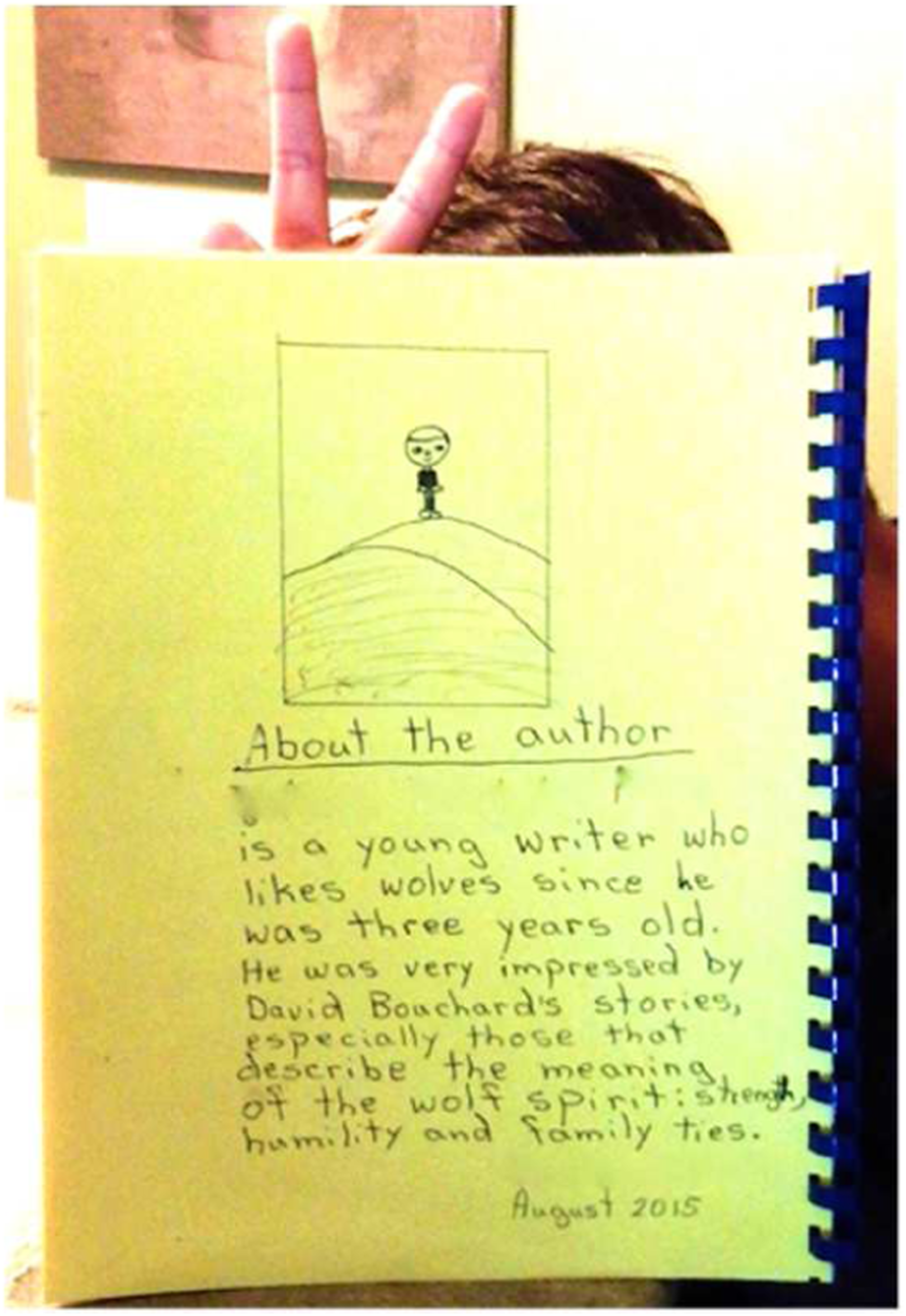
According to Inés, her husband would read David Bouchard’s stories with his grandchildren every time he picked them up from school and cared for them before their parents returned from work (Field note, March 16, 2016), which took the shape of a ritualized, intergenerational literacy activity from which meaningful projects such as this one could evolve—even at home, when school was out for the summer. Through this biographical text (Figure 1), Eduardo coauthors the relationship between Max’s Indigenous identity, his connection to the wolf figure, and his developing literacy skills and identity.
This summer project had left a strong impression on Max, and a desire to see it continue into the next year. The day before school started, I was unable to be with the family in person, so I asked Valentina if she might interview her children about how they were feeling about the incoming school year. After establishing that tomorrow was the first day of school, Valentina asked her son, “How do you feel about going back to school?” Max paused and then replied: Max: Happy and, sad. Valentina: Happy and sad? Why— Max: Happy and mad, sometimes. Valentina: Yeah? Max: Yeah. Ha.
Not accepting his mother’s subtle invitation to expand on why he might feel happy and sad and mad sometimes about going back to school, Valentina continued: Valentina: What are you looking forward to, at school? What, what, what’s gonna be your favorite thing, what do you want to learn about? Max: (quietly) Want to learn about (long pause) Wolves! Wolves. Wolves.
Wolves were clearly meaningful to Max, and so was the summer project that his school report on wolves evolved into with both of his maternal grandparents (Figure 1): Valentina: What’s your favourite school project last year? Or you did one over the summer right? Max: Yeah I liked my wolf report. I a:sked if I could do one but it didn’t end up so well, so I did it through the summer. Valentina: And who helped you with that? Max: My abuela! Valentina: And she made a nice little book for you, hey? Max: Yeah!
As Inés had also been his Grade 1 classroom teacher, the possibility to write the report over the summer was more likely than it might have been had she not occupied that dual role in his life. Furthermore, the freer mode of communication—creating one’s own book, versus filling in the blanks in one of the many teacher-provided worksheets and workbooks that awaited him in Grade 2—was undoubtedly memorable as it was more cognitively demanding and a product of conversations and reading in existing, meaningful relationships with grandparents.
Finding Max’s wolves outside
On February 5th, 2016, I was driving Max and Ella home from school. They lived at the very edge of town; their neighbourhood was loosely demarcated by a tall fence encircling the houses on one side of the road, and an agricultural field on the other. Remembering that Ella had reported seeing an eagle in her neighborhood before, I looked toward the field and asked: “Any eagles out today?” She then told us what she knew about the size of eagles’ nests, and then I offered that I’d also seen nests that size during a road trip I had taken through British Columbia. Max asked about the size of nest I had seen, and as I began my description, Ella drew a sharp in-breath and exclaimed: “Is that a fox?” and with another audible in-breath: “A wolf! Oh my gosh!” “No,” I uttered, having mistaken wolves for coyotes myself in this city as a child, “it’s a coyote.” “Oh,” she replied, sounding somewhat disappointed. But maybe I was wrong, I thought. I felt ashamed to have dismissed her observation so quickly. “Where?” I asked, to see if she could point to it. Her excitement crested again, and this time Max took notice as well: Ella: A coyote a coyote [right there! Literally!! Max: [Oh my gosh!! Ava: Oh yeah! That’s a coyote! Ella: [Oh my gosh!! Max: [Oh my gosh!! Ava: (laughs) That’s really sp[ecial Ella: [Oh my god!
As the energy in the car intensified, it became very clear that the coyote sighting was quite significant for both Max and Ella. My insistence that the animal we saw was not in fact a wolf didn’t seem to matter much to Max, however, who enthusiastically voiced his deep connection to the wolf in his next turn: “I’m lucky! I’m lucky! ‘Cause I have a wolf spirit! I’m lucky!” soon elaborating with “There’s my, one of my cousins!” Ella playfully attempted to downplay Max’s claim to his wolf spirit, first by stating “I like eating wolves yum yum yum!” and then by insisting that she had seen one when she “was really little but Max didn’t see it, so [she] should have had a wolf spirit instead of him.” Max stood his ground, though, skillfully drawing on his own story to counter his sister’s claim to have seen it “first” and therefore, have more connection with it: Ella: ‘Cause I saw it first. He was, he was asleep. He was asleep. Max: Yeah but [as soon as Tata showed me it— Ella: [I saw it. It was in the morning and it was a baby coyote. Max: Yeah I know. Ella: It was at night time. Max: And, and um, and [Tata showed me a wolf picture when I was a baby and I smiled. Ella: [that’s so cool! Ava: Ah! That’s how they knew that the wolf was your animal? Max: Yup.
In contrast to his sister’s repeated claims to have seen the wolf before him (and by implication, to have a greater connection to it), Max confidently constructed his counter-argument by re-voicing a memory of when he “was a baby.” His short but poignant narrative foregrounds their Tata’s crucial role in establishing his spiritual connection to the wolf through the literacy practice of sharing an image of the animal. In other words, simply seeing a wolf or coyote was not enough to be able to claim kinship to an animal; their Tata was a key mediator in this instance of cultural and spiritual socialization. Whether the animal was seen first—or even alive—was ultimately irrelevant, as becomes clear when Ella concedes to Max’s narrative about his Tata having shown him the wolf picture. Thus, we can see how powerfully the children’s Indigenous socialization was nested within their relationship to their Tata, and also to early literacy practices.
Three days later, Max’s class was on a field trip at one of the city’s public nature interpretation centres to learn about local animals’ winter adaptation strategies and also to try snowshoeing. Accompanying him on the trip as part of my fieldwork, I observed: At the Nature Education Centre, the interpreter shows a PowerPoint of different animal tracks in the snow and has the children guess which animal makes which print. A coyote pops up and everyone gets excited; a few mention that it might be a wolf. The interpreter announces that it was a coyote and that there were lots around town . . . . Max’s breath draws in sharply as his whole body slingshots his hand up, and he begins to say “we saw a…”. I could feel the recent story aching to be shared. It was so deeply meaningful. But the interpreter had an agenda and a lot of ground to cover (apparently) so he was not called on. She saw his hand, finally, as she moved on, and telling him to wait. Wait for what? The time never came. The story was buried. Later, in the hallway, some students were using the washroom before we headed outside and I watched Max try to tell his story to Sra. A, who was talking with a parent volunteer. She also told him to wait. He finally gave up and went to put on his boots and head outside. (Field note, March 8, 2016)
In many ways the lack of space for Max’s story in formal learning contexts, including classrooms as discussed below, is familiar. However, it does raise some important questions: Why are students’ funds of knowledge so frequently marginalized in formal learning contexts? Certainly, it isn’t always because of lack of time, or the “in/appropriateness” of children’s life experiences to their learning—oft-cited reasons that work to mask or naturalize adults’ decision-making regarding which stories/ knowledge they make space for. If we recognize that making space for student stories can be less a product of external constraints (e.g., time limitations and curricular “appropriateness”) than one that stems from the power that adults have to arbitrate which stories are heard and when, we must ask: Who benefits from these decisions? Whose stories are heard? When? In what contexts? And crucially: In what modes? What affordances might some modes have over others, particularly when addressing powerful audiences like teachers? And of what consequence might this multimodal power asymmetry be for students whose cultural practices are rooted in oral or visual traditions?
The wolf at the back
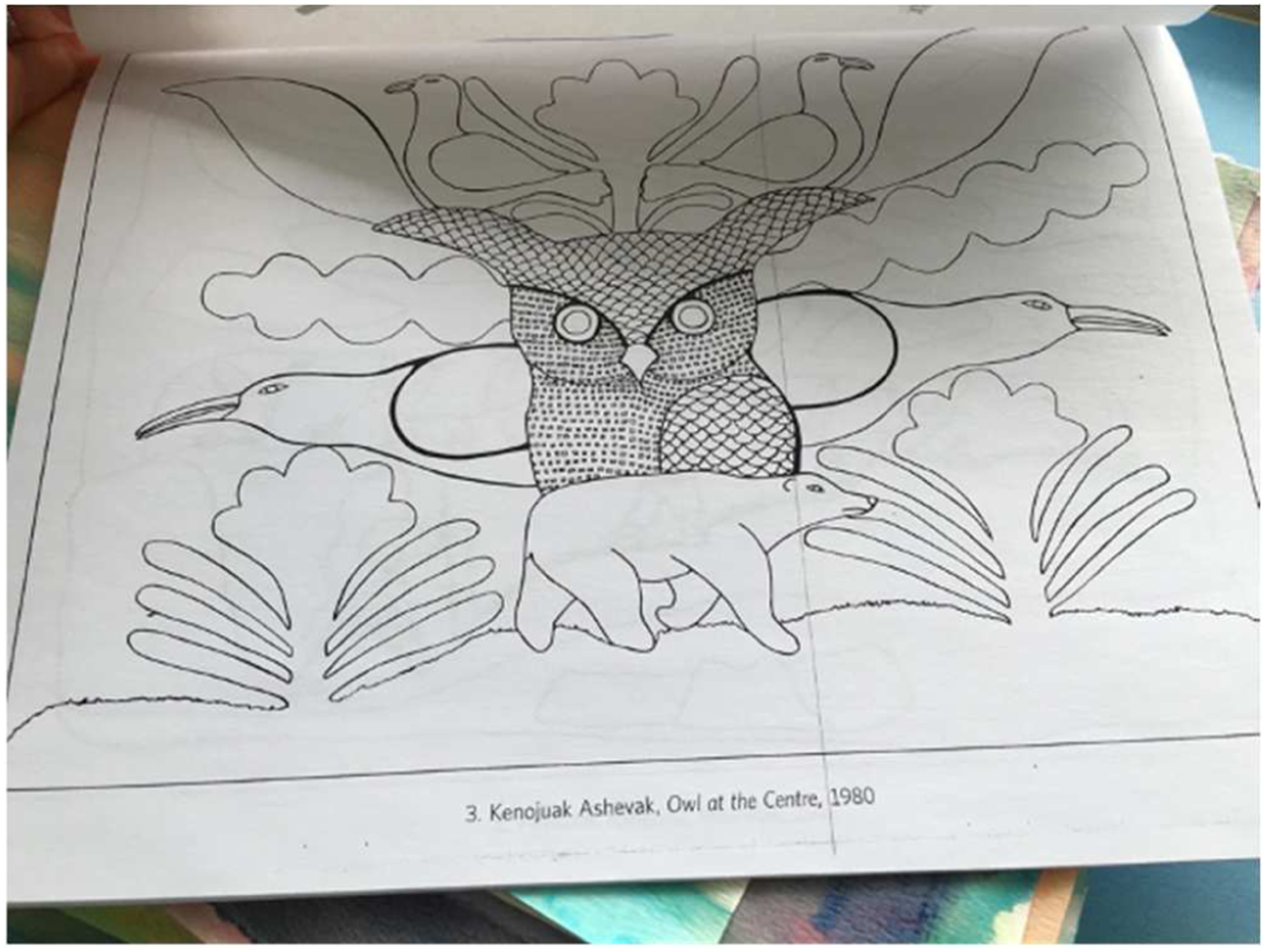
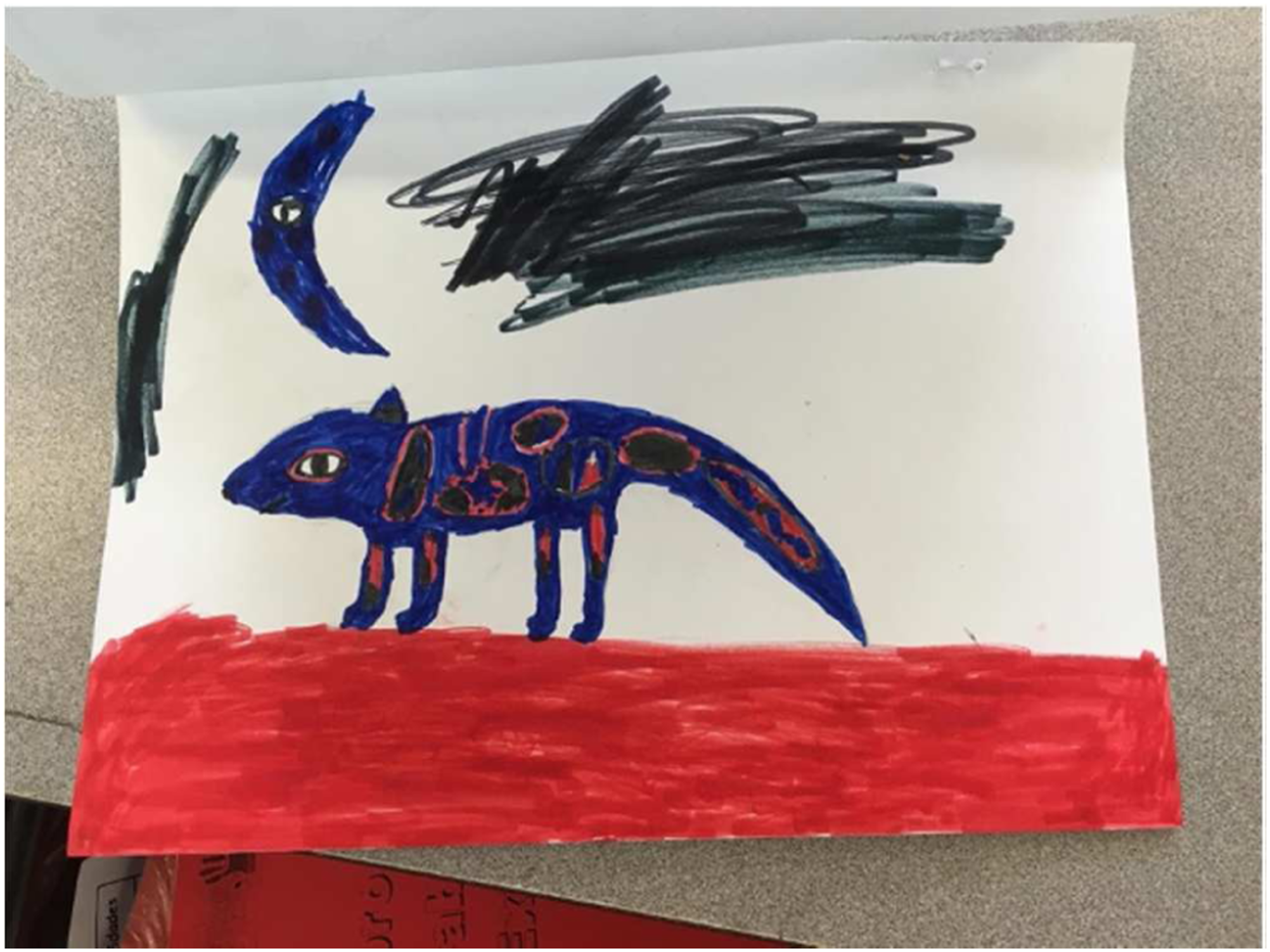
On May 10, 2016, after handing in a test, Max came to the back of the room where I was observing the class and somewhat nervously asked me to come with him: “I want to show you something.” I asked where it was, and he gestured toward his desk. We both seemed to be aware of the transgressive nature of our interaction, taking place during the undesignated classroom time he now found himself in. We communicated in low voices as he led me to the unofficial space his drawing now occupied at the back of his Inuit-themed colouring book (see Figures 2, 3, and 4). Most of the booklet’s official colouring pages were untouched. On the back cover of the photocopied and stapled-together colouring book, he’d drawn a wolf with intricate designs within it, including a star and a mountain (Figure 4). When I ask him about the star, he replied that he had seen it in one of his books. The cover of Max’s Inuit colouring book. One of the many untouched pages of Max’s Inuit colouring book. The Wolf Max Drew on the Back of his Inuit Colouring Book.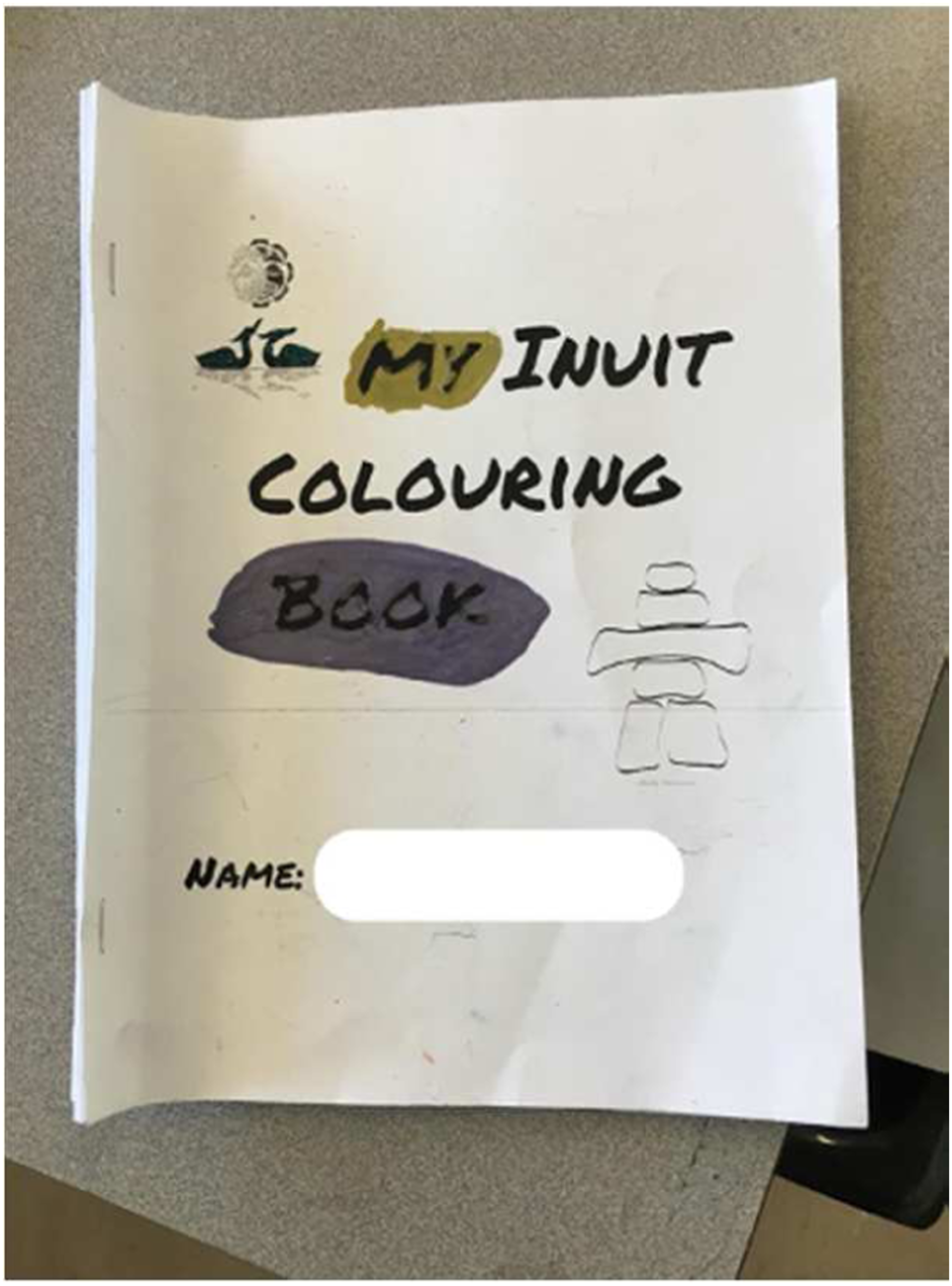
I pulled away from the interaction sooner than I would have liked because I felt obligated to observe the relative silence of the test-taking environment. In the last 10 minutes of the day, though, when the class was enjoying a period of unstructured time
5
, I approached Max again about the wolf drawing at the back of his colouring book, to which he was now adding more colour. Unsure of where to start, I pointed to the red-coloured earth the wolf was standing on: Ava: is that blood? (pause) Max: It’s the only colour I could find.
After a few more turns I asked: “So why’d you draw your own picture?” Claiming authority and agency over his creation, and ultimately negotiating his participation in the research on his own terms, Max replied: Max: Um… I just wanted to. Ava: yeah. Max: That and I got the idea ‘cause, and I did this at the Art Gallery with, um, What’s Your Story? and then I drew another one—
Just then, his best friend Pablo came over to us and interjected, commenting, as someone who knew Max well would: “Let me guess. A wolf.” “Yes,” Max confirmed. “Wow!” I continued, not wanting to lose the story’s momentum. “The Art Gallery?” Max: Yeah. Ava: They said what’s your story? and you drew a wolf? Max: Yeah. I did it this way.
I asked if Eduardo had accompanied him and his sister to the gallery, and Max confirmed that he had. In this sense, Max’s use of the blank page at the back of the colouring book served as a space for him to connect with the extra-curricular workbook in a personally meaningful and culturally relevant way, and in doing so, it became an opportunity for others (like Pablo and me) to inquire about his creative process and simultaneously validate the syncretic knowledge and relationships that his drawing indexed.
I decided to inquire further about the knowledge that seemed to be codified in his drawing: “So what are these symbols? What are your drawings symbolizing here [on the wolf’s body]?” After a long pause, Max replied: Max: I, I say it’s all his memories. Ava: It’s all his memories? What are they? Can you help me read it? Max: Shooting star… Ava: Uh huh. Max: And mountains… huge mountains. (pause) Max: I don’t know. I forgot what this is. Ava: Yeah. Max: I just did it. Ava: Yeah. Max: And this is to symbolize the tail. Ava: Mhm? What about here, near his lungs? Max:/Ein/, I just did that.
In Max’s family, remembering served strong social, affective, and political purposes (see Becker, 2021), so in this way, his wolf drawing can be understood as a representation of his connection to family—one whose memories of travel to the mountains and to recognizing wolves in the landscape—were another key part of his identity.
As we can see in the last few turns, Max’s explanations seemed to thin out, interspersed with responses like “I just did that.” So after a few more unsuccessful attempts to elicit deeper explanations, Max clarified: “‘Cause it’s mostly an artist we read about,” which speaks to the influence of reading on his text-making, and specifically to the importance of having access to texts by and about Indigenous authors at school.
Once the recorder was turned off following this exchange, Max mentioned to me that “he did the wolf drawings because he didn’t know what he was ‘supposed to do’ on that blank page” (Field note, May 10, 2016). The stark contrast between this rather resigned comment that echoed the language of school assignments, and the rich drawing he chose to fill the blank page with, haunted me. Max seems to have chosen to design (New London Group, 1996) his own drawing on the one blank page in the colouring book not because he was looking for instruction; indeed, he could well have coloured in any of the preceding colouring sheets. Rather, this choice to insert his syncretic identity (which indexed relationships, spirituality, and cultural heritage) on the last page of the colouring book enabled him to express his Indigenous identity in a less sanctionable way. Despite the pedagogical shortcomings of supplying an Inuit-themed colouring book to the children to work on in their spare time, the colouring book topicalized Inuit visual art, which seemed to make space for the visual representation of Max’s wolf in a way that worksheets or even classroom discussions had not been able to.
Without attentive and respectful audiences to create safe spaces for students with historically marginalized funds of knowledge (Campano, 2007; Marshall and Toohey, 2010; Wiltse, 2014), students have fewer opportunities to articulate the significance of their syncretic literacy practices. So when asked about their creative renderings of their identity texts (Cummins and Early, 2011) or funds of knowledge (González et al., 2005), a student might reply, as Max did “I just did it” that way, leaving authoritative others in their learning environments to believe, in cases like Max’s, that the wolf was his favourite animal, rather than the deeply significant cultural artifact, syncretic literacy tool, and Indigenous identity reclamation device that it was.
Discussion
The results presented above confirm the central role of family, heritage, culture, and spirituality in literacy socialization (see Gregory et al., 2013a, 2013b; Maybin, 2009; Sterponi, 2012) and particularly those of grandparents as caregivers and literacy mediators (e.g., Jessel et al., 2011). The lens of syncretism (Duranti and Ochs, 1996; Gregory et al., 2013b) highlighted the role of Eduardo not only as caregiver, but also as a key mediator of Max’s syncretic literacy socialization, literally coauthoring his grandson’s author biography (Figure 1). Throughout their interactions, which were frequently mediated by text, image, and narrative, Max and his grandfather were syncretizing their experiences, knowledge, and mutual interests. They were finding continuity in their shared Indigenous ancestry by creatively reapplying it (at times subversively, as in the colouring book example) to their present-day, local surroundings. Consequently, because language and literacy socialization “is both a lifelong and a ‘life-wide’ process across communities and activities” (Duff, 2012: 564), through their syncretic literacy practices in Canada, Max and his grandfather were able to successfully insert themselves into their own learning, identity development, and literacy socialization in ways that would likely not have been possible in other national, educational, or temporal contexts. As Duranti and Ochs (1996) and Gregory et al. (2013b) have posited, syncretism does not simply refer to supplanting one cultural practice for another, or braiding two or more cultural practices together. It implies the creation of a wholly new cultural practice out of the dynamic interplay of different social and semiotic (cultural, political, historical) influences. In the case of this Chilean-Canadian family’s literacy socialization practices, a powerful manifestation of syncretism can be seen in the way that Eduardo drew on local Métis and Cree authors’ work to inspire and support his family’s deeper Indigenous and literacy socialization goals—goals which were only partially supported by the school. In this sense, in this paper we saw how syncretic literacies can be a space for agency that extends from the personal to the political, taking the shape of intergenerational, cultural reclamation in the diaspora.
The value of Eduardo and Max’s syncretic literacy practices stretches across scales of space and time (Douglas Fir Group, 2016; Pahl, 2007; Rowsell and Pahl, 2007). According to Inés, the opportunity for their grandchildren to study in Spanish at school was “a dream'' that she and her compatriots had had since arriving in Canada as refugees of the Pinochet dictatorship in the 1970s (Inés and Eduardo Interview, May 3, 2016)—a move which, research has shown, could in fact support their Mapuche identities 6 . As Martínez and Mesinas (2019) have argued: “despite being a colonial/colonizing language, [Spanish] can serve as a powerful vehicle for Indigenous survivance” (p. 140) because it can help facilitate a connection to Chilean-Mapuche culture, in this case, which is significant in contexts of Indigenous language loss or erasure (see also Morales et al., 2019).
In a related way, Inés and her husband’s efforts to foster positive Indigenous identities in their grandchildren through literacy practices was fulfilling a dream that spanned decades and continents. Mapuche feminist activist, Rosa Isolde Reuque Paillalef (2002) explains the relationship between Mapuche cultural resurgence in Chile and the Pinochet dictatorship this way:
“If the dictatorship had any positive effect, it was to reawaken our culture. I think in times of great repression people look for ways to connect to each other and unify. When the repression was greatest, the Mapuche movement was strongest: with militant revivals of our language, our traditions, our traditional organizations. . . . Our greatest strength was that the younger generation was able to rekindle our identity as a people. (p. 115)”
Although Max and Ella’s maternal and paternal grandparents left Chile in the early part of the dictatorship, Inés and Eduardo carried the seeds of this cultural reawakening with them to Canada, and were able to continue on their path of reclamation, socializing their own children, and later their grandchildren, into proud Indigenous identities primarily through connections with local Indigenous peoples and participation in cultural activities like round dances and powwows. In this way, we can see how identity socialization in this family fruitfully extends foundational understandings of syncretic literacy to the realm of transnational (and transgenerational) political movements.
Unfortunately, at school, where the official focus was on Spanish-English bilingualism, the Indigenous aspect of Max’s ancestry was largely eclipsed by the school’s valorization of his Chilean/Hispanic heritage. Indeed, Max’s White Canadian teacher knew that his grandparents were actively involved in promoting Indigenous cultural awareness activities in the school, but it wasn’t clear to what extent she recognized Max’s Indigenous ancestry (or that of his Mapuche- and Indigenous-identifying peers, for that matter). This dissonance might have been partly due to “the false and pernicious representations of Indigenous peoples as vanishing Canadians” (Battiste, 2017: 31–32) (or as “vanishing” peoples and cultures more broadly) to which Valentina referred in an interview, and which I observed in the children’s social studies discussions of Canada’s Indigenous people. As such, language teachers committed to culturally responsive pedagogies would do well to educate themselves about the multiple histories and identities that their heritage language learners might hold, and look for ways to support those. Acknowledging these histories may be fraught, and even painful (Pitt & Britzman, 2003), but as part of the work of reconciliation and decolonizing language education, it is also invaluable (Macedo, 2019).
In formal learning spaces, Max was largely denied the power to impose reception (Bourdieu, 1977: 649) of his Indigenous identity and knowledge using the oral mode, which was even more profound given the colonial history of silencing Indigenous children in schools. However, by syncretizing wolves into his text-making at school—a powerful index of his ancestry, literacy identity, and family relationships—Max created ways to give voice to an aspect of his identity in an institutional space that could not or would not appreciate it (see Rowsell & Kendrick, 2013). In their analysis of Ugandan children’s drawings of HIV/AIDS, Becker-Zayas et al. (2018) observed that drawings can offer “children a less restricted and less institutionalized space to represent sensitive subject matter, which in turn, offers a means to insert themselves” into difficult yet important societal conversations (p. 385). While none of Max’s drawings represented anything that could be construed as “difficult” or problematic in mainstream classrooms, the spiritual, cultural, political, and kin relationships that his stories and drawings of wolves represented became a form of difficult knowledge in the classroom (Pitt and Britzman, 2003), because they represented knowledge that his White Canadian teacher had been socialized to understand only in a superficial way. In other words, she responded to them rather predictably, with the Eurocentric, colonial educational goals that have actively suppressed respectful cultural representations of Indigenous people and their intellectual and spiritual contributions. Consequently, Max’s rich understanding of and connection to wolves was not valued as such, and that aspect of his identity endured a form of symbolic erasure at school. This erasure also rendered his knowledge invisible to his peers as a learning resource.
Aside from large-scale policy changes, teachers have a significant role to play in transforming students’ (and their own) perspectives (Cummins and Early, 2011; Kenner and Ruby, 2013; Gregory et al., 2013b) regarding Indigenous learners from local and international backgrounds, and their relationship to both. Teacher education programs have a significant responsibility to prepare teachers to engage meaningfully and respectfully with their Indigenous-identifying students. What this might look like in elementary schools could take the shape of multimodal funds of knowledge (see Marshall & Toohey, 2010) or testimonio (testimonial) learning activities (Rodríguez and Salinas, 2019), or a Little Books Library in an easily accessible part in the classroom (e.g., Busch, 2020).
Conclusions and implications
For decades, language and literacy researchers have studied the ways in which schools privilege certain ways of being, knowing, and communicating to the exclusion of all others. Manifestos advocating greater social, linguistic, and multimodal inclusivity have been written (e.g., New London Group, 1996), and calls for increased socio-political engagement have been made (Douglas Fir Group, 2016). Scholars have put forth vital critiques of the underlying racist and colonial ideological biases in our research and teaching practice that have prevented (and in some cases, reversed) any real progress in this area (e.g., Flores and Rosa, 2015; Macedo, 2019). It would therefore be insufficient to conclude this paper by arguing that colonial models of education continue to marginalize students, or that students have complex identities, or that their out-of-school socialization has bearing on their in-school engagement and achievement. These points have been made, repeatedly and robustly (e.g., Dyson, 1997; González et al., 2005; Heath, 1982; Macedo, 2019).
The foregoing examination of the wolf figure in Max’s syncretic literacy socialization brings our attention to the interconnectivity of students’ funds of knowledge across time and space, via relationships, identities, and social movements, as well as multimodal forms of representation and expression. In this study, Max was being socialized into a syncretic Indigenous identity in a diasporic space through text, image, and narrative, which worked across scales, extending the current cultural revitalization work of Indigenous groups in Chile and Canada. It bears remembering that a child’s funds of knowledge are not theirs alone—they are nested within and linked to the knowledge of others in their world, which can span generations, as well as cultural, national, and importantly, political contexts. Just like Fatih’s birds (Pahl, 2007), children’s syncretic literacy practices are take place within socialization practices that work across multiple scales. In this way, the syncretic literacy lens sensitizes us not only to the complexities inherent in children’s text-making, but also to the embeddedness of their text-making in multi-scalar social, cultural, political, and historical contexts. Students’ stories are linked to other stories, which, as we saw in the foregoing analysis, can be the narratives of broader political and cultural movements. When considering the politicized elements that children’s literacy practices can embed and the key role they play in children’s broader socialization as actors in multiple communities of practice, it is difficult not to hear the intergenerational echoes of social justice lessons yet to be learned, and to ask questions about how these lessons might lead us toward a more affectively and politically conscious future (Freadman, 2014; Freire, 1970/2000; Macedo, 2019; Simon et al., 2000). The identity claims that students make multimodally are rooted in multiple, politicized histories and communities of practice. Acknowledging these claims and facilitating dialogue between them will be invaluable in building inclusive pedagogies for language and literacy education that are attuned to the increasing climatic, economic, and migratory uncertainty in the world.
Footnotes
Declaration of Conflicting Interests
The author(s) declared no potential conflicts of interest with respect to the research, authorship, and/or publication of this article.
Funding
The author(s) disclosed receipt of the following financial support for the research, authorship, and/or publication of this article: This work was supported by the Social Sciences and Humanities Research Council of Canada (752-2014-2305)

Notes
Transcription conventions
( )
My descriptions of non-verbal communication
[ ]
My clarifications
(( ))
Translation
[xxx]
Indecipherable
/xxx/
Phonetic transcription of utterance
“xxx ”
Text being read
Speaker emphasis
italics
Spanish
[
Indicates the beginning of an overlapping turn
=
Turn starts immediately following the previous turn
:
Drawn-out syllables (more colons signify greater drawing out)
word. word
Short yet noticeable pause between words
…
Voice trails off, resulting in a short pause between thoughts or phrases
—
Someone’s turn was cut short
.h
In-breath
Notes: Question marks, exclamation marks, periods at the end of a line, and commas are used conventionally, as they are in regular prose. Proper names are also capitalized. I include my participation in the talk, even when the content of what went before satisfied the thematic needs of the section, in order to give a more transparent account of my participation in the interaction.