



Abstract
The purpose of this study was to examine the outcomes of a home-based, repeated reading intervention in which texts are matched to children’s school-based instructional reading level. Results indicated that across the five cases, improvements were evident in reading accuracy, rate, and fluency for the take-home texts and all participants’ instructional reading levels increased during the intervention. Parents’ support for children’s reading differed across cases. The five participating children read more than 18,000 words during the course of the intervention.
Reading fluency, an indicator of automaticity in reading, is an essential element in successful reading endeavors. Fluency is often thought of in terms of reading rate, yet it comprises various components and is multifaceted. According to Kuhn and Levy (2015), fluency is signified by rate, which is an indicator of automaticity, as well as accuracy and prosody, which includes intonation and appropriate pausing. Further, Kuhn and Levy (2015) describe fluency as an element of reading that can either “limit or support comprehension.” The relationship between automaticity and reading comprehension was highlighted by LaBerge and Samuels (1974), who described the need for readers to focus their attention on meaning instead of decoding word by word. Although fluency is not synonymous with comprehension, the two appear to have a direct relationship with one another, whereby, children reading with fluency are more likely to comprehend the text and, conversely, children reading dysfluently are more likely to struggle with comprehension (Abbott et al., 2012; Kuhn et al., 2010; Perfetti & Zhang, 1996). If not addressed through instruction, struggles with fluency can persist throughout children’s years of schooling and beyond (Rasinksi, 2019).
To reach this level of automaticity, children need practice reading connected text and not just isolated words, to solidify their word recognition skills (Ehri & McCormick, 2004; Kuhn & Stahl, 2003). Yet, time spent reading connected text in school is often limited (Brenner et al., 2009), particularly for striving readers, as opportunities for reading in school are further diminished because more time is devoted to skill-based instruction and non-reading tasks rather than reading connected text (Allington, 1977, 1983, 2000, 2009; Juel, 1988; Chorzempa & Graham, 2006). Differences in reading opportunities for stronger and weaker readers is a primary reason children who struggle with reading, initially, continue to struggle with reading as they progress in school (Foorman et al., 1997; Juel, 1988; Stanovich, 1986, 2000; Stuart et al., 1999).
Home reading experiences also play a significant role in children’s reading development (Anderson et al., 1988; OECD, 2010). For example, children who read for pleasure outside of school have consistently higher literacy achievement on national assessments (National Center for Education Statistics, 2011). Despite the importance of home literacy, not all children have the opportunities to help them succeed in reading. Researchers have found that home language and literacy experiences vary depending on children’s cultural, linguistic, and economic backgrounds (Goldenberg, 1987; Hart and Risley, 1995; Heath, 1983; Jeynes, 2012; Maguire et al., 2018; Nord et al., 1999; Ortiz, 1986; Pollard-Durodola et al., 2017; Protacio and Edwards, 2015; Purcell-Gates, 1995). Building on our prior research (Hindin and Paratore, 2007), this study was designed to improve second-grade children’s reading performance by increasing their home reading opportunities while considering the role parents play in their children’s reading development. More specifically, we examine the ways home reading opportunities that use texts selected based on reading levels can influence children’s reading performance.
Literature review
Children experience difficulties with reading for a variety of reasons including, but not limited to, learning disabilities, early language and literacy experiences, and classroom instruction. Although there are many ways to improve children’s reading performance, one of the most important ways is to increase the amount of time children actually spend reading (Guthrie et al., 1999). Hiebert and Martin (2009) describe the importance of these opportunities to read (OtR) for children’s overall reading development. Research on the volume of reading that children complete in school demonstrates that although elementary school classrooms dedicate a large block of time to reading instruction, the amount of time children spend reading is quite small. For example, in a study of 32 schools, researchers found that during a 90-minute literacy block, children read for only 18 minutes, on average (Brenner et al., 2009).
Given the potentially limited opportunities that struggling readers may experience in school, it is important to consider ways to maximize their reading experiences outside of the school context. One way to accomplish this goal is to increase children’s home reading opportunities with the support of parents or caregivers. Building children’s home reading experiences aligns with the research that shows that both home reading opportunities and parent involvement in reading correlate with higher reading performance in large- and small-scale studies (Hindin and Paratore, 2007; Chall et al., 1990; Ece Demir-Lira, 2019; Inoue et al., 2018; National Center for Education Statistics, 2011; Dearing et al., 2006; Hewison and Tizard, 1980; Leseman and De Jong, 1998; OECD, 2010).
In addition to increasing overall home reading opportunities, the current study is designed to increase children’s reading fluency. The importance of reading fluency is tied to the connection between fluency and children’s reading comprehension (i.e., Rasinski et al., 2011). Fluency is evidence of automatic word reading, which allows the reader to focus attention on the meaning of the text rather than on decoding (Daane et al., 2005; LaBerge and Samuels, 1974; Kuhn and Shwanenflugel, 2009). Although rate and accuracy have been the primary focus of fluency research and assessment, recent research has demonstrated the important contribution of prosody as a component of fluency (Kuhn and Stahl, 2003; Rasinski et al., 2011).
One approach for improving children’s reading fluency is for children to engage in multiple readings of the same text. Researchers have found these repeated readings of the same text serve to build reading fluency (Chafouleas et al., 2004; Dowhower, 1987; Herman, 1985; Lee and Yoon, 2017; O’Shea, Sindelar, and O’Shea, 1985; Rashotte and Torgesen, 1985; Rasinski, 1990; Samuels, 1979; Sindelar, Monda, and O’Shea, 1990; Turpie and Paratore, 1995; Weinstein and Cooke, 1992). Repeated readings are used in many elementary school classrooms; yet this practice is not typically adopted in home reading. Even if parents used multiple readings of storybooks with their children when they were very young, it is unlikely that this type of reading is occurring in the homes of second-grade children who would be more likely to read by themselves, if at all.
Current study
Our prior work with home repeated readings (Hindin and Paratore, 2007) revealed that when children read at home to their parents, their reading fluency and accuracy improved for each home story and children who participated made substantial gains in their overall reading. All children gained at least one level in isolated reading (reading individual words), oral reading (reading stories aloud), and reading comprehension; five of eight children scored at or above grade level in isolated word reading, six of eight for oral reading, and six of eight for reading comprehension. Yet, we found that the lowest-performing readers read fewer times with their families. In the prior study, we had children reading grade-level stories that their teachers had already reviewed in the classroom to parents four times per week. All of the children were reading below grade level at the start of the intervention but for some children the stories were more difficult than for others. We reasoned that although the teachers had spent a week reviewing the stories prior to sending them home, these stories were still too challenging for some of the participating students. While challenging texts may be appropriate for teacher-supported repeated readings, they may not be appropriate for home readings in which parents’ level of support may not match the support children receive from their teachers (Stahl and Heubach, 2005).
Therefore, the current study extends the research by evaluating the effects of a home-repeated reading intervention in which texts read at home are matched to children’s instructional reading level each week. The study aims to address questions that remain in the fluency research, including which types of fluency interventions are most successful and what level of texts should be used to maximize reading gains (Kuhn and Stahl, 2003). The specific questions guiding this research are: Does participation in a home repeated reading intervention of instructional level texts improve second-grade students’ reading performance and increase their home reading experiences? What is the relationship between participants’ reading accuracy, rate, and overall fluency? Does the type of assistance provided by parents influence participants’ reading performance?
Methodology
Setting and participants
Five second-grade children participated in the study. They attended a small, suburban, ethnically and culturally diverse school in the United States with the following demographics: 65% White students, 20% African American students, 6% Hispanic students, 5% Native American students, and 4% students with more than one race. At this school, 5.6% of students are eligible for free or reduced-price lunch.
Participants’ initial DRA scores, duration of participation, and total words read.
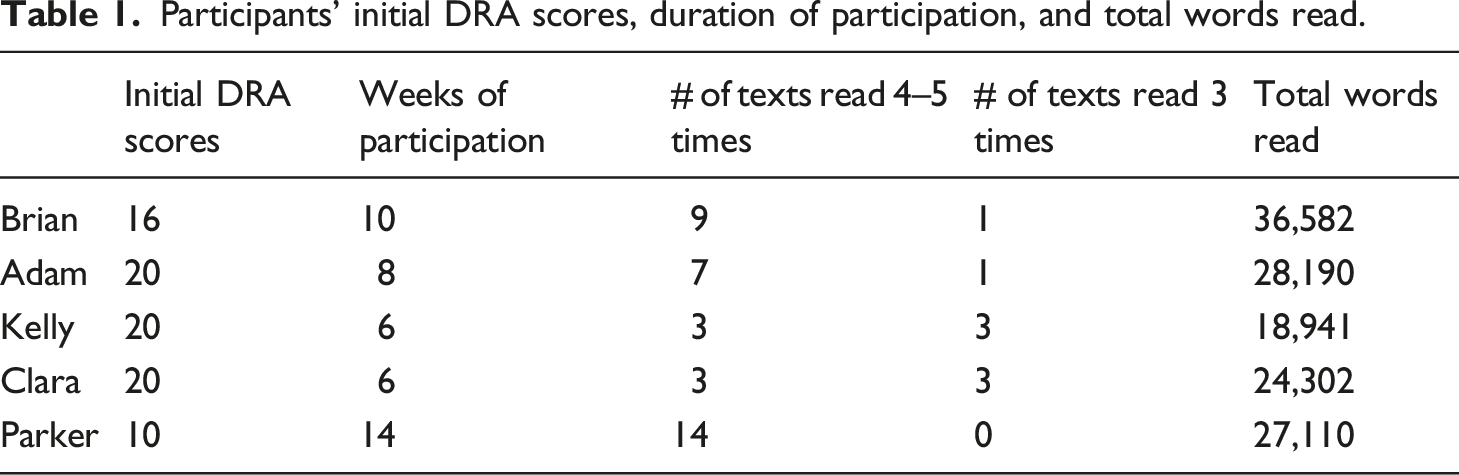
Of the five participants, Brian and Parker were considered below grade level at the start of the study, with DRA-3 scores of 16 and 10 in the middle of second-grade. Brian had been receiving extra help in reading since first grade in an after-school program, but he had not been diagnosed with a learning disability. Adam was not receiving any extra support for reading at school. Clara was one of the lowest-performing readers in her class at the beginning of second grade. Her second-grade teacher reported that Clara had made good progress in the first few months of school and she had not been evaluated for a learning disability. Parker had not been evaluated for a learning disability at the time of the intervention, although he was performing far below his peers in reading. Kelly was identified by her teacher to participate in the intervention because Kelly was dysfluent, lacked confidence, and often lost her place when engaging in guided reading.
Intervention procedures
Teachers identified the students who would most benefit from a fluency-based intervention based on their DRA-3 scores and observations of the students’ in-class reading performance. We then wrote to each of the parents/guardians of these children to participate in a home reading project. All parents expressed interest in participating in the study with their children. One of the researchers met one-on-one with the parents to describe the intervention procedures and to explain the use of the audio recorder, which we provided for each family. These meetings lasted approximately twenty minutes and were held either at the school or in convenient location for the parents.
During the meetings with parents, the researcher provided a brief description of strategies that parents could use to assist their children during the reading, if possible. Parents were informed that they could help their child during the reading when their child came to an unknown word. Suggestions for providing this support included asking the child any of the following questions: How does the word begin? Can you sound out the word? What do you think the word might be? Parents were also told they could provide a semantic clue such as, if the word is “house” you might say it is another word for “home” or provide the starting sound of the word. Additionally, parents received the directions in writing. During the intervention, the researchers emailed participating parents to discuss questions or observations about the home readings.
An adapted form of single subject, multiple baselines, across-subjects design was used for this study to specifically tailor the intervention to participants. This design was selected to allow for in-depth analyses of reading behaviors for a small set of students with varied reading profiles (Cakiroglu, 2012; Horner et al., 2005). This study differs from the traditional format of single-subject design because each week the texts students read at home aligned to their instructional reading level. This purposeful changing of text levels allowed us to provide a more customized intervention, yet, changed the text levels from baseline to intervention.
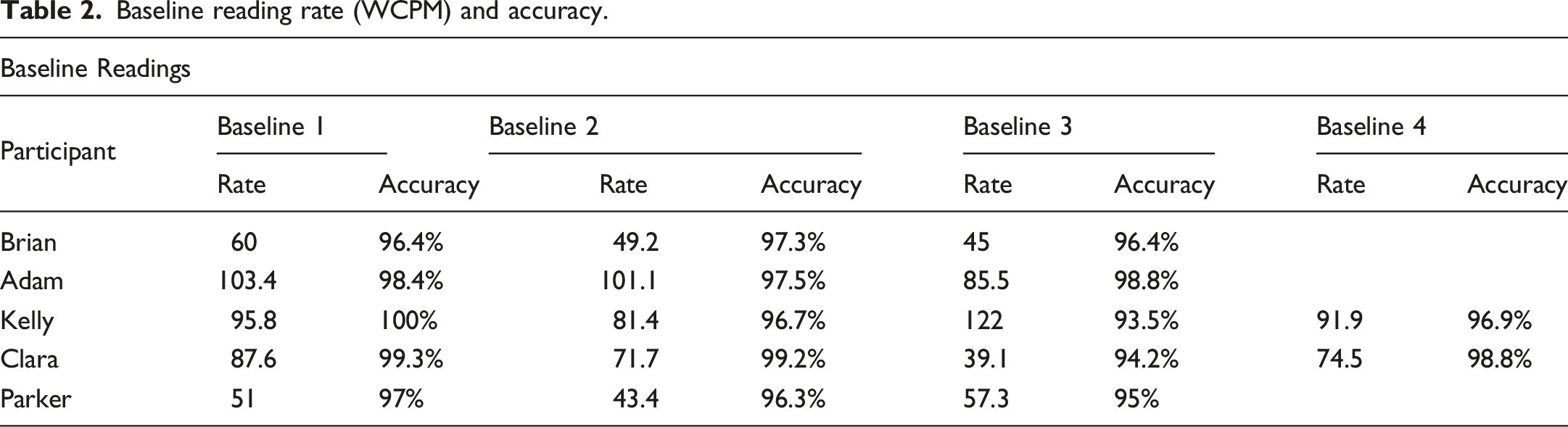
At least three baseline readings were used for each participant before entering the intervention (McCormick, 1995). A stable baseline was achieved when children’s reading accuracy scores were within 15 percentage points of their average reading accuracy scores (McCormick, 1995). Once the baseline was established, children were asked to read each take-home text at least five times with their caregiver and audio record each home reading session. Participants and caregivers were told they could determine how they wanted to conduct the readings over the course of each week, depending on their weekday and weekend schedules.
At the end of the week, children returned the recorders and the researcher conducted a running record on the first home reading of the week (Clay, 2000). The purpose of this analysis was to determine whether the take-home texts were at the children’s instructional reading levels in order to guide the selection of the next take-home texts. If the researcher determined that this text was at the participant’s instructional level, the same level of text was provided for the subsequent week. If the text was at the participant’s independent reading level, the researcher selected a higher-level text for the next reading. Take-home texts included fiction and non-fiction trade books from the classrooms and home libraries of the researcher that had been leveled using the DRA-3 three leveling system. All of the books included a combination of text and pictures and had not been used as part of the classroom instruction. Neither the children nor parents reported prior familiarity with any of the books. A list of the take-home books is displayed in the Children’s Books References.
Data collection and analysis
Assessments collected during the baseline and intervention phases of the study include measures of reading rate, reading accuracy, reading fluency, parents’ helping strategies, and number of words read. The individual assessments and the data analysis are described below.
The running record includes a measure of reading rate using words correct per minute (wcpm) and reading accuracy (% of correct words read). For the running records, miscues included insertions, deletions, and replacements. As per Clay’s (2000) guidelines, self-corrections were not considered as errors. The running records were based on a minimum of the first 200 words of each reading, with the exception of one text that only contained 131 words. To determine the reading level, children’s reading accuracy and rate were calculated and compared to Clay’s (2000) level of accuracy and the norms set by Hasbrouk and Tindal (2006). Accordingly, a rate of between 50–80 wcpm, the norm for second-grade students in winter, was used as a marker for an instructional level rate. At the completion of the intervention, the researchers completed a running record on the last reading of each text.
Results
Results are presented for each area of reading for individual participants using their baseline readings and weekly readings as sources of comparison.
Reading accuracy
Baseline reading rate (WCPM) and accuracy.
Initial and final reading accuracy for each text.
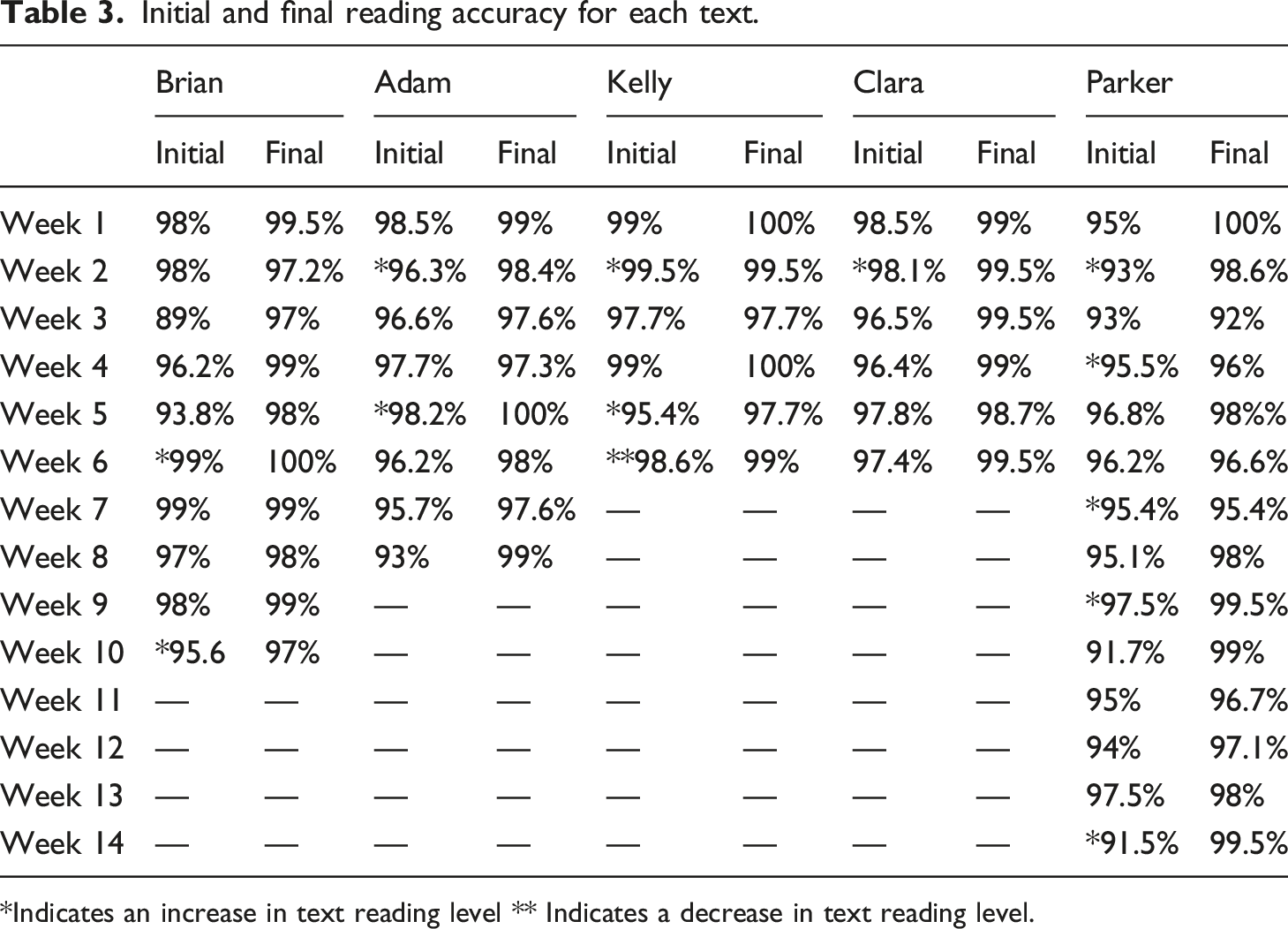
*Indicates an increase in text reading level ** Indicates a decrease in text reading level.
Reading rate
Initial and final reading rate (WCPM) for each text.
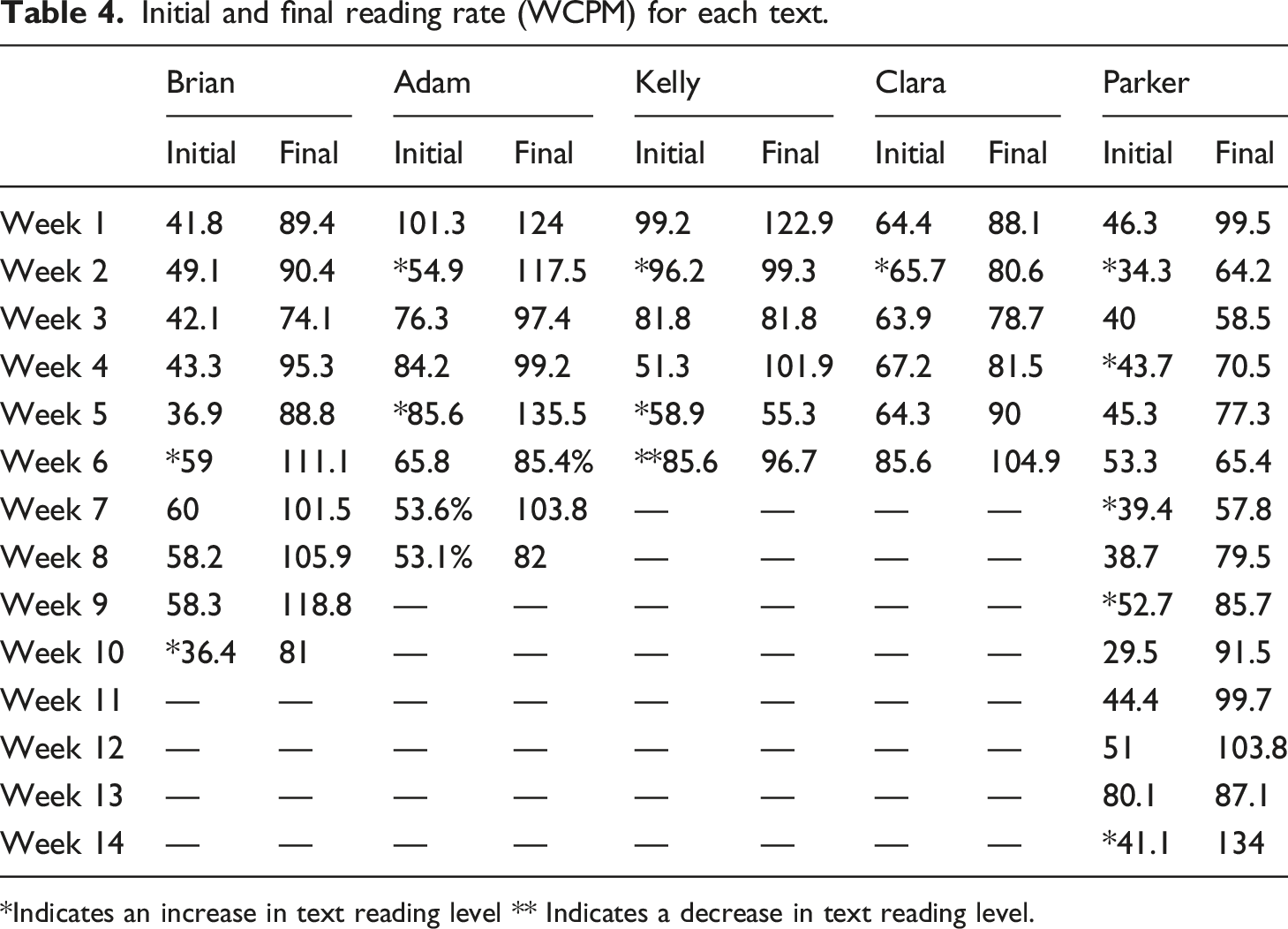
*Indicates an increase in text reading level ** Indicates a decrease in text reading level.
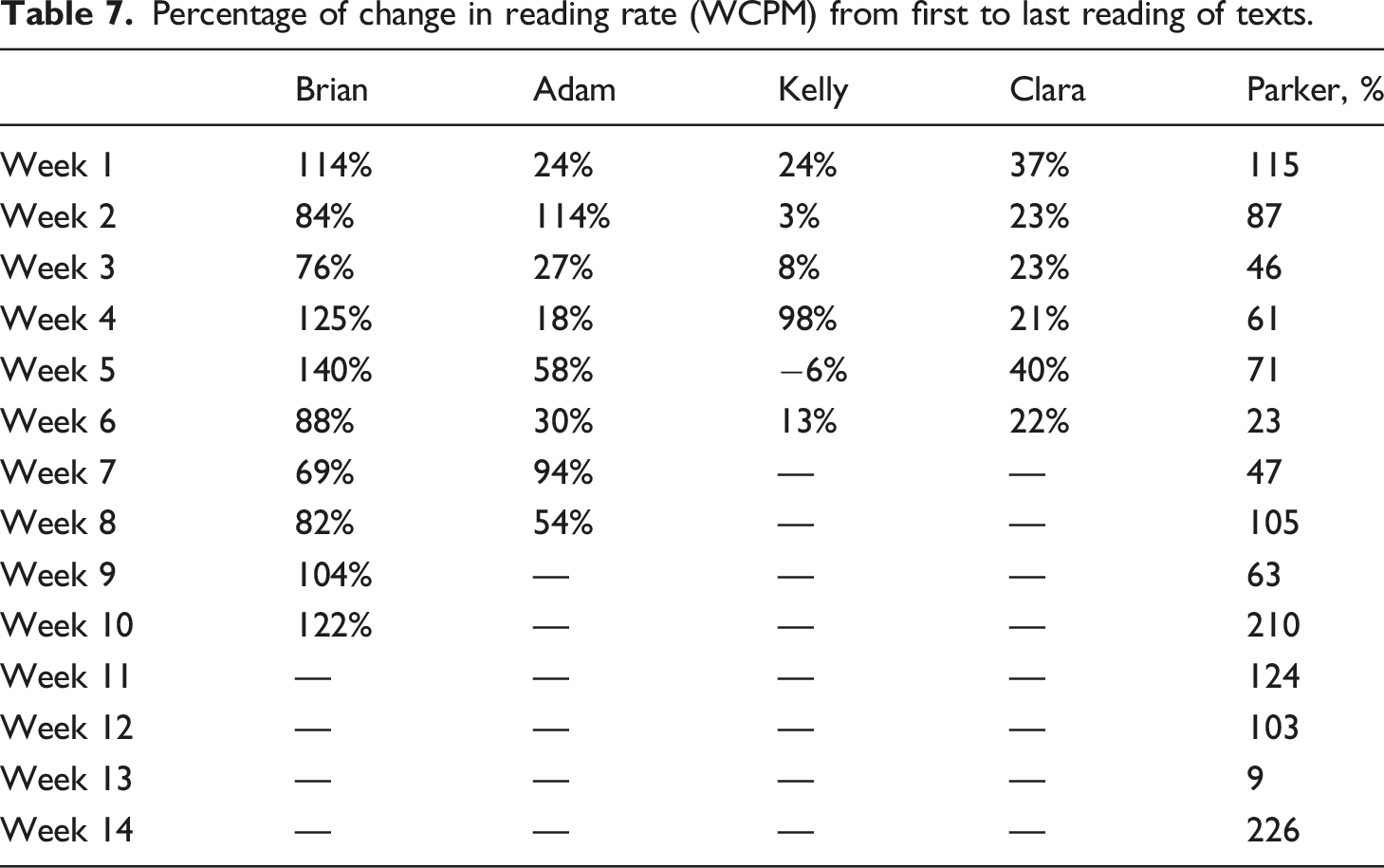
Reading rates improved from the first to the last reading of all but one take-home reading, with mean changes for participants ranging from 15.2 wcpm to 47.2 wcpm. The percentage of change from the initial to the final readings for participants ranged from −6% to 226% as shown in Table 7. Brian and Adam had large percentage changes in their reading rates from the initial to final readings of texts ranged from 69% to 140% and 54% to 114%, respectively, demonstrating large reading gains for texts read at home. Kelly’s changes in reading rate from the initial to final reading of texts tended to be lower than other participants, with the exception of Week 4, when her rate improved 98%. She read one text more slowly during the final reading as compared to the initial reading (change of −6%). Clara’s rate increased from the first to the last reading of each take-home story with her percentage of change ranging from 21% to 40%. Parker’s reading rates increased for each week of his participation (ranging from 9% to 226%), and for several weeks, his rate grew substantially with the percentage of change over 100% for six of the weeks.
Fluency
Initial and final fluency (CORF) for each text.
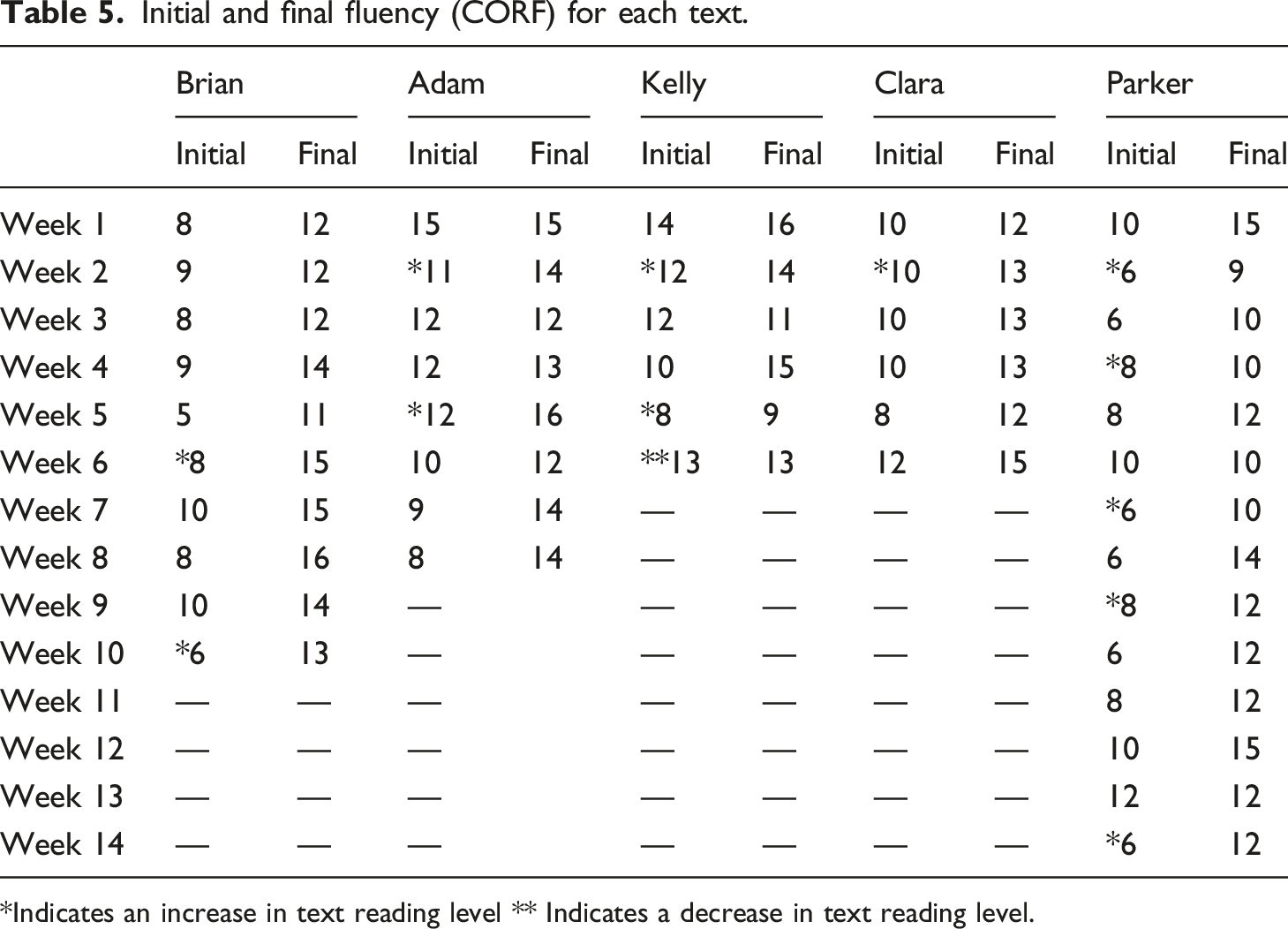
*Indicates an increase in text reading level ** Indicates a decrease in text reading level.
Percentage of change in reading fluency (CORF) from first to last reading of texts.
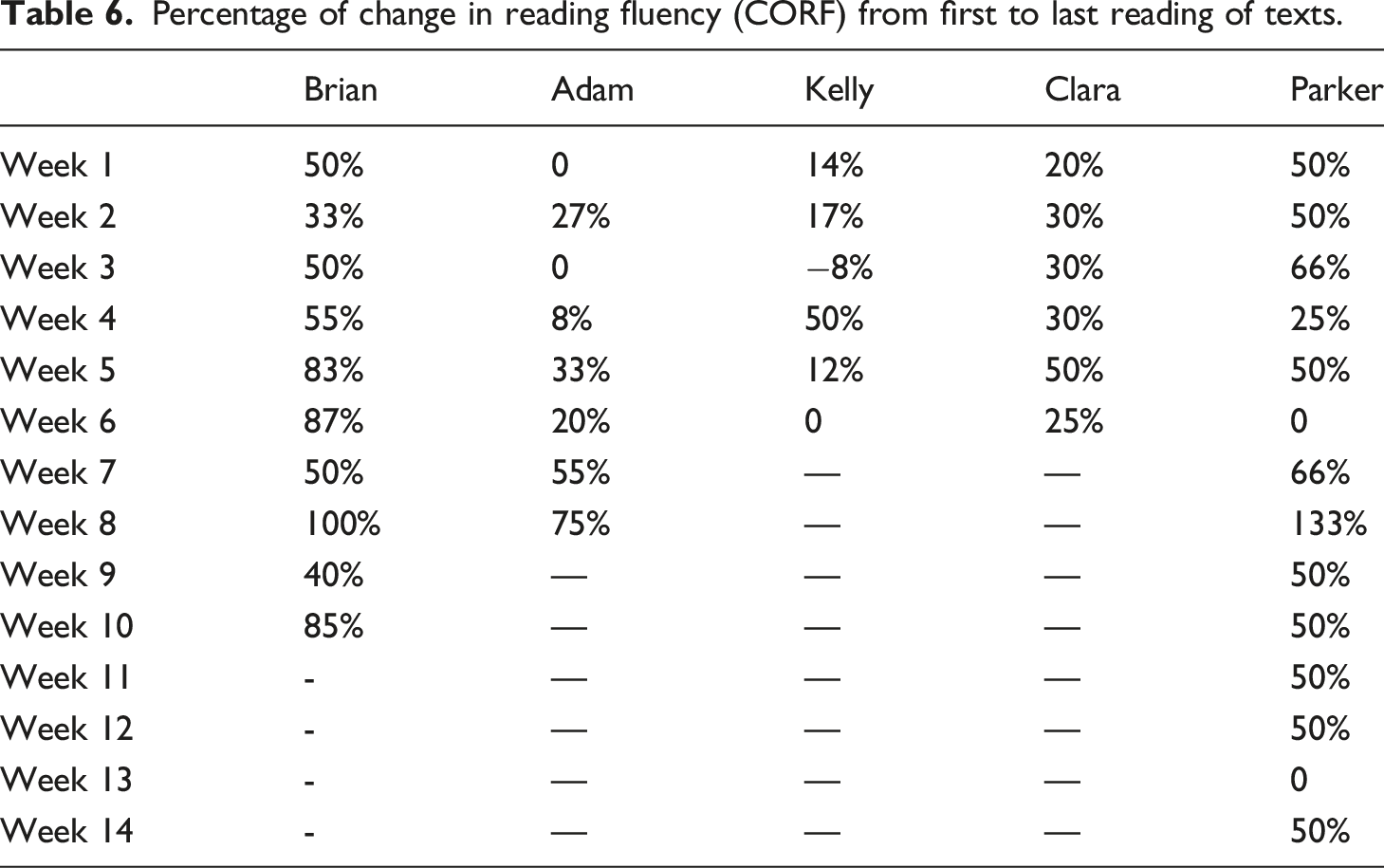
Increased levels of intervention texts
Based on the scoring of the first reading of intervention texts, the researchers increased the text levels participants at least once during the study to ensure that the texts remained as the participants’ instructional reading levels. This step was necessary to ensure the texts were matched to the readers’ level of difficulty. Clara’s text level was increased once and Brian’s and Adam’s were increased twice. Kelly’s was also increased twice but after increasing the level the second time, Kelly struggled with the higher-level reading so we dropped down one level for her last reading. Parker’s reading level was increased five times during the intervention. See Tables 3–5 for changes in text levels.
Total words reading
Participants completed between six to 14 weeks of home readings, when they read take-home texts three to five times. The intervention was designed to last 12 weeks, but some participants did fewer weeks of home readings, and one participant wanted to continue beyond the 12 weeks. Table 1 displays participation rates for each case, including the number of weeks and readings completed. Participants read a substantial number of words during the intervention ranging from 18,941 to 36,582 words.
Parents’ helping strategies
Percentage of change in reading rate (WCPM) from first to last reading of texts.
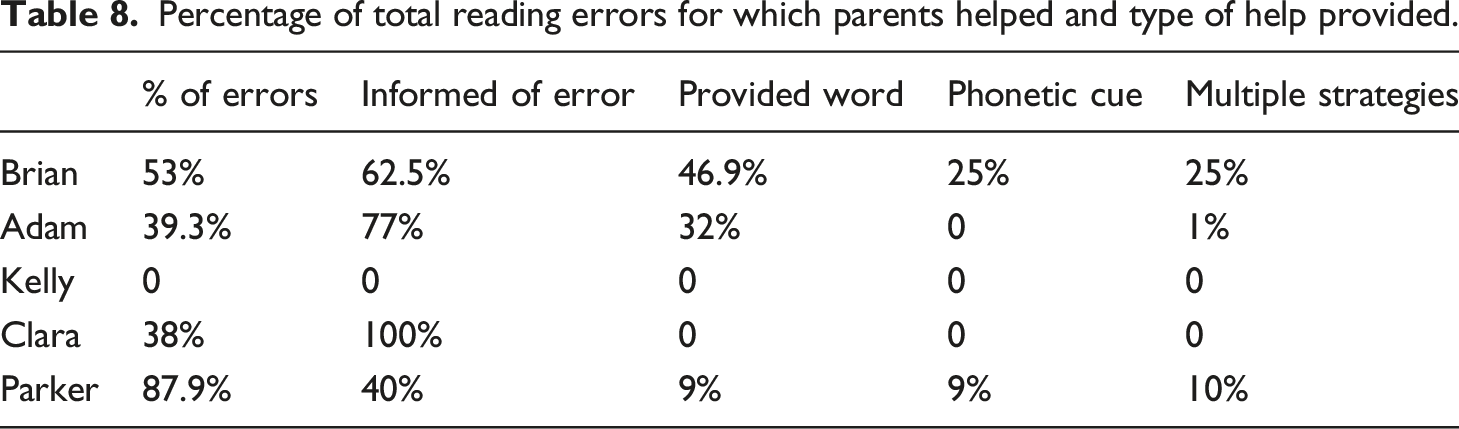
Percentage of total reading errors for which parents helped and type of help provided.
Highest reading levels
A final indicator of reading growth was determined by examining the first readings of take-home stories to identify the highest DRA-3 level on which participants were reading at the independent reading level for accuracy and rate. Brian’s first take-home story was at a DRA-3 level 16 and by the end of the intervention he was reading texts of level 18–20 independently. Adam began the intervention reading texts at DRA-3 level 24; by the end of the intervention, he read a level 30 text independently. Kelly started at DRA-3 level 24 and by the end she read level 28 texts independently. Clara started the intervention at DRA-3 level 24 and ended at DRA-3 28. Parker had the largest change from level DRA-3 10 to DRA-3 18.
Findings and recommendations
Developing children’s reading fluency requires ample opportunity for children to read at both school and home (Guthrie et al., 1999; Hiebert and Martin, 2009). However, parents may have limited knowledge in how to employ specific practices in the home to promote reading fluency, and teachers may have limited knowledge in how to involve parents meaningfully. This study demonstrated the potential for supporting teachers and parents in using repeated home readings to improve children’s reading fluency and increase the number of words children read at home. To answer the first research question as to how to gauge the effectiveness of a home repeated reading intervention using instructional level texts, we found that across the five cases, improvements were evident in reading accuracy, rate, and fluency for the take-home texts. All participants were able to read higher DRA-3 level texts successfully at the end of the intervention, as compared to the start of the intervention, as demonstrated by their first readings of home texts. The most substantial changes were evident for Parker, who had the lowest reading level at the start of the study. His reading of a DRA-3 level 10 was at the instructional level at the start of the intervention. At the end of the intervention, he read a DRA-3 18 text at the independent reading level. This finding is similar to Rasinski and Stevenson (2005) who found the most gain in their Fast Start home reading program for participants performing at lower reading levels.
The purposeful selection of instructional level texts allowed participants to read texts that were somewhat challenging, but not frustrating, as measured by the running record assessments. By monitoring the first readings each week, the researchers were able to increase the level of the texts to maintain instructional reading levels week to week and assess how changes in level influenced performance. Parker increased his reading levels the most times in the intervention, but he began at the lowest reading level at the start of the study and participated for the most weeks. Although the intervention showed positive outcomes, the intentional increase in text levels adds to the challenge of comparing baseline to intervention readings as would typically be done with a single-subject design study.
The number of words participants read at home was substantial, ranging from 18,931 to 36,582 in a short period of time, as displayed in Table 1. This intervention promoted important opportunities to read (Hiebert and Martin, 2009), and participants knew that home audio recordings were being monitored, which may have made them feel more accountable for their reading. Differences in total words can be explained by the number of weeks and readings completed as well as the reading levels of the texts. As expected, the lower-level texts had fewer words, meaning that the participants reading at a lower level had to read for more weeks and more times to have comparable reading experiences. For example, Parker and Adam read close to the same number of words, but Parker participated for six more weeks than Adam. This finding is consistent with the research that demonstrates differences in the amount of reading opportunities for stronger and weaker readers (Allington, 2009; Juel, 1988; Stanovich, 2000). The second research question addressed the relationship between children’s reading accuracy, rate, and overall fluency. This study utilized a new fluency assessment, the CORF, which includes a measure of reading prosody. This assessment provides a clearer picture of reading fluency as compared to reading rate. This is most evident when comparing changes in rate and changes in fluency from the first to last readings of texts. Although these measures sometimes aligned, there were times that they did not and the CORF more accurately reflected the way the text were being read (Benjamin et al., 2013). Coupling the measure of reading fluency with a measure of reading accuracy/error provides a more accurate profile of the participants’ reading performance (Abbott et al., 2012).
Lastly, the study addressed whether the type of assistance provided by parents influenced children’s reading performance. We found parents’ support for children’s reading differed across cases with four of the five parents providing word level support for more than one third of their children’s reading errors. These types of differences in levels of support have been found in other studies designed to promote parent and child reading and talk (Steiner et al., 2021; Troseth et al., 2020). When parents did provide support, they most often did so by providing their child the word or letting their child know they had made an error. We did not identify any patterns in the relationship between parents’ level of support and children’s reading gains, yet we did find differences in levels of participation and parental support. For Kelly, we found no evidence of any word level support from her parents and she had the lowest participation in terms of words read of the five participants. The students with the greatest percentage of word level support, Brian and Parker, had the highest levels of participation. A future study including more elaborate training with parents, in which they are provided ongoing examples of ways to support their children’s reading, may lead to greater levels of parental support as their children read.
Although this study is limited by a small sample size, the benefits of the home readings are evident for participants at varying reading levels, and the use of the adapted single-subject design of the study allowed for close monitoring of the children’s readings. Additionally, the system for leveling the texts may not be exact; nonetheless, this system is used in many school districts to create classroom libraries and served as a proxy for this process. This system was also chosen because it could be replicated by teachers who would like to use this model of this study to involve parents and caregivers in helping to promote children’s fluency. A further limitation of the study was the absence of a comprehension measure. Although fluency and comprehension are related, they are not the same, and the addition of a comprehension measure for the home readings would provide important data about children’s reading performance.
As mentioned, the model used in this study could be replicated for use at school and home. The study required little training for parents aside from the initial description of how they might help their children if they reach an unknown word while reading. This allowed parents to more readily integrate the home readings into their home literacy practices. Likewise, teachers could adopt this approach into their classrooms and manage it with little extra time and effort, apart from selecting books from their classroom libraries. The design of the reading intervention has additional benefits. Because parents are listening to their children read aloud, they can hear first-hand the ways children’s reading improves when completing repeated readings. This might lead parents to continue the practice, even when the intervention is complete, as they think their participation fosters increases in children’s reading achievement. It is essential that school-based attempts to promote parent involvement are specific and lead to “doable” parent activities in which they see the value of their involvement. If parents do not believe their involvement will have specific benefit for their child, they are less likely to engage (Green et al., 2007).
A next step for this research is to study the effectiveness of home repeated readings when parents are provided with training both for word level support and discussions around text. This addition would help determine whether providing training to parents in specific strategies would further enhance children’s reading performance and offer a window into children’s comprehension of the texts while they are reading at home. More research is also needed to see whether sending more difficult books would lead to even greater changes in children’s reading performance.
Footnotes
Declaration of conflicting interests
The author(s) declared no potential conflicts of interest with respect to the research, authorship, and/or publication of this article.
Funding
The author(s) received no financial support for the research, authorship, and/or publication of this article.
