



Abstract
Through analysis of the language, this study aimed to investigate the current practice of using songs in public library storytimes. Language interactions in 68 storytime programs involving 652 child participants were observed and transcribed. Then, textual analysis was conducted to examine the language of singing songs, focusing on how language used in singing songs differs from spoken language in storytime programs. Specifically, the study compared sentence and grammar structure between singing and non-singing language and explored how topics and themes covered in singing language compare with those of spoken language. In addition, the study examined singing accompanied by use of props and movements. The findings of this study indicate that the language of singing in storytime programs is rich; thereby, signaling the power of singing with young children as means to advance language development. Practical implications and strategies for maximizing integration of singing in storytimes and other informal learning activities for young children are discussed.
Introduction
Experiences in the first years of life serve as a developmental foundation upon which individuals draw henceforward. Rich language environments in the early years provide exposure to and facilitate use of interesting and increasingly complex syntax and vocabulary that serve as bootstraps for the subsequent expansion of language and future reading comprehension (Kahn and Justice, 2020). Public library storytimes are purported to support early literacy and position children for school success (Ghoting and Pugh, 2020). These highly interactive and engaging programs offered freely to the public through libraries around the world integrate shared reading, music making, rhyme and repetition accompanied with finger-play and full body movements. Several prior studies sheds light on the value of public library storytimes (Campana et al., 2016; Goulding and Crupp, 2017; McKenzie et al., 2007; Peterson, 2012; Stooke and McKenzie, 2009). Few investigations, however, have targeted the language environment of storytime and the ways in which storytime programs support children’s linguistic development (Cahill et al., 2020).
The purpose of this study is to examine the use of songs in storytime programs and determine how the integration of songs facilitates children’s language development. Adopting a learning science framework coupled with a language acquisition perspective (Hart and Risley, 1995; Hoff and Naigles, 2002; Grifenhagen et al., 2017; Hjetland et al., 2019; Khan and Justice, 2020), the study assumed that singing a song could support engaged learning and expose children to language conditions different from that of spoken language. Applying natural language processing techniques to the transcripts of public library storytime video observations, this study compares the sung and spoken components of public library storytime programs as a means to pinpoint how each supports young children’s language learning, and in turn, how storytimes help children develop skills necessary for later academic success.
Literature review
Effects of singing on children’s language development
From a very early age, children demonstrate a preference for singing over speech and a willingness to attend to sung language for longer durations than they are willing to attend to spoken language (Tsang et al., 2017). Songs, words that are sung rather than spoken, are regularly promoted as tools for rhyme awareness, prosody, and rhythm (Terrell and Watson, 2018), and most preschool age children emit affective cues, continued responses, on-task behaviors, and positive body movements that evidence their enjoyment of music and musical activities (Koops and Kuebel, 2018; Powell and Somerville, 2020).
Given children’s enjoyment of music, Heydon et al. (2018) point to singing as a meaning-making process that should be used as a literacy practice, and recent research in both the home and preschool settings hint at the role of music in advancing literacy skills of young children. For example, music activities shared between parent and child in the home between ages 2 and 3 years are associated with the child’s vocabulary knowledge at ages 4–5 years old (Williams et al., 2015). The value of music integration in the preschool setting is clear when making comparisons of the language learning of preschoolers in classrooms where the teachers received formal music education training versus those in classrooms of teachers who had not (Lorenzo et al., 2014). A recent study found that first-grade children learned more vocabulary and had a richer depth of knowledge when word learning was paired with sound-effects (Lawson-Adams and Dickinson, 2019); the researchers hypothesized that the sound effects created using instruments not only increased attention but likewise supplied additional semantic information that facilitated learning.
Theoretical frameworks
From a learning sciences perspective (Hirsh-Pasek et al., 2015), young children are purported to learn best in situations that involve a) cognitively active learning that is “minds-on”, typically paired with physical activity that is “hands-on”, b) engaged learning that fosters focused attention and on-task behaviors, c) meaningful experiences connected to existing knowledge, and d) social interaction with peers and/or adults. Situations that involve singing and music with young children tend to integrate these four conditions of learning (Winters and Griffin, 2014).
Much attention has been given to the quantity of language exposure in the early years (Hart and Risley, 1995); however, language quality, as measured by diversity (i.e. the number of different words used) and by complexity (i.e.mean length of utterance and syntactic complexity), has also been associated with child language outcomes (Hoff and Naigles, 2002; Khan and Justice, 2020). The postulation that music facilitates language learning is consistent with the Simple View of Reading (Gough and Tunmer, 1986). According to this theory, reading comprehension is the product of code related skills that manifest in word reading combined with linguistic skills that lead to language comprehension. Language exposure in the early years results in growth along both paths of the reading comprehension equation (Hjetland et al., 2019): early phoneme sensitivity plays a critical role in the development of decoding skills and early word recognition skills (Muter et al., 2004), whereas a large verbal working memory, grammatical knowledge and vocabulary are early language skills that contribute to language comprehension (Hjetland et al., 2019). Word-learning or vocabulary, in turn, is facilitated by repetition (Grifenhagen et al., 2017). Differences in the quality and frequency of language inputs in the early years lead to variations in vocabulary size (Hart and Risley, 1995), grammatical development (Huttenlocher et al., 2010), as well as conversational competence (Hoff-Ginsberg, 1998). Thus, language inputs, regardless of whether they are spoken or sung, have the potential to impact children’s language development and emergent literacy.
Use of singing in storytimes
Storytime programs have long included songs and music (Kewish, 1979), but librarians seeking to promote language development during storytime have recently paid heed to the learning benefits of singing and become more intentional about integrating singing into their weekly programming (Campana, 2018). Recognized as one of the five pillars at the core of the Every Child Ready to Read 2 (ECRR 2) initiative, an initiative of two divisions of the American Library Association, singing supports phonological awareness and vocabulary development in ways different from other traditional storytime activities, like reading aloud or group play. ECRR 2 points out that singing slows down language and breaks it into parts, a skill that is useful later when learning to sound out words; additionally, songs can introduce new and complex vocabulary not otherwise encountered in everyday life (Public Library Association and Association for Library Services to Children., n.d.). Moreover, singing introduces children to the concepts of rhythm and rhyme before they encounter them in texts (Fink and Marxer, n.d.). Songs offer opportunities for active involvement in storytime, with repetitive singing and movements creating a space for children to build semantic and contextual knowledge about words (Lawson-Adams and Dickinson, 2019), practice memorization and fine-tune motor skills (de Vries, 2008). Songs are not only enjoyable to storytime participants but also promote children’s development of sensitivity to the sounds of language (Stooke and McKenzie, 2009). With the right leader at the helm, singing in storytime can help children develop a range of early literacy skills necessary for reading success in later childhood.
Though librarians tend to focus on the contributions songs make to literacy development, the value of songs extends to other areas of learning. Because songs and music are culturally situated (Barton, 2018; Bohlman, 2005; Walters and Spitzer, 2003), incorporation of culturally diverse songs within storytimes can serve as a means to expand representation of peoples and ideas, which recent research identifies as a challenge for public library storytime providers (Cahill et al., 2021). As reflected in preschool social studies standards (Epstein, 2014), integrating diverse music is a strategy to help young children develop civic competence. Further, building programs around music can be especially beneficial for children whose first language is not English because they are able to participate musically, gain exposure to English in an enjoyable context, and develop early literacy skills (Olson, 2011; Shin, 2017).
Research on the use of songs in the storytime setting has thus far been limited, but some findings suggest that songs can serve a variety of school preparedness purposes in these programs. de Vries (2008) found that the songs used in storytimes were “well-known, mainly traditional children’s songs” (p. 475) that were sung more than once and with repetitive actions in order to engage children actively in the singing process. The themes of the songs often related to the stories preceding them in the storytime order, or even provided an opportunity to sing along with a story. Within the programs, de Vries (2008) found that the songs typically served at least one of four purposes: a) to enhance social interactions for children, b) to refocus the children after the reading of a long text, c) to embed music in storytelling, and/or d) to provide new ideas for using music at home and beyond. Parents and caregivers of children attending these programs valued the integration of songs identifying them as “valuable and worthwhile” (de Vries, 2008: 477) components of storytime. A study by Stagg Peterson (2012) yielded similar results, with the majority of the observed storytimes (i.e. 18 out of 20) opening and/or closing with songs to encourage children to demonstrate their phonological awareness. Additionally, librarians have used songs to encourage children to “remember the words” (Romero and Armstrong, 2017: 10) to popular texts as well as to practice the complex vocabulary of denser ones during storytime.
Songs can be used to encourage development in manifold ways. As argued by the Colorado Libraries for Early Literacy (n.d.) initiative, songs can be used in storytime to encourage print awareness—and the idea that texts have meaning—by reading books that can be sung aloud. Songs create intentional opportunities for children to practice their narrative skills; for example, songs like “Little Bunny Foo Foo” invite children to combine words and motions to practice telling a story aloud with a clear beginning, middle, and end (Colorado Libraries for Early Literacy, n.d.).
Additionally, many library storytimes for young children integrate songs with movements and additional props (Goulding and Crupp, 2017). Play acting, movement, and props can further facilitate engagement in storytimes (Dietzel-Glair, 2013), and children often do movement while singing along (Lenstra, 2021; Reid, 2009). Librarians widely adopted movement and physical activity for early literacy (Lenstra, 2018) and such activities can create more playful and engaging storytimes (Scherrer, 2017). For example, songs with associated actions (e.g., “The Itsy Bitsy Spider”) can encourage children to engage even more deeply in the storytelling process, practicing both motor skills and rhythmic patterns while singing. Because of the many ways singing can enhance storytime, it is imperative to examine empirically the ways in which singing potentially contributes to language development during these programs, in particular to what extent singing songs and movements occur together.
While previous studies indicate that songs serve valuable purposes in storytime programs (e.g., Campana, 2018; de Vries, 2008; Olson, 2011, 2020), no studies have explored the extent to which singing is integrated into storytime nor the complexity of the sung language. The overall purpose of the current study was to investigate how the language of songs in storytime programs differ from their spoken counterparts and might, therefore, support children’s language development. Questions guiding this investigation are as follows: RQ 1. What are the differences, if any, in the sentence length and grammar structure between singing and non-singing language used in storytimes? RQ 2. What is the association between singing and use of props in storytimes? RQ 3. What is the association between singing and movements in storytimes? RQ 4. Are there any differences in topics and/or themes between singing and non-singing language used in storytime programs?
Methods
Context and participants
The current study is one component of a multi-state investigation of public library storytime programs designed for children ages 3 to 5 years that was approved by University of Kentucky’s institutional review board (IRB number 42829). All public libraries within 135 counties across three states (i.e. Kentucky, Ohio, and Indiana) were invited to participate in the study. From the 115 responses, we drew a stratified random sample of 36 libraries based on population of the legal service area and rural/urban designation. Prior to data collection, one participating library dropped out of the study after a decision was made to stop offering preschool storytimes in lieu of offering storytime programs for younger children. The remaining participating libraries were relatively evenly distributed: 12 urban areas, 12 suburban areas (i.e. urban clusters), and 11 rural areas based on the location code ascribed by the Institute of Museum and Library Services (Pelczar, Frehill, Williams, Wan, & Nielsen, 2018) Public Library Survey. Storytime participants were informed that the programs were being recorded and caregivers were offered the opportunity to position their accompanying children in off-camera locations. Researchers collected no demographic nor identifying information about the child participants.
Data collection
Our research team scheduled and then observed and video-recorded two storytimes at each of the 35 participating libraries between September 2018 and January 2019. Video recordings utilized a two-camera system, with one camera positioned behind the storytime librarian to capture the actions of the children and utterances of the librarian and the other camera was positioned behind storytime participants to capture the actions of the librarian and utterances of the participants. Two of the storytime programs offered at two different libraries were unattended and the programs cancelled; thus, this analysis is based on a total of 68 storytime sessions provided at 35 public libraries involving 652 child participants and 479 adult caregiver participants. The number of child participants ranged widely: two storytime programs each had only one child participant, while one storytime program had 44 child participants (M = 9.59). Storytime programs also ranged widely in duration from approximately 10 to 40 minutes (M = 24 minutes, 44 seconds). Across those 68 storytime sessions, 160 books were shared. The number of books shared at each session ranged from one to five with an average of 2.35. An informal activity or free play time occurred after most programs; however, this study was delimited to the formal storytime programs only.
After collecting all 68 observations, the research team transcribed the storytime portion of the video recordings. The transcripts included all utterances spoken and sung during each storytime program. For this study, an utterance was operationally defined as a stretch (unit or piece) of speech that includes a pause, break, silence, or switch of speaker(s) in connection with other sequential stretch of speech (Crystal, 2008; Milburn et al., 2014; Neumann, 2020). Additionally, the transcripts included the following information for each utterance: the speaker of the utterance (i.e. librarian, child/children, other adult, or all of the above); whether the utterance occurred during a shared book reading and if it was voiced as talk or singing; whether a prop was in use at the time of the utterance and by whom (e.g. musical egg shakers, dance scarves, light-up sticks, flannel board stories, etc.); and whether body movement (e.g. dancing, planned actions to accompany songs and rhymes such as head nodding, or finger plays) was performed during the utterance and by whom. Children had many opportunities to engage in musical activity and fine and gross motor movements during storytime programs. Across the 68 programs we observed 153 songs, 90 gross motor action songs and rhymes, 9 chants, 71 fine motor fingerplays, and 163 materials including flannel boards, props and manipulatives. After several rounds of transcription preparation, all transcripts were subsequently verified for accuracy.
Data analysis
All transcribed text was analyzed quantitatively to examine the differences between singing and non-singing language in storytimes. Two dimensions of analyses were conducted with the transcribed text: (1) sentence-level analysis to analyze the complexity of the language and (2) content analysis to compare the topics and concepts between singing and non-singing language. For the purpose of this study, a sentence was determined by full-stop punctuations in language such as a period, question mark, or exclamation mark at the end of each sentence. We first counted the numbers of sentences for both singing and non-singing language along with the speaker of the utterance. To assess the complexity of the sentences, we counted the number of words in each sentence and analyzed the syntactic structure of the sentences based on part-of-speech (POS) tagging using the TreeTagger tool (http://www.cis.uni-muenchen.de/∼schmid/tools/TreeTagger). Then, we explored the content of the singing and non-singing contexts within storytimes. We investigated most frequent bigrams. A bigram indicates a sequence of two adjacent terms. Then, we employed bi-term topic modeling (BTM) to extract prevailing topics and themes. Topic modeling is a group of statistical modeling techniques used to uncover topics and themes from free text in documents (Blei et al., 2003). A topic is represented by a list of words with different probabilities/weights representing the topic. Topic modeling analysis offers insights to the topical content in free text. BTM is an effective method to analyze short text by resolving the problem of data sparsity caused from limited text in each document (Yan et al., 2013). As storytime language typically include short sentences, BTM was chosen as a tool to investigate topics underlying the observed language. The language we observed from storytime sessions contained a lot of short sentences, less than 10 words, so BTM was an appropriate option to deal with short sentences with a small number of terms.
Results
Sentence analysis
This study analyzed and compared singing and non-singing sentence contexts. Singing made up 44.5 sentences per session on average, which is approximately 8.9% of the entire sentences. This result reveals that songs are used as complementary sources while books and other conversation are the primary material in storytimes.
We counted the numbers of sentences by different groups of participants, i.e., child(ren), librarian, and other adults (Table 1). Singing sentences were more likely to be expressed by both the librarian and child(ren) together when compared with non-singing sentences. Approximately 40.5% of the singing sentences were expressed by both librarians and child(ren) together. On the contrary, only 1.8% of the non-singing sentences were spoken by both the librarian and child(ren). Overall, children had more opportunities to vocalize in the programs while singing songs with the librarian together.
Proportions of sentences by speaker type.
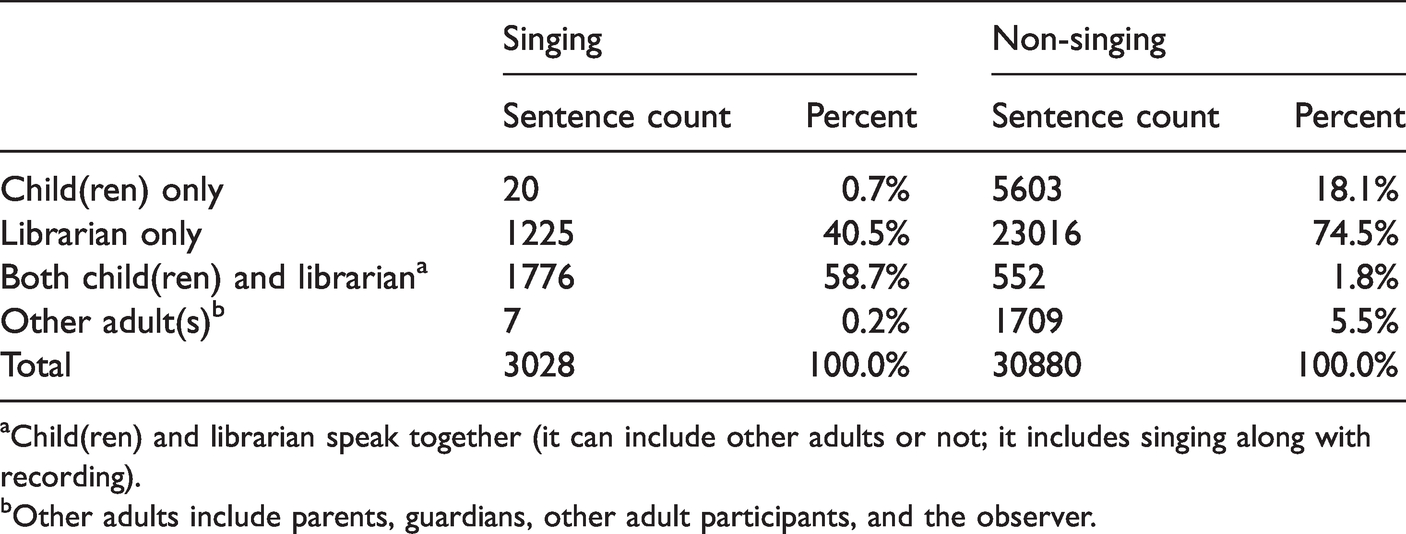
aChild(ren) and librarian speak together (it can include other adults or not; it includes singing along with recording).
bOther adults include parents, guardians, other adult participants, and the observer.
Comparison of sentence lengths between singing language and non-singing language.
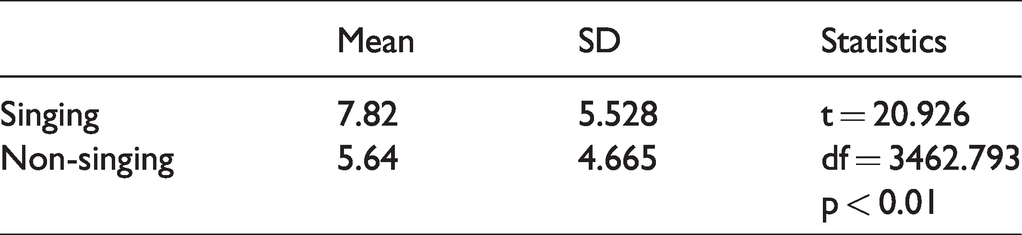
Singing sentences were likely to be longer compared with non-singing sentences in terms of word count (Table 2). The average number of words in a singing sentence was 7.82 (SD = 5.528) while that of a non-singing sentence was 5.64 (SD = 4.665). The t-test result shows that the mean difference is statistically significat at the alpha level of 0.01. That is, a singing sentence was approximately 2.175 words longer than a non-singing sentence on average.
Next, we measured and compared the lengths of the sentences spoken by different types of speakers (i.e., the categories of child(ren), librarian, all, and other adults). As shown in Table 3, we found differences in sentence length between the singing and non-singing utterances. When children sang with the librarian together, the average word count of each sentence was 7.63, much longer than the non-singing context, where the mean was 5.80. Moreover, the librarians’ utterances were likely to be longer when singing, compared with non-singing: 8.17 words vs. 6.41 words per sentence.
Sentence length (average word count) by speaker type.
aChild(ren) and librarian speak together (it can also include other adults or not).
bOther adults include parents, guardians, other adult participants, and the observer.
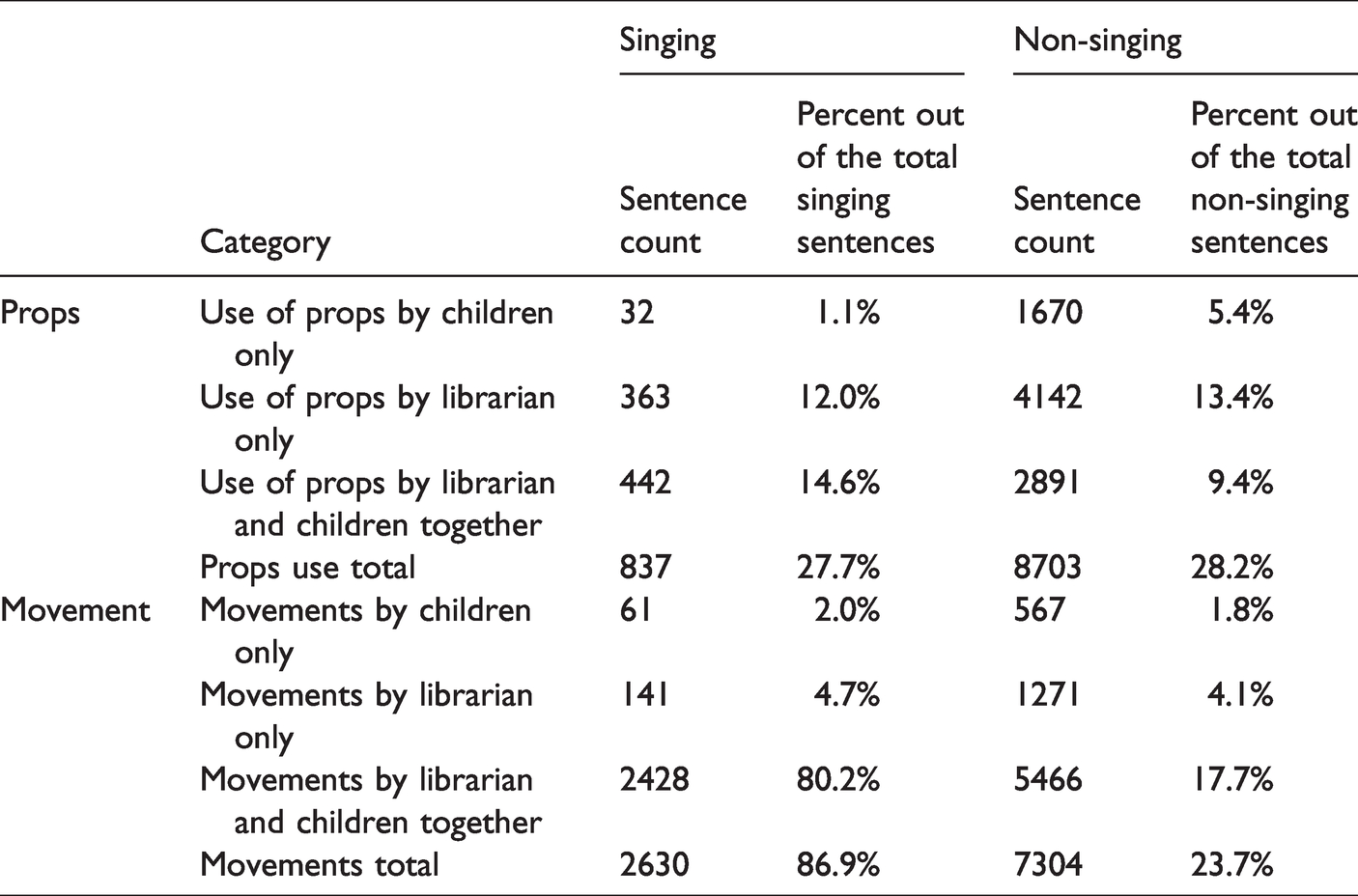
Proportions of sentences involving use of props or movements.
To investigate the grammatical complexity of both the singing and non-singing sentences, POS tagging was carried out (Appendix 1). We identified differences in the grammar elements across the two contexts. Singing sentences included more nouns than non-singing sentences and also showed higher proportions of conjunctions and prepositions than non-singing sentences. Because conjunctions and prepositions were typically used to combine additional phrases or supplementary clauses, higher incidences of these two elements signal sentence complexity.
Next, we looked into the associations between singing and both the use of props and movements (Table 4). Overall, we did not note differences in the use of props between singing and non-singing sentences: in total, 27.7% of the singing sentences were vocalized while using props compared with 28.2% of the non-singing sentences. In particular, the librarian and children were making movements (i.e. dancing and making accompanying hand and gross-motor movements in coordination with the words of the songs) in approximately 80% of the singing sentences. On the contrary, only about 23.7% of the non-singing sentences were spoken while incorporating movement.
Content analysis: Singing vs. non-singing contexts
As a way to investigate the content of singing language, we examined the most frequent bigrams from singing and compared them with the non-singing language (Appendix 2). A bigram indicates a sequence of two adjacent terms. There were distinct differences in the most frequent bigrams. We observed repeating words from those songs, such as “shake shake,” “swish swish,” “beep beep,” and “clap clap” giving evidence that storytimes for young children adopted many nursery rhymes which involve repetitive lyric lines and verses. In fact, ten out of the top 30 bigrams consist of repetitive words. In addition, storytime sessions were likely to play the same song multiple times within a program until children became familiar with that song. The following are examples of repetitive refrains and verses: “Shake your hands 1, 2, 3, shake your hands, shake with me, shake, shake, shake, shake, shake, shake … …,” “The wheels on the bus go round and round, round and round, round and round …” and “Head, shoulders, knees and toes, knees and toes … …”. On the other hand, the non-singing text was more likely to include everyday phrases, such as “good job,” and “looks like.” Additionally, some common interjection phrases appeared among top bigrams, such as “oh goodness” and “uh oh.”
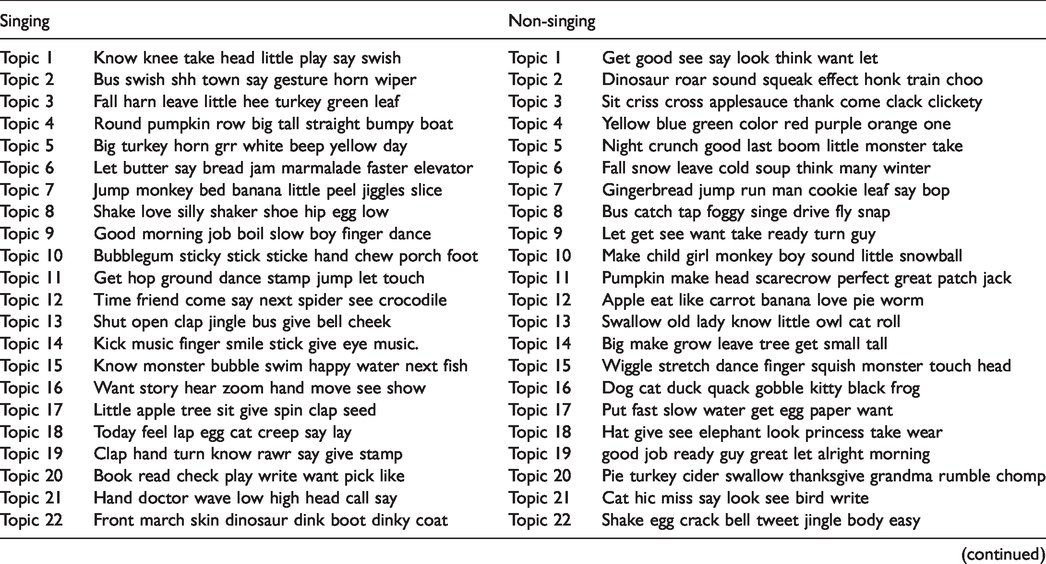
We conducted BTM to compare prevailing topics between singing and non-singing content in storytimes. BTM is one of the statistical modeling techniques that is used to uncover topics from unstructured short text (Yan et al., 2013). For both sets of text, we extracted 30 topics respectively, as shown in Appendix 3. Overall, we found the topics and the concepts covered when singing versus non-singing were distinct from each other. Not surprisingly, extracted topic terms from the singing language text reflect the words and topics of popular children's songs and nursery rhymes, such as “Wheels on the Bus,” “Head, Shoulders, Knees and Toes,” and “If You’re Happy and You Know It.” Prevailing topic terms include combinations of various animals, food and fruits, colors, and movements, revealing that diverse topics and themes young children typically like are covered in songs integrated into storytimes; yet, we did not note diverse cultural representations in the topics. Interestingly, singing topic terms were likely to involve various action or movement terms compared with non-singing terms, for example, kick, shake, clap, wiggle, stomp, fly, and among others. In contrast, non-singing language topics were more closely tied with books. Furthermore, we observed that non-singing language involved more everyday conversation, or instructional context in storytimes, for example, Non-singing Topic 1 (get good see say look think want let), Non-singing Topic 9 (let get see want take ready turn guy) and Non-singing Topic 19 (good job ready guy great let alright morning). In addition, it appears that the non-singing language was used for teaching colors and numbers. For example, we found a distinct topic concerning colors, Non-singing Topic 4 (yellow blue green color red purple orange one see like). While distinct contents were observed from each context, there were overlapping topics or themes between the two language environments, for example, halloween, monsters, some food (e.g., ice cream, bubblegums), and others.
Discussion
Discussion of the findings
Using text mining approaches, the present study investigated the prevalence of using songs in public library storytimes, and how the language of those segments of the programs differed from the language spoken during the programs. We divided all utterances in 68 storytime sessions into two text corpuses: “singing” and “non-singing,” and then compared them in terms of sentence complexity and topic content. Additionally, we examined the use of props and movements throughout the storytime session and noted associations between singing and non-singing language. Coupled with prior studies of storytime programs showing child and caregiver appreciation of music in storytime programs (Campana and Dresang, 2011; de Vries, 2008; Goulding and Crupp, 2017; Peterson, 2012), this study points to the value of integrating songs into library programs designed for young children. The findings of the study yield implications not limited to library practitioners, but to wider groups of audiences, such as early childhood educators and researchers in the field of early childhood literacy. The followings are the discussions of the findings of this study in association with prior studies.
Firstly, children had more opportunities to practice vocalizing language through songs than in storytime segments that solely involved spoken language. Songs and music are considered important components in storytimes, and findings from this study viewed through both learning sciences (Hirsh-Pasek et al., 2015) and language acquisition (Grifenhagen et al., 2017) perspectives, indicate that song integration in storytime contributes to children’s language development. Children tend to enjoy participating in musical events (Koops and Kuebel, 2018; Powell and Somerville, 2020; Wang et al., 2019), and interactions occurring in positive situations facilitate language learning (Zauche et al., 2016). Additionally, singing in storytimes serves as an opportunity for children to expand their language productivity. This study found that while only 8.9% of storytime language is associated with singing, singing accounted for nearly a quarter of the children’s expressive language contributions.
Secondly, the complexity of sung language in storytimes tends to be greater than that of spoken language. When comparing sentence length, we found that singing sentences were likely to be longer than spoken sentences. An average singing sentence included 7.82 words while a non-singing sentence consisted of an average of 5.64 words; thus allowing children to practice speaking longer sentences when singing in storytimes. In addition, singing sentences exhibited different patterns of sentence structure including more nouns, prepositions, and conjunctions. Length of a sentence and syntactic complexity are both positively associated with vocabulary growth and oral language development (Grifenhagen et al., 2017; Hoff and Naigles, 2002; Huttenlocher et al., 2010; Zauche et al., 2016).
Thirdly, the conditions under which singing songs occurred in storytime are conducive to language development. From a learning sciences (Hirsh-Pasek et al., 2015) perspective, the pairing of songs and movements coupled with active involvement of the children serves an experience ripe for children to advance their knowledge and understanding. The study found that approximately one-sixth of singing sentences were paired with physical props, and almost 87% of singing language involved some kinds of movements by the librarian and/or children. This indicates that songs were rarely language-only activities. In other words, the language was paired with additional signs or information in the form of gestures and concrete objects, strategies shown to facilitate language gains (Grifenhagen et al., 2017; Zauche et al., 2016). According to Lawson-Adams and Dickinson (2019), “when children are learning words, they build meaning for those words through both constructing verbally mediated networks and linking words to nonverbal representations to create multimodal networks … [and] connect sources of information presented to them with their own past experiences and understandings to construct enriched lexical representations” (p. 3).
Fourthly, singing songs expose children to various vocabularies, especially verbs and nouns, that are not commonly spoken from non-singing contexts. Verb learning tends to be particularly challenging for young children and aided through perceptual and social information as well as linguistic cues (Golinkoff and Hirsh-Pasek, 2008). As noted in the bigram analysis results, language used in songs is highly repetitive and contains a number of verbs (e.g. shake, swish, clap, jump, etc.), many of which can be readily paired with actions or gestures, which in turn, facilitate meaning making (Lawson-Adams and Dickinson, 2019). Popular children’s songs include repetitive rhymes and verses. Word repetition is particularly useful for learning verbs (Hoff and Naigles, 2002). Gestures, acting out and illustrating words are supply additional information about verbs (Golinkoff and Hirsh-Pasek, 2008; Lawson-Adams et al., 2019), and are therefore all strategies effective for supporting vocabulary learning (Grifenhagen, 2012). Topic analysis reveals children are exposed to different topic content in singing vs. non-singing components. The content in songs can cover vocabulary and topics not commonly covered in non-singing components in storytimes.
Implications for practice
Professional development programs and other librarian training materials encourage integration of songs into storytime programs with the intention of supporting phonological awareness (Diamant-Cohen and Hetrick, 2014; Ghoting and Pugh, 2020), and librarians seem to be fairly keen on integrating songs into storytime (Goulding and Crupp, 2017). Findings from this study confirm the value of this practice and point to additional strategies that might make the experience even more beneficial for children. The followings are the practical implications we suggest based on the findings of the study.
The findings demonstrate that songs expose children to complex language and that children had more opportunities to practice vocalizing language through songs than in storytime segments that solely involved spoken language. On the other hand, data from this study likewise indicate that librarians tend to engage in solo singing proportionately more than they facilitate group singing; thus, they may be missing opportunities to support children’s language learning. One simple change librarians might make is to encourage children to sing along with the librarian; thus, using singing as a scaffold for independent complex language production. In other words, group singing can serve as an initial step toward children producing complex language. Additionally, the study findings indicate that songs tend to account for a fairly small portion, less than 10%, of the language spoken during storytime; as such, we recommend that librarians consider adding more songs into their storytime routines to facilitate children’s rehearsal of more complex sentences.
Librarians might consider using songs as a tool for vocabulary development. Bigram analysis findings indicate that singing language included some interesting vocabulary and topics different from those in the non-singing language. As songs are likely to include more difficult words and concepts than what children typically encounter in everyday life, including songs with higher than average, but not untenable, vocabulary levels can scaffold literacy development for the storytime age group. Librarians selecting songs with more complex words should be sure to provide explicit definitions and explanations of these words before the song begins, then interactively review the words again after the song is completed, allowing the children to verbalize the words and their meanings, and then even repeat the words and definitions again towards the end of the storytime. Again, selecting songs with lyrics that repeat difficult words, phrases, and/or rhymes can be helpful to include in storytime because they allow for more scaffolded rehearsal of new vocabulary and grammatical structures.
The topic analysis showed distinct differences of topics and concepts covered by singing and non-singing contexts. However, we did note some overlap. Because repetition of ideas and words facilitates learning (Grifenhagen et al., 2017; Hoff and Naigles, 2002), librarians should choose songs that complement book content. These songs can be used to extend the content covered in the books included in each storytime, while introducing additional vocabulary words, topics, or concepts that relate to the program theme. Additionally, the findings from the topic analysis point to some missed learning opportunities. Specifically, we noted the absence of simple concepts, such as colors, size, directional prepositions (e.g. over, under, in, out), days of the week, that could very easily be introduced and taught in fun and engaging ways through songs.
Limitations of the study
This study is not without limitation. First, for ethical reasons, we did not attempt to collect demographic, personal, nor contextual information about children, such as children’s knowledge and experiences. Second, the study did not examine the content of books: the study focuses on observations of language use, so content analysis of books was beyond the scope of the study. We plan on a separate study that focuses on books read in storytimes. Third, though we did account for differences in sung and spoken language, we did not differentiate segments with recorded music versus those sung acapella and/or with an instrument played by the librarian. Finally, storytime observations were conducted in one region of the United States. It is possible that storytime programs in other countries and in other areas of the United States differ markedly from those of this study.
Conclusion
Literacy scholars stress the “need to structure early childhood programs to provide the types of activities that are conducive to teacher–child interactions that develop language skills” (Grifenhagen et al., 2017: 520). With opportunities for children to hear and participate in rich language interactions in both singing and speaking modalities, storytime programs appear to be one such program for young children in the communities they serve. Findings from this study indicate that integration of songs into storytime programs leads to a “nutritious” language learning environment (Zauche et al., 2016). The study empirically showed that singing language would give children an opportunity to be exposed to more complex sentences and distinct vocabulary different from non-singing language. The findings of the study support the value of integrating songs in storytimes in terms of children’s language development, and it indicates the potential of singing with young children as means to support language development. Practical implications and strategies for effective integration of singing in storytimes are discussed based on the findings.
Footnotes
Acknowledgements
We express sincere gratitude to Janet Ingraham Dwyer, State Library of Ohio; Krista King-Oaks, Boone County (KY) Public Library; and Beth Yates and Suzanne Walker, Indiana State Library for support of this project.
Funding
The author(s) disclosed receipt of the following financial support for the research, authorship, and/or publication of this article: This work was supported by the Institute of Museum and Library Services (Federal Award Identification Number: LG-96-17-0199-17).
