



Abstract
This longitudinal study documents a trilingual child’s struggle with decoding and word recognition, the remedies sought to help him start reading in his second language (English) while he was in French immersion, and his performance after the intervention on tests of phonological awareness in L1 Romanian, L2 English, and L3 French. The study commenced at age 5;6, when the child, Alex, was in English kindergarten and diagnosed with a reading deficit. The initial diagnostic assessment uncovered his near-complete lack of phonological awareness, a key ingredient of emergent reading. An intervention using a multisensory approach to reading was used twice a week until the child was 7;9, at which point he was completing grade 2 in French immersion. Alex’s phonological processing abilities were assessed in all three languages immediately after remediation in order to determine: (i) whether his phonological processing skills improved in English, the language of the intervention; (ii) whether there were similar effects in the two non-remediation languages (Romanian and French); and, finally, (iii) whether children at-risk for reading difficulties are able to continue their education in an L3, such as French in an immersion context.
Keywords
Introduction
The ability to read is a major contributor to academic success, making early identification and remediation of reading problems in elementary school crucial in the case of students at-risk for reading difficulties (Blachman et al., 2014; Bournot-Trites, 2008; Wilson and Lonigan, 2010). A central issue in this case study is whether children in elementary school who are at-risk for reading problems should remain in immersion programs in French, a language that they have been introduced to only upon joining grade school. While researchers like Genesee (2007) directed attention to the lack of research in this area several years ago, as have Arnett and Mady (2017) more recently, this issue still remains unresolved, with minor exceptions, for example, the small-scale study by Sauvé (2007). Meanwhile, the norm for children who struggle with reading in French is to drop out, often in the middle of elementary school, since this is when they are required to read and comprehend texts at the discourse level, that is, beyond the level of the word (Bourgoin, 2014; Bournot-Trites, 2008; Wise, 2011). Diagnosis and remediation are especially time-sensitive in the case of bilingual children entering French immersion, where French is simultaneously a language being newly acquired, the language of classroom instruction, as well as the language in which children are learning the rudiments of reading (Genesee, 2007; Wise, 2011). Any reading problems in this context are exacerbated by the much smaller range of instruments for assessing reading in French when compared with English, despite the shortage of French assessment instruments that was highlighted by Jared (2008).
The current case study is especially illuminating because the child in question is a sequential trilingual who, under normal circumstances, would have been retained in the ‘English stream’ of the Ontario school system. The participant, Alex, had Romanian as his first and dominant language until age 4. His formal introduction to English took place in full-time English kindergarten between the ages of 4 and 6, after which he joined Grade 1 in a French immersion primary school. However, despite the fact that his oral language skills in both Romanian and English were good, in the second year of kindergarten, Alex appeared to have few, if any, of the skills associated with emergent reading. Testing at the age of 5;6 demonstrated that Alex was greatly at-risk for reading difficulties, and at least in the view of educators, was probably dyslexic. This case study follows Alex from the time of diagnosis to his crossover from English kindergarten to French immersion in Grade 1, through the weekly remediation work done in English for over two years, and the evaluation of his phonological processing skills in Romanian, English, and French.
The issues addressed in this paper pertain to any situation across the world where a child who appears to be at-risk for reading difficulties begins their literacy training in a language that is different from the home (heritage) language. In our case, the language of intervention was neither the child’s home language (Romanian) nor the school language (French) but the societal language, that is, English. The question that arises is whether an at-risk child should be gaining literacy in a non-dominant language or whether it is preferable to become literate in the language that the child is most proficient in. If the child does indeed receive special reading remediation in his or her dominant language, a further question is whether any ensuing skills are successfully transferred to the school language, a crucial issue since literacy in this language is indispensable to academic success.
Factors that influence emergent reading skills
Various interacting factors have been offered as predictors of reading in a first language, many of which are age-sensitive (Bowey, 2005). As is to be expected, structural knowledge of the linguistic code, which includes phonological, lexical, and morphosyntactic knowledge gained through oral interaction with caregivers and peers during the pre-school years, is essential for reading (Perfetti et al., 2005). During the emergent literacy years, graphemic knowledge (i.e., knowledge about the units of the script) is also central to reading acquisition. However, identifying graphemes (often referred to as ‘letter knowledge’ in the literature on literacy in English) also requires recognizing that such symbols have sounds attached to them. After being able to match each symbol with its sound (also known as grapheme-phoneme correspondence or GPC rules), the child needs to manipulate this knowledge in order to disassemble the sounds of newly encountered words via these GPC rules and reassemble them in order to sound out the word: ‘Phonological sensitivity and letter knowledge co-determine early reading ability’ (Bowey, 2005: 165). In light of the general consensus that problems with phonological processing underlie most reading difficulties, the following section examines this issue as it pertains to a monolingual and multilingual situation.
Reading difficulties and phonological processing
Reading deficits are manifested in difficulties in decoding, word recognition, and reading aloud, often concomitant with poor spelling and despite normal intelligence, hearing, vision, and quality of instruction (Ferrer et al., 2010). Initially at least, children’s motivation to become literate is normal though this might be affected by subsequent failure or difficulty. There is current consensus that it is primarily a deficit in phonological processing skills that leads to reading difficulties (Anthony and Francis, 2005; Blachman, 2000; Blachman et al., 2014; Goswami, 2010; National Reading Panel, 2000; Stanovich, 1992), though a visual component could exist in cases of dyslexia, a brain-based reading disorder (Dehaene, 2009; Goswami, 2015). Phonological processing involves the use of knowledge of the language’s sound system (e.g., phonemes, phonotactics, morphophonemics, prosodic features, and word lexemes) to process both spoken and written input (Wagner and Torgesen, 1987). Inefficient phonological processing has been strongly implicated in children’s literacy-related difficulties (Blachman, 2000; Brunsdon et al., 2005; Stanovich, 2000). Factors related to phonological processing that have been tested and found to have the strongest predictive value for reading success are phonological awareness, phonological memory, and rapid naming of words and digits (Wagner et al., 1999).
Phonological awareness
Phonological awareness, the conscious knowledge of the phonological structure of words (e.g., syllables, onsets, rimes, codas), helps new readers to match sub-lexical phonological units with graphemic ones and is therefore a key predictor of reading success (Blachman, 2000; Bryant et al., 1990; Ehri et al., 2001; Stanovich, 1992; Vellutino and Scanlon, 2001). However, there are age-related differences in the predictive value of types of phonological awareness tests. Prior to Grade 3, awareness of syllables, onsets and rimes is highly predictive of reading success (Bryant et al., 1989). In Grade 3 and beyond, it is ‘phonemic awareness’, which involves an awareness of individual phonemes in all environments of a word, for example, in consonant clusters and syllable nuclei (Caravolas et al., 2001; Lervag and Hulme, 2010).
Research with bilinguals examining the role of phonological awareness in developing reading skills is concerned with determining whether phonological awareness transfers from one language to another. If phonological awareness, a subtype of metalinguistic knowledge, is a general cognitive skill, then bilingual children only need to acquire it once and transfer it to any other language in which literacy is needed. There is plentiful support for the argument that phonological awareness transfers from language to language (Anthony et al., 2009; Bryant and Goswami, 1987; Bialystok, 2007; Bialystok et al., 2005; Durgunoğlu, 2002; Erdos et al., 2011; Geva, 2000; Sparks et al., 2008). The findings of the research to date, however, indicate that morphological awareness is more influential than phonological awareness skills when a writing system is morphographic (e.g., Chinese), and being able to read in L1 Chinese does not result in heightened phonological awareness when the L2 script is phonographic (e.g., English) (Bialystok et al., 2005; Branum-Martin et al., 2006; Gottardo and Mueller, 2009).
The issue of the transferability of phonological awareness is also more complicated when three languages are at play. According to Andreou (2007), trilinguals have better phonological awareness skills as they need to continuously distinguish between different sounds and to segment the speech stream in three languages. This is an important point since the child in the present study is a speaker of Romanian, a language genetically related to English and it is expected that his knowledge of an alphabetic language (English) would facilitate the acquisition of phonological awareness in French (Bérubé and Marinova-Todd, 2012). Another important point related to phonological awareness and bilingualism is that the extent of facilitation depends on the typologies of the languages involved. For example, tonal phonological awareness is relatively independent of alphabetic phonological awareness, so knowing languages like Cantonese or Mandarin in addition to English is less helpful than knowing a language that is genetically related to English (Bialystok et al., 2003).
Phonological working memory
Phonological working memory or the ability to retain phonological information over a short period of time allows for ‘rehearsal’ of newly encountered words and enhances the chances of these words to be stored in long-term memory. Since it is considered to be a general cognitive skill, its effectiveness in one language should be transferable to another language (Jared et al., 2011), an issue that is relevant to the current study.
Phonological retrieval
Included in tests of phonological processing is rapid automatized naming (henceforth RAN). While there are a variety of perspectives on the precise cognitive ability that RAN is tapping into (e.g., Arnell et al., 2009; Moll et al., 2009), this construct is related to phonological processing in some fashion since it relies on the individual’s ability to retrieve phonological forms (‘lexemes’) of words from long-term memory. Most importantly, RAN has been shown to be a reliable predictor of reading outcomes in young children (Moll et al., 2009; Wagner et al., 1999). Since the construct taps into cognitive skills, it is expected that there is transfer across languages leading to an advantage for bilingual children (Manis et al., 2004).
Deficits in any of the three areas mentioned above, that is, phonological awareness, phonological memory and rapid naming, have been linked to reading difficulties (Perfetti, Beck et al., 1987; Vellutino et al., 2004).
Orthographic depth and learning how to read
Orthographic transparency has been put forward as a central factor that influences one’s ability to learn how to read (Ziegler and Goswami, 2005). While no script across languages is perfectly consistent, representing every aspect of oral language (e.g. phonemic stress, tone, or vowel length), overall there are scripts that show a great deal of isomorphy (Treiman and Kessler, 2005); in addition, there are languages that have simple syllable structure, making perception and representation of phonemes easier (Seymour et al., 2003). Some orthographies follow the alphabetic principle with a highly consistent 1:1 correspondence between letters and sounds (e.g., Romanian, Finnish, Italian, Greek, Turkish), while others have a more opaque orthography with a highly inconsistent grapheme-phoneme correspondence, making learning how to read more effortful (e.g. Danish, English, French). The languages spoken by the participant in this study vary with regard to orthographic transparency. Using Seymour’s continuum of transparency and simplicity of syllable structure, Romanian is at one end of the continuum with the most transparent mapping system and a high degree of systematicity. With a few exceptions, the Romanian orthographic system follows the phonological principle with a 1:1 letter-sound correspondence (David et al., 2019; see also Firică, 2009 for a review of the development of the Romanian writing system). Research conducted on several transparent orthographic systems has established that learning to read in languages with such systems is less effortful and faster than in languages with an opaque transparency (Aro and Wimmer, 2003; Seymour et al., 2003). Moreover, Borleffs et al.’s (2017) review of orthographic transparency and morphological-syllabic complexity in alphabetic orthographies establishes that there is evidence that even among those emergent readers who are not at-risk for reading difficulties, the scripts of some languages are more challenging than others. While both English and French are regarded as languages with an opaque orthography, various studies that ranked languages on the orthography depth continuum listed English as having the most ambiguous orthography of the two (Borgwaldt et al., 2005). In this study, however, the child’s reading instruction is in English, one of the three languages the child knows, and the most challenging from a literacy point of view. However, the use of English as the language of reading support was the one that seemed obvious in the child’s milieu: (i) It is the official language and the language of the vast majority of Ontarian communities, and (ii) the language in which most of the remedial materials for reading have been designed; (iii) a language known by the child while French was being newly acquired.
Research questions
Since the purpose of this study is to document the development of phonological skills of a trilingual child with reading difficulties and to evaluate the efficacy of remedial support in reading (via a multisensory method) from the age of 5;6 until 7;9, the following questions are to be addressed: What is the outcome of the reading intervention as indicated by a comparison of the program’s pre-test and post-test scores? To what extent do the results in Question 1 above correspond to the results of an independent standardized test of phonological processing in the same language (i.e., English, the participant’s second language)? Based on post-intervention assessments of the child’s phonological processing skills across all three languages (i.e. L1 Romanian, L2 English, and L3 French), do the results suggest comparable proficiency in phonological awareness, phonological memory, and rapid naming?
Method
Participant and his history
Alex was born into a middle-class immigrant family in the Greater Toronto Area (GTA). His parents had immigrated to Canada a few years earlier from Romania and decided that Alex and his older brother would speak Romanian at home and in the Romanian community before being introduced to English in kindergarten. His mother was familiar with the research on the vulnerability of heritage language and knew that, without conscious encouragement and support, the boys’ Romanian could suffer the same attrition that is noted in the literature on heritage languages in Canada (e.g., Cummins, 2005; Helms-Park, 2000). Until the age of 4, Alex was also cared for by a monolingual Romanian babysitter who spoke exclusively in Romanian. He also interacted with his maternal grandmother, who lived with the family. While Alex’s parents spoke to him in Romanian at home, his older brother would often address him in English (as is the norm among second-generation Canadian siblings). At the age of 4, Alex started attending English Junior Kindergarten, an optional program in Canada that is followed by another optional pre-school year, Senior Kindergarten. However, he continued to speak Romanian at home and in the Romanian-speaking community. A year later, at the age of 5, Alex’s Senior Kindergarten teacher informed Alex’s parents that, while he knew the letters of the alphabet, he exhibited very limited phonological skills when making the grapheme-phoneme connections relevant to emergent reading and spelling. This came as a surprise since nobody in his immediate or extended family had a history of reading problems. However, the teacher recommended waiting for Alex to get older before being assessed for dyslexia, noting in her report card to the parents that Alex ‘is able to use language in various contexts to connect new experiences with what he already knows. He usually shares his thinking to … solve problems.’
Despite Alex’s literacy-related set-backs, his parents decided to take the risk of enrolling him in a French immersion program in Grade 1 at the age of 6 in the hope that the reading remediation they sought for him would work just as well in a French context as in an English one. (We should note that Alex’s older brother was a successful trilingual and had excellent literacy skills in both English and French, and Alex wanted to join the same school and French immersion program as his brother.) Furthermore, Alex’s Grade 1 teacher, whose teaching focused on oral communication in French and not on literacy skills, mirrored the kindergarten teacher’s impression that Alex did not have an underlying oral language disorder. In fact, she confirmed that Alex’s oral communication skills were excellent even in a new language (French), reporting that Alex was using listening and speaking skills in French ‘with considerable effectiveness’. In short, his oral communication skills in both English and French were at least age appropriate. //However, Alex’s parents, and to an extent his teachers, were convinced that Alex had a reading disorder (i.e., dyslexia of some type and magnitude) and needed remediation. At that point, a friend of the family with expertise in linguistics (though not in reading remediation) suggested that the parents themselves test Alex’s ability to read nonce words like ‘rit’, ‘sem’, ‘fop’ and ‘nad’. When tested, Alex could not read any of these words. The parents also tried to sound out each phoneme in short words, for example,/p//I//t/to see whether Alex could guess what word the blended sounds would make, but almost always to no avail.
When arriving at a point where there is plentiful evidence that their children are struggling with the rudiments of reading when their classmates seem to be faring well, most Canadian parents typically switch their children to the ‘English stream’ (with all instruction in all subjects in English) (Bournot-Trites, 2008; Wise, 2011). Alex’s parents, however, decided to try reading remediation before making any drastic change to the trajectory of his education, a plan that Alex was wholly in favour of. As noted before, other than small-scale studies without strict controls or anecdotal evidence, there are no definitive research findings about such children’s performance if they remain in French immersion rather than switching to the Anglophone stream (Genesee, 2007; Jared, 2008). There also remains the concomitant problem of reading supports being sparse in French immersion programs (Delcourt, 2018).
Instruments
Instrument for diagnosis, intervention, and post-intervention assessment in English
The choice of intervention was guided by the view that a multisensory approach could potentially work best with a child in elementary school since it employs techniques that aim to stimulate and integrate various types of processing (e.g., visual, auditory/phonological, tactile, and kinesthetic) conducive to grasping grapheme-phoneme correspondences (NRP, 2000). The ultimate goal is to enhance the possibility that this knowledge is integrated into long-term memory (Baddeley, 2012). Multisensory approaches to teaching reading have yielded positive results in the past and have proven to be especially effective for children with dyslexia or those who are more generally at-risk for reading difficulties (Brady et al., 2011; Kilpatrick, 2015). Individualized lessons grounded in the multisensory approach introduce phonics elements such as letter-sound correspondence and spelling patterns in a planned, sequential manner with an aim to gradually help the young reader become independent of the reading scaffolds provided during training: ‘Multi-sensory activities provide needed scaffolding to beginning and struggling readers and include visual, auditory, kinesthetic, and tactile activities to enhance learning and memory. As students practice a learned concept, [you should] reduce the multi-sensory scaffolds until the student is using only the visual for reading’ (Center for Effective Reading Instruction, 2016).
In this study, the instrument used for the initial diagnosis, subsequent intervention, and post-intervention assessment was Lexia® Core5® Reading. This reading program provides a diagnostic placement pretest and then creates systematic, personalized lessons and scaffolding activities for a struggling reader. The program was selected on the basis of positive reviews in the literature. In Macaruso et al.’s (2006) study of Grade 1, the program yielded positive results, especially with below-average readers whether they were monolinguals or spoke an additional language. Furthermore, the Lexia® program was the only one examined by Slavin et al., (2011) that received a positive report in their broad-based, strictly conducted review of the results of technology-assisted reading support for struggling readers (Cheung and Slavin, 2013). The intervention provides instruction in what are considered five critical areas of reading: phonological awareness, structural analysis, automaticity/fluency, vocabulary, and comprehension.
Post-intervention instruments in English, Romanian, and French
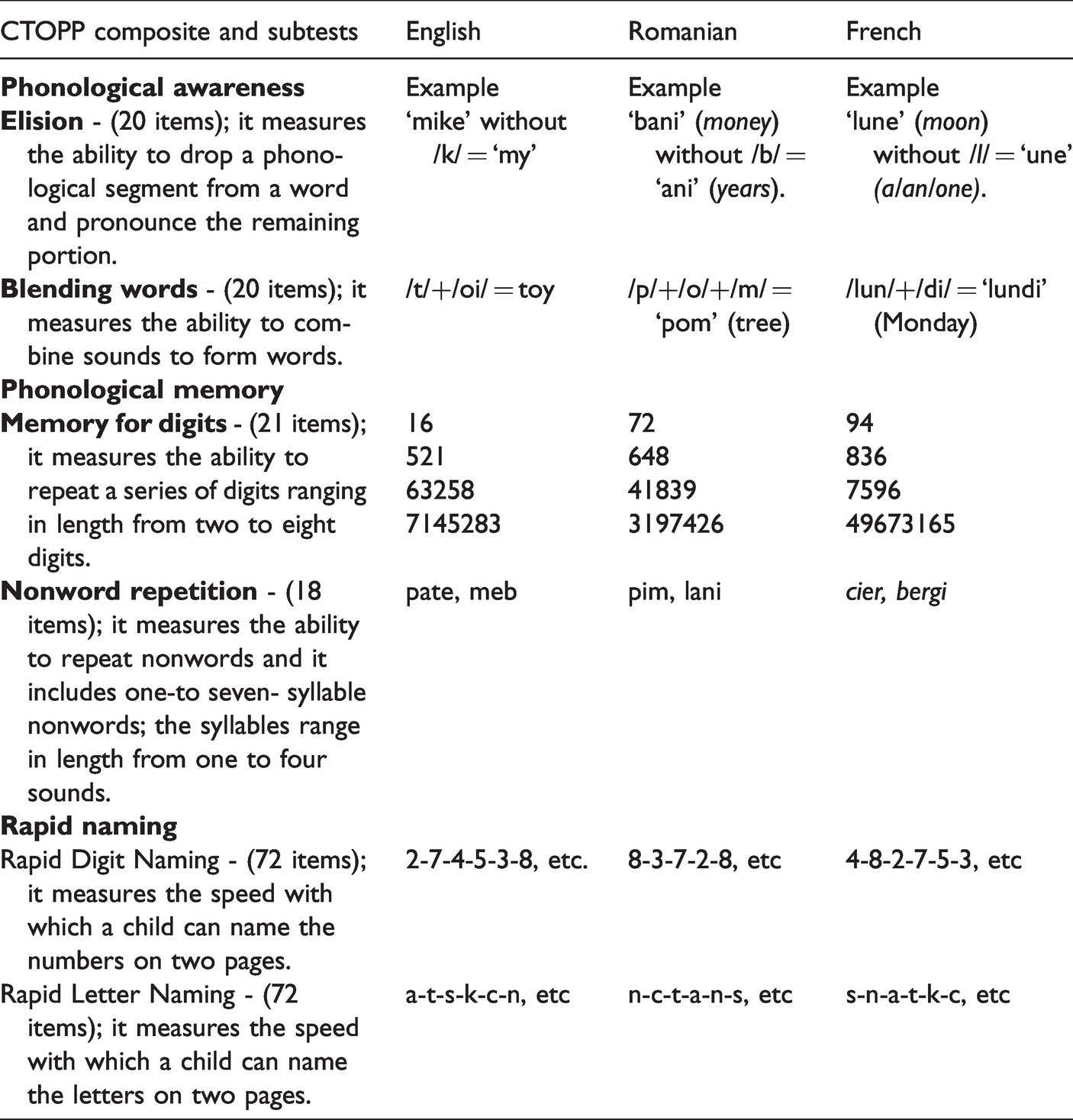
At the end of the intervention, we administered the Comprehensive Test of Phonological Processing (CTOPP; Wagner et al., 1999) in English and its adapted versions to Romanian (Petrescu, 2014) and French. The English CTOPP was administered first. Then, at two-week intervals, the Romanian and the French tests were administered, respectively.
Petrescu’s (2014) Romanian-adapted version of CTOPP was used to measure Alex’s phonological processing skills in Romanian. The adapted version closely matches the English version by maintaining the same organizational structure with six core subtests, but incorporates the distinct characteristics of Romanian phonology (Chitoran, 2001; Petrescu, 2014).
In the absence of an available standardized test for assessing French phonological processing skills, we have adapted the same core tests of the CTOPP to French. The same composite scores, i.e. phonological awareness, phonological memory and rapid naming, were used to measure the child’s phonological processing skills in French. All the subtests were developed based on the distinct characteristics of French phonology (Adda-Decker et al., 2005.) and in consultation with a French language specialist. For the nonword test, we used the computer software ‘Wuggy’ developed by a team of linguists in Belgium and other European countries
Table 1 offers a detailed description of the particulars of each subtest and examples for each language.
CTOPP subtests, their functions and examples in English, Romanian & French.
Procedure
Diagnostic process
At the age of 5;6, at his parents’ initiative, Alex was tested for reading difficulties using Lexia®, a computer program designed to assess a child’s phonological awareness and word recognition skills. Alex’s phonological awareness, fluency, vocabulary and comprehension were tested. The results of the diagnostic assessment revealed that Alex had difficulty in all the critical areas of reading and clearly needed intervention (see supplemental Appendix A). While he demonstrated good knowledge of English letter names and was able to visually match upper- and lower-case letters, he exhibited very limited phonological awareness and word-level decoding skills. For example, words that had a CVC structure, including reversible letters such as b, d, and p (e.g., ‘bin’, ‘pen’) were read at a very slow rate and were recognized only half of the time. Moreover, when the CVC words lacked reversible letters, the accuracy of decoding decreased further, dropping to 20% accuracy. When Alex was asked to decode very short phrases that had CVC and VC words (‘mix in a pan’, ‘a wet pup’), he could not read two-thirds of such phrases. Further, ‘silent-e’ CVCe words such as ‘bite’, ‘cute’, ‘joke’ were not recognized at all. Neither did Alex recognize common sight words such as ‘the’, ‘have’, ‘what’, or ‘your’. It was clear that Alex’s lack of phonological awareness, a skill essential for word identification, impacted his ability to map sounds onto print. In addition to limited word recognition skills, Alex’s response speed was slow, pointing to the fact that his lack of phonological skills was slowing down his processing skills, a finding that further indicated the need for systematic instruction.
Intervention
Alex was provided with reading support twice a week for one hour per session until the age of 7;9. During early activities, Alex was encouraged to develop phonological awareness through picture-matching activities that emphasized rhyming as well as blending and segmenting syllables in spoken words. For example, Alex would be asked to match pictures representing rhyming words, such as ‘mat’-’hat’ or ‘black’-’sack’. To identify and manipulate syllables, he would be asked to clap his hands, tap the desk, shake his head, or place his hand under his chin and count the syllables in words such as ‘crayon’, ‘window’, and ‘desk’. To start gaining phonemic awareness, Alex participated in initial phonics activities such as letter sound matching. Then, he learned how to identify open, closed, and silent-e syllables in one-syllable words, and later in two-syllable words. As he was progressing through the program, he was introduced to more complex sound and syllable patterns, such as vc/cv, v/cv, vc/v, and was encouraged to apply his expanding phonics knowledge throughout vocabulary learning activities. Fluency activities were also systematically built into the instruction, the focus being on important aspects of sentence structure and prosodic elements (e.g., intonation and rhythm). In order to build automaticity, each session would start with two-to-three-minute warm-up activities that would mimic the activities from previous lessons. This was followed by a review designed to consolidate what was previously taught so that his phonological processing skills would become automatic and word identification effortless. In the initial stages of the intervention, such warm-up activities began with letters and sound-symbol correspondences and moved to a recognition of both regular and irregular words as well as key elements related to comprehension. For example, he would practise how to automatically recognize sight words such as, ‘to’, ‘all’, ‘that’, what’ they’, etc., progressing to reading short passages while paying careful attention to punctuation and reading with expression. Progress was closely monitored and documented on a regular basis, and instruction constantly adapted to Alex’s needs. Once Alex successfully completed all the materials and assessments designed for Grade 1-2, the teaching and assessment progressed to Grade 3-4, and then Grade 5-6. Alex was last evaluated at the end of the intervention when he was 7;9.
Results
The first research question aimed to uncover whether the reading intervention led to improvement in the five critical areas of reading encompassed by Lexia®: phonological awareness, structural analysis, automaticity/fluency, vocabulary and comprehension. To answer this question, Alex was tested with Lexia® immediately after the end of the intervention in a manner that facilitated comparison with the initial assessment (see supplemental Appendix B). The results revealed important improvements from the initial to the final assessment in all five areas. First, as Alex had acquired word identification skills and an awareness of the syntactic structure of the sentences, he increased the speed of timed silent reading at the word, sentence and paragraph level, which is a marker of increased fluency and automaticity. He had also mastered all six syllable types: closed, open, silent e, vowel + r, vowel combinations and consonant + le as well as the rules for syllable divisions. For example, he was able to decode words with suffixes such as -s/-es/-er/-est, ed/-ing at a fast speed. One area that he still needed practice on was the speed of identifying three syllable words (e.g., ‘hitchhiker’) as well as multisyllabic words derived from Latin and Greek, which were either missed (e.g., the Latinate ‘dependable’ or the Greek ‘chromatic’) or decoded at an average speed. While the final assessment identified these areas in which Alex needed further practice, no need for further instruction was indicated in any of the five areas of reading. In conclusion, according to Lexia®, Alex showed enough improvement in his word recognition skills in English to no longer need additional reading support.
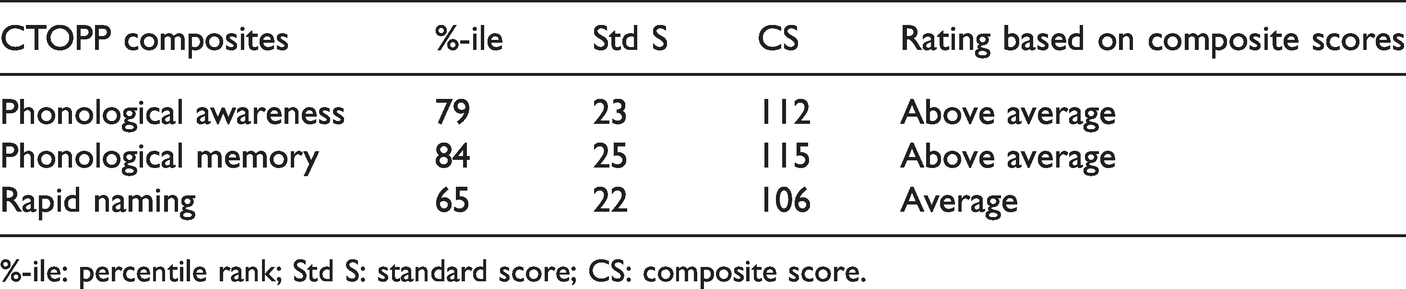
A second question we addressed in this study is to what extent this specific treatment in English corresponds to measures of Alex’s general phonological processing skills in the same language. These phonological processing skills were tested through the English CTOPP. Table 2 shows the standardized composite scores for English.
Alex’s CTOPP-Standardized composite scores in English.
%-ile: percentile rank; Std S: standard score; CS: composite score.
Alex‘s phonological awareness and phonological memory were rated ‘Above Average,’ while his rapid naming skills were rated ‘Average,’ based on the English CTOPP interpretation of the composite scores using ratings from ‘Very Poor’ to ‘Very Superior.’.
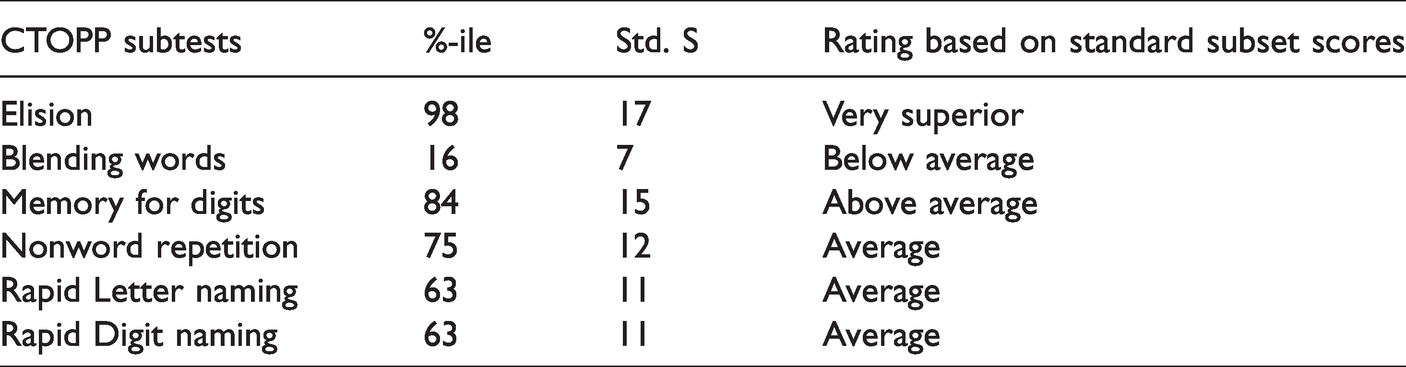
Table 3 records the child’s performance on the subtests that constitute the composite scores. Alex’s scores for Elision (17) are ‘Very Superior’, whereas his scores for Memory for Digits (13) are ‘Above Average,’ and his scores for Nonword Repetition (12), Rapid Digit Naming (11) and Rapid Letter Naming (12) all rated as ‘Average.’ On one subtest, Blending Words (7), Alex scored ‘Below average.’
CTOPP-standardized scores for English subtests.
The final question we addressed in our study was to what extent treatment in English and the assessment of Alex’s phonological skills in English at the end of the program correspond to his phonological profile in the non-treatment languages, that is, Romanian and French. In other words, how did various aspects of phonological processing compare across the three languages? Since the Romanian and French versions of the CTOPP have not been standardized, only raw scores across the three languages were generated and recorded. It must be noted, however, that in the case of Rapid Naming, a comparison between languages was not possible mainly because of a difference in the number of syllables in many test items as well as Alex’s lack of knowledge of grapheme (letter) names in Romanian.
Correlations based on CTOPP guidelines indicated that in areas of Phonological Awareness and Phonological Memory, English and Romanian scores were highly correlated (p = .005) but not between French and either English or Romanian (p = .4 in each case). However, as seen in Table 4. Alex’s French scores for Elision and Blending Words (component of Phonological Awareness) were almost identical to his English and Romanian scores. In contrast, Alex’s below average score the Memory for Digits and above-average on for Nonword Repetition in French created a lack of congruity between French and Romanian and English (his L1 and L2 respectively).
Alex’s Raw Scores (RS) for English CTOPP and Romanian- and French-adapted CTOPP.
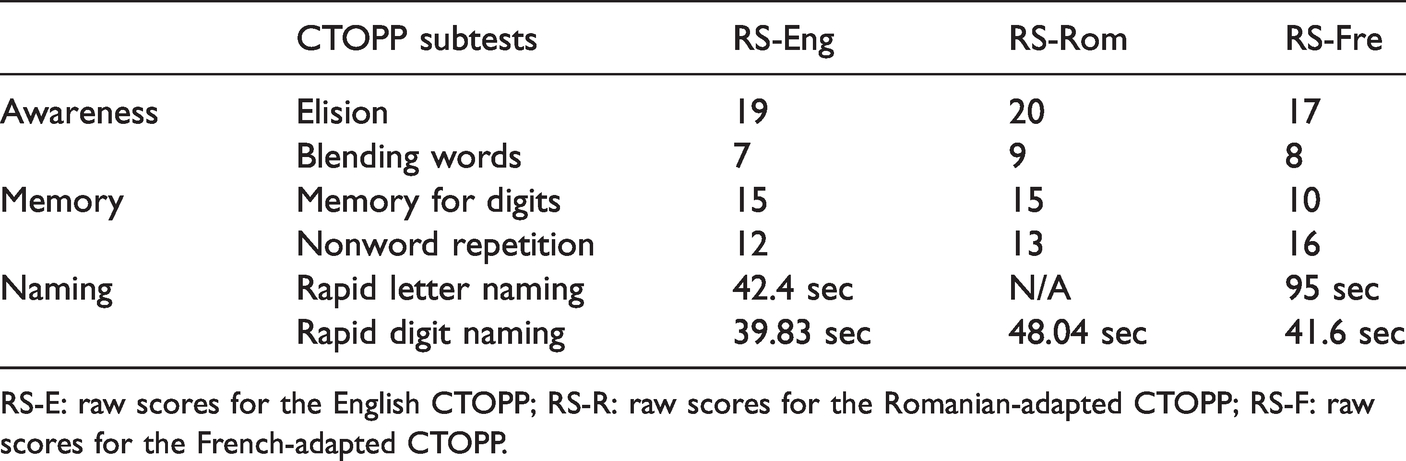
RS-E: raw scores for the English CTOPP; RS-R: raw scores for the Romanian-adapted CTOPP; RS-F: raw scores for the French-adapted CTOPP.
Discussion
Alex is a trilingual who struggled with emergent reading processes in English during his kindergarten years on account of his inability to apply GPC rules to short, regularly spelled known words and non-words. An initial assessment of his phonological skills at the age of 5;6 through the Lexia® program’s pre-testing program showed that Alex’s orthographic decoding skills were impaired. While he did have grapheme knowledge, one of the two main predictors of early reading success together with phonological processing skills (Bowey, 2005), he had great difficulty with identifying and manipulating sounds and, when he did recognize words by sight, his speed was slow. Alex’s lack of phonological abilities was consistent with the phonological deficit reported in children with literacy difficulties to the extent that he could even be diagnosed as dyslexic (Goswami, 2012; Ziegler and Goswami, 2005). Over a period of two years and three months, Alex was provided with an individualized reading intervention program that offered a systematic, carefully structured, and multisensory approach in the area of phonological awareness, automaticity, vocabulary, comprehension, and structural analysis in English. He started the intervention at Level 1 (corresponding to a pre-Kindergarten level of reading), and at the end of the intervention he successfully completed Level 21, the last level in the training program and corresponding to a Grade 5 level of reading in a North American context. Following this intervention, significant gains were observed in Alex’s word recognition skills as revealed by a comparison of his initial and his final Lexia assessments (see online supplemental Appendices A and B). His phonological awareness had improved considerably, as evidenced in his ability to apply knowledge of letter-sound correspondences to decode words, phrases and sentences. Simultaneously, his word recognition skills had become quick and accurate, reflecting a degree of automaticity that would facilitate fluent reading and comprehension of short texts. This provides a response to our first question, which addressed the impact of the intervention in the language/script that was the vehicle of this effort.
Our second question addressed the extent to which treatment in phonological awareness in the child’s second language, English, impacted his phonological processing skills, as measured separately by a standardized series of tests under the umbrella of the English CTOPP. The overall picture emerging from these findings generally supports the decision of Alex’s parents to provide their child with reading support when he displayed signs of not being able to connect graphemes with sounds at a stage when his peers had begun to understand these correspondences. In addition, Alex’s post-intervention performance provides a modicum of evidence to offset the fears of those members of the community who continue to worry about the supposedly deleterious effects of minority language retention. Alex’s phonological processing skills as measured by the CTOPP confirmed the findings of his final Lexia® assessment. In fact, in English, he showed above average phonological awareness and phonological memory abilities, and average rapid naming skills on the CTOPP, an assessment tool that is based on monolingual (English) norms.
A final question centred on whether at the end of the reading intervention, there was any evidence of comparable phonological processing skills in Alex’s three languages, that is, including the languages in which he received no special remediation. The English CTOPP and our specially-designed Romanian- adapted and French-adapted versions of the standardized English CTOPP indicated that Alex’s scores in the combined areas of Phonological Awareness and Phonological Memory were highly correlated in English and Romanian but neither the English nor the Romanian scores correlated with the French ones. A closer look, however, at each component revealed that, in the area of Phonological Awareness (Elision and Blending words) Alex’s French scores were close to identical to the English ones. It was only the second component of the CTOPP, focusing on Phonological Memory, that painted a different picture since Alex’s French scores were not aligned with his scores for English and Romanian. While Phonological Memory is considered to be a general cognitive skill and, therefore, its effectiveness across languages should be similar in theory (Baddeley, 2012; Jared et al., 2011), research involving bilingual children suggests that the degree of language knowledge drives memory performance on tests (Swanson et al., 2011; Thorn and Gathercole, 1999). In the present study, Alex’s performance on the Memory for Digits in French was worse than in Romanian and English, in keeping with the fact that French was his newest language. The one anomalous result was Alex’s performance on the Nonword Repetition Task in French where his score was higher than in English or Romanian. A plausible explanation for this is that, as observed during the testing process, the person who administered the French test (a French teacher) enunciated nonwords just as she would when introducing new vocabulary, that is, slowly and emphatically. This would give a test-taker an advantage when repeating non-words and serves as a caveat for future trials of the CTOPP.
As noted in the Results, one interesting observation that we made only after the CTOPP tests were administered was that Rapid Naming in CTOPP could not lend itself well to making comparisons between the language-specific phonological processing of a trilingual. First of all, the items themselves made varying articulatory demands on the participant. For example, the Colour Naming subtest could not be included because of numerous multisyllabic words for colours in Romanian (e.g., blue is ‘albastru’). However, even though we switched to Letter Naming (i.e., naming graphemes), problems still remained because of the child’s limited familiarity with these names in Romanian and, to some extent in French, since this skill is literacy based. Digit Naming in Romanian, where the child had much less formal education in numeracy, also created a confound. As a result, we felt that comparisons of Alex’s abilities in this area would not be based on phonological processing as much as on literacy experience.
While the comparability of Alex’s scores on the phonological awareness tasks in all three languages could be possibly attributed to the reading intervention in English, one could still argue that literacy training in L1 (Romanian) and L3 (French) rather than the intervention in English brought about a dramatic change in Alex’s word recognition and phonological awareness skills in Romanian and French. However, we should clarify that Alex received no literacy training in Romanian, but he did receive reading instruction in French immersion. If the latter had an influence on Alex’s phonological development, it probably was not as substantial as one would imagine. First, as mentioned earlier, there are no remedial reading classes in most French immersion programs (Delcourt, 2019), and there certainly were no special resources in Alex’s school. More significantly, the focus of Alex’s Grade 1 teacher was helping children to develop oral language skills, a curriculum requirement for Grade 1 French immersion. In Grade 2, the teacher took a “look/listen and say/repeat” approach without teaching word recoding through grapheme-phoneme correspondence rules.
In an ideal scenario, the English CTOPP and its Romanian and French adaptations would then be administered both pre- and post- intervention to answer our question on the transferability of phonological skills from the treatment language to the child’s other languages. This case study, however, provides anecdotal evidence of Alex’s very limited phonological processing skills in both Romanian and French prior to the intervention. As mentioned in Alex’s profile, his parents had tested Alex informally with various elementary recoding tasks, for example, asking him to read nonce words like lat, rud, sep, dom. What is noteworthy about these types of nonce words is that they are phonotactically and orthographically possible patterns in English, Romanian, and French. Alex’s inability to read these nonce words provides indirect evidence of his very limited phonological awareness skills in any of his languages at the commencement of the intervention.
Conclusion
This study highlights, although in modest ways, how necessary it is to take action in a timely fashion when a child appears to have reading problems in elementary school. Furthermore, the study supports the view that assessment and intervention can take place in a language other than the school’s medium of instruction. More importantly, this case study provides one answer to the question raised by Genesee (2007) as to whether children in French immersion struggling with basic word recognition skills can recover without being switched to the English stream. In Alex’s case, the answer is definitely in the affirmative. Irrespective of the nature and degree of the child’s reading problems, we encourage parents and educators not to automatically move children from French immersion to mainstream English schooling without careful consideration of the options available in any one of the child’s languages.
The issue of whether children with reading difficulties should continue to attend French immersion programs can be answered authoritatively only if a very ambitious study is launched in which a sizable number of at-risk children remain in French immersion and are compared over the years to another group who switch to the English stream. The feasibility of such research remains in question. Meanwhile, since parents’ choices are generally governed by what resources are readily available in the child’s community, our educated guess is that with children whose first language is a minority one, remediation could even be in this language, especially if all of the scripts are phonographic. One caveat is the finding that the transfer of literacy skills between languages is determined by how close they are in terms of writing system and script (Bialystok et al., 2005; Branum-Martin et al., 2006). Future research, therefore, needs to establish if intervention in English could be a successful strategy for those children in French immersion whose home language (and accompanying script) is typologically different from both English and French (e.g., Mandarin).
Another valuable research endeavour would be to create reliable diagnostic tests and literacy enhancing programs in other languages so that, in the absence of community resources, parents could help their children at home. The conclusions we drew about Alex’s progress, for example, were based on our own Romanian and French instruments for measuring phonological processing. Issues such as the comparability of tasks across languages (cf. Rapid Digit/Letter Naming in this study) need to be taken into consideration when instruments are designed and normed through large-scale test creation and validation.
Our final recommendation is linked to the proliferation of the term “dyslexia”. In retrospect, the researchers and the parents agree that a more comprehensive testing of other aspects of Alex’s learning profile, such as his oral linguistic skills, learning abilities, and his visual and auditory processing, would have revealed that Alex’s problems were solely in the area of phonological processing and that, if he were dyslexic, he suffered from a mild form of dyslexia. (See Giofrè et al., 2019 for a recent account of the wide spectrum of problems encompassed by the term ‘developmental dyslexia’.) Alex’s progression over the 2.5 years covered in this study suggests that he only had below-average phonological processing skills that simply needed the scaffolding of well-planned phonological awareness training, the way some children require extra coaching in mathematics or foreign language grammar. In fact, Alex’s parents’ retrospective view was that, had they withdrawn him from French immersion on the basis of a dyslexia diagnosis (as some educators and parents had advised), this would have had a deleterious effect on Alex’s academic progress as well as his self-esteem given his great enthusiasm for being in French immersion with his older brother.
Supplemental Material
sj-pdf-1-ecl-10.1177_14687984211041389 - Supplemental material for Trilingualism and reading difficulty in a third (school) language: A case study of an at-risk child in French immersion
Supplemental material, sj-pdf-1-ecl-10.1177_14687984211041389 for Trilingualism and reading difficulty in a third (school) language: A case study of an at-risk child in French immersion by Maria Claudia Petrescu and Rena Helms-Park in Journal of Early Childhood Literacy
Supplemental Material
sj-pdf-2-ecl-10.1177_14687984211041389 - Supplemental material for Trilingualism and reading difficulty in a third (school) language: A case study of an at-risk child in French immersion
Supplemental material, sj-pdf-2-ecl-10.1177_14687984211041389 for Trilingualism and reading difficulty in a third (school) language: A case study of an at-risk child in French immersion by Maria Claudia Petrescu and Rena Helms-Park in Journal of Early Childhood Literacy
Footnotes
Acknowledgments
We would like to thank Melanie Lamarca and Tamara Al-Kasey for their help with preparing the manuscript. Special thanks go to Alex for his enthusiastic participation in this project. He is still in French immersion and loving it!
Funding
The author(s) received no financial support for the research, authorship, and/or publication of this article.

References
Supplementary Material
Please find the following supplemental material available below.
For Open Access articles published under a Creative Commons License, all supplemental material carries the same license as the article it is associated with.
For non-Open Access articles published, all supplemental material carries a non-exclusive license, and permission requests for re-use of supplemental material or any part of supplemental material shall be sent directly to the copyright owner as specified in the copyright notice associated with the article.
