




Abstract
This paper reflects on a slow-motion video clip of the hands of three young children as they play with toys in the sand tray. It foregrounds sand and toys that are handled, as well as hands that grasp and relinquish things. Through this movement of hands that tug and pull at things, it explores how things animate bodies, and how this produces the felt-sense of other desiring bodies. As hands tender things, they are animated by what they touch, and simultaneously things are animated through the give and take of pulls and pushes of desire expressed as kinetic force. The slowed film of hands in motion draws our attention from words, towards a (re)cognition of a sensed intelligence which is not pre-language, but is produced before language, as well as with language. Arguing that child development theories are inextricably bound up in narratives of human exceptionalism founded in language and moralism, I will make the case for reinstating sense as a mode of attention in order to counter a lack that is perceived until children learn language. By troubling the boundaries that we draw between the animal and the human, there is much to learn from very young children when we seriously attend to their capacity for sensory ways of knowing that are so often eclipsed by the dominance of language.
This paper will work with data generated from a research project in which I have taken the role of researcher-in-residence at Martenscroft Children’s Centre and Nursery school in inner-city Manchester over a period of 3 years. Reflecting on a slow-motion video clip of the hands of three young children (2–3 years) as they play with toys in the sand tray, I foreground the responsive movements of hands as they play with sand and take hold of, and relinquish, toys. This close attention to motion makes perceptible more-than-human qualities of communication that are expressed through desiring bodies in relation to sand, toys and other hands. Studies of early communication and peer inter-action are often marked by a keen focus on the emergence of speech as that which makes us human (e.g. Boundy et al., 2016). Alongside this interest in the emergence of language in infancy, there has also been an increasing interest in the role of gesture in the development of language, both in relation to the human child (Arbib, 2012; Corballis, 2003; Tomasello, 2008) and at the level of human evolution (McNeill, 2016). This scholarship has supported a shift of focus from words uttered by mouths towards the gesturing of hands in early childhood language research (Goldin-Meadow, 2010). While I will sidestep the evolutionary quest for linguistic origins that so often haunts the theorising of early language development, I seek to reveal ways in which linguistic boundaries are tested in relation to the animal as an antidote to the human exceptionalism permeating infant language studies. I will work with the notion of ‘animaling’, as proposed by Birke et al. (2004: 169) with the intention of questioning the borders of the animal/human divide in relation to communication and language. This approach has potential because language theories are saturated and entwined with what De Waal has called ‘anthrodenial’ (1999); their starting point being, so often, about delineating what it is that makes us human as opposed to animal. This human exceptionalism is intensely bound up in the history of child development theories because of the ways in which they are coupled so closely with colonial evolutionary theories (Murris, 2018). In order to undo the evolutionary logo-centric hierarchies of knowledge produced by a colonialist fascination for human origins, I will use the notion of an ‘involutionary mode of attention’ (Hustak and Myers, 2012: 77) in order to think about communication more expansively, as an ongoing responsiveness to the world.
Looking beyond the individual child as the focus for pedagogical practice, I will explore the affective engagements of bodies in relation to matter, and the ways in which they are experientially entangled in our own and the other’s felt action (Stuart, 2012). Attending to grasp as a particular way of knowing gives value to the ways that hands touch matter and ‘encounter perturbations, feel difference, and engender change’ (Stuart, 2013: 11). As hands tender things they are animated by what they touch, and simultaneously things are animated through the give and take of pulls and pushes of desire expressed as kinetic force. As Haraway says: ‘through their reaching into each other, through their “prehensions” or graspings, beings constitute each other and themselves. Beings do not pre-exist their relatings’ (2003: 6). Following Page (2018), who calls for embodied material pedagogies, I would like to challenge the current climate of ‘wordism’ (Blum, 2015) that is so prevalent in early years policy discourse. In the data presented here, hands move towards things and, through this reaching out, things and bodies are touched. Touch becomes a ‘contact sense’ (Ratcliffe, 2012: 415), a sensed response to the world that takes place through kinetic dialogues activated by a curious reaching out. Intra-acting hands serve as ‘conduits through which we extend our will to the world’ (McCollough in Streeck, 2009: 52). But, ‘at the same time, they serve also as conduits in the other direction: they bring us knowledge of the world’ (Streeck, 2009). This sensory mode of understanding resides neither solely in the self, or not-self, but rather as ‘a force emerging between people and materials’, something that Kuby and Gutshall Ruckers call an ‘enacted agency’ (2016: 3). By focusing on hands instead of mouths, it is the capacities rather than deficits of young children’s communicative practices that will be highlighted.
In contrast to future-oriented trajectories towards words, speech, and then onwards to literacy, I will approach these touching exchanges from a post-human perspective, through the prism of non-representational theory, in order to (re)cognise the potential of pre-cognitive ‘intelligencing’ (Thrift, 2008: 153). Developing this notion, I will explore the possibility that this sensed form of intelligence is something that can extend our understandings of literacy, but not as something that is necessarily on the way to literacy. Rather, the research findings open up the possibility that this felt-sense might also be produced through, and become attached to, language. As such, it has something to tell us about what Dewey has called ‘surplusage’ (1998: 254) – the ‘more-than’ signifying function of language. Drawing our attention away from the denotative function of words, it points towards a (re)cognition of sensed intelligence which is not pre-language, but is produced before language, as well as with language. Instead of positioning the sensori-motor as the ‘prior’ of language, language is recast as not only ‘post-kinetic’ (original emphasis, Sheets-Johnstone, 2011: 448), but also as ‘not equal to the communicative power of these non-verbal behaviours’ (Sheets-Johnstone, 2011: 436).
I will begin by sketching out the policy and practice landscape that shapes the milieu of the nursery setting in which I took up residency. This early childhood education context is one where child development theories are overwritten with anxieties about both the social mobility gap and language acquisition. I will go on to situate the methodological stance that I adopted, by providing more discussion and context to residency-as-method, and the particular potential of slow-motion video. At the heart of the paper, I deploy the concept of ‘mo(ve)ment’ (Davies and Gannon, 2009: 9) to work with the multiple meanings that the term implies: both an attention to sensing in-the-moment, and an appreciation that this dynamic sensing is always being mobilised through movement. While Davies and Gannon deploy the term in relation to their methodology of collective biography writing, the double action that they invoke ‘of dwelling in and on particular moments of being, and of movement toward, or openness to new possibilities of seeing and being’ (Davies and Gannon, 2009) is conceptually productive when put to work in relation to slow-motion video. This movement-oriented ontology will explore how bodies in motion are always in-relation, and how this motion is always eliciting response-ability (Haraway, 2008: 88) through encounters with difference.
‘Minding’ the Gap
‘Minding the gap’ has become a commonplace phrase in current education policy discourse, deployed to signal the government’s concern about the growing gap between the education outcomes of the richest and the poorest children in the UK. I am interested in the double meaning of ‘minding’: to mind the gap is not only a rhetorical statement that equity matters, it also invokes a singular focus on the minds of young children. In a time of accelerating anxiety about closing literacy gaps when children start school, state-funded nursery provision now targets 2-year-olds from socio-economically disadvantaged backgrounds. Some minds, it would seem, are not as well developed as others, and funding this compensatory early education is an attempt to ameliorate this problem. My research project itself was conceived in response to this new funding, and it was located in a nursery class in order to research the worlds of 2-year-olds in educational settings as this is a very new phenomenon. In this climate, 2-year-olds have become central to concerns about ensuring the normative development of all children, and the maturing toddler has become the focus of intense scrutiny in order to ever earlier diagnose speech delay and other special educational needs (Bercow, 2008; Ofsted, 2012).
The motif of the ‘word gap’ has become significant as an explanatory factor in the diverging educational trajectories of different socio-economic groups. This term has been closely coupled with a specific research finding that, by 3 years old, a child from a lower socio-economic background will have heard 30 million fewer words than their wealthier peers (Hart and Risley, 1995, 2003). Despite the fact that this research was based on a small sample size in a particular US context, is over 15 years old and has been hotly contested (Dudley-Marling and Lucas, 2009; Johnson, 2015; Miller and Sperry, 2012), it continues to be used widely as a reference point both in similar studies and in policy documents (cited 8850 times Google cite 18/05/2019). In my writing here, I will avoid the debate about why the word gap matters, which is also highly contested (Golinkoff et al., 2019; Hoff, 2013; Sperry et al., 2018). Rather, I want to explore how data and theory might expand the discussion about what such a narrow focus on words might blind us to when we think about the literacy practices of very young children. In particular, by using Birke et al.’s notion of ‘animaling’, I hope to reframe the lack that is associated with children’s pre-verbal stages of development, instead as a rich ‘wild element’ (Deleuze in MacLure, 2013: 657) that is ideational both before, as well as with, language.
As with the rhetoric around the social mobility gap and its associated word gap, there are familiar tropes in the rhetoric around the term literacy and what underpins literacy in an educational context. An oft-quoted phrase is that ‘good literacy’ is presumed to ‘float upon a sea of talk’ (Britton, 1970: 164), and accordingly words become pedagogically weighty and exigent; children are entreated to ‘use your words’, and adults who care for children find themselves at the centre of ‘talk to your baby’ campaigns. In the UK during 2018, there has been a particular intensification of this ‘tyranny of talk’ (Pitt and Arculus, 2018: 12) expressed in the media and policy discourse at a national level. Two recent examples of this are government funding being channelled towards intervention strategies that are aimed at increasing the words spoken by children and changing parents’ behaviour, such as the Hungry Little Minds Campaign (DFE, 2019), and Head of Ofsted Amanda Spielman’s Word Gap speech (2018). It is the twinning of the notion that good literacy ‘floats upon a sea of talk’ with evolutionary ideas about language that I will now briefly touch on before moving on to discuss my methods and the video data on hands in the sand tray.
Being human: Literacy and oracy
Language has made possible man’s progress from animality to civilization … it permits its users to pay attention to things, persons and events … Language gives definition to our memories and, by translating experiences into symbols, converts the immediacy of craving or abhorrence, or hatred or love, into fixed principles of feeling and conduct. (Aldous Huxley, in Fisher et al., 2008: 168).
So much literature about children’s speech, language and literacy explicitly positions language as what makes us both human and civilised. This quote comes from the opening pages of a book about teaching literacy to diverse secondary school learners. Having positioned language as a uniquely civilised and human quality, with reference to Vygotsky, the authors go on to expand the idea that it is through talk that we think: Tracing this idea backward, speech—talk—is the representation of thinking. As such, it seems reasonable to suggest that classrooms should be filled with talk, given that we want them filled with thinking! (Fisher et al., 2008: 11)
Slow research
The data that this writing responds to were generated during a long-term research residency that was funded internally by Manchester Metropolitan University. In contrast to an outcome-driven externally funded research project, it offered a unique opportunity to conduct a form of ‘slow research’ (as advocated by Horton and Kraftl, 2006; Millei and Rautio, 2017; Stengers, 2004), one that is rare in these austere times steeped in discourses of accountability and solution-focused enquiry. The research was funded in response to the new 15 hours a week state funding for 2-year-olds living in families identified as being socio-economically disadvantaged. While there is a body of research in the nursery classes for 3–4-year-olds in the UK (there has been state-funded provision for this age group since the mid-20th century), there is very little research about nursery worlds of 2-year-olds in the UK context. At the invitation of Martenscroft Children’s Centre and Nursery School, I occupied the role of researcher-in-residence, and I spent one day a week in their setting over three years. For the first two years I was located in the 2-year-olds’ classroom, and for the last I maintained contact with the cohort of children and families by visiting the 3–4 year olds’ nursery classroom. This slow research allowed me to work speculatively with different methods, where initially I kept written fieldnotes, accompanied by photographs and video clips. As the residency developed, I became increasingly participatory (an extra staff member, albeit in a distinctly different role to the early years practitioners who worked beside me in the 2-year-olds’ room). By the end of the first year, slow-motion video emerged as a method of viewing filmed events that was particularly well suited to attending to the micro-responses of bodies as they encountered the material and physical space of the nursery class. The more I inhabited the space of the nursery, the more ethnographic descriptions were eclipsed by my own sense of mo(ve)ment. I became aware that by following the movements of children, my responses to children were also in motion at the same time as being ‘in the moment’. Inhabitation was itself a form of co-experimentation that responded to the movements of other bodies, and this methodology was well suited in reframing Piaget’s sensory motor ‘stage’ more as an ‘ongoing minor key’ that continued to have a life beyond infancy (MacRae, 2019: 4).
Echoing this slow research methodology that increasingly became entangled in relationships with practitioners, children and their parents, the method of slowing down video also foregrounded relations. It is this relationality expressed by movement, as children’s bodies responded to other bodies (both human and non-human), that I discuss now. In the film data gathered in my first year of residency, there were many short films of small groups of children playing alongside each other in various parts of the nursery. When I (re)viewed these in slow motion, my attention was drawn to moments in play-events when a toy, held in a child’s hand, would become caught up in a desiring tussle with another child’s hand that moved towards the toy. Sometimes a child might take hold of an object that another child was holding, and in such instances these tussles could erupt into affectively charged and visible events. When two children were both pulling a toy with force and became loudly vocal, or when they were in danger of hurting each other, adults very often moved in to intervene. In such situations, adult interventions unfolded in a number of well-trodden ways. For example, toys might be arrested and removed from children’s hands, and adults might use words to determine ‘who had it first’, or entreat children to ‘use their words’ and ‘share’.
As well as these major events, I also gradually became aware that these toy-child tussles took place far more frequently as quiet, unnoticed ongoing minor gestures, as children played in sand and water trays with construction and small world toys, as well as in the context of outdoor play. These events were often transacted through such diminutive gestures that I missed them altogether when I was observing or participating in play. It was only when I replayed film clips in slow motion that I realised how much they were part of the ongoing intra-actions of the toddler classroom, leading me to actively notice them more often as I participated in classroom life. In these small tussling events, a hand would be holding a toy, then another hand would reach towards it and take hold of it too. The first hand would appear to feel the presence of the incoming hand through the vibrational impact of the thing held, or through body-to-body contact because hands touched each other. In response, the two hands, now both holding the toy, would pull away from each other. The toy itself now connected both the children, and their desire could be felt through the vibrational movement of the toy itself. The toy would dance back and forth in relation to the desiring pulls of each body. Each body was able to feel the intensity exerted by the pulls of the other. These back-and-forth movements where bodies and things were kinetically connected most often ended when one hand relinquished a toy. Sometimes the taking hand might relinquish the toy, sometimes the grasping hand would let go. Sometimes the taking hand would offer another toy, an offer that might be accepted or declined. Very often these tussles were resolved in these various ways without coming to the attention of adults, and words were often not exchanged.
Tactful hands: A politics of the minor key
The data that I want to explore in greater depth comes from a short piece of video that I filmed with a hand-held iPad. Standing around the blue plastic sand tray were three children, playing alongside each other. One child (who I will call Amin) was pouring sand through a blue-topped sand wheel. His hand was scooping sand up from the tray bottom and pouring it through the funnelled hole at the top of the sand wheel. Sand trickled through his hand, and through the hole in the sand wheel; the sand-in-motion turned the wheel, and sand poured from the bottom of the wheel, back into the tray. At one end of the tray another child (Alfie) was also channelling sand through a green-topped sand wheel. He scooped sand with a large sieve, and with his other hand he held a toy human figure, and with this clutching hand, he steadied the sand wheel at moments when it started to topple over. Across from Amin, and next to Alfie was another child (Lola) who also held a toy human figure which she laid at the bottom of the tray, while her other hand poured sand on top of the toy. As I filmed the unfolding movement of hands in the sand tray I was aware of only one moment of tension where it seemed that Lola’s hand tried to grab one of the play people from Alfie’s hand. However, slow-motion viewing brought to my notice how objects set hands in motion in ways that I had not perceived while I was filming. The slowing of film brought into focus a contact zone of continually shifting space between hands, toys and sand. As hands responded variously to all of these, they moved in relation to sand to scoop or pour, they fluttered hesitantly as they reached towards toys held by other hands, they tendered toys, they grasped toys tighter as hands moved in their direction, and sometimes momentarily two hands tugged away from each other as they held the same toy. The scooping, scraping and pouring actions of hands in response to sand was also a reminder that sand moves hands differently to toys, or other hands.
Having set the scene, I will unfold the slow-motion version of the event in closer detail. In spite of the insufficiency of words to capture the complexity of motion, this retelling allows me to attend to mo(ve)ment in greater depth. I am able to pause the film and restart it in order to hover and linger over particular frames where, as Kathleen Stewart says, ‘things hanging in the air are worth describing’ (2011: 447). Drawing on Berlant, who talks about developing awkward descriptive methods, Stewart speaks of ‘approaching the thing that is happening by attuning to it as a thing of promise and contact’ (2011: 447). By trying to minutely story the slow-motion event in words, I try to follow mo(ve)ment, registering how this changes my perception. I return to Amin’s hand that has been pouring sand through the blue sand wheel that is closest to him. He reaches over to the green sand wheel that Alfie is playing with. It seems that this reaching was in response to the sudden turning of the other sand wheel that had just been set in motion by Alfie, who had knocked it accidentally and caused a rush of sand to pour through the funnel. Amin’s moving hand is already grasping sand, sand which leaks through his curled fingers as his hand moves towards the green sand wheel that Alfie is holding. Amin’s hand is still once it is over the funnel and his fingers release more sand. The sand starts to pour through the hole, and this keeps the sand wheel in motion. As the last sand runs out, Amin’s hand drops towards the top of the sand wheel, takes hold of it, and starts to lift and pull it towards him. Alfie, who had been playing with this sand wheel, and using a sieve as a scoop, had momentarily lost contact with the sand wheel. As Amin’s hand descends, Alfie’s clutching hand starts to move towards the wheel that is about to be pulled away. Amin’s hand takes hold of the side of the sand wheel, while Alfie’s hand (still clutching the toy person) forces the sand wheel back down. Amin’s hand pulls harder and the sand wheel is lifted with renewed force, and pulled back towards Amin’s body. Alfie’s hand starts to follow the moving sand wheel, but as it follows the direction of the sand wheel, it suddenly swerves to drop the toy, and moves back in the direction of the snatched sand wheel. Then Alfie’s hand halts in mid-flight and it withdraws, as if it was acquiescing to the sand wheel moving away from its reach (Figure 1).
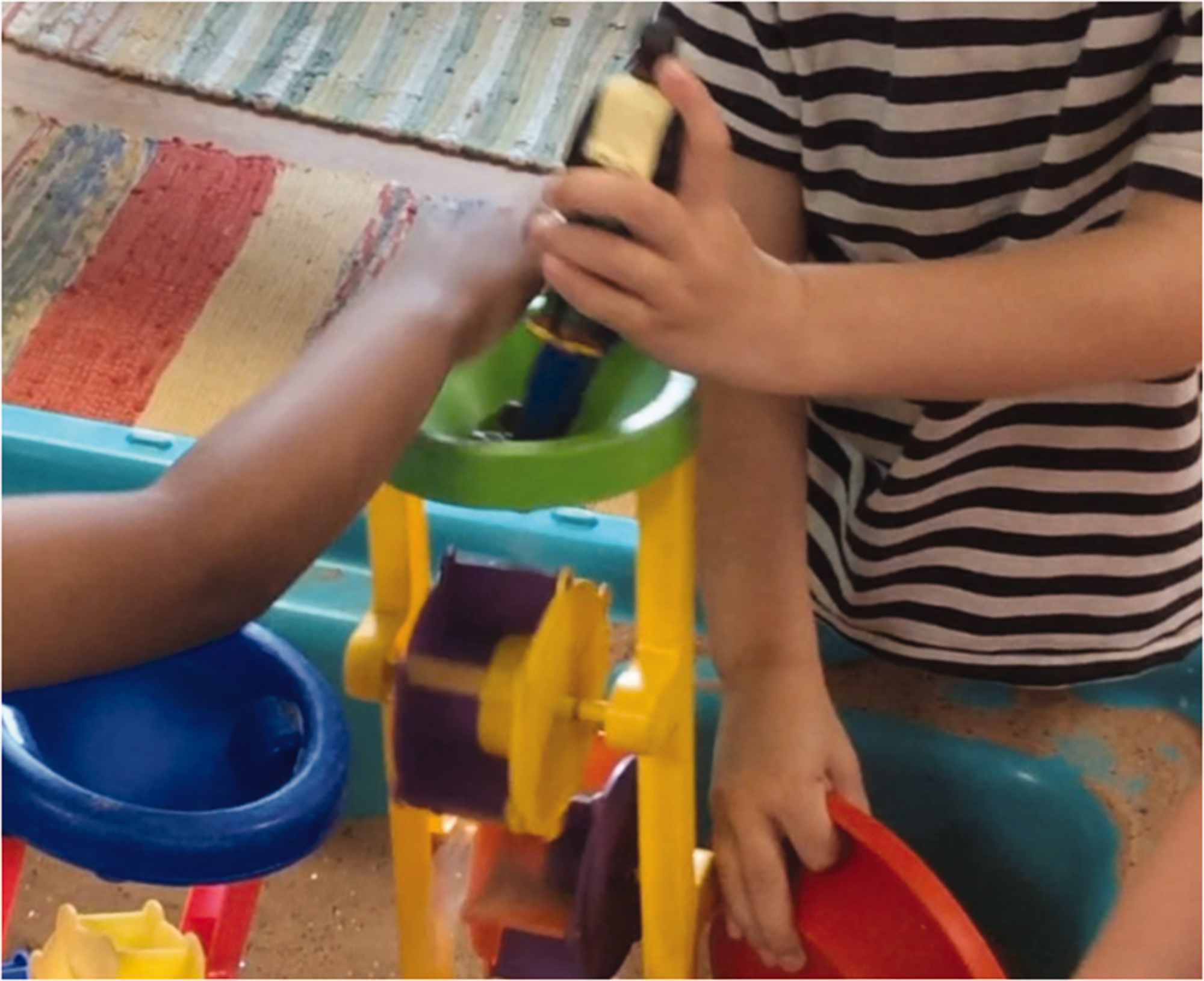
Hand/sand wheel contact.
Alfie’s hand moves back towards his body, slowing and hesitating, then suddenly speeding up, it changes direction and reaches over close to Amin to take hold of the discarded sand wheel instead. Through this action, the two sand wheels have been tendered, and swapped places. Now that the sand wheels have been exchanged, hands continue with their scraping and pouring. The exchange of sand wheels is followed a little later by another toy tussle that unfolds in a series of micro-moments when Lola’s hand, which also holds a toy person, moves towards the toy person that Alfie has momentarily placed on top of the sand wheel. I anticipate that another tender of toys will take place. However, quickly, Alfie’s hand moves in to grasp the toy that he had released. Now both hands grasp the toy they each hold more tightly, and toys stay held rather than being released. A little later, this movement is repeated when Alfie’s hand momentarily let go of the play person, and Lola’s hand moves in towards the figure lying on the top of the sand wheel. However, this time their hands do not make contact; Lola’s reaching hand retreats in response to the incipient grasping movement of Alfie’s hand that quickly moves to pick up the lying figure. During these exchanges no words are uttered (Figure 2).
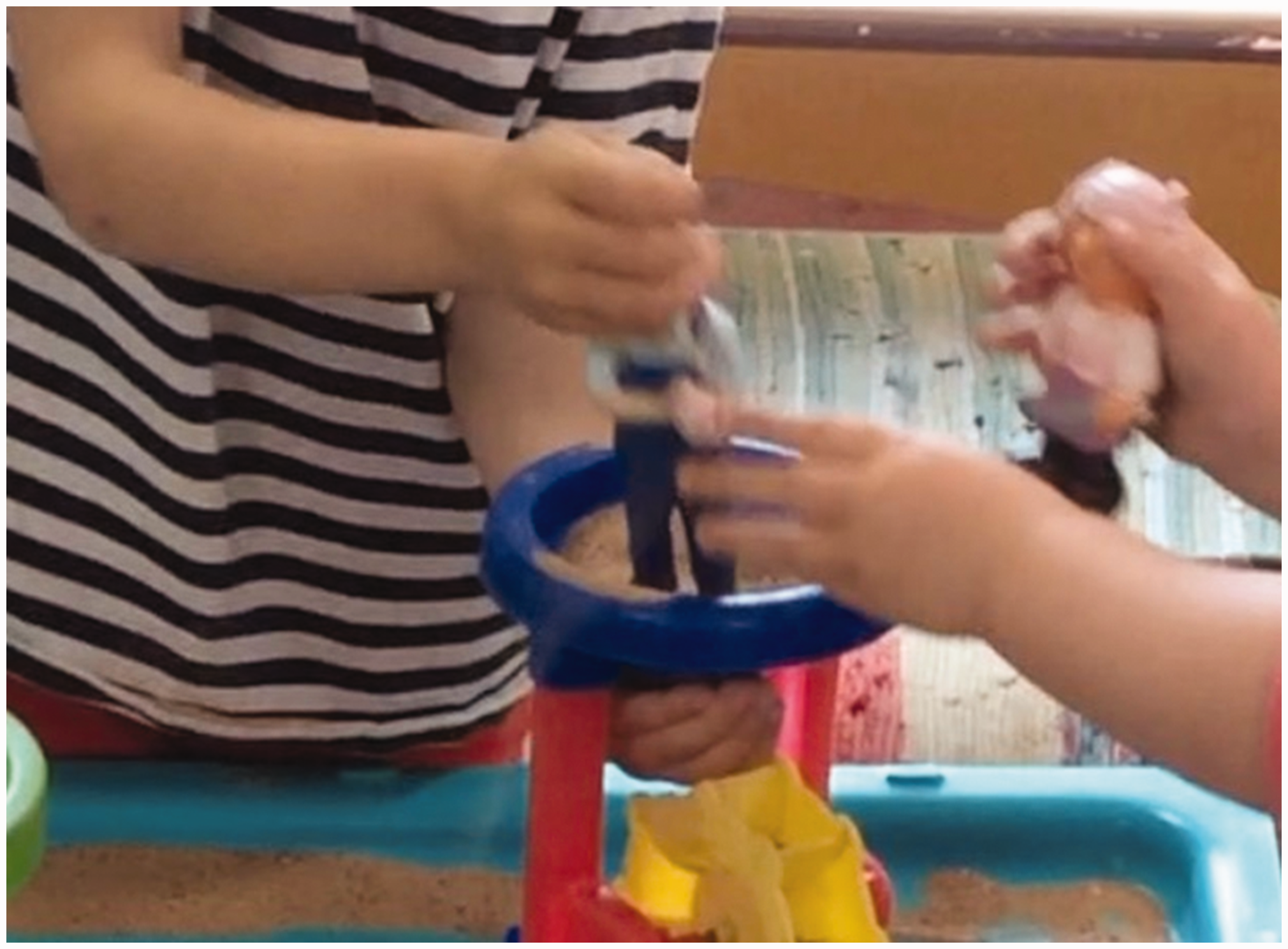
Moving hand with toys.
These are micro-moments that so often take place below the threshold of perceptibility, but which reverberate as what Millei and Kallio call ‘pedagogies of mundane politics’ (2017). Bringing such events into view troubles my adult assumptions about the role of adults in supporting children to ‘become’ political subjects, and makes me recognize that they are already political beings. The progressive move from animality to civility is a motif that also haunts the research literature on the development of moral reasoning in young children, and while there is not space here to explore this, nevertheless, it should be noted that there is a history of research that focuses on the analysis and interpretation of object-centred conflict (Eckermann and Peterman, 2004; Hay and Ross, 1982; Shantz, 1987) or the development of ‘prosocial’ sharing (Broadhead, 2009; Brownell et al., 2013; Hood et al., 2016). The more recent shift in emphasis from ‘object-conflict’ towards the development of ‘pro-social’ sharing reflects the turn towards a growing recognition of the socially inflected nature of the cognitive development of young children in developmental psychology. However, whether behaviour is described as conflict-based and object-centred or as proto-social with objects playing an instrumental role, what tends to unite these studies is an assumption that possession of the desired object is always the goal. Possession and ownership as universal and normative social concepts are taken for granted, as is the notion that desire is directed towards fixed goals and objects. However, the contact zone of hands in the sand tray bears witness to the already political lives of children that, if glimpsed more often by adults, might reframe their interventions away from a discourse of human exceptionalism in relation to a language of rights (or to use Guatarri’s term ‘orality morality’ 1995: 97). This reconceptualisation might shift adults towards new understandings. First, that desires themselves are in movement and always distributed beyond individuals, and also that responses to difference can be expressed through the felt sense of moving bodies. The noticing of slow-motion sand, hands and toys allows us as adults to recognize the dynamic and shifting horizons of desire (Bradotti, 2002: 100) as it is produced in and through the mo(ve)ment of bodily encounters, and the capacity for children to sense this shifting domain through their experiential ways of knowing beyond words.
Mo(ve)ment and affect
Bodies are distinguished from one another by reason of motion and rest, speed and slow-ness, and not by reason of substance. (Spinoza, in Zembylas, 2007: 19)
The developmental lens through which we view the growth of children, whether in terms of language or morality, is underpinned by a future-oriented hierarchy where conscious and abstracted thought is fetishized. A logic of progressive evolution is framed in terms of individual function and economy, where increasing intentionality of action is elevated as higher order knowledge. Following Hustak and Myers (2012: 95), I will argue that the effects of this evolutionary mode of thought are to render certain practices that generate other ways of knowing unintelligible, and, along with this, imperceptible. The narrow focus on intention couples minds with brains (so it is unsurprising that so much of evolutionary theory has been concerned with the size of human brains in relation to those of non-humans). Locating thought inside brains produces binaries where the inferior attentional qualities of the body are contrasted with the superior intentional qualities of thinking minds. Ingold rescues attention as a critical lively mode of engagement with the world that changes our own worldly practices. While child development theory essentialises intentional action as what makes us human and increasingly adult, he talks about how it is attention that occurs in the moment of encounter that quite literally ‘drags us’ from our position (Ingold, 2014: 136). Approached as such, attention is what moves us: or to put it differently, ‘We don’t act without being acted on … we’re always moved by something and it’s only because we’re moved that we act’ (Judith Butler in McMullen, 2016: 31).
If we can agree that we are moved by attentional responses, then movement is always in relation to the things that move us, and it is this relation that creates the ecology of the encounter: ‘a relation cannot exist in isolation, all entities can be understood as in relation to one another’ (Fraser et al., 2005: 3). In contrast with a narrow and developmental emphasis on the progressive evolution of intention, Hustak and Myers celebrate what they call an ‘involutionary’ mode of attention (2012: 77), which is more characterised by improvisation and playful experiment. This could be a way of expanding on Birke et al.’s deployment of the verb animaling as a way of rethinking what literacy might be if we take attention seriously as a mode of thought. The concept of involution stretches us a little further into the realm of the vegetal. We might think of tendrils that move responsively to sunlight and the uncanny ways that plants are now credited with conversing with each other across distances (Heil and Karban, 2010). Involutionist thinking amplifies the concept of ‘momentum’ as that which gives us a feel for the ‘affective push and pull among bodies’ and the ‘fleeting and contingent forms of life happening “now” and “now” and “now”’ (Hustak and Myers, 2012: 97). This mode of attention responds to movement through movement, a dynamic that means we are never quite certain what the signal transmits or what it might produce (Hustak and Myers, 2012: 104). This is an ethological approach, as proposed by Deleuze, where bodies are considered in terms of relations of movement, expressing a capacity to affect and be affected (1988: 125). It also resonates with Harraway’s thoughts about the tentacular, when she reminds us that ‘tentacle comes from the Latin tentaculum, meaning “feeler”, and tentare, meaning “to feel” and “to try” … ’ (2016). This kind of sensing is by its nature tentative. It is, in Thrift’s words, a kind of knowledge-in-formation (2008) – an intelligence that is not located in the person, one that is more affectively entangled with the world. In the tendering of objects, hands are both animated by the things that they touch, but at the same time the objects are animated through the give and take of pulls and pushes of desire expressed as kinetic force. Manning draws our attention to Derrida’s musing on the French word entendre (to listen), tendre (tenderly), tendre (to give or tender) (Manning, 2007: 12). Such a sensing through touch is always an attentional, propositional and ambivalent response that has the potential both to be tender and to violate.
When toy-child tussles unfold in the particulate context of a nursery classroom sand tray, rather than reading each other, bodies are registering difference through energy, force and resistance. As this ‘always-emerging body’ (Leander and Boldt, 2012: 30) registers difference, it responds with an affective charge. This sensing through bodily registration demands a response, and as such these toy-child tussles are deeply ethical events of encounter (rather than enactments of moral codes). In these encounters, each body is ‘constituted as responsible for the other, as the other’ (Barad, 2012: 215). In such moments, the other and its difference become perceptible, and with this perceptibility comes response-ability (Barad, 2012). An in-the-moment response is always uncertain, it does not pre-determine in the way that the language of possession and rights does, or that words themselves might. An attentional body might respond tenderly or violently, but it is always a body that learns itself through its difference, and through its openness to the encounter lies the potential for an affectively charged attunement towards the other.
Sense matters
This paper has responded to Hackett and Somerville’s invitation to read early childhood literacies through the posthuman in order ‘to reconceptualise emergent literacy in ways that reconcile with young children’s being in the world’ (2017: 389). Children pay a price when we see language or civility as uniquely human, because this prevents us from seeing a ‘fuller range of non-human powers circulating around and with human bodies’ (Bennett, 2010: ix). Furthermore, for certain children there is a higher price to pay, because when – mediated by national policies – poorer children are seen as particularly verbally disadvantaged, they are placed under greater scrutiny and pressure to utter words. This leads to some children (and often their parents) being subject to an extraordinary array of interventions, many of which are in turn scrutinised through government-funded research in terms of their success in reducing the relative ‘word gap’ (see for example, Asmussen et al., 2016). That language and words are critical to our lives as human beings cannot be disputed. However, the slow-motion film of tactful hands in the sand tray serves to remind us that the affective sensing of difference is a vital capacity that very young children have before they are able to speak, and one that a narrow focus on words can blind us to. The shadow of evolutionary theory falls heavily over both child development theories and theories of language acquisition. The fierce debate about language development and the origins of language is beyond the scope of this paper. However, ecologically inflected thinking that might move us away from seeking points of origin, towards a theorising that acknowledges the co-involvement of speech and gesture, can draw our attention to the ways in which ‘gestures, like speech, operate to conjure forth virtual worlds, which are the worlds we inhabit when languaging’ (Kendon, 2017: 168). This is a virtual charge that is both of the body, but not of it; it ‘means accepting the paradox that there is an incorporeal dimension of the body’ (Massumi, 2002: 4).
If we value action and affect as modalities belonging to both gesture and speech, then the boundaries that we maintain between animal/human, child/adult, verbal/non-verbal, civil/uncivil are less clear. This not only has the effect of reminding us of language’s colonising effects that might blunt other sensed ways of knowing (Viruru, 2001: 39), but could also revitalise some of the deadening effects of language. This sense that inheres in language (Grosz, 2017: 41, my emphasis) is what Olsson, with reference to Deleuze, calls the fourth dimension of language: a mode that opens up the closed circuit of language to both its indeterminate qualities and the way that it reverberates collectively across bodies (2009: 109). Olsson draws our attention to the way that ‘ … sense is continuously produced on the border of language and the state of things’ (2009: 115/6), and there is, as Massumi notes, an autonomous quality to the way that this is produced, a quality that escapes the confinement to a particular poised body (1997: 228). Tactful hands encountering difference through mo(ve)ment and touch have a capacity to both build worlds ‘sense by sense, perceptual organs upon organ … ’ (Grosz, 2011: 180), but also, they have an affective capacity to signal these trans-actions (Barua, 2015: 269, my emphasis) to other apperceptive bodies. This is an impersonal politics or ethics of encounter. Just as touch is less ‘a promise of enhanced contact with “reality”, but rather an invitation to participate in its ongoing re-doing and to be redone in the process’ (Puig De La Bellacasa, 2017: 117), to ‘witness’ an event also reverberates affectively; as Ingold says there is no observation without participation (Ingold, 2007: 157). Perhaps here it might also be helpful to remember that the word conversation is made from con (together) and verser (to turn). This simple reminder can serve to enhance the noticings of adults when they are in the company of children. Our (con)versations are always more-than-human: mattering is a form of (con)versation as bodies move both in relation to matter and in relation to the affective responses of other bodies. This emphasis on the collective act of turning also helps us to break away from a singular focus on hands as such. By turning our attention from mouths and words towards hands and gestures, we run the risk of abstracting hands as extra-ordinary organs, a re-inscription of a human exceptionalism that perceives manual dexterity as having a foundational link to language, in the manner of some hand-oriented scholarship (Sennett, 2008; Streeck, 2009; Wilson, 1998). In the current study, although the focus has been on hands, it is the tendering body, rather than the specificity of the human hand as a singular organ, that the sand tray data have alerted me to.
Finally, by way of conclusion, I will go back to the Latin/French verb ‘tendre’, in order to pause to think about our affective capacities as adults as we witness unfolding events that involve children. In particular, I would like to return to the verb ‘entendre’. In contrast with the verb comprendre, which Glissant has noted is connected with taking and understanding (Viruru, 2001: 39), entendre, which translates in English as ‘listening’, has older meanings that (like the word (con)versation) reference a turning of attention. This is an expanded and ethologically inflected form of listening, one that ‘is about being open to being affected’ (Davies, 2014: 1). Gallagher et al. highlight how institutions of education promote narrow understandings of listening ‘as the conscious reception and comprehension of symbolic meanings encoded in spoken language’ (2017: 1246). While their discussion concerns the price that children can pay when listening ‘skills’ are narrowly focused on the production of speech comprehension, the slowing down of hands in the sand tray has alerted me to own my impoverished listening practices as an adult involved in the lives of young children. The never ceasing movement of hands in relation to sand, toys and other hands not only brings to my awareness the fluid and shifting tendencies of hands as sense organs of thoughtful bodies, but this noticing aligns me more intensely with these shifting and transitive directions of thought. In particular, the slowing of film interrupts my viewing habits by bringing response through movement to the fore, and it expands my capacity to listen beyond the words or even sounds that children make. I am myself sensing the data, and I find myself re-oriented by my video sensing; just as I am unable to separate the hands from the matter they touch, nor can I separate my body from my video-mediated noticing.
