




Abstract
The present article provides an overview of the best-selling apps for the age range of 0–8 years under various categories, including ‘Kids’, ‘Books’, ‘Educational games’, ‘Family games’ and ‘Word games’ in the two major application stores (Google Play and iTunes App Store) in four economically diverse European countries: Hungary, Turkey, Greece and the Netherlands. As tablets seem to be a substantial part of children’s leisure activities, and thus apps might play an important role in their development, we conducted a content analysis to highlight two issues: the educational value of the most popular children’s apps and the fine-tuning of apps to the local culture and language of non-English speaking countries. There is a large overlap between the best-selling apps in the four countries; in fact, half of the apps appear among the most popular lists in more than one country. Consequently, most children’s apps do not include any oral language and, if they do, they are not available in the local language. Furthermore, the results show that a substantial part of the apps supported early literacy skills. In the majority of apps teaching literacy, although advertised for the youngest, the focus of instruction was more suited for school-age children.
Introduction
The ownership of tablet computers among adults has grown from 3% to 45% since computer tablets were first introduced in 2010 in the United States (Anderson, 2015). Tablets have also started to find their way into children’s daily life more and more (Chiong and Shuler, 2010). Common Sense Media, a nonprofit organization, reports that 80% of children aged 2 to 10 in the U.S. use educational media that are offered on TV and computer and mobile devices at least once a week, including about one-third of children who use them daily (Rideout, 2014). In the Netherlands, the ownership of tablets had grown to 65% of households in 2015 (Statista, 2015) and children go digital at an increasingly younger age. In 2014, 70% of Dutch children up to age 7 were reported to use tablets often (Iene Meine Media, 2014). Tablet usage seems to be a substantial part of children’s leisure activities, and thus the apps they use may play an important role in their development. At the same time, we have very little data regarding the language and content of those apps. Consequently, it is of great importance to assess the apps that children spend time with in order to make an educated guess about the impact tablet usage may have on children’s development and advise developers, educators and policymakers. We expect similar growth in tablet usage in the three other target countries of the present study but reports about children’s use of computer and mobile devices are not available for Greece, Turkey and Hungary.
Potential of apps as an educational activity
With more than one million apps available for IOS and Android devices and the fact that the vast majority in the Education category target children, it is of the utmost importance to examine the type of content that young children are engaging with (Lauricella et al., 2017). Even though apps may provide an active, enjoyable and engaging context, the question is whether they are attuned to children’s educational needs: Do popular apps offer opportunities to foster children’s emergent academic skills, including language, literacy, numeracy and science? For playing a role in language development, the minimum seems to be that they include oral language, preferably the first language of young children. There are, however, popular app series like Toca Boca that do not include any language. There is only nonverbal information in these apps, probably in order to expand the market.
Furthermore, there is an abundance of studies indicating that young children show an interest in academic skills and develop those skills through various voluntary activities in the preschool period (e.g. Duncan et al., 2007; Ferreiro and Teberosky, 1982; La Paro and Pianta, 2000). Purcell-Gates (1996), for instance, gives numerous examples of activities in the home environment that include literacy skills and that contribute to emergent literacy. To mention some, parents and teachers read storybooks to children, which improves their vocabulary and comprehension skills (Bus et al., 1995); children of preschool and kindergarten age practise writing their names and other words which may contribute to letter knowledge and phonemic awareness (Both-de Vries and Bus, 2010); children count objects in their surroundings which may foster number skills (LeFevre et al., 2009); and so on. Apps, if well-designed, may have the potential to elicit similar activities in the age range of 0–8 and give a boost to early literacy and numeracy skills. They may even have the potential to involve the child in these activities without any adult support because they provide guidance and feedback that is similar to adult scaffolding (Falloon, 2013; Kegel et al., 2011; Takacs et al., 2014).
In fact, technology, if well designed, may have an advantage over traditional learning materials. Apps have the potential to include nonverbal information that may, if congruent with the verbal content, including a story, numbers or letters, to facilitate learning in accordance with multimedia learning (Mayer, 2003). For instance, in a recent review, digital storybooks with nonverbal representations of the story, in addition to narration, were found to be more facilitative of story comprehension and word-learning than traditional paper storybooks (Bus et al., 2015). However, unlike research on digital picture storybooks, where studies have explored whether and how the multimedia additions of e-books affect young children’s learning, only a few studies have investigated other types or features of apps to test their effects on children’s learning (Lauricella et al., 2017).
The aim of the current study was to test available apps as an auxiliary to traditional playful activities that promote early skills in the language, literacy and mathematics domains. As a minimum, we propose that the majority of apps should expose young children to language, and preferably the local language, as one of the best predictors for academic success (Morgan et al., 2015). There are quite a few apps that enable activities, like cutting, decorating, cooking dishes or using make-up, designed to replicate aspects of children’s free play on digital devices (Lauricella et al., 2017). Although these apps do not include any language, they are promoted as ‘educational’ in online stores (e.g. Toca Boca apps). As reported on the official website of Toca Boca, these applications may improve ‘children’s creativity’ (Toca Boca, n.d.). This and other app series are quite famous and rank high on the best-selling lists, but the question arises: Are they an auxiliary in addition to traditional activities in early childhood, like drawing, writing and dramatizing?
In line with findings by the Joan Ganz Cooney Center, we expect that a substantial part of apps (about 40%) will provide educational content related to basic academic skills, and probably more to literacy than to maths and science, as children overall spend more time with literacy-related activities in daily life (Vaala et al., 2015). However, whether findings from the American market apply to the European market is, so far, an unanswered question. We also wonder whether popular apps available in main stores include language, in particular the local language, thus promoting language skills as a critical aspect of preschool development. This question seems particularly relevant in countries that represent relatively small languages (Simons and Fennig, 2017). Compared to English, spoken by 955 million people, Dutch (20 million speakers), Hungarian (10 million speakers), Turkish (80 million speakers) and Greek (11 million speakers) are small languages. Without localized content, apps can be promoted in more countries without the costs of translation and localization. However, bringing out apps in such a way that they can be sold in different countries makes sense from a commercial point of view but may be at the expense of fine-tuning to a specific culture and the local language.
This study
The two major international online application stores, the App Store (iOS) and the Google Play Store (Android), increasingly offer more apps including games and digital storybooks specifically designed for children (Guernsey et al., 2012). In every country, it is possible to download all available apps in all languages, but a somewhat different set of featured apps appears when you enter the store. The aim of the present study was, apart from an inventory of the most popular available apps in four European countries, to be a test of the overlap between the lists of the most popular children’s apps across European countries and what the consequences are. When apps rank high on best-selling lists in different countries they may not include the local language, especially when the language area is small, as is the case for the countries included in the present study. This omission is of high significance because, considering the amount of time that young children spend with mobile devices, this may be a missed opportunity for language development as compared to other common activities (e.g. watching educational television).
The number of apps available in the local language may differ as a result of fine-tuning, which might be related to prosperity. This could be another illustration of the finding that the quality of educational materials differs, at the expense of children growing up in less wealthy circumstances (Putnam, 2015). In order to test this hypothesis, we compared lists of the most popular children’s apps in four European countries with relatively small languages and differing prosperity: Hungary, Turkey, Greece and the Netherlands. Among the most popular apps in the Netherlands, the most prosperous country of the four, we may expect more apps in the local language than in the other countries.
In sum, in the present content analysis of the most popular children’s applications in four European countries we aimed to answer the following questions:
1. Are apps available in the local language, and more so in more prosperous countries?
Based on our impressions when familiarizing with the app stores' selections of children’s apps, we hypothesized that there is a significant overlap between the best-selling apps in the different countries. Consequently, we expected that most apps were developed by international companies, and accordingly, the majority of apps do not include any oral language and/or are not available in the local language. This is of high significance as such an omission means that applications do not provide any stimulation in the local language, which is a serious issue for the language development of children of preschool age and for their emerging academic skills that are founded in language skills.
Furthermore, we expected more apps in the local language on the Dutch market as compared to the other three countries; GDP (Gross Domestic Products) per capita for Greece, Turkey and Hungary ranges between 20 and US$26,000, but it is about twice as high in the Netherlands (World Bank, 2015).
2. To what extent do apps serve educational aims?
In line with previous results regarding the U.S. market (Guernsey et al., 2012), we expected that a substantial part of the best-selling apps would not serve purely as entertainment for children but would have some educational content. Insofar as apps are educational, they are expected to relate more often to literacy than to other academic skills and are mainly developed for children of preschool age rather than for school-age children.
Method
Sample of apps
Popular online stores offer apps for children under various categories. According to the scope of our study, we selected from the two main app stores' categories that might include educational apps for children. In the iTunes App Store, we targeted: Kids, Books, Education, Educational Games, Word Games and Family Games. In Google Play, we focused on Books and References, Education, Family Games, Word Games and Educational Games. We took a screen shot of the top 50 best-selling paid and the top 50 most downloaded free apps in each category on the same day for the Dutch, Turkish and Hungarian markets (23 March 2015). The same procedure was applied to the best-selling lists in Greece, but about six months later (16 January 2016). In some cases, 2–5 apps were included in one package in the paid section of the iTunes App Store as a bundle deal. We decided to include all those apps.
We focused on the top 50. The exact ranking in each category seems to change daily, but apps may stay for a longer period among the top 50. About a quarter of the apps were still on the best-selling lists one-and-half years after the first downloads. The numbers of the same apps were 22%, 30% and 25% for the Netherlands, Turkey and Hungary, respectively (on 5 December 2016).
We excluded any apps that were not designed for children, such as foreign language learning apps (e.g. Duolingo), word games, dictionaries, adult audio books, e-book readers, holy books (e.g. Bible, Quran), sky observation apps, topology apps etc. When the same apps appeared in different categories, we excluded duplicates. However, if the same app appeared in both stores, Android and iOS, both apps were included because the two versions are not necessarily the same. In the end, we analysed 560 Dutch, 492 Hungarian, 532 Greek and 494 Turkish apps for children found in the Android and iOS stores.
Coding
Each app was coded on the basis of the specifications explained below. To make all oral language and educational content manifest we applied very minimal requirements to apps that were coded as including oral language or apps that were considered as including educational content.
1.1. Overlap across countries: We coded for each app if it was unique on the best-selling list of the country or also appeared on the list of any of the other countries. 1.2. Device: We coded the app store where we found the app: iTunes (IOS) and/or Google Play Store (Android). 1.3. Developer: We coded whether the company that developed the app was a local or an international developer. 1.4. Age range: We coded if the app was recommended in the app store for infants (0–3 years old), preschool/kindergarten (4–6 years old) or children in primary education (6–12 years old). 1.5. Price of the app: We coded the price of every paid application in euros. If it was part of a bundle we divided the price by the number of apps in the bundle.
We coded whether the app contained any oral language (at least 5 words) or not.
2.1. Availability of oral language in the local language: We coded whether the apps that contained oral language used the local language or a foreign language. Sometimes, the title of the apps was in the local language but the app itself in a foreign language, mostly English. In these cases, we coded the language as a foreign language. 3. 3.1. Literacy content: We coded whether the educational content of an app was relevant for language and literacy development or not. We considered narrative stories in addition to games and activities identifying sounds or letter forms, teaching vocabulary and letter-sound relationships or practising emergent writing as related to language and literacy. The apps that contained narratives were mostly digital versions of existing print books (Dr. Seuss’s ABC; Frozen: Storybooks Deluxe).
3.1.1. Direct/indirect literacy content: We coded whether literacy skills were taught directly (e.g. games with words, letters and the alphabet) or indirectly by means of stories and nursery rhymes. Apps with a mix of the two approaches were coded as indirect because mixed apps typically had a main focus on storytelling.
Inter-coder agreement
The top 10 apps in all categories in the Dutch iTunes App Store were coded by two independent coders in order to calculate inter-coder reliability statistics. Coding these apps, Cohen’s kappa was satisfactory for all categories: (k > 0.78) whether the app was designed for children (k = 0.97), whether it was educational (k = 0.78), whether it was relevant for children’s literacy development (k = 0.82), whether it taught literacy skills in a direct or an indirect manner (k = 0.78), and whether the content of the app was available in the local language or only in another foreign language like English (k = 1.0). The findings were very similar for the three other countries where agreements between coders were also checked. All disagreements were settled by discussion between the two coders.
Results and discussion
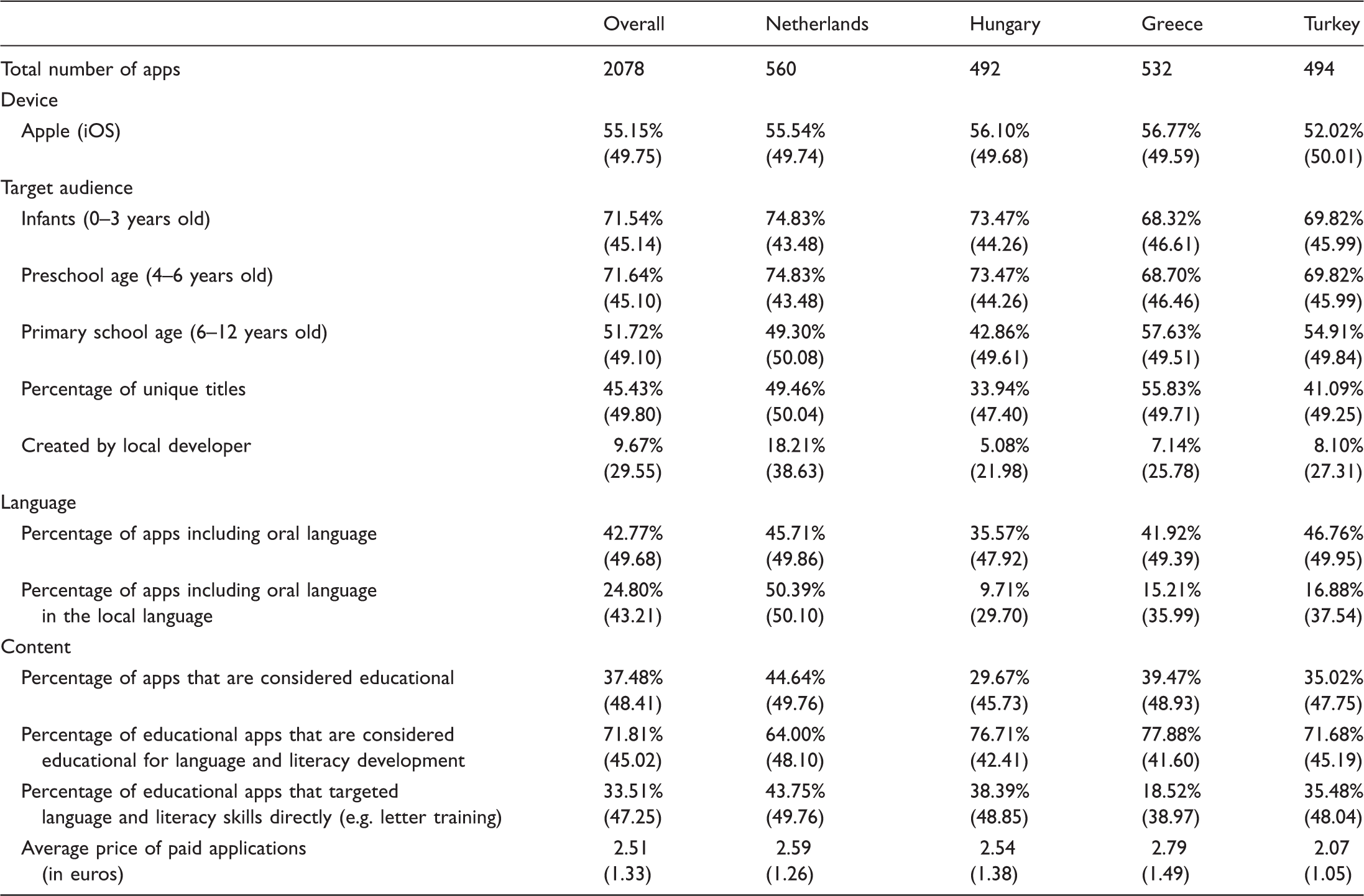
Descriptives of the characteristics of the most popular children’s apps in the four countries.
Fine-tuning to local language and culture
Overall, only 43% of the children’s applications included oral language. There was a significant effect of country (χ2 (3) = 15.68, p < .001), with Hungary having the smallest percentage of applications including any oral language (36%) and Turkey the largest percentage (47%). On average, only 27% of the apps included oral language in the local language. Regarding local language speaking apps, there were significant differences between countries (χ2 (3) = 56.81, p < .001). As expected, in the most prosperous country, the Netherlands, there were by far the most apps in the local language on the best-selling lists (50%), while in Hungary only 10% of the apps were in the local language. In the same vein, overall, 10% of the apps were released by local developers. There were significant differences between countries (χ2 (3) = 67.10, p < .001), with the most locally developed apps appearing on the Dutch best-selling lists (18%) and the least on the Hungarian list (5%).
As expected, there were substantial overlaps between the best-selling lists of the four countries: half of the children’s apps appeared on the list of two or more countries, as shown in Table 1. There was a significant effect of country on this variable (χ2 (3) = 56.81, p < .001), with the largest percentages of unique titles in Greece (56%) and the Netherlands (49%), as compared to 34% in Hungary and 41% in Turkey. As a consequence of substantial overlaps, one might expect that apps that are intended for the markets of more countries would either have no oral language or, insofar as there is language, it not to be in the local language.
Differences between apps that are unique titles for one country and apps that are on the best-selling lists in two or more countries.
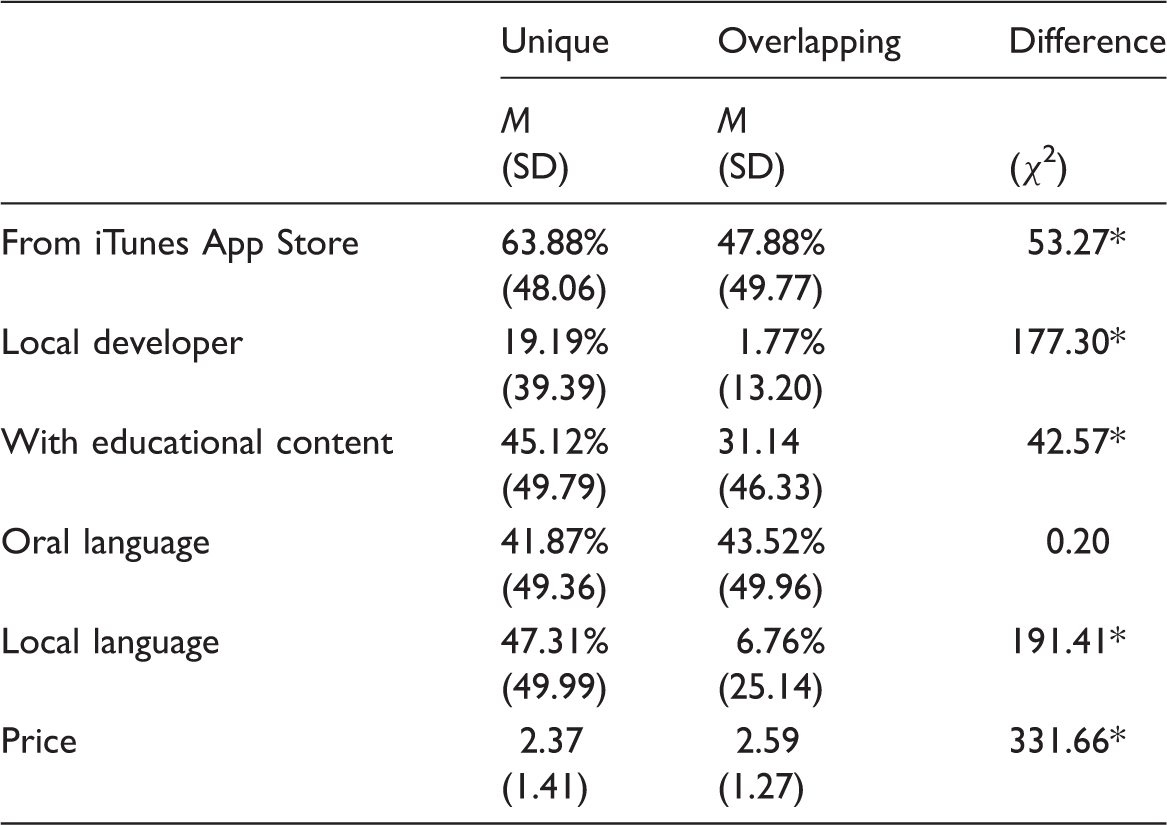
p < .01.
Apps serving emergent academic skills
Similar to the results of the American content analysis (Guernsey and Levine, 2015), 37% of the best-selling apps were categorized as educational regarding basic academic skills, meaning that 63% of the most popular apps were coded as purely entertaining. There were significant differences between countries (χ2 (3) = 27.22, p < .001), with the largest percentage of educational apps appearing on the Dutch best-selling lists (45%) and the lowest percentage on the Hungarian list (30%). More educational apps were recommended for preschool-age children (72%, n = 339) as compared to apps advised for school-age children (n = 113). This finding was similar for all four countries. Country-specific popular apps were more likely to be educational (45%) than overlapping apps on the best-selling lists of more than one country (31%), χ2 (1) = 42.57, p < .001. It is important to note that whether an app was available in the local language and whether it was categorized as educational was highly confounded in all four countries (the Netherlands: χ2 (1) = 26.19, p < .001, Hungary: χ2 (1) = 10.33, p < .001, Greece: χ2 (1) = 14.87, p < .001, Turkey: χ2 (1) = 5.49, p < .05). Thus, 75–100% of the apps that were in the local language in the four countries were educational. This makes sense as letter sounds, and similar topics in educational apps, differ across countries.
When considering educational apps, about 72% of the apps were relevant for children’s language and literacy development. There were, again, significant differences between the countries (χ2 (3) = 23.57, p < .001), with the largest proportion of literacy-related apps in Greece (80%) and the smallest percentage in the Netherlands (64%). This also means that the largest proportion of maths and science apps appeared on the Dutch best-selling lists. Within the category of literacy apps, 34% taught literacy skills in a direct manner. Most of these apps targeted teaching letters, spelling words, identifying phonemes in words and the like. The rest of the literacy apps included stories instead of or in addition to the direct teaching of basic literacy skills. It is doubtful that direct practice of basic literacy skills (e.g. letter knowledge, phoneme awareness) matches the interests of children of preschool age.
There was a significant effect of country (χ2 (3) = 25.29, p < .001), with the smallest percentage of apps directly teaching basic literacy skills on the Greek best-selling lists (19%) and the largest on the Dutch list (44%). It might be that there are fewer Greek apps because international literacy apps are not useful due to the Greek alphabet. The data support this hypothesis; overall, 50% of the literacy apps were international, while this applied to only 23% in Greece.
Main conclusions and future directions
Overall, the results of this first inventory of popular apps are not very promising. One consequence of the huge overlap in popular apps across countries (55%) is that most apps are not designed by local developers, which may have serious consequences for their content. They may, for instance, not include local characters, typical visualizations and local language, thus preserving the cultural heritage and fostering children’s developing language and literacy skills. In the current study, we tested whether the set of apps that is available in more than one country is less fine-tuned to children. We were particularly interested in the language: do apps make use of the local language? We found that the majority of apps that are on the lists of popular apps in more than one country and that include language are not available in the local language (75%). This is a serious issue, particularly when we consider that children spend an increasing amount of time with apps each year. The effect is stronger the less prosperous a country is. This finding is even more shocking when we consider the very lenient criterion applied in the present study, which was at least five spoken words with no restrictions on whether it is in a complete sentence or whether these words go beyond the most basic vocabulary, like ‘hi’ and ‘good’ (E.g. Dr. Panda: Restaurant). The finding that many apps for young children do not contain any language might be explained by considering the ease of adaptation of the apps to other countries. Apps without any language can be easily offered in all countries without the additional cost of translating them. Although this makes sense from a commercial point of view, it is a loss from an educational perspective, as these apps provide no language input for young children. In comparison, even television programming that is not educational or designed for children includes oral language and thus provides language stimulation.
About 30–40% of the popular apps are educational according to our definition: they included some task that is related to emergent literacy, numeracy and science. This is not a change compared to the pre-computer era: Since the seminal work of Ferreiro and Teberosky (1982), we are aware that preschoolers spend substantial amounts of time on practising academic skills. It is a reaction to the fact that adults are continuously modelling academic skills and children respond to that by showing interest in doing the same activities and making attempts to imitate. We do not yet know whether educational apps outweigh the benefits of traditional activities that relate to academic skills and what the long-term effects are when apps are an auxiliary in addition to traditional activities.
In line with Hisrich and Blanchard (2009), our findings suggest that few quality apps are available for emergent literacy skills – even with a very minimal criterion. Activities promoted by educational apps often include assignments that are not age-appropriate. Many apps advertised for preschoolers utilize direct teaching, e.g. letter training by making children click on the letter that matches the name, while it is doubtful that this kind of practice matches the interest of children in that age range. According to emergent literacy research, children in this age range do show some interest in reading and writing, but in a different way. From the research, it can be derived that when, for instance, they make attempts to write they are more interested in ‘drawing’ writing: they often produce writing-like scribbles or strings of pseudo letters and they mix writing with drawing (Levin and Bus, 2003). More in-depth content analysis is needed to test whether apps reflect such interests. However, from what we have seen, it is our impression that among the popular educational apps there are no apps promoting this kind of age-appropriate writing and reading activities. Note that computer programs like Kid Pix that came out in the 1980s to elicit writing and reading activities by young children are no longer available (see Labbo’s 1996 description of the programs). It is more common to practise school-like subskills of reading and writing. The echoes of thirty years of research on emergent literacy and numeracy do not seem to reach the domain of educational apps, perhaps because the development of apps is the exclusive domain of computer experts and designers and does not include educators or educational experts. This might provide an explanation for previous findings showing an ambiguous effect of tablet use on children’s emergent literacy skills (Neumann, 2014).
In sum
Our findings align with what Guernsey et al. (2012) describe as the ‘fast evolving and chaotic Wild West of digital apps’, and we gave some explanations for this. In As regards exposure to children’s first language, the situation seems even more worrisome in countries with a small language base. Many apps are developed without oral language, probably to expand the market for the apps. As a result of that, about 60% of all apps do not include any oral language and, if they do include oral language, they are not available in the local language, while language input is abundantly available in most alternative activities for children in early childhood. Another trend is that many popular apps targeting educational issues are recommended for a far too broad age range between 0 and 5 years. Many apps offer direct training in basic literacy skills including phonics/word recognition and sounding out letters – all activities that are not developmentally appropriate for the youngest children between 0 and 4 years of age. The advantage of apps is that they are cheap and easily accessible, also for children growing up in less wealthy circumstances but, unfortunately, the quality of educational materials is mostly not satisfying, at the expense of those children most in need of stimulating materials.
Limitations
The long lists of best-selling or most downloaded apps indicate how popular apps are. The exact rankings seem to change daily. However, after several attempts, we could not figure out how the best-selling lists are constructed and which underlying parameters are considered. For instance, it is not known exactly how many downloads are behind the rankings. Furthermore, a ranking might change at the exact time when someone downloads an app or the ranking may be based on daily or weekly data. Additionally, the high overlap between countries might be a result of how the lists are constructed: it might be that it is not only local sales that affect the rankings on best-selling lists. Also, we do not know how the lists relate to what is available in the stores. For different reasons, there may be few popular apps in the local language: these apps may not be selected or they may not be available. Likewise, the low percentage of apps with educational content can be both a result of availability and/or the preferences of parents and educators. As reported in the study, 72% of the apps are suggested for children between 0 and 6 years old. However, for 51% of the apps, no recommendation regarding the age of the audience was available. Additionally, the downloading of the Greek list was not done at the same time as the other downloads, which probably resulted in an underestimation of the overlap between the best-selling lists of Greece and the other countries. Finally, our criteria for oral language and educational content in the apps were set low (e.g. including at least five spoken words to qualify for an app with oral language). The results, however, justified this decision because even with such a lenient yardstick a shockingly small percentage of apps qualified as apps with oral language and/or educational content. Still, we did not differentiate at the other end of the spectrum and have no information about the number of high quality educational apps.
Footnotes
Author's note
Adriana G Bus is also affiliated to Eötvös Loránd University, Hungary.
Acknowledgements
We thank the Greek students, Artemis Petropoulou and Maria Sfyri, for helping us in the data collection process of best-selling applications in Greece.
Funding
The author(s) disclosed receipt of the following financial support for the research, authorship, and/or publication of this article: The present project was funded by the National Research, Development and Innovation Office (NKFIH, PD121297) and by The Netherlands Organisation for Scientific Research (Project 411-07-216).