




Abstract
Art and tourism provide a fascinating nexus for creative academic research. This paper explores this connection by interpreting art made about tourists and tourism and by listening to a Finnish artist, Erika Adamsson. Her perspective as well as the theoretical framework of understanding others without hiding stereotypes or challenging issues are discussed. The method used is autoethnographic artwork elicitation. As a result, this paper provides a mass tourism cultural heritage album with unique interpretations by the authors, yet collectively linked to academic theories: an account of tourist representations and the possibilities of art to open minds to the worlds of others. Art, with its compositions, colours and indirect messages, invites a self-critical reflection on mass tourism that is more fruitful for understanding than mere critical analysis. Artwork elicitation and critical empathy provide a fruitful avenue for tourism researchers to explore phenomena and to engage with people who are challenging to empathize with or face being stereotyped.
Introduction
We would like to think about how mass tourists and mass tourism are represented in fine art. We can trace the development of contemporary mass tourism practices over at least 200 years, yet artistic representations of the phenomena have received little attention in tourism research. Nevertheless, since its beginnings it has been the subject of an artistic gaze (Whiting and Hannam, 2014). For example, T. Ramsey’s painting entitled The Beach at Scarborough (circa 1770) and John Nixon’s 1808 A Morning View of the Sands at Worthing (In Sarah Howell 1974 The Seaside). Given the visibility of tourists both in the socio-cultural and physical landscapes of destinations and their sometimes-prominent place in the news media (Andrews, 2016), the scarce research on artistic representations is surprising. Some research exists about tourists in reality television (Casey, 2013, 2015), cinema (Pyyhtinen, 2014; Salmi, 1995) and popular songs (Salmi, 1995). American art critic Lucy Lippard (1999) explores the relationship between art and tourism by searching the art within tourism, but predominantly with photography. Similarly, the book accompanying the Chicago Museum of Contemporary Art’s exhibition Universal Experience is also mainly about photographs. Art, Live and the Tourists’ Eye (2005) explores the understandings and practices of tourism through art. In another example, a yearlong exchange between artists, environmental historians, art historians, geographers, curators and explorers sought to address the study of tourism from a critical perspective. This work explores notions of authenticity, the tourist gaze, the museumisation of landscapes and the construction of place through visual means (Martini and Michelkevicius, 2013).
Increasingly different ways of representing mass tourism emerge in art. Movies, e.g.: Aftersun (Wells, 2022) and Holiday (Jarva, 1976) are interpretations of package tourists from different temporal and cultural contexts. Children’s books, e.g.: the Flamingo Hotel-series (Milway, 2019a, 2019b, 2019c, 2020) and Hotel Bruce (Higgings, 2016) act as socialising mechanisms about tourism, holidaying and disappointments. Contemporary performances, for example, Sky Every Day (Lonka and Saariaho, 2023) and the opera Sun & Sea (Barzdžiukaitė et al., 2019) explore mass tourism, beach life and tourists against the backdrop of climate change. Art forms a creative arena of its own in which the artist, the spectators and the art piece are in dialogue.
In this paper, we concentrate on the work of a contemporary artist: Erika Adamsson. Erika is a Finnish painter and teacher of fine arts. She describes herself as an expressive artist (Unkuri, 2023): one who highlights her subjectivity, emotionality and inner views. Also, she says: ‘I strive to turn my personal experience into something others can relate to’ (in Unkuri, 2023). In 2016–2017, Erika painted a series of tourism inspired paintings. Her own relationship with tourism evolved from identifying as a critical cultural tourist to a mass tourist after having children. This is contrary to Whiting and Hannam’s (2014) findings that artists, who had previously been mass tourists, turned into alternative tourist-artists with anti-tourist attitudes. Erika said during our interview with her that she discovered what a (package) holiday was when she became a package tourist herself.
In Tribe’s (2008) The Art of Tourism, he presents, through what he describes as ‘virtual curating’, 10 galleries (II – XI) featuring works of art – paintings, photos, performance pieces, that for him represent an aspect of tourism. Gallery I uses art to explore the method Tribe adopted for assembling his exhibition. Each of the subsequent galleries deals with an aspect of tourism research. Gallery II, for example, addresses Home and Away, Gallery IV is titled Pleasure and Flow, Gallery IX Nostalgia and Novelty. Unfortunately, none of the hyperlinks in Tribe’s original paper now work, so it becomes an unsatisfactory journey into virtual space. Notwithstanding this, the paper highlights the connections between art and tourism in the way that many of the concerns of artists are also evident in tourism practices.
Other previous work has included participatory art-based research with female migrant workers of tourism (Rydzik et al., 2013) and interviewing artists in residence in Newcastle, UK, who adopted ‘an anti-tourism’ perspective (Whiting and Hannam, 2014). Similarly, Andriotis (2001: 307) investigated the roles of travelling artists, who identified themselves as simultaneously tourists, artists and volunteers in the process of producing ‘artistic spaces with tourism potential’ Heraklion, Crete, Greece. In Slak Valek’s (2020) study of artists in art-residence at the Abu Dhabi Art Hub in the United Arab Emirates tourism spaces were created by artists. But none of these examples focus on mass tourism from the perspective of a holidaying fine artist. Nor do they represent tourists in a mass tourism setting.
This research contributes to three streams of interdisciplinary (tourism) literature. Firstly, on art-tourism debates by focusing on representations of mass tourism. A limited, but growing, body of research link art and tourism (Franklin, 2018; Hughes, 2000; Hume, 2013; Obrador and Carter, 2010; Rakic and Lester, 2013; Thompson et al., 2012; Tribe, 2008; Wheeller, 2009). Our research is ‘about art’ on mass tourism, which means that art and its social dimensions are used in our research (Wang et al., 2017: 14). Considering the review by Slak Valek and Mura (2023) about art and tourism research, our paper is positioned within the majority using qualitative research methods. We highlight the importance of developing collaboration between art and tourism to interpret and understand tourism; and address the gap in research on mass tourism representations in art.
Tourist and tourism representations have a role in the social world: they frame who tourism and related practices are for and what kind of behaviour is considered welcome and what is not (Butcher, 2020). Since the earliest days of what is now described as mass tourism, there has been an anti-tourism sentiment (Buzard, 1993). The figure of the tourist, but especially the mass tourist, was increasingly demonised as travel moved from being the preserve of the wealthy and upper classes to first the middle classes and then the working classes in the mid-20th century (Andrews, 2023). We challenge the stereotypical portrayals of mass tourists as a homogenous crowd intent on self-indulgent, hedonistic behaviour with little regard for the environment. We explore how artistic understanding, knowledge and expressions of mass tourism constructs in dialogue with academic research. Obrador and Carter (2010: 527) approach similarly an interventionist art programme in Barcelona: ‘Equipped with its own tool kit of technologies, aesthetic sensibilities and predispositions, tourism, like art, can be considered a cultural milieu where meanings and frames about ourselves and the world are produced and distributed’. We build on this perspective and situate our discussion in the context of debates about empathy, because ‘artistic exercises [are] effective ways for promoting empathy’ (Sinquefield-Kangas, 2019: 1).
Secondly, we contribute to the debates on the conceptualisation and representation of mass tourism. Recent discussion on the conceptualisation of mass tourism (Butcher, 2017, 2020; Harrison and Sharpley, 2017; Vainikka, 2015) and representations of mass tourism in qualitative and ethnographic research about mass tourism (Cohen, 2021; Obrador, 2012; Obrador et al., 2009; Vainikka, 2013; Vainikka et al., 2024; Wickens, 2002; Wright, 2002) has not gained full momentum among the research community. Mass tourism is often discussed in relation to overtourism, climate crisis or sustainability, but the critical perspective has been pervasive in research and the academy has failed to fully understand the complexity of the phenomenon, problems of the current representations or even to conceptualise it. Obrador et al. (2009) call for taking mass tourists seriously because often the critical voices are prevailing, and the more experiential voices are absent or ridiculed to pathetic. We answer this by developing a more-than-critical approach: a critical, empathic framework.
Therefore, thirdly we contribute to the emotional/moral turn of tourism studies with critical empathy as both methodological tool and theoretical construct. Williams (1990) reminded us, that the masses are always the others, but for the other we are the masses. Fictional ways of elaborating on the phenomenon may reveal our own prejudices and force us to reconsider our own ideas and empathy. With these framings, we conceptualise our paper to encompass the building of a mass tourism art album resembling and inspired by private family photo albums. Our alternative to Tribe’s (2008) virtual curating is more intimate, via empathy and getting to know the other, the artist and the art pieces at home and as embedded in the everyday life of people rather than institutionalised gallery space. Alongside Erika’s art that was inspired by photos of real tourist experiences, the discussion between us researchers and Erika in her home-studio and this paper have together developed an intimate yet collectively understood mass tourism cultural heritages album. Which will be further interpreted and developed by the readers of this paper (via empathy) and by future contributions of artists and researchers. Heritage here refers not to a singular homogenous monolith, but to complex and rich evolving heritages of multicultural tourism based on the past experiences of the individuals involved.
Framing a critical, empathic account of tourist portrayals
We use empathy as theoretical and methodological tools to develop a critical, empathic account of representations that goes beyond the boundaries of object-subject, artist-tourist, researcher-tourist and gives space to the multidimensional character of what being a tourist means. Art evokes emotional experiences, asks and helps people to make connections with others. For Suzanne Peloquin one of the ‘rules’ of art is about evoking empathy, as she states: ‘reliance on bodily senses, use of metaphor and occupation by virtual worlds’ (Peloquin, 1996, p. 657). Socialised art viewing experiences, in the form of shared aesthetic discovery, provide a forum in which viewers can become familiar with alternative interpretations and perspectives as they are verbalised by fellow viewers (Chapman et al., 2014). Co-constructing meanings about images allows the participants opportunities to shift their pre-determined perceptions towards alternative ways of interpreting the image (Chapman et al., 2014). Indeed, Peloquin argues, ‘In the making of art, the response that occurs is an interaction among artist, art – object, and medium. In the appreciation of art, the response is an interaction among audience, artist, and art-object’ (1996: 656).
Tucker (2016) recognises the possibility of empathy research in the emotional and critical turn (Caton, 2014). According to Sinquefield-Kangas, ‘Empathy is the ability to understand emotions and feelings being expressed by others’ (2019: 3). Empathy is a complex term, studied in multiple settings and with different conceptualisations (Aaltola, 2018): cognitive-affective, and embodied, reflexive etc. It can be manifest through a variety of phenomena or behaviours and therefore, researchers develop a sensitivity to the various ways in which empathy is expressed (Batson, 2009). An examination of a particular empathic phenomena not only helps us to link with a self/other display of empathic engagement, but also allows us to connect the phenomena to empathy’s affective or cognitive attributes (Batson, 2009). In this paper, we adopt the cognitive-affective understanding of empathy (Silke et al., 2019). Empathy too should be put into action to make a change (Silke et al., 2021, 2024). We attempt to activate empathy in research. This means that we aim at being critical, but also empathic towards the subject in this research paper.
Both the potential and risks of empathy for (tourism) studies should be considered (Tucker, 2016). Pedwell (2016: 281) suggests that empathy should be considered as carrying the potential for harm, since empathy can lead to manipulative actions. Therefore, we employ a critical, empathic framework and approach it with critical reflexivity (Aaltola, 2018). Empathy itself may be rather difficult to achieve for some or without support and rehearsal (Silke et al., 2021). It is useful to ask, ‘who is in the position to “choose” whether to extend empathy, and who is chosen to have empathy extended to them’. (Tucker, 2016: 32). The expression of empathy can be directed to some people, but leave others forgotten or misunderstood. In a case provided by Modlin et al. (2011) on a guided tour of a plantation the empathic gaze of the tourists was directed towards those described as ‘the other plantation inhabitants’, but the enslaved workers were largely disregarded and, therefore, marginalised. We argue for a critical empathy or reflexive empathy (e.g. Aaltola, 2018: 92). Therefore, it is essential to recognise our prejudices and interests that guide our gazes and critically reflect on our feelings of and barriers to empathy. And to suspend possible judgement of the other in an empathic encounter: empathy is not to judge but to understand (LaCapra, 2004: 76–77).
Empathy brings together the human capacity to understand the other and to be understood by the other (Häkli and Kallio, 2021). In Plessner’s (2019) words, humans live in a world ‘where the emphatic I and you merge into the we’ and where a person ‘stands where the other stands and the other occupied his place’ (2019: 286, 319). In this sense, empathy marks a two-way path between the embodied subjects involved, one that does not unite but links them situationally. There is an intersubjective empathic relationship between us researchers and Erika during the interviews. We agree also with Tucker’s (2016) suggestion on empathy that draws from Dominic LaCapra’s notion of ‘unsettled empathy’: empathising without obscuring the line between self and other (2001: 40, 2004: 76). The unsettlement may be unsatisfactory regardless of whether it is a face-to-face encounter or not. Regarding the works of art considered in this paper, we understand Plessner’s and LaCapra’s points as a recognition that the people represented in the paintings do not have a voice or agency. We cannot engage directly with the people portrayed in the paintings, so empathy cannot be entirely intersubjective; yet we can respond in an empathic way as material artefacts do influence us whether by challenging or enabling empathy.
Methods
Artists have their own way of observing and analysing the world. An artistic gaze (Whiting and Hannam, 2014) in the context of tourism could be described as an aesthetic-reflexive sensibility in the artist’s tourist practices. The gaze is influenced by engagement with all the senses and the artist’s emotional responses, and desire to convey these to an audience. Before we begin the analytical discussion of Erika’s paintings, we wish to outline our own positionality and subsequent discussion with the artist and our methodological approach. ‘Navigating the world of others requires empathic understanding of the self, as well as of the other, and an ongoing negotiation of the intersubjective relationship between the two’ (Jeffers, 2009: 6). The painting might resonate differently with the viewer at different times. In the negotiation of the intersubjective relationship utilisation of the imagination plays a central role (Jensen, 2016). That is, the selection from the different possible interpretations may be guided by our imaginations more than, or as well as, our knowledge of theory.
We are female and identify as such, we are mothers and wives which gives a specific context for reflecting on mass tourism. We also share what might be described as an in-between social class (Käyhkö, 2023) status. In addition, we both have an academic interest in mass tourism. The first author, geographer Vilhelmiina Vainikka worked as a part-time travel agent for a large package tour operator Aurinkomatkat-Suntours for 6 years (2001–2008). She did several package holidays in Europe and beyond as a young adult. Hazel Andrews encountered organised British mass tourism when she began her research in the late 1990s. As a social anthropologist, Hazel’s endeavours were to see beyond the stereotype of holiday-making practices to illuminate an understanding of what was meaningful to the tourists and to seek understandings of why they responded to their holiday in the ways that they did.
We use a combination of autoethnographic interpretation (Causey, 2003, 2017; Morgan and Pritchard, 2005) with a form of photo elicitation (Matteucci, 2013; Rose, 2022), but with what we call artwork. First, we separately and independently interpreted the artwork, then together as co-authors, and again in the interview with Erika, who had her own visions and interpretations. Autoethnography has been applauded as a beneficial method for scholars to reach the complexity of human experience in tourism. Previous autoethnographies have used for example, souvenirs (Morgan and Pritchard, 2005) and drawings (Causey, 2003, 2017) to make visible the deeply personal, yet collective, meanings of tourism. ‘Artwork’ elicitation is a method in which an interview is augmented with artworks, because those ‘provide a vehicle for invoking and considering situations, events and issues’ (Hodgetts et al., 2007: 266–267). Herein, we call our method an autoethnographic artwork elicitation (Rydzik et al., 2013). For the interview, Vilhelmiina was physically present with the artist in her studio in Finland and Hazel was on Zoom in the UK. The art pieces were viewed on the computer screen. Later, the semi-structured interview audio recording was translated and transcribed in verbatim into English. Erika had prior knowledge (from the informed consent process) of the types of questions that would emerge.
We did not know Erika before our research. Vilhelmiina’s partner had seen her work in an exhibition in Lappeenranta Art Museum in 2018 and sent photos of the tourist paintings. She was excited about the work and discovered more on Erika’s website. Some months later she contacted Erika to ask the artist if she would be interested in participating in research. She answered positively. Hazel was introduced to the work of Erika by Vilhelmiina. She immediately identified a resonance with her own research about mass tourists and recognised some of the scenes depicted, albeit from a different mass tourism location.
What now follows is the analytical discussion with the artist and our interpretations of the paintings by employing the critical, empathic gaze shaped by the previously outlined theoretical underpinnings. We chose six paintings from Erika’s tourism collection to discuss empathy. Each portrayed a scene with a pool or a beach, that represent typical tourist scenes and activities associated with mass beach tourism/package holidays. These paintings are inspired by Erika’s own holiday photographs, one by a relative and one by old postcard. This selection has a temporal logic as it focuses on an imaginary mass tourism day and location. It moves spatially, too, from a bird’s-eye view to perspectives that take us closer to the tourists.
Depicting mass tourism by Erika Adamsson’s art
Power relations
The painting Morning in Las Palmas (Figure 1) portrays a situation from a hotel window from where the viewer self or ‘tourist’ is viewing the scenery with pool and buildings in its background. The viewpoint gives the onlooker a ‘bird’s eye view’ of a tourism scene, however unoccupied by tourist bodies: an empty hotel poolside in Las Palmas, the Canary Islands, Spain. We consider that in this painting the artist invites the viewer to have a more critical, yet empathic gaze of mass tourism. Erika imagines the viewer to be a tourist who has woken up early and gazes upon a ‘behind the scenes’ worker, a figure often not thought of in tourism. The worker is depicted getting the pool ready for the day. The density of the buildings, their crowdedness and attendant feelings of claustrophobia and oppression works perhaps against the holiday promise of freedom. The tourists’ ability to not engage with productive work as they spend time resting, relaxing, and enjoying themselves (O’Connor (2022[2018]) is in marked contrast to the worker’s physical work cleaning the pool. We see that the empty sun beds are traces of tourists who will spend their time there soon.
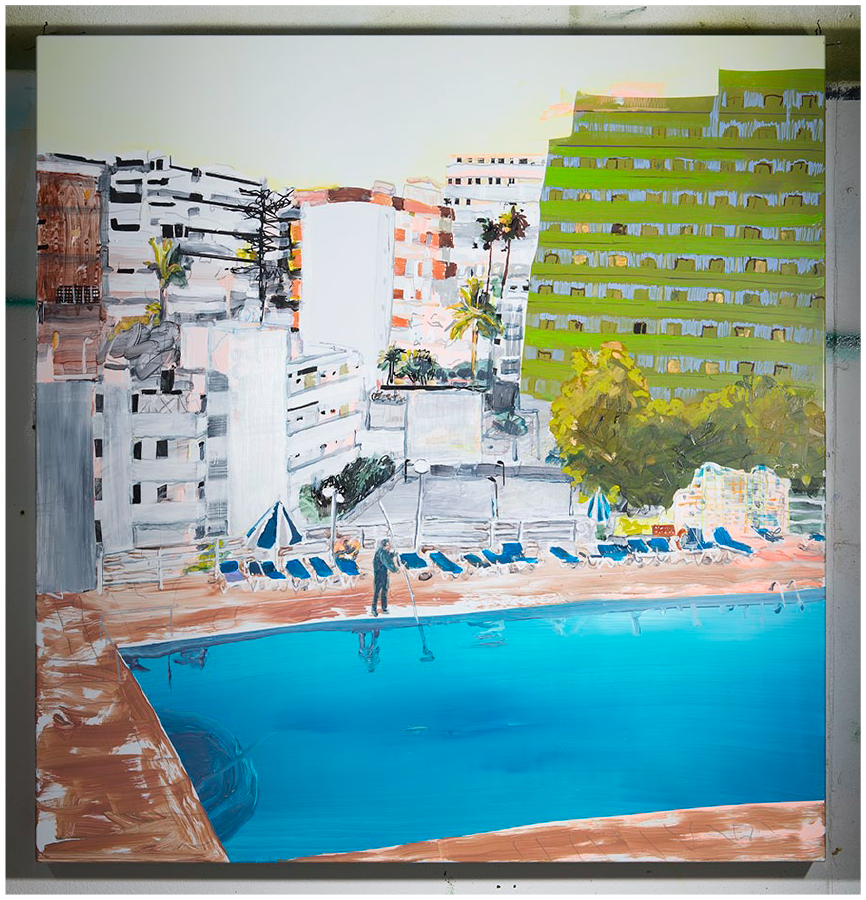
Morning in Las Palmas, 2016, Erika Adamsson. Photo: Pekko Vasantola.
Erika says that she did not want to directly pinpoint whether the worker is oppressed or not. It is up to the viewer whether they look at the worker with empathy and thus understand something about him and his position, or whether they fail to do so due to a lack of knowledge or concern about the power relations inherent in many tourist activities.
We see that empathy emerges when opening to the other, in this case a worker and recognised that this painting may start the process of empathy through the depiction of a distant, lonely figure against the towering hotel skyline. We interpreted that the bird’s eye view and the physical distance between the viewer and the viewed suggest differences between the viewer and the worker, for example, income, culture and profession. The painting and its composition thus challenge the viewer to relate to the tourist gazing at the workers serving tourists and to acknowledge the power relations between them. Therefore, the bird’s eye view is not a neutral portrayal of anyone. Due to the viewpoint, this painting speaks of the power relations behind the tourist being served, and the artist and the viewer positions herself as the tourist. How does that make us viewers feel? Are we taking sides? Are we able to feel empathy and, if so, for whom?
Crowds and beach tourism
Another bird’s eye view is in Sand from Sahara (Figure 2), but the focus of the gaze is the tourists. A question that emerges is ‘who is the gazer’? Erika says, I have been interested in this perspective, that they [the tourists] have been painted very small and in detail that we just about notice, we recognise certain cultural marks among others and then certain gender issues . . . even related to age and then how that ray of light hits . . . that one white-haired man sits and reads but possibly . . . (Erika Adamsson)
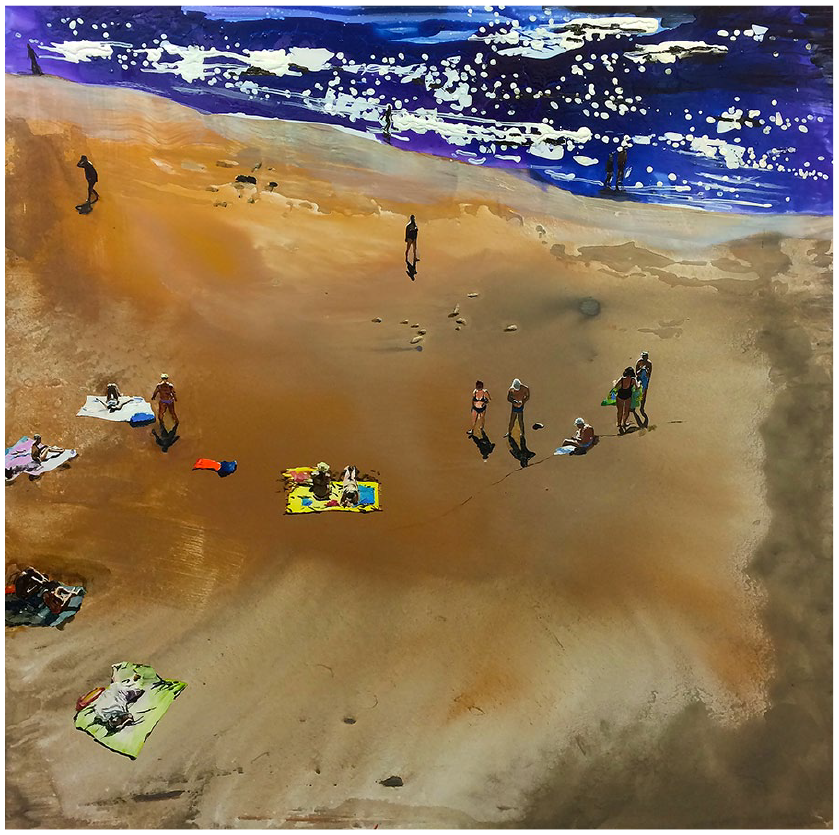
Sand from Sahara, 2017, Erika Adamsson. Photo: Pekko Vasantola.
The bird’s eye view positions the viewer above the tourists, and thus might result in diminishing them. This is the way mass tourists are often portrayed in tourism course books and media, according to our observations. But the details and traces of the figures’ features make the characters more human, relatable. The way the sun shines, catching the hair and someone reading allows us to identify the tourist as a person rather than indistinguishable from a mass engaged in stereotypical tourist behaviour (Vainikka, 2015; Vainikka et al., 2024). Do we become more interested in individuals if we are able to recognise or relate to some of what they are doing? Who do we empathise with in this painting? Although this painting shows only a handful of tourists it nevertheless invites us to ponder relations between the individual and the crowd as we are offered the chance to focus on the individuals (through their different activities) who make the whole.
Erika also discussed the fabricated, built world of tourism in, for example, the construction of sandy beaches where sand is imported. Such a process recalls a Hollywood production where the film sets are built in a studio. That the location of mass tourism products takes place in a fabricated environment has been playfully alluded to by tourism businesses. For example, the holiday company Thomson (now part of TUI) used this notion in their winter 2009 campaign (Thomson Holidays, 2009) in the UK in which representatives of the company were shown building a stage set of a palm-fringed beach complete with sun lounger and parasol against a blue sky and full sun. A question that emerges from these observations is: if the tourist world is so pre-made or contrived what does it say about the idea of finding freedom on holiday?
Another aspect of the painting we discussed was initiated by the researchers’ awareness of problems in tourism contributing to and stemming from climate change. The sunlight dances on the sea, but at the same time, the painting evokes a feeling of foreboding with a shadowing on the right that darkens the sand. This seems to represent an external threat, possibly due to changing weather conditions, to the ‘unaware’ tourists on the beach. This equally gives a sense of an empathic understanding of the vulnerability of tourists in the face of natural events. It has been proven by research that some beach tourism areas are under threat because of climate change impacts such as sea level rise, storm floods (García-Romero et al., 2023) or climate conditions (e.g. Ma and Craig, 2024). Discussing this perspective with the artist, she explained that criticism of tourism and thoughts of climate change had not helped to shape the painting. She had not intended to be directly political. She prefers to leave it to the audience to interpret how the painting ‘talks’ to them. Therefore, the political messages that we, as the audience, read from the paintings are our imagination at play.
Time and place
Viewing the painting Before the Rain (Figure 3), the viewer is getting closer to the tourists. Erika explains, I have wanted to portray like the threatening character of this kind of idyllic holiday atmosphere, like conflict and the threatening character comes like in the form of innocent rain or as the threat of the rain then it has maybe that what defines our beach holiday also, that it is wonderfully . . . (Erika Adamsson)
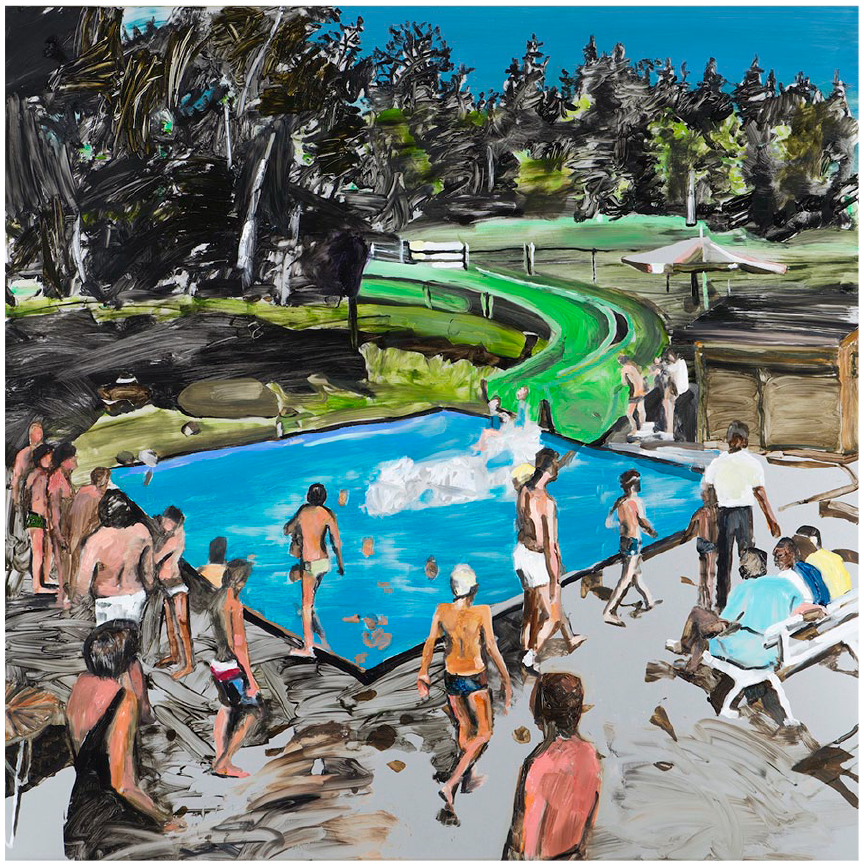
Before the Rain, 2017, Erika Adamsson. Photo: Pekko Vasantola
Again, this notion of threat links to the feeling that humans are vulnerable. Generally, on holiday we seek good weather that goes with a good time. What seems like simple choices may preoccupy us. The warm colours of the tourists’ skin evoke humanity in relation to the cooler tones of nature or the structures of the setting itself. The threat of rain can easily disrupt the idyll and ideal that we seek. Equally, the lack of rain can also threaten the ability to achieve what we seek as the images of wildfires on Rhodes and tourists fleeing their holidays in the summer of 2023 demonstrated (Otte, 2023).
The location and date of the postcard that inspired this painting are unknown. This makes the scene even more ambiguous. The inability to pinpoint the time gives a sense of the timelessness of human preoccupations. Temporality is also connected to empathy: [. . .] you get that nostalgic feel to it that can affect you once again like a family album and it can have that sense of identification . . . is this era from my childhood? But this is by no means the present. What are the factors that show that this is not happening yesterday somewhere in a swimming pool. (Erika Adamsson).
The painting has a sense of kitsch, perhaps because of the shades of colour used, which might evoke feelings of nostalgia or humour. However, it also invites a critical perspective, which distances the viewer from the people in the painting.
The ageing body and routines/rituals
In Guiris (Figure 4), we are getting even closer to the tourists, right next to them. The painting plays with the stereotype of tourists in a typical scene of lounging by the hotel pool. The picture’s name Guiris is provocative, in Spanish it is a derogatory word for tourists. The painting calls us to reflect on how we see and feel about the stereotypical tourist others: white, middle class, boomers? Erika remembers how these elderly tourists invoked mixed emotions in her: on the one hand she felt jealous, maybe even a little annoyed, that the people in the image had the time and freedom to be able to stay on holiday for a month. But she added that equally she felt it was great that they could do that.
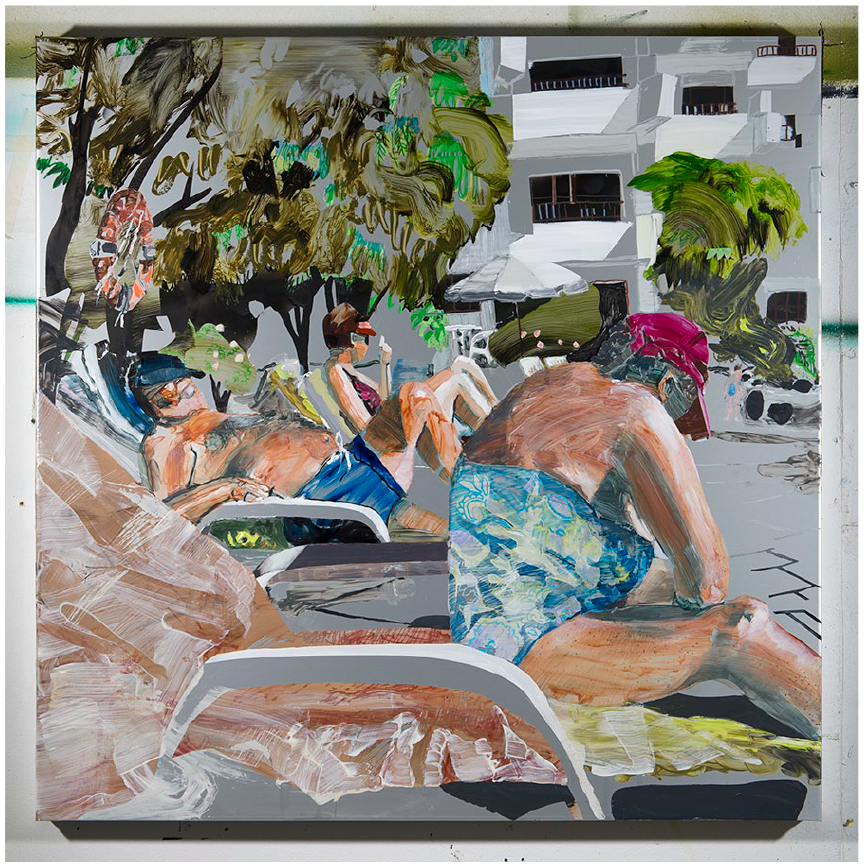
Guiris [Tourists], 2017, Erika Adamsson. Photo: Pekko Vasantola.
We felt in the interview that there is empathy for the ageing body of the woman foregrounded in the image – the roundness and softness of the body that often accompanies the hormonal changes women experience in later life. As Erika said: “I’m fascinated by the signs of old age, what happens to myself at such a middle age, but . . . why did I paint that woman? (Erika Adamsson). How did we, as female viewers, feel about growing older as women, and how do we relate to this character before Erika’s enthusiastic description? There was some physical and mental discomfort in the way we sensed the painting before the interview and recognised some changes in our own bodies resulting from pregnancy and ageing.
An interesting question to ask of this painting is: what social class(es) do the viewer and the tourist characters come from? We thought about how spending an extended period as a tourist may initially seem expensive, but for many, it is cheaper to live overseas during the winter because it reduces the cost of living by not paying heating bills at home. Further, tourists may develop routines which then become a swapping of the routine of the home world for the routine of the holiday (Sharma and Rickly, 2023). As Hazel also observed tourists often try to stick to the routines of home for such as mealtimes (Andrews, 2011). The mass tourist may be the object of ridicule or criticism for adhering to a routine by sticking to the familiar. However, routines can be important for mental health, providing structure and meaning to the day, especially when the structures of work and being a productive citizen are missing.
Conflicts of interests
In It’s Good to Be Bored (Figure 5), the focus is on an individual tourist, a child. Erika said that this moment happened in the evening, as indicated by the stacked sun loungers. We do not often get children’s perspectives in tourism, but here, we find a depiction of a child’s positionality.They are bored, although they reach for their mobile phone. We are looking down on the girl, highlighting the adult power over the young. We might feel as viewers that we are looking at the intimacy of a family situation and feel perhaps worried about disrupting it or rethinking its ethics.
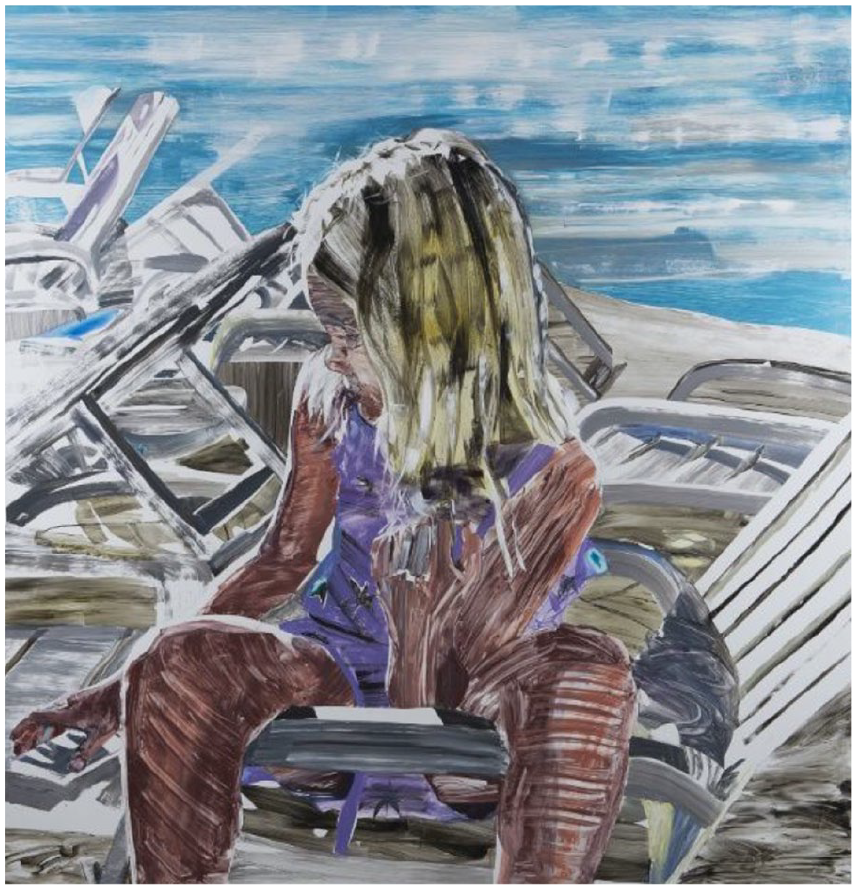
It’s Good to Be Bored, 2017, Erika Adamsson. Photo: Pekko Vasantola.
Erika says this is a teenager who is rebelling against mum and dad for taking them on holiday – and whose freedom and agency have thus been challenged. “The parent’s point of view that even if I would take you to . . . to Thailand and pay tons of money, perhaps this question will still arise: ‘There is nothing to do here’” (Erika Adamsson). Here we could empathise with the growing individuality of the child as they begin to move away from their parents and family towards greater independence. Simultaneously, there are aspects of being on holiday that can be boring, especially when, for example, it is engaged with pursuits that are often not judged as seriously purposeful (e.g. self-education at a site of cultural significance vs lying by the pool or on the beach sunbathing).
Boredom can be good because it is at such times that creativity can emerge, however: My own memories of vacations . . . that they have been creepy moments . . . maybe in July . . . there are no friends at home and [I am] staring out the window and still remember that moment that who and where . . . but when we look about that time perspective nowadays, so we dream about it and for us it has been a wonderful time . . . that we get the scene before our eyes where that girl or boy is staring boredly ‘there is nothing to do’, so we have a really big dream of that same state of being because this terrible of the rush and demands we have in adult life now. (Erika Adamsson)
It is the controversy in the positionalities between the parent and the child that also challenges empathic understanding. The needs are so different and may not always meet in various moments. Thus, the painting could be read as empathic to the adult viewer and, at the same time, also to the child. It poses the question: How can we try to understand the other when our own interests would be different in this situation? We must also be prepared to accept that we are not always able to be empathic and that there are limits to our empathy, although these limits are permeable, and we can shape them as situations unfold.
Unique and continuous endings
Evening on the Beach (Figure 6) takes us almost full circle back to the empty chairs appearing in the first painting Morning in Las Palmas and in time with the close of the day rather than the start by the pool. Here, the tourists are leaving the scene – a beach –: That the chairs are empty, the sand shields are piled up and it’s visually very beautiful, but it doesn’t have what brings money to the place, which is what runs this whole system. People walk for free at the water’s edge, in peace and at the same time, of course, it has the feeling of a holiday . . . and this black is very attractive and lovely, and this is melancholic (Erika Adamsson).
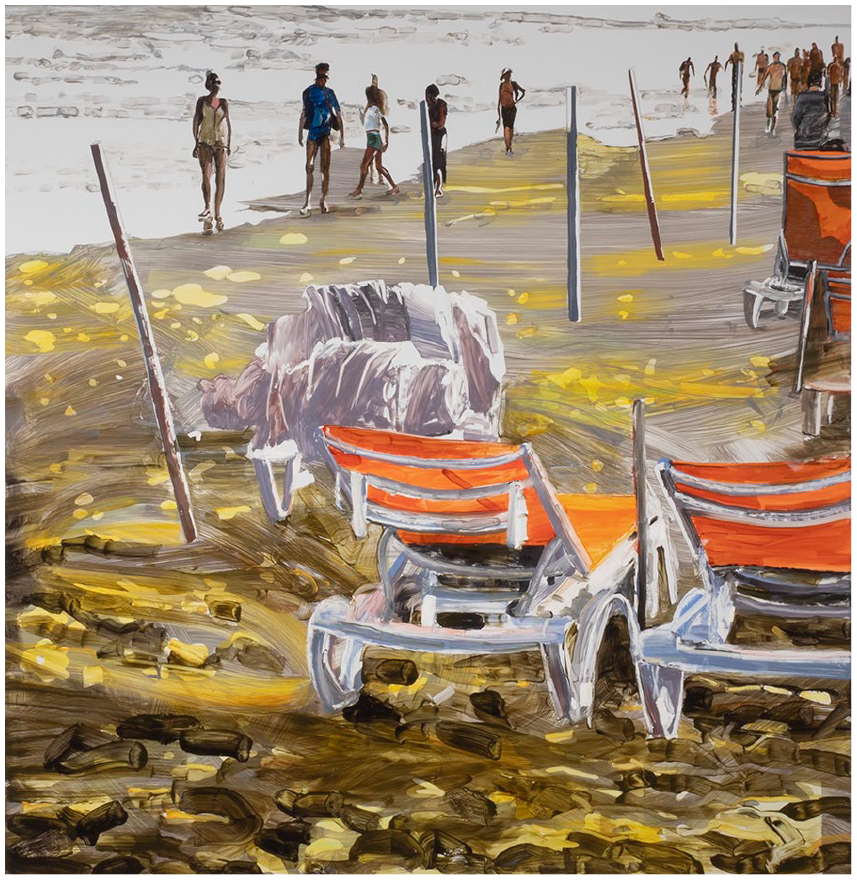
Evening on the beach, 2017, Erika Adamsson. Photo: Pekko Vasantola.
Vilhelmiina feels calm when looking at this painting but also a bit restless and melancholic, which indicates that she takes a tourist positionality to the view. She remembers the last days of the holiday or the final evening . . . But for a Finn, this is also a very rare experience: the sun setting rather early in the evening in summer and the darkness of the summer evening, since in Finland’s latitudes, the sun hardly sets in summer.
The painting is not just about the end of a day. It can also signal the fading of light or even the end of a holiday. For the people in the painting, leaving the beach may be individually significant, but it is an everyday occurrence: But such idle walking, evenings, is possible for a person to spend her time just walking and that also happens that these individuals feel that this is a unique, wonderful moment, but this really happens day after day, other people . . . (Erika Adamsson).
Vilhelmiina understands this continuity of tourism from her previous travel agent position, but also the uniqueness of each trip and its ending. The empathic nature of the image emerges as it shows us a collective moment for those on holiday. It indicates that we are all subject to the passing of time and light. There is a melancholy associated with the ending of something, an understanding of loss in terms of a sense of freedom, the time to be idle (O’Connor 2022[2028]) or bored; and sadness that might accompany a return to the quotidian world of home and recognition of the onwards ‘march of time’.
Conclusion
In this paper, we have explored an artist’s representation of mass tourism by adopting a critical empathic framework in which we draw on our own positionalities in a form of autoethnographic artwork elicitation to reflect our understandings of mass tourism. In the six paintings discussed, we see that Erika Adamsson brings autobiographical traces to the fore, such as understanding particular social relations, different seasons and climatic patterns, to go beyond superficial readings of stories about mass tourists. She has a critical, yet very warm view of the phenomenon and the others in the paintings. She deals with stereotypes, but also with the uniqueness of experiences and passing moments of collective mobilities. Zooming in and out of the individual tourist gives greater insight about how the narratives surrounding mass tourism construct the relations of the viewer and the tourist others. The lack of the tourists’ voices, however, in comparison to the personal tourist stories depicted in the paintings reminds us of the need to pay attention to those who do not have a voice in research (Andrews, 2011; Vainikka, 2015). For us authors, climate change and threats created by tourist activities were a strong theme in the paintings, although Erika had not had those in mind when painting.
This research ‘about art’ on mass tourism has offered new possibilities for academic discourses on mass tourism by framing this paper as a mass tourism album as part of a wider mass tourism cultural heritage album. You have been reading it at work, home or some other place, but possibly not in a gallery or museum. By directing your focus on this aspect of art gazing and research reading we highlight the relational dynamics of ourselves and others and call on everyone to test their own ways of relation to mass tourists. Erika’s paintings create ways for empathy (Sinquefield-Kangas, 2019) with the colours, viewpoints, compositions and indirect messages. We have discussed issues such as how a bird’s-eye view affects the recognition of power relations; how human details affect viewing of and interest in a crowd, how insecurities of tourism experience from, for example, the threat of rain, conflicts of interests or climate change affect our empathy and how the others, whether in ageing bodies, different social class, bored teenager or tourism worker cleaning the pool, make us feel about them.
The overall aesthetics invite us to consider the emotional experience of the protagonists whether they are the tourist as viewer, as in figure one, or the figure of the tourist in for example Guiris. By inviting a critical, empathic gaze we welcome understanding of the situation of the tourist, an invitation to try to think of them more as individuals beyond the limits of the tourist role or part of a family group in a setting that is stereotypically framed (and at times dismissed) in terms of the other as a dehumanising mass (Vainikka, 2015; Vainikka et al., 2024). Tourism research seems often to frame the figure of the tourists as if they are objects of study rather than thinking, feeling human beings. The understanding of the tourist as a taken-for-granted role is challenged here from the point of view of three women, who do not have the ‘privilege’ of being ‘just a tourist’ on holiday. It asks the question is anyone just a tourist? In many respects the tourists in the paintings could easily be us. The readers of this paper and viewers of the paintings will make their own interpretations and thus represent the potential future circles of empathy. Importantly, going forward, it would be essential to understand how other tourists interpret these or other tourist paintings to broaden further the understanding of empathy and self-reflection.
Researchers need to pay attention to whom they focus their empathy (Tucker, 2016) and recognise that empathy that results from being curious and open may only ever lead to partial understandings or empathic unsettlement (LaCapra, 2001, 2004). This means holding back the self for the sake of understanding the other and finding that internal ‘space’ where we can understand better. Empathy does not prevent critical discussions on power relations, social class, threats of tourism, conflicts of interests nor the collective-unique continuum of our experiences. The critical narratives can co-exist alongside ones more engaged with the experiences, meanings, emotions and interests of tourists and ourselves.
Footnotes
Acknowledgements
We would like to thank the reviewers for their constructive and valuable feedback on our paper. We would like to express our warmest gratitude to Erika Adamsson for her cooperation and inspiration. Thanks also to Dr. Joni Vainikka for discovering Erika’s paintings at an exhibition in Lappeenranta and to Pekko Vasantola for the photos of the artworks.
Author contributions
Data availability

Declaration of conflicting interests
The author(s) declared no potential conflicts of interest with respect to the research, authorship, and/or publication of this article.
Funding
The author(s) received no financial support for the research, authorship, and/or publication of this article.
Ethical approval and informed consent statements
This research was conducted with full participant understanding and consent following guidance from the University of Lapland website for ethical instructions and GDPR (October 2021).
The interview was conducted following the provision of a participant information sheet explaining the purpose of the interview, project and handling of data and full participant consent in the process. The final draft of the paper was shared with the participant to ensure that her interview responses had been correctly interpreted and she was happy with the representation of her voice in the quotes and interpretations of her words used in the analysis. Informed consent by the research participant for the interview and the re-publication of the art pieces, and photos by Pekko Vasantola.