




Abstract
Is tourism out of touch with touch? Have tourism researchers forgotten ‘touch’? Drawing on socio-spatial theories of haptics, I argue that through the sense of touch we critically understand co-constructions of affective tourist subjectivities. Specifically, touch and fear are part of a sensuous hapticality, intimately connected and happening within and around places and bodies – of tourists, local guides and soldiers – in areas of ongoing socio-political conflict. Interviews were undertaken with local tourism stakeholders and international tourists during fieldworks in the Palestinian West Bank in 2010, and 2017–2018. The Separation Wall and its checkpoints have become tourist attractions, pervasive and ever present in the landscape, enticing most tourists in the area to engage haptically in such places.
Introduction
In this article I explore the ways in which the sense of touch contributes to co-constructions of affective and emotional tourist subjectivities as I ponder whether tourism researchers have become out of touch with ‘touch’. More specifically, I contend that touch and fear, as part of a sensuous hapticality, are intimately connected and happen within and around tourist bodies and places in areas of ongoing socio-political conflict. Haptic tourism geographies (Johnston, 2012) – bodies touching places, places touching bodies, and bodies touching one another – are explored in the polemic and sensitive tourism context of the Palestinian West Bank. Mapped in relation to fear, these geographies contribute to unravelling and better understanding tourism dynamics in this region. As a result of the ongoing Israeli-Palestinian conflict, encounters between bodies, places, and material objects in this tourism context are intense, conflict-laden, yet with immense potential to generate positive socio-political action. To be sure, I understand haptic encounters more than just ‘meeting’ or a ‘coming together’ of different post/colonial bodies and places, but encounters ‘placed firmly within the remit of difference, rupture and surprise’ with creative potential and political possibility (Wilson, 2017: 452).
Interactions between tourists, local Palestinian tour guides, and Israeli soldiers are explored as I claim that tourism provides a platform from which to understand these complex tensed dynamics in an area of ongoing conflict. Indeed, such dynamics become more poignant in the West Bank, as not everyone has equal access to move and tour around. Tourists are allowed to move, albeit under the surveillant, patrolling and policing gaze of Israeli soldiers. Locals, however, whether Israelis or mostly Palestinians, are denied that same mobility not least through the imposition of a separation wall 1 that restricts and curtails movement.
Dynamics of tourism in areas of ongoing socio-political conflict cannot be discussed without necessary attention to senses, emotions and affects (Buda, 2015; Buda, 2016). The socio-spatial world of tourism is experienced and performed sensuously since senses, along with affects and emotions, are ‘felt individually, but also always shared intersubjectively’ (Paterson et al., 2012: 2 emphasis in original). In emotional and affective geographies, the essentialist notion that emotions are only psychological manifestations belonging solely to the individual and projected out in the world, has been hotly contested (Bondi, 2005; Hawkins and Straughan, 2014; Straughan, 2019). The socio-spatial milieu of affects, emotions, feelings and senses accomplishes a noteworthy role in the signification of self, other people, places and things, and within which they circulate.
In tourism, this sensuous circulation poses new challenges about theorizations of socio-spatial and cultural formation of tourism (Cohen and Cohen, 2019; Crouch and Desforges, 2003). Delving into the ‘sensual nature of travel’, Crouch and Desforges (2003: 7) in their special issue editorial on sensuous tourism, argue that ‘understanding our sensual relations with the world is not simply a case of “adding in” other senses: a sensory geography of taste, touch, smell or sound’. Despite the acknowledgement that senses are at the core of tourism experiences and encounters (Cohen and Cohen, 2019; Jensen et al., 2015; Kim and Fesenmaier, 2015; Saldanha, 2002), tourism studies still show little engagement with the ‘multiple sensualities of the body’ (Obrador-Pons, 2016: 47; Edensor, 2018).
My contention is that in tourism there is scarce engagement with the ways in which different senses, with their respective sensory geographies, construct sensuous, affective and emotional tourist subjectivities. There is, in fact, the need to ‘add in’ research on how different sensory geographies of taste, touch, smell or sound can lead to a more critical understanding of subjectivities in tourism. This is not to say that focus should be on independent workings of individual senses since these do not operate in isolation, but part of a sensory collective, of a sensuous ‘sensorium’. Focussing, therefore, on haptics in a tourism context addresses this gap.
Out of touch in tourism?
Is tourism out of touch with touch? Have tourism researchers forgotten ‘touch’? I am only echoing similar questions posed over the past decade in human geography. 2 Indeed, geographers are held accountable for having ‘quite simply and literally been out of touch’ and ignoring touch in spatial practices (Paterson et al., 2012: 6). To forget touch, it is bemoaned, ‘is to disregard the bodily senses, to emphasize the eye (abstracted visualism) rather than the hands and feet (haptic experience)’ (Paterson, 2005: 115). More recently, however, it has been argued that vision’s hegemony has been challenged (Edensor, 2018), ‘empire of the senses’ is on the rise and ‘touch has come to have considerable intellectual currency’ (Hawkins and Straughan, 2014: 131). Touch is analysed in relation to Polanyi’s concept of tacit knowledge to offer post-phenomenological accounts of embodied practices in the laboratory working with tissue cultures (Straughan, 2019). Haptic geographies are also used in conjunction with the digital and geographies of sexualities when exploring the embodied, material and spatial anticipation of offline encounters with people from the online dating application Grindr (Bonner-Thompson, 2021). In a tourism and hospitality context, the haptic system with its cues are made to work when examining online hotel booking decisions whereby mental imagery generated by description of tactile information influences consumers’ willingness to book online (Lv et al., 2020). In tourism studies, the focus on vision, visuality and visual metaphors has not really shifted to considering interconnections within the whole sensorium, between senses, sensations, emotions and feelings (Edensor, 2018; Obrador-Pons, 2016; van Hoven, 2011).
Touch is a ‘bridging force’ which meaningfully frames and shapes human experiences and the understanding of the surrounding (Scriven, 2019: 4). Touch is the most intimate sense which ‘as a corporeal sensation and as a metaphorical connection, presents a distinct avenue to examine practiced and material numinous experiences’ (Scriven, 2019: 4). Touch is also the most reciprocal of the senses since ‘to touch’ always implies ‘to be touched’ (Rodaway, 1994). Considering this reciprocity, tactile encounters and sensuous experiences are examined in relation to religious and sacred sites whereby participants at two sacred wells in Ireland touch and are touched – both spiritually and physically – by these places (Scriven, 2019). Particularly interesting is how the sacred and ethereal become corporeal and tangible. Hence, on a spiritual level the rituals performed by the pilgrims become tangible in the water of the springs (Scriven, 2019).
Similarly, tourists at the Buddhist pilgrimage site of Pu-Tuo-Shan in China engage in tactile experiences with objects on display (Wong et al., 2016). At this site, the physical contact with the religious objects is not always allowed, and presents some challenges because it can damage their true sacredness. In spite of this, tourists touch Buddhist objects to ‘bring good luck back home’ (Wong et al., 2016: 683), this highlighting the different tourist sensorial experience of touching. Tourists and pilgrims interact with the scared place through tangible and intangible touch, thus, understanding how human subjectivities are framed within these corporeal and spatial contexts helps to advance the emotional and spiritual registers of touch (Scriven, 2019: 4). For some tourists, however, the more profound spiritual connection to the sacred objects and space – as in the case of Pu-Tuo-Shan – is less evident. Touch becomes a ritual of tourist experiences where the physical contact, rather than the spiritual one, makes the experience unique and special.
Scratching the surface of the immediacy of tactility there is a whole haptic system which feels beyond the cutaneous experience of touch (Paterson, 2006). The haptic system, a concept borrowed from perceptual psychology, comprises three aspects (Paterson, 2004). These are: first, the kinaesthetic ability of the body to feel its own motion; second, proprioception or the sense of internally felt sensation and exterior perceptions; and third, the sense of balance, bodily re/orientation and inertia connected to the vestibular system. The haptic system is the largest and most decentered of the human systems of perception that deals with touch (Obrador-Pons, 2007). To understand its workings, Hawkins and Straughan (2014: 449) propose the relation between pathic and gnostic as ‘a complex process called hapticality’.
The pathic touch is a sense of precognitive information. The gnostic touch analyses, anatomizes and is ‘guided by intellectual knowing’ (Hawkins and Straughan, 2014: 451). Together the pathic and gnostic bring about praesentia of a place, explained as ‘the emergence of subjectivity through encounter between the self and the environment’. The distinction between pathic and gnostic loosely follows the proximal and distal touch. Proximal touch is fluid, ‘embodied, sensory, unsightly, and out-of-the way out-of-sight approach to knowing the world’ (Hetherington, 2003: 1935, emphasis in original). Distal touch is connected to ‘’a thing’ assumed to be in a stable and finished state and thereby amenable to representation’ (Hetherington, 2003: 1935).
This complex hapticality cuts across several systems of perception and brings together the proximal with the distal, the pathic with the gnostic, touch with the visual, the aural and the olfactory in synaestisia through which the body feels, experiences and performs place and time (Hawkins and Straughan, 2014). The mingling between vision and touch – a visuo-haptic collocation – (Paterson, 2006) is intensified when physically manipulating virtual as well as material objects. Physical touch is complemented by the proximity and intimacy of material objects, places, and bodies. Touch, beyond its physicality and tactility of the skin, becomes an awareness of temperature, pressure and locomotion (Obrador-Pons, 2007; Straughan, 2012). These play an important role when engaging in and with tourist places and activities.
Some tourists in Spain, for example, engage haptically with a nudist beach as wind and sand are felt by the skin (Obrador-Pons, 2007, 2016). These feelings of temperature, texture and movement are part of a sensuous haptic system, whereby the skin and whole body is touched and touches. Likewise, when hiking and bear-viewing in the Canadian Great Bear Rain Forest tourist experiences are ‘framed by the haptic for, at all times, wind and weather touched our skin thus warming, cooling, moistening or stroking us’ (van Hoven, 2011: 43). Leisure aquatic activities such as scuba diving are also performed through the touch of the water, whereby ‘the texture, temperature and spatiality’ (Straughan, 2012: 22) of water is felt and embodied suspending and enfolding the diving body. In this context ‘touch operates as part of a hapticality’ which is ‘a kinaesthesia that allows the body to feel its positionality in space’ (Straughan, 2012: 20). These same aspects of tactility, pressure, temperature and movement are considered in the argument that the hot desert air in Jordan produces a haptic shock through which place, the lowest geographical point on Earth near the Dead Sea, is felt (Buda et al., 2014). In Jordan, Israel and Palestine, a region plagued by continuous socio-political turmoil, this haptic shock is embodied and reverberates in the aural and visual as tourists in the area engage their sensorium – that system of sensory values which is rarely articulated in words, but nevertheless felt and performed (Buda, 2015).
Understanding this geographical space in relation to multisensory experiences, in particular in relation to touch and vision, enables us to engage on a deeper level with emotions and affects and to de-materialize tourism (Obrador-Pons, 2016). In complex places characterized by political unrest, touch, its entanglement with the other senses and its embodiment have the potential to alter tourist experiences. These experiences, hence, become sensuous, personal and profound. In such places of ongoing conflict, various modalities of touch open up possibilities of ‘proximity, openness and inter-subjectivity’ among individuals (Obrador-Pons, 2016: 51). On the contrary, haptic experiences can also reinforce separation and tension within tourist encounters. In reinforcing the need for a ‘personal distance’ from a subject/object causing uncomfortable feelings, such as fear or anxiety, touch allows for the emergence of an intimate awareness of such feelings. In Israel/Palestine, fear is felt as ‘touching intensity’ of anticipated unpleasantness. Touch in connection to this nuance of fear in explored in the following, and analysed in the context of tourism in Palestinian West Bank further in the article.
Fearing touch
Similar to touch, fear has also received unrivalled scientific attention from Aristotle to present and together with anger is considered ‘grander passions, cornerstone of philosophical discourse of emotions’ (Ngai, 2005: 6). Fear is often explained in connection to trauma and anxiety (Fennell, 2017; Pain, 2014; Rachman, 2013; Tuan, 1979, 2013). In one of the earliest geographical forays into the landscapes of fear, Tuan (1979) identifies two clearly recognizable strains: alarm and anxiety in the complex feeling of fear. Alarm is caused by an unpleasant and unwelcoming outside event, while anxiety is a more inward and vague feeling of dread, ‘a presentiment of danger when nothing in the immediate surroundings can be pinpointed as dangerous’ (Tuan, 1979: 5). In other instances, anxiety is considered ‘a negative affect (feeling)’ (Rachman, 2013: 3) resembling fear to such an extent that the two terms are often used interchangeably. The difference being in the position of the object, meaning that fear is an emotional reaction to an identifiable object with a specific focus and is ‘determined by perceivable events or stimuli’ (Rachman, 2013: 3). Unlike fear, anxiety is not so plainly manifest, is diffuse, objectless and persistent (Stinson and Grimwood, 2019).
Ahmed (2004: 64) challenges this model as she scrutinizes the spatial-temporal relationship between fear and object proposing that fear is ‘linked to “passing-by” [loss] of the object’. Fear has an object in as far as fear is in the present, we fear what and/or who approaches us. Fear, whether emotion or affect, is embodied and relational. It characterizes encounters and stresses social differentiation. Hence, bodies of familiar others are easier to be accepted to stand in close proximity to the self. On the contrary, bodies of distant – and as such feared – strangers are kept at distance (Schuermans, 2016).
In encounters between and amongst people and places, senses are at the core, and the body becomes ‘our first and foremost, most immediate and intimately felt geography’ (Davidson and Milligan, 2004: 523). Bodies, through touch, experience trust, joy, anger or fear, amongst others. This is particularly evident if the other person or object is socially distant from us. Hence, if a feeling of ‘negativity’ emerges, the body is kept at distance from the uncomfortable other, and a personal, protective space is established (Ahmed, 2004).
Physiological manifestations of fear, heart races, pulse quickens, palms sweat, turn one’s own body into ‘a space of unpleasant intensity an impression that overwhelms us’ (Ahmed, 2004: 65). A present impression of fear upon bodies becomes anticipated pain in the future projecting us from present into future. The futurity of fear is ‘an inconstant pain arising from the idea of something past or future’ (Spinoza cited in Solomon, 2003: 37). Temporal dimensions of fear, Ahmed (2004: 65) proposes, make the object of fear to pass us by, not in an overcoming of fear, but as an intensification of fear since the ‘possibility of the loss of the object makes what is fearsome all the more fearsome’. Fear touches bodies, objects and signs, it slides across and between them. This sliding gets stuck in an individualized time-space during the touching of a sign with a body, a touching like ‘an attachment that is taken on by the body, encircling it with a fear that becomes its own’ (Ahmed, 2004: 64).
Fear is relational, almost never felt singularly, always entangled with other emotions, experienced in the body and through the senses (Pain, 2014: 538). Fear is experienced individually as well as collectively, it becomes ‘materialized in a landscape’ (Williams and Boyce, 2013: 899) and experienced when engaging with checkpoints, border controls or warning signs, for example. Shaping fear through these material, tangible objects generates certain emotional responses such as anxiety or distance. The fluid becoming of fearsome subjects is characterized by our cultural and social ties yet it is inextricably bounded to specific bodies and specific places (Williams and Boyce, 2013).
Fear and touch are connected through these spatial temporalities generating a fearful touch manifest in tourist places of ongoing conflict. Fearful touch is temporally and spatially of the in-between, an outcome of possible discrepancies between outer and inner properties of entities (Terada, 2001). Tourist subjectivities, then, in places of conflict are co-constructed through the role of embodied touch and fear, of a fearful touch. This is an aspect explored below in the context of Palestinian tourism, but first I present the tourism ethnography through which material was collected in the Palestinian West Bank.
Tourism ethnography
In this article I draw on 63 interviews conducted with 71 interviewees in the Palestinian West Bank during July-November 2010, and November 2017–February 2018. Individual or small group interviews were conducted with 22 international tourists of 12 nationalities amongst which Moldovan, Chilean, Dutch, Swedish, English, and 44 tourism sector representatives (tour guides, owners and managers of tour companies, and of hotels) in the Palestinian West Bank.
As I was in the region, Jordan, Israel and the Palestinian West Bank, for a cumulated 12 months in 2010, 2017–2018 I also kept a diary in which I would write my daily experiences and observations, and which provided space to negotiate my feelings as a tourist and tourism researcher in the region (for another example of tourism autoethnography in this region see Shepherd et al., 2020). From this material I only showcase selected vignettes and quotations from some interviews, this serving the purpose of drawing the readers into the reading, to show how fieldwork developed, and to prove turning points in data collection rather than considering these “‘magical ethnographic moments’ in which the key themes of the paper [a]re perfectly realized in a field encounter’’ (Hitchings and Latham, 2020: 975 emphasis in original; Dowling et al., 2016).
This material is part of the longitudinal tourism ethnography in which I am engaged in the wider area of Jordan, Israel, Palestine since the spring of 2009 with stays in the region ranging from 1 to 4 months for a cumulated 20 months until May 2023, my last visit. Debates regarding the use of ethnography within wider qualitative methodologies in tourism happen especially within what has been identified as the critical turn in tourism studies (Ateljevic et al., 2007; Chambers, 2007; Phillimore & Goodson, 2004). Ethnography is traditionally known for its localized and longitudinal nature, attention to the everyday, and gathering in-depth information about communities and groups. Conducting ethnography in areas of ongoing socio-political turmoil refers to the in-the-trenches type of ‘live’ fieldwork that I use.
On July 11th 2010 I landed in Tel Aviv-Yafo, and until November 2010 I would travel back and forth between Israel, Palestinian West Bank and Jordan. Having to cross contentious borders in this area, I checked online advice of the Palestinian Ministry of Tourism and Antiquities which, at the time, noted the following: Due to the ongoing Israeli occupation, Palestine does not have control over its ports of entry or exit. Unfortunately, the Yasser Arafat International Airport in Gaza, which was officially opened on November 24th 1998, has been shut down by the Israeli Authorities since late 2000. Therefore, in order to visit Palestine you must pass through Israel. There are multiple entry options to enter Israel and consequently reach destination Palestine. (Visit Palestine, 2001: para 1)
During 2010–2011 I was affiliated with a university in Aotearoa New Zealand, travelled on a New Zealand insurance, so I monitored the travel advice of Manatu Aorere – New Zealand Ministry of Foreign Affairs and Trade (2011) for the West Bank, which at that time read: There is high risk to your security in the occupied Palestinian territory of the West Bank and we advise against all tourist and other non-essential travel due to the fragile security situation. The security situation in the West Bank has improved significantly in recent years but remains fragile and could deteriorate with little notice. . . . Israeli military checkpoints exist throughout the West Bank and have in the past been flash points for violent incidents. (para. 1)
Later, during November 2017–February 2018, I conducted fieldwork in the Palestinian West Bank I was affiliated with an English university and had to undergo strict safety training, download a tracking GPS on my phone, so that the university’s Insurance and Risk Manager could check my location and safety at any point.
The particular place of my fieldwork, the Palestinian West Bank, is considered area of an ongoing conflict. Like Dowler (2001: 154), who conducted research in troubled Belfast in 1991, I undertook ‘in-the-trenches type of geography rather than the proverbial armchair type’. The interviewing language was English even though it is not the first language for me or for most of my participants. Tourists and respondents working in the local tourism sector were able and willing to converse in English, they seemed to have felt at ease speaking to me, an eastern European woman. I do not speak Arabic, I am not from the region, so immersion in the Palestinian society or blurring the insider/outsider status was never a question for me.
Doing tourism ethnography is different to conducting more established anthropological or geographical ethnography. This is because the immersive promise of ethnographic research needs to be achieved with amorphous groups of tourists often known to be without ‘habitus of collectivity’ (Frohlick and Harrison, 2008; Germann Molz, 2017) on the one hand, as well as to overcome the challenge of understanding and following circulations of emotions and senses experienced or generated by local tourism stakeholders on the other hand. At the start of the interview, I would first hand out the project information sheet and then the agreement to participate. A digital recorder was used, and on average, an interview would last around 40–90 minutes. During the interviews I paid attention to feelings, emotions, motivations concerning matters of tourism in areas of ongoing conflict. In-depth, semi-structured interviews provide scope to probe ‘meanings and emotions . . . to explore and understand actions within specific settings, to examine human relationships and discover as much as possible about why people feel or act in the ways they do’ (McDowell, 2010: 158). I wanted to understand embodied sensuous experiences, and emotions engaged in a tourism environment of ongoing conflict.
Haptic tourism in the Palestinian West Bank
Some people know a little, but maybe some of them have read a lot about it [the Israeli – Palestinian conflict], you know, but it’s totally different when they come here, you understand? When they see the things by their own eyes, I mean when they touch the things physically, it’s a totally different experience, you know. (Palestinian Tour Guide, interview, 13.10.2010)
The scopic regime of touch is alluded by the Palestinian guide above when he explains the ‘mingling of senses’. The mingling or collocation of vision and touch – ‘the correspondence between visual and haptic stimuli’ (Paterson, 2006: 698) – is generated in these (tourist) places in (the Israeli-Palestinian) conflict and enables ‘a totally different experience’. It helps reduce ‘visuo-haptic ambiguities’ in a contested place of ongoing conflict. Meaning is thus given to Israeli – Palestinian hi/stories, about which they, the tourists, might have read a lot or might know a little. This juxtaposition of vision and touch brings about visceral engagements with places in conflict and brings forth a range of emotions such as anger, fun and fear.
The same guide recounts a story of a group of Swedish tourists who refused to have their passports handled by Israeli patrol: the Swedes refuse to show their passports again [for the third time in half an hour]. So, they kept us like half an hour and they, really, there were 10 people [in the group], we won’t show our passports – all of them. And the police finally, after half an hour, they left, I mean fortunately. It was not normal [for the tourists], because they are not used that all these people ask for their passports again and again. So, for them, they get angry from these experiences. (Palestinian Tour Guide, interview, 13.10.2010)
‘Getting angry from these experiences’ is something one can be sympathetic about when travelling in a locale of ongoing conflict. The Swedish tourists asserted their anger by refusing to show their passports and be complacent with the soldiers’ requests. The idea that anger should necessarily be avoided because it leads to negative socio-political outcomes has been challenged (Henderson, 2008). Anger can sometimes be the main, and handiest, response to perceiving and witnessing injustice. Due attention should be paid to anger – in this haptic encounter of handling identity documents – since affronts to common human dignity is something to be angry about (Henderson, 2008). Anger in this story represents a position taken towards a somehow humiliating situation of being subjected to often passport handlings, identity checks, questions about purpose of travel and about associations with one cause or the other involved in the ongoing regional conflict.
Another example of touch, handlings and emotional positions taken in relation to the conflict in the area, is the painting/graffiti on the Separation Wall. In the interactions between tourist bodies, the Wall and material objects, fun and fear, the visual and the haptic collocate when tourists engage with the Separation Wall. About the colourful graffiti on the Wall, a Palestinian tour guide, explains that ‘most of the writing things on the wall are done by international people – 99% is done by internationals and volunteers, not local people – and in different languages. Not all English. Spanish, a lot of Italians, Koreans and so on’ (Palestinian Tour Guide, interview, 16.10.2010).
This visuo-haptic engagement with the wall of covering parts of it in graffiti combines different sensations distributed throughout the body such as muscular tensions and balance as the person climbs, paints, and walks along the wall (see Figure 1). The opening of the Walled Off Hotel by artist Banksy and a local collaborator in March 2017, and the adjacent Wall Mart shop which provides graffiti tools, it is now much handier and ‘fun’ for tourists to paint on the wall.
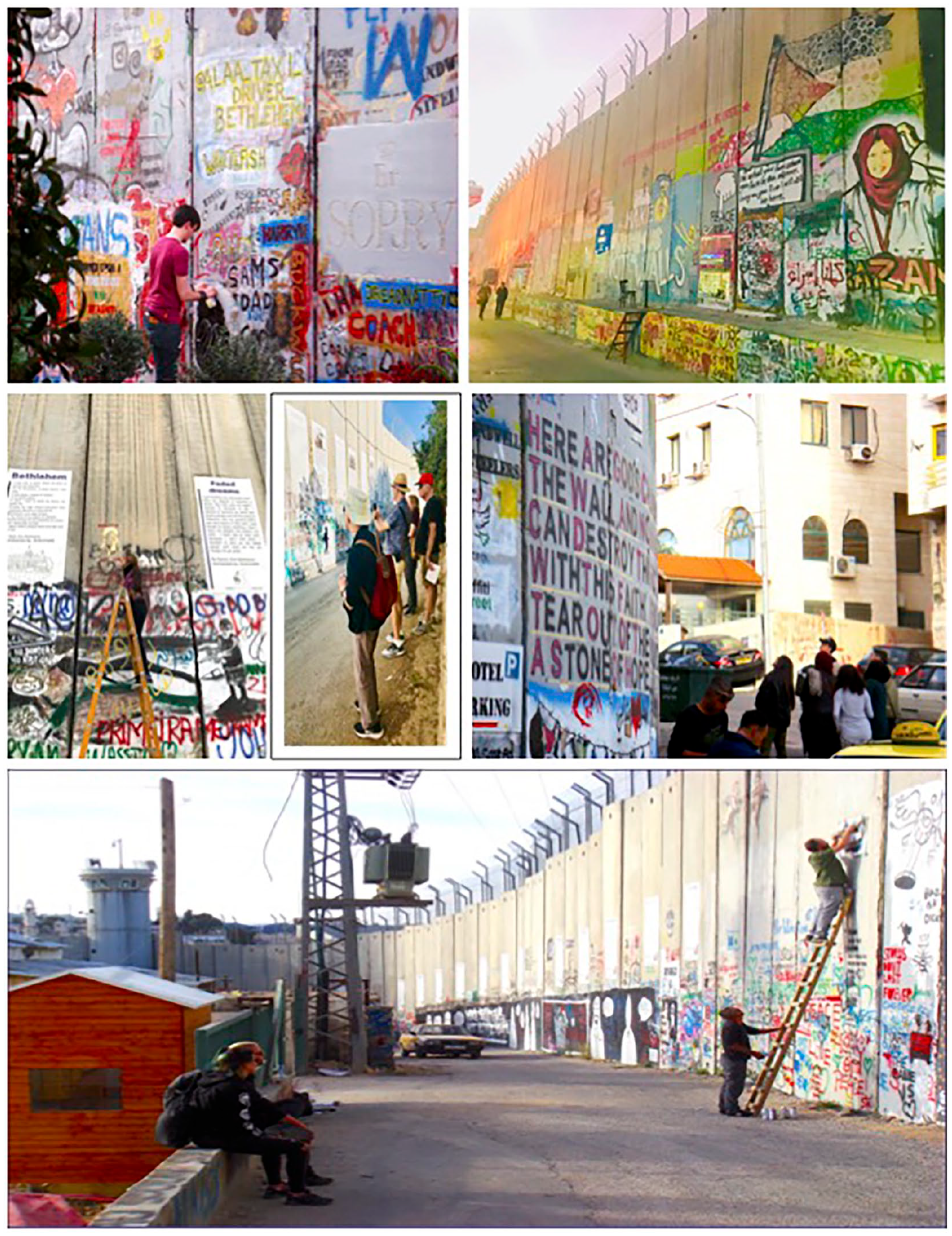
Tourists at the Separation Wall in Bethlehem.
The multisensory nature of the body-object interactions is mediated through proximal touch. This makes things happen in an immediate way and ‘therefore allows a sense of being immersed, being engaged with the task at hand’ (Paterson, 2006: 695). Interacting with the Wall, climbing it, and painting it, represent a direct manipulation of the Wall – a proximal touch of the Wall – which generates a feeling of solidity of the concrete since through touch, bodies grasp (the idea of) solidity (Paterson, 2006). The Wall is a haptic im/mobile geography, that encourages bodies to be on the Wall, near the Wall, touch it, paint it, and walk alongside.
The tactile feeling of solidity becomes a significant spatial characteristic. Touch with its proximity blurs the boundaries between body and object being handled (Hetherington, 2003). Tourist painters on the Wall become part of the Wall’s spatiality through haptic engagements. ‘While the eye consumes, the hand produces’ (Hetherington, 2003: 1936, 2003), in this context a socio-political hapticality is produced through the writings and drawings on the wall. Most messages that I saw drawn on the Wall represent signs of protest against the occupation, signs of resistance, encouragement and hope. About these messages, a Palestinian guide, says that some people, mostly tourists, like them, but some, especially locals are against ‘making the Wall pretty’: An old man once told me ‘we don’t need people to make the Wall pretty, to make nice graffiti on the Wall, so the people [tourists] will come to literally [just] see the nice graffiti, and they will forget about the Wall and what effect [it has on Palestinian lives]’- you know what I mean? So, that old man was sad, and he said, ‘tell your group [of tourists] we don’t need more people to do some graffiti on the Wall – on the ugly Wall. Leave it ugly’. We don’t want to make it look pretty with nice graffiti. People they come here – ‘wow, it’s nice’, and they will forget about what the Wall’s effects are. So, we need people to just destroy the wall not make it pretty. (Palestinian Tour Guide, interview, 16.10.2010)
Colourful graffiti makes the Separation Wall enticing and fascinating for tourists, turning it into a tourist attraction. Probably this is why the old Palestinian man in the tour guide’s story considers that foreigners make the Wall pretty and entice tourists to gaze at the Wall while forgetting the real story within and around the Wall. Banksy’s street art has become more prevalent in the Palestinian landscape, especially on the Separation Wall, but also inside Palestinian towns such as in Beit Sahour (a small town adjacent to Bethlehem) the well-known graffiti known as ‘Rage, the Flower Thrower’ portraying a man wearing a bandana obscuring his face, and his cap on back-to-front, taking aim and ready to throw his weapon – a bunch of colourful flowers. This and many other suggestive graffiti enticed this Palestinian tour guide to organize very successful ‘Banksy Tours’ together with an Israeli entrepreneur, founder of Green Olive Tours.
The Wall has become a complex emotional tourist attraction, which poses more difficulties to Palestinian tour guides when being asked about the Wall. Another Palestinian tour guide explains that it is always a complicated issue to respond to tourists’ questions regarding the rationale behind the building of the Wall: They [Tourists] ask lots of questions about the Wall, and I explain the difference between the wall and the fence. But they also ask about why the Wall was built, why the Wall exists. And this leads to other questions like, they will start getting into issues like suicide bombers. They’ll start driving you into these issues of refugee suicide bombers and so on. So, it gets very complicated. (Palestinian Tour Guide, interview, 14.10.2010)
A male tourist from the US in his 40s discussed his interest to travel to Palestine and Israel being ‘more to see things first hand, like the separation barrier, a refugee camp, and then typical tourist stuff, like museums and places holy to one, two, or all three Abrahamic religions’ (USA Tourist, interview, 10.10.2010). Through visuo-haptics, the ‘extra-ordinary’ in Palestinian tourism like the Separation Wall and refugee camps, is juxtaposed with the seemingly ordinary and typical tourism places like museums or religious buildings. Visuo-haptic engagements with, and at, the wall, refugee camps and checkpoints have transformed Israeli-Palestinian socio-political and cultural realities into tourist attractions. Tourists marvel at the Wall’s sight, are fascinated by the colourful messages on the Wall and are prompted to engage haptically with it.
For a tourist from the USA in his 20s, an encounter with an Israeli soldier pointing a gun towards their group whilst walking alongside the Separation Wall proved to be a shocking experience: . . .it was definitely a shocking experience and I still remember, I have plenty of physical reactions, from my head swarming with thoughts to my heart pounding, my whole body stopped, and I began to sweat a little bit and this was just 10 seconds, before we started to go away carefully. . . and it felt so unsafe being near an Israeli space. When I’m here at the hotel [in the Palestinian town of Beit Sahour], when I am planting olive trees, and I’m doing other things in Palestinian spaces with Palestinians, I feel safe, I feel okay, but as soon the Israeli military are near, I feel uncomfortable . . . and when I am in Israel, occupied Palestine, places that are Israeli spaces, I somehow feel less secure, I think it’s because these guards were walking around with guns and teargas. (USA Tourist, interview, 09.02.2018)
This tourist’s narrative of his personal account points to him feeling safe in Palestinian spaces planting olive trees with locals and fellow travellers. When Israeli soldiers are around inhabiting the same Palestinian space fear is more explicitly manifest: head swarming, heart pounding, whole body stopping. While the purpose of this analysis, and the paper, is not to pontificate on ‘who is right and who is wrong’ or indeed taking sides in this complex Israeli-Palestinian debate, I want to point that volatile haptic and emotional encounters (at checkpoints, the Wall, or with soldiers) were generally accepted by most interviewees as an ever-present hazard associated with visiting a place of ongoing conflict.
Another woman tourist from the US describes how the presence of security infrastructure, such as street cameras, allayed some of her safety fears: I had heard a lot about how dangerous it could be, in the old city [of Jerusalem/Yerushalaim/Al Quds], but I think that was more a couple of years ago, but of course that stays in people’s heads longer, but I felt very safe there, first of all there is a camera on every corner, or a couple of cameras in every corner, so nothing bad can really happen there, unless someone doesn’t care about getting caught, I felt safe walking around the old city, that’s where I spent most of my time. (USA Tourist, 08.01.2018).
For others, fear was not so poignantly felt as tourists were not perceived to be a target, ‘I think in general it’s actually quite a safe society’, as a Norwegian tourist expressed. The opportunity to get physically and haptically close to potentially volatile situations provided a way for some tourists to ‘expand their comfort zone’. This was particularly noted in the accounts of tourists who were in the region at the same time as the announcement by the USA administration in December 2017 that it would move its embassy from Tel Aviv to Jerusalem, and thus recognize Jerusalem as the capital of Israel. Adopting an approach of emotional distance yet physical closeness to the clashes that ensued, was commonplace with some tourists, as a British man visiting Bethlehem during that time said: The way I have seen it is that I can stand here, 20-foot away from an IDF [Israeli Defence Force] post, and a turret tower and a machine-gun up there, and a water cannon by the side of it, and a load of IDF soldiers on the other side, and feel so safe that I can give an interview to you, without stumbling across my words. I don’t feel threatened. I can take it for what it is, and I look at that side of the street and it’s quite disastrous, you’d have to be a fool to walk up and down that side of the street. I can walk on the side and have no problem whatsoever. (British Tourist, interview, 12.12. 2017)
The following extract from an interview with a woman US tourist, describes a seemingly incongruous picture of her haptic experience eating snacks whilst watching with her friends the protests unfold live in front of their eyes. In this example, the visuo-haptic experience is likened to watching live sport which sits uncomfortably with her, but nevertheless compelled her to watch for 3 days: . . . when the protests started [in December 2017], me and a few friends, for all three days, we were at Damascus Gate watching a lot of the time, and it was very cat and mouse [. . .] we would walk out and sit down by the press, eat falafel and dates and watch what was going on but there were a few tense moments. (USA Tourist, interview, 08.01.2018)
In places of ongoing conflict like the West Bank, kinaesthesia – or body’s sense of movement, of walking, sitting – includes internally experienced bodily states which form the larger haptic perceptual system (Paterson, 2009a, 2009b). Thus, in this tourist’s case, walking and sitting by the press to view an unfolding violent protest, she engages the larger haptic perceptual system. Violent encounters appear to be accepted as an ever-present hazard, and some seek a more distal touch engaging with violent encounters, alluding to an awareness of their temporary presence and reinforcing the need for ‘personal distance’ from a subject/object causing uncomfortable feelings. Being in the middle of violent clashes, crossing checkpoints, and touring along the wall often prove to be a frustrating and complex experience whereby feelings of fascination mingle with anger and fear, an aspect discussed in more detail in the following section.
Praesentia of checkpoints
Touch and the body’s kinaesthetic abilities are ways of making place and together with other senses, emotional and affective relations with place are formed. A haptic engagement in and with place alludes to an encounter with something, ‘a something’ called praesentia (Dixon and Straughan, 2010; Hetherington, 2003). This intimate, affective and touching encounter between bodies and places whereby subjectivities emerge – praesentia of place – is ‘a way of knowing the world that is both inside and outside knowledge as a set of representational practices’ (Hetherington, 2003: 1937). Tourist places in highly policed and patrolled areas of conflict come into being through sensed and lived hapticality of material objects such as the turnstile, the metal detector, the window of the cubicle through which you slip your documents, but also with other bodies who jostle your own bodily space forward, closer to the exit. This is the praesentia of checkpoints felt and experienced, as a local Palestinian guide explains below: we tell the groups, you walk how Palestinians walk [through checkpoints]. We want them to experience this, to feel how it’s happening, to have the experience. And, of course, when they see checkpoints many times we will stand at a checkpoint with a group and it’s three hours at the checkpoint, just because soldiers, young Israeli soldiers are having fun. (Palestinian Tour Guide, interview, 13.10.2010)
Kinaesthesia, the body’s sense of movement, of walking, includes ‘a range of internally felt bodily states which function as part of a larger haptic perceptual system’ (Paterson, 2004: 769). In Palestinian tourism, moving in and through place, touching material things is restricted, policed and patrolled. The contiguity of bodies, those of tourists, local Palestinians, and Israeli soldiers at checkpoints, intensifies lived haptic encounters. These encounters are performed through crossing of boundaries between fun and fear. The guide reads the soldier bodies as having fun while the reality imposed by soldiers is one of fear, of unnerving routine, of making Palestinians cross checkpoints and undergoing strict bodily check to move around place. Ahmed (2004) explains that we fear what approaches us, as it involves an anticipation of hurt or injury. Seeing Palestinian guides and international tourists approaching and then queueing at the checkpoint, Israeli soldiers, I claim, may feel fear, a form of uneasy and unpleasant intensity which is read as fun.
Our contention of soldier’s fun being a misread fear, follows Ahmed’s (2004: 63) argument that which is read off the surface establishes distance between bodies. One could, somewhat rhetorically, ask, are Israeli soldiers afraid of local Palestinians and international tourists as they approach the checkpoints? Do Palestinian guides feel vulnerable at the sight of armed soldiers? How do tourists negotiate such intensities? Fun/fear circulates in this space of ongoing conflict between soldiers, local guides and tourists. Rather than bringing different bodies together ‘as a form of shared or fellow feeling’ (Ahmed, 2004: 63) fun/fear opens up intricate and tense past histories of dis/associations.
I remember that I, too was in fear as my body was jostled by other impatient tourist bodies and local Palestinians in the queue at a checkpoint. We were all eager to find ways of skipping the line and pushing past the rest, to get closer to the metal detector and the turnstile. On such an occasion I wrote in my diary: A local woman in her late fifties asked if she could pass us (a group of tourists) to go in front of the queue. I did not mind as she started to explain she had her senior mother with her and four children. Another tourist, with a German-like accent complained, was vocal about not agreeing that the woman and her party went in front of the queue. ‘Are you better than us, why should you go before us, stay in the queue like the rest of us. Stop pushing’ he said in a loud voice. I interfered and explained that we carried EU/USA passports and were doing this as a tourist experience, rather the woman had to go through that ordeal on a daily basis. (Author, diary note, 20.07.2010)
Through touch, emotional and sensuous boundaries are asserted and disrupted. Touch may be unwelcome, intrusive and feel like a source of violation of the private and intimate ‘bodily space being touched in an unwanted manner’ (Hetherington, 2003: 1937).
The new border administration in Israel containing modern micro-mechanics such as turnstiles, fences and signs are implemented by Israel to ‘promote orderliness’ and ‘decrease human friction’ (Braverman, 2011: 279). The environment, however, formed at checkpoints, bodies lining up in front of turnstiles is conducive of increased, chaotic and often violent forms of friction. A Palestinian person was reportedly ‘crushed from the pressure between the entrance to the queue, on the one hand, and the turnstile, on the other hand, and as a result broke one of his ribs’ (Braverman, 2011: 279). This violent form of touch can only build more resentment amongst Palestinians, Israeli, and others witnessing such violent incidents and could possibly lead to aggravation and intensification of the conflict.
For an Australian tourist, a checkpoint crossing from Jerusalem to Hebron also proved dangerous as he experienced a violent haptic encounter when local Palestinian youngsters started a fire and began throwing stones at Israeli soldiers: It made me feel, like a sinking feeling, because I realized I was not going to be able to go back to Jerusalem the way I had come here, so I thought oh what have I done, I’ve made a huge mistake coming here, and this guide was saying to me ‘oh no problem, it’s safe’, and we were watching this whole conflict occur, and my initial feeling was ‘oh I’ve made a huge mistake’. . . .The kind of feeling where it was like I’ve made a decision that I can’t reverse, and I can’t just step back onto the other side I am now here, and I am stuck here potentially. It was like I’d gone through a one-way door and that door was stuck now quite literally. (Australian Tourist, interview, 12.12.2017)
In this Australian tourist’s account, the haptic perceptual system engaged when coming in contact with violent clashes in the area refers to ‘watching this whole conflict occur’ while feeling fear manifest in ‘this sinking feeling’ and fear of remaining stuck in the conflict area, because of a decision that could no longer be reversed.
The haptic perceptual system is composed of kinaesthesia, the body’s sense of movement, of walking, sitting which function together with internal bodily states such as fear in this space of ongoing conflict. Rather than bringing different bodies together ‘as a form of shared or fellow feeling’ (Ahmed, 2004: 63) haptics and fear open up intricate and tense past histories of dis/associations.
Conclusions
In this article understandings of haptic subjectivities in a tourism context of ongoing conflict are offered as I tackle the question whether tourism has become out of touch with touch. Critical tourism attention is paid to a polemic place under occupation, that of the Palestinian West Bank whereby the socio-political situation is complicated and conflict-laden. The location of the West Bank in the heart of the ongoing conflict turns tourism into a contested arena of exclusion of some, mainly locals whether Israelis or Palestinians, who are positioned not as free in the same way as tourists and/or soldiers. Everyday geographies imposed by these soldiers are of unnerving patrol and identity check through a system of checkpoints and the Separation Wall. These haptic engagements produce a complex narrative where encounters between bodies, places and material objects expose tensions between tourists, local Palestinian tour guides, and Israeli soldiers.
Many tourists accept and even desire to partake in unruly haptic encounters, supported by tour guides keen to provide lived haptic experiences. However, others seek a more distal touch through avoidance of fearful touch, alluding to an awareness of their temporary presence which reinforces a need for ‘personal distance’. Tourist haptic engagements with the numerous checkpoints in Palestine involve standing in the queue along with many other jostling human bodies, touching the turnstile, pushing it to move forward, passing through metal detectors, and handing in your travel documents.
Vision collocates with touch in a haptic system whereby fun merges with fear, senses mingle when engaging with the Separation Wall, producing and gazing at the graffiti adorning the Wall. Touch can have a scopic regime within the space of the Wall. On the Palestinian side of the Wall in the West Bank, touch is complemented by the sight of the colourful graffiti images on a painfully grey concrete body of walls. The Wall also does not seem to pose the same threat to tourists who ‘just visit it’, as it does for Palestinians and some Israelis who consider it intrusive in the land, an intrusion which threatens mainly Palestinian livelihood since it closely encircles their lives and their homes literally on three sides in some cases (Buda and McIntosh, 2012).
In this article, interconnections between embodied senses, emotions and affects are acknowledged as I delve deeper into examining the haptic sense in connection to anger, frustration and fear. These emotions are expressed and move tourists and tour guides to take social action, against humiliating stops for identity checks or queueing for hours at checkpoints. Sensuous, emotional and affective intensities are brought forth at the wall and its accompanying checkpoints. Such an approach is needed in tourism to advance critical understandings of sensuous tourist subjectivities, yet much more work remains to be done.
Geography with its affective and emotional turn (Anderson and Smith, 2001; Bondi et al., 2005; Davidson et al., 2005; Davidson and Milligan, 2004; Thien, 2005) has begun to inspire tourism researchers to unpack the role of embodied senses, emotions and affect in the production of tourist knowledges (de Jong and Waitt, 2022; see special issue Germann Molz and Buda, 2022). While ‘the tourist’ has arguably been grounded on objective, rational, detached and masculinist approaches, devoid of feelings and as part of a demand-supply system, there is evidence that this begins to change. Tourism is a long way away from experiencing geography’s ‘welling up of emotion’ (Davidson and Milligan, 2004: 523), yet recent engagements with senses, emotion and feeling stand proof that tourism researchers are increasingly turning their attention to embodied senses and affects.
Postscript
At the time of publication of this article, the Israeli-Palestinian conflict has degenerated into a war escalated by the Hamas attack in Israeli communities across the Gaza borders on 7th of October 2023 when 1200 people were killed, mostly civilians, and 253 people were taken hostage. The Israeli military retaliated with a bombing campaign in the Gaza Strip killing 35,000 Palestinians (Reuters, 2024). Subsequently, in January 2024 the International Court of Justice ruling in the case of South Africa versus Israel declared that Palestinians had ‘plausible rights to protection from genocide’ – rights which were at a real risk of irreparable damage, and if some of the acts South Africa complained about were proven, could fall under the United Nations Conventions on Genocide (Casciani, 2024; United Nations, 2022).
Specifically for this project in the Palestinian West Bank this escalation in the war resulted in increased violence in the West Bank perpetrated by Israeli settlers (Jeffrey, 2024). For the tourism sector, and wider socio-economic and cultural life in the area this war exerts irreparable damage with more than 30,000 employees in the Palestinian tourism sector having lost their jobs or livelihoods. In Israel, tourist entries decreased considerably, with only 180,000 international tourist arrivals in the last quarter of 2023 compared to the expected 900,000 (Valente, 2024). Some international airlines have resumed flights to Tel Aviv – Yafo beginning of 2024 and tourism in Israel is gradually recovering with the Israeli Central Bureau of Statistics noting a rise in tourist entries to 79,500 tourists in March 2024 from 68,100 in February (Valente, 2024).
Tourism in the West Bank and East Jerusalem might follow suit, albeit more cautiously, given that tourists wanting to visit these Palestinian Territories will have to enter via Tel Aviv airport. The Palestinian Ministry of Tourism and Antiquities have recently reported that there have been ‘few religious tourists, mostly Christians, in the cities of Jericho, Nazareth, and Bethlehem, but most of them come through Jordan’ (Valente, 2024: para. 10).
Tourism in the other Palestinian Territory, the Gaza Strip, which is beyond the scope of this research project, has been severely restricted over the past two decades, since it has rarely been open to individuals wanting to visit the place. The Yasser Arafat International Airport or Gaza International Airport located between Rafah and Dahaniya was opened in November 1998 and operable until 2001 when the Second Intifada/Uprising started and ‘Israel shut down the airport, and a year later IDF bulldozers destroyed the runway’ (Scharf, 2023). It is important to note that before October 2023 the Gaza Strip was surrounded by a large military wall and entrance into the Gaza Strip was only ever possible via Egypt through the Rafah crossing, or via Israel and the Erez crossing. Physically and bureaucratically, that was very difficult for tourists, only journalists, and workers at several humanitarian aid organizations benefitting from a special permit were allowed to enter.
There are debates about Israel and Palestine that could be considered beyond the scope of this article about haptic tourism in the region, but tourism does not happen in void, it is intimately entangled in the socio-cultural and geo-political milieus of communities. As such it would be remiss for tourism studies scholars not to engage in future research with such issues already in discussion in other disciplines like de-coloniality in education whereby decolonization is treated as activism rather than a metaphor (Fúnez-Flores, 2022), settler-colonialism, the Palestinian question in communication studies (Ghabra and Afifi, 2022), formation and transference of individual and generational trauma in psychoanalysis and connected to Holocaust tourism for example (Dawson et al., 2022), hybrid sovereignty in the Palestinian refugee camps in geography (Ramadan and Fregonese, 2017) and the ethics of visiting them, amongst others. It is, after all, the languages of justice and of life through which we can ‘understand why things happened the way they did, in order to make sure that the future is better than the past’ (Zreik, 2024: 210).
Footnotes
Funding
The author disclosed receipt of the following financial support for the research, authorship, and/or publication of this article: Funding for this project was received from the University of Waikato, Aotearoa New Zealand 2010-2011, and from the Dutch Research Council/Nederlandse Organisatie voor Wetenschappelijk Onderzoek, project number 451-15-041.
