



Abstract
Answering Huijbens and Jóhannesson’s call to investigate tourist destination development through a relational ontology marked by a vital materialism, this paper focuses on the creation of the Muraka. The Muraka is the underwater villa of the Conrad Maldives Rangali Island—an ultra-luxury resort located in Alifu Dhaalu Atoll. No social scientific research has ever been conducted at underwater hotels. Drawing upon fieldwork at the Muraka—part of a broader project on three underwater hotels (conducted in Singapore, Tanzania, and the Maldives), we aim to contribute original knowledge to more-than-human geographies and tourist studies by bringing attention to the architectural relations that entangle underwater hotels with their environments. In doing so we become attuned to more-than-human lives and create narratives that can help us imagine new relations with the planet both within and beyond the realm of tourist encounters. By focusing in particular on the creation of the Muraka through the lens of the original concept of alloutopia, we contribute to non-representational and more-than-human perspectives on tourism
The short elevator ride down to the Muraka’s underwater bedroom ended with a loud ding, echoed by the cavernous space. Saleem 1 stepped out first, with a spring in his step. The Maldivian, architect of the Muraka undersea residence, had very generously offered to fly from Male just to meet us for an interview, and that had given him the opportunity to check on his architectural work—something he had not done in 4 years. He quickly turned the corner leading into the corridor, immediately beginning to inspect the ceiling above him. He had designed the flooring plan so that upon entering the space, one’s eyes would be immediately directed toward the far end of the room. That’s where a massive floor-to-ceiling curved acrylic window generated a cinema-like experience of the reef, aweing the visitor from the very first step. Unlike a tourist’s eyes, his, instead, traveled upward, where they remained transfixed for a minute or two. He stepped slowly toward the bed, still looking up. “A lot of growth,” he noted pensively. He became quiet for a few moments, and so did we, attuning our collective hearing to the concerto of ticks and pops that together with the hum of the air-exchange unit constantly characterized the soundscape of the room. The unique sound [which can be heard at this link (click here)], was the result of fish eating the coral that had grown around the structure—we were later told by the hotel’s marketing director.
The Muraka Undersea Residence is part of the Conrad Maldives, an ultra-luxury resort located on Rangali Island, in Alifu Dhaalu Atoll. Keen on examining how architectural affordances shape tourist experiences and on answering Huijbens and Jóhannesson’s (2019) call to investigate tourist destination development through a relational ontology marked by a vital materialism, our goal for traveling to the Muraka and for this paper is to understand the creation (more on this concept later) of an underwater hotel and the imagination it stimulates—part of a broader project on underwater hotel tourism. By focusing on how architecture is alive (see Strebel, 2011) and how various actors relate to an underwater building’s inhabitation, our broader project’s intent is to generate a new comprehension of “earthly tourism” (Huijbens, 2021). Despite passing mentions (e.g., Bremner, 2016; Wille, 2023), no social scientific research before ours has ever been conducted at underwater hotels. After conducting fieldwork at three of these hotels (Singapore, Tanzania, and the Maldives), with our research we aim to contribute original knowledge to more-than-human geographies and tourist studies by bringing attention to the relations that entangle underwater hotels with their environments. In this particular paper, however, we focus exclusively on the Muraka and by attuning ourselves to more-than-human lives we create narratives that can help us imagine new relations with the planet, both within and beyond the realm of tourist encounters (see Huijbens, 2021).
There are nine underwater hotels in the world. Three are built within aquaria; these can be found in Shanghai, Dubai, and Singapore. One, located in Australia, consists of the bottom floor of a pontoon. Another four are amphibious buildings that are partly submerged. These are located in Tanzania, the Maldives (two), and Sweden. Lastly, one is fully submerged, laying on the ocean floor about 8 m below the surface of the water surrounding Key Largo, Florida. Because underwater hotels are very different from one another, throughout our research to date we have been focusing on one hotel at a time. In what follows we disentangle the more-than-human relations of the Muraka by concentrating on its affordances, our experiences, our imagination, as well as the perspectives shared with us by its general manager, marketing director, resident marine biologist, two of its butlers, as well as its chief engineer and, our key interlocutor, its architect: Ahmed Saleem. In particular, the story of our encounter with Ahmed Saleem will reveal how and why the Muraka was created, the experiences it affords, and, also how it is continuously being assembled by its more-than-human inhabitants.
We write this paper following the inspiration of non-representational and more-than-human traditions by aiming to de-center somewhat the role played by humans in favor of new imaginings of more-than-human relations and the many planetary and microbiological ways in which tourism comes to be and to matter in a particular place (Ren, 2021). Our research draws from an original concept: alloútopia. An alloútopia (from the Greek alloú, for else or elsewhere, and topia, for place) is a place where humans and non-humans encroach upon each other’s lifeworld by way of an enclave which enables their temporary co-presence and reciprocal visibility. Alloútopias are places where guests can venture into unfamiliar habitats and dwell—however temporarily—somewhere foreign, in other words, somewhere else, somewhere seemingly utopian and yet fully real. Places like the Muraka. As we will show, the concept of alloútopia does not just refer to a geographical place, however, but it also draws attention to a kind of reflexivity—enabled by alloútopic architecture—that fosters imagination, relational kin-making, and thinking life otherwise.
Background
Tourism at the Muraka and in the Maldives
The Conrad Maldives is a resort located on the islands of Rangali-Finolhu and Rangali (the two islands are connected by a 200 m long bridge). The resort can be reached by private yacht or by a 30-minute seaplane flight from Male. Rangali-Finolhu Island (about 20 acres in size) and Rangali Island (about 13 acres) are home to nearly 100 villa-style accommodations (many with their private swimming pools), three public swimming pools, two spas, ten restaurants and bars (one of which, the Ithaa Restaurant, is underwater), and a variety of leisure facilities ranging from fitness centers and boutiques, a dive center, a tennis court, and yoga and meditation pavilions. The Muraka is the resort’s only underwater residence. The Muraka is a large, two-story, three-bedroom, three-bathroom villa featuring a private pool and sundeck, a gym, dining room, living room, chef’s kitchen, as well as separate quarters for a nanny, a butler, and a bodyguard. It was built in 2018 on stilts off a pier connecting Rangali-Finolhu Island and “Staff Island,” an island dedicated to housing some 450 resort staff and serving as a base for operations (see Figure 1 below). The Muraka’s 505 m2 upper floor is above the water surface. The 110 m2 lower floor, reachable via a spiral staircase or by elevator, is about 5 m below the water surface. The underwater floor is designed as a semi-cylindrical (i.e., dome) structure and is home to a bathroom, a dressing room, a bedroom, and a sitting/viewing room. Transparent acrylic windows and ceilings encase the lower floor so that guests feel they are fully submersed in the reef.
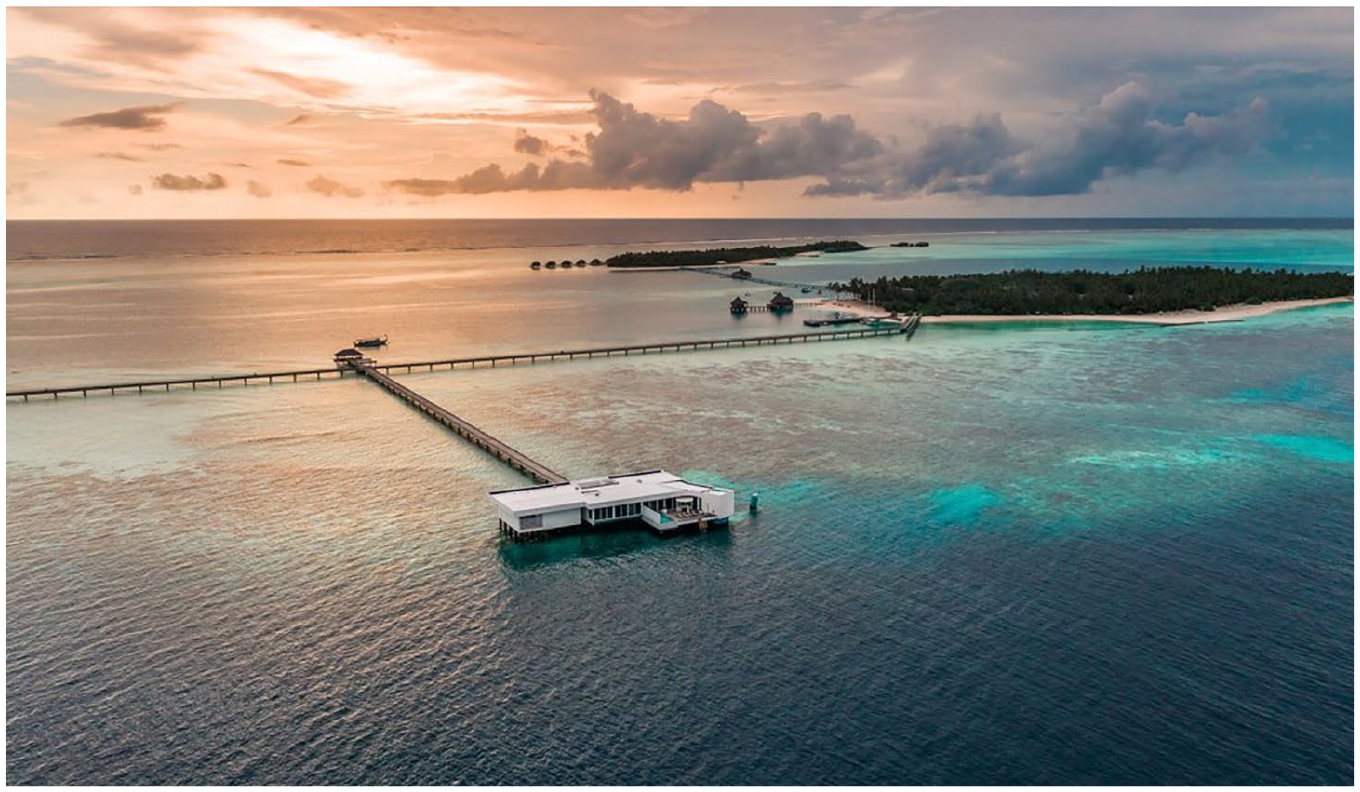
The Muraka, with Rangali Island on the right, and Rangali-Finolhu in the distance. “Staff Island” is off-frame, to the left. Copyright Conrad Maldives. Reproduced with permission.
One-night stays at the Conrad Maldives range from about US$900 to $4,000 depending on villa size, meal plan, and season. A one-night stay in the Muraka—reputed to be one of the world’s 10 most expensive hotels—ranges from $10,000 to about $30,000 depending on time of the year. Over the last 5 years, the Muraka’s guests have included global popular culture icons, professional athletes, business tycoons, and high-ranking statespersons. Most guests stay at the Muraka for only a few days. The longest booking on record is for 21 days. Many TV specials and even some movies, including the recent Hallmark production “Love in the Maldives,” have been filmed there over the last 5 years.
Like other resorts in the Maldives, Rangali Island and Rangali-Finolhu Island are an archipelago that is home to only one resort, part of the “one island, one resort” tourist policy that has been in place in the Maldives since the 1970s. 2 These dynamics have led to the formation of a particularly intense form of enclavic tourism (Dell’Agnese, 2019; Kothari and Arnall, 2017). As noted by Dell’Agnese (2019), all Maldivian resort islands feature the presence of a single commercial operator, the absence of a local residential community, the segregation of staff from tourists, as well as a complete physical isolation from other islands (islands can only be entered by guests or staff), something that engenders complete tourist insularity. Moreover, Maldivian islands tend to look very similar to one another: carefully manicured landscapes preserved to conform to the myth of the quintessential “tropical island” (see Baldacchino, 2012; DeLoughrey, 2007) that require constant staging by hard-working staff (see Edensor, 2001). Thus, beaches are regularly swept to look tidy, shorelines are maintained to prevent or repair sand erosion, waters are kept clean of flotsam and jetsam, dead leaves and seaweed are quickly swept up off the beach, and sea grass is removed from lagoons. Villas’ architectural and design styles are also developed to maintain an exotic atmosphere (Kothari, 2015; Kothari and Arnall, 2017). These strategies, tourist studies scholars have argued, tend to engender enclavic spaces of sensual pleasure and indulgence (Kothari, 2015) that promote “a sense of ease and security and a unique experience of relaxation” (Carlisle and Jones, 2012: 10). All of this, however, also poses a challenge for resort developers and managers because the complete conformity of beach and the sea to the “iconemes” of the tropical island (Dell’Agnese, 2018, 2019) runs the risk of offering guests an undifferentiated, standardized, and ultimately anonymous “serial global tourist spaces” (Kothari, 2015: 249). A distinctive architecture is one of the ways to combat this problem (Kothari, 2015) and underwater restaurants and rooms have been built lately all around the Maldives to this effect.
Alloútopias: Making with more-than-humans
Building on Foucault’s (2008) concept of heterotopia, we conceptualize an alloútopia as a liminal place that accommodates, cumulates, and celebrates a multitude of differences. Like heterotopias alloútopias are realized utopias, or “spaces that are somehow ‘different’: disturbing, intense, incompatible, contradictory and transforming” (see Johnson, 2013: 790). However, alloútopias are not a given, but rather contingent on specific encounters and relations, as we will see later. Alloútopias extend and update the concept of heterotopia in three significant ways. First, with the concept of alloútopia we draw attention to the more-than-human dimension of realized utopias. Thus, alloútopias may be understood as de-territorializations of a habitat as no longer exclusive to a species and as formations of a relational space of contact between humans and non-humans. Second, whereas Foucault (2008) paid attention to how heterotopias have mirror-like qualities insofar as they allow humans to direct their gaze towards themselves (Foucault, 2008), we want to highlight how alloútopias have windows that enable humans to gaze at animals as much as they enable animals to gaze at humans. Through their windows alloútopias work as “a system of opening and closing that both isolates them and makes them penetrable” (Foucault, 2008: 31). Third, we want to underline how alloútopias are not the outcome of a system of classification, but rather processes and relations: events in the making, verbs rather than nouns and therefore they won’t unfold in the same way for everybody, or even for the same actors in different circumstances. There is a lot to unpack here, but before we can continue, we need to better introduce some key characters of our story (Figure 2).
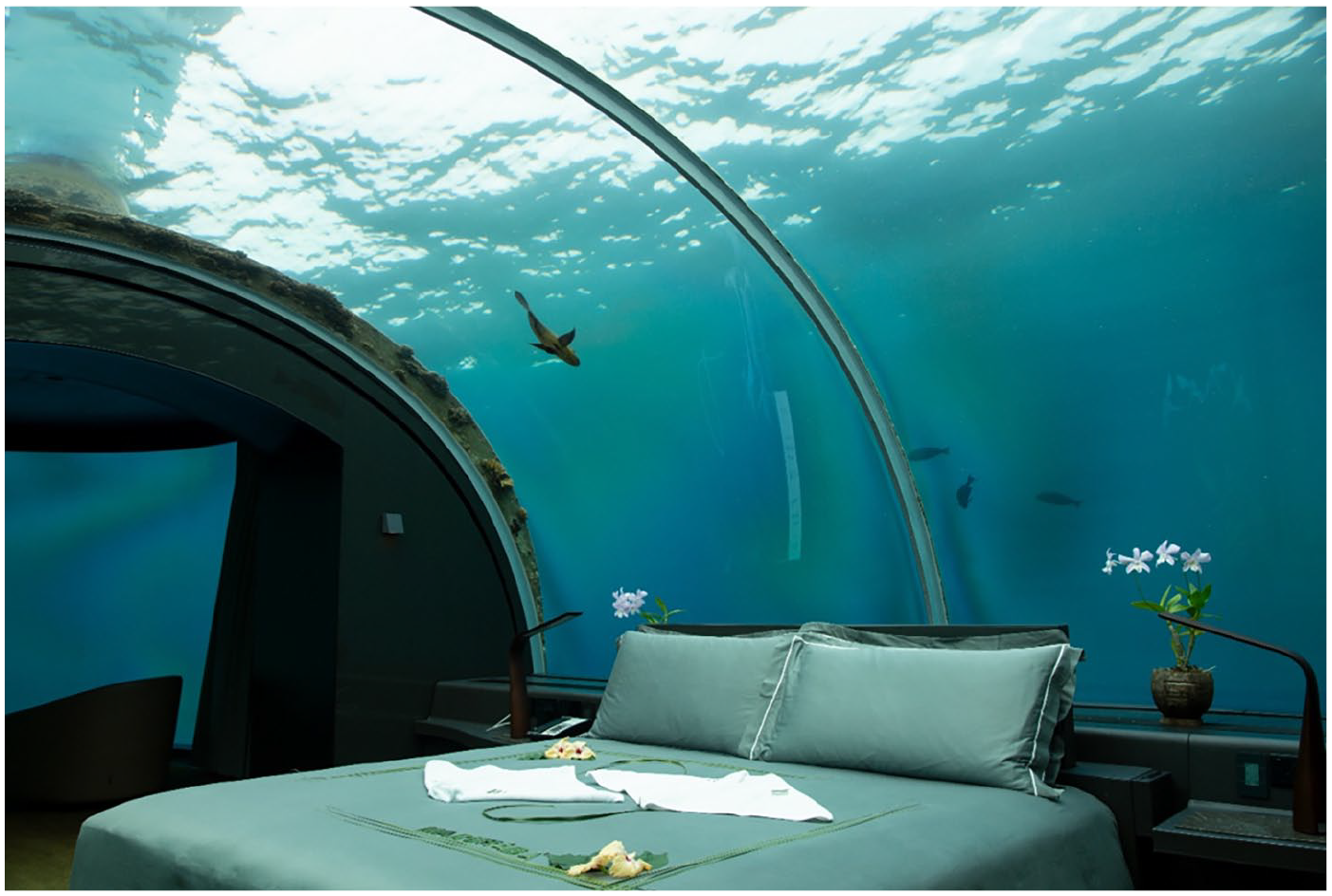
The Muraka’s underwater bedroom, with fish swimming behind the bed and coral visible on the cement frame. Photograph by the authors.
Let us begin with atolls. “Atoll” is an English word derived from the Dhivehi (the language spoken in the Maldives) word atholhu. An atoll is a ring-shaped coral reef, island, or series of small islets. To explain geological atoll formation in the clearest and quickest possible terms we can say that atolls were formed from prehistoric Indian Ocean volcanoes that went extinct. As the ocean floor subsided alongside with the volcanoes, previous coral growth expanded, eventually forming a fringed reef. The volcanoes eventually disappeared under the water surface, but the coral continued to grow. Grazing fish, sea urchins, and other organisms transformed coral into sand and very fine rubble. Slowly, these materials gathered on the shallower reefs, and these banks of sand became shallow bars. Winds, waves, tides, and currents shifted these sand bars and formed islands. Birds found these islands useful as resting and nesting spots. Their guano fertilized the sand and eventually these soils allowed plants to grow. Plants gave human visitors nourishment and shelter and eventually some of these islands became inhabited by them. It is therefore entirely accurate to say that the Maldives were made by animals, chief among them corals (see Bremner, 2016).
Coral polyps are tiny oceanic organisms that during their lives push their nutrient-gathering tentacles toward sunlight. As they do so they deposit limestone material. Coral reefs are the outcome of calcium carbonate secretions. As Bremner (2016: 291) insightfully observes: Polyps are nourished by a symbiotic relationship with zooxanthellae, a species of photosynthetic algae that live in their tissue. Coral polyps and algae have a delicately balanced mutualistic relationship that facilitates a tight, economic recycling of nutrients between them. This relationship is the substructure, the building block of life in the coral acquapelago. It is the finely tuned relational nexus connecting reef, fish and other invertebrates, sea grass beds, sand banks, and vegetated islands, and, when bundled with human activity, accumulates buildings, cities, livelihoods, and recreation as its progeny. [. . .] They are “small agencies” (Bennett, 2010: 95) that, without the slightest idea of what they are doing (or so we think) are, given time, changing the face of the earth, history, and human culture.
This allows us to think of the context of our story as an aquapelago. The concept of an aquapelago stems from the work of Hayward (2012: 4), who describes it as “an assemblage of the marine and land spaces of a group of islands and their adjacent waters.” Unlike an archipelago, a concept which is too land-centric, an aquapelago starts with the sea and pushes us to adopt an ocean-centric view, a “wet ontology” that sensitizes us to the “perspective of a world of flows, connections, liquidities, and becomings [. . .] by means of which the sea’s material and phenomenological distinctiveness can facilitate the reimagining and re-enlivening of a world ever on the move” (Steinberg and Peters, 2015: 248). From this ontological perspective, Rangali Island is therefore a world in process, an island made and re-made by the lively materials of the ocean and its inhabitants, a land/water form undergoing cycles of relative stability and instability with the coming and going of every one of its more-than-human inhabitants. In this story, as we shall see, the Muraka is a phase of growth in the aquapelago’s ongoing growth of transformation of itself.
Doing more-than-human, non-representational fieldwork
We gathered our materials for our broader research project during three separate stays at underwater hotels throughout 2023. During each of the stays we engaged in participant observation, semi-structured interviews with hotel staff, hotel owners and general managers, and architects, as well as in unstructured field interviews with hotel guests. Before and after each stay, we also conducted online interviews with engineers, architects, and marine biologists whom we were not able to meet onsite. In all, we spoke with 24 people over a period of 8 months. Because of the numerous differences among the hotels in terms of their histories, their locales, their architecture, and the experiences they afford, we treat them in separate articles. This article focuses on the Muraka exclusively, though it is also informed indirectly by data and personal experienced gathered elsewhere.
Stays at underwater hotels are typically extremely expensive. Our research grant budget allowed stays that ranged from as little as one single night, to as many as three nights. For example, we were only able to stay 28 hours at the Muraka, which cost us approximately US$14,000. At times throughout our research, however, we were recipient of the generosity of hoteliers who provided us with discounts in the interest of facilitating our work. These discounts enabled us to extend our stays. In addition to our 1-day stay at the Muraka, for example, we spent five nights at the Conrad Maldives in a much less expensive villa.
Doing fieldwork at a site of extreme luxury is an act that may connote certain impressions about our socioeconomic status, and therefore we find it important to be explicit about our positionality. We are two middle class academics who could not afford to stay a single day at the cheapest in-land villa of the Conrad Maldives. Therefore, we wish to underline not only how our travel was made possible in its entirety by a research grant (and some airline frequent flyer program points), but also how our socio-economic standing made us somewhat of a fish out of water at the Conrad Maldives. Ironically, however, this made our fieldwork easier as it allowed staff—who shared more of their socioeconomic status with us than their usual guests—to “relax” with us, better relate to us, and ultimately share their perspective and knowledge more authentically.
Underwater accommodations like the Muraka are designed to be extremely private to protect the comfort and the security of their guests. Access to the Muraka is guarded 24/7 to ensure that guests have maximum privacy. Hotels like the Conrad are also obviously not allowed to release names and contact information of guests, so reaching out to previous guests is impossible for research purposes. Moreover, underwater guests tend to stay in their villa, where they may have their own chef, or meals may be delivered to them. Bumping into them casually around the resort is therefore impossible.
Making contact with previous “public” guests of the Muraka is also very challenging for another reason. In theory, a researcher might be able to reach out to such guests by heading to YouTube or Instagram and contacting individuals who have uploaded videos of their stays. However, in nearly all cases these “travel influencers” are not actual guests who have stayed overnight, but visitors who were granted only very brief access (e.g., a couple of hours) to quickly shoot their videos. In other cases, when previous guests may be completely public about their extended stays, like some celebrities are, the guests’ own communication staffers may prevent access to them.
Our fieldwork at the Muraka was informed from the beginning by more-than-human and non-representational goals. Gathering verbal data from guests was therefore a secondary goal. The primary methodological goal of our research practice was the carrying out of an imaginative sensory ethnography intended to combine perception and imagination as a way of knowing (see Ingold, 2016, 2022). For us, an imaginative ethnography is focused on “drawing out,” that is, on “a way of making visible rather than reproducing the visible” (Ingold, 2016: 7), as well as a practice focused on asking questions that may seem absurd, and yet—we believe—the very act of asking them has the potential to stimulate reflexivity and allows us to imagine how things might be otherwise. With the intent of generating insights, rather than conclusions, an imaginative ethnography intends not to predict or “speculate about the future, but to see into it” (Ingold, 2016: 10). An imaginative approach—which is something that alloútopic thinking intends to facilitate—is essential when doing non-representational, more-than-human research. Doing fieldwork with more-than-humans is something that challenges researchers “to do geography differently—to perform, to engage, to embody, to image and to imagine, to witness, to sense, to analyse—across, through, with and as, more-than-humans” (Dowling et al., 2017: 824).
Encountering Acropora Digitifera
Acropora Digitifera, 5-cm-long light brown-cream corals shaped like fingers had been growing in little bundles all over the steel and cement structure sustaining the underwater dome. The small, thin branches had found the engineered structure to their liking as an ideal shelter from waves and currents. They had grown profusely since Saleem’s last visit. He smiled upon seeing them grow on the cement framing the underwater building. Whereas your average homeowner might balk at the sight of moss growing on the roof of their house, the Maldivian architect was delighted. This was really “good news,” he remarked. The oldest in-water structures of the Muraka are made of steel, a material chosen to help coral grow, he told us. A special paint had then been applied on top of the steel to preserve its lifespan. No one knew for sure whether it would. When the coral started growing, it “was like a living experience,” he said.
“Muraka” is the Dhivehi word for coral. Before its opening in 2018 Saleem and friends had chosen the name as a homage to the location—a coral reef—and to the broader significance of coral. Rangali Island and everything around it was dependent on coral, and not only the name of the villa, but its very architecture and engineering had been designed to limit disruption to the coral and enable its regrowth. From the methodical selection of the site to the limited footprint of the few piles, and the sustained effort over the years to manually plant coral, respect had been paid to coral, “our lifeblood.” “Without the coral, we wouldn’t exist,” Saleem told us, “what keeps us here is the growth of coral. If the coral stops growing, we’ll be gone.”
Coral had shaped Saleem’s life since his first arrival to the island over four decades ago. Only scrub and birds inhabited the island when he first arrived in 1994. The shallow coral reef had prevented him and his friends from anchoring their boat near the shore, so they had to swim the rest of the way. They sat on the island for a while, imagining its possible futures. Tourism had barely started in the Maldives by then, and only a small handful of resorts had been developed by local entrepreneurs. Saleem was fresh from completing his studies in Sri Lanka first, then New Zealand. So, after returning to Male from his first trip to Rangali, he and friends took out a US$30,000 loan and leased the island from the government for 99 years.
Over the next decade Saleem and his colleagues from the Maldives-based Crown Corporation began making way for the first few villas and resort structures on Rangali. Along the way, he experimented with design ideas. Some of these ideas were simply driven by necessity. Shipping building material to the island was prohibitively expensive and to save on flooring, the main lobby and bar, as well as some of the resort’s restaurants, featured sand for a floor. And they still do; a constant reminder that coral and its byproducts are intricate to the existence of the island and its resort.
Saleem’s underwater architecture ideas began with the design of Ithaa (Dhivehi for clamshell), the world’s first underwater restaurant. Neither Saleem, nor New-Zealander engineer Mike Murphy, had any real experience designing and building open sea underwater structures intended for human inhabitation. No one in the word really did. But that didn’t stop them—Mike revealed to us in a phone interview—as they wanted to be the first, they craved the challenge and the adventure. Like the Muraka, Ithaa was designed as a dome so that visitors could get a sense of full immersion underwater. That was an uncompromisable condition for Saleem; he didn’t just want windows to look out of, he wanted the feeling of a body fully submersed under the surface. Opened in 2005, Ithaa was incredibly successful, then it was emulated extensively by various Maldivian resorts. Eventually, demands for something bigger—a residence where people could sleep—kept piling up on Saleem’s desk. At first the resort arranged for people to sleep on a bed set in the restaurant. But that was far from ideal. Once again, he called Mike Murphy, his university friend in New Zealand. “We are not going for small ideas,” Saleem told Mike, “we are going for big ideas.”
The Muraka was a big idea, a US$15 million project designed and engineered from the underwater up. The expansive villa above the water surface was a secondary consideration, intended as a place where guests could get additional space. Built in Singapore, the 600-ton structure had to be lifted underwater by a ship with a crane. The weight and size of the Muraka were limited by the shallow reef itself, as ships capable of lifting the structure required a minimum water depth. But Saleem’s initial anxiety was another factor weighing on the design. One thing was designing a restaurant where staff were always present and patrons would come and go, another thing altogether was designing a place where guests could be left alone to sleep. Properly oxygenating and ventilating the place, providing an escape route, and generating various alarm systems, were key considerations. Wanting to ensure that it was actually safe, he was the first to sleep there. It turned out to be an amazing experience: “I thought, I’m the only one in this world right now sitting underwater in a room. There’s nobody else doing this except for me.”
Then, the next morning, he woke up. He saw the sunrays peeking through the water and fish flying all around him. “You’re lying in bed and there’s all this little fish going by,” he reflected with us as he told the story, “you go to the bathroom and you see all this fish biting on coral everywhere.” It was then that he realized in full the carnal dimension of his work, an experience he had not fully envisioned. Lying horizontally in bed well below the water surface, without the need to swim or breathe through an oxygen tube, freed the body enough to let the mind wonder and wander differently. Feeling fully submersed, he told us, with fish swimming around you and looking at you, you start thinking “what do these fish think of us? Who are these people? It’s a weird experience.”
It’s a weird experience that Saleem told us he wanted people to have. People who are not divers. People who can’t swim, or snorkel. Even people who are unable to walk the spiral staircase down the Muraka—people for whom the elevator was put in place. Surely, and inevitably, wealthy people, but there seemed no way around that, he confided genuinely.
As for the fish, Saleem told us he hoped they don’t mind having to swim around the Muraka. “If I could, I would say sorry for disturbing you, for invading your territory.” But the same apology, he noted, should go to the small gulls that were nesting on the shore when he first arrived on Rangali, or the coral all around us. We humans need somewhere to live and grow, he said, just like they do.
At first glance, it would make sense to think of the Muraka, like other Maldivian resorts, as a heterotopia. Following Dell’Agnese’s (2018, 2019, 2021) work on Maldivian resorts we could view such resorts as spaces apart from the broader Maldivian society; alternative spaces designed to be separated and different from the surrounding territory, spaces planned, envisioned, and managed as realized tourist utopian environments shaped by a logic of luxury and sensual pleasure. In his essays on heterotopias, Foucault (2008) himself used the example of resorts, highlighting how their accessibility depends on mechanisms of selective openings and closures, and how they function as illusory spaces that are meticulously designed and managed to offer vacationers brief alternatives from their normal lives. Maldivian heterotopias could then be argued to be another example of a tourist bubble (Judd, 1999); an enclave-like total institution whose physical perimeter isolates it from the broader society and whose territorial development and governance is driven by external social, economic, and political forces (see Saarinen and Wall-Reinius, 2019). Though useful in part, we believe that the concept of heterotopia can be updated and extended. Alloútopic thinking can help us with this.
The Muraka was specifically designed to give its human guests the opportunity to temporarily live in a foreign environment to them and to develop new relations with sea life. Simultaneously, as Saleem realized the first night he slept there, the Muraka gives individual fish, coral, and other marine lives the opportunity to be in contact with humans and take up residence and grow on and around their buildings. An alloútopia like the Muraka can therefore be understood as a more-than-human “elsewhere:” an “other” space unfolding as a temporary enclavic inhabitation entangling together humans and non-humans. Unlike a heterotopia—which refers to a realized utopian human space that is set apart from the broader human society—an alloútopia like the Muraka points to the emergence of a place where humans and non-humans may develop relations unlike those typically experienced elsewhere. However, an alloútopia like the Muraka is not necessarily a realized utopia (like a heterotopia is), but it is rather a potential: a realizable utopia dependent on the relations woven together by specific humans and non-humans.
The notion of utopia can be understood from a humanist perspective as an imaginary place where a human community lives in an ideal way, or at least this is what Thomas More intended with his vision of a fictional island in The New World. From this humanist perspective one could understand the Muraka as an idyllic and luxurious island where guests—pampered by attentive staff—can live the good life in a different kind of world. But what could an imaginative more-than-human(ist) perspective on utopia reveal? Let us imagine a reversal of species’ perspectives. In other words, how can fish or coral perceive the Muraka as a utopia? Swimming in a reef where 80–90% of the coral has died due to bleaching, a fish might look at the Muraka as a place where new food grows and is freely available. Could that fish—and we fully realize the absurdity of the question we are about to ask—view the Muraka as a “restaurant?” That fish might have also taken up residence—like many other fish have—among the piles on which the Muraka rests. Could that fish then view the Muraka as a “hotel,” or a home? Let us also imagine that fish as a curious being. She has seen plenty of divers and snorkellers throughout her life. She has long wondered—and again, we are aware this might sound absurd—what else humans do, how else they live their lives beside swimming clumsily. With the Muraka, that fish’s curiosity is satisfied. There is now a place that allows her to see humans stand up, eat, drink, shower, speak on the phone, have sex, go to the toilet, shower, and so on. The Muraka is then not only shelter and a source of food, but also a place that feeds her imagination and satisfies her curiosity. We realize that many of these statements about fish are absurd. They are, indeed, utopian. They are, better yet, a fully realized utopia for more-than-humans too: a place where fish can “eat out,” find shelter, go sightseeing and have an escape of sorts, doing something different for a change, view humans differently, and imagine how life could be otherwise. They are imaginings for real (Ingold, 2022) or, borrowing from Haraway (2016: 10, we might say that these are stories that work as forms of speculative realisms and fabulations, “stories in which multispecies players, who are enmeshed in partial and flawed translations across difference, redo ways of living and dying.”
As our encounter with Saleem revealed, an alloútopia like the Muraka was designed to give non-divers a unique experience of the underwater world, but it was also designed as a building that could give coral and sea life a chance to grow and live their life somewhat differently, even if only temporarily. This mutuality of design for more-than-humans is a quintessential characteristic of alloútopic architecture. Alloútopic architecture is a style of designing buildings in enclave-like more-than-human spaces where residents of different species have the potential to reimagine the relations they have with one another. As such potential becomes actualized in different ways, underwater architecture like the Muraka lives, evolves, grows, and undergoes transformation in animate ways (see Strebel, 2011). Animacy, according to Ingold (2010: 68) “is the dynamic, transformative potential of the entire field of relations within which beings of all kinds, more or less person-like or thing-like, continually and reciprocally bring one another into existence.” An animist ontological perspective points our attention to how a building like the Muraka is nor preordained or completed, but rather a generation of possibilities: an opening for lives to unfold and become tangled together in novel ways. It is this transformative potential for relations to be re-imagined that alloútopic thinking and imagining are about. As utopian as it may sound, a place like Muraka is therefore not just an “elsewhere” for humans, but for fish and corals too. It is a place where their lives can become entangled with human lives in a way that nowhere else in the ocean (let alone on land) is possible. It is a place where they can grow food, shit sand, engineer an island, and contribute to the growth of a building where humans reside. It is a place where they—just like us humans—might imagine life differently.
As our narrative has shown, the Muraka is alive and constantly growing, and it was intended to be so. This is something we could call a creation, or a crescent design. Buildings, notes Ingold (2016), are a part of their world, and the world and all its inhabitants continuously unfold alongside with it, following paths of growth, transformation, decay, and regeneration. A crescent design points to creation not as the realization of a mental image or as the imposition of a human fabrication upon an inert world, but rather as a generative process that “harbours its own impulse of growth and renewal” (Ingold, 2022: 5). Because it surrenders itself to the imagined, yet unknown, actualizations of more-than-human relations, the creation of an alloútopia like the Muraka is intended to bring forth new forms of life, continuously coming into being for long as the building is alive. This is, in other words, a more-than-human inhabited space that “carries on, or perdures” (Ingold, 2022: 27). An alloútopia is then not something “invented” by the mind of a human architect, but a realization of the world, an outcome of the world’s ongoing self creation.
Ingold’s view of creation is essential for our understanding of how an alloútopia enables a particular kind of imagination. For Ingold imagination is not an act of fiction, or something to be contrasted with the perception of the real, but rather an “an opening into the fullness of the real, in both its temporal incipience and experiential depth” (Ingold, 2022: xii). This is what Ingold calls “imagining for real,” an act that transcends the opposition of imagination and reality, objective fact and fantasy. The creation of the Muraka for us is something that allows imagination to unfold as “a way of entering from the inside into the generative currents of the world itself, by balancing one’s very being on the cusp of its emergence” (Ingold, 2022: 4). When we wonder about the “thoughts,” “moods,” or “feelings” of fish for example we do not engage in fiction. Rather, our imaginative perception of their disposition is marked by a quality of responsive attention engendered by the promise and potential of the Muraka’s alloútopic creation. Therein lies the imaginative power of an alloútopia: thanks to the perceptual attunement it allows, and thanks to the exposure to an unsettled and constantly self-revealing and self-forming world that it allows, it “opens a way for an imagination that does not oppose but reaches into, and joins with, the real” (Ingold, 2022: 6).
Encountering Jumbo and Polly
The unnamed reef shark glided calmly past our bedroom window with an air of disinterest, without as much as a side glance at us. Of all the sea life that had swum by our hotel room throughout the afternoon, sharks had seemed the least caring of our presence underwater. Unlike them, a pair of Powder Blue Surgeonfish and a school of Six-Bar Wrasse had been carefully inspecting us just centimeters away from the five-inch acrylic opening between our world and their theirs. As they swam by, the Wrasse gazed at us, only to sheepishly look away when we stared back. The Surgeonfish instead hung steady amidst the soft currents, blatantly staring at us. We had been in the Muraka for a few hours—taking notes, observing, video-recording, and photographing our marine neighbors—when a large Parrot Fish arrived. We had seen some earlier in the day and noted their vibrant fuchsia tail, teal-colored face, and generally inattentive conduct toward us. But this one—Polly, we named her—stood out.
After looking at us briefly, Polly began feeding by munching on the hard-as-rock coral that had formed on the cement structure above the ceiling. Then, Polly turned around and pooped sand. Yes, sand. Astonished by what had just transpired, we looked it up on the Internet. Parrot Fish, it turns out, have some of the strongest teeth in the animal kingdom. As they chew on coral, they eat both the hard calcium carbonate skeleton, and the soft-bodied organisms (polyps) that cover the skeleton as well as the algae (zooxanthellae) that live inside them. As they eat, the soft tissues are absorbed, and the rest is defecated as sand. A single parrotfish can poop as much as 450 kg of sand per year (BBC Earth, 2010). Sand—the beach stuff we had been sitting on, laying on, walking on for days—was mostly poop.
Jumbo arrived later, alone, close to dusk time, alone. He swam slowly, with an apparent sense of fatigue in his strokes. His bulging, beady eyes cautiously studied our gaze from behind the acrylic window. A coral reef marine life guide provided by the resort helped us identify Jumbo as a Sweetlips. We sat there for a while, wondering whether Jumbo could identify us as humans with similar precision. Unbequeathed with a similar manual on how to tell humans apart, Jumbo could perhaps refer to his experience with similar shapes in the water. How odd we must have seemed to him compared to horizontally-moving humans, the kinds of movements typical of divers and snorkellers. Perhaps, we began wondering, Jumbo was studying us so inquisitively because never before had he seen humans sitting, or drinking, or breathing without a tube.
Whatever it was that brought him here, Jumbo slowed his glide to a standstill an inch or two from the viewing room window, barely moving at all in the slack waters of the tidal change. Unlike other Sweetlips, who seemed to carry on effortlessly in their busy affairs, he seemed as if was overworked. If the effects of the long day filming and recording our observations in the Muraka were starting to show on our faces, Jumbo must have detected a similar haggard aura in our eyes too. After his ninth or tenth leaden lap around the viewing room, we couldn’t help but notice a certain morosity in his demeanor. Was he sad? Lonesome? Was he hoping we would do something else to entertain him? Or was that a ridiculous question to ask?
Sensical or not, these flights of fancy had become routine for us after spending several hours underwater. Elsewhere during our underwater fieldwork, we had become well aware of how our underwater hotel room gave us a familiarity with individual fish that was utterly unmatched by activities like snorkelling or diving (see Vannini and Vannini, 2023). While swimming, we had noted, the individuality of sea life is at best a competing priority with the demands of the physical activity. In contrast, while sitting on a comfy chair, or laying on a bed for hours at a time, individual Sweetlips and other forms of life could become familiar enough to receive pet names, were differentiated from their species, and were ultimately imagined to have distinct identities and personalities. Could the reversal also be the case? Could fish give the two of us nicknames? Could they tell our races? What if the fish too—like the resort staff—could identify our social class by looking at our modest clothes? Absurd questions, no doubt, yet this kind of reflexivity and utopian thinking were exactly what the alloútopic space of the Muraka was making possible. Just like the place had allowed us to learn about where sand came from, couldn’t the place also allow marine species to discover amazing facts about humans?
Unlike Jumbo, Polly seemed to have more ordinary concerns of the dietary kind. Over the last 25 years the Maldives have witnessed major coral bleaching events due to rising sea temperatures. The house reef of Rangali Island has not been spared. Yet, some planting efforts by the resort, accompanied by the coral growth facilitated by the sunken piles on which the villa rested, had given Polly new feeding opportunities. In fact, the first time we saw her, Polly was gazing at us while munching on coral that had formed on the cement structure right above our bedroom. It was a short while later that Polly pooped, right in front of us. Polly’s misty trail of sand poop hung briefly mid-current, then slowly trickled toward the bottom of the ocean floor. We began to imagine whether Polly could be just as surprised to see humans poop.
In fact, unlike other underwater hotel rooms, the Muraka features not only an underwater bedroom, but an underwater bathroom too. And in fact, marine life of all kinds had been examining our bathroom behavior in intimate detail. Six-bar Wrasse and Parrot Fish, in particular, seemed transfixed with what happened in the toilet. This kind of gaze reciprocity—with us peering at fish doing their business and fish staring back at our business—was essential to the emergence of an alloútopic space. In an aquarium visitors move around from tank to tank, with the fish remaining rooted, with nowhere to escape for privacy. In an underwater bedroom and bathroom the reverse happened. We sat on our bums and the fish swam around us, enabling utopian—but very real—reciprocal encounters based on maximal visibility to take place.
***
The Muraka is essentially an artificial reef. Artificial reefs are known to attract large schools of fish because they create shelter and because coral is known to grow on these structures, which in turn gives fish food. What is then the Muraka, for a fish like Polly? Imagine you are a fish. Imagine places where you can go to find shelter, find food, hang out, see new things, do something different, people-watch, have some fun. Imagine an elsewhere, a place that you won’t easily find anywhere else. Imagine a place like the Muraka, a realized utopia where not only you can live a good life for a little while, but also a place where you can gaze at humans and feel something else about life. We cannot know what else fish might feel about life by being around the Muraka, but it is fair to think there is a possibility they might. An alloútopia is a potential: something that may unfold as such—or not—depending on the specific development of interspecies relations and the unfolding of the more-than-human imagination. In other words, a place like the Muraka may work in alloútopic ways because it has the potential of generating alloútopic events, imaginations, and encounters. That potential may or not may be actualized by different actors (human or not), at different times. The Muraka became actualized as an alloútopia for us because it was the outcome of relations and imaginations that entangled our lives with sea life, not only through the ongoing visual recognition afforded by the glass, but also because of questions it led us to ask.
As the narrative of our encounters with Polly and Jumbo shows, an alloútopia’s opening into the world around it is afforded by its architecture. That opening is afforded by the building’s windows, which in the case of the dome-shaped Muraka uniquely enfold human guests at 180 degrees. This nearly all-encompassing visibility is what gave us the opportunity to reimagine the underwater world. It is after all the practical inaccessibility of the underwater world that has rendered it both obscure and mysterious for much of human history (Abberley, 2018; Squire, 2021). As a result, both underwater environments and many marine species have regularly been imagined as alien, quintessentially inhuman. In light of this, far from being an empty space of luxurious excess, and far from being an environment that separated us from sea life (cf. Bremner, 2016), through the visibility it afforded us, the possibility to dwell in a common world, and the imagination it stimulated, the Muraka gave us hospitality into an unfamiliar world and allowed us humans to reflect about ourselves as humans. Speculatively, we also like to imagine whether it might somehow allow fish to reflect about themselves about fish.
As our reflexive narrative makes clear, alloútopias afford a very visual experience. In contrast, snorkelling and diving allow people to experience the underwater world differently, multi-sensorially. As researchers like Merchant (2011) have remarked, divers’ experiences of underwater environment are not only visual but also auditory, tactile, kinesthetic, thermoceptive, nociceptive, and proprioceptive. Diving is also hard work. Unlike divers, underwater hotel guests do not have to swim, regulate air pressure, worry about contact with dangerous wildlife, or adapt to the currents of the ocean. As a result, some of our readers may be quite critical of underwater hotels. To these critics, a stay in the Muraka might appear lazy, or perhaps something like a visual spectacle deprived of fuller corporeal sensations. And yet, as Bitterman (2014) reminds us, the underwater world is not fully accessible to everyone. Alloútopias like underwater hotels are by design accessible and intended to provide experiences that—while mainly visual—are longer in duration and ultimately different than those reserved for swimmers.
The concept of alloútopia allows us to speak simultaneously about two things: the more-than-human architectural imagination and creation of an “elsewhere” like the Muraka, and the more-than-human touristic encounters, possibilities, and relations that this “elsewhere” enables. The two aspects of this concept—the architectural and the experiential—are not two separate stands in our argument and conceptualization of alloútopia, but two sides of the same coin. In Imagining for Real Tim Ingold (2022), inspired by an exhibition of artist David Lemm’s work at the Edinburgh Printmakers’ Gallery titled Debris and Phenomena, writes how he finds himself pondering an unusual question. Upon leaving the exhibition site on a particularly windy day, he begins to imagine he was out at sea. In his imagination his raincoat is a sail, and the features of the city around him something akin to flotsam and jetsam in oceanic waves. He goes on: “Holding my coat before the wind, was I sailing a flooded city? In reality, of course, I was on dry land, and the features were all firmly in place. I was not sailing but walking, and the pavement remained firm beneath my feet. But what if it were otherwise? What if the ground the city were an ocean, and its building ships?” (Ingold, 2022: 168).
“What if’s” are the types of questions that we want to ask as non-representational, imaginative sensory ethnographers inspired by alloútopic thinking and imagination. So, what if (more-than-human) life was otherwise? What if the sandy floors of the ocean were the pavement of a city, and its reefs buildings? What if fish were the tourists, and the human guests the tourist sights? What if coral was an architect, and a Sweetlips named Jumbo a tired engineer who occasionally needs a holiday? And what if the humans who spends a little bit of time in a place that is elsewhere in this world, a place envisioned to make them otherwise, end up re-imagining the ocean as a source of life and vitality, rather than a resource? In this utopian world, could a different way of life be imagined? One in which humans care about coral bleaching and climate change and actually do something about it? One in which fish and coral re-envision humans as kin, rather than killers and destroyers? These are the realizable utopias that alloútopic imagination intends to open up: places that are not only somewhere else, but places envisioned to help us all imagine life otherwise.
Departing thoughts
Throughout this paper we have shown how a more-than-human understanding of the Muraka allows us to think of underwater hotel experiences as visually reciprocal and relational. Windows, alloutopias’ visual openings onto the world, enable humans to imagine about sea life, as much as they make it possible for marine species to see and imagine about human life. It is to this kind of reciprocity that we want to dedicate our remaining space. This reciprocity, or better yet, correspondence (Ingold, 2022), is continuously unfolding in the ongoing creation of the Muraka. It is a correspondence knotting together humans and non-humans in myriad activities; from the way coral and architects build together, to the ways in which sand-pooping fish and developers assemble a coral island. Our perspective has led us to understand the Muraka (and nearby Rangali Island) as the aquapelagic outcome of more-than-human forces. This is particularly fitting because coral islands, as Bremner (2016: 292) are shown, are not islands in the ocean but instead: islands of the ocean, produced by its dynamic energies. They are topological forms, liminal spaces, geology and biology, human and animal, land and sea. They are arrested matter in motion, driven by currents, tides, winds, seasons, and marine life. Islands, lagoons, mangrove swamps, sea grass beds, and coral reef flats are little eddies of relative stability in a dynamic flow of relational instability. Landforms are sand-forms, relatively unstable, always moving, formed by erosion, deposition, or siltation and shaped by the forces of seasonal monsoons.
Alloútopias like the Muraka are intensely imaginative spaces that allows us and non-human companion to imagine for real (Ingold, 2022). The underwater world opened by the Muraka is an intensely reflexive elsewhere that allows guests to imagine the role that a reciprocal, more-than-human architecture can play in the habitation of newer spaces for both residential and tourist purposes. This alloútopic architecture, we believe, is going to become more prevent as previously inhabited environments are developed to adapt to climate change (e.g., rising seas), and the ever-growing demand for new travel sites and experiences results in the tourist development of extreme environments on this planet and others. In the Maldives, for example, where rising seas have been threatening the very inhabitability of islands, new residential developments in the forms of floating towns have been taking shape (see World Economic Forum, 2021). These amphibious spaces are intended to be resilient to water level changes and are destined to lead to re-imaginations of where else humans may be able to live. As this happens, alloútopic architecture and design are going to need to benefit both humans and non-humans by imagining new ways to building with nature (see Roudavski, 2018). Architecture that corresponds with non-humans needs to be attentive to the unknowns and the instabilities of the world’s ongoing formation. It needs to be a responsive and provocative practice intended to stimulate our imagination, as well as attention and care (Roudavski, 2018). In the case of marine tourist development, such architecture should also be, to borrow from DeLoughrey (2017: 42), the basis for a new sea ontology where oceanic spaces “including its submarine creatures, are no longer outside of the history of the human.”
In writing about alloútopias our goal is not to draw attention to yet-another case of tourist excess, but instead to stimulate our collective imagination for the ways in which a more-than-human lively ontology can lead us to ask new questions, to research new realms, and ultimately to understand tourism as a quest for new kinships (see Ren, 2021). The value of imagining-for-real (Ingold, 2022) about Jumbo or Polly in the way we have done, lies in drawing attention to the importance of being affected, to the power of non-human charisma, and to the need to cultivate our sensibilities for other species as kin. This is something that demands a new orientation toward research which, rather than describing and interpreting, seeks to envision new imaginary ways of encountering the world and all its inhabitants (Greenhough, 2019). Alloútopias’ openings onto the world are then not simply instruments for yet another kind of tourist gaze, but instead destabilizing imaginative forces that can lead us to engage in “a kind of experimental play that seeks to explore the multiple ways in which the world is coming to be” (Greenhough, 2019: 101).
One of the key elements of our conceptualization of alloútopias is the differential power structure that underlies their creation. Humans, after all, have a greater ability to design enclavic architecture than animals do, or perhaps have a greater ability to police its access. In light of this, we believe it is especially important to underline how in the future new alloútopic architecture and more-than-human resort destination development need to be sensitive to ethical matters. With the potential to create new and different relations among their guests and inhabitants, alloútopias will need to stimulate land- and sea-centered narratives for a tourism that is slower, attentive toward local attachments, and appreciative of what is proximate (see Huijbens, 2021; Rantala et al., 2023). This is an ethical, moral, and environmental vision focused on imagining and sharing stories about the wisdom of all forms of life, an actual “re-storying of our relations with planet Earth, calling for attentiveness to things we take for granted or even ignore” (Huijbens, 2021: 111). Alloútopias’ openings into the animal world can provide us humans with a view into not only an elsewhere, but also a moral otherwise: a worldview onto other species as teachers, not as Instagram backdrops, marketing attractions, or resources. This moral otherwise is what destination stewardship (Huijbens, 2021) can provide: opportunities to not only become attuned to more-than-human lifeworlds, but also lessons in imagining, corresponding, and caring about them.
Footnotes
Funding
The author(s) disclosed receipt of the following financial support for the research, authorship, and/or publication of this article: This research was funded by an Insight Development Grant by Canada’s Social Sciences and Humanities Research Council.
