




Abstract
Food tourism researchers are increasingly seeking to question why tourists eat animals, and the ethical dimensions of such encounters. The tourist experience has largely been taken as the starting point in this research, influenced by the anthropological origins of this research field. In effect, human-animal relations, for the most part, remain absent from such interrogations. In this paper we seek to engage with critical tourist scholars who are increasingly turning to post-humanist and more-than-human framings, to move beyond a fixation with human agency in understanding how and why we eat animals in tourism settings. Multi author participant observation is utilised to examine a touristic encounter with smalahove, a traditional Norwegian dish of smoked and boiled sheep’s head. Through this case study we argue that future food tourism research ought to shift focus beyond the tourist experience, so as to fully understand the processes through which animals become eaten. In exploring the ways that human-smalahove entanglements provoke consideration for how humans and animals might be-together-otherwise, we call on food tourism researchers to consider what sorts of other food tourism encounters might prompt reflection and how such ethical reflections might be leveraged in food tourism ventures.
Introduction
Food tourism is increasingly capturing the interest of tourism academics (see de Jong et al., 2018); yet, as Winter (2020) argues, the ethics of eating in food tourism settings remains largely untouched within food tourism research. Meat eating, in particular, has been positioned within food tourism research as an unquestioned, non-reflective activity (Cohen 2018), despite growing ethical and environmental issues associated with the slaughter and preparation of animals for food. Fennell and Markwell (2015) therefore call for greater attention to the animals constituting many tourists’ meals.
In the years since Fennell and Markwell’s (2015) call there have been some important attempts to engage with the ethical dimensions of animal meat consumption in food tourism research (e.g. Cohen, 2018; Fennell and Markwell, 2015; Kline, 2018). As noted by Winter (2020), much of this research has turned to sociocultural conceptualisations to understand why tourists engage with meat consumption. A smaller number of articles within the field of food tourism have turned to post-humanist and more-than-human framings as a way to shift focus away from the tourist experience (e.g. Bone and Bone, 2018; de Jong and Waitt, 2022; Lund, 2015). This research moves beyond a fixation with human agency in understanding how and why we eat animals in tourism settings, to foreground the multiple and complex ways through which things come together to make certain animals not only edible, but desirable, for tourists to eat.
In this paper, we contribute to this peripheral, yet emerging, area of work, to explore the multiple, complex and paradoxical ways animals and humans come together, alongside discourses and materialities, in the making of animals into ‘food’ within food tourism settings. We argue it is important to expand research in this area to understand food tourism encounters as not just the creation of memorable touristic experiences, but also as reflexive opportunity to engage with, and relate to, animals in different ways. Attending to food tourism settings through a relational more-than-human lens presents opportunity to consider where fixities and boundaries lie in terms of considerations of animals as food, and how such fixities and boundaries are dependent on power relations embedded within systems of food production and consumption.
We explore a touristic encounter with smalahove. Smalahove is a Norwegian dish of smoked and boiled sheep’s head, traditionally served between late autumn and Christmas. Smalahove is a useful case because it has previously been conceptualised through an anthropocentric positioning, as both a dish exemplifying Norwegian heritage and as an adventurous and scary challenge for international tourists due to its potential to disgust many Western consumers (Gyimóthy and Mykletun, 2009; Steadman et al., 2023). Moreover, a visit to a smalahove farm enables tourists to engage with the process of meat production and consumption, whereby the various stages of production can be viewed by the tourist before consuming the dish on site. Insights into these processes allows consideration of how things come together in ways that might create other ways of knowing the sheep that constitute this dish. In exploring smalahove, we seek to provoke discussions relating to how we engage with animal meat through food tourism in a Northern European setting, and how this might be otherwise, against the backdrop of planetary extinction, ethical concerns around the use of animals in food production systems, and the place of meat production and consumption in environmental sustainability (Waverley, 2023).
We begin with a review of literature that first introduces our more-than-human relational framework and how it affords ethical exploration regarding the animals tourists eat during travel. We then identify how tourism researchers have engaged with animals and animal meat, including more recent shifts to relational framings, before detailing the dominance of anthropocentric perspectives within food tourism scholarship. The case study and method are next discussed, where we introduce our multi-author participant observation approach that responds to the challenges of a relational ethics framework. Within our findings, we utilise three thematic framings – ‘(un)finished processes’, ‘(un)tidy spaces’ and ‘an (in)edible animal?’ – to outline the value of a relational lens to engage with the ethics of preparing animals for food in tourism settings.
Literature review
More-than-human and relational ontologies
More-than-human and posthumanism are loose terms drawing together relational thinking to examine the complex ontological relationships between humans, other beings (such as animals) and material things (Waverley, 2023). These theories cover a range of philosophical traditions, although postmodernist and critical feminist thinking has been influential (Waverley, 2023). Specifically, the questioning of truth central to postmodernist thought has been used to deconstruct the perceived control humans are assumed to possess over non-humans (Taylor, 2012). Flat ontology models are advocated, where all things have the same degree of being-ness. There is no pre-determined subject; everything, including humans, are things that can only be understood through their relationship with other things. Such considerations shift attention to the invisible bonds between various things, rather than with the things themselves (Pernecky, 2023a). Everything is constantly in the making, whereby things become mutually constituted through complex intra-actions (Barad, 2007), which are fluid, messy, multiple and paradoxical as things come together in diverse ways. Through flat and relational ontologies, it is hoped the ‘great divide’ between humans and animals is reconfigured to provoke nuanced considerations regarding human-animal relations.
In engaging with relational approaches, individuals cannot be fully autonomous, by virtue that they are entangled in complex assemblages that inform what comes. Relational approaches to ethics, therefore, reject normative ethical frameworks that construct notions of an autonomous individual capable of the rational thought required for ethical agency (Haraway, 2008). Universalised ideas relating to the ‘right thing to do’ are therefore considered unhelpful in their construction of a rational human subject that is assumed to possess the power to determine the fate of an essentialised object. Moreover, taking a relational approach, the nonhuman world is not considered to consist of discrete, killable entities (Potts and Haraway, 2010); rather, when something is killed for human consumption, we become entangled with that animal in ways that force intimate engagement. Relational ethics requires us to find ways to be together and generate an ethics of respect for the non-human (Haraway, 2008). ‘How is it between us?’ becomes the question driving relational ethics, pulling humans towards concern and care for the inbetweeness where encounters unfold, opening up possibilities for being-together-otherwise (Zigon, 2021).
Across the social sciences and humanities, attention has long been given to the value of more-than-human inquiry and relational ethical frameworks in making sense of the food that we eat (recent e.g. include: Hey, 2021; House, 2018; Shotwell, 2021; Waverley, 2023). Within this literature there has been some focus on making the animals that we rear for food visible and multiple by attending to the processes through which livestock becomes meat. A notable example is Roe (2010), who engaged with posthumanist ideas to identify the material traces of animal sentience in flesh post-mortem. In attending to a food-animal-meat-industry assemblage, we learn how an animal’s stress levels in the lead up to slaughter produce material changes in the pH and colour of meat. The sentient experience of the animal is thus directly connected with the utility of the animal’s body as sentient. Reducing an animal’s stress in the lead up to slaughter has become a prioritisation in this process – yet, as Roe cautions, such welfare is informed through human conceptions of taste, rather than care for animals themselves.
More recently, Lonkila and Kalijonen (2018) illustrate how the breeding practices of dairy cows in Finland emerge through more-than-human relations between humans and bovine actors (alive and dead) in ways that enable the breeding goal of ‘invisibility’ within livestock production. Invisibility elicits animals as more controllable (and therefore killable), as well as narrowing the space for other ways of valuing animals. There are, however, multiple ways of knowing dairy cows. In attending to these multiplicities, Lonkila and Kalijonen note that small shifts and adjustments in the production process may have significant consequences for the lived experience of dairy cows. These are just two examples to illustrate the ways relational ethics is informed through more-than-human inquiry, facilitating animal visibility within livestock production and consumption by exploring the multiple ways we might come to know farm animals as more than simply the animals we eat.
Tourism’s more-than-human turn
Within tourism studies, researchers are increasingly engaging with more-than-human relational framings to make sense of the ethical dimensions of tourism. There is increasing recognition by critical tourism scholars that rigid norms are unhelpful in responding to tourism’s role in our changing landscapes and climate, and that such issues should instead be approached as a relational configuration that seeks to explore the ways we can be with, and in, the world through tourism (Pernecky, 2023b). Such shifts seek to engage with the long use of animals as objects for consumption (Waverley, 2023) within the international tourism industry; largely informed by western capitalist structures that configure tourism actors as units of exchange. Cui and Xu (2019), for instance, illustrate the value of post-anthropocentric ethics in their work on elephant tourism in Thailand, highlighting how such approaches enable ethical contextualism that considers the role of geographical contexts and culture. Valtonen et al. (2020) similarly reveal the complexities of mosquito-tourist entanglements as comprising intersections between care, vitality, death, joy and sorrow. Their research challenges existing work examining animals in tourism research which typically focuses on large animals, including elephants (Duffy, 2014), tigers (Khanom and Buckley, 2015), mules (Cousquer and Allison, 2012) and dogs (Granås, 2018). Valtonen et al. (2020) therefore reflect that the selection of certain animals over others within tourism research reifies hierarchies between ‘flagship species’ that may be considered more charismatic or economically valuable, compared to smaller or less valorised forms of life (also see Waverley, 2023). We further suggest previous attention within tourism research has overlooked the most commonplace animals that many of us encounter as tourists through food production and consumption processes – such as chickens, cows, pigs and sheep. Following Haraway (2013), we do not normally ask questions about the domestic animals that we eat; yet, even domesticated sheep have complex lives and abilities.
Despite increased recognition within broader tourism research that greater commitment to post-anthropocentric approaches are required, evidence of this within food tourism research specifically, remains limited. Exceptions include Ren’s (2011) engagement with oscypek cheese in Poland, where it is shown how the agency of the cheese is a partaker in the enactment of Zakopane as a tourist destination. Lund (2015) likewise examines how mussels contribute to the making of Strandir, Iceland, as a tourist destination, questioning the limits of human agency in destination branding and placemaking. Similarly, Bone and Bone (2018) focus on Australia’s national animal icons (kangaroos, emus, crocodile) and the ethical issues involved in making these species killable tourist attractions. Engaging specifically with the ways tourism geographers have drawn on relational approaches, de Jong and Waitt (2022) call for further engagement with more-than-human framings to make sense of the complexity of what tourists eat, and why, through attunement to the active presence of food. In conversation with current scholarship, we hope to also decentre human agency within food tourism research to attend to the ethical dimensions of animals (particularly domestic animals) through a relational framework.
Such post-anthropocentric approaches are less common within food tourism research for two central reasons. First, economic analyses, quantitative analyses and linear determinism have dominated food tourism research, and as a result, critical theoretical inquiry by tourism researchers has more slowly manifested within this area of literature (for a detailed review of the evolution of theoretical turns in food tourism research see Everett (2019)). Second, it was largely anthropologists working beyond the confines of tourism research who were particularly influential in introducing more conceptually informed thinking into food tourism scholarship. There is as such, a strong legacy in engaging with the cultural significance of eating during travel, heavily informed through early anthropological framings of food tourism (cf. Hooks, 1992; Long, 2004). Indeed, Hook’s (1992) Eating the Other was particularly influential in informing the long-held conceptualisation of food encounters during travel as a symbol of ethnic distinction, whereby (predominantly white) travellers were understood to view the consumption of food in foreign settings as a means of encountering the Other. Following Hooks, several tourist scholars (cf. de Jong and Varley, 2017; Gyimóthy and Mykletun, 2009) have developed this idea of the Other to consider the tensions arising between visitors’ openness and closure to different foods. This is as much about the cultural status food tourists accumulate through consuming the exotic Other, as it is to do with any genuine interest in engaging and understanding varying cultures (Gyimóthy and Mykletun, 2009).
Building on anthropological work exploring cultural representation of eating on-the-move, and informed through tourism’s embodied turn (Johnston, 2001; Veijola and Jokinen, 1994), others have focused on how food is touched, smelt, tasted and digested by humans within tourist settings (Edensor and Falconer, 2015; Everett, 2009; Germann Molz, 2005; Steadman et al., 2023). Germann Molz (2005), for example, explored the digestive discomforts of long-term western travellers in Asia and found travellers’ embodied food histories stick as an absent presence, made known through digestive issues and fatigue. Such embodied experiences lead travellers to seek more familiar foods, letting go of desired cosmopolitan travel performances. Taking focus with the London restaurant ‘Dans Le Noir?’, Edensor and Falconer (2015) explore how diners make sense of place, fellow diners and eating when the habitual reliance on the visual is removed. With diners submerged into darkness, Edensor and Falconer share how embodied eating practices are disrupted, disarming even the most adventurous eaters.
The centring of human agency within food tourism scholarship has contributed to broader debates on sustainable regional development (de Jong and Varley, 2018), travel motivation and market development (Lee et al., 2014) and place branding and cultural heritage (Bowen and Bennett, 2020; Fusté-Forné, 2020). Enhancing the tourist experience takes focus within this scholarship, with concern remaining with the conceptualisation of food tourism as a consumptive activity (Everett, 2009). As a result, little attention is given to how food tourism businesses or visitors engage with animal ethics, or attempt to communicate and engage with animal rights issues through the production and consumption of food encounters. Animals have tended to be reduced to the position of a ‘something-to-be-eaten’ by-product in the quest to understand the tourist experience. The prevalence of anthropocentric accounts has objectified and commodified animals in ways that have become so mundane and everyday, that it is difficult to recognise that there are indeed rights issues at play within such encounters.
Case study and method
Smalahove
Smalahove is usually made from the Dalasau sheep breed (Ådnøy, 2018) and the history of humans and the Dalasu are co-emergent. These sheep would not exist today had they not proven to be such a popular utilitarian breed amongst Norwegian farmers. At the same time, it is possible that humans would not have been able to survive the harsh west Norwegian winters, had the Dalasau not been so tenacious. In Haraway’s (2008) words, there is an ongoing becoming with here, where neither the Dalasau nor human precede the meeting; rather they persist through their shared encounters. This becoming with is dependent on unequal power relations, whereby this sheep breed has been farmed in ways that align to human needs within the particularities of Norway’s west coast landscape. Given this animal-human mutual dependence, it is not possible to consider the Dalasau sheep without thinking through its role as a source of food.
Today, only one farm in Norway is licensed to produce smalahove (Garshol, 2014). The farm processes around 70,000 sheep’s heads per annum, with around 6000 of these eaten on site in the farm’s restaurant. The farm also manages an onsite retail meat outlet and runs guided tours, allowing tourists to learn more about smalahove production. The process involves charring the skin to burn the hair off the sheep’s head; a step that is now achieved mechanically, although traditionally made use of a fire pit. Two servings are then produced by splitting the sheep’s head in half. The brain is removed, although the tongue and eyes remain. Brine is then used to soak the halved heads, before the half heads are smoked over rowan wood. A smoked, moist meat is then achieved by boiling the half head for several hours (Steadman et al., 2023). A visit to the farm shop is also offered at the end of the tour, where visitors can purchase a range of meat products.
The smalahove farm follows traditional customs in serving the dish with mashed swede, potatoes, akevitt and home-made mead. The farmhouse restaurant is decorated to align with the 18th century Norwegian farmhouse architecture and atmosphere, which sets the scene for the consumption of smalahove as a traditional performance.
Method
Humanist underpinnings abound in social sciences methodologies. Even critical qualitative methodologies that seek to deconstruct social convention are themselves burdened with pre-existing constructions that fix what is possible through research (Kumm and Berbary, 2018). Arguably we require ways of rethinking how we do tourism research, to ensure we destabilise the structuralism inherent in humanist methodologies and do not reproduce anthropocentric tendencies. Importantly, however, the impetus is not to completely negate the value of existing methods, nor ignore the performative role of individuals in touristic encounters (Chakraborty, 2021). Rather, it is to pay heed to the ways individuals perform and make sense of contexts that not only make themselves central, but to also acknowledge that this is carried out through processes informed by pre-existing paradigms that may struggle to recognise the messiness and non-linearity of the more-than-human world (Dowling et al., 2017). There is no ‘correct’ way to engage with the more-than-human, although there are methods that are more methodologically congruent with relational theoretical orientations; interviews, observation and self-reflection have all been identified as having the potential to observe more-than-human entanglements in process and flux (Dowling et al., 2017).
The ideas presented here form part of a broader exploration of animals in Norwegian tourism settings. At the beginning of our inquiry, we did not know where our exploration would take us–our only direction being a curiosity with the positioning of animals in food tourism settings. A tour of the smalahove farm did not constitute the entirety of this research; we encountered several Norwegian food tourism experiences, including lutefisk, brunosk and Bergensk fiskesuppe. It was only through these encounters, along with the resulting analysis and reflections, that a shared sense of smalahove as being a particularly provocative case through which to explore more-than-human relations emerged.
In undertaking these food encounters, we carried out what we refer to as multi-author participant observation; that is, participant observation that was simultaneously undertaken by all members of the research team. We hoped that observation would place our bodies at the centre of the touristic experience, providing a valuable entry point to consider the complex, messy and paradoxical ways through which humans and animals meet in tourism settings (Bone and Bone, 2018; Haraway, 2008; McMorran, 2012). The multi-author dimension of the participant observation assisted in decentring the authority of any one researcher in ways that resisted singular truth and celebrated multiple interpretations (Hollinshead et al., 2021; Pernecky, 2023c). Our approach provided insights into the ‘in betweenness’ of human and animal through its focus on relational entanglements and modes of relating to the setting (Dowling et al., 2017; Pernecky, 2023c). In practice, however, it was difficult to decentre humanistic tendencies completely.
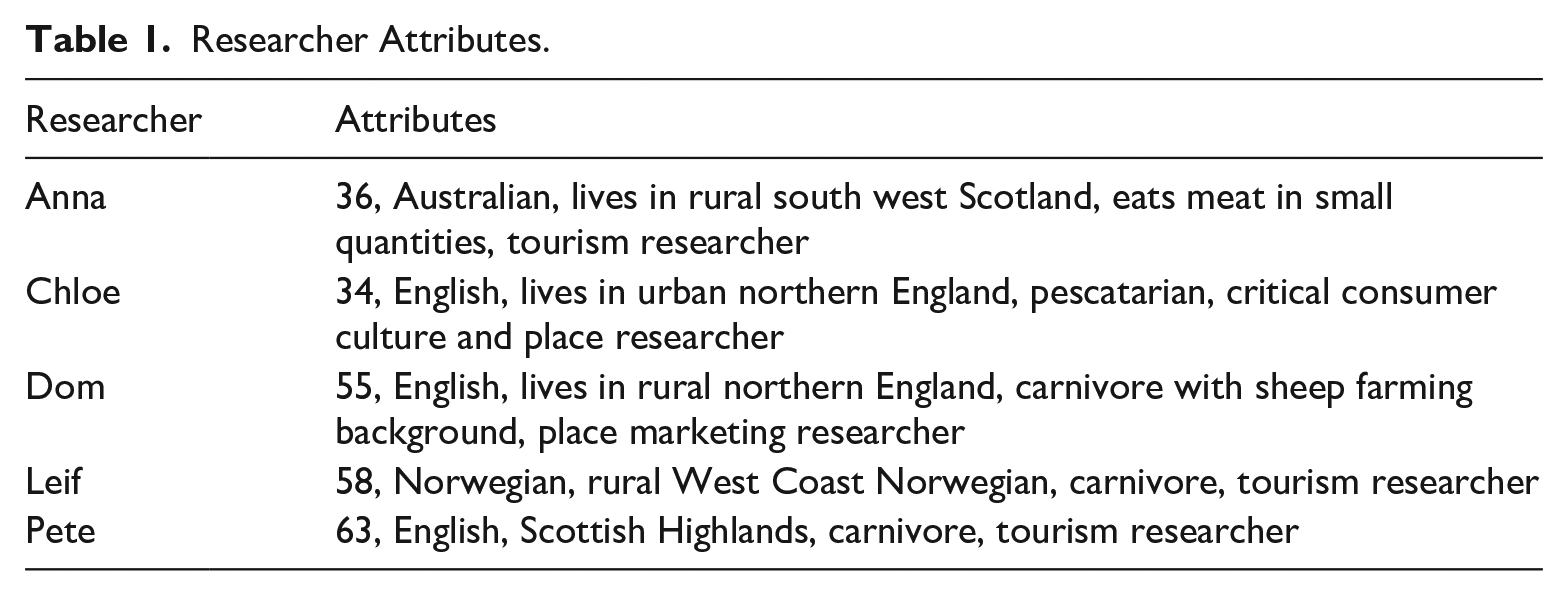
Four UK-based researchers, guided by one Norwegian-based academic (Table 1), engaged in participant observation at the smalahove farm to encounter the smalahove dish. We spent the day at the farm, where we witnessed the production process through a guided tour and visited the onsite shop, before four of the five were served the dish in the farmhouse. One of the UK-based researchers identifies as a non-meat eater and so was instead served traditional smalahove accompaniments of swede and potatoes. As we visited the farm in February, outside of the traditional smalahove season (December), we encountered no other visitors during our time at the farm.
Researcher Attributes.
We did not meet any living Dalasu during our visit. We were able to view what we presumed to be Dalasu sheep in the fields surrounding the farm; however, more proximate human/live Dalasu encounters did not unfold. The Dalasu was not granted the opportunity to look back at us (Haraway, 2013), and as a result, became constructed as an object through the farm tour performance. A construction that we attempted to rethink; albeit not always successfully. Moreover, animal welfare discourses did not feature as part of the tour narrative. Dialogue largely remained on nationalistic and heritage discourses relating to the preparation and consumption of the smalahove dish.
To capture the messiness and complexities of experience, we sought a methodological approach that facilitated space for difference in how we thought, sensed and felt the farm encounters. Each of the UK-based researchers took fieldnotes, photographs and videos, capturing our discursive, sensorial and affective responses, as well as the more-than-human materials constitutive of the encounters (including, e.g. the sheep, farm dogs, machinery, puddles of rainwater, smoking firewood, weather, culinary tools, etc.). The above data was assembled in the months following the experience and analysed using Braun and Clarke’s (2022) six phases of coding and theme development. Through the analysis, ideas relating to how smalahove both becomes ‘food’, and more-than-food through the production and consumption process unfolded (Pernecky, 2023c), which we present in this paper through three themes: ‘(un)finished processes’, ‘(un)tidy spaces’ and ‘an (in)edible animal?’.
Critical reflexivity was helpful in making sense of our research materials, as we engaged with both the (in)consistencies and paradoxes that unfolded through the research process. Critical reflexivity, for us, attempts to question the process through which research is produced. A single authoritative voice that seeks linearity is abandoned, as the researcher(s) seek to thickly describe the complex, ambiguous, messy nature of the research process. We are alert to critical feminist materialist critiques that caution reflexivity. Barad (2007) warns, for example, that reflexivity often fixes what is object, and what is subject, in advance. Such fixings tend to reproduce what we already know about ourselves, contrasting this knowledge to the object under investigation. Critical feminist materialists remind us that researchers are not outside observers; they are entangled in the world and play a role in the way things come together. Receptive to these concerns, whilst simultaneously finding continued value in critical reflexivity, we approached reflexivity as a process that helped us to understand the narrative of ourselves through engagement with our expectations, doubts, paradoxes (in)consistencies, what we did (and did not do) and our relations and connections.
Two of the four UK-based researchers are critical tourism academics who have previously undertaken research on tourist food consumption, with a focus on the moralised constructions of food in tourism settings. Through this work, they recognise the absence of consideration of animals within this space, and the centring of human experience. The remaining two UK-based researchers are engaged with critical approaches to place marketing and consumer culture, with interests in the more-than-human multisensory influences on consumption practice. Subsequently, they were especially attuned to the sensorial aspects of the experience. Our Norwegian-based academic guide is also a tourism researcher with a focus on cultural heritage and events within the Norwegian context, and as such had a close understanding and connection to smalahove history, tradition, production and consumption before fieldwork commencement. The five researchers each possess unique relations with tourism and the role of animals for food. Whilst Table 1 attempts to ‘capture’ the attributes of the researchers, these relations proved unstable because of the everyday encounters that took place between fieldwork and manuscript production. Anna, for example, began this research living in a highly urbanised area of Surrey, in her early 30s and now finds herself in her mid-30s in the meat producing region of south west Scotland. These changes, along with the changes experienced by the other researchers, influenced the research process, in ways that were both known and unknown.
Findings and discussion
(Un)finished processes
Crucial to the farm’s attraction for tourists is the ability to experience the process through which the Dalasau sheep head becomes smalahove. Upon arrival, we were met by the farm owner, who was stood over a fire pit, holding a long wooden spike with a sheep’s head placed on the end to burn the wool from the head in the flames of the fire (Figure 1). As we stood around the fire pit, we attempted to make sense of the encounter. The functional, utilitarian materialities of the agricultural setting and actions of the proud Norwegian farm guide came together to facilitate what we perceived as a celebratory expression of traditional Norwegian heritage:
There are vague themes I’m gleaning from his running commentary – references to tradition, culture, history. And this is all being delivered with a real sense of pride it seems. This man. . . seems puffed up about what he is doing – back straight, firm and expansive hand gestures, an authoritative tone.
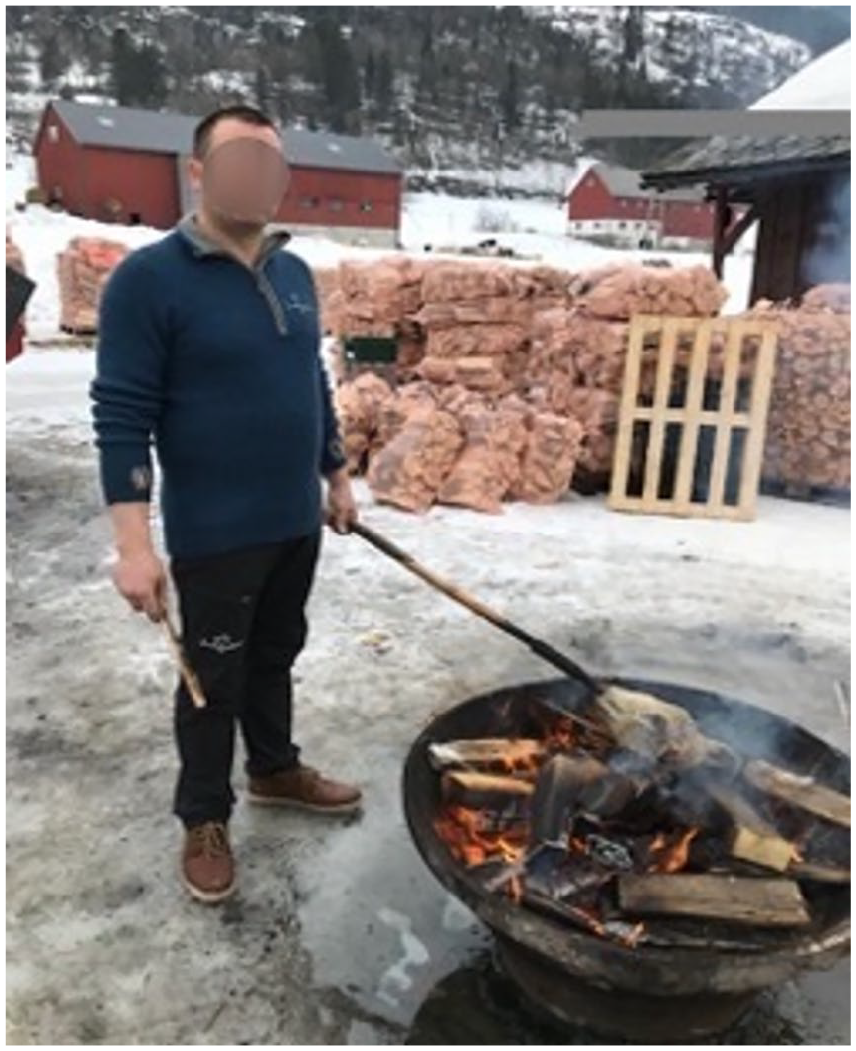
Smalahove farm owner.
The slaughter and butchery had taken place in advance, leaving us with only the part of the animal that was to become food – in this case, the head. Indeed, as Waverley (2023: 8) observes, animals are typically considered ‘. . .mere organs for human consumption, often literally’. This is commonplace in food tourism settings; as noted by Yudina and Fennell (2013: 61) ‘when we handle dead animals to make their flesh consumable to us, we most often do not experience the “whole” animal. . . The animal has already been dismembered – we interact with “parts”’. Adams (1990) refers to the omission of animal death from the consumption of meat as the ‘absent referent’. Behind every meal of meat there is an absence; that is the death of an animal. Adams reflects that this absent referent functions to veil the violence inherent in the eating of animals, protecting the conscience of the eater and ensuring that the idea of an animal as an individual becomes immaterial. The omission of the slaughter and the fragmentation of the Dalasu into parts, where here only the head is present, further facilitates this objectification – or presentation of animals as ‘organs without bodies’ (Waverley, 2023: 8).
The farm owner’s narrative focused on the dish of smalahove, and its preparation and positioning within Norwegian society. Omitted through this narrative was the Dalasau – whereby the sheep’s needs and experiences in creating this traditional dish were not included. In omitting encounters with the Dalasu, as well as insights relating to the sheep’s lived experience, ensured that the welfare practices at the farm remained absent. We did not learn how the sheep’s welfare needs are met, nor the conditions in which the sheep lived. The Dalasu’s lived experience is also absent from the farm’s website, which likewise remains focused on positioning smalahove in humanistic terms, as a traditional dish prepared on a historic site. That we did not meet the Dalasu before death, nor witness its slaughter or butchery, further aids its moral abandonment. And yet, despite the carefully staged omission of the death of the Dalasau, and its lived experience on the farm, some of us found it difficult to separate the sheep’s head before us, with that of sheep as once sentient being:
I glance to my left and see sheep grazing in the snowy fields. . .which is making me feel a bit sad. What a contrast to what is going on in front of me. I hope they don’t know that this will soon be their fate. . .
Boundaries between sheep and human become questioned here, as care is extended to that of the living Dalasau and their connection to the burning head before us, causing uncomfortable reflection, for Chloe, on the human practice of animal consumption.
Whilst these processes were presented as traditional, they are far from static. The constructed and processual aspect of the preparation became evident as we were told that, due to its inefficiencies, the fire pit is now a historical process of production. Rather, as we were next shown, a bespoke mechanised device (Figure 2) is now used, specifically for the preparation of smalahove:
It’s built by a local engineer apparently; this information is imparted as if this injects some kind of additional provenance into the foodstuff the machine is designed to produce.
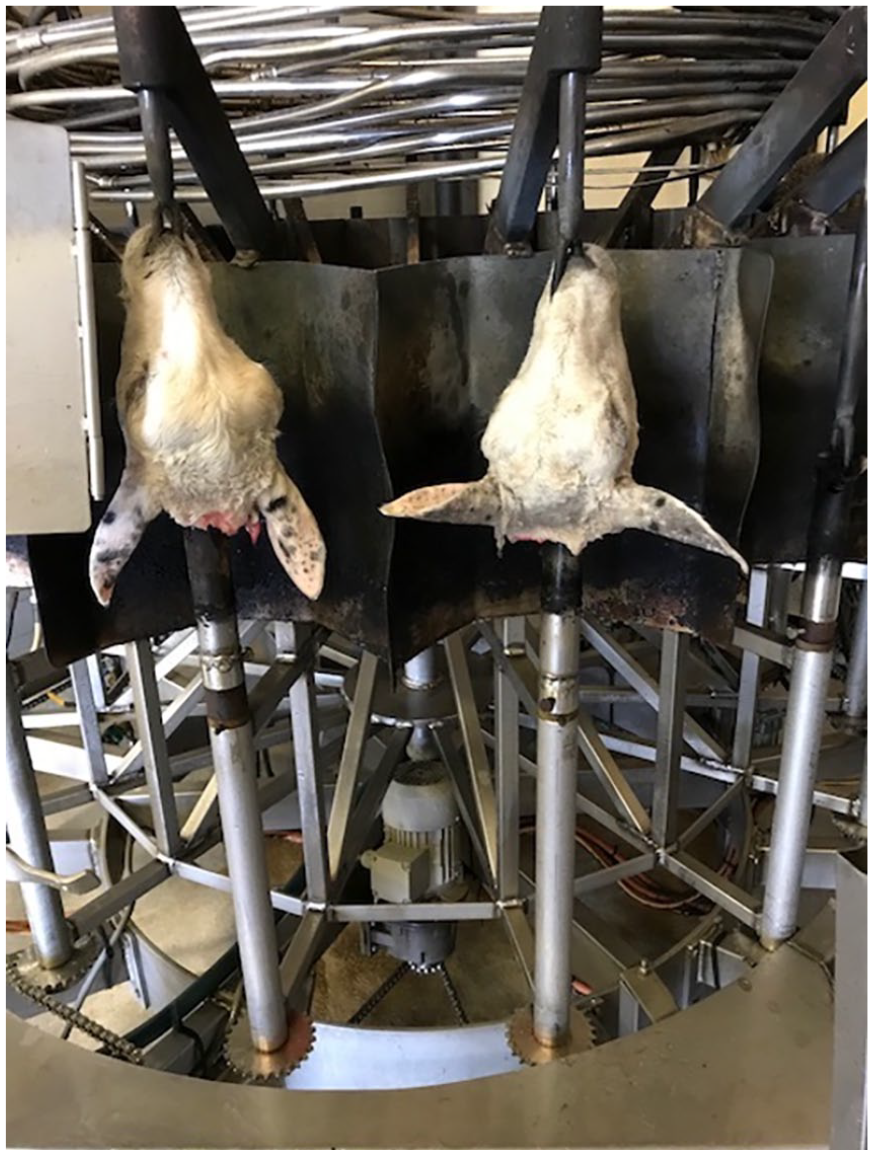
Machine utilised in preparation of smalahove.
The equipment used to prepare smalahove have co-evolved, as cultural and material manifestations of local practices and traditions, shifting and adapting with increased demand for the dish and aligning with technological advances. Its preparation has long required several steps in its processing, to ensure the meat remains edible throughout the winter. Whilst there are some variations across traditional smalahove recipes, we were shown four separate stages during the tour: burning, brining, smoking and boiling. This conflicted with our perceptions of the cooking processes required to transform meat into edible food within the space of the domestic kitchen. The effect of multiple, mechanised production stages raised reflections for us concerning the treatment of animals and the extent to which we value them in death:
I was conflicted. . .I felt this intimate process, working with an often-discarded part of an animal. . .gives a sense of respect and honour. . . .at the same time, this tradition, this process, is uncomfortably ritualistic – a performance that takes pleasure in the countless forms of burning, searing, smoking and boiling of a part of the sheep we most relate to – its face.
Tensions between care and violence therefore arose during the early stages of the tour, as we reflected on the unequal power relations at play, as enabled through insight into the unfinished processes of smalahove production within this touristic context. Such tensions are representative of the broader positioning of humans and animals within our food systems, whereby despite the central role of the sheep’s head in shaping this tourism assemblage, here it has clearly become an object of human appreciation (Valtonen et al., 2020). For all of us, however, this objectification was fragile as the encounter provoked varying degrees of reflection on what it means to prepare an animal for consumption and how this might change through things like environmental conditions, traditional practice and nostalgic heritage.
Chloe, as a pescatarian tourist, felt a mixture of both grief and optimism: ‘I hope they [the Dalasau sheep] don’t know that this will soon be their fate. . .’ In this sense, anthropomorphic care is extended to the Dalasau, unsettling the normally accepted power relations between sheep and human. Posthumanist inquiry has been cautious of anthropomorphic tendencies that are dependent on humanist ways of knowing and has rather sought other ways of speaking about animals (Holmberg, 2022). Rather than rejecting anthropomorphism entirely, we draw on Hurst’s (2023) notion of cautious anthropomorphism to make sense of the ways we anthropomorphised animals during our visit. For Hurst’s, cautious anthropomorphism offers a tool for recognising connection across human and animal difference. Remaining alert to its limitations, anthropomorphism has potential to complicate human-nonhuman binaries, to reveal and make sense of (dis)connections within more-than-human encounters.
Returning though to our initial point, it is important to note what Chloe is hopeful for – that the Dalasau do not know their fate, rather than an expectation that these sheep might not be killed at all. Such a distinction further emphasises the subordinate positioning of sheep within contemporary human-animal relations and the challenges in transgressing such relationships (Waverley, 2023). Even for Chloe, as a pescatarian, the requirement and inevitability of ovine slaughter remains unquestioned within this setting. Chloe’s position is perhaps not surprising when we consider the setting of this touristic encounter – a farm which is commercially dependent on the normalisation of death and commodification of the Dalasau’s meat, and is just one of 14,000 sheep farms in Norway alone (Norilia, 2022). It therefore becomes difficult to reimagine a world that does not conceive of sheep as food. As Garcia (2019: 357) confesses in detailing her own experiences of grief, having witnessed the death of a pregnant female guinea pig on a guinea pig farm in Peru, ‘the simple act of mentioning this multispecies [human/guinea pig] connection as [a] possibility. . .is often seen as transgressive and inappropriate’. Garcia further shares that to publicly voice her position on the killing itself was not only too much of a transgression, but it was also considered irrational and unintelligible, given the many forces that inhibit our abilities to challenge the killing of animals for food. Kline (2018) similarly reflects on how tourism settings further reinforce the power relations between humans and animals through routine, yet celebrated practices such as the eating of animals, and within this system, efforts to attribute ethical consideration to animals can be resisted by ‘societal forces belittling those who are overly sentimental towards them’ (Winter, 2020: 215).
Insights into the unfinished processes of smalahove production highlight two valuable, yet somewhat conflicting points. First, the unfinished processes of smalahove production provide opportunities to explore the messy encounters that unfold between humans and animals that are not straightforwardly interpreted as ethical, or not. Whilst insights into the Dalasu’s lived experience, as well as its death, were not part of the tour – the Dalasu’s spirit is revenant within the tour assemblage; emanating, partly, through the distant presence of sheep in the surrounding fields, alongside the evocative performance of the dismembered Dalasu head. Through such referents, complex, and paradoxical, reflections of care, pride, nostalgia, violence, grief and optimism are simultaneously experienced that highlight both the comfort and discomfort felt towards our use of the Dalasu for food.
Central to the argument in this paper, however, is that whilst discomfort was felt in some capacity by all of the UK-based researchers in this setting, the dominant forces attached to our normative food production processes produced impossibilities in us directly questioning animal death itself, and considerations of the Dalasu as more-than-food. This was so even by those most affected by the experience (e.g. Chloe). Ensuring concern remained with the welfare of the Dalasau through the food production process rather than its slaughter for human consumption; ultimately upholding the commodified use of the Dalasu for human consumption. Our inabilities to disentangle the Dalasau death within this setting points to the prevailing ubiquity and relational power imbalances in the use of animals for food, and the material and social forces that uphold such practices, even despite the immense growth in alternative eating practices emergent in Northern Europe in recent years – such as vegetarianism, veganism and plant-based diets (Milfont et al., 2021).
(Un)tidy spaces
British expectations relating to standardisation and hygiene practices that sustain narrow assumptions concerning the material conditions in which our food is produced and offered for consumption were strongly felt. Viewing the processes influenced our abilities to conceive of the smalahove as food (Sexton, 2018). Such expectations came to the fore for some of us as we entered the main smalahove production building:
I screw my face up in disgust as I immediately spot a plastic box on the floor to my left which contains two sheep heads bathing in bloody water. This startles me (Figure 3).
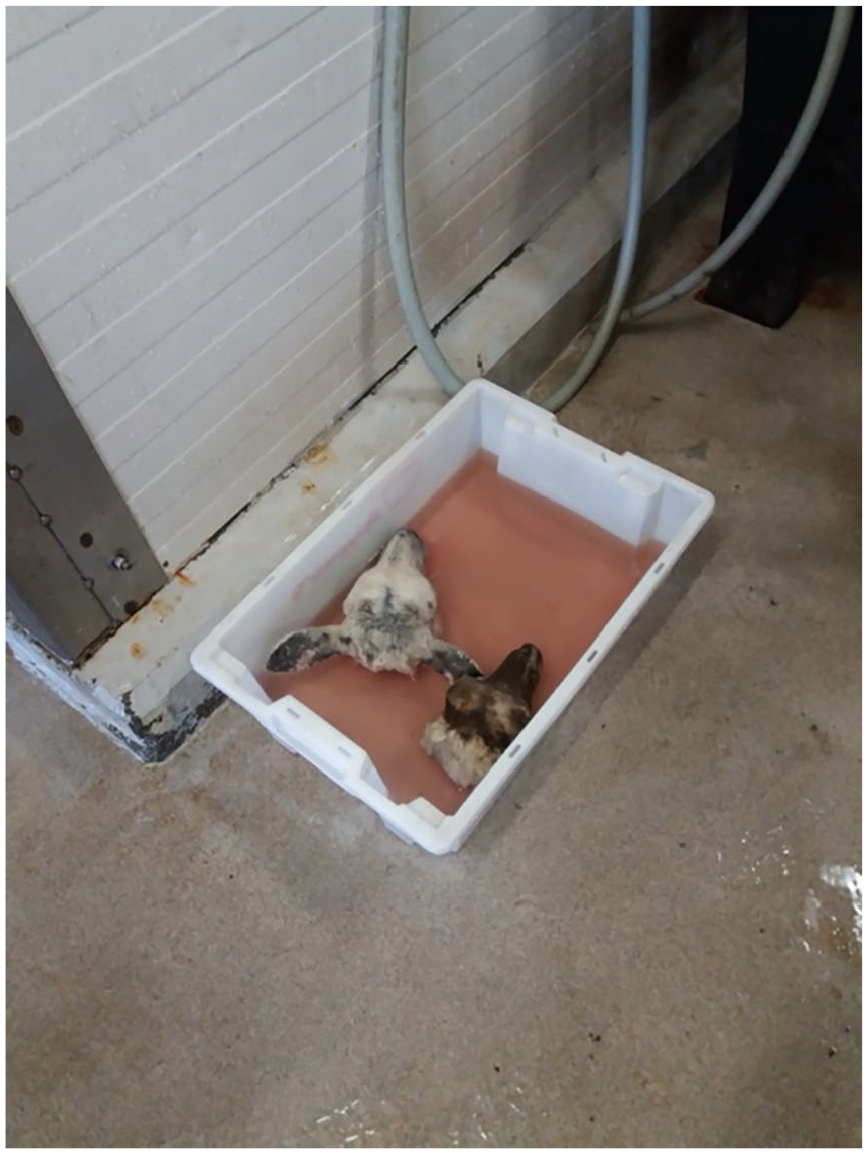
Sheep’s heads in pool of bloody water.
The smell of sheep’s heads, likewise, produced challenges that forced some to shift bodily practices and engagement with the processes occurring within this space, highlighting how the non-human world possesses agency over the human experience. Smell has historically been considered a ‘lower-order’ sense to be sanitised by shielding humans from ‘unpleasant’ smells (Canniford and Bradshaw, 2018; Korsmeyer and Sutton, 2011). Smell as a ‘potent elicitor of memory and emotion’ (Canniford and Bradshaw, 2018: 238) can evoke strong emotional reactions between people and (tourism) settings. Whilst familiar smells can elicit feelings of home and safety, unfamiliar smells–such as raw animal flesh – can be met with some trepidation (French and McLean, 2024), as can be seen in Anna’s attempts to escape such uncomfortable ‘olfactory atmospheres’:
Walking into the main production building I was met with the smell of watery, raw meat. I kept my breath shallow and held behind the others to distance myself from the process.
Boxes of raw heads, and smells of watery blood and meat, all produced perceptions of ‘matter out of place’ (Douglas, 1966: 44), whereby the untidy material realities of food production (blood, burning, etc.) served as evocative sensory reminders of the Dalasau’s life. This conflicted with ideas of sterility and hygiene that Chloe and Anna are more used to encountering within the context of food.
For all of us though, the assemblage of smells and sights of blood and raw flesh contrasted strongly with that of the final stages of the tour, where we were brought into the smokehouse and next the onsite farm shop. Within the smokehouse a stronger separation with smalahove as a once sentient being was felt. The familiarity of the smoky smell, and the effect the smoking process had in changing the colour and texture of meat and skin, produced a sense of ease and comfort (French and McLean, 2024). It appeared to reposition the sheep’s head as something closer to our own perceptions of animal meat as food (Figure 4):
If the brine tubs full of heads had a slightly macabre aspect, the smokehouse and smoked heads did not.
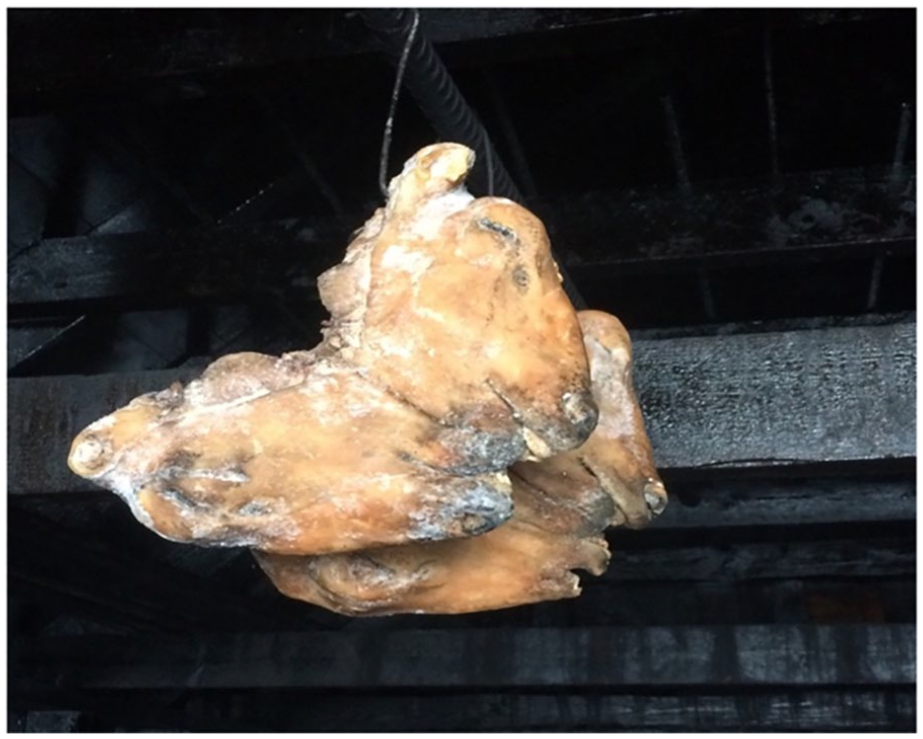
Smoked sheep’s head hanging in the smoking shed.
Touristic engagement with food production in this way allows insights into the social and material process an animal goes through to be considered accepted as food for humans. Our acceptance of an animal’s head as meat once it had been smoked highlights how our tastes are foregrounded by our complex relations with the world. Here it is the material and multi-sensory affordances that surrounded us (specifically, the sights and smells smoking of meat over smouldering firewood) that elicited embodied memories of smoked foods previously encountered (Canniford and Bradshaw, 2018). Such processes are culturally informed, defining a normative ethics of acceptability by connecting to our past experiences of affective comforts in the form of smell, taste and texture. Without such social and material processes any animal remains, arguably, an unethical (or at least, questionable) form of consumption (Probyn, 2011). As we entered the farm shop, further distinctions were felt between Dalasau and meat:
As I scan the room, I can see various fridges containing pieces of meat in various forms that people in England would usually be used to seeing dead animals in – bacon-looking pieces and pink steaks, etc. . .the group handles some plastic packaged pieces of meat from one of the fridges.
Following Serres (2007: 145) ‘purifying one’s space is an act of welcoming’ – a notion dominating conceptions of food production and consumption in many locations, influenced by pressures of globalised food safety standards (Sexton, 2018). Subsequently, the olfactory, auditory, tactile, visual and tasteful sensations we align with food are often narrowly defined and associated with notions of tidiness, hygiene and standardisation (Korsmeyer and Sutton, 2011). Indeed, such ‘purifications’ demanded by food preparation and processing regulations serve to de-nature food from the untidy encounters of blood and guts, and from the notion of meat as once sentient being. For example, the vacuum packaging encountered sealed in smells and liquids, prevented contamination and leakage and reduced visual and olfactory engagement. The sterility of this food production environment echoes recent research on ‘non-places’ in tourism (Varley et al., 2020), which explores how sanitised efficiency has become expected as a form of safety and comfort within spaces of tourism, such as airports. At the farm, like many other Western food consumption settings, the material evidence of animal parts, wastes or tissues is typically sequestered (Canniford and Bradshaw, 2018), where the realities of animal life and death were absent from the polished sterility of commercial stainless-steel fridges, tiled floors and bright strip lighting.
The distinction made between the sheep’s head before the smoking shed and farm shop, and smalahove as (potentially) food afterwards, highlights how narrow, prescriptive and spatially informed our expectations are. Recognising the power of materials and social forces in positioning food in certain ways is an important consideration for food tourism researchers, who in prioritising investigation into the tourist experience have tended to conceptualise what we choose to consume during travel as largely an individual choice, that is pre-conceived before travel (cf. Everett, 2016; Robinson et al., 2018). Failing to account for broader socio-material forces in relation to how things become food in tourism contexts ensures this field never fully grasps why certain animals become touristic attractions, and others do not; as well as perhaps – more significantly – why certain forms of animal consumption come to be considered acceptable, and others intolerable.
An (in)edible animal?
At the farm, material and sensory cues indicated when the sheep head was ready for consumption. We were led into a warm wooden outhouse, that contrasted strongly with the cold winter air outside. The space was filled with artefacts that celebrated the farming of animals; old tools, stuffed and mounted animal heads, reindeer skins and depictions of livestock on cutlery and glasses, which enticed evocations of an idyllic and traditional rural agricultural Norwegian space (Figure 5):
A small wooden cabin containing benches, tables, silver cutlery in the form of sheep heads, and shot glasses. . . I guess this is where we are going to be eating?
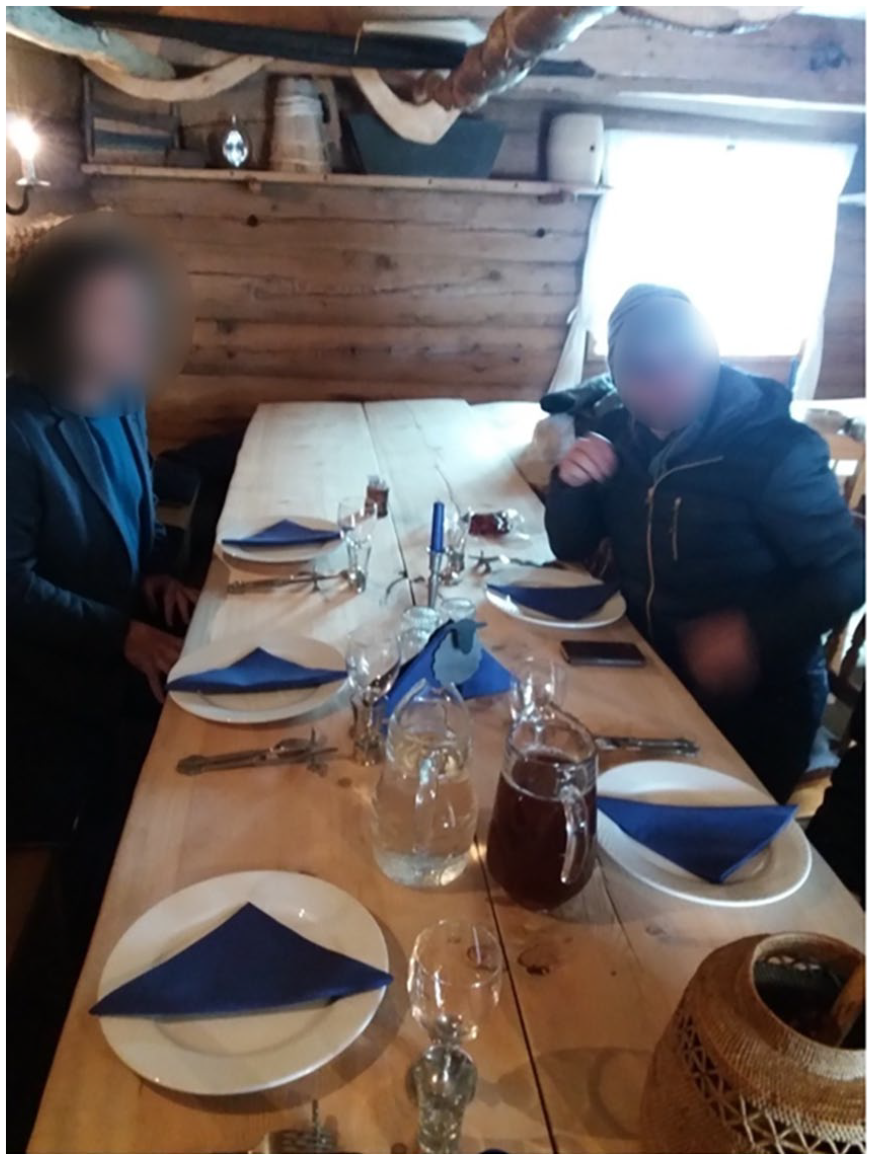
Wooden outhouse at the smalahove farm.
The materialities of the dining room worked to stage the space as intimate, cosy, clean-yet-rustic – with the animal and farming motifs, alongside the familiar cues that marked this area as a restaurant (tables, chairs, plates, cutlery), enhancing our ability to imagine smalahove as food. These materialities not only celebrated the role of animals in food production, but also reflected the dominance of humans within that process. Here, smalahove was presented as a totemic and practical form of cultural food heritage, prepared meticulously by a skilled farmer. This setting points to the paradox of killing animals for food, particularly within the context of touristic consumption, whereby animals are celebrated, whilst at the same time killed (Cohen, 2014). Despite this paradox, there was a sense of familiarity in this setting, that led some of us to form links between smalahove and our role in the production of other animals as edible in more routine settings:
I focused on inhaling the smokiness of the meat before me. Gently, slowly dissecting a small piece of meat from the fleshiest part of the cheek. Tentatively taking my first taste. It was fine. Slightly slimy, rather than dry, I tried my best to make connections to other forms of meat, regularly consumed.
Non-human interventions worked to provoke reflection on what has come before, reducing distinctions between the extraordinary and everyday, and repositioning smalahove as something not too dissimilar to everyday experiences of meat-as-food (for those of us who eat meat). This conception of the sheep head as nourishment held relatively steady as four of us slowly began to eat the smalahove dish. It was, however, soon tested as the presence of certain unfamiliar materialities and sensations offered stark reminders of the dish’s animal origins:
For some reason, the problems start as I begin to navigate the skull, inner mouth, try to get beneath its face to some of the soft, smoky meat beneath. This feels more like surgery, and takes me back outside to the ritual burning and scraping and amber liquids. The departed sheep’s teeth occasionally grin back during my prodding and cutting. Keep going. . . .But soon enough, it seemed, my head suggested to my stomach I’d had enough, and I had a moments’ quease.
As Kuruoğlu and Woodward (2021: 13) proport ‘as much as human actors extend themselves into spaces and objects, trying to make them take their shape; the spaces also push back onto humans and can mould them to behave and consume in certain ways if actors and objects that are “out of place” are flushed out by affects of discomfort. . .’. The unfamiliar material evidence of an animal’s face was jarring for those of us unfamiliar with consuming meat in this way. In particular, sheep’s eyes, tongues, jaws and teeth were emotive presences, disturbingly linked to ideas of a being’s sentience. This process of smalahove consumption opens opportunity for reflection because it reveals the production of animal meat beyond those boundaries we are normally familiar with and the typical and expected separation of inanimate ‘lamb’ meat from living sheep that many meat-eating British-based consumers would be used to. Here the presence of the face animates the sheep, rendering it personal; the presence of the face was a material presence that forced us to recognise what it was before – specifically, more-than-meat, and once a living sheep.
This encounter also highlighted the boundaries of our eating behaviours, and how these are dependent on material separations between animal and meat, and food consumption and production. Accordingly, the requirement to open the sheep’s mouth to get at the meat became an intimate and, for some, unsettling process. Such encounters move the eating of smalahove beyond conventional understandings of consuming food, (re)producing and transgressing boundaries that inhibit the acceptance of this dish as something to be enjoyed. Here, the presence of the face, and the need to excavate it, brought to question how our eating practices are culturally informed, and how such cultural constructions produce boundaries between nature and culture, and animal and food. In many everyday UK contexts, modern industrial food processes are a means of forgetting the animal, as bones and organs are habitually removed. This removal enacts a mediation between food and animal, as well as nature and culture, facilitating the edibility of animals (Lévi-Strauss, 1975). Encountering smalahove, the presence of bones and organs, and the viscerally challenging need to dismember the sheep’s face in order to get at the meat, provokes the perception that the smalahove remains ‘uncooked’, and as such not quite yet socialised. In other places, or for other folk, that same removal, or avoidance of excavation, may not be required for edibility. Our Norwegian guide Luke, for example, held no such hesitancies towards consuming smalahove. For Luka, this dish was consumed quickly and entirely, without hesitation and with nostalgic appreciation. Contrasting our smalahove encounter with everyday practice and with the practices of other folk with other histories thus assists in identifying where our boundaries lie in enabling and inhabiting what becomes food.
As with Edensor and Falconer’s (2015) participants who experienced challenges eating in the dark as part of an experimental dining experience at the Dans Le Noir? restaurant, the unfamiliar materialities present in this encounter stimulated reflection on our usually unreflective habits of eating and how the ability for us to conceive of animals as food is informed through narrowly defined ways of sensing the world:
I wonder if it’s just a presentational thing. . .if these little snippets of succulent salty and smoked head meat were placed into a ramekin with clarified butter and served with a gooseberry and onion salsa. . .it might all seem very different.
This idea of meat’s edibility being dependent on disconnection from the live animal form and skeletal structures – particularly the bones of the head – became more prominent as we were presented with a tray of lamb chops and sausages, following the removal of our still half-full plates of smalahove:
. . .The farmer comes back in with a massive silver tray filled with an assortment of meats, including sausages and lamb chops, seeming proud. The group seem excited by this.
The lack of concern from three of the UK-based meat eaters in eating sheep in this more familiar form highlights the sheep’s positionality (in British society, at least), where whilst domesticated, the sheep remains an animal of utility. This positionality inhibited the ability of the carnivores in the group to place the rights of the Dalasau at the centre of our considerations when the animal is presented to us in a familiar form, separated from its animal origins by human processes.
It is these slippages between the familiar and unfamiliar that interweave to prompt important reflections regarding animal ethics. Sheep is the fourth most consumed animal internationally (USDA, 2021), meaning the idea of consuming lamb or mutton was somewhat familiar to the three UK-based (carnivore) tourists and very familiar to the Norwegian researcher. For those of us who normally eat meat, the consumption of sheep was not necessarily the source of questioning in this touristic setting. Rather, we were confronted by expectations set by our own normative, familiar practices concerning which parts of this animal are usually eaten and how sheep is often served in ways separated from its presence as a once living being. The presence of the sheep’s head forced us to consider what was before us as a once living being, and our reliance on food production processes that enable us to eat sheep unreflexively. Such confrontations emerging throughout the food tourism encounter inhibited the ability of smalahove to be considered fully edible (in contrast to the sausages and lamb chops).
Within the UK, it is uncommon to use the meat of a sheep’s head as a cut and thus the presence of the head at the dining table was unfamiliar and unsettling. Indeed, the serving of sheep heads has become part of the (international) tourists’ experience at the smalahove farm because it is perceived as out of kilter with many contexts beyond traditional Norwegian cuisine (Gyimóthy and Mykletun, 2009). At the same time, the smalahove dish has come to symbolise Norwegian pride and heritage. Without these contrasts in human-animal relations, and between western Norway and other cultural contexts, smalahove might not have become a touristic attraction. Such contrasts align with Robinson’s (2001: 40) contention that, ‘what tourists seem to feed from is the apprehension of conflict and emotional response brought about by the tangible recognition of difference’.
It is these very contrasts that highlight why this, and possibly other, food tourism settings present useful spaces through which to untangle our ethical relations with the animals we eat. Unfamiliar settings whereby animals are served in ways that rupture normative consumption practices for the tourist often provoke challenging reflections that remind us of the messy and unequal relationships that prevail between humans and non-human animals. The unfamiliar though, will not always unsettle. In other tourism settings and entanglements, the unfamiliar may just as easily elicit desire and greed. What might unfold in such settings is always undetermined and multiple. We thus call on other food tourism researchers to further engage with more-than-human inquiry and relational ethics, to extend consideration regarding what sorts of unfamiliar food tourism encounters might prompt reflection and how this might be leveraged in food tourism ventures.
Conclusion
Having focused on the tourist experience, food tourism has given less attention to animal ethics, either in examining how food tourism businesses engage with animal ethics, or how tourists interact with animal rights issues (Everett, 2016). Recognising the need to consider the animals we eat within tourism settings, in this paper, we have engaged with a more-than-human relational ethics to not only explore how animals become food in tourism settings, but also to provoke reflection concerning how animals might be considered as more-than-food. In doing so, three considerations for tourism research were identified.
First, we argue a relational ethical framework applied in food tourism settings facilitates exploration of the complex, messy and paradoxical ways animals perform food tourism encounters, that are not easily classified as ethical or unethical, but rather present opportunity to explore the openings and closures of our relationship with animals as part of our food systems. Smalahove presented insights into the sense of care, nostalgia, violence, grief and optimism felt for the use of the Dalasau as food. At the same time, however, whilst such nuanced insights are identified, questioning and reflection can only go so far given the immense power of food production and consumption systems. Within our context, it was challenging to completely question the killing of animals for food. These insights into the limits of questioning are valuable for food tourism researchers and tourism ethics scholars, as they present opportunity to understand where fixities and boundaries lie, and how these are dependent on power relations within systems of food production and consumption.
Second, to provoke reflection, an element of unfamiliarity is advantageous, for it is this very unfamiliarity that facilitates reflection. Subsequently, food tourism settings present particularly valuable contexts through which to consider food ethics. This reflects how the very purpose of food tourism is to offer something distinct and exciting to that which is usually available as part of everyday food consumption (Edensor and Falconer, 2015). Whilst, conversely, the mundanity and distance of everyday consumption presents challenges in remaining attuned to the ethical issues at play as packaged supermarket foods largely do not resemble animals or even parts of them. Further, if food tourism settings require significant novelty in order to be attractive to visitors, then this may potentially favour and reinforce forms of food production and consumption that push the limits of ethical acceptability. This raises further ethical challenges for the tourism industry and tourists.
Third, attuning to the social and material processes required to make things food is crucial if we are to move beyond the prioritisation of human intentionality within food tourism research. Focus on human intentionality alone inhibits opportunity for engagement with food production and consumption, thereby closing opportunities to understand the role of things like packaging, cutlery, tables, chairs and processes like smoking, boiling and burning in making animals into food.
In highlighting the above three areas, we propose that future food tourism research continues to shift focus beyond the tourist experience – provoking exploration of the ethical dimensions of our use of animals in food tourism settings. In so doing, we hope future work overcomes the limitations of the methodological approach we have implemented. Whilst valuable in gaining nuanced insights into the social, multi-sensory and material dimensions of our smalahove encounter, there is potential to build on our single case study and multi-author participant observations by incorporating insights from the animals’ lifeworld, as well as a broader range of visitors and tourism management, to further examine the ethical dimensions of food tourism.
We are aware that through this research we have relied on Western more-than-human thinkers; this is somewhat ironic given that it is Western thought that initially produced hierarchical dualistic thinking. If we are to meaningfully relate to animals in different ways, then we need to engage more meaningfully with knowledges that already do consider humans and animals relationally, rather than consistently turning to Western ways of knowing. For this reason, we further suggest that future research turn to non-Eurocentric knowledges that share important, spiritually informed insights about animal lifeworlds.
Finally, we encourage practitioners to consider what would happen if focus was shifted in food tourism settings from that of the tourist experience and the construction of hedonistic encounters, to greater engagement with the life of the animal itself and the relational place of animals in the world. Such engagement might involve facilitating farm visits where the tourist can stay longer and meet the animals they might eat. It could also involve meaningful involvement in the production process itself; possibly even making visible the slaughter and butchery process. Unveiling what remains invisible in making animals food, and facilitating encounters in which humans and animals meet, might work towards recognising the individuality and lived experience of those animals.
Whilst some may argue this is idealistic – and such an approach is uncommon in most food tourism encounters – there are examples of food tourism offering a reflexive opportunity to engage with and relate to animals in different ways. In this regard, we highlight the work of Wright et al. (2009) and their account of an Indigenous-owned tourism enterprise in Australia’s Northern Territory. Here, the experiences offered invite visitors to question Eurocentric assumptions relating to the separation between humans and animals. Indeed, tourism has long been considered as offering opportunity for reflective practice (cf. Long, 2004; Parasecoli, 2011). There is likewise scope within food tourism settings for providers and consumers to move beyond mere food consumption and additionally engage with those human and non-human agents and their underpinning relationships.
Footnotes
Declaration of conflicting interests
The author(s) declared no potential conflicts of interest with respect to the research, authorship, and/or publication of this article.
Funding
The author(s) received no financial support for the research, authorship, and/or publication of this article.
