



Abstract
Several destinations have jumped on the TikTok bandwagon to explore consumer reactions and motivations towards visit intentions, though these are largely limited to point-in-time surveys. Using the example of Penang, Malaysia, this research contributes to the paucity of knowledge surrounding TikTok in tourism by analysing contents generated from the destination management organisation, travel influencers, and other tourists participating in a TikTok competition for the destination. Drawing from Burke’s Pentadic analysis, the findings reveal the sociological interactions where the performativity of the short videos are staged by different users with the destination as the backdrop. Theoretical and managerial implications are highlighted to inform current and future practices of TikTok (re)presentation in tourism, and how the platform can be used distinctively to socially interact with various target markets and stakeholders.
The purpose of this research is to explore TikTok marketing through the lens of Penang, Malaysia – a popular tourist destination. TikTok (https://www.tiktok.com/en/) is arguably one of the fastest-growing social media sites in the world (Sangra, 2019). The TikTok landscape has exploded over the COVID-19 pandemic, where virtual tourism and other forms of user-generated content have been utilised to engage with global audiences to keep destinations at the top of mind among its existing and potential markets (Fan and Lin, 2022). Tourists on social media platforms can be overwhelmed by a range of tourism content on TikTok, and other sites such as Instagram and Facebook. While several studies have focused on Instagram to investigate its effect on destination marketing and tourist perceptions, TikTok remains under-investigated (Cheng et al., 2023). Despite destinations such as Estonia generating more than 60,000 followers on TikTok engaging in their digital engagement and marketing efforts (Simpleview, 2021). Other destinations are also investing heavily in the TikTok platform, given its ability to stimulate visitor awareness and interest on the back of micro-videos (Borko and Habtemariam, 2023). More importantly, the sources of these videos are almost exclusively external to destination marketing/management organisations (Lee et al., 2023). Yet, these ‘influencers’ wield strong abilities to shape and direct positive attitudes to destinations (Zhou et al., 2023). Evidently, the TikTok phenomenon can no longer be ignored.
The contributions to tourism literature are therefore in elucidating more theoretical insights on this fast-growing social media phenomenon, as well as informing destinations of how to realise desired marketing objectives. Correspondingly, the research questions of interest are:
How do Penang’s DMO and destination influencers (re)present and perform Penang’s destination image via TikTok?
What are the implications of such similarities and differences in their social media performances?
Otherwise known as Douyin in China, the company was formed in December 2016, but according to Iqbal (2022), TikTok is estimated to have 1.2 billion monthly active users, with revenues close to US$4.6 billion. In brief, TikTok is a micro-video mobile application platform where one can personalise short videos, each lasting anywhere between 15 seconds and 10 minutes. As such, it has been seized upon by organisations wishing to promote tourism-oriented marketing discourses through business-to-consumer (B2C) and consumer-to-consumer (C2C) modes of messaging, using hashtags such as #ThisisJapan to anchor these discourses to a specific destination (Ruiz-Scarfuto et al., 2020; Wang and Feng, 2023). Whilst there is a burgeoning body of literature related to social media in tourism, studies on the use of TikTok in tourism remain embryonic (Bian and Zhu, 2020; Wengel et al., 2022). Amidst this backdrop, several destinations have already adopted TikTok as a tool for tourism marketing, though their returns on investment are largely implicit (Amelia and Hidayatullah, 2020; Li et al., 2020). This dearth of knowledge is the justification for undertaking this research.
Literature review
Mediatisation of tourism
Tourism has been an industry where its importance has been located traditionally within the broader auspices of economic, social, and environmental impacts and sustainability. Yet, increasing attention is being paid to the mediatisation of tourism, largely because it is highly experiential (van Nuenen and Scarles, 2021). In other words, tourism does not always result in the physical exchange of products or commodities but are instead interacting in the realms of service quality, and memorability. For this reason, destinations have sought to generate their own competitive advantage through innovative media spaces, and the advent of social media has since fuelled opportunities for the co-creation and convergence of memorable experiences (Månsson, 2011). In this vein, media framing offers content creators and users a canvas to paint their own unique stories that can be shared with a global audience. Today’s world is also afforded a greater choice of media platforms, including digital and social media, such as TikTok to receive personalised information (Xu et al., 2023). These technological developments have provided destinations with a wider array of tools to tackle the potential for media-induced tourism outcomes.
Media-induced tourism
Media-induced tourism is a broad term that suggests the role of various media sources or outlets that stimulate tourism demand (Iwashita, 2006). There is an increasing body of work surrounding media-induced tourism, where different scholars have investigated media genres such as film, magazines, books, comics and television drama series, among others and their effect on tourism demand and supply (Huang, 2013). In this space, several studies have been devoted extensively to exploring media-induced tourist characteristics and motivations, and how these engagements with the destination foster heightened cognitive, affective and conative outcomes to co-produce authentic and memorable experiences (Yen and Teng, 2015). Other scholars have investigated whether media-induced tourism generates valuable multiplier effects on destinations in terms of economic, social and environmental outcomes (Peaslee, 2011). Whilst there is some overall agreement that media-induced tourism can provide financial profits in the short-term, mid- to long-term returns on investment can be difficult to track. This is because tourists who attribute their visit intentions purely to the effect of media exposure tend to be a small minority when compared to those who already possess a well-developed destination image of the country, indicating that media exposure could just be an additional reason to validate destination choice (Månsson, 2011). There are also other serendipitous media-induced tourists, who stumble upon specific contexts and make impromptu decisions such as voluntourism while on location in China (Shao et al., 2011). Hence, as different countries seek to develop and further invest in their film and media industries on a global stage, interrogating the potential of media-induced tourism becomes a necessary and timely conversation (Tzanelli, 2019).
Social media and tourism
One of the most radical transformations within the tourism landscape is the advent of social media (Asongu and Odhiambo, 2019). Before its existence, tourism marketing, information search and transactions were mostly produced linearly, with national tourism organisations working with other operators and retailers, often dictating the terms and prices in which potential tourists would then transact. Social media changed the tourism landscape by shifting the power of knowledge and content production from a B2C to a C2C environment, where platforms such as Facebook, Instagram, and YouTube now offer synchronous co-creation of information to a global, digital audience (Scott and Orlikowski, 2012). Those kinds of social media platforms have influenced consumers’ points of view in the destination image. For example, Irfan et al. (2022) asserted that social media have a significant positive effect on consumer travel intent. Moreover, Fu and Timothy (2021) found that social media have a significant effect on the affective image of destinations through emotional experience. Therefore, it is extremely likely that destinations will have a combination of social media platforms in their repertoire of digital marketing tools to engage, disseminate and attract tourists to become a destination of choice. After all, a destination’s success hinges on its ability to attract tourists, especially in a choice-proliferated marketplace (Shirazi and Som, 2011).
The popularity of social media lies in its enormous base of user-generated content that can be personalised and easily accessed. Almost anyone can search for other tourists’ experiences in a destination and vicariously engage in conversations, reviews and text or visual cues to inform personal preferences, increase one’s knowledge, or purely for hedonic purposes to connect with others (Aleti et al., 2018). For this reason, academic and industry interest in social media has been piqued to get the right balance in understanding what influences tourism choices and preferences (Hudson and Thal, 2013).
TikTok and tourism
TikTok is to YouTube what Twitter is to blogs. TikTok allow a succinct video to capture the essence of an experience to be disseminated across cyberspace. Such intentions are perhaps justified, given that individuals are likely to be flooded with large amounts of digital content in a technologically mediated landscape characterising contemporary consumer culture (McDaniel, 2021). Indeed, like other social media platforms, the ease with which users can join and begin uploading content on TikTok means that, in principle, any user can begin publishing content which contributes to creating a destination image of a given location.
As it is considered a new social media platform, studies on TikTok have only started to emerge. For instance, Bahiyah and Wang (2020) found that TikTok users were motivated to engage with the platform because of four factors – Archiving, expressing oneself, interacting with others, and escaping from the real world. In contrast, Dalelio (2020) explored how TikTok and other social media platforms facilitate the heightened priorities around the co-creating of digital identities among students in terms of synchronous communication. TikTok is also articulated as a vehicle for stimulating national ties, where diasporic communities located in different countries can connect with their family and friends back in their homeland (Yu and Sun, 2019). In this space, Chinese digital communities are well acquainted with TikTok, given that the platform originated in China (Hong and Harwit, 2020). Despite the promises and potential of TikTok, other scholars have painted a cautionary note to its meteoric rise in terms of its prominence in digital and social media landscapes. As with any other form of technologically mediated leisure, TikTok is not immune to increasing attachment to its site and fostering addictive behaviour (Zhang et al., 2019). This criticism notwithstanding, TikTok, and its tourism relationship, should be understood as a form of social action, utilising semiotic resources to present images of the destination to an imagined audience. Edensor (2000) relates how tourism has performative elements, and that mobilities are an embodiment of place imaginations, identities, and motivations. This is manifest in TikTok, where content creators (and influencers) are equipped with multiple attempts at curating a desired ‘self’ and video that is portrayed to a global, digital audience (Lee and Abidin, 2023). More importantly, these videos are accompanied by music, themes and genres that viewers can like, and share with others in a social setting (Bossen and Kottasz, 2020). The appeal of TikTok reiterates its potential for different destinations to reach out to niche segments, especially those between the ages of 18 and 30 (Li, 2019; Wang and Gao, 2019).
This age group is widely accepted as the millennial segment and is one of the fastest-growing travel markets globally (Javed et al., 2020; Kim and Park, 2020). Across various studies, millennials tend to be highly technologically engaged and are also more likely to pursue experiences as compared to large ticket expenditure items such as home ownership (Bernardi, 2018; Han and Chen, 2022; Liu et al., 2019). Related to TikTok, millennials form more than 40% of its market share, hence attracting a range of destinations and attractions seeking to capitalise on the potential audiences to choose visitation over other competitors (Roostika and Putri Yumna, 2023). TikTok is a platform that destinations can no longer afford to ignore.
The COVID-19 pandemic also witnessed a heightened engagement by users with the TikTok platform. Due to a range of measures attempting to reduce the spread of the virus, digital and mobile home-based entertainment modes became a mechanism for global communities to participate in some form of leisure, and possibly alleviate stress levels triggered by perceived threats to one’s health and safety (Kay, 2020; Parivudhiphongs, 2020). It was also during this pandemic that TikTok released a hashtag – #TikTokTravel, to get users to create memories of their travel experiences, depicting happy emotions, spectacular landscapes, and heritage encounters, such as cultural experiences in museums (de Veiga, 2020). According to Yue et al. (2020), TikTok is also a useful risk management tool to confront a fast and evolving pandemic such as COVID-19. Yet, the ease with which content can be created and published on TikTok can lead to questions about unverified tourism claims (Ying et al., 2021). Nevertheless, the potential of TikTok as a mechanism to take different tourism experiences and personalise them to a range of audiences offers a valuable marketing frame to promote destinations (Du et al., 2022; Varnajot, 2020; Zhu et al., 2023), market specific tourism experiences (Ma et al., 2019; Senyao and Ha, 2022; Yang et al., 2022) and instigate pro-environmental behaviours (Xu and Han, 2019). In summary, TikTok has raised more questions than answers within extant literature. This necessitates a timely investigation to elucidate a more nuanced understanding of its role and relationship with tourism.
Influencer marketing
A recent development in the marketing discipline is the emergence of the term ‘influencer marketing’. Seminal work in this area defines an influencer as an individual or a group that possesses the ability to shape public perceptions towards or against specific products or services (Haenlein et al., 2020; Szymkowiak et al., 2021; Ye et al., 2021). Extant studies have been devoted to investigating different aspects of what accounts for influencer marketing, and the contexts in which influence is exerted (see for instance Chopra et al., 2021; Trivedi and Sama, 2020). Some scholars postulate that influencers have demonstrated source or content credibility to create a sizeable number of followers (Jang et al., 2021; Pick, 2021). Others point to the technical and creative skillset of influencers in manipulating digital and social media sites to their advantage and therefore formulating an online presence to craft a professional career (Belanche et al., 2021; Carter, 2016).
Influencer marketing is not without its critics. Studies have questioned the legitimacy of influencers as to whether they are representing specific brands or products out of their expertise, or if the opinions are incentivised (Campbell and Farrell, 2020; Coco and Eckert, 2020). In addition, some studies have accused influencers of painting a false impression of products and experiences, whilst fostering narcissistic impressions through their digital platforms for example, blogs, Facebook, Instagram or TikTok (Jin et al., 2019; Menon, 2022). In a tourism context, some influencers have been criticised online for expecting their experiences to be financed through industry operators, in exchange for an ‘objective’ post (Lorenz, 2018; Schlappig, 2022). Such encounters raise the grey area associated with influencer marketing ethics.
Related to this research, influencer marketing is of great importance especially when destinations seek new ways to leverage technological tools to access new markets. Tourism influencers are now being recruited to market destinations and reach digital audiences, especially during the COVID-19 pandemic through vicarious online travel experiences (Zhang and Huang, 2022). In this space, TikTok has been harnessed as one of the fastest-growing social media platforms, with destinations jostling for attention by collaborating with tourism influencers to stimulate awareness, interest, desire, and eventual choice outcomes. Yet, as Taylor (2020) concedes, further studies on influencer marketing are needed to unpack metrics and methodologies as the phenomenon is applied across different contexts. Influencer marketing tools are efficient in promoting and shaping the destination image of a tourist destination (Lorgeoux et al., 2023). Positive online feedback, comments, shares, or likes from social media influencers can improve the perception of a destination among potential tourists. Upananda and Bandara (2022) further revealed that social media influencers who hold greater perceived trustworthiness and quality content can enhance the destination image. In summary, these influencers wield significant influence through TikTok to formulate how a destination is perceived, and also the social modes in which engagement is taking place.
Context
Penang, Malaysia, was selected as the context to explore questions on the relationship between TikTok marketing and destination image. As one of the most popular tourist destinations in Malaysia, Penang has evolved from its role as an important trading port during its colonial times to a thriving, eclectic city featuring unique architecture, food, and heritage attractions for domestic and international tourists (Katahenggam, 2020). It has also become an important health and medical tourism destination for the country (Isa et al., 2019). In addition, George Town, Penang’s main commercial hub, was listed as a UNESCO World Heritage Site in 2008, and Penang Hill received its Biosphere Reserve listing at the end of 2021. The key role Penang plays in Malaysia’s tourism economy cannot be underestimated, prior to the pandemic, an anticipated 8.3 million visitors were expected each year (Ferrarese, 2021).
In 2019, Penang Global Tourism partnered with TikTok to further extend its marketing reach to new market segments (Ng, 2019). Under the hashtag #experiencepenang, the destination shortlisted a few travel influencers and invited tourists to create their own TikTok videos, competing for cash prizes of up to US$500. According to Vianna (2021), the collaboration between Penang Global Tourism and TikTok increased the destination’s online audience to more than 7000 members, and corresponding videos reached more than 44,000 views. While social media metrics provide some insights as to viewership and reach, qualitative approaches are required to evaluate how content creators discursively construct their messages using the multimodal functionality of TikTok while drawing on wider social and media ecologies of meaning (Hautea et al., 2021). While they exist within these ecologies, TikTok videos have their internal coherence and can be understood as a text developed with rhetorical motives. In other words, motives refer to the intentions of each content creator to produce the TikTok video for digital audiences. At a cursory level, the motives of Penang Global Tourism are largely to promote the destination to existing and potential visitors, while the submissions to the TikTok competition are undertaken to win prizes and create memorable vignettes of entertainment, or humourous value. Celebrity influencers are also motivated to promote the destination on the back of their paid endorsement, though they are largely focused on promoting their celebrity and generating engagement from their online followers.
This research therefore views each TikTok video as an instance of performative multimodal communication. This research seeks to integrate methodologies of multimodal analysis with dramatist approaches to human communication by analysing the #experiencepenang TikTok campaign adopted by Penang Global Tourism about the following research questions:
How do Penang’s DMO and destination influencers (re)present and perform Penang’s destination image via TikTok?
What are the implications of such similarities and differences in their social media performances?
Conceptual framework
As the technologies underpinning digital communication have developed, the ability to incorporate a diverse range of modes including image, sound, and video into online texts has made online interaction as much about ‘showing’ as ‘telling’ (Georgakopoulou, 2019). The nature of the content posted to TikTok very much draws on this multimodality, as music, video, and text are blended into rich semiotic artefacts which appear on the platform as videos. We therefore approach the videos found on TikTok from a Social Semiotic (Hodge and Kress, 1988) perspective which understands that in communication we recruit various semiotic resources (language, images, gesture, music, etc.) and combine them in various ways to produce socially agreed upon meaning.
Vital to this approach is the observation that each semiotic resource offers several possibilities for being used to generate meaning. For example, the colour red can carry several different meanings which can vary culturally and contextually. When combined with a hexagon, however, widespread norms will mean that it is understood specifically to mean ‘stop’. This potential for generating meaning can be understood as fitting within the broader notion of affordance. Beginning in the work of psychologist Gibson (1979), the term affordance refers to potential ways a given ‘thing’ can be used. To return to our example, an affordance of the colour red is that it can used to represent the idea of ‘stop’, often when presented in the shape of a hexagon. The notion of affordance though also works when talking about social media platforms themselves. For example, being able to add a filter to a video or limit who can comment on a given video can be understood as affordances of TikTok. Overall, a social semiotic approach allows us to approach each video as a complex, multimodal artefact in which various affordances have been drawn upon by the video creators to generate meaning for an imagined audience of viewers. To interrogate the motives of creators in their selection and arrangement of specific semiotic resources, we draw upon a complementary theory of social action in the form of Dramatism.
Dramatism is a theory of communication developed by Burke (1945) to understand the way that interpersonal relationships are mediated by, and develop through, language. In his foundational text, Burke (1945) argues for a view of human interaction that considers ‘the matter of motives in a perspective that [. . .] treats language and thought primarily as modes of action’. (p. xxii). This view of communication as a form of social action allows for the understanding of semiotic acts not as the transmission of informational content, but to achieve particular social objectives. Based on this notion of human interaction and the view that the motives for the actions of individuals can be understood by analysing them as though they are part of the drama, Burke developed an interpretive analytical tool called the Dramatistic Pentad (detailed below).
Burke’s Pentad has been productively adopted in other instances of tourism-related study. For instance, Park et al. (2021) analysed Japanese nomadic visitors seeking jobs as a socially constructed phenomenon and found that these individuals highlighted opportunities and challenges of nomadic visitor jobs. Likewise, Henning (2008) alluded to how guided hikes were akin to the notion of a performance, where visitors presented their encounters as ‘lived’ experiences in a dramaturgical manner. Burke’s Pentad has its merits in uncovering meaning within various tourism contexts.
Turning to TikTok and its use of short videos as a medium for communication, dramaturgical analysis provides a methodology for uncovering the motives that exist within a given scene or text. If we wish to get at the way that destination image is presented on TikTok, it is vital to unpack the ways that different semiotic resources are operationalised by the creator of the video to generate meaning, In observing how resources are composed, which are foregrounded, which serve to compliment or juxtapose with others, we can work towards an interpretation that reveals the social and ideological forces which inform the creators’ compositional decisions. The videos are then excavated from a dramaturgical perspective, whereby the various modes of a TikTok post combine into social action in service of the objectives of the creator. Dramaturgically speaking, TikTok videos are created for an express social purpose, and by drawing on Burke’s analytical framework, we can gain insights into that purpose and the way it is enacted.
Both approaches share the understanding of communication as shaped by deeply social processes but approach their analysis of its composition from different perspectives. In using both, we can come to a complete understanding of both the way that the medium of TikTok videos is being used about tourism and how those developing content for the platform impact what is presented.
Methodology
TikTok videos connected to the Penang Global Tourism campaign #experiencepenang formed the data set for this study. Specifically, 30 videos produced by three different groups were employed in this research:
The official Penang Global Tourism account
Influencers appointed by Penang Global Tourism to use the #experiencepenang hashtag (see pghyperlocal, 2019)
Individuals who participated in a promotional competition who posted under the hashtag #jomexperiencepenang
The 10 most watched TikTok videos from each of these three groups at the time of collection (June 2022) were employed as units of analysis, consistent with the approach undertaken by other scholars (Basch et al., 2021; Olvera et al., 2021). In terms of sample size sufficiency, various scholars have adopted a range of participant/artefact numbers when examining the application of Burke’s Pentad across various contexts. For instance, Park et al. (2021) employed just five participants in their study of nomadic seasonal visitors, while Chen et al. (2023) recruited nine respondents in an investigation of service design principles through the lens of Burke’s Pentad. Sampling in this context is determined by the richness of data to address the research questions of interest, as epitomised within small sample sizes observed in studies on TikTok too (see for instance Vizcaíno-Verdú and Abidin, 2023; Yu and Zhao, 2022).
As Jewitt (2016) explains, multimodal analysis is concerned with the ways that various modes of a specific text interact to create meaning. Multimodal analysis involves noting which modes have been included or excluded, the meanings carried by each mode, and the effects these meanings have on other modes. Modes may be aligned or in tension with one another. Their meanings may complement each other or produce contradictions. Noting these cross-modal interactions is vital for unpacking all the semiotic work that a given act is performing.
For this project, each of the 30 videos listed above was documented by each researcher and the meanings, communicated by each of the modes were analysed independently, and then across modes to determine the meanings they conveyed. These included the description of the video, music, video content, video length, overlay text, actor’s presentation including gestures and clothing, video transitions and overlay effects.
The results of this initial level of analysis were used to produce a schema of the elements within a given video that aligned with Burke’s (1945) five generating principles used in Pentadic analysis:
Act: the action or event being communicated
Scene: the physical and social context in which the act takes place
Agent: the person or entity responsible for performing the act
Agency: how the act is performed, including language, images, or other modes
Purpose: the intended effect of the act on the audience (of which there may be more than one)
Burke theorised that these principles were the essential elements of any dramatic situation and applicable to various forms of communication such as literature, advertisements, or political speeches. Individual TikTok videos represent a form of communication that can be analysed in the same way, identifying their dramatic principles and the purposes they serve in communication. For this project, each video was considered to be a singular communicative act, and principles such as scene and agency were read holistically due to the unifying effect that the music used in each video had and the thematic salience of the agents’ actions and physical locations used throughout each video.
Once each of the principles has been established for a given communicative event, pentadic analysis is performed by examining the relationships between these principles, called ratios. By examining these ratios, insights are gained into the dominant purpose of the communicative event and how different elements contribute to the overall impact it can have on an audience. Given the research questions of this project, each of the videos was examined along the Purpose ratios:
Act-Purpose: the relationship between the action performed and the motivation/s behind it
Scene-Purpose: how the setting and context shaped the purpose/s of the act
Agent-Purpose: How the identity and character of the agent affected the purpose/s of the act
Agency-Purpose: How the act took place shaped its purpose/s
Purpose-Purpose: the relationships between multiple purposes if identified
By examining each of these ratios about videos in this project, insights can be gained into the purposes of the videos and how specific elements contribute to those purposes. This includes hidden or underlying purposes that may be driving the primary purpose for producing a given video or any conflicting or competing purposes. This in turn is highly relevant for understanding the way that TikTok videos from different groups can communicate destination images to their audiences. Like other analytical approaches to communication, Pentadic analysis necessarily involves subjective processes of interpretation. To ensure the validity of these interpretations each video was analysed independently by two of the researchers and the results were compared. Where divergent analyses arose, an additional researcher also performed their analysis of the videos in question, and the results of all three were discussed and consensus sought where appropriate.
Findings
Analysis of the videos collected in this study revealed an array of similarities that were related to the nature of the TikTok platform. All videos except one were under 1 minute in length with many of them being 15 seconds or shorter in length. They all used music as a significant structuring mode and made use of descriptions and hashtags to frame the content of the video. The large majority were filmed in portrait mode, with a small minority using landscape or square orientations.
A summary of the videos included in the data is listed in Table 1.
Visibility and popularity for each group.
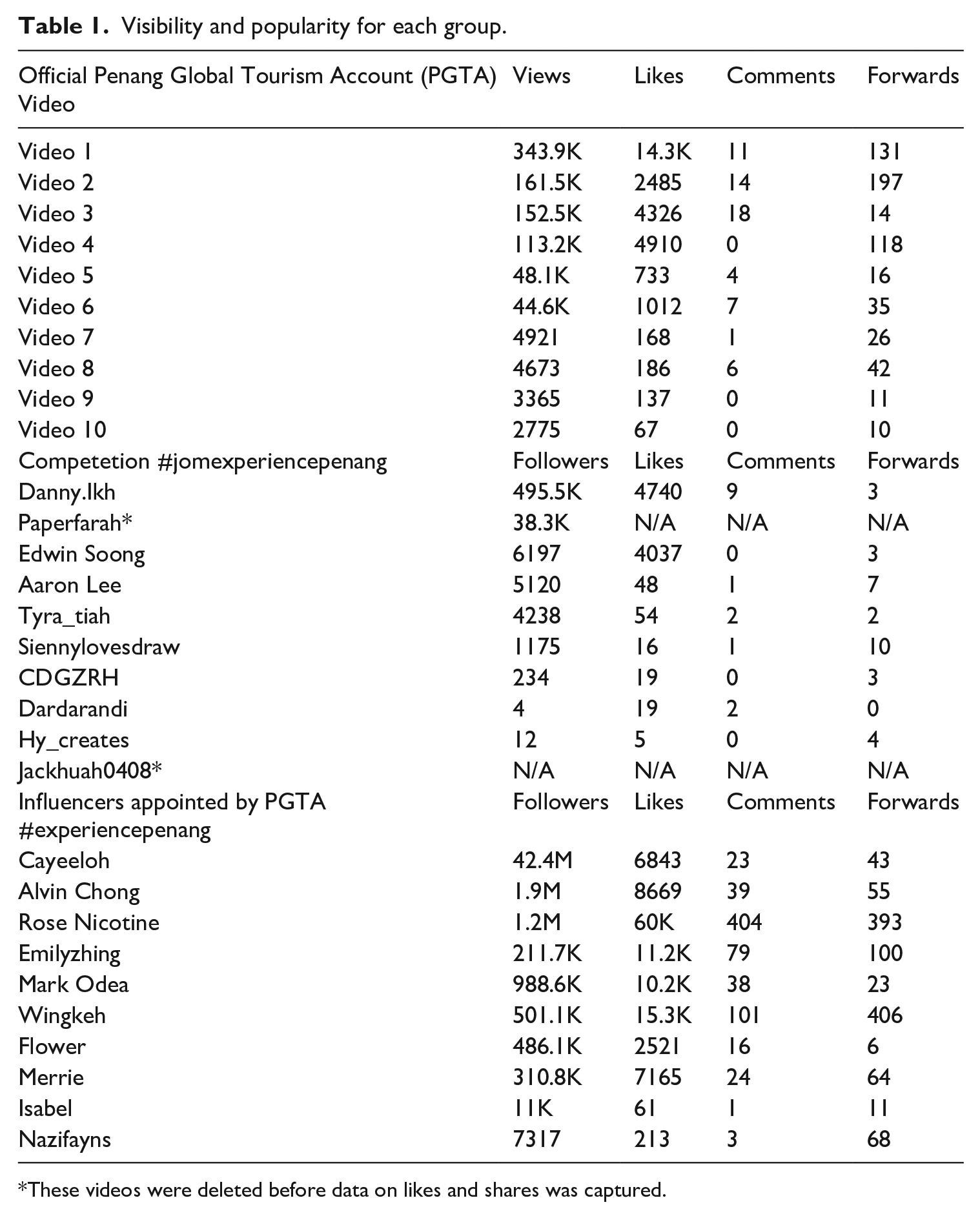
These videos were deleted before data on likes and shares was captured.
A generalised overview of Purpose ratios among groups was summarised in Table 2. It is important to note that while there are multiple purposes for any given communicative event, the results presented below have focused on the purpose we identified as most dominant across each of the groups examined.
Overview of the five-ratio among three groups.
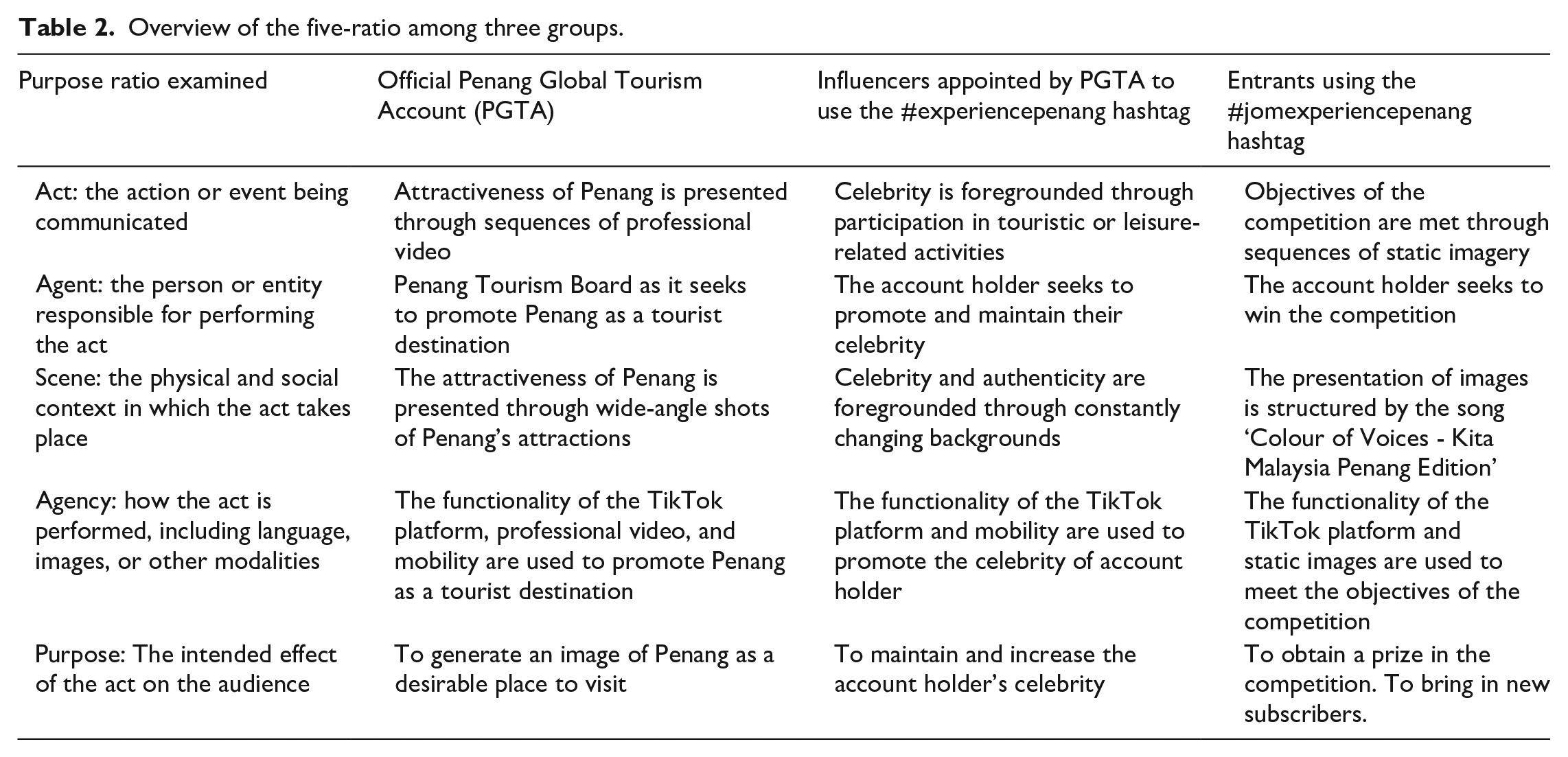
Given the focus on three distinct groups, we will begin by examining the Agent-Purpose ratio as this will highlight key points of difference in the way that purpose was enacted. For instance, Penang Global Tourism, the local destination management organisation (DMO), which operates the Official Penang Global Tourism Account (OPGTA) sought to promote Penang as an attractive, multicultural culinary tourist destination through its use of TikTok videos. Those who entered the #jomexperiencepenang competition, while nominally also promoting Penang as a tourist destination through video could primarily be seen as attempting to win the competition and structured their entries accordingly (discussed below). The group of influencers is the most interesting in this respect since they too were nominally presenting the attractiveness of Penang as a tourist destination for their much larger audiences. However, when examining the compositional decisions they made (Act) another purpose was revealed to be more prominent.
To understand the contrast, we turn to the Act-Purpose ratio and examine the videos posted on the OPGTA and how they sought to communicate the attractiveness of Penang. As indicated in the images below there was significant use of professional, wide-angle videography and quick cuts to present different attractions, from nature-based encounters at Penang Hill to the local food and heritage that are associated with its destination image, as supported by prior literature (Mohamad et al., 2022; Tilaki et al., 2016; Yousefi and Marzuki, 2015). Importantly the purpose was not achieved through one single unifying image, scene, or individual (those featured were nameless), but through a composite of different images taken at different angles, distances, and times of day. (see Figure 1).
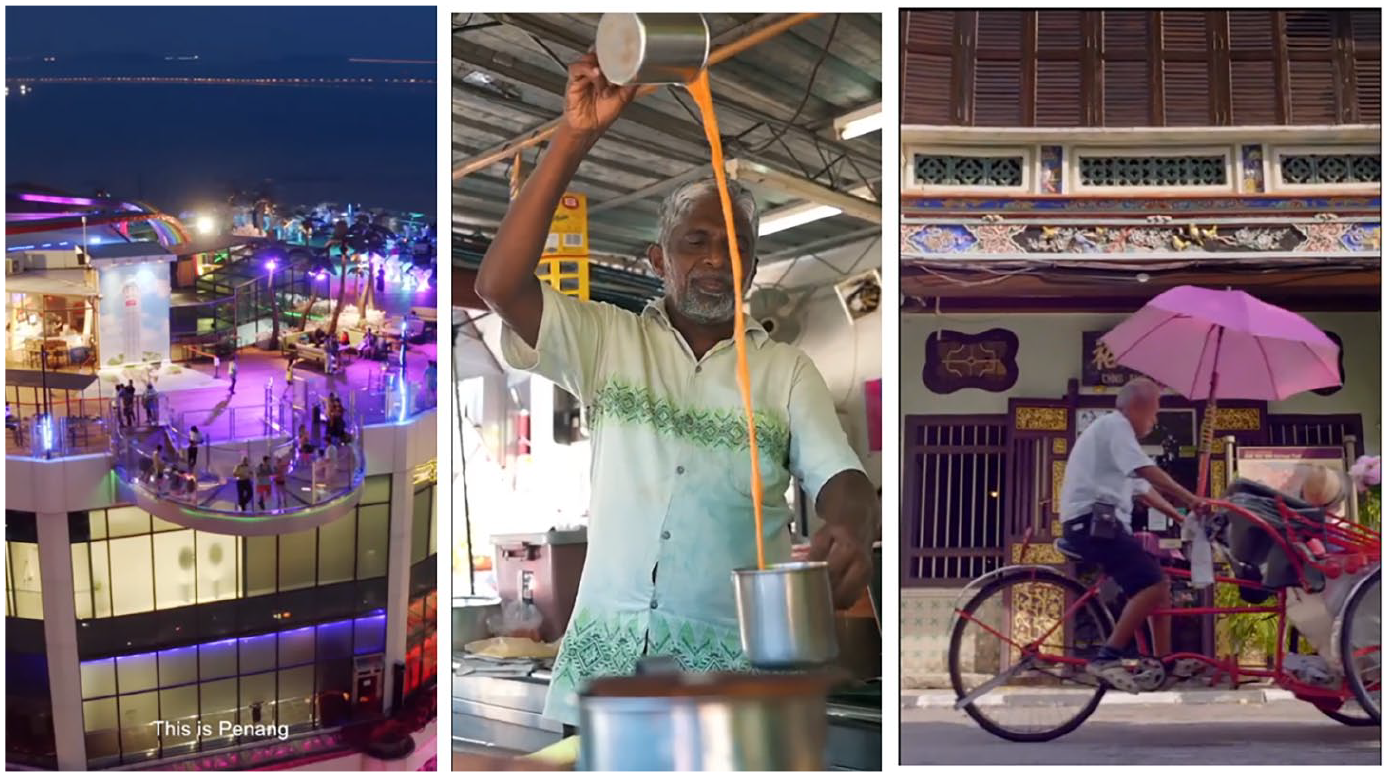
Screengrabs from PenangGlobalTourism (experience Penang).
In contrast, when examining videos produced by influencers, purportedly with the same intention of promoting Penang as a tourist destination, there is a vast difference in how this was done (Act) which points towards a different Purpose in the videos’ production. Consistently throughout the influencers’ videos, they serve as the unifying factor that cuts through the whole video. Influencers were positioned prominently in the framing of their videos and were strikingly similar in terms of a specific pose, striking gait, and the use of their hashtags. The videos themselves often displayed high production values, on par with those produced by OPGTA, using effects such as cutting and zooming effectively as a means of holding the audience’s attention while maintaining the focus on the self. As specially appointed TikTok ‘ambassadors’ of Penang, these travel influencers worked to integrate and maintain the personas they had cultivated with their followers online with the destination and its attractions. This centring on the influencer rather than the destination itself is highly evident across their videos, as the following illustrations reveal (see Figure 2).
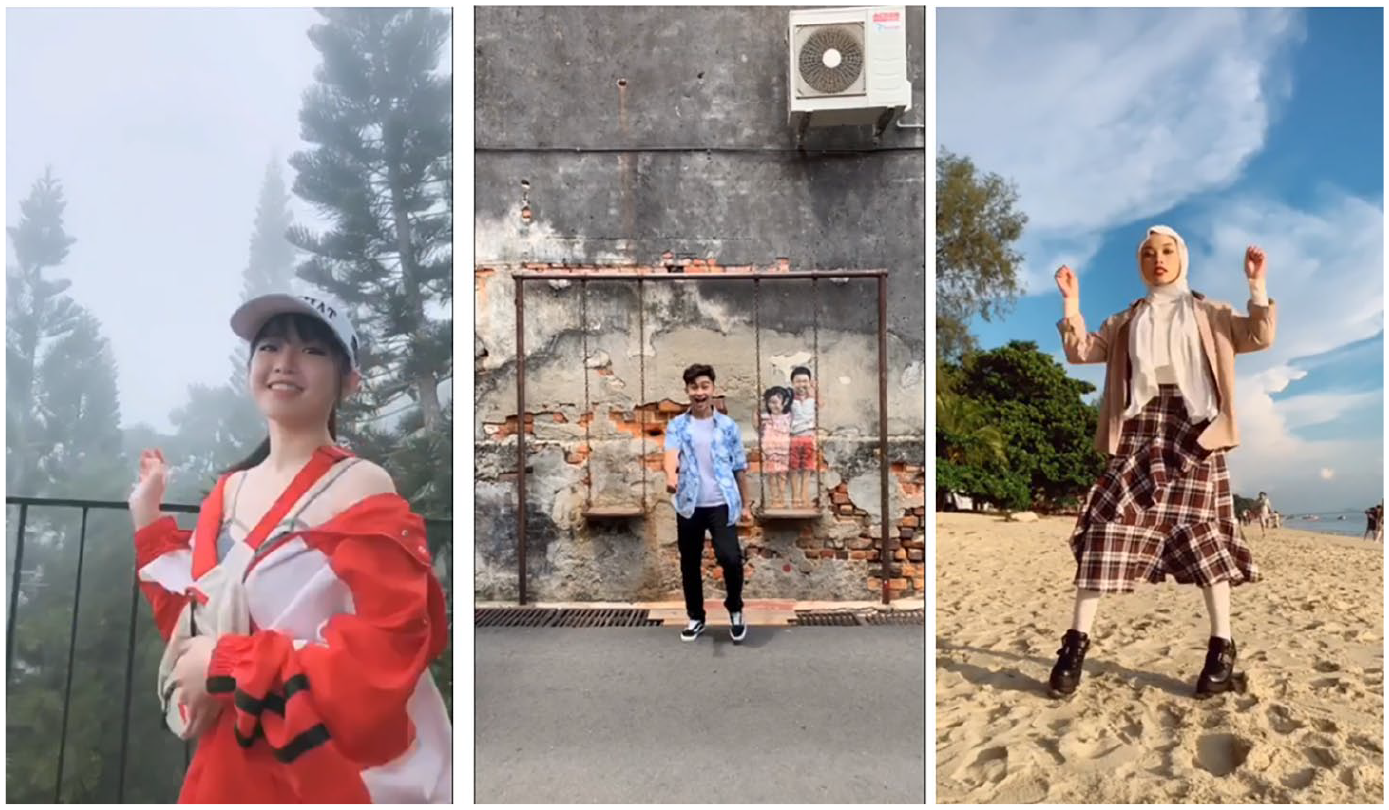
Cayeeloh Alvin Chong Rose_Nicotine.
What can be observed throughout the influencer videos is the subordination of the destination image to acts that serve to maintain or enhance the influencers’ celebrity. Indeed, as Turner (2004) has argued, celebrity is created through the discursive commoditisation of the self, and the influencers’ videos serve as a vehicle to construct and maintain their celebrity.
A contribution by @emilyzying0419 to the #experiencepenang hashtag, described as ‘Straits Quay > Bora Bora > The Top > The Habitat > Hin Bus Depot’ is emblematic of this interpretation and employs techniques seen in many of the influencer-promoter videos. The video, which runs over 15 seconds, involves @emilyzying0419 producing closed and open-mouthed smiles to the camera across a series of vignettes that place her alternatively in a hotel, a park, a beach, on a rickshaw, at a viewing area and in front of tropical plants as depicted in the screengrabs below (see Figure 3).
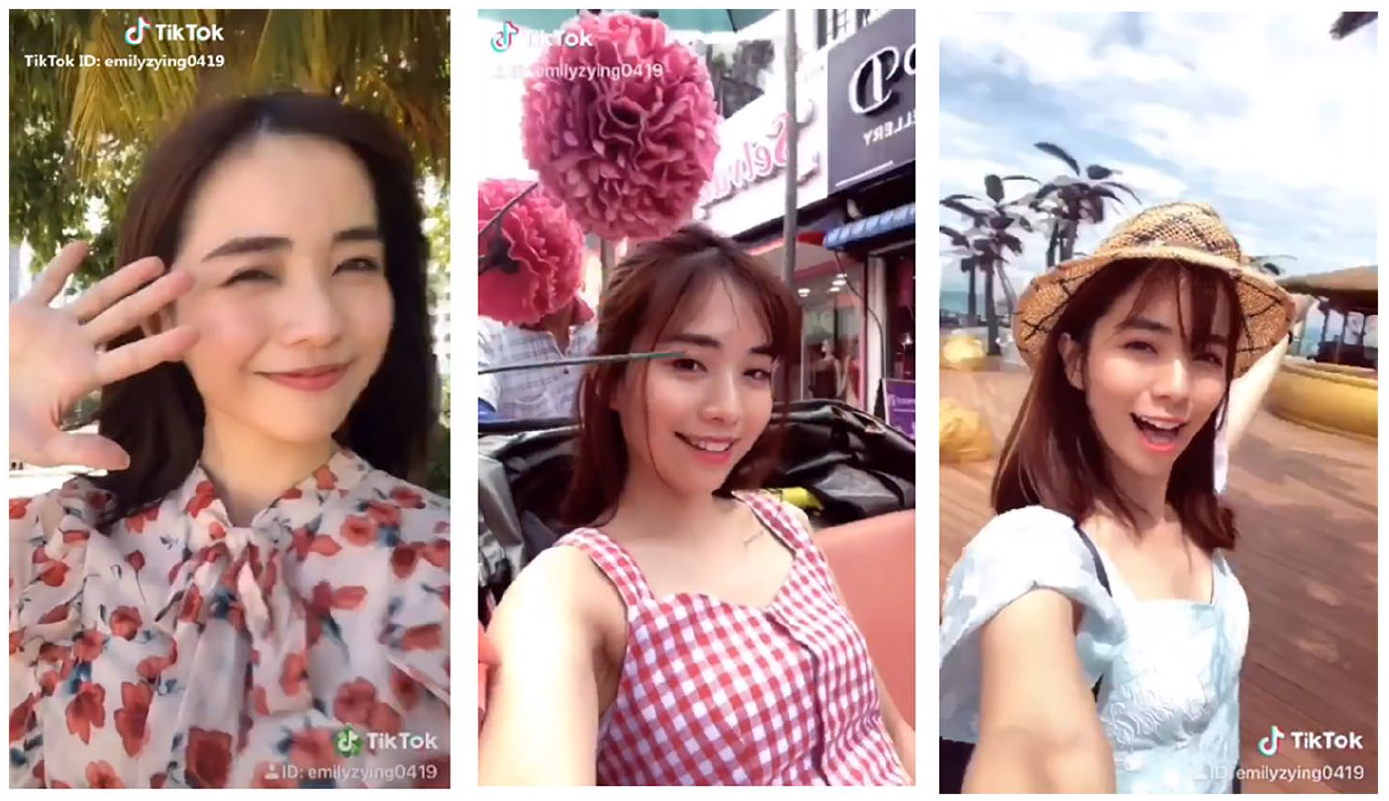
Screengrabs from emilyzying (emilyzying0419).
Within each of these vignettes, @emilyzying0419′s head and shoulders remain the primary focus and none of the scenes are identified, except through the English hashtag and the use of simplified Chinese for Penang (槟城) in the video’s description. Significantly, the description also contributes to an understanding of the celebritising purpose of this video.
如果可以跟你一起来槟城玩就好了 ☺️下次还要再来 ♥️
I wish we could go to Penang together ☺️ Come with me next time ♥️
Firstly, in constructing@emilyzying0419′s identity as a Chinese-language influencer, the language consists of terms that work to convey desire and invitation seeking to directly appeal to the audience. This represents performed intimacy in service of what Marwick and Boyd (2011) have termed ’fan maintenance’ - a description of how social media, such as TikTok, offer opportunities to retain ‘a network of affective ties with their followers’ (p. 156), which serves to maintain the celebrity status of the individual. In @emilyzying0419′s case, the primary purpose of the video can therefore be interpreted as a discursive act designed to perpetuate her celebrity status by directly connecting with her audience. The image of Penang is recruited to produce additional content in servicing her fame and reputation, rather than simply a promotion of the destination itself.
In those videos made by competition entrants, there was greater diversity with some following similar patterns to that of the influencers, however, Penang and significant attractions were more prominently emphasised than those in influencer videos with many videos not featuring representations of the creator at all. Moreover, these videos exhibited decidedly less literacy in the norms of the genre and lower production values, more often using static images of different aspects of Penang’s attractions than live video. These videos also made greater use of the overlay effects, however often the effects did not contribute to the meaning produced by the video and instead appeared as unsophisticated uses of the platform’s functionality for novelty value. For example, @Isabel’Lee’s video starts with a distortion effect and a rotation effect that transitions between a vignette of the Penang Bridge and tea on the table of a café, which appears to carry no relevant semantic purpose. Illustrative examples of entries of the #jomeperiencepenang competition analysed for this project can be seen in the screenshots below (see Figure 4).
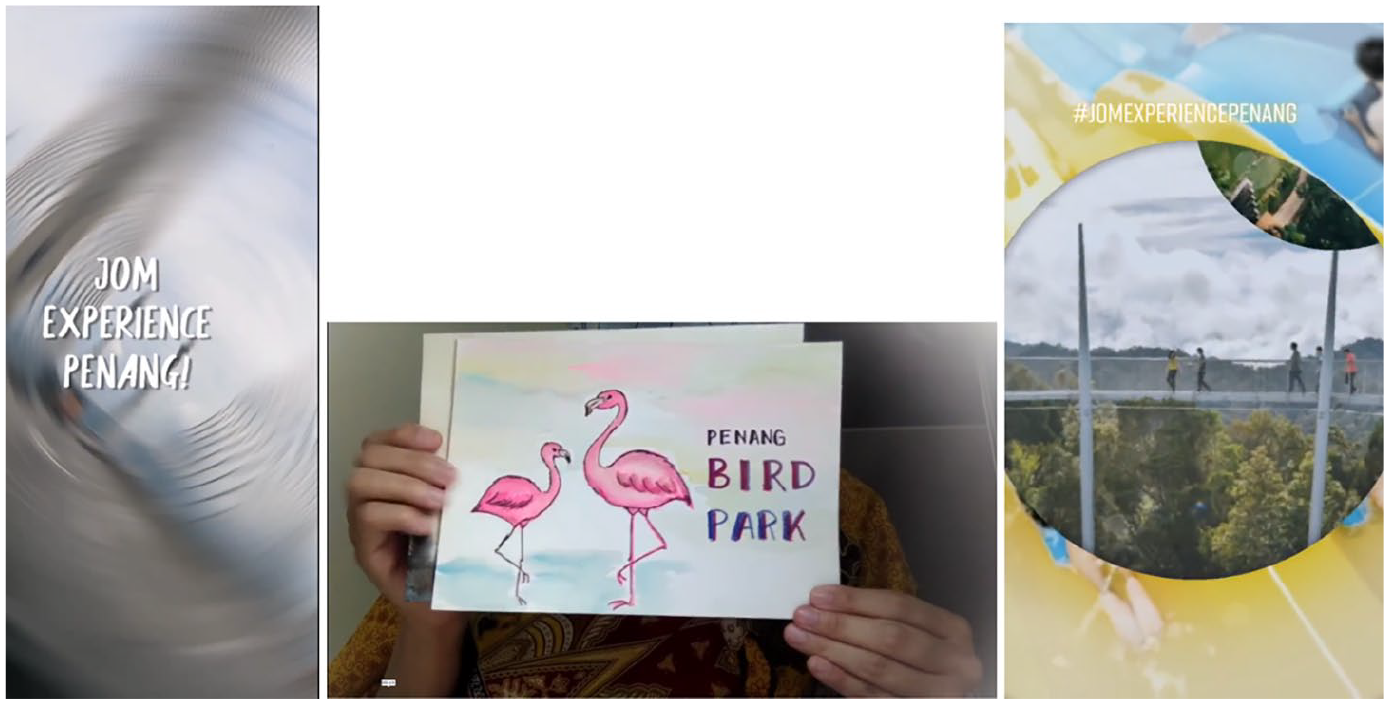
Isabel Lee hy_creates edwinsoong.
Overall, these observations signal a more diverse set of underlying purposes, with the desire to produce a competitive entry being the most consistent and unifying. The differences are perhaps emblematic of how TikTok can be manipulated to suit a self-image in the case of the travel influencers (see Brooks et al., 2021; Haenlein et al., 2020; Yang and Ha, 2021) or providing hedonic outcomes to generate likes and attention (Du et al., 2022; Scherr and Wang, 2021).
While touched upon already, examining the Scene-Purpose ratio provides further evidence in support of our interpretations. In the case of the OPGTA, the selection of locations and activities that are used reflected widespread discourses of the touristic values of Penang. In the case of influencers, however, while the scenes reflect an understanding of these ideas, they are also employed to attribute specific values to the creators themselves such as authenticity and celebrity. For example, in influencer @alvinchong123’s video, he locates his videos in outdoor street food markets and engages in performatively eating various foods associated with this location. Nominally, the purpose of the video is judged by the description ‘Penang has the best authentic local food! #TiktokTravel #experiencepenang #tiktokindia’ is the promotion of Penang’s food culture. However, the inclusion of the term ‘authentic’, the selection of the street food market as the scene, and the fact that the video almost exclusively focuses on the actor in the act of eating, taking up 60–70% of the portrait-framed video in each vignette is read multimodally as the actor’s self-positioning as ‘knowledgeable local’. This interpretation is supported by the fact that in the multimodal elements being presented, the food is always consumed in non-descript, but ‘authentic’ locations, and no identifying information is offered for audience members who may wish to visit the same locales (see figure 5).
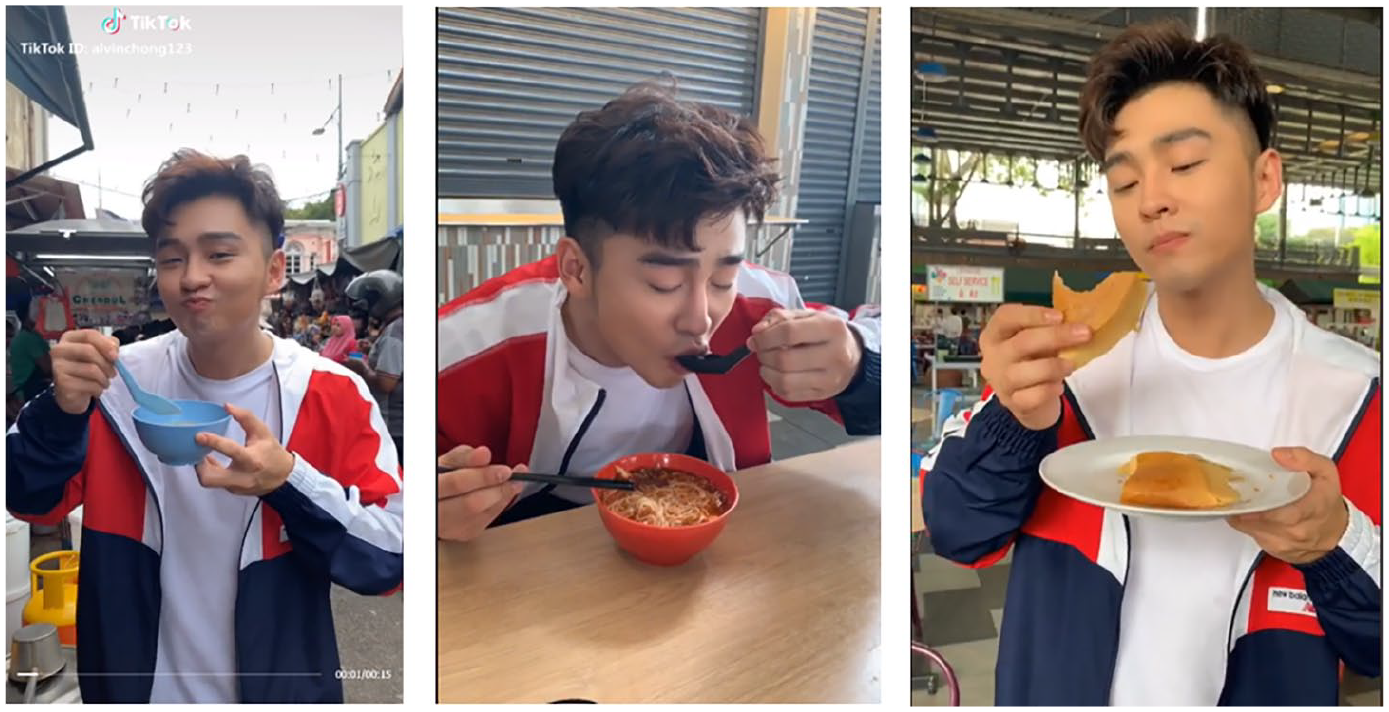
Screengrab from Alvin Chong (alvinchong123).
Continuing to explore the Scene-Purpose ratio, those videos created specifically for the #JomExperiencePenang competition used a song specified by Penang Global Tourism (Colour of Voices - Kita Malaysia Penang Edition) as their unifying scenic principal. This meant that in many of the videos, locations were decoupled from their usual spatial relationships and recontextualised to align with meanings conveyed in the song. Some videos therefore existed in a space where static images and short videos of locations were assembled into an aspatial mélange, which the agents used to reproduce touristic discourses of Penang. This atemporality is further obscured by the arrangement of the linguistic representations of these locations (e.g. Batu Feringhi, Butterworth, Bird Park, Seberang Perai, cultural batik, etc.) as they appear in the lyrics, following conventions for the textual genre of a list as can be seen below. The images and video vignettes used are therefore reconstructed into the visual equivalent of a list that is then effortlessly traversed by the actors when they take multiple days to visit in person. This idea of effortlessness is reinforced by the brevity of these videos, which were usually between 15 and 45 seconds. The result, therefore, intentional, or otherwise, is to construe the effortlessness of a touristic experience in Penang (see Figure 6).
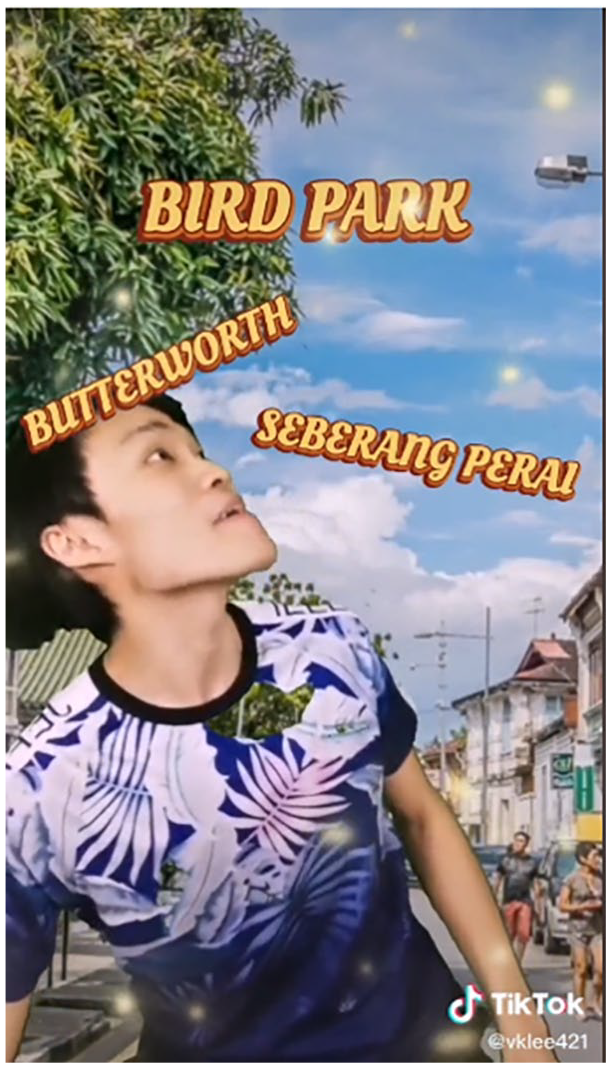
Screengrab from Aaron Lee (vklee421).
The functionality of the TikTok platform itself provided all the groups examined with similar agencies to create content related to touristic images of the destination. This includes the ability to capture and edit video, apply filters, and transitions, and overlay images and text onto video. As mentioned above, access to high-quality video production generated outside of the app itself as well as the ability to physically travel to several destinations to achieve the purpose of the video was primarily the domain of influencers and the official Penang Global Tourism account. However, users also exhibited their agency through the functionality of the TikTok platform itself. This includes the use of descriptions to frame the video and signal to the audience how it should be received. For example, one of the entrants in the #jomeperiencepenang competition, CDGZRH, produced a video that began with an image of an airport overlayed with letters spelling PENANG followed by five static images of food or vendors and one short clip of a vendor overlayed with location pin icons and text that indicated the business where the food was purchased. This was then framed by the description ‘You can never eat at the same place twice in Penang, there are too many options!’. While the act itself here is the construction of a video of food purchased in Penang, the creators’ agency is exhibited through their sequencing of the images use of text and icons to indicate a culinary tour, and the use of the description to frame the video for the viewer as exhibiting the variety of food options available (see Figure 7).
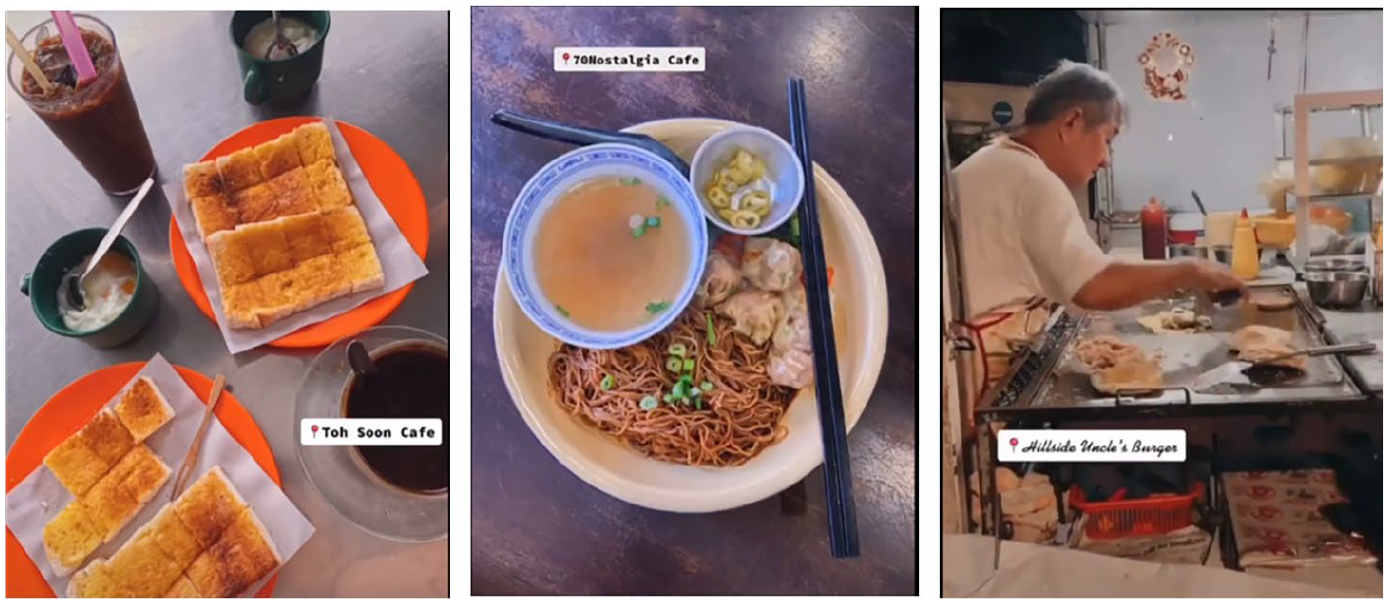
Cdgzrh.
Hashtags were also employed by users to both frame the contents of the video and ‘maximise’ the audience (see Androutsopoulos, 2014) for a given post by increasing the potential for a post to be seen and associated by the algorithm with other videos, as has been observed in other studies of destination promotion on social media (Wang and Feng, 2023; Zhang and Huang, 2022). This is exemplified in the description for a competition entry by siennylovesdraw, ‘#Now #stayhome #planning #JomExperiencePenang #trip ~ #food #culture #heritage #arts & enjoy #Penang TauSarPneah @experiencepenang #traveller #travel’. As such, the entertainment value and social effect of TikTok videos make the contents an attractive medium to formulate desired agency outcomes for a tourist destination such as Penang, offering virtual and vicarious consumption of visitor experiences, amidst a global pandemic (Lenggogeni et al., 2022). Finally, it is again important to note that influencers, and to a certain extent, competition entrants were themselves involved in the Act which was presented to their audience, emphasising their participation in the activities they performed. On the other hand, the OPGTA used anonymous vendors and very wide shots, which generates the possibility for an audience to imagine themselves in the scenes presented, rather than acting in the role of an observer.
Discussion
Applying Burke’s Dramatistic Pentad to TikTok videos that produce and reproduce images of Penang as a tourist destination reveals valuable insights into the way that various actors understand and instrumentalise these images for a variety of purposes. Significantly, the above findings reveal inherent tensions in the engagement of professionalised influencers, and to some extent amateur content producers, to promote tourist destinations, since this product is necessarily sublimated to individuals’ commodification of themselves to their audiences (Mak, 2017; Stepchenkova and Zhan, 2013).
Observing the diverging motives of different groups of actors and how this impacts media content production sheds light on the complexities of destination image performativity and (re)presentation on social media. This is because destinations can no longer exert full control over the content online and need to engage and manage the social modalities manifested through user-generated content (Liu et al., 2020; Sin and He, 2019). This shifts the relationship between destinations, influencers, and end-users of TikTok to iterative forms of evolving stories. While the destination image of Penang has been enhanced due to the interactions on TikTok, there are also wider social ramifications of how influencers, in their endorsement of the destination, further cement their ‘cult’ like status as leaders with their entourage of followers (Abbasi et al., 2023). There are obvious implications for destination marketing strategies, highlighting the importance of considering the motives of a given channel of promotion (see for instance Weatherby and Vidon, 2018) when seeking to communicate destination image through social media platforms like TikTok. In addition, there are social affordances of engaging influencers and other users of TikTok, where the destination subjugates its ability to control how destination insights are (re)presented and disseminated to others, and having to pay thousands to ensure the influencer’s curated content reaches his or her digital followers (Shoukat et al., 2023).
Early adoption of emerging technologies, coupled with intentional stakeholder partnerships (e.g. with travel influencers), can be advantageous to destinations in curating competitive advantages amidst a brand-, and market proliferated tourism industry. The addition of a TikTok contest also highlights the importance and value of gamification principles to TikTok in tourism, where the objective is met by some level of competition, requiring elements of creativity, and featuring a reward in exchange for the investment of time and resources to produce a video (Du et al., 2022; Yu et al., 2022). Yet, the hedonic elements of creating videos for fun and humour have helped to project positive memories for both users and their audiences, as exemplified by the 134,000 viewers of the TikTok contest (Vianna, 2021). The research also demonstrates that TikTok can be harnessed to go beyond passive consumption of video content to more active forms of co-created participation and engagement in tourism, which have been identified to be more interactive and effective in terms of generating destination branding and loyalty outcomes (Senyao and Ha, 2022; Wang and Feng, 2023; Zhang, 2021). These ultimately led to a successful pitch and global coverage to demonstrate the returns on engagement with TikTok, a growing social media platform of importance to global destinations. This research, therefore, lends valuable insights for destinations seeking to recover from the COVID-19 pandemic that has significantly crippled the tourism industry since 2020. In particular, the findings take a different tangent to what Lim et al. (2012) have found, where TikTok videos do possess the potential to create a positive impact on a destination brand, indicating just how far socio-technological advances have come in terms of influencing tourist perceptions over the last decade. The research also emphasises the greater focus on how digital content as evidenced on TikTok pay more attention to the social processes of fun, interactivity, and sharing of content, as compared to the business-minded landscapes of competing solely for tourism numbers and market share (Yin et al., 2023). Rather, destinations such as Penang appear to formulate opportunities for consumer-to-consumer partnerships, and in doing so, co-create the performative aspects of a staged depiction akin to a short video narrative, with the destination as a backdrop (Li and Hayes, 2023).
Taken together, the three strands of the #experiencePenang campaign demonstrate that the democratic and individual nature of social media such as TikTok recontextualise elements of destination image for other purposes. While conventional touristic images of Penang present it as a multiethnic island containing picturesque beaches, delicious street food, and British colonial architecture, in many of the influencers’ videos these images were appropriated in the service of constructing celebrity. By creating videos that focus on the performativity of the influencer in the service of authenticity and intimacy, these images serve as semiotic resources for the construction and reproduction of celebrity. The result is therefore a fragmentation and dilution of the destination image, at least as it can be observed through an individual hashtag such as #experiencePenang.
Overall, the findings demonstrate how such performative acts on TikTok can be equally applicable not just to Penang, but to other global destinations. More distinctly, our work offers a point for departure from extant studies that have focused on the visitors’ experiences with TikTok in terms of fun and excitement, to immerse instead with the semiotics of TikTok contents and performativity that in turn provide more nuanced insights to advance theory and practice of destinations seeking to understand and engage better with platforms like TikTok.
Conclusion, limitations and future studies
In conclusion, this research has shed light on the use and adoption of TikTok as a tool for destination marketing in the case of Penang, Malaysia. This contributes to the emerging body of work examining new social media practices and innovations as destinations seek to differentiate and engage themselves in a highly competitive environment. In addition, the research demonstrates the value of Dramatism as a useful framework to elucidate a more nuanced appreciation of TikTok in its performativity and connection to destinations. This goes beyond extant literature where studies comprising TikTok are concentrated in the use of surveys on TikTok end-users or tourists, with very few scholars attempting to engage in the analysis of videos, as called for elsewhere (Deng et al., 2022).
At a theoretical level, this research also contributes towards a more refined appreciation that TikTok manifests differently when appropriated by the destination management organisation, influencers, and others who submit their entries for competition purposes. This presents a more contextual approach to utilising TikTok and reveals deeper insights as to why the understanding of the ‘source’ matters, along with the effects that these content creators can generate for different destinations. Crucially, the findings inform that the destination image of Penang is heightened when measured by the number of views and likes. However, qualitative analysis reveals that destination image may play a subordinate role in influencer videos. Nevertheless, the meteoric rise of TikTok, and how these videos are portrayed by different tourism groups, can no longer be ignored.
The theoretical and practical implications of the different destination images and social functions formed by the various groups separately and collectively reveal a timely shift in terms of the performativity that TikTok contributes to tourism literature and practice. The study demonstrates the value of approaching the democratised promotion of destination image online as semiotic social action, interrogating the compositional choices made and the underlying motives they reveal. These outcomes generate a more nuanced approach to understanding returns on engagement, rather than the incumbent returns on investment that have been the dominant stream of queries surrounding how destinations should evaluate their time and resource allocation towards TikTok. This research emphasises the social value of the TikTok movement, and how such performative acts are equally applicable not just to Penang, but to other global destinations.
This research does come with its limitations. The study was centred on a solitary destination – Penang, Malaysia, during a particular juncture characterised by widespread concerns about the COVID pandemic. Consequently, the findings do not possess wide-ranging generalisability due to their highly contextual nature, while still shedding light on matters deserving of exploration within alternative contexts. In addition, this research utilised insights from TikTok content creators across three perspectives for example, destination management organisation, influencers and users who participated in the competition. The value of these videos could be further unpacked with other stakeholders such as tourists, operators, and government agencies as to their intentions towards engaging with TikTok. Notwithstanding these limitations, the research has generated avenues for future investigation.
Future studies could adopt a longitudinal, direct approach (e.g. interviews) and assess if the TikTok videos evolved in terms of their contents and focus over time. These lend an interesting insight into changes to destination images in contrast to what is populated within official destination management agencies. Another body of work can investigate whether there are gender and other demographic differences in terms of how TikTok videos are created and disseminated within tourism. This can help destinations and tourism operators refine their products and experiences better to meet the needs of their potential and existing markets.
Footnotes
Funding
The author(s) received no financial support for the research, authorship, and/or publication of this article.
