



Abstract
This article presents an analysis of film tour apps and maps, exploring the different functionalities they offer, how these functionalities contribute to shaping engagements with place in Edinburgh, Scotland, and the specific role of film in this process. We find that while they possess similar functionalities to more general tourism apps – for example, providing information and offering travel advice – film tour apps and maps also connect the real world to the ‘reel’ world through games, active engagement, and prosumerism. The specific functionalities of film media apps, we argue, have ramifications for film tourism experiences, potentially extending the touristic experience of a destination to a multi-mediated, multi-layered experience of a ‘patchwork’ place through the lens of film. Additionally, functionalities of film tour apps facilitate new types of behaviours and interactions with place.
Introduction
Film tourism, the popular cultural practice in which tourists travel to places that are featured in film and television productions (Beeton, 2016; Reijnders, 2011), has become a transnational, lucrative phenomenon. Known as the backdrop to many popular and successful media productions such as The Da Vinci Code (2006), Braveheart (1995), Trainspotting (1996), and Brave (2012), and more recently Avengers: Infinity War (2018) and Netflix’s Outlaw King (2018), Scotland is not untouched by this phenomenon. Many Scottish tourist organisations now offer visitors (both overseas and domestic) numerous cultural and/or themed film tours and services. In line with growing demand and a quest for differentiation among themed and specialised tours, fit to match a broad range of tourists with disparate interests, a more recent trend within film tourism is the emergence of film tour digital apps. Large players in the tourism and heritage sectors – such as VisitScotland, Historic Environment Scotland, and Edinburgh Castle – have branched out into offering interactive film maps, such as the Outlander Locations map1, and tour apps, affording both prospective and on-site film tourists possibilities to act as their own guide and visit locations featured in popular film and TV productions.
Within the film tourism landscape, extant research has explored several topics, including guided tours and how their practices are organised and affect place transformation (cf. Mannheimer et al., 2022; Šegota, 2018; Torchin, 2002), and film re-enactments and festivals and how these contribute to placemaking (cf. Alderman et al., 2012). Film tour apps, as relative newcomers in the film tourism landscape, differ from these more traditional tours, enabling different interactions with film and place. Therefore, they present a type of individualised, multi-media and multi-layered tourism experience that is potentially more tailored and interactive (Dickinson et al., 2014; Ghaderi et al., 2019). The apps’ capabilities can enable film tourists to guide themselves around film locations, indicate nodal points of film locations, share locations and personal photographs and videos, and link their social media, thus interacting with other film fans and tourists.
Such developments in film tourism are part of the growing significance of digital media in discovering, navigating, and mediating the experience of places (Bork-Hüffer, 2016; Kellerman, 2009; Miller and Horst, 2012; Rabari and Storper, 2015). In the tourism field specifically, as noted by Law et al. (2018), research on mobile technologies has centred on the adoption effect on the tourism and hotel industries. Less is known about the capabilities these apps offer to interact with attractions and destinations in different ways. This research addresses this gap, examining the use of mobile technologies at destinations and attractions, with the additional layer that the destinations are film tourism destinations. Locations are symbolically and at times materially shaped through film tourism practices, in a process in which locations become viewed, interpreted, and experienced through the lens of film and TV series (Schofield, 1996). Film tour apps potentially add an additional media lens through which tourist destinations can be experienced.
This article presents an analysis of film tourism digital media apps and maps, reviewing their functionalities and assessing their potential to shape and enhance the media tourism experience, through the research question: What kind of new functionalities do film tourism apps and maps in Scotland offer and in what ways do they impact engagements with place? The analysed (m)apps are either film tourism apps or tourism apps with a film component. Through a platform analysis (Van Dijck, 2013) using the case of Scottish film tour apps, this study offers an empirical account of the functionalities of film tour apps and how these might shape and mediate engagements with place through the lens of film. Through this analysis, the article offers new insights into how digital mobile technologies and functionalities might shape the phenomenon of film tourism.
Theory
Tourism and media products
Media products have been shown to have an impact on tourism, for example though the practice of film tourism. Film tourism is an increasingly popular leisure practice (Beeton, 2016; Reijnders, 2011) in ‘which media products have become incentives for people to explore places, as people are enticed by imaginations of these places from popular television series and films’ (Schiavone and Reijnders, 2022: 4). There are different ways in which tourists can connect to a place through media. For instance, Dubois and Gibbs (2018) identified three types of video game-inspired tourists: the serendipitous types, who find themselves in a destination by coincidence; general game-induced tourists, who are not necessarily drawn to media tourism activities but go along for the experience when visiting a destination; and specific video game-inspired tourists, who visit a location precisely because of its association with a video game.
Generally, the phenomenon of media tourism has been seen to affect engagements with place in various ways: by shaping the policy landscape, by opening up new tourism experiences, and by offering new representations of place through media. First, in the wake of film and tourism, governments and (local) municipalities anticipate film tourism booms and increasingly integrate film in shaping and promoting formal notions of regional and local heritage and place identity (cf. Saunders, 2017; Seaton, 2016). For instance, Schofield (1996) noted how film tourism gives rise to cinematic heritage: a kind of heritage that is developed during film tours in which representative and material space temporarily collide, and places and place identities are reproduced and reconstructed in the eyes of tourists (Schiavone et al., 2022).
Second, the cultural and embodied practices of and within film tourism (e.g. by tourist guides, tourists, and locals; performances and re-enactments) enhance and extend the tourist experience (Alderman et al., 2012; Benjamin et al., 2019; Schiavone and Reijnders, 2022; Šegota, 2018). The experience of film tourism has been captured in previous research, which has shown how film tourists seek out proximity with a film and its characters by visiting filming locations – where, for example, they can see props and studios – or participating in re-enactments (Kim, 2012). Other empirical accounts have focused on the (practical) engagements with place that happen within film tours, for example through embodied practices of visitors, guides and locals (cf. Schiavone et al., 2022).
Third, representations of place are constructed through media products, shaping how people view these places and contributing to more general placemaking processes (Edensor, 2015; Hall, 1977; Thompson, 1995; Urry and Larsen, 2011). Beyond ‘the tourist gaze’ (Urry and Larsen, 2011) – a concept illuminating how tourism practices are pervasive in shaping place and social spatiality – film tourism studies have unpacked the specific ways in which traditional film tourism contributes to shaping and reproducing place, spatial identities and a sense of place, for instance in the way it entices the imagination of visitors and develops particular affective bonds with place (Schofield, 1996; Torchin, 2002; Urry and Larsen, 2011).
Tourism and mobile technologies
The landscape of tourism has been further enriched through the proliferation of tourism-related mobile technologies, which have enhanced people’s mobilities and experience of place (Dickinson et al., 2014; Lu et al., 2015). Law et al. (2018) reviewed four factors affecting the uptake of mobile technologies by consumers, showing that the uptake of mobile technologies during travel was influenced by: convenience (e.g. information search and provision); a more general adoption of mobile technologies in daily life (i.e. not just for travel, but also because it aligns with lifestyle choices or a need for interaction during travel); a disposition towards adopting technologies (e.g. confidence in one’s own abilities to use them); and privacy or security concerns.
Exploring the functionalities of tourism-related mobile technologies has shown that they shape the tourist experience in multiple ways, ranging from the choices made prior to and during travel to the sharing of experiences afterwards (Law et al., 2018). For instance, building on Campbell and Kwak’s (2011) categorisation of smartphone use (i.e. logistical, relational and informational uses), Dickinson et al. (2014) found that a primary function of tourist apps is delivering immediate information, for example on attractions, destinations, timetables, and accommodation (p. 89). In addition, Dickinson et al. (2014: 89) identified two-way sharing capabilities (i.e. user data [such as location sharing, user recommendations and for market targeting purposes] can be shared between users, in social networks and with app providers); context awareness (i.e. smartphone sensors can provide services such as current temporal and spatial location, live travel, weather information and changes to tourist attraction timetables); Internet of things (sharing and communicating capabilities extending to everyday objects, e.g. real-time train positions and tracking of parcels); and finally, tagging (the ability to post information about locations and objects for other [future] tourists). The adoption of travel apps affords a more convenient, personalised, and empowered travel experience (Lu et al., 2015: 1071–1074). Consequently, Dickinson et al. (2014) argued that mobile technologies afford a more extempore travel experience, which is scheduled around personal needs and circumstances. In that sense, the use of mobile technologies in travel provides enhanced flexibility to tourists, offering ease of navigation and enabling unplanned and opportunistic behaviour. Moreover, as Liu et al.’s (2020) research shows, mobile technologies and social media in particular afford opportunities not only to shape one’s own tourism practices, but to steer and guide other people’s interactions with a tourist destination. Therefore, mobile technologies have altered – perhaps even evolved – people’s relationship with place and travelling.
Besides identifying their uses, researchers have also evaluated how these mobile technologies affect how people interact and engage with tourism and place. It is believed that the use of smartphones enhances local tourism experiences and provides tourists with an evolving local knowledge (Dickinson et al., 2014; Ghaderi et al., 2019). Ghaderi et al. (2019: 786) find that ‘tourists are no longer satisfied with standard services, but would rather be involved in local experiences such as local cuisine, participate in local festivals and events, and experience local lifestyles’. Smartphones’ capabilities address this wish, as they assist tourists in the ‘micro’ moments of travel – such as locating attractions, eating establishments, and toilets – as well as building a bridge between tourists and local service providers. Other ways in which smartphones alter tourist experiences with place are through the development of new travel skills in relation to travel modes and through possibilities of creating and sharing user-generated content within social networks, which exerts influence over decision-making before, during and after travel (Dickinson et al., 2014; Ghaderi et al., 2019). Finally, digital media stimulates imaginary mobilities and virtual mobility, helping people orient, navigate and explore places even at a distance (Bork-Hüffer, 2016; Verhoeff, 2012).
Through these practices, the digital also adds to the development of a sense of place, in which ‘the close and inseparable intertwining of offline and online space result[s] in a deepened sense of attachment and bonding to place’ (Bork-Hüffer, 2016: 2166). Moreover, as technologies become personalised, individuals enjoy more freedom and control ‘in the process of constructing new (and often highly personal) geographies’ (Bork-Hüffer, 2016: 2158) and tend to be freer in how and where they create and consume information, as well as the kinds of subjective associations and imaginations of places that consequently arise. In the same vein, van Nuenen and Scarles (2021) focused on the manifold ways in which interactive digital platforms interact with tourism. Technology has shaped the tourist experience by providing immediate information, immersive experiences, and practical solutions (e.g. checking the weather). Spaces are increasingly coproduced by tourists, who no longer need to rely on guides or help from locals, because they can produce their own tourist experience with help from apps and technologies. Technologies now provide such a wealth of information on a location that being there is ‘only one part of a touristic experience that is increasingly dominated by digital engagement’ (van Nuenen and Scarles, 2021: 121).
In this article, we explore the confluence of these two, growing media-related trends in tourism, notably how mobile technologies shape the media tourism experience.
Methods
Ten film tour apps and interactive film maps have been analysed in exploring the research questions (see Table 1 for an overview). Data collection was carried out in 2019 by the first author, by testing the apps and interactive maps during fieldwork in Scotland. All film tour apps reviewed are geomedia or locative media (Thielmann, 2010), that is, applications that sit at the intersection of interactive, digital, mapping tools, and mobile and networked media technologies (Leotta, 2016). Film tour (m)apps offer a variety of content that is related to film locations. Generally, the sample can be grouped into two kinds of digital film tours: apps that are downloaded and operated from a mobile phone (Global Movie Trails, MovieLoci, GuidiGO, Edinburgh World Heritage City and Edinburgh Castle Guide with audio) and web-based interactive film maps (Movie-locations, Movieworldmap, The Movie Map, VisitScotlandFilmOnline and The Outlander Map). Film tour (m)apps offer a variety of walking tours and routes via film-related locations. As indicated by Table 1 and shown in Figure 1, some offer a specified route for every individual film or TV series, whilst others offer a walking route along locations tied to several films or TV series. For example, Global Movie Trails offers a total of 10 film walks, each centred around a particular film production, such as Trainspotting, The Prime of Miss Jean Brodie (1969) and Sunshine on Leith (2013). In contrast, The Outlander Map presents a map of locations featured in the series Outlander (2014–).
Overview of analysed film tourism apps and maps and their characteristics.
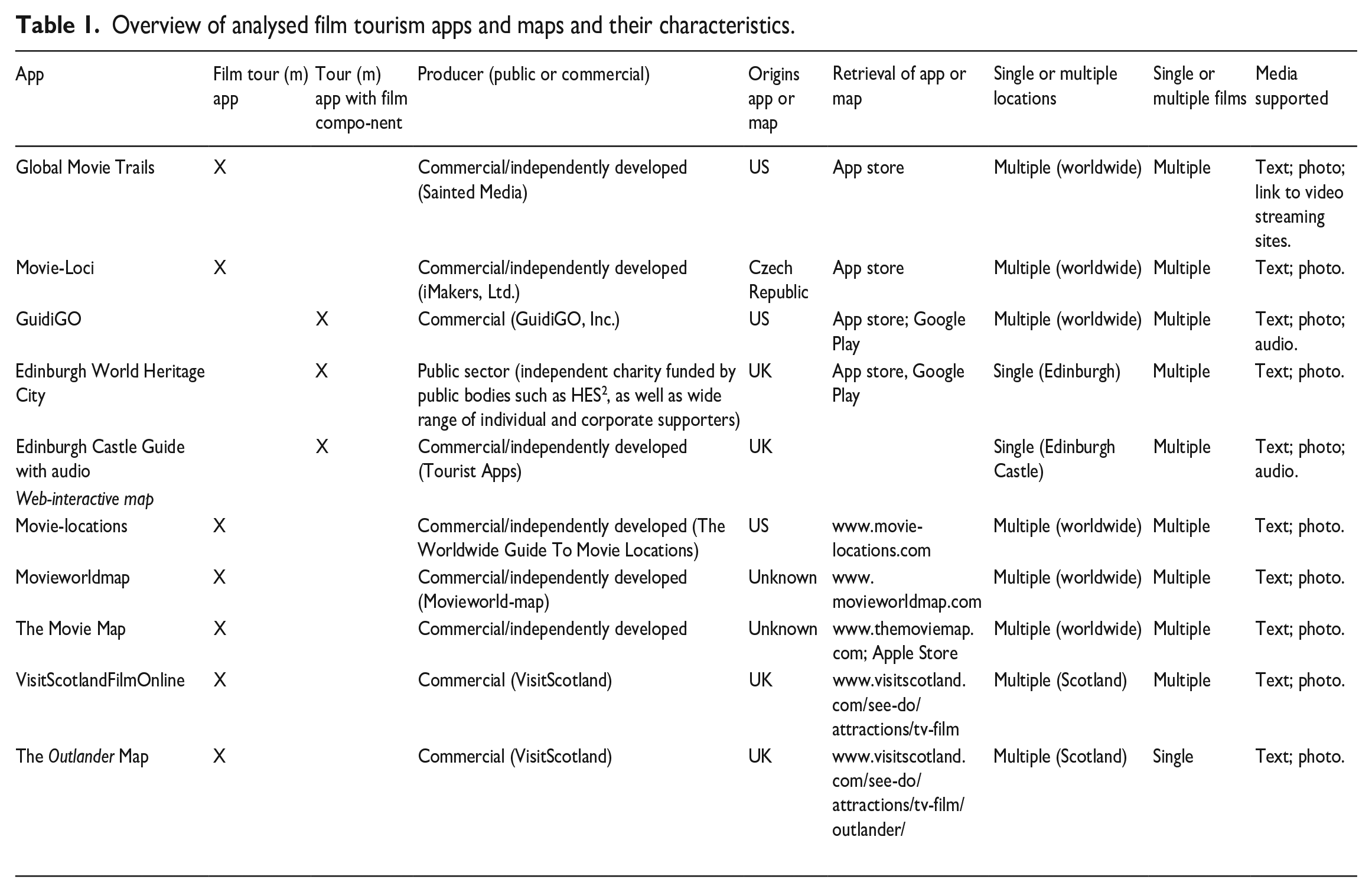
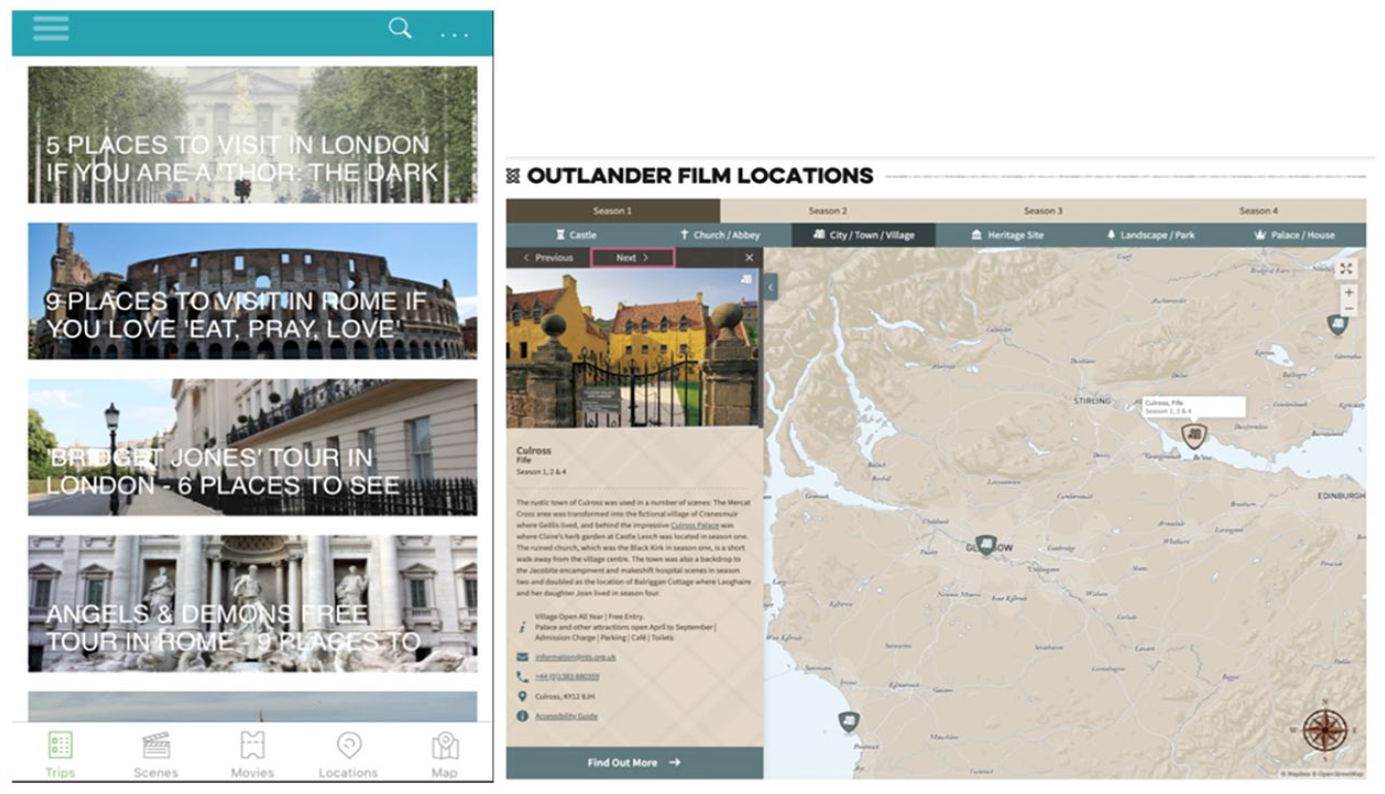
Example of GuidiGO’s offer of film related tours in Europe (left) and The Outlander Map (right). For this article, only the film tours taking place in Scotland have been deployed and analysed.
Film tour apps can be accessed through Google Play and Apple’s App Store, and interactive maps can be accessed and retrieved online. The origins of the film tour apps vary; some of the (m)apps have been developed by tourism and/or heritage organisations, whilst others are developed by independent (non-organisational) websites and developers.
As noted earlier, the first author participated in all available film tours using all 10 apps and maps during fieldwork in Edinburgh, Scotland in August 2019. Whilst undertaking the film tours on location, screenshots were made of every possible screen shown on the app and map (see Figures 2 and 3 for examples). Fieldnotes – which generally consisted of descriptive and reflective notes (Bogdan and Biklen, 1997) – were collected describing the first author’s experiences of deploying the apps and maps, detailing the experience of operating these tools on location in person. This method of data collection accumulated a dataset of 1090 screenshots, which are the main data source for this study. Fieldnotes were primarily used as secondary data for further interpreting the results of data analysis.
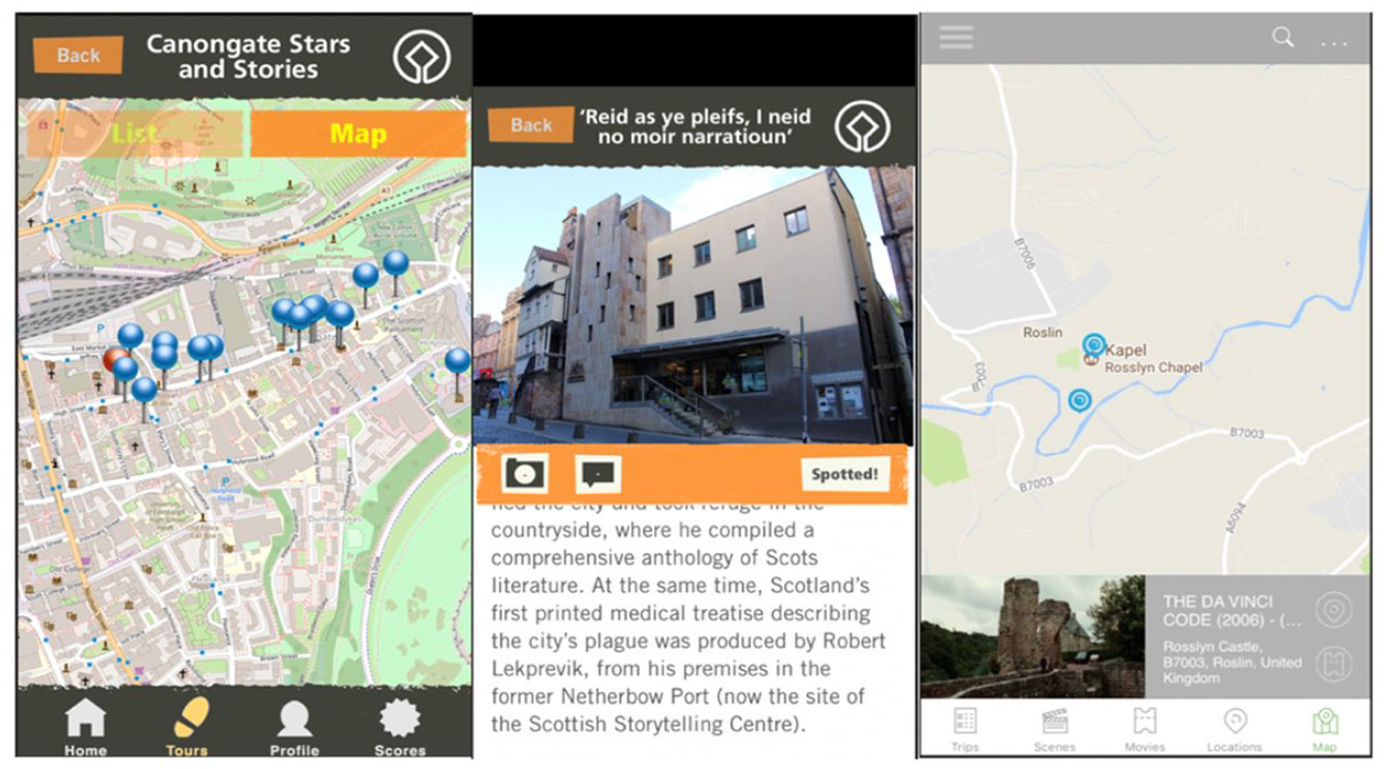
Examples of screenshots from the data set (left and middle: Edinburgh World Heritage City, right: GuidiGO).
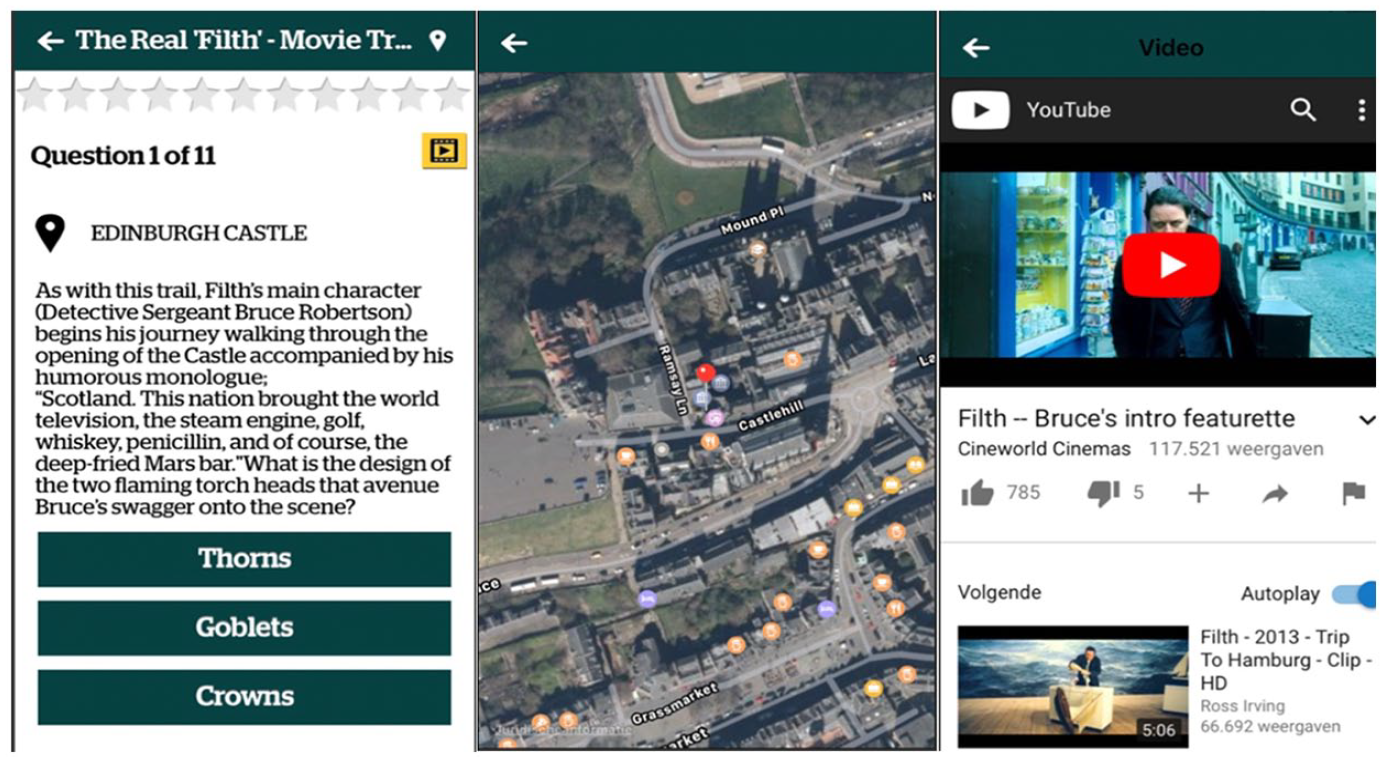
Screenshots from ‘The Real Filth’-tour on Global Movie Trails. Through quizzes and maps, you are led from one film-related location to another. On location, you are linked to a YouTube video of a scene taking place on that location.
A condensed version of platform analysis (PA) (Van Dijck, 2013) was used to analyse the screenshots. PA is a heuristic, qualitative approach towards analysing social media platforms (SMPs) that is especially helpful in dissecting SMPs into different components or characteristics. As such, PA offers multiple focal points on which researchers can focus when analysing SMPs. In this article, two components of PA have been used to analyse film tour apps, to explore what film tour apps consist of and how they shape engagement with place. Concretely, this means we have analysed (1) the technologies, construction and contents of the apps and maps and (2) their social use, or sociality, through an analysis of how the apps and maps create meanings about places and locality. The first component allows for exploring the functionalities of film tour apps, that is, what characteristics they consist of and what they ‘do’; the second component allows for exploring how film tour apps shape place-based meanings.
In analysing the first component, we examined the following aspects: (i) the technology of the digital film tours (cultural/technical protocols, interface, navigation tools, widgets, buttons); (ii) user agency (implicit and explicit participation, stimulation of active participation, constrains or empowerment of platforms; and (iii) content (standardisation of content and delivery, professional vs amateur content, comparison to traditional film tourism). These topics stem from Van Dijck’s (2013) PA foci and from previous literature on digital media and engagement with place (Ash et al., 2018). For the second component, sociality, we analysed: (i) how notions of place are (re-)addressed; (ii) co-creation of place; (iii) interaction with other tourists; (iv) re-enactment and performativity of place; and (v) performativity of incongruence. These topics stem from prior research that has explored how film tourism engages with place (Alderman et al., 2012; Benjamin et al., 2019; Schiavone and Reijnders, 2022; Schofield, 1996; Šegota, 2018; Torchin, 2002).
For data analysis we have employed Atlas.TI. We conducted three rounds of qualitative coding on the dataset of 1090 screenshots. This started with an initial round of open coding (Bryman, 2016), where the screenshots were first systematically analysed and categorised. This included, for example, identifying on a screenshot of an app a button which could be used by users for uploading self-made pictures, and coding it accordingly. Open coding was followed by a round of focused coding, in which similar codes were grouped together. For example, this included grouping together the code for uploading self-made pictures and the code for uploading self-made videos under a new code titled ‘uploading self-made content’. Coding concluded with a round of thematic coding in which code groups were linked to each other in order to develop overarching themes, comparing them to and using the two original PA components (Bryman, 2016; Hsieh and Shannon, 2005: 1281; Mace and Ward, 2002).
The following section presents an overview of the main findings, starting with a description of app functionalities and then highlighting how the apps shape engagements with place.
Results
Exploring the functionalities of film tourism apps
As the first author experienced during fieldwork in 2019, ‘The Real Filth – Movie Trail’ on the app Global Movie Trails takes users on a trail across the city, all the way to Edinburgh Castle. The app offers a quiz, where every question and answer leads users to another location related to the film Filth (2013). When deploying the app or map, and physically arriving at an indicated ‘node’ on the map – that is, a physical destination in the city – film stills and photos of the street pop up on screen, showing the location in different stages as depicted in the film. Embedded links lead to YouTube clips of scenes taking place at the exact location. Detailed information about hidden local gems is given when users further explore the app and continue the film trail. Users are also prompted to test and show off their knowledge of the film and location, for example by playing quizzes and sharing results on social media like Facebook. The Filth tour is revealing of the multiple functionalities of film tour apps and the diverse ways in which users can interact with their tourist destinations.
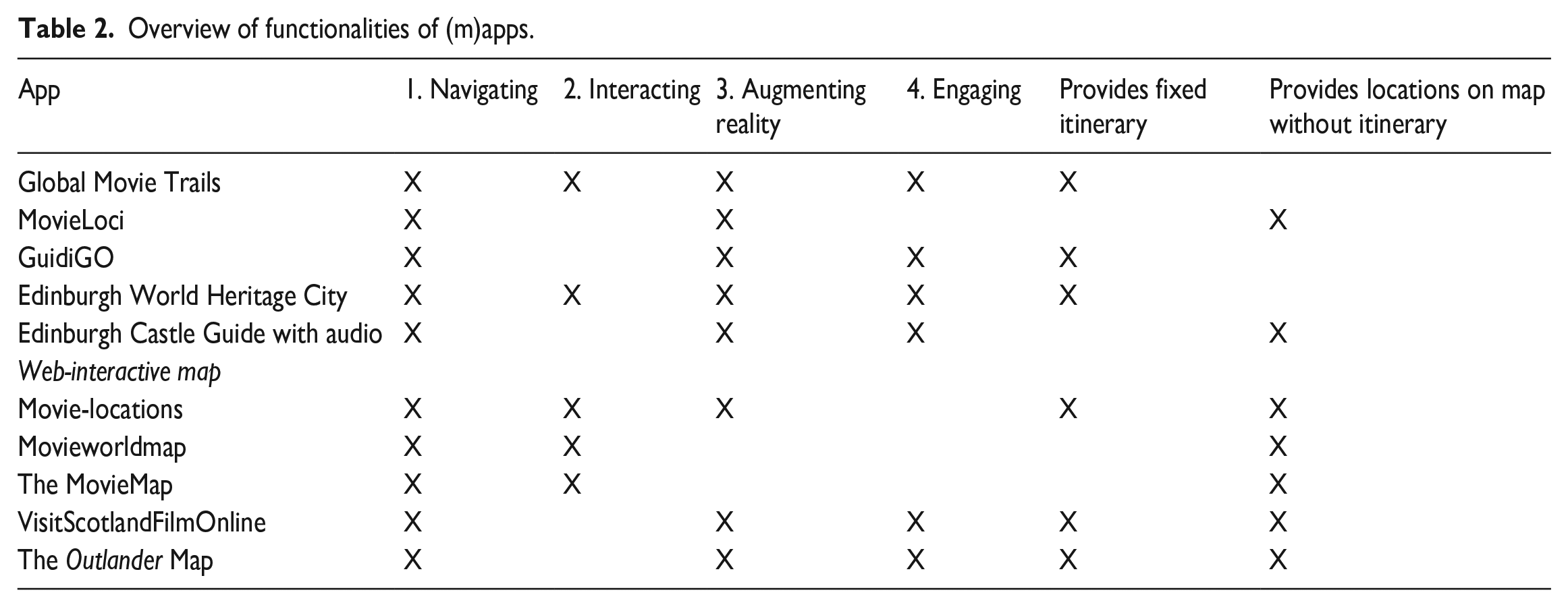
The following discussion presents the general functionalities of all analysed apps and maps, to maintain the brevity and clarity of the article. However, it must be noted that not all (m)apps share the same functionalities. Table 2 shows how the analysed (m)apps differ in that respect. Although the results are based on all analysed apps and maps, the discussion presents those examples which, in the authors’ opinion, most clearly illustrate the functionalities of the apps and maps, as well as how they shape engagements with place.
Overview of functionalities of (m)apps.
Navigating a tourist location through the media lens
First and foremost, and in their most basic operation, all apps function as a navigation tool – providing a map for tourists-turned-users for walking from one film-related location to another, as exemplified by Figures 4 and 5. Film locations are pinpointed on the map, by both the developers of the app as well as users. As Table 2 indicates, some film tourism apps and maps offer full itineraries that strictly guide users from one place to another, whilst others provide a map with pinpointed film-related locations which users can use to choose the order for visiting locations themselves.
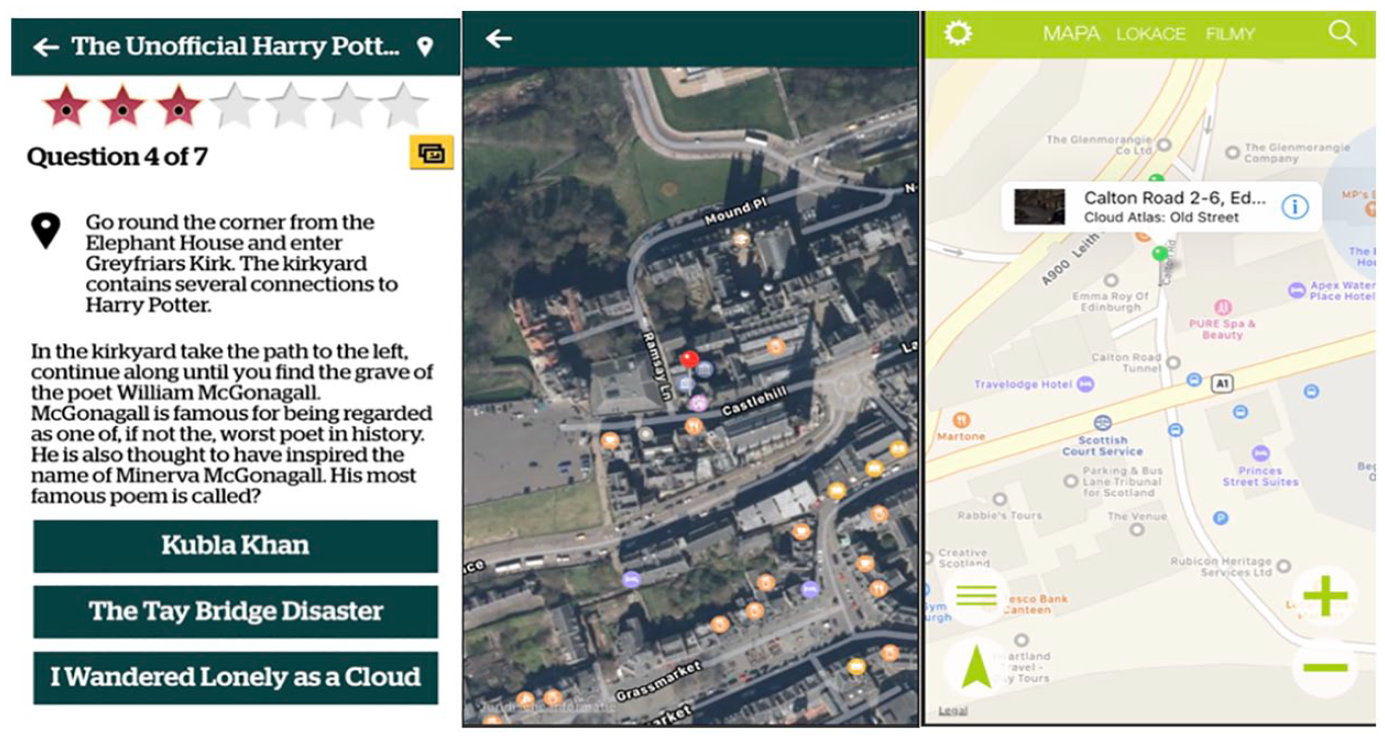
Examples of apps functioning as GPS navigator (left and middle: Global Movie Trails, right: MovieLoci).
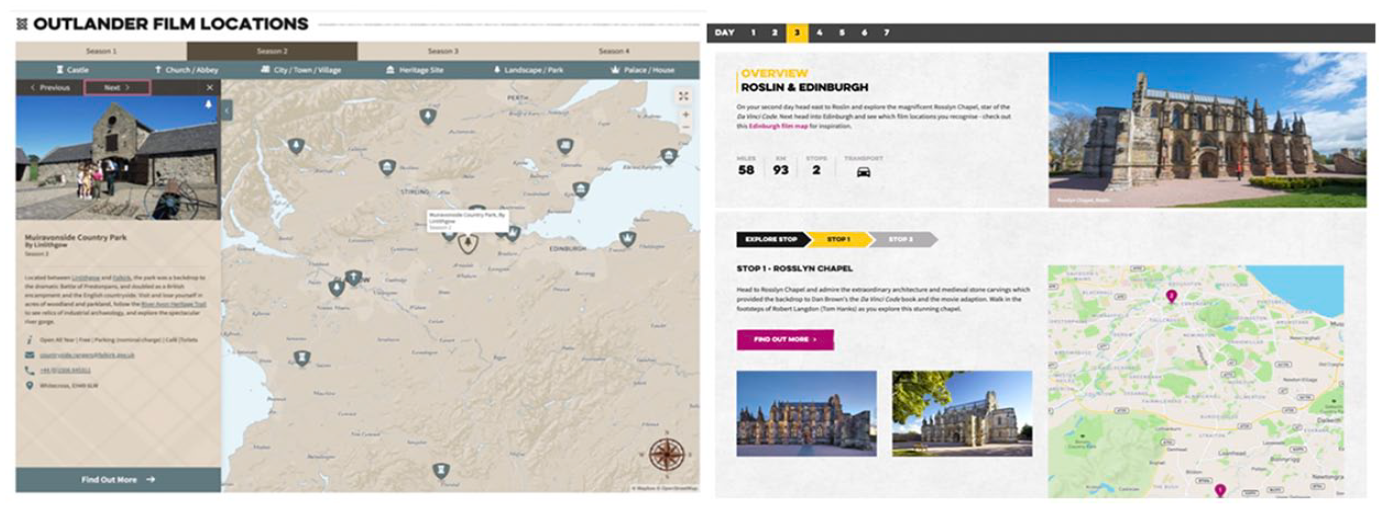
Examples of interactive maps functioning as GPS navigator (left: Outlander map, right: VisitScotland map).
Through the apps and maps, users can access and contribute to information on locations and their representation in films. As the first author experienced first-hand, film tour (m)apps help users navigate the spatiality of a place with reference to a film or series, and offer knowledge of a place in the form of practical tips and additional information, as shown in Figure 6. Whilst taking a film tour on a phone, a tourist learns about a destination, its logistics and infrastructure, and where certain buildings, streets, churches, schools, cinemas, shops, and other institutions are located (cf. Ash et al., 2018). Even though it might not be the main intention of undertaking the film tour, users are simultaneously familiarised with the area, as it helps them orient, navigate, and explore places (cf. Bork-Hüffer, 2016; Verhoeff, 2012). However, unlike normal maps or regular geolocation apps, film tour apps merge real and imaginative realities, offering a transcendental experience with consequences as to how place is understood, experienced, and engaged with by tourists. When helping tourists to navigate the city, film tour apps also recommend and encourage tourists to take in specific amenities, such as particular local bars, restaurants or (gift) shops, and other local ‘gems’.
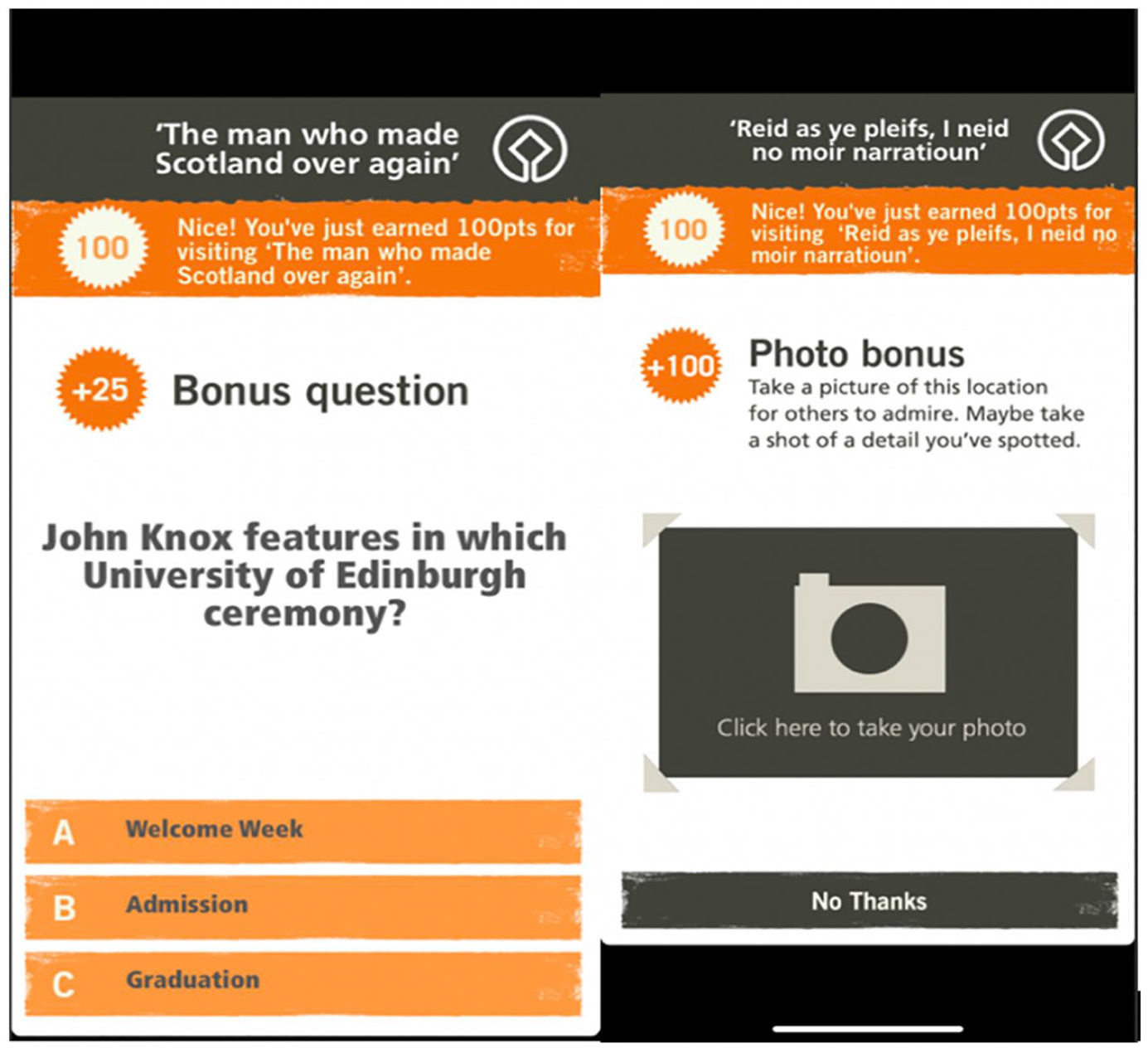
Screenshots from the Edinburgh World Heritage app.
For example, while participating in the ‘The Real Filth – Movie Trail’ on the app Global Movie Trails, the first author was directed towards a Christmas shop called Ye Olde Christmas Shoppe – located towards the bottom of the Royal Mile – which sells quaint and quirky holiday gifts. The directions were accompanied by a quote from Filth’s main character, who expresses his extreme disdain for Christmas. In the same tour, when continuing from Victoria Street to the High Street, the first author was led to the Scotland Storytelling Centre and encouraged to purchase several books the main character also reads. The apps and maps also provide opportunities to gain new – or test existing – knowledge on the media product itself. The filming and production processes of films and television series are well-documented on the apps and form a significant share of the content provided by the producers of the app. Detailed insider information on directors’ choices, set-dressing, music scores and trivia about the actors is shared. These capabilities are comparable to the information and context awareness capabilities of general tourism apps outlined in Dickinson et al.’s (2014) and Campbell and Kwak’s (2011) research, but with the added media dimension.
Interacting with a film tourism destination through play, online and offline
Users are also challenged to test their knowledge of a film location and media product, gamifying the experience of the film tourist and enhancing it through a system of gratification and rewards (Hofacker et al., 2016; Mulcahy et al., 2020). Some of the apps contain game elements, such as quizzes, receiving points, ‘stars’, or medals when answering questions correctly, seeing progression bars on continuing and completed tours, ranking on scoreboards alongside other users, and even earning real-life rewards such as price reductions on products. One example is the Edinburgh World Heritage app, in which users earn ‘points’ and receive cheerful encouragements and acclaim for leaving comments and pictures, as the following screenshots show:
Users of this app are quizzed on locations, local traditions and films while participating in a film tour. Through this, and through answer categories and elaborate answers, users test their knowledge and learn about a location. Users have an opportunity to make their knowledge of film visible to others, gaining status and reputation as a knowledgeable film tourist. Through gamification elements, tourists interact with other tourists as well, as the apps create an element of interaction and competition with other players. For example, in the Trainspotting tour on the Global Movie Trails app, when standing near the underpass at Carlton Road, one of the quiz questions reads ‘What contemporary Edinburgh Art Gallery can be seen through the archway of the bridge?’ The correct answer is Ingleby, and the app tells you that this building was formerly a music venue and nightclub that featured in Irvine Welsh’s novel Trainspotting. It also states that in the film Trainspotting, Ingleby was not used as the nightclub; rather, the Volcano Club in Glasgow acted as a substitute. Through this answer, a ‘false’ aspect from the film is indicated and information on a place is corrected (i.e. the Volcano Club is not representative of Edinburgh nightlife). Through this kind of ‘correcting’, tourist experiences can be enhanced as this promises insight into what is considered ‘authentic’ knowledge about Edinburgh. As MacCannell (1999) suggested, the search for authenticity and the ‘back-stage’ continues to be an important tourism trigger. Engaging with place through film tourism apps thus sets the stage for an intimate and authentic experience of a place, as tourists learn detailed, authentic facts about locations on the spot.
As shown in Figure 7, apps like Global Movie Trails and Edinburgh World Heritage City offer trails accompanied by quizzes testing users on their knowledge of a film and its location. These apps have reward systems, such as getting ‘gold stars’, ranking on scoreboards and progression bars. Some rewards spill over into the real world, as users can gain real-life rewards, such as a discount on a coffee in a local coffee shop or a present in a particular gift shop. For example, the ‘Trainspotters-tour’ on Global Movie Trails offers a digital ticket after completing the tour, which allowed the first author one free tea, coffee or juice from Muirhouse Library.
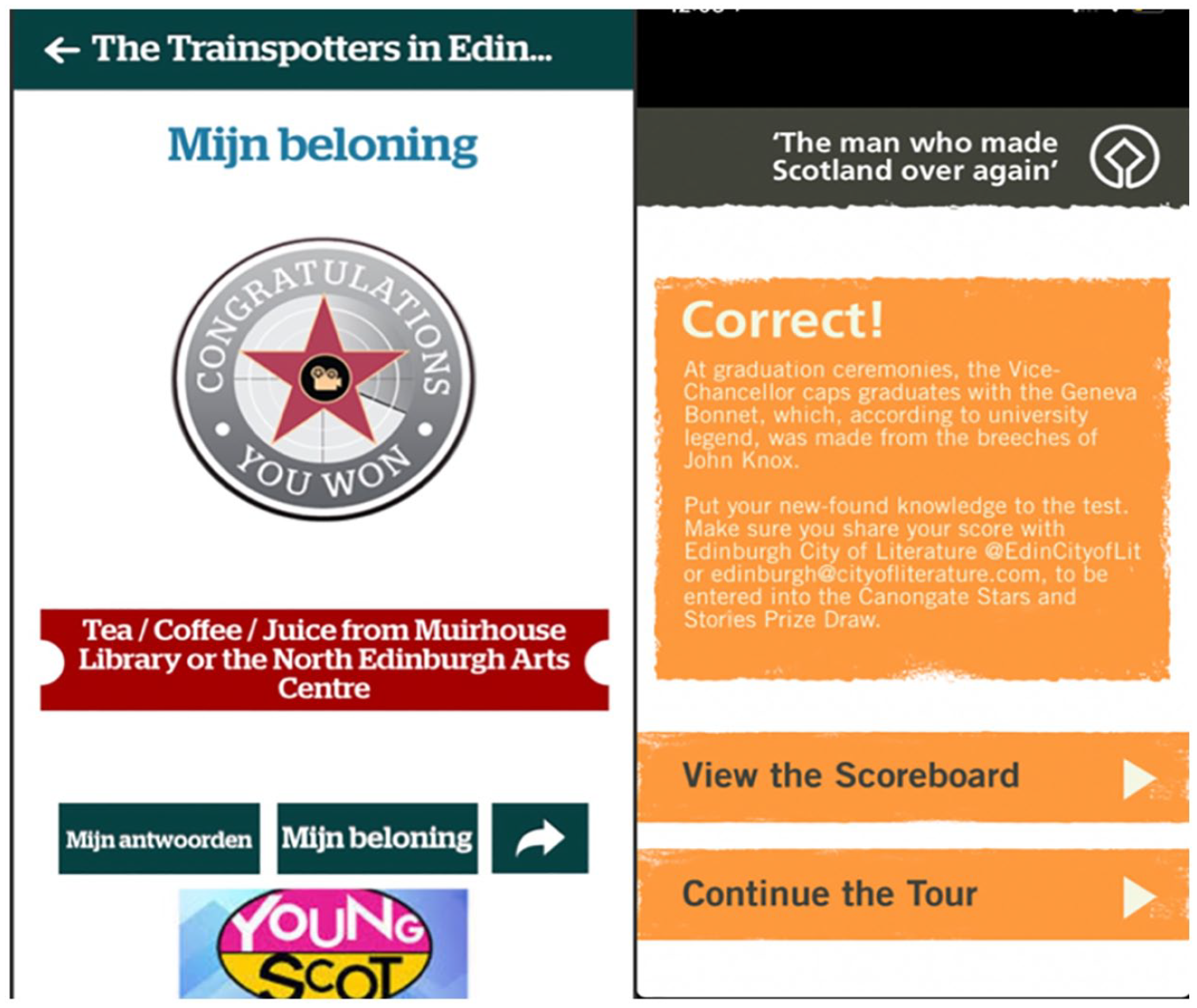
Real life rewards and scoreboards add a gamification element to the film tour apps (left: Global Movie Trails right: Edinburgh World Heritage City).
The local character of these locations is emphasised throughout the tours. By heavily referencing, recommending, and dangling a carrot in front of users – in the form of price reductions on products – these apps encourage users to visit and get to know certain places as locals know them, or more specifically what the apps – and in a broader sense, film narratives – conceive as being local knowledge. Through strategies which stimulate users to purchase goods or services, film tour apps directly connect tourists to local enterprises. It is these kinds of strategies that ultimately narrow tourists’ experiences, pointing them in a particular direction rather than presenting a wide array of local options. Moreover, film tourism apps, despite their initial promise of introducing tourists to authentic knowledge, are arguably organised around a ‘staged authenticity’ (Urry, 1995). Similar to regular tourism, film tourism apps are ultimately built to help tourists explore the ‘back streets’ and off-the-beaten track places (MacCannell, 1999), subduing their promise of effectively providing deeper, fuller, and more intimate experiences of place.
Compared to Dickinson et al.’s (2014) and Campbell and Kwak’s (2011) information and two-way sharing capabilities of smartphones in general, film tour apps additionally integrate a gamification element to their delivery of information – particularly on film, television, and media products – and this frames knowledge on locality. The commercial collaborations between app-makers and local businesses do, however, trigger the question of whether the information gathered from the apps is in fact a truthful reflection of local life in Edinburgh as experienced by its local citizens, or rather part of a marketing ploy concocted by app-makers and local businesses for commercial ends. This question is beyond the scope of this article, but deserves further attention.
Augmenting the reality of a media tourism destination
Film tour apps offer a form of augmented reality. Through different streams and kinds of information, notions and ideas about place are constructed, as places become embedded in different layers of social and cultural meanings. The film tour apps – and how they are operated by users – could be seen as ‘vaults’ of digital documentation of different versions of places at the disposal of the users, through which users can navigate and experience a tourist destination in different ways. Compared to the information capability of general tourism apps described in Dickinson et al.’s (2014) and Campbell and Kwak’s (2011) findings, film tour apps provide an augmented reality that entails a much more multi-layered and multifaceted experience of a destination. Users interact with each other through uploading and sharing their own content onto the app (such as photos or videos, see Figure 8), through in-app discussion boards, and through links to YouTube clips of film scenes and other social media, which creates a third party space for discussing with others (as shown in Figure 9).
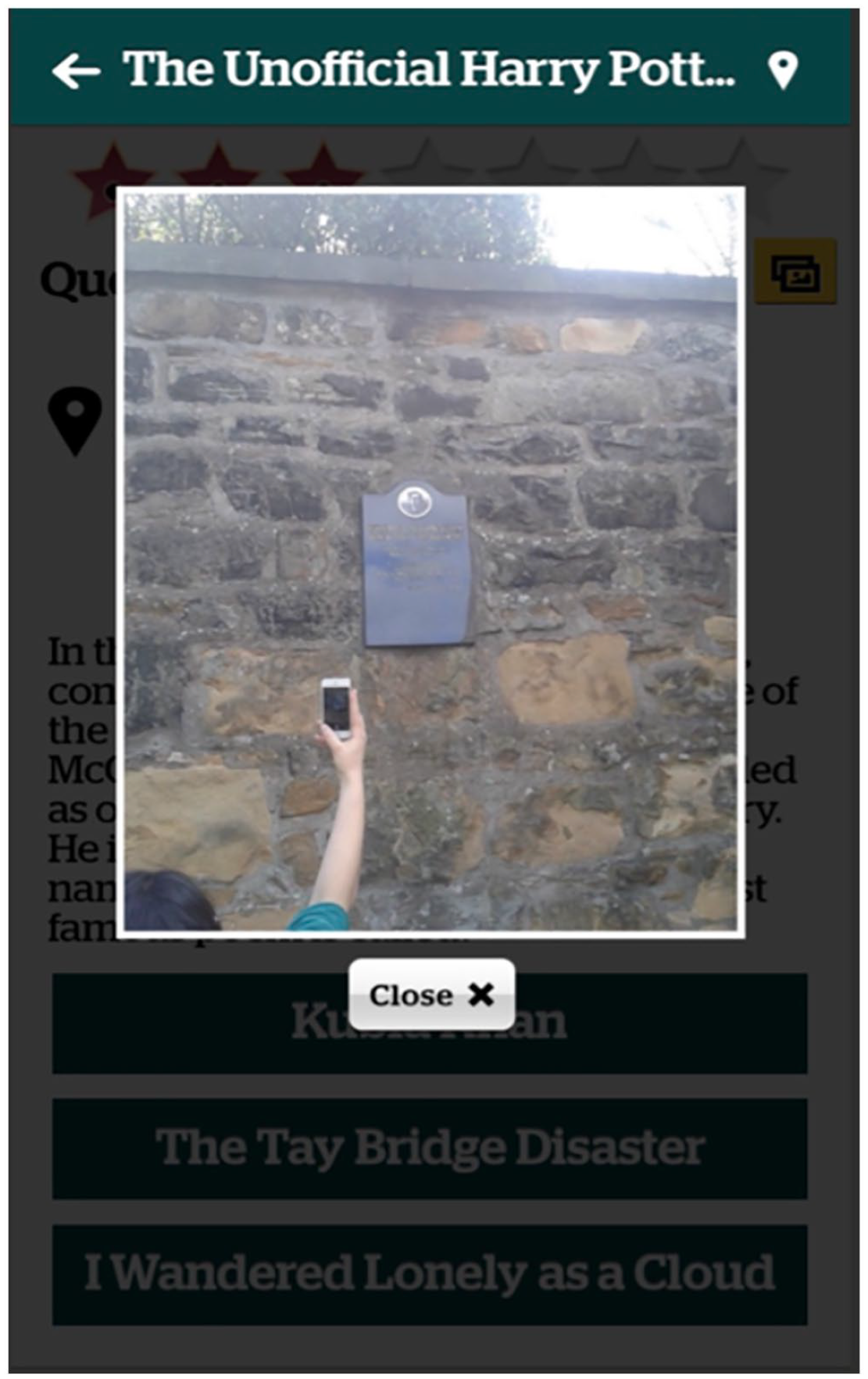
Example of user-added content on Global Movie Trails.
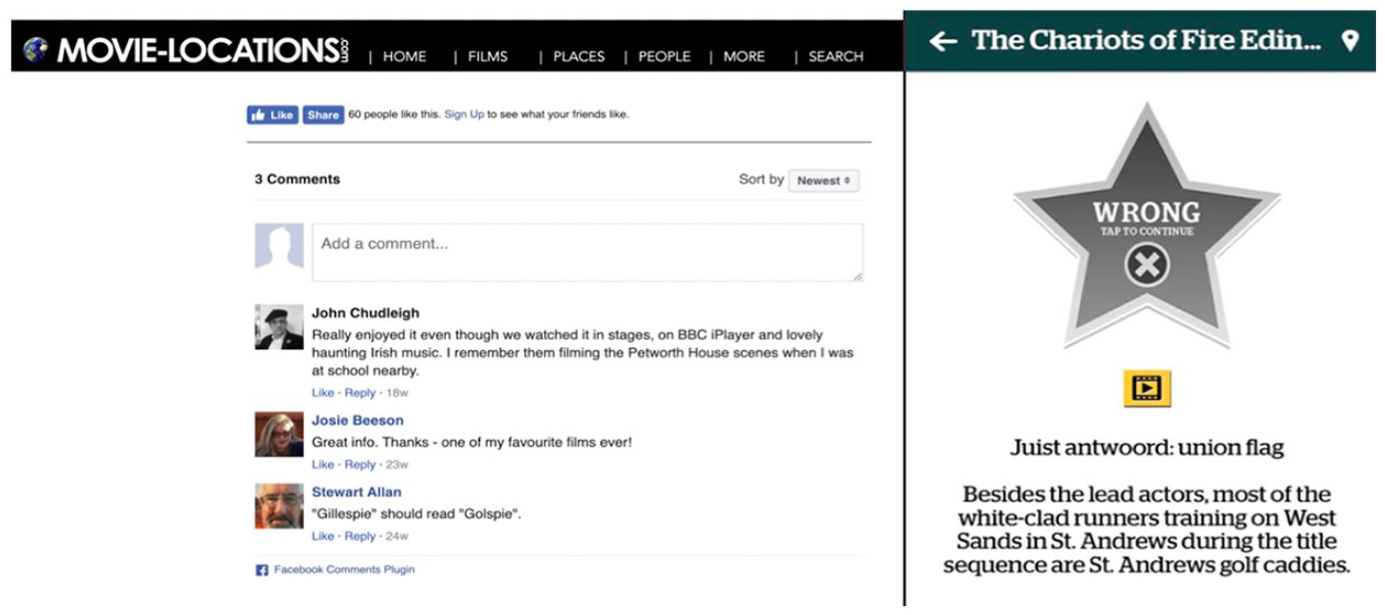
Designated comment sections, social media plug-ins and links to third party websites like YouTube provide space for connection and discussions (left: Movie-locations, right: Global Movie Trails).
Compared to Dickinson et al.’s (2014) two-way sharing and tagging functionalities of tourism apps in general, in film tour apps there is a clearer encouragement of prosumerism, as users are motivated to produce content. Prior research indicates that the digital is mediating and augmenting the production of space and transforming socio-spatial relations (Ash et al., 2018: 3). This holds true for film tour apps, but the engagement with film narratives and characters adds another dimension and embosses places through mediated experiences. Beyond merely helping users navigate, explore, evaluate, and experience places through digital interfaces, film tour apps offer tourists an engagement with places through lively retellings of and identification with fictional tales, spectacular visuals, and fictional characters. Finally, users are given the opportunity to share textual impressions of, and reactions to, their visits. Consequently, users become prosumers of the film tourist experience, for both themselves and for others, extending their active role in the co-creation of film tourism narratives (cf. Alderman et al., 2012; Benjamin et al., 2019). Some apps or maps make it possible for users to share their thoughts through designated comment sections. On The Movie Map, for instance, users put their experience into words, expressing dismay if a particular building looks different to its appearance in a film – for example, smaller, larger, or rather unremarkable – or not to their expectations. In these instances of discrepancies between imagined and experienced place, tourists express their displeasure at the difference between fiction and reality, a sentiment echoed in prior research where ‘findings suggest that the more perfect the representation of hyper-reality in the tours, the higher the satisfaction and the more enhanced the tourist experience’ (Carl et al., 2007: 49).
By using plug-ins from a third party like Facebook, or redirecting users to a third party – for instance YouTube – with its own comment sections, the apps and maps also provide a space that links and connect users to others. In theory, these options allot some degree of power to users in participating in the unveiling of realities, as they can contribute in establishing film tourism narratives to a higher degree than would be possible in traditional film tourism (Šegota, 2018; Torchin, 2002). As Bork-Hüffer (2016): 2158) already argued, geolocational technologies offer individuals more freedom and control ‘in the process of constructing new (and often highly personal) geographies’. This is seemingly the case for film tour apps, as users enjoy relatively more freedom and control in creating and consuming different versions of place, and in navigating the subjective associations and imaginations of places that consequently arise. However, users are ultimately contained within the structures offered by the app and its developers: as a user, you cannot go beyond the functionalities offered by the app or map, and must comply to the functionalities that are present, such as having to use Facebook to leave a comment. In that sense, users’ agency is tied to exactly these functionalities – and in some cases, third parties – that are presumed to increase users’ freedom.
Taking and uploading pictures on site, sharing findings with others, and engaging in a playful manner with place through quizzes are all part of the different embodied practices that film tour apps make possible, and show the discrepancies between mediated, representative space and real space. These embodied practices (cf. Benjamin et al., 2019) afford opportunities to shape and share one’s affective bond with the film location, in real time and in real places. Film tour apps consequently provide a space where conceptualisations of local place are addressed, corrected, and experienced in part by users. This close and inseparable intertwining of offline and online space that navigational apps offer (Bork-Hüffer, 2016: 2166) result in a deepened sense of place. In the case of film tour apps, it allows tourists to dabble in and embody the local life of Scotland, as understood by represented, mediated experiences of the place.
Engaging with place representations and identities through film
Getting to know a place and its amenities is not the only way film tour apps extend the experience of a destination. Film tour apps also allow tourists to get to know a destination through representations of lifestyles portrayed in film, which sets them apart from how destinations are experienced using more general tourism apps. The configuration with which film tour (m)apps function and are deployed by users casts a film layer over real-life places: users will see and experience places in reference to films (Schofield, 1996). Physical locations are navigated, re-viewed, and experienced through the lens of film by using the film tour app. These experiential practices provide an enhanced version of reality that goes beyond mere corrections of place. Film locations are recast in a different light: film and television become a portal to local knowledge and customs. Fictional characters’ habits, houses, likes, and the places they frequent are highlighted, extracted, and extrapolated to what is considered normal and typical for locals. This includes, for example, habits, mundane interests, or customs that are described as being typical for Edinburgh people. In several film tours offered by the app Movie, claims are made about what could be deemed as ‘typical’ for Edinburgh people. To illustrate, the Movie-tour focused on Sunshine in Leith takes users along some steps that connect the Old Town part of Edinburgh to the New Town. It is stated that these steps are ‘very congested, not helped by all the vendors [crowding together] there in summer’. This is framed by the app as a commonly-shared annoyance among Edinburgh people, as they ‘have been talking about an escalator there for years’. In the Trainspotting tour from the same app, the Hibs – short for Hibernian Football Club, Irvine Welsh’ favourite football team – are described as Leith’s locals’ favourite, and in the Sunshine on Leith tour, it is stated that the Grassmarket is the traditional gathering place for Hibs fans after a match, ‘whether they win, lose or draw’, supposedly ‘creating a magic atmosphere’. Milne’s Bar is mentioned as the local bar where many post-match drinks are consumed by local fans; the Mound is mentioned as ‘the place to be’ when it comes to playing games. Through describing what fictional locals are or do in film, an idea is created of what is typical for locals of that particular area. This immerses users into what is understood as local knowledge, through the vessel of – and identification with – cinematic local characters.
It is through this engagement with film narratives, stories, and characters that users are initiated and immersed into what is understood as localised or everyday local knowledge, such as what bars to visit and some of the concerns of the Edinburgh people. This is different from ‘traditional’ film tours, in which local knowledge tends to pertain mostly to national canonical repertoires (Schiavone and Reijnders, 2022; Šegota, 2018). The local knowledge that is constructed on film tour apps is based on lived experience; an apparent unfiltered notion of what it means to live in that particular place. It is supposedly popular, common knowledge shared by locals. Warning users that the Cockburn Street in Edinburgh – where two characters from Avengers: Infinity War end up living a quiet life – is phonetically pronounced as ‘Co-burn’ Street, the Movie app amusingly informs its users how to correctly pronounce the name of the street, to ensure tourists ‘don’t make a fool of themselves’. Knowing how to pronounce a street name correctly, knowing what desirable local bar to visit, and being aware of local concerns are framed as a particular kind of ‘expert knowledge’. In this sense, locals and tourists are recast as experts.
It should, however, be questioned what kind of knowledge or sense of place is constructed, as these apps have not been developed in a vacuum. Even though the apps and maps contain user-generated content, giving users a presumed vote in shaping the apps’ content, the bulk of information shared through apps stems from their developers. Many of the developers of the apps and maps are in fact from the commercial and/or public sector. Therefore, commercial – possibly even nation-wide, political, or governmental – agendas might be reflected in the localities that are constructed within and through the apps and maps.
Juxtaposing ‘real’ and ‘reel’
Media tour apps open up two avenues for shaping media tourism, by reuniting the ‘real’ with the ‘reel’ in two ways. First, they allow users to navigate seamlessly from the real world to the ‘reel’ one. Standing on Princess Street, Edinburgh, you will find yourself surrounded by plentiful well-visited shops, chain stores, many tourists, rushing locals and the occasional bagpipe player. It is an entirely different experience compared to the way the same street is portrayed in Trainspotting, where the police chase down the delinquent Renton, with his famous monologue about life narrated over the scene. Film tour apps frequently refer to this famous opening scene, one of the most iconic and memorable scenes from the film. As shown in Figure 10, stills depicting this scene this scene pop up on screen when using the app, as well as users’ uploaded personal photos of the street; embedded links direct users to YouTube clips of the scene, and accompanying blurbs of text further inform the tourist about Princess Street in relation to Trainspotting.
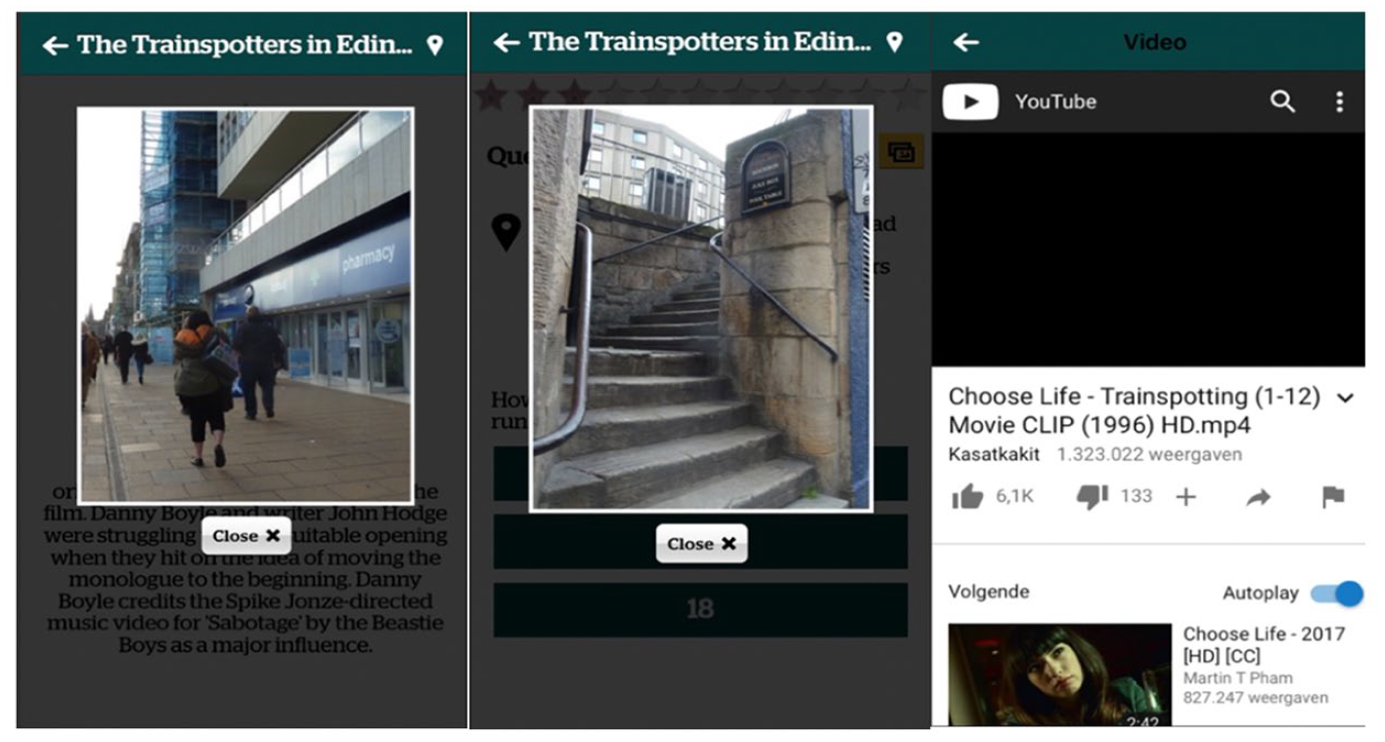
User-uploaded photos show the discrepancies between how users experienced locations and the way these locations are framed in film (Global Movie Trails).
This presents an intersection of the ‘reel versus real’. Film tour apps are correcting misrepresentations of reality in films, by showing the discrepancies between the reality of a place and how it appears on screen. As shown in Figure 11, there is a strong emphasis a strong emphasis on the artifice of the film, reminding tourists that it is a fabrication by cast and crew (Schiavone and Reijnders, 2022). For example, one of the apps features a visit to Dundas Street, which is shown in The Prime of Miss Jean Brodie. On site, it becomes very clear that contemporary Dundas Street looks nothing like its depiction in the film, which is set in the 1930s. It is revealed that the street was drastically altered during film production, for example by placing a steamroller and an ‘old style corporation transport bus’ in order to establish the 1930s time period. This kind of emphasis demarcates that there is a boundary between artifice and the authenticity of a location. This leads to the production of claims about truthful accounts regarding the place. As for how this could impact tourist experiences, research shows that screen tourists may enjoy experiencing the differences between the fiction and reality (Cooke and Stone, 2016), contradicting findings like those of Carl et al. (2007) mentioned previously. Cateridge (2015) already challenged the presupposed stark dichotomy between authenticity and artificiality in tourism, instead ‘granting tourists greater agency to negotiate between these two poles’ (p. 321). In this sense, film tour apps grant tourists greater agency to navigate between artifice and authenticity, offering immersion into – even embodiment of – the fictional and local, whilst also offering ample instances of ‘breaking’ the immersion by revealing the discrepancies.
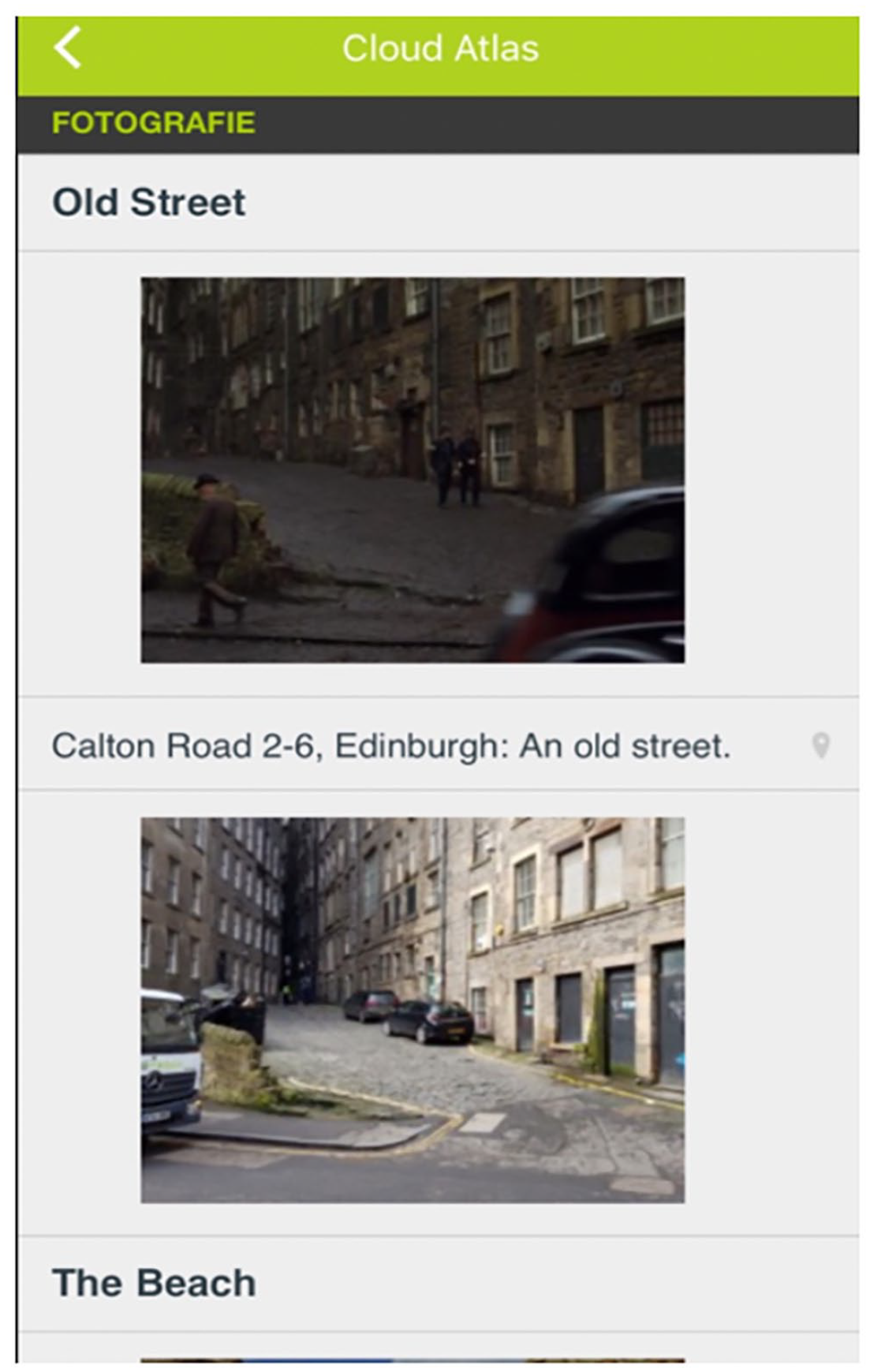
The comparison of a regular picture of the street and the movie still shows the alterations made to the street for filmic purposes (MovieLoci).
Beyond participating in quizzes, the apps offer film tourists the opportunity to engage in acts of addressing and correcting inaccuracies themselves, showing their knowledge of both the film and location. Pointing out inaccuracies is very popular on the apps; for example, famously known for its many inaccuracies, the film Braveheart is first introduced on Movie-Locations as Mel Gibson’s ‘two-dimensional tale of Scots hero William Wallace [with a] reckless disregard for historical accuracy’. Addressing inaccuracies serves as a way of correcting and making a claim about what is supposedly real. For instance, the discrepancies between physically standing at Cockburn Street and the way it is portrayed in Avengers: Infinity War are highlighted in the map Movie-Locations, which humorously remarks how extraordinary it is that characters ‘Wanda and Vision live in a famously touristy part of the city where you’re never more than 50 yards from a set of bagpipes, though the streets seem oddly deserted and oddly quiet’. A picture of the tourist-filled street is shown, presenting a stark contrast to its imagined, mediatised counterpart which shows an oddly calm, non-touristic area.
Users are heavily engaged in this process of shaping place: they are actively called to share their corrections by taking and uploading photos and engaging with other users. These pictures show the place exactly as they experienced it, in contrast to how it is shown in film. Such corrections can be spontaneous, but also guided and encouraged by the apps themselves. For example, one of the quizzes on the Edinburgh World Heritage app encourages users to take a picture of the Scottish Storytelling Centre, formerly the Netherbow Port, which holds relevance to 16th century Scottish literature and serves as the inspiration for a number of films and series. Users are motivated to upload their pictures to share with other users, in turn earning ‘points’. These pictures highlight the often-contradictory reality of a place compared to its mediatised counterpart, perhaps moreso in comparison to traditional film tours (Schiavone and Reijnders, 2022), resulting in a constructed dichotomy between what is considered factually accurate and what is fictitious regarding a location.
The second way in which film apps allow users to navigate between real and reel worlds is by undoing the seamless narrative of place created in films, revealing how different locations might be woven into a unified realistic yet fictional location. The Movie-Locations’ One Day (2001) film map alludes to this, stating ‘this is only the beginning of a complex patchwork of locations seamlessly knitted together to form one city’. Film apps allow film tourists to recognise and gain awareness of this ‘patchworked’ locality that, paradoxically, consists of myriad places from around the world. Moreover, film tour apps themselves connect locales, cities, regions and even entire countries through precisely these processes, using the films or series that tie these locales together. The discrepancies between what could be considered realistic and what is part of the fiction in film tour apps are clearer than within traditional tours, as during the latter tourists must often rely on their memory of a film, or on the recollections and narratives of the tour guide. On film tour apps, tourists can visually observe and dwell on the discrepancies for themselves through text and visual ‘evidence’. The interface of film tour apps thus allows for this kind of ‘confrontation’ between what is arguably factual and false. Rather than the conflation of mediated and real space reconfiguring our ideas about place (cf. Schofield, 1996; Šegota, 2018), it is through contrast and juxtaposition of these two realms that places are shaped.
Discussion and conclusion
Digital locative media and their different uses are ubiquitous, as they are increasingly part of our everyday lives and fulfil a key role in shaping a sense of place, people’s place perception, their engagement to place, and how they open up possibilities for socialities. It is only logical that film tourism industries follow suit in an attempt to cater to audiences and their changing consumption and leisure activities. In this article, we have used platform analysis to distinguish and analyse the functionalities of film tour apps in Scotland, and how they further impact engagements with place.
Film tour apps share many of the capabilities that more general tourism apps also possess, such as the functionality to deliver information, context awareness, and two-way sharing and tagging (cf. Campbell and Kwak, 2011; Dickinson et al., 2014). Specifically, we found that film tour apps and maps (1) navigate a tourist location through the media lens; (2) interact with a film tourism destination through online and offline play; (3) augment the reality of a media tourism destination; and (4) engage with place representations and identities through film. We found that film tour apps integrate a gamifying element to the delivery of information, encourage prosumerism by inviting users to produce and share film-related content, and provide a multi-layered and multifaceted experience of acquiring information about a destination. These functionalities of film media apps, we argue, contribute to shaping how a user would engage with place. First, they contribute to a multi-mediated, multi-layered experience of place through the lens of film. Film tour apps help tourists navigate a place through practical tips and information; they allow tourists to get to know a destination through the local lifestyles represented in film and television; and they offer tourists a multi-faceted experience of a destination that is built from different local spots and locales around the world. The touristic experience of a destination is also changed, as experiencing a destination through the lens of a media product reunites – but also disentangles – the ‘real’ with the ‘reel’, revealing patchworked locations. Second, film tour apps afford new ways of experiencing a destination as a film tourist, by testing or extending tourists’ knowledge through gamification, allowing them to share film tourism knowledge and experiences, and engaging them in tourist prosumer practices.
It is through these functionalities and experiential practices that users engage with place in a way that is significantly different than how tourists engage with place in traditional film tours. With a strong focus on correcting misconstrued imaginings from film, on creating local knowledge pertaining to place, on the visibility of users’ input, and on the multi-mediated comparison of imagined and real place that is afforded by how the apps are operated, a synthesising account of place is shaped which is formed by tensions between truth and fiction, film and reality, production/artifice and authenticity, structure and agency, and between app developers’, tourists’ and film productions’ imaginings of that place. This account of place differs from what is seen in traditional film tours (cf. Schiavone and Reijnders, 2022; Šegota, 2018); instead of the canonical repertoires of 18th and 19th century Scotland, an updated, contemporary perspective of the city emerges. We see a perspective arising which is local, small-scale, and sensitive to what locals find important or interesting or what is popular among locals; one that follows the interests of ‘normal’ Edinburgh people, that is, normal film characters, rather than historical figures from the 18th and 19th centuries who receive most attention in traditional film tours; and one that is co-construed by locals and users. What is more, these experiences of place are co-produced by different parties, enhancing the affective dimension as users co-create the experience of place, which is fed by users’ personal experiences, associations, and input, but also by app developers and third parties (e.g. shop owners who collaborate with developers).
Acknowledging the relative freedom users have in co-shaping the content of the apps and maps, we also want to highlight how the functionalities of the apps – and their infrastructure more generally – eventually hamper user experiences and freedom. Ultimately, the apps and maps are created by developers with commercial interests and aims of garnering traffic for their apps and maps. The functionalities of the apps and maps all work to extend users’ attention span, aiming to maximally engage and expose users to the app for commercial ends. This notion becomes particularly crucial when considering that apps and maps make claims about what is local, truthful, or typical of the people of Edinburgh. In addition, film tour apps are confined to the boundaries set by the film or series, and film and television series – perhaps unintentionally but inherently – construct an idea of a place informed by the social, cultural, economic, and political contexts of the film industry. Therefore, user possibilities are eventually fixed within parameters. The user of the app or map shifts through this configuration: they might have some freedom in addressing place – such as correcting misinformation, or providing their own input in the form of uploading photos, videos and comments – but they remain confined to the boundaries set and determined by app developers and, on a larger scale, film industries. Ash et al. (2018: 8) framed this structure in which users navigate within and through digital media as a ‘particular geographic domain with its own logics and structures’, which affects people’s engagement with place as it digitally mediates their experiences with and of places. In all their efforts to maximise users’ agency, especially compared to traditional film tours, apps and maps ultimately provide set boundaries in a fixed infrastructure, within which users have relatively little room for navigating with freedom.
This article has focused on the operation of film tour apps in Scotland, a country that contains many places and locations that have been used as film locations. Although we have focused specifically on screen tourism apps, similar tourist apps do exist, such as heritage tourism apps using archival footage, or walking tours typically focusing on old cinemas in city spaces like London, Manchester and Glasgow. Further research could explore the overlaps and discrepancies between these apps and the types researched in this article. It also remains to be seen how film tour apps affect engagement with place in other national, cultural and social contexts, or in different types of media tourism practices, such as music tourism or literary tourism. Moreover, this research has centred on the apps themselves, concentrating on their design and functionalities and the potential they open up for co-creating media tourism experiences. Future research should further investigate users’ experiences of the apps, exploring how users engage with, use and contribute to the apps to co-create their tourist practice. Furthermore, additional research could investigate the potential for film apps to support new media tourism practices that rely less on the physical mobility of the tourist, and more on their imaginary transportation to film sets and locations, via the intermediary of digital technologies.
Footnotes
Funding
The author(s) disclosed receipt of the following financial support for the research, authorship, and/or publication of this article: This project has received funding from the European Research Council (ERC) under the European Union’s Horizon 2020 research and innovation programme (grant agreement No. CoG-2015_681663).
