



Abstract
The guided tour industry has undergone drastic changes in China along with the socio-economic, demographic, and technological developments of the past decades, leading to new demands on the tour guide profession. The COVID-19 pandemic has further accelerated the changes. Yet little is known regarding how the tour guides’ roles have evolved. This study aims to fill this gap through exploring new roles and services undertaken by tour guides, drawing on qualitative data (in-depth interviews) from both tour guides’ and tourists’ recent guided tour experience in China. The findings demonstrate a continuum of roles of the guides, ranging from “the serving roles” to being “the ones who facilitate changes.” Five main driving forces were identified, namely: the tourists’ customization needs, demographic change, rapid ICT development, increased special interests, and the pandemic and tourists’ favor in remote destinations. Instead of expecting serving roles only, the Chinese tourists now welcome roles that can foster positive changes, reflecting Chinese tourists’ motivational shift to having eudaimonic experience through traveling.
Introduction
Traditionally, the main functions of tour guides are to guide tourists through geographical space and arrange for places to visit, to disseminate tourist information and mediate their experience (Pearce, 1984). Most prior studies of tour guides adopt a functional perspective to discuss their roles as pathfinders, ambassadors, buffers, interpreters, culture brokers, mediators, mentors and advisors (e.g. Ap and Wong, 2001; Cohen, 1985; Wong, 2013), the practicalities of tour delivery (Geva and Goldman, 1991; Huang et al., 2010; Pond, 1993), as well as the styles and behavior of tour guides (Ferguson et al., 2016; Xu et al., 2023). The changing socio-economic, demographic, and technological trends have been re-shaping the guided tour industry substantively. Among all, technology has been the biggest transformer of the tourism industry (Bowen and Whalen, 2017). Applications such as digital guides and google maps have greatly empowered the tourists to travel independently and replaced some of the guide’s traditional functions such as on-site presentation and path-finding (Bryon, 2012; Lyu and Hwang, 2015). Furthermore, tourists are becoming increasingly sophisticated and experience-oriented (Weiler and Black, 2015), while part of the tour guides’ service in this regard has become optional, consequently weakening the value of its economic offering. Other environmental factors such as the outbreak of COVID-19 has been a powerful catalyst, further changing the tourists’ travel behavior (Sigala, 2020), and imposing new demands on tour guides. The above changes have made some conventional roles of tour guides partially irrelevant or obsolete (Ren, 2022; Ren and Wong, 2021). It is thus timely to investigate how guides’ roles have evolved when there is a high degree of integration of ICT in traveling as well as more robotic and automated services are available in the tourism industry, in addition to all those social, political and economic macro changes that are happening worldwide.
However, facing the global macro changes, little is known about the changing expectations of the tourists regarding the preferred roles to be performed by guides. Thus, the purpose of this study is to understand the changing roles of tour guides, in response to the tourists’ changing demand on tour guiding service. To achieve this objective, the study adopts a qualitative approach and draws on thematic interview data from two stakeholder groups—16 experienced tour guides and 16 tourists. The research locus is mainland China, a conspicuous tourist source market in terms of both volume and growth rate. China has become the largest source of outbound tourism in the world (World Tourism Organization, 2019). The result of this study has potential in updating the existing knowledge of the roles of tour guides. Practically, the result may provide implications to tourism operators and marketers, and it may also lend support for future manpower trainings as well as recruitment.
Literature review
Cohen (1985)’s study of the role of tour guides is probably among one of the earliest. It identifies four major roles, including instrumental (management, organization, and leadership), interactional (mediation, relationship facilitation, and representation), social (group cohesion, entertainment, and socialization), and communicative (information provision, interpretation, and presentation). Since then, a good number of relevant studies has been made, approaching the topic from different angles, particularly research on guides’ roles and their respective functions, including but not limited to information provider, storyteller, pathfinder, culture broker, entertainer, translator, salesperson, docent, actor, ambassador, buffer, caretaker, entrepreneur, intermediary, interpreter, leader, manager, organizer, host etc. (e.g. Ap and Wong, 2001; Cetin and Yarcan, 2017; Prakash and Chowdhary, 2010; Ren, 2022). A few studies have focused on the Chinese tourists’ feedback on tour guides’ service. Zhang and Chow (2004) conducted a study among 500 Chinese tourists visiting Hong Kong on guided tours, with the purpose to understand what attributes and services of the tour guides best satisfied them. Their study revealed that the Chinese tourists preferred tour guides who took a humbler stance and could perform the serving role well. This finding was echoed by Huang et al. (2010), whose study revealed that the Chinese tourists emphasize the importance of the tour guides’ service roles, including intrapersonal and interpersonal “servability.” The former refers to the innate features and quality of a tour guide such as displaying both a proficient knowledge and a suitable personality, as well as the passion that is needed to serve the tourists well. The latter represents the interpersonal and relational aspects of serving clients, such as generating an engaging rapport and organizing interesting activities.
However, the above findings only provide a partial snapshot of Chinese tourists’ behavior. As the economy developed rapidly in China in recent decades and as Chinese tourists travel more both domestically and overseas, their travel behavior has been changing (Dichter et al., 2018). Dichter et al. (2018) did an investigation among 2000 Chinese tourists who engaged in outbound tourism, and reached a number of conclusions. Instead of focusing on service quality, the Chinese tourists are now more experience-oriented (Dichter et al., 2018). Guiding service is no longer a compulsory service when one travels, rather a patronage is made only when it can add value to the overall tourist experience (Ren, 2022). In this regard, the dominating notion is still to serve well. This is perhaps the reason why tour guides are primarily perceived as people who serve, lead the way, and do the introduction, so as to fulfill the tourists’ desire for understanding a place and enjoy themselves at the same time.
Both the European Federation of Tour Guides Associations (1998) and World Federation of Tourist Guide Associations (2014) defined similarly a tour guide as a professional who guides around venues of interest or places of historic, cultural, social and natural significance, interpreting those places in a knowledgeable, inspiring and entertaining manner. Guides have been compared to performing artists as both are requested to entertain their audiences. In fact, the “customer is always right” stance is widely adopted in the service industry. Kim and Baker (2020) report that many service enterprises cherish the value of “service recovery.” Even if customers voice unfounded illegitimate complaints, service providers should not hesitate to provide compensation in order to please and retain customers. By the same token, it is not surprising to see why guides need to please and satisfy tourists. The fact that guides take the role as “agents to serve” and work under a “quasi-slavery mode” has become a tradition in the guiding structure in order to generate a favorable guiding outcome and to avoid difficulties and complaints (Dahles, 2002; Garner, 2017; Wong, 2013).
While tour guides’ serving role is apparent, guides’ power to introduce positive changes to tourist’ behavior is getting noticed. Ong et al. (2014) report that UNESCO specialist heritage guides’ trainings offer the needed guiding capacity for tour guides to introduce positive changes to tourists’ behavior in terms of safeguarding heritage assets. Tilden (1977) and Hollinshead (2009) both suggested that, guides and tourism possess the power of world-making and should serve as “agents of change.” The motivation could be to alleviate poverty, correct social malpractices and tourists’ misbehavior through guiding as a form of reeducation. When “pleasing tourists” is no longer the exclusive objective, tour guides adopt a different stance to host tourists, which is consequential to guides’ narratives, their interpreting style and the elements to be included in a tour itinerary, in which a degree of “negotiated view” and “oppositional view” may be noticeable (Hall, 1980; Wong, 2013). Weiler and Black (2015) also report that there will be a shift in tour guiding communication. According to them, instead of performing one-way communicating role, tour guides need to choreograph different experience elements to satisfy tourists, including brokering or mediating physical access, encounters, understanding, as well as empathy (i.e. emotional access). In this way, tour guides serve as experience brokers, who actively devote their efforts to broker tourists’ experience. This brokering process involves tour guides’ intervention and even controlling in various aspects, including mediation of tourists’ inner journey during the tour process (Weiler and Black, 2015).
Xu and McGehee (2016) corroborate that tour guides would have a higher sense of job satisfaction and intrinsic awards if their work can be accomplished with a higher sense of autonomy. Christine and Mason (2010) concur and state further that, in the context of ecotours, tour guides should lead to change, and be able to take on a role as an education agent who is capable of delivering something more than a superficial introduction to a new environment. Irimiás et al. (2021) have taken the concept further in the context of TV-series themed tours. Apart from brokering between tourists and the destination physically, socially, intellectually, and emotionally, the tour guides in this context mediate between “different dimensions of space and time” (Irimiás et al., 2021: 1). To do so, a tour guide takes on additional roles such as being a director who organizes activities of reenactments of TV scenes, or as an elicitor who elicits right emotions at the right places and moments (Irimiás et al., 2021). In addition to Weiler and Black’s (2015) four brokering aspects, Parsons et al. (2019) report an additional role that tour guides can play in brokering tourists’ experience—facilitating tourists’ self-development in the context of spiritual tourism. In leading tour groups of this nature, tour guides create favorable circumstances in which tourists can achieve self-development, including pre-travel preparational communication, enclave development, mentoring, reflective guiding during travel, and integration after travel. In doing so, tour guides play an important role in helping tourists to immerse in spiritual tourism and achieve self-development (Parsons et al., 2019).
The other side of the coin is that the above expanded roles of the tour guides naturally entail varied knowledge, skill, as well empathy capacity. For example, in the context of TV-series themed tours, the tour guides need to mediatize between multidimensional realities to foster moments that contain symbolic meanings for the tourists, so the guides need to be able to fully understand those meanings first (Irimiás et al., 2021), and why those meanings would be important to the tourists. While the extant research documenting the above expanded roles and capacity of tour guides is informative, those studies are either based on archival research (e.g. Weiler and Black, 2015) or grounded in a relatively niche context (e.g. Irimiás et al., 2021). Investigation in a more general context thus is timely to verify as well as to further explore how the tour guide roles have expanded and evolved.
Methodology
This study adopted a qualitative method, with in-depth interviews as the main data collection device. Qualitative method allows the researchers to understand the worldviews, perceptions, and rationales of the interviewees, and is apt when the researchers seek to “establish the meaning of a phenomenon from the views of participants” (Creswell, 2009: 16). Sixteen experienced tour guides were invited to give an account of their experience in tour guiding (Table 1). Their observations on their new roles that have been getting increasingly important were of particular interest. All 16 tour guides were Chinese, with a diversity of background. Three out of the 16 were free lancers, and did not tie themselves with any particular companies, one owned a travel company but served as a tour guide as well whenever necessary. The remaining guides held formal contracts with travel agencies. They were recruited from different provinces of China, including Shanghai, Beijing, Sichuan, Zhejiang, Guangdong, Fujian and Xinjiang. The interviewees were recruited via the researchers’ personal connections and acquaintances’ referrals.
Profiles of the tour guides.
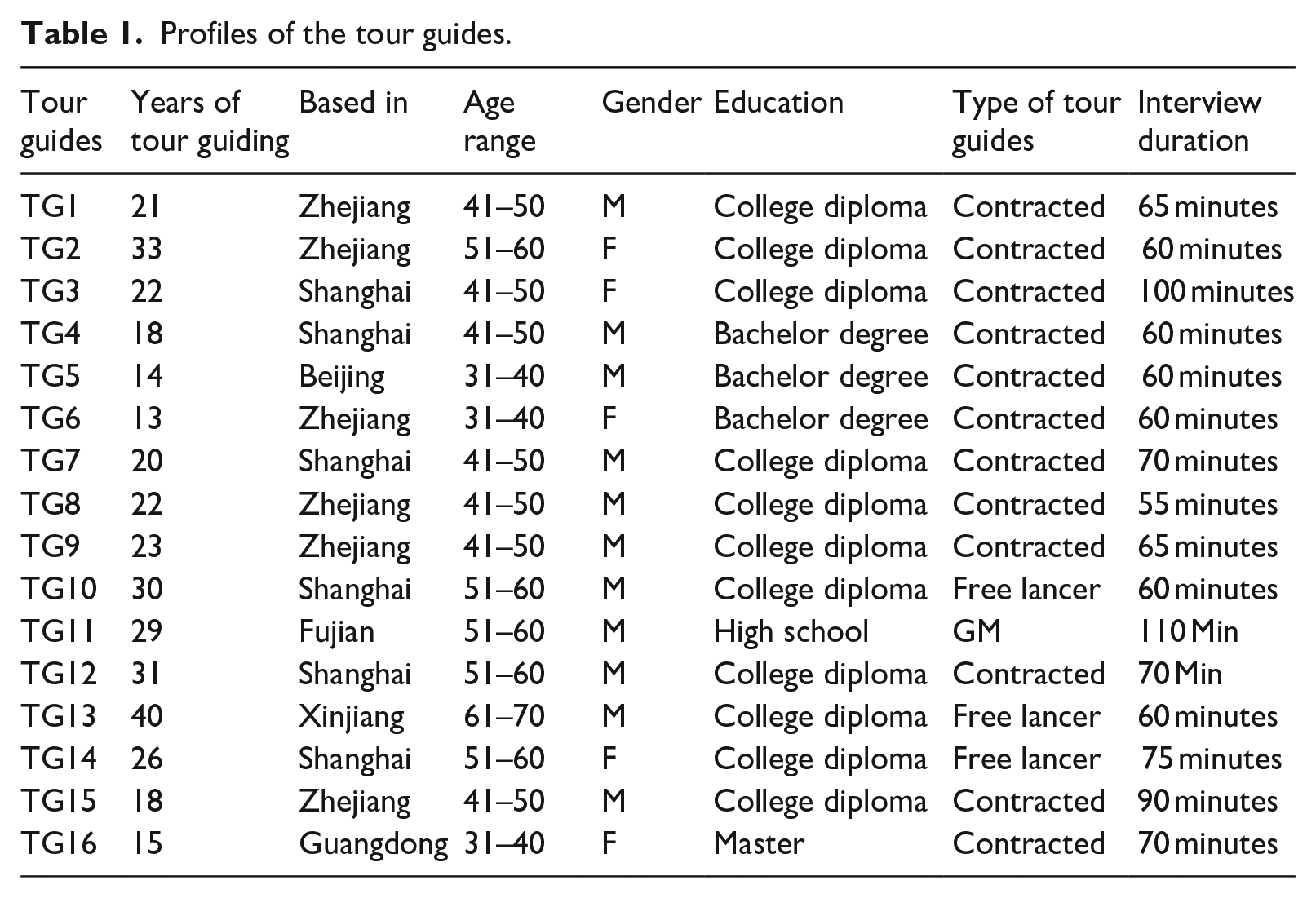
Special care was undertaken to ensure validity in qualitative research as suggested by Denzin and Lincoln (2003). All researchers of the current study had prolonged engagement in tour guiding research, the first author herself had years of guiding experience before she joined the academic. The research team’s long-term understanding of the guiding industry, along with the cross verification of findings among the team members, contributes to the credibility of the study. Although most tour guides and tourists were recruited via referrals, the researchers ensured the participants of the research purpose as well as anonymity. One of the valuable features of doing qualitative research is to allow researchers to unearth the salient meanings that are beyond the observable structure of a research phenomenon. Inviting interviewees via referrals is one of the ways to allow those insiders to share their insights under the circumstance when trust and rapport could be built. Thus, inviting friends’ referrals to participate in the current research would enhance the depth and richness of the data that the research team is delving into. Nevertheless, the research team was careful in selecting candidates in order to ensure that various voices were received from interviewees who had different demographic and social backgrounds. The interviewees were initially contacted via WeChat, the most popular social media and messaging platform in China at present. All interviews took place in 2021. Apart from two interviewees who took the face-to-face interview mode, the remaining tour guide interviewees were interviewed via WeChat video calls, due to the travel restrictions and social distance requirement of this pandemic (COVID-19) period. While conducting online interviews was a strategy due to the COVID-19 pandemic, the researchers were aware of the limitations of this method. Unlike face-to-face interviews, online video-call-interviews are less easy for the researchers to observe all of the participants’ body language and the rationales behind due to the limited view scope of webcam (Janghorban et al., 2014). Thus, the researchers spent more time in the pre-interview stage, chit chatting and getting familiar with the participants. The interviews were conducted in Mandarin, on average lasted for 1.5 hour, recorded upon consent, transcribed verbatim and translated into English shortly after each interview. The main guiding questions that were used for the interviews include (1) What is the general trend of the tour guiding service in China? (2) What service do the Chinese tourists expect from you now (as compared to the past)? (3) What emerging roles have you noticed and how do you and the tourists perceive about those new roles? (4) What do you think has caused these changes? Probing questions were further asked revolving around the above questions and the central theme of this research.
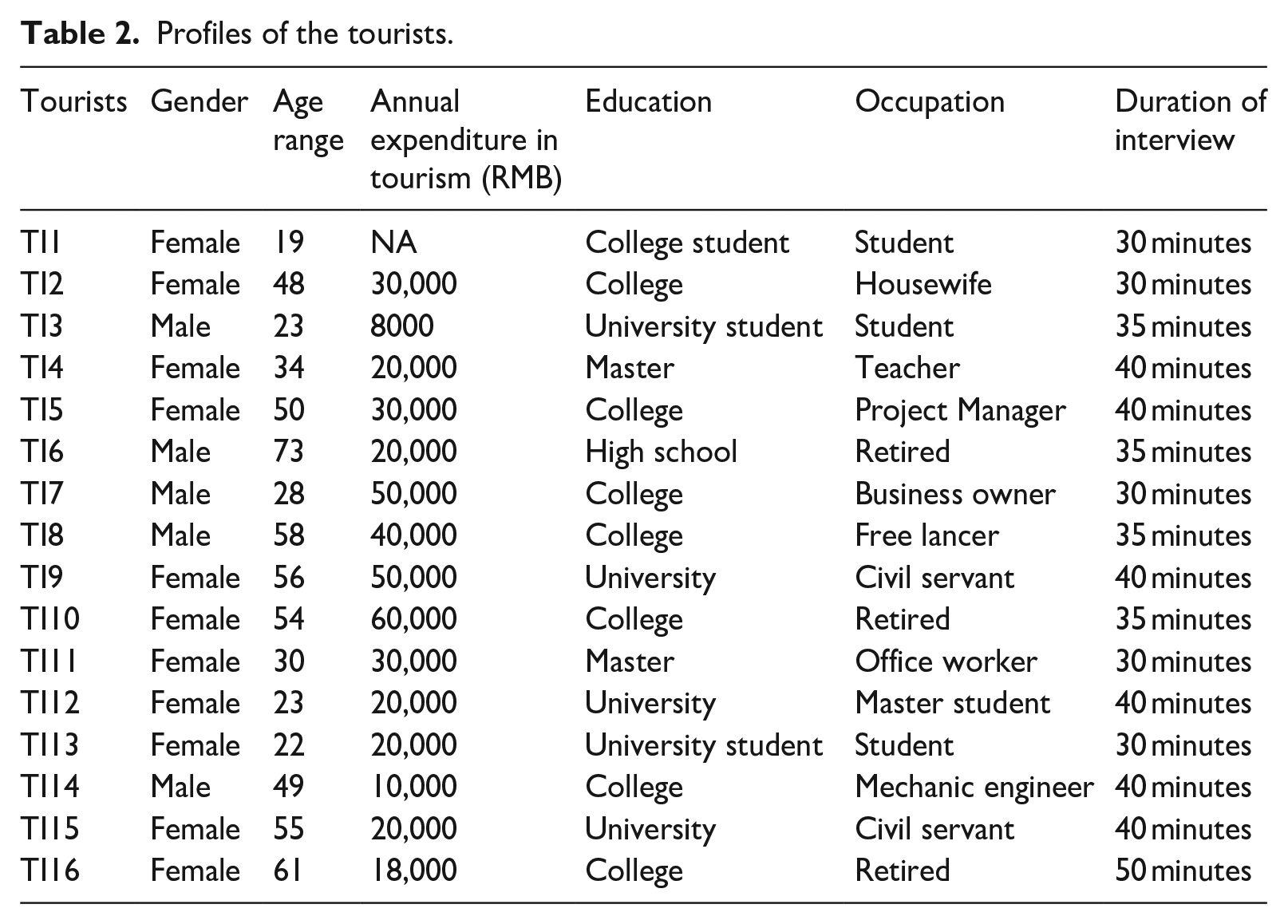
To understand the consumer perspective, and to triangulate (Decrop, 1999) the opinions from the tour guide interviewees, 16 tourists were interviewed, similarly via referrals. There were two pre-requisites to the recruitment of tourist interviewees: they must have traveled by joining guided tours, and must have done so during the last 3 years. Diversity was obtained by including tourists with different demographic features as shown in Table 2. All interviews were conducted via video calls, most of which lasted for over 30 minutes. All interviewees have at least a college degree, in which 11 were female and six were males. Their age ranged from 19 as a college student, to 73 years old retired seniors. The tourists interviewed are relatively well-off and favor package tours with guiding service. Their annual expenditure in tourism ranges from 8000 to 60,000 RMB (One US dollar equals to seven yuan approximately). According to Dichter et al. (2018), package tours in China are on the rise for certain segments such as the outbound market and groups with special interest. Thus, interviewing this segment allows the researchers to understand the emerging trend of the tourists’ perception of guiding service. Questions asked included: (1) Describe your overall experience with guided tours; (2) What types of tour guiding service did you expect; (3) How do you comment the importance of the various roles of a guide (by recalling your most recent trip with tour guiding service). The number of interviews (both for the tour guides and the tourists) was not set a priori. The researchers stopped recruiting more interviewees when they noted an apparent repetition of information and that no more additional new information emerged.
Profiles of the tourists.
Data analysis of the transcripts followed an inductive and bottom up process, in contrast to much of the literature, which follows a pattern of new needs/ demands—service—role—category type of coding and categorization. For example, when the tourists mentioned a new service that they expected from tour guides, they said guides should help edit the content of social media posts which document their trip experiences. Such a request indeed creates a new role for tour guides as it would get them to operate as social media content generators or facilitators, activities that fall outside their traditional role as pathfinders and cultural brokers, though such a new role is still servitude oriented. In this regard, a new category of guide’s role (related to technology) is called for.
Findings
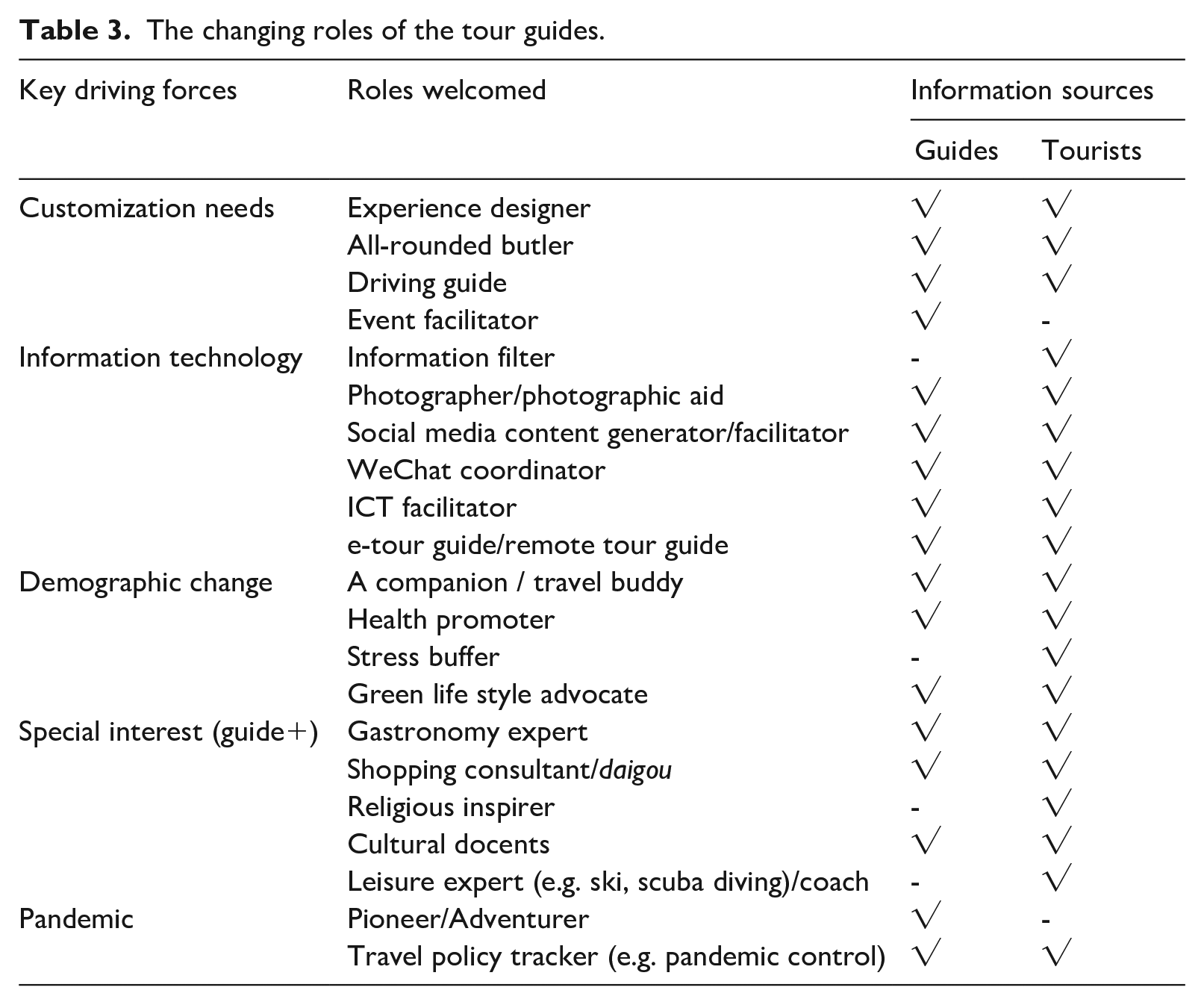
The datasets reveal the changing demand and expectations of tour guide service from the tourists’ perspective and consequently the new roles adopted and services provided as reported by the tour guide interviewees. This generally echoes Weiler and Black (2015) contention that the roles of tour guides do indeed evolve over time. Table 3 below presents the important roles that both tourists and tour guides mentioned. Though some roles have existed before the period considered here, they became more important in the Chinese context in recent years (e.g. the driving guide). Those roles are grouped according to five driving forces: (1) customization needs incurred roles, (2) technology-induced roles, (3) demographic change-induced roles, (4) special interest-induced roles, and (5) pandemic-incurred roles.
The changing roles of the tour guides.
Category 1: Customization needs
The increasing demand on providing customized services has made a few roles more important, including all-rounded butler, driving guide, experience designer, and event facilitator. Increasingly, more tourists prefer to form their own tour groups with just a few family members or close friends. They often do not want the ordinary tour itineraries, but something unconventional and bespoke. Most of these roles are not new (e.g. Zhang and Chow, 2004), but the call for quality has increased. The contributions of this group of roles are to serve, to provide comfort, and to please. They are mostly functional and instrumental, which is generally in line with the extant literature (e.g. Cohen, 1985; Prakash and Chowdhary, 2010). Tour guide TG9, who has been working in the guiding industry for 23 years, commented on the need to become an “all-rounded butler” (his own words) when guiding. As the number of rich tourists increases in China, they become the “big bosses” in the high-end tours they patronize and are correspondingly demanding when it comes to the quality of guiding.
‘Money is not an issue (to rich tourists), but the demand on service is very high. I have observed that the etiquette requirement is very different from what we experience with the ordinary tourists.’ (TG9).
This sentiment was buttressed by tourist participant TI5, who also mentioned this point especially when the tour takes place abroad, “The guide arranges everything for us. What we need to do is to have fun.” TI9 similarly commented on the importance of making tailor-made arrangements covering a number of aspects of a trip.
In order to provide a higher level of flexibility while traveling, tour guides often are drivers, or known as driving guides too and such a demand is increasing, as tourist participants TI1 and TI4 reported. This role is important for small groups in destinations where there is much driving needed. TG 14 often served as a driving guide and received small groups. In addition, it is increasingly important for a tour guide to be able to design a bespoke itinerary, including “what to see, what to do, and when to do so, but with the central theme to cater for the tastes of tourists” (TI9). This situation is particularly true for TG 13, who is a freelancer. TG13 said, “my income relied heavily on repeat customers and referrals, so it is important to make sure that they are happy with my service. . . I receive small groups only, and I design itinerary together with the tourists.” TI3 made a similar remark to the effect that a tour guide in this regard functions as an experience designer creating a tailor-made itinerary based on groups’ specific requests and preferences. This finding echoes Weiler and Black (2015) who argue that that the tour guides are shifting from being servient and regurgitating toward attentive and creative as experience brokers.
This finding also corroborates the comments of Dichter et al. (2018) to the effect that the Chinese tourists are increasingly experience-oriented. To tour guide TG1, this is a new challenge that he and his team members are trying to cope with in the new era of experience economy. According to Dichter et al. (2018), product-based packaging in traditional tour guiding is no longer popular, as the tourists will come back to them only if their overall experience is positive and their trip memorable. Thus, to create something extraordinary is the key to success. In addition, many customized tour orders nowadays are made for important celebrations. Therefore, it is important for a tour guide who undertakes this kind of tours to be good at facilitating these celebrations. Guides in this regard are similar to an event facilitator, as commented by TG15 that a tour guide should know “what and how to facilitate activities in order to create sweet moments for a honeymoon trip.”
Category 2: Information technology
The recent ICT development has been changing the tourists’ behavior drastically (Lyu and Hwang, 2015), consequently creating new demands on the tour guides. As most of the tourist interviewees would conduct internet searches before going on a trip, the tour guides’ traditional interpretation role has become less important. But as TI3 and TI11remarked, information on the Internet “does not go deep and lacks consistency; data are often commercially oriented.” The issue of information overload has confused the tourists and made their decisions more difficult to take (Ma et al., 2020). Therefore, tour guides act as information filters, confirming to the tourists which attractions they must not miss and which ones are not worthy of seeing. Although the tour guides might have biases in their opinions, receiving such suggestions that come from a paid guiding service helps the tourists to focus on what is valuable. This was valued by tourists such as TI3, TI7, and TI13. TI7.Tourists who are wealthy but busy in particular find this role useful. TI13, after being caught in many commercial traps, now resorts to his tour guide(s) for confirmation of many details.
The ICT development has also enabled the tourists to share their experiences easier and faster. Their sharing includes photos, videos, and textual content, and a guide is expected to take up the role as a photographer, as commented by Tour guide TG15. TI3 concurred and showed appreciation for the increasing importance of this photography service. TI3 explained that a tour guide with good photography skill will contribute to half of the success of a tour, as the tour guide knows which spots are worthy of memory and how the photos should be taken. The Chinese tourists’ passion for photo-taking when traveling is well noted by Wong (2013), and it shows no sign of abating. Some interviewees recalled that some study/business tours may need to keep writing travel logs and post in social media for records and promotion. Tour guides help with not only photo-taking but further with editing the textual content and posting the content. Tourists then can use those logs for personal sharing or for meeting their companies’ requirements. In this regard, the tour guides have taken the role as a social media content generator/facilitator. As evidenced in tourist interviewees’ quotes, this is a value-added service that guides could serve and please their tourists well. TI5, a 50-year-old female, expressed her satisfaction with the tour guide that took her group to Thailand, ‘I like all the photos, videos, and the edited posting that she made for us. They are tastefully taken and made. I posted them in my social media and attracted a lot of likes.’ (TI5).
In addition, the ICT development has also changed the way of communication between a tour guide and the tourists, as well as among the tourists of a group (Weiler and Black, 2015). As reported by the majority of the tour guide interviewees, they have taken up the role as WeChat coordinator as well as ICT facilitator. This is perhaps an indirect reflection of how guides can serve tourists better by taking advantage of using ICT in their tour coordination. A new role is thus emerged as ICT facilitator, particularly in connecting to wifi when arriving at a new destination. Such a supporting role is acknowledged and appreciated by senior tourists, such as TI16.
Nevertheless, regardless of being a photographer, a WeChat coordinator or an ICT facilitator, the notion to serve tourists well is apparent. In other words, the essence to serve is still dominating, the only difference is that the facilitation is achieved via a high level of ICT integration in the guiding practice.
Another recent trend is the demand for e-tour guides (or remote tour guides). Tourists such as TI1, TI3, TI11 have experienced such service. They purchased trips from a travel agency, but went on a tour without the physical presence of a tour guide. Instead, a human tour guide provides service via WeChat, including itinerary designing, attractions briefing, problem solving, question answering, etc. TI11, who does not like social interactions with strangers, said it is a perfect choice for her. She likes this type of communication, while she feels uneasy when there is a physical tour guide around her at all times. Tour guide TG6 shared that the profits made through providing this kind of service is minimal, but “If a good relationship is maintained, tourists will come back for guided tours” with the physical presence of a tour guide in future. This was concurred by free lance tour guides such as TG10.
Category 3: Demographic change
Aging population has posed various new demand on the tour guide service. Many go on guided tours out of the desire to have someone to accompany them, and at the same time provide all sorts of trip related services. The gray hair market is expected to boom in the next three decades in China, as indicated by both the size of the senior segments and their strong motivation to travel (Hsu et al., 2007). As is reflected in this study, senior tourists’ motivation to go on package tours is often related to their desire to have someone to talk to and to see the world. This is particularly important for senior tourists such as TI6, a 73-year-old man who feels that “the tour is relaxing and more fun when there is an en-route tour guide to talk to, who also arranges all the necessary details.” TI8, by the same token, finds it enjoyable to have interactive dialogs with the tour guide he met in Thailand, and these conversations have become his impression about the country and its people. The tour guide interviewees also happily take this role and it seems that such a new role brings increased satisfaction to guides.
Tour guide TG15 said, ‘I like it when my guests treat me as a friend, and I serve them as if I was treating my best friends. There is good rapport when this happens. I introduce goodies to them as if I am introducing my home to my guests.’
On tours where there are many seniors, the tour guides pay more attention to the wellbeing and fitness of the members on the trips. They spontaneously give advice on what to eat and what not to. Tour guide TG2 shared, “we now receive a lot of the gray hair market, but everyone can receive the gray hair market. The key is how to serve them well.” TG11, who owns a travel company and leads a team of tour guides, said that his company was trying to get prepared for receiving more senior travelers as they saw this market lucrative. But he also shared that his team would get more trainings in how to serve the seniors better by providing pro-health guide service. This pro-health guide role is commended by tourists such as TI6, TI9, and TI13, who find it helpful if the tour guide can arrange for a healthy pace of the tour as well as give more consideration to the dietary needs of the seniors. This trend becomes more evident in the post-COVID era, as the tour guides noted, tourists became more anxious about their health and would turn to the guides for advice. This practice was even adopted by the younger tourists. In this regard, tour guides assume the role of health promoter in which guides’ efforts could make positive changes instead of regurgitating only the pre-defined and memorized scripts and messages.
The emergence of the urban new elites in China has produced a new way of understanding the ideal type of guiding service too. As commented by TG7, who has guided many groups of well-to-do young people, that the young educated, and affluent tourists often choose unconventional destinations and attractions. Tourists of this segment do not need much help in terms of daily travel arrangement, but it is the tour guides’ companionship that is more valued. TI3′s quote is exemplifying. His main travel motivations are largely for escaping and emotional recharging. He likes to talk to guides who can feel one’s stress, as stress buffers, and help eliminate the negative emotions by having friendly and inspiring conversations on topics that are related to nature, culture, and whatever of interest. Both T13 and T14 commented that a high level of satisfaction is likely to occur with those like-minded guides who are able to provide quality companionship. Such a new preference reflects the tourists’ changed demand on the role and service content of a tour guide. In particular, this is a reflection that it is not the serving role that is appreciated by the tourists, but guides higher level of intellectual capacity. In exercising a higher level of intellectual capacity, a tour guide who has intellectual conversations with the elite tourists would qualify the guide to be “a travel pal” as commented by the tourist interviewees. Tour guides who have been serving this type of tourists find this new demand challenging but rewarding. TG5 said, “it is not easy, but I feel much better about what I can do to help. I make a lot of friends, many come back to me in their next holiday.” TG14 as a freelancer, has even developed a group of “fans” containing elite tourists, who repeatedly go back to TG14 when they see TG14′s new route posted on WeChat. Though there is no intention to disguise the commercial nature in guiding and hospitality in general, guides are no longer simply taking the servant roles, but as experts and trustworthy friends whose advice is sought for and respected
As the Chinese tourists get better educated and well-traveled, green awareness starts to emerge as an important issue. TI10 commended the Japanese tour guides for reminding their tourists from time to time on how to handle the garbage properly. TI7 and TI4 similarly expressed their appreciation when they noticed that the tour guides would consciously advocate environment protection while on tours. Although this trend is only becoming noticeable, the tour guide interviewees (e.g. TG1 and TG16) concurred by saying that they now have more awareness of the environmental issues and are gradually taking up the new role as green life style advocates. The underlying assumption of this emergent role is that guides are supposed to change tourists’ malpractice (if any) for the good sake of eco-sustainability. It also means tourists welcome roles that the guides could influence tourists’ behavior toward a positive-change direction.
Category 4: Special interests
As the Chinese tourists gain experience in travel and increased diversification in lifestyle, they have various special interests attached to their travel purposes. For example, the Chinese tourists favor shopping activities (Hung et al., 2021), and this interest has grown to be more prominent. Some tour guides find themselves playing the role of shopping consultants for giving recommendations on where to shop and what to buy. Tour guides sometimes even become daigous—shopping agents who purchase merchandises on others’ behalf (Ren and Hung, 2022). Tour guide TG15 said, “Often, there are previous tour members asking me to daigou a few things that they purchased last time and found them really good (to use), and ask me to purchase more of the same for them. Although it is no longer my duty, I often help them. I keep contact with them in this way.”
There is a remark of worthy of attention. To facilitate tourists’ shopping is different from the role that a tour guide plays in commission-based tours (e.g. Wong and McKercher, 2012). The former allows the tourists to shop on their own free will, at shops they have freely chosen themselves while in the latter case, tourists are pressured to spend much in prescribed “accomplice” shops that they never meant to patronize, a common phenomenon which has been well researched in the literature on commission-based tours (Xu and McGehee, 2016).
Likewise, most of the tour guides interviewed have highlighted other emergent roles, including being a gastronomy expert, a cultural docent and a religious inspirer. All these roles entail a higher level of autonomy and intellectual capacity. Tourists who indulge in different types of gourmet experiences in tourism destinations, such as TI5 and TI16, commended that the tour guides’ recommendation becomes important. Although tourists have all the social media channels and APPs on their mobile phones to help them, they often find themselves drowned in information overload and commercially motivated messages. Tour guides’ advice are thus resorted to. Being cultural docents for instance, can help facilitate tourists to achieve a substantially deep understanding of the destination. It is consequential to tourists’ length of stay too. TG11 reported that, in the past, tourists would only stay in attractions such as Gulangyu (a generating marker in Xiamen) for 4–5 hours, but now they often stay overnight as a result fostered by tour guides’ in-depth articulation of the cultural capital of a destination. As commented by TI3, who joined a guided tour in Huangshan, that his guide’s interactive and the in-depth introduction stirred his interest in understanding the Anhui culture more. TI12 corroborated and recalled how his tour guide talked about Buddhism in Tibet which allowed him to elucidate further his understanding of Tibetan Buddhism. His guide in this regard as a religious inspirer is apparent. TI12 said, ‘Even though we possess some knowledge already, it is nice that a tour guide who knows more can teach us and even inspire us. We followed his practice in paying tribute to Buddha and other rituals when we were in Tibet. . . He corrected us when needed. ’
The exact wordings used by TI12 reveal a strong recognition of guides’ role as a mentor rather than as a servant. The phrases such as “we follow,” “teach us,” “correct us” are explicit to showcase the influencing power of a guide as an expert. It partially corroborates the research findings of Parsons et al. (2019), whose study ascertains that tour guides can play an important role in facilitating the tourists’ self-development on spiritual tours. Apparently, the wordings used by TI12 suggests that there is a strong influence from the tour guide regarding what should be the proper way of practicing Tibetan Buddhist practice. To an extent, this facilitation turns into mentoring, which is consequential to help tourists to achieve their personal growth (Parsons et al., 2019) and correct their malpractice and misconceptions.
Category 5: The pandemic and tourists’ favor in remote destinations
In recent years, especially during the pandemic period, there has been an increase in interest for tourism in remote and niche domestic destinations. This requires the tour guides to possess adequate adventuring spirit and acquire local knowledge beforehand; and hence the role of pioneer or even adventurer. Tour guide TG7 has been exploring remote areas in the last 2 years, packaging his experience into tours that are useful to the tourists who would like to take adventures in those unexploited areas.
Tourists purchase guided tour services in remote areas for a number of reasons. First, travel agencies are more alert to all sorts of pandemic related policies and control measures, so using travel agencies is a safer choice for most people. Second, travel agencies usually have better deals regarding cancelation policies with the suppliers, which reduces the financial risks to the tourists. Tourists such as TI15 and TI16 are among those who prefer to patronize travel agencies. TI16, being retired, single with no children, feels desperate for traveling. She and her friends (five in total) went on three trips in 2021 alone, all brokered through travel agencies, in the company of a specific tour guide they had repeatedly engaged in the past.
‘I keep close contact with tour guide X, who we have known for a few years. He would tell us which place are safe and COVID-free, which place does not require quarantine, when we need to do our NAT (Nucleic Acid Test), etc. Very helpful indeed.’
TI16′s quote is illustrative in showing the special emergent role, that is, as a
Discussion and conclusions
The purpose of this study is to document along with the socio-economic, demographic, and technological developments of the past decades, leading to new demands on the tour guide profession. Drawing on two distinct datasets, tour guides and tourists, this paper reports five driving forces, namely customization need, information and communication technology, demographic change, special interest, and the pandemic, that have imposed new requirements on the tour guides and spurred them to adjusting their roles.
Even with the integration of ICT, guides’ role as “agent to serve” remains unchanged apart from the fact that their coordination work becomes easier due to a better use of ICT services. While the traditional service roles are still in practice, guides’ roles have gradually evolved toward a direction where guides could assume roles that have more potential to influence and lead to positive changes. As evidenced in the findings, tour guides’ different roles fall on a continuum going from “agent to serve” to “agent of change” (Figure 1). The relative importance of “service” versus “influence” determines the locations of the roles on the continuum. Roles such as a health promoter and a green life style advocate, and even a religious inspirer, are gaining significant recognition and respect from the Chinese tourists. Guides are no longer simply regurgitating the memorized scripts, but they give their expertise advice and even correct tourists’ malpractice. All these measures signify that the guides’ role has been transformed and expanded toward “agent of change.” This has revolutionized the traditional guiding structure in which tour guides are no longer simply serving but actively influencing. Even though it is not explicitly stated, tour guides who perform more roles toward the right end of the continuum are having a changed perception of the tour guiding occupation as well.
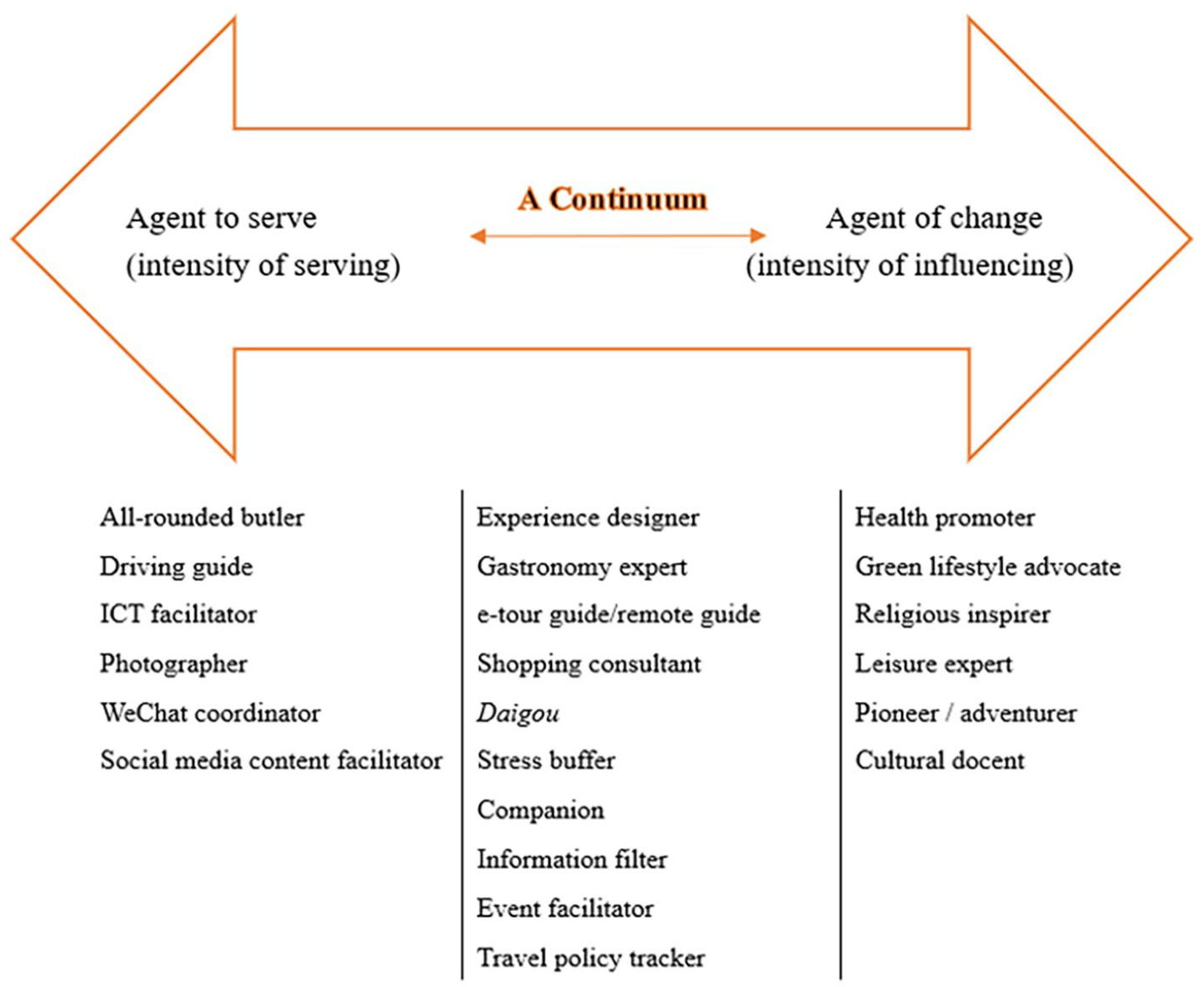
A continuum of guide’s roles from agent to serve to agent of change.
Toward the left end of the continuum, the focus on service is apparent. Using the roles of all-rounded butler, driving guide, ICT facilitator, social media content facilitator and photographer to exemplify, the names attributed to those serving roles signify that the guides need to please tourists, satisfy tourists’ needs, customize itineraries and meet tourists’ expectations. The continued significance of the service roles, either new or traditional, corroborates what is found in the existing literature related to tour guides (e.g. Wong, 2013; Zhang and Chow, 2004). The technology-induced new roles, in which the tour guides serve the tourists in the sphere of information technology by helping them to record, write-up and upload their tour experiences materials on social media platforms are examples to serve and please.
Roles such as e-tour guide, gastronomy expert, shopping consultant, and experience designer go beyond the service end of the continuum and a little step moves forward to the other side of the spectrum. Through these roles the guides do not directly make all the arrangements for the tourists but rather they provide advice and make suggestions on what to do and where to eat. The end result of the service depends on how the tourists make use of the suggestions and other contingent factors such as the quality of other service providers. More effort is needed from the tourists in the process, but value is added through a higher degree of flexibility and customization.
Toward the right end of the continuum, the focus on influencing tourists is evident in the preeminence of the guide roles as “agents of change,” such as being a health promoter or a religious inspirer. This reflects the Chinese tourists’ motivational change in traveling toward an eudaimonic experience (Hao and Xiao, 2021). The “change” desired is toward physical, emotional, and even spiritual wellbeing. This is in line with the general trend that the contemporary people are increasingly pursuing tourism and leisure activities that could contribute to their personal growth and self-development (Matteucci and Filep, 2017). The “change” also signifies the attitudes and behavior toward a sustainable development of the world, as reflected by the guide role of green lifestyle advocate. This ties to the recent research domains on tourist behavior such as tourist citizenship behavior (e.g. Liu et al., 2021) and tourist pro-environment behavior (Xu et al., 2018). However, although positive change has been noted in prior studies as one of the tourists’ motivations for traveling (Noy, 2004), how tour guides can proactively facilitate such changes is less discussed. This study is thus a pioneer attempt in delving into a prospective research stream.
A fundamental difference between a serving role and a changing role is about the underlying innate objective. The former is to please the tourists and provide comfort and convenience for an ultimate goal of securing guides’ sheer survival (Garner, 2017; Ong et al., 2014) while the changing role would not rely on a rule of thumb that “the customer is always right,” but ventures into “educating” and influencing the tourists. Of course, this change would become feasible because it is induced by the heightened travel needs and experience sought by the contemporary tourists. Such a new and proactive guiding practice is well received by the tourists, as evidenced in tourists’ quotes. At the same time, this revolutionary change in guides’ role is also the foundation where tour guides perceive differently of the guiding profession. In the current study, regardless of whether a guide is self-employed or has a formal employment contract, our tour guide interviewees do notice the changing preferences of guides’ roles. Though different guides might have different levels of interventions, guides are happy to be less malleable and more influential. They all find that the needed adaptation to the changing roles is rewarding. Although implicitly, the self-employed tour guides tend to display a more proactive attitude in embracing the changing expectation of the tourists, as the tourists’ satisfaction would directly influence their earnings.
The above results bear a few implications for the travel agencies, travel operators, as well as tour guide training institutes. On the one hand, travel companies are recommended to re-examine their existing in-house tour guide pool and scrutinize their knowledge as well as skill base. Trainings should be arranged and further education should be encouraged to keep pace with the changing tourist expectations. Tour guides who are self-employed are also advised to update their understanding of the trend. Educational institutes, on the other hand, are advised to keep close monitoring of the industry change and update their curriculum and syllabi accordingly. Importantly, the result of this study suggests a potential value revolution of the tour guiding service, which might revolutionize the economic value of the guided tours as well. Although it is still at its emerging stage, tour guides’ power to influence and foster positive changes coincides with the tourists’ pursuit of eudaimonic wellbeing, and this may become an important pull factor for the tourists to join the package tours with quality guiding service.
There are a few limitations of this study. First, the study was conducted during the COVID-19 pandemic, when most tourists were discouraged from traveling for an extended time period. Very few guided tours were offered in China during the pandemic. This might have constrained the tourists’ recollection of experience with guided tours. Future study will explore further the ever-evolving tourist expectations and roles performed by tour guides. Second, the dimension of guides’ power to influence is an emerging theme in the current study, future study might wish to explore further how this dimension would work in other specialized thematic tours context. Third, the current study has not intentionally distinguished between self-employed tour guides and those who have formal contracts with travel companies. As the number of self-employed tour guides is on the rise, understanding this distinction is included in our future research agenda. Fourth, the tourist interviewees were from the relatively well-off segment. Future studies will explore the less well-off segments for comparison. Finally, the current study has drawn on tour guides and tourists for information, and the data were collected in an interview format only. Future studies may consider collecting voices and posts from more diverse social media channels, such as WeChat moments and Weibo.
Footnotes
Funding
The author(s) disclosed receipt of the following financial support for the research, authorship, and/or publication of this article: This study is supported by IFTM: Prop 111/DP/2021
