



Abstract
This paper explores quests for silence in tourism in English-language online media. We offer a reading of media forms all articulating a soundscape of silence: a preferred sonic environment for tourists’ health and well-being. A relational and reflexive approach allows us to interrogate these taken-for-granted desired silences, and to emplace ourselves in the analysis. Using critical discourse analysis, we try to listen to the sounds produced in the texts, and to write with, and about, the sounds that resonate with us, to disrupt the naturalization implicit to the silent tourism soundscapes. Such calls for silent tourism use vocabularies that reproduce a universalistic aurality and binaries of wanted/unwanted, silence/noise, nonhuman/human, good/bad that moralize and objectify. Relational ontology and feminist critiques of “soundscape” help us to rethink silent tourism as ways of knowing. Ultimately, in the media we reflect on and are not separate from sonic ways of knowing seem very much entangled with wealth, privilege, individualism, and settler positionalities.
Introduction
Tourism makes sounds. Highways and airports emit roars, drones, rumbles. Tourists make sounds, and of course we also listen to sounds. Tourists—a category we use broadly to include outdoor recreationalists, day-trippers, cottagers, along with myriad others who are on tour in the general sense and temporarily away from home—desire and seek out particular sounds as part of the consumptive relationship they/we are in with humans and nonhumans. Echoing Feld (2019: 2), the study of sound and tourism is inseparable from “the history of slavery and colonization, the history of gaze, the history of reproduction of power relations of tourists and touristed.” Desires for certain sounds that are highly valued in touristic spaces for health-giving and restorative qualities are not to be taken-for-granted, which is the issue that this article explores.
Tourism literature has tended over past decades to give more attention to visual than to aural dimensions of being a tourist (Jiang et al., 2020). An overwhelming ocular-centrism emphasizes visual representations and the significance and meaning of what and how tourists see, evidenced in the enduring legacy of the tourist gaze concept and its iterations (Duffy et al., 2021). Of course, tourists not only see but hear too, varying in our corporeal and technologically-assisted capacities and impairments (Sterne, 2021). Recently, tourism scholars, such as Waitt and Duffy (2010), encourage a shift to the “ear” and whole body for potential insights gained by examining “the sonic knowledge of listening.”
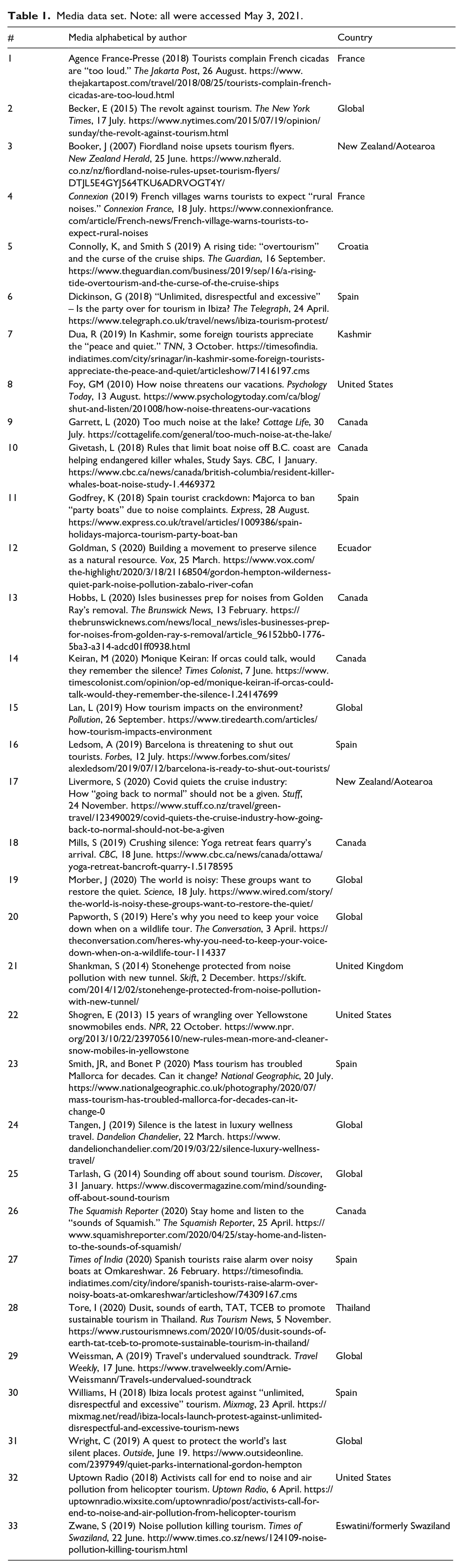
We contribute to this sonic turn in critical tourism studies (Galloway, 2018; Johinke, 2018; Lashua et al., 2014) through an examination of a trend we characterize as a call for silence in tourism—or “silent tourism”—published in digital English-language media between 2007 and 2020, mostly between 2018 and 2020 (see Table 1). This silent tourism trend became apparent to us while conducting a scan of media accounts on sound in tourism. We offer a reading of the set of online newspaper, blogs, travel writing, and magazine pieces we collected influenced by approaches to sound that share a concern with the historical, political, and cultural specificities of listening as relational (Born, 2019; Boudreault-Fournier, 2021; Feld, 2015, 2019; Goh, 2017; Peterson and Brennan, 2021; Robinson, 2020; Thompson, 2017). As part of our interpretive and analytical methodology we tried to “listen” to the sounds written on the page, represented by various authors, with a range of others in mind that includes tourists and other humans and non-humans co-occupying the places being written about (Peterson and Brennan, 2021), as well as to listen with one another.
Media data set. Note: all were accessed May 3, 2021.
Drawing from a framework known as “relational ontology” (Boudreault-Fournier, 2021), or, “acoustemology” (Feld, 2015), we offer two main contributions: One, we produce a sonic account of sounds and silences in text-based media that matter in this contemporary moment of tourism, leisure, and outdoor recreation. Rather than take the sounds for granted, we pull them from the pages of the media, not so much to document as to attune ourselves and readers to the acoustic vocabulary of tourism as a way of knowing. Vocabulary matters in how groups come to know and make their worlds (Feld, 2015). Second, we offer a critical reflexive analysis, applying the analytics of “critical listening positionality” (Robinson, 2020) in tandem with feminist critiques of the essentializing of sound and of space that occurs in the “soundscape” framework (Goh, 2017; Thompson, 2017).
Because of our own positive and even desirous relationships with some of the spaces where quiet is sought out by tourists who might share similar lifeworlds with us (with respect to race, class, gender, and nation and a familiarity with outdoor recreation), the media we curated warrants our own critical reflection. Our main argument considers how the calls for silent tourism are representations that tend to ignore the relational dimension of listening and sound and, rather, based on a binary of wanted/unwanted, sound/noise, and good/bad, erase a complex sonic history of wilderness spaces, spas, and other silent destinations in terms of privileged people’s entitlements and access to these spaces. A related secondary aim is to contribute to tourism scholarship falling under the broad category of reflexivity and therefore also aligns with feminist approaches in tourism studies interrogating the relationship between researcher and researched (Ateljevic et al., 2005) and using autoethnographic approaches as a means to think critically about “the shared responsibility of decolonization” (Cooke, 2017). Writing with sound means to work toward an accountability, where we, as co-authors, emplace ourselves in the touristic milieus of desired silences and quietness as desiring subjects, not above or outside of them, while also aiming to listen differently to the silences through the lens of relationality.
Silence in tourism studies
Silence, an “acoustic impossibility,” is sound (Ochoa Gautier, 2015: 183). Silence is a growing area of inquiry in tourism studies. This growth reflects the broader sonic turn as well as tourists’ changing interests and patterns of consumption, particularly within the groundswell of wellness tourism (Christou et al., 2021) and rural tourism (Kaaristo, 2014). The notion of silence as nonexistent and thus indexing far more than an absolute lack of sound and, rather, as culturally shaped and changing in meaning over time and place and as an auditory value and esthetic, comes across in the emerging scholarship (Campo and Turbay, 2015; Christou et al., 2021; Thurlow and Jaworski, 2011; Veijola, 2014).
Silence is wanted. In rural Estonia, Kaaristo (2014: 268) theorizes, silences are “regimes of value” central to farm tourism where particular sounds and noises are carefully orchestrated by farmer tourism operators to produce an aural environment attractive to tourists coming from cities. Forests are popular destinations for aural therapy, drawing from Japanese and Finnish traditions of forest immersion as a quiet counterpart to noisy urban lifestyles, and appealing to new markets groups such as wealthy Chinese young tourists (Komppula et al., 2017: 120). In luxury tourism, the quietude and minimal disturbance promised in advertisements featuring beaches and pools completely empty of other people is highly prized by elite tourists—“incorporated into the bourgeois imagination” (Thurlow and Jaworski, 2011: 212). Tourism industry workers and entrepreneurs also want silence, or at least relief from the noisy work places they are subjected to (Christou et al., 2021). Silence is also unwanted. For Israeli nature tourists from working class backgrounds, “the disciplinary silencing of space” that happens in contemplative nature tourism environments is an obstacle to their interest in nature as a social, even noisy, space (Schwarz, 2013: 393). The silent behavior of Kogi people in Colombia perplexes western tourists (Campo and Turbay, 2015). Yet for the Indigenous communities, being silent in front of tourists is “a potential strategy” to maintain contact with outsiders while retaining independence from the state (Campo and Turbay, 2015: 46). Wanted, unwanted, under constant transformation in meaning and materiality, silence in the context of tourism has shown to be rife with power relations.
This rich body of scholarship opens up possibilities for listening closely to silence through recent calls for silent tourism circulating online. We, too, engage with the question of power that undergirds quests for silence. As Ochoa Gautier (2015: 183) argues, while acoustically impossible (in that silence as complete soundless-ness does not exist) “silence is lived as one of the most intense experiences across cultures.” We see this intensity, and its desire, in the narratives about silent tourism we analyze.
Soundscapes of silence: Three excerpts from North American media
We begin with three excerpts from different online media outlets: a magazine (WIRED) based in the United States; a luxury lifestyle website (Dandelion Chandelier) based in the United States; and, a local digital newspaper from Victoria, a city in western Canada (Times Colonist). We use these excerpts to set up how the touristic sites that we refer to are depicted as silent tourism soundscapes—and also to begin reflecting on our own relationships with these auditory desires as tourists ourselves. For each excerpt, we provide a brief interpretation as a means to direct readers to the significance we see that they hold in terms of the language used to describe the desired sonic and sensorial space and its apparent benefit as one form of silent tourism or another. We recognize that, as with all media, multiple interpretations are possible (Harvey, 2020). Our interpretations are intentionally focused on, and attuned to, words that describe sounds, emotions that are named or evoked in association with the sounds, the places or types of milieus where the desired sounds can be found, and to the listening subjects, or lack of attention given to them/us.
Excerpt 1: “not a single human sound”
“It is a frosty March morning in the Hoh Rainforest, deep within the Olympic National Park in Washington state. The forest is full of Jurassic ferns, hanging moss, and towering spruce and cedars, but what I hope to find is an absence. . . I hear a roar of the river and maybe a waterfall. There is an occasional bird song. And nothing else. . . I can’t hear a single human sound. It feels amazing. I needed this quiet. We all do.” (Morber, 2020, in WIRED)
Excerpt 2: “enter silence tourism”
“Enter silence tourism, the latest trend in the wellness world. Today you can find a slew of resorts and retreats that go well beyond basic digital detoxes and relaxing spa services. They’re offering their guests anything from short-term silent activities and spa treatments to full-blown silent retreats lasting up to months at a time.” (Tangen, 2019, in Dandelion Chandelier)
Excerpt 3: “orcas. . . hear themselves think”
“Cruise ships and whale-watching boats stopped all operations [during the COVID-19 pandemic]. . . Southern resident orcas could suddenly hear themselves think—some for the first time ever.” (Keiran, 2020, in Times Colonist)
In Excerpt 1, author Jenny Morber describes her own experience of hiking into a rainforest in the northwestern United States to get away from human-made sounds. The destination of the Hoh Rainforest appears in her account to provide a quintessential experience of “nothing-less” in a quest for quiet within a state park. A waterfall, a river, and a bird song: these waterways and animals are described as quiet. For Morber, a sonic environment absent of human-made sounds makes her feel “amazing.” She suggests that the absence of a “single human sound” is a universal salve for all humanity, not merely her own.
In Excerpt 2, travel writer Jillian Tangen makes a similar call for silence in luxury wellness tourism. Rather than the earthy environment of a west-coast rainforest, in this second example it is a luxurious resort that provides the silent ambiance that wealthy tourists crave for its health benefits. Packages on offer include short term “silent activities” as well as month-long “silent retreats” for tourists seeking a wellness experience in a spa setting. By explicitly naming this “silence tourism,” the author calls attention to the processes of commoditization and consumption underpinning the experience of a commoditized silence available for a hefty price.
In Excerpt 3, silence in tourism is framed as a benefit for the non-human residents of a normally very busy tourism region, as Monique Keiran writes from a regional coastal newspaper. In the ocean waters of the Strait of Juan de Fuca in the Salish Sea in southern British Columbia, it is the blessed lack of human-made sounds resulting from the pandemic-related monumental occasion of the stoppage of ferry and cruise ship traffic that is celebrated and identified for being beneficial for resident whale populations. The let up of engine and propeller noises from tourism boats allows the orcas, in Keiran’s words, a much-needed chance to “hear themselves think.” The third excerpt highlights the feeling of relief that humans felt in sympathy with the whales over the historic oceanic silencing of engine-generated vibrations and echoes that otherwise disrupted the animals’ wellbeing. A call for silence in tourism, here, places the writer and the ocean residents both as the listening subjects. Silence emotes a good feeling, for them both.
Starting points: Relational ontology and settler listening positionalities
The media pieces we chose to analyze resonate with both of us. They speak a sonic language we understand. They articulate and identify the kinds of sounds, and the objects and entities that make sounds, familiar to us. Through this resonance, we are learning about our own acoustemology, or sonic way of knowing the worlds in which we live, through sound-oriented language we largely took for granted before undertaking this research. Yet, we also recognize this resonance to be one that comes from an uncritical settler listening positionality, from white privilege and supremacy, and therefore a resonance we ultimately wish to address.
Relational ontology
Anthropologist Steven Feld coined the term “acoustemology,” conjoining “acoustics” and “epistemology,” to refer to how sounds and listening are central to “what is knowable, and how it becomes known” (Feld, 2015: 12). Acoustemology theorizes “sound as a way of knowing” (Feld, 2015: 12). The main premise of acoustemology is that the world is not constituted by essences but by entanglements and co-presences of humans with others; thus, acoustemology is a relational ontology that posits “substantive realities do not exist outside of relations” (Feld, 2015: 13). Sound is therefore understood in relational terms; situational, reflexive, subjective, experiential, contextual, fallible. We learn from “interacting with a specific sound world” (Boudreault-Fournier, 2021: 39). Acoustic perception and audition occurs through “living with others-in-relation” (Feld, 2015: 15). Modes of listening, of attending to acoustics, derive from our relations with others, with cohabitation, and with our histories of listening (Feld, 2015).
Settler listening positionalities
Stó:lō sound studies scholar Robinson (2020) urges non-Indigenous listeners to pay critical attention to practices of listening that are colonizing, fixating, and “hungry” (a state of consumption underpinning settler subjectivity and history). His notion of settler listening positionality pertains to non-Indigenous residents occupying Indigenous territories that settler colonial nations such as Canada and the United States are premised upon. “Settler listening positionality” ties settler positionality with normative listening habits that structure listening as a “single-sense engagement,” and “a ‘civilizing’ drive for selective attention that renders listening as a process of the ear rather than of the body” (Robinson, 2020: 41). More specifically, it is a form of listening where settlers unreflexively consume sounds with a “fevered pace of consumption” where sounds are resources for ravenous extraction (Robinson, 2020: 53). He urges instead anticolonial modes of listening, what he calls “listening otherwise.” These modes “situate listening as a relational act that occurs between listener and listened-to and between layers of our positionalities”; self-reflexivity is necessary to shift away from non-situated and anti-relational settler positions of listening toward critical listening positionalities where we question the certainty of what we are hearing and its context (Robinson, 2020: 53, 58).
Taking a reflexive and relational stance, we do not regard ourselves to be separate from some of the aspirations and auditory experiences of quietness and silence that are described in the media in pleasurable terms. Such outdoor-recreational types of tourism—hiking, camping, and boating—are forms that we are both familiar with, although not in exactly the same ways. There are age and other differences and power relations between us as co-authors, as well as important similarities.
Sue Frohlick is an older person, a professor at a public university. Celeste Macevicius is a younger person, a student at another public university. We both live, work, and play as settlers on unceded Indigenous territories in the province of British Columbia that also happen to be popular tourism and outdoor recreational regions famous for their lakes, ocean, mountains, forests, and rivers and that depend on highways and ferry routes as corridors for the majority of the domestic tourists and visitor recreationalists. Celeste lives in Victoria on Vancouver Island, on the unceded Lekwungen and W̱SÁNEĆ Territory. Sue lives in a small community in the Okanagan Valley located on stolen land of the Syilx (Okanagan) Peoples. Both Vancouver Island and the Okanagan are tourism destinations, located in a province branded with the tagline “Super, Natural British Columbia.” We can easily draw upon our own experiences, thoughts, and feelings about particular sounds in our hometowns that are sites of tourism and outdoor recreation activities.
I (Celeste) am a 20-something white settler of Scottish, English, and Lithuanian heritage living on unceded Lekwungen and W̱SÁNEĆ Territory. I grew up across from a cruise ship terminal, where thousands of tourists would embark on buses, in taxis, atop horse-drawn carriages, and on foot through my neighborhood, which has led to a strong relation to tourism. I have been variously amused, indifferent, and frustrated toward the tourism sounds in my hometown (boat horns, bagpipes, amplified tour bus commentaries), and more acutely aware of my own touristic noises when I travel (my voice, motor transport I take, crowds I join). Until writing this article, I leaned toward understanding explorations in nature as separate from tourism, something I now consider a continued relationship amongst place, people, and sounds.
I (Sue) am an older white settler of Norwegian, English, and German ancestry. I grew up in the 1960s near Vancouver in the traditional territories of the Semiahoo, Katzie, Kwantlan, Qayqayt, and Tsawwassen First Nations; growing up I knew my hometown only as Surrey. My working-class father who grew up in the Prairies during the Depression years eventually made his way to the west coast because of his love for fishing and hunting (and for construction work). Because of him, backcountry exploration was part of childhood for me and my siblings. The outdoor recreation programs offered at the middle-class public high schools I attended also influenced me. An early appreciation of hiking and camping in the west coast mountain ranges has stayed with me. My lifestyle involves hiking and mountain bike riding with the family dogs in the semi-arid terrain of the Okanagan Valley, where the din of traffic from the highway corridor of Highway 97 that runs alongside Okanagan Lake competes with the ringing in my ears since developing chronic tinnitus years ago.
Writing and thinking collaboratively, we shared a palpable tension in the pursuit of a study of quiet and silence in recreational and wilderness tourism. The tension comes about because of how we relate to, or resonate with, media narratives that are celebratory of the quiet pleasures of listening to nature sounds while disparaging of human-generated sounds that create noise that brings about damaging effects on wildlife. Yet, we were aware of how complicated these narratives can be and, also, how they are situated within the economic, social, and racial privileges of tourism. Therefore, while they resonated with us, they also troubled us. It is this trouble and our interest in “staying with the trouble” (Haraway, 2016) that motivates our writing with, and against, silence in tourism.
An appeal for quiet tourism in the kind of media that we come across in our own lives as settler residents and recreationalists in the western most province of Canada, is therefore an appropriate place for us to interrogate our own assumptions about sound and its resonances. We reflect on how our conditioned ways of knowing and being may impact our work. We explore, while recognizing the constraints, ways of thinking and “listening otherwise” (Robinson, 2020: 51).
Methodology: Critical discourse analysis
In 2020 when the global COVID-19 pandemic curtailed in-person research, instead of conducting ethnographic research, I (Sue) elected to embark on media analysis as a first step in a larger project on summer tourism sound and noise in the Okanagan Valley. 1 Our work uses critical discourse analysis within a broadly decolonial feminist qualitative methodology. Critical discourse analysis is a research strategy that aims, by looking at any matter of tourism media form, including brochures, popular culture, websites, travelogs, to draw connections between “text/discourse/language and broader social issues” (Wilson and Hollinshead, 2015: 35). Critical discourse analysis is not content or textual analysis per se although both are used in the aim to situate the media claims about tourism and also to reveal how these claims reflect and enact histories of, and ongoing, power relations (Wilson and Hollinshead, 2015). Our selection of texts was guided by a reflexive approach whereby we wanted to probe the underlying assumptions about sounds and silences in discourses about tourism for their traces and legacies of colonialism and western ways of listening, while recognizing our own embeddedness within these discourses, practices, and histories.
The objective was to (1) curate a set of media that would elucidate how tourism-related sound is an issue in various locations in the world, and (2) probe those media for predominant patterns in how they articulate the issue of tourism sound. With Celeste, a student research assistant, I began the study with purposive sampling, conducting an Internet search using the keywords sound, noise, quiet, listen, hearing, tourists, and tourism.
The media set
The media set we curated includes 33 digital textual pieces found on publicly available magazine, newspaper, news outlet, and radio websites. Most are short pieces of a few hundred words. Dates of publication span from 2007 to 2020, with the majority of pieces published between 2018 and 2020 (See Table 1).
Most pieces are published in the United States (15) and Canada (5). Others were published in the United Kingdom (5), France (2), India (2), New Zealand (2), Turkey (1), Eswatini (1). The locations of tourist destinations reported on are spread out over at least 12 countries, mostly although not exclusively in the global north: Canada (5), Spain (5), United States (5), France (2), New Zealand/Aotearoa (2), and one each of Croatia, Denmark, Ecuador, Kashmir, Eswatini, Thailand, U.K, with the rest being global in scope (7). In addition to Wired, The Dandelion, and The New York Times, other media outlets are Forbes, Canadian Broadcasting Corporation, Psychology Today, Tired Earth, Times Colonist, the Telegraph, Outside, Cottage Life, Squamish Reporter, National Geographic, Travel Weekly, and The Guardian. One third of the media outlets cover local issues including tourism. One third are national or international outlets with a science or political focus with the occasional coverage of tourism. The remaining one-third are larger outlets focusing exclusively yet broadly on travel, tourism. and leisure.
Because all of these pieces are online, we presume that most readers will have computer access and literacy enough to navigate the pop-up ads, embedded videos, and autoplay functions that run throughout this media. As suggested by the advertisements and cultural references in the content, the publishers and outlets tend to cater to a readership that might be characterized broadly as middle-class or upper middle-class, university educated and/or highly literate, and also geographically and physically mobile in terms of domestic and international travel, outdoor recreation, and leisure activities. These media literacies and travel and tourism mobilities suggest a degree of privilege that, we argue, has a bearing on the acoustemologies and listening positionalities of the potential tourists targeted in the media’s call for silent tourism.
Analysis
In our analysis we paid attention to words, imagery, ideas, and affective aspects of the sample (emotions and emotive language) while also noting our reactions to the pieces and ways our respective positionalities might have shaped our interpretations. While we did not hear the actual sounds being written about, all are familiar to us and we felt that we could easily imagine the sounds being described and written about. We recognize that our ways of knowing and listening to the sounds we read about will be similar to, but also differ from, the acoustemological knowledges of the authors who wrote the pieces, the people they interviewed, and readers. Not all readers, including those now reading this article, share listening histories and positionalities (Rice, 2015; Robinson, 2020). Themes emerged through an iterative process, as we reflexively read, coded, reread, and re-coded the texts while moving back and forth between the media, our interpretations, and the analytical framework.
Vocabulary of silence in tourism spaces
The majority of pieces express an urgent concern over noise and a desire for quiet. The pieces also express a pressing need for nature spaces—oceans, forests, coastlines, mountains, fiords, lakes, and wildlife, and other nonhuman dominated landscapes. Not only humans are understood to need the silence in these nature spaces. Wild animals, particularly whales, are also subjects needing tourism to quieten down to maintain the health and reproduction of the species. Terms that reference outdoor and ecological settings such as natural, nature, ecosystem, and wildlife proliferate, mostly alongside terms that reference the desired sounds, such as “auditory solitude” (Morber, 2020) or, the opposite, the unwanted sound of “noise pollution” (Shogren, 2013; Tore, 2020; Zwane, 2019). Other pieces call for quiet amidst human inhabited settings including urban metropoles like New York (Uptown Radio, 2018), small towns in Spain (Dickinson, 2018; Smith and Bonet, 2020; Williams, 2018), heritage cities in Croatia (Connolly and Smith, 2019), beach resorts in Thailand (Tore, 2020), and “cottage country” and spa centers in Canada (Garrett, 2020; Mills, 2019). The media set conveys the idea that in these spaces excessive tourism is responsible for the creation of harmful noise. A sonic vocabulary conveys how human-created noise pollution—described as thumping electronic music, whirring helicopters, traffic, cruise ships, all-night party-going, shopping, voices, and crying—can be redressed; this exigency to redress the human-generated noise is described as the “craving” of quiet (Garrett, 2020), the need to create “quiet zones” (Becker, 2015), the luxury of “full-blown silence” (Tangen, 2019).
Representations of noise
Affective aspects of noise are vivid—with onomatopoeic language, hyperbole, and dramatic metaphors. As readers, we heard, and felt, the sounds through language. Words such as cacophony, clatter, rumble, racket, pounding, buzz, blast, blare, whining, suffocating, downing out, killing, epidemic, invasion, ogre, assault, pollutant, and toxin regularly appear. All and any human, including infants, are depicted as vectors of noise. Noise is characterized using the language of objectivity and science, reflecting western practices of standardization and rationality as a means to order sound (Sakakeeny, 2015)—for example, decibel levels, time spans, geographic scale, percentage changes, enumeration of locations safe from noise, and the use of quotes from research papers. At the same time, the associated experiences and impacts of the noise that is given scientific credence and objectivity tend toward emotions that are undoubtedly negative, such as shock, brashness, or anger.
The excerpts below exemplify how noise is represented as both materially objective and felt.
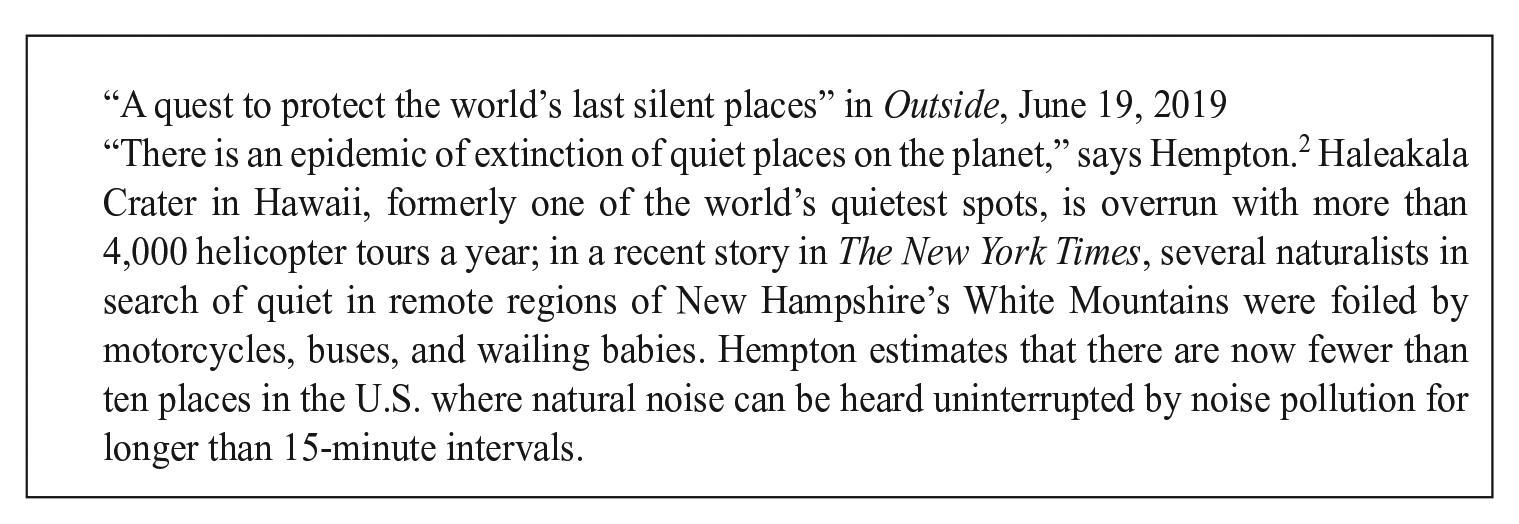
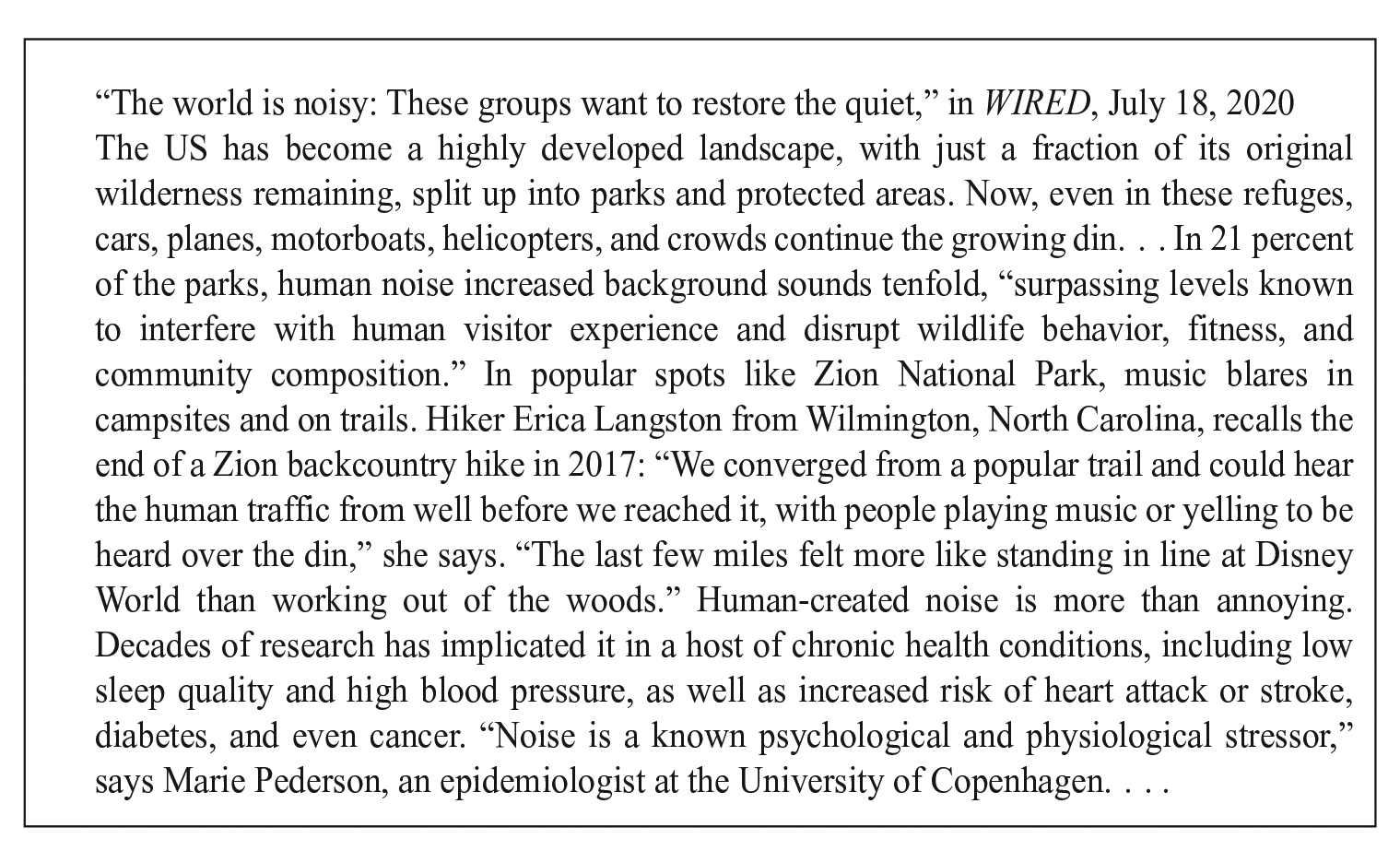
These pieces drew our attention to how sounds that were regarded as noise are human-made, emitting from combustion engines, crying babies, and people’s raised voices. Furthermore, the anthropogenic noise is framed as a threat to mental and physical wellbeing for humans as well as for wildlife. Noise appears to be intensifying—spatially, temporally, and in quantity—characterized in vocabulary such as: increasing, worsening, infiltrating, overshadowing, proliferating, spreading, doubling. Other pieces point out how a threat of harm from the intensification of noise as pollution extends to societal level, threatening human creativity, spirituality, culture, heritage sites, local economies, destination reputation, and the pleasures of tourism. It is a problem that needs a solution.
Noise is objectified sound, represented with objective language. Experts in quiet are quoted to back up the concerns raised over noise. Evidential information includes definitions, measurements, and trends, paired with alarmed testimonials from affected listeners. Coverage of experts and stakeholders often extends to their efforts to reduce or cut out noise, such as Quiet Parks International’s work to certify quiet areas (Morber, 2020; Wright, 2019). Other efforts to counteract or solve the problem of the growing threat of human-made sounds and their ruination include protests, filing complaints, regulations and laws, and awareness campaigns. Indeed, with noise problematized “objectively,” through a western framework of rationality and order, most pieces identify solutions, all of which center on what is seen as the corrective to noise: quiet and silence.
Representations of quiet and silence
While noise is represented as out of place, excessive, and ever-increasing, quiet and silence are sounds with the exact opposite characteristics to noise: naturally occurring, beneficial, elemental, in short supply, and ever-diminishing. Vocabulary includes: necessary, simple, good, respectful, noble, unadulterated, clean, peaceful, natural, healthful, and healing. In binary opposition to the human-made noisy sounds, in these media stories quiet and silence emit from nonhuman sources.
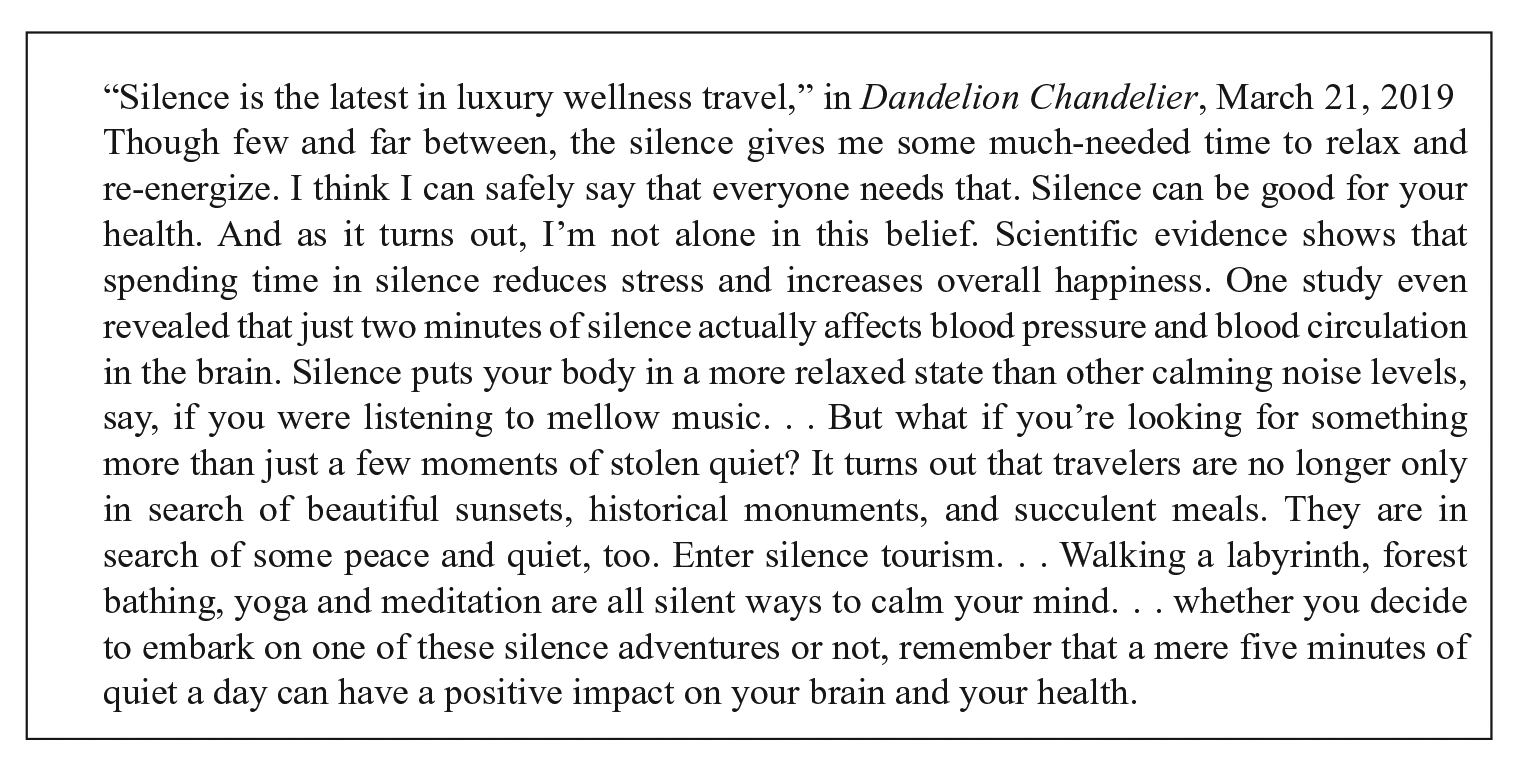
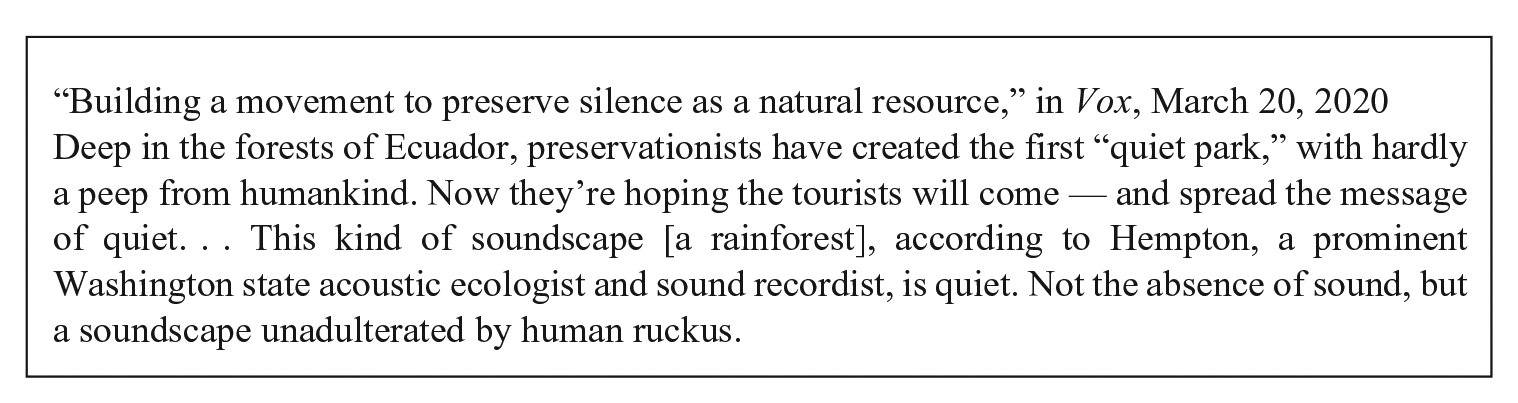
A humanistic universalism underpins these representations. Pieces, such as in the Dandelion Chandelier, recognize quiet in a commoditized form within luxury wellness to be sought out because of the seemingly universal need for the absence of human sounds. Where noise was represented as an intensifying problem related to a highly commercial and technological period in late global capitalism, marked by overpopulation, over-tourism, and industry, quiet is an apparent timeless natural state of non-sound-making human existence that seemingly prevailed in a more traditional era prior to modernity. Two more examples of this are: “Humans evolved in a quiet world, after all,” (Goldman, 2020) and “We want to return to the peace and quiet of the traditional Ibiza” (Dickinson, 2018).
Many examples suggested to us how quiet is represented as a humanistic state-of-existence that can be returned to. Yet the rediscovery of a past era of “quiet and peace” (Foy, 2010) is not easily realized. Language of scarcity is evoked. Quiet moments are “few and far between” (Tangen, 2019); quiet is scarce, endangered, fragile, hard to find, remote, and blocked out by increasing human-made noise. Quiet is an ecology to preserve, protect, seek out, treasure, raise awareness about, certify, and promote.
A final example, below, illustrates how the nonhuman undergirds the constitution of quiet in the silent tourism soundscapes. A rainforest utters “unadulterated” sounds while humans make “ruckus.” Anything that is associated with the nonhuman in the form of “nature” and “the natural” is perceived through this hearing of quietude. 3
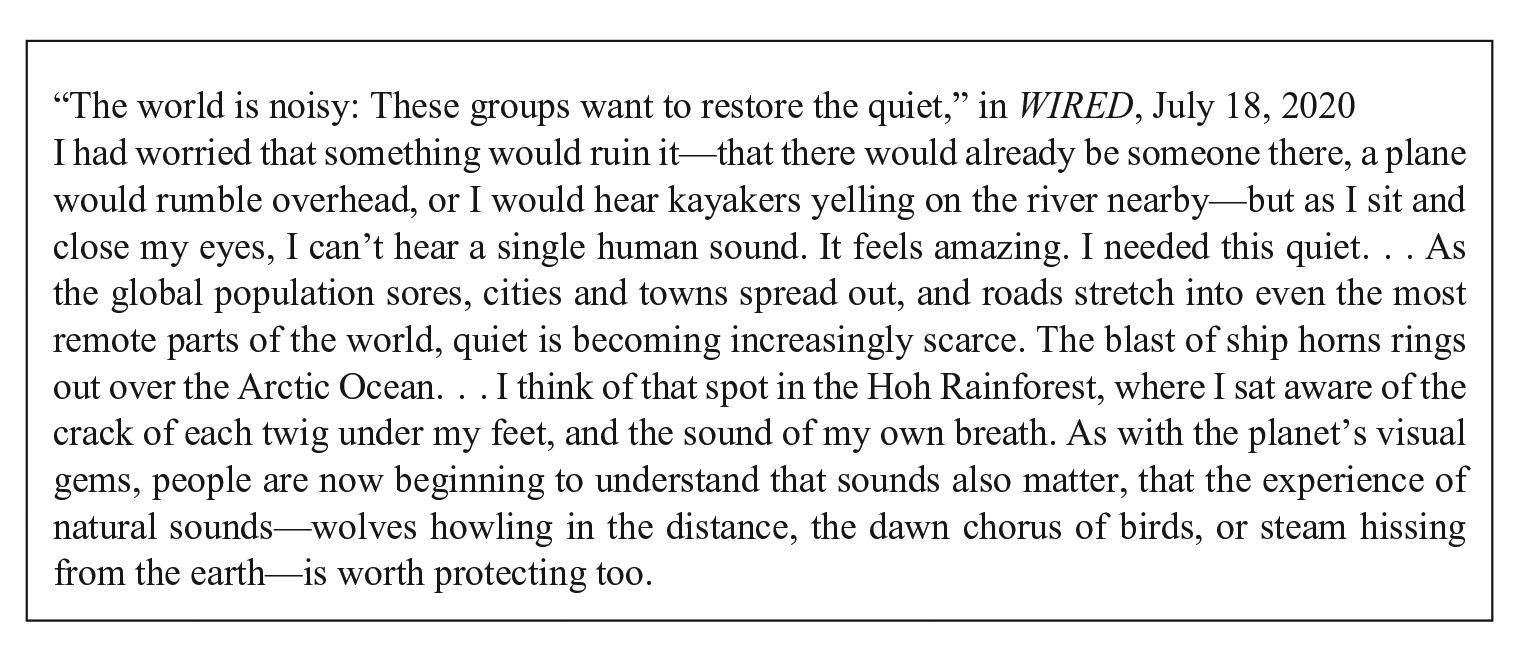
These humanistic qualities that silence is imbued with, and the attendant exigency to find or recover lost sounds of silence are, perhaps not surprisingly, written about using affective language: to “preserve and spread the gospel of quiet” (Goldman, 2020); “to locate the rare, relatively untouched natural soundscapes around the world and protect them before it’s too late” (Wright, 2019); and, the pandemic is a “wake-up call” for the need for quiet (Livermore, 2020).
Against the naturalization of silence
Feminist sound studies offer tools to critically reflect on these media representations that depict a sense of “goodness” that silence can, and, indeed, must urgently offer. To push back against one main assumption, the naturalization of silence, we found the concept “sonic naturalism” especially germane. Sonic naturalism refers to how sound is (mis)understood to exist “out there” in the world, pre-existent to social interaction and mediation, and, furthermore, as though certain sounds ought to be made or to emit from certain associated places. In short, sonic naturalism is a critique of the notion that the sonic is a naturally occurring “scape” in time and place.
In our reading of the media, these representations of sound tend toward the elevation of quiet and silence as humanistic auditory experience sorely missing from (every) readers’ lives and wellbeing. As desirable and recuperative human sensory experiences, silence and quiet are proscribed to be reclaimed and rediscovered through travel and recreation. “Forest bathing” (Goldman, 2020; Tangen, 2019), long hikes to remote rainforests (Morber, 2020), or walks on the beaches in Mallorca that are emptied of tourists while the pandemic kept the crowds away (Smith and Bonet, 2020) are all ways to access the apparent much-needed quiet presumably not available in readers’ everyday lives and auditory milieus overloaded with technological, mechanical, and ever-so-social sounds, that is, “noise.”
Throughout this media, an assumed “we” seemingly shares sonic knowledge and listening positionalities with the authors, especially around how the actual sound is supposed to make readers feel. This assumption of shared human auditory perception rang partly true but not completely true for us. I (Celeste) thought of times I’ve had growing up where being in a campground elicited a playful, noisy joy as I interacted with the forest around me. When I hear kids today shrieking as waves hit their ankles or shouting to one another, I revel with a familiarity and kinship in the human “noise,” even as I see disapproving or frustrated expressions on others. This small recollection underlined to me the real difference in listening experiences. I (Sue), felt fear, not calmness, when imagining myself in a week’s silent meditation retreat where the ringing in my constantly ringing ears would turn into unbearable noise without ambient sounds to fill in the “gaps.” When I am in the backwoods many kilometers from a road, I like to hear a few signs of human co-presence. And, I make these sounds myself, for instance, when I carry a bear bell when hiking during the months in the Okanagan when black bears and human hikers co-inhabit the woodlands and trail systems.
This bold and unequivocal articulation of a shared listening experience (“we all need quiet”) assumes a universal audition of sounds. It assumes the meanings of sounds, thereby separating them from contexts that are historical, cultural, social, political economic, that is, relational, and treats them as certitudes of perception and meaning without impairment of hearing capacities or ambiguity of meanings. Such assumptions were red flags in our evolving acoustemological attention. We turned to feminist critiques of the naturalization of sound.
Troubling soundscapes
We noticed, in particular, how the discourses reproduce the idea of “soundscape,” a term that suggests pre-determined sounds belonging to a landscape comprehended by a detached disembodied (missing) subject. Several pieces use the term “soundscape” explicitly and in various iterations, including “park soundscape” (Foy, 2010) and “auditory landscape” (Morber, 2020). Soundscape theory carries an extensive intellectual history and depth well beyond the scope of this paper. Here, we recognize that soundscape is “a legacy term” associated with Canadian composer R. Murray Schafer and the World Soundscape Project (WSP) (Feld, 2015: 15), whose aim in the late 1960s out of Vancouver, British Columbia, was to find solutions to achieve aural harmony in urban communities where noise pollution had, in Schafer’s view, become the sonic background of industrialized and technologized modern urban life. Efforts were made by WSP to preserve “natural ambiance” sounds threatened by the increasing din of machines, technologies, and urban development. 4 The WSP led to acoustic ecology, a theory wherein sound “is an ‘indicator’ of how humans live in environments” and thus the object is “to evaluate sound environments for their high or low fidelity according to volume or density, and cataloging place-based sounds and soundmaking objects through physical space and historical time” (Feld, 2015: 14).
Acoustic ecology bears significant limitations with respect to the tendency to objectify, catalog, and preserve sounds in their “rightful” space and to eviscerate listeners and others from the context. It can naturalize the physical location (“scape”) of some sounds as though they emit naturally in one place without human perception, other senses, relations of power, or human-nonhuman mediation. Critiques of soundscape in anthropology emphasize its lack of attention to agency, subjectivity, intersubjectivity, and relationality (Feld, 2015; Ingold, 2007; Kelman, 2010; Samuels et al., 2010). It is as though soundscapes are “things in the world, waiting to be tuned into” (Helmreich, 2010: 10). Feld (2015: 15) argues that acoustic ecology ignores “the experience and agency of listening histories, understood as relational and contingent, situated and reflexive.” Taking these critiques into consideration, we began to think about how the appeals to silence in tourism regarded these “quiet places” romantically and universally as silent soundscapes, as though sound was objective matter, a ready-made acoustic ecology, to be accessed by arrival into a space (Helmreich, 2010), or “a utopian and romantic-ecological-environmentalists vison of sound” that exists outside of the inimical noise pollution associated with urbanism (Boudreault-Fournier, 2021: 37).
Feminist sound scholar Goh (2017) conceptualizes sonic naturalism as a counter-theory to theories of sounds as existing “out there.” Goh (2017) argues that the naturalizing of sound in space is troubling for the ways in which clear distinctions between subject and object, nature and culture, and mind and matter, are upheld. Such naturalizations of sound in space reinforce dualisms inherent in western science and philosophy with the problematic result of producing a gendered, ahistorical, and universalizing approach to sound (Goh, 2017: 285). Another feminist sound scholar, Thompson (2017: 101), argues that the binaries inherent to sonic naturalism extend to “a division between a pure, positive and natural silence, and an impure, negative and unnatural noise.” Sonic naturalism critiques the binary thinking lodged in moral logic about the goodness and badness of some sounds over others, as well as a detached mode of hearing that imposes inherent values onto sounds deriving from western, masculinist, patriarchal, colonialist, and settler epistemologies of sound and space. In sonic naturalism, Goh (2017) argues, a neutral, objective (masculine, white) observer can be placed into an independently existing world and perceive and know sound and nature as-is. Sonic naturalism is thus an exertion of power (Goh, 2017: 284), which effaces intersectional lived experience and the diversity of situated knowledges of quiet and nature. Thompson (2017: 118) urges us to consider the particularities of sound and its valuation as relational, rather than as innate “god-given” values.
Valuations of silence/noise
The binaries of sonic naturalism extend to valuations, Thompson (2017) argues. In other words, the naturalization of sounds in their so-called rightful places is not innocent or neutral. Some sounds become more pleasurable and enjoyable while others are denigrated and regarded as without taste or any appealing character. This valuing of silence and demonizing of noise is what Thompson (2017) calls aesthetic moralism. Aesthetic moralism frames noise as “evil”—that which is harmful, disruptive and impure. Meanwhile, silence is “good”—that which is natural, pure, restorative, and healthy. Silence is what always has been and what should be, while noise is what has intruded and damaged at the onset of Western industrialization, urbanization, and technological development (Thompson, 2017). Conflations of the aesthetics with the moral, political, and medical tend to uphold binaries and polarizations (and certainties) such as: sound/noise, meaningful/unmeaningful, desirable/undesirable, natural/unnatural, pure/impure, healthy/unhealthy (Thompson, 2017: 91). Simplified decontextualized categories of good/bad, which is what we see in the media set in question, operate in such a way as to obliterate the history, ecology, culture, sound, politics, knowledges, and beliefs that are actually very complexly tied to sound (Thompson, 2017).
Aesthetic moralism shows up in much of the media. Noise was annoying, damaging, undesirable, and worsening while quiet was pleasant, healing, desirable, and natural. Some articles made explicit moral judgments: Associations with noise included “an ever-increasing appetite for leisure” (Foy, 2010), “psychopaths driving luxury cars,” (Williams, 2018) or tourists exhibiting “boorish and disrespectful behavior” (Becker, 2015) while association with quiet or nature sounds included “
The goodness of quiet was a moral position upheld in many pieces featuring efforts to define, differentiate, justify, and ensure quiet. Such attempts to reduce noise and achieve quiet—to “hear no evil” (Hagood, 2019)—may be more of an insulation from, than the absence of, demonized noise (Hagood, 2019; Thompson, 2017). One article describes Yellowstone National Park’s success in creating quiet by snowmobile regulations: “Now only a fixed number of private, fee-paying snowmobilers are allowed in daily. The rest must ride on a public transport version known as a ‘snow coach’” (Shogren, 2013). Here, quiet was predicated on separating those with the ability to pay from “the rest.” Another article features luxury silent retreats, such as The Ranch in Malibu (traditional Micqanaqa’n and Chumash territory) (Tangen, 2019). As with many of the pieces, silence relies on high prices, luxury services, and the benefits of colonialism that have allowed for settlement on traditional Indigenous territories.
As we read these pieces, we wondered how the celebration of a highly valued and moralized “good” quiet might muffle important noises of difference, dissent, and change. Aesthetic moralism devalues and categorizes certain sounds, like the undesirable din of everyday life, as “noise.” Sonic naturalism habituates and valorizes silence as positive and health-giving. These ways of naturalizing and moralizing some sounds as good and others (noise) as bad not only grossly over-simplifies sounds and listening but is bereft of a consideration of power, for in many contexts loud sounds or sounds that cause a disturbance can be a way to claim visibility, agency, and change (LaBelle, 2010; Novak, 2015). And, as well, “listening” to silence is not always positive. Being made to listen to silence can act as a tool of suppression, surveillance, and social control in a tourism context, including the exploitation of workers who are held responsible to maintain the silence of all-inclusive resorts (Harewood, 2019; LaBelle, 2010). A media account of over-tourism in Copenhagen subsumes the complex realities of Danish society and a diversity of Danish citizens’ relationships with the sounds that throngs of tourists make, by depicting state-enforced “quiet zones” as “emblematic of the Danish philosophy toward tourists” (Becker, 2015). Several pieces conflate “wilderness spaces” and “national parks,” reducing local specificities to a universal space. Morber (2020) explains that protecting “quiet in wilderness spaces” is the reason why national parks exist: A gross oversimplification that flattens the United States into a seamless national history with congruent ways of knowing and understanding nature and sound and erasing or obfuscating colonial dispossession and a diversity of human and more-than-human listening histories and co-habitations within an homogeneous “virginal” entity so-called “the wilderness” (Kanngieser, 2023; Vannini and Vannini, 2020).
Toward a relational approach to listening in tourism sounds studies
We argue that sound was overwhelmingly conceptualized in our curated media set using soundscape language that tends to reproduce masculinist Western Eurocentric moralizing universalistic dualisms that naturalize sound-in-space as bad human noise and good nonhuman silence. Relatedly, little regard was given to the power, privilege, and exclusion that underpins the calls for silence in particular tourism spaces, including wilderness, national parks, meditation and retreat centers, or to the specific embodied and relational listening-histories and listening cultural practices of the folks doing the listening. The calls for silence and quiet in tourism and recreation that we have analyzed tend to pare down messy sonic, bodily, environmental, and moral contexts into good/bad, healthy/damaging, and to erase any other beings who dwell temporarily or as residents in those contexts. Everyday life is abundantly noisy whereas silence is scarce and must be protected at special sites that include “quiet parks” and “quiet zones” where as consumers of leisure and recreation people “demand more space for themselves” (Veijola, 2014: 89). Bodies must, seemingly, be kept healthy through a naturalized nature-bound quiet. And, the absence of other bodies entirely is advertised in promotional media luxury wellness tourism that silences “poorer” others, “depriving them of voice” and ensuring they are out of earshot of the elite hyper-individualistic tourists seeking “golden silence” (Thurlow and Jaworski, 2011: 212).
Our own journey to a relational approach to tourism silences involves paying attention to our own emotional responses to the calls for a quieter tourism. We both relish and wish for times of quiet; we both seek out private beach spots to listen to waves lapping the shoreline or trails “off the beaten track” to access bird sounds. We both bristle at campers who bring their speakers and we both lament the vehicular traffic and other highway sounds that break the quiet as we walk in the woods. We also both make noise in spaces where quiet by others is desired, when our dogs break through the stillness of a trail with a cacophony of barking or the electronic noise of our cell phones interrupt the nonhuman and climatic sounds of outdoor spaces.
For me (Celeste), the articles about whales were particularly compelling. Three endangered resident orca pods live close by to me. I have caught glimpses of these pods and heard stories of new births with joy. While writing this article, I watched one pod of orcas swimming off the point where I walk my dog. Two whale watching boats followed, and I had an immediate reaction of agitation and concern. When I read the articles about the impact of noise on whales, I could relate and tended to agree, even as I have recognized the aspects of sonic naturalism and aesthetic moralism in my response. I have needed to think, read, and converse deeply to hold these seemingly conflicting concerns at once; to recognize the simple binary of my initial take of the “natural, good ocean” needing “protection” from the “unnatural, meddling” humans. More personally, to recognize I arrived by driving to the ocean on colonized, paved land in a fossil fuel-burning car with the radio on. And, yet to still allow for that I cared for the land and its sounds.
For me (Sue), the articles about the quiet wilderness parks touched me. I spent my twenties living on sailboats and being on the only dwelling for miles along the southwestern coastline of Canada as well in stretches of ocean in the Caribbean. I live in a rural community such that sounds of wind in the trees and the babbling of creeks rather than people surround me in my daily life. I, too, felt empathy with the articles that suggest that whales and other wildlife have been relieved of tourism noise during the pandemic. But in thinking more closely about the human-centrism and the ethnocentric whiteness of my own listening practices, I wonder about how being a white Anglo-settler living and recreating on stolen Indigenous territory, an able-bodied swimming, hiking, and biking ciswoman with a hearing impairment, a Canadian passport holder who has traveled to yoga tourism and wilderness park destinations at the drop of a hat. . . are positionalities entangled with relationships “both within and across species and materialities” through which my own listening history and experiences of sound occur (Feld, 2015: 13). As I listen while writing this paper with soothing pleasure to the curated Nature playlists on Spotify, the gloss of the seemingly “goodness of (nonhuman) quiet” now calls my attention. I am not removed from the moral aestheticism of the calls for silent tourism even as I try to listen more attentively to those silences for clues of such moralization and where they might be traced to in my childhood, growing up, my gender and age and race, and a lifetime of habituated cultural and social modes of listening.
A relational approach requires bringing into view the “all-encompassing relations in which the experience of sound is complexly and affectively enmeshed,” as Born (2019: 198) suggests, and thus raises new questions: What of the relations involved in this trend of understanding nonhuman sounds as a life-affirming quietude? Whose relations are enabled by the marketization of sensory experiences such as the sound of “nothing” or “only the occasional bird”? What is left out when quiet/good and noise/bad are etched onto another binary of natural/human? What about the listening positionalities from which the certain, authoritative espousing of moral aestheticism and sonic naturalism is done? What alternatives might involve awareness of, and even hesitancy over, asserting the value of one sound over another in relation to the listening histories and sonic experiences of a diverse body of readers?
These calls for a “good quiet” in silent tourism soundscapes deny a multiplicity of listening persons co-inhabiting and co-constituting polyvalent spaces. From how relations are represented in this media sample, we see it as a particular few people who can financially afford to travel to and occupy these spaces of silence and who can access them physically through mobile, able, privileged, and perhaps predominantly white bodies. To disrupt the binaries of quiet/nature/health and noise/human/harm is to argue for a much more inclusive, contextualized, and relational approach to the study of sound and tourism that is simultaneously attendant to feminist, queer, critical race, critical disability, decolonial, and intersectional approaches to the bodies and subjectivities of those folks who might also crave forms of quiet that these accounts of silence tourism exclude them from. Or they might crave altogether very different sonic experiences.
Conclusion
Through a critical reading of the media, where feminist media analysis understands media as more than harmless rhetoric (Harvey, 2020), we reveal moralism and power dynamics that render sound, a priori, with innate values, separated from the place, history, and context of the co-production of sound that is integral, not separate (Born, 2019: 198). In our reflexive and relational approach to an analysis of media depicting nonhuman silence as a desired touristic experience in the early 21st century, we have contributed to the growing literature on silence and tourism. By pulling the words off the page of our curated media set, we reveal a particular vocabulary that verbalizes a contemporary silent tourism soundscape. Our analysis of that vocabulary reveals the intensity in both emotions and rationality with which silence is desired by the readership of the relatively elite media we curated and, through critical discourse analysis, the binary of silence/noise and good/bad that reproduces naturalized associations of nonhuman sounds with silence and thus as good and human sounds with noise and thus as bad. Putting ourselves into the analysis, we have tried to shift the conversation about silent tourism away from a “soundscape” motif (i.e. non-relational) to a relational ontological framework that thinks about silence as a way of knowing that comes about through listening and awareness of our acoustic presence (Boudreault-Fournier, 2021: 39). Ultimately, these frameworks encourage us to rethink silent tourism as ways of knowing and therefore, in this particular set of online media, they appear to be aural ways of knowing that are entangled with wealth, privilege, individualism, and settler positionalities.
Footnotes
Acknowledgements
We thank Chin Ee Ong for his editorial guidance and two referees for their comments that we found wise, helpful, and friendly. Additionally, we are grateful to Alexandrine Boudreault-Fournier for her generous reading of an earlier draft.
Declaration of conflicting interests
The author(s) declared no potential conflicts of interest with respect to the research, authorship, and/or publication of this article.
Funding
The author(s) disclosed receipt of the following financial support for the research, authorship, and/or publication of this article: We acknowledge the generous funding support of the Social Sciences and Humanities Research Council of Canada (SSHRC) Insight Development Grant Program for new pilot projects.
