




Abstract
Sydney is an Indigenous place – Indigenous Country – infused with Indigenous stories and lore/Law. Yet as the original site of British colonisation in 1788, Sydney today is also a deeply-colonised place. Long-held narratives of Sydney as a colonial city have worked hard to erasure Indigenous peoples’ presences and to silence Indigenous stories of this place (Rey and Harrison, 2018). In recent years, however, Indigenous-led tours on Country are emerging in the Greater Sydney region, whereby Indigenous guides share with visitors stories of place, history, culture, language and connection. We write together as Indigenous and non-Indigenous researchers, in conversation with four Indigenous tour operators in the Greater Sydney region to reflect on their experiences of conducting Indigenous tours in this Indigenous-yet-deeply-colonised place. We document the kinds of ‘deep-colonising’ (Rose, 1996) narratives and assumptions the operators encounter during their tours and within the tourism industry, and highlight how Indigenous tour operators facilitate many non-Indigenous peoples in taking their first steps towards meaningful interactions with Indigenous Sydney-siders. We conclude that Indigenous tour operators undertake incredibly complex, confronting and challenging emotional labours trying to change the pervasive and deep-colonising narratives and assumptions about Indigenous peoples in the Greater Sydney region. In a world where the histories of thousands of cities ‘lie in dispossession and genocide of Indigenous peoples’ (Porter, 2020: 15), we argue for further and careful analytical attention on Indigenous tourism encounters in Indigenous – yet deeply-colonised – places.
Introduction
Sydney, like all of Australia, is an Indigenous place – Indigenous Country – infused with Indigenous stories and lore/Law. Yet as the original site of British colonisation in 1788 on the continent now known as Australia, Sydney today is also a deeply colonised place. In the 230-odd years since colonisation, deeply-embedded narratives of Sydney as a colonial city have worked hard to erasure Indigenous peoples’ presences and to silence Indigenous stories of this place (Rey and Harrison, 2018).
Despite the fabrications and devastations of the colonial project, Indigenous peoples have always been present in Sydney. Indeed, today some 70,135 people identify as Indigenous (Australian Bureau of Statistics (ABS), 2016) in this deeply-colonised, Indigenous place. In recent years, opportunities to learn about Indigenous peoples’ presences, histories, stories and custodianship of this place now-known-as Sydney are increasingly evident – through festivals, exhibitions, interpretive walks and cultural performances. Both domestic and international tourists appear increasingly keen for these learning opportunities, with 500,000 visitors taking part in an Indigenous cultural tourism experience in NSW in 2018–19 – an increase of 47.3% since 2014 (Destination NSW, 2019).
An emerging Indigenous tourism experience in the Greater Sydney region are Indigenous-led tours on Country. In such tours, Indigenous guides share with visitors stories of place, history, culture, language and connection. Offering opportunities for talking, sharing, intimacy and connection, in this article we focus on Indigenous-led tours in the Greater Sydney Region to better understand tourism encounters in deeply-colonised Indigenous cities.
In this article, we write together as Indigenous/non-Indigenous researchers, drawing on our different knowledges and experiences within the Indigenous tourism sector. In conversation with four Indigenous tour operators in the Greater Sydney region, we reflect on their experiences of conducting Indigenous tours in this deeply-colonised Indigenous place. We draw on the words of the tour operators to document the kinds of ‘deep-colonising’ (Rose, 1996) narratives and assumptions the operators encounter during their tours and within the tourism industry. These narratives are reflective both of the operators’ everyday experiences, and of wider societal realities of racism and ignorance (wilful and otherwise) in contemporary Australia.
This documentation serves to highlight the ways that Indigenous tour operators facilitate many non-Indigenous tourists in taking their first steps towards meaningful interactions with Indigenous Sydney-siders. We conclude that Indigenous tour operators undertake incredibly complex, confronting and challenging work trying to change the pervasive and deep-colonising narratives and assumptions about Indigenous peoples in the Greater Sydney region. The significant emotional labour undertaken by Indigenous tour operators in doing so is also highlighted. We advocate for increased recognition of the incredibly important work these operators do within the fledgling urban-based Indigenous tourism industry in Australia. In a world where the histories of thousands of cities ‘lie in dispossession and genocide of Indigenous peoples’ (Porter, 2020: 15), we also argue for further and careful analytical attention on Indigenous tourism encounters in deeply-colonised – yet Indigenous — places.
Sydney: Indigenous-and-deeply-colonised Country
The area known today as the Greater Sydney Region is Country to a diverse range of Indigenous custodians, including Darug, Guringai, Dharawhal and Gundungurra peoples, and to the Central Coast in the north, Awabakal and Darkinjung peoples (Figure 1). Greater Sydney is today classified by the Australian Government as extending from the Central Coast in the north of the city to the Royal National Park in the south, following the coastline in between. To the west, the region includes the Blue Mountains, Wollondilly and Hawkesbury (ABS in City of Sydney, 2018). Indigenous-identifying people in the Greater Sydney Region today include traditional custodians of Country, as well as many Aboriginal and Torres Strait Islander peoples who moved (or were forcibly moved) to the city from all over New South Wales and Australia, most notably from the middle of the 1900s (Taylor, 2013).
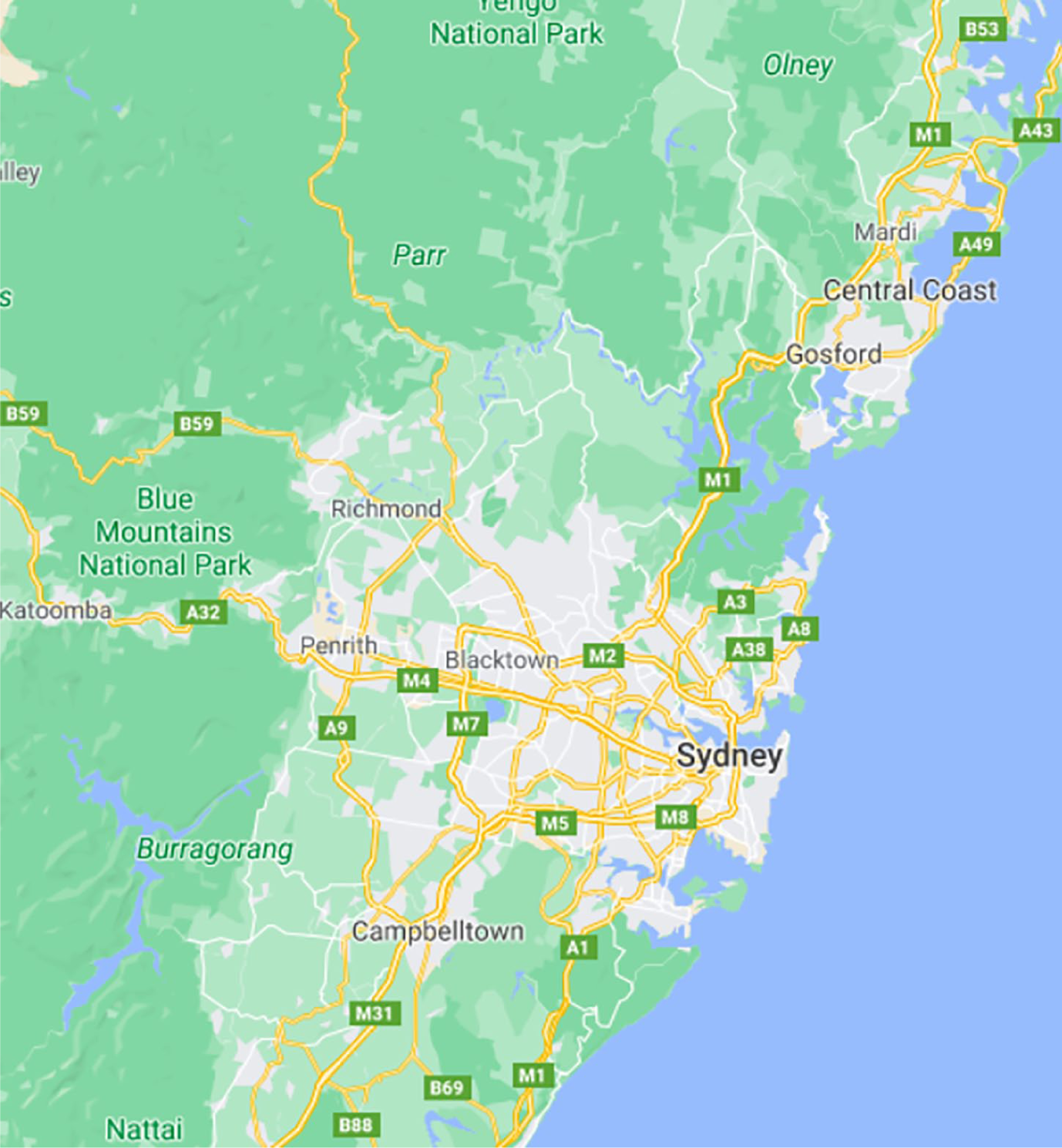
The area today classified as the Greater Sydney Region includes the Countries of Darug, Guringai, Dharawhal, Gundungurra, Awabakal and Darkinjung peoples.
Despite the city’s substantial Indigenous population, Rey and Harrison (2018) note that Sydney is rarely seen as an Aboriginal place. Goodall (2017: 76) writes on Sydney’s colonial narrative: ‘There is little room in this story for any ongoing presence of Aboriginal people in what rapidly became the urban space of Sydney. Aborigines mostly disappear in local histories in Sydney after the first chapter. The stories of conflict, massacre and epidemic are disturbing, but they also conveniently suggest that there was no future for Aboriginal people, which leaves a narrative space into which settlers could inscribe their own histories of nation-building’.
Like many settler-colonial states, the scarcity of Aboriginal presence in Sydney’s historical narrative is not an historical peculiarity or aberration in Australia (Porter, 2020). As Libby Porter powerfully writes, this is wilful and institutionalised disregard:
All places in Australia, whether urban or otherwise, are Indigenous places. Every inch of glass, steel, concrete and tarmac is dug into and bolted onto Country [and] knitted into the fabric of Indigenous law and sociality. . . [Yet] we appear unable and unwilling to grasp that this urban country is also urban Country. (Porter, 2018: 239)
In Sydney, as in many settler-colonial contexts, such disregard is deeply rooted in historical processes of colonisation. The often-violent colonisation of Indigenous places in Australia was grounded in large-scale attempts to exclude Indigenous people from settler society (Altman and Sanders, 1995). Brutal and systematic processes of land dispossession and resource appropriation occurred alongside the establishment of state-run Indigenous ‘missions’ and ‘reserves’ located on the peripheries of settler society, to where Indigenous peoples were forcibly removed. Indigenous languages, cultures, ceremonies, and practices of land management were suppressed and/or often severely disrupted as result (Aboriginal Affairs NSW, 2017). Indigenous peoples’ lives were heavily monitored and severely curtailed (Aboriginal Affairs NSW, 2017) – first under the pretence of ‘protection’ of Aboriginal peoples, and later under the guise of forced ‘cultural assimilation’ into the dominant culture (Schaffer, 2002).
Alongside this dispossession, destruction, erasure and the many massacres inflicted upon Australia’s Indigenous peoples, generations of children – known as the Stolen Generations – were forcibly removed from their parents and placed in institutional ‘care’, right up until the 1970s (Commonwealth of Australia, 1997). Forced removals involved deeply scarring processes of removing children from family, community, Country and culture, and also in many instances physical, sexual and psychological abuses and slavery-like conditions (Commonwealth of Australia, 1997; Schaffer, 2002).
As the starting point of European colonisation of the land now known as Australia, Sydney bears the scars of these deep-colonising (Rose, 1996) practices, policies and mindsets. Denis Foley, Indigenous Gai-Mariagal scholar, writes how Sydney-based Indigenous peoples bore the brunt: ‘of nearly 180 years of physical and psychological trauma (dating from the establishment of Sydney town adjacent to our lands in 1788 through to the 1967 referendum which removed discriminatory clauses from the Australian constitution). These traumas included firstly dispossession of our land, enforced segregation and discrimination, and then assimilation and the denial of our culture’ (Foley, 2007: 168).
Colonising practices continue to have deep socio-economic and psychological effects and inter-generational trauma for Indigenous peoples in Australia (Atkinson, 2002). There remain long-standing, substantial differences between Indigenous and non-Indigenous Australians in almost all measures of health and wellbeing (Australian Institute of Health and Welfare, 2019). Disturbingly, many social commentators also argue that the stealing of Indigenous children continues unabated today under different but equally (if not worse) destructive ‘social welfare’ guises (Wahlquist, 2018). At the same time, a self-perpetuating rhetoric of Indigenous dysfunction, disadvantage and hopelessness continues unabated in Australia, whereby, for 200 years Aboriginal peoples have been viewed as an ‘intractable problem’ in Australian public and policy discourse (Aboriginal Affairs NSW, 2017).
Alongside these socio-economic realities, policy failures and deeply damaging colonising rhetoric, the legacies of long-held racist attitudes against Indigenous Australians remain very much with us today (Bodkin-Andrews and Carlson, 2016). This fact is evidenced in the most recent bi-annual Reconciliation Barometer (Reconciliation Australia, 2018), which reports high instances of racialised abuse and vilification of Indigenous Australians. In Sydney, Read (2015) documents contemporary Aboriginal residents’ memories of outright and institutionalised racism, intense fears of children being stolen from their families and communities, and of being racially vilified and discriminated against. Such that, Aboriginal people in twentieth century Sydney: ‘had very good reason not necessarily to extinguish their identity, but to take it ‘underground’. Indigenous descent sometimes became a secret shared only by the immediate family or Aboriginal neighbours’ (Read, 2015: 122).
And yet, despite this context of the deeply-colonised city and the many institutionalised and everyday injustices inflicted on generations of Aboriginal people in Australia, many Indigenous Sydney-siders have worked hard to retain links to culture and Country, and work tirelessly to rekindle cultural knowledges, practices and ceremonies and share aspects of these knowledges with Indigenous and non-Indigenous Sydney-siders (Ngurra et al., 2019; Rey and Harrison, 2018). In the last decade in particular, some Indigenous educators, knowledge-holders and entrepreneurs have branched into the field of Indigenous-led tours; committed to sharing their stories of history, culture, language and connection with tourists, both domestic and international, Indigenous and non-Indigenous.
The tourism encounters emerging within Indigenous-led tours offer an important space for examining Indigenous and non-Indigenous Sydney-siders ‘working together to understand some of the uncertainty and vulnerability in each other’s lives’ (Rey and Harrison, 2018: 87). It is the experiences and words of four Sydney-based Indigenous tour operators that we engage with in this paper.
Indigenous tourism in an Indigenous-and-deeply-colonised city/country
To examine the Indigenous tour operators’ experiences of conducting their tour activities within the Indigenous-and-deeply-colonised city, we turn to Rose’s (1996) concept of ‘deep-colonisation’. Rose (1996) argued that despite time and institutional change, ‘the practices of colonisation are very much with us’. She continues:
More profoundly, many of these practices are embedded in the institutions that are meant to reverse processes of colonisation. . . Colonising practices embedded within decolonising institutions must not be understood simply as negligible side effects of essentially benign endeavours. This embeddedness may conceal, naturalise, or marginalise continuing colonising practices (Rose, 1996: 1).
Rose’s (1996) conception of ‘deep-colonising’ has proven an important analytical concept in Australia, focused on diverse processes and practices. Including on contemporary government ‘interventions’ into the lives and living conditions of Aboriginal peoples in the Northern Territory of Australia (Howard-Wagner et al., 2011); wildlife management (Suchet, 2002); and, in relation to natural resource management on Indigenous lands, including co-management (Howitt and Suchet-Pearson, 2009).
Focusing the deep-colonising lens on the Indigenous tourism industry is important to understand the ways that ‘the practices of colonisation’ remain ‘very much with us’ within the Indigenous tourism sector. For, on one hand, Indigenous tourism is a widely supported development practice, supported by international organisations, national governments and tourism advocacy and regulatory bodies alike. Demonstrated by the promotion of Indigenous tourism through the United Nations World Tourism Organization’s (UNWTO, 2017) Panel on Indigenous Tourism, for example, and in Australia specifically by the Australian Government’s recently-announced 4-year, AUD$40million Indigenous Tourism Fund (Australian Government, 2019). On the other hand, however, Trask (1999) identifies how tourism forms a ‘colonising structure’. Through Trask’s (1999) colonising structure perspective, tourism research has ‘recurrently demonstrated how the production and consumption of tourism (re)inscribes colonizing structures, systems, and narratives across time and space’ (Grimwood et al., 2019: 1).
In this paper we direct the deep-colonising lens specifically towards the Indigenous ‘tourism encounter’ between Indigenous tour operators and their guests. Gibson argues a focus on tourism encounters ‘enables a closer dissection of the moments and spaces in which power is exercised, and relations of care extended’ (Gibson, 2012: 55). Certainly, our experiences of observing, conducting and researching Indigenous tourism encounters in Sydney, described herein, indicate such encounters involve deeply interpersonal interactions and dialogue between and amongst Indigenous tour operators and tourists. These interactions often engender deeply intimate sharing between and among tourists and operators alike, offering opportunities for Indigenous and non-Indigenous Sydney-siders to ‘work[] together to understand some of the uncertainty and vulnerability in each other’s lives’ (Rey and Harrison, 2018: 87).
Indigenous tour operators’ voices are prioritised in this article in order to tease out some of the deep-colonising realities of these encounters. This involves describing the ways that Indigenous tour operators are faced with racialised stereotypes about Indigenous peoples; with assumptions about who are ‘authentic’ Indigenous peoples, and about where and how they ‘should’ live; and, are confronted with deep ignorances and insensitivities about Indigenous peoples’ histories, cultures and lived realities.
However, we tease out these realities not only to understand how they manifest through the tourism encounter, but also to highlight how Indigenous tour operators work hard to challenge and re-configure these deep-colonising relations through substantive, persistent and pointed efforts, and through much emotional labour. Indeed, this analysis of ‘the moments and spaces in which power is exercised and relations of care extended’ (Gibson, 2012: 55) within the Indigenous tourism encounter serves to highlight the powerful and confronting work that Indigenous tour operators do in working to change Indigenous and non-Indigenous relations in Sydney.
Methods
In this paper, we Uncle Lex Dadd and Marnie Graham – write together as researchers, colleagues and mudjin (family). Uncle Lex is a senior Darug custodian of western Sydney, currently employed as Cultural Educator at the Aboriginal Culture and Resource Centre. He has worked in Indigenous cultural education and Indigenous tourism in Sydney and surrounds for many years through his business Burangilli Educational Services. In recognition of his important knowledge, skills and cultural expertise, and of his contributions to teaching and research, Uncle Lex is an Adjunct Fellow at Macquarie University. Marnie is a non-Indigenous researcher working for Stockholm University on a 4-year post-doctoral research project that involves collaborating with Indigenous tour operators in Australia, South Africa and Sweden, to understand the role of Indigenous-led tours in processes of reconciliation in these countries. Uncle Lex is her cultural mentor, who provides invaluable cultural guidance in life and in particular to her Australia-based research.
We write together in order to enrich the research findings, based on our respective experiences, knowledges and engagements with Indigenous tourism in Sydney. We have worked together for 4 years, collaborating closely along with researchers and students from Macquarie and Newcastle universities in the Yanama budyari gumada research collective. Through this collective work we have all become mudjin, family, committed to working together to bridge Darug and non-Indigenous knowledge systems to care-as-Darug Country (Ngurra et al., 2019, 2020). We acknowledge much of this article’s research has been conducted on Darug Country, and we pay our respects to all the Elders who have informed this work, and who continue to work tirelessly to Care-as-Country and pass on their knowledges to the next generations.
This research is based on Marnie’s collaborations and interactions with four Indigenous tour operators in the Greater Sydney Region. The interviewees were recruited in a snow-balling fashion based on word-of-mouth, starting with one of the interviewees with whom Marnie has a long-standing collaborative research partnership. This research deals both with complex and sensitive issues of race relations and colonial pasts, and with deeply personal feelings and experiences of identifying as Indigenous in Australia. The four operators therefore remain anonymous to protect their identities and business operations, ensuring they can speak with their own words about their experiences in the industry, whilst protecting them from any negative repercussions arising from participating in this study.
With the participants’ consent, we do share, however, some aspects of their cultural identities and places, though we endeavour to ensure that no individual can be identified from the reading of this paper. In sharing aspects of these diverse identities, we seek to contribute in some small way to an exploration of diverse Indigenous experiences of contemporary Sydney, the heterogeneity of which are ‘yet to be effectively explored in the field of human geography’ (Rey and Harrison, 2018: 81). We explore this heterogeneity by focussing on four interviewees who, whilst sharing the experience of being employed as Indigenous tour operators in the Greater Sydney Region, nonetheless diversely self-identify, live and work in different areas of the city-region, and work for four different organisations.
The interviewees’ various tours are held in: Sydney CBD; in the city’s south; in the Central Coast region to the north; and, north-west of the city. All four interviewees identify as Indigenous, and their differing Indigenous heritages include Darug; Dharawal/Yuin; Wiradjuri/Ngiyampaa; and from Far North Queensland. All four interviewees also identify with other aspects of their European and/or Maori and/or Asian heritages. Two interviewees are female and two are male, and all range in age from early 30s to early 60s. All four have been employed by their respective tourism organisations for at least the previous 2 years. Some have long careers in the Indigenous tourism sector, sharing Indigenous culture with international and domestic visitors, and others are more newly engaged in this sector. They represent different types of tourism organisations, including: two self-employed operators who run their own tourism businesses; one operator who co-owns and -runs their tourism business with a non-Indigenous friend; and, a third operator who works as an Indigenous tour operator for the NSW Government on NSW Government lands.
Marnie has been participant-observer in all of the four tours offered by these operators, attending tours several times as relationships of trust and friendship developed between her and the various operators. The research is informed by these experiences and by informal conversations documented in research notes and reflections. The research is also substantially based on one-on-one, in-depth, semi-structured, voice-recorded interviews, and the interviewee quotes in this paper are taken from these interview transcripts. These interviews lasted around 1.5 hours and were conducted during 2017–2019, either in interviewees’ places of work, on Country, in Marnie’s home, or at Macquarie University. During these interviews, Marnie asked interviewees about their experiences of engaging with international and domestic tourists on their tours. Based on her participant-observations of the tours, and emergent from informal conversations with the operators, this involved asking about what kinds of tricky or challenging questions, attitudes or behaviours they have encountered from tourists.
The deep-colonising themes identified in this paper – around Indigeneity and ‘authenticity’, racialised assumptions, ignorance of Indigenous lived experiences, and the emotional labours of operators – were developed iteratively through careful reading of the interview transcripts and research notes, by both Marnie and a colleague, and with reference to the literature on Indigenous histories and experiences in Sydney. These themes and ideas were then workshopped iteratively by Marnie and Uncle Lex, drawing on our respective knowledges of the Indigenous tourism industry, and working together to craft our analysis of these ‘deep-colonising narratives’ that emerge through Indigenous tourism encounters in Sydney. We use the interviewees’ own words to firstly describe these narratives, and, secondly, to highlight how the operators address and seek to challenge these narratives.
‘First of all we make a safe space’ – Fostering safe spaces in Indigenous tourism encounters in Sydney
Through many conversations with tourists, the Indigenous tour operators engaged in this study are aware that their respective tours represent many tourists’ first meaningful interactions with an Indigenous person. This awareness presents the operators with significant feelings of responsibility to ensure tourists feel a sense of safety in sharing ideas, stories and conversations without judgement, aggression or fear. Indeed, the operators work hard to nurture atmospheres of ‘safety’ within their tours:
First of all we make it a safe space, and that would be in the form of some cleansing, whether it be smoking [ceremony] or there’s a number of ways you can do that. . . I don’t impose my beliefs, I invite them. Sometimes I highly recommend that they go through the smoke. Other times, if they can just get a sniff of it I’m happy. . . It’s all about trying to create a safe space, [which] means, for me, they’re comfortable.
You start to set the parameters for sharing, to feel confident, to open up, to share. Some people take longer, but when you’re out in the bush I don’t need much help. Mother Nature does most of it for me. They already relax, and slow down, and start to open up. I just let the smoke do its stuff and Mother Nature does it all for me. . . she supplies the tools and I just facilitate. (Interviewee D, 2018)
The four operators describe the various ways they foster safe spaces in their tours – through conducting smoking ceremonies (where tourists engage in a cleansing smoke ritual); by making tourists feel ‘equal’ to each other by engaging together in a circle formation; inviting tourists to hear the tour operator’s beliefs (rather than imposing on them); painting ochre on tourists’ faces in order to connect people to Country; and inviting tourists to introduce themselves to the tour group in order to commence the tour with a sense of intimacy.
In addition to fostering this sense of safety, the operators interviewed here commit to meeting tourists with openness, candidness and connection. All of the operators invite tourists to ask any questions they might have, even if they are unsure if they should ask them. These commitments and invitations are sincere acts of generosity on behalf of the operators, aimed at fostering dialogue, sharing and learning. As this operator explains, this involves dealing with tourists’ senses of fear at creating offence:
That’s what you’re pretty much looking for: for the people not to be afraid. . . [And] I ask for [all the questions]. . . People get scared to ask the question. And at the beginning of my talk I say ‘you’ve got to ask it the way you need to ask it. I won’t get offended’. Because if I did, yeah, that’s not a good thing. Because people don’t know how to ask properly, or if there is a proper or a not proper way to ask – I think it’s just important that they ask it. . . but they hear a lot of stuff about racism and they don’t want to offend.
Fostering senses of openness and safety can empower tourists to share their feelings, opinions, understandings and questions around Indigenous peoples, cultures and places. As this operator foreshadows, this not only requires the emotional labour of managing tourists’ feelings of fear, but also managing their own reactions to and feelings of offense when tourists relay incorrect and/or offensive stereotypes, assumptions, ignorances and prejudices.
‘We’re not what you read about, you know’ – Emotional labour in the Indigenous tourism encounter
Australian society has long denied the diversity and complexity in Indigenous identities (Bodkin-Andrews and Carlson, 2016). This denial and the historical and contemporary use of the collective term ‘Aboriginals’ alongside the associated idea of ‘pan-Aboriginality’ in Australia are rooted in racialised histories and policies (Bodkin-Andrews and Carlson, 2016). The tour operators describe how the deep-colonising narrative of ‘pan-Aboriginality’ persists within Indigenous tours in Sydney, whereby many non-Indigenous tourists often assume Indigenous Australians are a collective, homogenous entity. With this stereotype, individual Indigenous peoples are therefore assumed as representative of a whole community or ‘people’. As such, there are many on-tour discussions to alert tourists about the huge diversity of Indigenous peoples, cultures, languages, identities and experiences in Australia.
For this operator, this deep-colonising narrative elicits a huge sense of responsibility at being viewed as ‘representative’ of all Indigenous peoples:
So if you always come at [questions and discussions] positively, then it gives them time to think within themselves how they approach the next question or how they approach their outlook on Indigenous peoples of Australia. Whereas, if I were to bite their head off and say something, it’s not going to make them think. It’s just going to make them resent me and resent other Indigenous peoples; because I am very aware that we are seen as one people here in Australia, so I do take that responsibility very heavily because I ‘represent’ Indigenous peoples of Australia as a whole. (Interviewee K).
This denial of Indigenous peoples’ diversity is often accompanied by the long-held associated negative stereotypes of Aboriginal people as the ‘intractable problem’ (Aboriginal Affairs NSW, 2017). This operator views tourists’ lumping of Indigenous peoples into one group as his opportunity to challenge these negative stereotypes about Aboriginals by ‘setting an example’:
I’m just myself. . . I’m there to let them enjoy me, be comfortable, and I suppose that’s just to let them know what Aboriginal people are like. I’ve got to, as I’ve said, I’ve got to set an example for Aboriginal people. We’re not what you read about, you know, we’re not like that (Interviewee T).
The Indigenous tour operators seek to challenge deep-colonising narratives around the homogeneity of Indigenous identities, peoples and experiences. Operators do this by sharing stories of culture, place, and history, and often share stories of a deeply personal nature. The operators’ reflections of tourism encounters described here highlight the huge emotional labour operators undertake in creating these intimate encounters – in feeling they are ‘representative’ of all Indigenous peoples and in seeking to change negative perceptions and stereotypes held by some tourists. These responses carry an emotional weight that requires operators to carefully negotiate what and how to share with visitors, and how to react to people:
I know a lot of people don’t deal with [difficult questions], but I’m okay. As long as I stay strong and don’t get upset when they ask a silly question. . . And it’s all a learning process. And a learning process for me if they do ask it wrong – how am I going to deal with that? You know, I’ve got to be bigger than everything else with the way I come back at that. (Interviewee L).
‘You’ve got to live in your little humpy’ – Racialised stereotypes and assumptions
Indigenous tour operators describe how racialised stereotypes around what Australian Indigenous people ‘should’ look like emerge in their tours:
Sometimes people don’t even realise that I’m Indigenous and I think that’s funny because other [Indigenous] people that are fairer than me, you know, who have the blonde hair and blue eyes, are like ‘What do you mean, they don’t think you’re Indigenous? You look black!’. So, yeah, they [tourists] always have that postcard [image], the night sky, the midnight blackfella; and they don’t realise that over 200 years of colonisation is going to make you look a little bit different than the postcard blackfella (Interviewee K, 2017).
And this from an operator who views themself as ‘light-skinned’:
I have to establish very early the colour of my skin, ‘cause people look at that. The first thing they see is the colour of your skin. It’s the very first thing, so that’s that physical judgment that they make. I have to give my ancestral line. Within about two minutes, most of those people get it, they go, ‘Okay. Yeah. He knows what he’s talking about’ (Interviewee D, 2018).
Racialised stereotypes about where and how Indigenous Australians ‘should’ live in remote and regional spaces are also frequently confronted within the tourism encounter. These stereotypes are accompanied by assumptions about the city as ‘inauthentic’ Indigenous space, and racialized stereotypes about urban Aboriginal peoples living in supposedly degenerated areas of the city.
This operator expresses exasperation at some tourists’ inability to listen, learn and be educated about their personal experiences, which do not fit tourists’ racialised stereotypes of ‘Indigenous people’:
[A] lot of the time people come here [to Sydney] and they look for that colonial history. They don’t realise that there was Indigenous history here as well. . . They think that ‘real’ Indigenous history is surrounded by bush [] and nature and you’ve got to live in, like, your little humpy or your little shelter. . .
[Or I hear:] ‘oh you know, your people live in very dirty areas’, or, ‘you must live in Redfern because that’s where a lot of Aboriginal people live’, and this and that. I’m like, ‘aaah, no’. Then you try and educate and you say, ‘I’m from North Queensland.’ Then they go, ‘oh, yeah, but you know in Redfern, the high crime rate’ etcetera; and I’m sort of like: I’m trying to educate you here (Interviewee K).
‘The media is telling them they have to go to Uluru’ – Authenticity and the city as colonial space
The tourism sector in Australia has a long history of not representing Indigenous peoples respectfully or appropriately in tourism media (Seiver and Matthews, 2016; Zeppel, 1998). Indeed, the tour operators recognise that deep-colonising narratives around representations of ‘authentic’ Indigenous Australians, and where and how they live, remain entrenched in tourist advertising and campaigns, as well as in the wider mass media. These representations have implications for how tourists can view urban-based Indigenous peoples, cultures and knowledges as lacking or lost, and the city as a non-Indigenous/colonial space:
Australian media have a role that they need to look at, is that the token black Aboriginal people with their red lungis and red headband, playing a yidaki, that’s not what all Australian Aboriginal people look like. . . I mean, you could be from India or Africa and they could say that you’re Aboriginal, and you would accept that; but the east coast Aboriginal people are fair skinned, and that’s reality. Doesn’t mean they have not got those skills and knowledge that other black people have. They may even have more knowledge in certain areas. . . . Nearly 100% of tourists fly to Sydney, so they’re looking for experiences local to [Sydney], a local experience, whereas the media is telling them they have to go to Uluru. (Interviewee D, 2019).
And this operator:
Sydney isn’t marketed like Darwin or Cairns where it’s like, you know ‘Our tourism is Indigenous tourism’. Sydney is more ‘So, we’ve got a beautiful harbour and we’ve got beautiful buildings’. So I think it’s really hard to find. . .that Indigenous content here in not only in Sydney but in New South Wales, because it’s not seen as a place that the fore focus is Indigenous history or culture, or anything like that. So, it’s one of those struggles. (Interviewee K, 2017)
‘I didn’t think you guys existed anymore?’ – Insensitivities and ignorance
Offensive and insensitive questions and narratives emerge during tours, highlighting some tourists’ ignorance of Indigenous peoples’ histories, realities and lived realities:
[When I first started tours] it was sort of like you had to take a step back and you’d say, ‘oh, that’s right!’ Because I went to university for about a year-and-a-half, and then I came into tourism; and I think school and university kind of shelters you. And then when you get out into the real world here it’s sort of a shock at first. You’re like, ‘argh, people are really this ignorant!’ (Interviewee K, 2017).
Some of these ignorances and insensitivities are reminiscent of deep-colonising narratives of assimilation of Indigenous lives into non-Indigenous society, as well as ideas of Indigeneity being ‘bred out’ of Indigenous people and of the city:
I think tourism gives you sort of a backbone because you have heard everything. . . I’ve had people say, ‘I didn’t think you guys existed anymore?’, ‘I thought you were extinct,’ or ‘what do you wear when you go home?’, ‘Do you speak your language?’. You know, it’s either one or the other. It’s either they think I’m really traditional at home or they think because we’re in the city that I must be whitewashed and I’ve assimilated. So, it’s interesting. You’ve always just got to have a smile on your face because nobody is ever going to learn anything from a negative experience (Interviewee K, 2017).
Another operator describes his difficult efforts to explain to tourists the truth of Indigenous histories of colonisation and trauma and the persistence of these realities for many Indigenous people:
A lot of people don’t want to look at the truth, don’t want to look at the massacres and removal of Indigenous people out of Australia. . . So, to make people stop and look and think. I’m not blaming the tourists – I don’t want to blame people – but you need to know the past, you need to know your history. You need to know why Aboriginal people are the way they are – through trauma, intergenerational trauma and so forth, illiteracy. ‘Cause my mother wasn’t allowed to go to high school, she barely got through school ‘cause of the colour of her skin – that’s my MOTHER, Marnie – that’s so close (Interviewee D, 2019).
The operator goes on to explain the ignorance and insensitivities of some tourists, who make gross assumptions about Indigenous peoples, cultures, histories and knowledges based on narratives of ‘the primitive’:
There’s no [historical] evidence in Australia of fences, fortifications, moats, from a physical point of view, but there
Writing from the Canadian context, Schaefli and Godlewska (2014: 110) explore how ignorance in settler-colonial states is both wilful and strategic, operating in ‘highly sophisticated and often readily justifiable ways to uphold settler interests’. They argue, ‘[t]he first and most difficult step towards challenging ignorance is recognizing it’. For certain, the Indigenous tour operators interviewed in this paper work relentlessly to challenge tourists’ ignorances, a point we return to later on emotional labour.
The ‘ancient civilisation’ – Romanticised stereotypes
Notions of Indigenous peoples being primitive are also accompanied by romanticised stereotypes of ‘authentic’ Indigenous peoples as existing only in the past – not here in the present, living contemporary lives. This operator describes how some tourists assume Indigenous Australians are ‘ancient’ peoples who lived in isolation, ‘untouched’ from ‘civilisation’:
I do come from one of the most diverse areas in Australia, where we were trading with Melanesia and we had really tight connections with the Torres Strait and with Asia, so a lot of my family are either half Chinese, half Japanese, half Indonesian because of that trade. . .
[But] people forget that you inter-marry or that we have connections to other countries. Because I think a lot of the time it’s pushed that we’re an ‘ancient civilisation’ that was so far away from the rest of the world. The rest of the world they’re talking about is the Western world (Interviewee K, 2017).
At the other end of the spectrum, tour operators have been confronted with the notion that, despite the brutal human, cultural and ecological losses of colonisation, Aboriginal people know everything about their cultures and histories and can speak for how people felt and what they knew prior to colonisation:
Gee, I get asked so many questions. . . You get these questions like, ‘Were there gay people around in those days?’ Of course there would have been gay people around in those days, but to answer that question is a challenge. . . because I could only give my opinion, because I wasn’t there 200 years ago. (Interviewee D, 2018).
‘How do you not know this by now?’ – Dealing with shame, guilt and embarrassment
The concept of ‘white guilt’ in relation to Australia’s colonial history has received academic attention in recent decades, referring to a collective and deeply psychological feeling that may not refer to any sense of ‘guilt’ as it is commonly understood (Maddison, 2012). Maddison (2012: 24) writes of this uncomfortable and complex collective emotion, that despite much denial, the ‘experience of collective guilt persists. . . not only in the present but is transmitted to each new generation, maintained by a form of defensive nationalism that will not allow an honest attempt to redress the past’.
This tour operator describes their young visitors’ feelings of guilt and shame on learning more about Sydney’s sad and horrifying early colonial history and how it impacted the operator’s family:
What happens, like a lot of the kids [on tours] will laugh and say: ‘oh, we’re sorry!’. And I’m like, what’s going on? These kids are saying sorry for Captain Cook, and, like, to me! I say: ‘What are you sorry for, were you on that boat?’. I say: ‘I wasn’t here watching you, so don’t be sorry to me. What have you got to be sorry for?. . . Them days are over, mate, we’re here together, I’m happy for you to come with me’. And that’s what makes them, they feel really good. . .because they know, I don’t care what happened [back] then. I’m just telling you how to look after the land for
Another operator describes how ignorance of Indigenous and colonial histories can also elicit feelings of embarrassment for Australian tourists:
9 times out of 10 the Australians are the ones who have the least knowledge. . .They have the worst questions. The international guys are like, what do you mean you don’t know [that]?. . . And I sort of have to back them [Australian tourists] up and say, ‘our schools don’t really teach it’, because the Australians are embarrassed. And it’s sort of like, ‘ugh’. Outside of work I have the same question, I’m like, ‘how do you not know this by now’? But at work I’m, like, ‘oh, you know’ (Interviewee K, 2018).
These touristic encounters require the operators take on significant emotional labour in helping tourists deal with their feelings of guilt, shame and embarrassment, through making visitors feel welcome and at ease, asking them not to feel sorry or guilty, and ‘backing them up’ in order to relieve tourists of feelings of embarrassment for their ignorance. These and other emotional labours are enmeshed throughout this analysis. While emotional labour was first theorised by Hochschild (1983) as ‘the management of feeling to create a publicly observable facial and bodily display’, Bunten (2013) has contextualised the emotional labours within Indigenous tourism encounters specifically, noting how the interplay between Indigenous host and tourist gazes can be both painful and empowering for Indigenous hosts, enabling Indigenous operators to assert and be proud of their identities. Our analysis herein also elicits this complex interplay between Indigenous operators enabling feelings of safety and comfort for tourists whilst also allowing them to challenge deep-colonising assumptions about Indigenous peoples and places. This interplay is indicative of the important emotional work that Indigenous tour operators do in their tours, a point we now return to.
‘I don’t get angry because it might enhance the stereotype’ – The emotional labour of intimacy
Australian Aboriginal peoples are subjected to a range of impossible and damaging tropes, ranging from the ‘angry Aboriginal’ who is irrationally mad at everything, to the ‘purity’ of the ‘noble savage’ living in perfect kinship with nature. This operator describes how they foreshadow these deep-colonising tropes within their tours and, indicative of their emotional labours, modify their reactions and responses so that tourists might continue to learn and grow through the Indigenous tourism encounter:
[I don’t get angry] because it might enhance the stereotype, the stereotypical stuff because we’re all ‘the angry race’ and ‘we all drink’ and. . .this stereotype stuff that, you know, I can’t say anything, can I?: ‘You’re just too sensitive!’. Well, no. . . a lot of people still think that Aboriginal people get free education. [That] a lot of [Aboriginal] people still get their free-for-all, special considerations and all that kind of stuff (Interviewee L, 2019).
The intense emotional labour of keeping calm, hiding anger, and responding to tourists with positivity, kindness and a willingness to continue sharing – despite being confronted with sometimes deeply hurtful stereotypes – is testament to the ways that operators skilfully navigate this tricky emotional space of the tourism encounter. We have described also how the operators also manage tourists’ feelings of fear, shame, guilt, and embarrassment and their own feelings of anger, exasperation and being upset. On top of this, the operators regularly engage in deeply intimate interactions – they talk tourists through their identities as Indigenous peoples; explain the colour of their skin, and where and how they live; they situate their knowledge credentials; and, stay strong in the face of sometimes troubling perspectives.
These responses and strategies are indicative of the persistence and resilience of the tour operators, who repeatedly engage in the emotional journeys of Indigenous tourism encounters in order to keep educating and keep connecting tourists with Indigenous stories, people and places. As this operator explains, these emotional labours require ‘protecting yourself emotionally’:
To be intimate with people that you don’t know, that’s scary. But if you come on a tour and see how it’s done, then it’s actually quite easy. There’s a certain level of protection that you have to give yourself. . . It’s an emotional thing as well. You still have to protect yourself emotionally, but really, I’m about knocking those walls down. (Interviewee D, 2018).
The importance of Indigenous tours on Urban Country
The interviewees often jump between talking about their tours and talking about their experiences of how some non-Indigenous people relate to them in the everyday – in their jobs, neighbourhoods, communities. It therefore must be noted that the deep-colonising narratives of racialised stereotypes and assumptions, and deep insensitivities and ignorances towards Indigenous peoples are also representative of everyday life for the tour operators.
For certain, Indigenous-identifying people may be familiar with aspects of these deep-colonising narratives from experiences in their own lives. This potential is reflected, for example, in the bi-annual national Reconciliation Barometer (Reconciliation Australia, 2018), which describes significant and worrying trends in race relations between Indigenous and non-Indigenous Australians. In the most recent report in 2018, Indigenous-identifying survey respondents reported high and actually increasing levels of racial prejudice and discrimination, with 33% reporting that they experienced verbal abuse in the previous 6 months. Despite these worrying trends, a relatively small amount of research exists on Indigenous peoples’ experiences of racism in Australia (Paradies et al., 2008).
This paper contributes to this research gap by describing the overt racism which Indigenous peoples face in the tourism encounter, but also by examining the implicit racism that is evidenced through those encounters – for example in those narratives that deny Sydney as unceded Country, deny Indigenous peoples’ existences in urban spaces, and those which speculate on damaging questions of the authenticity and legitimacy of Indigenous Sydney-siders’ identities – due to their skin colour, heritage, ways of life, or what kinds of knowledges they may or may not possess.
We identify these deep-colonising narratives to highlight how Indigenous tourism encounters can be sites of deep-colonising processes, despite the de-colonising intentions of the Indigenous tourism industry. A key inter-related point, however, is to highlight in a deeply divided city and nation, the incredibly important work that Indigenous tour operators perform. They actively put their hands up to share culture, story, history and parts of their personal lives with tourists. They skilfully employ a wide range of strategies to encourage sharing, openness and learning within the encounter, even though such openness can be confronting, and even though they will likely be faced with deep-colonising narratives that can feel hurtful and/or uncomfortable.
Through these strategies, Indigenous tour operators create safe spaces for tourists to begin to engage with Indigenous Sydney-siders, and to voice their long-held questions and assumptions. In doing so, the operators undertake difficult, confronting, powerful, and transformational work in challenging the racialised stereotypes, assumptions, ignorances and insensitivities that pervade the deeply-colonised Indigenous city, and which are expressed by some tourists. Indigenous tour operators thus facilitate many non-Indigenous peoples in taking their first steps towards meaningful interactions with Indigenous Sydney-siders, and we also acknowledge the complex, confronting and challenging work they do to try and change these pervasive and deep-colonising narratives, and the intense emotional labour this effort requires. Little attention has been directed towards the contours of these intense and complex emotional labours in the Australian context.
Writing from the North American perspective, however, Indigenous academic and tour operator Bunten (2013), highlights how the colonising narratives and emotional labours of the Indigenous tourism encounter are both deeply challenging and empowering:
As one can well imagine, it can be emotionally draining to work as an Indigenous tour guide. The guide must respond to the same questions (often based on stereotypes) day after day while remaining pleasant and hospitable toward his or her customers. . . Most of the time, however, our work felt empowering. Our jobs gave us the opportunity to turn the ‘official’ record on its head by telling our own stories from our alternative, Native points of view. . . We ultimately felt great pride in our multicultural Indigenous identities, identities that visitors from around the world paid to experience! (Bunten, 2013: 111)
This point is echoed by the participants in this study – they do this work because it is empowering, because they know it can change tourists’ perspectives and lives. Indigenous tour operators therefore play incredibly important roles in seeking to change colonising relationships between Indigenous and non-Indigenous peoples and between people and Country. We argue these roles must be acknowledged, valued and better supported within the Indigenous tourism sector, and within Australian society more broadly.
We urge for continued and further careful academic attention to deep-colonising processes in Indigenous tourism encounters in Australia and in other deeply-colonised contexts in order to understand their impacts – within and beyond the Indigenous tourism encounter. For, as Rose (1996: 1) has argued, deep-colonising processes ‘must not be understood simply as negligible side effects of essentially benign endeavours’. The deep-colonising narratives identified in the context of this paper highlight the long path that must be travelled toward relations of trust, understanding, empathy, connection and reciprocity between Indigenous and non-Indigenous Sydney-siders.
In a world where the histories of thousands of cities “lie in dispossession and genocide of Indigenous peoples” (Porter, 2020: 15), the examination of deep-colonising processes within urban-based Indigenous tourism encounters can enable greater reflection and discussion about what kinds of cities we want to live in, how we know them, and how we want to live and walk together.
Footnotes
Funding
The authors disclosed receipt of the following financial support for the research, authorship, and/or publication of this article: Marnie Graham received research funding DN-2015-781 from Formas, the Swedish Research Council for Sustainable Development.
