




Abstract
Hospitality has often been conceived primarily as a supporting component of the tourism product. This commentary synthesises inter and multidisciplinary literature to examine alternative and more complex intersections of hospitality and tourism. It discusses four thematic areas of hospitality research: labour; the transformation of place (experiences); socio-material and socio-technological practice; and human encounters. It argues that applying hospitality as a sensitising concept in these domains of enquiry, and studying hospitality’s abstract and concrete dimensions, enhances our understanding of tourism as socio-economic phenomena and a global system, and helps to appreciate tourism’s implications for multiple stakeholders. Moreover, it proposes a range of questions for future research.
Keywords
Introduction
Conceptions and applications of hospitality have expanded dramatically over the past 20 years (Lombarts, 2018; Lynch et al., 2011). These developments have been driven by engagement with a broader theoretical and disciplinary base. Our understanding of hospitality and appreciation of its wider relevance have been enriched by contributions from philosophy (Shaul, 2017), political science (Boudou, 2015), history (James, 2019), cultural and literary studies (Kakoliris, 2016), sociology (Byrne, 2016), anthropology (Curro, 2014) and geography (Broek Chávez and van der Rest, 2014). Consequently, principles and practices of hospitality have been applied in studies of art (Aristarkhova, 2020), education (Obrador, 2020), diplomacy and international relations (Craggs, 2014; Fregonese and Ramadan, 2015), healthcare (Kelly et al., 2016), homelessness (Hogeveen and Freistadt, 2013), reproduction (Aristarkhova, 2012), death and dying (Hay, 2015, 2020) and migration (Araya-Moreno, 2020). The transformation of our conceptions has driven academics to extend their contributions beyond the traditional boundaries of hospitality (management) scholarship, creating new concepts, exploring new contexts and engaging new audiences (Lugosi, 2020).
The evolution of hospitality research has also helped to reassess its relationship with tourism. Hospitality has often been viewed as a fundamental, albeit supporting component of the tourism ‘product’ (Page, 2019; Smith, 1994). Hospitality-focused enquiry has therefore dominantly been conceived in relatively narrow, utilitarian terms, as helping to improve productivity, satisfaction and profitability. However, multidisciplinary scholarship has shifted the scope and focus of hospitality studies, driving it to examine the interests and experiences of a wider set of stakeholders, and taking a more critical approach to assessing hospitality’s implications. Arguably, by doing so, hospitality research provides opportunities to enhance our understanding of tourism as a global system and as socio-economic phenomena. This commentary reflects on four thematic areas of hospitality research over the last 20 years, discussing how such work contributes to our understanding of tourism and tourists, and it identifies a number of potential questions for future studies. As Figure 1 summarises, I argue that examining hospitality’s abstract and concrete dimensions, and utilising hospitality as a sensitising concept in studying interactions between people, places, socio-material and socio-technological infrastructures, helps to better understand tourism’s practices and appreciate its impacts for multiple stakeholders.
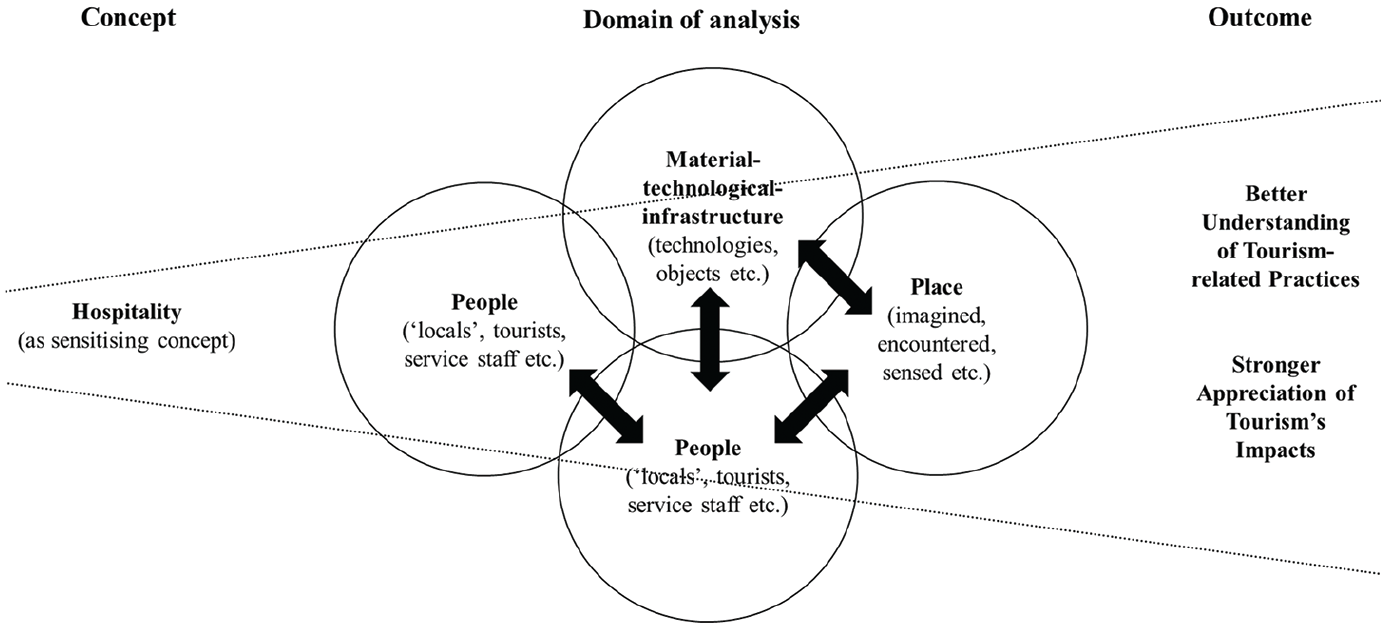
Framework for applying hospitality to study tourism.
Hospitality and tourism labour
Labour practices, experiences of work in the hospitality and tourism sector, and their impacts have been key areas of research (Cassel et al., 2018; Dumbrăveanu et al., 2016; Heimtun, 2012; Ong, 2012). This stream of enquiry has primarily sought to better understand and expose the problematic dimensions of work in foodservice, accommodation and entertainment organisations that form a large component of tourism’s infrastructure and shape tourists’ experiences. The sector is often criticised for its precarity, poor working conditions, low levels of unionisation, job stratification based on gender and race, harassment and low wages (Robinson et al., 2019). These challenges have been amplified by the emergence of new technologies that disempower or replace hospitality workers (Ivanov, 2019). Studies have frequently examined the experiences of frontline service workers, but research in this area has expanded to encompass those who remain even further marginalised and hidden from view. This includes those working in supply chains, cleaning services and kitchens (cf. Kensbock et al., 2014; Lozanski and Baumgartner, 2020; Paraskevas and Brookes, 2018; Robinson, 2013). Researchers have adopted a critical, emancipatory agenda in exposing and challenging inequities (Jayaraman, 2016), a consequence of which is the perpetual demonisation of the sector and potential devaluation of hospitality labour.
However, research has also acknowledged that intersections of tourism, hospitality and labour can been seen in terms of positive outcomes. Low barriers to entry, flexible working arrangements and the blurring of work and leisure means that hospitality work is now enfolded into wider lifestyle mobilities (Duncan et al., 2013; Zampoukos, 2018). Such mobile workers are empowered through engaging in tourism and hospitality employment because it facilitates their temporary settlement and subsequent travel. Similarly, research also highlights how hospitality employment can positively shape migrants’ experiences. Hospitality work provides opportunities to accumulate social, economic and cultural capital, which facilitates migrants’ settlement and integration in ways that are not possible in other employment spheres (Janta et al., 2012; Lugosi et al., 2016).
In sum, this strand of research raises important moral and practical questions about the ‘costs’ of hospitality for those involved in its production. However, it also encourages us to examine the ability of hospitality and tourism work to support sustainable lives in and across places. Importantly, the global nature of tourism, the increasingly mobile character of contemporary society, and rapidly changing technologies provoke pressing questions that continually need to be addressed in studies of diverse national and cultural contexts:
Q1. How are emerging technologies, evolving infrastructures and changing cultures transforming the forms and dimensions of hospitality-related labour in tourism?
Q2. What are the short and long-term social, cultural and psychological impacts of engaging in hospitality and tourism-related work?
Q3. How do factors such as gender, race, ethnicity, class, sexuality, physical appearance, nationality and political affiliation intersect to shape experiences of hospitality and tourism workers?
Q4. What are the transformational capacities of engaging in different types of hospitality and tourism work, including how these vary according to the organisational, cultural and national context?
Q5. How are individuals from diverse backgrounds able to create and mobilise resources and exert their agency through engaging in hospitality and tourism employment?
Hospitality and the transformation of place (experiences)
Tourism experiences and tourists’ engagement with places are affective, embodied and multi-sensual (Crouch and Desforges, 2003; Everett, 2008). They are therefore perceived, sensed and interpreted as much as they are performed (Lugosi, 2014; Lynch, 2017). The production and consumption of hospitality, in all its eclectic forms, undoubtedly shape encounters between people and places. Therefore, examining the different manifestations and dimensions of hospitality becomes necessary to understand the processes constructing tourism experiences, and their outcomes.
New forms of mobility, underpinned by evolving travel technology and infrastructures, have blurred the divide between tourism and migration, which transform social relations and experiences of place. Specifically, growing numbers of leisure and working travellers can change the makeup of communities and thus disrupt traditional notions of ‘host’ and ‘guest’ in destinations (Halvaksz, 2006; McNaughton, 2006; Sherlock, 2001). This can raise existential questions regarding who is a local or resident, and potentially undermine existing social capital that helps communities to function (Marcher et al., 2020). Moreover, such disruption raises wider questions concerning the place of culture and identity within tourist experiences. Specifically, the presence of temporary residents and migrant workers limit opportunities for tourists and ‘embedded’ locals to meet, which thus challenges the objective authenticity of hospitality-based encounters or cultural experiences (Baum et al., 2007; Halvaksz, 2006).
Residents are regularly enrolled by state actors, destination marketing organisations and businesses to co-create and perform hospitality within the visitor economy (Hollows et al., 2014; Richter, 2010). The valorisation of hospitality, especially when performed in ‘acceptable’ forms, for example in gastronomic events celebrating local products, craft skills and heritage, is thus used in strategic placemaking and regeneration practices (Bell, 2007). Such initiatives may help to reinvigorate community pride and identification, and revitalise cultural practices. The ability to create value can also drive innovation in developing new food, drink and hospitality-related practices that are integrated into tourism infrastructures (Lugosi and Allis, 2019; Sørensen et al., 2020).
Moreover, as tourism becomes the dominant economic activity in a destination, it begins to transform the hospitality characteristics of place in terms of the food, drink and entertainment services catering for visitors and locals. For example, Gyimóthy’s (2018) work showed that ‘local’ foods were supplemented by what residents perceived to be ‘foreign’ foods, which were preferred by the tourists who visited the destination. Arguably, the presence of familiar foodstuffs, drinking practices or entertainment venues (e.g. pubs or clubs) provide a form of ontological security for tourists: these negate the need for tourists to adapt, and facilitate the transfer of hedonistic leisure practices from home to the destination (Andrews, 2005). However, the presence of tourists and the development of a hospitality infrastructure that caters to their needs rather than those of existing locals is often viewed as detrimental to a sense of heritage and community (Germann Molz, 2018; Jover and Díaz-Parra, 2020).
The key implication of this nascent body of research is the move towards interrogating the transformative capacities of hospitality either as a driver or as an indicator of wider transformations, for example in the local population, culture or the economic and material landscape. This raises multiple questions for future enquiry:
Q6. How do the presence and practices of diverse types of migrants and sojourners influence interactions and relations in tourist destinations?
Q7. What socio-material, cultural and economic innovations and impacts emerge from the practices of disparate types of ‘guests’ for place-specific stakeholders?
Q8. How does the presence of a mobile network of ‘guests’ shape destinations’ place-image or sense of place for residents and tourists?
Hospitality as socio-material and socio-technological practices
The practices of welcoming, presenting, serving, encountering, consuming, reciprocating etc. that characterise hospitality have socio-material and socio-technological dimensions. These practices begin before tourists arrive in destinations. Huijbens and Benediktsson (2013) for example, discussed how landscapes are framed and represented through media campaigns to potential tourists as enchanting, ‘hospitable’ places offering experiential possibilities for recreation and self-fulfillment. Similarly, Xu et al. (2020) pointed to the role of mediated food-related practices in captivating visitors and shaping their material-embodied tourism experiences in place. Importantly, members of the ‘host’ population are often co-opted in such tourism promotional practices to construct messages about the welcoming and hospitable nature of the tourist encounters that visitors can expect (Jaworska, 2016).
Hospitality related socio-material and socio-technological practices permeate the tourist experiences. For example, research has examined how social media and other technological platforms such as TripAdvisor and Airbnb enrol content creators in assigning value to specific forms of hospitality experiences within tourism (Liu et al., 2020; Lugosi, 2016). Perpetuating consumer-focused evaluation and review in a wider recommendation system that promotes activities, products and places has a number of implications. In principle, it has led to a greater sense of transparency, helping to enchant potential tourists, driving them to visit attractions, utilise services and create memorable experiences. However, it also promotes a perpetual culture of surveillance, where everything is subject to review and valuation, including the service providers, locals, tourists and their material ecologies (Chen, 2018a; Farmaki and Kaniadakis, 2020).
Beyond the socio-technological regimes of platform economies, research has highlighted how socio-material practices are embedded in the production and consumption of hospitality and tourism. These include the enrolment of materiality in experience design to mediate relationships between organisations and consumers, for example, the display of foodstuffs and related paraphernalia to convey hospitableness to tourists (Höykinpuro and Yrjölä, 2020). Research has also pointed to the role of socio-materiality within production regimes, for instance in kitchens where they determine food waste practices (Chawla et al., 2020). Studies have also explored how materiality and technology-related innovations are changing hospitality procurement, operations and service practices, driving efficiency and enhancing consumer experiences (Tuomi and Tussyadiah, 2020).
Examining hospitality-related socio-material practices is often important for making sense of tourist experiences, for example, as people encounter servicescapes, or as eating and drinking shape visitors’ engagement with destinations and its inhabitants (cf. Bezzola and Lugosi, 2018; Mkono, 2011; Osman et al., 2014). Arguably, the material-technological dimensions of hospitality have the potential to transform perceptions of welcome or hostility for visitors, insofar as they reinforce a sense of foreignness and outsider status, familiarity or accommodation. Importantly, perceptions of hospitality or hostility are shaped by practices across multiple domains, for instance a country’s visa documentation procedures, signage governing in-destination mobility, access to Wi-Fi services, and even toilets.
In short, examining materiality and technology-related practices help us to understand how hospitality is perceived and performed, and how it is ‘put to work’ or mobilised in the service of wider interests in the visitor economy. Future research may thus seek to address several critical questions, including:
Q9. What types of hospitality-related socio-material and technological practices operate in destinations, and how do they evolve over time?
Q10. How are residents and tourists enrolled in socio-material and socio-technological regimes in value creation practices?
Q11. How do diverse, evolving hospitality-related socio-material and socio-technological practices transform perceptions and experiences of place for tourists, locals and other stakeholders?
Hospitality as human encounter
Human encounters, including their dynamics, intentionality and their outcomes, have often been placed at the centre of conceptualisations of hospitality (Bethmann, 2017). In the past, discussions of hospitality, including in the context of tourism interactions, regularly invoked notions of ‘host’ and ‘guest’, implying interpersonal relationships (Lynch et al., 2011; Moufakkir, 2019; Nelson and Matthews, 2018). However, this has been critiqued partly because it risks essentialising multidimensional and shifting roles or relations, but also because hospitality does not always involve human actors (cf. Lugosi, 2014; Moufakkir, 2019; Sherlock, 2001).
Nevertheless, studies of touristic encounters have repeatedly examined how commercial and non-commercial relationships are negotiated as different actors perform and interpret hospitality and hospitableness (Chen, 2018a; Christou and Sharpley, 2019; Farmaki and Stergiou, 2019; Varley et al., 2018). In principle, hospitality contexts reinforce notions of sociality among existing social units, for example in the context of family holidays (Schänzel and Lynch, 2016). However, changing demographics and tourism practices have driven solo consumption of hospitality and tourism (Brown et al., 2020). Hospitality venues also enable tourists to engage in liminoid forms of social encounter, for instance involving sex (Berdychevsky et al., 2013). Hospitality practices within human encounters thus help create affective bonds, building notions of community or communitas between tourists (Jayne et al., 2012; Rickly, 2017). Consequently, performed and thus ‘experienced’ hospitality within touristic encounters can transform evaluations of places (Binnie and Klesse, 2011). The perceived hospitableness of locals experienced directly through interaction becomes part of destinations’ positive image and appeal for tourists (Jørgensen, 2020).
In contrast, many studies of interactions within tourism domains point to potential hazards. Human mobility creates perceived risks for tourists and residents as they are exposed to new threats posed by the ‘Other’. This may range from ‘cultural pollution’, terrorism and disease (Gössling et al., 2021; Harrison and Lugosi, 2013; Korstanje, 2017). Hospitality venues become potential targets for crime and violence; they may also be seen as risky sites insofar as they enable deviant behaviour (Lugosi, 2019). The heightened risks associated with human encounters thus renders some places inhospitable because people feel exposed and unsafe. For example, studies of solo, female, Asian and Muslim tourist experiences demonstrate how surveillance and harassment led to them viewing some places as being a threat (Brown and Osman, 2017; Osman et al., 2020). Moreover, ascribing risk in defining others engenders new surveillance, bordering and exclusionary regimes. People’s mobilities and behaviours are monitored; physical, economic, administrative and symbolic barriers are erected to separate locals from tourists; and distinctions are drawn between different types of visitor based on their potential value or capacity to harm (cf. Lugosi, 2019; Morgan and Pritchard, 2005; Schmid, 2008; Vollmer, 2020).
Previous work has provided rich accounts of human encounters where hospitality has either been the context for interaction or where hospitality practices mediated encounters. These studies also suggest that hospitality and hospitableness as qualities or attributes can be seen as outcomes of human encounters, insofar as they are used to conceive or assess the positivity or negativity of interactions. Hospitality’s potential to become a social and economic resource, which involves opportunities and risks, raises several questions for future studies:
Q12. What types of commercial and non-commercial hospitality-related human encounters operate within tourism contexts?
Q13. How are human encounters within and in relation to hospitality spaces conceived by different tourism stakeholders?
Q14. How do different actors and institutions attempt to govern hospitality-related human encounters within tourism?
Conclusion
This commentary has identified multiple ways that hospitality and tourism intersect. Moreover, the eclectic literature exploring this nexus highlights hospitality’s potential as a sensitising concept for studying tourism and impacts. Specifically, focusing on hospitality’s manifest forms, for example the socio-material practices of welcoming, interaction, affective relations, service, conflict, exclusion, identity performance etc., helps to understand essential dimensions of the tourism experience. This includes how people engage with places, other people and their infrastructures and their consequences for diverse tourism stakeholders.
Hospitality as a sensitising concept can also help to understand its fundamental role in tourism, and beyond it. Using hospitality as a conceptual tool provides opportunities to (re)interpret the significance of other domains of practice that may not initially appear to be connected to it. For example, studies of socio-technological infrastructures, the materiality of destinations and foodstuffs, or experiences of harassment may not immediately seem to be associated with hospitality. However, hospitality’s power as a ‘device’ is that its invocation invites us to question whether and how practices in and across these domains shape perceptions and interpretations. This includes how people are included in or excluded from activities or spaces, how they develop affective relationships with and attitudes towards people and places, and how these inform their subsequent tourism-related behaviour.
Key to hospitality’s versatility and utility is, firstly, that hospitality can simultaneously refer to concrete practice or experience, as well as abstract notions of morality and philosophy. Moreover, it can also be used to examine the same phenomenon through these diverse lenses. Secondly, multidisciplinary interest in hospitality as a concept and its disparate applications will ensure that it continues to evolve and its transferability extends. Hospitality’s vitality in terms of reach, sophistication and impact will benefit from incorporating further multicultural, especially non-Western perspectives (cf. Chen, 2018b; Korstanje, 2015; Munasinghe et al., 2017; Nelson and Matthews, 2018; Stephenson, 2014). Appreciating the eclectic forms and domains of hospitality can help to develop a richer understanding of global tourism’s practices and its consequences. Importantly, the diversity and imagination exhibited over the past 20 years illustrate the possibilities for future research exploring the hospitality-tourist nexus in wider society.
Footnotes
Funding
The author received no financial support for the research, authorship, and/or publication of this article.
