




Abstract
Holiday travel offers the opportunity for self-definition and enhancement of social prestige. Due to the growing importance of self-expressive values within the ongoing course of individualisation, tourists increasingly make use of their travel experience to self-present in a positive way. Yet, tourism studies have not investigated what tourists actually want to communicate about themselves when representing their travel experience through the display of souvenirs. Using semi-structured qualitative interviews, this study examines touristic self-expression and exposes the self-concepts attached to and communicated through the display of souvenirs as material symbols of travel experience. Results show that tourists often have a clear intention to express positive self-messages when showing their souvenirs to others. Souvenirs are used to represent personal character traits, social affiliation to in-groups and neo-tribes, and to demonstrate individual travel history. This article adds to the discussion of individual ascription of meaning to the tourist experience and souvenirs, and gives an insight to the function of souvenirs for self-expression and social exchange.
Introduction
Holiday travel is a commodity that offers potential for conspicuous consumption and a leverage point for self-definition and self-consolidation in the social hierarchy (Boley et al., 2018). Positive self-representation grows more and more important in the process of individualisation (Krings, 2016), and values of self-expression progressively gained prominence in the past four decades (Orehek and Human, 2017). This value shift leads to changes in orientation towards leisure activities and holiday travel, whereat the tourist experience is increasingly rendered an activity for self-definition and a medium to enhance social prestige by strategic positive self-presentation (Hales, 2006). Even though the idea that tourists are partly motivated by prestige needs has long been established (Crompton, 1979; Dann, 1977; Fodnesss, 1994; MacCannell, 1976), touristic self-presentation after holiday travel has only recently entered the focus of tourism research (Bui and Trupp, 2019; Bui and Wilkins, 2017; Urry and Larsen, 2011), so there is large potential for further research into touristic self-presentation and prestige enhancement.
Positive self-presentation requires an active and reflective performance of self-identity (Goffman, 1959; Swann, 1983). Accordingly, tourists need to carefully construct the ‘ideal self’ (Higgins, 1987; Rogers, 1959) regarding their role as a tourist, and develop strategies to communicate this idealised self appropriately to the social environment. Due to the popularity of social media and its potentials for positive self-presentation, it is not surprising that recent investigations of tourists’ self-presentation strategies have focused on touristic self-expression online (i.e. Azariah, 2016; Huang et al., 2010; Lyu, 2016). Yet, positive self-presentation does not depend on virtual media channels alone. In fact, the social media platform is just one specific opportunity for self-presentation provided by today’s technology. An examination of real-life settings and touristic self-presentation through material souvenirs offers a direct person-to-person approach to capture meaningful value ascription and self-expression in the context of the tourist experience (Büscher and Urry, 2009).
In this context, souvenirs are useful material symbols of travel experience for tourists to disclose self-messages and to construct positive self-representations. As a tangible remnant of a travel experience, souvenirs ‘are seen to encode individuals’ personal histories, ideal selves, significant others and self-expression’ (Morgan and Pritchard, 2005: 32) and thus serve as a vehicle to transmit messages about self-identity (Gibson, 2014) within the strive for social prestige. Shopping for souvenirs is a common holiday activity and accounts for billions of dollars of revenue for the tourist industry (Swanson and Timothy, 2012). Souvenirs often have a sacred character and are cherished by their owner; they are collected, arranged at home, or carried out into the world (Peters, 2011). Hence, they serve as a symbolic materialisation of tourist experience and its perceived implications on self-identity. Symbolic values attached to souvenirs have been examined in a number of studies (Hume, 2013; Morgan and Pritchard, 2005; Nyffenegger and Steffen, 2010; Paraskevaidis and Andriotis, 2015; Wilkins, 2011), yet the self-expressive value of souvenirs and underlying dimensions of intentional touristic self-presentation have not been explicitly studied.
This paper adds to the discourse of self-expression through travel experience and in more detail addresses the utility of souvenirs for positive self-presentation and prestige enhancement in the social environment. Using exploratory qualitative interviews, touristic self-expression through souvenir display in real-life settings is examined. This paper argues for a closer investigation of touristic self-presentation and prestige effects of holiday travel. The findings expose specific dimensions of touristic self-expression through souvenir display and offer an insight into the way in which tourists make use of souvenirs to self-present in a positive way.
Literature review
Holiday travel and prestige enhancement
Literature on the prestige motivation to travel suggests that holiday travel is a commodity to demonstrate financial wealth and a measure for ego-enhancement (Pappas, 2014) with a value-expressive function (Fodnesss, 1994), for attaining personal rewards (Mannell and Iso-Ahola, 1987), or as status symbol potentially satisfying prestige needs (Correia and Moital, 2009). For a long time, a considerable focus in tourism research was set on the prestige motivation rather than on processes of prestige exchange and perceived prestige effects, so that individual interpretations and social processes resulting from prestige-driven travel motivations were long neglected. Only recently, perceived prestige effects have experienced increased interest of tourism scholars, whereat holiday travel is examined as a medium for positive self-presentation and a means of social distinction, conspicuous consumption and prestige enhancement (Boley et al., 2018; Bui and Trupp, 2014, 2019; Chua and Chang, 2016; Kim and Tussyadiah, 2013; Lyu, 2016).
Prestige is given to someone by someone, and as such signals a transaction between the giver and the recipient of prestige (Domanski, 2015). This process is often set equal to an economic transaction with a straightforward predictable exchange of money and status symbols against prestige, grounded in the theory of conspicuous consumption from Veblen (1899). Prestige is hereby being reduced to a measure of financial status, drawing a one-dimensional image of the concept. It has been argued that a growing living standard and material abundance would diminish the value of products for conspicuous consumption and decline their role as status symbols (Todd, 2001). Yet, foundations of prestige do not reside merely in economic capital, but in social, cultural and symbolic capital generated through habituation and acquired during socialisation processes (Bourdieu, 1984). Social capital and distinctive features like experience, skills, behaviour, knowledge and beliefs are a substantial basis for prestige (Domanski, 2015). The habitus, as ‘a necessity internalised and converted into a disposition that generates meaningful practices and meaning-giving perceptions’ (Bourdieu, 1984: 170), determines which behaviour – including travel behaviour – is prestige-worthy. As such, the social transaction of prestige is not as straightforward and tacit as an economic transaction: It is based on the subjective values of both the givers and recipients of prestige, and are subject to constant change (Domanski, 2015).
Tourism studies have largely focused on the prestige motivation on the basis of the simplistic conceptualisation of prestige as an economic transaction based on financial status (i.e. Pappas, 2014; Riley, 1995; Swanson and Horridge, 2004; Vigneron and Johnson, 1999), and hereby disregarded the social and cultural capital symbolised by representations of tourist experience as a basis for distinction and prestige enhancement. Correia and Moital (2009) adapt socially constructed values and different prestige foundations in their model on the prestige motivation, in which they distinguish between subjectively perceived antecedents and social consequences of holiday travel. Their model is based on five values of holiday travel rendering a tourist experience worth sharing with social others in pursuance of prestige, which is outlined in the following paragraph.
According to Correia and Moital (2009), the unique value of a specific touristic product, as well as the quality in terms of perceived performance determine the prestige-worthiness of a tourist experience. The conspicuous value refers to the degree to which a tourist experience signals financial wealth. These values rely heavily on the conceptualisation of tourism as a commodity, in which the holiday trip is seen as a product acquired and consumed for representation of status. Further, the perceived emotional and hedonic values of a holiday lead tourists to express their experiences to others, and the social value of a holiday facilitate the social affiliation as a member of a group (Correia and Moital, 2009). Travel is hereby depicted as an element of social closure organising the belonging to specific social in-groups. As such, prestige-worthy values of holiday travel entail all foundations of prestige mentioned above: Self-expression through travel experiences can lead to prestige transactions based on financial values and product quality, on social in-group affiliation, and on ideological values like hedonism and uniqueness. The model of antecedents and consequences of the prestige motivation to travel has therefore combined the individual and social component of the prestige phenomenon as well as different kinds of travel related foundations of prestige determined by perceived ideological values. However, the types and content of self-messages conveyed when representing travel experiences is not addressed in the model and need to be further examined using exploratory methods.
Touristic self-expression
Self-expression in pursuance of prestige is organised through idealised roles and narratives and often performed deliberately and reflectively (Domanski, 2015; Goffman, 1959). In the context of holiday travel, tourists are required to reflect upon a touristic role for individual self-expression (Week, 2012) and upon an appropriate stage for self-presentation (Goffman, 1959). Research into positive self-presentation in the context of the tourist role has become especially prominent on the ‘virtual stage’ (Urry and Larsen, 2011) of social media. Numerous studies have examined strategies for sharing travel photos and blog narratives online and found that tourists make use of social media for strategic positive self-presentation (Lyu, 2016; Munar and Jacobsen, 2014), to attain social support and positive resonance (Kim and Tussyadiah, 2013), for positive self-branding (van Nuenen, 2016), to create a positive ‘online self’ (Azariah, 2016: 942) or for peer comparison (Chua and Chang, 2016). However, social media is but one of the stages for tourists to self-present. On the stage of the ‘real world’, verbal narratives and the placement of souvenirs are often strategically deliberated in order to be seen and noticed by social others (Morgan and Pritchard, 2005; Peters, 2011). Souvenirs are an enactment of a materially extended self (Belk, 1988), and are therefore deeply entangled with processes of identity construction and consolidation. Bearing in mind that tourists are partly motivated by prestige reasons, the assumption here is that they can make use of souvenirs to draw a positive picture of themselves and enhance their social prestige. Humans communicate and send messages to others through their very existence, and so does the mere existence of souvenirs as components of the extended self (Belk, 1988, 1992): They are possessions that ‘give us a sense of who we are, where we have come from, and where we are going’ (Belk, 1992: 37). Consequently, it is necessary to further investigate tourists’ positive self-presentation through material souvenirs in everyday life settings. This in turn sheds light onto the ‘ideal self’ (Higgins, 1987) in the tourist role, and how meaning is created with regards to the ideal self-concept of tourists.
‘Material things have a particular value in the leisure and tourism markets as they are absolutely necessary for human agency and performativity in them’ (Muecke and Wergin, 2014: 228). Souvenirs can symbolise and materialise the tourist experience, they have the ability to ‘absorb’ tourists’ narratives and express individual travel experience to social others (Hume, 2013) induce conversations about travel experience in a social setting. Yet, it is the tourists’ task to present the souvenirs and convey self-messages adequately, and ‘it is apparent that such items provide evidence of the conspicuous side of tourism consumption’ (Todd, 2001: 188). Such objects, as self-representative symbols ‘must be noticed by others, they must characteristically evoke certain specifiable reactions from others, and they must be in control of the individual’ (Swann, 1983: 37) in order to be effective vehicles for self-expression. This study depicts souvenirs as any material objects that are purposefully taken home by the tourist for reminiscence and representation of the tourist experience. As to the issue of what renders an experience, or a symbol representative of the experience, prestige-worthy, tourists have to rely on perceived values of a holiday (Hume, 2013), ‘filtered through subjective perceptions of objective characteristics, stereotypes and colloquially comprehended norms and values’ (Domanski, 2015: 12). Therefore, the collective knowledge on what is worth to be collected and represented is determined by subjective interpretation of collective, societal values (Bourdieu, 1984).
The symbolic messages attached to and represented by souvenirs are, for example, the value of ‘the extraordinary’ (Gordon, 1986), travel history and evidence of having been somewhere (Wilkins, 2011), understandings of authenticity (Chang et al., 2008; Hashimoto and Telfer, 2007), group conformity (Anderson and Littrell, 1996), or aesthetics (Stanley, 2000). Hume (2013) suggests a model for an analysis of ‘the language of souvenirs’ along five axes ‘that are present, to some degree, in the expression of all souvenirs’ (Hume, 2013: 121). The model constructs a souvenir’s expressive pattern as a composition of the object’s raw material (medium), the level of human intervention to the item becoming a souvenir (marker’s mark), the relation to people and places (relational), the capacity of an item to absorb a narrative (invitational), and the inherent values of a souvenirs’ narratives (iconofetish). Hume’s model sets strong emphasis on souvenirs’ capacity to express narratives, however his analysis conceptualises these narratives as expressive patterns of an objective reality and quantifies the level of expression of three ideal types of souvenirs. The reflective process or the active construction of self-messages by the tourist are not specifically analysed here. Thus, even though research into the meanings and values behind souvenirs has gained increased interest in past years, the specific contents of self-expression through souvenirs have not been extensively investigated so far.
An attempt to elaborate on self-messages conveyed through souvenir display is made by Morgan and Pritchard, who find a close link between materiality and self-expression. They term souvenirs ‘signifiers of self’ (Morgan and Pritchard, 2005: 37) which, by being displayed at home or on the go, symbolise self-identity, state of mind and social position. More specifically, they find that revealed aspects of identity and social position refer to social relationships, travel history, privilege and touchstones of memory. Yet, their auto-ethnographic approach concludes in rather abstract findings of what they personally express through their own souvenir display, but results lack the specific aspects of personal identity signified by souvenirs. Thus, their study offers a starting point for the self-expressive function of souvenirs, yet a comprehensive understanding of the content of self-expression through souvenir display is not put forward.
The literature review found a number of economic, symbolic and ideological values attached to souvenirs, a proportion of which is focused on values of self-identity. Yet, these findings are incomplete and address abstract and theoretical implications of self-expression referring to terms like ‘identity’, ‘self’ or ‘state of mind’ (Morgan and Pritchard, 2005). Swanson and Timothy (2012) criticise the narrow and atomistic way in which value-expression through souvenirs has been researched and call for a deeper examination of the object-person-place relationship of souvenirs. The present study aims at a more thorough understanding of the person-dimension in this relationship framework and exposes specific contents of self-messages expressed through souvenir display.
Methodology
Sampling procedure and interview method
Data collection took place in Lueneburg, Northern Germany in June 2018 using semi-structured qualitative interviews. Respondents were sampled via the university participant platform ‘Sona Systems’ of Leuphana University Lueneburg. The study description invited respondents to sign up for an interview about their most cherished travel souvenirs.
The purposive sampling procedure was informed by two respondent characteristics. For one, respondents were filtered regarding their involvement with holiday travel overall. Reflective self-presentation is a performative act depending on individually and socially ascribed values and roles (Azariah, 2016; Goffman, 1959). A condition for such a reflective performative act is the relative importance that a person ascribes to these values and roles (Walsh and Tucker, 2009). Related to self-expression through the travel experience, a high involvement with holiday travel is expected to induce more reflective symbolic self-presentation through travel souvenirs. To ensure that all interviewees set importance on holiday travel, they were asked about their perceived importance, perceived pleasure and sign-value of holiday travel before the interview (Laurent and Kapferer, 1985). Only those respondents that indicated strong approval with respect to their involvement with holiday travel were considered for data analysis. Due to lacking involvement, three interviewees were ruled out for data analysis.
Second, values of self-expression have risen especially in the younger age groups in the past four decades (Inglehart, 2008; Inglehart and Oyserman, 2004). Thus, the focus is set on younger cohorts aged between 19 and 29 years, as the shift of traditional values towards expressive and post-modern values centred upon personal lifestyle choices is most evident in this age group. Selecting young interviewees from the University respondent platform therefore resulted in more reflective and meaningful interpretations of ‘experts’ in the field of self-presentation. However, it is necessary to bear in mind that the homogeneity of the sample also limits the generalisability of the findings: Even though the focus on young, educated Western tourists provides a valuable insight to this specific group of people, the results of this study cannot unequivocally be applied to the larger population of tourists.
Relying on interpretive methodologies, this study centralises subjective meanings and perceptions of tourists and seeks to unveil their own perceived usage of and self-expression through material souvenirs in real life-settings. Despite the focus on perceived self-expression, the interview should not solely be disembodied and de-materialised, but take into account the socio-materialistic experience that souvenirs bring about. The self-expressive agency of humans is ‘co-constituted by various material agencies, of clothing, tools, objects, paths, buildings, machines, paper, and so on. And thus we have never been simply “human”[. . .]’ (Büscher and Urry, 2009: 100). Consequently, respondents were asked to ‘collect those things that strongly remind you of a holiday and that are something very special to you. Please assemble those items that directly come into your mind when thinking about your most cherished souvenirs’ (Invitation message). Further, the definition of a souvenir was left to the interpretation of respondents: ‘A “souvenir” you can take to the interview can be anything – there is no right or wrong. Just make sure that it is a material item that you brought from a holiday and that you sometimes come across in everyday life’. This open definition enabled interviewees to focus on material things related to tourist experiences that hold significant meaning to them and are of relevance for the purpose of this highly interpretive study. Figure 1 exemplifies the collection of four respondents’ souvenirs.

Souvenirs of four respondents. Top left (‘Birgit’): Moai figure (Easter Islands), painting of a coconut (Brazil), Alpaca blanket (Peru), Superman T-Shirt (NZ). Top right (‘Sina’): Merci Leòn movie poster (France), Harry Potter chocolate frog (UK), Rosewater (France), beer caps (collection), School uniform accessory (Thailand). Bottom left (‘Hannes’): postcard (Costa Rica), printed photos (collection), cappy (Australia), Buddha figure (Thailand), rusty metal sign (France), wooden key ring (Mentawai), bank note (Indonesia). Bottom right (‘Petra’): pants & photo (Thailand), blanket (Turkey), handmade wristband (Peru), streetside painting (Australia), mass-produced hair decoration (Turkey).
The interview guide was structured in three main blocks of questions. The first block of the interview guide began with an open question, namely ‘Tell me about your souvenir’, which often resulted in long narratives from respondents. Follow-up questions concerned the time, place and rationale of the souvenir purchase, the current usage, placement and conspicuous display of souvenirs to others and other peoples’ reaction to the souvenir display, be it compliments or resentments. A third block of questions focused on the values and roles assumed to be represented through the souvenir. Here, the aim was to tap into the manner and interpretation of self-messages and self-revelation through souvenirs. Therefore, this block constitutes the main section of the interview, unveiling the way in which souvenirs reveal messages about their holder.
Materially enriching the interview ‘enabled access to participants’ in-the-moment experiences’ (Dowling et al., 2016: 4), as they cause deep and meaningful recollections of the travel experience within respondents. The sensory experience of holding a souvenir, touching the material and sensing its smell or sound induced long narratives after the first open question of the interview guide was posed. Through the presence of the souvenirs during the interviews, respondents were reminded of their trip, the time and place of souvenir purchase, the everyday usage of souvenirs and situations of talking to social others about a specific souvenir. Including souvenirs in the interview situation is a means of tackling the ‘major research challenge to get inside such private worlds [. . .] through often complex and difficult conversations’ (Büscher and Urry, 2009: 107).
Data analysis
Data was analysed following Grounded Theory methodology (Glaser and Strauss, 1967). Even though the literature review brought about a number of expected contents of self-expression through touristic souvenirs (Correia and Moital, 2009), this coding procedure for data analysis was selected due to its openness for new concepts emerging from the data, and in order to enable a constant comparison of codes, and to maintain theoretical sensitivity and analytical induction (Boeije, 2014; Glaser and Strauss, 1967). The axial coding process resulted in the concept of ‘self-revelation’ emerging as the key category, around which the remaining codes were analysed in the selective coding procedure. This approach enabled an exploratory analysis of the data and the completion and integration of concepts for self-expression through the tourist experience additional to the values suggested by Correia and Moital (2009) and aspects of self-signification (Morgan and Pritchard, 2005). However, the reviewed literature introduced some self-expressive values assumed to be conveyed through souvenir display so these theoretical backgrounds were kept in mind and later related to the findings resulting from data analysis.
Data collection was completed after 19 interviews, when a point of saturation was reached and codes repeatedly appeared without new content coming forth during the interviews (Glaser and Strauss, 1967). The 19 interviewees were all of German nationality and aged between 19 and 29 years, with the sample exhibiting an average age of 21 years. Concerning the gender split in the sample, 11 interviewees were female and eight interviewees were male. In total, 93 souvenirs were brought to the interviews, with each respondent bringing between three and eight cherished touristic remnants. Out of the 93 souvenirs, 76 have at some point actively been shown to friends, family, visitors or study colleagues. With this study focussing specifically on self-expression, the 17 souvenirs that were not presented to anyone before were ruled out for data analysis.
As neither the number, nor the type of souvenirs was specified in the interview invitation, a variety of material objects were brought. The souvenirs all hold special symbolic value to their owners and are bound up with positive memories and emotions. Table 1 exhibits the types of souvenirs, their current usage and location and the type of holiday they were taken home from.
Overview of analysed souvenirs.
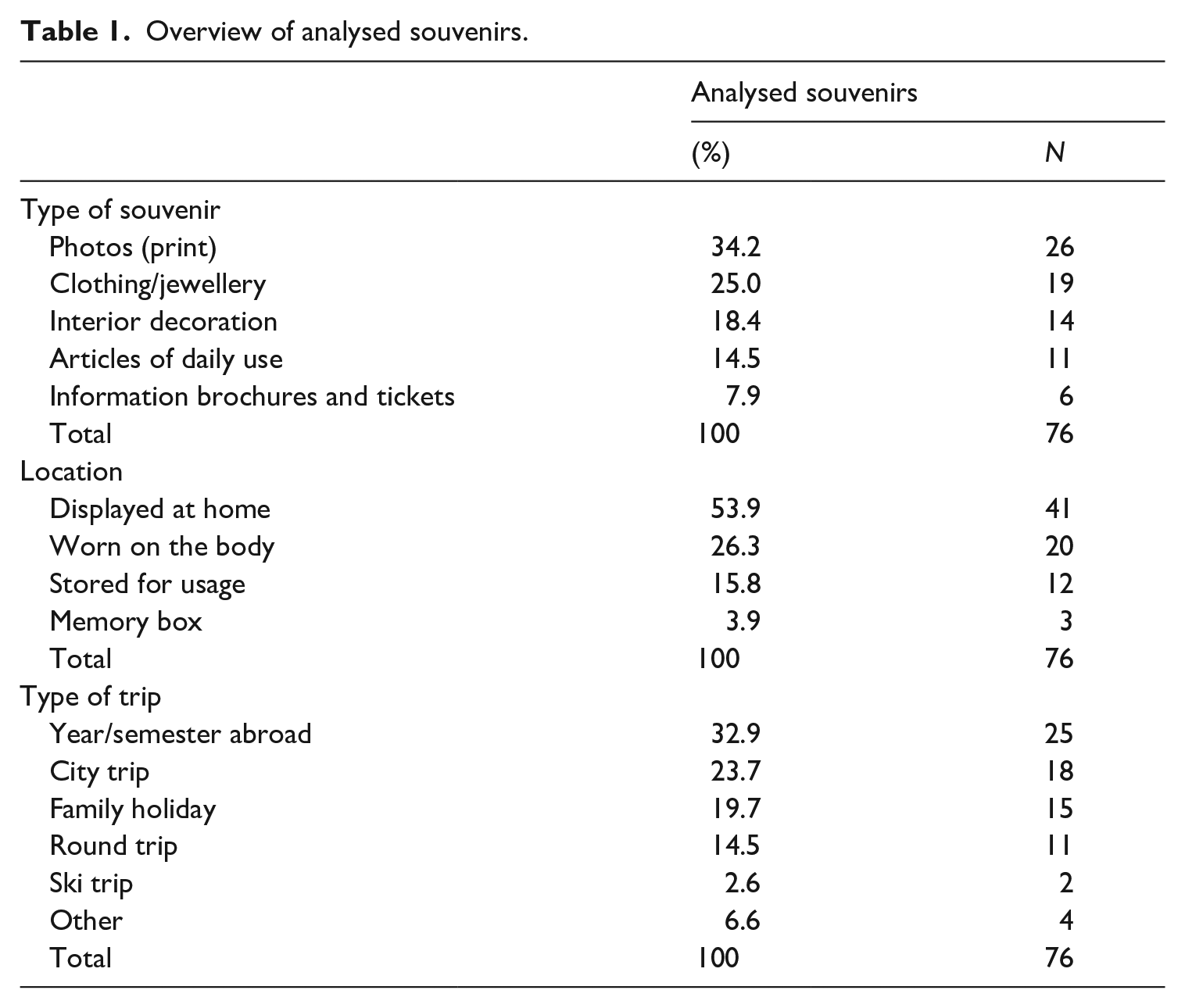
A large part of the souvenir sample consists of printed photos. Even though photos are not a typical kind of souvenir, the 26 photos were all printed and mostly framed, thus constituting material objects as opposed to merely digital photos. Further, 19 articles for self-decoration like clothing and jewellery were brought, which were obviously worn on the body of participants as mobile souvenirs that can be noticed by others at the given time the tourist decides to wear them. The 14 items of interior decoration were objects like blankets, paintings, figurines and small statues. All these items were placed at a prominent location at home and also shown to visitors to represent the tourist experience. The 11 articles of daily use were keychains, glasses and cups or sports gear and were placed according to their function – stored in the kitchen cupboard or used during sports classes. The smallest cluster consists of material reminders of touristic attractions or activities, like information brochures and flyers, entrance- and flight-tickets. These were either pinned on a wall, and three of them were stored in a memory box for future presentation.
Concerning the types of trips the souvenirs were taken home from, a large part, namely 25, were brought back from a year or semester abroad. Considering the sample of respondents, this is not surprising as many students engage in a year away from home after finishing school, and these experiences are intensively bound up with emotions and the construction of personal identity (Noy, 2004). Another 18 souvenirs were taken home from city trips of short duration, 15 from a family vacation, 11 souvenirs were acquired during a round trip to different cities, and 2 souvenirs were brought from ski trips. Another two items were taken home from a honeymoon and 2 souvenirs were parts of a collection from different types of trips.
Results
Souvenirs’ level of conspicuousness
Overall, tourists clearly evaluate the level of prestige potentially garnered by the display of their souvenirs and reflect on the way in which they are positioned and displayed to social others. The conspicuousness of a souvenir is subject to the tourists’ perception. There appears to be a clear distinction between ‘showing off’ and ‘revealing’ self-messages through tourist experiences. This distinction is closely linked to the place and placement of souvenirs: Tourists contemplate the relevance and meaning of a holiday, subsequently decide on the placement of each souvenir (Peters, 2011) and make assumptions on the souvenirs’ level of conspicuousness. Those souvenirs with substantial meaning for the holder are presumed to be displayed more candidly and conspicuously than those with little or shallow meaning. This is also a matter of the souvenirs’ material agency, as perceived by their owner, and their assumed capability to attract attention of social others (Walsh and Tucker, 2009). The same type of placement of souvenirs is interpreted differently depending on the subjective meaning ascribed by the tourist.
A number of souvenirs were deliberately displayed to be noticed by an audience as large as possible: ‘I am kind of showing it [a painting] off, because I hung it centrally into my room. And I am asked about it a lot, because people want to know who [the person is] and where [it] [the background] is. And then I love talking about it. I really like that, which is why it is hanging on my wall as an eye-catcher’ (Petra). At the same time, however, some souvenirs placed at a similar location were not assumed to hold a high level of conspicuousness: ‘Well, it [bow-tie] is hung up centrally above my bed. When I look at it actively, I think about the trip, but I don’t look at it every time I go to bed. You sort of overlook the things [in your room] that never change. You don’t notice them as much anymore’ (Sina). Even though both souvenirs were displayed centrally on a wall, their level of conspicuousness is interpreted differently by their owners and is highly dependent on the subjective meaning ascribed to the item. This goes in line with Peters’ (2011) findings that regardless of the perceived symbolic values of souvenirs, the level of conspicuousness of souvenirs is not dependent on the placement itself, but on the interpretation of the level of conspicuousness on the side of the tourist.
Other souvenirs were not considered to convey meaningful self-messages, while others even became a characteristic that a tourist is identified with by social others. Hannes’ cappy from Australia serves as a unique feature and even gave rise to a soubriquet. ‘And when I was new at University, I was [called] “the guy with the Australia Cap” when people didn’t know my name. People sort of defined me by it, because apparently the most prominent feature that I had was that cappy’ (Hannes). On the other side, Wencke, who wears her Canada shirt relatively often, states that: ‘I think it is pretty inconspicuous. [People just think]: Okay, she is wearing a Canada shirt’. Thus, even though both souvenirs are able to reveal the tourist experience and are regularly worn by their owners, they appear to hold varying levels of conspicuousness and representativeness.
Some souvenirs are also not displayed just after the holiday trip, but are collected for future presentation. ‘I really kept this [football ticket] as a memento. And then I also found it cool that when I have children, I can show it to them. I think it doesn’t have a material value for anyone, but as I said my kids might be happy about it.’ (Dennis). As such, a souvenir does not only express messages about the ‘current’ self, but also signifies what a tourist wants to represent in the future. This relates to Goffman’s (1959) idealised role and Higgins (1987) idealised self, whereat the tourist reflects upon potential future selves and depicts the holiday experience as a feature for future identity consolidation.
Expressing character traits
Tourists make use of souvenirs to express their perceived character traits. The character traits are hereby just as diverse as the tourists themselves: Souvenirs are symbols of interpersonal differences; their meanings are related to the individual identity and perceived singular experience of the tourist. Reoccurring concepts in data analysis concern adventurousness, spontaneity, sentimentalism, practicality, perseverance, straightforwardness and hedonism – traits that encompass typical notions of holiday travel as an escape of the ordinary or a sacred period of time (Graburn, 1989). The self-revelation expressed by each souvenir is closely related to either perceived characteristics of the tourist experience or to characteristics of the item itself. This shows that, to make use of souvenirs for self-presentation, tourists have to engage in multiple reflective processes of representation: Meaning has to be reciprocally ascribed to the tourists’ self-concept, the travel experience and the souvenir.
Souvenirs are metaphors and meaningful symbols for self-identification with personal characteristics. During a holiday, Franziska found that a sailing boat is a self-representative metaphor, stating: ‘It is kind of like, the symbol says a whole lot about me, because it shows that I love to be on the move, and discover new things. This metaphor behind it, too, that I like to leave safe harbour, I’d say. [. . .] That is also why I got a tattoo of it after the holiday’. In this, a necklace with a sailing ship pendant symbolises venturesomeness and openness for novelty. This openness for adventures can also signify a daring character: ‘It [a bow-tie] symbolises my interest in other cultures. And also [. . .] it kind of shows that I dared to go there. [. . .] It really took some overcoming, and I did it anyways because it interested me so much’ (Sina). This character trait emerged as an intended self-revelation of many souvenirs, as they express ‘[. . .] that I like getting out of Europe sometimes’ (Jonas), or ‘that I love travelling and getting to know new things’ (Wencke). Here, the perceived characteristics of the holiday are internalised as a personal character trait and projected onto the souvenir, which serves as a vehicle to represent the intended self-message and idealised tourist role.
Another character trait emerging from the data is sentimentality and a proclivity for nostalgia. For example, Jonas states: ‘It [flyer] expresses, that I keep some really trivial things. So maybe I am a little nostalgic – which I am – and yes, that’s what it expresses’ (Jonas). Petra’s friendship bracelet signifies ‘that many things are important to me. So for one, it is the memory of the trip, and also that I cherish my friends. I think that’s what it would express about me’, and therefore addresses her sentimentality. With many souvenirs, especially printed photos, tourists intend to express the fact that they are very caring of relationships, or have a friendly and loving character. This goes in line with the expression of social affiliation towards travel companions suggested by Correia and Moital (2009). The importance placed on relationships is represented by many souvenirs, exemplified by statements like: ‘I think it [printed photo] shows what I am like in my relationships’ (Franziska); or ‘it [printed photo] shows that I am a family person’ (Dennis). These self-expressions address personal characteristics of the tourists rather than characteristics of the touristic product itself, setting focus on people rather than place.
Other souvenirs are expressive through their function. Finn anticipates about his pocket knife: ‘About me personally, yes. It says that I like to be prepared for everything, for every possibility. And also that I don’t like planning everything, but that I am more of a practical kind of guy’. Here, the knife is a practical item, revealing the practical nature and straightforwardness of its holder. The meaning is ascribed to the item itself rather than the travel experience; however, narratives are still closely linked to the holiday: ‘I took it to some festivals, and when we used it I also told the story behind it and where it is from’ (Finn).
Linking this finding back to prestige foundations, the character traits represented by souvenirs address the charisma dimension regarding personal ‘central features of a man’s existence and the cosmos in which he lives’ (Shils, 1968: 107). The he display of souvenirs serves the purpose of identity construction and self-extension (Belk, 1992) as tourists shape self-perceptions and express these perceptions through souvenirs. The reflective process of respondents in terms of value ascription was specifically interesting with regards to character traits: Meaning is ascribed to the tourist experience, the tourist experience is attached to the self-concept, and the souvenir brought home from the trip is seen to symbolise both the experience and the self-concept. Even though souvenirs were identified as ‘signifiers of self’ (Morgan and Pritchard, 2005) before, character traits were never specifically exposed as part of this signified self in the tourism literature and bear numerous leverage points for further research into touristic self-expression.
Expressing social affiliation
Another prevailing self-revelation is the affiliation to a social group expressed by souvenirs. This concerns either the relationship and affection towards travel companions, or the belonging to certain interest communities, also termed ‘neo-tribes’ (Cova and Cova, 2001; Thompson and Holt, 1996).
Regarding the relationship to travel companions, souvenirs reveal the tourists’ love and affection towards the people they travel with. This is not far-fetched considering that the sample implied a lot of holiday photos depicting traveller and companions, which are often printed and displayed at home. Franziska states: ‘This photo makes me very happy, especially because of my friend. We had just moved to different cities. And because of that it is a memory that we had a good time together even though we don’t see each other that often anymore. [. . .] I think it shows what I am like in my relationships. Here, it shows a very deep friendship that I really cherish and want to maintain’. Displaying the souvenir, she expresses the way in which she appreciates friendships and cherishes the time spent together. For Timo, a souvenir table tennis ball reveals his pride of being a member of a narrow circle of friends: ‘It kind of makes me proud somehow. Having a group like that, that I went on a holiday with. I mean nothing specific happened that I could be proud of, but that I was there with an awesome group like that’. Therefore, the self-revelation signified through souvenirs is closely connected to the social value of a trip (Correia and Moital, 2009), deepening relationships and immersing the tourist into a group of travel companions.
Social affiliation is also expressed through souvenirs regarding the belonging to a neo-tribal community. Such neo-tribes are groups of people ‘held together through shared emotions, styles of life, new moral beliefs and consumption practices’ (Cova and Cova, 2001: 67), also termed the linking values of such communities. This linking value is subject to change, is inherently fluid and allows members to be part of numerous neo-tribes at once, such as the communities of surfers, snowboarders, hippies or backpackers. Neo-tribes are often analysed through a lens of postmodern consumption (Cova and Cova, 2001), whereat the value of specific products is not reduced to the mere use-value but is seen in numerous ideological and emotional linking values. Holiday travel, through its ability to arouse memorable emotions and affective states, appears as an optimal product for such social affiliation in neo-tribal communities. Hannes refers to a keychain as a symbol of his belonging to the neo-tribe of the surfers. ‘Mentawai [Indonesia] is a small and popular archipelago among surfers, because it has a lot of good waves. [. . .] And it’s truly off-grid. And people say either “Oh, where is that from?” or, in case they are surfers, too, [they say] “Oh Mentawai, have you been there?” [. . .] So, people can infer that I am a surfer-dude’. Here, the keychain is a symbol that only members of the community in question can accurately interpret: Only surfers know about the peculiarity of Mentawai and its ideological implication and linking value for the surfers’ community, whereas outsiders of the tribe do not know the meaning and value of this particular destination. Hannes herein interprets the souvenir keychain as a symbol of neo-tribal consumption, signifying his affiliation to the neo-tribe of the surfers and expressing his affiliation to this community to others.
Evidence of ‘having been there’
Souvenirs are also signifiers of travel biography, manifesting the fact that a tourist has actually physically been to a destination. As such, a souvenir provides proof of the tourists’ travel accomplishments at different destinations (Paraskevaidis and Andriotis, 2015; Wilkins, 2011). This is closely related to either conspicuous or unique values of holiday travel suggested by Correia and Moital (2009).
The conspicuous value of holiday travel derives from a ‘Veblenian’ travel motivation (Correia and Moital, 2009: 19) signalling and representing financial wealth through conspicuous consumption of a tourist destination. Among others, Sofia is well aware of this aspect: ‘It [beach towel] tells others a lot about me on different levels. Just the fact, that I had the possibility to go to Costa Rica at the age of 13 shows that I am quite privileged and that I was lucky’. This does not imply that a souvenir as a piece of travel evidence is always consciously displayed to represent financial wealth; however it is an aspect that tourists are often aware of and sometimes actively express when exhibiting souvenirs.
Displaying various souvenirs from the same region, Birgit anticipated the unique value of her travel experiences in South America as a self-revelation performed through her collection of souvenirs. ‘It reveals that I was there. And I think you can see that in my room. My friend also told me that when she visited my home. She said I really have a theme there, because there is so much stuff from the South American area, because I have been there a lot. You can really see it’. Birgit’s collection of Southern American souvenirs becomes a theme in her apartment, and represents the unique value of her meaningful relationship to the region as a proof of her travel experience.
Michaela also focuses on the conspicuous and unique value of her experience in Italy, even though she did not particularly enjoy the experience at the time. ‘In retrospective, I reckon it is pretty cool to have seen an Italian opera in Italy. Being able to say that about myself and having experienced it. At the time, it was just an annoying event that my parents dragged me to. It isn’t special or unique for an Italian, but here in Germany, for me or others, it is something unique’. Even though Michaela did not participate in the activity for prestige enhancement, the value she ascribes to it has changed over time (Collins-Kreiner and Zins, 2011) and now holds a unique value for her, proving that she has been to an Italian opera in Italy. She ascribes meaning to the souvenir posterior, even if the experience did not hold particular hedonic value at the time.
The uniqueness of a tourist experience is closely linked with its prestige-worthiness and its conspicuous value. It addresses the prestige foundation of achievement (Wegener, 1992), implying that going to a specific destination is somewhat of a conquest made by the traveller, and being able to consume a specific – unique – travel destination is a prestigious performance, and a self-expression mediated through display of souvenirs.
Theoretical implications and limitations
Theoretical implications
This study examined touristic self-expression through souvenir display with a focus on positive self-presentation regarding the prestige motivation to travel. The expressed self-messages as well as the level of a souvenirs’ conspicuousness are determined by the perception of the tourist: Individual ascription of meaning and the relative importance of the holiday affect the way in which tourists intend to express self-messages through a souvenir to social others for positive self-presentation and prestige enhancement.
The ascription of meaning
The findings enhance the understanding of tourisms’ impact on the traveller’s idealised self-concept as a precondition for positive self-presentation through souvenir display. Considering Belk’s (1988) notion of the extended self that ‘we are the sum of our possessions’ (p. 139), the study offered an insight into the reciprocal process of appropriation and attachment, in which the individual constructs meanings and values, and attaches this meaning to the possession. The attached meanings and values are also appropriated, namely embedded in the personal interpretation of an individuals’ self. For positive self-presentation, an ‘ideal self’, that embodies one’s hopes, aspirations and wishes (Higgins, 1987) is constructed.
The tourist experience is especially interesting in this context: It is a product that is constituted by an intangible experience so that a number of self-reflective thought processes and value ascriptions are required from travellers. For one, the tourist needs to reflect on and ascribe individual meaning to the travel experience itself, and deliberate on the capacity of the tourist experience to reflect the self-concept and an idealised touristic role. Further, the souvenir needs to represent the tourist experience and its perceived values respectively. At last, the souvenir is used to represent the perceived self-concept attached to the tourist experience. This shows how ‘the world of meaning that we create for ourselves, [. . .] creates ourselves’ (Rochberg-Halton, 1984: 335) in turn. As such, this study enhances our understanding of reflective performances of value ascription to the tourist experience, to the self-concept, and to the souvenir as a material representation of both tourist experience and self-concept.
Holiday travel has emerged as an expedient product for identity consolidation and positive self-presentation. Through the reciprocal reflective ascription of meaning, travel experience can represent character traits and moral beliefs, commitment to relationships and social belonging to specific groups, and our experience with the world. It therefore is a versatile product with perfect prospects for self-expression. Hence, souvenirs are more than a collection of reminders: They materialise ideological values we hold about ourselves and the symbolic meanings ascribed to travel experience, and serve as a medium to represent these values and meanings to others.
The self-expressive value of souvenirs
The study found empirical evidence of symbolic values attached to souvenirs derived from the literature, such as social affiliation (Correia and Moital, 2009; Paraskevaidis and Andriotis, 2015) into in-groups and neo-tribes and a tangible evidence of having been to a destination (Swanson and Timothy, 2012) in terms of an achievement or a symbol of financial wealth (Pappas, 2014). Additionally to these previously established values, souvenirs serve the purpose of consolidating and communicating character traits to social others. Tourists make use of souvenirs to express what they are like as a person and to reveal personal moral virtues with touristic self-expression. In this study, the picture of adventurous, open-minded, extroverted and practical tourists was represented, but also sentimental and melancholic personality traits were expressed by souvenirs. Thus, the types of self-messages found were related to prestige foundations of prosperity, experience and social belonging (Domanski, 2015), achievement and charisma (Wegener, 1992).
Concluding, this study exposed an important utility of travel souvenirs. Depending on the individual subjective meaning ascribed to a holiday and the tourist’s self-concept, souvenirs are a vehicle for self-expression and positive self-presentation. The findings added to the discussion of souvenir expression, provided empirical evidence on intended self-presentation of tourists making use of their souvenirs for social prestige enhancement, and exposed some concrete values addressed when people represent their travel experience. Positive self-expression is a need that grows more important in the ongoing course of individualisation (Inglehart and Oyserman, 2004; Krings, 2016). This study has shown that the symbolic meanings of souvenirs as representations of travel experience enable tourists to reflect on and communicate self-concept, idealised touristic roles and symbolic beliefs to social others.
Limitations
Self-expression through souvenirs is deeply entangled with subjective meanings and values attached to the travel experience. Even though reflective self-presentation is a performative act determined by individually and socially ascribed roles and values (Azariah, 2016; Goffman, 1959), it is apparent that we do not reflect upon how we present ourselves in each and every moment of our lives. ‘Activity or inactivity, words or silence all have message value: they influence others and these others, in turn, cannot not respond to these communications and are thus themselves communicating’ (Watzlawick et al., 2007: 275). In other words: We communicate ourselves to others, even if we do not mean to do so.
The present study set focus on tourists’ personal reflection on what their souvenirs tell others about them. For most items in the sample, messages were actively constructed and reflected upon, whereat other souvenirs were not actively shown to anyone and were therefore ruled out for data analysis; however participants were conscious that any souvenir tells others something about them. Thus, even though not all souvenir display is actively and reflectively conducted, tourists’ are aware of the fact that their behaviour is noticed and valuated by social others.
This study set focus on a small, homogeneous group of young tourists, who are presumed to be ‘experts’ in the field of self-presentation due to the rise of self-expression values in this age group (Inglehart, 2008; Orehek and Human, 2017). Therefore, the picture drawn of touristic self-presentation through souvenirs in this study is limited to interpretations of young, Western students and cannot be unequivocally applied to the larger population of tourists. As different kinds of people engage in different types of tourism (Dolničar, 2004) and younger tourists differ in their behaviour from older ones (Carr, 2002; Lawson, 1991; Pizam et al., 2004), further research into other cohorts could expose additional aspects of self-presentation through souvenir display.
At last, it needs to be taken into account that the prestige motivation is a subordinate travel motivation. It can hardly be assumed that people travel primarily for self-enhancement and prestige gain (Crompton, 1979; Veblen, 1899), but it is rather a consequence of personal ascription of meaning and importance toward the travel experience, as well as involvement with holiday travel that leads people to hold this travel motivation and conspicuously display souvenirs in their everyday life. In short: People actively represent what is of personal value to them. If a trip is not considered special, souvenirs are rarely actively displayed. Further research should also focus on the perception of the social environment and investigate whether intended self-messages actually reach their audience. This would be a leverage point for an examination of actual prestige effects of tourist experiences.
Footnotes
Acknowledgements
Special thanks to Prof Dr Martin Lohmann (Leuphana University Lüneburg) and Prof Dr Florian Kock (Copenhagen Business School) for their initial review and useful suggestions for the improvement of this paper.
Declaration of conflicting interests
The author(s) declared no potential conflicts of interest with respect to the research, authorship and/or publication of this article.
Funding
The author received no financial support for the research, authorship and/or publication of this article.
