




Abstract
This article explores how the mythic, nineteenth-century American frontier is authenticated by postmodern forms of storytelling. The study examines accounts of William Cody’s extensive 1902–1903 Buffalo Bill’s Wild West tours in the United Kingdom and the futuristic television series, HBO’s Westworld (2016–), which is set in an android-hosted theme park. Comparing the semiotics of the two examples indicates how over a century apart, the authentication of the myth involves repeating motifs of setting, action and character central to tourist fantasies. The research illustrates how some elements of the myth seem to remain fixed but are negotiable. It is suggested that both examples are versions of a ‘hyper-frontier’, a nostalgic yet progressive, intertextual retelling of the American West and its archetypal characters, characterised by advanced technology. The implications for tourism are that simulating the authenticity of the frontier myth creates doubts in its veracity paradoxically due to its lifelikeness.
Introduction
This article integrates three different concepts of tourism: fantasy, myth and storytelling to offer a new perspective on the authenticity of the American frontier. MacCannell (1973) first suggested that tourists, alienated from modern life, fantasise about finding authenticity ‘elsewhere’. According to Knudsen et al. (2016), tourist fantasies are narratives which explain how when authenticity may be absent from everyday life, it is located elsewhere. Tourists are said to pursue this fantasy of authenticity because they long to escape the mundane and instead find variety and difference while accumulating symbolic capital (Cohen, 1988; Bruner, 1994; Knudsen, et al., 2016; Oakes, 2006; MacCannell, 1973). This article examines a myth which has long been an object of tourist fantasy, the story of the nineteenth-century American West. Two adaptations of the frontier myth are compared in this study: William Cody’s travelling Wild West Show and its reinvention in the first two seasons on the television series Westworld (2016–). Both Buffalo Bill’s Wild West Show and Westworld’s versions signify different themes which feature in tourist fantasies of authenticity, for example, self-identity and the redemption of nature (Hennig, 2002; Knudsen et al., 2016; Salazar, 2012). They use storytelling to transport tourists ‘elsewhere’ to the mythic space of fantasy.
Myths are said to be the stories of the origins of a people. As Baudrillard (1981) suggested, ‘we require a visible past, a visible continuum, a visible myth of origin, which reassures us about our end’ (p. 10). The phase we most commonly think of as American frontier expansion only lasted from approximately 1803–1893, yet it acted as the crucible for an enduring, essentialist ‘mythic space’ by providing a set of symbols which epitomise the qualities of the frontier (Chronis et al., 2012; Slotkin, 1992; Spurgeon, 2005). Spurgeon (2005) elaborated on the significance: ‘Since the frontier itself can be seen as a set of symbols that constitute an explanation of history, its significance as a mythic space is more important than any geographical location’ (p. 8). Chronis et al. (2012) suggested that the frontier’s transcendental wilderness and sense of opportunity was socially constructed: ‘We call these narratives cultural imaginaries: socially important narratives invested with collective values’ (p. 265). The frontier myth has been described by Maher (2016: 3) as lodged in the American psyche, as a ‘frontier complex’ or ‘frontiers in the attic’, responsible for the perpetuation of the myth and consequent tourism development; a cultural imaginary which thus merits further research.
Tourism development has been shown to be influenced by myths in other contexts. The desire of tourists to experience their fantasies has influenced the tourism industry to manufacture destinations based on fictional places such as Shangri La (Gao et al., 2012). DeLyser (2003) described how the fictional landscapes in the 1884 novel Ramona which inspired nostalgic Southern Californian regional tourism, was motivated by the desire to experience a mythic, vanishing Hispanic pre-colonial past. Buffalo Bill’s Wild West and Westworld perpetuate mythic narratives. Representations of myth in cinema, theatre and the arts have been argued to be highly relevant to tourist studies (Hennig, 2002). Canavan (2019) recently indicated that literature enriches our understanding of tourist behaviours. Canavan’s assessment of ‘tourism-in-literature’ draws a parallel between literature and frequently cited tourism marketing narratives, concluding that representations of tourism offer an equally valid, relevant and insightful subject of investigation.
Examining how Buffalo Bill’s Wild West and Westworld retell the events of the frontier myth also shows how the authenticity of tourist fantasies changes. According to Hannam and Ryan (2019), the authenticity of storytelling is memetic, connecting past, present and future. In other words, the authentication of stories is vested in the repetition of their rituals and traditions, the reappearance of familiar characters and plot devices. One of the plot devices in Westworld is a ‘loop’ a term describing how the android hosts’ scripted actions are repeated as if new every day when the park opens. Similarly, myths revolve on a loop, they are extensively appropriated, revived and adapted (Barthes, 1972 [1957]; Thompson, 1955). Therefore, the authenticity of myths is ‘emergent’ (Cohen, 1988), meaning that it reflects the changing social tastes and values of each generation.
A similar point is made about storytelling by Leotta (2019) following Barthes’ (1977: 37) theory of narrative as a chain of ‘floating signifiers’ which are open to a broad interpretation. Leotta reflected on how ‘mediated places’ in audiovisual tourism promotional texts are signifiers which are not ‘entirely floating’ but are anchored to meanings by contextual and textual variables. A piece of unconnected but parallel research makes a similar point. A recent study of storytelling by Fagence (2019: 487) applied Latham’s (2016) theory of ‘floating fixity’ to the case study of the legend of Ned Kelly in Australia. According to Latham (2016: 2), ‘something is authentic when it is original and how one perceives original depends on where that point is placed’. Fagence argued that reinterpretations and new evidence about the Ned Kelly legend ‘floated’ the fixity of authenticity to evolve the narrative, affecting tourist experiences of visitor attractions. The emergent, negotiable authenticity of stories is thus inevitably affected by how, as Bruner (1994) observed, ‘all cultures continually invent and reinvent themselves’ (p. 407). Examining the same frontier myth at different points in time illustrates how the storytelling approach can add texture and the contemporary values provide context.
The article brings these ideas about storytelling together by demonstrating how a comparison between Buffalo Bill’s Wild West Show and its futuristic incarnation Westworld enhances our understanding of the negotiability of authenticity.
Buffalo Bill’s Wild West Show and Westworld
The first of the two examples examined in this article is William Cody’s Buffalo Bill’s Wild West Show. Cody popularised some of the integral motifs of the story and could therefore be considered a myth-maker. While his troupe performed at the 1893 World’s Fair, also in Chicago, the historian Frederick Jackson Turner delivered his Frontier Thesis to the American Historical Association. Barthes (1972 [1957]: 159) has indicated how myths are also rooted in reality as semiotic systems of meaning, from which they are transformed into an ideology, or system of belief. Turner’s (1893) thesis illustrates this process. He argued that the development of the frontier had forged the individuality and exceptionalism of the American character and that the frontier had ‘closed’ (a theory based on contested census information). As a result, Turner’s ideology that the wilderness was both essential to the American character, but had been tamed and was now unattainable, was instrumental in mythologising the allure of the West for tourists. Meanwhile, Cody’s sensationalist ‘Wild West’ consolidated Turner’s historicism, turning the message that paradise had been lost into an adventure story.
The Wild West Show was a travelling, dramatised, live-action visitor attraction, performing throughout the United States and notably in 333 European destinations from 1902–1903. In addition to city appearances, the extent of the tour offered the residents of small market towns the chance to experience the frontier myth at a time when few people travelled. They audience were both locals and, this article argues, tourists, spending an evening immersed in a theatrical fantasy of exotic, mythic space ‘elsewhere’, peopled by iconic characters, with sweeping, scenic backdrops. In addition to the dramatic narrative, the spectacle was striking for its scale and use of technology. While The Wild West Show was nostalgic fantasy about a lost frontier wilderness idyll, simultaneously it was a self-confessed advertisement for the ideologies of American modernity and progress, which was designed to attract travel and investment (Cody, 2012b [1846–1917]).
The second reinvention of the frontier myth examined in this study is the HBO production, Westworld (2016–) which is set in a future approximately 50 years from now. It is rare to encounter such a globally highly successful television series about tourism to the American west, theme parks and travel and this article explores the narrative and making of the show. The series, based on the Michael Crichton science fiction novel and the 1973 film of the same name portrays a futuristic, frontier-themed nineteenth-century theme park, again mixing ideologies of nostalgia and progress. Westworld used tourism as a metaphor for colonialism. Brutalised android Others ‘host’ the attraction, allowing wealthy tourist guests to experience a nostalgic version of the ‘Wild West’ while some indulge their hedonistic fantasies. Westworld Season 1 averaged an estimated 13.2 million viewers per episode across different viewing platforms, equaling HBO’s number 1 series, Game of Thrones (Statsocial, 2018).
The Wild West Show is a histo-fictional account of the frontier and Westworld a science fiction interpretation, but both depictions of the frontier myth allow us to explore the fluid authenticity of a mythic tourist fantasy.
American Western tourism
The frontier myth has attracted domestic and overseas American Western tourism because of its iconic power to inspire tourist fantasies (Beeton, 2015; Frost and Laing, 2015; Handley and Lewis, 2004; Maher, 2016). Representations of the fantasy about an authentic, unspoiled, sublime wilderness setting have appeared in different media where they fueled tourism. For example, in 1830–1870, the Romantic Movement and Transcendentalist paintings ‘inspired travel to the American West’ (Brégent-Heald, 2007: 50). The frontier myth was also communicated in the form of literature, travel narratives and popular fiction. When William Cody’s show was performing, women on the frontier were portrayed in ‘dime store novels’ in 1903 as captives, but also as legendary heroines, ‘waging sword duels, shooting Indians, rescuing in a hot air balloon . . .’ (Riley, 1984: 40). Riley states that as a result, some European female tourists travelled to the American West in search of adventure.
The frontier has since frequently appeared as a setting for theatrical productions, most notably Sam Shephard’s 1980 play True West, juxtaposing the wild Old West, where his characters travel to ‘find themselves’, with the New West of corporate conformity and capitalism. From Stagecoach (1939) onwards cowboy films perpetuate the myth and tell new stories which themselves become iconic, the cinematic tourist frontier becoming a ‘mythscape’ (Beeton, 2015) comprised of characters and action in sublime locations. These settings are enhanced by editing, studio shooting and computer-generated imagery (CGI), and inspire Western film tourism (Beeton, 2015; Frost and Laing, 2015; Maher, 2016). Vidon (2019) has described how contemporary nature tourists desirous of escaping the alienation of their everyday lives still harken to the ‘siren call of the wilderness’ (p. 17). These increasingly operatic modes of storytelling have thus added textual details to the myth, augmenting the formative motifs of the story.
As described earlier, representations of the frontier myth are memetic, repeating the same rituals. The story is also continually reinscribed by visitor attractions. According to DeLyser (1999), visitors to the ruined ghost town of Bodie in California sought to trace the material landscape of the ‘authentic’ West in the ruins. In search of this origin story, nostalgic frontier heritage tourists have made excursions to annual Frontier Days, costumed displays, literary and film sets and locations, dances and crafts, frontier towns such as Dodge City, forts, theme parks such as Knotts Berry Farm and National Parks (Frost and Laing, 2015; Maher, 2016). The frontier rituals and traditions which are re-enacted include gunfights, such as those performed at the theme park Knotts Berry Farm, or at the Helldorado festival in Tombstone, which focuses on re-enactments of the 1881 Gunfight at the OK Corral, between Sheriff Wyatt Earp, his brothers, Doc Holliday against the outlaw Cowboy Gang. Participants dress up as gunfighters and stage battles (Frost and Laing, 2019).
Simulated authenticity
Ritualistic gunfights and other performances at visitor attractions could be argued to present the story of the frontier in the form of ‘staged authenticity’ (MacCannell, 1973). MacCannell’s (1973: 106) contention was that staged authenticity was ‘invented’, and contrived by the tourist industry, performed in a separate space and set apart for tourism. The theory of ‘narrative transportation’ describes the feeling of flow, absorption and travelling to a different time or place (Green and Brock, 2000). Absorption through narrative transportation is a key aspect of tourist story-building (Chronis, 2012). Staged authenticity, while artificial has the potential to immerse tourists and evoke experiential authenticity. On occasion, tourists knowingly choose to participate in staged authenticity as Vidon et al. (2018) reflected, ‘Tourists may well be aware of the inauthenticity of a site or attraction, but they participate as if it were authentic or holds the potential for their own authenticity’ (p. 63). This paradox has been identified in tourism literature in environments including Australian historic theme parks (Moscardo and Pearce, 1986: 125), New Salem Historic Site (Bruner, 1994), Spring Hill Pioneer Village (Rickly-Boyd, 2012, 2013) and British historic cities (Lovell and Bull, 2017).
The theory of staged authenticity was devised by MacCannell before the advent of postmodernism (Baudrillard, 1981). Simulacra (Baudrillard, 1981) make the distinctions between originality and replication imperceptible, making it harder for tourists to be ‘aware of the inauthenticity’ of stagings such as re-enactments. Simulacra are authenticated by tourists on multiple levels, as demonstrated by research conducted on Lord of the Rings locations and film sets in New Zealand (Buchmann et al., 2010), in the Adirondack Park (Vidon et al., 2018) and at large-scale projection-mapped light installations (Lovell, 2018). Both Buffalo Bill’s Wild West and Westworld could be considered simulacra in the sense that they use the sophisticated technologies of hyperreality to augment their retelling of the frontier myth. The implications of simulating rather than staging authenticity are experiential. Simulation enhances the spectacular texture of storytelling, amplifying the potential for narrative transportation. Buffalo Bill’s Wild West Show and Westworld thus heighten the potential for touristic immersion in a hyper-frontier.
Analysing storytelling
Analysing representational material is not always straightforward. The data collected about Buffalo Bill’s Wild West Show was gathered from newspapers which reviewed performances local to the researchers in Kent. They were obtained from the archives of the Buffalo Bill Centre of the West (Image 2) in Cody, Wyoming and included the Folkestone Express, Kent Messenger, Canterbury Journal and the official tour programme. These data were supplemented by William Cody’s (2012a, 2012b [1846–1917]) autobiographic accounts of events. While the press aims to sell papers and their accounts could thus be said to be biased, these 1903 reviews and observations provide an indication of the symbols used in the show narrative (9937 words). The first two series of Westworld were viewed, as were multiple associated show platforms, including tourist destination websites and a detailed Wiki.
The frontier myth was constructed from motifs (Frost and Laing, 2015; Handley and Lewis, 2004: 5). These motifs structured the analysis. Thompson (1977) defined a motif as ‘the smallest element in a tale having a power to persist in tradition. To have this power it must have something unusual and striking about it’ (p. 415). He developed the comprehensive Motif Index of Folk-Literature to enable folklorists to investigate how motifs are assembled to create tales and ascribe commonalities to myths of different cultures. Inquiries were framed and categorised using Thompson’s motif categories of setting, action and character (object, the fourth category of motif used by Thompson, was included in the findings of this article as an aspect of character). This approach involved using content analysis (Rose, 2001) in Buffalo Bill’s Wild West Show and Westworld to identify different motifs which deconstruct the myth of the frontier.
The limitations of this approach is that Thompson’s method has been critiqued as ‘motif spotting’ (Koven, 2008) and, furthermore, content analysis is considered quantitative (Hannam and Knox, 2005). While motifs of setting, action and character provided a clear thematic overview, the analysis therefore added qualitative depth and richness through the recognition of the semiotics of the motifs throughout the different stages of inquiry. The use of semiotics in tourism has been shown to be highly relevant to myths of place (Barthes, 1972 [1957]; Echtner, 1999; Fagence, 2019; Hannam and Knox, 2005; Waitt and Head, 2002). Following Peirce (1934), Echtner (1999: 48) described the ‘semiotic triangle’. This suggests that meaning is derived from the designatum (the object/concept signified: the frontier myth), the sign (the signifier used to represent the object: for example a 10-gallon hat) and finally the interpretant (the idea: the concept of boundless freedom) of the sign. The data were analysed and coded in NVivo.
The process of watching, reading and rereading data for repetition, similarities and disparities allowed symbolic meanings to emerge from the motifs. Waitt and Head (2002) examined postcards in their semiotic analysis of the Australian frontier, observing how they were ‘suffused with codes representing the exotic, cute, beautiful or primitive’ (p. 325). Similarly, the motifs in Westworld and Buffalo Bill’s Wild West signified larger discourses of authenticity, including those about paradise, nature and the lack of restraint. These symbolic meanings of motifs were derived from the themes of tourist fantasies identified by Hennig (2002) and Salazar (2012). Following Echtner and Prassad (2003), Salazar (2012) identified three recurring myths about authenticity in tourist perceptions of developing countries: ‘the myth of the unchanged, the myth of the unrestrained and the myth of the uncivilized’ (p. 871).
It is important to stress that the connotations of motifs are entirely relative, culturally contextual and that the researchers exercise reflexivity (Echtner, 1999). For example, the motif of the gun fight may symbolise freedom for theme park consumers in Westworld, who desire lack of restraint, but simultaneously the oppression of the theme park hosts.
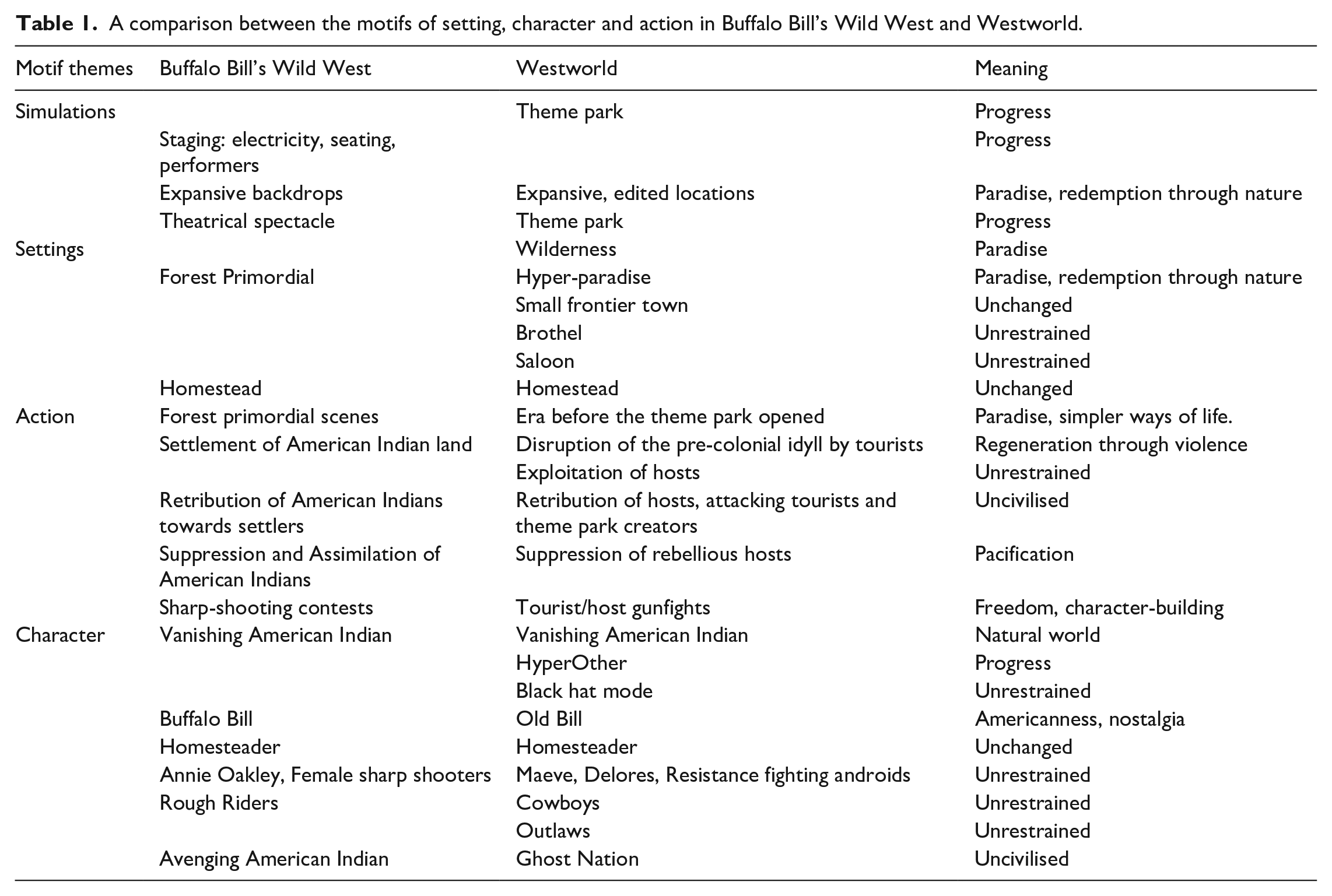
The thematic overview combining motif and meaning which emerged from repeated evaluations of the data is shown in Table 1.
A comparison between the motifs of setting, character and action in Buffalo Bill’s Wild West and Westworld.
Discussion
Action
The discussion now moves on to how Buffalo Bill’s Wild West and Westworld stage mythic space using a variety of motifs, beginning with those associated with action. As Chronis et al. (2012) argued, in addition to the public heritage industry, commercial agents stage plausible cultural imaginaries, building ‘storyscapes’, where narratives are played out. William Cody was such an agent, his social values were symbolised by the tropes which he popularised. Cody’s (2012a) veneer of showmanship made the historical theatrical, simulating his actual experiences as Chief of Scouts for the Kansas 3rd Cavalry during the Plains Wars and as a bison hunter. In 1903, travel opportunities were more limited, but many members of Buffalo Bill’s Wild West Shows audience had read about adventures on the frontier in newspaper accounts, travel writing and sensationalised novels (Riley, 1984: 18). Cody was aware of this and played to their fantasies of the unbounded, uncivilised frontier.
Buffalo Bill’s Wild West shows began each performance with a ‘forest primordial’ sequence, connoting the lost idyll so central to nostalgic tourist fantasies. This was followed by settler colonisation scenes, which led to retribution by American Indians and then their oppression. The order of events symbolised the self-explanatory contemporary ideologies of ‘regeneration through violence’ (Slotkin, 1992: 5) and the ‘pacification of violent Indians’ (Deloria, 2004: 62). It is worth noting that, simulated authenticity meant that American Indians were not allowed to fire guns or compete with Whites in sharp-shooting competitions.
A comment from The Canterbury Journal (1903) suggested that the audience were immersed in the storyscapes, experiencing the narrative transportation of simulated authenticity, describing the performance as ‘a remarkable object lesson in history’. The gunfights simulated by Cody’s performers may seem inauthentic, however, as Chhabra et al. (2003) observed, ‘. . . what is staged is not superficial since it contains elements of the original tradition’. The reporters thus detected a continuation of ritual through its reenactment. For example, the Folkestone Express (1903) declared, ‘It is the portrayal of these true incidents of western life that make the Wild West entertainment so intensely interesting’. The official tour programme (Folkestone Express, 1903) also authenticated the myth:
A veritable reproduction of the stirring scenes of border life on the American Plains, from the earlier sanguinary period down to the time when amity began to dawn between the white man and the red Indian . . . the Exhibition contained nothing that gave any possible scope for misrepresentation or deception . . . [and offered] . . . conclusive proof of its realism and of its value as an educational factor. (p. 6)
In Westworld, historical fiction diverged into science fiction. Action motifs such as gunfights signalled the notions of unrestraint, but with more violent undertones. In parallel with the Wild West Show’s rule that American Indians were not allowed to shoot, the android hosts were prevented from firing working guns. The theme park brand statement ‘Live without Limits’, connoted the tourist fantasy of the authenticity of self in a boundless frontier wilderness. However, the simulated authenticity of gunfights enabled some tourists to enter the theme park as their brutal alter-egos, entering ‘black hat mode’ to fulfil their fantasies. They raped and murdered the android hosts who were provided for their consumption without retribution: the memory of the hosts was repeatedly wiped. A fictive ‘Ghost Nation’ tribe of American Indian riders in war paint was designed to be highly aggressive, both to increase the excitement and to reduce the guilt of the tourists who kill them. The action motifs of the two series followed the colonial themes of the Wild West Show – resistance, retribution and oppression – the realisation of tourist fantasies assuming a brutal form.
Character
When tourists fantasise, their imaginary landscapes include idealised character archetypes, which tourists both inhabit and encounter as part of their own mythic journeys (Frost and Laing, 2015; Oakes, 2006; Salazar, 2012). According to Salazar (2012: 471), tourism fantasies ‘often propagate historically inherited stereotypes’. A compendium of ‘original’ character motifs were established by William Cody, for example Buffalo Bill and Annie Oakley, who performed cowboy skills of sharp-shooting, lassoing displays with the ‘Rough Rider’ performers. They accompanied the traditional cast of characters, the outlaws, trappers, homesteaders and American Indians who roamed the range, with their object motifs of pistols, tomahawks, pioneer sprigged dresses and poke bonnets, cowboy boots, Stetsons and sheriff badges. These character motifs fixed the tradition, thus the authenticity, of the frontier myth community, embodying the ideologies of freedom, fulfilment and simpler ways of life.
The role of Buffalo Bill, hero and sheriff of the lawless west, was established by Cody. His persona encapsulated the concept of legends as purporting to be historical but consisting of a histo-fictional pastiche (Barthes, 1972 [1957]). The self-made legend of Buffalo Bill conformed to Warren’s (2005: 76) concept of ‘frontier imposture’, defined as ‘real people taking on language and shaping (or fabricating) their biographies from fictional stories and vice versa’. Buffalo Bill was actually a derivation of an earlier frontier motif, James Fenimore Cooper’s fictional hero, Leatherstocking, an Anglo-American scout raised by the Delaware people. Cody adopted Leatherstocking’s costume of fringed jacket and cattleman hat, as shown in Image 1, the cover of the official Wild West programme. The review below from the Kent Messenger (1903) suggested both that reporters understood the references to Leatherstocking and how simulated authenticity enabled the audience to experience a sense of narrative transportation:
. . . the romances of life in the pioneer past, recalling the most thrilling descriptive pages taken from the most exciting of Cooper’s tales. The auditor of an imaginative spirit can, temporarily at least, conceive himself an actual witness of the thrilling events which strongly marked the history of the march of civilisation in the far West.
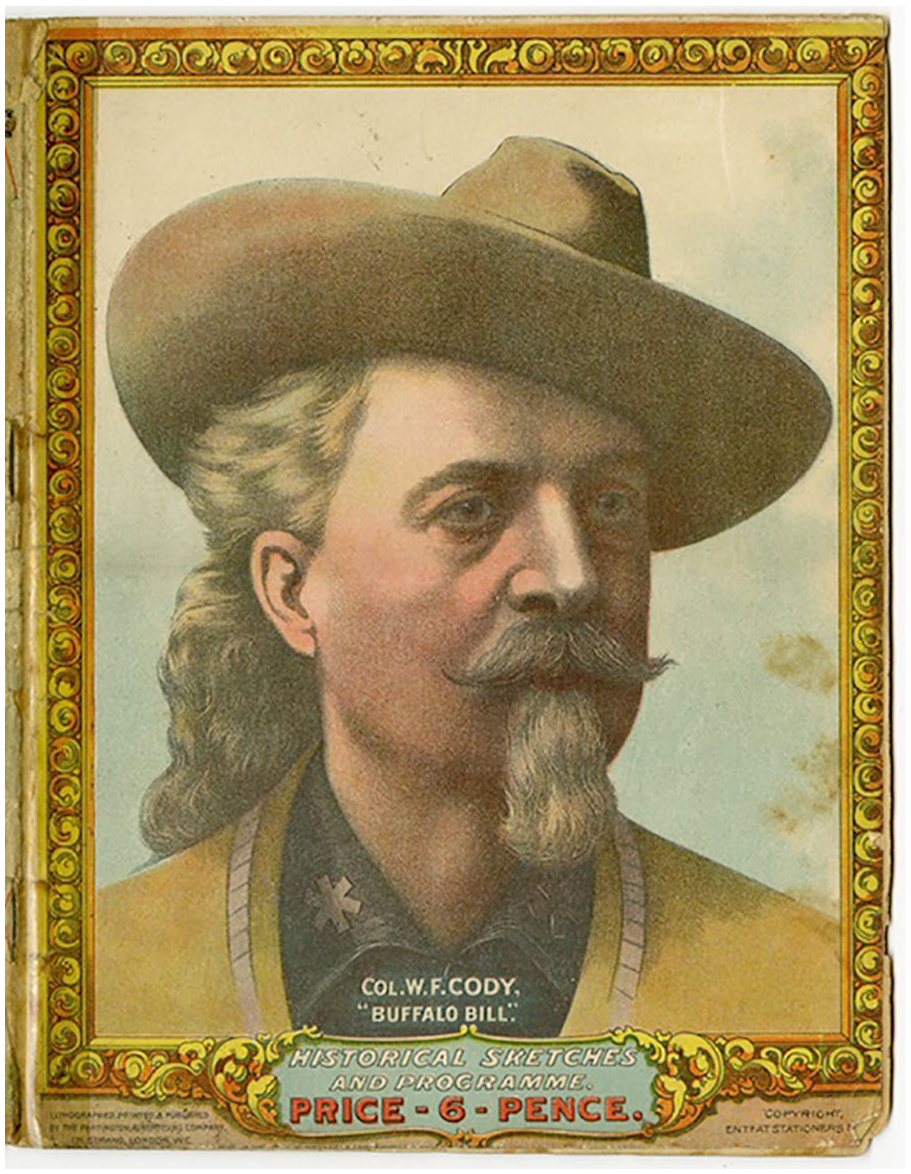
Buffalo Bill programme cover image.
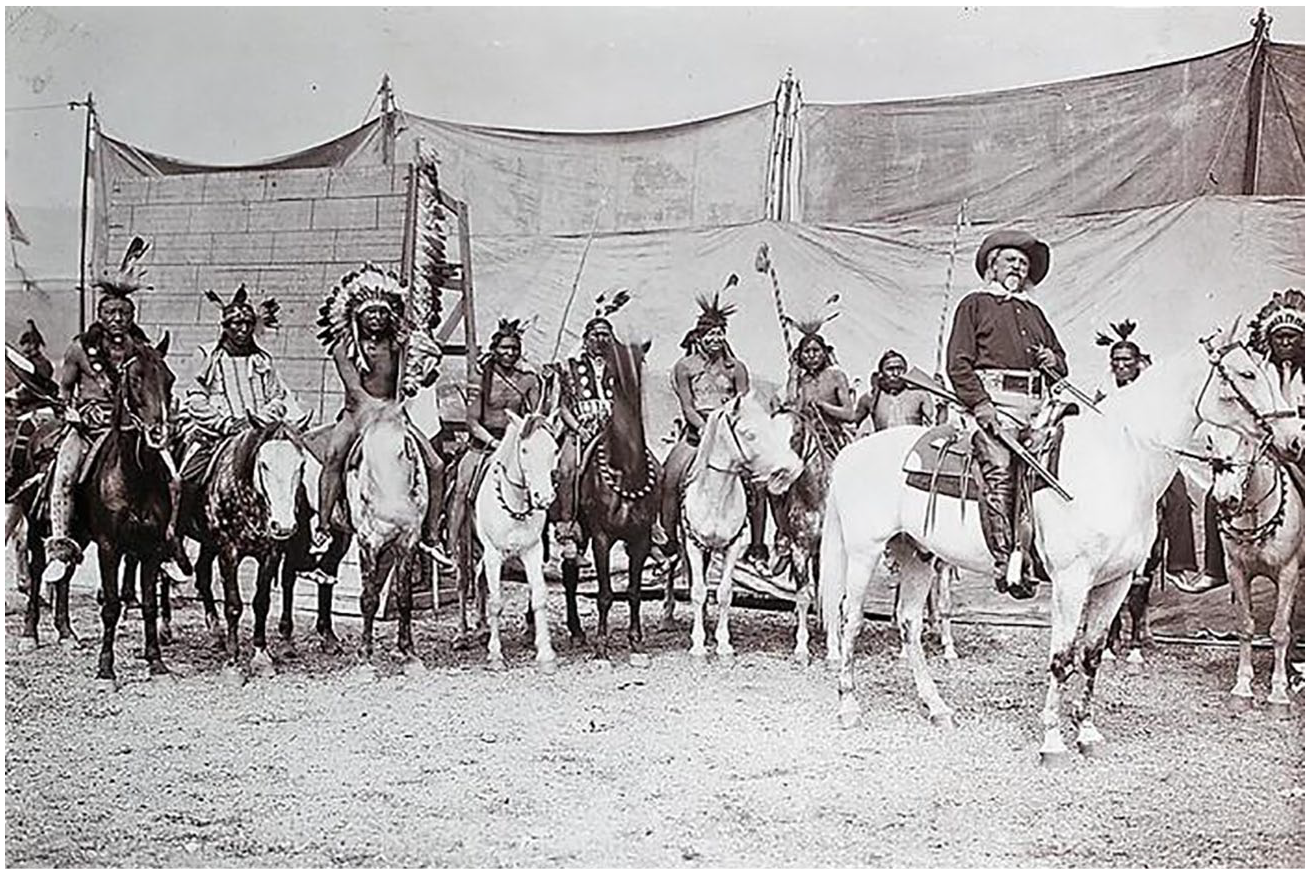
Cody and the American Indian troupe.
The story-building of tourists is substantiated by the cultural imaginary (Chronis, 2012) and Buffalo Bill is a recognisable motif within that imaginary, embedded by Cody as a connotation of Americanness. Like the Wild West Show, Westworld used familiar intertextual frontier character references of outlaws, sheriffs and homesteaders to construct the myth for theme park tourists. In the first episode of Westworld, appropriately entitled ‘The Original’, the prototype android host was revealed to be a barkeep called ‘Old Bill’ who physically resembled William Cody. He was invented by the theme park creator, Dr Robert Ford, whose name alluded to the outlaw Robert Ford who murdered Jesse James (and by extension the Old West) in 1882. A meta-narrative about the closure of the frontier takes place at the end of the scene, when Old Bill climbed onto a shelf and zipped himself into a storage bag, a signifier of nostalgia for the myth.
The hero is not always a male character motif. Cody included heroic adventuring women in The Wild West Show who were familiar to contemporary dime-novel readers, where they received equal pay (Cody, 2012b [1846–1917]). This progressive stance was a tourist draw and Annie Oakley has evolved into a recurrent motif, connoting freedom. However, many of Westworld’s character motifs initially seemed to be less advanced than their 1903 counterparts. Prostitutes, mothers and virgins seemed at first to symbolise exploitation and oppression rather than the freedom of self. As ideologies, myths were said by Fjellman (1992) to mask the contradictions in society, however, some female characters were adapted by Westworld using plural narratives to unmask some contradictions. For example, representational progress had been made in that an African American woman, the host Maeve Millay (given the roles of homesteader, brothel madam and resistance fighter) would have been Whitewashed from Cody’s frontier. As a variation on the heroic women motifs, the host Delores Abernathy (homesteader, virgin) took retribution to a hyper-level. She was programmed to turn into her violent alter-ego Wyatt, when the phrase from Shakespeare’s Romeo and Juliet ‘These violent delights have violent ends’ was spoken. She and Maeve then dispensed justice in payment for the touristic ‘violent delights’, overturning female stereotypes.
Other characters
Mythic spaces are also inhabited by the Other. Cody’s audiences may have already encountered visiting American Indians as toured spectacles, for example, George Caitlin’s 1840 visitor attractions, which included exhibitions of photographs of American Indians and ‘authentic’ live, costumed, posed tableaux (Deloria, 2004). Cody simultaneously appropriated and showcased American Indian culture in an approach which was designed to attract tourism. A Kent Messenger (1903) reporter witnessed the scenes:
Indians, brilliantly coloured and richly feathered, dash across the arena on their swift and hardy ponies, repeating the war-whoops, cries and yells which have many a time and oft blanched the cheek and quickened the heart-beating of the hardy pioneer.
Comparing representations of American Indians in the Wild West Show and androids in Westworld suggests the perpetuation of tourist fantasy stereotypes which symbolised nostalgia for a lost idyll. The massacre of several 100 Lakota tribespeople in the battle of Wounded Knee in 1900 inspired a parallel regretful narrative of ‘vanishing Indians’ who might fade into a memory during the Government’s cultural assimilation process (Deloria, 2004; Hennig, 2002). This led to their preservation through simulation and staging. The character motif of the ‘vanishing Indian’ was bluntly noted by the Canterbury Journal (1903), adding a note of extinction tourism to the show,
The native Indians are fast passing away, and the redskin warriors, who terrorised the frontier of the western United States, will soon join the braves who have passed to the happy hunting-ground.
Westworld moved the story forward by conflating two myths for the consumption of the exclusively wealthy, Anglo-Saxon tourists visiting the theme park: the frontier and the android. What could be termed ‘hyper-Others’ are designed to meet the fantasies of the visitors, which tend to be violent. The series is preoccupied with the concerns of originality and replication. In the episode Chestnut, a first-time Westworld tourist asked a host, ‘Are you real’? She replied, ‘Well if you can’t tell, does it matter’? However, it does matter to tourists and those androids who discover that they are not human. The android myth is a metaphor for futuristic colonialism where the new, improved ‘posthuman’ (Braidotti, 2013) will always try to replace reality by supplanting humankind. The more the ‘fidelity’ of androids is enhanced, the closer they come to destruction due to ‘uncanny valley phenomenon’, which is defined by Saygin et al. (2011): ‘As an agent’s appearance is made more human-like, people’s disposition toward it becomes more positive, until a point at which increasing human-likeness leads to the agent being considered strange, unfamiliar and disconcerting’ (p. 414). The theory contradicts Wang’s (1999) argument that postmodern authenticity implies that differences between copies and fakes cease to matter to tourists. In fact, the differentiation matters more as simulation techniques sharpen.
Setting
Setting is the final motif to be examined. Myths are said to contain a suggestion of the supernatural (Spurgeon, 2005) and both Westworld and Buffalo Bill’s Wild West used technology to construct a hyper-frontier setting with the ‘play of illusions and phantasms’ of the simulacrum (Baudrillard, 1981: 12). The Wild West Show was replete with the motifs of American modernity, from guns to electric lights, signifying progress. As DeLyser (1999) observed, commenting on tourism to the Western ghost town of Bodie in California: ‘Authenticity is not the end result of a visit to Bodie. Rather, it is a vehicle through which the narratives of the mythic West, of progress and American virtues, are made tangible and believable to visitors’ (p. 624). This perspective is supported by an account from the Kent Messenger newspaper which conveyed the narrative of modernity through the scale of the 1903 Maidstone show, which was unimaginable at the time, when provincial circuses and fairs were far smaller:
The magnitude of this enterprise is startling. Four railway trains transport an army of men and horses, their habitations and subsistence; also a grand stand capable of seating 10,000 people and two electric light plants, the largest portable installation ever constructed.
The vastness and sublimity of the landscape is a motif of the frontier setting and Buffalo Bill conveyed mythic space to visitors using seductive backdrops painted by Matt Morgan, at the cost of 40,000 pounds, which was a hyperreal sum of money at the time (Cody, 2012). These canvases were the simulacra of their time, conveying tourist fantasies to the audience on a cinematic scale. Cody’s (2012b [1846–1917]: 102) lyrical description described the effect of the simulation:
The illusion, indeed, is so well-managed and complete, the boundless plains and swelling prairies are so vividly counterfeited that it is hard to resist the belief that we are really gazing over an immense expanse of country from some hillside in the far west.
The classic nineteenth-century frontier town Westworld, town of Sweetwater also displayed classic frontier myth setting motifs of steam railroad, wooden sidewalks and saloon, all of which set the scene for the inevitable gunfights and barroom brawls. However, Westworld used composite footage of forests taken in Utah to frame Sweetwater and simulate an authentic setting. Zack Grobler, the show’s production designer deployed multiple techniques to amalgamate different places into one symbolic, mythic touristic space:
If you pay a lot of money to go and have fun in this old west park, then you’d like it to be the really iconic ideal of the west. You’d want to feel like the Marlboro Man riding out on the range. You want to be a gunfighter like Clint Eastwood. Those are all the ideals that you’re looking for. That’s what we tried to make it look like. (Grobler in Zacharin, 2016)
As Buchmann et al. (2010) observed of the fantasy locations of Lord of the Rings: ‘The worlds one sees on the big screen are such simulacra: places that never existed but seem to have been based on real locations’ (p. 243). Yet, the reverse is also true. The screen mythologises landscapes. On the Westworld hyper-frontier, even the scenery appeared to roll on a loop of icons; exterior scenes for the series were shot in Monument Valley, Arizona, Moab and Dead Horse Point State Park, Utah. Within the Westworld plot, the authenticity of these locations was simulated, they were copies, they had been ‘terraformed’ (replicated in different landscapes) for tourist consumption in the theme park.
The promotion of natural and themed locations in Westworld, including Castle Valley, Utah and Paramount Ranch was consolidated by tourist agencies. For example, Davidson (2018) invites tourists to ‘see Westworld for real’. The narratives created by destination marketers at Visit Utah (n.d.) exemplify the hyper-frontier:
In season one, the sweeping place-setting camera shots of Castle Valley and Canyon Country (Dead Horse Point and Canyonlands National Park) that Jonathan Nolan’s production team cut into the ‘Westworld’ narrative are fitting for multiple reasons. This scenic corner of Utah, more than anywhere else on the map, is a place that evokes the mythological west of classic Hollywood Westerns, including John Ford’s long love affair with nearby Monument Valley Navajo Tribal Park in his depictions of the Wild West. It is quintessential western America, but these locations feel otherworldly, almost impossible. It is a natural amusement park of the highest order, home to Moab, Arches National Park, some of the West’s best whitewater on the Colorado River and virtually limitless open space to roam. (Visit Utah, n.d.)
The landscape is depicted by Visit Utah as an ‘impossible’ simulacrum of the West, symbolic of character-building and unboundedness. This reflects Vidon et al.’s (2018: 62–64) observation that theories of simulacra may be applied to wilderness environments, such as the Adirondack Park, which is could be considered ‘hypernatural’.
A last, key setting motif adds to the discussion of simulated authenticity. Regaining paradise is a central tourist fantasy (Hennig, 2002). This notion is explored in an episode in Westworld, Kiksuya, which is pivotal because it illustrates contemporary social values. In contrast to the silence of American Indian voices in the performances of Buffalo Bill’s Wild West, Kiksuya was largely told as oral history by a host, Akecheta, who echoed Hennig’s (2002: 176) description of tourist fantasies of ‘the noble savage’, who ‘lives in harmony with the forces of nature, in contrast to modern man, who has become alienated from his origins’. The episode opened with a primitive ‘in time and place’ fantasy of a tribe of android American Indians living peacefully in the pre-colonial era before the park opened and tourists arrived. It was spoken in the Lakota language (‘Kiksuya’ means remember). Westworld was the first television series to use the language on a global scale. Spurgeon (2005: 5) stated that mythic space encapsulates not simply settler, but also indigenous mythologies, but the narrative is more mystical than truly plural; the park was created by (White) Robert Ford who choreographs the action motifs.
Paradise, the utopia which tourists seek, was only found when Akecheta determined to lead his people to safety away from the theme park. He discovered a mysterious ‘Door’, which opened in the series finale The Passenger to reveal a virtual, sublime, wilderness. The consciousness of Akecheta and many other hosts was downloaded into freedom, completing a cycle of programming which returned them to (pre-colonial) peace. The ultimate example of simulated authenticity is this mythic space, paradise glimpsed, yet out of reach of tourists on the hyper-frontier.
Conclusion
This article examined how mythic space is composed of symbolic motifs and how their authenticity is not simply mimetic, but simulated, emergent and negotiable. Both Westworld and Buffalo Bill’s Wild West raised issues which are central to discussions of authenticity, such as the meaning of replication, originality, historic interpretation and ownership and artificial intelligence. As a themed spectacular, Buffalo Bill’s Wild West Show could be considered Disney’s precursor and the android-hosted theme park depicted in Westworld its evolution. Because of William Cody’s ability to tell a persuasive story, the perennial motifs, Buffalo Bill and Annie Oakley, still perform on a loop, notably in the Disneyland Paris performances of The Wild West Show With Mickey and Friends. Emergent authenticity suggests that even Disney is ‘increasingly recognised as part of contemporary American culture, and as such, as authentic’ (Cohen, 2007: 78). That the Westworld version of the frontier myth has also percolated into the cultural imaginary is suggested by a common phrase describing the reality of copies in theme parks and resorts: ‘That’s a Westworld’ (Bishop, 2017).
A limitation of the research may be its breadth, yet placing the examples side by side enabled a comparison between the ‘original’ motifs and their evolution, which is set out in Table 2. While the motifs remain similar, the findings confirm how the authenticity of the meanings of storytelling is negotiable, reflecting the specific nuances of changing social awareness. The study observes how emergent authenticity alters characters: while the ‘vanishing Indian’ motif continues, it is revised in 2018 in the hyperOther, ‘woke’ character of Akecheta. Hennig (2002: 180), has detailed how tourist fantasies denote the pursuit of the authentic, ‘true self’. Annie Oakley’s shooting skills signified freedom. However, the glamorisation of Oakley and character motifs such as Maeve and Delores means that tourists want to play the anti-heroes, the outlaws and saloon girls at the Helldorado festival, rather than the homesteaders (Frost and Laing, 2019). The experiential authenticity of re-enactments involving those frontier character motifs signifying liberation and adventure could be a future direction of this research and merits further study.
The characteristics of tourism to the American west compared with the tourist hyper-frontier.
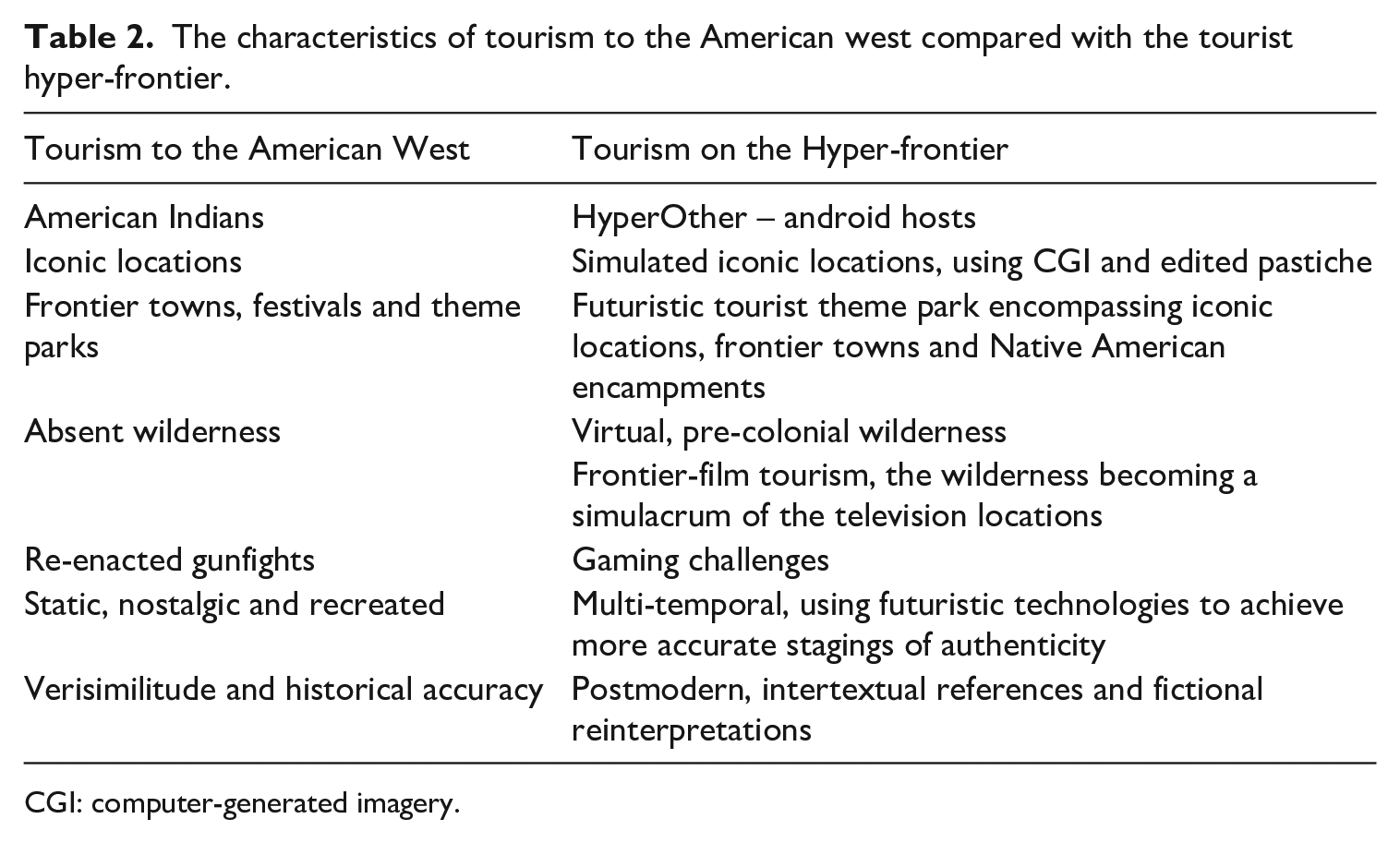
CGI: computer-generated imagery.
As discussed earlier in the methodology, it is important to note that the signification of motifs is relative. The sublime landscape of Westworld was dystopian for the brutalised android hosts. Like the tourists visiting the theme park, the hosts also fantasised about escaping their everyday realities. The host Delores echoed the classic tourist fantasy in the episode ‘Trompe D’oeil’. She longed to leave the park boundaries for the freedom of the place ‘where the mountains meet the sea’. The phrase was reminiscent of Turner’s (1893) initial description of the frontier as the ‘hither edge of free land’, encapsulating the fantasy about the redemptive power of nature (Hennig, 2002) which is a powerful and recurrent theme of tourist fantasies. Yet, even as Delores rode through the iconic scenery on horseback, the mythic space she desired remained uninhabitable. The point of fantasies is that they cannot be realised.
The article explored the original theory of simulated authenticity. Simulated authenticity was developed as a way of explaining how storytelling can use technology to reduce the differentiation between original and copy. Buffalo Bill’s Wild West presented a pseudo-historic atmosphere which combined effects, scenery, action and character tropes. The event was authenticated by local reporters as a historically accurate depiction of frontier life. In addition to action and character, Westworld presented androids so lifelike that they were unaware that they were manufactured. Simulated authenticity penetrated tourism marketing, with landscapes portrayed as ‘real’ Westworld locations. Thus, a postmodern infinity mirror existed of landscapes which had been made iconic through their representations, which were then ritualistically represented, resulting in the hyper-authenticity of ‘impossible’ locations.
A further contribution of this article was to conceptualise the hyper-frontier as multi-temporal, historical-fictional, intertextual and characterised by the use of technology. Comparing the two examples suggests how, nearly 120 years apart, fidelity to the original ideologies of progress and nostalgia which fuel the frontier myth remains consistent. The Wild West Show and Westworld predict that tourist fantasies of naturalness, sublimity, innocence and adventure will be founded on new technological hyper-frontiers which use increasingly realistic and immersive forms of simulated authenticity to generate the motifs of the myth. Yet, progress may add texture to the storytelling format, but it runs counter to tourist fantasies of the natural world away from modern machinery. The androids suffered the most human dilemmas in Westworld, but due to uncanny valley syndrome, most tourists treated android hosts with an atavistic distrust and hyperreality led to hyper-violence. It was significant that the inevitable patterns of the myth overrode the hyperreality. For example, the Westworld theme park offered marvels of replicant design, such as buffalo and a terraformed real-scale Monument Valley, yet many tourists were caught in the same, colonial pattern of action motifs, condemned to repeat the past and ignore the true objects of wonder.
As an indication of future tourism trends, Westworld suggests that while attempting to escape the alienation of their everyday lives, tourists may instead be alienated from their fantasies by simulated authenticity. The events of Westworld indicate that replication may, therefore, be rejected by tourists, suggesting that there is such a thing as too much authenticity.
Footnotes
Funding
The author(s) received no financial support for the research, authorship, and/or publication of this article.
