




Abstract
This article elaborates the post-tourist de-differentiation thesis in the light of digitalization and the coming of transmedia as the dominant mode of cultural circulation. It is argued that transmedia extends and provides new facets to the de-differentiation of tourism and social life. Based on an overview of previous research, three versions of the ‘transmedia tourist’ are theorized – the ubiquitous transmedia tourist, the decapsulated transmedia tourist and the streamable transmedia tourist – representing different trajectories of de-differentiation. The typology provides an argument for the continued relevance of the de-differentiation thesis and a research agenda for future research on tourism and digitalization.
Keywords
Introduction
What is consumed in tourism are visual signs and sometimes simulacrum; and this is what is consumed when we are supposedly not acting as tourists at all. (Lash and Urry, 1994: 272)
A key concern in the post-tourism debate of the 1980s and 1990s was the gradual de-differentiation of tourism and social life. Theorists like Feifer (1985), Munt (1994) and Lash and Urry (1994; see also Urry, 1995) argued that tourism in (post)modern, post-Fordist societies was becoming less spectacular; something that was spread out across ever more time-spaces of everyday life and that a growing share of the population considered a normalized mode of encountering the world. The coming of post-tourism was associated with improved standards of living and more efficient and diversified forms of travel. It was also linked to new media and the ‘aestheticization of everyday life’ (Featherstone, 1991). Due to new forms and genres of communication, notably television, lifestyle magazines and later on the Internet, people were turned into ‘armchair travelers’ whose journeys started at home, in the form of fantasies and plans that were sometimes realized, sometimes not. In this way, the everyday saturation of tourist images – emanating from producers both within and beyond the tourism industry proper – led to the popularization of the tourist gaze and blurred boundaries between home and away, between reality and image, and between tourism and social life at large (Haldrup and Larsen, 2009; Tomlinson, 1999; Urry, 1995).
Since the turn of the millennium, however, the post-tourism thesis – whose ultimate consequence in terms of de-differentiation can be formulated either as the ‘end of tourism’ (Lash and Urry, 1994: 270–71) or as the over-expansion of tourism as a generalized social condition (Tesfahuney and Schough, 2016) – has been relatively absent from the theoretical debate. The term post-tourism still figures occasionally in the tourism literature (see, for example, Mason, 2004; Powrie, 2005; Wijngaarden, 2016), but is mostly taken as a particular, self-reflexive attitude among tourists rather than as a social condition bound-up with the broader transformations of society (but see discussions in Campbell, 2005; Haldrup and Larsen, 2009; Jansson, 2018a, 2018b). Current uses of the term rarely live up to the grander claims of the original post-tourism protagonists, who saw the post-tourist as key figure of the de-differentiated, postmodern ‘semiotic society’ (Lash, 1990). Yet, rapid changes in media and communications since the turn of the millennium have led in directions that seem to reinforce precisely those forms of de-differentiation that were intimated by the notion of post-tourism. This has to do, above all, with digitalization and the shift from mass media to transmedia as the dominant mode of cultural circulation – a shift that has rendered significant attention among media scholars (for an overview, see Freeman and Gambarato, 2019) but whose implications in tourism have not yet gained any systematic treatment.
The aim of this article is to provide a theoretical typology that explicates how the normalization of transmedia in society contributes to further de-differentiation along the lines of the post-tourism thesis. This is not to say that transmedia is all about blurred boundaries. There are also new distinctions emerging (partly in response to de-differentiation). Still, as discussed below, most research on digitalization and tourism suggests that the practices and spaces of tourism are increasingly open-ended and hard to specify. Here, the figure of the transmedia tourist will be used as a theoretical shorthand for grasping these transformations and identifying key areas of future research. The transmedia tourist entails a triple articulation of de-differentiation highlighting the increasingly complex entanglements of media, tourism and ordinary social life. First, there is the ubiquitous transmedia tourist, referring to how transmedia extends the normalization of tourist practices and attitudes in everyday life. The tourist is here taken as a virtual traveller. Second, there is the decapsulated transmedia tourist, the corporeal traveller for whom transmedia opens up actually ongoing tourism to the time-spaces of ordinary life. Finally, there is the streamable transmedia tourist, an articulation of the broader tendency in transmedia circulation to use tourism imaginaries to generate and extract digital audience data. The tourist is here envisioned, or implied, as a digital subject (Goriunova, 2019), whose energies in the shape of digital data are circulated across transmedia platforms.
The typology brings a composite approach to the cultural and geo-social implications of digitalization and datafication that has hitherto been absent from tourism studies. The article begins with a conceptual discussion of transmedia, where after the three versions of the transmedia tourist are elaborated in turn. The article concludes with reflections on how the proposed typology could be translated into a research agenda for forthcoming research on the digitalization of tourism.
Transmedia as a mode of cultural circulation
The post-tourism thesis was formulated at the threshold of digitalization when satellite television and mobile phones were multiplying, but still before the real breakthrough of the Internet, smartphones and social media. It was formulated during a period when it was possible to anticipate what digitalization would imply for tourism and other sectors of society, for example, in terms of growing flexibilization of production; differentiation and specialization of the market; and de-differentiation of cultural, social and geographical realms (Lash, 1990; Lash and Urry, 1994). As to the latter, Lash and Urry (1994) argued that new telecommunications infrastructures, notably fibre-optic cable networks, sustained time-space convergence on a global scale (p. 25), and led to the ‘de-territorialization’ of everyday culture (p. 307). Similarly, they argued, the ‘post-tourist does not have to leave his or her house in order to see many of the typical objects of the tourist gaze’ (Lash and Urry, 1994: 275). Yet, mass media was the dominant mode of cultural circulation, relying on freestanding analogue and/or digital technologies of production and distribution. Audiences were relatively easy to envision – albeit not easy to measure or understand (Ang, 1991) – as located in front of TV sets and VCRs hopping from channel to channel whereby a ‘collage of disconnected stories intrude and shape everyday life’ (Lash and Urry, 1994: 244).
Digital media technologies brought along the possibility to record, transfer and store greater volumes of information at greater speed, which had a significant impact on the efficiency of mass media channels like television and radio. More significantly, however, digital media sparked a development towards greater interactivity and thus blurred lines between producers, mediated content and consumers, as well as the possibility to stream digital content (Murray, 2003) and user data (Pigni et al., 2016) across different computer-based technologies and platforms. This was more than a technological shift. Digitalization – referring to ‘the way many domains of social life are restructured around digital communication and media infrastructures’ (Brennen and Kreiss, 2016: 1) – entailed a gradual shift from mass media to transmedia as the dominant mode of cultural circulation in society (Fast and Jansson, 2019).
The notion of transmedia dates back to analyses of cross-promotion and narrative ‘world-building’ in popular culture franchises like Teenage Mutant Ninja Turtles (Kinder, 1991; see also Fast and Örnebring, 2017; Freeman, 2015) and has since the 1990s been used mostly to describe the proliferation of fan cultures and digital storytelling across different media (e.g. Jenkins, 2006; Scolari, 2009). In the meantime, however, similar industrial logics and modes of user engagement have spread along with digitalization and datafication into a plethora of social realms, including social activism (Costanza-Chock, 2014; Soriano, 2016), education (Tárcia, 2019) and work (Fast and Jansson, 2019). The main breakthrough of what is here understood as transmedia – a mode of cultural circulation – came with the introduction and expansion of smart mobile devices (iPhone 3 released in 2007) and social media platforms like Facebook (founded in 2004) and Instagram (launched in 2010, since 2012 owned by Facebook), which also gave rise to new business models across the media landscape. Today, in deeply digitalized societies, the printed newspaper is seen as a secondary product to the digital multi-platform circulation of news; the shares of the audience consuming broadcast radio and television are continuously shrinking compared to the audiences of streaming services, and people are expected to constantly interact with and re-circulate content they encounter through social media.
There are three key characteristics of transmedia that set it apart from mass media (Fast and Jansson, 2019). First, as professed by Murray (2003) in her account of the digital economy, neither cultural content nor users and their practices are maintained within one technology and modality but stream across platforms and devices, whereby the modes of representing and consuming the information may also change. Today, users may receive news-flashes in their smartphones, re-directing them to online articles that incorporate video clips that may also encourage the users to access the same story through other devices and platforms.
Second, as Jenkins (2006) argued in his studies of transmedia storytelling, users are increasingly invited to take part in the processes of circulation, which means that information is continually re-moulded and re-contextualized. This happens through various forms of online sharing, commenting, tagging, liking, rating, remixing, and so on, whereby mediated contents may also take on new meanings as they move between users and platforms (especially on social media).
Third, transmedia circulation leads to the generation and industrial accumulation of digital data, including geodata, which means that users are automatically entangled in processes of surveillance and consumer profiling, materialized in the shape of location-based advertising, personalized recommendations, and so forth, across platforms (e.g. Bernard, 2019; Karppi, 2018; Striphas, 2015; van Dijck, 2013; Wilken, 2018). With transmedia circulation, there is no longer the same need for external surveys to map the audience; what is important from the industry’s point of view is that users stay connected and remain active as digital subjects (Goriunova, 2019), that is, willing to give away and stream data.
Altogether, transmedia circulation obeys a logic of streamability pertaining to both cultural content (Murray, 2003) and digital user data (Pigni et al., 2016). This invokes a contradictory condition, where information is managed in an increasingly dynamic, open-ended manner (Jenkins et al., 2013), while at the same time kept within an enclosed, commercially governed system that automatically surveils and commoditizes ever expanding areas of social life (Andrejevic, 2007, 2019). Research has also found that transmedia contributes to the blurring of boundaries between different institutions and different geo-social regions; a phenomenon called ‘context collapse’ when it happens online (Marwick and boyd, 2011), but which holds a more general purchase as for example mediated networking and various self-branding activities come to saturate all parts of everyday life (e.g. Fast and Jansson, 2019; Gregg, 2011; Scolere, 2019).
Similarly, as will be argued below, there are indications that the social normalization of transmedia has de-differentiating impacts on tourism. This condition, however, has not yet rendered any systematic treatment among tourism researchers or other scholars. While transmedia has been given some attention in the literature on media and tourism (Månsson et al., 2020), most of this research follows the ‘Jenkins legacy’ focusing either on the usage of transmedia storytelling for the promotion of tourism destinations and place brands (e.g. Parmett, 2106) or on tourism concepts and practices formed around popular transmedia products (e.g. Hills, 2016; Norris, 2016). Likewise, while the de-differentiating role of media in relation to tourism has been studied and discussed occasionally (see, for example, Haldrup and Larsen, 2009; Jansson, 2007, 2018b; Mostafanezhad and Norum, 2018; White and White, 2007) the specific conditions of transmedia have not been teased out. As a response to these shortcomings, this article presents a triadic typology of the ‘transmedia tourist’, advancing transmedia as a techno-social force that coincides with and escalates the de-differentiation of tourism and social life.
How to understand the typology
Before scrutinizing the three versions of the transmedia tourist, a few clarifications are needed as to the nature and rationale of this typology – what it is, and what it is not, and why. First, the ‘transmedia tourist’ does not refer to a particular category of travellers. Probably, most people today could be called transmedia tourists to a greater or lesser extent, as our lives are increasingly reliant on transmedia. The transmedia tourist is a metonymic shorthand for a complex set of processes that characterize the digitalization of tourist practices and experiences.
Second, the proposed typology does not cover all aspects of ‘transmedia tourism’, but is concerned only with the question of de-differentiation between tourism and social life at large. The three suggested versions of the transmedia tourist – the ubiquitous, the decapsulated and the streamable transmedia tourist – represent three trajectories of de-differentiation.
Third, the three types are theoretical constructs representing processes that are not always mutually exclusive in the empirical world. Rather, they should be seen as complementary articulations of dynamics that together – sometimes symbiotically – make up an increasingly de-differentiated culture of tourism.
Fourth, the aim of the typology is not to provide a complete overview of all the ways in which transmedia shapes, and blurs the boundaries of, tourism, but rather to theorize what de-differentiation means today; where we should start looking for it, and what the reactions to de-differentiation might be. As such, the typology opens up a research agenda whose purchase reaches beyond the confines of tourism studies and speaks to the need to gain deeper knowledge about what it is to live in a digitally – and ‘touristically’ – entangled society.
Finally, the creation of the typology was not originally sparked by any intention to ‘prove’ the links between transmedia and de-differentiation. Rather, the ideas behind this article emerged in and through previous research projects dealing with transmedia in other contexts than tourism (see Fast and Jansson, 2019) and more delimited studies of social media uses among alternative tourists (e.g. Jansson, 2018a, 2018b). The findings from these earlier projects laid the ground for the triadic conceptualization whose substance and contours were then elaborated through an overview of previous research.
The ubiquitous transmedia tourist
A key element of the original de-differentiation thesis was that people in postmodern societies are continuously mobile through various means of communication and thus, potentially, ‘tourists most of the time’ (e.g. Lash and Urry, 1994: 259). During the mass media era, an emblematic incarnation of the post-tourist was the ‘armchair traveler’ who could indulge in the phantasmagoria of tourism adverts, travel programmes on TV, and glossy magazines with feature articles from around the world. Similar themes were also encountered when walking out the door and into the built environment (Eco, 1986; Feifer, 1985; Ritzer and Liska, 1997). The post-tourism argument is thus one concerned with the ubiquity of tourism as an attitude and a source of imaginative enjoyment in everyday life. Ubiquity also brings along more fine-grained distinctions (Munt, 1994), which are present in the realm of virtual travel just as they are in corporeal travel. People tend to seek out the type of media contents and formats that resonate with the type of travel they mainly identify with (Jansson, 2002).
Since the 1990s, the notion of the virtual tourist has become all the more relevant and taken on more concrete articulations, ranging from ‘indoorization’ (Ferrero Camoletto and Marcelli, 2020; Fredman and Tyrväinen, 2010) and urban beaches to ‘virtual worlds’ (Gale, 2009) and ‘networked travel’ (Larsen et al., 2007). Virtual tourism has turned into an everyday pastime, regardless of time and place, and carving out one’s own preferred ‘tourism diet’ has become a more time-consuming issue. Transmedia accentuates this development along two main trajectories.
First, with transmedia, virtual tourism becomes less confined to the realm of phantasmagoria and more closely linked to continuous tourism planning. The step from a mediated travel impulse or fantasy provided through, for example, a tourism advert to actual planning has become much shorter since one does not have to visit a travel agency or take up the phone and order a tourism catalogue. Even before the breakthrough of smartphones and social media, searching for travel-related information and customer reviews, especially about accommodation, was one of the most common things people did online (Gretzel and Yoo, 2008; Lee and Gretzel, 2010). With ‘smart tourism technologies’, notably mobile apps and online systems for booking, rating, reviewing and comparing destinations, itineraries and modes of travel, the practice of online tourism planning has become even more important and interwoven with everyday life (Huang et al., 2017; Xiang et al., 2015). Attractive destinations, hotels, tours, hosts and so on, may be bookmarked for future purposes and shared with prospective travel companions regardless of place and time, which means that one person may entertain several different travel-plans at the same time, among which only a few, if any, might get realized. This is just as much about adding some extra flavour to day-to-day life as it is about finding the ‘right destination’ and the ‘right experience’ to the ‘right price’. Since much travel planning now occurs across different platforms, including social media, the boundaries between information seeking and enjoyment continue to blur (e.g. Chung and Koo, 2015; Xiang et al., 2015).
In this way, transmedia contributes to the normalization of tourism as an ongoing process within everyday life. Important to stress, though, is that this trajectory of de-differentiation is reinforced by, rather than opposed to, pre-existing mass media logics (cf. Chadwick, 2013; van Dijck and Poell, 2013). The importance of television, radio and movies as an information source in tourism planning has continued to grow also under the regime of transmedia, at least in the American context (Xiang et al., 2015: 522). This can be seen in multi-platform advertising including social media as well as mass media channels (e.g. television and public screens) for hotel-booking sites, travel agencies and so forth. In this way, tourism planning also turns into a more complex arena of socio-cultural differentiation and distinction. Research suggests, for instance, that the online tourism domain entails a ‘bifurcation’ between ‘traditional online travelers’ searching for standard products and those whose online practices lead in more alternative and diversified directions in search for unique experiences (Xiang et al., 2015: 523).
Second, people are continuously involved in the tourist activities of others, including family, friends, acquaintances and various media personalities. While other people’s journeys used to be experienced through occasional postcards, phone calls or photo albums, typically consumed after the journey had taken place, transmedia radically enhances people’s ability to take part in distant tourist activities more or less as they are happening. Touristic impulses – from selfies and sunsets to more elaborated travel-blogs – saturate the lifeworld and are typically framed by the connectivity industry to generate maximum traffic through likes and comments (Karppi, 2018). Research shows that most tourists stay in touch with friends and family while travelling, using a variety of online channels. They not only take photos but to an increasing extent also share them online (e.g. Lo et al., 2011; Munar and Jacobsen, 2014). As such, transmedia circulation makes people increasingly aware of, and virtually involved in, tourism activities also when they are not travelling themselves.
This trajectory of de-differentiation contributes to the internalization of certain modes of gazing across social domains, as seen for instance in the spread of the ‘tourist selfie’ (Dinhopl and Gretzel, 2016). On social media, events and practices that cannot be defined as tourism are often framed and circulated along similar visual repertoires, evoking a kind of ‘aestheticization’ (Featherstone, 1991) or ‘exoticization’ (Szerszynski and Urry, 2006) of everyday life. The main similarity with tourism photography is not the motifs or settings, for obvious reasons, but the growing awareness of the audience (Lo and McKercher, 2015). Especially, younger individuals develop sophisticated techniques for managing their Instagram flows, designing their interaction with people and places within as well as beyond the everyday – what Manovich (2017) calls ‘Instagramism’. One can say that transmedia and especially social media contribute to a growing duality of gazes (Dinhopl and Gretzel, 2016), obscuring the division between corporeal and virtual tourists and their imagined audiences. Transmedia thus extends the relevance of Lash and Urry’s (1994) post-tourist argument that the tourist gaze is more and more entwined with everyday life, and by the same process altered (see also Haldrup and Larsen, 2009).
The decapsulated transmedia tourist
Decapsulation should be understood in relation to its opposite; the mutual practices through which travellers and tourism stakeholders encapsulate tourism experiences as a closed-off tourism-world of extra-ordinary forms of recreation, diversion and/or potential self-growth (e.g. Li, 2000). From a phenomenological viewpoint, encapsulation can be seen as the symbolic-material production of tourism as a ‘temporary getaway’ from the centre of ordinary life (Cohen, 1979: 181). According to the encapsulation/decapsulation dialectic, media are key ingredients in establishing a sense of tourism when people are away on their journeys (Jansson, 2007). Emblematic media rituals like photography, sending postcards and collecting various media related souvenirs (anything from stamps to vinyl records) have since long reinforced the sense of being away and enabled tourists to bring memories of the tourism-world back to their homeworlds (alluding here to Husserl’s distinction between the ‘alienworld’ and the ‘homeworld’; see, for example, Steinbock, 1995). Lately, travel-blogs have been found to play an encapsulating role in relation to longer tourism journeys (Bosangit et al., 2015). However, media may also interrupt tourists’ desire for encapsulation, whether we speak of recreational holiday trips or distinctive forms of experimental and existential travel (cf. Cohen, 1979). Magic may be broken through sudden media intrusions, such as the unwanted work-related phone-call or email (e.g. Dickinson et al., 2016; Kirillova and Wang, 2016).
While the threat of decapsulation was indeed present during the mass media era, transmedia accentuates the de-differentiation between the tourism-world and the homeworld. This accentuation has occurred largely since the encapsulation/decapsulation dialectic was first formulated. Individuals who want to avoid decapsulation – by no means all tourists – must maintain strong discipline as to how they use social media and other transmedia platforms in order to not get virtually transported out of the tourism-world and back to their homeworlds. Anyone who has ever posted something on Facebook knows that the postings of others can hardly be avoided (often triggering extended scrolling) and that social responsiveness is often taken as mandatory (e.g. Karppi, 2018). Similarly, to most people, just picking up the smartphone means that a flow of push notices, email messages and system related reminders risk bringing one’s attention away from the here-and-now of tourism and into the phenomenological homeworld where the user needs to discriminate between different kinds of information. The simple act of sharing a tourist image on social media, a common ritual that has largely replaced postcard writing, opens up a series of possible exit routes and decapsulation threats, further accentuated as most users are keen also to see how such messages are perceived (liked, commented upon, etc.) by others. In short, transmedia implies greater ambiguity. Touristic media rituals are difficult to separate from everything else going on online; a phenomenon akin to ‘context collapse’ (Marwick and boyd, 2011).
Again, it should be stressed that patterns of media use vary a lot between tourists, in terms of purposes as well as attitudes to digital (dis)connection (Dickinson et al., 2016; Kirillova and Wang, 2016; Magasic and Gretzel, 2017; Wang et al., 2014). Not all tourists strive for encapsulation, and certainly not in the same way. A recent study by Fan et al. (2019) is informative in this regard. Having interviewed 47 Chinese outbound tourists concerning their modes of online interaction and patterns of direct social contact during their journeys, they arrived at 6 ideal types maintaining greater contact with the ‘original zone’ or the ‘liminal zone’. Most in touch with the liminal zone (basically, the local textures of the tourist destination) was the so-called ‘digital detox traveller’, followed by the ‘disconnected immersive traveller’. Both types were marked by significant degrees of digital disconnection. At the other extreme were the ‘daily life controller’ and the ‘social media addict’, that is, people who stayed in touch with the homeworld either through monitoring practical issues through media or engaging intensely in both tourism-related and other exchanges on social media. In-between these extremes were the ‘dual zone traveler’ and the ‘diversionary traveler’. While the former maintained mediated contacts with the homeworld as well as social contacts with the foreign place, the latter showed little commitment to either of the zones and forms of contact.
The findings underscore the need to look deeper into how different groups of tourists maintain the boundaries of home and away, between the ordinary and the liminal, and how they handle the growing opportunities for, or threat of, de-differentiation. The findings also, more implicitly, point to the absence of any type of tourist that uses media intensely to get immersed into, and close off, the foreign place. The most immersive travellers are those that prefer disconnected modes of travelling. And while engagements with social media or travel-blogs (Bosangit et al., 2015) may enhance tourist experiences through sharing and self-reflection, they also open up the tourism-world to more mundane communicative circuits.
Accordingly, the risk of decapsulation and geo-social de-differentiation in tourism more generally, raise further demands on individuals to develop reflexive strategies, possibly turned into routines, for how to manage their complex polymedia environments (cf. Madianou and Miller, 2012) and the consequences of transmedia circulation while travelling. Furthermore, media-related reflexivity per se may have a disturbing effect on the tourism experience, since many people intend to escape precisely such considerations when they travel for leisure. As transmedia, in general, and social media, in particular, get normalized within everyday life, questions of ‘whether to connect or not to connect’, ‘whether to share or not to share’, and so forth, remain a lingering concern also while travelling. No wonder that ‘digital detox tourism’ has emerged as a new form of experimental tourism, promoted as an emancipatory way of dissolving the problem of media reflexivity altogether (e.g. Li et al., 2018; Syvertsen and Enli, 2019).
Studies among ‘voluntourists’, that is, tourists engaged in volunteer work, show that the ‘use of social media platforms today complicates the ethics of photographic practices, as the ease of sharing photographs accentuates and stirs up the unequal relations between the photographer and the photographed’ (Sin and He, 2019: 215). Similarly, research on urban explorers, a type of alternative tourists striving to find, explore and document abandoned and derelict buildings and off-grid places, has identified different registers of ‘reflexive hesitation’ related to the aesthetic, place-political and ethical dilemmas of predicting what might be the implications of picture taking and online circulation (Jansson, 2018b). Otherwise, few studies have looked more phenomenologically into how tourists cope with the over-abundance of media and the open-ended consequences of engaging online while travelling. The theoretical figure of the decapsulated transmedia tourist identifies an increasingly important research area pertaining to the interplay between transmedia saturation and geo-social de-differentiation in corporeal travelling.
The streamable transmedia tourist
The final articulation of geo-social de-differentiation concerns how transmedia contributes to the normalization of the tourist as a social type, that is, a (most often) desired and positively recognized subject position among people in general, across social fields and sectors beyond tourism. As Salazar (2012) holds, tourism imaginaries are continuously recreated and exposed in the global marketplace. Even though this marketplace and its offerings are continuously diversified ‘the image-making machinery behind them shares well-established strategies and scripts’, ranging from ‘essentialized, mythologized, and exoticized imaginaries of otherness to more realistic frames of reference’ (Salazar, 2012: 865). These image-making processes expand and coalesce with cultural circuits beyond the tourism sector. Uses of tourism imaginaries as a form of narratology in, for example, cosmetics and fashion advertising are by no means a new phenomenon. Liminal spaces and events, often with eroticizing and exoticizing undertones, have a long-standing history as means of evoking consumer attraction (e.g. Sturken and Cartwright, 2001). In narratological terms, then, the implied readers, that is, the preferred or anticipated audiences of such media messages, are positioned as (prospective) tourists. Their desire for tourism is supposed to harbour energies that may spill over onto other consumption practices as well.
What is new to the transmedia landscape is that tourism imaginaries are used not merely to spark an interest in various products, but to stream users, or more precisely, their data, between platforms that may have nothing or little to do with tourism. As mentioned earlier, one of the defining criteria of transmedia is that the generation of profit among commercial actors online, notably the so-called connectivity industry (van Dijck, 2013), stems from the production of ‘audience engagement’ rather than from the circulation of content per se (cf. Murray, 2003). As Karppi (2018) notes, this ‘engagement’ refers to any kind of user activity that generates data that can be aggregated and turned into new, targeted offerings or improved efficiency. From the commercial point of view, then, the more data stream across platforms – and the more detectable, measurable and interpretable these digital data streams are – the better (Pigni et al., 2016: 12–13). The deployment of tourism phantasmagoria in transmedia marketing becomes a rational way for the connectivity industry and other commercial actors who benefit from big data analytics to turn liminal desires into profitable digital data streams.
There is still no systematic overview of where, in which business sectors, and under which cultural conditions the streamable transmedia tourist figures most prominently. The very principle, however, can be illustrated through preliminary findings from a case study of online casino advertising in Sweden. Having gathered screenshots of the start pages of all online casinos listed and rated on the national portal Svea Casino, altogether 149 casinos (November 2018), about one-third of them were found to deploy tourism-related depictions of the game-world as a liminal space. Most common were direct textual and visual allusions to Las Vegas – a space that in turn harbours (simulated versions of) multiple iconic tourist destinations – with casino names like Leo Vegas, Dream Vegas and Queen Vegas. There were also numerous other iconic tourist destinations and sights represented by casinos like NY Spins, Napoli and Miami Dice, often displaying postcard-like views of the cities. A number of casinos used more generic illustrations of paradisiac islands (e.g. Frank & Fred), exciting cityscapes (e.g. Spintropolis) and phantasmagorical agglomerations of more or less realistic tourist destinations (e.g. Dunder; Image 1). Yet, others strived to transform tourist desires into gambling through the prospects of winning exclusive shopping trips, luxury cruises and so forth (e.g. Play Ojo), or through associating gambling with certain types of tourism mobility and event spaces, such as ocean cruises (e.g. Casino Cruise), adventure tourism (e.g. Instacasino), sun-and-beach tourism (e.g. La Fiesta Casino) and various forms of air travel (e.g. Sloty; Image 2).
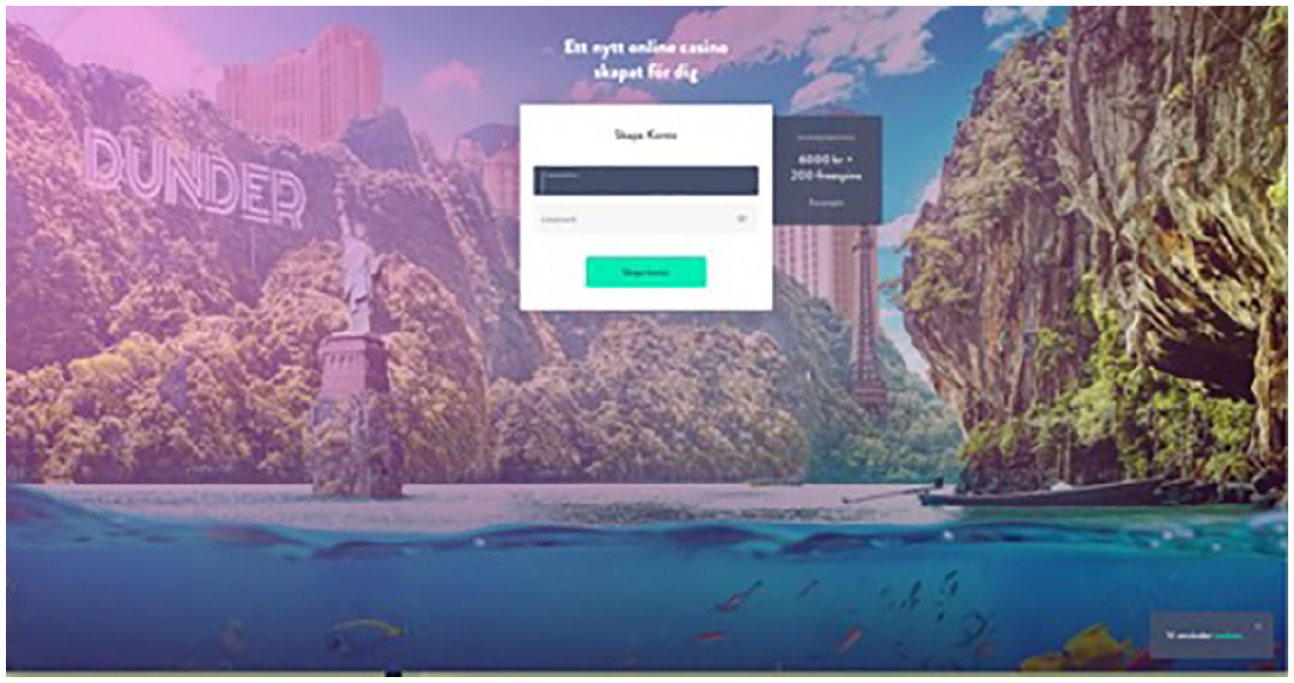
Screenshot of the start page for the Dunder casino website, retrieved in November 2018 from www.dunder.com/sv.
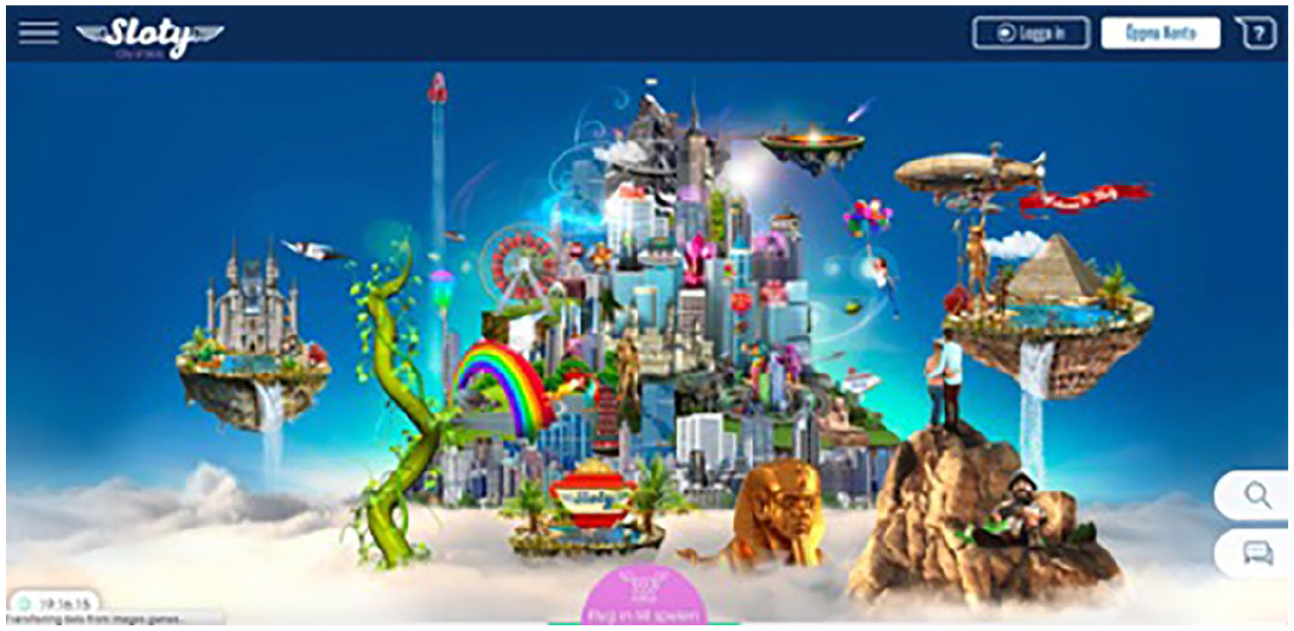
Screenshot of start page for the Sloty casino website, retrieved in November 2018 from www.sloty.com/sv.
While the principal end of online casinos is to make users spend money on gambling, the purpose of using tourism imageries/imaginaries is to make users shift their attention and activity from one place online to another, that is, to move and eventually enter the encapsulated virtual world of the online casino (cf. Gale, 2009). These mobilizing efforts are part of a broader field of online transactions that involves more stakeholders than the casino enterprises; notably social media, news media and broadcasting companies (also serving as platforms for casino advertising). All of these stakeholders benefit from the generation of digital data streams to fine-tune their businesses. The streamable transmedia tourist is thus not a real subject, but a strategically designed and implied ‘mode of address’, whose real-life counterparts, in this example the actual audiences of online casino adverts, are expected to manifest themselves as data producers, or, digital subjects. The digital subject, following Goriunova (2019: 2), is ‘distinct from the living self’, entangled with the industrial logics and performances of transmedia circulation:
This concept includes a subject of a data profile or of a Facebook stream, a history of browsing or search engine queries, mobile phone positioning records, bank transactions, sensor data, facial recognition data, biometric movement recognition data, or email inboxes, among other things. The digital subject thus moves between captured, unique, and persistent biological characteristics and premediated forms of symbolic expression, judicially inferred subjects of actions and performed identities. (p. 2, emphasis added)
The key term here is movement. The digital subject is an in-between, intermediary position – neither subject nor data – defined by its particular mode of generating data streams, for instance through visiting online casinos, searching for affordable accommodation or checking-in at a hamburger restaurant in a foreign city. The commercial imperative in transmedia environments to continuously produce such in-between, continuously mobile, quasi-subjects, should lead us to anticipate the continued primacy and normalization of touristic imaginaries across institutions and social fields. As such, the streamable transmedia tourist represents the most recent extension of post-tourist simulacra. It articulates a key aspect of tourism to investigate in order to grasp the nature of de-differentiation in times of datafication.
Conclusion: towards a research agenda
The aim of this article has been to revisit and rethink the de-differentiation thesis associated with the post-tourism debate of the 1980s and 1990s (e.g. Feifer, 1985; Lash and Urry, 1994), in the light of digitalization and the recent, and still ongoing, expansion of transmedia as a mode of cultural circulation. It has been argued that the regime of transmedia reinforces and provides new facets to cultural and geo-social de-differentiation. While tourism markets and modes of travelling become ever more differentiated, just like the protagonists of post-tourism predicted (e.g. Munt, 1994), the boundaries between tourism and other realms of experience and practice become more open-ended. This article has tried to capture and explicate this development through a triadic typology, where the ubiquitous transmedia tourist, the decapsulated transmedia tourist and the streamable transmedia tourist represent different trajectories of de-differentiation. Their main characteristics are summarized in Table 1.
Three types of transmedia tourists.
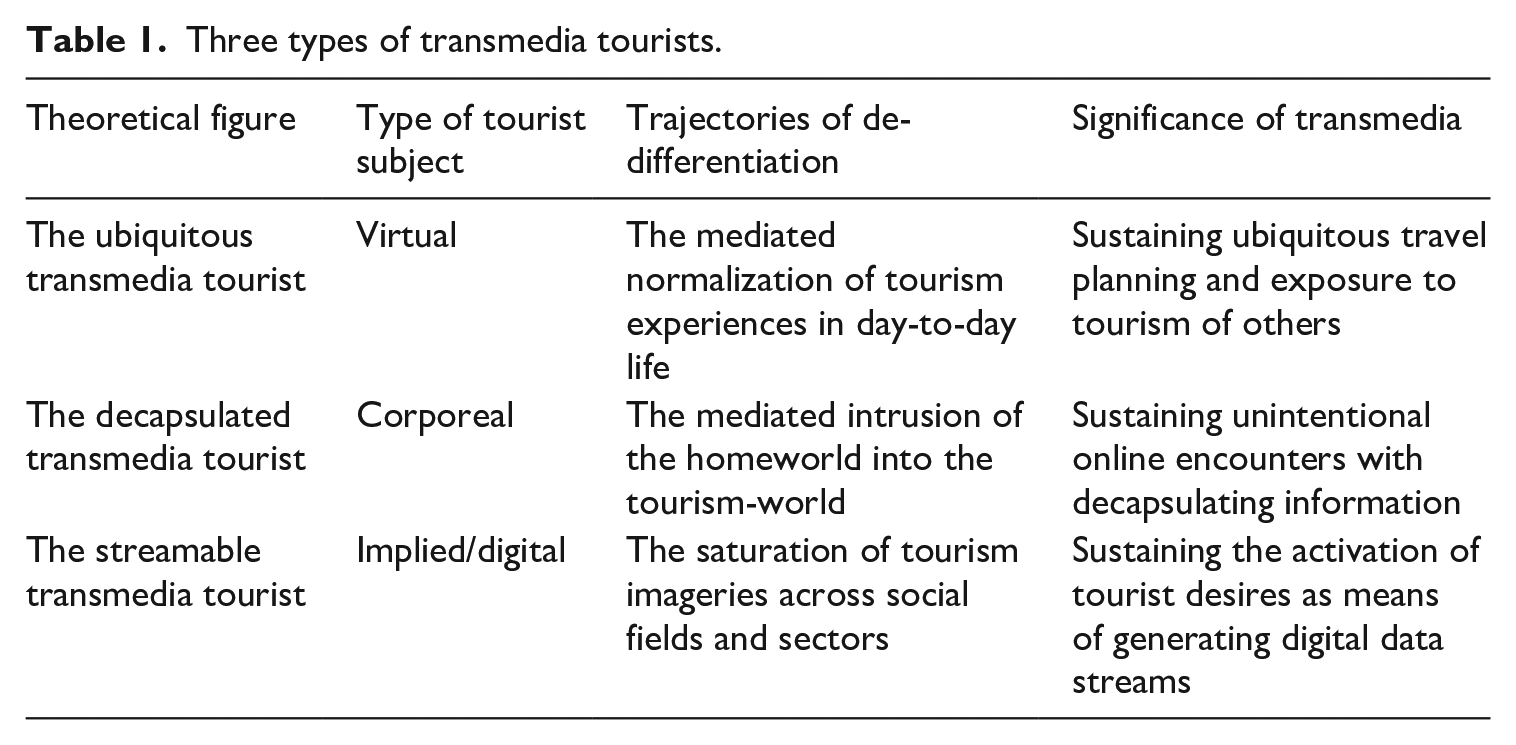
The first type points to the normalization of transmediated tourism planning and exposure to other people’s tourism practices in everyday life. The second type refers to the escalating threat of mediated intrusions from the homeworld while travelling, and the associated need to develop strategies for coping with transmedia in general and the open-ended implications of online sharing in particular. The third type addresses the significance of tourism imageries as means of producing mobile digital subjects that generate valuable data for the connectivity industry and other transmedia stakeholders. The current proliferation of these types/trajectories of de-differentiation should not be taken as evidence of ‘the end of tourism’, however. Rather, as suggested by the primacy of tourism imageries in popular media as well as peer-to-peer communication, transmedia fuses tourism and everyday life while at the same time entertaining the deep-seated cultural vision of tourism as a temporary getaway from ordinary life (cf. Haldrup and Larsen, 2009: 21–26).
The triadic conception of the transmedia tourist should be seen both as an argument for the extended relevance of the de-differentiation thesis – and postmodern social theory at large – in a digitalized society and as a research agenda for further research. As to the latter, the three theoretical figures can be seen as complementary research areas, each calling for in-depth empirical analysis. While certain research themes have already been identified earlier, there is also reason, by way of conclusion, two highlight two analytical routes that cut across the three types.
The first route concerns the socially embedded nature of transmedia and, hence, the socially differentiated articulation of de-differentiation. The perspective elaborated in this article should not be mistaken for being ‘techno-determinist’. While the earlier discussions mainly highlight the ways in which tourism is remediated and adapted to new modes of circulation, this does not mean that the consequences of transmedia are unitary or that the affordances of transmedia technologies are socially ‘objective’. Rather, future investigations into the proposed trajectories of de-differentiation – and the relations between them – need to address the socio-culturally differentiated appropriations and consequences of transmedia and the mutual shaping of transmedia technologies (in terms of architecture, logics and industrially encoded affordances) and the appropriation of these technologies in different contexts of tourism (see, for example, Jansson, 2018b, 2019). Theoretically, this would call for interdisciplinary analyses combining, for example, the social construction of technology (SCOT) approach (e.g. Pinch and Bijker, 1984) and Bourdieu’s (1984 [1979]) theory of habitus and social space.
A second interesting route would be to relate the transmedia tourist(s) to different modes of tourism experience, for instance following Cohen’s (1979) division between recreational, diversionary, experiential, experimental and existential modes. Such elaborations of the proposed typology could give us answers to a number of important questions. What does the ubiquitous transmedia tourist look like in different socio-cultural contexts and how is the day-to-day involvement in travel planning motivated and experienced? How do different groups handle the threat of decapsulation in transmediatized tourism, and how are coping strategies related to the formation of new technological solutions and transmedia repertoires? How is the streamable transmedia tourist discursively constructed across business sectors and social fields – and how is this mode of address related to other means of producing digital subjects? Explorations into these, and related, questions should lead to a more comprehensive understanding of how transmedia opens up tourism to ordinary life, and vice versa, and thus plays into, and reinforces, long-standing processes of de-differentiation, while at the same time invoking new forms of reflexivity, distinction and boundary work among post-tourists.
Footnotes
Funding
The author(s) received no financial support for the research, authorship, and/or publication of this article.
