




Abstract
This article attempts to understand the value and meaning of a hazardous natural environment for tourists. It focuses on the attraction of volcanic sites in the eyes of sensation-seeking hikers. The research is based on a participatory observation study and in-depth interviews with 11 hikers on the Laugavegur hiking trail, in the Highlands of Iceland. The research questions addressed in this article are, do hikers experience a threat from the natural environment, and does a hazardous environment contribute to a feeling of the sublime? In support of the theories put forth in the article about sensation seekers, risk perception, its heuristic traps and sublime feeling, the article argues that tourists perceive risks in the hazardous environment in a positive way, as something spectacular, unique and sublime. Thus, their positive risk perception of existing potential environmental hazards encourages tourists to ignore signs of risks and hazards and subsequently puts them in unnecessary danger.
Introduction
Risk is a part of human experience, even during the holidays (Smith, 2013). Tourism has risks and fear embedded into its core, and even as it tries to distance itself from risks and deaths, avoiding risks is impossible (Cohen, 2009). Tourists who visit foreign places are guests in a strange environment, and some will even seek out travel in dangerous environments in order to experience risks (Williams and Baláz, 2014).
Iceland is known as a place with unusual extremes of nature and wilderness ever since geographical literature became popular in Europe in the sixteenth century (Oslund, 2002). One recent extreme example was the eruption of the volcano Eyjafjallajökull in 2010, which brought attention to Iceland (Karlsdóttir, 2013). Tourism had been slowly growing before that but since the eruption, the number of international tourists has had a 25% annual average growth (Icelandic Tourist Board, 2017). Those who want to experience wilderness in relatively unspoilt nature typically hike in the Central Highlands (Sæþórsdóttir, 2014). Laugavegurinn, the most popular long-distance hiking trail in Iceland, is in the southern Highlands, near some of the most active and dangerous volcanoes in Iceland. In the fall of 2016, increased risk of a volcanic eruption in two nearby volcanoes was declared by the authorities (Icelandic Met Office, 2016). During this hazard alert, it became interesting to know how tourists hiking the Laugavegur trail experienced risks in the environment. In order to develop future risk mitigation plans, it is essential to understand travellers who go towards an eruption or potential eruption, as tourists are often forgotten, misunderstood or considered irresponsible. It was interesting to see if there was something else that contributed to the specific risk tourists face. Some literatures have connected the attraction that tourists have to natural hazards to the feeling of sublime (Michels, 2004; Roberts, 2004; Stranger, 1999). While there are other contributing factors, this article will specifically look into how the sublime experience interacts with risk in the natural environment. The aim of this research is to analyse how hikers experience potential volcanic threats in a hazardous environment, what attracts them to volcanic sites and what role risk awareness plays in the attraction of such places. The specific research questions are Do hikers experience threats in the natural environment? How does that fear manifest itself, and does experiencing that environment contribute to a feeling of the sublime?
The study is based on in depth interviews with 11 hikers on the Laugavegur hiking trail, in the southern Icelandic Highlands, as well as a participatory observation study.
Literary review
Perceptions of risk
In comparison with other environmental hazards, volcanoes usually create few casualties annually. That does not change the fact that they have a very dramatic appearance, high public profile and a firm place in the public imagination as hazardous phenomena. Eruptions like the ones in Mount Tambora and Krakatoa in Indonesia and Mount Pelé in Martinique, in which thousands of people lost their lives, engrained the threat of an eruption in people all around the world and is the main reason for the risks associated with volcanoes (Smith, 2013). In Iceland, few destructive volcanic eruptions have occurred, of which the most notable was the eight-month long Laki eruption in 1783–1784 that caused fatalities of about 20% of the Icelandic nation and 75% of the domestic animals. Despite the vast area covered by lava, the most hazardous impacts were due to the persistent and widespread poisonous sulphuric aerosols (Thordarson and Self, 2003).
Risk is often divided into objective and perceived risk, where objective risk is the calculated risk, assessed through scientific methods, while perceived risk is the individual perception of that risk (Mitchell, 1989; Slovic, 1987). These two phenomena do not have to align, and people usually rather trust their own perceived risk rather than the objective risk (Smith, 2013). Up until the mid-1970s, risk was treated as something that existed inherently and risk assessments focused their research on objective risk (Douglas and Wildavsky, 1982; Slovic, 1987). With an anthropological reading of risk, Douglas (1970), in her cultural theory of risk, brought about a paradigm shift where risk is understood as socially constructed; this is often referred to as The Cultural Theory of Risk (Douglas, 1966; Douglas and Wildavsky, 1982). The theory claims that different cultures perceive different meanings in conditions, activities, happenings, things and interactions and that the perception of risk is therefore always biased by the various cultures and social groups (Douglas and Wildavsky, 1982; Eiser et al., 2012; Espiner, 2001; Freudenburg, 1988). In line with that, Freudenburg (1988) points out that, ‘… the dichotomy between “real” and “perceived” risk is less “real” than is often assumed.’ (p. 44).
The main way people contextualise risk is based on whether they have experienced similar risk before, a process in which people either consciously or unconsciously rely on their own experience rather than on the observations and inquiries of distant scientists (Eiser et al., 2012; Mitchell, 1989; Piekarz et al., 2015). The factors that influence risk perception are individual personality and behaviour, cultural background, knowledge, emotions and skill levels (Piekarz et al., 2015). The Cultural Theory of Risk, furthermore, points out that risk is people’s image regarding hazard, which means that hazard is the possibility of a disaster, and disaster is a phenomenon that causes a disastrous event (Douglas and Wildavsky, 1982; Eiser et al., 2012; Espiner, 2001).
Interwoven with risk perception is the concept of locus of control, which refers to the extent people believe that they are in control and are responsible for their life, successes and failures (Rotter, 1966). People who feel that they are in control of most aspects of their life are considered to have an internal locus of control, while people who feel that most aspects of their life are beyond their control are considered to have an external locus of control (Mitchell, 1989). People with an external locus of control usually perceive risk more strongly, feel anxiety more strongly and expect hazard rather more than people who have rather an internal locus of control (Espiner, 2001). One thing that could explain this difference is that people who have an internal locus of control, feel like most risks they perceive are voluntary while people who have an external locus of control feel that the risk they perceive is involuntary. Starr (1969) looked specifically at voluntary and involuntary risk. If people choose to take a risk, they perceive themselves as having more control of it rather than when they have no choice in the matter. In exercising their choice, they generally overestimate their own abilities to protect themselves. Various variables affect a high or a low risk perception, such as, for example, age, gender, culture, nationality, knowledge but none of them are prevalent enough to put forward generalisations (Espiner, 2001; Freudenburg, 1988; Mitchell, 1989). Research on resilience and hazard preparedness near the Katla volcano in Iceland showed that the local people from rural communities had an inherited memory of an eruption and, therefore, showed more awareness of the volcanic risk and more signs of resilience than the people who had moved there in later years and lived in the urban area (Bird et al., 2011; Jóhannesdóttir and Gísladóttir, 2010). It is possible to strengthen the resilience of people through education and encourage them to make personal preparation to reduce the effects a disaster can have on them (Bird et al., 2011; Pagneux et al., 2011; Paton et al., 2008).
Risk assessments typically focus on local inhabitants (Bird et al., 2011; Jóhannesdóttir and Gísladóttir, 2010) but often leave out others, like tourists who are there just temporarily. It has been an issue, both in Þórsmörk in Iceland, and around Mount Pinatubo in the Philippines, that guides cannot adequately communicate the volcanic risk to tourists in the area (Aquino et al., 2017; Bird et al., 2011). The best way to protect people from possible volcanic eruption is to block all access to all volcanoes at all times. Nevertheless, it is not a feasible option for many reasons, as that would eliminate individual freedom, the right to roam and possible profits for the tourism industry (Newhall, 2014).
McCammon (2004) points out the importance of knowledge and information in relation to risk perception in his theory of heuristic traps, in which some people do trust their perceived knowledge over their perceived risk. This can be because of their inexperience with the risk, so they cannot visualise the risk and cannot put it in a context of their own life. On the opposite end of the spectrum, they have become too used to and habituated to the hazard that produces the risk and, consequently, stop perceiving the risk. Some are poor learners and don’t absorb the available information about risk, while other risks are perceived as rare and unique enough to be rather tempting than frightening. Some people will continue with their travel plans, regardless of the potential risks as they do not want to appear inconsistent and cancel their plans. Likewise, those plans are more tangible for them than any potential risk. Therefore, if the plans are set in motion before the risk is perceived, there is a chance that the perceiver will ignore it to appear consistent with his plan (Eiser et al., 2012; McCammon 2004). The leader of the groups is often followed unquestionably, and the participants often dismiss their own responsibility in keeping themselves safe; the leader is saddled with the responsibility of perceiving risks and reacting to them, that is, the so-called halo effect (Piekarz et al., 2015). People often follow the consensus behaviour of their group, so if the group deems something to be risky or not, individual perception of risk is diminished. Other people have the need to stand out from the group and increase their social impact in their group and therefore take unnecessary risks in order to view themselves as braver than the rest of the group (McCammon 2004). Because of these social and heuristic limits to risk perception, authorities can have a hard time decreasing the vulnerabilities of groups and people in the vicinities of natural hazards (Eiser et al., 2012; Piekarz et al., 2015).
Sublime-seeking tourists and their relationship to risk
With the growing popularity of nature tourism, tour operators have sprouted in national parks and various protected areas outside of the urban environment, where tourists are frequently exposed to natural hazards unique to the individual sites. These are often the same as the natural features that attract tourists to those spaces (Espiner, 2001). Some people seek out thrills, excitement and risks (Mitchell, 1989). These people stand out while they are travelling, as they seek out adrenaline touristic activities or dark touristic sites. Zuckerman (1979) called such tourists sensation seekers and defined them as people who are constantly seeking an experience and the thrill of taking a risk. They may underestimate the possibility of injuries, death and danger and overvalue the possibility of feeling pleasure, possibilities, power or the sublime (Stranger, 1999).
Stranger (1999) described thrill seeking or sublime seeking as an individualistic, amoral and hedonistic desire, but it is probably more complex than that. The risk the tourists are seeking is voluntary, and individual tourists do not experience voluntary risk in the same way as they would an involuntary risk situation (Starr, 1969). The sublime is a philosophical phrase that refers to something that cannot be beyond the ontological reality (Roberts, 2004). Skúlason (2005) and Cosgrove and Daniels (1988) describe the sublime as a divine experience out in nature, as they got closer to god. It has been connected to the perception of nature in many ways. Michels (2004) refers to Nietzsche’s explanations (1844–1900) of why people stand in awe in the face of the natural powers. Nature cannot be put in a logical context for people to understand it. In trying to understand this power of nature and codify it in a way comfortable for people, it appears they have transformed the feeling of a fearful respect into the feeling of the sublime.
Cochrane (2012) theorised five experiences of the sublime: the relief experience, the heroic experience, the humble experience, the attractive experience and the identification experience. The relief experience is based around the fact that the sublime-seeker feels the threat and imagines the pain and the danger from it, but as they are observers of those threats while being safe and uninjured, they feel pleasure instead of fear. The heroic experience is about the pleasure of overcoming one’s fear. Both the preceding experiences are egoistic experiences of attraction to the sublime, but the following three experiences are non-egoistic. The first one, the humble experience, is a direct contrast to the heroic experience. It is about the feeling of the insignificance we feel in comparison to the sublime object; our everyday problems and struggles are nothing in comparison to it. Furthermore, this feeling does not include hostility or a need to overcome the sublime (Cochrane, 2012). The humble experience does not answer the question of why the sublime object is attractive or why the sublime experience can make people forget all their problems and stand in awe of the phenomenon. The fourth experience, the attractive experience, attempts to explain the experience in terms of how it reflects on how we are inspired by the sublime. It accentuates the aesthetic of the sublime and that it is like a work of art experienced from a distance and mainly as aesthetically pleasing. The fifth experience is the identification experience and reflects all the reactions listed above. In addition, it draws the attention to the physical and unconscious interactions individuals have with the sublime, as well as how they identify themselves with the sublime. Olafsdottir (2013) stated that it was indeed this identification with the sublime that provides the sensation of joyous peace which many people seek out. In nature tourism, the sublime wilderness is often presented as a romantic image for people to want to be away from the human space (Weatherby and Vidon, 2018).
Methods
The study area
Positioned on one of the most active volcanic regions of the Earth, Iceland typically has volcanic eruptions every two–three years (Compton et al., 2015; Pagli and Sigmundsson, 2008). Some of the popular tourist sites in Iceland are exposed to volcanic hazards, for example, lava flows, volcanic tephra, poisonous gases and jökulhlaups, which are sudden catastrophic glacier outburst floods due to subglacial volcanic eruption.
The research site and the area in focus in this study is the extended hiking trail Laugavegur in the southern part of the Central Highlands (Figure 1). The trail is surrounded with active volcanoes with different risks associated with them and whose past effects are visible in the landscape of the trail. It stretches from Landmannalaugar in the north to Þórsmörk in the south, through the obsidian lava fields of Laugahraun and the crater of Torfajökull. The trail is 55 km long, and it is usually hiked in three–four days, with overnight stops in mountain huts. The extended part of the trail is from Þórsmörk to Skógar on the south coast, which is about 24 km and is usually hiked in one day. That part of the trail goes over Fimmvörðuháls, which is between the two glaciers Eyjafjallajökull and Mýrdalsjökull. On Fimmvörðuháls are new volcanic craters and lava created in a lava flood eruption in the spring of 2010, which attracted numerous visitors during its eruption (Benediktsson et al., 2011). That eruption was the precursor for the subglacial eruption in Eyjafjallajökull that started as soon as the other one finished in 2010. Although that eruption caused severe disruption to the international aviation industry and considerable challenges to the local communities, it did not cause fatalities (Bird and Gísladóttir, 2014). Under Mýrdalsjökull glacier is Katla, a subglacial volcano that has erupted at least 21 times in the past 1100 years (Larsen and Gudmunsson, 2017). Parts of the southern half of the Laugavegur hiking trail are under the threat of jökulhlaup due to the eruption of Katla (Bird et al., 2017; Bird and Gísladóttir, 2012). By each hut on the trail was a signpost detailing the natural hazards and the evacuation plan for the area. The final volcano that needs to be named is the volcano Hekla, which has erupted 18 times since 1104. Although it is located further from the trail than the other volcanoes, hikers on the Laugavegur trail could be seriously affected by volcanic ash from the volcano. It is closely monitored by scientists (Larsen and Thordarson, 2017).
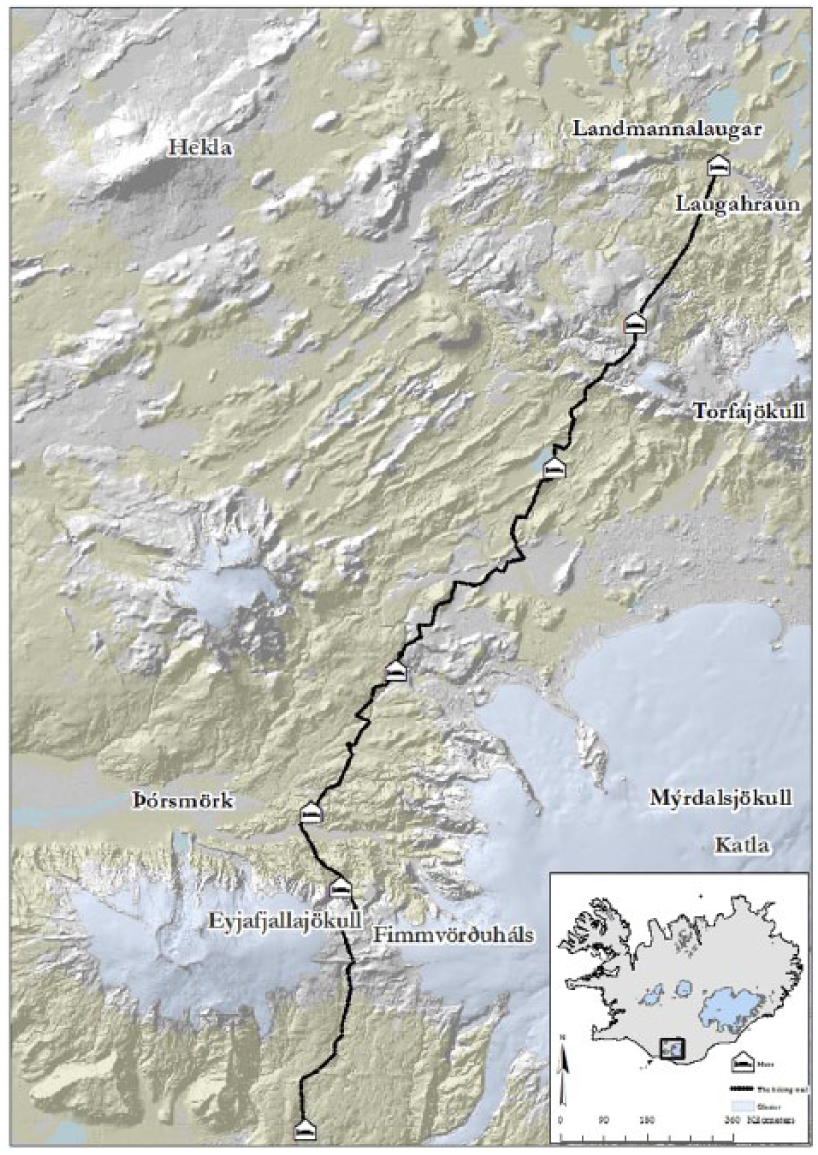
Laugavegur hiking trail (Landmælingar Íslands, 2018).
At the end of August 2016, a few days before the start of the hike that is the focus of this study, increased activity in the volcano Katla started and the Department of Civil Protection and Emergency Management declared that the risk of a volcanic eruption had increased (Icelandic Met Office, 2016). The media reported that people could smell sulphur in the glacial rivers draining from Mýrdalsjökull and interviewed many geologists and geophysicists (Hilmarsdóttir, 2016). Simultaneously, the volcano Hekla had increased earthquakes and various news in the national media stated that the volcano was ready to erupt at any moment (Sigurðsson, 2016).
The interviewees
This research is based on in-depth interviews with 11 master’s students, all hiking the Laugavegur hiking trail in the end of August/beginning of September 2016 as well as participant observation during the hike. The hike was a part of a graduate course called Tourism and Wilderness at the University of Iceland. The hikers were from Europe and North America: two from Denmark, Finland, Iceland and France (a couple interviewed together) and one from each of Norway, Germany, the United States and Russia. The first author of this article is an Icelander who took the course with the other students and conducted the interviews. Four of the interviewees were men and eight were women, with an age range between 25 and 50 years. They all had some experience hiking in nature from their own countries and some had also hiked in other countries. One of the interviewees (Icelander) had experienced a volcanic eruption, as that interviewee had been a part of the search and rescue unit during the eruption in Fimmvörðuháls in 2010.
The interviews were taken in December 2016 and were taken in a café in Reykjavík, at the University of Iceland or through Internet conversation via Skype. The interviews were based around questions that were focused on their lived experience of the hike itself. They told their own narrative of the hike. Then were they asked about the possible eruption in Katla, Hekla or another type of volcanic hazard, their other fears regarding life in general and their risk-taking behaviour. They were asked about their fondest memories of the hike, whether they became afraid, and if they did, what caused it, and their expectations before the hike. These questions were the jumping-off point for further questions personalised for each interviewee that aimed to create a cohesive image of how they experienced the natural environment as well whether they experienced any threats (Cresswell, 2013), especially from the possible imminent threat of the volcanoes which were trembling in the days before the hike.
The course, Tourism and Wilderness, was taught by one of the authors of this article, Professor Anna Dóra Sæþórsdóttir, who was also the guide in the hiking tour. She is a professional tour guide with a long experience of guiding and hiking in the Highlands. Prior to the hike, due to the increased volcanic risk, the professor/tour guide consulted with professors in geophysics at the University of Iceland who monitor the volcanoes. The day before the hike, a meeting was held with the students in which she carefully explained the situation and emphasised the risk involved, and it was up to each individual to decide whether or not he or she wanted to participate in the hike. All who had signed up for the course decided to go on the hike despite the warnings. An equipment list of what to take for the tour, as well as explanations regarding the various weather conditions which could be expected, was given to the participants before the hike.
The phenomenological approach
The phenomenological perspective is used in this study to understand the lived experience of a risk of possible volcanic eruption while hiking in wilderness landscape. Research on environmental hazard and risk has a long history of being interdisciplinary based both on positivist methods, to understand environmental forces, and phenomenological approaches to understand people’s perception of the risk (Mitchell, 1989). The approach of philosophies of phenomenology gives in-depth understanding and is useful, as it focuses on people’s mental construction of the physical world and the meaning it has, to them. It rejects the idea that the experience of nature can be studied objectively, as everything is ‘relative’, and that absolute truth is not possible because individuals always perceive reality within a template that varies between persons; therefore, truth is contingent, shaped by time, culture and place (Demeritt, 2002).
Merleau-Ponty (1964), an influential philosopher in phenomenology, focused on his own living body and how it is used as a tool to experience the environment by moving within it. He points out that the emotions of other people are visible through their movements. In that context, risk perception is based on how it is sensed partly via individuals’ movements and how other people respond to it. It can therefore affect our experience of a phenomenon if we know that we are supposed to react in a certain way; as if we feel like we should feel a certain way, we will move accordingly and therefore will sense the world accordingly (Overgaard, 2012). One of those methods is in-situ ethnography, where the research project is focused on space and the behaviour, thoughts and performances people use in that space (Cadman, 2009). Ingold (2007) used similar methods to study nature. For him, nature only exists via our experiences and in the emotions that the experiences evoke. To understand risk perception, it becomes essential to study the feelings that a sense of risk evokes. Therefore, it is needed to experience the site and feel it on one’s own skin to understand the experiences and the emotions of the people interviewed.
Participatory observation was furthermore used in this research in order to increase the researcher’s understanding of the subject and circumstances and the growth and progression of ideas (Kitchin and Tate, 2000; Laurier, 2016).
Results
The perceived threats
The hike was memorable in many ways for the hikers that went together at the end of August 2016. One of the things that stood out was the threats they felt on the way. Quite a few of the interviewees described it as various versions of fear of heights. One of them described it as a fear of falling, but he had tried to overcome it by learning how to fall. Another had the same feeling of dread on cliff edges and on top of high buildings. In the words of one interviewee about cliffs: ‘ […] I don’t know why I’m scared, I’m not scared of falling but a bit, but there is that feeling unsafe and uncomfortable’.
Crossing a glacial river was also a source of dread for the hikers beforehand. They walked towards the first river with an air of nervous excitement and afterwards talked about how they mentally prepared themselves beforehand, how they took every step carefully and deliberately while crossing it and how exhilarated they felt afterwards. One of them described the crossing with another hiker in the following way: I was actually crossing with [another hiker] and he was, and he was like freaking out as we were going, and he was trying to go like really fast when we were crossing, and I was like no no no, you have to slow down, you have to focus one foot at the time and not freak out because you could get into your head, you start getting sloppy and you could make a mistake.
That was also visible in the group dynamic when they were being observed, as afterwards the group was more joyful, more cohesive and friendlier. They hiked from the glacial river happily chatting together after going together through a dreaded experience and having no injuries or accidents. The same interviewee from the earlier quote continued describing his feelings after he finished crossing the glacier river: [..] but there is the sense of an accomplishment, there is a sense of comradery if you hike in a group and there is a sense of [,] awe as well, you are in this sceneries and places so much bigger than yourself.
Some of the hikers talked about fearing that a bad storm would start with little notice, and they tried to be properly prepared for every possibility. Before the hike, many also dreaded a volcanic eruption, but they didn’t know how to prepare for that possibility.
Perceiving nature
The interviewees were happy to reminisce about the hike. They talked about the joy they felt when they hiked, how calm and serene they were. One of them described the hike as ‘very real and very raw and you were sort of in a powerful element’. One of the experiences that made them feel good was the feeling that they were experiencing something special. They also talked about how they felt like a part of nature, a small and insignificant part of it but a part of it nevertheless. One interviewee likened the landscape to a video game. They felt the environment as beside themselves or on the verge of normal life. The words they used to describe the landscape emphasised how everything seemed on the edge of real life. During the hike, they talked about how the landscape reminded them of fantasies like The Lord of the Rings or Game of Thrones. The people who were hiking the Laugavegur for the first time talked about how different and unusual everything was, as though it were not a part of normal life.
One of the specific places that evoked feelings was when they walked past the craters that had formed in the Fimmvörðuháls eruption in 2010. One talked about feeling the power from the crater; another said that they imagined the warmth from the ground. Yet another hiker had been practicing mindfulness and meditation during the hike, which had been incredibly easy during most of the hike but seeing the recently formed crater and lava field ruined his concentration and he couldn’t calm down. In contrast to his feeling about the other land formations on the hike, he didn’t feel connected to the craters. They didn’t feel like they were a part of this world, and he called them a moonscape to underline their foreignness. The black desolation and the strangeness of the craters gave him an ominous feeling.
Another site that affected the interviewees during the hike was the area by the three memorials located by the trail, erected for people who lost their lives there. Most of them talked about the memorials taking them out of their heads, how they felt uneasy and fearful as well as insecure and unsafe. As one hiker described: ‘[…] having a pile of rocks with a cross on top and a name of that person on it makes it really real, so it wasn’t something that I just looked at and then looked away’.
That type of sense of risk felt real and the group came together to get support from each other. That was both visible on the trail and talked about during the interviews. In the face of the memorials, the risk became real and stopped being imaginary for the hikers. They described it as losing focus, feeling uncomfortable and stressed. One interviewee described the dread and the solemnness he felt when seeing a memorial about hikers who had died on the hiking path. While telling this story, the interviewee tried as hard as he could to understand and to explain why they were in peril while he was safe. He finally concluded that they must have done something wrong even though the hikers didn’t know what had happened. It felt like that the interviewee had to remove himself from the embedded risks in the environment. If the hikers had been just as safe as the interviewee, they would have survived.
The creation of a safe experience
Many of the hikers said that they wouldn’t have wanted to hike the Laugavegur trail all alone. One of the interviewees said, ‘A group of people gave a feeling of safety’. Another person echoed the same sentiment and added that they would have been more aware of the possible dangers if they had been on their own. A group gave them a sense of comradery and supportive company. It was visible observing the group that when they didn’t feel threatened by the environment, they would rather walk in solitude and the group would spread out, but after walking past memorials or through desolate spaces, the group walked together and chatted more together, stuck together and tried to distract themselves by any means possible.
Another major impact of the perceived feeling of safety was the fact that most of the hikers trusted the professor completely, as she was a professional guide who knew the area. The trust in the guide was so great that even when warnings were given about possible eruption in Katla and subsequent floods, some said it didn’t frighten them one bit, as the possibility didn’t feel in any way real to them. One person said: ‘I didn’t feel like [it was] too large of a risk, even though she [the guide] sounded like we had taken it seriously’.. Another person said: ‘I was in the hands of a teacher who was going to take any precaution, so in my mind it was safe’. Some of the participants said it was the ‘university’s job’ to evaluate the risk and not to lead students into any danger. Many of the interviewees mentioned in the interviews that knowledge provided by the guide and the university as a phenomenon that would protect them, specifically the knowledge of the guide. If the guide felt secure enough to hike, they were ready to hike. During the hike, the guide pointed out the evacuation plans, but that did not disturb the hikers’ serenity. A few of the interviewees didn’t remember the evacuation plans at all, and those who did said that they wouldn’t have noticed them if the guide had not pointed them out. None of the interviewees checked the activity of Katla during the hike or whether warning signals had been issued. No one listened to the radio during the whole trip or tried to see whether the possibility of a risk of an eruption had increased or decreased. They trusted that their guide would keep on track for that information. Some of the interviewees saw the hike as a type of a controlled risk. One interviewee said that he wouldn’t have done it otherwise, as he ‘[doesn’t] do things I can’t control’.
Regarding the interviewees’ experience of both the volcanic hazard and other environmental risks, their focus was mainly on other hikers on the trail and criticised that they didn’t respect nature like the students did. One of the interviewees said this about the other hikers regarding taking irresponsible risks: ‘[…] they want the pictures, because it looks so dangerous and they don’t respect nature, but I don’t do that’. The distance they created between themselves and ‘poorly behaving tourists’ was big. There was an underlying sense that the irresponsible tourists would be punished and were therefore more at risk than the well behaving tourists, no matter what the risk in question was.
The perception of volcanic risks
While hiking close to the volcanoes and when they passed craters, the interviewees regarded them as a ‘wonderful example of risk’, especially when an eruption was possible. One of them said that the dangerous aspect of the hiking trail made it more intriguing and the fact that there was an increased risk of a volcanic eruption made the hiking trip even more exciting. Some interviewees perceived the risk of an eruption in different ways. One of them described it thus: […], certainly, hiking between two active volcanos is a bit of a scary experience, […] I definitely picked up my pace a little bit more. I was conscious that it was a looming threat.
One person in the group felt nervous before the hike because of the plan of walking through the two active volcanoes on each side, but as soon as the hike started, he stopped feeling nervous, as when he came to know the guide, he put all his trust in her.
Another interviewee who felt very uneasy about hiking during the hazard period was an Icelander who occasionally worked as a guide with hikers on the trail. Furthermore, the interviewee was a part of the local rescue team during the eruption in Fimmvörðuháls as well as had experienced the ash plume in Eyjafjallajökull in 2010. The increased risk of an eruption before the hike therefore concerned the interviewee a great deal and created reminiscence about the situation during the past eruptions. The interviewee talked about how mesmerising the eruption was but also how terrified the interviewee was that some people would get seriously hurt if any of the volcanoes woke up. The interviewee was therefore very cautious during the hike and looked for signs and information about possible volcanic activity, such as sulphuric smells and increased water in rivers. The interviewee furthermore mentioned how bothersome it was that other guides were hiking with groups and were excited about the possibility of a volcanic eruption, as though they did not have a clue what that would mean. The interviewee wouldn’t have planned to guide a hike during an alert situation during hazard periods. But at the same time, the interviewee followed the leader and did the hike with the rest of the group.
Most of the interviewees in the group touched on the possibility of death in the interviews. One of the interviewees said that as soon as he heard that there was an increased risk of a volcanic eruption, his called his partner excitedly to tell her how excited he was about having the opportunity to die in an interesting way. Many of the hikers focused on that while hiking, they felt that nature didn’t care about them. They were insignificant and disposable in the face of nature. As experienced by one of the hikers, ‘that’s also maybe why I like volcanos so much, because they are also very strong, they can destroy us, and they won’t have any problem’. Another hiker said it in a similar way: [for humans] going in to powerful elements in nature makes us feel how tiny we actually really are and how powerful nature actually is. And how nature can destroy you if it wants to or if, I mean, if something happens like an earthquake, or a volcano eruption or a tsunami or whatever, you know, you’re pretty insignificant, and I like that.
Discussions
The hikers’ experiences of threats in the natural environment
The way in which the hikers experienced the environmental risk along the hike varied. It can be assumed that the hikers perceived the volcanic risk less than risks associated with the weather because they knew how bad weather felt but didn’t know what volcanic activity felt like. The hikers perceived threats in many ways and had different reactions to it depending on the circumstances. Sometimes they focused on how the intangible threats were all around them and invigorated them as though they felt like they were in control of it, for example, the possibility of falling, the possibility of an eruption, the possibility of a flood. But at the same time, the tangible threats of what they could not control, such as combined knowledge of potential impacts of bad weather, and the monuments frightened the hikers and made them feel unsafe. That became visible in the stories from the Icelandic interviewee who had been working on security around a volcanic eruption in the same area as the hiking trail went through. The risk of a volcanic eruption was more tangible to that interviewee than to the other people, and he spoke about the risk in the same way as the others in the group spoke about the risk of bad weather, reflecting how knowledge and personal experience is important (Bird et al., 2011; McCammon, 2004). The other people in the hiking group felt like the possibility of a volcanic eruption was so little that if the event were to happen, it would be rare and unique enough to be worth it. They were not able to visualise the risk to themselves because they didn’t have the frame of reference, rather they just trusted that their guide, the park rangers and the university would protect them or not put them at any real risk. The Icelandic interviewee did, though, have different experiences and a different embedded knowledge than the other people hiking at the same time, as the interviewee had experienced eruptions in that area just six years before. That interviewee was the only one who could put the risk of a volcanic eruption in the context of experience and therefore had a risk perception closer to the ‘real’ risk (Freudenburg, 1988). That is similar to the findings of Bird et al. (2011), Pagneux et al. (2011) and Piekarz et al. (2015), where people with prior experience with a certain risk or who have lived in its vicinity have their risk perception closer to the ‘real’ risk.
The manifestation of that fear
The interviewees voluntarily hiked in the Highland of Iceland despite the various threats in the environment, for example, signs of increased volcanic activity. Therefore, their decision to go there changed their perception of the risk. For one thing, many of them overestimated their control over the volcanic forces and underestimated the effects the risk could have on them. That corresponded with Starr’s (1969) theories about voluntary and involuntary risk, which can also be regarded as the difference between experiencing risk if the experiencer feels like he used his agency and self-determination to get into that risky situation and experiencing the risky situation when it is forced upon him. The hikers put a lot of trust into their guide/professor, reflecting a good example of the halo effects (McCammon, 2004).
The memorials of casualties on the hiking route made the hikers sombre and scared, as they faced the idea that mortal risk was something more than imagined. When they faced the fact that something had happened there, that the mortal risk was something more than imagined, the excitement went away. It felt like the hikers were trying to keep control over the risk in the environment and kept projecting their fears onto the others. There was also a strong theme in the interviews, wherein they thought that other people were at risk but not themselves. There is a possibility that people who voluntarily choose to take risks ignore signs of warning because they don’t think it applies to them (Douglas and Wildavsky, 1982; Eiser et al., 2012; McCammon, 2004). The group itself affected their risk perception as well, as can be seen by the reflection of one of the hikers, who said that he would have been more on the alert if he had been alone; another said that he had been fearful and nervous before the hike started, but as soon as he started to hike with the group, the fear disappeared as if the support of the group decreased the risk he felt, which was in line with the writing of McCammon (2004).
The evacuation plans on the trail didn’t have any significant effect on the hikers and did not make the volcanic risk more tangible. The signposts need to be reviewed, as the research of Bird et al. (2011) on information and education in Þórsmörk and the observations have already indicated that the risks in the area are not being disseminated in an effective way.
The contribution of the environment to a perception of the sublime
Many of the interviewees had a very positive experience of feeling insignificant in the face of some natural hazards, which left them in awe of the elements as had been described by Roberts (2004), Stranger (1999) and Michels (2004). None of the interviewees used direct references to the divine in their narrative about the hike and its environmental risks in the same sense as Skúlason (2005) and Cosgrove and Daniels (1988) theorised, but they did reference regularly the powerful disinterested element which could kill them at any time and was described as something bigger than them; all of which can be connected to the divine.
As the interviewees used fantasy books as reference in describing the environment, it seems that they were experiencing something beyond their ontological reality in a way that Roberts (2004) had theorised. They used it because they couldn’t put the experience in a logical context as Michels (2004) described. The interviews showed that their experiences were transformed from feeling the fear to feeling of the sublime, which they often did with the help of the references to fantasy books. This became clear as it was contrasted with the one interviewee who had had an experience with volcanic activity. That one knew the context, was familiar with it and knew what the consequences could be, and therefore, felt fearful and unnerved the whole time. The interviewees’ sublime feelings varied within the different experiences and could be contextualised with Cochrane’s (2012) framework of different experiences in association with the sublime. For example, one interviewee described how he wanted to challenge himself while simultaneously being sure about his own safety because he trusted that he had knowledge and knew his limits, which corresponded with what Cochrane (2012) called a heroic sense of the sublime. Others described how the sense of accomplishment gave them profound joy. The feeling of safety that they felt, while contributing to their joy, fits with the relief experience of the sublime. The sense of safety, most of the interviewees felt during the hike, can be connected to the trust in the guide and its halo effects, as well as the support of the group they were in, both of which enabled them to experience the sublime joy in the face of risk (Cochrane, 2012; McCammon, 2004).
To experience security in a dangerous situation can be related to Cochrane’s (2012) relief experience of the sublime. The interviewees felt rewarded, in control and knowledgeable based on the information received by the guide. That could be the basis of the rewarding feeling many risk-seekers describe. For a moment, they control the uncontrollable forces and even volcanoes. The interviewees experienced the risk in the environment as internal, something they had control over, as opposed to the external and having no control over it (Eiser et al., 2012; Mitchell, 1989).
Conclusion
It is rather peculiar that some people like feeling that a phenomenon doesn’t care about them. What can explain that good feeling? A possible answer lies in the demands and pressures of our everyday life. We are bound by duties and responsibilities towards phenomena that say that they care about us. When we are faced with a phenomenon that doesn’t care about us, we are relieved of our duties and responsibilities. That makes the disconnection between the experience of risk and the experience of the sublime so attractive and worth seeking. These appealing feelings can easily explain the attraction tourists have, to environmentally hazardous places. While perceiving the risk in a positive way, the hikers experienced that it enabled them to identify and empathise with the risk, which in turn provided them with a sense of control and power. These traps in perceived risk are important to keep in mind during disaster risk reduction and risk mitigation. This article tries to point out that many people who voluntarily seek out risks such as hiking in the Highlands underestimate the imagined risk they are seeking and overestimate their own abilities. If authorities want to reach tourists in a more focused way, they need to provide information about risks and hazards with personal and tangible methods, as opposed to focusing on the abstract, awesome and sublime sides of the hazards.
Footnotes
Declaration of conflicting interests
The author(s) declared no potential conflicts of interest with respect to the research, authorship, and/or publication of this article.
Funding
The author(s) disclosed receipt of the following financial support for the research, authorship, and/ or publication of this article: Financial support was provided by the University of Iceland – Nature-based tourism and the Nordic Centre of Excellence for Resilience and Societal Security – NORDRESS, which is funded by the Nordic Societal Security Programme.
