



Abstract
The paper focuses on the differential impact of ethnicity and the ethnic composition of community on residents’ perceptions of safety among Jews (majority population) and Arabs (ethnic minority) in Israel. Data for the analysis were obtained from a national representative sample of 908 Jews and Arabs residing in 71 urban localities. The localities were divided into two major types: ethnically homogeneous and ethnically heterogeneous (mixed) communities. The findings indicate that Arabs do not feel as safe as Jews, regardless of type of community, and that Arabs’ level of sense of personal safety is similar in the two types of localities. Multivariate analyses (linear regression and bi-level hierarchical regression model) reveal that residence in an ethnically homogeneous locality is likely to enhance positive perceptions about personal safety only among Jews (but not among Arabs). Consequently, Jews residing in ethnically homogeneous (Jewish) communities report the highest level of personal safety. The findings hold after controlling for socio-demographic attributes of respondents and variations in size, socioeconomic standing and crime rate of communities. Apparently, the ethnic composition of community is consequential for formation of perceptions about safety only among members of the majority population. The meanings of the findings are discussed and interpreted in the light of sociological theory and within the context of Israeli society.
Introduction
Ethnic residential segregation has long been associated with differential access to employment opportunities, social and public services and cultural amenities. Ethnic residential segregation is also associated with differential exposure to crime and violence, hence, with differential levels of fear of victimization and feelings about personal safety (e.g., Chiricos et al., 1997; Collins and Williams, 1999; Krivo et al., 2009; Peterson and Krivo, 1993; Sampson and Raudenbush, 1999). Specifically, members of ethnic minorities are more likely than members of the majority population to reside in poor communities; communities where not only employment and economic opportunities are limited but also where cultural amenities and public services are scarce, and where criminal activity and violence are widespread and abundant. Consequently, residents of localities inhabited by ethnic minorities and of ethnically diverse communities are more fearful about criminal victimization and thus, less likely to feel safe and secure as others (e.g., Chiricos et al., 1997; Semyonov et al., 2012; Whitley and Prince, 2005; Hooghe and Vroom, 2016).
Several researchers, however, contend that ethnic homogeneity of the community can become a protective mechanism that increases feelings of personal safety. According to this view, the prevalence of social bonds, a common culture, and social capital in ethnically homogeneous localities is likely to enhance social cohesion and trust among residents. Trust and cohesion, in turn, are likely to increase feelings of personal safety among the residents (e.g. Adams and Serpe, 2000; Glass et al., 2019; Hooghe and De Vroome, 2016; Visser et al., 2013). That is, whereas ethnic diversity of the community’s population has the potential of increasing ethnic conflicts and ethnic tensions, ethnic homogeneity of a community (or of a neighborhood) has the potential of minimizing or even preventing such conflicts, thus, increasing sense of personal safety.
Along the logic embodied in the argument stated above, it is plausible to expect ethnic homogeneity of a community to increase the sense of personal safety not only among members of the majority population but also among members of ethnic minorities. In other words, whereas the literature on ethnic-groups relations has repeatedly suggested that members of disadvantaged ethnic minorities are likely to feel discriminated against, maltreated and less secure as compared to the majority population, the sense of personal safety of ethnic minorities, although lower than the majority population, is expected to be higher among those residing in ethnically homogeneous localities (i.e. communities inhabited exclusively by residents belonging to the minority group population). Indeed, higher levels of sense of safety in ethnically homogeneous communities can be attributed to a prevalence of trust, social cohesion and shared cultural values not only among the majority population but also among ethnic minorities.
In the present research we examine, in the context of Israeli society, whether and to what extent the ethnic composition of the community is consequential for sense of personal safety among Jews (majority population) and Arabs (minority population). Israel, as one of the most spatially segregated societies in the developed world offers a critical setting for studying the links between ethnicity, segregation, and safety. The Jewish–Arab divide is not only spatial and socio-economic but also political as it further shaped by an ongoing national conflict. In addition, Arab localities have experienced a sharp rise in violence over the past two decades, further eroding residents’ sense of security. Taken together, these features make Israel a critical case for advancing comparative theories of segregation, intergroup threat, and subjective safety, and for a better understanding of the ways that deeply divided societies shape the everyday experience and sense of security among members of the minority and majority populations.
In what follows therefore, first, we examine whether perceptions of safety are higher among the majority population (Jews) than among the ethnic minority (Arabs). Second, we examine whether perceptions of safety are higher among residents of ethnically homogeneous communities than among residents of ethnically heterogeneous communities, and third, we examine whether the association between the ethnic composition of the community and perceptions about personal safety differs across the two ethnic groups.
To answer the research questions, we use a representative sample of the adult population in Israel to distinguish between residents of two types of communities: ethnically homogeneous communities (localities inhabited either only by Jews or only by Arabs) and mixed communities (cities and towns where Arabs and Jews share residential space). Then, we compare the sense of personal safety between Jews and Arabs residing in different types of communities. By doing so we will be in the position not only to contribute from a comparative perspective to a better understanding of the impact of ethnicity and ethnic composition of the community on the sense of personal safety in ethnically divided societies, but also to broader debates on how majority and minority populations in divided societies differently experience residential segregation and the consequences of segregation for quality of life and ethnic inequality.
Previous studies and theoretical considerations
Studies in the US have long demonstrated that the racial or ethnic composition of the locality is strongly associated with perceptions about neighborhood safety and fear of victimization. More specifically, researchers have long observed that a large concentration of Black or of Hispanic residents in a neighborhood (in North American cities) is likely to reduce the sense of personal safety and to increase the fear of criminal victimization (Chiricos et al., 1997, 2001; Eitle and Taylor, 2008; Liska et al., 1982; Moeller, 1989; Quillian and Pager, 2001; Stinchcombe et al., 1980) 1 . Furthermore, the relationship between the racial composition of the community and the residents’ sense of safety remains significant even when controlling actual crime rates (Henson and Reyns, 2015; Liska et al., 1982; Quillian and Pager, 2001). The latter findings suggest that sense of personal safety, at least in part, can be attributed not only to actual crime and threat of crime and violence but also to racial stereotyping of the locality (Chiricos et al., 2001); stereotyping that are associated with emergence of cognitive maps regarding ethnicity and spatial safety not only in the US but in other societies as well (Sampson and Raudenbush, 2004; Semyonov et al., 2012) 2 .
In recent decades a new body of research on the relationship between the ethnic composition of communities and perceptions about personal safety has emerged mostly among members of the majority population. With the influx of immigrants to Europe and the subsequent change in the ethnic fabric of many European cities, more researchers have begun examining the relationship between the ethnic composition of the neighborhood and the residents’ sense of personal safety (e.g., Brunton-Smith and Sturgis, 2011; Glass et al., 2019; Hooghe and de Vroome, 2016; Semyonov et al., 2012; Smiley and Yang, 2021; Thakkar et al., 2023; Visser et al., 2013). These studies lead to the conclusion that neighborhoods inhabited mostly by immigrants (i.e. ethnic neighborhoods) are not viewed as safe as the neighborhoods inhabited solely by residents of European origin (e.g. Semyonov et al., 2012; Thakkar et al., 2023). Consistent with this view, Smiley and Yang (2021) further demonstrated that residents’ sense of personal safety tends to decline as the percentage of residents of non-European origin in the community increases.
When explaining the association between the ethnic composition of community and residents’ sense of safety, some researchers (e.g., Adam and Serpe, 2000; Glass et al., 2019; Hooghe and De Vroome, 2016; Visser et al., 2013) maintain that due to ethnic tensions, an increase in ethnic diversity of the community is likely to reduce neighborhood cohesion and trust. Reduction in neighborhood cohesion leads, in turn, to a rise in fear of victimization and decrease in the sense of personal safety. According to this view, integration of residents that differ in race, ethnicity or religion from those of the majority population in the community (or neighborhood) is viewed by the residents as a source of threats and tensions that decrease cohesion and in turn, decrease sense of personal safety.
Notwithstanding the impact of ethnic composition of community (and of ethnicity) on sense of safety (and fear of crime), researchers have repeatedly observed that individual level attributes are also associated with sense of safety or fear of crime. For example (De Donder et al., 2005; Semyonov et al., 2012; Sutton and Farrall, 2005; Vauclair and Bratanova, 2017; Whitley and Prince, 2005) found that sense of safety is less pronounced among socioeconomically vulnerable populations and especially among physically vulnerable populations such as women and the elderly. Whereas the major goal of the present paper is to explore the impact of ethnicity and of ethnic composition of community on sense of safety, it seems important to also consider the differential effects of individual attributes on sense of safety.
In what follows we put to test the theoretical argument that ethnic composition of place of residence is consequential for sense of safety among minority and majority populations by studying the relationship between ethnicity, the community’s ethnic composition and perceptions about personal safety among Arabs and Jews in Israel. That is, we examine the extent to which ethnicity interacts with ethnic composition of the community in producing divergent levels of sense of safety. When doing so, we provide, to the best of our knowledge, the first examination of the association between ethnic composition of place of residence and feelings about safety among members of the majority population and the minority population.
The Israeli context
Israel is a society characterized by unusual ethnic diversity. Nonetheless, the most meaningful ethnic split in Israel is between the Jewish majority and the Arab minority (e.g., Khattab and Miaari, 2013; Lewin-Epstein and Semyonov, 1993; Yaish and Gabay-Egozi, 2021; Yonay and Kraus, 2001). Jews who comprise over three quarters of the Israeli population are advantaged over the Arab minority in every indicator of socioeconomic status including wealth, income, occupational position, education, and standard of living (e.g., Semyonov and Lewin-Epstein, 2011; Yaish and Gabay-Egozi, 2021; Bental et al., 2017). The differences between Arabs and Jews are also evident in the extreme residential segregation between the two groups. About 90% of either the Jewish population or the Arab populations live in communities inhabited only by Jews or only by Arabs; only small numbers of Jews and Arabs reside in mixed communities (Ali and Rosenberg, 2023; Diab et al., 2022; ICBS, 2019; Khattab and Miaari, 2013; Semyonov and Tyree, 1981; Shdema et al., 2018).
In other words, although Israeli Arabs are citizens of the state, the two ethnic groups reside in different towns, different villages and even different neighborhoods within the same city (e.g. Ali and Rosenberg, 2023; Diab et al., 2022; Shdema et al., 2018; Yacobi, 2009). Currently, only eight localities in Israel are formally defined by the Israeli Central Bureau of Statistics (ICBS) as “mixed localities”. The mixed localities include the major cities and mid-sized towns. The percent Arabs that reside in the ‘mixed localities’ range from only 4.7% in Tel Aviv-Jaffa to 32.7% in Acre. Although some gentrification of old Arab neighborhoods by Jews had taken place in recent decades in some mixed towns, and although some Arabs have begun moving to new established Jewish cities and towns in the vicinity of Arab communities in search of better living conditions and better housing prices (e.g. Diab et al., 2022; Shdema et al., 2018; Yacobi, 2009), the spatial and social segregation between Jews and Arabs in Israel is still substantial, even extreme (Diab et al., 2022; Shdema et al., 2018; Yacobi, 2009).
The extreme patterns of social and residential segregation between Jews and Arabs are associated with the historical peculiarities of the state. Whereas Arabs have been living in the area for generations, mainly in villages and small towns, Jews began migrating to the area in large numbers and repopulating the country only in the beginning in the 20th century. The Jewish immigrants established their own communities, cities, towns and villages without any intention of integrating with the local Arab population. Likewise, Arabs had no intentions of integrating with the Jewish population.
After the establishment of the State of Israel in 1948, the Arabs who did not leave the country became citizens of the country but remained in the Arab communities, living separately from Jews. Over the years, government investment in infrastructure development in the Arab localities was minimal. Consequently, economic and employment opportunities in the Arab communities were quite limited with Arabs experiencing social and economic disadvantages as compared to Jews in Israel in general and in the labor market in particular (e.g., Khattab and Miaari, 2013; Lewin-Epstein and Semyonov, 1993; Yaish and Gabay-Egozi, 2021; Bental et al., 2017; Yonay and Kraus, 2001).
Recently, Ali (2024) and Ali and Rosenberg (2023) argued that the spatial segregation between the two ethnic groups not only hinders Arabs’ employment and economic opportunities but also increases their exposure to crime and violence. They maintain that, with limited government intervention and few employment opportunities, criminal activities and violence in Arab communities have intensified dramatically in recent decades (Ali, 2024; Ali and Rosenberg, 2023a, see also Abu-Nimer, 2025). Consequently, fear of criminal victimization has considerably increased and sense of personal safety among residents of Arab communities has decreased.
In a survey conducted in 2019, Ali et al. (2020) reported that over 60% Arab respondents felt a sense of personal insecurity in their communities (as compared to 12.8% of Jews). Likewise, almost 80% of the Arab population expressed worries about violence and crime, as well as about the use of firearms. Ali and Rosenberg (2023) observed that, as compared to Arabs residing in homogeneous Arab localities, Arabs living in mixed communities are more likely to express worries about a variety of issues including exposure to violence and crime. The researchers attributed the relatively lower level of concern among residents of homogeneous Arab places as compared to mixed places to the prevalence of social bonds, a common culture, and social capital in the homogeneous Arab communities.
Hypotheses
Previous studies that dealt with personal safety in the US and in European societies coupled with the studies that focused on patterns of ethnic spatial segregation and ethnic inequality between Arabs and Jews in Israel lead us to following four hypotheses.
Sample and data source
To test the theoretical expectations, we collected original survey data from a national representative stratified sample of the Arab and Jewish citizens of Israel, aged 21-70 in December 2020 3 . The sampling procedure was based on a multi-stage stratified random sampling of households from all geographical regions in Israel 4 . The sample was drawn from 71 urban communities that their size ranges 951,149 residents in Jerusalem, followed by 463,308 residents in Tel Aviv-Jaffa, to 7,792 residents in Rama (a small Arab locality). 43 localities were Jewish homogeneous communities, 24 localities were Arab homogeneous communities and 4 are defined as mixed localities, where Arab and Jews share residential space. Respondents within the households were selected based on ‘last birthday method’—the last person in the household to celebrate their birthday The number of sampled respondents per community ranged from 51 (in Tel Aviv-Jaffa) to 10 (in small localities) with response rates of 51% for the Jewish sample and 65% for the Arab sample 5 . After receiving approval from the ethic committee and respondents’ informed consents, questionnaires to the Jewish sub-sample were presented in Hebrew, and to the Arab subsample in Arabic. The mode of the interview was computer-assistant-personal-interview (CAPI). The data set contains answers from 600 Jewish respondents and 308 Arab respondents (with the Arabs being oversampled).
Variables and measurements
In addition to the ethnic background of respondents (i.e. Arabs and Jews) we distinguish between two types of communities to capture their ethnic composition: mixed localities versus ethnically homogeneous localities. The ‘mixed localities’ are those that are defined as such by the Israel Central Bureau of Statistics (ICBS). Yet, it should be noted that even in the mixed locality, Arabs and Jews tend to reside in different neighborhoods. The mixed localities include the three major metropolitan urban centers of Israel (i.e. Tel Aviv, Haifa and Jerusalem 7 ) as well as mid-size old towns (i. e. Lod, Ramle, Acre). Overall, in the mixed localities category there are 6 communities (3 major cities and 3 mid-sized towns) 8 . The ‘ethnically homogeneous communities’ category includes 66 cities, towns and small urban localities that are populated exclusively by either Jews or Arabs (41 places are homogeneously Jewish cities or small towns, and 25 are homogeneously Arab cities or small towns).
Information is also available about a series of socio-demographic variables known to affect the sense of personal safety. The socio-demographic characteristics of respondents are included in the data analysis as individual level control variables. Except for age (in years), all the socio-demographic variables are defined as dummy variables. They are gender (woman = 1), education (academic education = 1 vs without academic education = 0), labor force participation (not economically active = 1) and subjective household income (living comfortable with family income = 1 vs difficult living on present income = 0).
In addition to the ethnic composition of the locality (ethnically homogeneous vs mixed), we include (for the bi-level hierarchical regression model estimation) three variables at the community level. They are the size of the locality, rate of violent crime per capita and the socio-economic standing of the locality. Community size is measured by the number of inhabitants in 2020 and then converted into a natural logarithm 9 . Rate of violent crime is calculated as the sum of two items that pertain to murder and attempted murder and two items that pertain to physical assault and grievous bodily harm over 5 years (2016-2020) 10 . The total number of violent crimes is divided by the number of years to determine the average per year and by the number of residents in the community in 2020. The socioeconomic standing of community of residence was obtained from the publication of the Israel Central Bureau of Statistics (ICBS, 2019) for the year 2019. The community index of socioeconomic standing is computed through factor analysis (based on a series of socioeconomic indicators of the community) and is clustered into ten categories ranging from 1 (at the bottom) to 10 (at the top).
The community-level variables are included in the estimation of bi-level regression equations as second level variables. Because the rate of crime is available only for 60 communities, the bi-level estimation is restricted to this subsample of respondents. We contend that considering community-level contextual variables enables us to relate the feelings about personal safety not only to respondents’ attributes but also to the conditions associated with community of residence. More specifically, inclusion of both individual level attributes (i.e. ethnicity, gender, age, education, economic condition, labor force status) and a series of community level contextual characteristics (i.e. community ethnic composition, size, crime rate, and socioeconomic standing) in the regression analysis enables estimation of the net effects of respondents’ attributes and attributes of their community on sense of personal safety.
Findings
Descriptive overview
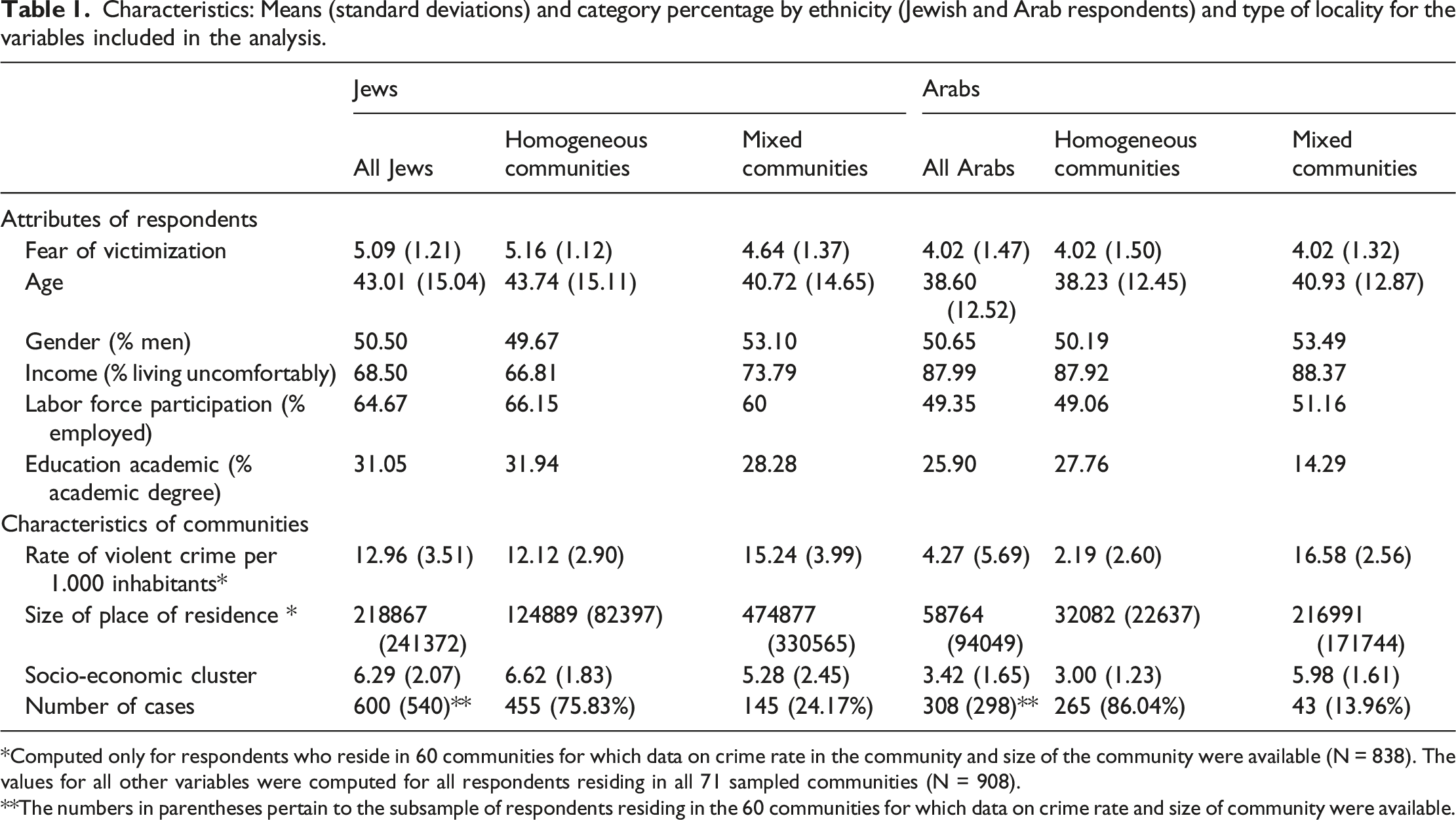
Characteristics: Means (standard deviations) and category percentage by ethnicity (Jewish and Arab respondents) and type of locality for the variables included in the analysis.
*Computed only for respondents who reside in 60 communities for which data on crime rate in the community and size of the community were available (N = 838). The values for all other variables were computed for all respondents residing in all 71 sampled communities (N = 908).
**The numbers in parentheses pertain to the subsample of respondents residing in the 60 communities for which data on crime rate and size of community were available.
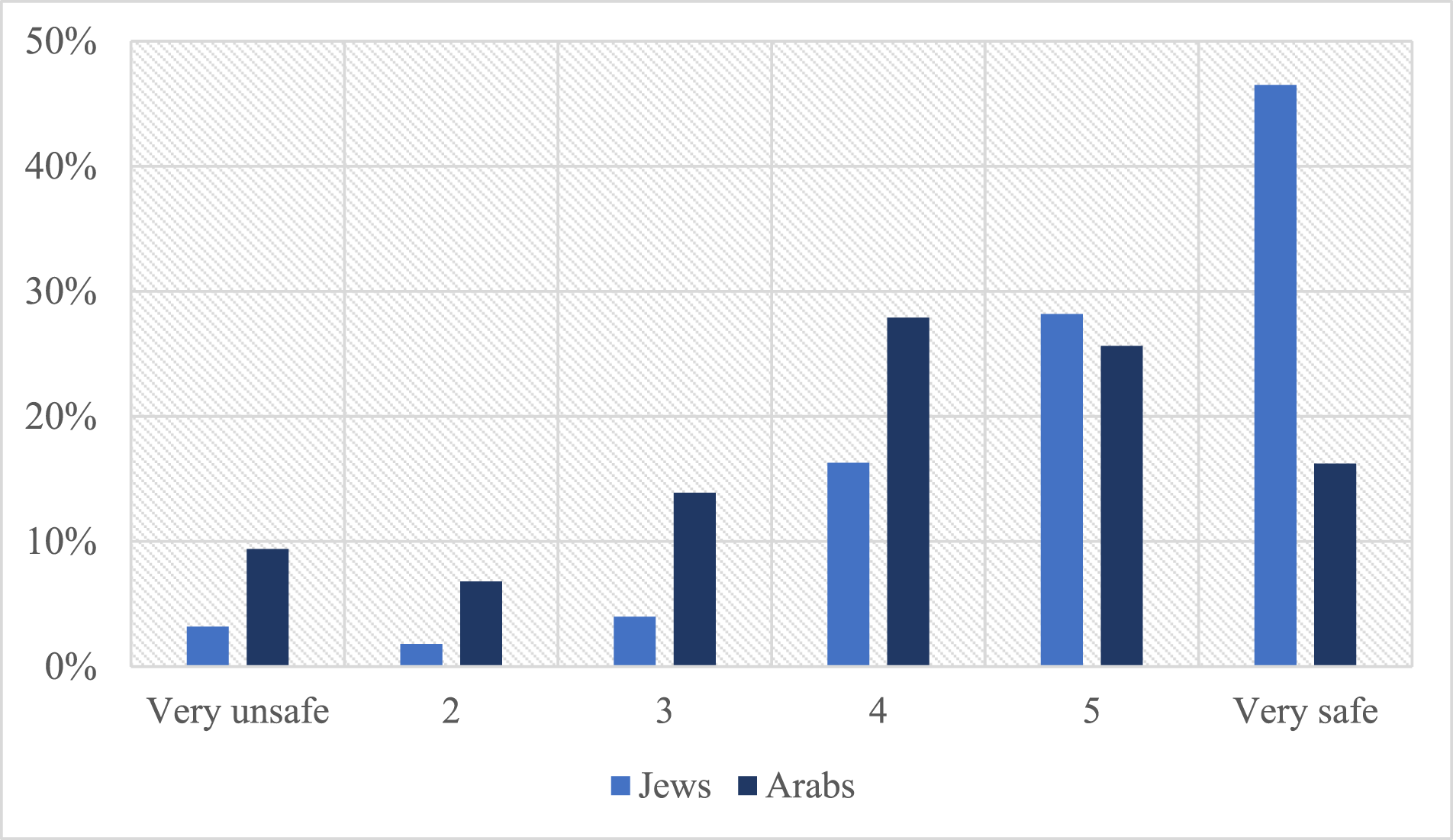
Sense of personal safety (measured on 6-point scale) among Jewish and Arab respondents.
Jews and Arabs not only differ in their levels of sense of personal safety, but also in their socio-demographic attributes. As expected, and consistent with findings reported by previous studies on the subject, the data reveal considerable differences in the socio-demographic attributes of the two ethnic groups. First, Arabs are younger than Jews. Second, Arabs have lower levels of formal education than Jews as indicated by the lower percentage of Arabs who hold academic degree (25.9%) as compared to Jews (31.05%). Third, Arabs are less likely to be employed than Jews, and fourth, Jews are more comfortable than Arabs with their household income (31.5% among Jews vs 12.11% among Arabs).
The data listed in Table 1 also underscore the extreme patterns of residential segregation between the two ethnic groups, with over 86% of Arabs and over three-quarters of Jews residing in ethnically homogeneous communities. Indeed, most Arabs and Jews do not share residential space. Most live in communities inhabited either only by Jews or only by Arabs. Table 1 further reveals that Arabs tend to reside in smaller places than Jews. Whereas the average number of residents in a Jewish community is about 218, 867 persons (median is approximately 146,000 residents), the average size of communities where Arabs reside is 58,764 residents (median is slightly over 27,000 inhabitants). Not only do the communities where Arab and Jews reside differ in their size, but they also differ considerably in their socio-economic standing. Whereas the average score of the socioeconomic index of localities where Jews reside is 6.3 (on the 10-point scale), the average socioeconomic score of the index of the localities where Arab live is 3.4. Note, however, that Jews on average reside in communities with a higher rate of violent crime than Arabs (13.0 vs 4.3 per 1000 residents) with the crime rate being highest in the mixed communities. One plausible explanation for this result might be that, in general, crime rates tend to be higher in larger cities than in small communities 11 . Likewise, Arabs are less likely than Jews to report crime in their communities due to lower level of trust in the police. Given that Arabs tend to live in small communities and are less likely to report crime, we can attribute the difference in the crime rate, at least in part, to differences between Jews and Arabs in the size of their places of residence and difference in reports of crime.
When comparing the two ethnic groups across the two types of communities, a curious finding emerges. Whereas the socioeconomic status (i.e. income, education labor force participation) of Jewish respondents who reside in mixed communities is considerably lower than that of the Jewish respondents of the homogeneous localities, the socioeconomic attributes of Arabs who dwell in homogeneous (Arab) places do not differ considerably from the attributes of the Arabs who live in mixed localities, except for education. The percentage Arabs respondents with academic education is remarkably higher (27.8% vs 14.3%) among residents of the homogeneous communities as compared to the mixed localities.
Figure 2 graphically illustrates the average sense of personal safety among Jewish and Arab respondents by type of residential community. The figure clearly reveals that level of personal safety among Jews is higher in the homogeneous localities (5.17) than in the mixed places (4.64). Nevertheless, among Arabs, average level of personal safety, while lower than that among Jews, is similar in the two types of communities (4.2 in both the ethnically homogeneous and mixed localities). That is, Arabs express similar and lower levels of personal safety, regardless the type of locality. Apparently, the lower levels of sense of safety among Arabs, can be attributed to their ethnic subordination in Israeli society and not to the type of community of residence. Mean sense of personal safety (measured on 6-point scale) among Jewish and Arab respondents in two types of communities of residence.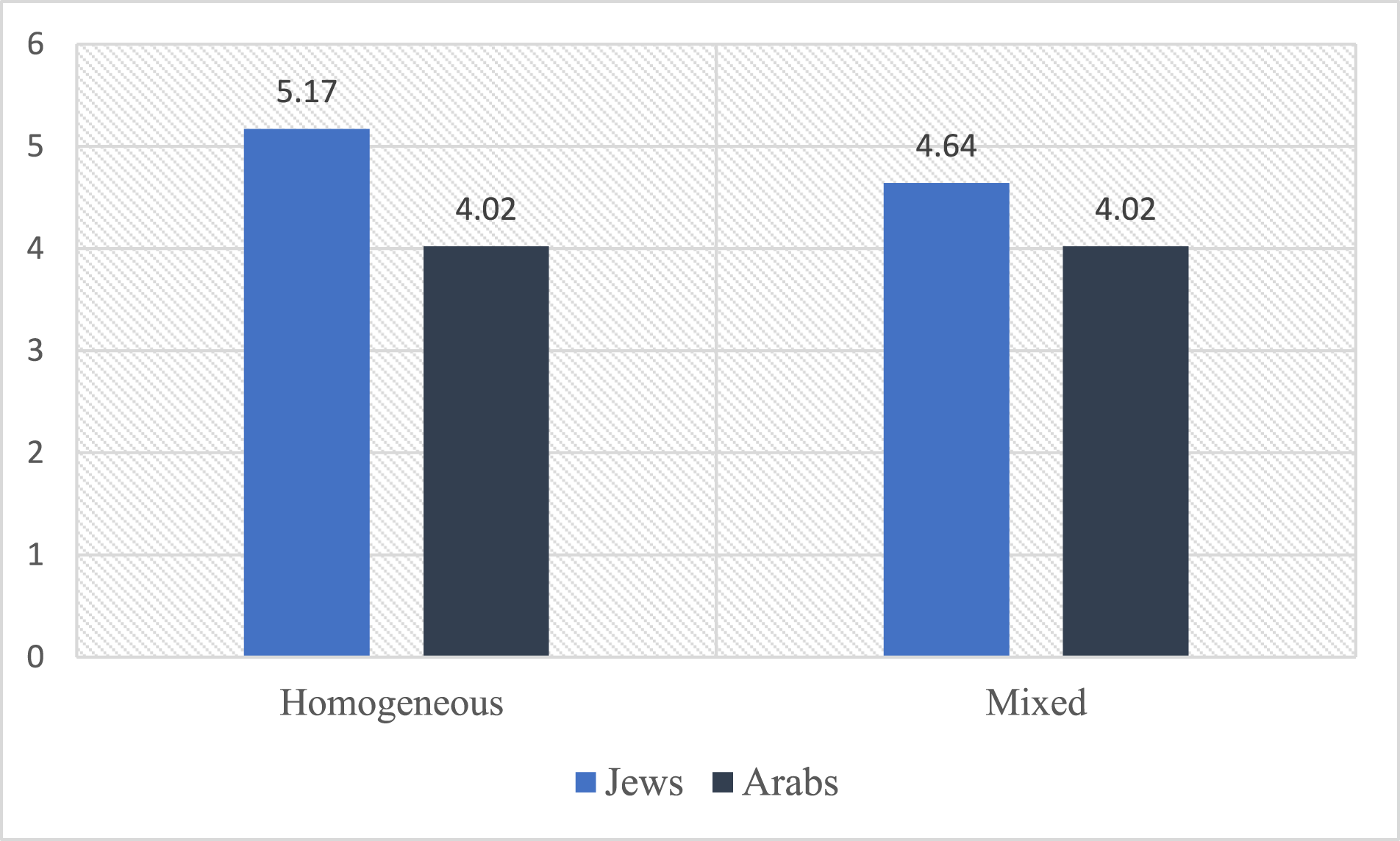
Estimating regression equations
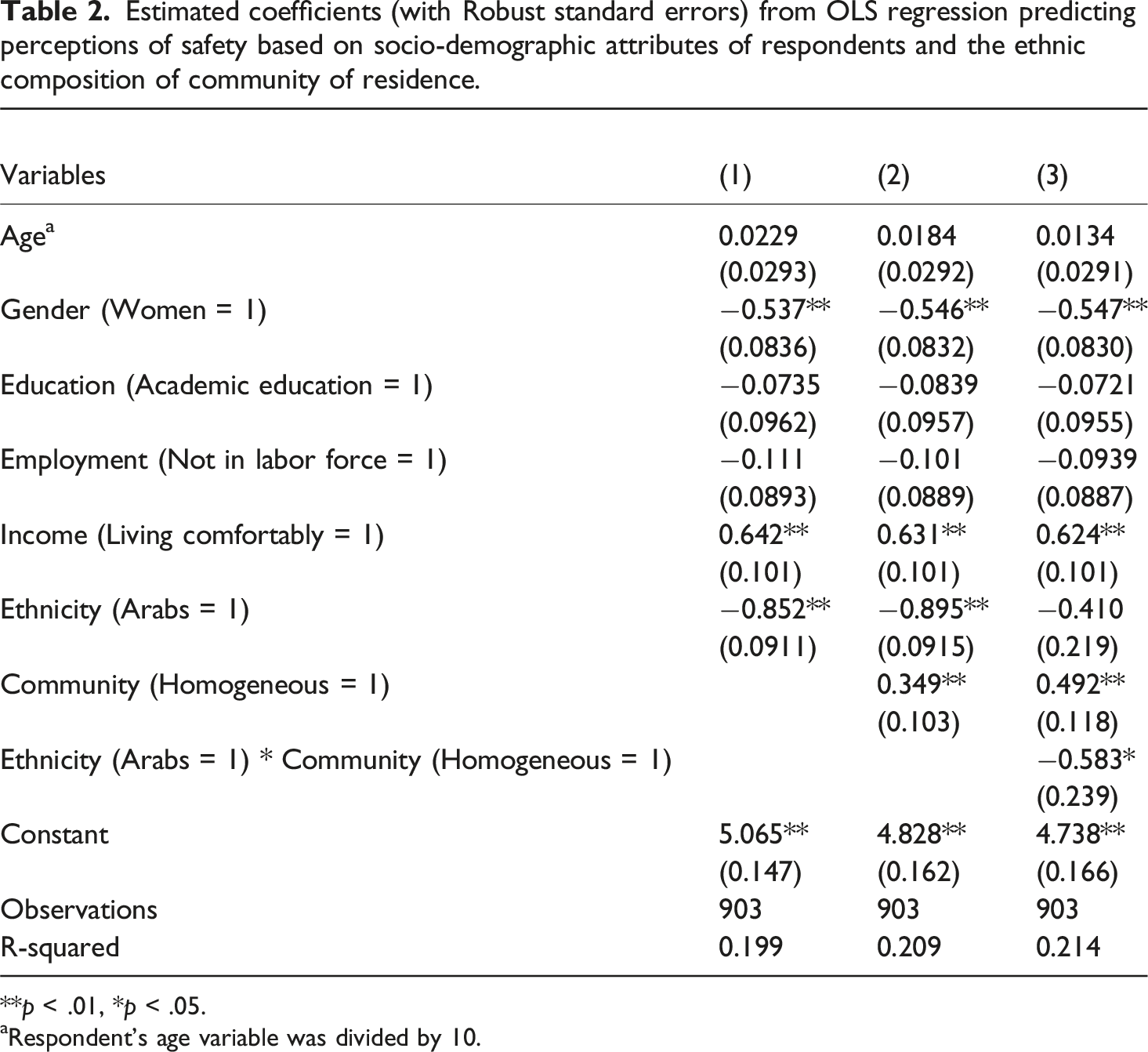
Estimated coefficients (with Robust standard errors) from OLS regression predicting perceptions of safety based on socio-demographic attributes of respondents and the ethnic composition of community of residence.
**p < .01, *p < .05.
aRespondent’s age variable was divided by 10.
The findings presented in Table 2 reveal that, other things being equal, both ethnicity and ethnic composition of community exert significant impact on personal sense of safety. First, the negative and statistically significant coefficients of ethnicity (b = - .852 and b = - .895) in equations (1) and (2), respectively, imply that sense of safety is less pronounced among Arabs (the minority population) than among Jews (the majority group population). That is; after taking into consideration differences in socio-demographic attributes and even the type (ethnic composition) of locality, Arabs do not feel as safe as Jews. In equation (3), like equations (1) and (2), the coefficient of ethnicity is also negative (b = −0.410) and on the verge of statistical significance (p = 0.06). Second, the statistically significant and positive coefficient for type of locality (homogeneous vs mixed) in equation (2) (b = .349) lends support to the argument that sense of personal safety is considerably higher in ethnically homogeneous communities than in the mixed localities, regardless of the ethnicity of respondents. More specifically, after controlling for variations in socio-demographic attributes and ethnicity, residents of the ethnically homogeneous localities express a higher level of sense of safety than the residents of mixed communities. Third, the negative and statistically significant interaction term between type of locality and ethnicity in equation (3) (b = −.583) suggests that higher level of sense of safety in the homogeneous localities is pronounced among Jewish respondents (b = .492) but not among Arab respondents.
Indeed, the findings displayed in Table 2 lend firm support to the hypothesis that being a member of a disadvantaged ethnic minority is associated with lower levels of personal safety but only partial support to the hypothesis that residence in ethnically homogeneous communities increases feelings of safety. The findings lead to the conclusion that residence in ethnically homogeneous communities is associated with a higher sense of safety (than in the mixed localities) only among the majority population but not among members of the minority population. The findings also reveal, consistent with previous studies, that sense of safety is less evident among women and more pronounced among those comfortable with their income 12 .
Estimating Bi-Level hierarchical regression equations
The results of the regression analysis presented in the previous section support the argument that both ethnicity and ethnic composition of the community are consequential for the way that residents feel about their personal safety. Nevertheless, it is still possible that a sense of safety is associated, not only with ethnicity and ethnic composition of the locality but also with attributes of the community, especially with the socioeconomic status of community, its size and its rate of crime. Therefore, it is important to consider the role played by community attributes when estimating the net impact of ethnicity and ethnic composition of community on personal sense of safety.
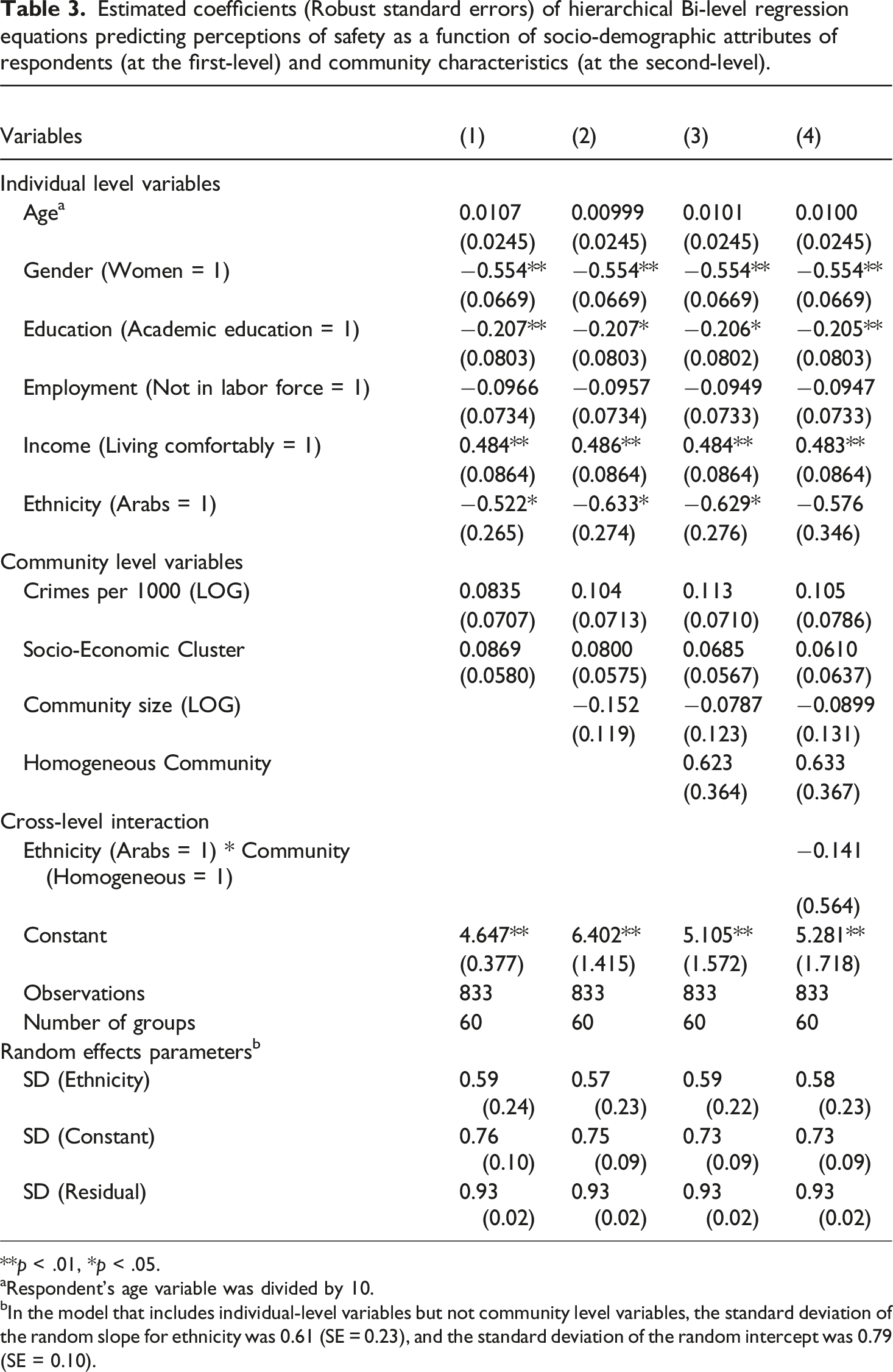
Estimated coefficients (Robust standard errors) of hierarchical Bi-level regression equations predicting perceptions of safety as a function of socio-demographic attributes of respondents (at the first-level) and community characteristics (at the second-level).
**p < .01, *p < .05.
aRespondent’s age variable was divided by 10.
bIn the model that includes individual-level variables but not community level variables, the standard deviation of the random slope for ethnicity was 0.61 (SE = 0.23), and the standard deviation of the random intercept was 0.79 (SE = 0.10).
The results of the bi-level regression analysis re-affirm the observation (previously displayed in Table 2) that other things being equal, the level of safety among members of the minority group population (i.e. Arabs) is lower than that of the majority population, as is evident by the negative, sizebale and statistically significant coefficients for ethnicity in all equations (two-tailed tests in equation 1-3 and one-tailed test in equation 4). The coefficient for type of community in equations (3) and (4) (b = .623; b = .633) are in the expected direction and substantial in size, yet on the threshold of statistical significance (p = .084) 13 . That is, when variations across communities in crime rate and in size are considered, the estimated higher level of personal safety in homogeneous communities (compared to mixed communities) becomes less certain. Furthermore, the statistically insignificant coefficients for ethnicity and for community type as well as the statistically insignificant coefficient for the interaction between the two variables in equation (4) suggest that due to shared co-variance and small number of cases (both at the individual and community levels) caution should be considered in the interpretation of the findings.
Apparently, the high levels of spatial segregation between Jews and Arabs (resulting in shared covariance between ethnicity and locality) coupled with differences in the attributes of the communities where Arabs and Jews live, become a major source for the differences in feelings of safety between Jews and Arabs. Indeed, perceptions about personal safety are influenced, first and foremost, by ethnicity, being higher among Jews than among Arabs in all types of communities and being especially high among the Jewish residents of the (Jewish) homogeneous communities. Notwithstanding the association between the sense of personal safety and ethnicity and the ethnic composition of community of residence, it is important to also note that neither the size of the community nor the rate of violent crime significantly affects the residents’ sense of personal safety 14 .
Discussion and conclusions
We embarked on this study to examine the extent to which ethnicity and residential segregation differentially affect perceptions about personal safety among members of the majority (Jews) and the minority (Arabs) population in an ethnically divided society (Israel). The data analysis lends support to the first hypothesis leading to the conclusion that perceptions about personal safety are associated, first and foremost, with ethnicity. More specifically, the data reveal that members of the majority population, Jews, feel safer than members of the minority population, Arabs, regardless the place of residence. Consistent with expectations, perceptions about personal safety are also associated with the ethnic composition of the community of residence. However, the ethnic composition of community of residence is consequential for feelings about safety only among Jews but not among Arabs. More specifically, the data reveal that residence in ethnically homogeneous communities increases positive perceptions about personal safety only among Jews. Consequently, Jews living in ethnically homogeneous places feel much safer than either Arabs (regardless of where they reside) or Jews living in ethnically mixed communities. Indeed, even after taking into consideration cross community differences in size, socioeconomic standing and in crime rate, the Jewish residents of the Jewish localities are characterized by the highest level of personal safety.
One explanation for the higher levels of a sense of personal safety among the Jewish residents of ethnically homogeneous places is derived from the nature of inter-ethnic conflictual relations in ethnically divided communities. As previous studies in Europe (see, e.g., Glass et al., 2019; Hooghe and De Vroome, 2016; Visser et al., 2013) suggested, an increase in ethnic diversity is likely to reduce neighborhood cohesion. This disruption, in turn, is likely to increase ethnic tensions and conflictual relations between minority and majority populations, hence, to decrease the sense of personal safety. By way of contrast, ethnic homogeneity is likely to increase trust and cohesion in the community, leading to a rise in the sense of personal safety among members of the majority population. We suspect, therefore, that one of the reasons majority populations (perhaps also members of the minority population) view homogeneous communities as their preferred place of residence (e.g. Clark, 1992; Gorbunova et al., 2015; Semyonov et al., 2007) is based not only on community ethnic stereotyping but also on feelings of trust and cohesion and sense of belonging.
Beyond trust and cohesion theories, perceptions of safety can also be understood through intergroup threat and symbolic boundaries. Intergroup threat theory (Stephan and Stephan, 2013) distinguishes between realistic threats, such as concerns about crime, security, or economic resources, and symbolic threats to values, identity, and cultural norms. In parallel, research on symbolic boundaries (Lamont and Molnár, 2002) emphasizes the cultural distinctions that groups draw between “us” and “them,” shaping who is seen as trustworthy or dangerous. These perspectives suggest that residents may feel unsafe not only because of actual crime but also because the presence of out-group members crosses entrenched symbolic or political boundaries. In the Israeli case, where Jewish–Arab relations are deeply entangled with national conflict and structural inequality, with both realistic threats (rising violence in Arab communities) and symbolic boundaries (ethnic otherness) playing a central role in shaping subjective feelings of safety.
The lower (and similar) levels of personal safety among members of the minority population (Arabs) both in the mixed and the homogeneous communities can be attributed to the nature of residential segregation in Israel. Jews and Arabs hardly share residential space whether across the ethnically homogeneous communities or across Arab neighborhoods within the mixed cities and towns. Therefore, and due to ethnic subordination, members of the minority population are likely to feel similarly threatened and less safe, regardless of the type of community. In addition, it is possible and in line with the last hypothesis that due to the recent rise in crime and violence in the Arab communities (Abu-Nimer, 2025; Ali and Rosenberg, 2023), the ‘protective effect’ of the Arab homogeneous communities on residents’ perceptions of safety, as compared to mixed communities, is offset and lowered, leading thus to similar perceptions of personal safety among Arabs in the homogeneous and mixed localities.
The findings presented here contribute to the theoretical debates about the protective role of ethnic homogeneity. Whereas researchers in other contexts have suggested that living in homogeneous communities may enhance feelings of safety through trust and cohesion regardless of ethnicity, the results presented here show that the protective mechanisms of homogeneous localities do not operate for Arabs in Israel. This underscores the importance of considering how structural subordination and rising violence within minority localities can offset the expected benefits of social cohesion. In doing so, the paper highlights the contingent and context-specific nature of the relationship between residential segregation and subjective safety.
It is important to recognize that the outbreak of the Gaza war following the October 7, 2023, attack, has dramatically altered the context in which perceptions of safety are formed in Israel. While our data were collected in 2020, before these events, the war has intensified feelings of insecurity among both Jews and Arabs. For Jews, the large-scale attack and its aftermath reinforced existential fears and concerns about security even in everyday life. For Arabs, the war has added layers of vulnerability, not only because of increased exposure to violence but also due to rising political tensions, stigmatization, and mistrust. These developments suggest that the patterns documented in our study may have deepened in the post-2023 context, as current perceptions of personal safety are also shaped by the national trauma of war. Future research is needed to assess the ways that these recent events have reshaped feelings about safety and intergroup relations in Israel.
Limitations and future studies
The study presented here focuses on the impact of ethnicity and the ethnic composition of community on sense of safety among Jews and Arabs in Israeli society. Despite its apparent contribution to knowledge in the field of ethnicity and ethnic relations in general as well as to the study of ethnic relations in Israeli society, we should recognize several of its limitations. First, Arabs and Jews in Israel live in much more spatially segregated communities than majority and minority ethnic groups in most other parts of the world. This is so because inter-ethnic relations between Arab and Jews in Israel are influenced by the ongoing conflict between Jews and Arabs in the region. Therefore, some caution should be exercised when generalizing the results presented here to other societies. Yet, we do believe that the findings presented by this study have general theoretical and empirical implications that extend beyond the borders and the context of Israeli society. We hope that future studies on the issue will be conducted in other societies to further examine the general nature of the arguments regarding the impact of ethnicity and ethnic composition of community on sense of safety within a cross-national comparative perspective.
Second, we utilized a single measured item to capture residents’ feelings about personal safety. Although such a measure was commonly used in previous studies, we believe that the use of multiple indicators regarding sense of safety might better capture feelings about personal safety than a single measured indicator. Multiple indicators might also capture a wider concept that pertains to fears of criminal victimization in society at large. Third, the study presented here relies on quantitative statistical analysis of a random population sample. In the future, such an approach can benefit from supplementing it with in-depth interviews and qualitative analysis of data regarding fear of criminal victimization and sense of safety. Analysis of qualitative data can shed light on the sources and complexity of feelings about fears of criminal victimization and safety in community of residence and beyond.
In sum, future studies should further examine the relationships between ethnicity, ethnic composition of community, and residents’ sense of safety through both quantitative and qualitative approaches. We contend that cross-national and comparative research, complemented by in-depth qualitative analyses, may deepen understanding of how ethnic spatial segregation and integration influence inter-ethnic relations and quality of life in everyday contexts.
Footnotes

Ethical considerations
Faculty ethics committee approval (Haifa University, Israel) for research “Understanding Attitudes towards Immigrants: from respondents’ characteristics to immigrants’ attributes”. Approval number 372/19. Informed consent was included in the questionnaires and provided orally by the interviewer.
Funding
The authors disclosed receipt of the following financial support for the research, authorship, and/or publication of this article: Work on this research was supported in part by an ISF grant (ISF 769-2018) awarded by the Israel Science Foundation.
Declaration of conflicting interests
The authors declared no potential conflicts of interest with respect to the research, authorship, and/or publication of this article.
Data Availability Statement
Data set is available from the authors upon request.
Notes
Appendix
Estimated Coefficients (with Robust Standard Errors) from OLS Regression Predicting Perceptions of Safety Based on Socio-Demographic Attributes of Respondents and the Ethnic Composition of Community of Residence, excluding Jews residing in Jerusalem. **p < .01, *p < .05. aRespondent’s age variable was divided by 10.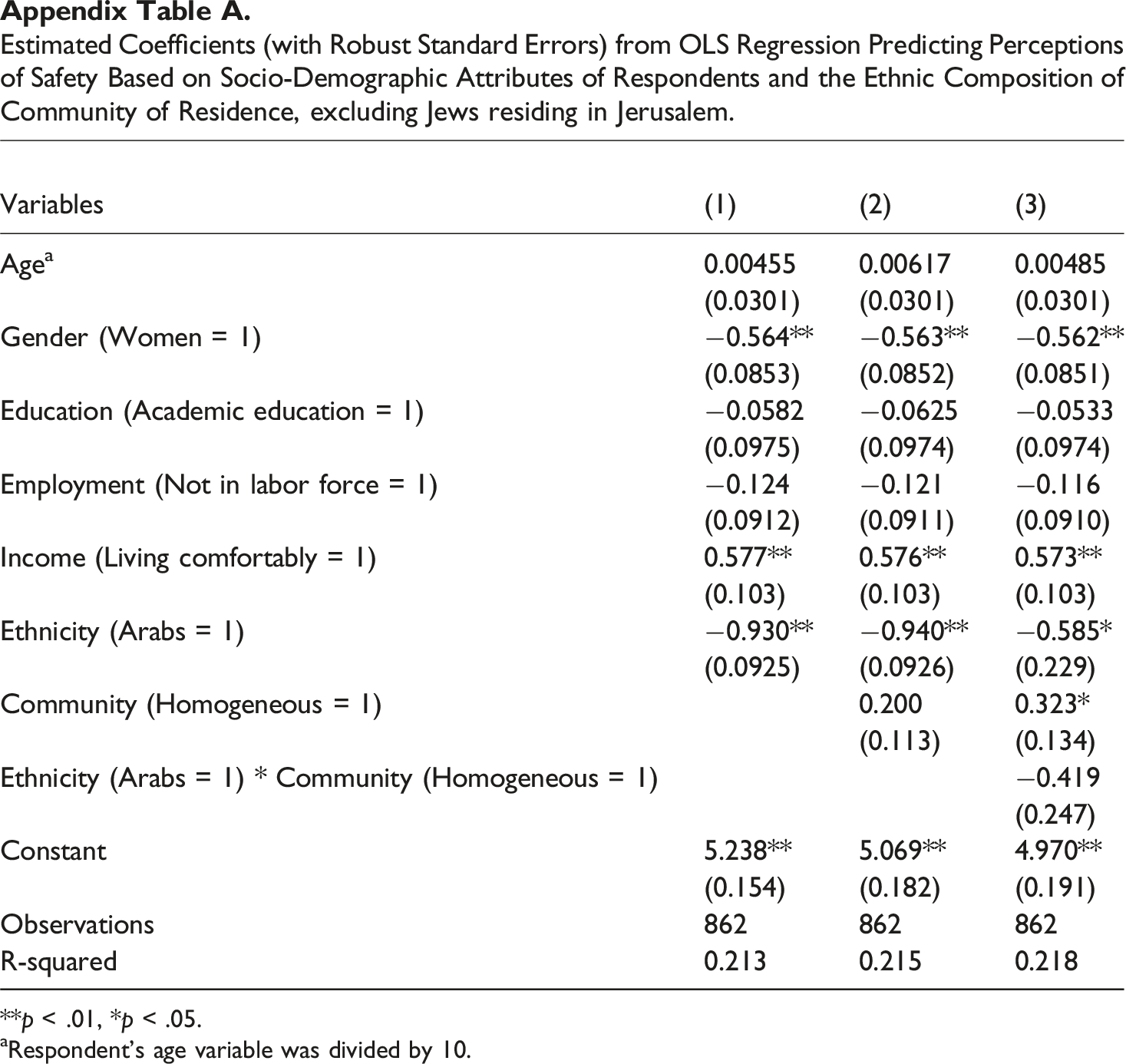
(1)
(2)
(3)
Variables
Age
a
0.00455
0.00617
0.00485
(0.0301)
(0.0301)
(0.0301)
Gender (Women = 1)
−0.564**
−0.563**
−0.562**
(0.0853)
(0.0852)
(0.0851)
Education (Academic education = 1)
−0.0582
−0.0625
−0.0533
(0.0975)
(0.0974)
(0.0974)
Employment (Not in labor force = 1)
−0.124
−0.121
−0.116
(0.0912)
(0.0911)
(0.0910)
Income (Living comfortably = 1)
0.577**
0.576**
0.573**
(0.103)
(0.103)
(0.103)
Ethnicity (Arabs = 1)
−0.930**
−0.940**
−0.585*
(0.0925)
(0.0926)
(0.229)
Community (Homogeneous = 1)
0.200
0.323*
(0.113)
(0.134)
Ethnicity (Arabs = 1) * Community (Homogeneous = 1)
−0.419
(0.247)
Constant
5.238**
5.069**
4.970**
(0.154)
(0.182)
(0.191)
Observations
862
862
862
R-squared
0.213
0.215
0.218
Estimated Coefficients (Robust Standard Errors) of Hierarchical Bi-level Regression Equations Predicting Perceptions of Safety as a Function of Socio-demographic Attributes of Respondents (at the First-Level) and Community Characteristics (at the Second-Level), excluding Jews residing in Jerusalem. **p < .01, *p < .05. aRespondent’s age variable was divided by 10. bIn the model that includes individual-level variables but not community level variables, the standard deviation of the random slope for ethnicity was 0.61 (SE = 0.23), and the standard deviation of the random intercept was 0.79 (SE = 0.10).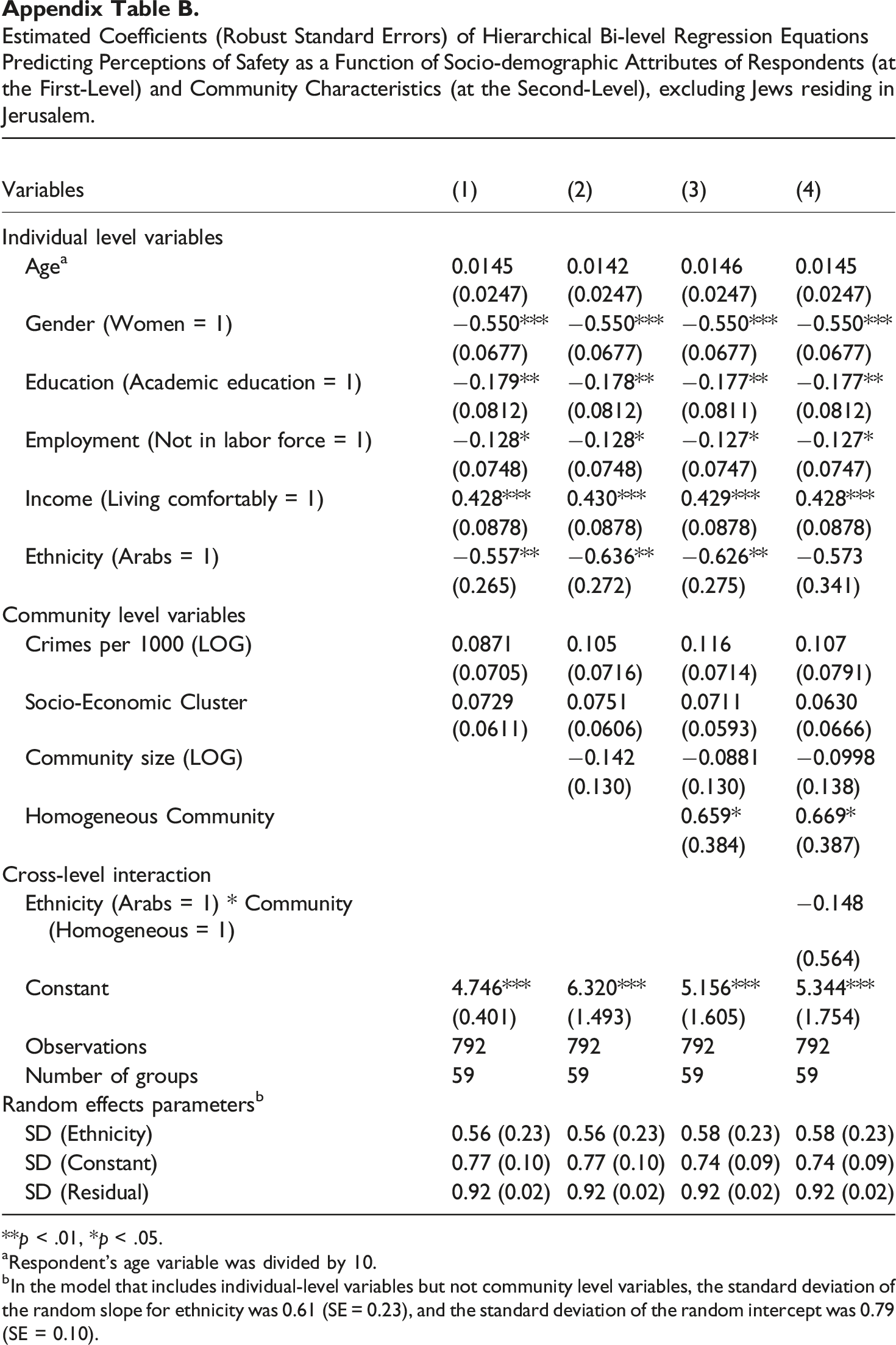
(1)
(2)
(3)
(4)
Variables
Individual level variables
Age
a
0.0145
0.0142
0.0146
0.0145
(0.0247)
(0.0247)
(0.0247)
(0.0247)
Gender (Women = 1)
−0.550***
−0.550***
−0.550***
−0.550***
(0.0677)
(0.0677)
(0.0677)
(0.0677)
Education (Academic education = 1)
−0.179**
−0.178**
−0.177**
−0.177**
(0.0812)
(0.0812)
(0.0811)
(0.0812)
Employment (Not in labor force = 1)
−0.128*
−0.128*
−0.127*
−0.127*
(0.0748)
(0.0748)
(0.0747)
(0.0747)
Income (Living comfortably = 1)
0.428***
0.430***
0.429***
0.428***
(0.0878)
(0.0878)
(0.0878)
(0.0878)
Ethnicity (Arabs = 1)
−0.557**
−0.636**
−0.626**
−0.573
(0.265)
(0.272)
(0.275)
(0.341)
Community level variables
Crimes per 1000 (LOG)
0.0871
0.105
0.116
0.107
(0.0705)
(0.0716)
(0.0714)
(0.0791)
Socio-Economic Cluster
0.0729
0.0751
0.0711
0.0630
(0.0611)
(0.0606)
(0.0593)
(0.0666)
Community size (LOG)
−0.142
−0.0881
−0.0998
(0.130)
(0.130)
(0.138)
Homogeneous Community
0.659*
0.669*
(0.384)
(0.387)
Cross-level interaction
Ethnicity (Arabs = 1) * Community (Homogeneous = 1)
−0.148
(0.564)
Constant
4.746***
6.320***
5.156***
5.344***
(0.401)
(1.493)
(1.605)
(1.754)
Observations
792
792
792
792
Number of groups
59
59
59
59
Random effects parameters
b
SD (Ethnicity)
0.56 (0.23)
0.56 (0.23)
0.58 (0.23)
0.58 (0.23)
SD (Constant)
0.77 (0.10)
0.77 (0.10)
0.74 (0.09)
0.74 (0.09)
SD (Residual)
0.92 (0.02)
0.92 (0.02)
0.92 (0.02)
0.92 (0.02)