



Abstract
During the Spanish Civil War (1936-1939), General Franco recruited approximately 80,000 Moroccan Muslim soldiers to support his cause. Part of the strategy to uphold the soldiers’ morale and the image of a “joint crusade against the godless” involved incorporating Islam into the Spanish context. Services such as Muslim hospitals and cemeteries were organised, representing the largest presence of Islam in the public sphere since medieval times. Nevertheless, in the aftermath of the war and following Morocco’s independence from Spain, most of these spaces have either been forgotten, destroyed, or subjected to prolonged contestation. This article explores the evolution of these sites and the diminishing burial options for Muslims through Spain’s dictatorship and transition to democracy, explicitly illuminating how its purportedly multicultural facade has eroded. This relates to the notion of the Moor in the Spanish national imagination and how, over centuries, this imagined other has continued to serve as a scapegoat for social and political ills. As such, this article also links the contact of spatial contestations over multicultural emerging movements aimed at normalising burial practices for Muslims in Spain. Thus, allowing Spanish Muslims to live their dual identity through acts of citizenship such as being buried in their places of residence.
Introduction
Moros y Cristianos, while still a festivity celebrated in different parts of Spain, signifies the names of two important groups present in the country’s history: Muslims and Catholics. Despite its homogenous Catholic imaginary, Spain has a long-standing history of religious diversity, particularly with Islam and Judaism in the territory from before it became a nation until today (González Ferrín, 2017; Pérez, 2005). While many focus on the romanticised period of “Convivencia” during the Middle Ages, suggesting that Muslim and Jewish life is essentially a relic of the past, there is also a contemporary history and reality of both Muslims and Jews in Spain. Despite a sudden revival of “Hermandad” (brotherhood) towards Sephardic Jews during the years leading towards the Civil War (1936-1939) with the philosephardism 1 movement (Pérez, 2005) and in recent years with the laws of nationality favouring those descendants of Sephardic Jews to obtain their rightful Spanish nationality 2 , there has only been one significant similar narrative towards Muslims as friends and brothers in combat, and that is during the month leading up to the Civil War and until the independence of Morocco from Spain (Casas-Cortés and Cobarrubias Baglietto, 2023).
The military strategy of Franco during that month focused on the narrative of Catholics and Muslims working together against those who did not believe in God (Balfour Sebastian, 2018; Bornstein, 2020; El Merroun, 2003). As it has been very well documented, one of the cleavages that led to the Spanish Civil War was that between religion and secularism (Preston, 2006). Although it was not the primary driver, those in the nationalist band made use of that cleavage to justify the inclusion of Muslim Moroccan troops in their battalions. This sudden burst of cooperation was part of a crucial military strategy by the nationalist side that eventually helped them to win the war and take over the peninsula (Preston, 1993, 2006). The national memory of the Civil War in Spain is complicated, as Spanish society has struggled over the years to document it in a manner that includes both band’s perspectives (Iturriaga, 2019; Madariaga, 2015; Preston, 2006). The commonplace narrative is one of perpetrators against victims and, in most cases, portrays Franco and his Moroccan soldiers as perpetrators (Madariaga, 2015).
Since Spain transitioned to democracy between 1975 and 1978, there have been plenty of initiatives to create a national collective memory of the war, particularly for the remembrance of the victims. However, this view fails to acknowledge the complexity of the actors involved in the war. While Moroccan soldiers cannot be acquitted of all their actions, it is crucial to understand the context that led to their participation in the war. It is here that one can see an economically crushed Morocco. As households struggled to survive, Franco’s army offered advanced payment and promised that soldiers would return with enough means to maintain a family over time. When they enlisted, volunteered soldiers would receive two months of payment in advance, four kilos of sugar, a can of oil and daily bread according to the number of children each family had (Madariaga, 1992). Once enlisted, they received proper clothing, food, and a salary. Once the recruitment began to slow down, there were documented instances of forced enlisting through diverse methods by Franco’s army to ensure the constant inflow of Moroccan soldiers into the Peninsula (Madariaga, 2015).
Furthermore, most of those recruited were illiterate; thus, El Merroun (2003) recorded that when they signed contracts, some soldiers were told they would participate in a parade in Seville rather than go to war. Although the literature is mixed on whether the recruitment was voluntary or forced, one can, at the very least, ascertain that many who enlisted did it out of economic necessity (El Merroun, 2003). Finally, as can be seen in Becker, Suárez Collado and Arana Barbier’s article (Becker et al., 2025), in many cases, the young Moroccan soldiers did not want to go out to battle, yet they were forced by their commanders to jump in, knowing they were about to get killed. Thus, while fighting for Franco, Moroccan soldiers fall under a grey area of actor and victimhood.
As noted above, religiosity played a role in the participation of Moroccan soldiers; therefore, once the soldiers began to arrive on the Peninsula, the management model used for Islam in the Protectorate was exported to the Peninsula (Hernando De Larramendi and González Gonzáles, 2018). This translated into a policy of respect towards Moroccan Muslim religious beliefs; this policy was instated in the Protectorate as a way to avoid religion becoming an argument for locals contesting the legitimacy of the protectorate (Hernando De Larramendi and González Gonzáles, 2018). As such, their system of “friendship” and respect towards Islam travelled to the Peninsula in the form of religious personnel, with the creation of Muslim hospitals, cemeteries, and coffee houses, in which Muslim Moroccan soldiers’ needs could be tended according to their religion (Al Tuma, 2018; El Merroun, 2003; Madariaga, 2015).
This article focuses on these cemeteries, what happened to them after the war, and how they can serve as a starting point to analyse the connection of national imaginaries to the politics of death. After the war, Spain’s national imaginary became highly intertwined with Catholicism, as this religion became the only one allowed to be practised in public and protected by the state (Di Febo and Juliá, 2018). Eventually, together with a later increase in Muslim converts (Del Olmo Pintado, 2004) and an immigration wave (from the 1990s onward) (Planet and Madonia, 2018), the national discourse would problematise Muslim belonging and the belonging of Islam (Bravo López, 2006), attempting to relegate them to the past rather than placing Muslims as contemporary actors in Spain. In doing so, Spain, like many European nation-states, casts Islam as external to–if not threatening the integrity of–the contemporary Spanish nation (Lems and Planet Contreras, 2023; Zapata-Barrero, 2006, 2010). Anderson (2008) theorised nations as “imagined communities”, arguing that nationhood is constructed through a shared imagination. In the Spanish case, this construction of nationhood entailed the explicit collapsing of the historical figure of the Moor and contemporary Muslims (Madariaga, 1988; Zapata-Barrero, 2010). Yet, imaginings of the nation lead to material representations and absences. In this paper, through the case of cemeteries in Spain, I interrogate how and why such imaginings of nationhood can be linked to practices of politics of death, which exposes the forced absence/forgetting of 20th-century Muslim life in Spain.
While the question of the death and burial of people belonging to a minority religion might not be new, this article aims to examine the powerful relationship between the politics of death and identity and later focus on how the politics of death can be influenced by identity and national imaginary. As of 2023, Spain has a population of 2.4 million Muslims, of which at least 1 million are Spanish nationals (Observatorio Andalusí, 2023). The idea of a final resting place can no longer be taken for granted for Muslims in Spain, who sometimes question whether it should be better to be buried somewhere else than their country of residence and citizenship (Lems and Planet Contreras, 2023; Moreras and Solé Arraràs, 2019). As Balkan (2015) explored in the case of Turkish Muslims in Berlin, one of the most important factors influencing the decision to repatriate is a sense of belonging and community. Such feelings can be challenging when the national discourse refers to one’s religion as an outsider, but also when there are material difficulties in finding burial places (Lems, 2021; Lems and Planet Contreras, 2023; Salguero Montaño and Siguero Lizano, 2021).
This article showcases a peculiar case through the lenses of Multiculturalism, as the usual trend in contemporary Europe is to experience a rise in diversity and then apply action to assert a sense of belonging to all citizens (Ansari, 2007; Modood, 2010, 2018). The case of the Spanish Politics of Death showcases a pseudo-multicultural model that was abandoned, but it is being reinvoked by some (Muslim) communities in Spain, and as such, adding to the importance of context-specificity brought forward by the British School of Multiculturalism (Uberoi and Modood, 2019). Therefore, this article first tries to emphasise the cemetery’s importance in constructing a national imaginary and its influence over the feeling of belonging of minority religious citizens. It then connects this to the complexity of the politics of death and the different actors that can influence it, mainly by providing an analytical lens through which the politics of death can be better explored in diverse contexts. More specifically, it looks at the construction and enablement of cemeteries and burial sites for Muslims during the Spanish Civil War as part of Francisco Franco’s attempt to include Moroccan soldiers in his army. Later, it examines the current standing of burial places for Muslims in Spain and showcases the main routes they followed when the war ended and later during the transition to democracy. Finally, it describes how these actors are highly interrelated and influence each other in the current struggle to create a more inclusive national imaginary through a multicultural memory.
The role of cemeteries in the national imaginary
From sources of architectural analysis of style and stylistic changes to geographical analysis of patterns in land usage, cemeteries have long been of interest to scholars of various disciplines (Francaviglia, 1971). However, from an interdisciplinary perspective, cemeteries can be seen as microcosmos that might represent the societies they were built to serve (Francaviglia, 1971). These microcosmos are places where life and death meet, as they serve for corpse disposal and for the living to feel connected to their loved ones after death (Warner, 1959).
Cemeteries can also be understood as places of shared memory, see Becker, Suárez Collado and Arana Barbier in the case of Asturias (Becker et al., 2025), since they transform the dead into living time and an ordered space, which symbolically help to maintain their identities and ensure their continued social existence (Francis, 2003). This memory needs to be understood as a cultural deposit, which assumes a previous consensus on what needs to be preserved and what is not (Fischer, 2021). This memorialisation should also be seen from a political and nationalistic lens, with military cemeteries being the most prominent examples (Natali, 2008). From a nationalistic perspective, every citizen should be ready, if not to die, to kill in the name of the nation (Uzelac, 2019). Thus, the concentration of all dead soldiers in one place focuses on the idea of sacrifice for the country, converting those public places into spaces of worship for the service given to the nation (Mosse, 1990). In a sense, despite our cultural traditions of placing the dead in another world, these nationalistic memorialisations immortalise the dead (Grant, 2004). Using the dead as national symbols can cause one to wonder to whom they belong. While it may not be obvious, it is a political question that involves conflicts and confrontations, which inevitably relate to questions of ownership over and inclusion in history (McEvoy and Conway, 2004; Uzelac, 2019).
Cemeteries thus represent spaces of inhabited memory (Rodríguez Barberán, 2005). Still, they can also become sites of a memory of constant transformation, through which we trace the histories of diverse populations and their social and cultural aspects (Tarrés and Moreras, 2012). This shared identity and memory can be tampered with through different mechanisms, like showcasing some stories over others to unite or divide. An excellent example of using cemeteries to construct a shared national identity is the case of Sri Lanka, as elucidated by Natali (2008). Although predominantly Hindu and thus not in need of burial sites 3 , Sri Lanka had a transition in funerary practices that started to involve the usage of cemeteries for burials and as places of historical remembrance (Natali, 2008). These can be seen as symbols of national history, similar to those in Western nations. Still, at the same time, they project the new national values of non-difference between people, symbolically carried out by performing the same funerary rituals and building equal tombs for everyone (Natali, 2008).
The case of Spain similarly showcases the importance of cemeteries for a shared national identity. Military memorials and cemeteries of those who fought for the nation are sites of cultural heritage and tend to be taken care of by the state, non-profit organisations or families. The most well-known of these cemeteries is the Valley of the Fallen (Valle de los Caídos), which has, in recent years, experienced a re-branding by the government to stop the glorification of Franco’s regime. The structure was built between 1940 and 1958, predominately by the forced labour of political prisoners of the Franco regime to physically immortalise Franco’s ideology (Solé Barjau and López Soler, 2019). The structure showcases a very evident Catholic conviction, thus connecting nation and religion (Méndez, 1959; Solé Barjau and López Soler, 2019). In it, they initially buried Francisco Primo de Rivera (founder of the Falange in Spain) and the soldiers who died fighting in what is referred to as the Glorified Crusade (the Spanish Civil War). Although it was meant for soldiers of the nationalistic band, they also buried corpses from the republican side without the permission of their families (Martín, 2012). The total number of burials is estimated at 33,833 corpses 4 . After his death, Franco was also buried in the valley.
However, due to the passage of Spain’s law on Historical Memory in 2019, Franco’s body was exhumed and transferred to another cemetery as a way not to glorify the dictatorship 5 . Moreover, Primo de Rivera’s body was also exhumed in 2023 6 . Furthermore, the valley was renamed the Valley of Cuelgamuros (Valle de Cuelgamuros). The valley is one of Spain’s most visited places of cultural memory, and the number of visitors rose significantly in 2019 as people wished to say farewell to Franco before he was moved elsewhere. As such, this cemetery shows a deep connection between the dead and the national imagination, what, for some, it means to be Spanish; this conception continues to be contested in contemporary times.
Cemeteries can also carry historical repression on their walls, as in the case of Spanish cemeteries. During the Spanish Civil War (1936-1939), cemeteries, particularly their walls, were utilised not only for burials but also for the mass killing of people (Hernandez Burgos and Del Arco Blanco, 2011). All over the Spanish territory, one can gather stories of those whose family members were shot against their local cemetery walls. The reasoning behind the choice in place is unclear. Still, logistically, it allowed to immediately bury those killed, usually in mass graves right underneath their place of death, dehumanising subjects that opposed the sovereign regime. However, after the war, walls served as a place of historical memory, as in the cemetery of Granada, where a commemorative wall was placed next to the cemetery walls, naming everyone who had been killed in front of that wall.
Finally, national historical monuments and memorials can also be powerful agents of erasure or forgetting, as some histories are privileged over others (Sumartojo, 2015). In the case of Spain, the idea of a “collective us” never included minorities, and eventually, discussing funerary patrimony became an exclusive “us” and not “them” or “the other” (Tarrés and Moreras, 2012). Notwithstanding, in recent years, the idea of a minority religion’s cultural patrimony is starting to become a more common claim in contemporary Spain, as these groups are reclaiming their spaces and showcasing their histories (Salguero, 2023).
However, all these have one factor in common: the physicality of death and its strong connection to the construction of national imagination, shared memory and ideals of cultural belongingness. Cemeteries can showcase a diverse cultural heritage, especially when including minority burial sites. Yet, this becomes an even more complex notion when including the myriad actors involved in the management of dead bodies in societies, and those interactions and negotiations, as will be showcased in the next section, can be considered the politics of death.
The politics of death
The politics of death is a diverse concept that includes a myriad of areas, mainly focusing on the disposal of a corpse. Dead bodies can be seen as a powerful political symbol that can carry diverse meanings for different actors that may make claims over them, such as states, families, and religious communities, among others (Balkan, 2023). Although once living beings, corpses are no longer people, nor are they objects; this crucial dichotomy helps one understand why it is part of our rituals to take care of corpses and why any mistreatment generates feelings of pain in those living (Balkan, 2023). An example of an explicit act of violent exclusion is the inability to bury the deceased in their country of residence or citizenship, mainly if such limitations only apply to a specific minority group (Balkan and Masarwa, 2022). That is, while dead bodies are sensorially unfeeling, they are not exempt from acts of state violence. This issue involves several actors and can be focused from diverse perspectives.
I am not the first to analyse the ‘after-death landscapes’ of Muslims in modern Europe; this issue has been extensively studied through diverse perspectives as it is a central area of concern for Muslims in Western Europe (Maussen, 2007). In the Spanish case, the problematisation of Muslim burials has been one of the most often articulated demands made by communities to their public institutions across the different autonomous communities over the last thirty years (Lems, 2021), or as I will observe in this paper, since the transition to democracy and freedom of religion in 1975.
One of the foci of these demands is on public rights held by citizens; as such, this perspective uses a civil law perspective to problematise the lack of cemeteries or burial spaces for Muslims in Europe. They identify an axis that relates political and social action from religious and civil communities and is thus a citizenship right (Salguero, 2023; Salguero Montaño and Siguero Lizano, 2021). A different perspective uses the Muslim Question as a central factor to the problem, in the impossibility of asserting a dual identity of citizen and Muslim at the time of death. Ural (2014) relates the challenges Muslims face with the normative of laic cemeteries in France. As these cemeteries have evolved and been influenced by Catholicism and laicité, their rules and setups turn them into a space of contestation for the religious identity of European Muslims who wish to assert both of their identities at the time of death (Ural, 2014).
One crucial commonality between these perspectives is the state’s involvement as an actor. In the case of death, governments have created regulations and laws regarding the transition to death, which also includes the final destiny of corpses (Stepputat, 2014). Although there is a negotiation between states and diverse actors within them in day-to-day practices, the ultimate authority over the governance of the dead relies on often the national and local government, its legislation, jurisdiction, and institutional provisions (Stepputat, 2014). In Europe, the provision of cemeteries is predominantly managed by municipalities, with the state as the central regulatory body, delimiting the management of funerary practices and burials (Rugg, 2000).
Since within the European Convention on Human Rights, and in almost all European constitutions, there is a right to be buried according to one’s convictions (Lems and Planet Contreras, 2023), this issue falls under the governance of religion. As it can be considered a political right of citizens, its regulations can be mainly seen through social policy and tools of religious accommodation (Arana Barbier and Suárez Collado, 2023). As social policy, the issue of cemeteries and burials can be divided into macro and micro institutional responsibilities; on a national level, it involves the areas of hygiene and public order. In contrast, at the municipal level, it is primarily concerned with urban planning, safety, and soil requirements (van Den Breemer and Maussen, 2012). In general, it has been seen that countries have been trying to find diverse solutions to the matter, as intentions to be buried in the country of “arrival” are seen as an essential sign of integration (van Den Breemer and Maussen, 2012).
In the UK, for example, some argue that burial spaces can be seen as a tool for integrating and constructing Muslim identity as part of the national one (Ansari, 2007). This can be seen as an overlap between the politics of death and the Multicultural approach brought forward by the British School of Multiculturalism (Meer, 2019). While, in this case, most governments and citizens are on the same page most of the time, I will use the case of Spain to add a new perspective to the discussion. It combines two polarising ideas: a Spanish national imagination as the opposite of Islam and a group of Muslims who feel they belong to Spain and continue to fight over their place as members of the national community.
While recognition and accommodation of religion-based burial practices play a role in the politics of death in Europe, scholars explored the reality that some Muslims might not want to be buried in Europe. In the case of Muslim communities in France and Germany, Balkan and Masarwa (2022) articulate the sentiments of rejection and isolation that Muslims experience because of their religious identity, and due to their immigrant background, they had a stronger connection to a different country where they wished to be repatriated. Thus, burial regulations are not as crucial in these cases because people do not ask for a space to be buried. This view, instead, examines and sheds light on the funerary practices, exposing not only new insights into European national societies but also into the transnational links that have long existed between Europe and North Africa and the Middle East (Balkan, 2023): trans-Mediterranean relations deepened and disrupted by trade, migration and colonialism.
My contribution to the discussion on the politics of death is to operationalise the concept, showcasing its different facets and how they are crucial for better understanding minority inclusion and explaining in the specific context of modern Spain. The afterlife of corpses is highly political and social, as it is related to the politics of inclusion, memory, and space and how crucial these are in the construction and reinforcement of a national imaginary. As such, although dead, corpses can continue to be political actors, and while cemeteries are crucial for this study, the treatment of corpses and their disposal processes can also enlighten the inclusion or exclusion of minorities.
Looking at the overall literature and factors, the politics of death touches upon four crucial areas that contribute to the timeline of the political and social afterlife. First, the afterlife focuses on everything that involves the corpse and the dead after they have passed. Four crucial areas can be identified: memory, space, the internationalisation of death and the state’s management of minorities. Although corpse disposal is at the centre of the politics of death, it is clear that these areas allow for a better understanding of a possible extension on the timeline of discrimination and exclusion, as well as putting the dead at a central role in the creation of shared identities that can be manipulated over time. Therefore, using the politics of death allows for exploring these four areas in the case of Spain and a more empirical understanding of them.
Muslim cemeteries during the Spanish civil war
The first records of accommodation for burial were created during battles when corpses were separated by religion in different common graves. Such action is thought to be a reaction to soldiers’ complaints, as in the war’s early days, Muslim and Christian soldiers were buried in the same mass graves (Al Tuma, 2016). It was not until 1937 that burial plots were explicitly designated for Moroccan soldiers (Al Tuma, 2016, 2018).
As described above, the protectorate of Morocco already had an administrative system for governing Islam in the territory, and such a system was then exported to Spain to manage the religious needs of the soldiers (Hernando De Larramendi and González Gonzáles, 2018). Thus, during the war, Franco, together with the Delegation of Indigenous Affairs, exported the bureaus to the Spanish peninsula for the proper management of indigenous soldiers (Al Tuma, 2018; Madariaga, 2015). Madariaga (2015) explains the hiring of Imams, Mudarris, Munadifs and cooks. The Imams led the prayers, performed the rites, and received the soldiers’ legal wills. The Mudarris worked by reminding the soldiers of the teachings of Islam. Then, the Munadif took care of the dying soldiers, later washing and wrapping them for burial according to the Islamic rite. The hospital cafeterias were often businesses set up by Moroccans in Spain for the soldiers to eat according to their religious requirements. Within them, cooks slaughtered the animals and then cooked them according to Halal standards.
The services made sure the religious needs were met in life and death. Thus, the designation of burial plots is related to the hiring of designated personnel for the correct performance of the funeral rite per Islamic tradition, that is, burying soldiers without a coffin and positioning their bodies in the direction of Mecca. These burials used two cemetery types: predominantly municipal (civil) 7 cemeteries with designated Muslim areas and Muslim-only cemeteries. The municipal cemeteries are those belonging to the municipalities around Spain that were already built, in which plots considered ‘unholy’ or empty were designated for the burial of Muslims. Generally, these parts of already existing cemeteries were used to bury atheists and citizens who had died by suicide. In this case, space was made available for the burial of Moroccan burials according to the Islamic tradition without any distinction; an example of this can be seen in the municipal cemetery of Zaragoza 8 (one of those that has restored the use of these plots for the subsequent burial of Muslims in Spain today).
Muslim-specific cemeteries, on the other hand, can be divided into two subtypes, the first being those annexed to civil cemeteries. In these cases, the plot where the burials would occur was fenced off. Despite being an annexe to the municipal cemetery, they had their own entrances and buildings for the correct performance of Islamic burial rituals; one example of a Muslim-specific cemetery would be the Muslim cemetery in Sevilla. Then, there are cemeteries built on separate plots of land for the sole purpose of burying Muslims. In these cases, classic Islamic-style infrastructures were created, with clear distinctions and the necessary buildings for the rites; illustrative examples would be the Muslim cemetery at Barcia or the one in A Coruña. Here, not only were burial places designated, but a room was also built for washing the bodies and shrouding them.
Around 21,000 Moroccan Muslim soldiers died during the war, and I have identified 193 locations throughout Spain in which the burials took place (Figure 1) (El Merroun, 2003). For the most part, the types of burials and their locations are unknown, despite the public administrations’ (Delegación de Asuntos Indígenas) attempts to collect data from 1939-1940
9
. As seen in Figure 1, throughout the war, Muslim warriors were buried along the peninsula; however, most of them are of unknown type, and data shows no precise number
10
other than “some” burials that took place in this town. Most sites have burials ranging between 1-100, while in some cases, there are 130-300; it is interesting to note that those with the most burials are Muslim cemeteries. The cemetery with the most burials, 400, is the one in Talavera de la Reina; it is catalogued as a Muslim cemetery because even though it is within the municipal mausoleum grounds, the section is separated by a fence from the rest of the cemetery. Muslim burials in peninsular Spain during the Spanish Civil War 1936-39 places, type and number of Muslim Moroccan soldier’s burials.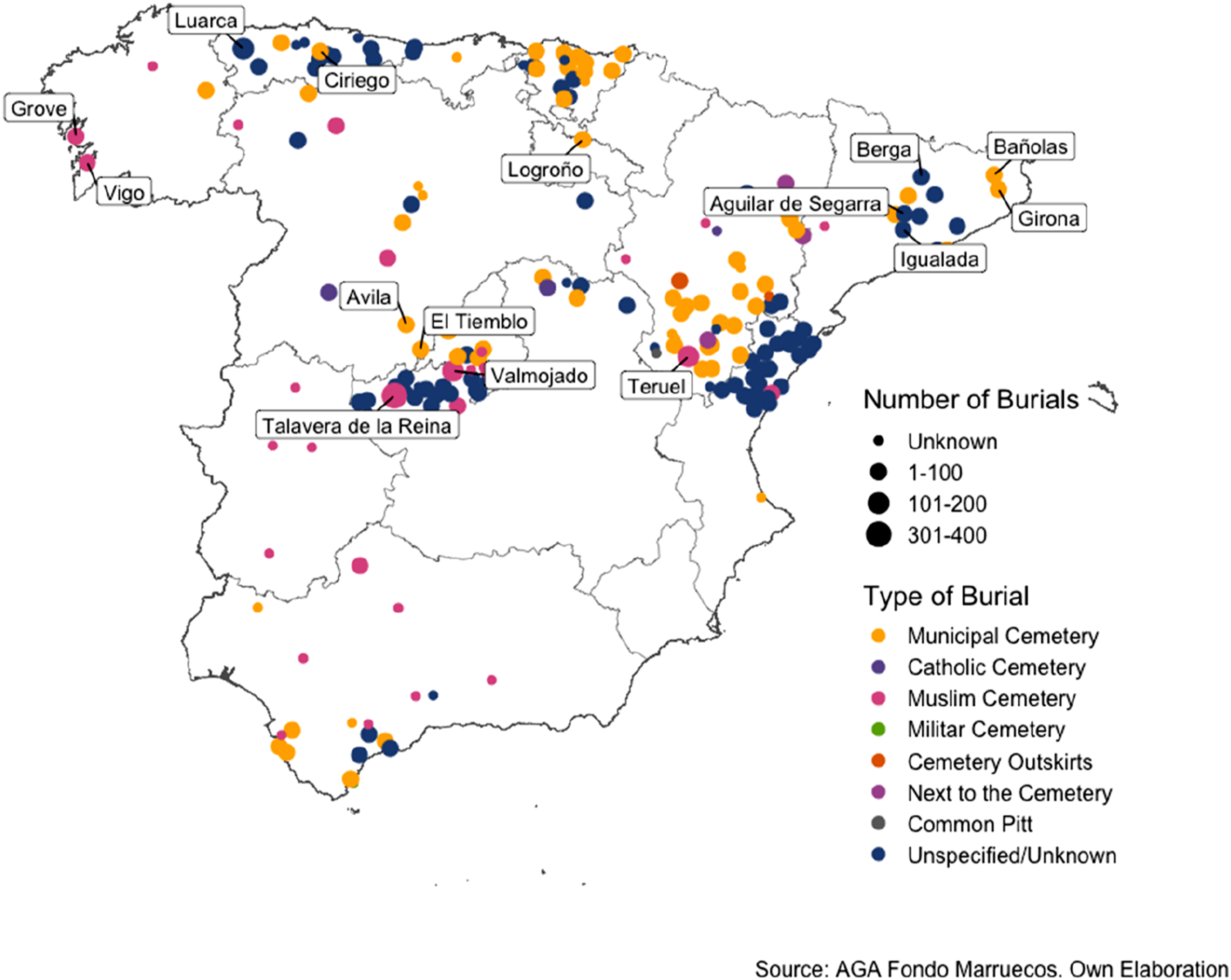
After the end of the war, however, many of these infrastructures (both hospitals and cemeteries) were dismantled or transformed into secular or Catholic spaces 11 . For example, the Muslim Hospital in Salamanca changed its name from Hospital Militar-Musulmán de la Vega to Hospital Militar de la Vega and stopped tending to Muslims in 1939 12 . Another example is the Pabellon Marroquí de Sevilla, which was dismantled in 1942 as its inventory was sent to Tetoan 13 . Many of these sites have been neglected and built over, and their histories have been hidden, with many not demarcated at all. In some cases, bodies have been removed 14 or enclosed under layers of cement to create space for other burials.
Once Franco was the country’s leader, the narrative was one of Catholic unity and national identity (Di Febo and Juliá, 2018). The soldiers who survived were then sent back to Morocco, except those from Franco’s guard (Madariaga, 2015). As such, Catholicism became the only recognised religion in Spain, thus leaving behind the system of incorporation of Islam into the public sphere. These spaces tell a story about how Spanish nationhood has been constructed with spatial politics of erasure, a politics of erasure that targets Muslims in modern Spain. With the end of the war, the need for extra troops also ended, and the participation of Muslims in the Civil War was slowly silenced, as it was deemed incompatible with the Catholic image of the nation. Eventually, cemeteries and monuments were built for those fallen because of the war, but the places that remembered Muslims were abandoned or closed. In the case of the cemeteries, Muslims have contributed to critical events that have shaped the modern Spanish nation yet are explicitly erased from the country’s physical face. This points to the role of geographical expressions of imagined inclusions/exclusions and how history is written and spatially configured by “the victors.”
Muslim cemeteries in contemporary Spain
After the war, the Catholic narrative that initially motivated the conservative band to act took over, and while Spain described itself as a country where people were free to practice whichever religion they chose, all the institutions created for Muslims were repurposed or abandoned. As soldiers were sent back to Morocco, the remaining Muslims in the peninsula (predominately converts) went into hiding as the law prohibited the practice of any religion other than Catholicism. During this time, Muslims were not allowed to bury their deceased according to their religious prescriptions, which led to the transportation of bodies or secret burial places, as happened in Granada or Sevilla (Salguero Montaño, 2011).
Although there had been a clear expression of multiculturalism before, it was not until it transitioned to democracy that Spain finally passed the Religious Freedom Act (1967), which motivated the already existing and sometimes hidden Muslim communities to attempt to institutionalise themselves (Salguero Montaño, 2011). Notwithstanding, the Religious Freedom Law in Spain was only enforced in 1980 when Muslim organisations pushed to recover some of the cemeteries (Salguero Montaño, 2011).
Over time, the post-war period and the democratisation process have seen three possible scenarios for the cemeteries created during the war. The common denominator between them is municipalities’ foreclosure of properties and the permanent or temporary prohibition of their use. Compared to the cemeteries or memorials of other soldiers of the war, the ones involving Muslims slowly fell into oblivion, as they have either been abandoned, turned into cultural heritage, or recovered for burial.
The first two can be considered to be dead-ends for any future recovery for Muslim burials. One case that showcases abandonment is one of the cemeteries in Barcia, as Becker, Suárez-Collado, and Arana Barbier explore (Becker et al., 2025), that was left to be consumed by nature and only recently started to be taken care of by the town’s administration. Another case that extended outrage among people is the one in A Coruña, where the corpses were first moved to a civil cemetery to a common pit where a plaque was installed signalling “Arab citizens”; later on, some were repatriated 15 . The cemetery was turned into a monument to commemorate the meeting of different cultures. Notwithstanding, despite the intention to celebrate the Arabic influence over the local culture, the so-called “Casa de las Palabras” (House of Words) has remained abandoned in recent years.
The path to a burial site recovery has not been straightforward either. Especially since the initial diversity had been forgotten and the association between diversity and immigration became stronger (Tarrés and Moreras, 2012). The first two cemeteries that managed to reclaim spaces were the ones in Seville and Granada. The cemetery in Sevilla, closed by the municipality in 1944, is managed by various volunteers from the different small Muslim communities in the area and received final approval for its reinvigorated use in 1984; however, it only became operational again in 1987 (Salguero Montaño, 2011). This was accomplished through a long process across generations, which consisted of back-and-forth petitions and negotiation attempts to reclaim the usage of the space. Despite the various communities in the city, they aligned to showcase a united front, even petitioning the former queen of Spain (Sofia) for her intervention to allow them to use the site for burials.
The Granada cemetery had a similar ending, yet a more controversial route, as it is well known that the Muslim community had a long road of protesting to reclaim the space back, and it became a publicised case as there are two instances of burials in the cemetery even before legislation allowed for burials to take place in that space (Salguero Montaño, 2011). Despite having had an agreement in 2002 between the municipal enterprise and the Muslim community to use the cemetery for the next 75 years, it was not until 2009 that the cemetery was reinaugurated (Salguero, 2023).
A third path is the recovery of Muslim burial parcels as part of municipal cemeteries, which, as showcased by Maussen and Van den Breemer (van den Breemer and Maussen, 2012) or Nordin in this special issue, tends to be the most common route in other European countries. Some examples in Spain are the municipal cemetery in Zaragoza or Leon. As these were part of the city graveyards with no separate entrances within the original categorisation created during the war, they were considered Muslim parcels rather than separate cemeteries. These processes of recovery have happened quite recently as a response to the growing presence of Muslim citizens within these areas.
Notwithstanding, even after Spain transitioned to democracy in 1975, the evolution of the construction and facilitation of infrastructure to ensure religious liberty took some time (Maussen, 2014). This can be appreciated by the official data gathered by the Andalusi Observatory, which provides the evolution of the recovery of cemeteries, facilitation of parcels in municipal cemeteries or the creation of private-only Muslim cemeteries and private multi-confessional cemeteries (Figure 2). In this graph, the data only considers municipal Muslim cemeteries or parcels included on the grounds of municipal cemeteries. The reduction in the number of places available for burial is apparent, as, during the times of the civil war, Muslims were buried almost all over the country (in 193 places). In 2003, the number of legal burial places was only ten. Number of public burial places for Muslims in Spain evolution of the number of available spaces in public cemeteries.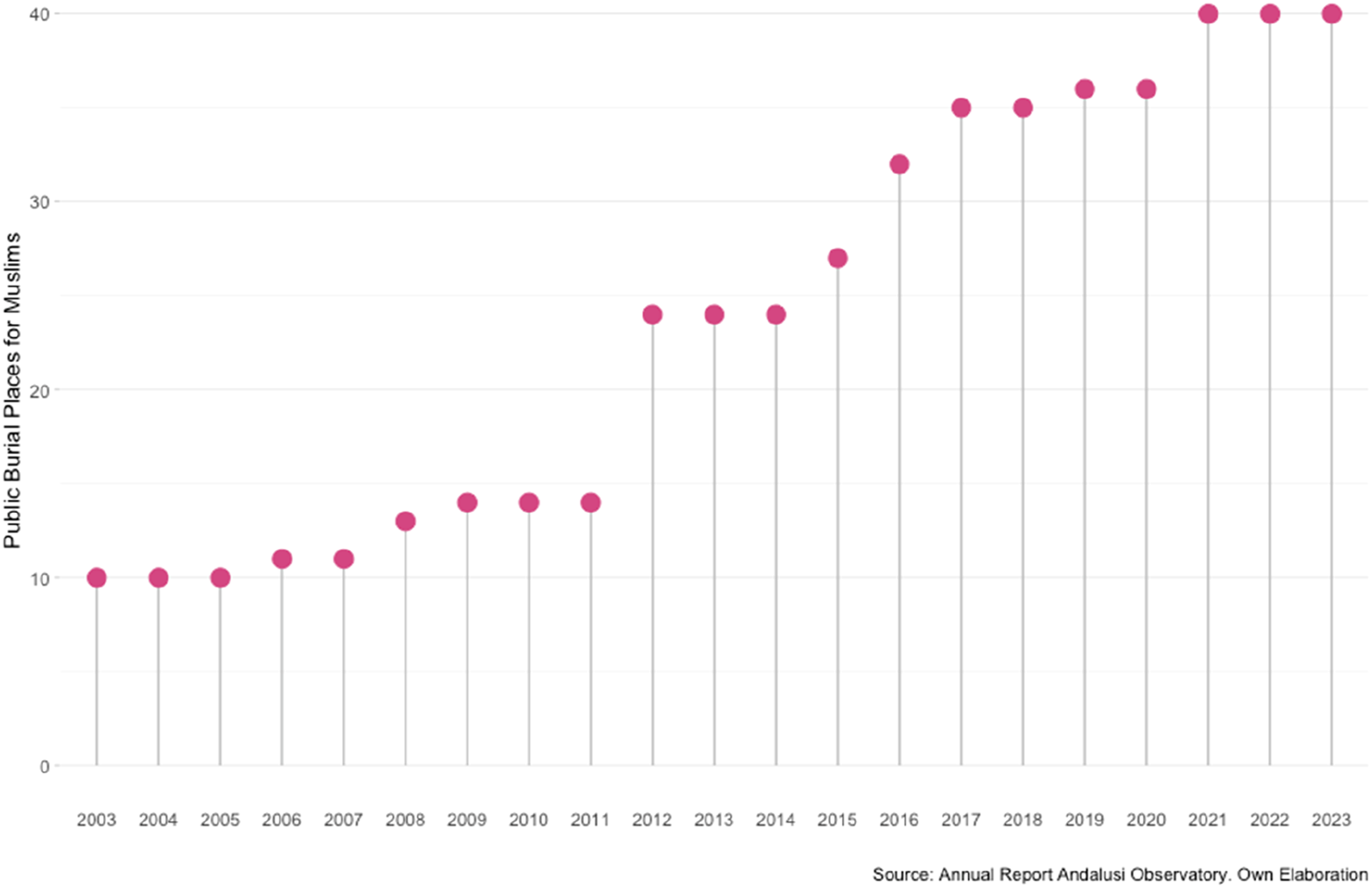
Most contemporary Spanish cemeteries are within the municipalities' jurisdiction and are managed by funerary enterprises (municipal, private, or mixed) (Tarrés and Moreras, 2012). Some exceptional cases, like the Muslim cemeteries in Sevilla, Granada and Valencia, have created a precedent agreement between municipalities and Islamic communities for the management of the cemeteries by the communities themselves. Yet, the majority of the governance of dead bodies continues to fall under the responsibility of the municipality or the enterprise that manages cemeteries in the area.
While the number of places for the burial of Muslims in Spain has significantly increased over the years, they continue to encounter two main problems. Firstly, the cemeteries/parcels are not evenly distributed among the country, thus leaving areas where Muslims have no access to a burial space (Figure 3). The second issue is that several of these cemeteries/parcels do not have enough space for current and future demand. An example is the cemetery in Palma in Baleares. The graveyard had, until last year, a total of 40 parcels that were supposed to cater for the over 30,000 Muslims that reside in the municipality. Thus, any Muslim person who dies in the future will need to be sent to a different place in Spain or another country. A project started to expand it, notwithstanding that it would only add 50 additional burial places and would not cater to the needs of those residing there
16
. Other small cemeteries are in the situation of having to reject people from being buried there and have had to implement a rule of residence, thus only allowing Muslim residents from the municipality where the cemetery is located to be buried there. Muslim burials in peninsular Spain as of today (2023) types of cemeteries.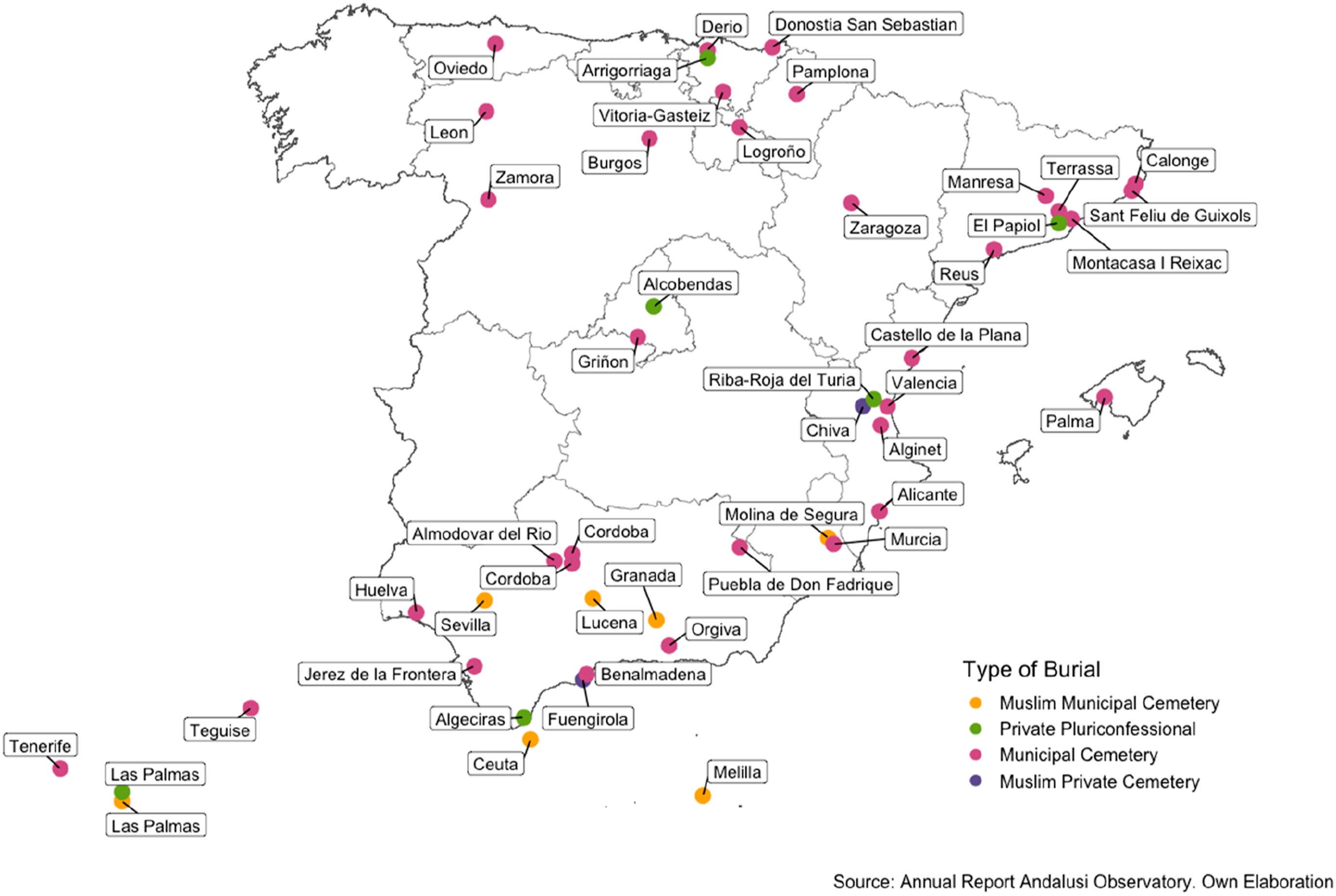
A different case is the one in Griñón in Madrid, originally a cemetery habilitated during the Civil War for Franco’s guard; the graveyard fell into abandonment for several years and was eventually recovered for further burials; notwithstanding, the cemetery recently reached capacity, and Madrid’s Muslim communities have been requesting an expansion. For instance, in the community of Madrid, there are around 300,000 Muslims, and each year, 1500 could die, yet the Griñón cemetery only has space for around 700 burials. It was announced in April 2023 that the expansion would take place, but at the same time, the mosque inside the premises would be demolished 17 . In the same community, in 2016, the mayor of Madrid reserved a plot of land in the municipal cemetery for the exclusive burial of Muslim residents; notwithstanding, despite the project’s approval, no action has been instigated to habilitate the spaces.
In these cases, they are expected to opt for repatriation or to attempt a burial in a different place in the country; this is possible, mostly in private cemeteries, albeit at a cost. Sometimes, repatriation or moving bodies to a private cemetery will not cost less than €3000; in many cases, families cannot cover these exorbitant costs. Occasionally, their community will gather money to help them, or as explained by Ural in this special issue (Ural, 2014), a whole organised support system can emerge through an economic institutionalisation of Muslim funerary parlours. These parlours can emerge with the community's donations or eventual monthly payments as “insurance” to care for the corpse once death arrives. Notwithstanding, Spanish Muslims are eager to find alternative solutions to this dispute.
The issue of repatriation is chiefly related to the lack of belonging, particularly when studying communities with an immigration background (Balkan, 2015, 2023; Balkan and Masarwa, 2022). Such a perspective was evident during my fieldwork in Spain when I encountered a significant number of Muslim citizens who wished to be buried abroad, as they believed Spain was a Catholic land. This perception can be related to the strong connection between Catholicism and the Spanish national imaginary pushed during the Franco regime, which continues in the country’s current political discourse (Lems, 2021, 2024; Planet and Madonia, 2018).
One can see the continuing influence of the homogeneous Catholic national imaginary. Although the regulations change in some cases, the general trend in Spain is to continue with the traditional burial practices that emerged from Catholicism. As seen in the case of Madrid, the notion of expanding Spanish identity to include Muslims is considered either a challenge or unnecessary. This context also endangers the rights of those Muslim Spanish citizens with no immigrant background, as they cannot be sent off to a different country to be buried. A fully Catholic understanding of the nation denies the existence and identity of at least 1 million citizens in Spain.
Despite the current situation and what they describe as adversity, there is a group of Muslims in Spain that is starting to question the idea of repatriation and attempting to claim their right to be buried in Spain. They are beginning to claim to belong as they fight for spaces to be buried in and assert their dual identity as Spanish and Muslim.
Conclusion: Towards a multicultural politics of death in Spain?
Although considered a predominantly contemporary issue, as showcased in this paper, the politics of death in Spain is highly intertwined with the country’s history and shared memory. In this case, the history of Muslim cemeteries during the Spanish Civil War and their later treatment highlights the exclusion of Muslims from the national imaginary, especially considering these soldiers fought in the “name of the nation”. As explored with the importance of cemeteries when creating a narrative for the nation, the exclusion of Muslim soldiers also speaks loudly to the chosen narrative of the country’s national imagination. The paths of the cemeteries after the Civil War showcase how these soldiers were remembered. They raise the question of whether memory can be expanded to include the role of Muslim soldiers as crucial actors in Spanish history. Maintaining the remains in these cemeteries and continuing to care for them allows these soldiers to be remembered, and their stories can be told through cemeteries.
The Spanish case enlightens us about the presence of Islam in a country where the national imaginary is highly connected to Catholicism. As in many countries in Europe and in Spain, Islam is seen as a recently arrived outsider and oppressive religion. Notwithstanding, as it has been shown, the country has an extended history of relations with religious pluralism, particularly with Judaism and Islam. It introduces a long dichotomy between “us” (Spain) and “them” (Muslims and Jews) and the formation of the image of the Moor as the enemy, as the savage who came to kill Spanish people (Madariaga, 1988). Such dichotomy is quite usual within the formation of identities, as before the group can identify itself, they first make clear who the outsider is (Jonker, 1995).
Space is also a salient issue in Spain, intertwined with history. Repurposing or transforming spaces into something else can be considered a practice of erasure. As such, the physical memory of the soldiers is erased or attempted to be forgotten from the general narrative. As they are ignored, it is challenging to showcase precedents of Muslim burials approved by the state, thus influencing the arrangement of spaces provided to minorities, in this case Muslims, for their burials. Furthermore, current challenges over the distribution of the cemeteries continue to be part of the day-to-day of many Muslims in Spain, who are struggling to bury their deceased in a place close to their homes.
The internationalisation of death shines through in the repatriations that result from the lack of space, accommodation, and a lack of sense of belonging. While it is usually theorised that the reason for repatriation lies in one of the factors, it is clear that the three are essential to understanding the international side of the dead. As such, the last journey corpses embark on, as seen in the case of Spain, is related to the lack of integration of their dual identity in the national imaginary, a constant failure to accommodate their religious precepts and a sense of feeling like a stranger in one’s land; as seen in the belief that the land of Spain is only Catholic.
The state and its management of religious minorities (governance) have a crucial role in the politics of death. Regulations for the inclusion of Muslims into the mainstream community depend on the government. Through the lenses of multiculturalism, we can see the constant requests from Muslim communities for accommodation policies of their religion, particularly in the funerary area. Putting aside the challenges that Muslims face in their day-to-day life, the issue of death and the right to receive a burial with no discrimination based on religious beliefs continue to be the last act of violence many Muslims face in contemporary Spain. Despite the belief that Islam is an immigrant religion, at least half of the Muslims living in Spain are Spanish, and quite a lot of them do not have an immigration background (Salguero Montaño, 2011). Thus, their fight to recognise their belonging can be seen as their continued push for a societal space over the years.
The politics of death in Spain are encountering a forceful transition to include a multicultural lens affected by the constant negotiation and fight from those minorities challenging the status quo for their inclusion in space. This unique case shows a national image rapidly changing from the citizen’s point of view and one where the government fails to keep up. In this case, Spain can learn from its modern history, in which a multicultural public sphere that included institutional support for Muslims existed.
Footnotes
Declaration of conflicting interests
The author(s) declared no potential conflicts of interest with respect to the research, authorship, and/or publication of this article.
Funding
The author(s) disclosed receipt of the following financial support for the research, authorship, and/or publication of this article: This work was supported by the Volkswagen Foundation, Freigeist Fellowship.

Data availability statement
Data sharing not applicable to this article as no datasets were generated or analyzed during the current study.