




Abstract
In the course of my response to the five critics of “Race as Denegated Ethnicity,” I explicate the core principles and concepts of my book Racial Domination (2025) by contrast with the reigning paradigm of “race and racism.” I assert the need to sharply differentiate analytic from folk concepts; to move from population to problematic; and to “provincialize” the US, whose racial common sense fosters essentialism at the heart of constructivism. I propose to grasp “race” as a disguised subtype of ethnicity (on both logical and historical grounds) and race-making as a particular case of a general theory of group-making as the “realization” of categories inspired by Pierre Bourdieu’s genetic structuralism. This theory seeks to model the dialectic of classification and stratification by means of Weberian ideal types. It breaks racial phenomena down into a concatenation of elementary forms: categorization, discrimination, segregation, seclusion and violence. Replacing “race and racism” with ethnoracial domination (with its three faces of exploitation, subordination and exclusion) enables social scientists to stop replicating the “race effect”; reveals that “racial capitalism” and “structural racism” are rhetorical and not analytical notions; and provides powerful tools for both understanding and undermining racial oppression.
I am grateful to Ethnicities for organizing this symposium which makes it possible to have a multisided and forthright exchange on fundamental issues arising from the ontology, the theory and the methodology of “race.” I also thank the contributors for their searching and frank critiques. This symposium gives me a rich opportunity to elaborate on the arguments developed in my “Notes on Race as Denegated Ethnicity” and to spotlight the approach that guides my book Racial Domination (Wacquant, 2025; 2024), to which this article serves as gateway.
Let me clarify from the outset that I do not consider myself a specialist “race scholar” and that this may turn out to be an advantage for three reasons. First, I have no skin in the game and therefore I can escape the usual censorship that bears on this domain of research as on any other (established scholars have vested interests in defending theories in which they have sunk years of work and built a career; younger academics are eager to patrol the boundaries of the area of knowledge they are entering to attest that they belong). Second, I seek to grasp race-making as a particular case of a more general theory of group-making as the “realization” of categories inspired by Pierre Bourdieu’s (1987) genetic structuralism. This theory seeks to model how mental constructs, lodged in bodies (classification), are turned into material realities, institutions and distributions of efficient resources (stratification). Third, I relentlessly apply the four principles of historicist-analytical sociology: define concepts clearly; decompose the phenomenon into its constituent parts; uncover mechanisms; and take time and historical counterfactuals seriously. 1
For this approach, the reigning paradigm of “race and ethnicity” or “race and racism” (as its advocates call this domain of inquiry) suffers from three cumulative flaws: first, it confuses folk and analytic concepts; second, it is group-oriented rather than problem-oriented; third, it is doggedly and terminally US-centric, typically conflating race with the white/black (or white/people of color) dichotomy both nationally and globally, and thus oblivious to forms of ethnoracial domination that do not fall into the Procrustean bed of “white supremacy” and its others, and it fails to capture the variable configuration of white supremacy itself. Let me consider each of these properties in seriatim before turning to the specific points raised by my critics.
Epistemological shift
The philosophy of knowledge that animates my work is the historical rationalism of Gaston Bachelard, Georges Canguilhem and Alexandre Koyré, and imported into the social sciences by Pierre Bourdieu in his coauthored book Le Métier de sociologue (The Craft of Sociology). 2 Three fundamental tenets of this epistemological school are that science is elaborated by rupture with common sense and, therefore, that folk (ordinary) and analytic (scholarly) constructs belong to different orders of knowledge; that the subject of science is not an individual ego but a plural cogitamus; and that concepts are historical fabrications that evolve as science progresses through episodic discontinuity and not gradual accumulation. This implies, first, that we should not choose our terms based on how they are used in everyday life or in political discourse. Whether there is “race-talk” or “ethnic-talk” circulating in a given society is an empirical matter that, contrary to Magali Bessone’s (2025) worry, has no bearing on our analytical constructions. Ordinary racial constructs are objects and not tools of analysis.
For the same reason, I disagree with Stephen Cornell and Douglas Hartmann (2025) when they contend that “analytic categories must also remain grounded and in dialogue with the world and thinking of the ordinary, non-ivory-tower world.” Social science has emerged historically by separating itself from the everyday and by elaborating its own standards of pertinence and validity. Analytic concepts obey epistemic criteria (logical consistency, type specificity, parsimony, empirical adequacy, etc.) that folk notions do not; the former should encompass the latter and for that they need to be clearly distinct. When Marx defines capitalism by the extraction of surplus value through the wage-labor contract, Weber the state by the monopolization of legitimate violence, and Durkheim anomie by the fading of normative standards of conduct, they do not parrot common sense, they break with it. Why should it be different with the study of “race”?
A second implication is that we should always, as a matter of principle, welcome and collectively explore approaches that challenge accepted ways of framing a question—the opposite of the defensive posture adopted by Karida Brown (2025), who will be surprised to learn that I consider my critics as allies, and not adversaries, since they help us in the collective quest for knowledge. An open mind is particularly recommended in this case since the “race” question is a highly ductile and flammable one that triggers personal emotion and collective commotion. But it is W.E.B. Du Bois (1898) himself who insisted on the need to differentiate the analytics from the politics of race, and to valorize what he deftly called “the heroism of the laboratory” over the “swagger of the street broil.” 3
From population to problem
The deliberate and decisive move I make in Racial Domination is to shift from a group-centered to a problem-centered framework. I am not the first to make this move but I make it the dorsal fin of my approach: resolve the analytics prior to tackling the empirics. Groups should enter into our theoretical ambit only as case illustrations, tests and materials to articulate and revise our models. For instance, where do ethnoracial classifications come from, what is their different bases and how do to operate? What are the articulations between discrimination on the job market and discrimination on the housing market? What are the dimensions of ethnoracial segregation, residential, occupational, educational and marital, and the mechanisms that produce and reproduce them? What social forces drive the escalation of ethnoracial violence from intimidation and assault to riot and ethnic cleansing to genocide, the ultimate form of ethnoracial domination? How does violence, in turn, work to uphold other elementary forms of racial domination? 4
The rationale behind this shift is twofold: to examine the social conditions under which group formation occurs or fails to materialize, and on what basis (class, ethnicity, nationality, migration experience, etc.), instead of taking the existence of groups for granted, congruent with Pierre Bourdieu’s (1984) radically historicist social ontology; 5 and to open wide the gamut of historical cases that can be covered by the model, including negative cases when ethnoracial collectives fail to coalesce and make the transition from “practical group” to “instituted group” fostered by the alignment of habitus, position in social space and classification struggles (Wacquant 2024: 198-201). For instance, why do Afro-French people from the country’s overseas dominions refuse to merge with African immigrants and fail to respond to the calls for joint mobilization by a new cadre of educated black elites plugged into the political and journalistic field (Ndiaye, 2008)? Staying attached to particular groups, their histories, boundaries and predicament exposes us to falling into substantialism and constitutes an obstacle to uncovering the mechanisms that increase or decrease what Brubaker (2004) calls “groupness.”
Provincializing the US
Opening the range of historical cases is critical in that it allows us to displace the US from its Archimedean position and to extricate concepts from the gangue of the historical unconscious of that country founded on settler colonialism, racialized slavery and indigenous genocide. I advocate, not only “provincializing” the US, but also uniting West and East as well as restarting the dialogue between colonial and metropolitan racial formation in the tow of C.L.R. James’s The Black Jacobins (1963). Colonial societies were built on rigid and suffusive ethnoracial distinctions; they were created and defended by virulent racial states (Howe, 2020); therefore, they offer a wealth of constellations to add to the comparative and historical theorizing of the manner in which indigenous and imperial constructs of race hybridized (Stoler, 1989).
Thus, it is a curiously Eurocentric vision of history to believe that race as an essentialist principle of classification and stratification is a monopoly of Western nations and empires. Homegrown lineages of racialization are well documented in Japan, China, Korea, India and many countries of the Middle East and Africa, as shown for instance by Gi-Wook Shin’s Ethnic Nationalism in Korea: Genealogy, Politics, and Legacy (2006), and Bruce Hall’s A History of Race in Muslim West Africa, 1600-1960 (2011). They do not derive from western constructs and they do not fall under the “white/people of color” canopy. Better yet, India and China together account for over one-third of the world’s population and yet they rarely figure in the sociology of ethnoracial vision and division. 6 Why not start there and then expand back into the Euro-Pacific region?
The imperative of conceptual clarity and type specificity
Bessonne concurs with me on the need to infuse clarity and logic in an area of research that she rightfully calls “muddled” (an urgent warning under the pen of a political philosopher!) but questions whether we should get rid of the diptych “race and ethnicity” (or “race and racism”). There are three reasons for doing so: first, race does not have a stable referent and is overloaded with moral baggage; next, the duo creates confusion as it is redundant and mixes ordinary and scholarly meanings; and, last, it endlessly replicates the race effect which is precisely the collective belief—that social scientists should repudiate rather than validate—that “race” is something fundamentally different from ethnicity deserving of its own concept. This presumes a dualistic ontology that has no foundation in either philosophy or history and reinserts essentialism at the core of constructivism. In any case, social scientists should always make minimal ontological claims, and I heed that principle: I am not arguing that “ethnicity” and “race” are essentially the same thing but, rather, that the latter is logically and historically derived from the former. So, it is analytically heuristic to roll race under ethnicity since the creation of these two divisions involves the same generic process of boundary-drawing and group-making; ethnicity is the conceptual mother, race the child (Wacquant, 2024: 197-205).
Ethnicity, that is, a statutory collectivity formed on the basis of “positive or negative social estimation of honor” (in the language of Weber [1920, 1978]), has multiple subtypes: in rough order of epochal appearance, ethnolinguistic (the first human communities are bounded on the basis of language), ethnoregional (next comes belonging to a place), ethnoreligious (when faith-based categories spread across space), ethnonational (with the emergence of the modern state) and ethnoracial (in many cases, but not always, ethnosomatic in the language of Patterson [2005] and Wimmer [2013]). 7 There is no warrant to grant “race” a sort of extraterritorial status in this conceptual landscape. Especially since ethnoracial vision and division is a modern phenomenon, dating either from the 15th century (religious origin), the 16th century (colonial origin) or the mid-18th century (the science of naturalists), to invoke its three common origin stories. 8 “Race” comes late in the history of the unfolding of ethnicity as one of its specifications, another ground to roll it under the latter.
Cornell and Hartman write that, by flagging them as an instance of the “intersectional” view of race and ethnicity, I am “putting up a strawman.” But they feature the exact same figure I use in their book Ethnicity and Race (Cornell and Hartman, 2006) and I validated my interpretation in personal communication with Doug Hartman back in July of 2022, in which Doug wrote me: “I think your representation is accurate; indeed, it is a rough sketch of Figure 2.1 (p. 36) in the second edition of our book (snapshot attached).” When they write that “external assignment is how races are created and reified; it is a cultural act but with ‘others’ as the object,” they are in full agreement with the idea that “race” and “ethnicity” result from the self-same symbolic process, the one tending to identification and the other tending to categorization. They should draw the logical implication of this similarity by affirming the subsidiarity of race to ethnicity.
Let me explicate a keyword that is not obvious: “denegated” does not come from Latin but from the German Verneinung (negation). It is a concept elaborated by Sigmund Freud ([1925] 1950) in his psychoanalytic theory of mind to describe how a repressed wish, thought or feeling is simultaneously brought to consciousness and denied by the individual (as in “you may think I hate my father, but I don’t”). When racialized ethnicity proffers, “I am not ethnic, I am based on the necessity of nature and biology and not on the arbitrary roll of culture and history,” it both claims to be a natural entity and makes a cultural assertion that reveals its very historicity.
Deploying an ideal type
Karimi and Wilkes correctly acknowledge that what I sketch is not an empirical but an analytical model, that is, an ideal type à la Max Weber. Remember that an Idealtypus, according to the author of Wirtschaft und Gesellschaft, “is formed by the one-sided accentuation of one or more points of view and by the synthesis of a great many diffuse, discrete, more or less present and occasionally absent concrete individual phenomena, which are arranged according to those one-sidedly emphasized viewpoints into a unified analytical construct” ([1904] 1949: 90). It is not a description of reality but a tool for formulating hypotheses and explicating why reality departs from the model. 9
So, Andreas Wimmer’s (2025) ingenuous empirical test of the continuum of ethnicity is fully congruent with my approach and its tentative result is an invitation for further analytic elaboration. An ideal type is neither true nor false, only heuristic or not. In Racial Domination, I seek to demonstrate its productivity by means of two historical case studies, Jim Crow as caste terrorism in the US South at the close of the 19th century and racialized hyper-incarceration at the end of the 20th century. The test here is, does my analytic framework allow me to produce descriptions, interpretations and explanations that I could not have produced otherwise? I invite the reader to peruse those two chapters and decide for themselves.
Wimmer believes moreover that there is a residue of Americano-centrism in the continuum of ethnicity which tacitly opposes flexible white ethnicity with the rigid predicament of African Americans. When I constructed the continuum of ethnicity, I did not have in mind racial formation in the US but ethnic classification and stratification in Japan and, in particular, the dual opposition between the Yamato (ordinary) and the Burakumin (racialized) ethnicities. 10 This indicates that I make no presumption that “ethno-somatic differentiations are associated with more domination on average” (Wimmer, 2025) since the Burakumin are phenotypically indistinguishable from their fellow Japanese. “Distinguishing between race as fixed, imposed, and exclusionary, on the one end, and ethnicity as fluid, self-ascribed, and voluntary, on the other end of the continuum” (Wimmer, 2025) is not an empirical claim but a conceptual précis, summed up by Figure 1 below.
The diagonal of racialization.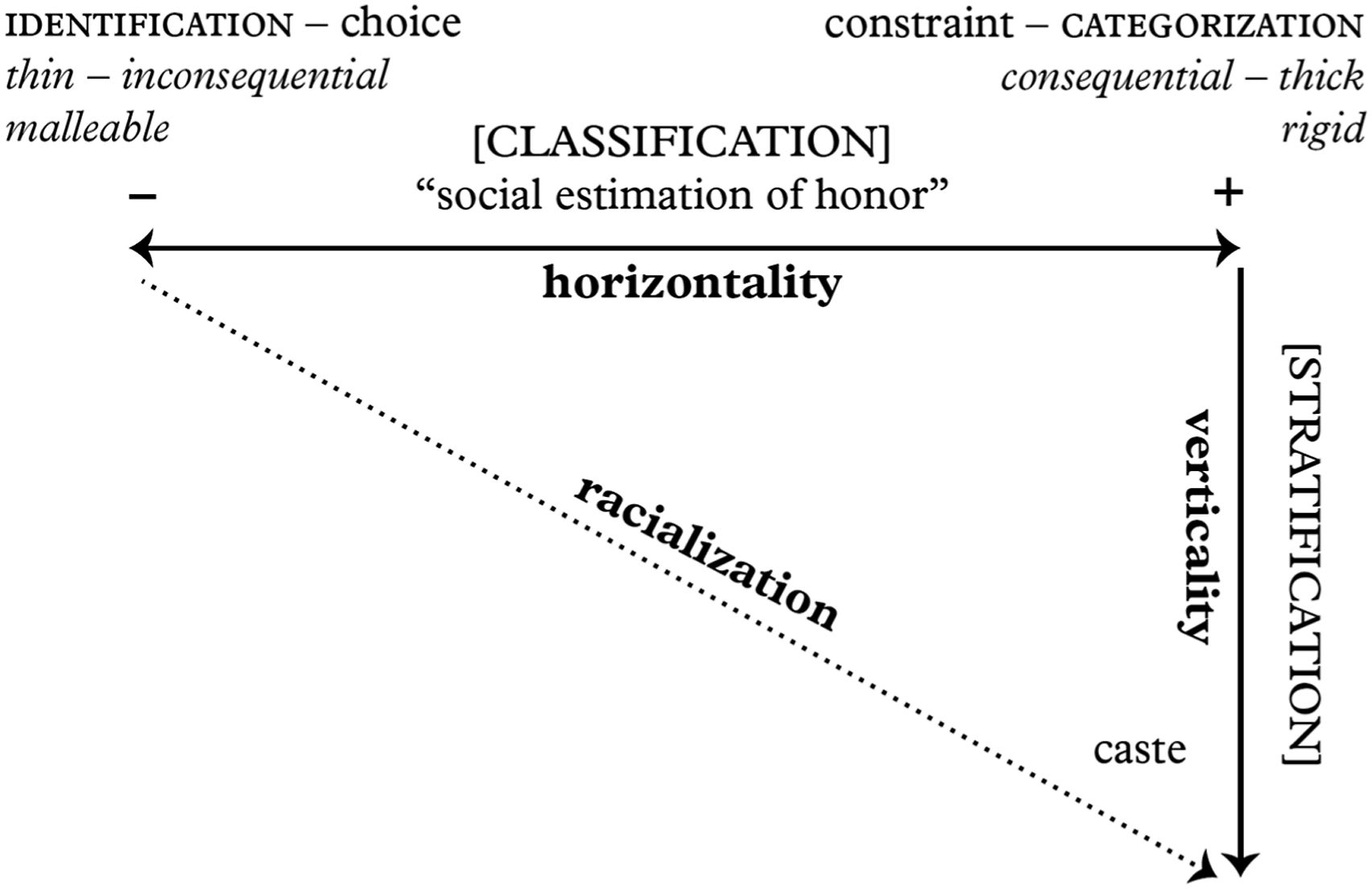
I am intrigued by Aryan Karimi and Rima Wilkes’s diagrams and mathematical equations working out the different logical configurations coupling race and ethnicity. Figures are powerful instruments for stimulating theory because they condense and clarify relationships between key concepts and invite one to think in terms of hierarchical causality, correlation, types, encompassment and subsidiarity (Silver, 2020). But I disagree with the way they represent my framework in their diagram 5. In the horizontal dimension of classification, the symbolic order of honor, neither form of ethnicity, ordinary to racialized, presume different life conditions and opportunities. It is only when we move down in the vertical dimension of stratification that we attach material outcomes to membership. The “ethnic penalty” for the subordinate category grows pari passu with the rigidity of classification. Other things being equal, clearcut categorical boundaries foster ethnoracial domination inasmuch as they sharply delineate the target group. The most rigid and consequential modality of ethnoracial domination is the caste system, as indicated on the bottom right-hand side of Figure 1, that is, where the diagonal of racialization has its maximum impact. That is a proposition I would welcome Wimmer to test.
No sacred cows
Karida Brown’s (2025) vitriolic paper is disappointing. It is long on proclamation and vituperation (longer than the article she responds to!) and short on argumentation, complete with the invention of a decades-long academic cabal against proponents of “systemic racism” to which I would be a knowing party. Academic marginality is wont to breed intellectual paranoia but these proponents have rightfully achieved positions of eminence in the American academy; they have many journals dedicated to their pet topic (including the newer Sociology of Race and Ethnicity sponsored by the venerable American Sociological Association); they publish books that are widely read and cited beyond their province. So, it is hard to comprehend the basis of this absurd conspiracy theory, other than as a product of epistemic insecurity.
This leads to the bizarre proposition that I draw on a “poisoned well” and partake of a “crusade for putting a stop to race-talk” (Brown 2025): by writing a 512-page book on Racial Domination? This is, to say the least, a strange way to silence “race-talk”! What Brown cannot accept is that one may approach the topic differently from the “race-first, race-everywere, race-forever” paradigm based on the veiled essentialism of US racial common sense which has attained dominance in this sector of social science, and by drawing on authors that are not part of the official canon of race scholarship. She is the one defending an academic turf and protecting an intellectual doxa, not me.
Now, Brown’s paper suggests that questioning such notions as “structural racism” and “racial capitalism”—the sacred cows of our intellectual-political moment—is a crime of conceptual lèse majesté that shall not be tolerated and must be shouted down. If she was so assured of their robustness, would she not engage my substantive arguments showing them to be rhetorical and not analytical constructs? She bemoans the “persistent refusal to honestly engage with the scholarship on ‘big R’ Racism” (Brown, 2025), but I do engage these notions in great detail in Racial Domination, working my way through several hundred references covering cases around the world over five centuries.
I devote a full eight pages to a critique of “racial capitalism” and find it inchoate and wanting, based on a series of postulations instead of demonstrations. 11 I develop my critique of “structural racism” over 15 pages and find the notion vague, tentacular and evanescent, confused and confusing—as indicated by its three common metaphors, the iceberg, the spiderweb and the epidemic. I then demonstrate this empirically over another 10 pages in a section on “structural racism” in the “criminal justice system”—which, precisely, for starters, is not a system. I comb through Omi and Winant’s classic Racial Formation in the United States (2014) to show that they use the term “structural racism” no fewer than 19 times without ever defining it, tacitly relying on the (American) reader to fill in the blanks with nebulous and uncontrolled meaning. Similarly, I closely dissect a raft of influential papers by Eduardo Bonilla Silva and disclose that his arguments are circular, redundant and tied together by repeated appeals to US racial common sense.
Brown’s text is not an explication or a defense of “racial capitalism” but a celebration of the notion. But piling on the names of authors who have used it does not establish its epistemic validity and its heuristic productivity. We have known for nearly a century that race and capitalism slept in the same bed at the dawn of modernity, thanks to the works of W.E.B. Du Bois, Eric Williams, Oliver Cromwell Cox, Walter Rodney, and Manning Marable (as I point out in Racial Domination, p. 168). So, what is new under the sun? This will surprise Brown: I wish there were a robust concept of “racial capitalism”, and I do not mean this facetiously. When one is formulated, I will rejoice and embrace it because it will help us resolve an epochal enigma at the foundation of the Western world as we know it. But, as of today, racial capitalism is the label of an intellectual-political agenda or a loosely formulated problematic, how to link capitalism and racial division, that is neither new nor innovative, and it falls flat inasmuch as it ignores the “varieties” of ethnoracial division and the “varieties” of capitalism needing to be “articulated” (Wacquant, 2023b).
Out with “race and racism,” in with racial domination
As I make clear again and again in Racial Domination, getting rid of “race” as an analytical category does not—I repeat not—mean that we deny, overlook or minimize the divisions and oppression to which the term usually refers. Wimmer (2025) reinforces this point when he writes, “nesting these concepts [of race and ethnicity] in no way prevents us from analyzing racial inequality and hierarchy or from highlighting unique features of race not found in other forms of ethnic classification.” On the contrary: the concept of racial domination is more precise and powerful analytically than the vague and emotive term of “racism” (especially of the structural variety), and thus, down the road, potentially more useful politically. Let me rephrase this so my critics get it: I propose to get rid of the tired diptych of “race and racism” to replace it with racial domination because the latter concept is semantically clear, logically sharp and heuristically more powerful.
In Racial Domination, I build on Max Weber, Michel Foucault and Pierre Bourdieu to elaborate a chiselled and concise concept of domination as “the extraction of compliance to the social order by material and symbolic means.” I paint its “three faces” as exploitation (the extraction of economic value), subordination (the imposition of statutory inferiority), and exclusion (the denial of access to resources and institutions) (Wacquant, 2024: 16-29). I then propose to break down any “racial” phenomenon—say, colonial technologies of rule in imperial India, caste abjection in Tokugawa Japan, terroristic violence against African Americans in the post-bellum South, religious endogamy in postcolonial Syria, the stigmatization of “Arabs” in contemporary France or the economic marginalization of 19th-century Amerindians in Peru—into its five “elementary forms”: categorization, discrimination, segregation, seclusion (comprising the ghetto, the camp and the reservation) and violence. Far from abandoning the project of spotlighting and fighting racial subjugation, then, the agonistic sociology of race-making gives us potent tools for tracing its genealogy and dissecting its anatomy, thus putting us in a stronger position to launch practical and policy actions designed to erode it.
As for the farcical essentialist defense that arguments based on the work of “white men” would be eo ipso tainted or invalid, collapsing identity and knowledge, it was effectively dealt with long ago by Robert Merton (1972) in his examination of the burst of nativist epistemology that accompanied the percolation of the Civil Rights Movement into the US academy. But consider the absurdity of deriving the validity of a social theory from the social identity of its author. How do scholars of racial capitalism dare use the notion of capitalism elaborated by Karl Marx: was he not a white male, a philanderer and the scion of a well-established bourgeois family, four strikes against him that should, if we follow the reasoning of Brown, disqualify him as a knowledge producer and with him his theory of capitalism? Similarly, did Du Bois’s mixed ancestry (including French!), descent from a free black family, comparatively privileged upbringing in a small white town and early access to high-quality education prohibit him from grasping the condition of deep poverty, educational exclusion, rural isolation and political oppression of African Americans descended from slaves?
Footnotes
Declaration of conflicting interests
The author(s) declared no potential conflicts of interest with respect to the research, authorship, and/or publication of this article.
Funding
The author(s) received no financial support for the research, authorship, and/or publication of this article.
Data availability statement
Data sharing not applicable to this article as no datasets were generated or analyzed during the current study.