




Abstract
This paper explores how parents in intermarriages choose between the majority language (Serbian) and the minority language (Hungarian) as their children’s instruction medium in Vojvodina, the northern province of Serbia. Adopting language ideologies as a theoretical framework, the study sheds light on (systems of) cultural ideas concerning social and linguistic relations, encompassing family and societal contexts. Qualitative research involving interviews was conducted with spouses/partners of individuals from the Hungarian national minority who are in a marriage/partnership with members of the majority community in Vojvodina. The analysis reveals that the choice of education in the majority language is influenced by both objective factors (such as the absence of minority language schooling in the parents’ locality) and subjective considerations, which are connected to adopting various language ideologies supported by gender differences. The study highlights the crucial societal function of intermarriage, as family decisions significantly shape the identity and ethnic affiliation of children born into these unions. The choice of the language of instruction for their education plays a significant role in this process, with opting for the majority language accelerating acculturation and assimilation compared to choosing the minority language and maintaining the minority community.
Keywords
Introduction
Intermarriages 1 occur worldwide but are particularly prevalent in regions with diverse ethnic, religious, and cultural backgrounds. The Autonomous Province of Vojvodina in northern Serbia, home to 25 ethnic minorities, stands out as fertile ground for mixed marriages (Statistical Office of the Republic of Serbia, 2023). Notably, the Hungarian community, comprising 10% of the population, has a unique position as an autochthonous minority with significant cultural autonomy (Beretka, 2020). Members of this community enjoy the right to education in their first language throughout their schooling (Lendák-Kabók, 2021) and have well-established networks within the minority world (Brubaker et al., 2018). The introduction of the Law on Hungarian Citizenship (2010) added to these advantages, as it enables all Vojvodinian Hungarians with origins in the territory of the Austro-Hungarian Monarchy with a good command of the Hungarian language to obtain Hungarian citizenship. As Serbia is not part of the EU, knowledge of Hungarian implies great opportunities for social vertical and horizontal mobility through Europe, especially the opportunity to study and work in an EU Member State (Lendák-Kabók et al., 2020). These advantages have simplified the migration and resettlement procedure of members of the Hungarian minority in the EU Member States significantly since the start of the Yugoslav Wars of the 1990s (Lendák-Kabók, 2024). Hence, the Hungarian minority community has been declining rapidly according to 2022 Census Data for Serbia, and minority-language classes in schools in some settlements (like in Novi Sad, the capital of Vojvodina) struggle to exist as such classes can only run with a legal minimum of five enrolled students.
Mixed marriages have substantially influenced the population structure in Vojvodina throughout history, and with the migrations of new populations from neighbouring countries (mostly Serbs from Bosnia and Herzegovina and Croatia) during the 1990s Yugoslav Wars, discussions about minority acculturation and assimilation through mixed marriage have intensified (Sokolovska, 2008). The social context and nationalist sentiments prevalent in the 1990s may have influenced individuals from minority communities to reconsider their national identity and opt for assimilation into the majority community (Göncz, 2004). This period also saw a trend towards adopting the majority language as the language of instruction within mixed-marriage families (Lendák-Kabók, 2022). Recent research indicates that Vojvodina continues to be home to more ethnically mixed marriage than other regions of Serbia (Lazar and Aćimov, 2017). Within those intermarriages, the choice of the language of education significantly impacts children’s identity formation, leading to either the preservation of minority identity and multilingualism or rapid acculturation and assimilation (Örkény and Székelyi, 2016; Lendák-Kabók, 2021).
Based on the above, this study aims to explore how parents in Hungarian-Serb mixed marriages decide on the language of instruction for their children (whether the majority Serbian or the minority Hungarian) from the perspective of the minority parent. Adopting a theoretical approach grounded in language ideology, the study seeks to illuminate the cultural system of ideas concerning social and linguistic relations in Vojvodina at the family and social levels while considering the moral and political interests of communities and individuals. The paper gives an insight into unspoken and undocumented dilemmas of identity building within mixed unions that take place in the private sphere – i.e., within families – but which affect the ethnic composition and identity patterns in society.
The paper will begin by examining prevailing views about language and mixed marriages internationally, before specifically focusing on Serbia and its multi-ethnic northern autonomous province of Vojvodina, known for its exceptionally large proportion of mixed marriages (Petrović, 1985). Subsequently, it will delve into the methodology and research findings before concluding with a summary of results.
Language ideologies, minority identities, and multilingual dynamics
The paper adopts a language ideology theoretical approach to explore the cultural system of ideas surrounding social and linguistic relations in Vojvodina considering speakers’ moral and political interests (Irvine, 2012). Language ideologies encompass beliefs about language and its usage, impacting identity construction and power relations (Gal, 2002; Irvine, 1989; Silverstein, 1979; Woolard and Schieffelin, 1994). The former influence daily interactions, child-rearing, and interpersonal discussions in societies and are tied to ethnicity, gender, race, age, and nationality (Woolard and Schieffelin, 1994). Several language ideologies are relevant to this study, including monoglot and polyglot nationalism, standard language ideology, and multilingualism for economic prosperity.
National identity plays a crucial role in contemporary social identities. In Europe, the process of nation-building is inextricably intertwined with linguistic nationalism. Unlike the multilingual nature of preceding monarchical empires such as the Habsburg Empire, modern nations were established on the principle of ‘one language, one nation.’ Nations are not just ‘imagined communities’ representing shared cultural experiences but also involve exclusionary historical and institutional practices restricted through citizenship access (Piller, 2001). Therefore, language is important for achieving group cohesion and collective identity (Gábrity, 2012). The ideology of ‘polyglot nationalism’ or ‘lived multilingualism’ was prevalent in Vojvodina, as in all (post)Habsburg lands, until the 1950s, allowing for locally oriented reciprocal bi-/multilingualism without conflicting with national identity (Gal, 2011; Krel and Mandić, 2016; Schjerve-Rindler and Vetter, 2007). However, with the rise of monolingual nationalism, this ideology was suppressed, implying that minority speakers should be multilingual while majority speakers are not expected to be (Annamalai, 2003; Mandić and Rácz, 2023).
Another important aspect is how and in what way is the language spoken. Standard language ideologies prevail in European nation-states, maintaining inequality between standard and non-standard varieties of the same language through state-sponsored institutions (Bourdieu, 1977; Milroy, 2001). The worth of a specific language variety lies in its ability to facilitate entry to sought-after positions in the job market or social advancement. The power imbalances between coexisting ethnicities are evident in the prestige and assessment of the languages/varieties they use (Bourdieu, 1991). As pointed out by Heller (1992), groups with valuable resources control the marketplace of exchange, shaping social relations and defining resource value. Beyond direct force, these marketplaces operate through symbolic domination, where specific groups define the rules of resource distribution. Participation necessitates demonstrating linguistic and cultural proficiency, with success contingent on mastering these dictated rules (Heller, 1992). In our case, Hungarian and Serbian cultures exemplify standard language cultures (Laihonen, 2009; Filipović, 2011, cited in Ilić [Mandić], 2014), relegating speakers of non-standard varieties to a less favourable situation and making them subject to language stereotypes and prejudices (Lendák-Kabók, 2022), incentivising parents to value majority language schooling as the preferred provider of standard language education. The response of the minoritised language communities to this prevailing monolingual standard language hegemony ranges from subordination to resistance (Ilić [Mandić], 2014).
Highlighting the usefulness of multilingualism is yet another language ideology, as knowing more languages is perceived to increase one’s value in education and work, a perspective also embraced by the European Union (Mandić and Rácz, 2023; Romaine, 2013). For instance, Gábrity (2012) studied how the Hungarian minority express pride in their bilingual or multilingual abilities, acknowledging their daily advantages and practical benefits. These include enhanced job market opportunities, successful communication abroad, and the potential for future migration to Western countries (ibid).
However, complete (standard-language) bilingualism for members of minority communities is challenging to achieve for various reasons, but primarily insufficient instruction in the majority language during minority language education (see Lendák-Kabók et al., 2020). In the Republic of Serbia, the education of minorities in primary and secondary schools is facilitated through three distinct approaches: (i) Model A involves complete education in the language of the national minority (L1), supplemented by a mandatory course in Serbian as a second language (L2), for two to 3 hours weekly; (ii) Model B offers bilingual education in both Serbian (L2) and the national minority’s language (L1); (iii) Model C provides education entirely in Serbian (L2), with the option to take an elective subject or program titled ‘Mother Tongue with Elements of National Culture’ (L1) for 2 hours each week (see Mandić, 2024). Linguists in Serbia, such as Filipović (2011), Vučo (2014), and Ateljević (2017), argue that bilingual schools, if introduced in Serbia, could aid minorities, particularly in mixed marriages, to maintain their minority language. The current situation in minority-inhabited areas in Serbia, i.e., exclusively minority-language schooling with the majority language as a compulsory subject, is supported by Göncz (2004), a prominent psychologist, who contends that minority-focused education is preferable as it fosters an additive bilingual environment: family and school encourage the first language, while the wider community and, to some extent, the school system nurture the development of the second language.
The impact of intermarriages at the social, family, and individual level: a gender perspective
Because marriage is a mechanism for transmitting ethnically specific cultural values and practices to the next generation, intermarriage can fundamentally affect the boundaries and distinctions of minority communities (Barth, 1969). Gordon (1964) outlines three stages of assimilation: cultural (acculturation), structural, and marital. He highlights that this process may lead to the disappearance of an ethnic group as a distinct entity. 2 For this very reason, mixed marriages serve as the main indicator of acculturation or even assimilation (Merton, 1941; Blau et al., 1982); they call into question the principle of division and distance between different ethnic and racial groups (Törngren et al., 2016). Mixed marriages also indicate relations among groups; if they do not scale between two groups living in the same area, this indicates a rigidity of borders (Gordon, 1964). Numerous mixed marriages between the minority and the majority group indicate openness and acceptance of the minority community by the majority and vice versa, which can lead to the loss of the cultural characteristics of the minority group (Schoen et al., 1989). If we accept that intermarriage involves the genuine social acceptance of ‘others’ as equals, then may also conclude that it deconstructs ethnic and racial prejudice against minority groups in society (Song, 2009). For these reasons, intermarriage is usually considered an indicator of the success and social acceptance of a minority group (ibid.).
The role of mixed marriages is multifaceted regarding integrating the minority population. Namely, members of minorities can ‘get closer’ to the majority population in their homeland (Kemp, 2006) through choosing a spouse from among the latter (Hoóz, 2002). Also, spouses who are members of the minority population can be integrated into structures and institutions or build social networks this way (Song, 2009). However, it is uncertain whether mixed marriages positively impact national tolerance or are a consequence of positive attitudes (Burić, 2020).
Researchers such as Rodríguez-García et al. (2016) argue that mixed marriages often do not foster societal harmony but become a source of social tension at both macro and micro levels within families. These unions do not necessarily involve partners abandoning their differences or beliefs, potentially leading to marital conflict (ibid.). Numerous studies show that divorce rates are higher among exogamous (mixed) couples than endogamous ones, both due to socioeconomic- (Goldstein and Harknett, 2006) and cultural differences (Kalmijn et al., 2005), as well as disagreements within the family, i.e., non-acceptance of the spouse’s family (Milewski and Kulu, 2001).
Research on mixed marriages emphasizes the decision points or choices within mixed families that significantly shape children’s identity (Hărăguș, 2017). Crucial decisions include choosing the child’s name (indicating attachment to a specific nation), religion, and the language of education. Research indicates that opting for primary (and occasionally secondary) education in a minority language preserves the minority language for children (Lendák-Kabók, 2021). The special role of the mother in preserving minority identity in the family has also been pointed out because mothers often have the task of reproducing the nation in a cultural sense through education (Yuval-Davis, 1997). Kandiyoti (1994:377) argues that “women bear the burden of being ‘mothers of the nation’, as well as being those who reproduce the boundaries of ethnic/national groups […] who transmit the culture and who are the privileged signifiers of national difference.” Further, it may be expected that women should remain at home and fulfil their duties as mothers, housekeepers, wives, caretakers, and “guardians of the home language” (Pavlenko and Piller, 2001: 7). Education in the minority language is not the only indicator of the preservation of minority identity (which inevitably also consists of the preservation of the minority language) but also requires an environment where the minority language is spoken (Örkény and Székelyi, 2016). Considering the prevalent perspectives on mixed marriages globally and in Central and Eastern Europe (CEE), especially regarding the identity formation of children born to such unions, the question arises: How do parents of different national origins, who typically use two languages at home, decide on the language of their children’s education? Do they opt for the majority (Serbian) or minority (Hungarian) language, and how do they rationalise their choice?
Research methodology
This paper is grounded in qualitative data from thirteen (13) semi-structured interviews conducted with spouses from the Hungarian minority community whose partners are from the majority (Serbian) community. The decision to exclusively interview minority spouses is based upon the assumption of their weaker social power within the predominantly majoritarian context, as shown in previous research in Subcarpathia (Kovály and Ferenc, 2020) and Transylvania (Brubaker et al., 2018) in terms of how they amplify their voices and foster their empowerment. Respondent selection involved the ‘snowball’ method (Esterberg, 2011). Interviews were recorded in September and October 2021 in the Hungarian language in person and online. The interviews were transcribed into Hungarian and the author has translated the excerpts used in the analysis and preparation of this paper into English.
Of the 13 interviews, four were conducted with men and nine with women. The respondents were born between 1964 and 1986. The identities of the respondents have been protected: instead of names, codes are assigned according to gender (F – female; M - male) and year of birth, from the oldest (starting with number 1) to the youngest.
The interview grid consisted of twenty-five connected questions divided into three main thematic areas: (1) childhood and schooling, family and environment; (2) choice of spouse, the national identity of the new family, and cultural differences; (3) choice of markers of children’s national identity and language of schooling. The paper will analyse parts of the interview related to the third group of questions – more precisely, family reasons for choosing schooling in the majority or minority language. Reduced transcription was used, whereby verbal statements were recorded without marking intonation, paralinguistic elements (laughter, sighs, etc.), which is suitable for ethnographic and sociological but not for linguistic analysis; additional notes by the transcriber are given in square brackets to improve understanding of the context.
Attribute Coding of Respondents From the Hungarian National Community.
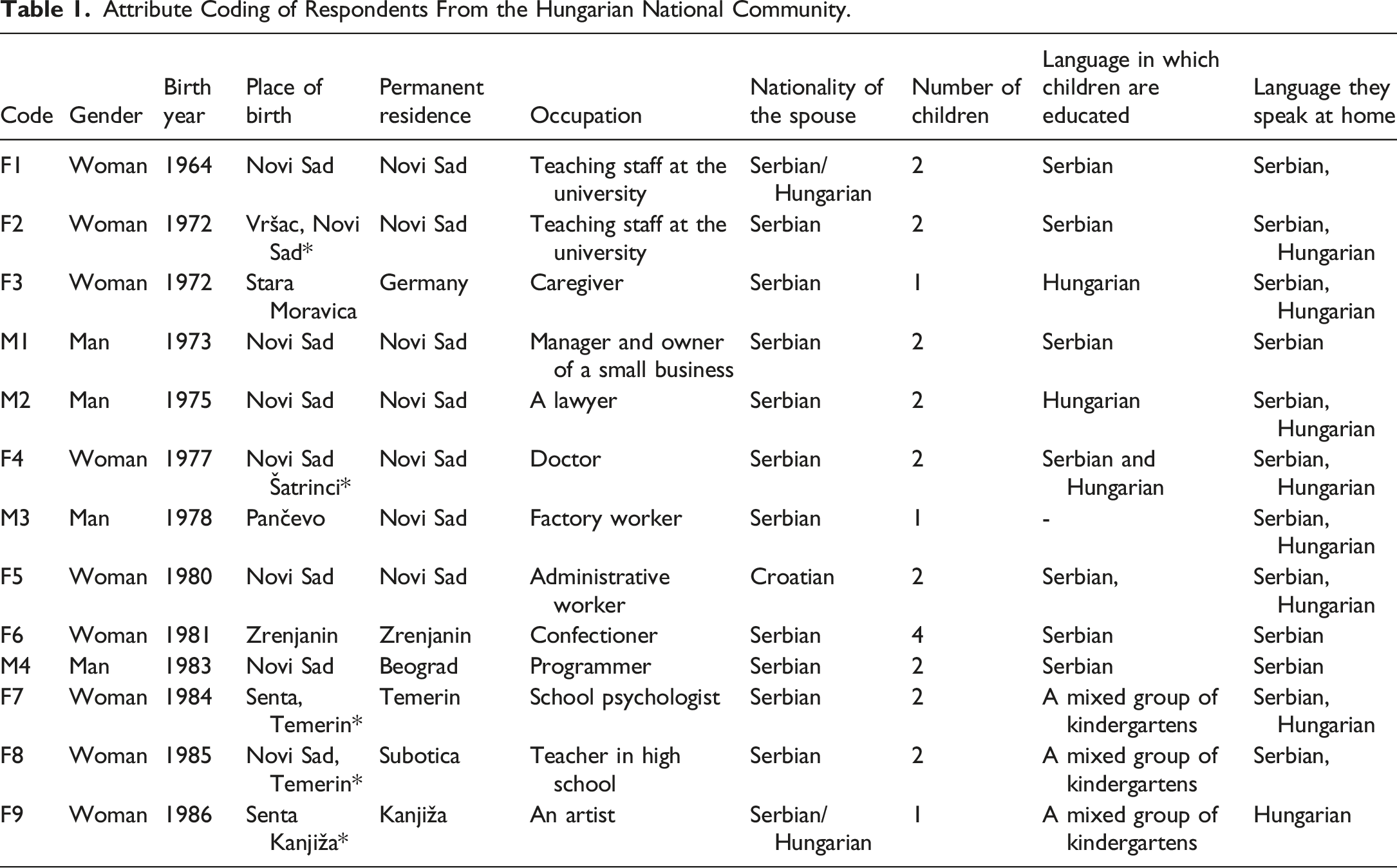
When analysing the transcripts, three dominant positions were identified: respondents whose children were attending classes (1) in the majority language, (2) in the minority language, or (3) those who had not yet decided. Then, the following four themes were identified (which were also cited as reasons) in relation to the choice of schooling in the majority language: (1) No classes available in the minority language; (2) Less competition in minority language classes; (3) Integration better through education in the majority language; and (4) To avoid exclusion of majority community parent from the education of the child (in the minority language). Content analysis was conducted to record the frequency of references to specific topics (reasons or arguments), thus introducing a quantitative dimension. Finally, the study’s results are evaluated in relation to some of the linguistic ideologies of the interlocutors.
Findings
Quantified thematic coding (Table 1) showed that 5 out of 13 respondents stated that their children attend classes in the Serbian (majority) language at school, 5/13 stated that they are in the process of negotiating the choice of language of instruction for their children because their children are still in kindergarten, and 2/13 that their child attends school in Hungarian or had a strong opinion that they would like them to attend school in the minority language in the future. Only one respondent stated that her children have different languages of education (one attends Serbian-language classes, the other Hungarian).
Choice of the majority language
The choice of majority language is sometimes compelled rather than chosen because the parents live in an area where no minority schooling is available. This was the case for M4, who moved to Belgrade for economic reasons. However, it is important to mention here that the children’s father did not speak the minority language with his children at home, having adopted monolingual nationalism through choice; thus, even if there had been opportunities for minority schooling, the parents would probably not have opted for it.
Regarding the subjective factors influencing the ‘choice’ of the mainstream language of schooling for mixed couples, several reasons emerge. Two respondents, F1 and F2, residing in Novi Sad, expressed that their decision to enrol their children in a Serbian-language instruction class was more compelled than voluntary. Their husbands’ primary argument was that this choice would facilitate their children’s integration into local society, which was a frequent argument when children were small and the Hungarian language had less prestige. However, in hindsight, F1 regretted not prioritizing minority language education for reasons of identity. This underscored a subtle critique of the prevailing language ideology adopted by her husband that emphasized the importance of the standard majority language for successful integration into society: “In such cases, the argument is that [Serbian is] the language of the environment [so] the child will integrate more easily [but] in the end, it’s not like that” (F1, Novi Sad).
F1 and F2 highlighted that their sons still converse in Hungarian with them, albeit less frequently, but acknowledged that their proficiency in reading and writing in the minority language may be lacking. An excerpt from F1’s testimony is provided below. I think they outvoted me; I didn’t fight enough for them to attend Hungarian school. My husband argued that Serbian is the language of the [mainstream] environment and that [the children would] integrate better; in the end, this argument was not valid, but both went to Serbian-language school, and both know Hungarian. I speak more Hungarian with my younger son, who now lives abroad; when we speak on the phone, we speak more Hungarian. Not so much with my older son, but I was pleasantly surprised when my sister [living in Hungary] was visiting that he spoke Hungarian fluently with her. I was very happy. He seems to have preserved the Hungarian language. (F1, Novi Sad)
Another subjective motive for enrolling children in majority language education stems from the desire to involve the majority parent in the education of the children. Despite traditional gender norms that the responsibility for children’s school progress is the mother’s, F5 highlighted the significance of her husband’s active participation in their children’s schooling, underscoring that they help with schoolwork together. This emphasis may be her attempt to justify her choice and alleviate doubts regarding its wisdom. Importantly, F5 asserted that her husband did not influence the decision about the language of their children’s education, as it was hers to make, implying the partner’s cultural assimilation or appeasement. However, this reveals the presence of an ideology of monolingual nationalism, which involves the expectation of bilingualism for minority speakers, while majority speakers are not similarly expected to know the languages of their communities (Mandić and Rácz, 2023). Thus, the possibility that her husband could have learned enough Hungarian to become involved in their children’s education did not even arise. Furthermore, F5 observed that her son’s proficiency in Serbian appeared strong even before he began kindergarten, as he had formed friendships with peers who did not speak Hungarian. This suggests that her son was inclined toward Serbian, potentially due to his (home) environment, where both parents used Serbian more. Her testimony implies a desire to draw closer to the majority community and, in doing so, potentially subdue her minority identity through the language of her children’s education. language ideology. An excerpt from her interview is provided below. My son went to kindergarten in Hungarian [where Hungarian was the main language], but the group was mixed; it included one or two children who did not know Hungarian, so my son made friends with a boy who is a Serb, so he did not really build up his Hungarian at the kindergarten. […] that is why we decided he should go to a Serbian-language school. Also, it was important that my husband could engage with the schooling. My husband, unlike other husbands, really engages with the upbringing of our children. He explains the mathematics tasks and other subjects… when he runs out of patience, then I step in. This would not be possible if my son attended school in Hungarian. I also enrolled my daughter in Serbian, even though she knew Hungarian well when she finished kindergarten, but I didn’t want to create these language differences between the children. (F5, Novi Sad)
Similarly, F4 enrolled her son in Serbian-language schooling as her husband argued that he would not be able to help him with his homework if he attended school in Hungarian. However, she regretted this decision and enrolled her daughter in a Hungarian-language class afterwards. As the children’s mother, she stated that the choice was hers. I really regretted not enrolling the boy [in a Hungarian-language class], I guess there would have been no problem, [my husband] could have helped him with math, I would have helped him with other subjects (F4, Novi Sad).
Gender roles associated with family dynamics are evident in men’s statements as well, as exemplified by M1 from Novi Sad, who referenced traditional the former to rationalize and minimize the dilemma of selecting the language of their children’s education. He asserted that choosing Serbian for their children’s education was necessary for their mother’s understanding and assistance with homework, underscoring the internalized language ideology that assumes that the majority speakers are monolingual. Therefore, the language in which children from mixed marriages are taught may depend on the mother’s first language (Lendák-Kabók et al., 2022). Furthermore, during the interview, M1 confirmed that his children now primarily communicate in Serbian and no longer respond in Hungarian due to their Serbian-language education. This shift highlights how Serbian has become their dominant, if not exclusive, language of interaction. An excerpt from this interview is presented below. …So that their mother would understand what they were learning [and] so that she and I would understand, we preferred to enrol them in a Serbian [-language school]. If they had attended elementary school in Hungarian, the mother would not have been able to follow what they were learning; she would not have been able to help them. (M1, Novi Sad)
Negotiating the choice of language of education
Some parents have yet to decide on the language of instruction for their children’s education. Their indecision arises from concerns about their children’s future and the input from parents of the majority community regarding assistance with homework, which was also a reason for choosing the majority language education for those who have children in school already.
Parents employ various strategies to promote their child’s multilingualism before they reach school age, such as F7’s decision to have their child attend kindergarten in a bilingual class, where one of the teachers speaks Hungarian while the other Serbian. Minority language education is typically chosen for lower levels of education like primary school. In contrast, the majority language tends to be favoured for higher levels, especially high school, as it helps children prepare for majority-language higher education (see Lendák-Kabók 2022). An excerpt from F7’s interview is provided below. We thought about enrolling him in a group in kindergarten where only the Hungarian language is spoken, but then we decided on a mixed-language group. We also discussed whether he should go to school [where the main language is Hungarian]. I am more inclined to enrol him in a Hungarian elementary school, and then he could attend a Serbian high school. I have a feeling that my husband approves of this solution, but he asked me how he will study mathematics with him and how he will explain it to him. I told him we would solve [this issue]; for now, we have time to decide, and we will see how it goes. (F7, Temerin)
M2 from Novi Sad values practical multilingualism aligned with an ideology of polyglot nationalism, emphasising its benefits for education and employment, in line with the European Union’s perspective (Mandić and Rácz, 2023; Romaine, 2013). Although his daughter was already studying in Hungarian, M2 reported tension with his (Serbian mother-tongue) wife over enrolling their son in a Hungarian-language class in primary school since she would feel excluded from their daughter’s educational journey. This highlights the internalized language ideology that distinguishes between multilingual minority speakers and monolingual majority speakers. M2’s testimony highlights spousal discord over attempts to preserve the minority language through elementary-level education (aligned with F7’s position), as this could undermine a significant component of the identity of the majority partner. Disagreements about the language of children’s education can strain marital relationships to the point that partners considering separating. An excerpt from M2’s interview is presented below: When my daughter started school, there was a debate about whether she should be enrolled in a Hungarian-language class, but she ended up attending school in Hungarian. Now, my son has to go to school; the current decision is [for him] to go to a Serbian-language school, which I consider an irrational solution. He still speaks Serbian better than Hungarian, and his mother is Serbian... Let's look at it from a practical perspective: I know a lot of people who didn't take advantage of the opportunity for education in a minority language, and after 20–30 years, they were angry with their parents for not teaching them. I want my son to at least finish elementary school in Hungarian in order to learn to read and write in Hungarian. My wife argues that in this way, she will be excluded from his life, which I think is wrong – by opposing minority schooling, she is excluding herself from his life in the long term. (M2, Novi Sad)
F8 highlighted an option that parents are usually reluctant to pursue. Namely, that one child finishes their education in Serbian language and the other in Hungarian (as employed by F4, and F5 was thinking about it, but later dropped the idea, as she did not want her children to be “separated” like this, while M2’s wife insisted on this division). F8’s choice involves a joint parental decision to maintain both languages equally in the family, suggesting that, gender-wise, they are equal in this decision. A teacher by profession who teaches in both Serbian and Hungarian classes, F8 stated that there is less competition in classes in the minority language, which deters parents living in mixed marriages from enrolling children in them. The same argument was used against majority-language education in Kanjiža, where the dilemma involved whether to enrol a child in a very small Serbian class. In the interviewee’s opinion, due to the desire to preserve these small minority classes, evaluation criteria are weaker. However, they [minority members] are few, and there is no competition, so they [class standards] are much weaker. For example, a school maths competition, or any competition, cannot be held at the same level. So, they’re not on the same level because, with the Hungarians, it’s okay [i.e., perhaps people think] ‘just don’t fail them because there will be no class then’, you know, they’re overprotected a little bit, the Hungarians, I think. (F8, Subotica).
In areas where Hungarians still constitute a majority, such as in Kanjiža, where they are concentrated along the Tisa River in Vojvodina, parents often strategically choose the majority language as the medium of instruction for their children. This decision is driven by the desire for their children to acquire proficiency in the majority language, thereby enhancing their prospects for secondary and higher education. This choice reflects an underlying language ideology of monolingual nationalism and the importance of the command of a single standard language for successful integration. Parents often face a dilemma – whether to opt for Serbian-language education to facilitate better integration in Serbia, or a Hungarian education that may lead to their children continuing their education and life in Hungary. For instance, F9 was contemplating enrolling her child in a Serbian-language school in Kanjiža, where there is only one Serbian-language class with few students. Her concern stemmed from the lack of competition in the class, which has, as above mentioned, deterred other minority parents in intermarriages to choose Hungarian-language education in a majority-inhabited setting. However, F9’s narrative reflected her own experiences and challenges when she pursued higher education in the Serbian language in Novi Sad after a completely minority-language education. She had noticed that colleagues who grew up in a predominantly Serbian-speaking environment and spoke standard Serbian adapted more quickly to university studies.
Choice of minority language
F3’s grown-up son had completed both primary and secondary education in Hungarian. Initially, he began his schooling in Serbian. However, residing in Stara Moravica, where the Hungarian population is in the majority, he naturally excelled in Hungarian but this necessitated assistance in understanding the Serbian curriculum. Thus, F3 had initially adhered to the standard majority language ideology but later shifted her stance. Her decision to prioritize education facilitated her son’s better integration into their family and local environment, and her husband left this decision to her. I thought that if he studied in Serbian, it would be easier for him later because, based on my own experience, those who graduate in Serbian somehow assert themselves more quickly; they are much more relaxed in high school. I enrolled him in Serbian school, and he attended classes for half a year, but he did not have such a rich vocabulary [that he could] express himself, and that bothered him, too. I saw that the child was suffering, so we decided during the school year to enrol him in the Hungarian class, and then on he studied at both [Hungarian-language] primary and secondary school. (F3, Stara Moravica)
One interviewee, M3, resides in a smaller settlement near Pančevo, where the Hungarian population has historically been small but constantly present. It is quite distant from the Hungarian-majority settlements in Vojvodina, located primarily near the northern Hungarian border. In this context, classes in a minority language become available in years when there is a legal minimum of five enrolled students. M3 expressed a strong desire to educate his child in the minority language, a sentiment fully supported by his wife. M3 highlighted that his wife shares a deep affinity for Hungarian culture and people, leading to a harmonious alignment in their approach to their child’s identity development and a desire to preserve both cultures and traditions at home. This could also be interpreted as an expression of polyglot nationalism in their microenvironment. Regarding gender roles, M3’s wife has no desire to have a say in her husband’s decision regarding the language of the education of their child. Below is an excerpt from the interview with M3. My wife said that if there is a Hungarian class in school, my son will study in Hungarian. In kindergarten…, I don’t know if there is currently a kindergarten [that uses] Hungarian; we had to enrol him in the nursery, which is only held in Serbian and not in the part of the city where Hungarians live. When he turns three, we want to return him to Vojlovica; maybe there is a Hungarian-language kindergarten here. One of my acquaintances is Hungarian, a kindergarten teacher by profession; if [my son can be moved] to where she is, he can speak Hungarian with her. I want my child to go to a Hungarian-language school, but that [may] not [be] possible because if only one or two or three parents want to enrol their child in Hungarian, then, unfortunately, nothing will come of it. (M3, Vojlovica)
M3 struggles, as he feels powerless about the possibility of enrolling his child in a minority language environment. His observation is that parents living in mixed marriages do not enrol their children in a minority language class, as they give up on the preservation of the minority identity and community, which results in rapid assimilation.
Conclusion
In conclusion, this study aimed to investigate parents’ choice of language for their children’s education, explicitly focusing on the selection of the majority or minority language for children born to mixed marriages in Vojvodina. Additionally, the research aimed to uncover the language ideologies reflected in parents’ statements and increase understanding of how these choices contribute to the ethnic composition of the multi-ethnic province, concentrating on parents from the Hungarian national minority.
The analysis revealed that objective and subjective reasons determine the choice of schooling in the majority language among parents from the minority community. Objectively, the absence of minority language classes nearby and factors like choosing a majority community partner and continuous migration contributed to the former’s limited access to organized minority language education. As a result, parents often found themselves in predominantly majority environments where minority language instruction was unavailable. On the other hand, subjective factors emerged as key elements in justifying the decision to educate children in the majority language. Concerns about the limited competition in minority language classes, especially in areas experiencing a decline in the minority population, led parents to prefer larger classes in the majority language, believing this would enhance their children’s academic progress and socialization. These subjective reasons were often rooted in the internalization of linguistic ideologies associated with monolingual nationalism and the belief that successful integration into the majority culture relies solely on the knowledge of a single standard language. This integration perspective compelled parents to downplay the minority characteristics of their children to ensure equal opportunities for their personal and professional growth and to support national exclusivity, which involves unequal expectations of multilingualism for minority and majority language speakers. Polyglot nationalism also emerged as an explanation for the choice of minority education: the majority language is acquired from the majority parent and is the dominant language in the child’s environment. In contrast, the minority language ‘should’ be developed and maintained through education and from the minority parent.
Interestingly, gender differences were observed in the statements, as patriarchal norms supported by language ideologies may influence the choice of education language of children from intermarriages. Elevating the man to the position of head of the family and the woman as devoted to her spouse enables men to decide on their children’s language of education or to argue in favour of the minority language and resist and counter the arguments of their spouses against minority education. Men’s decisions are sometimes based on the mother’s role in their children’s education – the latter’s mother tongue will be chosen for children’s education as she needs to help them with homework. Consequently, even though the pressure implied by the mother not being able to help if the child is educated in the minority language, or the fact that they would be excluded from their child’s education exists, some women may opt for majority language education to adapt and highlight the importance of their majority spouses in the education of their children, thereby strengthening their identity. While some female respondents justified or regretted their decisions regarding their children’s schooling, the study revealed that the desire for social capital associated with the majority language often overshadowed the importance awarded the minority language in their decision-making processes. The minority language may currently have more value than before, but not enough to be the first choice of intermarried couples.
Finally, the study highlights the crucial societal function of intermarriage, as family decisions significantly shape the identity and ethnic affiliation of children born into these unions. The choice of the language of instruction for their education plays a significant role in this process, with opting for the majority language accelerating acculturation and assimilation compared to choosing the minority language and maintaining the minority community. Accordingly, the research calls for further exploration of the complex relationship between intermarriage, language, the education level of parents, educational strategies, and language ideologies to help construct a comprehensive linguistic map associated with intermarriage, thereby deepening the understanding of the dynamics of language and identity in mixed marriages.
Footnotes
Acknowledgements
I would like to extend my gratitude to Professor Emeritus Antal Örkény (Eötvös Loránd University, Hungary) for his continuous support as my supervisor during the Marie Skłodowska-Curie Postdoctoral Fellowship and for his valuable insights on the earlier version of this manuscript. Additionally, my thanks go to the reviewers for their meticulous and thorough work.
Authors’ Note
This research was conducted as part of the “Scientific Research and Development Research Projects for National Minorities - National Communities” in the Autonomous Province of Vojvodina during 2021-2022. The project, titled “Mixed Marriages of Hungarian, Slovak, and Romanian National Communities in Vojvodina: Qualitative Analysis,” The writing of the paper received support from the Marie Sklodowska-Curie project (2022-2024), project number 101068320 – IMEI – HORIZON-MSCA-2021-PF-01.
Declaration of conflicting interests
The author declares no potential conflicts of interest with respect to the research, authorship, and/or publication of this article.
Funding
The author(s) disclosed receipt of the following financial support for the research, authorship, and/or publication of this article: This work was Financed by the Provincial Secretariat for Higher Education and Scientific Research, grant number: 142-451-2117/2021-01, as well as within the Marie Sklodowska-Curie 2022-2024 project. Project number:101068320 – IMEI – HORIZON-MSCA-2021-PF-01 fx.

Data Availability Statement
Data sharing not applicable to this article as no datasets were generated or analyzed during the current study.