



Abstract
For over five millennia, Mongolia has been home to a remarkably resilient, land-connected, pastoral nomadic way of life and cultural heritage. Traditional local communities of Mongolian nomadic herders are custodians of the land. Since Mongolia’s transition to democracy and a neoliberal capitalist economy in the 1990s, an unprecedented mining boom has set in as large deposits of mineral resources were discovered. The mining boom and climate change impacts have put mounting pressure on herders’ ability to access their traditional land. Drawing on ethnographic research through storywork with Mongolian nomadic herders (malchid) in their traditional land (nutag) in the Gobi Desert region in Mongolia, this study aims to expand the discourse of the Anthropocene by engaging with the concept of posthumanism. We unpack the predominant discourse among Mongolian nomadic herders – loss of traditional land – induced by mining. In the Anthropocene – the epoch of human-induced planetary change – herders have become victims of both human-induced global environmental and climate change and the neoliberal capitalist extractive economy. Driven by mining-induced forced displacement from their traditional land and the natural resources on which they depend, herders are dispossessed and marginalised, resulting in the loss of their livelihood and severing of their special relationship and spiritual connection with their traditional land. We conclude that Mongolian nomadic herders’ voices urge us that it is crucial to expand and pluralise the discourse of the Anthropocene by relearning our ancestral ways of knowing, being and doing, and reconnecting to our holistic, spiritually and physically entwined, reciprocal and symbiotic relationship with land, non-human beings and the natural world that are all regarded as living and sentient entities with identity, agency and intentionality. Mongolian nomadic herders’ ancestral cosmology and onto-epistemology turn us to posthuman or more-than-human ways of understanding and interacting with the world, which decentre human exceptionalism and dominant position in the Anthropocene.
Keywords
Introduction
Respecting Indigenous peoples’ and local communities’ (IPLCs) cultural protocols, we begin this study by identifying who we are and where we are from. Ulemj Dovchin is of Mongolian heritage and is a legal scholar and doctoral researcher at a university in Germany. Her research explores the intersection of international investment law and international human rights law in the context of IPLCs affected by transnational development projects in the extractive industries sectors in resource-rich countries. Sender Dovchin is of Mongolian heritage and is an applied linguist at a university in Australia. Her research interests reflect her personal experiences as a proud culturally and linguistically diverse woman.
Drawing upon the synergy of our transdisciplinary perspective and knowledge garnered from undertaking ethnographic research with Mongolian nomadic herders (malchid) in their remote traditional land (nutag) in the vast steppes of the Gobi Desert region in southern Mongolia, this study aims to expand the main theme of this Special Issue – the Anthropocene – building upon the predominant discourse – loss of traditional land (nutag belcheer, nutag usgüi bolokh) 1 – among herders, induced by the ever-expanding neoliberal capitalist extractive economy. For the purpose of this study, we refer to the Mongolian term nutag as “traditional land,” while discussing the manifold meanings of the term nutag in the next section. Among others, the concept of nutag embodies homeland, birthplace, territory, mother country, pastoral nomadic territory and seasonal pastureland.
For over five millennia, Mongolia has been home to a remarkably resilient, land-connected, pastoral nomadic way of life and culture (Fernández-Giménez et al., 2017). Traditional local communities of Mongolian nomadic herders are custodians of the land, pastoral nomadic lifeway, cultural heritage and traditional knowledge. This lifeway cannot be seen as an aimless, roaming or wandering subsistence activity, a misconception that is widespread. At its heart, it relies on mobility and flexibility in accessing pastureland and water resources as herders are engaged in animal husbandry, including sheep, goats, cows, horses, camels or yaks, with seasonal migrations between winter, spring, summer and autumn pasturelands, thereby preventing overgrazing and land degradation. Herders alternate seasonal pastureland through established nomadic routes in an annual cycle; however, they can adapt their migratory routes in response to shifting environmental, economic and social conditions (Sneath, 2018).
Since Mongolia’s transition to democracy and a neoliberal capitalist economy in the 1990s, an unprecedented mining boom has set in as large deposits of mineral resources were discovered, attracting foreign and domestic investors. Mining is now central to its economy, constituting over 20% of GDP and over 90% of exports (MRPAM, 2023a). Mongolia is classified as one of 29 resource-rich developing countries by the International Monetary Fund (IMF) (Dhaneshwar and Pattillo, 2012). Nonetheless, the mining boom and global climate change impacts have put mounting pressure on herders’ ability to access their nutag, including its pastureland and water resources, rendering them increasingly vulnerable to displacement and dispossession, threatening their livelihood and severing their special relationship and spiritual connection with their traditional land.
Loss of traditional land (nutag belcheer, nutag usgüi bolokh) in this respect, is not a simple one-sided discourse. It is a complex multilayered notion, which requires us to rethink the discourse of the Anthropocene by engaging with the concept of posthumanism (Pennycook, 2018; Ulmer, 2017). Posthumanism emerges in IPLCs’ cosmologies and onto-epistemologies, which emphasise the spiritual relationship with land and the natural world, in which learning about the world is not isolated from learning about oneself. Being in oneness with the land entails profound care and nurture of the land-self body. It treats the land as a living, sensorial entity. The interrelation between human and non-human land is one of reciprocity, responsibility, responsiveness and mutual sustenance (Henriksen et al., 2022). Following ancestral Mongolian cosmology, the fate of humankind is inextricably interwoven with the fate of the natural world itself (Osornamjim, 2001). The land does not belong to humans; humans belong to the land, which is embodied in the Mongolian proverb “humans, land and the natural world are connected through an umbilical cord” (“khün, gazar, baigal’ delkhii khüin kholbootoi”).
In this vein, we argue that Mongolian nomadic herders’ ancestral cosmology and onto-epistemology turn us to posthuman or more-than-human ways of understanding and interacting with the world, which decentre human exceptionalism and dominant position in the Anthropocene. The voices, stories and lived experiences of Mongolian nomadic herders urge us that it is crucial to expand and pluralise the discourse of the Anthropocene by relearning our ancestral ways of knowing, being and doing (Martin and Mirraboopa, 2003) and reconnecting to our holistic, spiritually and physically entwined, reciprocal and symbiotic relationship with land, non-human beings and the natural world.
The Anthropocene and posthumanism
The Anthropocene refers to the present epoch in Earth’s geological history: an era in which the human species has become a geological force, irreversibly changing the planet’s atmosphere, climate, biodiversity, geology and chemistry (Eriksen et al., 2023). Deriving from Greek for anthropos for “human,” and cene for “new,” the term Anthropocene was coined by Earth scientists Crutzen and Stoermer in 2000 (Crutzen and Stoermer, 2000). While human activity has been geologically recent, it has had a far-reaching impact on the global environment, from land transformation to changing of atmospheric composition. Human-induced impacts will be apparent in the geological stratigraphic record for millions of years to come (Lewis and Maslin, 2015).
From a political perspective, the concept of the Anthropocene has been critiqued for its universalist narratives that conceal and depoliticise the unequal distribution of both the causes and impacts of global environmental transformations, in particular, for overlooking the ecologically destructive forces of colonial racial capitalism (Simpson, 2020). By using a homogenous anthropos, the Anthropocene is framed to refer to humanity at large, thereby erasing historical differences, making all humans equally culpable of driving global environmental crises. Nonetheless, scholars point to the ways in which some human activities or cultural values are more complicit than others. Another framing of the Anthropocene, therefore, traces its origins to the forces of imperialism, colonialism, and capitalism and the racial conventions that underlie them (Nightingale and Côte, 2023). Colonialism, with its processes of slavery and dispossession, was always about appropriating and transforming the land and exploiting the natural world. What colonialism and its extension into capitalism does is a severing of entwined relationships between humans and the land, non-human entities and the natural world (Davis and Todd, 2017). Colonialism and capitalism devised the foundation for industrialisation, militarisation and carbon-intensive economies that are driving forces of global climate change. Indigenous studies conceive of vulnerability to climate change as an “intensification of colonially-induced environmental changes,” which disrupted Indigenous peoples’ reciprocal relationships with their ancestral lands and the natural world (Whyte, 2017: 154).
Despite their diversity, IPLCs hold shared conceptions of the nature of the universe and of the human place within it, which can be in stark contrast to those that underpin Western science and philosophy. IPLCs’ onto-epistemologies embody profound and reciprocal relationships with land, non-human beings and the natural world. It is, therefore, inconceivable to disconnect humankind from the natural world and many IPLCs do not adhere to Judeo-Christian philosophy, according to which humans are separate from, superior to and entitled to exploit the land, non-human beings and the natural world (O’Faircheallaigh, 2023). In this vein, the discourse of the Anthropocene has been problematised for its reproduction of Western onto-epistemology based on dualism, such as nature-human, nature-culture and nature-society binaries, where the notion of human uniqueness determines the natural. It fundamentally privileges humanism by centring human agency and taking humanity as the prime reference point in understanding the world and raises questions on how we attempt to sustain the planet and our central position in it (Jeong et al., 2021). The discourse of the Anthropocene, therefore, inadvertently reproduces and entrenches Eurocentric logics and its onto-epistemological foundations, which discredit and delegitimise ways of understanding and interacting with the world not rooted in Western modernity (Simpson, 2020), such as historically marginalised IPLCs’ onto-epistemologies.
Yet, as an umbrella concept, the Anthropocene is useful: it provides a frame for research and debates on human-induced crises on the planet, challenging us to transcend disciplinary boundaries (Eriksen et al., 2023). Nevertheless, we must expand and pluralise collective conceptions of the catastrophes of the Anthropocene and recognise humanity’s entwined and embodied relationships with and dependency on the planet Earth, land and our non-human kin (Davis and Todd, 2017). In this vein, we aim to expand and pluralise the discourse of the Anthropocene by opening up space for IPLCs’ cosmologies and onto-epistemologies that reject nature-human and nature-culture dualisms by embodying a holistic, reciprocal and symbiotic relationship with land, non-human beings and the natural world. This calls for a posthuman turn in our conception of the Anthropocene.
Posthuman theory is a generative instrument for rethinking the basic unit of reference for the human in the Anthropocene. It assists us in reconsidering the fundamental tenets of human interaction with both human and non-human agents (Braidotti, 2013). Posthumanism endeavours to transcend epistemological constraints of humanism by decentring the human and provides a radical onto-epistemological change by positioning the human in a more-than-human world (Jeong et al., 2021). It creates openings to reimagine challenges of our times and transform our relationship with the world, while rejecting that humans are the sole species capable of producing knowledge. Hence, it generates possibilities for other beings/forms/things/phenomena to know (Ulmer, 2017). It guides us towards IPLCs’ more-than-human ways of understanding and interacting with the world. Many dimensions of indigeneity relate to and predate contemporary posthumanism. One way this unfolds in IPLCs’ onto-epistemologies is the acknowledgement of non-human beings like animals, plants, mountains, rivers, forces of nature and any elements from the natural world as entities with agency, intentionality, identity or personhood. Accordingly, we aim to engage in a holistic approach, which expands beyond Western anthropocentric views to acknowledge historically marginalised IPLCs’ onto-epistemologies (Henriksen et al., 2022).
Background: Mongolia
In 1990, in the wake of the socialist regime’s collapse, Mongolia had the opportunity to embrace independence and democracy for the first time in three centuries. From 1691 to 1911, the nation was under the colonial rule of the Manchu Qing dynasty. From 1921 to 1990, officially not part of the Soviet Union, Mongolia became a Soviet satellite, resulting in the imposition of a 70-years-long socialist regime. The collapse of socialism gave Mongolians a chance to follow their own path (Dovchin, 2017; 2020). Mongolia took a course to champion Western liberal democracy and commit to a neoliberal capitalist economy in the “age of the market” (zakh zeeliin üye). Ensuing far-reaching reforms produced a fundamental transformation of the political, economic and societal life. The country transitioned from a centrally planned, command-and-control economy to a free-market, neoliberal capitalist economy.
In 1991, following policy prescriptions of the Washington Consensus institutions, including the IMF, the World Bank, the US Department of the Treasury, and the Asian Development Bank, Mongolia embarked on shock therapy and structural adjustment programmes (Rossabi, 2005). Mongolia was hailed as “the darling of ultra-liberals in the West,” and “the star pupil of liberal development economics” (Griffin et al., 2001: 1). The state committed to the rapid implementation of policies advocated by neoliberalism. It led to a minimal state, privatisation of state enterprises and public assets, deregulation of the economy, and reduction of the state budget and public expenditures to shrink the welfare state. It involved the liberalisation of trade and prices, devaluation of the national currency, and removal of restrictions on capital flows to attract foreign investment. Ultimately, shock therapy produced rising inequality, corruption, social dislocation and polarisation, population disentitlement, dispossession and displacement, deindustrialisation, poverty, unemployment, poor prospects for economic growth, and a dependency on foreign aid, conditional loans and capital (Rossabi, 2005). Since the 1990s’ opportunistic accumulation of riches and contest over state enterprises, public assets and mineral resources passed on from the socialist era, Mongolia has not experienced a “trickle-down” of wealth from the rich to the rest of society, an economic theory professed by advocates of neoliberalism. The country’s economic policy remains distributionally blind and unconcerned with rising inequality (Marshall et al., 2008). In 2020, nearly 28% of the population was living in extreme poverty, below the international poverty line of less than US$1.90 per person per day (World Bank, 2021).
For over five millennia, Mongolia has been home to a remarkably resilient, land-connected, pastoral nomadic way of life and culture. Traditional local communities of Mongolian nomadic herders are custodians of the land, pastoral nomadic lifeway and cultural heritage. Mobility and flexibility, which are at the heart of pastureland use, ensure the persistence of pastoral nomadic social-ecological systems (Fernández-Giménez et al., 2017). In Mongolia, the terms “herder” (malchin) or “herder household” (malchin örkh) are defined as a person or a household engaged in animal husbandry year-round, whose livelihood depends on it as a main source of income. In 2021, the total population was over 3.4 million. About 30% were leading a pastoral nomadic lifeway: herder households comprised 20% of all households, herders accounted for 9% and herder household members for 20% of the total population. In 2021, the animal husbandry sector produced 11.6% of GDP and 6% of export income (NSO, 2022). In contrast, in 2000, herder households comprised 34.5% of all households and herders accounted for 17.5% of the total population of over 2.4 million (NSO, 2021). Hence, the decreasing number of herder populations in the past two decades evidences their increasing sedentarisation and urbanisation. Declining herder populations could indicate the advance of a cultural tipping point, where the pastoral nomadic lifeway disappears as a livelihood; and culture, identity and traditional knowledge are lost or greatly reduced, likely restricting the potential for adaptation to maintain resilient pastoral systems or transformation to sustainable futures (Fernández-Giménez et al., 2017).
At the international level, the concept of traditional local communities has been much less prominent in comparison to that of Indigenous peoples. From a human rights perspective, traditional local communities remained invisible and in legal limbo due to the lack of concrete elements for their identification. One of the working definitions of the term “traditional local communities” pertains to communities engaged in small-scale rural activities pursuing economic, social and cultural objectives. They are distinguished by longstanding relationships of solidarity among members, the collective use of land and natural resources, the genesis and custody of traditional knowledge strongly embedded in community values, customs and traditions, including religious and spiritual beliefs, and critical for biodiversity conservation and sustainable management strategies. Such communities do not necessarily belong to any specific ethnic, linguistic or religious minority in the countries where they live and do not qualify for the strict legal categories of Indigenous peoples and minorities, as stipulated in international law (Bessa and Gilbert, 2022).
The term “traditional land” denotes lands used, managed, regulated and inhabited collectively under customary land tenure rights of IPLCs for their ways of life and livelihoods. The term “customary land tenure rights” applies to patterns of long-established collective use of land and natural resources in accordance with IPLCs’ customary laws, values, customs and traditions, including seasonal or cyclical use, as opposed to formal legal title to land issued by the state (CCBA, 2008). In Mongolia, pastureland is under state ownership and private property in pastureland is unconstitutional. Land rights are defined through an interaction of state legislation, herders’ customary (ulamjlalt) land tenure rights and the adapted legacy of historical institutional arrangements (Upton, 2009). Customary land tenure rights encapsulate the context of herders’ land use and tenure practices, which determine herd animal movements and enable herders’ flexibility in mobility (Sandagsuren, 2016).
Mongolia has voted in favour of the adoption of the 2018 United Nations Declaration on the Rights of Peasants and Other People Working in Rural Areas (UNDROP), which recognises the special relationship of local communities to the land and natural resources to which they are attached and on which their livelihood depends. It defines the term “peasant” as any person who engages in small-scale agriculture, including livestock raising and pastoralism, for subsistence and the market, and who has a special dependency on and attachment to the land. It also applies to Indigenous peoples and local communities working on the land, transhumant, nomadic and semi-nomadic communities (UNDROP, 2018). Although legally non-binding, the UNDROP provides concrete elements for the identification of traditional local communities, and accordingly legal protection, and the recognition and protection of collective rights to land and natural resources, including customary land tenure rights, in international and national law and policymaking (Bessa and Gilbert, 2022).
Mining in Mongolia
Since Mongolia’s transition to democracy and a neoliberal capitalist economy in the 1990s, the state has designated the mining sector as the foundation of its economic growth and national development. Contemporary Mongolia is a resource-rich, frontier economy endowed with vast deposits of mineral resources in global demand. Its mineral wealth is valued between US$1 trillion and US$3 trillion (Baatarzorig et al., 2018). The country is rich in deposits of metallic and non-metallic mineral resources, and energy and fuel resources.
Mongolia’s shock therapy made the country an adjunct to global resources markets (Munkh-Erdene, 2012), labelled “Mine-golia” by some commentators (Langfitt, 2012). Presently, the country’s economy is increasingly dependent on the extractive industries sector and vulnerable to mineral resources boom-and-bust cycles. The mining sector attracts the largest inflow of foreign direct investments. In 2022, the mining sector constituted 22.8% of GDP, 93.7% of export products and 68.4% of foreign direct investments (MRPAM, 2023a). As of September 2023, 2690 mineral exploration and mining licences were granted, covering 6.7 million square hectares of land. Specifically, 975 exploration licences, covering 4.8 million square hectares; and 1715 mining licences were issued, covering 1.8 million square hectares of land (MRPAM, 2023b).
Nonetheless, the mining boom has put mounting pressure on Mongolian nomadic herders’ traditional land (nutag) and their ability to access pastureland and water resources essential for their livelihoods. Globally, mining entails encroachment on lands used and inhabited by nomadic communities, results in forced displacement, loss of livelihoods, migratory routes and community cohesion. The direct impact involves the pressure placed on lands and natural resources they rely on for sustaining their nomadic lifeway. Mining also generates irreversible land disturbance and severe environmental damage. Whereas mining produces benefits for corporations, investors and states, in most situations, nomadic communities remain marginalised and do not receive benefits (Gilbert, 2014).
Concurrently, in Mongolia, global climate change impacts are coinciding with local socio-economic changes, exacerbated by the state privileging land uses such as mining, agribusiness and industrial projects, resulting in diminishing access to pastureland and water resources. Human-induced impacts of climate and environmental crises are wide-ranging, involving land degradation, desertification, deforestation, soil erosion, declines in surface and groundwater resources, changes in precipitation, increases in climate and weather extreme events like winter disasters (dzud), 2 droughts, floods, dust and sandstorms. The compounded impacts of climatic and socio-economic changes are rendering pastoral nomadic livelihoods increasingly marginalised; hence, pushing herders to give up this lifeway (Tugjamba et al., 2023).
We, therefore, pose following research questions: What does the discourse of the Anthropocene signify for Mongolian nomadic herders? To what extent and how do they construct their special relationship with their traditional land and the natural world? To what extent and how are they affected by and experience mining-induced impacts?
Methodology
Storywork
Our study draws on ethnographic research conducted through empirical qualitative fieldwork in Mongolia. The fieldwork was carried out in two provinces in the Gobi Desert region: Ömnögobi aimag, Khanbogd soum and Dornogobi aimag, Dalanjargalan soum during October and November 2021. Specifically, empirical data was garnered through storywork with Mongolian nomadic herders. Storywork (Archibald et al., 2019) or yarning (Bessarab and Ng’Andu, 2010; Tankosić et al., 2022) is a decolonising research methodology reflecting IPLCs’ knowledge systems, which works as a theoretical and methodological framework for qualitative ethnographic studies (Dovchin and Dryden, 2022; Dryden and Dovchin, 2021). Storywork embodies seven principles: the researcher must listen to stories with respect, build responsible story relationships, reinforce storied impact through reciprocity, and adhere to holism, interrelatedness and synergy to enhance the meaning-making process about IPLCs’ traditional and lived experience stories (Archibald et al., 2019). Storywork or yarning is a process that transcends the formality of identity as a researcher, which reinforces collaborative research with IPLCs, as opposed to on them, where a researcher and a research participant are both knowers and learners in the process (Bessarab and Ng’Andu, 2010; Steele et al., 2022). A theoretical framework for research on IPLCs’ ways of knowing, being and doing builds upon three constructs and processes: first, establishing what is known about the entities (ways of knowing); second, establishing relationships amongst entities (ways of being); and third, enacting ways for sustaining these relationships (ways of doing) (Martin and Mirraboopa, 2003). The research participants are traditional local communities of Mongolian nomadic herders affected by transnational and national mining projects. Their lived experiences involve mining-induced forced displacement from their traditional land (nutag), loss of their livelihood and severing of their special relationship and spiritual connection with their nutag. Storywork was conducted in Mongolian, transcribed and translated into English. The research ethics consent was obtained from all the research participants.
Research site
Ömnögobi aimag 3 (South Gobi province), Khanbogd soum, 4 is home to one of the world’s most abundant copper and gold deposits, which is developed by the Oyu Tolgoi mega-mining project. It is estimated to become the world’s fourth-largest copper mine by 2030, comprising open pit and underground mines. The Oyu Tolgoi project, the largest foreign direct investment in the country’s history with investments exceeding US$13.5 billion, is managed by Rio Tinto Group, an Anglo-Australian multinational mining corporation. The investment agreement was concluded in 2009 between the Mongolian government and Ivanhoe Mines Ltd (now Turquoise Hill Resources Ltd) and Rio Tinto International Holdings Ltd. Turquoise Hill Resources, a wholly owned subsidiary of Rio Tinto, holds a 66% ownership stake and the government owns a 34% equity stake (common shares) in the mine (Investment Agreement, 2009).
Dornogobi aimag (East Gobi province), Dalanjargalan soum, is home to large-, medium-, and small-scale mining projects with foreign and domestic investments. The mines develop deposits of coal, iron, fluorspar (fluorite), construction materials and semi-precious stones. Dalanjargalan soum is one of the districts with the highest number of mineral exploration and mining licences nationally, with 93 licences granted to 73 companies as of March 2023 (EITI Mongolia, 2023) (Figure 1). A Mongolian pastoral nomadic herder with her herd animals in their nutag next to open pit mines in Dalanjargalan soum, Dornogobi aimag. Dalanjargalan soum is one of the districts with the highest number of mineral exploration and mining licences in Mongolia (Source: Ulemj Dovchin, October 2021).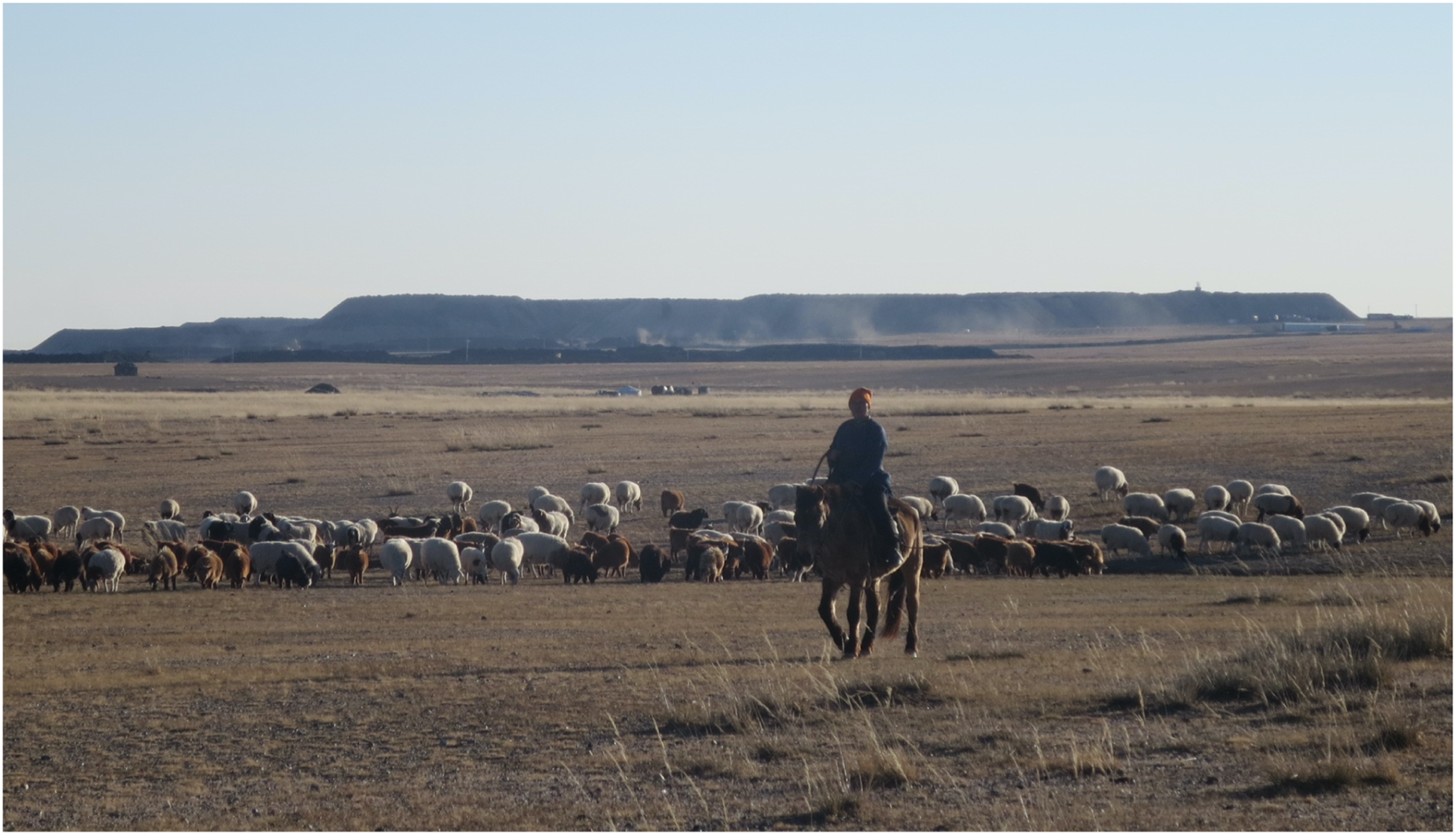
Research participants: Mongolian nomadic herders
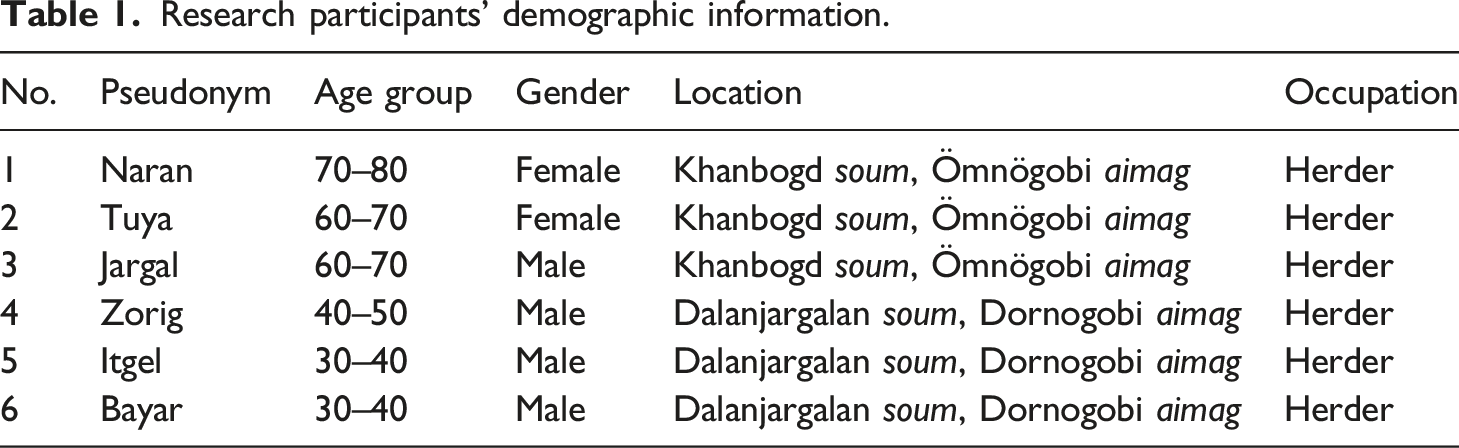
Research participants’ demographic information.
The discourse of loss of traditional land
Our data illustrates that the predominant discourse that emerged from storywork with Mongolian nomadic herders is loss of traditional land (nutag belcheer, nutag usgüi bolokh) induced by mining. The concept of nutag has a multiple, fluid and multi-scalar character, which embodies homeland, birthplace, territory and mother country. It also encompasses broader notions, such as nature, the environment, resources, origin, history, identity, sovereignty, authenticity and spirituality (Bumochir, 2019). Nutag also represents different ways of existing, imagining and relating of humans with non-human beings inhabiting the realm of nutag (Namsaraeva, 2020). It expresses the traditional or shamanistic belief that a specific land is possessed by ancestral spirits; hence, confined to a particular people (Bulag, 1998). The ritual of burying the placenta and umbilical cord after childbirth and the custom of naming the birthplace khüis or khüist (umbilical cord) signifies a conception that the human-birthplace relationship is natural. At the heart of the term nutag, there is a ritually embodied and naturalised relationship between human and nature (Bumochir, 2019). Nutag is, therefore, believed to be connected to one’s umbilical cord (khüin kholbootoi) (Bulag, 1998).
The territory in which herders live and nomadise is known as nutag (traditional land), which embodies a source of a holistic, spiritually and physically entwined, reciprocal and symbiotic relationship with land and the natural world, sense of belonging, attachment, culture, knowledge and identity. Herders’ nutag can be their mother country (ekh oron), province (aimag) and district (soum) of origin. Specifically, nutag pertains to the place where herders live within the district, the place of ger 5 encampments, the pastoral nomadic territory and the winter campsite (övöljöö), which is the sole location of dwelling formally declared by herders to the government. Herders’ nutag commonly encompasses the “birthplace” (törsön nutag), where their placenta and umbilical cord were buried. Herders do not leave their nutag, as they would no longer be safeguarded by spiritual deities of land and it is desirable to be buried there upon death (Marchina, 2021). Beyond the birthplace, törsön nutag comprises the seasonal pastureland inherited by herders under ancestral customary land tenure rights (Upton, 2009). Nutag, therefore, represents more than just a place, it embodies the special relationship herders uphold with spiritual deities of land, the natural world and other entities who live there (Marchina, 2021). Nevertheless, the mining boom in the past two decades, coupled with climate change impacts, have posed a major threat to herders’ nutag and natural resources essential for their livelihoods, rendering them increasingly vulnerable to displacement from their nutag and loss of their livelihood, while severing their special relationship and spiritual connection with their traditional land.
Forced displacement
Large-scale mining projects become sites for a profound clash of worldviews and conflicting conceptions over land as companies’ private property, and land as an IPLCs’ individual and collective relationship on which cultural and socio-economic survival depends. Such projects can amount to land grabbing as they run the risk of impoverishing already marginalised IPLCs through displacement from their traditional land and natural resources and dispossession of their livelihoods. Tensions between mining companies, states and IPLCs are characterised by an inherent power disparity, asymmetrical relationship, and a weak bargaining position of IPLCs vis-à-vis mining companies and states (Bhatt, 2020).
As discussed previously, Mongolia has voted in favour of the adoption of the UNDROP. It urges states to ensure that exploitation affecting the natural resources that local communities traditionally use is allowed based on social and environmental impact assessments, consultations and equitable sharing of benefits; provide legal recognition and protection of collective (and individual) rights to land and natural resources, including customary land tenure rights; and incorporate protections against displacement into national legislation. States must not arbitrarily or unlawfully displace local communities without providing access to legal protection and must provide fair and just compensation for losses when displacement is unavoidable (UNDROP, 2018).
Mining-induced forced displacement, including physical and economic displacement, was a common lived experience among Mongolian nomadic herders in Khanbogd soum, Ömnögobi aimag and Dalanjargalan soum, Dornogobi aimag. Development-induced displacement involves the exclusion of communities from critical uses of a specific area of land or other territory. Displacement can occur not only by the eviction or removal of communities from their homes and places of belonging (physical displacement), but also by the restriction or prohibition of established activities, including access to lands and natural resources, which communities depend on for their livelihoods (economic displacement) (Penz et al., 2011).
For Mongolian nomadic herders, the inherent power imbalance vis-à-vis mining companies and the state is evident as they are often made invisible and voiceless in the face of displacement and dispossession, neither informed, nor consulted, nor participate in decision-making prior to mineral exploration and mining projects affecting their traditional land and natural resources. The legal framework governing herders’ rights to information, consultation and participation in decision-making prior to mineral exploration and mining projects, development- and mining-induced displacement, resettlement and compensation is inadequate. As herder Itgel, Dalanjargalan soum, explains, “Herders only get to know that the mineral exploration is starting when the drilling equipment is installed. The government needs to inform and consult with local communities whether to announce the mineral exploration in our nutag before the exploration licence is granted.” He further describes, “When it comes to herders displaced by mining, how to deal with compensation becomes the matter between herders and mining companies. The companies decide at their own discretion whether and what form of compensation to provide to whom.”
Globally, development-induced displacement and resettlement strategies are predisposed to treat places as if they are interchangeable. The implication is that as long as the amenities are provided, any place is as good as any other and any livelihood would be suitable. This ignores the possibility that communities could suffer a loss based on their inability to be on the land from which they were displaced, or to engage in a specific livelihood in a particular place. Even as livelihoods are acknowledged as crucial in processes of displacement, they are treated as separable from land. Such an approach makes livelihoods reducible to incomes and devises them as independent of land. It stands in stark contrast to IPLCs’ entwined relationships with and embodied practices of living on their traditional lands, which cannot simply be transposed to or substituted with another place or a different livelihood (Scott and Smith, 2017). As herder Naran, Khanbogd soum, explains, “We did not resettle from our nutag because of compensation. We did not have any choice. On the one hand, they advised that it would be good for our mother country; on the other hand, we had to resettle under conditions of forced displacement. There is no herder who resettled because of compensation. Giving our nutag to someone else is beyond any compensation. We had to decide ourselves where to resettle. We were given one month; thus, we were anxious and decided to resettle closer to the soum due to our six children’s schooling. Back then, there was no chance to think about whether our herd animals would develop an attachment to another place.”
In the name of national development and economic growth, Mongolian nomadic herders endure loss of their traditional land (nutag belcheer, nutag usgüi bolokh) induced by mining. As herder Zorig, Dalanjargalan soum, states, “When mining projects commence, they are seen positively throughout the country because of increasing state tax proceeds. However, what also needs to be considered is how many herders, how much land and the natural world must be sacrificed to make them possible. They say that everything will proceed in accordance with the law. The law’s concept states that the national development foundation is the mining sector; thus, the law is committed to that purpose. Hence, it is a form of infringing on one’s right to fulfil another’s right.” He further explains, “Mining companies contend: ‘We are not taking anything from you, we are taking from the state, we have the right to conduct business here.’ However, herders are engaged in household business through animal husbandry. This is because the company pays more taxes and creates more jobs, what is happening is ‘survival of the fittest,’ which is an ongoing absolute disgrace for this democratic society.”
Herders’ lived experiences demonstrate that mining-induced forced displacement is not only an issue of individual human rights violations, but also of violations of collective rights to land and natural resources, including customary land tenure rights, and by extension, of the rights to water, food, health, culture, development, an adequate standard of living, and a safe, clean and healthy environment (UNDROP, 2018). The policy and legal framework protecting herders’ collective rights to land, including customary land tenure rights, and by extension, the pastoral nomadic lifeway and cultural heritage, is inadequate. Mongolian nomadic herders’ collective rights to land, including customary land tenure rights, require legal recognition and protection. As herder Zorig, Dalanjargalan soum, urges, “Common use pastureland and water resources shall be passed on to future generations without destroying them. Pastureland management must be effectively organised. When it comes to finding solutions, politicians and the legislature debate pastureland ownership, privatisation and enclosure. It is an assault on the pastoral nomadic way of life and cultural heritage. It is based on reproducing foreign practices. They do not contemplate the value of ancestral nutag and pastureland for herders; they only see them in economic, commodified and monetised terms. They do not consider the cultural heritage and the extent of violations of herders’ rights. The policy and legal framework must be developed based on rigorous research.”
Loss of livelihood
Mining-induced impacts brought about profound environmental, economic, cultural and social ramifications on Mongolian nomadic herders’ livelihoods, including herders’ loss of access to seasonal pastureland and water resources due to mining license area enclosure, mine-infrastructure and transportation roads, fragmentation of pastureland, herders’ diminishing mobility, flexibility and seasonal migration, overgrazing and pastureland degradation due to increased density of herd animals shared by herders affected by displacement, increasing competition over pastureland and water resources and community conflicts (Sternberg et al., 2022). As herder Naran, Khanbogd soum, explains, “The pastureland nutag has diminished. We had no choice but to resettle due to mining-induced physical displacement, however, other households have ostracised us for many years. They mistreat and label us that we got money in exchange for selling off our nutag to the mine. When we were displaced, our herd animals ran away back to their pastureland nutag, where they developed an attachment. We had to herd our animals back from afar by driving cars and motorcycles that require petrol. We suffered so much loss. There are so many issues that have not been considered, especially, our suffering from loss of pastureland nutag and water resources.” Another herder, Tuya, Khanbogd soum, describes, “The herder households that were affected by mining-induced physical displacement spread out in places where other herder households live. Sharing pastureland nutag with displaced herders and water scarcity for herd animals have led to a great deal of pressure and become a source of conflicts. Relationships among herders got damaged.”
In the South Gobi province, mining-induced radical transformation of waterscapes has greatly diminished herders’ access to common use surface and groundwater resources, resulting in growing contestations over access to water. Water infrastructure for mining represents the movement of water resources away from its environmentally, culturally, socially and spiritually embedded contexts towards water management practices that privilege the demands of national development, economic growth and company profits (Jackson, 2018). In the arid Gobi Desert region, surface water is scarce; herders and their herd animals depend on groundwater resources. Herders use traditional shallow hand wells and newly-introduced motorised deep wells. Striving to control scarce resources, herders started locking motorised deep wells. Locked wells are highly unfamiliar in Mongolia, where common use water resources are accessible to herders and the local authority is responsible for the well maintenance. Herders’ access to water, therefore, is reduced through physical (locked wells) and social (winter campsite delineation or requirement for permission) ways of control (Sternberg et al., 2022). Locked motorised deep wells, triggered by competition for access to scarce water resources, resulted in the de facto privatisation of common use groundwater resources. As herder Tuya, Khanbogd soum, explains, “The water level in our well is not enough for our herd animals anymore. Thus, we herd our animals five km away to water them. It requires a whole day of work. Since the mine started, water and pastureland issues have emerged. Herders, therefore, started locking their wells whether they want it or not.”
In the arid Gobi Desert region, dust produced by mining exacerbates other causes of dust, including climate change, overgrazing and land degradation. Dust from unpaved mining roads disconnects herders from their sense of belonging to a place, landscapes that sustain them, livelihoods that rely on pastureland and eventually endangers human and animal health (Jackson, 2015). As herder Bayar, Dalanjargalan soum, describes, “In our arid nutag, mine-transportation trucks with heavy loads of up to hundred tonnes generate soil degradation and dust. Pastureland, grass, plants, herd animal cashmere and wool are all covered in dust. Herder households living adjacent to mine-infrastructure and transportation roads suffer economic losses to their livelihoods and damages to their own and their herd animals’ health. Herd animals suffer lung diseases due to dust.” He further explains, “We are in hands of the ‘middleman’ (chenj) when we sell our produce, including meat, cashmere and wool. Cashmere is herders’ main source of income. Due to mining dust, our cashmere and wool are covered in so much dust. When middlemen check our cashmere, they say it has too much dust; thus, they undervalue it and buy at much lower prices.”
Notably, herders’ practices demonstrate that the notion of nutag is wholly transposable to herd animals. When on seasonal nomadic or daily journeys to reach pastureland and water resources, herders and herd animals habitually travel through their nutag, regularly pursuing the same routes. Like herders, herd animals develop a form of attachment to their nutag, which becomes evident in the attraction it exerts on them. Attachment to the nutag manifests itself when there is a definite change of dwelling, including when nomadic routes are altered. This attachment is not only due to a mechanical process of habituation, but also defined by herd animals’ intelligence (Marchina, 2021). Impacted by mining-induced displacement, herders emphasise their herd animals’ attachment to their nutag, alongside their own belonging and connection to their nutag. As herders Tuya and Jargal, Khanbogd soum, explain, “The five kinds of herd animal (tavan khoshuu mal) develop an attachment (nutagshikh) to their nutag. Herd animals will not grow an attachment to another place. Eventually, herders will lose even if they are paid high compensation. Herders will lose, who wish to raise their herd animals and pass on to future generations, if they are displaced from their nutag, no matter how high the compensation paid.” Likewise, herder Naran, Khanbogd soum, notes, “We do not easily abandon our nutag, where we belong, developed a connection all our lives, and our herd animals developed an attachment (ideeshikh) to their nutag as well.” Similarly, herder Bayar, Dalanjargalan soum, describes, “Herders in our bagh6 (subdistrict) had access to common use pastureland, however, not anymore. Nowadays, inside this dust, herd animals run away back to their pastureland nutag, where they developed an attachment (dasakh), which has now turned into mining sites and they are chased away. Even if we face mining-induced physical displacement, our herd animals developed an attachment to this winter pastureland, which is a beautiful valley with feathergrass (ders). If we resettle our winter campsite to the steppes, our herd animals cannot survive on the steppes during winter storms because they developed an attachment to this valley during winter.”
The compounded effects of global climate change and local mining-induced impacts threaten the survival of the pastoral nomadic lifeway and cultural heritage. Young herders are increasingly giving up this lifeway due to loss of access to their traditional land, including its pastureland and water resources, seeking out sedentary lifestyles in urban areas or mining sites. As herder Naran, Khanbogd soum, notes, “There are no more young herders. Because there is no water and no pastureland nutag. Young herders contemplate whether to struggle to live a suffering life like us, elderly herders. I do not know whether the pastoral nomadic culture will survive or end with us. It will depend on the state policies.”
Severing of spiritual connection
The severing of their special relationship and spiritual connection with their traditional land (nutag) is another dominant discourse that emerged from our storywork with Mongolian nomadic herders. Following ancestral Mongolian cosmology, the fate of humankind is inextricably interwoven with the fate of the natural world itself (Osornamjim, 2001). Accordingly, land, non-human beings and the natural world are living and sentient entities with identity, agency and intentionality, neither a resource nor a commodity to be owned and exploited, but revered, nurtured and sustained in a holistic, spiritually and physically entwined, reciprocal and symbiotic relationship. Not only herders’ livelihoods are lost by displacement, but also their special relationship and spiritual connection with their nutag is severed. As herder Zorig, Dalanjargalan soum, describes, “From birth, herders grow up learning the names of mountains, ritual cairns and water resources in their nutag. For herders, their nutag is like their father and mother, like their friends. Herders live dependent on Mother Earth (Ekh Delkhii) and the natural world. Herders, therefore, cherish Mother Earth and the natural world much more than anyone would, same as their own life.” He adds, “For herders, their nutag and pastureland are essential like the air. There may be no herder who would want to resettle from their nutag in exchange for compensation.”
According to ancestral Mongolian cosmology, spiritual deities preside over land and the natural world, emphasising that human claims to land are custodial rather than absolute. The masters or owners of the land (gazryn ezed) are spiritual deities believed to govern and oversee the climate and environment of each place in the natural world. Spiritual deities are honoured in worshipping ceremonies at ritual cairns (ovoo), which represent relations between human and supernatural powers connected with the land. Such ceremonies and rituals illustrate the concept that humans do not own the land as they do other possessions; instead, they must build relations with spiritual deities of land and the natural world to safeguard good conditions and the well-being of present and future generations (Sneath, 2018).
One of the rituals is sharing food, not only with the living but also and above all with deities and spirits, including the souls of the deceased. Offerings comprise the upper or first share, part, drop or taste (deej) of a drink, dish or product that is being made. Offerings are made inside or outside the ger, depending on whom the offering is intended for and the demands of the ritual. Each morning, a female head of a household makes enough milk tea to offer the first share of tea: she sprinkles (tsatsal) an offering (tsatslyn örgöl) to spiritual deities of land and the natural world outside the ger (Ruhlmann, 2019). As herder Zorig, Dalanjargalan soum, shares, “A herder’s morning starts with rekindling fire, making tea and offering the first share of tea (tsainy deej) to the sky, mountains, head deities of the landscape and nature spirits (lus savdag) of nutag to entrust everything and all engagements. Herders live dependent on Mother Earth and the natural world entwined within the harmony of sky and land.”
Ancestral Mongolian cosmology emphasises spiritual and practical interdependence between human and non-human entities. Spiritual deities’ inherent presence and role in everyday life are recognised, such as gazryn ezed (masters of the land), lus (head deities of the landscape), savdag (local nature spirits) and usan khan (water lords). They are omnipresent, omniscient and immortal; they own, govern and inhabit specific realms of the landscape, including mountains, rivers and forests. It is with respect to them that pursuits such as herding and mining are commonly deliberated locally. Since spiritual deities are believed to own and govern different domains of the landscape, practices such as disturbing the earth, digging the land, unearthing the subsoil and extracting its minerals are viewed to anger them. Acknowledging land and the natural world as having life, identity, agency and intentionality, taboos inform humans to abstain from activities that negate the existence of non-human beings. Identity, agency and intentionality are, therefore, not perceived as an exclusively human attribute, but a shared ability of human and non-human entities, interconnected and interdependent forces that together compose the natural world (High, 2017).
The transgression of taboos (khorio tseer) associated with worshipping the land and the natural world would therefore anger spiritual deities, thereby bringing natural disasters or other adversities to human and non-human beings. It is encapsulated in the Mongolian saying “spiritual deities would get furious, lives could be in trouble” (Osornamjim, 2001). As herder Itgel, Dalanjargalan soum, shares, “The mines exploit fluorspar (fluorite), which stores the earth moisture. It has angered head deities of the landscape and nature spirits (lus savdag khilegnekh). Consequently, there has been no rain, just dust storms. Presently, the rain that falls in June only falls in July. Usually, the rainfall is low to medium intensity that lasts a few days (zuser boroo); however, nowadays, the rainfall is more intense and shorter (aadar boroo), leading to floods.” Another herder Zorig, Dalanjargalan soum, notes, “Gold and other elements and minerals are regarded as holding the land together (gazryn gagnaas).”
Various taboos elucidate human relations with the land and disturbing the earth has been one of many taboos. Accordingly, the Mongolian ger has no foundations and is directly placed on the land, while traditional Mongolian boots have a smooth sole and the tip is curved upwards to prevent damaging the earth (Marchina, 2021). Although Mongolia is endowed with vast mineral resources, historical sources indicate a long-established aversion of Mongols to digging the land, unearthing the subsoil and extracting its minerals (High, 2017). In 1914, British observers asserted that the only gold mining venture in Mongolia, the Mongolore Mining, operated by a Russian investor, “was obliged to import Chinese labour from 1000 miles away, simply because the Mongols refused at any price to work the mines,” “the very nomad habits of the Mongols prevent them from ever becoming westernised,” and “a race that is too lazy to till the ground, and that looks upon trade as almost degrading, devoting itself cheerfully to obtaining its livelihood by the easy method of tending flocks and herds, could never be expected to adopt Western habits” (Perry-Ayscough and Otter-Barry, 1914: 4–5). British observers’ assumptions, therefore, evidence the profound misunderstanding of the pastoral nomadic lifeway and the disregard of a deep-seated aversion of Mongols to disturbing the earth and extracting its minerals (Endicott, 2012).
Discussion and conclusion
This study aims to expand the main theme of this Special Issue – the discourse of the Anthropocene – through the voices, stories and lived experiences of Mongolian nomadic herders. The compounded impacts of global climate change and local mining-induced pressures on herders’ traditional land (nutag) demonstrate that the Anthropocene – the epoch of human-induced planetary change – is here. Essential to the physical and cultural survival, and to the identity, knowledge and spirituality of IPLCs is their special relationships with their ancestral lands and the natural world. Land is not deemed to be the property of humans; land is believed to be ‘owning’ humans connected with it, as opposed to being owned by those humans. Disconnection from, destruction of, or loss of the capacity to influence the fate of one’s ancestral land signifies a profound threat: it represents not only loss of physical sustenance, but also of culture, identity and knowledge (O’Faircheallaigh, 2023).
In this vein, drawing upon the predominant discourse among Mongolian nomadic herders – loss of traditional land (nutag belcheer, nutag usgüi bolokh) – it is evident that they have become victims of both human-induced climate and environmental change and the neoliberal capitalist extractive economy. They are increasingly vulnerable to dispossession and marginalisation, driven by mining-induced forced displacement from their traditional land and natural resources on which they depend to sustain their way of life, resulting in the loss of their livelihood and severing of their special relationship and spiritual connection with their nutag. Concurrently, they are coping with climatic and ecological crises, such as winter disasters (dzud), land degradation, desertification, droughts and floods. Ultimately, more and more herders are giving up the pastoral nomadic lifeway and herder populations have been decreasing in the past two decades, evidencing their increasing sedentarisation and urbanisation. Declining herder populations could indicate the advance of a cultural tipping point, where the pastoral nomadic lifeway disappears as a livelihood; and culture, identity and traditional knowledge are lost or greatly reduced (Fernández-Giménez et al., 2017).
Crucially, Mongolian nomadic herders’ special relationship and spiritual connection with their traditional land is severed. Following ancestral Mongolian cosmology, the fate of humankind is inextricably interwoven with the fate of the natural world itself. The land does not belong to humans; humans belong to the land, which is embodied in the Mongolian proverb “humans, land and the natural world are connected through an umbilical cord” (“khün, gazar, baigal’ delkhii khüin kholbootoi”). Cherishing, glorifying and worshipping land and the natural world and obeying its laws have been fundamental to this worldview, which goes beyond contemporary notions of environmental protection. The aim of venerating land and the natural world is to gratify the spiritual deities who preside over it, entrust everything and ask for blessings for the well-being of nutag, herd animals, and present and future generations. For millennia, by way of such reverence, the harmony and balance between humankind and the natural world have been sustained (Osornamjim, 2001), which are at the heart of the health and continuity of both nature and culture. Accordingly, land, non-human beings and the natural world are living and sentient entities with identity, agency and intentionality, neither a resource nor a commodity to be owned and exploited, but revered, nurtured and sustained in a holistic, spiritually and physically entwined, reciprocal and symbiotic relationship. Once this special relationship with land is severed, the pastoral nomadic lifeway that is inextricably interwoven with land and the natural world, is also lost.
The voices, stories and lived experiences of Mongolian nomadic herders urge us to rethink the discourse of the Anthropocene through posthuman or more-than-human ways of understanding and interacting with the world, relearn our ancestral ways of knowing, being and doing, and reconnect to our holistic, spiritually and physically entwined, reciprocal and symbiotic relationship with land, non-human beings and the natural world. Ancestral Mongolian cosmology rejects nature-human, nature-culture dualisms and decentres human exceptionalism and dominant position in understanding and interacting with the world. It instead emphasises kinship with and custodianship of land, our non-human kin and the natural world. This onto-epistemology aligns with posthumanism, which urges us to reimagine the basic tenets of human interaction with the natural world, non-human entities and the planet Earth. Accordingly, herders remind us to engage in a holistic approach, which expands beyond Western anthropocentric views and acknowledge historically marginalised IPLCs’ onto-epistemologies.
We conclude that future studies of the discourse of the Anthropocene should be expanded and pluralised by focusing not only on the damaging impacts of global climate and environmental crises, but also on the devastating effects on IPLCs’ special relationships with their traditional lands and the natural world, and their land-connected ways of life and cultural heritage. The effective participation of IPLCs’ in decision-making about land and the natural world must be ensured, their knowledge systems must be acknowledged as critical to planetary sustainability and their voices must be heard in the discourse of the Anthropocene if we are committed to “walking the walk,” not just “talking the talk.” IPLCs hold long histories of place-based living and developed and accumulated time-honored traditions that produced sophisticated knowledge and practices about the world around them. IPLCs’ knowledge systems, transmitted through generations as ancestral wisdom, embody profound and reciprocal relationships with land, non-human entities and the natural world. IPLCs’ knowledge systems are an invaluable contribution to humankind’s heritage and an indispensable living repository of extensive information on how to protect life on the planet (Fernández-Llamazares et al., 2021). Societies have much to relearn from IPLCs’ responsible and ethical custodianship of land, non-human beings and the natural world. It is in the interest of the planet and its inhabitants that societies relearn what it entails to observe a kinship with, and act as custodians of the land, our non-human kin and the natural world and walk gently upon the planet Earth.
Finally, despite the global proliferation of transnational development projects in the extractive industries and other sectors in countries with a non-settler colonial history, such as Mongolia, there is a lack of research and policy advocacy examining the special vulnerability of land-connected, traditional local communities. In transnational mining projects that produce substantial and irreversible land disturbance, much greater emphasis must be put on recognising the special vulnerability of land-connected communities: a vulnerability and discrimination arising from their special relationship with their traditional lands. Such context-specific endeavours can advance the policy and legal framework in an inclusive and rights-compatible way by enhancing the visibility of land-connected communities that are intrinsically vulnerable to transnational development projects in diverse historical and geographical contexts (Bhatt, 2020). Mongolian nomadic herders’ collective rights to land, including customary land tenure rights, require legal recognition and protection to ensure that the pastoral nomadic way of life, cultural heritage, identity and ancestral Mongolian knowledge pass on to future generations.
Footnotes
Acknowledgements
We are deeply grateful to the Mongolian nomadic herders in Khanbogd soum, Ömnögobi aimag and Dalanjargalan soum, Dornogobi aimag, who generously shared their stories, knowledge and lived experiences and made this study possible.
Declaration of conflicting interests
The author(s) declared no potential conflicts of interest with respect to the research, authorship, and/or publication of this article.
Funding
The author(s) disclosed receipt of the following financial support for the research, authorship, and/or publication of this article: Deutscher Akademischer Austauschdienst (German Academic Exchange Service).

Data availability statement
Data sharing not applicable to this article as no datasets were generated or analyzed during the current study.