



Abstract
This article aims to explore the interrelation between post racialism, colorblind ideology, and the perception of Swedishness. Through 40 interviews and surveys conducted in Malmö, Sweden, participants were asked to reflect on race, ethnicity, and Swedishness. Multiple meanings were present in the participants’ responses, half of whom were white and half non-white. For white participants, boundaries around the in-group construction of ‘Swedishness’ were based in whiteness, yet these participants held overwhelmingly negative attitudes towards the use of words race or racialization. On the other hand, non-white participants viewed race and racialization with less negative connotations, yet they also endorsed the need to be white in order to be perceived as being Swedish. The results support the notion that abandonment of the word race does not always equate to an abandonment of whiteness. This article builds upon and expands previous findings in the U.S. context while contributing to an emerging body of literature on race and racialization in Sweden. Additionally, it seeks to challenge dominant narratives and assumptions of 'Swedishness' and its connection to whiteness.
Keywords
Introduction
In 2008, the word race was not included in the anti-discrimination legislation in Sweden (Diskrimineringslag (2008: 567)). The rationale behind this was that the removal of the word race would delegitimize the biological construct of race, a process which has been on-going in Sweden for several decades. However, some scholars have questioned whether such harsh measures obfuscate a layperson’s understanding of race as a social construction (Hübinette and Lundström, 2014). A desire to move beyond race as a social category constitutes a post racial ideology (Goldberg, 2015). Post racialism denotes a contextual, temporal space where the concept of race is no longer needed and exhibits ‘racial nonracialism’, meaning that the historical legacy of race is ignored (Goldberg, 2015). Post racialism can collaborate with colorblind ideology theoretically which has two tenants: (1) color evasion, or the downplaying or refutation of racial differences by promoting similarity between the race and (2) power evasion, or the emphasizing of equal opportunities as a denial of racism (Neville et al., 2013). However, post racial (Goldberg, 2015) and colorblind attitudes held by individuals can produce negative societal effects by dismissing race as the mechanism behind racism and obscuring efforts to dismantle structural oppression (Bonilla-Silva, 2015).
Social categorizations relating to race and ethnicity are fraught in Swedish legislation. There are no official statistics on racial or ethnic identifications, rather only on country of origin/birth and country of citizenship (Statistics Sweden, 2022). Individuals whose parents were born abroad are classified as ‘having a foreign background’, yet these distinctions are not registered for third generation individuals. These structural impediments hinder the exploration of the racial and ethnic backgrounds of individuals on a demographic level, as researchers are left to infer these identifications. In 2018, the UN criticized Sweden for not having accurate population data and formally suggested for anonymous ethnic and racial self-identifications be collected (Committee on the Elimination of Racial Discrimination, 2018). Despite the limitations with population data, Sweden is undoubtedly becoming more and more ethnically and racially diverse. Data from Statistics Sweden, the official statistics bureau, shows that 14% of the gross population have at least one parent with a foreign background, and 67% of those individuals with at least one foreign parent is 35 or younger (Statistics Sweden, 2022). Multiple migration waves have occurred since the end of WW2: war survivors and refugees; labor migrants from Finland and southern Europe; humanitarian migration from those fleeing dictatorships, war, ethnic cleansing and other crises in Latin America, the Middle East, and Africa (Behtoui et al., 2019), as well as free movement within the EU (Emilsson and Adolfsson, 2019). All of these have increased ethnic and racial diversity within Sweden.
Sweden frames itself as an egalitarian, democratically centered nation (Heinö, 2009) and therefore societal problems like racisms and the effects of power and oppression are discussed and even researched. The government has continued to reaffirm anti-racism as a priority (Government Offices of Sweden, 2017). However, contradictions found at the structural level seep into these discussions. Race is often critiqued as a categorical label which promotes essentialism (e.g., Wolgast and Wolgast, 2021), or the belief that groups exhibit stable and fixed characteristics (Haslam et al., 2000). Yet, wariness around the concept of race is not seen as a barrier to discussing or researching racism. The irony of presenting race gingerly, as to not promote historical hierarchies of power, is indicative of a much larger complication within Swedish society, namely, the juxtaposition between the utilizations of terms which give voice to the realities of the system of race, while simultaneously denying that support for that system’s legacy is productive. This reflects ‘racial non-racialism’ (Goldberg, 2015) or the misconception that the historical legacy of race can be avoided simply by not using the word race (McEachrane, 2018).
Despite arguments against racial categories, the idea of in and out groups (Tajfel, 1974; Tajfel and Turner, 1979) within Sweden has been studied extensively. Bodies of research have highlighted the issues of societal exclusion faced by those not considered ‘fully’ Swedish. Grouping variables for this research vary depending on the discipline. For example, ethnic groups like Poles (Shmulyar Gréen et al., 2021), Somalis (Scuzzarello and Carlson, 2018), Turks (Virta et al., 2004), and others; religious groups like Muslims (Bursell, 2012) who are often understood also as refugees (Lundström, 2017); and second-generation individuals (Moinian, 2009), even race (Adolfsson, 2021). In some these previous studies ‘Swedes’ are framed as the comparison group. However, the composition of this group is difficult to ascertain when relying on population statistics. Due to the implicit whiteness associated with Swedishness (Hübinette and Lundström, 2014), based in the historical presumption of the ‘pure Nordic race’ (Ericsson, 2021), the reproductions of a ‘Swedish’ in-group reinforce the assumption of whiteness. It is unsurprising, then, that previous studies have shown that white individuals in Sweden are more likely to be appraised as Swedish (Adolfsson, 2021).
Sweden constitutes an interesting, potentially contradicting study of post racial and colorblind ideology. Although research has explored the process of ‘those looking in’ (i.e. out-group members), less research has been conducted on ‘those looking out’ (i.e. in-group members). This article aims to inquire about individuals’ feelings towards the word race, both theoretically and empirically, recognizing that these feelings may not be experienced equally by members of different races. It seeks to address questions regarding how race functions as a mechanism in group formations in Sweden, despite being controversial concept. Additionally, this article aims to challenge the privileges associated with whiteness when the concept of race is denied.
The data in this work was collected in Malmö, Sweden and includes participants who self-identify as white and non-white, both ethnically and non-ethnically Swedish. Through surveys and interviews, 40 research participants were asked to reflect on the constructs of race, ethnicity, and Swedishness. The analysis showed white participants were more likely to seek distance from the word race, which provoked negative emotions, although they self-identified racially. For non-white participants, multifaceted ideas around race matched their own self identifications. The experience of being non-white in Sweden gave non-white participants a clearer vantage point toward understanding the dynamics of race as well as their own racial identity. However, white participants were less attuned to these intersections. Rather, the invisibility of their whiteness colored their contextualization of race; noticing race - in others - is what racists do.
Theoretical framework on racial identities and relations
From a social psychological standpoint, race and ethnicity can be conceived as variables within an individual’s life which exist within the personal and structural (Markus, 2008), personally integrated but also existing as systems outside the individual (Lange and Westin, 1985). Race and ethnicity are often integral elements of group formation (Hunt et al., 2000). Structures in society reinforce these identities as well as creating disparate outcomes for persons who inhabit different categorizations (Hunt et al., 2000; Lange and Westin, 1985). Ethnicity can be defined in many ways but often definitions of ethnicity focus on kinship which can take the form of shared customs, practices, religion, and language (Phinney et al., 2001), and often is equated to origin, making ethnicity a strong group construction (Verkuyten, 2004). Race, which was once conceptualized as biological but has since been disproven, also has multiple definitions many of which include two interwoven factors: the phenotypic and the system(s) or structures of society (Smedley and Smedley, 2005). Race has also been described as ‘the curtailment of one’s life choices’ (Goldberg, 2015) and a ‘system of power’ (Lentin, 2020). Race and ethnicity have always overlapped in definition and are often colloquially used interchangeably (Suyemoto et al., 2020). Therefore, there can exist a myriad of groups based on a variety of combinations of either ethnicity and/or race, including possible combinations of ethicized racial groups, or racialized ethnic groups. Categorizations and identifications pertaining to both race and ethnicity are bound to the temporal, contextual and political (Goldberg, 2015, 2020). Further, these are defining, important ways that individuals create and are assigned identities.
Although all ethnic and racial identities are important for the individual, white racial identity and whiteness are particularly important for this work. Whiteness has been described as ‘invisible’ (Bonilla-Silva, 2015, 2018), ‘worldly’ (Ahmed, 2007), unquestioned (Feagin, 2020) and a maintenance of social power (Suchet, 2014). Used together or in different constellations, these elements contribute to the overt or underlying belief that ‘white’ is synonymous with ‘normal, neutral, and good’ (Feagin, 2020), suggesting a hegemonic ideology (Lentin, 2020). Critical race and whiteness scholars often present whiteness as a socially constructed identity, akin to and derived from race, lastingly linked to privilege, power, and oppression (Suchet, 2014). White privilege is a term which describes the advantages that white persons have in society, whether realized or not (Mcintosh, 1990). Previous research has shown how white persons often see themselves as ‘raceless’ (Goldberg, 2015). Studies on urban elite white women found that they do not identify as white, and do not want to be associated with racial terms (Frankenberg, 1993). In part, this speaks to the ways in which individuals are taught to ‘think through race’ all while inhabiting ‘racially identified bod(ies), thinking as a self that is racially positioned in society’ (Frankenberg, 1993: 142).
Identity is problematized within the social sciences as being vague and holding several conceptual meanings (see Brubaker and Cooper, 2000). However, identity remains a primary focus and is often postulated as an explananda in social science research (Lange and Westin, 1985). Although a myriad of identity related theories exists, there are two main branches; ‘self-defined and other-defined’. Self-defined theories take an individual’s ability to define themselves, or their locus of control, as the primary mechanism, whereas other-defined theories focus on how persons are assigned or ascribed individual or collective-bound identities (ibid). In the same way that groups are composed of individuals, and therefore no group can be said to exist as completely homogenous, all individuals are simultaneously connected to their own private psyche and are inhabitants of a variety of different groups (McGarty, 2009).I have chosen Social Identity Theory (SIT) as the identity framework for this article due to its malleability. Originally, SIT focused on the interrelation of salient social categories and group identification as the basis for understanding the conditions for intergroup discrimination when the groups were similar and relevant to one another (Tajfel, 1974). Therefore, SIT provides an important vantage point for understanding ‘irrational discrimination in terms of fundamental social psychological processes’ (Rubin and Hewstone, 1998: 40), because it allows for the study of phenomena from interpersonal, contextual, and historical perspectives. In this work, ‘in-group’ will be used to refer to the majority racial and ethnic group in Swedish society, which is coded as white and ethnically Swedish (Hübinette and Lundström, 2014) and ‘out-group’ will be used to discuss the experiences of individuals who have not been considered a part of the majority in-group.
In this work, I use the concept of everyday racism from Essed (2014) to discuss the interactional, daily racisms experienced by individuals. I also use Goldberg’s definition of racism as a relational process between individuals (2009). Psychological research often orients racist attitudes at the individual level (See Markus, 2008 for an overview), however, structural inequalities and systems of oppression or domination are group problems (Essed, 2014), even if a given individual does not harbor racist views. When the eugenics movement failed to establish biological differences between the races, and in the light of the Holocaust, doubt surrounding the idea race began to increase across Europe (Mulinari and Neergaard, 2017) and terms like race became replaced by terms like ethnic identity. Creating a psychological distance away from ‘race’ towards ethnicity has helped reinforce the underlying assumption that individuals are blind to race, and that by not noticing it, they are being inherently less susceptible to racist thoughts. This is a pilar of colorblind ideology (Neville et al., 2000, 2013; Bonilla-Silva, 2015, 2018). This is due to the mistaken assumption that acknowledging race legitimizes biological theories of race (McEachrane, 2018), which is especially prevalent in the Swedish context. Post racialism coexists with these aspects of racial denial and colorblindness, as it further reinforces the notion that societies have moved past the need for race as a social construction. In this work, I operationalize post racialism as an individual’s dismissal or disregard for the concept or use of the word race. This operationalization is an adaption of Goldberg’s (2015) definition, which frames post racialism as ‘racial non-racialism’ or the acknowledging of past racisms while promoting the idea that these are no longer present for the same targets of that historical racism. Therefore, my operationalization of post racialism is distinct from colorblind ideology in that it promotes the rejection of the theoretical concept of race.
Within the Swedish context, the word racialization (rasifiering) is preferred to the word race (ras). Omi and Winant (2014) define racialization as “the extension of racial meaning to a previously racially unclassified relationship, social practice or group” (p. 64). The Swedish national encyclopedia defines racialization as, ‘a term used to emphasize that the perception of people as belonging to different races is a construct rather than a biological fact’ (Nationalencyklopedin, accessed 2022). The differences between these two definitions could be perceived as relating to ‘genesis of difference’. Omi and Winant utilize racialization to highlight the procedural nature of race and how it is influenced by history and context, emphasizing that it does not need to be exclusively applied on humans. The Swedish national definition orients itself as a re-wording of ‘race is a social construct’. Within academia in Sweden, racialization (rasifiering) or racialized (rasifierad) are the preferred terms to use when discussing individuals of different racial identities (e.g., Mulinari and Neergaard, 2017; Schierup et al., 2018). Relevantly, the word racialization was used in lieu of race in the survey portion of the data which will be presented below and was intermixed with the word race in the interviews.
Racial relations in the Swedish context
Sweden is an ethnically and racially diverse nation, yet when speaking about that diversity, one can become tongue-tied. Migration streams since WW2 have increased ethnic and racial diversity (Behtoui et al., 2019). Yet, hyphenated identities are uncommon in the Swedish context, which is mirrored in Western Europe (Simonsen, 2016, 2017). Previous research has found that those persons considered to be a part of the ‘second-generation’ often refer to themselves as migrants and that this is prominent across different ethnic and racial groups (Trondman, 2006; Behtoui, 2021). Scholars have described Sweden as hegemonically white, positioning this as the mechanism that hinders the validation of Swedish identities claimed by non-white or multi-racial persons (Hübinette and Lundström, 2014). In Sweden, but also the rest of the Nordics and Europe, there exists a ‘sleight of hand’, meaning that ‘as soon as race appears as a semiotics of difference, (…) it disappears as a social discourse (Skinner, 2022: 9). This is because race is perceived as unnecessary or even something that should not exist, leading to a reluctance to discuss it McEachrane, 2018; Hubientte and Lundstrom, 2014; Skinner, 2022). As a result, in lieu of race, signs of differences are easier to discuss with terms like immigrant, or even foreigner, despite the potential inaccuracies in this language.
Method
The analysis in this article is based on data collected through a survey and semi-structured interviews. The data was collected as part of an experiment examining the perception of Sweden and Swedishness through tourism advertisements and facial images. The experiment consisted of three blocks, and I use data from the second and third block.
In the first block of the experiment, participants were shown different pictures of scenery within Sweden as well as faces of different races. After viewing the facial photographs, participants were asked to answer the following question: ‘How Swedish do you feel this face is?’. Participants were then asked to ascribe racial categories to the faces they had seen. In the second experimental block, participants answered survey questions, including the colorblind racism scale, designed to assess racism and racial dynamics denial (CoBras; Neville et al., 2000) as well as open ended questions where participants were prompted to define their own race and ethnic identities, and what these words meant to them. Finally, participants entered the third block of the experiment where the debriefing interviews were conducted, giving participants the space to reflect on how the experiment had made them feel The length of the interviews varied from 8 to 22 min. The first two blocks were conducted in Swedish and the third was conducted in English.
Interviews were held in a separate room from other parts of the experiment. After being greeted, participants were told that they would be asked a few questions about the experiment, in the form of an exit interview. Participants took part voluntarily, understood that they could discontinue the interview or refuse to answer certain questions, and consented to the interviews being recorded. I positioned myself as a researcher who was a part of the experimental team, looking for reactions to and personal interpretations of the experiment by participants. Therefore, I was not positioned as a ‘neutral observer’ but rather as a person ‘explicitly involved’ in the research (Frankberg, 1993: 30). This created a power dynamic which is standard: I asked questions which were answered. Participants were encouraged to ask questions if they wished, but very few did. Of those that did, their questions concerned an overall explanation of the research project which I answered as thoroughly as possible. Moreover, as a researcher, my own ethnic and racially identifications are important for not only my framing of this work but also for how I was perceived by the participants within this study. I self-identify as ethnically Swedish and Italian and racially as white. Although having Swedish heritage, I was born and raised in the United States and am coded in a Swedish space as being non-Swedish. Despite understanding and speaking conversational Swedish, the interview portions of this experiment were conducted in my mother-tongue English, which positioned myself as an outsider to participants. This was intended to encourage participants to explicate and educate me on the racial dynamics within Swedish society.
The study was conducted in September 2020. A total of 40 respondents (29 of them female) with an age span between 18 and 50 years participated in the study. All respondents were enrolled in educational programs in college/university level at the time of the study, with 34 enrolled in social science majors. Twenty-two students were pre-recruited, and 19 students were recruited on spot at the Malmö University. One participant did not attend their experiment appointment. The students were compensated with a 100 SEK (10 USD) gift certificate for their participation. The population of the study was chosen due to time and cost restraints. However, university students are representative in terms of within-country comparability, meaning they represent the attitudes of their age and demographic group.. Additionally, this study was interested in how a participant’s racial identity impacts their personal views, so participants from the same environment can be viewed as representing a small microcosm of thoughts, attitudes, and beliefs. The study was approved by the Swedish Ethical Review board (Etikprövningsmyndigheten).
Data used in this article contains participants’ self-identified ethnic and racial identifications, layman definitions of race and ethnicity, as well as interview material. The open-ended survey questions were answered in Swedish. In the experiment, the word racialized was used as an equivalent term for race. However, in the interviews both ras (race) and racialization/racialized were used. Participants were given the opportunity to reflect on how these words made them feel, and they were then prompted to explore those emotional connections. Interviews were semi-structured. Sample questions included: How did you feel about the use of the word ‘racialization’ in the experiment? How do you feel about the word race? Do you consider yourself Swedish? Who do you feel is Swedish? What does the word race mean to you? Follow-up questions and clarifications were asked based on the participants answers. This created a conversational dialogue between interviewer and participant.
Data analysis consisted of three steps. First, groups of participants were created based upon self-reported racial and ethnic identities. As I was interested in the differences between Swedish majority in-group and minority out-group members, through participant self-report, I created two groups: a white, ethnically Swedish group and non-white participant group. Throughout the rest of the analysis, I examined the data through the parameters of these two groupings. The parameters of these groups, especially their limitations, will be discussed later in this work. Secondly, I examined responses to two open-ended survey questions: What does the word racialization mean to you (Vad betyder ordet rasifiering för dig?) and what does the word ethnicity mean to you (Vad betyder ordet etnicitet för dig?). Finally, I used thematic analyses to explore the interview material.
Thematic analysis, as described by Clarke (2015), was selected as the appropriate method for analysis of the interview material, in part due its flexibility and theoretical malleability. In essence, two thematic analyses were completed. The initial analysis was guided by the research question, in which focuses on exploring participants’ understandings of race and racialization in relation to post racialist and colorblind ideologies. Therefore, a theoretical thematic analysis was conducted. The coding was expressly linked to the frequency of post racial/colorblind framing within participant’s discussions, as feelings towards race and racialization were coded and then related to the aforementioned theories. Secondly, an inductive thematic analysis was used to explore participants’ feelings towards Swedishness. Here, themes were not theoretically driven, but rather data driven. However, because my data set was already spilt into two groups, coding was used to identify different themes within the interviews but also between interview groups, which were checked for consistency and revised throughout this process. 1 The themes developed from coding were meant to represent the data and the participants while seeking to analyze and interpret key concepts presented. Finally, data extracts were pulled from the material to highlight and illuminate analytic claims. Data presented in this sample is only a snapshot of a much larger range of phenomena, and therefore is not generalizable.
Reported racial and ethnic identifications
In the survey portion of the experiment, respondents were asked to self-identify their racial background. For racial self-identification, participants were able to select as many categories/groups as they felt resonated with them. There was no option for open-ended response to avoid non-responses or colorblind identifications like ‘human race’. The options available were: White/European, Asian, Middle Eastern, Black/African, and Mixed. Twenty-four participants selected White/European, constituting the largest group. Other groups found in the sample were: Middle Eastern (n = 7), Black/African (n = 1), Mixed (n = 1). The Asian mixed and white mixed groups, represented in table one, are amalgamations of individuals who selected multiple racial groups. The Asian mixed group consisted of four persons (Asian/Middle Eastern, n = 2; Asian/White/Mixed, n = 2). The white mixed group consisted of three persons (White/Middle Eastern/Mixed, n =1; White/Black/Mixed, n = 1; White/Middle Eastern/Black/Mixed, n =1). The categories offered to participants were meant to represent racial or racialized identities common to the Swedish space, which were based off on implied racial identities associated with the countries of origin of different migrant groups in Sweden over the past several decades (SCB, 2022). As argued earlier in this work, the crudeness of these categories is a limitation of the ways in which racial and ethnic identities registered in Sweden. Additionally, a lack of open-ended response limited the participants’ ability to define themselves in perhaps more creative ways yet enabled clearer racial identifications for the purpose of analysis. The implications of the racial categories offered in the survey will be discussed later in this article.
Participants self identified ethnicity by racial identity.
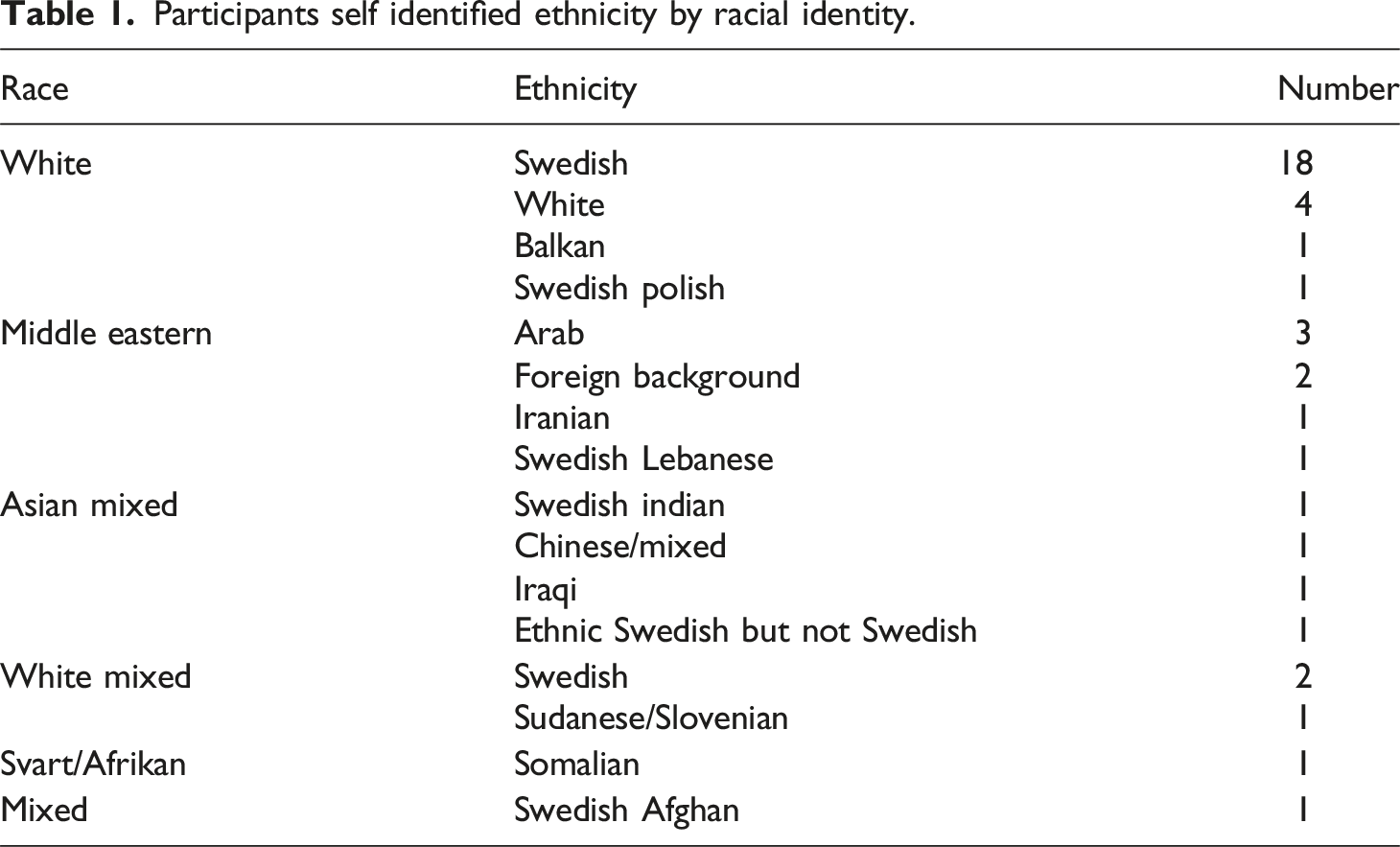
The largest claimed ethnic identity was ‘Swedish’, and although most participants who designated their ethnicity as Swedish also self-identified as white, some non-white participants also identified themselves as Swedish. Four participants marked their ethnicity as ‘white’, and this was the only racial identity also indicated as an ethnicity. Seven participants indicated a mixed ethnic identity like ‘Swedish Afghan’ or ‘Sudanese/Slovenian’. One participant marked ‘ethnic Swedish but not Swedish’, possibly suggesting a conflict in the identity. Although the rationale behind this answer is unclear, it conveys a reticence towards being singularly identified as ethnically Swedish. These responses suggest the presence of different hyphenated identities within Sweden, which previous research has found to be less common (Simonsen, 2016, 2017).
Based on these ethnic and racial identifications, a so-called Swedish majority in-group was operationalized containing individuals who self-identified as white (either racially or ethnically) and Swedish. The remaining participants constituted a supposed minority out-group, including those individuals who racially identified as white but not Swedish or those who identified themselves as non-white but ethnically Swedish. The degree to which the participants would have agreed with these classifications is unknown. However, within the interviews participants did affirm inclusion or an exclusion to the majority group. Therefore, the creation of these two participant groups were seen as representing the societal dynamic inherent to my research interests.
Participants’ definitions of race and ethnicity
Open ended survey answers were examined to determine subjective understandings of racialization and ethnicity. As race and ethnicity are often conflated (Suyemoto et al., 2020), answers to both questions were seen as having relevance to how participants understood their own identifications. Interpersonal understandings of complex terms like race/racialization and ethnicity are multifaceted, the full range of which is outside of the scope of this work. However, to build a more coherent picture of the participants and how they saw themselves, answers to these survey question will be briefly presented below.
For non-white participants, definitions of the word racialization (Vad betyder ordet rasifiering för dig?) took on meanings associated with categorization, identifications, and appraisals of race. These responses tended to be more process driven, mentioning that racialization was the act of identifying a person with a race, rather than feeling that racialization was simply a proxy term for race. For some participants, this process was additionally associated with discrimination. For example: Kim, self-identified Swedish Indian, Asian Mixed, aged 21 wrote: ‘To draw attention to someone's race, for better or worse. But the word has a negative connotation. (Att dra uppmärksamhet till någons ras, på gott och ont. Men ordet har en negativ klang)’ Here, Kim highlights how racialization is different to race, as well as being a potential mechanism for intolerance or everyday racism. These definitions were in-line with previous results found within the US context (Suyemoto et al., 2020), suggesting that non-white Swedes have similar associations to these terms as do Americans.
Definitions of ethnicity (Vad betyder ordet etnicitet för dig?) for this group predominantly mentioned traditions, culture, and identity. These semantic associations mirror commonly accepted social science definitions of ethnicity (Suyemoto et al., 2020). Interestingly, responses were also associated with mobility and migration. Maria, self-identified Iraqi, Asian Mixed, aged 20 wrote: ‘That your family, your origin is something other than the place you were born. (Att ens familj, ens ursprung är av annat än det land man föddes i)’. This reflects a self-referential experience of feeling ethnically different from the majority, perhaps by being a second generation individual.
For white participants, definitions of racialization were strongly tied to skin color, racism, deviations from the majority or whiteness, and ethnicity. Similarly, to the non-white participants, racialization was often associated with an active process like categorizing another individual. However, white participants were less likely to endorse race as the mechanism by which individuals were identified or classified within the process. Instead, skin color and ethnicity were used. This is in-line with racial non-racialism (Goldberg, 2015) or colorblind ideology (Bonilla-Silva, 2015) in that proxies are used to subvert and avoid race. Unlike the non-white participants, white participants were less likely to see themselves in the racialization process. For example, Stina, self-identified as ethnically and racially white, aged 31 wrote, ‘To distinguish someone from whites. Can be done due to racism and can be used as a word to talk about the process that is happening. (Att skilja någon från vita. Kan göras pga rasism och kan användas som ord för att prata om processen som händer)’. For Stina, racialization is processual but unidirectional, from whites to others which mirrors previous results found in the US context (Frankenberg, 1993).
Ethnicity for white participants held themes of geography, genetics, and background. These definitions were somewhat like non-white participants’ answers and involved facets commonly associated with social science definitions (Suyemoto et al., 2020). Although for white participants, ethnicity was framed as relating to biology (i.e. genes) and origin. Theo, self-identified as ethnically Scandinavian and racially white, aged 26, wrote, ‘Ancestor’s place of origin (Förfäders ursprungsplats)’. Theo’s response highlights a genealogic theme found in many white participants answers, which unlike Maria’s response does not include a migratory element.
Emotional responses
Overall, individuals within the white Swedish group expressed more trepidation around endorsing or using the word race then non-white participants. For white participants, a variety of negative valanced emotions were associated with the theoretical and empirical concepts of race or racialization. This means negatively valanced reactions were present in both the idea of race, and what some participants called racialization (theoretical) as well as observation of racial identity in others (empirical). However, white participants’ empirical conceptualizations of race were appraisal-based, towards others rather than themselves. A latent theme presented was the belief that race, or racialization was explicitly tied to racism or being a racist. The interrelation between racism, race, and negativity was bound to the fundamental belief that by using the term race or the concept of either race or racialization, racism would flourish or that individuals who notice race are racists. Ida, self-identifying as White and Swedish, aged 21, said: ’I obviously think about racism. I mean I’m a white, privileged person in society, so for myself I don’t feel (racialized) so much. But I feel for my friends and others that I know are victims of these words. When you use this word (race) there is a certain group of people, if you want to call them a group I don’t know, that might be hurt. So, it’s not a positive word for me, definitely not.’
For Ida, using the word race or, possibly, identifying someone’s race could be potentially offensive for them. However, Ida also expresses an awareness not only of her own race, but her social position as well. This contradiction, between not acknowledging race but endorsing whiteness, was present for many respondents. Although quick to recognize their own whiteness, these participants did not see a need to also abandon their own whiteness in pursuit of non-racialism, nor did they believe that the process of racialization included becoming white. Instead, race and racialization took on meanings that were only applied to non-whites. This suggests an awareness of race in others, meaning that often, despite a desire to be colorblind, white participants did notice race in others. Additionally, Ida attempts to disentangle an essentialist view of race. Using race to identify a group could be offensive to individuals because a group based upon race might not be real. Again, Ida was aware of her own racial group identity however and understood that being apart of this group accompanied privilege. Similar results have been found in the US, where white women have desired distance from the concept of race, despite wanting to embody anti-racist ideals (Frankenberg, 1993).
Negativity towards the theoretical concept of race also took the form of hesitancy and aversion. For example, Iris, self-identified White Swede, aged 26 stated: ’I just think it is unnecessary, that word should not exist.’
Iris’s response is a direct endorsement of non-racialism (Goldberg, 2015). Like Ida, Iris feels negatively about the theoretical concept of race but unlike Ida, she does not see any need for the concept to be used. Iris holds post racialist beliefs in that she dismisses the need for word race. This is different but adjacent to colorblindness, in that we do not know whether Iris claims to notice race or not but rather the theoretical concept of race is disavowed. For some of these participants, their negativity around the concept of race was more than just pessimistic, it was adversarial. Johan, self-identified White Swede, aged 27: ‘I think it’s the same as the ‘n-word’, for example.’
Equating a racial slur to the word race exemplifies how extremely negatively some participants felt. For most of the white participants, the word race was uncomfortable and evoked unpleasant associations. This also mirrors the previous results found in the US context (Suyemoto et al., 2020). These participants felt that the word race or racialization carried such weight, that it was too burdensome to even be used. In this way, the theoretical concept of race, or the word itself, was associated with racism or being a racist. The hostility and anger associated with racial epithets was akin to the negative emotions evoked by the word race.
Conversely, for non-white participants, race and racialization were concepts that evoked neutral, ambivalent, or positive associations. For these participants, there was dynamism when discussing meanings around these terms, both theoretically and empirically. Rather than having a dichotomous reaction, these participants saw a gray area. For example, Sarah, self-identified Iranian, White Mixed, said: ‘Anyone can choose not to (racialize) someone, but you still do it. Like, even if you don’t want to, you still do it. Because it just comes naturally like ‘What is this person?’ Like you can choose to say ‘You are an Arab’, in a bad way. But you could just say ‘Oh, you are an Arab’, in a good way. It all has a different meaning depending on how you choose to use it.’
Sarah describes something akin to automatic processing different racial backgrounds. In her description, there is a lack of shame in observing someone’s race, which she feels is normal. This is different to the feelings of the white participants who were more likely to express discomfort in the same circumstances. Sarah also sees how racial acknowledgment from others can be operationalized in either a positive or negative way. Therefore, race as a theoretical concept was seen as context dependent, and the empirical concept could be utilized in different capacities, spanning from bigoted to affirming.
Non-white participants were more likely to see themselves within discussions of race and racialization than non-white participants. For example, Eva, self-identified Swedish-Afghan, Asian Mixed, who stated: ’Like I said, I see myself as Swedish-Afghan. If I want to ‘racialize myself’, that means that I am Swedish-Afghan.’
Here, Eva uses racialization to affirm her identity. Through this process she gives voice to different facets of herself, both her Swedish and Afghani side. It is unclear how positively Eva views this process, but her ownership over her own identification evokes power and confidence. She is deciding who she is and how she wants to be referred to. Further, ‘Swedishness’ often holds dual meanings of both ethnicity and nationality. Previous research has shown that non-white persons in Sweden would self identify as ‘immigrants’ despite being born in the country (Behtoui et al., 2019), suggesting a linear process of identity with whiteness as an ethnic marker, which connotes Swedishness. It is ambiguous whether Eva sees herself as ethnically or nationally Swedish, or both. Either way, Eva chooses to identify herself as Swedish through the process of racialization.
Some non-white participants were still uneasy about how these terms should be theoretically applied both within their own lives and in society. In part, this was based in uncertainty or ambivalence. However, these participants still exuded an indelibleness towards the concept of race. Moa, 24, self-identified as Sudanese and Swedish, White Mixed, stated: ’I don’t think it matters how I feel, it’s something that exists. Even though Sweden might be more progressive or have more progress in many ways compared to other countries, those issues definitely exist, but I don’t have a general feeling toward the term (race) because (…) people haven’t really put a label on me. I have always just been, for the most part, treated like I’m part of Sweden or like I was Swedish.’
Moa communicates a clear differentiation between her own subjective understanding and patterns of racism and oppression within Swedish society. This is an important insight, because it communicates that despite her privilege of not feeling excluded, she understands this has not been afforded to all. For Moa, her ambivalence towards the theoretical concepts of race and racialization do not prevent her understanding of the empirical interconnection with racism and the perpetuation of bias within society. In this way, Moa helps us see a need for racial and ethnic identifications in Sweden: to better understand a multiplicity of attitudes held by members of different racial or ethnic groups.
Feelings of Swedishness
In the interviews, participants were also asked how they defined Swedishness, both within themselves and others. White participants were more likely to espouse an intrinsic belief about their own Swedishness, meaning that it represented something inherent to them. For these respondents what makes them Swedish was not about what is visible but what you feel or something internal such as experiences or values. Stina, aged 31, self-identifying as White Swede stated: ’I was born here, my parents are born here, and I was raised here… I mean, people looked at me like I was Swedish, so I was raised as being told I was Swedish. Kind of like, being raised a girl, people tell me that I am a girl and then I behave like that, yeah.’
Stina describes a performative function of group membership: she inhabits her Swedish identity by conforming to group standards. This embodiment of the Swedish in-group is also derived from other in-group members agreeing and encouraging this identification in Stina. By feeling that she was ‘looked at’ as being Swedish, Stina describes an appraisal that is available to her, in part because of her race and other identity signals. Stina’s answer also communicates the invisibility of her own whiteness and the hegemonic whiteness associated with Swedishness. Whiteness in this way is learned and naturalized (Frankenberg, 1993). Stina’s race was not a barrier to her inclusion to the in-group, rather it was unquestioned, perhaps even essentialized (Haslam et al., 2000). This was not the case for non-white participants, whose race or non-whiteness mattered to their potential in-group claiming.
For non-white participants, the degree to which they identified with the label of ‘Swedish’ varied based on a variety of factors, like growing up in a diverse place or being ethnically or racially mixed. These participants held an idea of Swedish identification that was scaled: at times they felt more Swedish than they did at other moments. This is inline with SIT and multiple spheres of identity (Tajfel and Turner, 1979). Clara, self-identified Chinese, Asian mixed, aged 21 describes her interaction over her lifetime with Swedishness: ‘Since my mother is from China, I do often identify myself as Chinese. Because I don’t think I have felt like I am Swedish in a way. Maybe when I was younger, but I didn’t understand a lot of things. But I felt like I was different after I grew up, from many other Swedes or those who at least call themselves Swedes. (…) I don’t know what exactly made me feel like I wasn’t accepted, or super like a Swede in a way.’
Clara describes how her feelings of Swedishness have changed throughout her lifetime, morphing into a salient adult identity. Here, Swedishness is not performed or ratified by others. The feeling of in-group belongingness that Clara inhabited when she was younger stands at a contrast to how she feels now, as an adult. This insight is truncated by Clara’s lack of understanding of why she feels at distance to other Swedes. However, as Clara has aged, she has been exposed to a greater number of behaviors which have pushed her from the in-group to feeling as if she is a part of an out-group. This lack of inclusion could be due to a variety of factors, including her racial and ethnic identities.
Being Swedish
Both white and non-white participants validated the preexisting stereotype of a white, blonde, blue-eyed person as a typical Swede. For both groups, this stereotype was a foundational way that participants identified others as being Swedish. In this way, across racial groups, participants essentialized the group identity of Swedishness (Haslam et al., 2000). Ulrika, self-identified Swedish, White Mixed, aged 28, said: ‘So, for me, someone who is Swedish is someone who is light-skinned, blonde hair, or light hair at least. That’s how I would say that Swedish people identify other Swedish people. I see myself as a Swede, but I am half Swedish and half Egyptian. And I always had an issue because I grew up with my mom who is Swedish, that’s why I identify myself as Swedish. I don’t know anything about Egypt or the culture, or that part of my life. But always when someone asks me ‘Are you Swedish?’, or ‘Where are you from?’ and I answer that I am Swedish, they always say ‘Oh, you look kind of exotic’. So, then I must start explaining (…) more or less my whole life, why I’m not Swedish.’
Ulrika’s personal experience describes the interaction between the feeling of Swedishness and a lack of appraisal. Here, being seen as ‘exotic’ is akin to being non-white. Unlike white participants whose Swedishness was unquestioned, in part due to the invisibility of their whiteness, Ulrika is visible. Ulrika’s mixed background allows her to embrace multiple identities, of which she feels more aligned with claiming her Swedishness. However, this claiming is not ratified by other in-group members, and therefore places Ulrika in the out-group. This exclusion from the in-group is then fortified by requests for an explanation of her identity, which serve to substantiate her claims of Swedishness. For Ulrika, in this process she responds by having to give voice to the ways in which she is not Swedish, rather than the ways that she is. Many previous studies have found similar effects for participants of many different social categories (e.g. Virta et al., 2004; Behtoui et al., 2019; Adolfsson, 2021).
Despite a lack of appraisal, both white and non-white participant’s felt many types of people could claim a national Swedish identity. Especially for white participants, claiming Swedish national identity was framed as being available to those who wanted it. Linda, self-identified as ethnically and racially White, aged 33: ‘I think, for me it means that you just live in Sweden, wanting to live in Sweden, wanting to be a part of our culture, our traditions, and just finding Sweden as a place you want to stay. Make a living, make a home.’
Linda, like other white participants, emphasizes active participation to affirm belongingness in Sweden as well as power evasion, or the promotion of equal opportunities for members of all races. This is a form of colorblind ideology (Bonilla-Silva, 2015), specifically downplaying the barriers that exist for non-white persons who wish to claim Swedishness. In contrast to Ulrika’s answer, Linda suggests perhaps an unattainable norm for a non-white person in Swedish society to reach. Despite Ulrika's feelings of being Swedish and her desire to be seen as Swedish, like her mother, she has still been excluded from the in-group, even though it is how she self-identifies. These quotes highlight the tension between how different members of racial groups can claim Swedishness and whether that Swedishness is confirmed by majority in-group members.
Conclusion
According to Goldberg (2015), post racialism is the latest version of racism, representing a new wave in perpetuating the ideology of racial hierarchy. Alongside colorblindness, the psychological distance from the concept of race can lead to confusion regarding the most effective approach to dismantling racism (Bonilla-Silva, 2015). In Sweden, the aversion to the concept of race has resulted in the blurring of boundaries regarding in-group membership through vague language, which in the absence of terms like race, reaffirms whiteness as a prerequisite for belongingness (Hübinette and Lundström, 2014). This study’s data confirms that non-white persons know this and are excluded either actively or passively within Swedish society. For white Swedes, attitudes towards race and racialization, ranging from hesitation to detachment or even adversarial views, significantly influence the perception of Swedishness. Namely, race and racialization are terms that are disliked and yet, stereotypes around Swedishness still involve whiteness.
It is unsurprising that the stereotype of a white, blonde, blue eyed Swedish appearance was so often used a reference type for participants in this study. This speaks to the strength and salience of this archetype, and the group essentialization of Swedishness. It is also unsurprising that non-white persons and white persons alike validated the of idea of multiple spheres of identity: namely, that an individual could be both ethnically or nationally Swedish (e.g. Adolfsson, 2021; Verkuyten et al., 2019). For non-white individuals however, this duality matched with their multifaceted ideas of ethnicity and race. Non-white participants in this study saw race and racialization to be a functional categorization of an identity. The idea of race was rooted in social construction, given meaning contextually and existed not only in the color of someone’s skin. For non-white participants, the idea of another person using the social construction of race as a method to define or calcify a type of identity was neutral or provoked an ambivalent response. Some of these participants felt that racial identifications were a positive method of identity, connected to personal pride.
However, for the white participants, there existed a slight contradiction. On the one hand, race and racialization were words connected to negative emotions. These participants expressed hesitation and uncomfortability around the use of these words and reflected a post racial aversion to these constructs. Namely, feeling that race and racialization were words that should not exist and were as offensive as racial slurs. However, this aversion did not stop these same participants from using whiteness to define themselves, their own identity, and to ratify the stereotyped appearance of a Swede. In this way, their own whiteness evoked what Frankenberg has called the ‘givenness’ of whiteness (1993, pp. 236). This interaction shows the inherent confusion of race within Sweden: it is a word that becomes synonymous with non-whiteness. When describing their own ethnic group, a race-bound stereotype was easily utilized and upheld for white participants. Although these same participants did agree that they saw Sweden was a place with a variety of cultures and that national identification was open to non-whites, they still ratified a traditional stereotype that was intrinsic to themselves. Despite their negativity towards the concept of race, it was a primary way that these participants saw themselves and others within their in-group. Further, through unquestioning of their own status as white persons, they held up a construction of whiteness which is common, as it signifies dominance, normativity, and privilege (Frankenberg, 1993).
A limitation in this work is the degree to which participants understood the difference between race and racialization. Several participants indicated that they had not heard of the word racialization previously. The specificity of these terms is academically important, but within this context, participants and the researcher were engaged in discussions that related to both race and racialization, sometimes interchangeably, even if the participant did not know this. In this article, I have used both terms and tried to represent the answers of the participants as authentically as possible. Future work in Sweden could benefit from attempting to disentangle these. Additionally, participants’ knowledge and understanding of concepts like whiteness and race were discussed in the interviews either implicitly or tacitly. However, future work could benefit from more explicit conversations about participants definitions. Further, participants were asked to racially identify based on previously identified categories. This served as a method for participants to identify and not abstain from answering in an open-ended format. However, in pre-selecting racial categories, participants were then limited to specific choices. Racial categories chosen for this study were based on represented groups commonly found within Swedish society, based on official statistics data (SCB, 2022). Some of the categories offered, like Middle Eastern, are the representation of a racialized ethnic group (Murji and Solomos, 2015).
This article critically examined the ways in which post racial beliefs on an individual level uphold strict barriers to in-group inclusion. Within Sweden, one such barrier is whiteness. This is reflected on the individual level as well. Within this work, white participants expressed negative views related to both race and racialization. However, as the analysis has shown, acknowledgement of whiteness or being white as racial identity is still ratified, thereby creating an unequal power structure where non-whiteness is discouraged from being acknowledged while whiteness is implicitly tied to Swedishness. This article adds to the understanding of how post racialism intersects with personal identifications and adds to the growing body of race and ethnic studies in Sweden. As well, it expands the scholarship on whiteness and broadens the geographical scope by examining how white racial identity influences the social norms, values, and power structures in Sweden.
Footnotes
Acknowledgements
The data analyzed in this article was collected as part of the research project Turismens roll i multikulturella samhället – TiMS (The role of tourism in multicultural societies). I am grateful to Sayaka Osanami Törngren for the opportunity to participate in the project, as well as Marcus Nyström for his help during data collection.
Declaration of conflicting interests
The author(s) declared no potential conflicts of interest with respect to the research, authorship, and/or publication of this article.
Funding
The author(s) disclosed receipt of the following financial support for the research, authorship, and/or publication of this article: This work was supported by the Svenska Forskningsrådet Formas (2018-02236).
