




Abstract
In the last decade, the spread of the violence became one of the most worrying phenomena in the Palestinian Arab community in Israel. This article focuses on the violence where victims and offenders come from Palestinian Arab community in Israel. Its purpose is to review the attitudes of the public figures in the Jewish and the Palestinian Arab communities of the country regarding the violence in the latter community through the lens of the conspiracy and the cultural violence theories. The review shows that some leaders of the Palestinian Arab community tend to refer to the persistence of violence and crime in their community in a cospirative way. Their key claim is that the state authorities intentionally neglect this phenomenon and possibly have some sinister goal behind this way of conduction. In contrast, public representatives of the Jewish community tend to refer to the persistence of violence and crime in Palestinian Arab community in cultural terms. Their key claim is that violence in Palestinian Arab community is deeply rooted in the culture of this community. The review suggests that the attitudes reflect the discourse around the “blaming the victim” concept, whereas representatives of the hegemonic Jewish majority use this tactic in their cultural violence rhetoric, and representatives of the dispossessed Palestinian Arab minority complain against it using the conspiracy beliefs. The review is concluded with broad implications for the Israeli society.
Introduction
Violence is a phenomenon existing in various forms in every country of the world (‘Ali, 2014). However, societies all over the world differ in their reactions to violence, the extent of its acceptance, and the ways in which they understand, explain and treat violence (‘Ali and Lewin-Chen, 2019). Most of the research on violence focuses on understanding the causes and the motives of violent and criminal behaviors, as well as their consequences of on personal and/or collective behavior, health, and other aspects of individual and community life. Yet, despite all the efforts invested in studying this domain, the research is still far from reaching definite, consistent and conclusive results that can contribute to development of policy directed towards mitigation or prevention of violence.
The rates, the extent, and the dimensions of crime in Israel are similar to those of the other Organization for Economic Cooperation and Development (OECD) member-countries. In 2019, Israel was ranked in the middle of the spectrum with respect to rate and number of suspects arrested and convicted, as well as numbers of victims of violence (Gazal-Ayal and Eisenband, 2019). The latter issue is critical for the country’s minority populations. To demonstrate, members of Palestinian community in Israel (hereinafter: Palestinian Arab citizens), who fell victims of violence, accounted for 65% of the overall number of people who were killed in crimes committed across Israel in 2019 (‘Ali et al., 2020). In 2022, 112 Palestinian Arab citizens victims were killed 1 .
Whereas violence has extensively been discussed as a phenomenon on individual or community level, less is known what is the nature of the public discourse on violence taking place in minority communities. This review introduces the attitudes of representatives of the two major communities in the country, Jewish and Palestinian Arab, using the conspiracy theory and the theory of cultural violence as analytical tools. To clarify, the term Palestinian Arab citizens refers here to members of the Arab-speaking ethno-religious minority groups residing inside the “Green line” in Israel. Consequently, the community these citizens belong to will be referred to as Palestinian Arab community. These terms do not include Palestinians residing in the Gaza Strip and Palestinian Authority as the overwhelming majority of them do not possess Israeli citizenship and do not take part in violence occurring in the Palestinian Arab community in Israel. To clarify further, the article refers to the violence which involves offenders and victims who Palestinian Arab citizens, i.e. intraethnic interpersonal violence. Therefore, police, interethnic, and political violence are beyond the scope of the current study’s discussion.
Palestinian Arab citizens of Israel
Before delving into the issues discussed in the article, a brief description of the Palestinian Arab citizens is provided. This population represents a notable ethnic minority in Israel, compiling 17.2% (1.6 million people) or 21.1% (about 1.96 million people) if including Palestinians of East Jerusalem in this count, out of about 9.3 million Israelis (Inter Agency Task Force, 2022). For historical reasons (Ariely, 2021), the overwhelming majority, 90%, of Palestinian Arab citizens reside in separate localities (Shdema and Martin, 2022). Palestinian Arab citizen population is heterogeneous in terms of religious and cultural background, being comprised of Moslems (82.9%), Druze (9.2%), and Christians (7.9%). The proportions of Palestinian Arab citizens belonging to these religious backgrounds significantly vary between the regions of the country (InterAgency Task Force, 2022).
The war of 1948-the War of Independence for the Jews and the Nakba for the Palestinians-created a new situation in which the Palestinian Arab community underwent a complete transformation, including its status, which was shaped by the tragic circumstances of war, destruction, evacuation, and coercion (‘Ali, 2019).
Today, adult Palestinian Arab citizens are granted the country’s full citizenship (Rekhess, 2014), having a right to vote in local and national elections, to serve in state institutions (Hitman, 2021), to legally obtain healthcare (Daoud et al., 2018) exactly as Israeli citizens of other ethnic/immigrant backgrounds. However, their social, cultural, and political inclusion is highly limited while policy of exclusion is widely expressed and employed (Ariely, 2021). For example, political parties of Palestinian Arab citizens have always been a part of the opposition in the Knesset, while only following the 2021 elections, one party (RAAM) entered the governing coalition for the first time in the modern history of Israel (‘Ali, 2022). Palestinian Arab citizens are oftentimes negatively portrayed in traditional and new media outlets (Shomron and Schejter, 2021). In addition, numerous laws were legislated to preserve Jewish hegemony and Palestinian Arab citizens subordinance (Shdema and Martin, 2022). Palestinian Arab citizens tend to be discriminated or treated in a non-just way in various domains such as resources and budgets allocation, healthcare (Saabneh, 2015), housing solutions (Totry-Fakhoury and Alfasi, 2017), occupation and income (Shomron and Schejter, 2021), state institutions-citizen relationships (Hassanein, 2016) and more. Possibly as a result of it, compared to Jewish citizens, they tend to express lower satisfaction with or trust in public institutions: police (Mentovich et al., 2020) or government (Pinchas-Mizrachi et al., 2020), although expressing more favorable views of the healthcare (Pinchas-Mizrachi et al., 2020) and the social security (Ariely, 2021) systems.
Closely related to the topics of the study, in many cases the violence arises, Palestinian Arab citizens practice conflict resolution outside the legal system, i.e. by using sulha (for the definition and the typology of this practice-see Shahar, 2021) or turning to other sources, although a majority of them claimed that they would turn to police in case of victimization (‘Ali and Rosenberg, 2022).
Literature review
Violence
Abu Halawa (2016) maintains that violence is an ancient and a renewed human practice, thus, its meanings and definitions depend on the visions, philosophies, and methodologies used for its understanding throughout the ages and decades. Philosophers and political scientists conceptualize violence as “physical and/or psychological harm and injury caused by direct, and, in some cases, intentional action through the application of vigorous or extreme physical force.” (Parsons, 2007: p. 174). Serious physical violence includes notable physical damage to others' body, use of weapons or restraints (Massarwi and Khoury-Kassarbi, 2017). Al-Nassiri (2017) claims that violent incidents do not emerge unless there is a material stimulus that supports its emergence and spread. Violence encompasses dehumanization of the victims and exclusion of others from the competition arena, by means of either reducing them to the dependent or subordinate status, or their total elimination from the arena of power through their moral or physical liquidation (‘Ali, 2014a).
Are minorities over-represented in crime?
This question was raised by Gordon et al. (2014). They attempted to understand whether minorities are victims of segregation by the penal system due to racial profiling, or whether other reasons-cultural, economic, genetic, among others-can explain their over-representation in violent activity. The authors noted that in almost every Western country, members of several minority groups are disproportionately more likely to be arrested and convicted. For instance, Blacks and Latinos are about seven times more likely to be incarcerated in the United States than Whites. In England and Wales, this applies to the following minority groups: Blacks, Asians, Arabs, and South Americans. In Sweden, it applies to the residents of Eastern European origins. In the USA, it applies to African Americans. According to the report issued by Uniform Crime Reporting Program in 2015, African American residents made up 12.7% of the population, but in that year they were arrested for 37% of violent crimes, including murder and non-negligent manslaughter, forcible rape, robbery and aggravated assault (Federal Bureau of Investigations, 2015). In 2016, African Americans comprised 27% of all individuals arrested in the United States. African American youth accounted for 15% of all children in the country, yet made up 35% of juvenile arrests in that year (Puzzanchera et al., 2017). In addition, African Americans were incarcerated in local jails at a 3.5 times higher rate than non-Hispanic Whites in 2016 (The Sentencing Project, 2018). 2
The intraethnic violence is also highly pronounced in minority populations. In the US, between 1976 and 2005, 94% of African American victims of homicide were killed by their co-ethnics (Fox and Zawitz, 1999; Latzer, 2018). Between 2012 and 2015, over 63% of nonlethal violent crimes with African American victims involved co-ethnic perpetrators (Latzer, 2018; Morgan, 2017).
Violence and crime in the Palestinian Arab community in Israel: Statistical data
Intraethnic violence is also evident in Israel. This type of violence has become a phenomenon of major concern in the localities populated by Palestinian Arab citizens. Numerous incidents of physical violence, shootings, murders, domestic violence, intimate partner violence, property destruction or damage or armed robbery taking place on a daily basis. As a result of its elevated rate, violence has become a factor endangering personal and collective safety and weakening and dismantling the social structures of the entire community (‘Ali et al., 2020).
Generally said, Palestinian Arab citizens are overrepresented in crime. Their rates in crimes, especially those encompassing physical damage (murder or attempt to murder), are five times higher than in Jewish population of the country. In some other types of crime, for example, illegal caring or transporting weapons, the differences between the rates of the two population groups are even bigger (see Hassanein, 2016). According to the data published by the Information and Research Center of the Knesset, although the Palestinian Arab citizens constitute less than one fifth of the total country population, they are suspected to be responsible for 82% of the murders in the country, and for 56% of murder attempts where incidents of illegal use of weapons were registered. The data also indicates that the number of cases where firearms violations has remained stable in the Jewish population group throughout the recent years but has increased among the non-Jewish population groups from 1,645 in 2015 to 2,205 in 2019, an increase of 34% (Yachimovich-Cohen, 2020).
In 2020, beyond the large number of severe injuries caused by shooting and stabbing incidents, the number of murders in the Palestinian Arab community in Israel reached 96 cases, constituting about 65% of the murder cases in Israel in that year. It seems that this number increases the general feeling of personal and collective insecurity throughout the community (‘Ali et al., 2020). On a political level, both Palestinian Arab and Jewish public figures accuse each other of the spread of violence, without taking any responsibility, or providing particular solutions to mitigate the spread of violence.
Data collected by the Aman Center, The Arab Center for Fighting against Violence, show that 1,581 Palestinian Arab citizens have been killed since 2000 (Aman Center, 2021). The year 2000 was the year of the uprising of the Palestinians in Israel, which resulted in the murder of 13 citizens by the Israeli security forces. The year 2000 uprising was influential for the deterioration in the state of violence and crime, as will be clarified later.
Figure 1 shows the scope of the violence in this community throughout the previous decade. The number of victims among Palestinian Arab citizens of Israel, 2010-2020.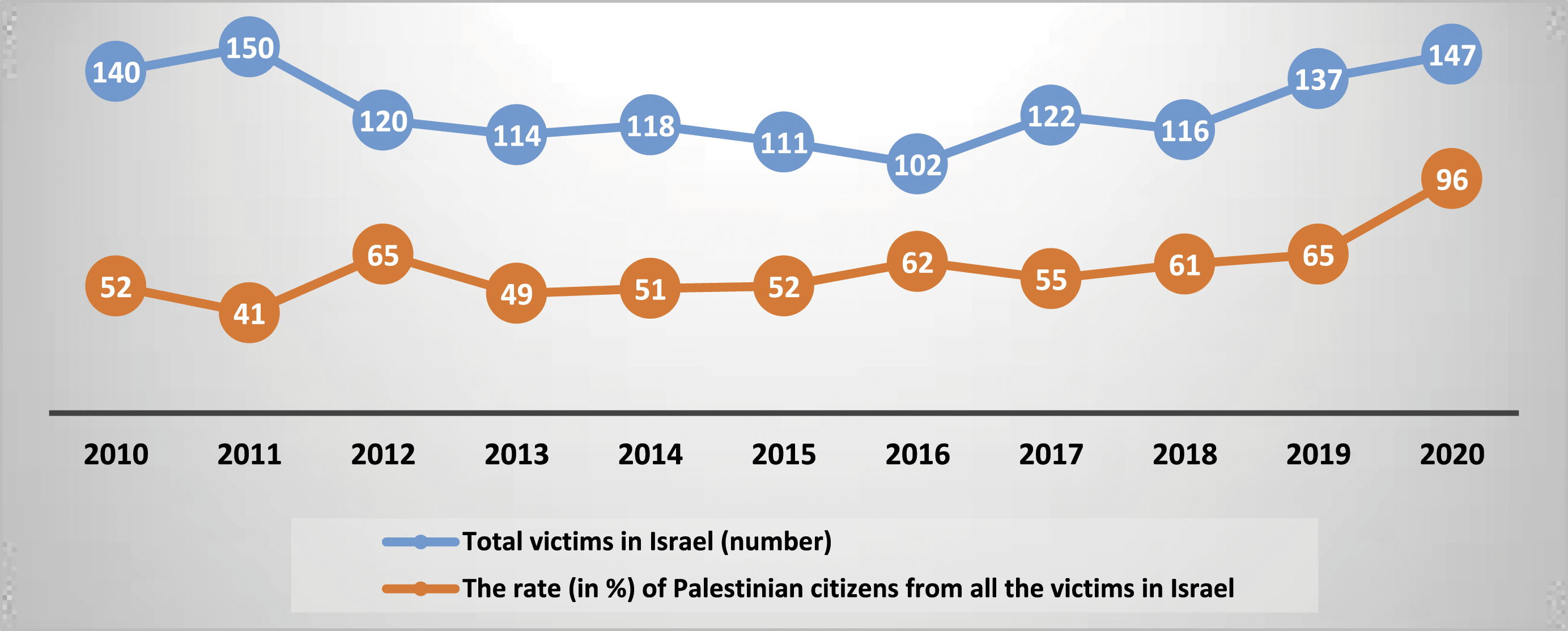
The data shows a concerning rise in the number of Palestinian Arab citizens killed every year, especially since 2017. According to another data, approximately 83% of the killings were carried out by means of using firearms (Abraham Initiatives, 2021).
Factors contributing to violence and crime in the Palestinian Arab community in Israel
Violence in Palestinian Arab community in Israel did not emerge out of nowhere; it has many origins which can be grouped into two categories. The structural-institutional causes are directly linked to the (non-)performance of the state authorities, its policies, institutions, and (mis)treatment of the Palestinian Arab minority. The internal causes are related to the transitions in the social, cultural, economic, and political structures and institutions of the community itself.
Structural-institutional factors
(a) Decades of lacking the fair and the adequate police services which are reflected in the over- and underpolicing in Israel’s Palestinian Arab localities (Ben-Porat, 2021). Palestinian Arab citizens have been suffering from the limited police intervention into the mitigation of criminal activity, poor law enforcement efforts, slow response to reports, insufficient efforts directed toward the resolution of conflicts. Insufficient training of the staff and limited resources are invested to address issues of violence and crime across the localities populated by Palestinian Arab citizens. The strict criteria for recruitment to the police force, which prevent young Palestinian Arabs from serving in the police force are also worth of noting. On the other hand, the police do not hesitate to use excessive force against them when they are involved in protests or breach public order (Ben-Porat, 2021). (b) Poverty and unemployment-a direct relationship exists between economic hardship and the levels of violence. More than a half of the male Palestinian Arab citizens are employed in low-skill and low-status occupations (Miaari et al., 2020). In terms of poverty, Palestinian Arab families can be considered the poorest, with the highest share of families with poverty by net income (38.9% in 2019 and 38.2% in 2020) among the three main economic groups (Non-Haredi Jewish, Haredi, and Palestinian Arab). Among the poor population of Israel in 2020, after the transfer payments and direct taxes, 40.2% of individuals and 32.6% of families were Palestinian Arab (Endeweld et al., 2021). In general, the vast majority of localities populated by Palestinian Arab citizens only rank at the bottom of the socio-economic scale (Birenbaum-Carmeli and Chassida, 2020), and suffer from a noticeable lack of development, poor education and welfare services and a low-quality infrastructure (Levy, 2020). (c) Low presence of civic services-almost all localities of the Palestinian Arab community in Israel suffer from low scope or lack of basic services such as hospitals, public transportation hubs, fire and first aid stations, and governmental offices (Hasisi, 2007; Saada et al., 2018). (d) Limited capital and bank credit-naturally, development, business initiatives, trade, construction and so forth require capital and bank credit (Saada et al., 2018). Unfortunately, these resources are insufficiently available in the localities populated by Palestinian Arab citizens. Therefore, although some of them legally obtain loans from the banks for consumption and mortgage (Shami, 2019), many others resort to high-interest loans which is a huge burden and risk on the entire community, especially when these loans are not paid in time, leading to the use of violent methods of debt collection, extortion, protection fees, and more (ibid). (e) Protest, alienation and despair-the high rates of crime in Palestinian Arab group, alongside other expressions of law disobedience, may sometimes be seen as the methods of protest against the state, its identity, authority, and social stratification system. Resorting to such methods is likely to be a result of the deep sense of hopelessness and a lack of collective vision and goals inside this population group (Agnon, 2006; 'Ali, 2019; Landau, 2015). Most of Palestinian Arab citizens do not perceive themselves as Israelis (Alfasi, 2014). Levels of institutional trust is typically lower in Palestinian Arab than in Jewish citizens of Israel (Mentovich et al., 2020; Pinchas-Mizrachi et al., 2020). (f) Elimination of crime in Jewish localities-the effective methods of fighting against violence and organized crime in Jewish localities by the law enforcement authorities did not eliminate violence there but rather pushed it outside-to the localities populated by Palestinian Arab citizens. In these localities, law enforcement is poor and ineffective, like in the case of areas such as the Triangle and Wadi Ara. Therefore, Palestinian Arab neighborhoods in the so-called mixed cities (for definition-see Goldblatt and Omer, 2014) became the main and the preferred areas for criminal activities (‘Ali et al., 2020). An abundance of firearms and their widespread illegal use in localities populated by Palestinian Arab citizens of the country must also be mentioned (Ben-Porat, 2021). (g) Failure to activate the youth-nearly 40% of young adults (aged 18–22) in Palestinian Arab community of Israel are unemployed, nor they are affiliated with educational frameworks. High school graduates in this community face uncertain futures, limited job opportunities, lack of vocational training frameworks, and are underprepared for the academic studies (‘Ali and Daas, 2018). Furthermore, their local surroundings lack public centers, sports, and entertainment facilities. All these factors and conditions create widespread sense of boredom in Palestinian Arab young adults, which constitute fertile grounds for the growth of antisocial behaviors.
Internal factors
(a) Conflict over resources, mainly land and jobs-Palestinian Arab community in Israel experiences severe shortage in the land. Whereas this segment of population has grown 11 times since the establishment of Israel, the municipal areas of localities populated by them were shortened 10 times (Toutry-Fakhoury and Alfasi, 2017), resulting in their overcrowding (Ben-Porat, 2021). Due to the shortage of land available for housing, as well as to increase in standard of living and the willingness to escape from the traditional way of life, many Palestinian Arab citizens were forced to leave their hometowns and settle in mixed localities (Diab et al., 2021). Similarly, the scarce availability of jobs and positions in the Palestinian Arab community in the country increases the tough competition for them. In some cases, such competition leads to conflict not only between the individuals but also between the entire families (‘Ali and Lewin-Chen, 2019). Moreover, many of the conflicts that take place during the periods of local government elections are not actually related to ideological differences (Saada et al., 2018). (b) Internal shifts and changes in social structures-Palestinian Arab community in Israel is referred to as a collectivist one and characterized by praising tradition, preserving rigid hierarchy, and caring about the community welfare (Abbas and Mesch, 2018). Yet, like many minority societies around the world, this community undergoes rapid modernization, including increasing contacts with the Jewish population, greater consumption of new media, and an increase in level of education (Abbas and Mesch, 2015). This shift is faced with controversy and resistance that is sometimes manifested violently, especially towards those who challenge the traditional patriarchal lifestyle or gender gaps that exist in the community.
The erosion of family order and authority is one of the main manifestations of these cultural shifts. Extended families are replaced with nuclear ones, with respective changes in residential patterns (Manor, 2018). Also, intergenerational gaps emerge, whereas younger people tend to embrace Western values, whereas their older counterparts remain devoted to the traditional modus vivendi (Massarwi and Khoury-Kassarbi, 2017). This erosion of family leads to the situation when conflicts, that used to be resolved previously by mayors, legal persons, or reconciliation committees, are now easily turned into interfamily clashes involving multiple participants. Similarly, individualistic behavior demonstrated by many (young) people contributes to the decrease in group attachment, which inevitably leads to the loss of means for supervision and informal social control.
Conspiracy theory
The term conspiracy refers to a set of beliefs according to which power actors plot some sinister goal while covering up information and advancing their own interests (Marinthe et al., 2020). Power actors can refer to individuals, groups or organizations (Constantinou et al., 2021). The example of conspiracy beliefs is the perception of COVID-19 as a hoax or thinking that Bill Gates has created some microdevice that is injected when vaccinating against the virus (Hebel-Sela et al., 2022b).
Conspiracy beliefs appear out of uncertainty (Bacon and Taylor, 2021). The prevalence of the conspiracy beliefs increases in times of major social crises when the uncertainty and the general fear overwhelm the social space (Pivetti et al., 2021). Anxiety, feeling of powerlessness, and sense of lacking control over situation typically contribute to elevated conspiracy beliefs (Constantinou et al., 2021). The ongoing escalation of violence in Palestinian Arab community and its decline in the Jewish community, provoked different reactions, interpretations, and theories regarding the initiation of violent behavior. Social disorganization inside the Palestinian Arab community has paved the way for many Palestinian Arab citizens to adopt conspiracy beliefs.
Conspiracy beliefs tend to appear where the intergroup conflicts take place (Hebel-Sela et al., 2022a). In general, intergroup conflict is characterized by two dynamic processes: favoring the ingroup and perceiving the outgroup as a source of threat (Van Prooijen and Song, 2021). When two groups are in conflict (which do not have to be violent), perceiving one another as antagonistic and salient, and consequently, encompassing some threat, it develops a belief in this antagonistic group’s plotting some secret goal (Hebel-Sela et al., 2022a). Indeed, study by Hebel-Sela et al. (2022b) conducted on the data from 66 countries has found a positive association between the intergroup conflict intensity and mean extent of conspiracy beliefs. This is highly applicable to Israel which is constituted as deeply divided society (Lewin-Epstein and Cohen, 2019).
Conspiracy beliefs may undermine the confidence in social institutions (Liu and Mesch, 2020). This is clearly reflected in lower institutional trust in Palestinian Arab compared to Jewish citizens of Israel (Mentovich, 2020; Pinchas-Mizrachi et al., 2020). Opinion polls indicate that more than 71.6% of Palestinian Arab citizens expressed their belief that the Israeli authorities, especially the police, are complicit in tolerating violence and crime among Palestinian Arabs in Israel 3 , while 81% of the respondents agreed that the Israeli police are capable of eradicating crime in the Palestinian Arab community if it wanted to do so, alluding to its success in the Jewish community in apprehending criminals and bringing them to justice (‘Ali, 2014a).
Cultural violence theory
According to cultural violence perspective, violence refers to various cultural components such as religion, ideology, language, art, and even science. In addition, a violent culture is one based and motivated by a main ideology and skewed ethical system (Abu Halawa, 2016). According to this theory, the real danger lies in those cultural values that impact individual behavior, attitudes, and orientations through their direct or indirect involvement in the practice of violent and counter-violent activities, be they real or symbolic.
This theory goes hand in hand with the perspective that claims that the longer a group of people practice certain phenomena, the more extensively its members adapt and internalize them, until these phenomena become part of their way of thinking, conscience, behavior, values, and culture. This is referred to as the paradox of belief (Bourdieu, 2001). Bourdieu (2001) maintained that long-term exposure to violence leads to social transformations where violence becomes part of social habit or the social norm.
The interest in cultural explanations of violence is not a new phenomenon (Anderson, 1994; Markowitz, 2001). These explanations are rooted in the classic subculture of violence theory (Wolfgang and Ferracutti, 1967). According to it, there are subcultures which access to resources has been denied, so they utilize violence in order to attain them. Members internalize the norms of their subcultures. If violence is a normative behavior in them, they will be socialized to use violence (Cavanaugh, 2012). Consequently, violence becomes cultural, and those people who belong to these subcultures would be more likely to engage in deviant behaviors than those who do not belong or do not endorse them (McGloin et al., 2011). Galtung (1990) defines cultural violence as those aspects of culture, the symbolic sphere of our existence exemplified by religion and ideology, language, art, empirical and formal science that can be used to justify or legitimize direct or structural violence. One example of this is the culture of honor which characterized the Scottish/Irish population residing in the southern territories of the USA. It is believed that members of these populations applied a set of values, in accordance with Protestant movement, that defined violence as a normative modus conductus in order to achieve particular goals (Lee and Ousey, 2011).
Despite this claim, not all people will act violently in the same way, distinguishing between violent culture as a set of violent values and violent culture as a strategy for action. In the former case, violence is rooted in what people endorse and attempt to preserve (for example, independency, right to stand up for oneself). In the latter case, violence is just one of the possible actions that can be applied for particular situations whereas there is no pre-existing endorsement for violence (meaning no values that justify the use of violence) (Lee and Ousey, 2011).
The current review
Political representatives of the majority and the minority populations may adopt different worldviews, that correspond to these two theories, with respect to the major issue prevailing in the minority population. This may stem from different interests the two sides hold with respect to the issue, the level of interethnic tension, and more. This paper does not intend to engage in theoretical discussion. Rather, it is concerned with reading the difficult reality, its practical impact, the possibilities to curb it, and its implications on the collective vision for Palestinian Arab community, internally and in its relationship with the Israeli establishment. Hence, the purpose of this review is to show how the conspiracy and the cultural violence theories correspond to the views of violence in Palestinian Arab community by representatives of the two communities. Before the article delves into these theories and how are they expressed in views of each community representatives, the methodological approach is described.
Methodological note
The quotes in the article, most of them, are from Jewish and Palestinian Arab public figures, from recent years (2017–2021). Most of those quoted deal with the issue of violence and crime in Palestinian Arab society as part of their professional or public duties. The authors reviewed all the references and explanations related to the topic of violence and crime. However, since there was a lot of similarity between the speakers, we referred to the most representative figures in Palestinian Arab community. In the context of those quoted from the Jewish community, we referred only to those quoted in the media.
In total, the article relies on the statements made by eight Palestinian Arab and three Jewish Members of Knesset (the Parliament of the State of Israel), the director of the Aman Center, and two Palestinian Arab journalists, as well as Jewish senior police officer. In addition, some of the statistics are based on the “Coexistence Index” study from 2021 (with the support and funding of the Israel Science Foundation) co-authored with Prof. Sammy Smooha. The research findings have not yet been published.
Review of the statements and arguments
Conspiracy approach-community leaders and representatives’ arguments
Palestinian Arab leadership in Israel has undergone major changes over the last decades. Under the impact of sociological and political change, a new generation of leaders has emerged. It can be characterized as transformative, more self-aware, and far more capable than the leadership that predominated in the early decades of the state. This new generation is also more representative of the socioeconomic and sociopolitical composition of Palestinian Arab community and reflects its growing national consciousness. As a result, it is viewed as the community’s legitimate representative, especially with regard to matters of collective identity (Jamal, 2006). This generation of Palestinian Arab leadership brings patterns of social mobility, especially new modes of communication that do not necessarily accept the leadership patterns common in Palestinian Arab institutions, including political parties (Jamal, 2022).
In one interview, Member of the Knesset (henceforth-MK) Mansour Abbas (at these time, member of The Joint Arab List party, and currently-the leader of the RAAM party (‘Ali, 2022)) affirmed: “Before the Al-Aqsa Intifada in 2000, the Palestinian community lived in a state of safety and peace, when crime rates were among the lowest in both the region and the world. However, after the Al-Aqsa Intifada (October 2000) a withdrawal of police involvement coincided with a proliferation of weapons in the Palestinian community, which were sold to criminals, in collaboration with the military and police” 4 . MK Abbas further argued: “It makes one think a lot whether these policies were directed toward striking at the Palestinian community, or toward breaking up the social fabric of that community. Perhaps these policies are intended to keep us preoccupied, so that we lose sight of the major national issues of injustice against our people, in addition to passing laws such as the Nation State law, and so on? These conditions prompt people to think that the community is targeted, yet we are obligated to interact and cooperate with the police and demand it to play its role” 5 . Similarly, MK Walid Taha (currently-member of the RAAM party) maintained: “The Palestinian Arab community had never been a violent community before 2000, until the government adopted neglecting policy, which led to the spread of criminal gangs that escalated in the community, contributing to more criminal activities because of the gang fights and conflicts that were also ignited by the traditions and practices of revenge, and leading to a spike in the number of annual murders”. 5
At the same time, MK Ayman Odeh (currently-head of the Hadash-Taal political block), maintained: “After the police neglected our streets and left them to criminal organizations and gangs, the death toll began to increase. Violence in the Palestinian Arab community is not a product of the Palestinian or the Arab culture, but rather a result of governmental discrimination; a government whose ministers considers us as enemies and refuses to protect us from the criminal organizations that get the vast majority of weapons from the [Israeli] army”. 5
Former MK Yousef Jabareen claimed: “If the police had acted as required and dealt with crimes as they did in the Jewish communities, we would not have reached the wide scope of the current crime”. 6
In a report submitted to the State Comptroller in Israel, former MK Haneen Zoabi affirmed: “The issue of police dealing with violence and crime among [the Palestinians] cannot be separated from the issue of police violence against [Palestinians]. The Israeli police killed 69 [Palestinian] youths since the start of the second intifada. These hostile dealings with the [Palestinians] are the indication of [the police’s] true intention and direction”. 9 She added: “The police are not interested in fighting crime when the victim is [Palestinian], although they have the means to do so”. 7
In another letter MK Ahmad Tibi (Hadash-Taal party) has sent to former MK Gilad Ardan (in those days-Minister of Internal Security), he maintained: “The recurrence of these crimes and the proliferation of weapons are evidence of the police’s failure to deal with the most important issue for [Palestinian] citizens, which is the issue of violence and murder, instead of being preoccupied with demolishing homes and traffic offences. We demanded and reiterated our demand to deal seriously with violence and crime in [Palestinian] towns, collect illegal weapons, and that failure to decipher the mystery of past crimes and not bring accused persons to trial prevents stopping criminals from forming a deterrent to commit other crimes”. 8
Former MK and head of the Anti-Violence Committee in the High Follow-up Committee for Arab Citizens’ Affairs, Taleb Al-Sana claimed: “The crime in the [Palestinian] community is a clear and direct result of the police and occupation authorities turning a blind eye to the widespread of the [Palestinian] street with weapons”.
9
In a report by the Haaretz newspaper (by Joshua Breiner
Sheikh Kamal Rayan, head of the Aman Center (the Arab Center for a Safe Community), asserted: “The [Palestinian] community has been targeted since 2000 by organized crime with a remarkable increase”. 13 Rayan further stressed: “There is no explanation for the spread of crime in the [Palestinian] community after the second intifada, except that its spread is an act of revenge against the Palestinian community for its patriotic stand with our Palestinian people, the Al-Aqsa Mosque, and the cause of our Palestinian people. It is a kind of punishment, as Israel kept matters in the dark, abandoned its legal and political responsibility within the Palestinian communities, and treated matters as if we lived in the jungle rather than to urban community”. 11
Former MK Sami Abu Shehadeh asserted that the Israeli authorities can control criminal gangs or draw red lines for them, as happened with criminal gangs in some Jewish communities, and if there is political will, Israel can eliminate these gangs, as it did with gangs in Jewish society. He further asked: “If the state is capable in the Jewish society, then why not do the same thing in the Palestinian community too?”. 12
To summarize, the Palestinian Arab representatives, be they former or current MKs or other public figures, claim that violence was not a part of their community up until the beginning of the 21st century. They tend to see the government responsible for the emergence of violence in Palestinian Arab community, its escalation, and lack of actions taken in order to prevent or at least mitigate it. Many of them find it hard to understand why the police and state institutions are not involved enough in mitigation of violence in Palestinian Arab community (to the same extent as they do in Jewish community) and a notable share of them suggests that there are malevolent goals behind it (some of them even state what these hypothesized goals are).
Conspiracy views can also be seen in the statements made by Jewish public representatives in Israel. In an interview with the former minister of Internal Security, Omer Bar-Lev, on the Ynet website he claimed: “For years, Israeli governments have been saying that ‘as long as they (the Arabs) kill each other-what do we care?’ Until it (the crime) reaches the centers of (Jewish) cities like Rishon Lezion and shared cities”. 13 Additionally, in a report for the Maariv newspaper, the newspaper quoted an interview with a senior officer on the Keshet12 TV channel, who argued: “Most of the serious crime in Arab society is caused by collaborators with the general security services.” 16 According to the newspaper, the senior police officer maintained in a discussion held at the national headquarters of the police: “The criminals who currently perpetrate serious crime in Arab society are mostly assistants or collaborators of the general security services. In this situation, the police’s hands are tied. Those helpers who enjoy immunity [from the General Security Service-authors] cannot be touched”. It should be noted that the General Security Service denied this claim. 14
Responsibility for crime and violence in Palestinian Arab community in Israel.
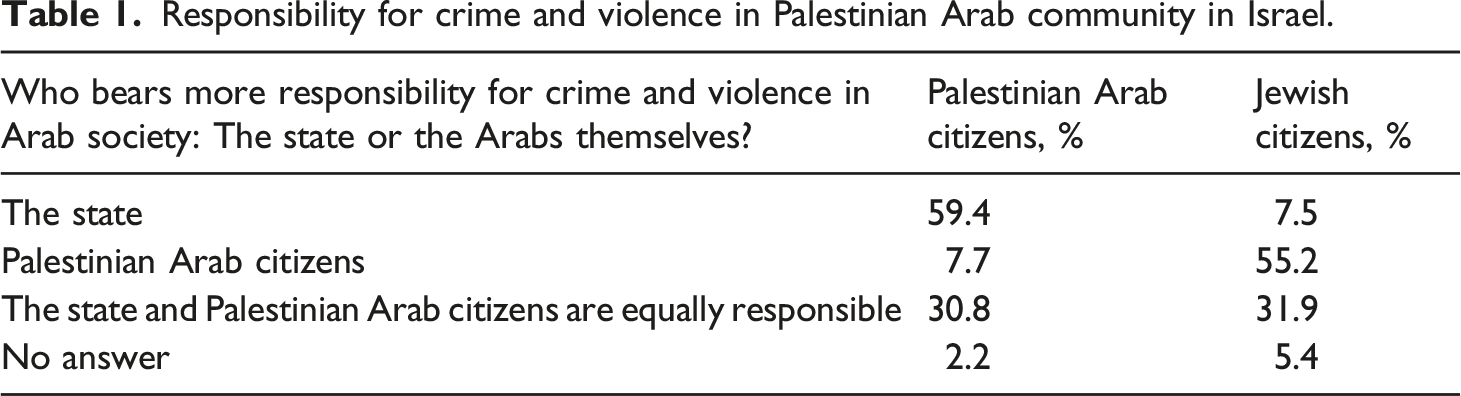
As can be seen, the findings echo the claims made by the public Palestinian Arab figures. The overwhelming majority of Palestinian Arab respondents (59.4%) think that the state is mostly responsible for crime and violence in their community whereas the corresponding figure in Jewish citizens is considerably lower (7.5%).
Cultural violence approach-community leaders and representatives’ arguments
Several representatives of the Jewish community, especially senior police officers and politicians, have developed interpretations and perceptions that contradict those common in Palestinian Arab community. According to those leaders in the Jewish community (ministers and MKs), no matter how much the state and police invest in efforts to fight against crime and violence in the Palestinian Arab community, it will not produce the desired results, simply because they believe that violence is deeply embedded within the Palestinian and Arab culture.
As a first example, the former Minister of Internal Security, former MK Gilad Erdan, during his tenure maintained: “The Arab society, and I say it with sadness, it is very, very violent”. 17 He further added: “Whereas a lot of conflicts end up with the filing of a lawsuit here (meaning within the Jewish community), there (meaning within the Palestinian Arab community) they take the knife and the weapon off”. 17 According to Erdan, violence in the Palestinian Arab community is related to the culture. Another statement of him was as follows: “It is linked to the fact that a mother may give her son an approval to kill his sister because she dates a man who does not look to the family”. 15
In 2020, after another Palestinian Arab citizen fell victim of violence, police spokesperson unit issued the message to the media. In this message, the violence occurring in localities populated by Palestinian Arab citizens has partially been attributed to Arab culture: “The fight against violence in the sector is not the domain of the police alone, and only a deep-rooted change that will come from Arab society in Israel in education, culture, cooperation with the police, denunciation of wrong norms and active leadership actions will lead to the desired change”. 16
In unrecorded meetings with senior Israeli police officers, where the author of this article was participating, they claimed: “There are types of violence deeply rooted in Arab customs and traditions that are difficult to eradicate from their culture”. Similarly, others claimed that “An Arabic person boasts about carrying and using weapons.”
In an interview given to the Haaretz newspaper, Yoaz Hendel (in those days MK and later-Minister of Communication) claimed: “I think the Arab culture around us is a jungle. There is a blatant violation of every human right we know in the Western world. Those rights did not even grow there. They did not reach the stage of evolution where there are human rights. There are no rights for women, no rights for LGBT people, no rights for minorities, no education”. 17 It is true that Hendel spoke about the culture of the surrounding countries. However, it must be mentioned that the culture of the Palestinian Arab citizens of Israel is an integral part of this culture.
Another statement was registered at the academic conference on the violence in Palestinian Arab community held at the Western Galilee College, Akko, on June 21, 2022. During his speech, MK Amichai Chikli (then member of the Yamina party, and nowadays-Minister of Diaspora Affairs and the Minister for Social Equality) claimed: “Let’s face it, crime in Arab society is a matter of Arab culture”. 18
In an indirect response to the allegations of the culture of violence theory and its promoters, a report was presented. 19 According to it, since the beginning of 2019 until 28 October of the same year, 77 Palestinian Arab citizens were killed in Israel while in the West Bank 28 people were killed in the same period. Note that the Palestinian population in Israel is 1,452,200 but it reaches about 2.9 million in the West Bank (Theodora, 2020). The aim of this report was to show that despite minor numeric differences, both groups share the same culture, habits, and traditions.
To summarize, in contrast to their Palestinian Arab counterparts, representatives of the Jewish community, be they former or current MKs or other public figures, tend to claim that violence has always been an integral part of the Palestinian Arab community. This is simply because in their opinion, these are the values, the norms, the customs, and other cultural elements which generate, perpetuate, and transmit the violence inside and across the culture so that this phenomenon remains deeply rooted inside it. Many of them use stereotypes and clichés, inter alia, as an expression of the lack of desire to take responsibility for fighting against violence and transfer this responsibility to the Palestinian Arab community.
Cultural aspects of violence are also addressed among publicists in Palestinian Arab community in Israel. In an article published by advocate Jawad Boulos, he claimed: “No matter how much we deny, the truth will remain the same; it seems easier for our helpless community to throw its failures on the State of Israel. The knives will remain hidden for the tribe to shine, they are in our children’s school notebooks, mosque sermons, and church preachers. The sources of disease are among us and are produced in our Palestinian community”. 20 In a similar vein, in an article the publicist Jalal Ayoub wrote for the Globus newspaper, he argued that: “As Arabs, we must admit that in Arab society there are problems of using violence to resolve conflicts and using the concept of respect to justify violence”.
Summary and discussion
The goal of conducting this review was to outline views concerning violence in Palestinian Arab community in Israel through the lens of the conspiracy and cultural violence perspectives. The attitudes of public figures belonging to the two major communities in the country, Jewish and Palestinian Arab, were provided.
From the review, it can be maintained that public representatives of the two communities are polarized in terms of their approach towards violence in Palestinian Arab community. The claims stated by the Palestinian Arab leadership in Israel can be attributed to a conspiracy theory. Leaders of the Palestinian Arab community in the country believe that there is a conspiracy to confuse the Palestinian Arab masses with social problems, such as violence and crime, in order to deflect, neutralize and take their attention away from important national issues. Therefore, in their view, the noticeable rise of violence after the Al-Aqsa Intifada in 2000 is not a coincidence, but rather a “job” “done” by the state, with some possible malevolent goal behind it. They tend to blame the Israeli authorities and institutions, mainly the police, for the exacerbation of violence and crime in the Palestinian Arab community of the country. They see that it is important to having this in mind, in order to change the behavior of the disruptive groups, confront them, rebuild the education system and the social fabric of the community, and create the civil society institutions that can restore the social order and fix the societal chaos in the long run. It must be mentioned that except for single cases (like the one presented in the previous chapter), political representatives of Jewish community tend not to refer to violence in Palestinian Arab community of Israel in the conspiracy terms.
These views are not surprising as they can be corresponded to a general distrust in government among Palestinian Arab citizens (Pinchas-Mizrachi et al., 2020). Whereas conspiracy beliefs tend to increase distrust in government (Pfeffer et al., 2022), the pre-existing distrust may increase the conspiracy beliefs intensity, possibly creating a vicious circle. This circle, as can be seen from the statements, can apply for Palestinian Arab public figures too (after all, they are also citizens and were habitual citizens before becoming public figures). Among the statements provided in the previous section, the conspiracy views reflecting distrust in state institutions and dissatisfaction from their activity regarding mitigation of violence in Palestinian Arab community can be found in statements made by MK Ayman Odeh, MK Walid Taha, former MKs Haneen Zouabi and Yousef Jabareen, and Sheikh Kamal Rayan.
The conspiracy views of Palestinian public figures can also be understood in terms of the societal effects. Conspiracy beliefs tend to appear where perceptions of inequality, deprivation or social exclusion predominate (Hebel-Sela et al., 2022b). Given that Palestinian Arab minority is subordinated to Jewish majority in many domains of life (Saabneh, 2015), the conspiracy views maintained by their representatives may be seen as manifestation of this lower social status and the exclusionary policy applied towards Palestinian Arab community. Among the statements provided in the previous section, the conspiracy views reflecting social exclusion and discrimination can be found in statements by former MK Taleb Al-Sana and former MK Sami Abu-Shehadeh.
The conspiracy views expressed by Palestinian Arab public figures can also be understood in terms of intergroup conflict. Since Israel is considered a deeply divided society (Lewin-Epstein and Cohen, 2019) where two ethnic groups even reside mostly separately from each other (Shdema and Martin, 2022), and given the fact that Israel is situated on higher places in terms of both conflict intensity and conspiracy beliefs (Hebel-Sela et al., 2022b), it can be seen as an arena for intergroup conflict and conspiracy beliefs. Minorities tend to perceive high outgroup threat (Van Prooijen and Song, 2018). Possibly some Palestinian Arab public figures claim the things they claim because of some collective threat in which more vulnerable members of society tend to blame someone for this threat (Hebel-Sela et al. (2022b)). Among the statements provided in the previous section, conspiracy views reflecting the intergroup conflict can be found in statements by MK Mansour Abbas.
In contrast, the cultural violence theory can explain the positions held by the Jewish political elites and senior officers in the Israeli police services. They tend to see crime and violence in the Palestinian Arab community of Israel as an integral part of its culture. This approach is possibly used in order to avoid (a) taking the responsibility for seeking solutions, implementing law and order, (b) investing in the infrastructure in localities populated by Palestinian Arab citizens, (c) increasing the allocation of budgets to build institutions, or (d) working to improve the social and economic situation of the community.
In the cultural violence perspective, the “other”, meaning outgroup, is typically devaluated and debased (Oyedemi, 2016). This can be reflected in the Jewish representatives' arguments regarding the violence in Palestinian Arab community. This view is similar to the “blaming the victim” strategy, when Palestinian Arab citizens are blamed for violence because they preserve and appraise it. This may again correspond to a relatively high conflict intensity and deep ethnic cleavage characterizing Israel (Lewin-Epstein and Cohen, 2019). However, what do the Jewish representatives' arguments do not distinguish between violence as a set of values and violence as a strategy of action (Lee and Ousey, 2011). A deeper understanding of this issue may serve as a direction for future research.
Two main points should be referred to with respect to the cultural violence perspective. First, it has penetrated into the Palestinian Arab community as well, in the form of self-criticism regarding the purity of violence in this community or lower self-flagellation. This can be seen on social media and throughout the discussions during public events that accuse the Palestinian Arab community and its customs and traditions as a source of the scourge, regardless of the role of the state and its institutions. Second, the arguments about cultural violence are not heard from most of the public representatives of the Jewish community, including party leaders, former MKs or former prime ministers. One reason for this is that most Jewish public figures who tend to demonize the Palestinian Arab culture were severely criticized, and their arguments were labeled as racist or discriminative. This has possibly refrained other political representatives of the Jewish community, who do hold similar views, from expressing them in public.
Conclusions and implications
To conclude, the debate on the violence in Palestinian Arab community in Israel ranges between two narratives: conspiracy and cultural violence. Both ideologies are supported and evident in the political and national discourse (Ariely, 2017), as well as in the ideological polarization between the representatives of the two communities of the country, who, as can be seen, tend mostly to adopt either of the perspectives.
The differences between the viewpoints of the Palestinian Arab and Jewish elites on one hand, and those held by the Palestinian Arab and Jewish communities on the other hand, with respect to the intraethnic violence in Palestinian Arab community, have several clear origins. One such a possible origin lies in the nature of Israel, as both society and state. The general Israeli society is a very divided one, especially along the ethno-national lines, where the Palestinian Arab and the Jewish citizens live separately and remain deeply divided over many issues like the nature of the Israeli system and the Palestinian Arab cause (Lewin-Epstein and Cohen, 2019). As can be seen from this review, the society, especially on the representative level, tend to be polarized, deeply divided, also with respect to one very important phenomenon taking place in the Palestinian Arab community, i.e. intraethnic interpersonal violence.
The escalation of violence in the Palestinian Arab community obliges all involved parties, regardless of the views they hold (conspiracy or cultural violence), to make efforts, motivate and participate in all possible steps, including the development of the holistic structural explanations to address this phenomenon, in addition to building comprehensive governmental plans aimed at confronting and mitigating violence. At the same time, there is a need for a comprehensive plan that takes into account the characteristics of the Palestinian Arab culture, by creating remedial methods and mechanisms that consider the very sensitive nature of the relationship between the Palestinian Arab citizens and the Israeli police, especially the abuse that occurred in this relationship in the aftermath of the Al-Aqsa Intifada in October 2000. These proposed solutions do not exempt the Palestinian Arab community and its leadership from responsibility to stand up against this phenomenon and face it by their own means (‘Ali, 2014a).
Looking at violence through the lenses of these two theories has broad implications on the nature of the relationship between the Palestinian Arab and Jewish communities and the state institutions, including: (a) Implications on the status of citizenship: the fact that the violence is rampant in Palestinian Arab community, while being on a decline in Jewish community, reduces the value of citizenship which has always been fragile for the Palestinian Arab citizens; however, it increases the extent of alienation from the state where they are supposed to benefit from inclusion and protection. (b) Tensions in the relationship between the Palestinian Arab and the Jewish citizens of Israel: it is well known that the relationship between the Palestinian Arab and the Jewish communities, as two different ethnic and national groups, have been complicated and tense since the establishment of the state in 1948. However, the mutual accusations between Jewish and Palestinian Arab citizens, whereby the latter accuse the state institutions, and the former accuse the latter and the latter culture, fuel preconceived stereotypes and increase the tension between the two sides. (c) Tensions between the Palestinian Arab citizens and the authorities in the State of Israel: the polarization between positions of those who support two previously discussed theories and the blaming of each other increases the tension between state institutions, especially the police, and the Palestinian Arab citizens. This situation has many negative implications on the work of the police and the way the Palestinian Arab citizens view this work.
In this article, we have highlighted some of the cracks in Israeli society which are expanding to include social and humanitarian issues of the first degree. This situation seems quite threatening, especially because both involved parties have established their views on their ethno-national affiliations, instead of looking at it matter-of-factly to seek collective benefits. The views which are currently held by both groups, regardless of their validity, increase the tension in the relationship between, and deepen the divide between the Jewish majority and the Palestinian Arab minority.
Footnotes
Declaration of conflicting interests
The author(s) declared no potential conflicts of interest with respect to the research, authorship, and/or publication of this article.
Funding
The author(s) disclosed receipt of the following financial support for the research, authorship, and/or publication of this article: This work was supported by the Israel Science Foundation; 2870/20
