



Abstract
The issue of working out a viable relationship between accepting and/or living with diversity on the one hand and fostering integration on the other has occupied public debates, political agendas, and social sciences for decades. Our point of departure is that the contemporary European context provides distinct challenges. We need to understand how postmigrant integration is shaped and conditioned by the European public space understood as a geographical space; a composite of legally and institutionally constituted entities; covering nations, regions, and cities mainly within but also beyond the EU; and a site of interaction, and public expression of contestation and cooperation. In so doing, we have to contend with the fact that such important perspectives for handling diversity as multiculturalism, interculturalism, transnationalism and cosmopolitanism occupy distinct roles within the European public space whose governance is multi-levelled yet not reducible to a single tiered system. The European public space is more encompassing than the EU even while that level of governance has some important regulative functions upon member states and to some extent even on non-EU states such as Norway and the UK, especially in what we refer to as the outer circle. While the national level is the most powerful normatively and by most other measures on the inclusion of difference (our inner circle), municipalities also contribute to the constitution of this space. We explore the logics of our four ‘isms’ and of the tiers of governance and their interaction with each other, both the isms in tensions and syntheses with each other and differentially in relation to the levels of governance. This is an exercise that has not been done before. Our purpose is to suggest a new normativity that might feasibly achieve a broader degree of support and success than any of the isms have achieved alone.
Keywords
Introduction
The issue of working out a viable relationship between accepting and/or living with diversity on the one hand and fostering integration on the other has occupied public debates, political agendas, and social sciences for decades. Critical aspects pertain to the formation of post-immigration ethno-racial, ethno-cultural and ethno-religious groups, along with the expression and organization of collective identities; claims for non-discrimination, participation/representation, and recognition. We use ‘post’ in order to underline that we are not primarily talking about migrants, but citizens marked by a migration-based ‘difference’. 1
Although policies of immigration, integration and citizenship relate to state policies, converging controversies in different European countries are reflected on a European level. The dynamic development of a multilevel system of governance that spans across large parts of Europe as an intrinsic part of the European integration process has affected these policies. 2 These developments give new meaning and significance to the notion of European public space, which we define as a site that is made up of identities, values and beliefs, a site of interaction among states, nations and societies, a site for public expression of contestations, formed and sustained by networks and institutions. ‘European public space’ encompasses Europe as a continental geographical space. There is a certain sense of Europe as a regional identity and a network of interactions that draws on but cannot be confined or delimited to the EU and its member states. Debates on the politics of immigration, accommodation of diversity, state-religion relationships, and the increasing influence of diaspora and transnational politics, must be viewed with reference to a distinctly European public space that is at the same time multilevel, embedded in a complex of different institutional configurations, bounded but highly permeable (open and susceptible to external transnational influences).
Given this framework, the two main questions that we address in this article are: First, how to reconcile diversity and integration in a multi-level European public space? Integration as it is used here refers to the policies, regulations and institutional arrangements that are devised for post-immigration ethno-racial, ethno-cultural and ethno-religious groups. Second, what type of normativity do we need for founding a multilevel governing approach in relation to this diversity? 3 Our point of departure is that public inclusion of diversity through changes in patterns, levels, and processes of governing have important implications for how diversity is understood and addressed by public actors in each European country and across all of Europe.
Public inclusion of diversity takes place through functional systems, identities, and forms of political expression at different levels of governing. These are neither static; nor is there necessarily a single or coherent logic driving their development. The Council of Europe now lists 46 member states, out of which 27 are EU-members (Council of Europe, 2022). Within the EU there is a general dynamic upwards to supranational arrangements and downwards to local and regional ones, but as the case of Brexit – and in a different way, politics in Scotland and Catalunya – demonstrate, there can be independentists as well as integrative movements, with bearings on cross-border relations and activities. In this context, the dynamic development of Europe as a site of governing brings up questions of sovereignty and political autonomy; possible tensions between different integration philosophies; questions pertaining to the distribution of competences across levels of governing (who does what to whom); questions of who can and should confer rights (what type(s) of rights) on whom; and potential competitions for citizens’ loyalties and sense of belonging.
The challenge is however not only practical-political; it is clearly also normative-analytical: it is about developing a normative framework that ensures consistency with basic principles of justice, freedom, solidarity, equality, and democracy across levels of governance and public spheres. Our approach is distinct in that it compares and contrasts four difference-sensitive perspectives on governing diversity, each of which is attentive to a distinct governing configuration; hence they vary with regard to the level and scope of governing that they prioritize, and they vary with regard to stage of citizen inclusion (we distinguish between an outer and an inner circle). These four perspectives are: multiculturalism, interculturalism, transnationalism and cosmopolitanism. It is important to underline, as indicated above, that each has its own conception of public space, diversity, equality, and solidarity. We examine how these perspectives can and should relate to each other by outlining their main similarities and differences, including how they relate to the organization of public space across levels of governing in contemporary Europe. In this article we develop these perspectives at one step removed from specific policies and present them as a set of four theoretically and normatively based perspectives for designing policies.
The article’s main aim is to develop a more composite and apt approach to governing diversity that is sufficiently attuned to the vertical and horizontal changes in governing systems and societal interactions that are taking place in Europe. In that connection a critical issue is to establish how and the extent to which the changes in European patterns and processes of governing have direct implications on how diversity and integration are reconciled across Europe’s states and societies. We will show that establishing this is far from a theory-neutral undertaking as each of the approaches we operate with will highlight some distinctive traits of Europe’s multi-level governing systems and downplay others. It is therefore when putting these perspectives together that we get a clearer more encompassing understanding of the current European public space. The thesis we will substantiate is that when applying our four perspectives to the contemporary European migrant integration situation we get a more complete but also composite picture of what is going on. The perspectives differ but when we consider them in relation to issues of scale and multilevel dynamics, we find important complementarities between them. These observations underline the need for developing a new normativity in diversity governing that encompasses local, regional, national, and European levels, as well as the transnational dimension (relations between Europe and its external environment).
Conceptualizing Europe’s public space(s)
This section addresses the first question presented above, which refers to how we may reconcile diversity and integration in a multi-level European public space. It starts by elaborating on what we mean by the European public space. This unpacking on the one hand refers to spatial reconfigurations and patterns of change across levels of governing in Europe, and on the other hand presents the 4 analytical perspectives as distinct intakes to the discursive and ideational construction of Europe’s public space. The presentation makes clear that each perspective has a distinct – and partial – conception of the complex and composite European public space. That paves the way for the analysis in Part III which outlines key complementarities and differences between the four perspectives, multiculturalism, interculturalism, transnationalism and cosmopolitanism.
Uncovering the contours of the European public space(s)
The European public space is an imagined and a geographical space; a composite of legally and institutionally constituted entities; covering nations, regions, and cities mainly within but also beyond the EU; and a site of interaction, and public expression of contestation and cooperation. This space is constituted by norms, regulations, and institutions, on the one hand, and by public expressions of territorial and non-territorial identities and senses of belonging (local, regional, national, European, transnational, global) that interact and communicate. Public space is thus composed of ideas and structures and their interaction, in the ways in which ideas and concepts are linked together in ‘social imaginaries’ (Taylor, 2003). The European public space is multilevel, given that it encompasses such governing units as the municipality (city); the region; the national; and the European Union (EU), and beyond. A hallmark of this multilevel European public space is that there are significant tensions between its three constitutive elements, the spatial-territorial dimension, the legal-institutional dimension and the discursive dimension. We will clarify this as we proceed to unpack the notion of European public space.
The discrepancy between the territorial-spatial and the legal-institutional dimension is for instance reflected in the fact that there are at least five groups of states that make up the European public space as defined above: EU-members; affiliated non-members (the EEA-EFTA states Iceland, Lichtenstein, and Norway; Switzerland and a range of less closely affiliated states); ex-members (the UK); and EU applicant states.
In addition, Europe’s public space(s) is given an additional layer of global and European institutional and legal provisions. There is a whole host of institutions and treaties associated with the United Nations. In addition, and more directly legally binding since many states have incorporated these in their national constitutions, are the rules and regulations that Europe’s states have agreed to abide by through the Council of Europe and the European Court of Human Rights (ECHR).
The implication is that issues of human rights, immigration, 4 and minority rights no longer remain within the exclusive domain of states, the latter find themselves constrained to accept new legal norms produced by norm-giving European institutions, for EU’s 27 member states upheld by the Court of Justice of the European Union (CJEU), and for the Council of Europe’s 46 member states the ECHR (the latter overlaps with EU membership) (Council of Europe, 2022). The UK as an EU ex-member state (and one of the initial signatories together for instance with the non-EU-member Norway) remains tied to the European Convention of Human Rights (ECHR). This does not however mean that the governing of diversity or diversity management in Europe has shifted upwards to the European level (or beyond). Instead, what has become apparent is that the UN-based and the European-specific (ECHR) institutional and legal arrangements make up a context of cosmopolitan-inspired rules and norms that provide guidelines and seek to set and maintain outer bounds for both the EU and Europe’s states with bearings on how all ECHR signatories notably should relate to immigration as well as diversity and integration of their citizens (and asylum-seekers and migrants) in Europe. This provides as we will elaborate on in the below a distinct approach to the integration of post-immigration diversity with an outer and inner circle. 5 The development of the European Union (and the ECHR) has given a distinct shape to this outer circle and at the same time reinforced the European-level imprint of such arrangements for the EU’s member and affiliated states. At the same time, the European Union and its member states’ handling of the refugee crisis amplified by the rise of populism brought up the spectacle of securitization, 6 as part of a more restrictive approach to migrants and especially asylum-seekers (the recent influx of refugees from Ukraine is a clear and notable exception, reflecting a European identity; it will most likely not have any knock-on effects on asylum-seekers or migrants from the Middle East, for instance). In today’s world with the rise of right-wing populism there is no assurance that EU-level developments or developments in EU member and affiliated states will necessarily be in synch with the cosmopolitan-oriented legal and institutional framework that was established in the post-war period to prevent authoritarian excesses. 7
These observations help to underline that when dealing with the question of reconciling integration and diversity associated with post-immigration ethnic and related formations, we cannot confine the attention to the national level but must focus on identifying those aspects of the multi-level European public space that have direct bearing on reconciling integration and diversity associated with post-immigration groups. In that sense, our conception of public space is devised to help us uncover the main governing sites and actors that set the terms of post-immigration inclusion and integration.
Governing diversity in a non-unitary, multilevel, and differentiated Europe
A hallmark of contemporary Europe’s public space is that it is a multilevel value-community, organized from the European level to the city-municipal level, albeit not a comprehensive system, and with various stresses and strains, horizontally and vertically. This in no way refutes the fact that the core unit of governance remains the state. It does however call into question the ‘master narrative’ in integration studies, which has focused on the individual state (and its internal relations) as the key to understanding integration and as the main determinant for diversity management in Europe.
More specifically, our approach challenges the master narrative not by claiming that the locus of migrant integration policy has shifted to another governing level, but to show that the constitution of Europe’s public space is multilevel (a composite of national, European, and regional/local levels), and is ‘stretched’ across migrants’ country of origin and country of settlement, through mobility, networks, and diaspora politics. The discursive construction of Europe’s public space reflects these traits. Further, the nature and scope of Europe’s public space is dynamic and there is lack of agreement on its contours, whether between Europe’s states or within Europe’s states (as we see for instance in Spain where powerful regions such as Catalunya seek greater autonomy). Disagreements and tensions are reflected in states’ differential willingness to submit to EU-governance (best exemplified by the UK’s decision to leave the EU), and in diverging positions on the EU’s value-basis and policies regarding the rights of migrants, asylum-seekers, the EU’s anti-discrimination policies, and the role and status of policies on post-immigration Muslim integration.
Within the context of the multilevel European public space, the legal framework of rights and entitlements embedded in the EU and the ECHR is constitutive of the ‘outer circle’ of immigrant incorporation and integration in Europe. Both legal systems provide citizens with rights that they can hold against their respective states, and many of these rights are also available for migrants. EU citizenship, which operates with different statuses codifies that through its distinctions between first country nationals (FNCs), second-country nationals (SCNs, which move and reside in a different EU member country) and third-country nationals (TCNs, which come from outside the EU and therefore have a weaker rights status than FNCs and SCNs). Some migrants take up citizenship in an EU member state, others remain in the TCN category. The outer circle of migrant integration is concerned with the terms of entry and non-discrimination; neither the EU nor the ECHR has much of the toolset that we associate with the inner circle of post-migrant integration, which focuses on citizenship, socialization and acculturation, that is, integration proper.
Generally speaking, within nation-building processes, citizenship has been a centrally important vehicle for integration, and has served as the bridge between the outer and inner circles of migrant integration. European citizenship is as noted more clearly located in the outer circle and as such is far less amenable as a means for socializing citizens than is the case with traditional forms of national citizenship. European citizenship fragments national citizenship through its transnational character and the fact that it is directed towards the four freedoms (of goods, of people, of services and of capital) that make up the EU’s internal market. Article 45.2 of the EU Charter of Fundamental Rights notes that ‘(f)reedom of movement and residence may be granted, in accordance with the Treaties, to nationals of third countries legally resident in the territory of a Member State.’ (EU Charter) Thus, whereas European citizenship is less suitable for integration than national citizenship, it nevertheless affects migrants and governing of diversity given that it introduces distinct and legally relevant statuses, that of second country national (SCN) and third country national (TCN). It follows that the role and status of migrants as third country nationals cannot be the responsibility of the individual state in Europe exclusively. The individual state now not only shares control of the outer circle with the EU and ECHR but is also subject to their legally binding constraints.
International and especially EU developments have relied heavily on law as a means for social regulation and for social integration (Cappelletti et al., 1986). This heavy reliance on law testifies to the limits that are built into such measures when it comes to integration. As suggested above, our notion of European public space must include a space of political socialization of actors, a space of shared citizenship beyond any legal definition. The European public space as a space of political participation and representation, a space of solidarity and a space promoting and protecting equality, a space that creates a common political culture based on liberal values of equality and recognition of differences, is a space that is open and dynamic, given that it is permeated by transnational and global processes and arrangements. Networks of information and media exchange, networks of institutions and networks of solidarity and interests—whether presented as economic, political, cultural, or identitarian—constitute the web that covers the European space and beyond. Encouraged by supranational institutions, the actors within the European public space involved in setting up such networks try to act directly through the European Commission and the European Parliament in Brussels, and consequently beyond the limits of nation-states, with varied knock-on effects on non-EU actors. Thus, there appears a new mode of political participation occasioned by a space open to the demands of both its citizens’ and residents’ interests and identities. This allows them to assert autonomy in relation to state systems that are territorially bounded. By the same token, transnational activity strengthens the demands of populations resulting from immigrants now resident in European countries, and/or legal citizens, for equality of rights and treatment at the European level, as well as their struggle against racism; is a means of substituting the assimilationist approaches of nation-states for an EU-directed assimilation. Transnationality, thanks to increasing interactions among actors from different traditions, might even become a means of socialization and training in a new political culture, expanding the European public space (Kastoryano, 2009).
Our search for a new normativity involves addressing at least three under investigated issues. The first is to what extent the development of a complex and composite multi-level European governing system shapes how post-immigrants are included and integrated in their respective societies across different levels of governing in Europe, in other words in terms of what we here define as the European public space and how that has come up with a new configuration of outer and inner circles of post-migrant integration.
In response to this lacunae the article shows the merits of a wider, more encompassing, approach that on the one hand covers different governing levels, within and outside the EU and also including migrants’ country of origin and country of settlement interaction, and on the other distinguishes between an outer and inner circle of post-migrant integration. Our framework, while not obscuring how each national state and so many of their regions and cities have become increasingly active on integration and diversity issues that continue to grow in salience with national politics takes heed of transnational connections of post-migrants, and transnationalization of controversies with regard to politics of migration, accommodation of diversity, state-religion relationships across European countries that mobilize states and groups. We thus trace the effects of developments inside and outside the EU at the European level; the EU’s member and affiliated states (such as Norway); and their respective regional and local levels of government; states like the UK as an ex-EU-member; and countries of origin of post-migrants through their transnational mobilization. The development of a system of supranational legal and political integration reconfigures relations across levels of governing (vertically) and between governing systems within member states (horizontally and diagonally). It serves variously to constrain and enable action.
Europe’s public space, then, exhibits a ‘variable geometry’, partly integrated albeit not a single system and also quite internally differentiated. The latter is well-reflected in a second issue that is under-investigated, namely what difference it makes that states across Europe have different EU-affiliations. We focus on how reconciling integration and diversity takes place within two EU member states (France and Spain); one closely affiliated non-member (Norway) and one ex-member (UK). Norway has constantly sought as close an association with the EU that is possible for a non-member, whereas the UK, being the first example of a partial reversal of EU-driven integration of the European public space, will show how far and in what direction an ex-member state manages to diverge from the EU-led governing system. Transnationalism, we will show, despite the solidarity networks within the European space, reminds us of how country of origin and country of settlement dynamics affect the outer and inner circles of post-migrant integration.
The third under-investigated issue is that the dynamic developments in Europe’s multi-level governing system are far from theory neutral. Each of the four perspectives in the governance of diversity – multiculturalism, interculturalism, transnationalism and cosmopolitanism presented here – has its distinct take on diversity and post-immigration integration. In addition, the perspectives diverge on whether they place the focus on the outer (access/arrival) or inner (social and cultural integration) circle. Thus, it should be readily apparent that some theories of post-immigration integration will be more conducive to the development of supranational and transnational governing systems, whilst others will be more focused on national integration, and yet others on local integration.
Developments are neither theory-neutral nor to be delinked from specific normativities, they provide different theoretical accounts with different normative implications. The search for a new normativity accordingly requires that we clarify the similarities and differences between our four different analytical perspectives on post-immigration integration. In doing so we also need to recognise that each perspective plays an important role in fostering the discursive construction of Europe’s public space as it is unfolding in actual practice. These perspectives are therefore not only analytical devices that analysts use to discern an empirical reality that is ‘out there’; they inform the more or less explicitly articulated reference-points that policymakers and publics operate with when seeking to explain, articulate and justify Europe’s public spaces. The interesting point is that it is when we consider them as inputs to the discursive construction of Europe’s public space that it becomes readily apparent that each on its own provides us with a partial account only – a piece of the puzzle – of the spatial-territorial, legal-institutional and identarian aspects of Europe’s public space, and the relevant range of policy prescriptions. The theoretical implication is clear: It is when putting them together and seeing how they relate to each other that we will be in a position to develop a new normativity for post-immigration integration in Europe.
In the following, we present the four perspectives with a view to discern their respective positions on governing integration and diversity in Europe: where, how and by whom. In the next section, we compare and contrast them with the view to pave the way for a new normativity that incorporates a multi-level European public space. Each of the four ‘isms’ has many interpretations in the academic literature and in public discourse; we present here only the versions as espoused by the respective author that identifies with that ‘ism’, and so appreciate that some will question aspects of our interpretations of these ‘isms’. 8
Four perspectives and discursive constructions of Europe’s public space
For assimilationists it might sound strange to associate multiculturalism with the ‘master narrative’ in migrant integration. Nevertheless, whereas
A core idea informing multiculturalism is that equality in the context of ‘difference’ cannot be achieved by individual rights or equality as sameness but has to be extended to include the positive inclusion (not assimilation) of marginalized groups marked by race and their own sense of ethnocultural identities. Multiculturalism thereby grows from an initial commitment to racial equality into a perspective that allows minorities to publicly oppose negative images of themselves in favour of positive self-definitions and institutional accommodations (Modood 2005).
With regard to the question of levels of governing across Europe’s public space, multiculturalism posits that Europe offers a direction to nation-states on multicultural citizenship and hyphenated nationality, highlighting and endorsing good practice of nation states without expecting uniformity, whilst also fostering a dialogical European identity on an additive, not substractive national basis. Multiculturalism posits that the national level is in charge of and puts in place provisions for equal citizenship, anti-discrimination and positive action, and codes of good practice. These are geared to ensuring institutional accommodation of minority group identities, and forms of recognition of difference that are attentive to and meeting of distinctive group needs. The ultimate goal is to produce a national citizenship to which all nationals may achieve a sense of belonging (CMEB, 2000; Modood, 2013 [2007]). The local level for multiculturalism will basically be designed to serve and ensure that the rights and policies formulated at the national level are carried out with due attention to the cultural recognition concerns involved, local variation and the participation of minorities. Multiculturalism thus has the national state and civil society as its centre of gravity and its understanding of public space is centred on how majorities and minorities together participate in, contest, remake and identify with the national culture as a shared possession.
From the perspective of Europe’s multilevel public space interculturalism is being discussed in all areas of public policies basically as a city project (Zapata-Barrero, 2015). The policy focus on shared spaces (Wood, 2015; Cantle, 2016) is understood as the main area where face-to-face communication among people from different backgrounds arises, in community gardens, libraries, public amenities, festivals and neighbourhood spaces as has been reported by Bagwell et al. (2012). This urban dimension provides diversity governance with a proximity to people that is more difficult at other levels and is a direct invitation to micro-politics, face-to-face relations, and provides pragmatism and proximity in diversity management. At this micro-level, interculturalism is close to the republican citizenship tradition (Zapata-Barrero, 2020) and combines two meanings of public space. Following the Habermasian critical theory meaning, public spaces are first of all spaces of communication and exchanges, today severely colonized by a consumer society and polluted by security stress. They are spaces where extreme power relations emerge, where social inequalities based on categories of diversity spread throughout the urban territory. From an urban perspective we can also understand public spaces as neighborhood spaces where public encounters happen. This origin provides interculturalism with two main strengths: propinquity as it primarily promotes face-to-face relations and develops most of its policies at the neighborhood level, and pragmatism because action and practice prevail over any preconception of justice or ideal of equality. The regional and State level of governance need to contribute to these local efforts providing the appropriate legal and political arrangements to ensure the conditions for interculturalism: equality and power-sharing, diversity-representation and diversity-participation.
Transnationalism has a distinct take on Europe’s multilevel public space in that it places particular emphasis on the horizontal dimension – of cross border state and societal interaction and interweaving. As such, whereas transnationalism operates in a context of multilevel governance: local, national, transnational, European and global, it focuses less on vertical and more on horizontal (cross-European internal and external borders including countries of origin) relations. It is at the local level that the community first defines its internal and external boundaries, develops networks based on a common identification beyond the local and national territory, to extend it to the state of origin. Transnational organization allows the post migrant ethno-religious populations to escape national policies and generates a new space for political participation and socialisation for post-migrants involved in building networks beyond national borders (Faist, 1998; Kastoryano, 2009). The cultural and political specificities of national societies (origin and settlement) are combined with emerging multilevel and multinational activities in a new space beyond territorially delimited nation-states (Kastoryano, 2010).
Transnationalism however also has a vertical dimension. International organizations and European supranational organizations contribute to the formation of internally diverse and heterogeneous transnational communities. While international organizations try to centralize the internal diversity around a common denominator such as ‘being Muslim in Europe’, European supranational institutions that are at the core of legitimate representation and democracy contribute to unify internal heterogeneity of transnational communities around norms and values through the process by which these same institutions give the diversity a legitimacy on the international stage, especially via an inclusive discourse developed by transnational activists founded on human rights, the fight against racism or any other form of social, political and cultural exclusion (Kastoryano, 2016). The evolution underlines the multiple interactions between transnational networks, national societies (origin and settlement) and the wider European space and beyond, between national, international and supranational institutions and among states creating all together a common social, cultural, economic and political involvement.
Cosmopolitan democracy as developed here understands the relationship between governing levels as structured in line with morally reversed subsidiarity. Subsidiarity means that the lower level is key and the higher level’s role is to support the lower level to develop to its fullest potential. Most of the decisions also under cosmopolitanism must be made at a lower level. Morally reversed subsidiarity entails that the lower levels when taking decisions must align these with the core normative principles and legal requirements that cosmopolitanism privileges and entrenches at the global (or highest possible) level. Consider the UN Declaration of Human Rights and TEU Article 2 (2012a), which states that: ‘The Union is founded on the values of respect for human dignity, freedom, democracy, equality, the rule of law and respect for human rights, including the rights of persons belonging to minorities. These values are common to the Member States in a society in which pluralism, non-discrimination, tolerance, justice, solidarity and equality between women and men prevail.’
The reversal is therefore in the direction of the subsidiarity logic, from bottom-up to top-down, in that there is a set of basic moral norms and precepts that has a regulative function on all levels of governing. This does not affect the governing structure of norms, rules and institutions that remains pyramidal, in the sense that lower levels intervene more directly and comprehensively in citizens’ lives than higher ones (especially supranational ones). The critical issue is that lower levels must justify differential rules, provisions, and policies with reference to human-rights related universal principles and laws. In line with this cosmopolitanism posits that the global level, the European level, and the national level all function as rights granters, and that the relationship between rights and obligations across levels are arranged in line with the logic of, morally speaking, reversed subsidiarity, in that the lower levels must align with universalist precepts to the extent necessary.
Analytical perspectives situated in a two-dimensional integration grid.
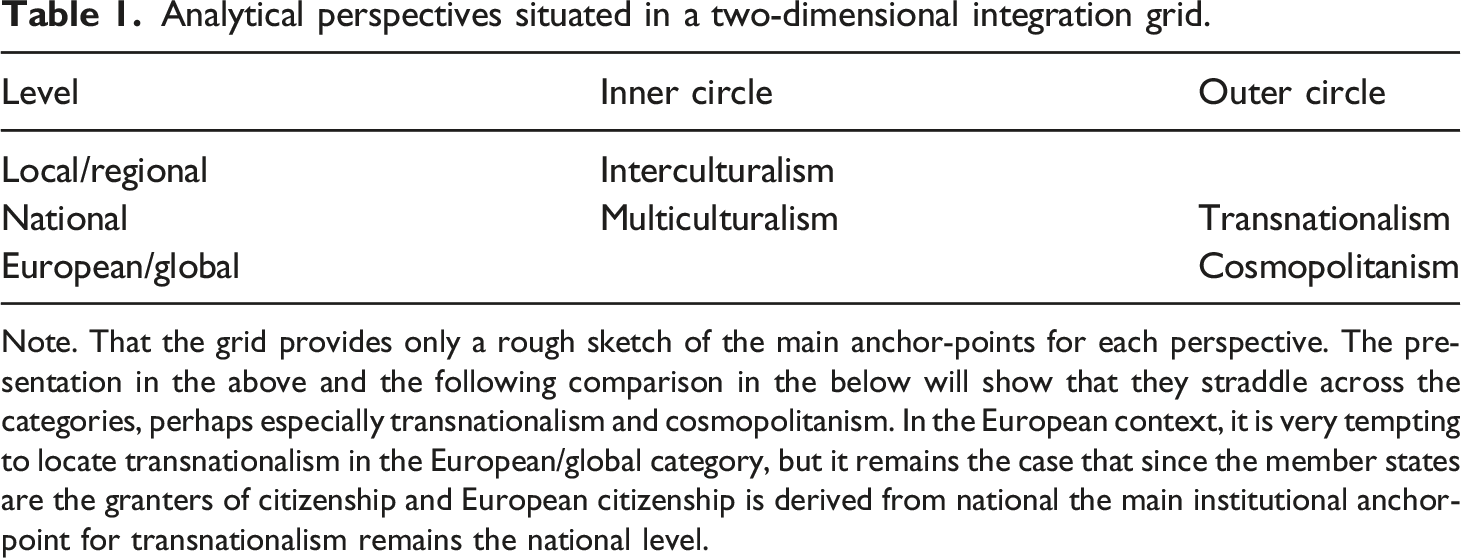
Note. That the grid provides only a rough sketch of the main anchor-points for each perspective. The presentation in the above and the following comparison in the below will show that they straddle across the categories, perhaps especially transnationalism and cosmopolitanism. In the European context, it is very tempting to locate transnationalism in the European/global category, but it remains the case that since the member states are the granters of citizenship and European citizenship is derived from national the main institutional anchor-point for transnationalism remains the national level.
In search of a new normativity through combining four perspectives
This section provides (a) a systematic comparison and assessment of the four normative approaches: points of overlap/correspondence and points of divergence; (b) an assessment of the complementarities with regard to scale of governance; and (c) based on these two sets of investigations seeks to set out the basic parameters of a new normativity in diversity governance.
Similarities and differences between the four perspectives
This section provides an overview of the main similarities and differences as well as complementarities between the four perspectives, along a continuum from complete distinctness to complete correspondence. This assessment cannot only be a matter of enumerating similarities and differences; it is important to consider whether there are certain features of each perspective that are particularly important and whether they pertain to similarity or difference. Such an undertaking is important in order to establish the scope for developing new normativities.
Cosmopolitanism is the most extensive of our four perspectives because it is not specifically focused on the question of ethnic diversity. Centered on human personhood and the equal moral worth of all persons it is remote from specific policies, and close to universal moral principles. It seeks to ensure that its moral egalitarianism is observed in core human-rights based laws and policies at all levels of governance, which operate as constraints on diversity. Nevertheless, these constraints are far from absolute. That is reflected in the fact that we locate cosmopolitanism in the outer circle, and not in the inner core which focuses on integration, socialization and belonging. Moral cosmopolitanism’s central form of expression of moral egalitarianism is also tempered in cosmopolitan democracy. Democracy refers to citizens’ ability to govern themselves and as such is communally bounded through the delineation of the democratic demos. Democracy’s built-in paradox – there is no democratic way of determining the bounds of the demos (Offe, 1998) – spills over into cosmopolitanism, which thus seeks to reconcile universalism and boundedness. The communal bounding in cosmopolitanism is nevertheless in tension with multiculturalism that gives value to ethnocultural group identifications and seeks to have those identities modify a national citizenship, which multiculturalism too sees in normative and not merely instrumental terms – forms of normativity that are group-specific rather than centered on individual persons as members of the human race. Multiculturalism thus has its own way of reconciling the universalism of equal citizenship with the particularities of multiple identities within a common belonging fostered by a national identity.
On the other hand, the moral-legal individualism of cosmopolitanism sits well with interculturalism’s preference for interpersonal contact and eschewing of policies that target specific groups, such as a cultural minority with its own distinctive needs receiving public funding for its own cultural center. At the same time, cosmopolitanism is in tension with transnationalism and its focus on diasporic groups, but may be of assistance to transnationalism in its questioning of singular national citizenship in favour of ‘playing off’ one national citizenship (country of origin) with another (country of settlement), given the central role both transnationalism and cosmopolitanism occupy in the outer circle of integration. In doing so, cosmopolitan democracy insists that these relations must be steeped in democratic norms. The challenge then is whether this combination of cosmopolitanism and transnationalism can come up with a form of citizenship that has a universalist rather than merely a transactional, self-interested character and can safeguard one state from morally impermissible (e.g. anti-democratic) undermining of the other.
Multiculturalism, an avowedly macro-normative philosophy, is centred on making national citizenship difference-friendly and thus works with a much thicker concept of ethical citizenship than cosmopolitanism. It thereby challenges narrow and exclusivist conceptions of nationalism and national identity while still giving a multicultural citizenship and inclusive nationalism a high significance and goal as a political project (Modood, 2019). It is, however, often silent on micro-relations, which is a central focus of interculturalism. However, multicultural equality and recognition are often considered to be a normative condition of interculturalism, if so, then it seems that multiculturalism and interculturalism are complementary, as has recently been argued (Mansouri and Modood, 2021). Similarly, transnationalism, when it is group-based rather than state-directed appears as a consequence of the multicultural recognition of groups (Kastoryano, 2016). Transnationalism’s onus on participation in more than one national society can be understood as the extension of equality and rights beyond borders. The question then is to what extent participation in more than one political space may weaken citizenship’s integrative function within the country of settlement, which is multiculturalism’s concern (in line with its situating within the inner circle)? Multiculturalism – as understood in these works (Taylor, 1994; Kymlicka, 1995; Parekh 2006 [2000] and Modood 2013 [2007]) – like other citizenship projects, is concerned with nurturing and promoting ‘the common good’ and the cultivation of difference-including commonalities and reciprocities. It therefore opposes ‘othering’ or ‘negative difference’ as manifested in various forms of racism not just at the level of non-discrimination, the level that cosmopolitanism operates at but also at the discursive and symbolic levels, seeking to supplant exclusionary national identities with inclusive ones (Modood, 2013 [2007], 2019). That also means that multiculturalism seeks to convert ‘separatist’ groups and identities into groups and identities that take pride in the sharing of a nationality, albeit often a hyphenated identity, such as British-Pakistani, sharing this aspect of the transnational idea. Yet for multiculturalism, the hyphenated identity means that they see their Pakistaniness as an aspect of their Britishness and wish other Britons to do the same, namely as a way of belonging to Britain. This means not just a tension with transnationalism but creates a significant lacuna in normative transnationalism in that it seems to neither endorse multicultural citizenship as a normative idea, nor the moral individualism of cosmopolitanism, while not offering an alternative normativity.
Transnationalism in Europe reflects two developments with regard to social organization, and political participation of post-migrant populations like any interest group that acts across borders. Post-migrants with the status of permanent residents or legal citizens of their state of residence foster solidarity networks across national borders on the grounds of one or several identities, linking the country of origin to the country of settlement and to a broader European space. The emergence of such transnationalism is linked to multiple and complex interactions between states and collective identities expressed by immigrants and their descendants, or any kind of interest group who tries to imprint their independence towards the state. Some of the transnational networks are formal, others informal; some are based on identity, others on interest; and some are based on both. They all portray bonds of solidarity based on an identity across national borders in relation to populations displaying identity and/or interest whether religious, national, regional, or ethnic and thus raise the question of boundaries (Basch and Glick Schiller, 1994). A transnational lens gives power to a cross-border civil society shaped by its internal diversity in addition to states and therefore is more open to integration than national public spaces, leading to the expansion of the European public space as well (Kastoryano, 2009). Thus, whereas transnationalism is mainly situated in the outer circle of integration it also underlines the integrative character of cross-society networks.
Transnationalism relates to cosmopolitism in the way it takes into consideration the process of globalization as a source of the expression of solidarity and identification beyond and across national borders. Transnationalism is thus perceived as a challenge to the founding principles of nation-states with regard to territoriality, citizenship and membership in a single political community and raises normative questions with regard to the relevance or permanence of nation-states. The concept recognizes the multiple links and affiliations to the country of origin and the country of settlement is increasingly institutionalized around dual citizenship. The normative question of transnationalism is raised when the individual expression of belonging and loyalty to the country of origin leads to a collective action importing ‘home’ country politics and conflicts to the country of settlement; and on a broader sense when transnationalism promotes an identification with conflicts elsewhere, and develops ‘a sense of co-responsibility’ (Werbner, 2002).
The relation to cosmopolitism is however a source of paradox: the supranational normativity of globalization and Europe promotes the construction of transnational networks as an influential mode of action of post-migrants to fight against racism and for equality beyond borders and contribute to the creation of a European public space. On the other hand, the transnational practices reinforce solidarity on a ‘communal’ identity and are sources of tension with the universal values espoused by cosmopolitanism. The more dense, binding and committing the transnational networks the more pronounced the tension for multiculturalism, interculturalism and cosmopolitanism. The other three ‘isms’ are therefore essential to ensure that the normative core of citizenship is maintained, that transnational actors do not simply take something from their citizenship (simple or dual) but also contribute to it. Specifically, for cosmopolitanism is the question of what resources there are for cosmopolitanism to ensure compliance with universal human rights norms when transnational relations and dynamics relate democratic and authoritarian regimes or especially bind authoritarian regimes together.
One of the questions in the emergence of transnational communities and the formation of a ‘communal identity’ is sustained by liberalism privileging ethnic pluralism where identities are organized and redefined. Encouraged by identity politics and ‘politics of recognition’ (Taylor, 1994) in democratic plural societies, some cultural, ethnic and religious communities recognized as such may seek transnational solidarities to form a new kind of political community where the country of origin provides the emotional factor, and the country of settlement the legal and political support for their action and brings the country of origin or its organisations into the process of integration in the country of settlement. This can work as a transnational contribution to multicultural integration, what Dikici (2021) calls ‘three-way’ integration (the majority, minority and its transnational organisations) and it creates a tripartite identification; to the political community in the country of settlement through citizenship, to the country of origin in terms of roots and ethnicity and to the transnational community as a common experience and new elan for an unbounded community identity (Brubaker, 1996). This is when transnationalism creates new expressions of belonging and a political engagement that is beyond national boundaries that reflects the nationalization of communitarian sentiments guided by an ‘imagined geography’, leading to a transnational nationalism, non-territorial (Kastoryano, 2016) and so may challenge the local and national cohesion, that interculturalism and multiculturalism are, respectively, seeking to achieve. In both cases transnationalism and multiculturalism raise methodological questions that are also normative; how should states accommodate cultural diversity in order to respond to theories of citizenship, equality and justice, if justice and equality are re-defined and influence post-migrants’ integration through ‘diaspora politics’ developed by countries of origin? Transnationalism becomes thus a challenge to multiculturalism and to interculturalism when countries of origin pursue their objective to maintain the loyalty of their citizens abroad.
Focusing the debate on the conditions for positive contact in diversity settings, interculturalism takes an instrumental approach towards multiculturalism. Even if there is not always a continuous linear link, since interculturalism can develop without multiculturalism, the fact is that multiculturalism can be functionally helpful for interculturalism in ensuring the necessary conditions for contact. Multiculturalism’s concern about equality and power sharing, can ultimately contribute to the promotion of ‘contact zones’. Interculturalism, however, sets limits to this process of recognition of differences, and will limit it within liberal democratic and human rights constraints. The epicenter connecting interculturalism with transnationalism and cosmopolitanism is firstly that they sprung up as direct criticisms of methodological nationalism and its by-products (such as multiculturalism). They converge on the notion that the national-state serves as an epistemological barrier to a more pragmatic policy formulation against discrimination, inequality, racism and xenophobia practices still to be found in our cities. What they share today is that they play the function of counter-forces against the hegemonic theoretical paradigm governing migration studies: namely, national-state based and multicultural-based approaches to diversity (Zapata-Barrero, 2019b).
If the rough notion of transnationalism is expressed in terms of multiple identifications (Levitt and Jaworsky, 2007), then the intrapersonal dialogue that occurs is, in itself, an intercultural dialogue. The embeddedness in more than one national culture fosters the development of intercultural skills, namely the capacity to enter into contact with other people with different backgrounds on terms of equality, the tendency to normalise diversity and difference, without separating it from an ‘imagined’ national-unity (Kastoryano, 2022). That is, the notion of transnationalism necessarily contains intercultural practice, and interculturalism is a way to understand transnational behaviour. Formulating the argument in terms of a hypothesis, the growing importance of people with multiple affiliations (the basis of transnationalism) is a favourable context for promoting contact between people of different backgrounds, including national citizens (the basis of interculturalism). Interculturalism and transnationalism present then some ‘overlapping affinities’ (Zapata-Barrero, 2018).
On the other side, interculturalism helps to foster a diverse society with a cosmopolitan bent. In fact there is an affinity between how interculturalism and cosmopolitanism conceive of society. Cosmopolitanism develops a sense of awareness to live in a complex and diverse society, and that oneself is just one part of this national diversity geography. The initial premise is that the growth of human mobility and the consequent encounters with difference inevitably leads people to step beyond the national boundaries to establish shared bonds (Beck and Sznaider, 2006; Schiller and Irving, 2017). In this sense, interculturalism is seen as a post-national strategy, and even post-identity strategy (Cantle, 2012). Human rights serve as a regulative principle for diversity governance. This humanism is probably one of the substantial bonds between interculturalism and cosmopolitanism.
The epistemological consequence is that cosmopolitanism cannot be understood today without this encouragement of cultural diversity and intercultural encounters. In this view, cosmopolitanism is a way to say that there is no rational ground for curtailing the cultural freedoms (of language, religion and customs) in the name of a so-called majoritarian nation/church, or cultural dominant ideology. Cosmopolitanism also assumes culture is a fluid concept, elastic, open-ended, not a temporally fixed entity which is also the basis of methodological interculturalism. Within this framework, methodological interculturalism tells us that fostering contact is a strategy to build a society with a cosmopolitan orientation (Zapata-Barrero, 2019b). While multiculturalism seeks to institutionalise recognition and diversity into a thick national identity and citizenship, cosmopolitanism and interculturalism prefer a thinner and more open citizenship ethic.
Complementarities with regard to scale and scope of governance
The development of a more complex multi-level governing system with bearings on the handling of diversity and post-immigration integration can be considered both a challenge and an opportunity. It is a challenge in the sense that it is difficult to analyse the distinct and unique European multilevel governing system without drawing on several analytical perspectives and working out their relations. It is an opportunity in the sense of intellectual innovation and possible policy improvements. From our perspective, this development is an insufficiently examined aspect of post-immigration integration, yet it is important to the development of a new normativity. How can we develop complementarities between the perspectives in terms of scale and scope of governance? It is quite clear from the assessment above that the perspectives have different scalar centers of gravity, with cosmopolitanism rotating towards the global, interculturalism rotating towards the local level. The interesting issue is, given cosmopolitanism’s universalist regulatory impetus, how and to what extent the other issues can be aligned with that. In addition, how might the other perspectives propose to revise cosmopolitanism in order to align with them? As part of this assessment, we will discuss whether certain traits of a given perspective should be particularly weighted in relation to a particular level of governing. Could for instance cosmopolitanism be particularly weighted for the supranational level; multiculturalism and transnationalism for the national level; and interculturalism for the local level?
In so far as cosmopolitanism is about the basic universalist core of normativity, such as non-discrimination, equality as sameness, treating like cases alike and due process, then from the point of view of multiculturalism’s character as a national philosophy, these aspects should be present in national governance and that the national democracy should be vigilant in upholding them. However, there is nothing in multiculturalism that leads it to an acceptance of cosmopolitan’s concept of ‘morally reversed subsidiarity’, namely an institutional dependence on legal or quasi-legal structures or directives from above the national level. Nor does it have to reject it in principle. For multiculturalism the evaluation of a supra-national law or directive will depend on whether it strengthens or impedes the goals of multiculturalism. So, there should be a process built into the morally reversed subsidiarity logic where national multiculturalisms can check that any law or directive from ‘above’ is consistent with multiculturalism or not; and if not, have a mechanism for making it so, ideally through a democratic process. In terms of the relationship between the national and city levels, given the contextualist adaptation and flexibility built into multiculturalism, the city should enjoy some discretion on how it interprets the national framework of law and policy and the freedom to take its own multiculturalist initiatives that go beyond that of the national government. Indeed, in this way the example of a city or several cities, can nudge the country into a more multiculturalist direction, just as a national example can nudge the EU into a more multiculturalist direction.
Transnationalism relates to all three levels. Post-migrants with the status of permanent residents or legal citizens foster solidarity networks across national borders on the grounds of one or several identities, linking the country of origin to the country of settlement and to a broader European space.
Interculturalism’s business card is that it is a local policy strategy targeting the entire population and not only migrants. It is a strategy to promote urban citizenship in urban diverse settings. It is best promoted through micro-politics and neighbourhood policies. In fact, interculturalism arises from the streets or with a local policy-maker’s concerns for how to solve diversity tensions and see how to take advantage of the potentialities of diversity by transforming diversity into opportunities and resources for social and economic development. In this sense, interculturalism charts the course, the focus, the horizon and the direction of small-scale programmes, and is becoming a strategic local project. Implementation areas can have a variable focal length within the territorial limits of the city: as an overall local project, and on a smaller scale, at the level of districts, and even streets and concrete public settings (market, playground, etc.), particular projects either thematic and topic-oriented or targeting particular profiles of people (young people, women, artists, intergenerational projects, etc.) or seeking to foster determinate values, beliefs and life prospects.
Towards a new normativity
The development of a new normativity as noted above will result from pulling together the main findings from
These observations underline that for cosmopolitanism to serve as a form of regulatory universalism it must be thinly constituted. In addition, as noted above cosmopolitanism’s work is more at the outer circle (regulating access and ensuring individual rights) than at the inner circle of integration-through-socialization and acculturation stage or the collective, democratic debates and the remaking of citizenship and the public space it exists in. Cosmopolitanism serves as an outer-circle constraint on diversity; and as such cannot serve as a self-standing doctrine of integrating post-immigration diversity. 13
Multiculturalism is both a challenge to and a reinforcer of national citizenship and is situated within the inner circle. It appeals to and extends the ideas of equality, citizenship and national belonging to embrace anti-racism and the institutional accommodation of new ethno-religious identity groups. It thus transforms the older, exclusivist ideas of the national as monistic and homogeneous while finding new normative significance for the national as long as it is made compatible with multiculturalism. In a new, forward-looking, multiscalar normativity, multiculturalism must be open to concerns identified by the other perspectives, such as international human rights laws and standards, dual citizenship and transnational belonging, interpersonal contact, and social mixing. Multicultural citizenship must be made mindful of its potentially exclusionary dynamic in relation to non-citizens and extend its normativity to engage with temporary migrants, asylum-seekers, refugees, and others who may or may not be on a pathway to citizenship but are part of the society that multiculturalism offers itself to as a governing philosophy of egalitarian and respectful integration.
For transnationalism the extension of solidarities beyond national boundaries of both country of origin and country of settlement, and their expression on a transnational space, challenges states’ singular power and action on immigration and integration and citizenship; thus, the notion that transnationalism operates at the outer circle. Political participation in more than one political community, which brings to light multiple memberships and multiple loyalties is reflected in dual citizenship, and therefore de-singularising the coupling of citizenship and nationality. For post-migrants, involved in transnational activities, nationality becomes a way to maintain an identity rooted in the country of origin, and citizenship an entitlement within the country of settlement. Such an evolution places territory at the core of the analysis of citizenship and nationhood, for communities as well as states (Kastoryano, 2007). For countries of origin this means maintaining a link with citizens ‘abroad’; it involves at the same time the extension of states’ power into the territory of other states. It becomes a resource for identity and for mobilization for individuals and/or groups of immigrant descent. This involves the states behaving as transnational actors in permanent interaction within a global de-territorialized space or encountering cultural and political specificities of national associations with multinational activities (Kastoryano, 2016). Receiving and sending countries are driven to collaborate in order to ensure the integration to ‘re-territorialise” citizenship and identities. In both cases, transnationalism points to the potentials for maintaining the ‘power’ of incorporation and citizenship while expanding state influences beyond territories and to compete with transnational communities in their engagement in the process of globalisation.
Interculturalism’s primary concerns are not about abstract or universal notions of justice or rights and goods in the context of diversity, but about a society that takes advantage of the resource that diversity offers while also ensuring community cohesion (Cantle, 2012). Therefore interculturalism may also lead to campaigns to garner a sense of solidarity. Against the status-quo narrative, interculturalism’s efforts is to rebut those who ground their xenophobic narratives on the assumption that cohesion is only possible in homogeneous societies (Portes and Vickstrom, 2011). Following Kymlicka (2016), solidarity refers to the practice of sharing material/immaterial resources based on a sense of belonging and group loyalty. Traditionally the concept has assumed a certain sense of community with a shared (national) history and shared (national) norms and values, which is the basis of action. Behind these statements, there is a sense of belonging but also some emotional ties (empathy) to the situation of disadvantage of certain people who require external help. Today, in complex diverse societies, solidarity has real difficulties remaining within this national-state paradigm. Hence, a need to reboot the traditional view of solidarity is necessary for interculturalism. Indeed, inverting the argument, non-solidarity situations reveal a certain failure of community cohesion and shared values. This supposes breaking down some epistemological barriers around diversity management basically related to methodological nationalism (Zapata-Barrero, 2019b). Group solidarity can be produced by cultural exchange. If we assume that the European space embraces people with various ethnic, racial, economic, cultural and religious categories, this cooperation between individuals becomes a value that needs to be promoted.
The conundrum is that the state is transforming and as such providing new opportunities for multilevel governance dynamics. At the same time, the transformation of the state can render it less capable of reining in excesses and undemocratic actors and factors.
We may propose two models for the scalar configuration of the new normativity. These are analytical constructs, and not depictions of empirical reality. Having said that, they are ‘realistic utopias’ in the sense that they take inspiration from existing arrangements but modify and extend these so as to outline properly the normative potentials. As such the first model draws loosely speaking on the European integration project and seeks to tap the normative potentials from that. The other model draws loosely on the UK experience as a political system with elements of all four perspectives.
The first model is in line with the European integration process, multilevel proper and seeks to bring greater coherence to the European public space as a site for governing diversity, with bearings on the relationship between outer and inner circles of integration. In other words, the objective is to foster coherence between Europe as a territorial space; as a legal-institutional framework; as a discursive construct; and as a democratic space for activism, mobilization and the forging of and contesting of political goals. This includes the important transnational dimension; it underlines that transnational relations and dynamics must correspond with and help to foster the basic human rights norms and principles that Europe espouses.
The governing structure is devised along multilevel lines precisely to avoid propounding political centralization or selecting out any one single level of governing as the main distinctive site for governing diversity and the integration of post-immigration ethnic diversity. Instead, it recognizes the need for a multilevel division of tasks which is explicitly designed to draw from each of the four perspectives’ center of gravity. The key to the model’s search for fostering complementarity among the perspectives is the recognition that the four perspectives have different centers of gravity.
The model posits the development of a set of cosmopolitan rights and principles at the European level which are anchored in and resonate with global rights and principles (embedded in the United Nations); configures states to comply with these norms and principles whilst retaining the core instruments of socialisation and cultural integration; offloads tasks to the regional and local levels to facilitate interpersonal contact and interaction; and links in with other parts of the world across levels in line with transnational principles. The division of powers and competencies across levels of governing serves as the main structuring device for the interaction and communication between the different perspectives. This model comes with a strong ‘liberal’ tenor, in the sense that the ongoing interaction among levels of governing and the system’s relations to its external world render socialisation and inculcation less community-focused and more rights-oriented. The model presupposes a more integrative European citizenship and democratically legitimate institutions at the EU-level and at the same time clear constraints on the EU-level’s realm of operations to prevent undue centralization.
The other model for the scalar configuration of the new normativity is steeped in the notion of the permeable and reflexive state. It is permeable in a vertical sense, across global-regional, and regional-local levels, and it is permeable in a more horizontal – transnational – sense, across different communities. This model is thus configured differently from the first along both the (horizontal) outer-inner dimension and the (vertical) levels of governing dimension. This model places a stronger accent on sustaining the basic socialising and inculcating apparatuses of the national state and civil society – to serve community formation and sustenance – but subject to constraints brought on by all the four perspectives addressed here. This model thus comes with a stronger ‘communitarian’ or ‘communities of communities’ tenor (CMEB, 2000), not in a socially and culturally exclusive sense but in the sense that it sees the reconciliation of diversity and integration of post-immigration groups as a matter that should remain with the state and the national community. The state should be structured and configured – internally and externally – to have to respond to the imperatives brought forth by the four perspectives developed here but without having to give up the goal of creating a national identity that is a focus of belonging. This model combines moral individualism and basic rights universalism with a moral valuation of groups and the meaning they have for individuals and has a goal of a democratic community-building and self-determination based on an ideal of a difference-recognizing national citizenship, to which all citizens can have a sense of belonging, even while the national identity is debated, contested and remade.
Conclusion
This article has addressed two main questions. The first pertained to how to reconcile diversity and integration in a multi-level European public space. To this end we defined public space as an imagined as well as a geographical space, a legal-institutionally embedded site encompassing identities, values and beliefs, and modes of social, cultural, and political communication. We applied that notion to Europe and found that Europe is marked by a certain disjuncture between territorial space, the configuration of legal-institutional systems of governing, and the discursive representations of these spaces. The implication is that diversity governing is stretched out across levels of governing and territorial space and not contained within a single, unified structure, whether this single structure is understood as a network of national states or as units of a supra-state. This European configuration operates with a distinct constellation of rules, institutions and procedures guiding the outer and inner circles of post-migrant integration.
An overly simplistic nation-state master narrative conflates the issue of levels and fails to capture the manner in which the contemporary European space is configured in outer and inner circles of post-migrant integration. A more sophisticated nation-state master narrative thus must offer a less biased and misleading rendition of today’s reality. What is also notable is that when focusing on the discursive construction of the European public space our four diversity-sensitive perspectives all represented partial accounts only. It was only by considering how to combine them that we could get a more encompassing account that could approximate the nature of the system of governing and the discursive construction of diversity and integration dynamics in Europe.
The search for perspectival complementarities paved the way for the second question that this article addressed, namely the type of normativity that is required for founding a multilevel governing approach in relation to the diversity that marks Europe. We devised two possible models for how such a normativity can be structured. Both models are based on a notion of inclusive space but privileges relations between persons, groups and levels differently. Perhaps the greatest potential for Europe’s normative development lies in an ongoing contestation between several models. That actually makes our framework amenable across the globe given the resilience of the state form outside of Europe. In outlining the two models this article has taken us a step in the right direction because it shows more clearly than before the potentials (and pitfalls) in Europe’s multilevel governing complex.
Footnotes
Acknowledgement
We would like to thank Hauke Brunkhorst, Will Kymlicka, Geoffrey Levey and Pnina Werbner for their comments on an earlier version of this article. We very sadly record the loss of Pnina, who passed away on 17 January, 2023.
Declaration of conflicting interests
The author(s) declared the following potential conflicts of interest with respect to the research, authorship, and/or publication of this article: Tariq Modood is a co-editor of Ethnicities and played no part in reviewing this article.
Funding
The author(s) disclosed receipt of the following financial support for the research, authorship, and/or publication of this article: This article is the result of our collaborative research project PLURISPACE on Integration and European Public Space. The project PLURISPACE is financially supported by the HERA Joint Research Programme (www.heranet.info) which is co-funded by AHRC, ANR, MINECO, RCN and the European Commission through Horizon 2020.
