




Abstract
The capability of accommodation policies to create inclusive and cohesive societies for social integration has recently been called into question. Some people worry that accommodation may upset those who disagree about the policy and create a backlash effect. This study examines these issues using the theory of cognitive dissonance and empirically tests whether individuals’ policy preference influences the impact of accommodation of Islam policies on anti-Muslim sentiments. Using survey data from 15 Western European countries, we find that accommodation of Islam policies produce socialising effects on those whose opinions resonate with the policies. However, we do not find statistical evidence of backlash on those whose opinions dissonate with the policies. The findings suggest that accommodation of Islam policies do not radicalise dissonant opinions and are likely to reduce anti-Muslim sentiments among those whose opinions resonate with the policies.
Keywords
Introduction
Accommodation policies, which we define as the adaptation of rules and social practices on the part of the majority to fit the wants and needs of minorities, emerge not only as a topic of public policy debates but also as a subject of recent scholarly discussion (e.g., Dikici, 2021; Eisenberg, 2020). Against this backdrop, this paper examines whether and how the accommodation of Islam policies influence people’s feeling towards Muslim immigration. 1 Recent studies on accommodation policies have focused on states’ policy choices (e.g., Sarrouh, 2021), public attitudes towards accommodation (e.g., Reijerse et al., 2015; Wright et al., 2017), and the effects on immigrant integration (e.g., Koopmans, 2010). While the effects of accommodation of Islam policies on anti-Muslim sentiments have been examined (e.g., Czymara, 2020; Helbling and Traunmüller, 2016), people’s policy preferences and their psychological reactions to the policy regime have received only limited attention.
This study addresses this gap and argues that the effects of the accommodation of Islam policies depend on individuals’ attitudes towards accommodation and are therefore heterogeneous (Reijerse et al., 2015). On the optimistic side, accommodation policies may create a socialising effect and improve people’s perceptions of cultural minorities in the country (Czymara, 2020; Visintin et al., 2018). However, accommodation policies may also have a backlash effect when people experience normative threats produced by changes in the current order of values (Stenner, 2005). People who disagree about accommodation policies may perceive that the policies are unbalanced and onerous, as they demand a shift on the status quo that is deemed overly burdensome by the host community (Helbling and Traunmüller, 2016). Accommodation policies may also generate feelings of discomfort and alienation towards minority groups that receive—in the eyes of the dominant group—an unjustifiable preferential treatment (Heisler, 1988). This can lead the host communities to reinforce their national identities, making the boundaries between groups harder to penetrate (Wright, 2011).
The effect of people’s policy preferences has been explored in the context of multiculturalism (Plaut et al., 2011) and immigrants’ right to demonstrate (Helbling and Traunmüller, 2020). Following this line of research, this study uses state-level data on accommodation of Islam policies and individual-level public opinion data in Western Europe to test whether high levels of accommodation of Islam policies are associated with anti-Muslim sentiments when the policy regime is aligned or unaligned with individuals’ preference for accommodation. 2 Evidence on the existence of these alignment and backlash effects is crucial for policymakers, as it will assist them to assess whether and when accommodation of Islam policies will keep Europe diverse but cohesive, and under which circumstances her people feel comfortable at home.
Accommodation policies and anti-Muslim attitudes
Anti-Muslim attitudes are often produced through a boundary-making process triggered by perceived threats (Andersson and Dehdari, 2021; Hainmueller and Hopkins, 2014; Velasco González et al., 2008). As new values, norms, and beliefs can be conceived as threats to cultural identity, these perceived threats can lead to the formation of negative feelings towards the outgroup (Stephan and Stephan, 2000). A study by Velasco González et al. (2008) has found that symbolic threats are a strong predictor of anti-Muslim sentiments among secondary school adolescents.
Fortunately, some studies suggest that anti-Muslim sentiments could be mitigated by government policy. Two types of policies are conceptually possible: assimilation and accommodation policies. Assimilation policies facilitate the integration of immigrants by encouraging them to adopt the culture of the dominant group. These policies, if successful, can potentially reduce perceived differences and hence cloud the boundary between the immigrants and the host community (Alba, 2005).
Accommodation policies help minority groups to preserve their cultural identities. The degree of accommodation varies from country to country, but the underlying idea of such policies is to promote diversity because all groups should be treated with equal respect (Kymlicka, 1995). Previous research has found that the accommodation of Islam policies have an effect on anti-Muslim sentiments albeit with highly different explanations. Specifically, Helbling and Traunmüller (2016) found that accommodation of Islam policies could reduce anti-Muslim sentiments when governments take a neutral stance with regards to all religions. By accommodating Muslims in a neutral way, fewer institutional changes will be required, and this will make people see accommodation as less threatening. Along this line of reasoning, Grim and Finke (2007, 2011) found that state religious regulation leads to higher negative attitudes towards minority religious groups. By contrast, Fetzer and Soper (2005) have found that states’ embracement of the majoritarian religion can pave the way for the accommodation of Islam. When a state is more friendly to religious demands in general, accommodating Islam’s religious claims can be achieved within the established social structures. Similar findings have been found by Wright (2011) and Carol et al. (2015).
Nevertheless, this model of policy effect idealistically assumes that citizens have reasonably good knowledge about national immigration policies and that citizens are passive recipients of the policy in a top-down manner. It also fails to explain why the policy may induce polarised opinions and remains debatable in many societies. The present study goes beyond this model of policy effect and acknowledges the importance of individual preferences in the policy process. In particular, it focuses on people’s alignment with the accommodation of Islam policies in Europe. Recent studies have shown that individual support for immigration policies is shaped not only by the policy contents but also by one’s position in society. In particular, Gale et al. (2021) demonstrated that attitudes towards multicultural policies were dependent on group membership. Using European Social Survey data, Gale et al. (2021) showed that minorities tend to support multicultural policies more strongly than majorities. Sharing the view that policy effects can be moderated by individual preferences, in the following, we further on the need to explore both individual and social contexts for determining the effect of accommodation of Islam policies.
Policy effects and cognitive resonance
We argue that the effect of accommodation of Islam policies is moderated by individual preferences towards the policy. The moderation approach can contribute to our understanding of policy effects as it allows us to identify under which circumstances accommodation policies can have a positive and a negative effect.
Accommodation of Islam policies can shape perceptions in two ways. They may socialise individuals into the policy environment or backfire and produce a policy backlash. Policies that resonate with individuals’ interests, values, or beliefs are likely to have the intended policy effects by socialising them. In contrast, policies that are dissonant with these interests, values, or beliefs could be perceived as a threat and create a backlash (Schneider and Ingram, 1993).
These policy effects have been theorised using a constructivist approach (Mettler and Soss, 2004; Pierson, 1993; Schneider and Ingram, 1993). The idea behind this approach is that policymakers identify target groups, to whom policy burdens or benefits are accrued (Schneider and Ingram, 1993). The way the policy addresses this group shapes not only social perceptions about the group but also their participation in politics and future policymaking (Schneider et al., 2014). Those social perceptions are however moderated by individual cognitive biases and moral intuitions (Schneider et al., 2014). As not everyone shares the same moral intuitions and bias, for instance, about the Muslim population, the accommodation of Islam policies are expected to influence perceptions differently.
While accommodation of Islam policies could have an intended effect on those who agree with them, they could also annoy those who oppose them in the first place. This contrasting policy effect on anti-Muslim sentiments can be understood through the concept of normative threats in political psychology. Normative threats refer to fears produced by changes to the current order of values, which cause people to oppose a policy and act defensively (Stenner, 2005). These normative threats are experienced by persons differently, depending on their personal beliefs (Traunmüller and Helbling, 2020). As the accommodation of Islam policies may involve a burden of cultural change for the dominant social group, the fact that the policy is backed by the state authority may only heighten the feelings of cultural threat. Consequently, instead of normalising the presence of foreign cultures, accommodation policies might radicalise hostility towards the out-groups (Helbling and Traunmüller, 2016).
The present study advances previous research on policy effects in two respects. First, it looks at the effects of the accommodation of Islam policies on anti-Muslim sentiments. Most of the current research has focused on the outcomes of multicultural policies (Banting and Kymlicka, 2013; Hooghe and De Vroome, 2015; Koopmans, 2010; Plaut et al., 2011). Since multiculturalism is a rather broad concept, a concrete aspect of it will bring more clarity about its real effects. Second, it will look at the moderating effect of opinions about accommodating Islam in the country on anti-Muslim sentiments. The moderating effect of opinions has been explored in other contexts (Bishin et al., 2016; Bratton, 2002; Fejes, 2008; Traunmüller and Helbling, 2020; Zagarri, 2007), but the focus on the accommodation of Islam policies is still limited.
Based on the above discussion, we hypothesise that, first, higher levels of accommodation of Islam are associated with a decrease in anti-Muslim sentiments (Hypothesis 1). We also hypothesise that the size of the policy effect varies depending on whether the policy contents resonate or not with the beliefs and values held by the policy addressees. The level of tolerance is higher when the policy contents resonate with their beliefs (socialising effect; Hypothesis 2). The level is lower when the policy contents dissonate with their beliefs (backlash effect; Hypothesis 3). More specifically, we posit that opinions that resonate with the accommodation of Islam policies are associated with a larger decrease in anti-Muslim sentiments than dissonant opinions.
Data
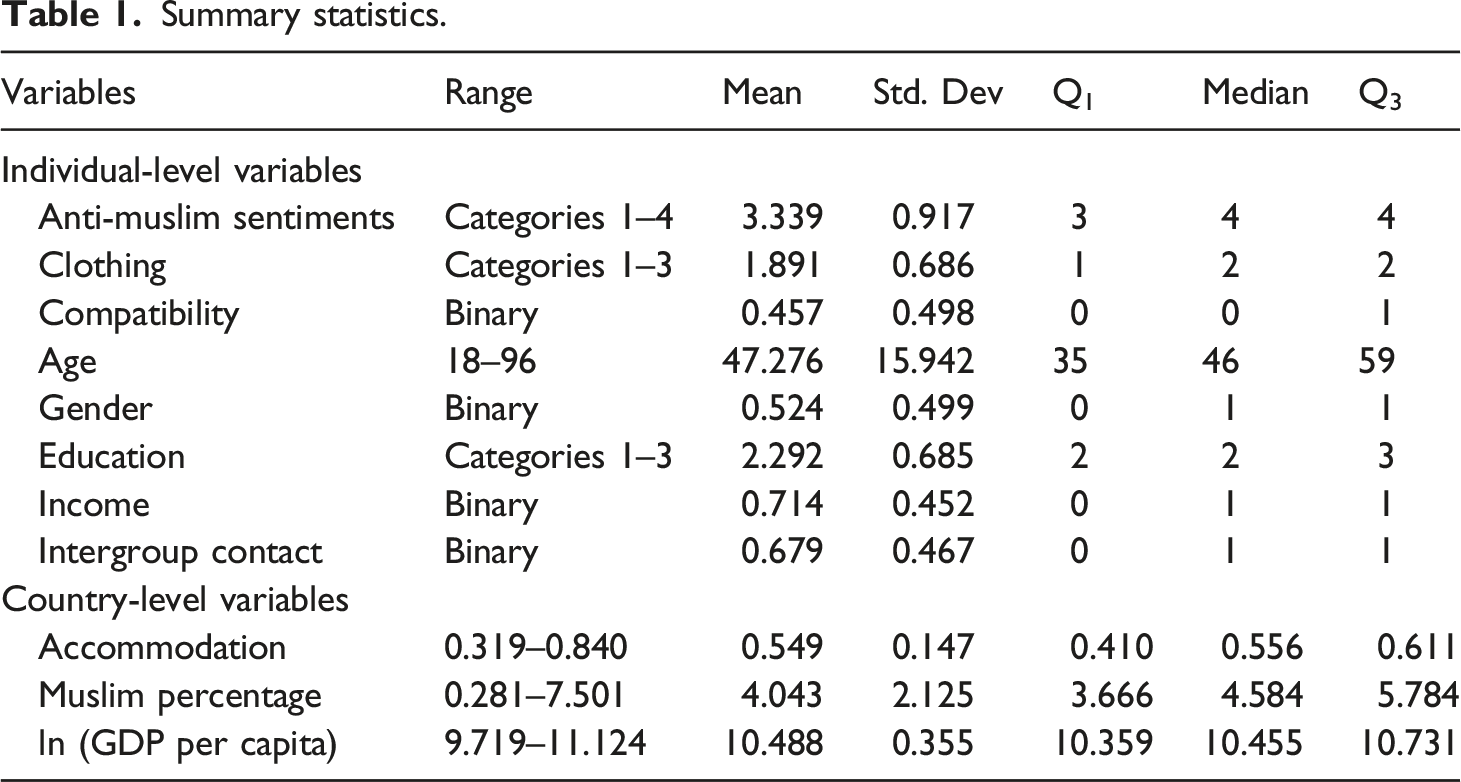
To test the above hypotheses, we combined micro-level data from a public opinion survey with country-level indicators from various sources. The main data source is the Western Europe Survey Dataset from the Pew Research Center (2018). The dataset contains responses from 26,096 individuals randomly sampled from 15 Western European countries between April and August 2017 after the so-called ‘refugee crisis’. 3 The sample is nationally representative and includes approximately 1,500 randomly sampled adults in each country. The sampling units were constructed through a random-digit-dial method and the respondents were selected through the next birthday method. Before running the models, the data was cleaned, which means that “don’t know” and “refuse” answers were dropped from the dataset. In addition, those aged “97 or older” were dropped (0.01% of the observations). The responses “Other”, “Both”, “Neither”, and “Depends” to the question about the compatibility of Islam with the national culture (6.87% of the observations) were also dropped from the dataset. After removing the missing values and restricting the sample to non-Muslims only, the final sample includes 21,589 adults. Respondents were between 18 and 96 years old, and 47.62% of them were female.
We use a question from the Survey to measure sentiments towards the Muslim population (sentiments). The question asks the respondents to indicate the extent to which they agree that, “[d]ue to the number of Muslims here, I feel like a stranger in my own country”. There are four possible outcomes: completely agree (coded as 1), mostly agree (2), mostly disagree (3), and completely disagree (4). A similar question can be found in other surveys, but we employ the data from the Western Europe Survey for two reasons. First, the European Global Values Survey contains a question relating alienation to immigration in general but with no reference to the Muslim population in particular. Second, the World Values Survey (Wave 3) asked whether people felt that Muslims were threatening the socio-political order of the society, which is particularly relevant to our research interest, but the survey was carried out over 20 years ago and may not reflect what people think after the ‘refugee crisis’ in Europe in 2015.
An important observation should be made here with regards to the framing of the dependent variable as “anti-Muslim sentiments”. Feeling like a stranger is interpreted through the concept of anti-Muslim sentiments because they are clusters of closely connected concepts. The presence of immigrant Muslims poses a cultural or symbolic threat to Western liberal societies. This produces anti-Muslim sentiments and affects social cohesion (Helbling, 2014; Saroglou et al., 2009; Sniderman and Hagendoorn, 2007; Van der Noll, 2010). Several studies have demonstrated the connection between feelings of threat and anti-Muslim sentiments (Ciftci, 2012; Velasco González et al., 2008).
The main independent variable is the index of the accommodation of Islam policies (Kaya, 2017). The index ranges from 0 to 1. Lower values mean a lower level of accommodation. The index captures six major cultural aspects in which Muslims seek accommodation: Islamic attire; cemeteries; chaplaincy; mosques (composite of three variables: permits, architecture, and call-to-prayer); education (composite of two variables: course on Islam in public schools and state funding for schools owned by Islamic institutions); and halal food (composite of two variables: ritual slaughter and provision of halal food). To measure the level of accommodation, Kaya (2017) evaluated the above six areas in terms of the presence of legal restrictions, the level of state support, and the difficulty of obtaining a permit for certain activities. Each aspect was assigned a score between 0 and 1 with increments of 0.25. The scores for mosques, education, and halal food are the averages of their constituting elements, whereas the final accommodation index is the average of the scores for the six cultural aspects. The variable measures the level of accommodation of Islam policies in the sampled European countries in 2015.
We hypothesise that the effect of the government’s accommodation of Islam policies can be moderated by people’s policy preferences. To capture individual preferences, we use people’s opinions about women’s religious clothing as a proxy. Muslim religious clothing is a perceptible aspect of the Muslim culture that has negative connotations in Western societies. However, it is precisely its visibility and controversy that make it a good proxy for people’s preference for the accommodation of Islam policies.
Clothing is a categorical variable that indicates people’s opinions on Muslim women’s religious clothing. The categories are: “Muslim women who live in [country] should be allowed to wear any religious clothing of their choosing” (coded as 1); “Muslim women who live in [country] should be allowed to wear religious clothing, as long as it does not cover their face” (2); “Muslim women who live in [country] should not be allowed to wear any religious clothing” (3). The data is from the Pew Research Center (2018).
In our robustness checks, we use compatibility as a proxy for cognitive resonance or dissonance. Compatibility is a binary variable that takes the value 1 if the respondent agreed that “Islam is fundamentally incompatible with” their national culture and 0 otherwise. We used data from the Pew Research Center (2018) to code this variable.
Intergroup contact is a strong predictor of anti-Muslim prejudice (Pettigrew et al., 2007). Intergroup contact reduces prejudice because it gives the chance to both parties to know each other. This rapprochement between the parties increases the possibility that the misconceived differences vanish (McLaren, 2003; Pettigrew, 1998). Several studies have demonstrated that intergroup contact decreases anti-Muslim sentiments. For instance, Velasco González et al. (2008) demonstrated that intergroup contact reduces stereotypes against Muslims. The variable is captured through the question of whether the respondent knows Muslims personally. This is a dichotomous variable, which takes the value 1 if the respondent knows Muslims personally and 0 otherwise. The data is from the Pew Research Center (2018).
Summary statistics.
Models
Since the dependent variable is an ordinal variable, we employ an ordered logistic model for our analysis. Moreover, because the dependent variable is measured at the individual level and one of the key independent variables is measured at the country level, to distinguish the within- and between-country effects, we used a multilevel ordered logistic regression to estimate the parameters of the models. Individuals within a country are subject to the influence of similar macro-level effects. Failing to recognise such a multilevel structure will give the impression of no variation between individuals (Snijders and Bosker, 2012). Consequently, findings from a typical ordered logistic regression would lead to the ecological fallacy and hence misleading standard errors and wrong predictions. This necessitates a different estimation method to separate the within- and between-country effects (Snijders and Bosker, 2012). One major limitation of our model is the small number of countries in our sample (i.e., 15), which can bias the estimates of country variances. Therefore, the results should be interpreted with caution, as this small number of level-2 units will undermine the statistical power of the regression models (Kreft and De Leeuw, 1998).
The individual-level equation is

and
The equation for 
Results
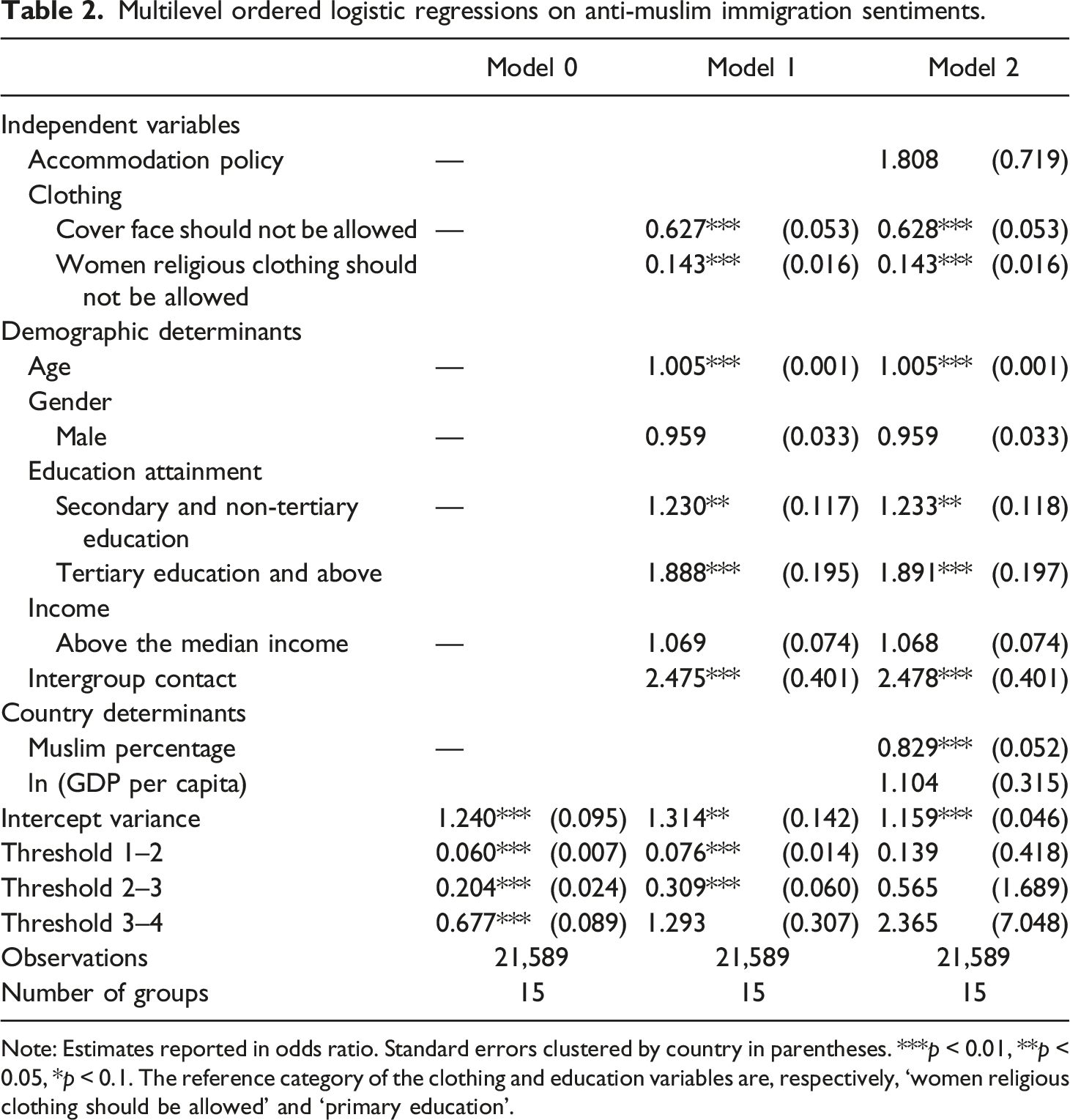
Multilevel ordered logistic regressions on anti-muslim immigration sentiments.
Note: Estimates reported in odds ratio. Standard errors clustered by country in parentheses. ***p < 0.01, **p < 0.05, *p < 0.1. The reference category of the clothing and education variables are, respectively, ‘women religious clothing should be allowed’ and ‘primary education’.
Since the intercept variance is statistically significant (p < 0.01), multilevel modelling is preferred. Model 1 includes only individual-level variables in a random-intercept model. The estimation results (in odds ratios) show that people who oppose women’s religious clothing are more likely to have negative sentiments towards Muslims (p < 0.01). Model 2 includes country-level variables. According to the estimation results, anti-Muslim sentiments are less pronounced in a more accommodative policy environment (p = 0.136). The estimates of the clothing variable are similar to those obtained from Model 1. We see, however, that the coefficient on the accommodation of Islam index is not statistically significant. In other words, there is no evidence for the existence of an unconditional policy effect (Hypothesis 1 is not substantiated). Nevertheless, as we will show below, the existence of the policy effect can be conditional on people’s policy preference.
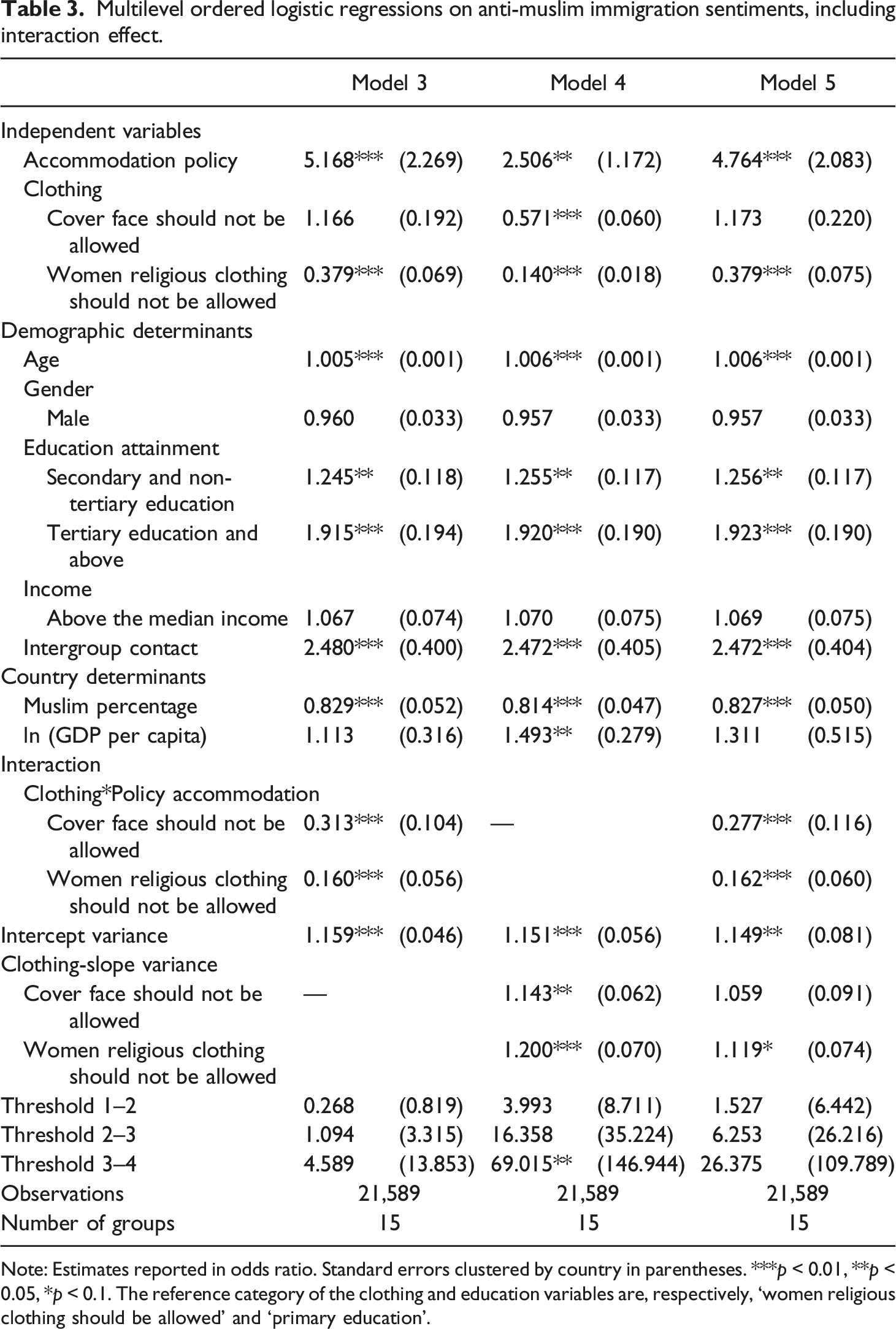
Multilevel ordered logistic regressions on anti-muslim immigration sentiments, including interaction effect.
Note: Estimates reported in odds ratio. Standard errors clustered by country in parentheses. ***p < 0.01, **p < 0.05, *p < 0.1. The reference category of the clothing and education variables are, respectively, ‘women religious clothing should be allowed’ and ‘primary education’.
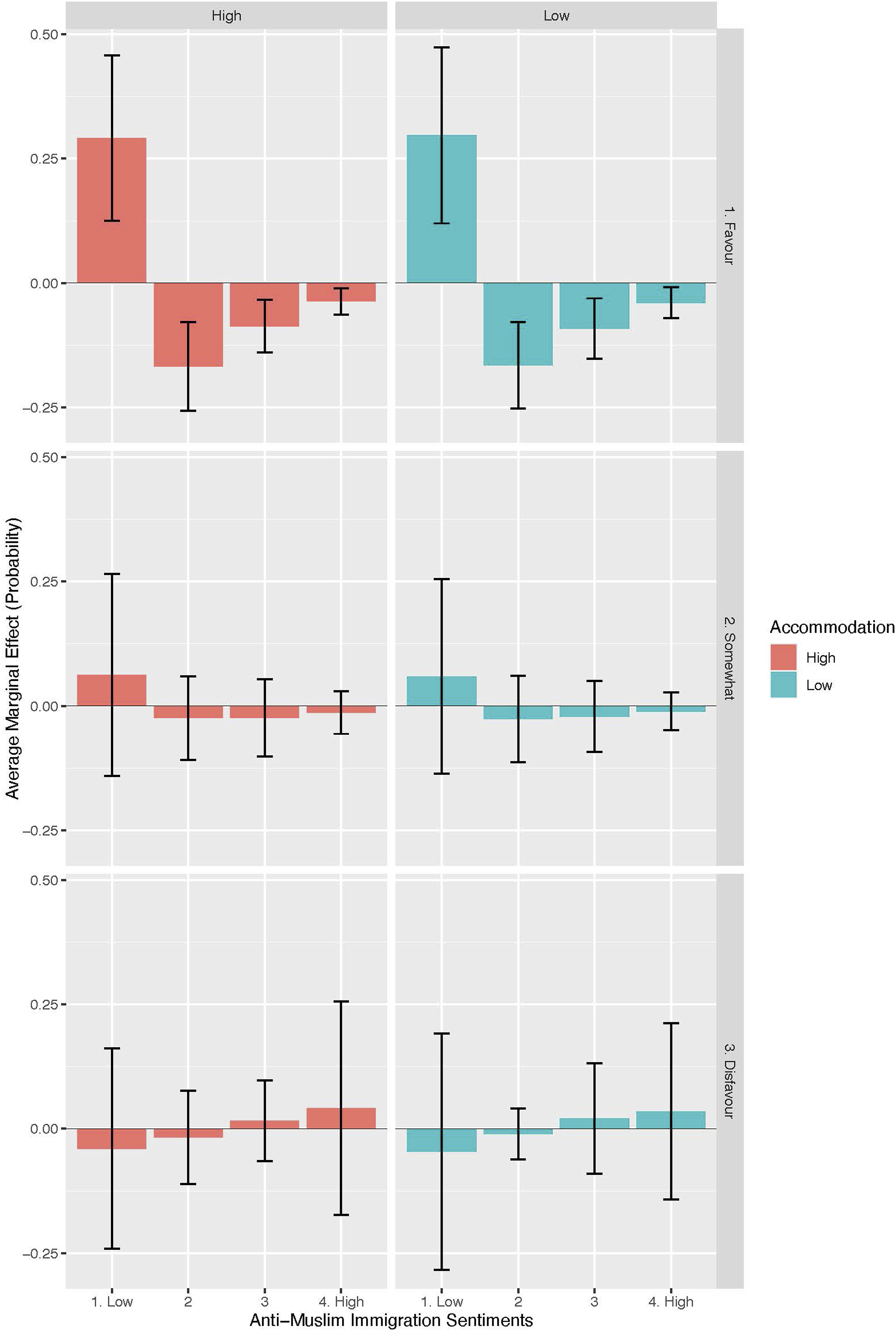
Accommodation policies, opinions on religious clothing and sentiments towards the Muslim population.
Figure 1 displays how accommodation policies and opinions on women’s religious clothing are related to sentiments towards the Muslim population. Six scenarios are presented. They are organised by the level of accommodation (by column) and attitudes towards accommodation (by row). The level of accommodation is labelled as high when the accommodation index is above the sample median (0.556) and as low when it is below. People are said to favour accommodation when they think that women’s religious clothing should be allowed and disfavour accommodation when they think that it should not be allowed. It is somewhat favoured when they think that women’s religious clothing should be allowed if women’s faces are not covered. In each of the six panels, the vertical axis represents the average marginal effect of accommodation of Islam policies, and the horizontal axis represents the degree of anti-Muslim sentiments (from low to high; the original scale was reversed for ease of interpretation). People are said to have a higher degree of anti-Muslim sentiments when they indicated that they feel like a stranger due to the number of Muslims in their countries. Compared across rows, we see that individual preferences moderate the effect of accommodation policies on anti-Muslim sentiments. We observe a larger drop in anti-Muslim sentiments when people favour accommodation policies, both in high and low accommodation contexts, which lends partial support to Hypothesis 2 on the existence of a socialising effect.
When we compare individual bars in the left-hand diagrams with their counterparts on the right, we notice that the marginal effects of the accommodation of Islam policies are very similar, no matter whether the level of accommodation is high or low, meaning that the impact of the policy on anti-Muslim sentiments seems to be minimal. We also found that accommodation of Islam policies reduce the likelihood of like-minded people to backlash against the Muslim population. In contrast, this effect is weaker among those who disfavour or somewhat favour accommodation. This lends support to the hypothesised socialising effect for people whose opinions resonate with accommodation of Islam policies (Hypothesis 2). Although a similar pattern can be observed for those who slightly favour accommodation (row 2), there is no strong statistical evidence for this group of people, as the 95% confidence intervals always include 0. Similarly, although an increase in the level of accommodation appears to make people who disfavour accommodation radicalise by making them more likely to have negative feelings about Muslims (row 3), the size of the effect is small (close to 0) and is short of statistical significance. This finding shows that people who disapprove of the policy do not change their positions because of the policy. The same results also suggest that there is no evidence of backlash effect for this group of people (Hypothesis 3 is not substantiated).
Estimation results related to the control variables are intuitive and corroborate previous empirical research. For the country-level variables, the Muslim percentage is positively related to anti-Muslim sentiments. This finding is contrary to Schlueter et al. (2020) but consistent with Semyonov et al. (2006), who showed that the growth of the Muslim presence in Western Europe increases the level of prejudice against Muslims. Individual characteristics such as gender, level of education, and intergroup contact are strong predictors of tolerant attitudes towards migrants. Similar to Meseguer and Kemmerling (2018), we found that people with a higher level of education are less likely to have anti-Muslim sentiments. Laurence et al. (2019), and Andersson and Dehdari (2021) showed that having personal contact with immigrant friends and ethnic minorities tends to reduce anti-immigrant sentiments. We also found that males are more likely to have anti-Muslim sentiments than females. This finding is comparable to Pichler (2010).
In summary, we found that the socialising effect of accommodation of Islam policies is effective for like-minded people only (Hypothesis 2). This result is consistent with the theory of policy resonance, which predicts that people who agree on the policy contents are likely to be socialised, a finding consistent with previous research by Weldon (2006), Wright (2011), and Schlueter et al. (2013) on citizenship policy. People who disagree with the policy are, expectedly, unmoved by it. Regarding the backlash effect (Hypothesis 3), we did not find any statistical evidence for its existence, as more accommodative contexts do not seem to create a societal backlash against the Muslim population for people who disfavour accommodation in the first place.
The sensitivity of these results has been examined through additional robustness checks. We use compatibility to measure one’s personal view about accommodation. The variable compatibility indicates whether the respondent agreed that “Islam is fundamentally incompatible with” their national culture. Compatibility differs in its degree of potential dissonance with the policy environment. While clothing might be interpreted as a willingness to tolerate, compatibility speaks to the potential of cultural coexistence. Accommodation is reflected here through the compromise between the Western and the Islamic cultures when any perception of disagreement or incompatibility has been overcome. Therefore, the opinion that Islam is compatible with the host community’s culture is consonant with accommodation policies.
The marginal effects of experiencing anti-Muslim sentiments for the variable compatibility are plotted in Figure 2. They are based on multilevel models similar to Model 5 in Table 3. Figure 2 confirms our findings from the main model. Accommodation policies, compatibility of Muslim and sentiments towards the Muslim population.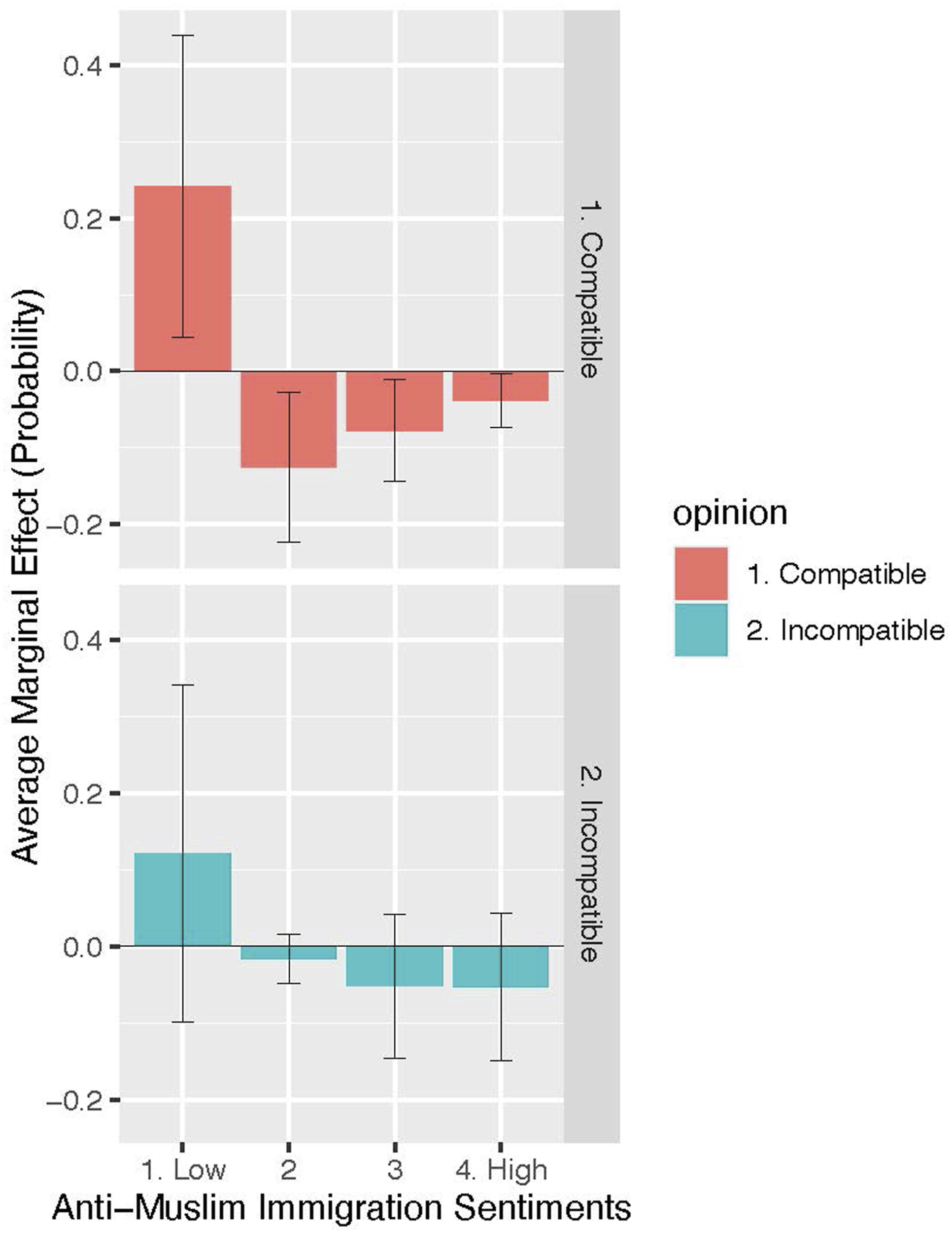
As an additional robustness check, we also run the multilevel model by treating the dependent variable as continuous. The regression results can be found in Tables A2 and A3 in the Supplementary Material. The results from the linear multilevel regression models confirm the results from the multilevel ordered logistic regression models, reported in Tables 2 and 3 above.
Discussion, limitations, and conclusion
This study has looked at the effects of the accommodation of Islam policies on anti-Muslim sentiments and the moderating effect of individuals’ policy preferences. With regards to the first hypothesis, we have not found evidence of a policy effect. However, when we introduce individuals’ policy preferences as the moderator, we observe a policy socialising effect only on those whose opinions resonate with accommodation policies, and we do not see it when opinions dissonate with the policy contents. This means that the accommodation of Islam policies have no apparent effect on those who disagree with accommodation. This finding is interesting because it counters what has been documented in the social movement literature (Bratton, 2002; Fejes 2008; Zagarri, 2007; however, see Bishin et al., 2016 for a different finding), according to which policies will have a socialising and a backlash effect, depending on the policy addressees’ opinions.
The absence of policy effect when opinions dissonate with the policy contents can be explained by the compromised statistical power of our tests due to the small number of level-2 units. It can also be explained by the nature of dissonance. According to Festinger (1957), dissonance can be based on a disagreement on values or on facts, and disagreements on values usually increase the magnitude of dissonance. Following Festinger, the impact of the dissonance can be larger when the source of disagreement is based on normative values instead of physical reality. 5 The possibility to test the correctness of one’s opinions is, for Festinger, at the heart of this distinction. People change their minds more easily when their opinions are falsified by physical reality. On the contrary, disagreements on normative values, at any rate, are difficult to falsify. People disagree about the wearing of Islamic attires possibly because such practice infringes upon their ideas about gender equality. By exposing someone to more veils in the country, their value judgments about the infringement would hardly change. This explains why we do not observe a socialising effect on those who disagree with accommodation policies. Similarly, those who see Islam as incompatible with their own cultures may perceive that both cultures embrace contradictory principles or values. In view of this, the accommodation of Islam policies are not going to change people’s value judgments, since the disagreement is based on a clash of values.
In connection to this, the experiments conducted by Ivarsflaten and Sniderman (2022) in Great Britain, Norway, and the US showed that people are in general widely tolerant of Muslims but are not ready to protect Muslims’ culture and traditions, even less when they go against liberal values. In line with this, the results of the present study show that the accommodation of Islam policies do not socialise dissonant opinions that find Islam at odds with liberal values.
Our findings should not be interpreted as the failure of accommodation policies. Following the literature on group threat, we could have expected a radicalisation of dissonant positions. Cooper and Mackie (1983) argued that dissonance in definitional elements, which represent the core values of a group, are difficult to change. Certain Western liberal values, such as gender equality could constitute, for many, definitional elements of European societies. In this sense, allowing veils in the country may be seen as an infringement of a definitional element and will increase anti-Muslim sentiments. In a similar vein, Glasford et al. (2008) found that cognitive dissonance between personal values and state policies can cause disidentification and hence induces activism in order to reduce the dissonance. Accordingly, one may expect that those with strong dissonance would take public stances against Muslims. However, in our study, we do not observe that dissonance with accommodation policies increases anti-Muslim sentiments.
An additional explanation for the absence of backlash effect is that integration policies do not change people’s beliefs but only further tolerance for disagreements. Good fences make good neighbours. The literature on tolerance distinguishes between respect tolerance and coexistence tolerance (Velthuis et al., 2021). While respect tolerance is based on the principle that individual cultural differences deserve tolerance as all human beings should be treated equally, coexistence tolerance, on the contrary, conceptualises tolerance from a pragmatic point of view: tolerance is there to ensure peaceful coexistence. The results we find here can be understood from the perspective of coexistence tolerance. The absence of a backlash effect might be interpreted as a sign of indifference. People accept Muslim practices for the sake of coexistence, but they refuse to internalise and embrace the spirit of multiculturalism. In this sense, living with the Islamic culture may help non-Muslims familiarise themselves with the religious meaning of women’s attires for Muslims. Although this will not make the non-Muslim population change their beliefs and values, the exposure and the need for a peaceful coexistence may prevent anti-Muslim sentiments from escalating. Similarly, experiencing accommodation will not change non-Muslims’ view on the incompatibility of Islam with their own cultures, but it may help both groups to identify points in common in order to live together, which is reflected in the absence of backlash effect.
Our analysis is subject to several limitations. First, this study demonstrates that there is a socialising effect when people’s opinions resonate with the accommodation of Islam policies and that there is no backlash effect when the opinions dissonate with them. However, the causal mechanisms that lead to these results are yet to be established by more sophisticated methods.
Second, like existing studies in this line of research, due to data unavailability, the sample of countries used to model the multilevel regression is limited to 15. The small number of groups will weaken the statistical power of our tests. However, with a small intra-class correlation, the relatively large number of individual respondents within each country may help to alleviate this problem (Kreft and De Leeuw, 1998). For a similar data availability concern, we are not able to include the respondents’ migration background either. Although in the survey there is a question related to the respondents’ citizenship, because the variable is subject to measurement error (e.g., the category of first-generation and second-generation migrants depend on the law and policies of each country), we did not include the variable in this study.
Third, the present study used only cross-sectional data and hence is not able to isolate the effects of significant events like the refugee crisis in 2015. Further studies should capture policy changes introduced after the refugee crisis and examine if they influence the results reported in this research.
Fourth, one may argue that the dependent variable is conceptually close to the moderators. This indeed can be a concern. However, if this were the case, one would have expected a robust statistical relationship between the dependent variable and the moderators at all levels. Nevertheless, the moderation effect is found only in some cases and the accommodation of Islam policies appear to have no effect on those who disagree with them. Further research should investigate when backlash occurs and to what extent it is related to respect tolerance or coexistence tolerance. In relation to this, further studies should come up with an empirical test to identify mechanisms that lead to tolerance. For example, Verkuyten et al. (2022) found that people are more likely to be tolerant when engaged in deliberation. The absence of a policy effect suggests that the accommodation of Islam policies can be skin-deep when it comes to engaging people in reflection.
Multiculturalism as a political ideal has recently received much criticism. Koopmans (2010) and Uslaner (2012), for example, argued that multiculturalism could foster segregation and lead to poor integration outcomes. The present study shows that the accommodation of Islam policies do not produce backlash effects and intolerance. This can be interpreted as evidential support for the soundness of multicultural programmes.
Supplemental Material
Supplemental Material - A stranger at home? A multilevel analysis of anti-Muslim sentiment in Western European societies
Supplemental Material for A stranger at home? A multilevel analysis of anti-Muslim sentiment in Western European societies by Ana Maria Torres Chedraui and Pui-Hang Wong in Ethnicities
Footnotes
Declaration of conflicting interests
The author(s) declared no potential conflicts of interest with respect to the research, authorship, and/or publication of this article.
Funding
The author(s) received no financial support for the research, authorship, and/or publication of this article.

Supplemental Material
Supplemental material for this article is available online.
Notes
References
Supplementary Material
Please find the following supplemental material available below.
For Open Access articles published under a Creative Commons License, all supplemental material carries the same license as the article it is associated with.
For non-Open Access articles published, all supplemental material carries a non-exclusive license, and permission requests for re-use of supplemental material or any part of supplemental material shall be sent directly to the copyright owner as specified in the copyright notice associated with the article.
