




Abstract
The determinants of whether or not an immigrant seeks to become a citizen are still largely invisible to scholars; as are the decisions made during the naturalization process by street-level bureaucrats. Research on the acquisition of citizenship has incorporated a number of determinants of naturalization outcomes over the past decades, but lacks the contextualization of immigration law in its relation to criminal law. This systematic literature review of the 140 most-cited papers across the naturalization and crimmigration literatures seeks to construct a theoretical bridge between the disciplines in an effort to illuminate the blind spots challenging naturalization scholarship. I argue that the inclusion of crimmigration as a factor impacting naturalization is essential for scholarship in order to accurately use citizenship policies as an indicator of a state’s overall approach to immigration - particularly regarding residence requirements. The conceptual utilization of crimmigration in the context of citizenship acquisition offers new insights into the underexplored relationship between citizenship policy and the individual migrant, potentially uncovering some of the factors hindering immigrants’ ability to seek formal membership. Evidence within recent crimmigration scholarship points towards the role played by racialization within the functioning of a crimmigration system. This paper reviews the prominent streams of both strands of literature first utilizing a bibliometric analysis of the respective citation networks and second, diving into the substantial developments and parallels in naturalization and crimmigration research.
Keywords
Introduction
In 2006 socio-legal scholar Juliet Stumpf observed two major developments in the relationship between criminal law and immigration law in the United States. Criminal categories were being imported into immigration law while administrative and regulatory characteristics of immigration control were being established in the criminal justice system. In order to describe this increasing interweaving between both systems of law, Stumpf (Stumpf, 2006) coined the term ‘crimmigration’. The onset of this entanglement dates back to the 1980s, when the United States Congress criminalized behaviours associated with migration - such as hiring undocumented persons - and subsequently facilitated the deportation of non-citizens for criminal offenses (Sklansky, 2012; Stumpf, 2006). A legal framework impacted by crimmigration is able to control migration through the criminal justice system by criminalizing the immigrant and their behaviour and by utilizing immigration law for criminal justice purposes (Van Berlo, 2020). The increasing interweaving of criminal law and immigration law has accompanied certain developments such as the perception of migration and the migrant on the individual level as a risk, specifically a security risk. What used to be mainly a discussion of financial burden on the receiving state has been blanketed with the general assumption of security being the decisive factor in policy changes; or as Sklansky put it, the characterization of immigrants changed from the ‘freeloading foreigner’ to the ‘criminal alien’ (2012: 196). Recent crimmigration scholarship has highlighted the role of racialization within the functioning of a crimmigration system. Colorblind policies end up harming minorities and people of color to a greater extent than those read as belonging to the majority race or ethnicity (Armenta, 2017; Pickett, 2016).
The changes within legal frameworks as they were first labelled by Stumpf and observed by many socio-legal scholars since speak to a blind spot within migration scholarship, more specifically research on citizenship and the acquisition of formal membership. Naturalization policies are often used as an indicator of a state’s overall approach to immigration (Huddleston and Vink, 2015). The acquisition of citizenship constitutes a major, if not the step in the integration process marking the formal inclusion of the migrant into the polity. Research on naturalization and naturalized citizens has thus puzzled with identifying and evaluating the exact factors determining whether or not an individual will naturalize. Hainmueller et al. illustrate in their work on the long-term social integration of immigrants that ‘naturalized citizenship is not randomly assigned, but results from a complex double selection process’ (Hainmueller et al., 2017: 257). Firstly, the determinants of whether or not an immigrant applies for naturalization are to a large extend still invisible to scholars. Those never attempting to acquire citizenship might differ in significant ways from those who try and fail or those who succeed. Secondly, the decisions made during the naturalization process by street-level bureaucrats, which effectively select the new members of the citizenry, remain unobserved (Hainmueller et al., 2017). Scholarship on citizenship acquisition is thus confronted with two blind spots: the process leading up to the formal application for citizenship and the discretionary practices of bureaucrats before and during the naturalization procedure. Anderson outlines the typical trajectory of long-term migration to a Western liberal democracy as ‘entry, temporary stay, settlement, and citizenship’ (Anderson, 2013). Naturalization and the formal process itself only occur between settlement and the acquisition of formal membership, but the new citizen also has to go through the steps of entry and temporary stay in order to make it to the settlement stage in the first place. This is to say, the new citizen at one point in time had to be granted territorial access to the state and not be removed from it subsequently. As criminal behaviour is increasingly punished through means of immigration law such as deportation, territorial access is not a given condition for many migrants - especially those who are branded as criminal aliens through the racialized discourse fuelling the intersection of criminal and immigration law (Riva, 2017; Sklansky, 2012). Only observing naturalization from the point of formal application onwards means disregarding or at least discounting the stages of entry and temporary stay concerning their impact on an individual’s migration trajectory.
This paper seeks to construct a theoretical bridge between the literatures on citizenship and crimmigration in an effort to illuminate these blind spots. Research on the acquisition of citizenship has incorporated a number of determinants of naturalization outcomes but lacks the contextualization of immigration law in its relation to criminal law. I argue that without the inclusion of crimmigration as a factor impacting naturalization, scholarship is unable to accurately use citizenship policies as an indicator of a state’s overall approach to immigration - particularly regarding residence requirements. The conceptual utilization of crimmigration in the context of citizenship acquisition offers new insights into the underexplored relationship between citizenship policy and the individual migrant, potentially uncovering some of the factors hindering immigrants’ ability to seek formal membership. This paper reviews the prominent streams of both strands of literature first utilizing a visual analysis of the respective citation networks and second, diving into the substantial developments and parallels in naturalization and crimmigration research. Even though the two fields of scholarship have not yet been in explicit dialogue with one another, they do illustrate similar developments in the realm of citizenship policy and practice utilizing differing terminologies. I argue that the contextualization of immigration law in its relation to criminal law has to be included in studies of naturalization in order to overcome the literature’s blind spot concerning immigrants’ lives before their potential application for citizenship. This contextualization can be done most feasibly through the application of the concept of crimmigration within the naturalization scholarship.
Methodology
This literature review will utilize a semi-structured approach of examining the two bodies of literature. I examine both fields through a visual analysis of their respective citation networks followed by a substantive analysis of the most-cited papers. In a first step, the 140 most-cited papers relating to crimmigration or naturalization research respectively were determined through the citation data base Web of Science.
1
The bibliographic network created by these papers was then visualized through R utilizing the ‘bibliometrix’ package in an effort to determine whether or not any explicit connections between both literatures exist already. A full list of all articles plotted in Figure 1 is listed in Appendix I. Citation Network of the 140 most-cited articles in the naturalization and crimmigration literature.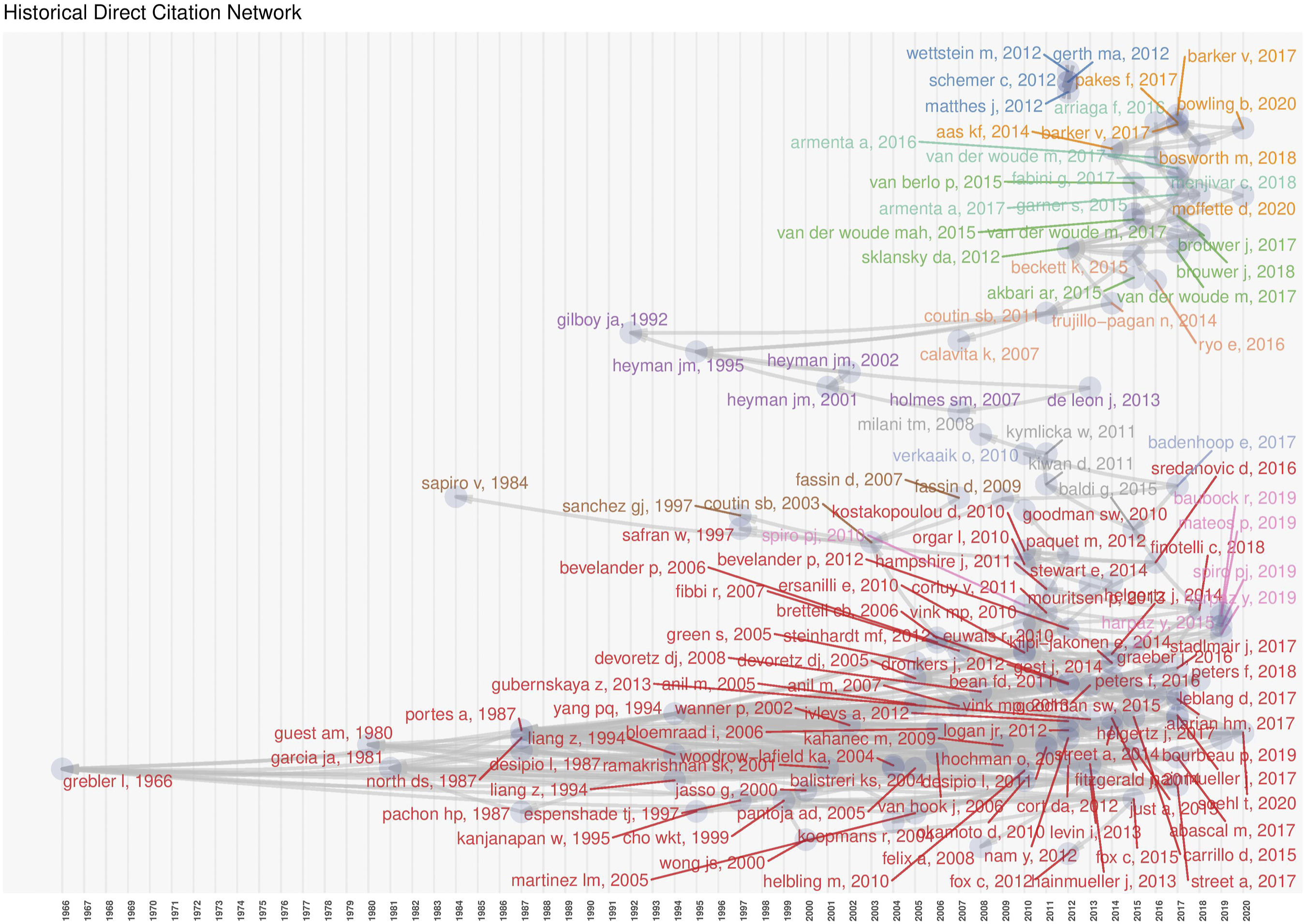
Secondly, I compare the substantive questions posed and results offered by the 30 most-cited papers in both fields of literature published between 2010 and 2020. 2 The review does not restrict itself to referring only to the top 30 most cited pieces, but will also supplement these works with more recent scholarship that simply has not had enough time since its publishing to garner the number of citations a paper from the early 2010s might. These papers are predominantly chosen by their unique positioning within the literature such as Graebsch’s 2019 article on crimmigration in Germany being one of the first of its kind. This way, the review follows a semi-structured approach guided by citation statistics and bibliometric-based visualizations in order to accurately reflect the state of art. It bears acknowledging that the utilization of citation-based criteria within a literature review always requires the reproduction of a somewhat problematic status quo, which prioritizes citation statistics as an indicator of the value of a piece of scholarship. However, as the first goal of this review lies in determining whether or not two schools of thought have been in discernable dialogue with one another – and academic dialogue necessitates interaction in the form of citation – I recognize my method as flawed, but view it as the best tool available. I believe that the overall argument made here, namely the value added to naturalization scholarship through the inclusion of crimmigration, outweighs these limitations. After a brief examination of the citation networks, we will look at the evolution of both fields as well as the substantive parallels between the bodies of research outlining why bridging these scholarships furthers our ability to examine and understand naturalization outcomes.
Analysis
Bibliometric connections
The main goal of the bibliometric analysis was to ensure the review did not overlook any already existing explicit connections between the two fields of literature. As naturalization research is mainly based in political science, sociology and public administration while crimmigration research is conducted almost exclusively by socio-legal scholars, I did not expect to find any clear connections made between the fields or any common scholarly ancestry.
Figure 1 visualizes the first broad analysis of the 140 most-cited papers. At the bottom of the historical direct citation network, we can follow a time bar starting on the left in 1966 with Grebler’s paper on the naturalization of Mexican immigrants in the United States published that year and stopping in the year 2020 on the right. Even though not all lines expressing direct citations are easily discernable, we are able to detect two separate citation networks. The web consisting of mainly red-labeled articles in the lower half of the diagram illustrates the network created by the naturalization literature while the green-, purple- and orange-labeled network at the top of the diagram consists of the crimmigration scholarship. It is apparent that the two bodies of literature have not interacted with one another based on Figure 1 as both citation networks are entirely separate from one another.
However, it is worth taking another look at the purple arm of the crimmigration citation network extending from 1992 to 2013 closest to the top of the naturalization citation network. As stated earlier, crimmigration as a term was coined in 2006 and gained in prominence only within the last decade. The purple arm of the network predating that time suggests that these publications are included in the analysis as part of the naturalization literature. Examining the articles constituting this section of the citation network only partially confirms this suggestion. The connection of this set of papers to the crimmigration literature is made by Coutin and her 2011 article on ‘The Rights of Noncitizens in the United States’, in which she cites works by Gilboy (1992) and Heyman (1995) respectively. Both papers are included in the analysis due to their usage of the term ‘naturalization’ albeit that Heyman and Gilboy do not discuss naturalization itself, but rather mention the Immigration and Naturalization Service (INS), a United States agency functioning until 2003 as part of the U.S. Department of Justice, as well as the category of ‘immigration and naturalization law’ (Heyman, 1995: 268). This circumstance points to more than the limitations of papers such as this one that utilize keywords in their sampling: It provides an example of the crimmigration literature drawing from and combining adjacent literatures such as sociology and anthropology when assembling the evidence for the developments accompanying crimmigration.
Gilboy (1992) analyzes the ‘Penetrability of Administrative Systems’ by examining the interdependence between immigration inspectors and U.S. airlines. She describes a pattern in the decision-making of inspectors as to when they are more likely to release a suspect depending on whether they arrive on a flight at the beginning or at the end of the day. Coutin refers to this article in an effort to demonstrate that the conditions determining noncitizen’s rights are also impacted by nonstate agents as shown through the analysis conducted by Gilboy. Heyman’s work on the anthropology of bureaucracy studies the world views of INS officers (1995). His article is utilized by Coutin as a source documenting an increase of border control agents being deployed at the border, which she in turn views as evidence of the salience and polarizing character of the subject of ‘rights of resident noncitizens’ (Coutin, 2011). Both articles, while not constituting a substantive part of the naturalization citation network as they are unconnected to the red web of citations, do illustrate the variety of literatures influencing crimmigration scholars.
Much more compelling than her citations of scholars using the term ‘naturalization’ is the fact that Coutin herself published research on the topic of naturalization and is part of its citation network. Her 2003 article ‘Cultural logics of belonging and movement’, which can be seen colored in brown along the upper edge of the naturalization citation network in Figure 1, explores the experiences of Salvadoran migrants in the U.S. caught between dynamics of exclusion and a rhetoric of inclusion broadcasted through naturalization ceremonies. Even though she has published within both strands of literature, Coutin has not yet incorporated both subjects into a shared piece of research. Her 2013 journal article ‘In the Breach: Citizenship and its approximations’ reports the experiences of young migrants in the U.S., who became vulnerable to deportation due to criminal convictions. As she recounts these developments, Coutin refers to crimmigration and Stumpf’s work in a footnote. This connection comprises the extent to which naturalization and crimmigration literature have been in dialogue with one another, which is to say, they have not done so extensively.
Based on the analysis of the aforementioned visualization of both citation networks, the expectation of no clear connections between the fields as well as no common scholarly ancestry is confirmed. We do see that it is possible to find scholars researching within both fields but direct connections have not been made at this point. The following section will review the evolution of both sets of literature regarding the questions and assumptions guiding the research as well as the substantive contrasts and parallels observed by scholars of both fields.
Substantive analysis
The state of the art on naturalization and crimmigration
The central question to scholarship on citizenship acquisition has revolved around the ‘why’ of naturalization: Why does a person acquire another citizenship? Early works on citizenship acquisition centered around the motivations and characteristics of the individual in question gaining citizenship – particularly Latin American immigrants residing in the United States (Grebler, 1966; Jones-Correa, 2001; Yang, 1994). The set of determinants of naturalization outcomes has since been expanded to include two more dimensions of factors. The second dimension denotes the characteristics of the individual’s country of origin such as whether or not it allows for dual citizenship or citizenship renunciation as well as the country’s level of development (Bloemraad, 2004; Vink et al., 2013). The third dimension illustrates the citizenship policies of the destination state, particularly the requirements for citizenship status. These include but are not limited to prerequisite language classes, citizenship or integration courses, naturalization fees, citizenship ceremonies or oaths as well as economic and residential requirements (Goodman, 2010; Huddleston, 2020; Verkaaik, 2010). This framework created by the citizenship laws in the countries of destination is also referred to as the ‘opportunity structure’ an immigrant acts within (Bloemraad, 2006; Okamoto and Ebert, 2010; Vink et al., 2013).
The inclusion of more and more factors into the analysis of naturalization has also been accompanied by the problematization of certain assumptions underlying the field’s scholarship. Research on naturalization often characterizes this step as a ‘flick of a switch’. This comparison denotes two supposed aspects of naturalization. It firstly assumes an immediacy of the process: One chooses to naturalize and there we are, they are a citizen. Secondly, it views the change in status as a binary from non-citizen to citizen. These assumptions of immediacy and binarity are emphasized by the lack of studies examining the process of the naturalization itself. More often, naturalization or being a naturalized citizen is used as a category to differentiate between foreign residents, naturalized citizens and natural-born citizens. In their 2018 paper, Peters et al. examine the effect of naturalization on immigrant employment in the Netherlands. Their findings do not reproduce a ‘flicked switch’ between naturalized immigrants and those that are long-term residents. They conclude that though the finished naturalization process does produce a ‘boost’ on the labor market, the employment probability of migrants also increases significantly in the years leading up to the acquisition of citizenship. The status change alone does not seem to be the only factor that differentiates individuals within a population from one another.
Schlenker (2016) utilized a similar categorization of the population studying the effects of dual nationality on a person’s feelings of solidarity towards their citizenry and their self-identification in Switzerland. Her findings also do not indicate that formal status alone matters but also how it was acquired. Swiss citizens that had naturalized were significantly less likely to describe themselves as Swiss, but exhibited greater attachment and solidarity than their natural-born fellow citizens. What seems to matter is not only whether or not a person has citizenship status, but also how they acquired said status. The dichotomous condition of state membership is not necessarily reflective of the multi-facetted individual understandings of membership within the citizenry.
The recent introduction of concepts such as the opportunity structure signals a break from the assumptions much of the older naturalization literature made, particularly the implicit assumption that states create a citizenship and immigration policy that is in a sense fair towards the immigrant, aiming to include rather than exclude: As long as the immigrant in question demonstrates motivation to integrate and acquire citizenship, then the system will allow for this process to unfold, as integration is associated with positive economic and social outcomes (Hainmueller et al., 2017). This assumption is partly owed to the fact that early scholars of citizenship acquisition focused on the individual dimension of naturalization and not policy. Formulations such as a naturalization ‘payoff’ for immigrants, the framing of acquiring citizenship as a mere calculation on part of the migrant as well as the fact that scholars were not explicitly questioning the goals of states’ immigration policies demonstrates an implicit notion of naturalization as a beneficial favor for the immigrant offered by destination states.
Scholarship concentrated on determinants of immigrant motivation to gain citizenship rather than factors creating hinderances for them to do so. The inclusion of a concept outlining the systematic opportunities provided to immigrants highlights the growing awareness within the literature that citizenship policies are ‘crucial’ in determining naturalization outcomes as they regulate the conditions under which migrants can acquire citizenship (Vink et al., 2013: 4). This awareness has most recently translated into the inclusion of not only immigrants’ motivation towards citizenship acquisition, but also their ability to do so. Huddleston (2020) illustrates the conceptual difference between an immigrant’s interest and ability to naturalize with the latter requiring not only motivation but also eligibility and the capacity to submit a citizenship application. Referring to sociologists Bloemraad and Aptekar, Huddleston views the ability to become a citizen as determined by the ‘context of reception’ created by bureaucracies and service providers both before and during the formal naturalization process (Aptekar, 2016; Bloemraad, 2002, 2006; Huddleston, 2020).
The addition of the factor of ability into the trajectory of citizenship acquisition also portrays a necessary move away from the ‘flicked switch’ notion of naturalization. The assumption of immediacy that is part of said image is no longer viable once motivation is not the sole determinant for an application for naturalization. However, the contextual structure within which the ability of an immigrant to acquire citizenship is shaped should not be limited to institutions and immigration policies. There is ample reason to argue that the inclusion of a broader view of the legal framework, incorporating not just immigration law but also criminal law as well as their respective implementation, has to be taken into consideration.
Retracing the inclusion of a growing number of dimensions into the analysis of naturalization since the field’s inception demonstrates a move away from a focus on individual characteristics of the immigrant and towards the institutional features and policy aspects exhibited by the states immigrants are moving between. Contemporary research has started to look at the relationship between these sets of factors, highlighting a need to explore the impact of immigration policy and practices on the individual migrant – not only in the sense of whether they motivate them to apply for formal membership, but also deliberating whether this structure of opportunity limits immigrants’ ability to do so. It remains unchanged that naturalization studies focus on the process of naturalization from the moment of its formal initiation onwards. As outlined above, this concentration on the formal procedure of citizenship acquisition neglects the stages of entry and temporary stay of an immigrant’s migration trajectory. But what are the factors that remain uncovered when the difficulty of acquiring citizenship is based solely on the existing set of factors used by naturalization scholars?
As naturalization and citizenship policies fall – at least partly – under the jurisdiction of immigration law, recent scholarship has taken to include states’ respective policies in their analyses of naturalization developments. Citizenship regimes are commonly categorized as ‘restrictive’ or ‘liberal’, exhibiting ‘thick’ or ‘thin’ configurations of nationality (Dronkers and Vink, 2012; Goodman, 2010; Orgad, 2010). While contemporary works on naturalization incorporate various factors possibly influencing an individual’s pathway towards and through the naturalization process (Huddleston, 2020; Vink et al., 2013), the legal frameworks of destination countries have not been explored beyond the categorization of the laws on the books. However, the contextualization of immigration law in its relation to criminal law has to be included in future naturalization research in order to overcome the literature’s blind spot concerning immigrants’ lives before their application for citizenship.
The necessity of said contextualization is due to the changing relationship between criminal and immigration law in many Western liberal democracies. Socio-legal scholars of immigration and penality have observed the increasing entanglement of immigration law and criminal law, expressed in the term ‘crimmigration’ (Sklansky, 2012; Stumpf, 2006). Both systems of law are utilized to regulate membership: The former governs the entry and exit of persons across borders, the latter regulates the conduct within a community (Stumpf, 2011).
Since the inception of the term, crimmigration scholarship has evolved into two main pillars of research: One focusing on the concept itself examining its origins and proliferation through legal structures as well as the public and political discourse and law enforcement (Coutin, 2011; Pickett, 2016; Sklansky, 2012; Van der Woude et al., 2014; Van der Woude and Van Berlo, 2015) and another studying the impact of crimmigration on the treatment of non-citizens by the criminal justice system (Aas, 2014; Armenta, 2016, 2017; Beckett and Evans, 2015; Bosworth et al., 2018; Chacon, 2015; Kirk and Wakefield, 2018; Ryo, 2016; Stumpf, 2011). Contemporary crimmigration scholarship still centers around the North American context with a growing number of studies examining the expansion of crimmigration to other Western democratic states such as the Netherlands, Norway and Germany, which limits the scope of this review (Aas, 2014; Graebsch, 2019; Van der Woude et al., 2014; Van der Woude and Van Berlo, 2015).
In contrast to the field of crimmigration, scholars of naturalization and citizenship more broadly have examined the subject from various perspectives in the past ten years: its connection to international law (Orgad, 2010; Spiro, 2011), its impact on social, political and economic integration (Bean et al., 2011; Ersanilli and Koopmans, 2010; Hainmueller et al., 2017; Peters et al., 2018), the evolution of citizenship policy (Dronkers and Vink, 2012; Fitzgerald et al., 2014; Goodman, 2010; Kostakopoulou, 2010; Verkaaik, 2010; Vink et al., 2013; Vink and De Groot, 2010) and the determining factors of naturalization outcomes (Dronkers and Vink, 2012; Fitzgerald et al., 2014; Hainmueller and Hangartner, 2013; Kostakopoulou, 2010; Okamoto and Ebert, 2010).
Crimmigration research is defined by its ability to connect overarching developments in a country’s legal system to – for example – an individual’s struggle with local police practices (Beckett and Evans, 2015). These connections can be made due to the three layers through which crimmigration expands: the public and political discourse progressively defining immigrants as a security risk or as criminal aliens (Sklansky, 2012), the legislative layer where criminal and immigration law are ‘increasingly merged’, and the layer of implementation and enforcement (Van der Woude and Van Berlo 2015: 63). Hence, crimmigration describes a substantive as well as a procedural merger of two legal systems. It shows that it is not only the law as it is written that matters, but also how it is being put into practice, because the implementation of certain policies can entail unforeseen interactions with other pieces of the legal system. These potential interactions are particularly apparent concerning issues of residence. In the following section, I examine the increased importance of legal residence and its connection to deportability highlighting the inability of policy evaluations viewing immigration procedures as being independent from other parts of the legal framework to accurately evaluate the restrictiveness of a state’s immigration approach. Even though much of the crimmigration literature has not zeroed in on this issue, it is also evident that not all migrants are equally exposed to the crimmigration system with issues such as racialization impacting the implementation of certain policies.
The case for connection: the restrictive power of residence requirements
Stepping away from analyzing the developments within the fields of naturalization and crimmigration concerning key assumptions and research goals, it essential to now examine the developments within citizenship and immigration policy as observed by the scholarship itself. In the context of naturalization, Vink and De Groot (2010) describe six broad trends in citizenship attribution across Western Europe: Firstly, the descent-based transmission of citizenship by women, men and emigrants has largely been extended. Secondly, many states have granted a path to citizenship for second- and third-generation immigrants through ius soli provisions. Thirdly, holding multiple citizenships is an increasingly accepted practice. Fourthly, naturalization requirements such as language and integration courses have been introduced. Fifthly, countries try to avoid statelessness of individuals through their citizenship law. Lastly, EU membership has gained in relevance in the context of citizenship. Concerning crimmigration, Sklansky (2012) illustrates four key developments: First, immigration violations are increasingly being treated as crimes. Second, criminal behavior is more and more punished through an immigration related consequence such as deportation. Third, immigration proceedings are more often of criminal character than previously. Fourth, immigration law is increasingly enforced through local police force.
At first glance, these outlines of key developments do not intersect in an obvious manner. But there are indeed parallels that can be found between these phenomena. While all six points made by Vink and De Groot (2010) relate to naturalization, the clearest change in the process itself is shown in points (4) and (6). Relating to point (4), the authors state that ‘apart from the required number of years, we notice a restrictive trend towards the requirement of legal residence as a condition for naturalisation’ (Vink and De Groot 2010: 726). This observation is not examined more closely, but their categorization of the trend as ‘restrictive’ demonstrates an acknowledgement of the increased burden put on the immigrant. The number of years required for naturalization has decreased in many states – most notably in Germany from 15 to eight years – but the quality of said residency has changed arguably drastically. While Germany shortened the required time of legal residence significantly, the additional requirement of legality of said residence excludes migrants living in Germany without a residence permit. A person might reside in Germany with only a temporary suspension of deportation (Duldung) for years with none of that time counting towards citizenship as naturalization policy requires a residence permit, which a Duldung is not categorized as (Act on the Residence: Chapter 1, Section 60a) . The naturalization and citizenship literatures do describe residency requirements as exclusive or restrictive the more years of residence are required of the individual who wishes to naturalize (Goodman, 2010: 765). Nevertheless, this understanding is never given the explicit reasoning that the crimmigration literature can provide the vocabulary for.
The potential consequences of the interweaving of criminal law and immigration law on residency can be easily illustrated through the example of the Secure Communities program developed by the US Immigration and Naturalization Service. Secure Communities automated and established the checking of criminal arrestees’ immigration status as routine. Within the first four years following its complete implementation in 2013, more than 180.000 people were deported due to the program (Pickett, 2016). From a naturalization study’s perspective, these 180.000 individuals constitute those overlooked due to the double selection bias of only incorporating those initiating the citizenship application process. Their fates demonstrate that evaluating how restrictive a citizenship policy is cannot be limited to solely examining the formal citizenship requirements. Two states might prerequisite six years of residency to apply for naturalization, but if one state reserves itself the right to remove immigrants from its territory for traffic law violations (Armenta, 2017; Pickett, 2016) while the other has established a significantly higher threshold for deportation, then those respective sets of policy cannot be categorized as equally restrictive; especially when having been deported constitutes grounds for disqualification from gaining any kind of permanent legal status.
However, crimmigration does not only extend the list of formal reasons for removal from state territory, it also erodes the protections of non-citizens within the criminal justice system and undermines the stability of legal statuses. As Aas observes in her study of the Norwegian criminal justice system, crimmigration functions to produce a differentiation between citizens and non-citizens resulting in a ‘more exclusionary penal culture directed at non-citizens’ (2014: 521). This consequence manifests itself in the differing procedural treatment and standard of rights afforded non-citizens compared to citizens (Aas, 2014; Graebsch, 2019). Through these developments non-citizens are made deportable. Their status, whilst allowing them to stay within state territory, remains precarious due to the constant possibility of status revocation (Graebsch, 2019). At the same time, deportability also acts as an incentive for immigrants to aspire to naturalization. Utilizing the conceptual framing provided by Huddleston (2020) of interest and ability, immigrants have a greater interest to apply for citizenship since formal membership status is the only fully protected status. Simultaneously, their ability to achieve their goal is heavily reduced as they are treated more harshly by the criminal justice system and are not afforded the same rights and protections as citizens. This set of circumstances produces an immense level of tension for the immigrant as they have to navigate high personal interest in citizenship acquisition and low ability to do so.
Interestingly, the awareness of the precarity of non-citizen status also extends into the naturalization literature. Hainmueller et al. acknowledge that even though non-naturalized immigrants holding permanent resident status can feel somewhat secure and protected from expulsion, they only ‘enjoy the full protection by the state’ once they have gained citizenship (2017: 258). This psychological burden of insecurity is often carried not only by the individual in question, but also other family members. Bean et al., ‘s 2011 analysis of educational attainment of immigrant children in the United States found that the greatest improvement of a child’s academic performance occurred when a parent’s status changed from illegal to legal. Residing within a certain territory thus constitutes a challenge to migrants that goes beyond denying oneself the desire to move to another country.
Deportability creates an ongoing precarity for the immigrant since their length of residence is not solely determined by whether or not they wish to remain within a certain state, but also by whether or not they are allowed to do so. This explicit description of the challenges inherent in residency requirements has to be made, because it illustrates the importance of examining not only the formal requirement, but also the circumstances that enable or hinder the individual from fulfilling the required length of residence. Only when scholars are able to contextualize citizenship policy within the legal framework of a nation state and consider the extent to which crimmigration has affected the functioning of said legal system, will they gain insight into the mechanisms active between policy and individual, determining naturalization outcomes. The double selection bias of naturalization studies as described by Hainmueller et al. (2017) can be reduced through the analysis of citizenship policy through the crimmigration frame. Focusing on the interaction of criminal law and immigration law enables the researcher to determine those most affected by these policies and legal system entanglements offering indications of what type of immigrant is excluded from the formal naturalization process.
Another aspect of this set of issues is indeed the question of who is most affected by the crimmigration system. All migrants are impacted to some extend by the concerted functioning of immigration and criminal law, but there is reason to believe that the severity of the impact differs between groups of migrants. In his review of two cornerstones of early crimmigration scholarship, Garner identified ‘a reluctance to frame any aspect of these studies in terms of racialization’ (2015: 198). Much of the crimmigration literature, especially works set on the European continent, have not engaged with the concepts of race and racialization 3 due arguably to European scholarship’s fraught relationship with the concepts referring more often to ‘ethnicity’ rather than ‘race’ (Hellgren and Bereményi, 2022). However, when gathering knowledge on the formulation and implementation of a legal framework that is increasingly intertwining separate bodies of law, the reality that ‘race-consciousness and social prejudices based on an individual’s phenotype endure in most societies’ (Törngren et al., 2021: 768) has to be taken into account. This reality is particularly salient with recent rulings in the Netherlands paving the way for racial profiling to be exempt from anti-discrimination legislation (Salomon, 2022).
Current crimmigration scholarship has highlighted the interaction of systems aiming to target immigrants through criminal law and issues of race and the racialization of migrants. As Armenta illustrates in the case of Latino immigrants in the US, their deportability is not only rooted in federal immigration policy, but in ‘a system of state laws and local law enforcement practices to reinforce Latinos’ subordinate status in the racial hierarchy’ (2017: 83). Similarly to the aforementioned Secure Communities program, which resulted in 180,000 additional deportations, Armenta (2017) elaborates on the 287(g) program, which enables selected state and local law enforcement officers in the US to enforce federal immigration law. Through 287(g), about 8400 individuals were identified for removal with 98% coming from Mexico or another Central American country. The majority of these individuals was arrested for a traffic violation. The institutional pressure to conduct traffic stops at a high frequency ‘may put officers into contact with all residents, [but] these practices subject only some residents to increased levels of scrutiny’ (Armenta, 2017: 92). Race is, to date, an under-researched yet essential aspect of how crimmigration operates. An individual that is able to ‘pass’ as a member of the majority ethnicity or race will be able to avoid interactions with, for example, law enforcement and hence the crimmigration system more easily than a person, whose appearance fits the perpetuated look of someone that ‘does not belong’.
The precarity of status, most succinctly summarized by the deportability of the individual, is not only the subject of socio-legal research, but also echoes through naturalization studies. The vulnerability of any status other than citizenship emphasizes the importance of accounting for the make-up of a country’s legal framework when evaluating its naturalization policy – especially in a field of study where said policy is often utilized as an indicator of a state’s overall approach to immigrant integration (Huddleston and Vink, 2015). Crimmigration, its inherent interaction with racialization, and subsequently the level of deportability a migrant has to navigate have to be included as factors determining naturalization outcomes.
Objectives of immigration policies
Naturalization and crimmigration scholarship respectively provide different perspectives on the question as to what goal immigration policies are pursuing. In the previous sections, we outlined the growing awareness within the field of naturalization that citizenship policies play a crucial role in the process of acquiring formal membership adding further dimensions to the set of determinants. Where earlier studies did not explicitly question the purpose of a nation state’s immigration policy, recent studies have begun to scrutinize which central goal immigration procedures are serving. In her analysis of current citizenship policy developments in the United Kingdom, Kostakopoulou emphasizes that immigrants are increasingly made solely responsible for the outcome of their integration process creating the ‘impression that migrants have been the defaulting party, and must now redress this by being willing and ready to integrate’ (2010: 836). The impact of this ‘responsibilization’ is amplified by the sanctions applied should the individual not succeed in what the state deems integration (Bloemraad et al., 2019): An unsuccessful naturalization application under the British ‘probationary citizenship’ policy, put forth by the Labour government in 2008, may lead to the individual being asked to leave the country (Kostakopoulou, 2010: 834). Policies such these proposed by the former UK administration do not prioritize the sound integration of immigrants, but rather follow a different outcome: the control of migration. Goodman goes so far as to argue that the main reason for the implementation of civic requirements such as language courses and integration classes is ‘to limit and control the inflow and settlement of migrants’ rather than to increase immigrants’ autonomy (2010: 767). Legal scholar Orgad, when discussing whether certain religious behaviors should disqualify individuals from acquiring citizenship, seems to be unknowingly describing a case of crimmigration: ‘Immigration laws are not the appropriate means for resolving [social] tensions (…) The reason is that immigration law is not the appropriate method by which to control a person’s religiosity. If she violates the law, civic and criminal sanctions exist’ (2010: 95). Orgad thus acknowledges the entanglement of multiple bodies of law. Hence, naturalization scholars portray policy mechanisms that function to either deter immigrants from wanting to enter the country at all or to create reasons for the state to reject their appeals for social or political rights.
Sociologist Armenta (2016) begins her paper on local policing within a crimmigration system by posing the question of what immigration laws are meant to accomplish. Are they meant to restrict unauthorized access to a state’s territory or do they serve to include those with subordinate status exhibiting most vulnerability? The resounding answers from other socio-legal scholars points to the former (Beckett and Evans, 2015; Chacon, 2015; Macklin, 2014; Pickett, 2016; Stumpf, 2011). The clear goal behind the phenomenon of crimmigration: ‘greater consolidation of state power vis-à-vis would-be entrants’ and would-be citizens (Chacon, 2015: 754). As crimmigration law ‘combines and heightens the exclusionary power of criminal and immigration law’, it serves the exclusion of the immigrant from equal access to the criminal justice system, society and, ultimately, the state’s territory (Stumpf, 2011: 1709). Much like their fellow researchers stemming from the naturalization literature in the context of citizenship policies, crimmigration scholars identify the control of migration as a key objective of the interweaving of criminal and immigration law. In his analysis of threat perceptions of Latinos in the United States, Pickett (2016) pinpoints crimmigration as the mechanism through which anti-Latino sentiment is translated into the removal of Latino non-citizens from the state territory. Here, the US criminal justice system functions as the primary tool to locate and remove immigrants from the United States. Ultimately, scholars of crimmigration view the criminalization of migrants, their detention and eventual deportation as elements of a government strategy of power meant to sustain national sovereignty (Beckett and Evans, 2015; Bosworth et al., 2018). This consolidation of state power is accomplished through the creation of more insecure, liminal legal statuses for non-citizens forcing those affected into precarious conditions (Chacon, 2015; Bosworth et al., 2018). Much like Kostakopoulou (2010) observed in her analysis of British citizenship reform, the responsibility for the success of the formal integration process is placed on the immigrant in an effort to rid the state of accountability (Coutin, 2011).
Concerning the reasoning as to why states are making these efforts to extend their power over matters of immigration, Bosworth, Franko and Pickering identify the ‘proliferation of border control’ as a reaction to the increased mobility and globalization of human life across state borders (2018: 46). In this context, we see a significant overlap with a key debate also occurring in the naturalization and the more general citizenship literature. How do states generate meaningful membership when territorial borders are no longer the main delimiters of a citizenry (Bauböck, 2017)? Citizenship scholar Spiro highlights citizenship law as the last ‘bastion of sovereign discretion’ of the nation state as international law and supranational entities gain in influence (Spiro, 2011: 694).
This consistency across disciplines, the nation state’s move towards sovereign power concerning matters of territorial expulsion, seems to denote a compensation of a perceived loss of power at its geographical borders (Shachar, 2020). A dialogue between scholars of crimmigration and naturalization is essential to determine precisely how these efforts of power consolidation affect those most vulnerable.
Conclusion
Scholarship examining the acquisition of formal membership within a citizenry has expanded over the decades now spanning three dimensions of factors being taken into account: the characteristics of the person immigrating such as their level of education, gender, marital status, age and financial capital; features of their country of origin such as policies concerning dual citizenship and the renunciation of nationality as well as the country’s level of development; aspects of the destination state such as its requirements for naturalization. However, naturalization itself is only studied from the moment the formal process begins, with immigrants, who are never able to submit a citizenship application, being excluded from most research. I argue that the inclusion of crimmigration as a concept into naturalization research offers the opportunity to extend previous analyses of citizenship policy to evaluate not only the policies as they have been formulated, but also in the context of the broad legal framework of the respective nation state and how this context impacts the implementation of said policies.
This first comparative review of the naturalization and crimmigration literatures demonstrates a lack of discernable dialogue between the fields as evidenced by the bibliometric analysis outline above. Nonetheless, a theoretical bridge between both bodies of research helps us understand the factors impacting an individual’s ability to naturalize. The increasing interweaving of criminal and immigration law depicted by the concept of crimmigration, results in the heightening of criminal and immigration law’s exclusionary powers making any status but citizenship more insecure and formal membership status within the citizenry less attainable. This context has to be considered when classifying states based on their citizenship policies. The same requirement for naturalization in one state – particularly those relating to residency – might be harder to fulfill in another due to a lower threshold as to what warrants one’s deportation. Recent crimmigration scholarship indicates that groups negatively affected by racialization are more likely to be subjected to the crimmigration system, subsequently removed from the territory in question and thus unable to become citizens. These policies thus have to be assessed within their broader legal context connecting the disciplines of citizenship studies and crimmigration in order to determine who might be systematically deterred from becoming a citizen. The focus of naturalization research has to expand beyond the formal process of citizenship acquisition to include all stages of the migration trajectory. Conversely, creating greater dialogue between the fields of study could serve the understanding of the specific factors driving states’ proliferation of exclusionary power within the realm of citizenship and immigration policy.
The limitations of this study point to the future research necessary to fully understand the interaction between crimmigration systems and the racialization of individuals by bureaucrats and other representatives of the state. The literature reviewed in this article and hence the scope of its argumentation are further limited to South-North migration narratives in liberal democratic states, specifically North America and North-Western Europe as the crimmigration scholarship centers around these contexts. The interaction between criminal and immigration law has a significant effect on the implementation of immigration policies as well as on an immigrant’s ability to legally reside within a given state and thus to move further along the trajectory of citizenship acquisition. Studies of South-South migration in particular and whether these movements have also been affected by crimmigration are pertinent to the progression of this field of study.
Supplemental Material
Supplemental Material - Future citizens between interest and ability: A systematic literature review of the naturalization and crimmigration scholarship
Supplemental Material for Future citizens between interest and ability: A systematic literature review of the naturalization and crimmigration scholarship by Hannah Bliersbach in Ethnicities.
Footnotes
Acknowledgements
Previous versions of this article were presented online at the 2021 ECPR General Conference as well as the 2021 Public Administration PhD Seminar at Leiden University, the Netherlands. The feedback I received by the participants of both events undoubtedly improved this article, especially Janna Goijaerts and Emily A. Wolff’s kind suggestions. I thank Maartje van der Woude and Olaf van Vliet for their continued support and comments. Finally, I would like to thank the three anonymous reviewers for their insightful questions and criticism.
Declaration of conflicting interests
The author(s) declared no potential conflicts of interest with respect to the research, authorship, and/or publication of this article.
Funding
The author(s) disclosed receipt of the following financial support for the research, authorship, and/or publication of this article: This study is part of Leiden University'

Supplemental Material
Supplemental material for this article is available online.
Notes
References
Supplementary Material
Please find the following supplemental material available below.
For Open Access articles published under a Creative Commons License, all supplemental material carries the same license as the article it is associated with.
For non-Open Access articles published, all supplemental material carries a non-exclusive license, and permission requests for re-use of supplemental material or any part of supplemental material shall be sent directly to the copyright owner as specified in the copyright notice associated with the article.
