




Abstract
This paper has two purposes. The first is theoretical: to revise use of the concept of moral economy in migration studies, and the related concept of deservingness. I will identify different versions and meanings, showing their significant contribution to the understanding of migration issues, but discussing their lack of consideration of a particular aspect: the conflict between competing moral economies. The second and related purpose will be to apply the concept of moral economy to an analysis of the public debate on the recent measure, related to the COVID-19 pandemic, enacted to regularise unauthorised immigrants in Italy (May–August 2020). The measure, almost unique in Europe and in the Global North, has involved only workers, and workers employed in two sectors: agriculture and domestic/care services. This decision can be seen as a choice in terms of moral economy: some sectors and some immigrant workers have deserved more consideration than other workers. The empirical material is constituted by declarations and statements by social and political actors who took part in the debate, using moral-economic arguments to support their position. I will review this debate through the lens of competing moral economies and different notions of deservingness. In the conclusion I argue that in migration policies, relevant moral and political values are involved: human rights and national sovereignty, the right to mobility and citizens’ rights, the right of asylum and social cohesion. I wish for a more subtle use of the concept of moral economy to feed a better discussion of these crucial topics.
Keywords
The concept of ‘moral economy’ has been applied to migration issues in various ways in recent years, conferring new meanings and functions to a term which has met with great favour in the social sciences’ literature of recent decades. Often, another concept, ‘deservingness’, has been connected to it in advocating the acceptance or tolerance of immigrants who show particular attitudes, adopt appreciated behaviours, live in difficult conditions or face severe problems.
Wide reference to moral economy (and deservingness) has shed new light on crucial dimensions of ethnic relations and of migration policies, introducing moral and emotional arguments in their definition (see below). But it has also blurred clarity and precision in the usage of those terms.
This article has two purposes. The first is theoretical: to revise use of the concept of moral economy, and the related concept of deservingness, in migration studies, with the provision of several relevant examples. I will identify different versions and meanings, showing their contribution to the understanding of migration issues, but discussing their lack of consideration of a particular aspect: the conflict between competing moral economies. The second and related purpose will be application of the concept of moral economy to an analysis of the public debate on the recent measure enacted to regularise unauthorised immigrants in Italy. I will review it through the lens of competing moral economies and different notions of deservingness.
The article is organised as follows. In the first section I will introduce the concept of ‘moral economy’ in social sciences. Then, in the second section, I will focus on the employment of that concept in the analysis of migrations and migration policies, together with the related concept of deservingness. In the third section, I will review how conceptions of moral economy and deservingness informed several measures to regularise irregular immigrants in Italy in the past. In the following section, I will reconstruct the debate on the recent legalisation of unauthorized immigrants (May–August 2020) in connection with the COVID-19 pandemic. The fifth and last section will summarise the main results and suggest directions for future research.
The concept of moral economy
Discussion of the moral order on which economic exchanges are based has a long intellectual tradition: according to Fourcade and Healey (2007), it is as old as social science itself. In this article I shall focus on a single but crucial aspect of this tradition: the concept of moral economy.
The contemporary use of this concept derives from social history and anthropology, and it is commonly attributed to the historian E.P. Thompson (1971), who investigated the traditional vision of norms, social obligations, and suitable economic functions performed by members of local communities in England in the 18th century: what as a whole constituted the moral economy of the poor.
The same concept was adopted in US anthropology in the same period, initially by the political scientist J.S. Scott (1976), who studied the economic behaviours of peasants in South-East Asia, inspiring several studies on economic conceptions and social mobilisations by rural populations in developing countries. As Booth (1994: 656) summarized, “central to the moral economy account is that the transition from the embedded economy to market society marked a radical watershed in human history”. The explicit or implicit reference to Polanyi's thinking (1957), about the relationship between economy and society, was evident. Thereafter, many researchers referred to moral economy when describing very different social phenomena, provoking criticism concerning ‘banalization’ of the term (Fassin, 2009: 1240). A feature common to these works, however, resides in the fact that such accounts oppose a ‘moral’ economic order, claimed by poor peasants or other marginal groups, to an intrinsic ‘immoral’ economic order shaped by ruling classes and public powers.
More recently Götz (2015), on critically reviewing Thompson’s work and the subsequent debate, recalled that the concept of ‘moral economy’ has a longer history and possesses a broader meaning rooted in philosophical debates and philanthropic endeavours of the 18th and 19th centuries. 1 Referring to this tradition, he suggested expanding the critical potential of the term by liberating it from the reference to pre-modern hunger rioters clashing with emerging market forces. In short, the substantive meaning to recover was that of an economic order imbued with humanitarian principles, and in particular concern for the poor. For this reason, the concept can be updated as a guiding framework for civil society’s claims to “global justice”. Arnold (2001) had already gone in the same direction, linking the concept of moral economy to “communal social goods” to preserve, such as water, and advocating a “a moral-economic political analysis based on social goods” (ibid: 93).
More general, and less imbued with social and moral concerns, is the definition of ‘moral economy’ provided by Sayer (2004: 2): “‘moral economy' is the study of how economic activities of all kinds are influenced and structured by moral dispositions and norms, and how in turn those norms may be compromised, overridden or reinforced by economic pressures”. He shares the idea that moral economies are not solely related to pre-modern societies and peasants’ claims for social justice, but he takes a distance from the idea that ‘moral economies’ are opposed to modern, rational or capitalist economies on the basis of a binary contrast between a moral versus an amoral (or even immoral) conception of economic activities.
In a different field of inquiry (the history of science), Daston (1995) referred to a different version of this intellectual tradition, defining ‘moral economy’ as “a web of affect-saturated values that stand and function in well-defined relationship to one another (…). A moral economy is a balanced system of emotional forces, with equilibrium points and constraints” (ibid: 4). Here the emphasis is on values and emotions, on beliefs and culture, on moral sentiments, more than on economic functioning in itself. The reference to emotions suggests a connection of this version of moral economy to the concept of “affective economies”, introduced by Ahmed (2004), who argues: “In such affective economies, emotions do things, and they align individuals with communities—or bodily space with social space—through the very intensity of their attachments” (Ahmed, 2004: 119).
The common thread with Thompson’s argument, but also with that of Götz and the intellectual tradition of studies on the moral economy in the 18th century, can be found, as Daston writes in a footnote, in the “appeal to a broader sense of ‘legitimizing notion’” (ibid., p.3, footnote 1). The main difference is that Thompson and Scott talked of the ‘moral economy’ of popular or rural classes of the past, or in developing countries, as a conception alternative to the dominant economic ones. Götz and Arnold transfer the concept to present times, in order to discuss civil society’s contemporary mobilizations in the defence of common goods. Daston suggests that ‘moral economy’ is a system of values, emotions, and norms which is shared by the mainstream of a given society. Sayer in turn maintains that not only minorities, oppressed classes or pre-modern societies express moral economies; so too do majorities, ruling classes, and modern societies. We can conceive this version of moral economy as ‘durkheimian’, or ‘mainstream’, while the first version can be termed ‘critical’, or ‘alternative’.
It is worth noting, however, that also scholars who refer to the Marxist tradition or other critical approaches do not talk of different visions of moral economy in competition (Arnold, 2001; Götz, 2015; Scott, 1976; Thompson, 1971): if there is conflict, it is conceived as opposition between the moral economy of marginal subjects and the social order established by ruling classes.
As I will suggest in the next section, these different meanings of the concept have influenced its application in migration studies.
Moral economy and immigration: A map of meanings and applications
These different versions of ‘moral economy’ have several links with use of the concept in migration studies in recent years. What appears relevant, in this case, is mainly reference to social norms and obligations. On the one hand, it has to do with networks of ethnic solidarity: what can be termed the ‘alternative side’ of a moral economy, i.e. norms which are shared by members of a minority social group and which are related to economic exchange. They c(Chauvin and Garcés-Mascareñas, 2020; Polanyi, 1957)an differ from, and even contrast with, the norms established by public powers and institutional bodies, and which are supported by the majority. Here researchers have defined ‘moral economies’ as “the alternative norms and rationalities that characterize exchange in nonmarket contexts” (Horton, 2015: 57), recalling the meaning given to the term by Thompson and Scott. In Horton’s case, these ‘alternative norms’ refer to the social regulation of the lending of identity documents by citizens and regular residents to irregular immigrants so that they can obtain a job. As she states, “identity loan forms part of a complex moral economy in marginalized migrant communities in which the circulation of resources serves as the basis of migrant sociality itself (…)” (ibid.: 56). Fedyuk (2020), in turn, employs the concept in a similar way, illustrating how some immigrant mothers, having given birth to children at the margins of the legal system, navigate the rules of receiving states. They make “choices motivated not only by economic logic but also by moral judgement as to what is just, even if it goes against the logic of the regulatory immigration regimes of their host countries” (ibid.: 1919). Here, moral economy is conceived as a code of economic conduct divergent from written laws, but perceived by the people concerned as substantially more right, human and dependent on stronger ethical values. A gender dimension also emerges: mothers base their claim on moral norms that challenge borders and immigration policies.
Quite similar is the use of the concept of ‘moral economy’ to consider the exchange of remittances (economic, but not only) between emigrants, their families and communities in the homeland. Here the concept recalls moral obligations and unwritten norms shaping behaviours of senders and receivers on both sides of migrants’ journeys (see, among others: Garbin, 2019; Katigbag, 2015; Paerregaard, 2014; Simoni and Voirol, 2021; Solari 2018).
Other researchers have taken a different approach by emphasising the ‘mainstream side’ of a moral economy, i.e. values and social norms orienting moral judgement by the majority, and guiding the determination of legal frameworks: a ‘durkheimian’ version of the concept closer to Daston’s interpretation. In this regard, the concept of ‘moral economy’ has been employed especially to talk of immigration policies: more precisely, of the combination between ‘compassion and repression’ in the treatment of asylum seekers and irregular immigrants (Fassin, 2005). Fassin employs the concept in “the analysis of the values and norms by which immigration and asylum are thought and acted on and, in a broader sense, which define our moral world” (ibid: 365). He adds: “This moral economy defines the scope of contemporary biopolitics considered as the politics that deals with the lives of human beings (…), oscillating between sentiments of sympathy on the one hand and concern for order on the other hand, between a politics of pity and policies of control” (ibid.: 366). The setting in which ‘moral economy’ is elaborated has been changed, even reversed: it does not refer to subaltern classes or marginal communities, but to the ruling class and its political institutions. Also the meaning has been transformed: it does not refer to resistance to legal rules and dominant values, but to the principles inspiring the definition of those rules. Here the emphasis is on ‘economy’, and the concept of economy has been widened to resemble that in eighteenth-century philosophy. Moral economy is defined from above: as the frame of reference of decision makers and institutional actors. A stream of scholarship on “humanitarianism”, its flaws and contradictions, ranging from critical anthropology to development studies, has worked on the same ground: although not mentioning moral economy, it has highlighted as some moral values and sentiments (“compassion”, in Fassin’s (2005) terms) have been blended with neo-liberal policies and harsh restrictions in immigration and asylum policies (Agier, 2011; Malkki, 2015; Ticktin, 2011).
An interesting effort to factor different levels of this meaning of ‘moral economy’ has been made by Sahraoui (2020), in her discussion of the “moral economy of healthcare”, distinguishing among a micro, meso and macro level. Also here, at the macro level moral economy has to do with values underpinning legislative measures, policies and discourses.
In similar vein, the concept has been introduced in discussing social evaluation and the practical enforcement of positive rules: a series of assumptions in which ethical concerns influence and redefine the implementation of the laws in practice, sometimes more rigidly, at other times more softly. ‘Economy’, in the substantive sense given to the term by a long tradition of social thinking, is conceived as the organization of the practical subsistence of households (oikos in ancient Greek), and is mediated with ‘moral” concerns’ about the treatment of people who provide essential services for the daily functioning of such households. In this case moral economy does not refer to the principles inspiring the normative production, but to the reception and the actual application of the laws written in books. I have already discussed elsewhere (Ambrosini, 2016) the fact that in Italy, as in other countries, irregular migrants are more tolerated and even protected if they are women, especially when employed by native families, than if they are men, especially when unemployed and homeless. We can talk here of a moral economy regulating the social acceptance of unauthorized immigrants beyond the terms of the laws, in which gender plays a relevant role. Näre (2011) more specifically employs the term ‘moral economy’ in analysing the moral norms which characterize domestic and care labour relations and their influence on the negotiation of labour conditions: “Moral notions of good/bad and just/unjust regard labour practices and relationships” (ibid.: 401). In this context, a labour contract is accompanied by a moral contract “based on normative notions of good and bad, reciprocity, shared duties and responsibilities” (ibid.). Also Bonizzoni (2017) talks of ‘moral economy’ in regard to domestic and care services. She argues that the moral economy of domestic work favours “the creation of close, dyadic and trustworthy relationships” (ibid: 1657) which can be used for legalization purposes, albeit at the price of establishing binding and often exploitative relations between domestic workers and their employers. Gender is again involved, as these relations develop mainly between native women, as employers, and immigrant women, as workers (Amelina and Lutz, 2019)
The same concept has been assumed also to analyse an aspect that lies somewhere in the middle between the alternative and the mainstream versions of moral economies. I refer to efforts by irregular immigrants to demonstrate ‘moral qualities’ through compliance with the law, hard work, and irreprehensible behaviour (Chauvin and Garcés Mascareñas, 2012, 2020; for unaccompanied minors: Wernesjö, 2020). In other words, they appeal to ‘deservingness’ in the eyes of people in contact, and afterwards by receiving societies and public institutions. The acquisition of legal status is conceived as an achievement based on an effective performance of deservingness (Bonizzoni, 2017; Chauvin and Garcés-Mascareñas, 2014). This claim becomes a response to the conditionality of solidarity among the public, highlighted by Van Oorschot (2000).
Here the emphasis is more on the adjective ‘moral’ as a feature of personal conduct able to gain acceptance by hosting societies, and ultimately access to legal rights. Moral economy consists in a lifestyle compliant with standards of behaviour inspired by ethical norms, and perceived by the majority as worthy of appreciation. In this case moral economy is constructed from below, as a strategy adopted by unauthorized immigrants to achieve tolerance, then social acceptance, and then – if possible – legal recognition.
Deservingness as a ‘moral bridge’ between immigrants and receiving societies
Crucial to this version of the moral economy is the above-mentioned notion of ‘deservingness’. As Guzman Garcia, (2018: 423) argues for the USA, “some religiously active migrants use participation in Evangelical churches to be seen as, and to see themselves as, more deserving citizens in a neoliberal context where citizenship is defined through individual responsibility, self-sufficiency, and moral deservingness”.
In some cases, different versions of the concept can combine, at least implicitly, when some social institutions contribute to producing and reproducing the figure of the ‘good immigrant’, as Nagel and Ehrkamp (2016) show, with reference to Christian churches in the South of the USA. They emphasize the ability of dominant groups to articulate merit and deservingness and to hold immigrants to their standards (ibid: 1056). Worthiness is acquired by complying with norms established by dominant groups and in this way being recognized as deserving the rights and privileges of membership.
On the other side, the idea of ‘deservingness’ as a strategy to acquire acceptance, can be reversed into a tool of selection, distinguishing migrants and asylum seekers who deserve to be received, and migrants and asylum seekers not deserving shelter. The affirmation of deservingness, according to criteria which are ultimately established by the receiving society, implies a separation between deserving and not deserving immigrants (Nicholls et al., 2021). Critics show not only that the frame of deservingness has been severely restricted in immigration policies, but also that the concept of ‘deservingness’, as defined by the local majority, induces the exclusion of a growing number of immigrants (Marchetti, 2020). It also infiltrates the mentality, attitudes and evaluations of social workers working with asylum seekers in reception centres (Casati, 2018). Advocates of migrants, and especially of asylum seekers, however, very often appeal in turn to some form of ‘deservingness’ in order to affirm the rights of those whom they try to protect.
Deservingness is connected to moral economy also by Sahraoui (2020). Here deservingness is related to the formal and informal criteria according to which decisions are taken about the entitlement of different categories of migrants to receive various types of medical treatment. In the same vein, other researchers have employed the concept of deservingness on discussing the right to reception of unaccompanied minors in the USA (Galli, 2020) and in Europe (Wernesjö, 2020), despite the harsh stigmatisation of irregular immigrants.
To be noted is that in all these conceptions, with the partial exception of Sahraoui (2020), moral economy is treated essentially as a unitary concept shared by the relevant actors. From the point of view of decision makers, the mix of “compassion and repression” (Fassin, 2005) is conceived as a form of moral economy able to reconcile competing notions of immigration policy. From the point of view of immigrants, the appeal to deservingness presumes that their social networks, significant portions of the receiving societies, and ultimately public authorities will recognize their efforts to behave as good citizens and keen workers. From the point of view of religious communities, deservingness is related to actions and self-representations compliant with established moral codes. From the point of view of healthcare professionals, deservingness relates to some form of agreement about the entitlement of (some) migrants to be treated by health services, even if they have a weak legal status. Contrasting opinions, cultural assumptions, political and economic interests in defining the frame of ‘moral economy’ in which irregular immigrants or asylum seekers can enter, and achieve some form of acceptance, have not been adequately taken into account in the relevant scholarship.
Advancing forward in this debate, I will refer to the concept of competing moral economies to discuss policies concerning the regularization of irregular immigrants (section three), and in particular the decision by the Italian government (May 2020) to grant legal status to irregular immigrants employed in some sectors as a consequence of COVID-19 and the (alleged) shortage of labour (section four).
I will show that different versions of ‘moral economy’ have been discursively introduced in this debate, namely the “alternative”, the “mainstream” and the “deservingness-based”. At the end a restricted conception of it has prevailed, nevertheless making it possible to pave the way for the regularization of more than 200,000 immigrants.
Moral economy and regularization policies in Italy
The issue of irregular immigration, and in particular the idea of giving an opportunity for regularization to unauthorized immigrants, can be framed in terms of ‘moral economy’: such concept provides a lens to grasp as moral arguments have been employed in justifying the introduction of (repeated) exceptions to the legal framework of immigration policies. This regards in particular the second version (mainstream) of the concept: legislators have from time to time recognized that regularizations are necessary, because they respond to moral concerns, shared by the majority of the public opinion, towards the situation of immigrants working and living in Italy without a legal authorization. In turn, ethical principles, humanitarian arguments, social norms and economic considerations can be cited to support such claims by immigrants and their supporters (first version of the concept). The notion of ‘deservingness’ is also often associated with such requests: working immigrants, abiding by the law, behaving as ‘good citizens’, integrated into the local society, and even better if accompanied by a family with minor children, can be presented by their advocates as deserving a permit. The economic role (workers) at the service of Italian economy or, even better, of Italian families, is complemented by good behaviour, thereby constructing an image of moral worthiness. Gender is also involved, because domestic and care workers, the main target of several regularizations, are mainly women.
Italy has provided fertile ground for such campaigns, just as Spain (and Greece) (Finotelli and Arango, 2011). These countries have been often classified as constituting a distinct welfare model (‘Southern European’), in which families (and more precisely, adult women) continue to play a crucial role, in comparison with other European regions, in which the state, the market and the third sector have more importance (Ferrera, 1996; Moreno, 2002). This makes domestic and care work a crucial complement of family-based assistance to frail members (van Hooren, 2010). Furthermore, also in terms of positioning in the geography of European capitalisms, Southern Europe has been often distinguished from its Northern counterparts. Some specific features of this economic system have been highlighted: fragmentation of the economic structure (high proportion of SMEs), high rate of independent work, importance of the hidden economy, incidence of seasonal activities (tourism, agriculture, construction). All these aspects have favoured the employment of immigrant labour through formal and informal arrangements (Baldwin-Edwards and Arango, 1999; King and Black, 1997).
Italian governments enacted seven regularization measures in 26 years, from 1986 to 2012, besides other minor or hidden amnesties. With the exception of the amnesty of 1990, all the other ones were connected to a working relation with an (informal) employer. As Colombo and Dalla Zuanna explain, “Unlike the countries of Western and Northern Europe, Southern European countries have been unable or unwilling to adopt active entry policies, rather preferring a ‘back door entrance’ policy, which amounts to relinquishing control, allowing spontaneous matching between demand and supply of labor” (Colombo and Dalla Zuanna, 2019: 588). I only specify that in recent decades it is hard to find ‘active entry policies’ also in Northern Europe. The idea of ‘weak’ states in Southern Europe, as opposed to ‘strong’ states in Northern Europe, is a simplistic stereotype. In fact, the ambiguities and contradictions of immigration policies in Italy (and in Southern Europe) are due to contrasting pressures (Finotelli and Sciortino, 2009): the need to control European borders, the restrictive and selective attitudes of Northern European counterparts, and internal demand for cheap labour and support for the family-based welfare system. Periodic amnesties are the outcome of these opposing forces: from time to time, Italian governments have recognised that it is necessary to reconcile the world of legal immigrants with the world of actual immigrants residing and working in the country. This solution was also regularly conceived in terms of ‘deservingness’, since it was linked to (informal) work and a positive evaluation by an employer. A moral-economic argument implicitly influenced these political decisions through the recognition 1) of the moral duty of granting working immigrants with a legal status and 2) of acknowledging the deservingness of immigrant workers. The four amnesties enacted between 1986 and 1998 regularized the positions of almost 800,000 immigrants. Between 2002 and 2012, three amnesties granted a permit to more than one million foreign workers.
The relevant point here is that in Italy the application for an immigrant’s regularisation was submitted by his/her employer: the immigrant could receive a permit only through a formal contract with this employer. Immigrants could be regularised if they demonstrated that they deserved a permit, and deservingness was strictly connected to a working relation. It was certified by an employer, who undertook to hire the immigrant worker with a formal contract. In this way, he/she demonstrated that he/she considered the immigrant a valid collaborator, and, implicitly, an honest and reliable person. Especially when the employers were Italian families (and the same occurs in other Southern European countries, such as Spain and Greece, but also in Austria and in some way also in Germany, even without regularizing immigrant women involved: Lutz and Palenga-Möllenbeck, 2010), this idea of deservingness was particularly emphasised: people who took care of seniors and children with continuity, having proved their dedication, merited recognition as official residents and formal employees (Ambrosini, 2013, 2018). Even in 2009, in a period of recession and under a government which emphasised a strong struggle against irregular immigration, about 300,000 domestic and care workers were legalised: “Domestic work legitimizes an inherently problematic tool – the one of mass amnesties – at a time of economic crisis, when unselective approaches would have been more difficult to justify” (Bonizzoni, 2017: 1657).
After the regularisation of 2012, for some years the idea of new regularizations disappeared from the Italian political discourse. Entry quotas for new (regular) immigrant workers were also reduced and kept for years at the level of about 30,000 new entrants, mainly seasonal workers with short-term permits. The attention was mainly attracted by landings from the Mediterranean Sea and by the reception of asylum seekers, generating fears of invasion well in excess of the objective figures (Ambrosini, 2018). The prevailing frame, in terms of moral economy, became “Let Us Help Them at Home” (Caselli, 2020), even if actions rarely followed this appeal.
The electoral victory of national-populist parties (Five Star Movement and League) in the general elections of 2018 had the rejection of migrants and asylum seekers among its main reasons; and one of its consequences was the approval of several restrictive provisions targeting asylum seekers in particular.
The change of government in September 2019, from a coalition between the Five Star Movement and the League to a coalition among the Five Star Movement, the Democratic Party (centre-left), Italia Viva (Italy Alive, centre-left), Liberi e Uguali (Free and Equal People, left) had some practical effects on immigration policies only at the end of 2020, just before the fall of the government, with the reform of the so-called “Security decrees” approved in 2018. Measures against NGOs rescuing migrants in the Mediterranean and harsh restrictions in the rules on the acceptance of asylum applications were softened, but after a long resistance by the Five Star Movement. The official discourse has become less antagonistic against refugees, and more in general against immigrants, but without a clear reversal of the negative attitude against landings and asylum seekers.
The Covid-19 pandemic and the regularization of 2020: Economic arguments and moral debates
In spring 2020 the Covid pandemic provided the government with an opportunity to propose a new regularization measure, supported in particular by the Democratic Party and Italia Viva, but opposed by the majority of the Five Star Movement, a populist political formation in which different political positions coexist (Biorcio and Natale, 2018).
The curious aspect of this proposal was the fact that its main proponent was the Minister of Agriculture, Teresa Bellanova (Italia Viva party). The alleged main motivation was a shortage of labour for food production, and the injustice of employing irregular immigrants to perform such essential work, due the impossibility of importing seasonal workers from abroad and the difficulty of transferring workers from other regions. Agriculture in Italy, as in other countries (the USA being the main example) employs large numbers of immigrants as seasonal workers, often irregularly. Official figures give a picture of 368,000 workers (2019) and 28.6% of overall employment in the sector (Idos, 2020), but many studies state that actual employment is much higher, because of informal recruitment. Harsh exploitation is the consequence, especially in Southern regions, and in so-called ‘Mediterranean agriculture’ (Corrado et al., 2016; Cavanna, 2018). In the last decade, asylum seekers and refugees coming from Africa have fed labour force in this sector, to the point of fostering a narrative in which migrant employment in agriculture has been equated with African immigration. It is often neglected the fact that women are also involved in the sector (Avola, 2022), also suffering sexual exploitation (Cortese and Palidda, 2018). At the same time, critics have highlighted that in most of the public debate, and also in scholarship, migrant labourers have often been depicted as “victims of exploitation” (for this criticism: Dal Zotto et al., 2021), or “modern slaves” (for this criticism: Dines and Rigo, 2015; Howard and Forin, 2019), obscuring both their agency and contradictions of Italian immigration policies: forced migrations have in some way (partially) compensated the very scarce opportunities of legal entrance for working purposes (Caprioglio and Rigo, 2020).
For what regards the methodology of this research, I studied the debate on the amnesty by selecting a set of declarations by key actors in the time frame February–May 2020: members of the Government and other public institutions; leaders of political parties; civil society actors (NGOs, the Catholic Church); social movements; experts and intellectuals who mobilized through public appeals. I chose these declarations according to two criteria: 1) public importance of the speaker and resonance in the debate; 2) assertion of reasons which could be classified as ‘moral-economic’. I drew them from several sources: mass-media, official websites, public statements; social media. I acknowledge that this selection reflects a personal choice of what I have considered relevant under both points of view.
I will connect these declarations to the main conceptions of moral economy I factored in the previous sections: 1) moral economy as a set of alternative norms; 2) moral economy as a set of guiding values, shared by the mainstream society; 3) moral economy as referred to the claim of deservingness.
The point of departure of the debate was the fact that in February 2020, employers’ associations sounded an alarm bell about the shortage of labour on Italian farms, recalling that more than one quarter of Italian agricultural production is picked by hundreds of thousands foreign workers. 2
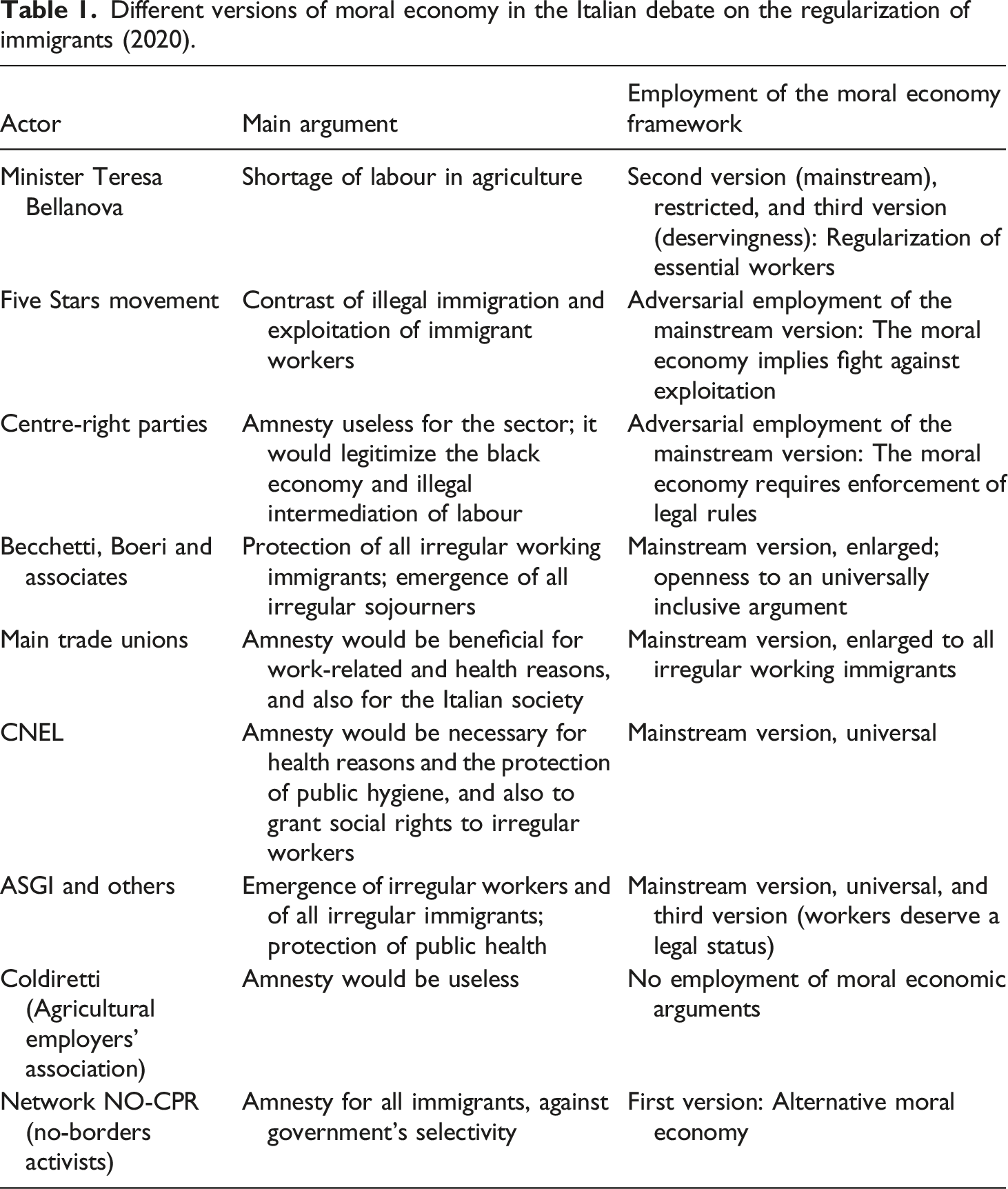
Minister Teresa Bellanova then took the opportunity to demand an amnesty for irregular immigrant workers in agriculture. She declared, threatening to resign: “immigrants are essential to carry on some activities in our country. I do not speak only of agriculture (…) We tell these people that we give them a permit if they accept a job (…) We have unsolved contradictions in Italy which now are even more evident: not regularizing these people risks making us mainly responsible for the spread of illicit recruitment of workforce and illegality”. 3 In her discourse two types of moral economy converged: on the one hand, irregular immigrants deserve a permit (even if temporary: 6 months) if they work in crucial sectors; on the other, regularization would be necessary to free them from exploitation and illegal recruitment. Widespread humanitarian concerns about migrant (and especially African) labour in agriculture are the backdrop in which the political proposal of a new amnesty could be presented under a compelling frame: in this sense, a moral economy framework is involved in the political discussion. Immigrants in turn deserve to be regularized through hard work in essential jobs; but at the same time rewarding their engagement would be an act of justice. In this crucial statement, the second and the third version of the moral-economic argument were mobilised: regularization is a moral duty for the receiving society; immigrants performing crucial tasks, but at risk of exploitation, deserve to be regularised and protected.
Initially, employers’ associations in the sector cautiously endorsed the proposal 4 of an amnesty. This was an uncommon occurrence in the Italian debate. In the past, employers had taken advantage of immigrants’ regularizations, without exposing themselves in publicly supporting such measures, contrary to the predominant attitude of public opinion. Thereafter, however, they preferred to emphasize other solutions, such as the so-called ‘green corridors’ to import agricultural workers from Eastern Europe 5 and the employment of Italian unemployed workers. 6 In the end, the president of the main employers’ association in the sector, Coldiretti, openly criticized the regularization. 7 One of the reasons was the time frame: the long debate and the time necessary for the implementation of the bill would not have coincided with the needs of the sector, since most agricultural operations are concentrated between Spring and the beginning of Autumn. A second reason would have been the cost of the procedure and the obligation to keep the workers on the books, whereas agricultural employers can in practice employ irregularly legal and unauthorized immigrants, rarely having to fear harsh inspections and lawsuits. So, their real interest may have been to do business as usual. A third possible reason may have been the alignment of employers’ associations with the political right, or at least the will to avoid a conflict with these forces on such a sensitive issue.
In sum, the regularization of irregular immigrants was mainly justified by a shortage of labour in Italian agriculture, but this claim was not supported by employers’ associations. The moral aspect diverged from the economic reason cited to legitimize the proposal. As the opponents of the bill highlighted, the government (and in particular the Minister of Agriculture) used the argument of workforce shortage in agriculture (a strictly economic argument) to support a wider regularization of unauthorized residents (a moral and political purpose). 8 The moral-economic discourse (second version) of fairness of regularization of essential workers was weakened by the asserted uselessness of the provision to satisfy the sector’s labour needs. As a consequence, also the third version (deservingness of agricultural workers) was undermined. Minister Bellanova, however, and the centre-left parties held to their position, as a flag-measure to assert their pro-immigrant discourse.
In the government, the Five Star Movement openly opposed the proposal for some weeks. The spokesperson of the Movement, Vito Crimi, declared: « We shall continue to do whatever it takes to make hidden labour emerge, for Italians and foreigners. But if someone proposes a mass regularisation (…) we disagree. (…) If we give legal status to people who are in Italy illegally, we allow these people to continue to perform black labour and be the object of exploitation” (6 May 2020). 9 A Minister, Sergio Costa, previously a high official in an Italian body of police, declared: “Nobody dare save the ‘caporali’ [illegal labour recruiters]!” 10 It is worth noting that also the opponents adopted a moral-economic justification for their position: an amnesty would favour illegal immigration and exploitation. Here, moral-economic arguments were employed to support an anti-immigrant political discourse, in continuity with the policy of the first Conte government, in which the Five Star Movement cooperated with the League on a xenophobic platform.
The centre-right parties in the opposition employed similar arguments. In particular, the counsellor for Agriculture of the Veneto region (centre-right), followed by other regional counsellors of the same political orientation, wrote as follows in a letter to Minister Teresa Bellanova and to the Minister of Labour Nunzia Catalfo (Five Star Movement): “This proposal does not respond to the needs of seasonal labour in the agricultural sector, and it will increase the grey and illegal area of ‘caporalato’”. 11 Here the moral-economic argument, in its second version, was employed to cast doubts on the proposal: the regularisation would legitimize the black economy, illegal intermediation and exploitation. The moral-economic argument was reversed: it is unfair to legalise the black market for much of the seasonal labour in agriculture.
After several days of negotiation, the Five Star Movement slightly altered its position, even if it maintained a critical attitude. On 12 May 2020, the Five Star Movement stated in a written declaration: “On the issue of seasonal workers, we remain strongly averse to every provision which means an indiscriminate regularization. We do not think that this solution could respond to the actual needs of our firms in the agro-industrial sector”. 12 Again, moral-economic arguments were employed to oppose a proposal for the emergence of irregular immigrants.
Other voices from civil society instead went into the opposite direction, demanding that the scope of regularization be extended to other economic sectors and workers. A significant case was a group of 370 academics, headed by two well-known Italian economists, Leonardo Becchetti and Tito Boeri, who demanded that regularization should apply to irregular workers employed in “all the other economic sectors”, and above all in “crucial” sectors, such as personal services, craft work, industry and related services. They specified that they did not emphasize “the evident humanitarian reasons”, but those related to “health, security, economic and social” factors. In other words, they highlighted the confluence of moral concerns and economic convenience of an amnesty for Italian society. While framing their appeal in these terms, at the end of the document Becchetti and Boeri wrote: “because the regularization will be provided mainly for reasons of public health, it is necessary to issue to all irregular immigrants a residence permit for asylum”. 13 In this way, they employed the second version of the moral economy (regularization as a moral duty for the receiving society), but switched to an extensive interpretation of it: a moral economy in which reasons of public health could justify an amnesty for all irregular immigrants.
The three main Italian trade unions (CGIL, CISL, UIL), in a document on “COVID 19 – Dossier immigration”, 14 among several other issues, included a few lines in the last page on immigrants’ regularisation, going into the same direction. They argued: “A regularization of foreign citizens not holding a residence permit, besides its important value as a measure against black work, would reduce the risk of exposure to the virus and would provide thousands of workers, at present in an irregular situation, with access to social protection. Never as today has the need for a measure for the emergence from irregularity appeared an economic and social benefit for the whole society”. Here two similar moral-economic arguments are employed: one related to the labour market (fight against black work), the other related to health protection. Both connect the regularization of irregular immigrants to benefits for Italian society as a whole, adding another element to the second version of moral economy: the regularization would be not only a duty, but also a benefit for the receiving society.
Even more direct was the position taken by the National Council of Economy and Labour (CNEL): a constitutional body through which trade unions, employers, representatives of the third sector and experts give advice to the government and the parliament. In an official document, unanimously approved on 22 April 2020, 15 the CNEL demanded, as its first point, that “the Government and the Parliament launch a measure for the emergence of foreign citizens living in Italy but not holding a valid residence permit, in order to protect their health and public hygiene”. Only in its third point, after having urged the provision of accommodation for regularised immigrants, did the CNEL maintain “on the basis also of requests by the organizations of the sector, that such a measure could provide the agricultural sector with the workforce necessary for the forthcoming harvests, in compliance with laws and collective agreements”. 16 In this case, health protection took priority, and the provision of (regular) labour to Italian agriculture was cited as a supplementary reason for enacting an amnesty. While remaining inside the second version of moral economy, health reasons became the main argument, and work-related issues lost relevance.
The proposal of general regularization of immigrants living in Italy was advanced also by ASGI (Association of legal studies on immigration), without any reference to economic sectors and workforce needs. The stated purposes were: “the emergence from invisibility of thousands of people who live and work in the country, and then a better protection of personal and public health”. 17 The only condition envisaged was demonstrating to have been in Italy before the end of February 2020. The document was signed also by the Foundation Migrantes, an official branch of the Italian Catholic Bishops’ Conference, together with several other associations (among them, Oxfam and Action Aid). It was a good example of a broad advocacy coalition in favour of immigrants’ rights (Ambrosini, 2021, 2022).
Apparent in these documents is a moral economy different from the limited (and contentious) scope of the government’s project. Firstly, all immigrant workers irregularly employed in Italy should be regularised, not just those working in agriculture. Second, for humanitarian and public health reasons, all sojourners, including those unemployed at present, must be regularised. In this case, also the third version of moral economy (deservingness of a permit for irregular workers) is mentioned, together with an inclusive version of the second version (regularization as a duty for the receiving society).
Put otherwise, different frames of moral economy have been advanced to support the amnesty’s proposal. They can be classified between the second and third version of the concept. A first frame is more restrictive and strictly connected with what are perceived to be essential needs of Italian society. The second frame extends the proposal of regularization to all workers employed, informally, in the Italian labour market: the motivation adopted in previous amnesties. The last frame is universalistic: all foreign sojourners, employed and unemployed should receive a legal status to protect them against the pandemic and to safeguard public health, i.e. all the country’s residents. At the same time, the issue of deservingness is also reported (in first place, by Minister Teresa Bellanova), as a reason in support of the regularization’s measure.
The final outcome of political negotiations consisted in a compromise, which was included in the so-called “restart decree”, n.34 of May 2020 (article 103): employers can regularise immigrant workers (hired off the books), and other foreign and Italian workers, in agriculture, fishing, livestock farming, care and domestic services, and these workers (if irregular immigrants) can obtain a 6-month residence permit. The same permit is granted to newly hired immigrants in the same sectors, again under employers’ choice. An important point is that immigrant workers can subsequently renew their permit if their employers offer them a new contract, and they can also change employer and sector, under a new contract. Furthermore, a second channel of regularization allowed foreign citizens, with a residence permit expired from 31 October 2019, to apply for a temporary residence permit lasting 6 months to look for a job in the specified sectors. To be able to apply, specific conditions were needed. Especially the 6 months residence permit to look for jobs, significantly limited the scope of this second channel, leaving out numerous migrants in conditions of irregularity and precariousness, including many of those affected by the so-called Security Decrees of 2018.
As a lawyer observed, “In a few weeks, the regularisation project decisively changed its nature (…). It passed from the idea of a regularisation whose purpose was to allow the creation of new employment contracts in order to respond to specific needs of the market, to a measure intended to regularise already existing irregular working relations” (Codini, 2020: 1). This quote grasps a change in the moral-economic discourse (second version and third version) adopted by the advocates of the amnesty: from an emphasis of the duty to legalise essential workers in a crucial sector, to a wider (but not universal) regularization of irregular immigrants working in the underground economy. The initial emphasis on an argument more connected to the functioning of the agricultural sector was replaced by an emphasis on the moral argument of immigrant workers’ rights (even if limited to some sectors).
Inevitably, social movements and radical activists protested against the narrow window of regularization. I cite just one example here. In a demonstration in Milan, in front of the town hall, the activists of “Rete NO cpr – Mai più lager” (Network No detention centres- Concentration camps nevermore) demanded “Residence permits for everybody”. They declared: “Instead of dealing with the issue of immigration as a whole, and from the leading point of view of rights and entitlements, granting dignity and the right to stay to people regardless of their capacity and opportunity to work, the government opted for a selective and discriminatory logic. Moreover, it unrealistically makes a residence permit and emergence from exploitative situations contingent upon the initiative of the exploiters themselves”. 18
Again, conflicting moral economies are at work: a “no border” paradigm against one (allegedly) focused not only on labour market needs but also on some economic sectors and on the willingness of employers to hire irregular immigrants on formal contracts. Here the moral-economic frame is closer to the first version of the concept: the idea of a universal regularization is presented as the alternative approach supported by radical minorities, against the social and political order defended by the government.
Different versions of moral economy in the Italian debate on the regularization of immigrants (2020).
Once approved, the regularization encountered many obstacles in its implementation. Besides sectoral limitations (Campomori and Marchetti, 2020), the other main problems were income requirements for employers, demonstration of presence in Italy before the eighth of March 2020, and the costs of the procedure: employers were charged 500 euros if they wanted to regularise an immigrant worker (plus a still unknown sum for social contributions), and even if they wanted to hire a new one. Employers were then discouraged from hiring irregular immigrants. In this case, the sum was very probably requested from the immigrant worker, who hardly possessed such money.
The consequence, at the conclusion of the procedure (15 August 2020), was a number of applications lower than expected by several observers: 207,542 applications, mainly for domestic and care work (85%), against a government forecast of 220,000 applications. 19 Agriculture, in practice, has almost disappeared from the reasons for regularization, despite initial claims. The low interest in this opportunity of agricultural employers was confirmed by these figures and contributes to explain this outcome. Agricultural employers were interested in hiring a seasonal workforce, mainly for short periods, and they worried costs and times of the procedure. Workers were in a weak contractual position to convince employers to legalise their status, and this is especially true for African asylum seekers and refugees.
Some actors openly criticised these results. To give just one example, the person in charge of immigration issues at national level for CISL (one of the three main trade unions), Andrea Cuccello, declared in a public letter: “We restate what we have already said in various places, namely that the condition of illegality will not be removed with this Decree, and consequently nor will the vulnerability of many migrants. They will remain excluded and invisible, left in impossibility of becoming regularly and legally resident in Italy.” 20 On the other hand, the possibility of regularization for more than 200,000 immigrants has had no parallel in any Western country in recent years, and it has been achieved through a Parliament in principle largely hostile to immigrants, and under a government deeply divided on this issue.
Functional arguments (providing the labour market with necessary workforce in crucial sectors) have been combined with the moral imperative to combat illegality and exploitation, while limited attention has been paid, in the final text of the bill, to the protection of irregular immigrants’ health (Caprioglio and Rigo, 2020).
In the perspective of the present article, an application of the second version of moral economy argument has prevailed (reinforcement of the moral order of the mainstream society), at least partially, combining with some elements of the third version (recognition of deservingness): immigrant workers in some essential sectors deserve the legal status of residents and a regular employment contract, provided that their employers perform the procedure, and in this way recognise their useful contribution.
Conclusion. A dynamic and competitive vision of moral economy (and deservingness)
The concept of moral economy has been widely adopted in scholarship across several disciplinary fields, but its fortune has gone hand in hand with an extension of its meaning. Different versions of the concept can be detected, and not always have the authors provided a clear justification for their choice. A first contribution of this article consists in having clarified the main versions and uses of the concept: these versions can be ordered in a conceptual map ranging from an ‘alternative’ notion of moral economy to a ‘mainstream’ notion of it, encompassing the concept of deservingness as a kind of bridge between the two contrasting visions. This is also relevant for migration studies, because something similar has occurred in this field too, in which the concept has likewise achieved remarkable fortune and a variety of applications. On the one hand, it has been applied to talk of alternative conceptions of what is right (and moral) in economic behaviour among immigrant minorities facing laws and rules of conduct established by the local majority. Similarly, it has been widely employed to talk of the moral obligation of immigrants to send remittances to their homeland. Here, moral economy refers to the alternative values of marginal groups, in contrast with the vision of the social order supported by the majority. On the other hand, it has been adopted within the mainstream discourse, to discuss the moral and economic foundations of immigration policies, and in case to urge their reform; or to justify acceptance of certain categories of immigrants (e.g. minors, pregnant women, sick people, domestic workers). Here the moral economy of immigration is conceived as related to the social and moral order of hosting societies.
Somewhere in the middle, between the alternative and the mainstream version of the moral economy, lies the concept of deservingness. It has been applied to talk about efforts by immigrants in a weak legal position to achieve the right to stay, or at least a form of tolerance, through hard work, irreprehensible conduct, compliance with the laws and social norms of receiving societies. Deserving immigrants claim, or are entitled to, a better acceptance: deservingness is a tool with which to apply moral pressure in regard to harsh restrictions in migration policies. These immigrants (and their supporters) accept in some way a neo-liberal framework (individuals must earn certain rights), but try to open a window of opportunity through that framework: if individuals behave correctly, they deserve to be granted acceptance and the relative rights. The reference to moral economy can be adopted as a discursive strategy to justify, or contrast, certain political measures of immigration policy. It does not only belong to the weak, in social and political terms, but also to the partisans of nativist visions.
To recap, in relevant scholarship, and especially in migration studies, the concept is frequently cited, but not adequately analysed and discussed in its meaning and implications. In this article I tried to move forward a clarification of these aspects, paving the way, I hope, for a more aware use of the concept and a more refined discussion about the intersection of moral values, economic arguments and political goals in immigration policies.
Furthermore, what is widely neglected, is the tension between competing versions of the moral economy. In pluralist, and even fragmented societies, in which migration issues are a main cause of political conflict, various actors can express their own views of what should be the right, or the more acceptable, ‘moral economy’ of immigration and asylum.
I applied this idea to the case of regularisations of unauthorised immigrants in Italy, examining in particular the most recent provision, enacted in May 2020. The debate I reconstructed highlighted how partisans and opponents of this measure referred to different moral-economic arguments, and notions of deservingness. Among the arguments in favour of regularisation, a tension appeared among a narrow notion of ‘deserving’ candidates (only agricultural workers), a wider notion (all immigrant workers informally hired and exploited), and a universalistic notion (all immigrants residing in Italy at present). Old moral-economic arguments (regularization of immigrants employed in the underground economy, if their employer is amenable) have been challenged by new moral-economic claims connected to the Covid pandemic threat and the right to health for everybody. But also the opponents of the amnesty employed allegedly moral-economic arguments: regularization implies a pardon for the exploitation of immigrant workers, a concession to unlawful practices of intermediation between labour supply and demand. A moral-economic frame was adopted not only by supporters of immigrants’ rights, but also by anti-immigrants actors.
In the end, the enactment of a partial amnesty has been justified mainly by the recognition of immigrant workers’ efforts in some sectors, and only indirectly by the pandemic. It can be considered a particular and disputed application of the moral-economic discourse, and more precisely of a combination between some elements of the second (mainstream) and of the third version (related to deservingness) of the concept: immigration policies should take account of the contribution made by immigrants to the national economy, especially in sectors of vital importance for the everyday lives of the native population. Other moral-economic arguments, such as the necessity of fighting against the exploitation of immigrant labour and its employers, influenced the debate, but they were presented in such a way that supported a restriction of the scope of the amnesty. Reference to health issues and related rights, at the end, almost disappeared in the final compromise (Caprioglio and Rigo, 2020).
Also for this reason, the Italian amnesty exhibits several contradictions and shortcomings (Campomori and Marchetti, 2020). Its implementation has been even worse, since only a minority of cases have completed the procedure so far (July 2022). In any case Italy represents an exception in the European framework, in which the COVID epidemic has not opened any window of opportunity for irregular residents, with some exceptions only for pending applications by asylum seekers and other sojourners in Spain and Portugal.
In such perspective, the decision to enact an amnesty during the pandemic could raise some questions about the moral economy of European immigration policies, and fuel a revision of what norms of justice, rights, socio-economic integration European and national institutions want to apply to third-country residents, including also long-term residents without a legal status.
To conclude, I advocate a refinement of the concept in the direction of a more dynamic and competitive conception of moral economy, through which various actors try to justify their claims, making reference to moral norms and economic arguments which can be shared by the majority of public opinion. In other words, moral economy and deservingness can be conceived as discursive weapons on the battleground of immigration policies. Furthermore, such concepts build a bridge between social theory, political debate, everyday individual behaviours. Establishing convincing moral-economic arguments, against competitive frameworks, means gaining advantage in the battle to win the minds and hearts of the public opinion. Legislators, immigrants’ supporters and people concerned can introduce such arguments and compete to highlight the moral-economic reasons that justify their claims. A crucial point regards the fact that not only the poor or marginal groups, or their advocates, can adopt moral-economic arguments, but also their opponents: moral-economic frameworks are plural and competitive.
Directions for future research, first of all, could further develop, at a theoretical level, the meanings and functions of recourse to the concept of moral economy in migration studies. Second, research could analyse the conception of moral economy underlying other measures of migration policies, other proposals of reform, other statements by relevant actors, other social practices performed by migrant populations. In this way, research could explore how competing moral economies work in various settings, countries and sectors of immigration policies: e.g. family reunifications, reception of asylum seekers, treatment of weak sections of immigrant populations. In terms of policy, comparative studies could also identify what frames of moral economy achieve more success, how this occurs, and under what conditions.
In migration policies, relevant moral and political values are involved: human rights and national sovereignty, the right to mobility and citizens’ rights, the right of asylum and social cohesion. I wish for a more subtle use of the concept of moral economy to feed a better discussion of these crucial topics.
Footnotes
Declaration of conflicting interests
The author(s) declared no potential conflicts of interest with respect to the research, authorship, and/or publication of this article.
Funding
The author(s) disclosed receipt of the following financial support for the research, authorship, and/or publication of this article: The article is related to the PRIN 2017 project ASIT (Italian Ministry of Research (Ministero dell'Istruzione, dell'Università e della Ricerca), prot. 2017999JXZ).
