



Abstract
This article examines the regulation of linguistic diversity in Spain from a combined empirical and normative perspective. Spain is a particularly interesting case due to the intersection of linguistic and national diversity and its peculiar combination of territoriality and personality. We first present a conceptual framework which draws on the personality and territoriality distinction as established by political philosophers. Second, we examine the way multilingualism is regulated in Spain. A dual system emerges in which Castilian is the only state language while four other languages – Aranese, Basque, Catalan and Galician – are co-official in six Autonomous Communities. We identify two models concerning the degree of institutionalisation of non-Castilian languages: co-officiality and limited recognition. Finally, we characterise and assess normatively the advantages and disadvantages of the Spanish linguistic regulation. We argue that the Spanish linguistic system may be characterised as an Unequal Personality Linguistic Regime. This regime offers several instrumental advantages related to the prevalence of a shared language as well as a significant degree of territorial accommodation for minority language groups, but it also gives rise to injustices related to unequal treatment and domination. This article contributes to the academic debate about the politics of language by analysing a paradigmatic case of multilingualism and plurinationalism, Spain, and considering the usefulness of the territoriality and personality framework to study specific cases.
Keywords
Language policies are usually a hot-button issue in linguistically and nationally diverse states. Institutionally, states may regulate linguistic diversity in different ways, reinforcing or diffusing disputes between and within groups. Language policies may become strategies of territorial management to accommodate the demands of sub-state nations and linguistic groups, or they may seek assimilation and foster conflict. Symbolically, language policies affect the relative status of the different languages within the state and that of their respective speakers, which is especially important in sub-state nations built upon linguistic distinctiveness. Symbolic recognition may include projecting a state image of diversity (i.e. recognising more than one national or state language) and establishing minority languages as dominant in certain territories.
In this article, we examine the complexities of the regulation of linguistic diversity in plurinational states through the case of Spain. Spain is a multi-level and multilingual state facing different currents of sub-state nationalism and linguistic and territorial identities and demands. Adopting a combined empirical and normative perspective, we address in this paper three core questions: (1) How is linguistic diversity regulated in contemporary Spain in terms of institutionalisation (i.e. which official languages) and level of policy responsibility (i.e. central government, devolved administration, or both)? (2) What characteristics of the Spanish linguistic regime fall under the territoriality and personality linguistic principles, respectively? and (3) What are the advantages and disadvantages of the Spanish system from a normative point of view? The first and second questions are empirical and analytical, whereas the third is normative in nature. 1 Ultimately, our goal is to offer a characterisation and normative assessment of the Spanish linguistic regime. In the process, we seek to assess the usefulness of the territoriality and personality linguistic principles to study specific cases.
Spain, so we argue, offers a combination of the linguistic territoriality and personality principles that may be characterised as an Unequal Personality Linguistic Regime. This novel concept seeks to capture the hybrid or mixed dimension of the Spanish linguistic regime, which includes elements of both the territoriality and personality principles but, crucially, applies the personality principle on unequal basis, favouring Castilian. While minority language groups 2 enjoy a significant degree of territorial accommodation, the unequal bases of the Spanish linguistic regime give rise to injustices related to unequal treatment. This is so because only Castilian speakers may claim full personal language rights across the state, including territories with co-official languages.
We structure the article as follows. First, we define the analytical tools we will use to analyse the Spanish case – the influential linguistic personality and territoriality principles – placing an emphasis on the normative shortcomings of strict territoriality. Second, we examine the way multilingualism is regulated in Spain. We find that the Spanish model is monolingual for most of the state territory and we distinguish between two models in the recognition of multilingualism: co-officiality and limited recognition. Third, drawing on the conceptual distinction between territoriality and personality, we introduce the concept of an Unequal Personality Linguistic Regime (UPLR) to frame the Spanish case and we explore the key normative advantages and disadvantages arising from this mixed regulation. In the conclusion, we briefly elaborate on what the Spanish case tells us about the usefulness of the territoriality-personality framework to study specific cases and identify avenues for further research.
Regulating language: Territoriality and personality as a normative framework
In this theoretical section, we define the analytical tools we will use to analyse and normatively assess the Spanish case: the linguistic territoriality principle (LTP) and the linguistic personality principle (LPP). This is a key distinction drawn by normative political theorists working in the field of linguistic justice to examine language policies and how language rights may (and should) be exercised. 3
Characteristics of the linguistic territoriality and personality principles. 5
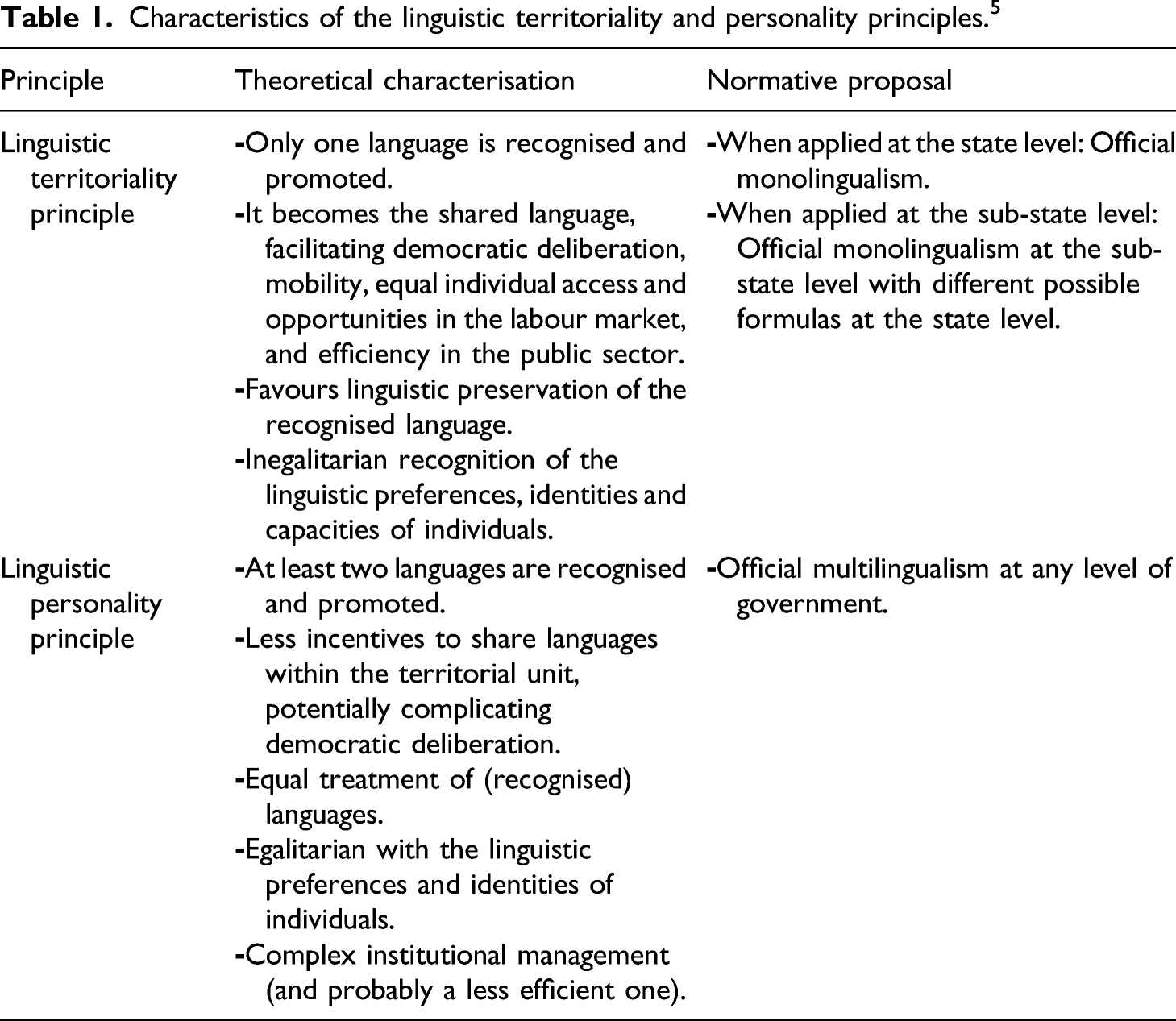
Several scholars have put forward LTP as a desirable strategy for achieving linguistic justice in countries with more than one historical language group (see Grin, 1996, 2011; Kymlicka, 1995, 2001a, 2001b; Laponce, 1984; Stojanović, 2010; Van Parijs, 2011; Vergés Gifra, 2014). The most developed defence in the literature of a strict understanding of the LTP is that of the Belgian political philosopher Philippe Van Parijs. He defends that historical languages in a territory should be territorially maintained, with each particular territorial unit giving public support to only one language group. Speakers from other languages are perfectly welcome in the demarcated territorial unit, but they cannot demand public support for their languages (Van Parijs, 2011). Empirical examples include the regions of Flanders and Wallonia within Belgium, although their municipalities with linguistic facilities represent exceptions to the rule.
There are ‘weaker’, or less strict, versions of the LTP that we are not going to consider here. 6 We concur with De Schutter (2008) that the LTP should be understood in the strict version. The reason is that any kind of openness to soften the model would make the distinction between personality and territoriality ‘blurred, since, in a sense, the territory is then characterised by a sort of micro-personality’ (2008: 106). In fact, in the absence of a world state, the terminological distinction between territoriality and personality may be misleading. Any linguistic regime, either territorial or personal, is territorially based (Morales-Gálvez et al., 2022; Réaume, 2003: 275–276).
As mentioned earlier, the strict version is the position defended by Philippe Van Parijs (2000, 2010, 2011, 2015). Van Parijs defends the LTP on several grounds, the main one being the value of dignity. 7 For him, individuals may value their language(s) for reasons of equal dignity or equal status. That is, individuals may derive their value qua individuals from how institutions value their language(s). If institutions confer more recognition to language X than to language Y, speakers of language Y can deduce that their status is lower than that of speakers of language X. This is what Van Parijs names linguistic justice as parity of esteem (or equal dignity). For him, parity of esteem is a significant moral value worthy of promotion and the only way to attain this equal status/dignity of language groups is via the LTP. According to Van Parijs, this is the only way to make minority languages dominant in their own territory, ensuring their usefulness and the equal status of their speakers vis-à-vis majority language speakers.
Van Parijs does not only support the LTP for dignity-based reasons, but also for pragmatic ones. For him, linguistic diversity (in a particular territory) may endanger values such as unity and solidarity and, consequently, deliberative democracy. Van Parijs (2004) endorses some of John Stuart Mill’s (1998 [1861]: 310) arguments about the necessity for some degree of homogeneity in order to make mutual trust, solidarity and, therefore, deliberative democracy, possible. Without trust and solidarity, Van Parijs argues, following Mill, it is more difficult to have a democratic regime and a distributive welfare state. For Van Parijs, linguistic homogeneity (via the territoriality principle) facilitates the basis for common effective communication and deliberation (enhancing democracy) and distributive socio-economic justice (improving everyone’s equality of opportunities). Other authors have argued that the LTP also facilitates individuals’ mobility within the given territory and improves the efficiency of institutions. The institutional recognition of linguistic diversity, it is argued, might impose some costs on both individuals’ mobility (Robichaud and De Schutter, 2012: 129) and the efficiency of institutions (Grin, 2006).
All in all, the LTP would result in an a priori (all things equal) territorial monolingual system, promoting the territorial language as a right and a duty for all. Additionally, it is important to mention that Van Parijs concedes that a ‘weaker’ version of the LTP may be more desirable in concrete situations (Van Parijs, 2011: 165; see also Riera-Gil, 2018) such as deep linguistic heterogeneity contexts, when there are ‘substantial communities of permanent residents that not only speak a distinct language, but perceive it as distinct and identify sufficiently with this distinctiveness for them to wish it to enjoy the parity of esteem territorial regimes are meant to pursue’ (Van Parijs, 2011: 165).
Not everyone agrees with the LTP. Political philosophers such as Helder De Schutter raise convincing critiques concerning the unrealistic conception of language and territory (one territory/one language) that the LTP assumes. It is unrealistic because the world in which we live ‘is imbued with multiculturalism, multilingualism, and linguistic opacity’ (De Schutter, 2007: 15). In addition, we can also identify two elements which are normatively problematic in the LTP proposal. First, if we recognise the value of linguistic-dignity interest as relevant, on what grounds (all things equal) could one support giving such recognition to X but not to Y? Why give recognition and rights to, say, Gaelic Speakers in Ireland but not to English speakers? Second, without any kind of recognition of minority groups, how can they defend themselves and their language rights from the domination of majority groups? Is this morally justifiable? (Morales-Gálvez, 2017).
These two shortcomings (the charge of empirical implausibility and the normative concerns) have led some scholars to support an alternative linguistic principle: the LPP. According to this principle, language rights can be enjoyed independently of where individuals live within the territorial unit. A central element here is that political institutions should address (and may be addressed by individuals) in any of the recognised languages. This results in a ‘free choice’ model under an officially multilingual regime. A good example of this proposal is the Belgian capital region of Brussels.
Several scholars support, or articulate views that fall close to, the personality approach (Carens, 2000; Gagnon, 2012; Patten, 2014, 2018; Peled, 2017; Réume, 2003). Arguably, the most developed philosophical defence of LPP is that of Helder De Schutter (2007, 2008, 2011, 2014, 2017). De Schutter endorses an equally enabling language policy, instead of a restrictive one. For him, equal dignity (or parity of esteem) regarding language is an undeniable requirement for linguistic justice. He also supports giving more resources to more vulnerable language groups on the basis that one’s linguistic membership is a matter of luck and not of choice (De Schutter and Ypi, 2011). De Schutter defends an equal-services principle which ‘prescribes upholding the official languages as the languages in which the state speaks and in which public services are provided, irrespective of changing numbers of speakers’ (De Schutter, 2017: 75). Regardless of whether language X is decreasing its number of speakers, public institutions should fully provide all their services in this language (even if the per-capita invested resources is higher than in the majority language, Y).
All in all, LPP defenders reject LTP for two reasons: first, if we agree that individuals derive dignity value from language, it is unfair to not grant equal dignity to other languages (as the LTP proposes). For defenders of the personality principle, ‘the desire to confine language recognition to a single language is an expensive taste, and policies that honour this desire violate principles of equality’ (De Schutter, 2008: 113). Second, insofar as rights should be guaranteed to speakers, not to languages, promoting any language via LTP at the expenses of other’s language rights without further justification cannot be fair. Why does language X deserve to be promoted while language Y does not if both groups share the same territory? LTP tends to deny instances of linguistic pluralism, mixture, or hybridity.
In this section, we have examined the main normative approaches to raising standards of linguistic justice. In the next sections, we will draw on them as theoretical lenses to examine the case of multilingual and plurinational Spain, assessing in the process the usefulness of this theoretical distinction. In this, we draw inspiration from McRae (1975: 52), who argued that ‘it appears to be of limited usefulness to try to evaluate the principles of territoriality and personality in the abstract’.
Regulating linguistic diversity in Spain: Monolingualism, co-officiality and limited recognition
Two models in the regulation of multilingualism in Spain.
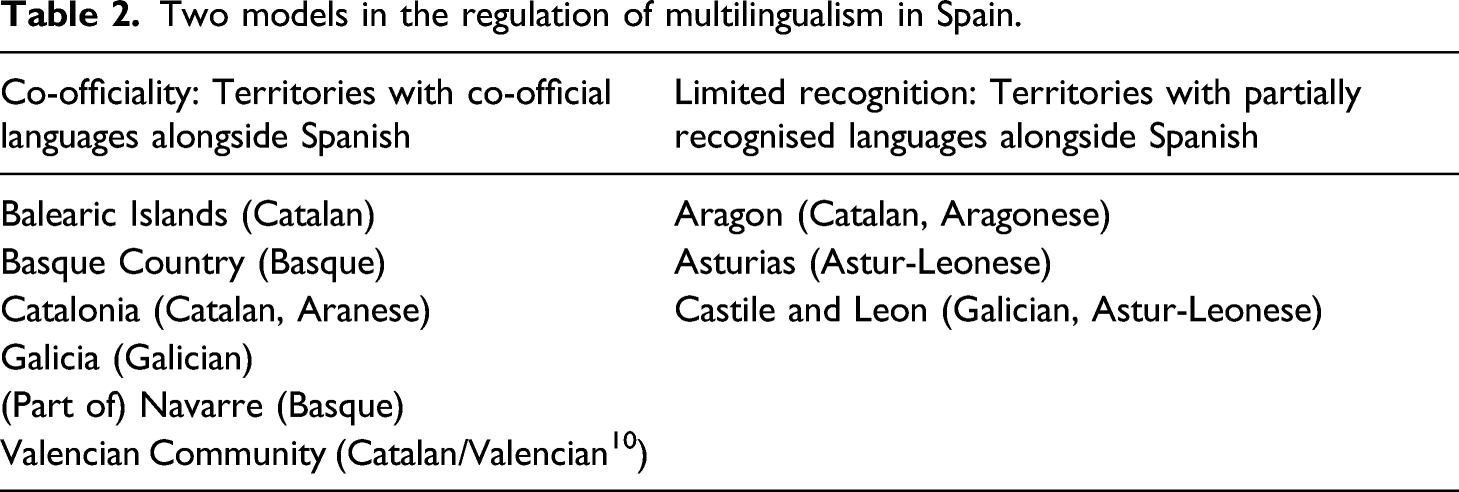
The legal framework establishing the predominance of Spanish is the 1978 Constitution, which states that ‘Castilian is the official language of the state’ and that ‘the other Spanish languages will also be official in their respective Autonomous Communities’ (Article 3.1). The ‘other languages’ are not specified. The Spanish linguistic constitutional design keeps the centre predominantly monolingual and establishes Spanish as the only language whose knowledge is a duty for all Spanish citizens. We write ‘predominantly monolingual’ because there a few ‘linguistic facilities’ – for example, the Official State Bulletin (BOE) is also published in Basque, Catalan and Galician. There is not an explicit Spanish state linguistic policy but rather it is implicit in state functioning and regulations which promote Spanish and make it compulsory. For example, only Spanish is allowed to be used in the lower chamber (Congreso de los Diputados); the Justice Administration and state civil servants only have to know Spanish, including in territories with other co-official languages; and several sectoral regulations impose labelling in Spanish. Linguistic diversity is positively considered as a cultural heritage to be respected and protected (Article 3.3, Article 20), although the Constitutional Court has not derived legal consequences from this precept. In addition, Spain ratified the European Charter for Regional and Minority Languages in 2001, thus committing to the protection of minority languages in several domains including education, administration, the judiciary and economic and social life which have been fulfilled to varying degrees (see Ramallo, 2018: 468–472). 11 In practice, the nurturing of minority languages has been largely externalised to the Autonomous Communities (AC).
As Spain decentralised in the early 1980s, crucial in the decision by multilingual ACs to adopt the co-officiality model or the limited recognition model was the correlation of political forces in their territories and the existence of alternative national projects to that of the state. The Basque Country and Catalonia represent the cases of co-officiality in which the regional language is most developed vis-à-vis Castilian, a choice informed by the fact that sub-state nationalist parties usually hold regional office in these territories, either alone or in coalition governments. By sub-state nationalist parties, we refer to the party family characterised by the claim that a territorially concentrated group within a state constitutes a distinctive political community (Hepburn, 2009). Successive Catalan and Basque Governments have used their political autonomy to protect and promote their language, often as part of the wider aim to develop and assert the national character of their territories.
The Catalan language in Catalonia represents the case of co-officiality in which the regional language is most developed vis-à-vis Castilian. The Statute of Autonomy of 2006 (and previously that of 1979) establishes Catalan as ‘Catalonia’s own language’ and consider it the ‘normal’ [usual] language of the Catalan administration and public media, to be ‘normally’ used as the vehicular language of education in publicly funded schools. Proficiency level of Catalan is required of all civil servants across all Catalan administrative levels and there is a Catalan-speaking media system including a dedicated public broadcaster as well as public subsidies to Catalan-speaking private media (Tàrrega and Guimerà, 2020). Attention is also paid to the linguistic landscape, with signboards and part of product labelling required to be at least in Catalan although, in practice, the level of compliance varies from one city to another (Direcció General De Política Lingüística, 2016). The Catalan linguistic laws of 1983 and 1998 established a general regulatory framework which has been subsequently specified in sectorial regulations and developed and implemented by the General Directorate of Linguistic Policy, created in 1983. Another key institution is the Consortium for Linguistic Normalisation, formed by the Catalan Government and 135 local bodies, which offers a range of learning courses in Catalan. While there is political consensus in Catalonia in support for the preferential treatment given to Catalan on the grounds that it protects social cohesion and linguistic knowledge and use vis-à-vis changing demographics and a large immigrant population, there is also a degree of internal contestation on the grounds that certain measures, most notably in education, infringe individual rights (see Cetrà, 2019).
The Catalan case shows that the co-officiality model allows for the development of distinctive, ambitious linguistic policies by Autonomous governments. It also allows for internal asymmetries and autonomies: Aranese – a version of Occitan – is official in the whole of the Catalan territory since 2010 despite only having a few thousand speakers and it is recognised as the Aran Valley’s own language, as a result of which it is the language normally used by the different administrations in that territory in the Catalan Pyrenees. At the same time, the Catalan case also illustrates the unequal nature of the co-officiality model. Whereas ‘Castilian is the official Spanish language of the State’ and ‘all Spaniards have the duty to know it and the right to use it’ (Spanish Constitution 1978, Article 3), to be official for the other languages is only a right but not a duty. This unequal but accommodating linguistic design has been subject to a restrictive interpretation by the Constitutional Court (Milian i Massana, 2019: 152–156) which has reduced the scope for, and exposed the limits of, linguistic autonomy and the co-officiality model.
A paradigmatic example is provided by the ruling 31/2010 of the Constitutional Court on the 2006 Catalan Statute of Autonomy, article 6.2 of which established that ‘citizens of Catalonia have the right and duty to know the two official languages’. The Court did not declare unconstitutional the duty to know Catalan but interpreted it restrictively as a ‘concrete and individualised’ right in education and public administration. According to the Court, it would be unconstitutional to establish a general duty to know Catalan: ‘in the case of co-official languages distinct from Castilian, (…) citizens living in Autonomous Communities with co-official languages have the right to use both in their relations with the Authority and only the – constitutional – duty to know Castilian, which guarantees communication with the public power without the need of demanding the knowledge of a second language’ (Constitutional Court, 2010: 476 – our translation). Indeed article 6.1, establishing Catalan as the ‘preferential’ language of Catalonia’s public administration and public media, was declared unconstitutional, with the Court stating that the Catalan public administration cannot have a preference for any of the two languages and that it is up to individuals to exercise their right to use either language. To this effect, the Court recognised the duty to know Catalan in the case of civil servants at the Catalan administration. The Court stated that there needs to be an ‘unavoidable equilibrium’ between Catalan and Spanish, which may be modulated to correct ‘historical situations of imbalance’, but not to establish priority for Catalan as a general rule (see Pons Parera, 2011 for a detailed discussion). There are several ongoing linguistic conflicts in the Spanish constitutional jurisprudence (Vernet i Llobet, 2015: 51–90), many of which stem from the limits of ‘unequal co-officiality’ and, specifically, from the difficult reconciliation of Spanish being the privileged language of the Spanish Constitution and the possibility of offering preferential treatment to other languages in some areas in certain territories.
The Basque language in the Basque Country represents the second most developed case of minority language institutionalisation after Catalan in Catalonia. The 1979 Statute of Autonomy establishes Basque as ‘the Basque people’s own language’ and the successive Autonomous governments built on the ‘Law for the Normalisation of the Use of Basque’ (1982) and sought the normalisation of the language on key areas such as education, media and the administration. The key institution designing the Basque linguistic policy is the Department of Language Policy, created in 1983, while others promoting and spreading the use of Basque include the Service of Euskera of the Department of Education, the Institute for the Alphabetisation and ‘Reesukaldunisation’ of Adults, and the Basque Institute of Public Administration, as well as a wide range of private associations. The main difference with the Catalan linguistic policy is the territorial fragmentation of the Basque system – linguistic promotion is most active in areas with high numbers of Basque speakers – and the separation of students by language in education. The Basque publicly funded education system offers four models: exclusively in Spanish; Spanish as the language of instruction with Basque taught as a subject; equal presence of the two languages as languages of instruction; and Basque as the language of instruction with Spanish taught as a subject (Fernández-Ulloa, 2005). To be sure, the lower numbers of Basque speakers and the fact that Basque and Spanish do not belong to the same linguistic family (which makes the learning of the former more challenging for Spanish speakers) are a structural constraint for the Basque linguistic policy, which has traditionally focused on increasing the number of speakers and the social use of the language (Gobierno Vasco, 1999).
In the other cases of the co-officiality model, namely, the Valencian Community, the Balearic Islands, Galicia, and part of Navarre, minority languages enjoy a lower level of institutionalisation and a subsequent lower level of social prestige. Linguistic policies in these territories are less consistent across domains, susceptible to changes in ruling autonomous governments, and mostly focus on ‘recovering’ and fostering the social use of their respective languages in part or all of their territories vis-à-vis dynamics of minoritisation and loss of prestige.
The Balearic Islands and the Valencian Community enjoy a very similar, intermediate level of institutionalisation. In the Valencian Community, Valencian/Catalan is official throughout the AC territory but the most active policies of linguistic promotion and prestige are developed in the area with the highest number of Valencian speakers (Bodoque Arribas, 2011), where the language is compulsory in education, with different bilingual programmes available. A proficiency level of Catalan/Valencian is required to all civil servants (although its use within the administration varies) and public broadcasting is mostly in Catalan/Valencian. Territorial and linguistic fragmentation is also present in Navarre, which is actually divided in three linguistic areas: the Basque-speaking area, with the co-officiality model; the mixed area, where Basque is recognised but not co-official; and the non-Basque-speaking area. Navarre is also the only case of the co-official model where the minority language is not defined as the Autonomous Community’s own language in its Statute. Galician in Galicia also has an intermediate level, with a bilingual education based on a 50% Spanish–50% Galician model and a strong presence in audio-visual media, although the requirements for becoming a civil servant have become less restrictive. While Galician in Galicia is the only case of a minority language being the most widely spoken language in the territory of an AC, its linguistic policy faces a challenging situation characterised by an ongoing process of language shift especially apparent in cities and a loss of value of the language as a reference point for social mobility (Ramallo, 2018: 478–481).
In the second model, the limited recognition model, minority languages are not co-official and have a low level of institutionalisation, with linguistic policies limited to formal recognition and support to occasional social initiatives. This is the case, in different ways and degrees, of Catalan and Aragonese in Aragon, Astur-Leonese in Asturias and Castile and Leon, and Galician in Castile and Leon. The consequences of the languages lacking official status are clear in areas such as education, the media and public services. In Castile and Leon, for example, the 2007 Statute of Autonomy recognises Galician as a language of the territory and guarantees respect and protection for it, although legislation in this regard is minimal. Most worthy of mention is a bilateral agreement to strengthen Galician within the educational system of the Castilian-Leonese regions where it is spoken, either as part of the curriculum or as an extracurricular activity (Ramallo, 2018: 482). In the Asturian education system, Astur-Leonese may only be chosen as an elective in primary and secondary school.
This overview points at the significance of the politics of language (Cardinal and Sonntag, 2015; May, 2013) within each sub-state unit. In order to explain different levels of institutionalisation of the same language in different territories, we must consider political factors. These include the correlation of political forces in each territory and the extent to which political and social actors construct language as a collective identity marker. For example, the Valencian Community, the Balearic Islands and Galicia have been run by the Conservative Popular Party for long periods, with a linguistic ideology and practice hostile to the promotion of languages other than Spanish. This results in the fact that speakers of the same language (i.e. Galician) have different linguistic rights in separate Autonomous Communities (in Castile and Leon and Galicia). This asymmetry is reinforced by the low dynamics of collaboration between ACs sharing the same language.
To conclude, the regulation of linguistic diversity in Spain may be characterised as a monolingual project for most of its territory and significant linguistic autonomy for part of the ‘periphery’, that is, multilingual ACs, which may choose between the co-officiality model, the limited recognition model, or non-recognition at all at the Autonomous level. Both models are limited by a degree of inequality insofar as Spanish is the only official language across the state territory. While there is no intrinsic incompatibility between the co-officiality model and instituting priority for minority languages in key areas (indeed, we have provided examples in this section), in practice there is disagreement about linguistic prevalence. The Spanish linguistic regulation, and especially its interpretation, acts as a constraint for attempts to push the limits of the co-officiality model. For example, in July 2018, the Superior Court of Justice of the Valencian Community invalidated 11 articles of a decree expanding the Law of Usage and Education of Valencian and seeking to prioritise Catalan/Valencian in areas including internal and external communications of the administration, and signposting in public buildings and roads.
Having provided an overview of the regulation of linguistic diversity in Spain, in the next section we place it in the territoriality-personality framework and we offer a normative evaluation of its main features.
Territoriality and personality: Characterising and assessing the Spanish ‘Unequal Personality Linguistic Regime’
In this section, we introduce the argument that the Spanish linguistic system may be characterised as an UPLR. 12 It is a hybrid or mixed system including elements of both the territoriality and personality principles which, crucially, applies the personality principle on unequal basis.
We emphasise the ‘personality’ character of the regime because, as explained in the section Regulating Language: Territoriality and Personality as a Normative Framework, the territoriality principle is fundamentally characterised by its monolingual nature. In contrast, the Spanish linguistic regime is open to linguistic pluralism, although it entails some elements of the territoriality principle. While the Spanish regime incorporates some features of the territoriality principle – mainly the duty to learn just the Spanish language –, the fact that it also allows for (limited) linguistic pluralism suggests that it is best to categorise the system as closer to personality rather than territoriality. As stated by De Schutter (2008: 106), territoriality with linguistic pluralism might lead a territory to be ‘characterised by a sort of micro-personality’. In this sense, the Spanish regime is better characterised as a personality one, even though it also has some territorial peculiarities as we will explain later.
Additionally, we argue that it is ‘unequal’ for two related reasons. First, the prioritisation of Castilian via the partial adoption of the territoriality monolingual principle state-wide. Second, because personality linguistic rights are not applied equally to all the Spanish languages across the state. Personality linguistic rights vary depending on the extent to which each Autonomous Community institutionalises non-Castilian languages.
Thus, the Spanish UPLR combines personality and territoriality in peculiar ways. It is characterised by (1) a territoriality principle preponderance at the state-wide level due to the duty-based constitutional priority of Spanish and (2) the promotion of the personality principle by Autonomous Communities endorsing the co-officiality model, albeit with specific territoriality elements in concrete domains (i.e. priority of Catalan in publicly funded education in Catalonia and the Balearic Islands). Sub-state territorial units are not constitutionally allowed to endorse an overall territoriality principle and the monolingual approach of territoriality is broadly applied only to one language state-wide: Spanish.
Specifically, the following characteristics of the Spanish UPLR fall under the personality principle: Full Personal Rights for Spanish Speakers: Spanish speakers – and only Spanish speakers – can claim language rights across the state, including territories with co-official languages. All administrations (regardless of the level of government) have the obligation to attend and respect the linguistic usages of the Spanish-speaking population. Limited Personal Rights for Minority Language Speakers: Speakers of languages different from Castilian have personality language rights but only in the particular territories where those languages are legally recognised. Indeed, the scope of those rights depends on the type of linguistic regime chosen by the Autonomous Community, namely, the co-officiality model or the limited recognition model (the less recognition, the more limitation of personal language rights). This limitation also applies to people’s (linguistic) relationships with the general Spanish administration, where speakers of languages different from Spanish have very few opportunities to use their preferred languages. There are some exceptions to this limitation in the form of some facilities offered state-wide to speakers of languages different from Castilian. For example, as explained in the previous section, some webpages of the Spanish government and the Official State Bulletin are offered in more languages than Castilian.
The following characteristics fall under the territoriality principle: Duty-based Priority of Spanish: The Spanish constitution states that Spanish citizens have the duty to know and the right to use Spanish, while successive jurisprudence have confirmed that there is no scope for a similar duty in relation to minority languages. This design entails, in practice, the obligation to learn Spanish and to use it in several contexts. As explained in the section Regulating Linguistic Diversity in Spain: Monolingualism, Co-officiality, and Limited Recognition, the fact that there is a duty to learn only one language is, a priori, an indicator of territoriality. Exceptional Territorial Measures for Minority Languages: Some Autonomous Communities with co-officiality linguistic regimes enforce the prioritisation of languages different from Spanish in some domains of their public administration. This would be the case of the requirement to have a good competence in a language different from Spanish in order to be a civil servant in some regions. Cases include the Balearic Islands and the Valencian Community, but it is Catalonia and the Basque Country, typically led by sub-state nationalist parties, which provide the most developed example of these exceptional territorial measures.
Like all linguistic regimes, this system has advantages and disadvantages. We now examine the advantages and disadvantages of the Spanish UPLR from a normative standpoint, assessing the normative implications of the Spanish peculiar combination of territoriality and personality in relation to the reasons one may have to promote particular languages (such as effective communication, deliberation, efficiency, equality of opportunities and individual dignity, as explained in the section Regulating Language: Territoriality and Personality as a Normative Framework).
On the one hand, the advantages of the Spanish linguistic regime mostly derive from the instrumental value of languages. The existence of the duty-based constitutional priority of Castilian can be considered as convenient in order to: Increase people’s equality of opportunities: being able to speak the same language equalises individuals’ opportunities in life, in particular when looking for jobs in the labour market (Pogge, 2003).
13
Enhance individuals’ mobility across the state: having a shared language allows speakers of both majority and minority languages to move from one place to another without severe constraints.
14
Improve the efficiency of institutions: efficiency consists of producing something that we value (for instance, communication) employing the fewest possible number of resources. Language barriers may be obstacles to many issues, such as mobility or trade. They imply, thus, a cost (Grin, 2006). Promoting one shared language decreases such cost. Make effective communication possible: the promotion of one shared language in a linguistically diverse political community makes communication possible for everyone, enabling such society to share a public space where everyone can deliberate. As argued by Van Parijs (2011), common deliberation is considered an essential precondition for democracies. Territorial measures for minority languages: in addition to the possible advantages of the duty-based priority of Spanish, the Spanish linguistic regime allows for the development of personality regimes at the sub-state level aimed at accommodating languages other than Castilian.
On the other hand, we may identify several shortcomings in the Spanish UPLR, all of them grounded in the unequal spirit of its linguistic regime. Equal treatment (or equal consideration) is usually seen as critical aspect in normative debates. Following Patten, here we understand equality as when a ‘comparable form of customized assistance is extended to each of them. The same kind of rules, facilities and resources that are offered to assist one are also offered to assist the other(s)’ (2014: 161). In other words, if there are good reasons to value an important good (such as language), these reasons should also apply to all, and not just to some. This would be the case, as is to be shown, of the value of dignity. With these ideas in mind, let us point out the following two main disadvantages of the Spanish linguistic system from a normative point of view: Dignity: building on the influential Van Parijsian understanding of linguistic justice as equal dignity (or parity of esteem), we develop the view that it is an unfair characteristic of the Spanish UPLR to grant dignity on unequal basis. This value says that ‘language is a source of collective and personal self-respect and dignity’ (De Schutter and Robichaud, 2015: 6). In this sense, the (public) equal recognition of languages
15
equally dignifies the status of their speakers (assuming of course that they indeed wish to enjoy such status). However, the inegalitarian recognition of the linguistic preferences, identities and capacities of individuals in the Spanish system results in granting speakers with unequal dignity. While this inequality is not exclusive of the Spanish system and may be explained by patterns of state-building and nation-building, from a normative perspective the Spanish UPLR fails to grant equal dignity to all. Linguistic Domination: here, we understand domination as the capacity of X to arbitrarily interfere in Y’s interests and actions without their consent (Pettit, 1997, 2012).
16
If linguistic unequal treatment is in place (in this case, being competent in Castilian is a duty, whereas this is not the case for the other languages), how could speakers of minority languages defend themselves from the arbitrary interference of the majority linguistic group? In the Spanish linguistic system, some of the Autonomous Communities which have adopted the co-officiality model promote policies that seek to overcome this problem and make ‘their’ languages dominant in certain areas (for instance, the conjunction education model in Catalan in Catalonia; or the requirement to be competent in languages different from Spanish if one wants to be a civil servant in some regions). Nonetheless, speakers of the majority language group still have the capacity: (1) to arbitrarily interfere in the linguistic uses of linguistic minorities
17
and (2) to impose their political will, due to their demographic majority, regarding the status of languages in the legal system. This is especially significant in ‘constitutional’ or ‘founding’ moments, when the linguistic vision of the state becomes codified (Cetrà and Swenden, 2021), but it remains important afterwards as majorities in non-federal contexts may want to erode or even remove legal protections for minority languages.
Conclusion: Is it useful to use territoriality and personality as a framework?
This article has analysed the Spanish linguistic regime and has evaluated normatively its main characteristics. We have identified two models regarding the institutionalisation of languages other than Spanish: co-officiality and limited recognition. We have then put forward the novel concept of an UPLR as a way to conceptualise the Spanish case as a whole. It has four normatively relevant characteristics: Full Personal Rights for Spanish Speakers; Limited Personal Rights for Minority Language Speakers; Duty-based Priority of Spanish and Exceptional Territorial Measures for Minority Languages. While the Spanish ULPR offers several instrumental advantages related to the prevalence of a shared language while granting a significant degree of territorial accommodation for minority languages, it also gives rise to injustices related to unequal treatment and domination.
Our analysis underscores the difficulties of applying complete equal dignity in practice and the challenges to balance the instrumental advantages of dominant languages with minority language recognition. One of the most important tasks to be performed both normatively and empirically is to balance out the advantages and disadvantages of a particular linguistic regime in order to assess how to improve it – an endeavour that should be done, generally speaking, not discussing in the abstract but in relation to particular contexts (Carens, 2000; Oakes and Peled, 2018). At the same time, we would contend that the two aforementioned injustices (unequal dignity and linguistic domination) might not be normatively permissible in any fair linguistic regime. In the Spanish case, we think that it is possible to overcome some of the disadvantages of the linguistic system without necessarily undermining many of its advantages. We tentatively envisage three complementary possibilities: (1) to give a co-official status to languages different from Spanish at the state level (if their speakers wish so), at least in certain domains, in order to solve the unequal dignity problem (for instance, to have a full right to speak in any official language different from Spanish in state-wide public institutions); (2) to enshrine constitutional protection to minority language speakers, making it impossible for the linguistic majority to unilaterally interfere or erode the legal status of minority languages; and (3) to establish the constitutional duty to learn minority languages at least within the regions where those languages are recognised as co-official. The first one would help to avoid the unequal dignity problem, whereas the second and the third relate to the domination problem. Of course, these three possibilities should be demanded by the Autonomous Communities with languages different from Castilian (and the speakers of those languages) in order to be consistent with the idea of local autonomy and self-government.
In addition, our analysis allows us to ponder the usefulness of the territoriality-personality normative debate to approach specific cases. Overall, the framework has proved helpful. Empirically, we have ‘operationalised’ territoriality as official monolingualism and personality as official multilingualism and this has allowed us to characterise the system as an UPLR. Normatively, the framework as developed by language justice theorists has greatly facilitated the identification and assessment of relevant, value-laden aspects resulting from the linguistic regulation. If anything, our analysis highlights that the two principles are not mutually exclusive in practice, despite being constructed as opposites in the theoretical debate. The territoriality principle may dominate in a state but it may leave room for the personality principle to be adopted in certain regions where, in turn, linguistic regulation in specific areas may fall under territoriality.
We see two main avenues in which this research can be extended further. Firstly, our observations about the Spanish unequal combination of territoriality and personality could be placed in a broader comparative perspective. We would expect other linguistically and nationally diverse states to institutionalise in different ways their linguistic pluralism. Secondly, researchers may want to explore what factors explain the adoption and evolution of specific linguistic regimes in these contexts. Following Cardinal and Sonntag (2015), we would expect historical legacies of state traditions concerning conceptions of language and nation to play a significant role in shaping language regimes.
Footnotes
Declaration of Conflicting Interests
The author(s) declared no potential conflicts of interest with respect to the research, authorship, and/or publication of this article.
Funding
The author(s) disclosed receipt of the following financial support for the research, authorship, and/or publication of this article: This work was financially supported by the Juan de la Cierva-2018 Training Aids for Labour Contracts (grant no: FJC2018-037713-I) offered by the Ministry of Science and Innovation and Ministry of Universities of the Spainsh Government (Morales-Gálvez). No financial interest or benefit has arisen from the direct applications of this research.
