



Abstract
This article examines the subjective understanding of success among members of three groups of children of immigrants from Mexico, North Africa and Turkey, in Dallas, Paris and Berlin respectively, by accounting for their educational and early labor market experiences. We utilize neo-assimilation and segmented assimilation theories and highlight their divergence with regards to downward assimilation and frames of reference. We focus on the working-class children of immigrants in the three settings, as they are at the highest risk of downward mobility. We find that frames of reference play a significant role in shaping the subjective understandings of success among the three groups. Despite their disadvantaged position, Mexican Americans in Dallas regard their experiences as successful given their significant departure from their parents’ low status. French North Africans in Paris, on the other hand, emphasize their limited ability to overcome the restrictions imposed on them by French society and especially schools. Doing so, they compare themselves to their French peers who do not have an immigrant background. Children of immigrants from Turkey in Berlin, by comparison, encounter labor market discrimination but feel successful relative to their parents’ generation. We find that the children of immigrants in our study rely on members of their social networks who impact their labor market experiences as their frame of reference. When they compare themselves to their parents or earlier waves of immigrants, the children of immigrants perceive their accomplishments in a positive light. When they compare themselves to mainstream society, however, they emphasize persisting inequalities. Our conclusions emphasize the importance of understanding subjective experiences of success and mobility that have been largely ignored in the migration literature.
Keywords
Introduction
For the last two decades, immigration scholars have paid ample attention to the socioeconomic integration of the children of immigrants. In assessing the integration trajectories of the children of immigrants, scholars compare groups of the second generation to the native majority group, other national second-generation groups, as well as the immigrant generation itself, even when ‘this may not be the perspective that migrants themselves find most relevant’ (Zuccotti et al., 2017: 98). Zhou et al. (2008: 42) emphasize that little research has investigated the ways children of immigrants ‘define, experience, and perceive mobility and success’. More than a decade later, we find that the children of immigrants’ perceptions continue to be under-utilized in understanding mobility and integration. Furthermore, the experiences of children of working-class immigrants have largely been characterized as unsuccessful, despite what the members of the second generation might think about their own incorporation. This article focuses on the subjective understanding of success of three groups of working-class children of immigrants: the children of immigrants from Mexico, North Africa and Turkey in Dallas, Paris, and Berlin respectively. Within these groups, we choose to focus on those who have not attained higher education. Instead of objective measures of parity with other groups, we focus on perceptions of education- and employment-related experiences among the children of immigrants in order to delve into their understandings of success. Our findings indicate that frames of reference are key in shaping perceptions among the children of immigrants, and that these frames are themselves constructed through experiences in school and in the labor market. Following an exploratory approach, we aim to arrive at a model explaining commonalities in perceptions that can be examined in other contexts and groups.
Our inquiry into perceptions of success benefits from the literature on life satisfaction among immigrants which draws attention to the role played by frames of reference (Bartram, 2011; Gelatt, 2013; Gokdemir and Dumludag, 2012; Obućina, 2013). Life satisfaction among immigrants is also shaped by experiences of discrimination (de Vroome and Hooghe, 2015; Safi, 2010), objective economic circumstances (Hendriks, 2015) and social capital (Tegegne and Glanville, 2019). In line with the arguments in the literature, we concur that these four variables intertwine to shape the children of immigrants’ understandings of their experiences and, consequently, perceptions of being successful in their societies, but highlight frames of reference as a key factor in shaping the subjective experiences of the children of immigrants in the three contexts. We extend this discussion by showing that frames of reference are themselves shaped by other experiences of discrimination, social capital and economic standing. We find that the children of immigrants in our study rely on members of their social networks who impact their labor market experiences as a source of comparison as well. In other words, those who help them get ahead (Putnam, 2000) are the ones they compare themselves to in assessing their success in life.
In the following section we discuss the prevailing theories within existing research and provide a brief background on the three groups of children of immigrants. We then describe our methodology followed by the findings of the study. Finally, we discuss these findings in light of the existing theories and literature.
Incorporation of the children of immigrants
By and large, two theories, neo-assimilation (Alba and Nee, 2003) and segmented assimilation (Portes and Rumbaut, 2001; Portes and Zhou, 1993) have dominated the discussion on the new second generation in the United States (US) (Haller et al., 2011; Vermeulen, 2010; Waldinger and Perlmann, 1998) and Europe (Hartmann, 2016; Silberman et al., 2007; Thomson and Crul, 2007; Vermeulen, 2010). The neo-assimilation approach builds on classical assimilation theory to argue that children of immigrants, over time and generation, integrate into the host society (Alba and Nee, 2003). The segmented assimilation model is a critique of classical assimilation theory that outlines multiple trajectories of incorporation for the children of immigrants including: (1) assimilation into the mainstream; (2) upward mobility through ethnic pluralism; and, (3) downward assimilation into an underclass (Portes and Rumbaut, 2001; Portes and Zhou, 1993). Notably, the segmented assimilation model stresses that a sizeable group of children of immigrants, especially those with no college degrees, experience ‘downward assimilation’ or a failure to improve on their parents’ unskilled positions.
The two approaches are seen as largely complementary (Alba et al., 2011b; Zhou and Gonzalez, 2019) but differ with regard to two specific points. First, the theories view discrimination and downward mobility in different ways. In segmented assimilation theory, experiences with discrimination are thought to lead the second generation to give up on their aspirations in favor of an ‘oppositional culture’ and the ‘willful refusal of mainstream norms and values’ (Zhou, 1999: 204). While neo-assimilationists do not deny the possibility of downward assimilation, they do not equate it with ‘permanent poverty and assimilation into the underclass’ (Portes and Zhou, 1993: 82). Second, while both agree that assimilation into a middle-class stratum is the desirable outcome for integration, they measure the movement towards that goal somewhat differently. Neo-assimilationists stress inter-generational mobility, while segmented assimilation stresses parity with the host society’s dominant group (Zhou and Gonzales, 2019). Divergent frames of reference used by analysts lead us to question their relevance to the individuals themselves. Both approaches rely on objective measures of mobility for their analyses and only provide secondary attention to subjective understandings of the processes they analyze. 1 Of the two theories, segmented assimilation takes frames of reference into account more, arguing that, while immigrant parents maintain dual frames of reference, the children of immigrants lack the frame of reference from the home country. That said, we hold that segmented assimilation analyses tend to hold an objective definition of success, one that is shared by the children of immigrants and the majority group alike. We argue here that frames of reference are key—not only as to whether a group is considered to be successfully incorporated by researchers, but also how the children of immigrants feel about their own success (see also Zhou and Lee, 2007). By bringing in the subjective understandings of the children of immigrants, we explore the impact of opportunities for, and constraints to, social mobility and success on the children of immigrants’ experiences of attaining educational degrees and incorporation into the labor market. We also emphasize the role of frames of reference, showing that the children of immigrants may choose to compare themselves to natives, their own parents, or members of their ethnic group of different generations. Our findings show that, when they compare themselves to their own parents or the first generation of immigrants more generally, they are likely to emphasize the intergenerational mobility that is emphasized by the neo-assimilation model. When they compare themselves to the mainstream, they are likely to emphasize their unsatisfactory life experiences, which is somewhat emphasized by the segmented assimilation model. Our analysis indicates that the choice of frame of reference is influenced by the social capital that helps the children of immigrants get ahead. Even when they emphasize their dissatisfaction with their social position, however, we find that the children of immigrants stress their desire to persevere within existing institutions in society and thus contradict arguments for downward assimilation as put forth by the proponents of segmented assimilation.
Diverse contexts
We focus on the experience of the children of immigrants from Mexico in Dallas (CIM), North Africa in Paris (CINA) and Turkey in Berlin (CIT) as three case studies for understanding the experience of the children of immigrants in diverse settings. 2 The three immigrant groups are the largest in each setting and have experienced multiple waves of migration that were predominantly labor oriented (especially for the parents of the contemporary second generations). Immigrants in the three groups tend to be less educated than other groups of immigrants and occupy the lowest stratum in the labor market (Alba and Foner, 2015; Geddes and Scholten, 2016; Perlmann, 2005). 3
The three settings were chosen, however, to account for diverse ideologies of national belonging (see for example Alba and Nee, 2003; Brubaker, 1992). In France the Republican model of citizenship places a strong emphasis on assimilation whereby immigrants (and their children) can be French as long as they discard their particular ethnic and cultural identities (at least in public). This may lead the children of immigrants to have higher expectations related to the Republican promise or a resentment of the system that denies them the right to be different. In Germany, an ethno-cultural conception of nationhood meant that the children of immigrants were unable to claim German citizenship until 2000 when the laws were changed. The recent change in citizenship laws may lead to residual feelings of temporality and ineligibility to the rights available to natives. It may also lead to increased optimism that Germany is moving in the direction of becoming more inclusive and multicultural. The US is often described as a multicultural setting where hyphenated identities and ethnic communities are accepted and considered relevant for socioeconomic mobility. As segmented assimilation argues, however, the US context offers multiple trajectories that are affected by experiences of discrimination and resources available within the ethnic group. While the different conceptions of citizenship are important in understanding the experiences of the children of immigrants in our study, the three different models do not offer predictions of experiences or outcomes and the differences between neo-assimilation and segmented assimilation carry on within the three contexts. As such, our study approaches these differences in contexts and trajectories as accounts for diverse experiences of working-class membership.
Regarding the educational trajectories, the three settings offer different school systems, but they all reproduce social inequality, albeit in different ways. In Dallas, secondary education is loosely connected to the labor market, and the funding of school districts is such that schools end up less equipped to redress social inequalities (Alba et al., 2013). In Paris and Berlin, secondary education is more closely connected to labor market integration than the US system given the availability of vocational tracks and apprenticeships. While tracked educational systems are associated with class inequality, secondary education in both France and Germany has undergone processes of democratization to reduce inequalities by opening up avenues for working-class students to pursue academic tracks (Heath and Sullivan, 2011). In France especially, democratization efforts entailed introducing new variations of the school leaving degree (baccalauréat) that are considered professional or technological with the explicit goal of 80% of French students obtaining one of the different types. These different degrees are ‘unmistakably ranked,’ however (Alba et al., 2013: 182), and empirical evidence shows that class inequalities persist despite such efforts (Ichou and Vallet, 2011; Primon et al., 2018). Alba et al. (2013: 200) find that, in France, ‘for every initiative to reduce inequality there is an opposite reaction to preserve it.’ Similarly, in Germany, efforts to increase access to secondary education have resulted in blurring the divisions between the different tracks and increasing the flexibility for moving between them (Schneider and Tieben, 2011). Despite these changes, the tracking system in Germany continues to operate as a ‘sorting machine’ creating different pathways for different groups of students (Schneider and Tieben, 2011: 161).
Despite class inequalities, the educational trajectories of the children of immigrants can be read as a mixture of mobility and stagnation. Alba et al. (2011a) find that Mexican Americans, especially the second generation, attain several years of schooling above that of their parents’ generation and that the educational gap between Mexicans and Anglos is decreasing (see also Tran and Valdez, 2017). Ortiz and Telles (2017), however, find that the large majority of CIM do not have a college degree (86%). French studies also point towards assimilation showing that the educational attainment of the second generation is better than that of their parents and is comparable to the non-immigrant group of the same social class (Simon, 2003). Despite relative gains, discrimination against CINA (and especially boys) leaves a lasting effect on educational attainment (Primon et al., 2018). CINA, however, encounter different problems in their educational experiences from those of CIM—tracking at the secondary level being the most significant. 4 Brinbaum and Guégnard (2013) find that, compared to native French, CINA are less likely to obtain the most prestigious school-leaving degree (baccalauréat generale) and more likely to acquire a vocational one, and Langevin et al. (2017) find that 75% of CINA have only a high school degree or lower. Similar to French education, tracking in Germany reproduces inequality. 5 For example, Crul et al. (2012) estimate that less than 10% of CIT enter the highest secondary track that leads to university (see also Sürig and Wilmes, 2015). Despite such experiences of ‘pronounced disadvantage’ (Kristen and Granato, 2007), a larger proportion of CIT than nonimmigrant Germans obtain a higher level of education than their parents (Worbs, 2003).
Comparative research within Europe reveals that more open educational systems (such as the French one in our study) provide more paths for higher education but tend to be less effective in providing avenues for employment (Crul, 2011; Crul and Schneider, 2009). This argument cannot be extended to the more open American system, however. Research on labor market outcomes of CIM points to their mobility vis-a-vis the first generation but that low levels of education have a large effect on their occupational outcomes whereby they are more likely than native whites to be working in low-paying jobs without benefits (Duncan et al., 2006; Lutz et al., 2014; Reimers, 1985; Telles and Ortiz, 2008; Waldinger et al., 2007). This means that they experience simultaneous intergenerational mobility emphasized by neo-assimilationists and downward assimilation assumed within the segmented assimilation model.
CINA in France have a more difficult time in the labor market than CIM in the US, with the disparities increasing over time (Alba et al., 2013). Generally speaking, unemployment in France is particularly serious for young male jobseekers (Primon et al., 2018; Simon, 2003). In 2018, the unemployment rate for those between the ages of 15–24 was 20.7% (Granelli et al., 2021); and those of North African origin are even less likely to be employed (Frickey et al., 2002). Those with less prestigious diplomas, including CINA, are among the least likely to be employed (Granelli et al., 2021). While youth unemployment in France is twice that in the US—when employed, CINA are more likely to be in part-time positions, and under-employed compared to their native French peers (Alba et al., 2013). The surplus of young people in the French labor market may result in discriminatory hiring practices (Hargreaves, 2015), and Silberman et al. (2007) find that many CINA feel that they have been discriminated against on the basis of their names (see also Galland, 2006). Langevin et al. (2017) find that, even though education plays a significant role in explaining employment and wage gaps in the French context, hiring discrimination plays a role in ethnic labor-market outcomes.
Youth unemployment is much lower in Germany (6.2% in 2018 according to Granelli et al., 2021). In Germany, the apprenticeship system distinguishes the transition from school to work for CIT as compared to CIM and CINA. That system is intended to serve as the path for working-class youth to successfully enter the labor market (Eksner, 2015). Comparing the vocational education and training systems in France and Germany, Granelli et al. (2021) find that different approaches are behind the large divergence in youth unemployment in the two countries. According to the authors, the German system combines theoretical teaching with training in real-life work environments. The system also benefits from close cooperation between firms and schools and is regulated by law. The authors find the French system lacking due to the weak links between theory and practice, and that students are in charge of finding their own training opportunities. This results in a very small percentage of apprenticeships among those in vocational tracks. Alba et al. (2013), for example, find that, in 1995, as few as 1% of North African youth were in apprenticeships despite their high concentration in vocational education. By contrast, the German model is often used as an example of a successful vocational educational system, due to its success in reducing youth unemployment (Rözer and van de Werfhorst, 2020). Youth within the German model still experience difficulties, however, due to a ‘shortage of apprenticeship positions in the German economy’ which make them more difficult to come by (Worbs, 2003: 1029). That shortage, especially for those who studied in the lower tracks, demotivates CIT from finishing an upper secondary education (Crul and Mollenkopf, 2012) and, arguably, leads to the declining market value of apprenticeship diplomas as those holding them are likely to remain unemployed (Eskner, 2015). For the three contexts, however, whether the children of immigrants choose to emphasize limited occupational options, labor market discrimination and underemployment as unsatisfactory experiences limiting their success and life satisfaction is yet to be examined.
Data and methods
Given the divergence between the proponents of neo-assimilation and segmented assimilation regarding downward assimilation, we focus on those with the highest risk of undergoing it—the working-class children of immigrants who have not completed a higher education degree. Our focus on those in positions of disadvantage is empirically and theoretically motivated given the uncertain possible outcomes of their incorporation trajectories. They could end up experiencing upward, horizontal or downward forms of mobility. They can also interpret their experiences differently depending on the different frames of reference. That is, they experience simultaneous success (compared to their parents) and failure (compared to the native population). In order to understand perceptions of success and their connections to particular experiences within educational and labor market institutions, we use in-depth qualitative interviews and life histories to examine educational experiences and transition into the labor market among three groups of children of immigrants.
We chose three major metropolitan areas as sites for our data collection. Paris and Berlin are the biggest cities in France and Germany. 6 Dallas was chosen in the US as a context with a large concentration of Mexican immigrants across generations. 7 The three cities have large communities of the chosen immigrant groups; for example, Dallas has a large Mexican population as opposed to New York City where the Latino community is more diverse. Importantly, the three cities provide opportunities for incorporation and finding jobs in ethnic enterprise or mainstream economic institutions. A total of 92 qualitative interviews were conducted with CIM in Dallas (25 interviews), CINA in Paris (37 interviews) and CIT in Berlin (28) 8 who had not completed a university degree (Bachelor’s degree or equivalent). We include those who were born in the US, France or Germany as well as those who arrived at a young age and did their entire schooling in the respective countries. All our respondents have at least one parent who is an immigrant and hence the designation ‘children of immigrants’. Most of the parents occupy working-class positions and have limited education. The backgrounds of our respondents’ parents resonate with the general characteristics of first-generation immigrants in their groups (see for example Alba and Foner, 2015).
In order to account for diverse contexts of reception, for each city, we sought out respondents who lived in an ethnic neighborhood and others who lived in a diverse neighborhood. Respondents were selected using purposeful snow-ball sampling methods. Initially, respondents were recruited as we visited ethnic businesses, civil society organizations, and ethnic local events. Respondents were then asked if they could introduce us to others who fit our research criteria. For each of the cities, a research assistant who is a native speaker in the languages spoken (and is an immigrant or a child of an immigrant themselves) was hired to help as an informant and took part in conducting interviews. The research assistants also helped introduce us to an initial small number of respondents from their own social circles. Table 1 summarizes basic characteristics among our respondents.
Sample characteristics.
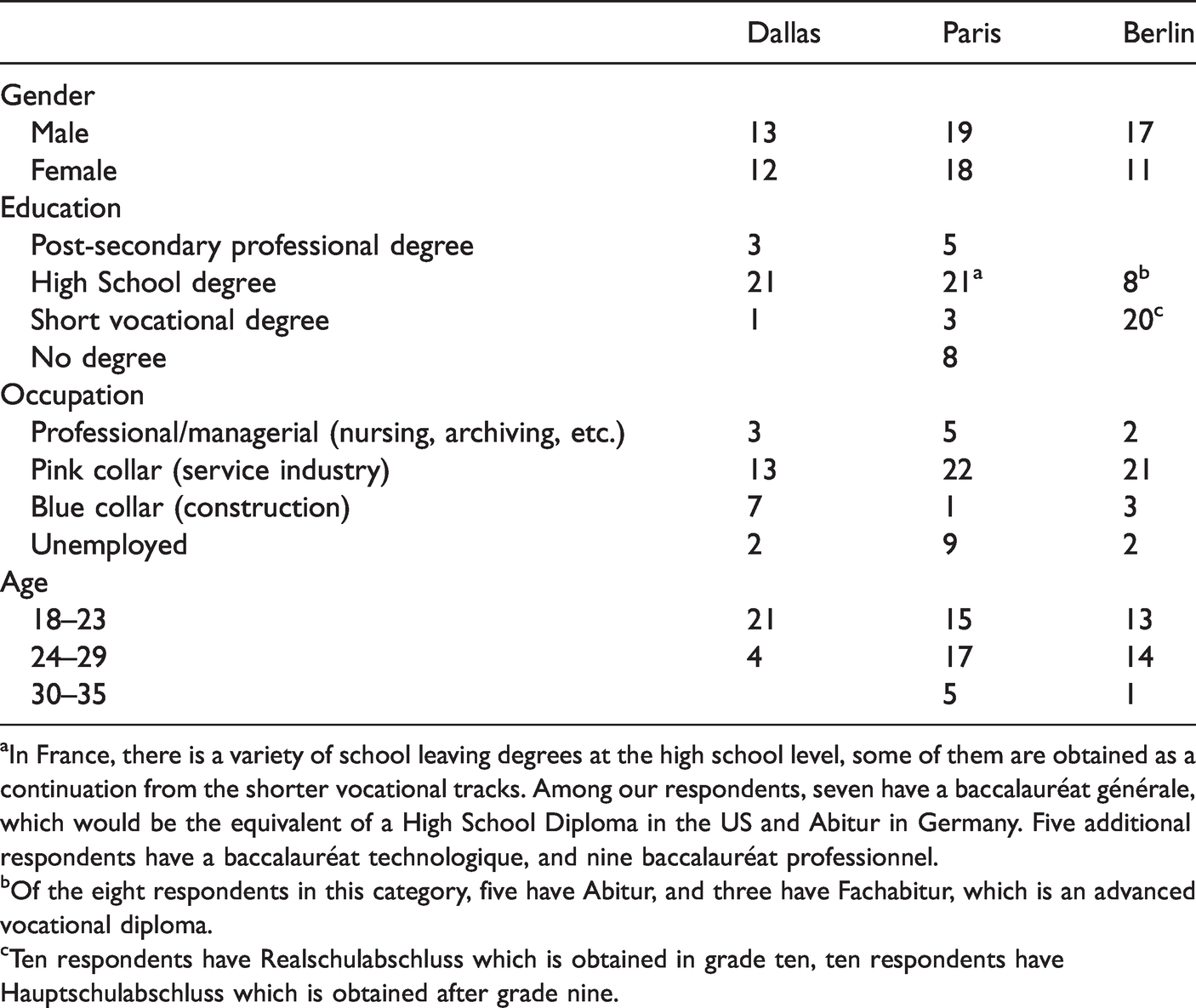
In France, there is a variety of school leaving degrees at the high school level, some of them are obtained as a continuation from the shorter vocational tracks. Among our respondents, seven have a baccalauréat générale, which would be the equivalent of a High School Diploma in the US and Abitur in Germany. Five additional respondents have a baccalauréat technologique, and nine baccalauréat professionnel.
Of the eight respondents in this category, five have Abitur, and three have Fachabitur, which is an advanced vocational diploma.
Ten respondents have Realschulabschluss which is obtained in grade ten, ten respondents have Hauptschulabschluss which is obtained after grade nine.
Data collection proceeded in multiple waves during the last decade (in Dallas, 2008–2011 and 2018; in Paris 2007, 2010, 2015 and 2019; in Berlin 2013, 2015 and 2019). In the three settings, we used the same interview guide, which was translated into the different languages. The questions asked were exploratory in nature, allowing for open reflections on experiences and proving malleable in the different settings. We utilized a number of coding techniques in analyzing our data. Specifically, descriptions of how respondents found jobs or interacted with teachers were coded focusing on the process. Value coding (which reflects ideas, attitudes and beliefs) was also utilized to reflect on the respondents’ perspectives on their outlook for the future, and also their attitudes towards their experience with education and employment.
Perceptions of (limited) success
Discrimination
Discrimination is considered a key factor within the segmented assimilation model that leads to the refusal of mainstream society and, ultimately, downward assimilation. In our study, we found that members of all three groups expressed multiple forms and sites for their experiences of discrimination, but each emphasized a different site as central in their own narratives. For example, while some CINA and CIT also gave examples of public discrimination such as in getting into nightclubs or interactions with the police, it was more central in CIM’s narratives as it featured in their descriptions of everyday interactions and activities. Similarly, the education system was a more central site of discrimination for CINA and the labor market for CIT in the sense that they connected such experiences to other difficulties they are facing in their lives. We choose to focus on these central sites as they reflect the role discrimination plays in shaping the narratives and perceptions among the different groups.
CIM describe discrimination in the public sphere more than discrimination at work or at school. Such discrimination includes being stopped by the police (males), receiving bad service at restaurants, and being watched at stores. Monica describes her experience with discrimination at a big box store: One time at [a store], I was there with my mom and baby, and we asked someone for help… [The salesperson] acted like she didn’t want to help us. She was slow and not very friendly. Then after she left us, I heard her complain to one of her colleagues that Mexicans come here to have babies and don’t speak any English. I pretended that I didn’t hear it as my mom was with me and I didn’t want her to get upset.
While CINA shared with CIM experiences of discriminatory encounters in daily settings our respondents emphasized the school council was the source of the biggest injustice they faced in life. Most of our respondents stressed the importance of a school-leaving degree as means for social mobility and success. They had aspired to do the baccalauréat général, the most prestigious academic track, and go on to higher education. For most of our CINA respondents, their overwhelming channeling into the non-academic vocational tracks forms the basis for their feelings of exclusion within French society. These frustrations persist as they navigate the French education system to attain better educational credentials. For example, Yusri, who was 25 and unemployed at the time of the interview, explained his views of the BEP vocational degree that he obtained: I had no choice. When I got to secondary education, they put us all in the BEP track… Instead of orienting us, advising us, they put us all in BEP, because we did not know what to do after high school. They said that one could change [educational] careers after getting the BEP, but the majority got lost in the system and ended up leaving without any diploma. I didn’t see this as my path. I didn’t like the vocational track, so I finished my BEP in sales, but I didn’t want to become a salesman.
CIT in Berlin emphasize labor market discrimination, with some reporting that they quit their jobs because of the way they were treated at work. Hakan works for the public sector and explains how discriminatory hiring practices affect his work environment: Until recently they didn’t hire Turks or foreigners in this organization. I am one of the first Turks doing Ausbildung, and among the people working none of them are Turks.
The different sites where discrimination is emphasized reflects our respondents’ feelings of exclusion from certain spaces in their societies. For CIM, they emphasize their exclusion from public (white) spaces; for CIT it is mainstream economic institutions; and for CINA exclusion starts earlier in schools and continues to the labor market. Members of the three groups choose to move past these experiences of exclusion, however. Similar to Monica, our CIM respondents choose to exit sites of exclusion. CINA respondents, like Yusri, strengthen their motivation and perseverance to overcome discrimination. For CIT respondents, their ethnic community shields them and facilitates labor market incorporation, which we discuss in the next section.
Social Capital
All our respondents had access to networks of friends and family members whom they met on a regular basis. Expectedly, at times, family members played a role in navigating the educational systems, especially among our CINA and CIT respondents. Reflecting on their labor market experiences, the different groups were found to have different levels of access to bridging social capital, or ties with those who are socio-demographically different from them, which facilitated their ability to find jobs (Granovetter, 1973; Putnam, 2000). For CIM in Dallas and CIT in Berlin, the ethnic community they participated in provided resources that facilitated their access to jobs. In the case of CINA in Paris, such access was limited given the meagre resources found in the community. We find that, when the ethnic community plays a role in getting ahead (Putnam, 2000), the children of immigrants utilize the community as a frame of reference facilitating their feelings of success compared to their own parents or to members of the first generation.
Many CIM reported that they got their first jobs, and at times subsequent jobs, through family members and friends. Juan, who started out working with his father at a construction site, used that experience as a stepping-stone to something better: I started working in the same company as my dad. People around knew him and were nice to me because of that. When a better job came by, I knew I should take it. It paid more money and it is a big company. I have a contract now and get paid leave.
CINA also rely on social networks for finding jobs. These networks may not provide information on specific jobs and translate into direct employment as in the case of CIM, but they still prove beneficial in navigating the job market. Importantly, social networks are perceived as sources for accessing mainstream institutions that may otherwise be difficult to access due to prejudice. Chahine explains: It is important to have a network, to know people. Jobs in the public sector are hard to come by and take a long time. First you have to have the right diploma, and then you have to take tests and apply and wait for many interviews, if you’re lucky. They get hundreds of applications so why should they choose you? It is easier for them to not choose you, to not choose an Arab who may be a problem for them, or maybe they are just biased and just do not want to work with an Arab, so you have to know the place and people have to know you before you can apply, so that when you apply they can take you seriously.
CIT rely more heavily than CINA on their ethnic community to access jobs both in ethnic and mainstream institutions. While the German educational system offers links to work through vocational apprenticeships, few of our CIT respondents relied on their Ausbildung as an avenue to employment. At the end of the apprenticeship, many did not receive a permanent position at their placement and had to look for jobs on their own. These respondents used their social networks, including family members, to find jobs. After finishing Realschule, Remzi was not sure what to pursue for his Ausbuilding, so he took a year to work with his father and uncle selling textiles and vegetables in the bazaar: I didn’t need to search for it as it was a family business. And during the time I worked in the bazaar I was thinking about what I want to do in life, and I quit the job in the bazaar and directly started the Ausbildung right away.
Subjective understandings of social positions
In this section we discuss the perceptions of the children of immigrants about their socio-economic success and their overall life satisfaction. When asked about their future outlook, our respondents took this as an opportunity to reflect on their present moment and share their perceptions of where their lives were going. The role played by frames of reference gains importance in understanding the ways these perspectives are framed.
Among our CIM respondents, hopeful attitudes towards the future echoed their beliefs in their ability to work hard and obtain what they want. They stressed that they are happy with what they have achieved in their lives, in terms of education (almost all of them finished a high school degree) and occupational status. This understanding of success was recognized when comparing themselves to their parents: Marisol, Francisco, Juan, and Sergio compared themselves to their fathers in particular and remarked that they do not have to endure the same physically strenuous activities at work as their fathers, who labor manually. A few others, mostly women, such as Monica, Christy and Minerva compared themselves to their mothers who also had to endure physically strenuous activities at work. All of them also emphasized that their jobs are more stable, pay better and provide benefits that their parents’ jobs did not. Our CIM respondents’ ability to escape replicating the work conditions endured by their parents was the marker of success in their perspectives.
Our CINA respondents, on the other hand, did not compare their lives to those of those parents—they were oriented towards mainstream society.
9
Such a comparison made them conceive of their situation as a dead-end, a battle that they cannot win. For example, Choukry, a 28-year-old man, began to think about his place in French society after he finished secondary education and started looking for work: When I started looking for jobs after the bac, I started feeling the difference. I was meeting people outside school and seeing how those French have a different life, different chances. That’s when it hit me that I am not treated like they are; they have a completely different life than mine; and I cannot win. I knew that there are rich people, and I know that money makes a difference. But these people I saw, they were not the same kind of rich people we see on TV. They were people, what do you call them? Middle class. They had to find jobs and struggle to be happy as well. But their struggles were easier. They looked for jobs and found them.
Despite discrimination and a working-class incorporation, CIT seem more hopeful about their place in German society than CINA in France. Devrim, who is doing an Ausbuilding at a construction company, explains: It is not like the old times anymore. Turks who came here first had big dreams when they migrated. But they ended up doing the worst and dirtiest jobs, like cleaning and stuff. But now, for us who are born here and even if you are not born here if you are qualified enough you can find good jobs. You can become anything here in Germany, it is up to you. So long as you believe in it, really want it and you have patience.
Discussion
In seeking to understand the incorporation of children of immigrants, both neo-assimilation theory and segmented assimilation theory use objective education and labor market outcomes. The theoretical frameworks differ with regard to their views on downward assimilation as the result of discrimination, and the frame of reference when comparing second-generation groups to earlier generations (neo-assimilation) or the dominant group (segmented assimilation). In this article, we illustrate the experiences of three groups of working-class children of immigrants as a way to understand their subjective understandings of success and integration. Our starting point is that subjective experiences are central to understanding success and mobility among the children of immigrants. We focus on three groups of working-class children of immigrants as they are at a higher risk of experiencing downward mobility and the mix of intergenerational mobility (compared to their parents) and stagnation (compared to the dominant groups) allow for scrutinizing the ways they rely on different frames of reference.
In the three groups, a strong desire to succeed shapes their understanding of their opportunities and obstacles in their respective societies. For the three groups, a working-class background, aspirations for material success and emphasis on the importance of work motivate them to pursue success through gainful employment. What working-class incorporation means for children of immigrants varies depending on context, however. Frames of reference mean that children of immigrants think differently about their own success, depending on context. This is something that is not theorized in either segmented assimilation or assimilation theories. For example, what may seem like a dead-end job according to segmented assimilation theory may be a step up from one’s own parents’ job and thus may seem like success in one context, while in another context the same job may seem a step behind the majority population and thus a failure. While segmented assimilation and neo-assimilation perspectives theorize the social mobility of children of immigrants, they do not account for their perceptions of success and failure. We argue that these perceptions of success or failure link to their perceptions of belonging and incorporation in the different societies. We find that the respondents in the three contexts have varying views regarding their experiences in schools and the labor market, and overall life satisfaction. Based on our research and the literature, we identify four variables that are important in shaping the perceptions of success and life satisfaction among immigrants and their children including socioeconomic position, social capital, discrimination, and frames of reference. Table 2 outlines these variable and summarizes our findings for the three groups.
Factors affecting life satisfaction among the children of immigrants.
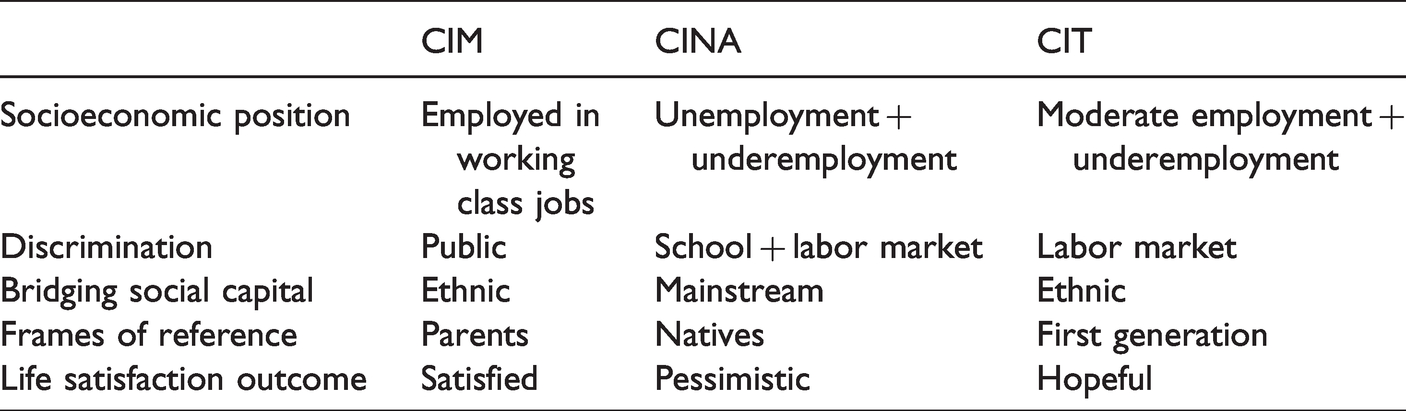
While our study focuses on the working-class children of immigrants, not all groups shared the same socioeconomic position in their societies. CIT in general have high rates of employment compared to CIM and both groups have higher rates than CINA. Access to employment leads to more satisfaction with working-class jobs given the CIM and CIT ability to improve on their parents’ (generation) working conditions in general. Such access to employment and the ability to improve one’s position in the labor market result in relatively strong perceptions of success among our CIM and CIT respondents. Unemployment faced by CINA, however, leads many of them to accept jobs that they may view as undesirable exacerbating their sense of economic marginalization.
All groups have access to different forms of social capital, but CIM and CIT benefit from an ethnic community that facilitates their access to jobs. CINA express their need to rely on social networks that extend to members of mainstream French society as they favor employment in mainstream organizations to which members of their communities have limited access. Alba et al. (2013) point to the low levels of employment among members of CINA’s ethnic network as causing their lack of expectation of help in finding jobs from friends and relatives and forcing them to rely on assistance from formal associations. The Republican orientation towards a mainstream society also diminishes the role of the ethnic community in their perspectives. We find that when members of the ethnic community play a role in facilitating access to jobs, they constitute the frame of reference for the children of immigrants. Likewise, when access to jobs is facilitated by networks developed with members of the dominant group, mainstream society becomes the frame of reference affecting the children of immigrants’ perceptions of their social position.
While experiences of discrimination are common to all three groups, they emphasize different sites of discrimination that also have a bearing on their perceptions of success and life satisfaction. CIM respondents emphasize discrimination in public, which they address by exiting the situation. Such experiences, especially those involving the police, may have detrimental effects on CIM’s lives, but do not directly affect their feelings of socio-economic success. CIT stress the prevalence of discriminatory behavior limiting their access to jobs and satisfaction with their chances in the labor market. While some encounter discrimination in school, they do not see such experiences as detrimental given that the educational system promises them placement in apprenticeships that could lead to permanent employment. Encountering discrimination in the labor market, and often in the workplace, is perceived as a failure in people, but not the system. CINA, on the other hand, emphasize discrimination in their tracking into undesirable lower educational tracks that consequently affect their labor market incorporation. The injustice encountered within the educational system is considered a precursor for further experiences of discrimination for CINA. Our respondents also described experiences of discrimination in the labor market, which are shared by 30–40% of all CINA (Alba et al., 2013). Experiencing discrimination at an early age, and within the very institution that socializes them into French society, has long-lasting effects and shapes the whole trajectory of making a living. It should be stressed that these different spheres are not mutually exclusive but, rather, are focal points in the narratives presented by members of the different groups. Stressing different focal points, thus, should be understood within the general perceptions of their position and opportunities in society.
Given the children of immigrants’ insistence on perseverance and hard work in the face of discrimination, our findings challenge segmented assimilation’s conclusions about downward mobility into an underclass that refuses mainstream institutions and values. While CIM choose to exit situations of discrimination when they can, CINA find ways to navigate institutional obstacles and manage to obtain educational degrees that are considered higher than the ones they were tracked into; 10 and CIT rely on their ethnic community to find jobs in organizations that would welcome their presence. The different strategies to deal with discrimination highlight the importance of subjective narratives in understanding success and incorporation.
In sum, the three groups exhibit different understandings of their success as a result of the interaction between the variables outlined earlier. For CIM, early access to jobs and the ability to improve on their own and their parents’ labor market position allow them to see their socioeconomic position as successful achievement. Relying on their ethnic community in general—and their parents specifically—as their frame of reference enables them to see the material improvements they have accomplished intergenerationally. CINA in our study also improve on their parents’ educational attainment, and many improve on their parents’ occupational status. In the narratives of our respondents, however, experiences of discrimination at school provide the earliest and most lasting feelings of exclusion. Institutional discrimination, unlike public forms of discrimination encountered by CIM, have a direct impact on CINA’s ability to succeed socioeconomically. Their largely unemployed, or underemployed, networks of family members and peers exacerbate their feelings of exclusion as a group vis-a-vis their native French peers. As such, their frame of reference is collective, placing North Africans in opposition to white French. Thus, despite improving on their parents’ status, CINA do not see their trajectories as successful—as the CIM do. CIT also improve on their parents’ educational and labor market position. Their ethnic community plays an important role, however, in granting them access to jobs and shielding them from the effects of labor market discrimination. Thus, their ethnic community continues to play an important role in their understanding of their position in German society as they stress the improved positions they occupy vis-a-vis earlier waves of immigrants from Turkey. As such, they have a positive outlook toward their future and ability to continue to experience upward social mobility and success.
Thus, despite somewhat similarly disadvantaged circumstances, children of immigrants in Dallas, Paris and Berlin view their situations differently. We find that frames of reference are an important factor in understanding the perceptions of children of immigrants, although unrecognized by contemporary theories of immigrant incorporation. Children of immigrants’ frames of reference are shaped by education and labor market experiences, experiences with discrimination and, perhaps most importantly, social networks. Ultimately, frames of reference form a lens through which children of immigrants view their own success, which may be distinct from an interpretation based on the objective criteria normally used by immigration scholars.
Footnotes
Acknowledgments
We would like to extend our gratitude to Richard Alba for providing comments on an earlier draft of this manuscript. We also wish to thank Karim Mendil, Ulla Mundinger, Caner Naim, and Serena Nilsson for their research assistance and help in the field. We are also grateful for the two anonymous reviewers and the journal editors for the feedback they provided as we developed the manuscript.
Declaration of conflicting interests
The author(s) declared no potential conflicts of interest with respect to the research, authorship, and/or publication of this article.
Funding
The author(s) disclosed receipt of the following financial support for the research, authorship, and/or publication of this article: This work was partially supported by the Children of Immigrants in Schools grant from the Partnership in International Research and Education Program at the National Science Foundation and the Social Science Research Council in the US. The Centre for Advanced Middle Eastern Studies at Lund University provided financial support for data collection in 2019.
