




Abstract
Most research on migration and ethnic boundaries is concerned with boundaries between a specific migrant minority and the ‘majority society’ in the destination country. However, migrant groups are not homogenous; within-group boundaries that are relevant in their context of origin may also play a role in the host context. Focusing on migrants from former Yugoslavia, we analyse the relevance of ethnic boundaries between Bosniaks, Serbs and Croats in Germany. We do so by interpreting migrant parents’ practices of first-name giving as instances of ethnic boundary work. In the case of migrants from former Yugoslavia, first names are a salient marker of ethnic affiliation. Based on 22 semi-structured interviews, we distinguish between three types of ethnic boundary work based on first-name giving. ‘Particularists’ wish to express their ethnic affiliation via first names, and they maintain ethnic boundaries both towards the German majority society as well as other ethnic groups from former Yugoslavia. In contrast, ‘cosmopolitans’ reject names with specific ethnic references and base their choice on personal taste, often opting for international names, thereby rejecting ethnic boundaries towards other former Yugoslav groups. Finally, ‘negotiators’ stand in between. They blur boundaries towards the German majority society, but maintain boundaries towards other ex-Yugoslav ethnic groups. Overall, we find that ex-Yugoslav migrants’ strategies of ethnic boundary work are shaped by a multiplicity of reference groups, not just the relationship with the German majority society.
Introduction
The rather intangible barriers to the incorporation of migrants into a society have been conceptualized as ‘ethnic boundaries’ (Barth, 1998; Wimmer, 2008). This concept refers to the cognitive and evaluative distinctions people make between different ethnic categories, the corresponding processes of group making and the unequal access to material and symbolic resources that can result from these classifications. Ethnic boundaries between migrants and the majority society can be marked in different ways. For example, dresses, customs, or languages can be interpreted as expressions of membership in an ethnic group. Another potential marker of ethnic boundaries frequently studied in the literature are first names, as name pools often differ between ethnic groups (Gerhards and Hans, 2009; Gerhards and Kämpfer, 2017; Lieberson, 2000; Lieberson and Mikelson, 1995; Sue and Telles, 2007). When people migrate to another country and have a child there, they can choose between different names, for example names that are common in their host society, in their country of origin, or in both. Migrant parents’ considerations when choosing a name for their child likely express emotional ambivalences in the process of relocation and can reflect their sense of belonging towards different contexts. Thus, first-name giving can tell us how migrant parents relate to the ethnic boundaries they face in the host society. In this paper, we take name giving as a starting point to analyse the ethnic boundary work of migrants.
So far, most of the literature on migrants’ ethnic boundary work in general, and their practices of first-name giving in particular, has focused on the ethnic boundaries between the respective migrant minority under study and the majority society in the destination country. However, societies have become increasingly diverse, receiving migrants of different origins. In addition, migrant groups themselves are not homogenous. When people move across borders and resettle in another country, any ethnic boundaries that are relevant in their countries of origin may also play a role under the new circumstances (e.g. Brieden and Runge, 1995; Hanrath, 2012). In other words, migrants might face multiple ethnic boundaries. In consequence, their practices of first-name giving could not only reflect ethnic boundary work vis-a-vis the majority population, but regarding other migrant groups as well. This paper explores the relevance of such interethnic boundaries among migrant groups within the receiving society, as reflected in their practices of first-name giving.
We seek to analyse the relevance of intra-migrant ethnic boundaries for a particular group: migrants and their descendants from former Yugoslavia 1 in Germany. Currently counting around 1.9 million, they are one of the largest migrant groups in Germany (Destatis, 2020). 2 After a first round of migration due to the labour recruitment agreement between Germany and Yugoslavia in the 1960s and 1970s, in a second round of migration, several hundred thousand refugees fled to Germany over the course of the wars in the years 1991 to 1995 and 1999 to 2001 (Alscher et al., 2015). 3 As is well known, these wars were accompanied by intense nationalist mobilization, forced displacement and ‘ethnic cleansing’ in former Yugoslavia. This raises the question as to what extent the interethnic conflicts on the territory of the former Yugoslavia and the associated boundaries between the various ethnic groups play a role for the migrants from former Yugoslavia and its successor states in Germany.
In the next section, the analytical framework, we will outline the core concepts and theoretical assumptions that guide our analysis, before turning to a description of our research methods. As outlined in the following section, we conducted 22 semi-structured interviews with migrants and their descendants from former Yugoslavia and three successor states (Croatia, Serbia and Bosnia and Herzegovina) residing in Germany. We analysed the relevance of ethnic boundaries between these groups, and towards the German majority population. In particular, we interviewed migrants of the first and the second generation, who had at least one child born in Germany after 2005, and inquired about the names they gave their children, exploring the considerations and emotions connected to their choice of names. In the subsequent section, we present our empirical results in the form of a typology of ethnic boundary work. We found that migrants and their descendants from former Yugoslavia in Germany differ substantially in terms of their attitudes to first-name giving and the relevance they accord to interethnic boundaries, and that these differences do not primarily correspond to ethnic group membership. We propose to distinguish between ‘particularists,’ ‘cosmopolitans,’ and ‘negotiators.’ In the concluding section, we summarize our results and situate them within the broader debate on ethnic boundaries in the context of migrant incorporation.
Analytical framework
1. The core concept of this study is the concept of ‘ethnic boundaries’ (Barth, 1998; Wimmer, 2008). Ethnic boundaries are socially constructed distinctions between ethnic groups based on the belief in some sort of shared characteristic like a common phenotype, ancestry, history, religion, or language. Following Michèle Lamont (Lamont and Molnár, 2002: 168–169), boundaries have a ‘symbolic’ and a ‘social’ dimension: The symbolic dimension of an ethnic boundary refers to a ‘conceptual distinction’ between ethnic categories based on certain markers of membership, while the social dimension of an ethnic boundary refers to group-making and the unequal access to resources and opportunities this entails. In consequence, ethnic boundaries typically result in social closure and the monopolization of resources for the in-group.
Ethnic boundaries are not static but – under specific structural and social conditions – open to negotiation or ‘boundary work.’ Previous research has shown that migrants confronted with ethnic boundaries in their host society can engage in different strategies of boundary work. Scholars typically distinguish between the following strategies. ‘Boundary maintenance’ refers to emphasizing the migrant identity and its particular value vis-a-vis the majority population. ‘Boundary crossing’ means assimilating to the majority population. Finally, ‘boundary blurring’ refers to de-emphasizing ethnicity as a principle of social differentiation, or adopting multiple and/or hybrid forms of ethnic belonging (e.g. Alba, 2005; Carter, 2006; Lamont and Bail, 2008; Warikoo, 2011; Wimmer, 2008; Zolberg and Woon, 1999).
2. Among other markers, first names can function as markers of ethnic boundaries. In general, a first name can communicate different aspects of one’s social identity to others, such as gender, social class background or ethnic affiliation (Gerhards, 2005; Lieberson, 2000). 4 For example, a person named Rocío or Ülker will probably be associated with a Spanish or Turkish background, respectively. First names can express an ethnic boundary in symbolic terms. However, they can turn into a social boundary when they affect access to valuable resources. Indeed, there is ample evidence from experimental field studies that migrants face manifest discrimination on the housing and labour markets based on the ethnic affiliation signalled by their name (for many others, see Auspurg et al., 2019; Kaas and Manger, 2012; Schneider et al., 2014). Thus, the names that parents choose for their children are likely to have direct, practical consequences for them.
In consequence, we argue that migrant parents can conduct ethnic boundary work through practices of first-name giving. Note that this does not mean that migrant parents choose or reject first names only because of their ethnic affiliation. Parents’ name choice is typically informed by many different motives, such as their tastes or family traditions. However, previous research suggests that migrants are mostly aware that names can potentially mark an ethnic affiliation, and that they usually consider this when naming their child (Gerhards and Kämpfer, 2017). 5 Given this possibility, parents can adopt many different strategies. For example, they can simply ignore the fact that names can signal ethnic affiliations and choose a name for other motives. Or they may choose to name their child in a way that is common in their country of origin, but not in the host country. This can be interpreted as a practice of ‘boundary maintenance,’ because the child’s name will signal its ethnic background. Alternatively, they can choose a name that is typical of the majority population, but not in their country of origin (‘boundary crossing’). Finally, they may choose a name that is common in both the host society and the society of origin. This can be interpreted as a practice of ‘boundary blurring,’ because the name signals the child’s belongingness to several contexts at a time; the specific ethnic affiliation is blurred.
It must be noted that the ethnic boundaries associated with first names can depend on the cultural distance between the name pool of the migrant group and the majority population (Gerhards and Hans, 2009). While the name pool of some migrant groups has large overlaps with the name pool of the host country (e.g. Italian migrants in Germany), other groups face rather distinct first name pools (e.g. Turkish migrants in Germany). Accordingly, the amount of first names that are common in both contexts may shape the opportunities and constraints of migrants’ ethnic boundary work through naming, leading to different strategies. Indeed, quantitative studies have shown a strong correlation between cultural distance and the choice of strategies of boundary crossing or boundary maintenance (Gerhards and Tuppat, 2020). However, such quantitative studies cannot account for the meanings and processes of negotiation associated with parents’ name choice. As we will show via our qualitative analyses, naming strategies are not ‘determined’ by ethnic affiliation.
3. Much of the literature on ethnic boundaries has focused on the boundary work between migrant groups and the host society, or ethnic minorities and the majority population. However, societies have become increasingly diverse because of immigration from different countries and regions, sometimes generating ‘super diverse’ settings (Vertovec, 2007). In the context of Germany, researchers have coined the term ‘post-migrant’ society to refer to the fact that migration and diversity have become a part of everyday social life (Foroutan, 2016). In consequence, researchers have also begun to examine inter-minority attitudes and relations, in particular in light of the question whether shared minority status enhances or decreases potential interethnic boundaries (e.g. Bubritzki et al., 2018; Burson and Godfrey, 2018).
We side with this literature by arguing that migrants’ ethnic boundary work is more complex than implied by the simple model of ‘minority’ and ‘majority,’ as it may occur with respect to multiple reference groups. However, we move beyond this literature by specifically considering inter-minority boundaries against the background of the ethnic identifications and boundaries relevant in their societies of origin. When people move and resettle to another country, they frequently continue to be connected to their societies of origin in multiple ways (Faist, 2000; Pries, 2010; Wimmer and Glick Schiller, 2002). In consequence, migrants may not only be engaged in ethnic boundary work vis-a-vis the host society and immigrant groups from other countries and regions, but also with regard to other immigrant groups from their own societies of origin, such as Kurds and Turks or Bosniaks, Serbs and Croats in Germany (Brieden and Runge, 1995; Hanrath, 2012).
4. In this regard, the group of migrants and refugees from former Yugoslavia in Germany is a crucial case. The identity label ‘Yugoslav’ has its historical origins in the 19th century and refers to the idea of a cultural unity of South Slavic peoples, and their equitable co-existence within a multinational state (Sekulic et al., 1994). However, the dynamics of nationalist mobilization since President Tito’s death led to the disintegration of the Republic of Yugoslavia into various successor states in the 1990s. This mobilization occurred along ethnic and religious lines, such as between Bosnian Muslims (‘Bosniaks’), 6 Orthodox Serbs, and Catholic Croatians. Religious affiliation and ethnic identification intertwined and reinforced each other in a context otherwise shaped by cultural and linguistic commonalities (Perica, 2014). To date, the wounds of the conflicts have not healed, particularly in Bosnia and Herzegovina and Kosovo. Despite the prosecution of war criminals through the International Criminal Tribunal, there has been no successful reconciliation process, and the atrocities committed during the wars remain largely silenced in interethnic encounters (Mijić, 2018; Stefansson, 2010). On the population level, interethnic social ties have not yet been fully re-established, and trust in other ethnic groups remains rather low (O’Loughlin, 2010; Pickering, 2006).
Despite this, many studies on migrant integration in Germany and elsewhere have tended to treat ‘Yugoslavs’ or ‘ex-Yugoslavs’ as a distinct group of migrants. Only a few studies have focused on ethnic boundaries among them. For example, Brieden and Runge (1995) report that ethnic identifications among former Yugoslav migrants living in Germany have strengthened in the course of the conflict in Yugoslavia. Mijić (2020) explored symbolic boundaries among ex-Yugoslav migrants in Vienna, Austria. She finds a complex constellation consisting of a boundary between the Austrian majority society and the ex-Yugoslav immigrant community based on stereotypes about the ‘Balkans,’ as well as interethnic boundaries in consequence of the Yugoslav conflict. 7 We contribute to this literature by disentangling the different strategies of ethnic boundary work vis-a-vis multiple reference groups of migrants from former Yugoslavia living in Germany.
To do so, we primarily analyse their practices of first-name giving. While sharing a South-Slavic name pool, the three groups under study here – Bosniaks, Serbs and Croats – also have specific names that they can draw on in order to signal their respective ethnic affiliation and draw a boundary vis-a-vis the other groups. Corresponding to the significance of religious affiliation as ethnic marker, these are mainly of religious origin. For example, ‘typical’ Bosniak names are frequently of Muslim origin (e.g. Alija and Emina), Serbian names are closer to the Orthodox tradition (e.g. Lazar and Natasa), and Croatian names closer to Catholic name pools (e.g. Luka and Josipa). Furthermore, in Yugoslavia during the wars, carrying a first name identified with former nationalist leaders (such as Ante) has been shown to correlate with the likelihood of involvement in the conflict, suggesting that name giving can be understood as an expression of nationalist sentiment (Jurajda and Kovač, 2016). We therefore expect name giving to be a salient marker of ethnic boundaries among ex-Yugoslavs in Germany.
Methodological approach
We conducted 22 semi-structured interviews with migrants and their descendants from former Yugoslavia residing in Berlin, Germany. Interviewees were recruited via migrant associations (such as sports, music, and folklore clubs, etc.) and businesses (restaurants, crafts enterprises, etc.). Additionally, we shared an interview request via social media and mailing lists. The respondents received an expense allowance for their participation.
The recruitment followed the logic of quoted sampling. All interviewees in our sample share two fundamental characteristics: First, they or their parents immigrated from Yugoslavia or the respective successor states to Germany. Among those, we have chosen to focus on Croatians (N = 5), Serbians (N = 10) and Bosniaks (N = 7), given that they were at the centre of the conflict. 8 Second, the respondents all had at least one child born in Germany after 2005. Apart from that, our respondents vary in their education levels, gender and whether they or their parents migrated to Germany: Half of our interviewees are first-generation immigrants to Germany, the other half are from the second generation, i.e. whose parents migrated to Germany. This way we are able to cover descendants of Yugoslav ‘guest workers,’ refugees of the Balkan wars in the 1990s, and those who migrated for professional or educational reasons in the 2000s. Furthermore, we interviewed people with different levels of education: Ten hold a university degree or doctorate, five hold a lower secondary degree or less, and the rest lie in between. Finally, our sample consists of seven fathers and 15 mothers. Interviews were mostly conducted in German (except for two), which probably introduces a bias towards more structurally integrated respondents into our sample.
Our research strategy consists of analysing the naming preferences of migrant parents as a reference point to explore their strategies of ethnic boundary work vis-a-vis multiple groups. In line with the previous literature (e.g. Gerhards and Hans, 2009), we interpret name giving as a more or less ‘pure’ expression of parents’ preferences with low material costs but tangible consequences for social life. More specifically, we explore to what extent parents’ name choice is associated with their perception of ethnic boundaries and if so, what strategies of ethnic boundary work their choice of names express. As mentioned above, this does not mean that we interpret name choice always as an expression of ethnic boundary work. As we will see, for some parents, ethnic affiliation is irrelevant when choosing a name for their child.
The interview guideline covered the following three topics. (1) The main part of our semi-structured interview addressed the respondents’ practices of first name giving. We asked what names the respondents gave to their children, and we inquired about their thoughts, feelings and negotiations during the naming process. Furthermore, we conducted a brief naming experiment with the participants. For this purpose, we presented several first names considered ‘typical’ of the different ethnic groups of former Yugoslavia, as well as of the host society. It included common German (e.g. Friedrich and Lisa), Serbian (e.g. Slobodan and Natasa), Croatian (e.g. Josipa and Stipe) and Bosniak names (e.g. Amer and Emina). The respondents were asked to express their thoughts and feelings related to these names, and whether and why they would consider giving them to their own children or not. (2) The second part of the interview asked about boundaries between the different ethnic groups from former Yugoslavia: In this part, we asked whether respondents form friendships with members of the other ethnic groups from former Yugoslavia, and what role ethnic and religious affiliation has played in their partner choice and should play for that of their children. It also covers their attitudes towards the former Republic of Yugoslavia, and whether the conflicts continue to be perceived as significant, both in the German context, as well as in the territory of the former Yugoslavia. (3) The final part dealt with the migrants’ level of inclusion regarding German society, based on subjective feelings of belonging and objective indicators such as having attained a German citizenship. This part of the questionnaire also covers experiences of discrimination and stereotyping, for example in the German labour and housing market. 9
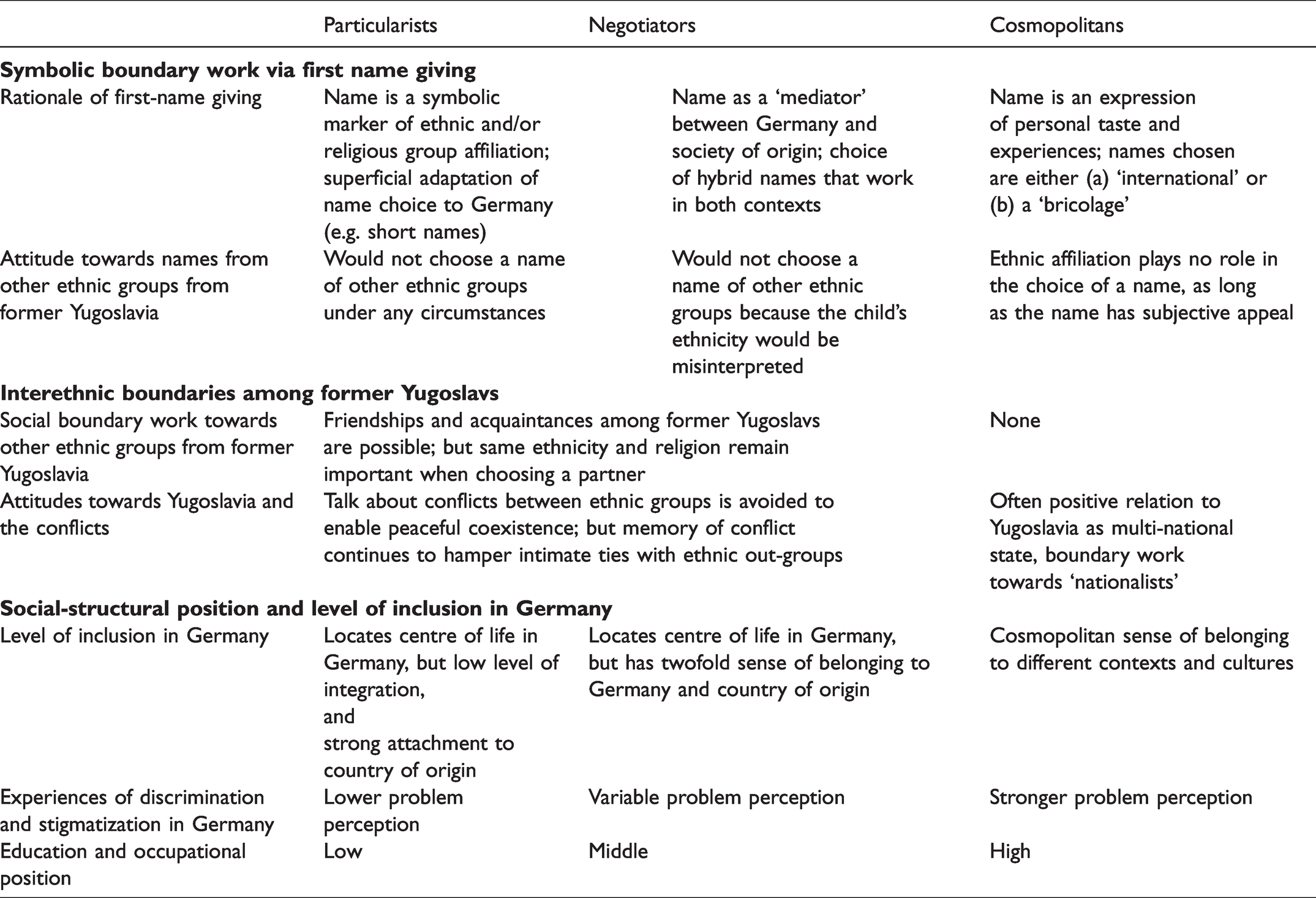
The interviews had an average length of 77 minutes. We transcribed the entire interview material, and coded it thematically following the logic of qualitative content analysis (Kuckartz, 2018; Mayring, 2010). The codes reflect our research interest in the respondents’ ethnic boundary work and are specifications of the three topics covered by the interview guideline reported above. Based on these codes, we reconstructed three ‘ideal-types’ of ethnic boundary work through first-name giving. Ideal-types represent generalizations from the empirical data, and are generated by relating the different values across several dimensions of comparison to each other in a theoretically meaningful way (Kuckartz, 2018: 143–162). Their function is to pinpoint relationships between these values and carve out the corresponding patterns in the data beyond single cases. 10 Table 1 summarizes the three ideal-types generated from our interview data along the three dimensions of comparison: (1) strategies of ethnic boundary work as reflected in first name giving; (2) ethnic boundary work towards other former Yugoslav groups; and (3) level of inclusion regarding German society. We will turn to an in-depth description of these ideal-types in the following section.
Three types of ethnic boundary work and the associated practices of name giving of migrants from former Yugoslavia in Germany.
The interview quotes reported below were translated from German to English, and edited for better readability. The names of the interviewees, as well as the names referred to in quotes (e.g. of parents, children or other relatives) were anonymized. We tried to replace them with names that convey a similar ethnic affiliation and meaning.
Empirical results
Our interviews suggest that we must distinguish between three types of strategies of ethnic boundary work via first name giving (see Table 1). First, the respondents we labelled ‘particularists’ consider their ethnic (and corresponding religious) 11 affiliation an important part of their social identity, and wish to express this through their choice of first names. Following from their strong orientation towards the in-group, these respondents maintain an ethnic boundary regarding both the German majority population and the other migrant groups from former Yugoslavia. The second type we labelled ‘cosmopolitans’ follows the opposite strategy. These respondents do not express any kind of ethnic affiliation via first names at all. For them, names are a matter of personal experiences and taste. They tend to ignore and often reject boundaries with respect to multiple reference groups – both Germans and former Yugoslavs. For them, ethnicity and nationhood are not relevant principles of social differentiation. Finally, we also detected an in-between group of respondents we called ‘negotiators.’ These typically choose hybrid names that express their double sense of membership in the German society and their respective society of origin. These respondents maintain boundaries towards the other ethnic groups from former Yugoslavia, but these are more porous. Below, we will describe each of these three types in detail.
Additionally, our interviews tentatively suggest that these three strategies of ethnic boundary work – as expressed through first-name giving – are associated with different types of migrant groups. 12 The ‘particularists’ are principally former Bosniak refugees as well as second-generation labour immigrants from Yugoslavia with a lower level of education and who work in manual jobs. In contrast, the ‘cosmopolitans’ tend to be highly educated respondents who hold mostly high-skilled occupational positions. This group is made up of upwardly mobile second-generation labour immigrants from Yugoslavia as well as recent migrants from the region who moved to Germany for educational and professional reasons since the 2000s. Finally, the ‘negotiators’ are often upwardly mobile descendants of Yugoslav ‘guest workers’ in Germany and more recent immigrants who have attained a middle socio-structural position. This points to important socio-cultural divisions within the group of migrants and their descendants from former Yugoslavia in Germany, which partly crosscut the ethnic divide between Bosniaks, Croats and Serbs.
‘Particularists’: Maintenance of ethnic boundaries
For the respondents in our sample that we labelled ‘particularists,’ ethnicity forms an important part of their social identity. They explicitly try to uphold their identity as Serbs or Bosniaks in Germany, 13 and pursue a strategy of ethnic boundary maintenance towards other ethnic groups from former Yugoslavia. This is clearly reflected in the kinds of first names they prefer and have given their children. For them, it is important that their child’s first name expresses its ethnic membership and the corresponding religious affiliation. In consequence, these respondents take into consideration only the specific names of their ethnic group, which often have a religious background. For example, Serbian respondents of this type preferred names from the Serbian Orthodox tradition. Likewise, Bosniak respondents of this type typically preferred Muslim names with a ‘beautiful meaning’ in Arabic, such as ‘Amer’ and ‘Emina’ from our naming experiment. 14 The following Bosniak interviewee stated this preference most clearly. For him, it is important that ‘… the names are short. That they have an Islamic background, as I said, that they are Muslim names, that they are on the list [of Muslim names] and that they have a beautiful meaning. Yes, nothing more’ (Int. 06, Bosniak: 159).
This respondent’s preference for Muslim names is in line with the significance of religion as a marker of ethnic boundaries in the context of former Yugoslavia. The name is understood as both an expression of ethnic identity as well as of religious affiliation.
Following their strong orientation towards the name pool of their own ethnic group, ‘particularists’ reject names both from the German name pool, as well as from other Yugoslav ethnic groups. For instance, when asked whether he had considered giving his child a German name, the previous respondent answered: No, not at all. Not at all. Because I find it important that children should have names that somehow connect them with their heritage, because … I had a certain fear that […] you forget where you come from. So, to have a bit of a connection to where you’re from. That’s important. […] There are enough people called Thomas and Friedrich [considered typical German names]. So, it should become colourful [laughs] here. If you look around and it’s already colourful, then it should also be colourful with names. (Int. 06, Bosniak: 173–175)
Similarly, ‘particularists’ also consider it out of the question to choose a name that is associated with an ethnic out-group from former Yugoslavia. For instance, the following Bosniak interviewee explains why he would not give his child such a name: I support the need for Bosnian names. Now, for connoisseurs who know the Balkans and its denominations. Three plus: Catholic, Orthodox, Muslim. The three plus Jewish. Roma we would not have as religion. In my opinion, if there can be a language, if there can be a country, if there can be a nation, then there also must be names. (Int. 03, Bosniak: 68)
These respondents’ exclusive in-group orientation in their name choice coincides with a strategy of maintaining ethnic boundaries towards various perceived out-groups – both German and former Yugoslav – in more or less conscious terms. They report that their closest friends and intimate partners are typically of the same ethnic background, though they may have acquaintances of other groups as well. When asked about partner choice, these respondents explicitly prefer a partner of the same religious affiliation and ethnic origin as themselves, and they desire and would recommend the same for their children. Some refer directly to the conflicts while others cite cultural concerns and stereotypes as reasons. The following Orthodox Serbian respondent sums up this preference most clearly: Well, you always try to take someone that is like you [laughs]. I would say, I’d rather prefer a German, honestly. It is difficult with religion anyway. Then I’d rather stick to Christianity than switch to Islam. That would not be so … […] Yes, these are two cultures. I don’t know, if my daughter / there are radical Bosnians too. I don’t want that she can’t wear make-up or live freely like us. (Int. 17, Serbian: 127)
For these respondents, the history of interethnic conflicts in former Yugoslavia continues to be subjectively relevant. Nevertheless, they seem to be generally interested in maintaining a peaceful co-existence with other ethnic groups. To achieve this, the latent interethnic boundaries are mostly silenced, and not deliberately politicized. These respondents generally seem to avoid raising thorny ‘political’ issues in interethnic encounters, in order not to hurt any sensibilities and evoke a dispute (this strategy has also been observed by Mijić, 2018, 2020; Stefansson, 2010). Talking about the Yugoslav wars remains a taboo. A Bosnian Muslim illustrates this strategy of deliberate silencing in the following paragraph: I have a good example. A very good friend of mine is Serbian. And she knows what happened. She is Serbian. My father went missing by the Serbs, but I can't blame her for it. But there are always these boundaries. And when you're sitting together, you can't speak openly about everything. You have to have respect. She has respect for me and I have respect for her. And this will stay with me my whole life. So for me nothing's going to change. I mean you just don't forget about this. I mean for some people, who maybe haven't experienced the history that I have experienced, it doesn't matter. I can kind of understand that. For me it is really important. My child will know someday why we came here from our country and about the other religions, be it Serbian, Croatian or whatever. One should be able to identify them. But when it comes to serious stuff like marriage or so, no. (Int. 07, Bosniak: 57)
Who are the ‘particularists’ in our sample and what is their level of inclusion in Germany? On the one hand, this group consists of Bosniak respondents who have fled to Germany as children or young adults during the Bosnian wars. Most of them have experienced personal suffering and loss due to persecution and war, which might have shaped their strategy of ethnic maintenance. They continue to hold their citizenship of origin and feel emotionally attached to their country of origin or ‘not really’ German (Int. 9, Bosniak: 70). However, they locate their centre of life in Germany, often for ‘pragmatic’ reasons, such as the standard of living or security issues. Some would consider moving back in the future, especially in old age.
On the other hand, the group of ‘particularists’ also includes some respondents (Serbian and Bosniak) who are the children of labour migrants from Yugoslavia in Germany. Even though they call Germany their ‘home,’ some of them continue to feel that they ‘are not really completely German’ (Int. 18, Serbian: 26).
All respondents of this type have in common a lower level of education and that they work in low-skilled jobs – for example, in our sample there is a construction worker, a hairdresser and a bus driver. Interestingly, however, the respondents of this type show the lowest awareness of discrimination and stigmatization by the German majority population in our sample (for instance, on the housing and labour markets). 17 Although this finding seems surprising at first sight, it fits with the literature on perceived discrimination from survey research, which reports lower levels of perceived discrimination among the lower educated, despite – or precisely because – of being less well integrated in the majority society. 18
‘Cosmopolitans’: Rejection of ethnic boundaries
The respondents we labelled ‘cosmopolitans’ are fundamentally different from the respondents of the previous type. They do not consider ethnic and/or religious membership a salient aspect of their social identity. In consequence, they ignore and often explicitly reject possible boundaries between ethnic groups in Germany, including those between former Yugoslavs. This finds expression in their first name giving. These respondents’ name choice is primarily guided by personal life experiences and aesthetic preferences. Some even try to avoid signalling an evident ethnic belonging or country-specific attachment by their child’s name. This ‘cosmopolitan’ orientation is expressed in two ways. First, if possible, the respondents choose ‘international’ names that are common ‘all over the world.’ For example, the following interviewee named his child ‘Tomas’ and gave the following explanation for his decision: [The mother] said, that's a nice name, we can do that, then I said, all right. My only condition was that the name is without funny characters, so a name without ‘s-c-h,’ ‘t-s-c-h’ and similar stuff, the ‘shs’ and ‘chs’ and so on. However, she somehow wanted to think about funny names and so on. So, I said, it would be best to have something that can be written down in all languages, in any conceivable script, be it Cyrillic or Latin or whatever. Ana – one ‘n’ – if it’s a daughter, or a girl. And then [Tomas] came, I said, okay, you want it, all right, fits, we do it, but then please without [th] […] So that it is as simple as possible. (Int. 15, Serbian: 41)
While this respondent has opted for a rather pragmatic strategy of internationalization, in other cases, the interviewees performed a downright postmodern ‘bricolage’ when naming their children. A particularly pertinent example is the following Croatian mother who chose to name her children ‘Stephan,’ ‘Luca-Elias’ and ‘Mia-Rosalie.’ She explained: We had a Brazilian boy in kindergarten and his name was [Luca] and he was totally likeable, […]. I talked so much to him and thought he was so cute and so when [Luca] was born, he was a bit darker and reminded me of him and then we actually wanted [to call him Elias], but my husband thought [Luca] was prettier, so then we gave a double name. That was a compromise. […] With [Mia] we wanted to have an even simpler name and [Rosalie] I liked, because I think the name is just beautiful, I don’t know, so refreshing and such a down-to-earth name and it fits so well to her. Sometimes you have a picture in your head when you hold the child in your arms. But we always call her [Mia]. (Int. 10, Croatian: 154–156) I find Emina very melodic; it sounds very, very nice and poetic somehow. I do know that it is from Bosnia, or typical for Bosnia and Islam, but that does not play role. I find Islamic names very nice, too. (Int 12, Serbian: 69)
The conflicts in former Yugoslavia are relevant for these respondents in a way that is quite different from the previous type. Some interviewees express a positive identification with Yugoslavia as a multinational state, in which the different ethnic groups had managed to live together peacefully. This pro-Yugoslav attitude is often accompanied by an explicit rejection of ‘nationalism,’ and symbolic boundaries are drawn against ‘nationalists’ within all ethnic groups. Contrary to the previous type of respondents, who prefer to keep silent about ‘politics,’ the ‘cosmopolitans’ voice an elaborate opinion on the conflicts accompanying the collapse of Yugoslavia. In their view, the conflicts were a result of the nationalist propaganda of politicians and journalists that exploited ethnic and religious differences to their own advantage. In consequence, these respondents often view the political situation and the continuing nationalism among former Yugoslavs highly critically: I know that in the past years / I would say most strongly in the past ten years, nationalism has increased in these countries, and is promoted by politics and the media. And the people believe that, even against better knowledge. I experience that with people who live there, who are actually educated, and who know that it is bullshit, and in whose daily life it [nationalism] doesn’t play / or just a minor role / that they, when a political debate comes up, suddenly defend nationalist positions, and guilt assignments, and narratives that have developed from the wars of disintegration. (Int. 11, Serbian: 149)
The ‘cosmopolitans’ in our sample have diverse profiles. On the one hand, this group consists of highly qualified immigrants (from Serbia and Croatia), who have migrated to Germany in the past decades for educational and professional reasons. They do not report any deep emotional attachment either to their country of origin or to Germany, and claim to feel at home where they happen to live. On the other hand, this group is made up of highly qualified descendants of labour immigrants from Yugoslavia born in Germany. They are also characterized by high levels of educational attainment and are self-employed or work in high-skilled jobs. Some of them come from a multinational or a multireligious family background themselves. 19
Interestingly, however – and again, in accordance with the literature on the integration paradox – among this group of respondents we find those with the strongest problem perception concerning discrimination and stigmatization in Germany, not only on the labour and housing markets but also in social and political life in general. This chimes with their stated aim of overcoming ethnic and national belonging as relevant social marker.
Negotiators: Blurring and maintaining ethnic boundaries
Finally, the last type of respondents we labelled ‘negotiators’ stand in between the ‘particularists’ and the ‘cosmopolitans.’ Much like the ‘particularists,’ they consider ethnic membership and religious affiliation a relevant aspect of their social identity. In contrast, however, they are more ready to symbolically blur ethnic boundaries, particularly regarding German society. Interethnic boundaries among former Yugoslavs continue to be maintained, but in a less self-evident manner than among ‘particularists.’ This finds expression in their practices of name giving. Our interviews show that these are shaped by two main considerations. First, parents of this type choose names that allow their children to become attached to both Germany and their country of origin, and prevent them from feeling alienated in any one of the two contexts. Furthermore, they often choose names that ‘work’ well, i.e. that are recognizable and easily pronounceable in both contexts, in order to avoid complications. As a result, these respondents often chose hybrid names that exist in both name pools, and were willing to consider adjustments in terms of spelling and pronunciation in order to adapt typical names from their country of origin to the German name pool, and vice versa. The following Croatian parent illustrates this strategy: Yes, so for me it was of course important that the names sound good in Germany, but also in Croatia. For example, Germans often write [Anna] with [two ‘n’]. Our [Ana] is written [with one ‘n’], so of course I made sure that this, how shall I say? Yes, that this is the spelling, which occurs in Croatia as well. So, [Anna] with [two ‘ns’] is definitely not existent there and [Ana] with [one ‘n’] exists in Germany, so it works in both. But that was important to me, that it works well in both countries, that’s what we went for. Then, of course, what you like – I wouldn’t pick a typical Croatian / well there are beautiful names, I don’t know, [for example] Danica [pronounced with a soft ‘c’] [laughs]. I always found it cute, but Danica in German, then its Danica [pronounced with a hard ‘c’]? I don’t know how they would pronounce that, it just doesn’t work and I would not do that. (Int. 08, Croatian: 68)
It must be noted that the availability of such hybrid or adaptable names depends on the name pools of the respective migrant groups. In this regard, Croatian and Serbian migrants have it ‘easier’ than Bosnian Muslim migrants do, because their names are typically closer to the German name pool. Consequently, in our sample we find only one Bosniak respondent who follows this strategy of boundary blurring. The following quote from this respondent – who in his own words gave his children sequentially first ‘Arabic’, then ‘Bosniak,’ and then ‘German’ names – illustrates the difficulties of finding a hybrid name as a Muslim in Germany: So, you see, in the beginning we wanted to adapt the Arab names to the German circumstances, for example, spelling it with an ‘a’ instead of an ‘e,’ so it is more easily pronounceable. But we noticed that it doesn’t make a difference. Foreign names are foreign names. Then we said, let’s make it easier for the people, as well as for our children. And then we chose [Josef] and [Maria]. (Int. 05, Bosniak: 156) Yes, Amer, or whatever, because that’s more of a Muslim name, and it just does not fit, maybe if we lived in Bosnia, it would be different, because the cultures are a bit mixed. But if he comes to Serbia now, and has such a name, then it is a bit difficult again, because I think if you give such a name, for example, when the children come to school, and you hear his name: Oh, you’re Muslim, right? Then it’s just a misinterpretation. Because I think if you’re religious – we’re not the most religious now, we do not go to church every week or so – but we have our faith and you should, I think, go by that. (Int. 16, Serbian: 65)
In terms of their social ties, ‘negotiators’ are like ‘particularists’ in that their closest friends are often from their own ethnic group. Likewise, when it comes to intimate relationships, these respondents also have reservations about marrying members of an ethnic or religious out-group, and they would prefer a partner who is knowledgeable about their own culture and traditions. However, they express their reservation with a less firm conviction and in a more self-reflexive manner, allowing for the possibility that the ‘person’ could trump ‘ethnicity,’ as the following example shows: [Y]ou grow up with some values and evidently I would be happy if I could talk to my son-in-law – I only have daughters – in Croatian. It doesn’t matter, it can be a Serb too, but, you know, the language, I wouldn’t find that too bad. Probably I’m somehow more traditional; I would find it nice too, if they had kids, that they would be baptized Catholic. But I wouldn’t have a problem – so for me, it’s mostly about the person, and that I have a good feeling with my kids’ choice, that they have someone nice at their side. That is the most important for me, and if it is a Croat on top, then it’s even nicer, but if not, then that’s ok as well. (Int. 08, Croatian: 59)
Among ‘negotiators,’ the Yugoslav conflicts continue to generate the perception of ethnic boundaries, though they are also silenced in interethnic encounters, in order to maintain a peaceful co-existence (Mijić, 2018, 2020; Stefansson, 2010). Respondents often avoid the topic by stating that each group has ‘their own opinion’ on the conflicts and their aftermath, and by seemingly accepting this multiplicity of views. This respondent from Serbia describes how she deals with the topic with her friends: You have reports, but no one ever said something like the Serbs are guilty or the Bosniaks. Because my husband and I deliberately do not say that, because we do not want to hurt them, they also have a national pride, of course, I have my point of view, they have their point of view. And then there are ten other views, what the politicians have done and the journalists, that’s always such a thing, but apart from that, not at all. It’s never talked about, it’s just personal experiences, such as, when did they get their residence permit, that’s what they talk about, but maybe that happened just two times during the last fifteen years of friendship? Or you know, for example, they congratulate us in January for Christmas, we congratulate them on Bayram, something like that, but otherwise never. (Int. 19, Serbian: 152)
The group of negotiators in our sample covers mostly the descendants of Yugoslav labour immigrants in Germany, and some respondents who have migrated to Germany since the 2000s. Even though many of them continue to have the citizenship of their countries of origin, these respondents tend to locate their centre of life in Germany. They usually report feeling ‘at home’ in Germany, but also in their country of origin, and lead a life that spans across national borders. They often identify both as ‘German’ and as ‘Serbian’ or ‘Croatian,’ sometimes viewing these two nationalities as complementary aspects of their identity. To some respondents, Germany is associated with work and everyday life, and their origin country with holiday and leisure: While being German is associated with discipline, work ethic and reliability, being from former Yugoslavia means embracing the values of openness, cordiality and joie de vivre.
Overall, compared to the ‘particularists,’ these respondents have a higher level of educational attainment and work mostly in jobs that require a medium qualification level, like adult education or manufacturing control. This suggests that educational upward mobility could be associated with a loosening of interethnic boundaries. Their experiences of stigmatization and discrimination in Germany are variable; no clear pattern can be discerned in the data.
Summary and conclusion
Based on semi-structured interviews with 22 Bosniak, Serbian and Croatian parents, we have analysed the interethnic boundary work among migrants from former Yugoslavia living in Germany. To do so, we explored their practices of name giving, and have reconstructed three different types of boundary work. ‘Particularists’ maintain ethnic boundaries both towards Germans as well as towards other ethnic groups from former Yugoslavia. They typically choose a first name for their child that signals an exclusive ethnic and religious affiliation, which is central to their social identity. ‘Cosmopolitans’ reject drawing ethnic boundaries. They typically do not take the ethnic affiliation of names into consideration, and choose names based on personal preferences and experiences. Finally, ‘negotiators’ blur boundaries regarding the German majority society but maintain boundaries regarding other ethnic groups from former Yugoslavia, albeit in a more self-reflexive way. They evaluate names in terms of whether they ‘pass’ both in their country of origin as well as in Germany, thereby attempting to avoid integration difficulties. They often choose hybrid names, and are willing to adapt their spelling and pronunciation depending on the context.
Overall, how do these findings contribute to research on migration and ethnic boundaries? First, we have demonstrated the utility of analysing first-name giving as an indicator of migrants’ ethnic boundary work. Parents’ considerations and feelings regarding name giving reveal a lot about the importance they attribute to ethnic membership, and the expectations they have for their children. We have shown how name giving is systematically related to the perception of ethnic boundaries and other aspects of ethnic boundary work, such as emotional identification with different societies and preferences regarding social closure through friendship and partner choice. Our interviews suggest that these practices of first-name giving are shaped by interethnic boundaries between different migrant groups as well, and not only between migrants and the majority population.
Second, we have shown that migrants’ strategies of ethnic boundary work are more nuanced and complex than suggested by the image of ‘minority’ and ‘majority’ population. While most studies on migrants’ boundary work focus only on the boundary towards the host society, we have reconstructed the ways in which interethnic boundaries among migrant groups (in this case migrants from Bosnia and Herzegovina, Croatia and Serbia in Germany) can remain relevant within the context of the host society and affect the way they position themselves in it. On the one hand, we can show that adopting a strategy of boundary maintenance does not necessarily have to do only with the relationship towards the host society, but towards other migrant groups as well. On the other hand, adopting a strategy of boundary blurring towards the host society does not necessarily imply blurring boundaries towards other minority groups as well. This could also apply to other immigrant groups with a history of conflict, such as Kurdish and Turkish migrants in Germany (e.g. Hanrath, 2012), or refugees from regions with interethnic tensions. Thus, future studies should take into consideration this (potential) multiplicity of ethnic boundaries to more fully understand migrants’ boundary work and assess dynamics of integration.
Finally, our findings show that the strategies of interethnic boundary work vary in a way that cuts across the divide between Bosniaks, Serbs and Croats: On the one hand, we have observed a rejection of ethnic boundary making among more highly qualified migrants of the first and second generation regardless of ethnic affiliation. On the other hand, we have observed a maintenance of ethnic boundaries among former refugees and second-generation immigrants of lower qualification levels. This suggests that the extent to which the interethnic boundaries in the migrants’ context of origin are relevant in the host context can vary according to broader socio-cultural divisions , such as the one between ‘cosmopolitans’ and ‘communitarians’ (e.g. Zürn and de Wilde, 2016), who differ in their normative stance on processes of globalization and denationalization. This division seems to affect migrant groups and their strategies of ethnic boundary work as well – an observation which invites further inquiry.
Footnotes
Acknowledgements
The authors would like to thank Emilie Schreier, Damir Softic and Linda Beck for conducting the interviews for this study. The authors would also like to thank the respondents for their time and for sharing their personal experiences , as well as the three anonymous reviewers for their helpful comments.
Declaration of conflicting interests
The author(s) declared no potential conflicts of interest with respect to the research, authorship, and/or publication of this article.
Funding
The author(s) disclosed receipt of the following financial support for the research, authorship, and/or publication of this article: This work was supported by the German Research Foundation (Deutsche Forschungsgemeinschaft, DFG) under Grant CRC 1171.
